Live Casino Guide: How Live Dealer Games Work & What to Expect

Live casino streams real tables from a studio or casino floor. You play online while a human dealer runs the game on camera. The dealer deals cards or spins a wheel, then the system logs your bets and pays results.
This guide shows you how live dealer games work, step by step. You will learn what happens from the moment you place a bet to the moment the round settles. You will also learn what to check before you play, including game limits, table rules, stream quality, and latency. You will see the most common live games and what the pace feels like compared to RNG casino games. If you plan to play live blackjack, start with basic strategy so you make fast, correct decisions.
Key Takeaways
- In het kort: Live dealer games stream a real table to your device, you bet in an app, and the dealer runs the round on camera.
- Every round follows the same flow, open bets, betting timer ends, dealer deals or spins, results post, payouts settle.
- Latency matters. Your bet must reach the server before the timer closes, you cannot react after the cutoff.
- Check limits and rules before you sit down, minimum and maximum stakes, side bets, and table procedures.
- Stream quality affects play. Poor video or audio slows decisions and increases misclick risk.
- Live games run slower than RNG. Plan fewer hands per hour and longer sessions.
- Fast decisions win in live blackjack. Use a blackjack basic strategy chart so you act before the timer ends.
- Use bankroll rules. Set a session budget, set a stop loss, and avoid chasing losses between tables.
What a Live Casino Is (and How It Differs From RNG Games)

Live Dealer vs RNG, What Is Actually Happening
A live casino streams a real table with a real dealer. You place bets in an app, the dealer deals or spins on camera, and the result settles in your account.
An RNG game uses software to generate results. The app draws a random number, maps it to a card, symbol, or roulette outcome, then pays you based on the math settings.
- Live dealer outcome source: physical cards, wheel, or dice, captured by cameras.
- RNG outcome source: a certified random number generator inside the game code.
- Game pace: live runs slower because the dealer must shuffle, deal, and manage bets; RNG runs as fast as you click.
- Game flow: live uses bet timers and fixed decision windows; RNG often lets you play instantly with fewer pauses.
- Transparency cues: live shows the table and the procedure; RNG relies on audit reports, RTP data, and regulation.
Behind the scenes, live games use tracking. Card recognition, wheel sensors, and dealer input send results to the game server. The server then settles every player bet in real time.
Studio Tables vs Real Casino Floors
Most live tables run from studios built for streaming. Some run from real casino floors. Your experience changes based on the setup.
- Studio tables: cleaner audio, consistent lighting, fewer interruptions, more table options, better uptime.
- Casino floor tables: more atmosphere, more background noise, occasional delays from floor activity.
- Studio trade-off: it feels more controlled, less like a night out.
- Floor trade-off: the stream can stutter or the dealer can pause, which slows hands per hour.
Studios also support features you will not see on a physical floor, like multiple camera angles, side bets tuned for online play, and UI tools like bet replays and roadmaps.
Common Live Game Formats
- Classic tables: blackjack, roulette, baccarat, poker variants. You get a standard ruleset with a live dealer and a betting timer.
- Game shows: high production, fast rounds, bonus wheels, multipliers, and large bet ranges. Outcomes still follow fixed game rules, but the presentation drives the pace.
- Hybrid variants: live dealing plus RNG elements for speed or bonuses. Examples include auto-shuffle shoes, bonus multipliers, or extra side bets resolved by a random draw.
Classic tables suit controlled play and lower volatility. Game shows suit high swings and shorter decision cycles. Hybrid games sit between them, but you must read the paytable and bonus rules before you scale your bets.
Who Makes Live Games
Live casino has three main parties. Each one affects game quality and reliability.
- Operator: the casino brand you deposit with. It sets limits, promotions, payments, and the table list.
- Live studio: runs the dealers, tables, cameras, and shifts. It controls stream quality and table procedures.
- Software provider: builds the user interface, betting logic, and game servers. It also handles integrations, limits, and account settlement.
One company can fill more than one role. Some providers run their own studios and software, then license the games to many operators.
How Live Dealer Games Work: From Stream to Payout

Video streaming basics: cameras, angles, and real-time broadcast
Live dealer games run on a real-time video stream from a casino studio or a regulated casino floor.
- Cameras capture the full table, dealer hands, and key landing zones, like the roulette wheel and ball track.
- Multiple angles reduce blind spots and support dispute checks, like confirming a card rank or a roulette result.
- Audio carries dealer calls and table cues. You can often mute it without affecting bets.
- The broadcast path goes from the studio to a streaming server, then to your device. Your connection and device load affect how smooth it looks.
Game Control Unit (GCU): how physical results become digital outcomes
The Game Control Unit connects the physical table to the game server. It turns real-world actions into verified digital results.
- Roulette uses wheel sensors and ball tracking, plus dealer input checks, to register the winning number.
- Blackjack often uses RFID or optical recognition in the shoe and on the table. The system logs each card as it appears.
- Game events get time-stamped and sent to the server, which locks the result and triggers settlement.
- Human oversight still matters. Studios log incidents and can pause a table if data and video do not match.
Betting interface walkthrough: chips, side bets, and UI essentials
Your screen sits on top of the stream. The UI handles all betting and account actions.
- Chip values set your stake size. You tap to place, tap to repeat, and tap to clear.
- Main bets follow the core rules, like blackjack hands or roulette inside and outside bets.
- Side bets sit in separate areas and often have different limits and payout tables. Check the info panel before you use them.
- Table limits apply per bet type. The UI blocks stakes outside the min and max.
- History and stats show recent outcomes. Treat them as a record, not a predictor.
Round timeline explained: open bets, close bets, deal or spin, results
Each round follows a fixed sequence. Timing differs by game, but the steps stay consistent.
- Open bets starts the betting window. The UI shows a countdown.
- Close bets locks your wagers. After this point, the server rejects changes, even if your video looks behind.
- Deal or spin shows the physical action. Blackjack deals, roulette spins, baccarat draws.
- Result confirmation comes from the GCU and the studio feed. The server finalizes the outcome.
- Settlement updates your balance and round log, then the next betting window opens.
Payout settlement: how wins are calculated and credited
The server calculates payouts from your accepted bets, the confirmed result, and the game rules.
- Accepted bet only counts. If the system did not confirm your wager before close bets, it does not settle.
- Payout rules depend on the table, like blackjack 3:2 or 6:5, roulette odds, or baccarat commission.
- Side bet settlement follows its own paytable and may resolve at a different moment than the main wager.
- Credits and debits post to your account ledger. Use the game history screen to match each round to each balance change.
Latency and synchronization: why you might see delays and how to handle them
Live casino has built-in delay. The stream and the betting server do not always arrive at the same time on your device.
- Stream delay can run a few seconds behind real action due to encoding, routing, and device buffering.
- Server time wins. The betting countdown and close bets lock follow server time, not what you see in the video.
- Desync signs include a dealer already dealing while your UI still shows a short countdown, or your video freezing while the timer keeps moving.
- What you should do is place bets early, avoid last-second taps, and refresh the table if the timer and video feel out of sync.
- Connection tips include using stable Wi-Fi, closing background downloads, and lowering stream quality if your device supports it.
What to Expect When You Join a Live Table for the First Time

Choosing a Table
Start with the limits. Check the minimum bet, maximum bet, and any side bet limits. Pick a table where your usual bet size sits far above the minimum and far below the maximum. You avoid forced all-ins when the table raises limits or when side bets tempt you.
Check the number of seats. Many blackjack and baccarat tables cap players. If all seats fill, you may watch but not bet. If you want to play right away, filter for open seats or choose unlimited-seat variants.
Check table speed. Fast tables cut your decision time. Slower tables give you more time to read the UI, learn the flow, and avoid misclicks. If the lobby shows rounds per hour, use it. If it does not, watch one full round before you sit.
The Lobby Explained
Open the info panel before you join. You should see the rules set, bet limits, and any special payouts. Rules change the math. Small rule changes can swing the house edge.
- Rules: Look for key items like number of decks in blackjack, dealer stands or hits on soft 17, surrender rules, roulette wheel type, and side bet payout tables.
- RTP or house edge: Some providers list RTP, others list house edge. Higher RTP and lower house edge favor you. If you play roulette, confirm the wheel type first, then compare odds using European vs American roulette odds.
- History panels: You will see recent results, bead roads, or trend charts. Treat them as a record only. They do not change the next outcome. Use them to verify the game runs clean and to spot limits or rules you missed.
Chat and Interaction
Chat sits next to the stream. You can talk to the dealer and other players, but keep it focused. Dealers may respond, but they follow studio rules and time limits.
- Do not share personal data. Skip email, phone, payment details, and account info.
- Do not click links or follow contact requests from other players.
- Use mute and block tools. Use report if someone spams or harasses.
- Do not ask the dealer for betting advice. You will not get it, and it slows play.
Autoplay, Rebet, and Hotkeys
These tools save time, but they also lock in mistakes.
- Autoplay: It keeps betting through distractions, lag, and limit changes. Use it only after you confirm the table runs smooth and your bankroll plan fits the stake.
- Rebet: It repeats your last wager. It can also repeat a side bet you forgot you placed. Check the bet slip every round.
- Hotkeys and quick chips: They speed up stakes. They also raise stakes fast. Set your default chip size low. Confirm totals before you submit.
Common Beginner Mistakes
- Missed betting windows: You join mid-round, the timer looks short, and you hesitate. You miss the lock. Fix it by watching one round, then betting early in the next.
- Misread table limits: You place a side bet that carries a higher minimum than the main bet. The UI may reject it or adjust your stake. Read each bet spot limit.
- Side bets misunderstood: Side bets often pay big but carry a high house edge. Many have complex payout tables. If you cannot state the payout and hit rate, skip them.
- Seat confusion in blackjack: You sit, then time runs before you act. Learn where your action buttons appear, and where insurance and split options show up, before you play for real money.
- Late chip moves in roulette: You drag chips while the timer hits zero. The bet fails or lands on the wrong spot. Place bets early, then stop touching the layout once you feel the lock is close.
Popular Live Casino Games and How Each One Plays
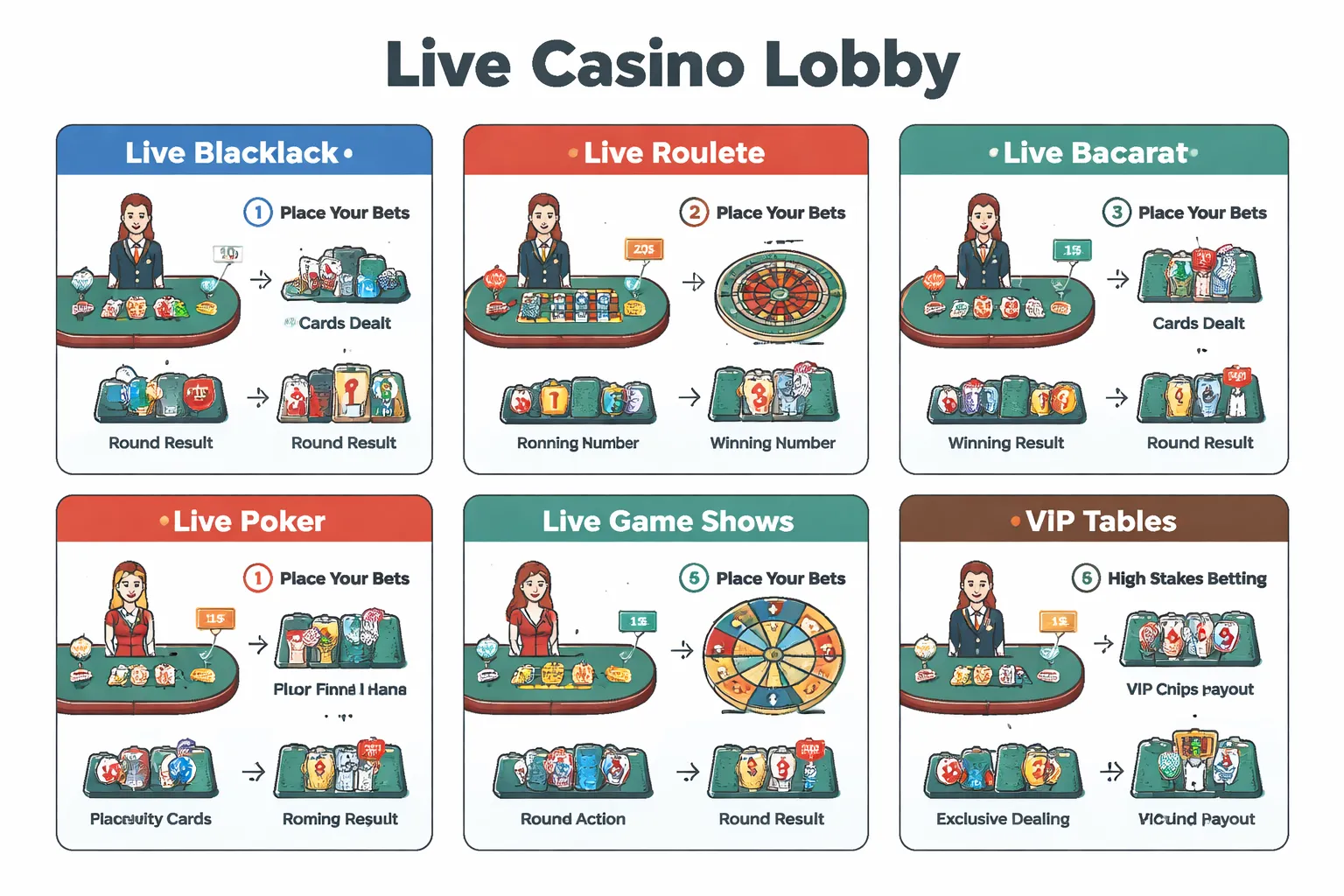
Live Blackjack: hand flow, decisions, and typical table rules
Live blackjack runs in a fixed loop. Betting time opens, you place chips, the dealer deals, you act, the dealer finishes, the round settles.
- Hand flow: You bet during the timer. The dealer deals two cards to each seat, then takes two cards. One dealer card shows.
- Your decisions: You hit, stand, double, split, or take insurance if offered. Some tables also allow surrender.
- Decision timing: You must act before your countdown ends. If you time out, the game usually auto-stands. Some tables auto-hit on low totals. Check the table help panel.
- Typical rules you should confirm: Dealer stands or hits on soft 17, blackjack pays 3:2 or 6:5, double rules (any two cards or 9 to 11 only), double after split allowed or not, resplit limits, surrender available or not.
If you want the full rule set and odds details, use this online blackjack guide.
Live Roulette: European vs American wheels and racetrack betting
Live roulette centers on one decision, which numbers and bet types you cover before the timer locks.
- European wheel: 37 pockets, numbers 0 to 36. One zero reduces the house edge versus American.
- American wheel: 38 pockets, adds 00. The extra pocket increases the house edge on most bets.
- Betting flow: You place inside bets on the grid (straight, split, street, corner, six line). You place outside bets on sections (red or black, odd or even, low or high, dozens, columns).
- Racetrack betting: You select number groups instead of clicking single squares. Common presets include neighbors of a number, tiers, orphelins, and sometimes jeu zero. The game places the chip pattern for you.
- Speed and locking: The table closes betting before the spin result. Place bets early, then stop dragging chips once the lock feels close.
Live Baccarat: banker, player, tie mechanics and commission basics
Live baccarat plays fast because most of the round follows fixed drawing rules.
- Core bets: You bet on Player, Banker, or Tie. You do not decide hits or stands.
- Hand values: Card totals use 0 to 9. Tens and face cards count as 0. Only the last digit matters.
- Drawing: The game may draw a third card based on standard rules. You just watch the sequence.
- Commission basics: Banker often pays 0.95 to 1 because the casino takes a 5% commission. Some tables use no-commission variants with different payout rules on certain banker wins.
- Side bets: Player Pair, Banker Pair, and Perfect Pair are common. They pay more, but they add volatility and usually a higher house edge.
Live Poker formats: Casino Hold’em, Three Card Poker, and variants
Live poker table games use house rules and fixed payouts. You play against the paytable or the dealer, not against other players.
- Casino Hold’em: You get two cards. The dealer deals five community cards. You choose fold or call after the flop. If you call, the hand compares against the dealer hand, usually with a dealer qualification rule. Some tables offer an optional AA side bet.
- Three Card Poker: You get three cards. You place an ante, then decide fold or play. The dealer shows three cards. The dealer must qualify, often with queen high or better. You can also place Pair Plus, which pays based on your hand strength, regardless of the dealer.
- Common variants: Ultimate Texas Hold’em, Caribbean Stud, and Let It Ride appear often. Each adds extra betting rounds or side bets. Read the help panel before you post chips, the betting order matters.
Live game shows: Monopoly-style titles, multipliers, and volatility
Live game shows blend simple bets with bonus rounds and large multipliers. You should treat them as high swing games.
- How they play: You bet during a timer. The host triggers a wheel, cards, or a number draw. Some outcomes pay fixed odds. Others trigger bonus features.
- Multipliers: Many titles add random multipliers to specific outcomes. Your payout equals stake times odds times multiplier when it hits.
- Bonus rounds: Monopoly-style games often send you to a board feature, where extra rolls or picks can stack wins. These rounds drive the biggest payouts and the biggest variance.
- Volatility: Expect long stretches of small wins or losses, with occasional spikes when a multiplier or bonus hits. Bet smaller per round if you want longer sessions.
VIP and high-limit tables: what changes besides the stakes
High-limit live tables usually change more than the minimum bet.
- Limits and bet sizing: Higher minimums and higher maximums. Side bet caps can rise too.
- Rules and payouts: You may see better blackjack payouts and more favorable rule sets. Roulette may offer higher maximums on outside bets and straight-up numbers.
- Speed and service: Some VIP tables run fewer seats, faster decisions, and more dealer interaction. Others run slower to support higher chip movement.
- Access: Casinos may require a certain deposit, loyalty tier, or invite. Some tables hide unless you log in.
- Streaming quality: VIP rooms often use multiple camera angles and clearer table views, which helps you confirm cards, chip placement, and results.
Rules That Matter Most (and How They Change Your Odds)
The biggest edges in live dealer games come from small rule changes. Learn the rules, then pick the table. You control that choice.
Blackjack rule checklist
Rule differences change the house edge. They also change what plays you should make. Check the table rules before you sit.
- S17 vs H17: S17 means the dealer stands on soft 17. H17 means the dealer hits soft 17. H17 usually adds about 0.2% to the house edge versus S17.
- Double rules: Best is double on any two cards. If the table limits doubles, your edge drops. Tight rules like double 9 to 11 only can cost roughly 0.1% to 0.3% versus double-any.
- Double after split (DAS): If you can double after you split, you get more value from strong split hands. No DAS often adds around 0.1% to the house edge.
- Splits: More re-splits help you. Re-splitting aces matters most. A common limit is split to 3 or 4 hands. Rules that block re-splitting aces can add about 0.05% to 0.1%.
- Hit or stand after splitting aces: Many tables give one card only to each split ace. If a table lets you hit split aces, it improves your odds.
- Late surrender: If offered, it can cut the house edge by about 0.05% to 0.1%. Use it when basic strategy says so. Do not improvise.
- Blackjack payout: 3:2 is the standard. Avoid 6:5. That single change can add about 1.4% to the house edge.
- Number of decks: Fewer decks help you, but rules matter more. An 8-deck game with strong rules can beat a 6-deck game with weak rules.
Roulette specifics, zeros decide your edge
In roulette, the wheel layout drives the math. More zeros mean a bigger house edge on most bets.
| Wheel type | Pockets | Typical house edge |
|---|---|---|
| European (single-zero) | 37 | 2.70% |
| American (double-zero) | 38 | 5.26% |
| Triple-zero | 39 | 7.69% |
- Single-zero: Your best default choice.
- Double-zero: Common in some live lobbies. You pay for the extra zero.
- Triple-zero: High edge. Skip it unless you accept the cost.
- Rule add-ons: Some tables use La Partage or En Prison on even-money bets. That can cut the effective edge on those bets. Read the table help panel, then confirm on the layout.
- Bet types: Inside and outside bets share the same house edge on the same wheel. Outside bets just reduce swing per spin.
If you want a deeper breakdown, use this roulette guide to compare wheels, bet types, and odds.
Baccarat nuances that change value
Baccarat looks simple, but the variant matters.
- Banker commission (standard baccarat): Banker usually pays 1:1 minus 5% commission. This keeps the game balanced. On many standard tables, Banker has the lowest house edge, often near 1.06%. Player usually sits around 1.24%.
- No-commission baccarat: Casinos remove the 5% fee but take value back through a rule. The most common rule is Banker wins on 6 pay 1:2. That pushes the Banker edge up, often close to Player, and can remove the usual advantage of betting Banker.
- Tie bet: High edge on most tables. It also spikes variance. Treat it as a cost, not a strategy.
- Side bets: Pairs and bonus bets often carry much higher house edges than Banker or Player. They can still be fun, but they change your bankroll curve fast.
Side bets, why they look good and what they do to your results
Side bets sell big payouts. They also raise the casino edge and increase variance.
- Payout rate is not the same as value: A 30:1 payout can still be a bad bet if the hit rate does not justify it.
- Higher edge compounds faster: If your main bet has a 1% to 3% edge against you, a side bet can jump to 5% to 25% depending on the game and paytable.
- Variance spikes: You will see longer losing streaks, then occasional large hits. That feels exciting, but it makes bankroll planning harder.
- Best practice: If you use side bets, cap them to a small fixed amount per round. Do not scale them up after losses.
Table limits and maximum payouts
Limits decide how you can use a strategy and how much risk you take.
- Minimum bet: Sets your cost per hour. A higher minimum forces you into bigger swings even if you play the same way.
- Maximum bet: Blocks recovery systems and streak chasing. If you try to raise bets after losses, you will hit the cap sooner than you think.
- Max payout: Some live tables cap winnings per hand or per round. This matters most for high-odds side bets and bonus bets.
- Blackjack bet limits interact with doubles and splits: A table can show a $10 to $500 limit, but splits and doubles can raise your total exposure to 2x, 4x, or more in one hand. Make sure your bankroll supports the worst case.
- VIP tables can change speed and risk: Faster rounds mean more decisions per hour. More decisions mean the house edge applies more times per session.
Fairness, Security, and Trust: How Live Casinos Are Regulated
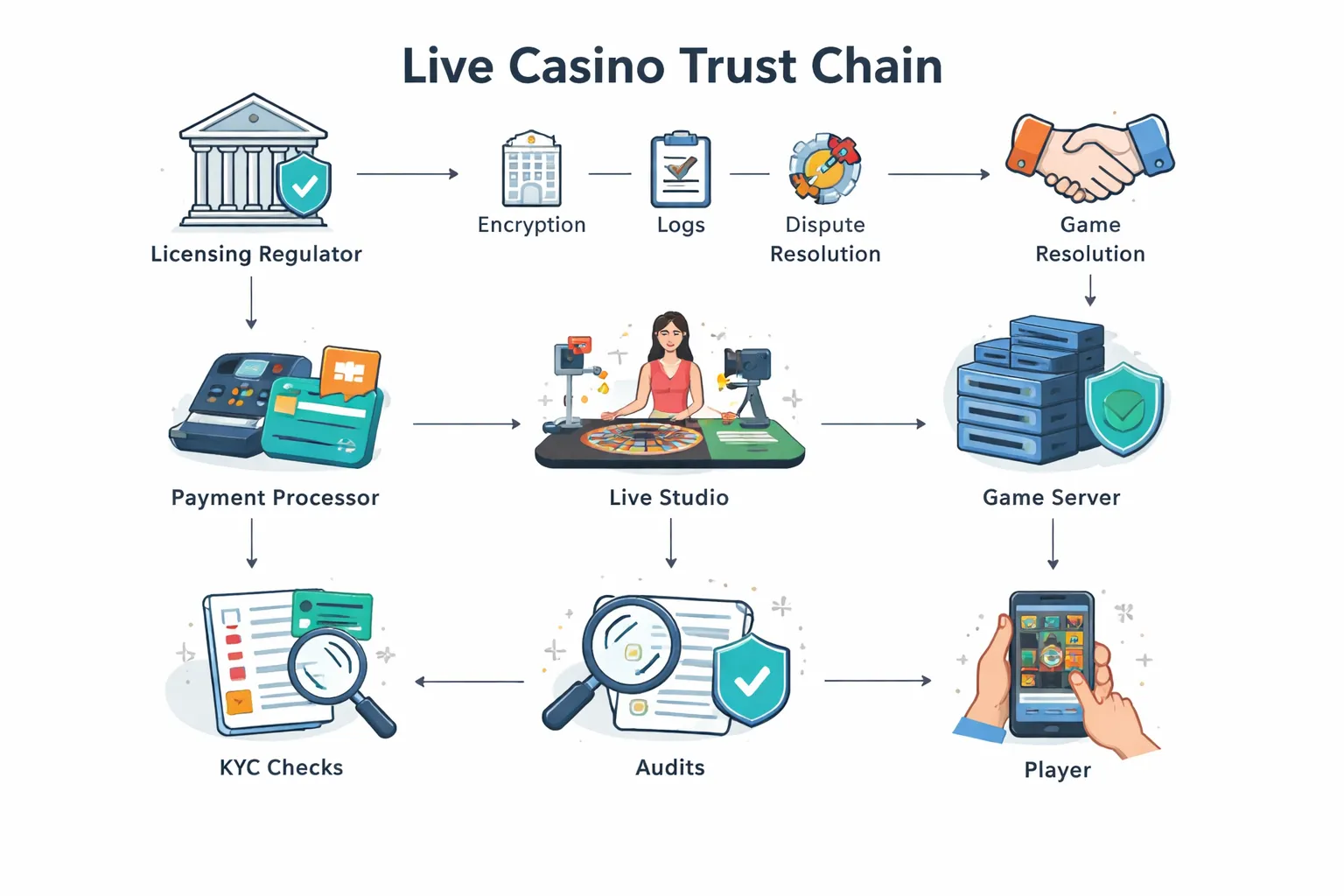
Licensing and oversight: what a reputable license should include
A live casino stands or falls on its license. A reputable license requires clear ownership, fit and proper checks on key staff, and strict rules for handling player funds.
- Public license details: You should find the operator name, license number, and regulator on the site footer. The details must match the regulator register.
- Approved game supply chain: The license should cover the operator and the live studio provider, or show that the provider operates under an accepted B2B license.
- Player fund rules: Look for terms like segregated funds, trust accounts, or protected balances. Exact wording varies by regulator, but you want a stated method.
- Complaint path: The license should require a formal complaints process and access to dispute resolution.
- Responsible gambling controls: The regulator should require deposit limits, loss limits, time-outs, and self-exclusion tools that work.
Game integrity measures: shuffling procedures, wheel inspections, and logs
Live games use physical equipment. Integrity depends on repeatable procedures and records you can audit.
- Card handling: Dealers follow set shuffle and cut procedures. Many tables use continuous shuffling machines for blackjack, which reduces card tracking and keeps pace consistent.
- Shoe and deck controls: Staff track decks in use, replace them on schedule, and log swaps. Cards get retired when wear shows.
- Roulette wheel checks: Teams inspect wheel level, rotor speed, freespin, ball condition, and pocket wear. They log maintenance and component changes.
- Round records: Systems store time stamps, bets, outcomes, and video references. This supports dispute reviews and pattern detection.
- Game rule display: The table must show rules that affect house edge, like European vs American roulette layout and blackjack rules. If you need a refresher on roulette bet rules and payouts, use this roulette rules guide.
Audits and testing labs: what gets tested in live environments
Live casino testing focuses on systems, not just outcomes. Labs and auditors check that the stream, game server, and settlement match the physical result.
- Bet acceptance and cutoffs: The system must lock bets at a defined time and apply the same cutoff to every player.
- Result capture: The platform must map the physical outcome to the digital result correctly, every time.
- Payout logic: Auditors verify payouts, void rules, and settlement timing for each bet type.
- Change control: Providers must document software updates, approvals, and rollback plans. Auditors check logs.
- Incident handling: Labs review procedures for camera loss, hardware faults, misdeals, and wheel issues. You want clear void and restart rules.
Fraud prevention and KYC: why identity checks happen (and when)
KYC exists to stop fraud, underage play, and money laundering. It also protects your withdrawals from account takeover.
- When checks happen: Expect KYC at signup in some regions, or before your first withdrawal, or when you hit set thresholds.
- What you provide: ID, proof of address, and sometimes payment method proof. Names must match your account and your payment method.
- Source of funds checks: You may need to show income or bank records if your deposits or withdrawals rise fast.
- Fraud signals: Multiple accounts, mismatched details, VPN abuse, or unusual payment patterns can trigger reviews and limits.
Data privacy and payment security: encryption, tokenization, and best practices
Security has two parts, data in transit and data at rest. Strong casinos reduce what they store and lock down what they must keep.
- Encryption: Your browser should use HTTPS on every page, including cashier and account areas.
- Tokenization: The best setups do not store your full card number. They store a token from a payment processor instead.
- Access controls: Staff access should follow least privilege. Sensitive actions should require approval and logging.
- Your best practices: Use a unique password, turn on two factor authentication if offered, and avoid public Wi-Fi for deposits and withdrawals.
Red flags to avoid: unlicensed sites, unclear rules, and broken responsible-gambling tools
- No verifiable license: Missing license number, regulator name, or a link that does not match the regulator register.
- Hidden rules: Rules that appear only after you deposit, or rules that change between the lobby and the table.
- Cashier friction with no reason: Repeated delays, vague requests, or new requirements added after you request a withdrawal.
- Weak responsible gambling controls: Limits that reset too fast, self-exclusion that does not block access, or tools that fail to apply across products.
- Unclear game provenance: No named live studio provider, no table rules, and no stated dispute process.
Bankroll Management and Responsible Play for Live Dealer Games
Setting a session budget
Set a session budget before you open the lobby. Treat it as spent money.
- Pick a fixed amount you can lose without impacting bills or savings.
- Split it into units based on your base bet. Keep 50 to 100 units for most live table games.
- Plan for table minimums. Live tables often start higher than RNG games. If the minimum forces you below 50 units, choose a lower-stakes table or skip the session.
- Separate your bankroll from your main balance. Move only the session amount into the casino wallet you will use.
Choosing stakes that fit volatility
Live dealer sessions can move fast. Your stake size decides how long you can stay in the game.
- Slow-drip sessions use small base bets, low-risk options, and high unit counts. This works well for blackjack and baccarat base bets.
- Swingy sessions come from higher variance bets, side bets, and roulette outside or inside bets. Expect deeper downswings and shorter sessions.
- Use a unit rule. Keep your base bet at 1 to 2 percent of your session bankroll. If you want more stability, drop to 0.5 to 1 percent.
- Watch side bets. Many side bets carry a higher house edge and higher variance. Cap side bets at 10 to 20 percent of your total action for the session.
If you play roulette, know the gap between European and American layouts, it changes your long-run cost. See European vs American roulette odds.
When to stop
Define stop rules that do not depend on how you feel.
- Loss limit: Stop at 30 to 50 percent of your session budget. If you hit it, end the session.
- Win goal: Take profit at 20 to 40 percent of your session budget. Do not raise the goal mid-session.
- Time limit: Set a hard stop, for example 45 to 90 minutes. Live games run slower per hand than RNG, so long sessions increase fatigue and errors.
- Table change limit: Allow one table switch. Repeated switching often follows losses and leads to stake creep.
Understanding bonuses and wagering
Read bonus terms before you opt in. Live dealer games often count at a lower rate toward wagering.
- Contribution rates vary. Slots may count 100 percent. Live blackjack, roulette, and baccarat may count 0 to 20 percent, sometimes excluded.
- Max bet rules matter. Many bonuses cap your stake per hand or spin. Live minimums can exceed the cap, which breaks the terms.
- Game weighting changes the real requirement. If your live table play contributes 10 percent, a 30x wagering requirement behaves like 300x on your live action.
- Time limits add pressure. Short bonus windows can push you into larger bets and longer sessions. Avoid bonuses that force volume.
| Term | What to check | Why it matters in live games |
|---|---|---|
| Contribution | Percent by game type | Low contribution makes clearing slow or unrealistic |
| Max bet | Allowed stake while bonus active | Live table minimums can exceed the cap |
| Excluded bets | Roulette inside bets, baccarat ties, side bets | Some common live bets may not count at all |
| Time limit | Days or hours to complete wagering | Live pace can make the target unreachable |
Responsible gambling features
Use built-in controls. Set them before you play. Keep them strict.
- Deposit limits: Set daily, weekly, or monthly caps. Choose an amount below your comfort level, not at it.
- Loss limits: If offered, set a hard loss ceiling. Match it to your session rule.
- Wager limits: Cap total stakes per day. This blocks long, slow bleed sessions.
- Reality checks: Turn on timed pop-ups that show session length and net result. Use them as a stop trigger.
- Cooling-off: Use short breaks when you feel stake creep starting.
- Self-exclusion: Use it when gambling stops being controlled. Pick a duration you cannot reverse quickly.
Live Casino Etiquette: Do’s, Don’ts, and Dealer Interaction
Chat etiquette: what dealers can respond to and what to avoid
Use chat to keep the table clear and moving. Dealers can answer game flow questions. They can confirm bet windows, limits, and basic rules shown on screen. They can repeat the last call and announce outcomes.
Dealers cannot change results. They cannot pause the game for you. They cannot give betting advice or tell you what to play. They cannot discuss other players’ balances or personal details.
- Do: Greet the dealer. Keep messages short. Ask one question at a time.
- Do: Use clear terms, like “What is the table minimum?” or “Is side bet open this round?”
- Don’t: Spam chat, all caps, or repeated complaints. It distracts the dealer and other players.
- Don’t: Share personal info, payment details, or account data in chat.
- Don’t: Ask the dealer to confirm “rigged” claims. Use support if you think something is wrong.
Table behavior: respecting pace, players, and game flow
Live tables run on a timer. You need to place bets before the betting window closes. If you miss it, wait for the next round. Do not ask the dealer to reopen bets.
- Do: Check limits before you join. Leave if the pace or stakes do not fit your plan.
- Do: Use auto-bet features carefully. Confirm amounts after reconnects or device swaps.
- Do: Keep side talk minimal. Other players need focus during short bet windows.
- Don’t: Slow the table with repeated rule debates. Read the in-game help panel, then ask one targeted question.
- Don’t: Blame other players for outcomes. Their bets do not change the math of roulette or baccarat.
If you play baccarat, learn the standard bet options and table labels first. Use this baccarat rules guide to avoid basic mistakes that waste betting time.
Tipping policies: where it exists, how it works, and expectations
Many live casinos allow tipping. Some do not. The option depends on the studio, the casino, and local rules. You will usually see a “Tip” button on the interface.
- How it works: Tips come from your balance. The system logs them as separate transactions.
- When it applies: After a hand, after a win, or at session end. Timing does not change outcomes.
- What to expect: Tips are optional. Dealers should not ask for them. You should not feel pressure to tip to get better results.
- What to check: Minimum tip size, currency, and whether the tip goes to the dealer or a pooled team.
Set a tip budget if you tip at all. Treat it like entertainment spend, not a strategy.
Handling disputes: screenshots, game IDs, and how to contact support
Handle disputes fast and with records. Most issues come from missed bet windows, connection drops, or misunderstanding a rule display.
- Capture proof: Take a screenshot of the table, your bet slip, and the result history. Include the time and round if shown.
- Save identifiers: Record the game ID, table name, round number, and session time. These let support pull the correct log and video.
- Check your history: Review transaction logs and bet history in your account before you file a claim.
- Contact support: Use live chat or email inside the casino app. Avoid public chat for disputes.
- Explain clearly: State what happened, what you expected, and what the interface showed. Attach screenshots.
Do not argue with the dealer. Dealers cannot adjust wagers, reverse outcomes, or credit funds. Support can verify the studio feed and the bet ledger.
Mobile and Technical Setup: Getting the Best Live Experience

Device requirements
Live casino runs a video stream plus a betting interface. Your device must handle both without stutter.
- Browser vs app: Apps usually load faster and manage audio better. Browsers work well on modern Chrome, Safari, or Edge. Update your browser or app before you play.
- CPU and RAM targets: Aim for a recent phone or laptop with at least 4 GB RAM. For smooth HD streams, 6 GB to 8 GB RAM helps. Older devices may overheat, drop frames, or desync audio.
- Storage and OS: Keep at least 1 GB free storage for caching and updates. Use a supported OS version so the stream codec and DRM work.
- Background load: Close other streaming apps, VPN video tunneling, and heavy tabs. They compete for CPU and bandwidth.
Internet speed and stability
Stability matters more than raw speed. Packet loss and Wi-Fi interference cause most buffering.
| Quality | Recommended download | Recommended upload | Target latency |
|---|---|---|---|
| SD | 3 Mbps | 1 Mbps | < 100 ms |
| HD | 6 to 10 Mbps | 2 Mbps | < 80 ms |
| Full HD | 12 to 20 Mbps | 3 Mbps | < 60 ms |
- Use 5 GHz Wi-Fi: It reduces interference and drops. Stay near the router.
- Switch networks before you join a table: Avoid changing Wi-Fi to mobile data mid-round.
- Reduce buffering: Lower stream quality in the player menu, then restart the stream. Disable other devices on your network that pull video.
- Avoid captive portals: Hotel and airport Wi-Fi can pause traffic for re-authentication.
Audio and video settings
Set your audio and display before you place real bets. Small settings issues can cost time during betting windows.
- Enable sound: Unmute the player and your device. On iOS, turn off Silent Mode. In browsers, allow autoplay and audio for the casino site.
- Full-screen mode: Use full-screen to avoid mis-taps near the edge of the betting grid. Lock screen rotation on mobile so the layout does not shift.
- Quality control: If the feed stutters, set the stream to SD. A stable SD stream beats a buffering HD stream.
- Accessibility: Increase font size in the game UI if the casino offers it. Use system zoom for chip values and timer visibility. Use captions if the studio provides them.
- Audio output: Use headphones in public spaces. They reduce echo and help you hear dealer calls and timer cues.
Troubleshooting common issues
- Stream lag: Drop to a lower quality, close background apps, then refresh the table. If you use mobile data, move to a stronger signal area.
- Audio out of sync: Pause the stream for 2 seconds, then resume. If it persists, reload the table.
- Frequent disconnections: Switch to a stable network, then rejoin. Turn off power saving modes that throttle network activity.
- Stuck bet or frozen interface: Do not place repeated taps. Take a screenshot with the round ID and time. Refresh once. Check your bet history to confirm whether the wager logged.
- Bet rejected: You likely hit the table limit, ran out of time, or lost connection. Add funds before you sit down, and place bets earlier in the countdown.
- Black screen: Update the app or browser, disable strict ad blockers for the game domain, then restart. Some streams require DRM support and will fail on outdated systems.
Playing on the go
- Data usage: SD often uses 0.7 to 1.0 GB per hour. HD often uses 1.5 to 3.0 GB per hour. Full HD can exceed 3.0 GB per hour. Track usage inside your phone settings.
- Wi-Fi safety: Avoid public Wi-Fi for real money play. If you must use it, use your mobile hotspot instead. Log out after each session.
- Battery: Live streams drain fast. Use low power mode only if it does not break the stream. Reduce screen brightness, close background apps, and keep a charger or power bank ready.
- Heat control: Heat causes throttling. Remove thick cases, avoid direct sunlight, and take breaks if the device gets hot.
How to Choose a Live Casino: A Practical Checklist
Game selection and providers, why studios matter
Start with the studios. They control stream quality, dealer training, table uptime, and game rules. Big providers tend to deliver steadier video, faster dealing, and better game logs. Smaller studios can still be good, but you need proof.
- Check provider names in the lobby. Look for multiple studios, not one white label feed.
- Test peak hours. Open tables at night and on weekends. Watch for freezes, audio drift, and reconnect loops.
- Check table uptime. If your favorite game shows long gaps or constant “maintenance,” skip it.
- Look for game history. You want clear hand history, results, and bet records for disputes.
Table rules, limits, and localization
Rules and limits decide your cost per hour and your edge. Do not assume two tables with the same name play the same way.
- Scan table limits. Find a minimum that matches your bankroll and a maximum that fits your target stakes.
- Verify rule details. In blackjack, check hit or stand on soft 17, double rules, split limits, and side bet paytables. In roulette, confirm single zero or double zero.
- Check bet timers. Short timers increase misclick risk. Longer timers help on mobile and slower connections.
- Use localized tables. Pick your language and table chat options. Confirm your currency and regional availability.
- Watch speed. Some “speed” tables raise decision pressure. Choose standard pace if you play longer sessions.
Payments and cashouts, fees, processing times, verification
Live casino play feels instant. Cashouts often do not. You need to know the friction points before you deposit.
- Match deposit and withdrawal methods. Many sites require you to withdraw to the same method you used to deposit.
- Check fees. Look for deposit fees, withdrawal fees, and currency conversion spreads. Spreads can cost more than flat fees.
- Read processing times by method. Cards and bank transfers often take longer than e-wallets. Crypto can be fast, but confirmations and network fees vary.
- Review withdrawal limits. Check minimum cashout, maximum per transaction, and maximum per day or week.
- Do KYC early. Upload ID and proof of address before you win. Expect requests for payment proof and a selfie in some cases.
- Check fraud triggers. VPN use, mismatched names, chargebacks, and multiple accounts can block withdrawals.
Customer support quality, how to test it
Support matters most when a stream drops mid hand, a bet misfires, or a withdrawal stalls. Test it before you deposit.
- Time the first reply. Use live chat if available. Measure how long you wait at a busy hour.
- Ask a specific question. Request the withdrawal processing time for your payment method and your country, plus fees and limits.
- Check if they cite policies. Good agents link you to terms, KYC steps, and timelines. Weak agents send generic lines.
- Confirm dispute flow. Ask how to escalate a live game issue and what proof they accept, such as game round ID.
- Look for 24 7 coverage. Live tables run late. Email only support slows fixes.
Promotions for live games, real value vs hype
Many bonuses exclude live dealer tables or cap your bet size. Your goal is to find promos you can actually use.
- Check eligibility. Confirm the bonus applies to live casino, not slots only. If you play slots too, use this guide on how to play online slots.
- Find wagering rules per game. Live blackjack and roulette often contribute less than slots, sometimes 0 to 20 percent.
- Check max bet limits. Many bonuses void if you exceed a stake cap during wagering.
- Watch for cashout caps. Some “free bet” deals limit how much you can withdraw.
- Compare to loyalty value. A steady cashback rate can beat a one time bonus with heavy wagering.
User experience signals, lobby navigation, filters, stability
Good UX reduces mistakes. It also helps you find the right table fast when limits change.
- Use filters. You want filters for provider, limits, language, game speed, and table features.
- Check table info layout. Limits, rules, and side bet paytables should show before you join.
- Test stability. Switch from Wi-Fi to mobile data and back. A solid platform reconnects cleanly and keeps the session stable.
- Check bet confirmation. You want clear chip placement, undo options before the timer ends, and readable totals.
- Review responsible tools. Deposit limits, loss limits, and session timers should sit in account settings, not hidden in help pages.
Pros and Cons of Live Dealer Games (Compared to Other Casino Formats)
Advantages: immersion, transparency, and social play
- More like a real table. You see a dealer, a wheel, and cards in real time. You make decisions on a timer, like in a casino.
- Clearer game flow. You can watch the shuffle, the deal, and the spin. That helps you trust the process, especially if you dislike black-box results.
- Human interaction. You can chat with the dealer and other players. This matters if you play for entertainment, not just volume.
- Table rules sit upfront. Live tables usually list limits and key rules on the screen. You can compare options fast, like roulette variants or blackjack side bets.
Drawbacks: slower pace, higher minimums, and connectivity dependence
- Slower hands and spins. A live dealer must deal, collect bets, and manage chat. You get fewer outcomes per hour than RNG games.
- Higher minimum bets. Many live tables start higher than RNG versions. That raises your hourly cost and your bankroll swings.
- Stream quality matters. Lag, dropped frames, or audio glitches can break your focus. A disconnect can force auto-stand, missed bets, or a rushed rejoin.
- Less control over pace. You cannot speed up animations or skip downtime. Table limits can also change when seats fill.
Who live casino is best for: player profiles and goals
- You want a casino feel at home. Live dealer fits if atmosphere matters more than speed.
- You value visibility. If you prefer to see the physical action, live play can feel more transparent than pure software results.
- You play longer, lower-volume sessions. Live tables suit steady play where each decision feels important.
- You can handle higher minimums. Live works best when your bankroll supports table limits without forcing big bet jumps.
When RNG may be better: speed, low stakes, and solo play
- You want more rounds per hour. RNG blackjack and roulette run fast. That helps if you prefer quick sessions and rapid betting.
- You play low stakes. RNG tables often offer smaller minimums, which lets you test games without pressure.
- You need stable play on weak internet. RNG games tolerate poor connections better because they do not rely on live video.
- You care about math and settings. RNG formats often show RTP info and game rules in a clean menu. Use our guide to RNG, RTP, and house edge to compare games on numbers.
| Factor | Live Dealer | RNG Casino Games |
|---|---|---|
| Pace | Slower, fixed timers | Faster, instant outcomes |
| Minimum bets | Often higher | Often lower |
| Transparency feel | You see cards and wheel on stream | You rely on software and published rules |
| Social play | Dealer chat and table chat | Usually solo |
| Connection needs | High, video stream must stay stable | Lower, light data use |
FAQ
What is a live casino game?
A live casino game streams a real dealer from a studio or casino floor. You place bets in an online interface while the dealer runs the game on camera. Results come from real cards, wheels, or dice, then the system settles your bet.
How do live dealer games decide the outcome?
The dealer deals, spins, or rolls on camera. Game servers capture the result from the physical equipment. Most providers use sensors like RFID in cards and optical wheel tracking in roulette. The system then pays out based on posted rules.
Do you need a fast internet connection?
You need a stable connection more than a fast one. Video must stay steady to avoid freezes. If your stream drops, the game usually keeps running. Your bet still stands if the betting timer closed before the disconnect.
Can you chat with the dealer and other players?
Yes. Most tables offer dealer chat and a table chat feed. Use it for simple requests, like slow down or confirm last result. Dealers follow studio rules, so they may ignore offensive messages or repeated demands.
What happens if your video freezes during a round?
Your wager stays active if you placed it before the timer ended. The server records the result even if your screen lags. Refresh the table or rejoin. Check the game history to confirm the outcome and settlement.
Are live casino games fair?
Fairness comes from two layers. You see the physical action on stream, and the provider logs results on the backend. Look for licensed operators, audited game providers, and visible game history. Avoid unlicensed sites with no stated regulator.
Are the odds different from RNG table games?
Core house edges stay close to standard rules, but they depend on table settings. Side bets and game show titles often carry higher house edge. Always read the paytable. For roulette specifics, use our roulette odds guide.
Why are minimum bets higher at live tables?
Live tables cost more to run. Studios pay dealers, camera crews, and equipment costs. Limits also help manage table traffic. Some providers offer low-limit tables, but peak hours often push minimums up.
Can you use bonuses on live dealer games?
Sometimes, but often with restrictions. Live games may contribute less to wagering requirements, or they may exclude certain tables. Check the bonus terms for contribution rates, max bet rules, and excluded games before you play.
How do withdrawals work for live casino winnings?
Withdrawals work the same as other online casino games. You cash out from your wallet balance. Expect KYC checks, like ID and proof of address. Some payment methods process in minutes, others take days. Fees depend on the operator.
Conclusion
Live dealer games give you real tables, real dealers, and clear rules, streamed to your screen. Your results still follow the same math as any casino game. The edge does not change because the dealer is live.
Pick a licensed casino, then pick one game and learn it. Read the key numbers before you bet, RTP, table limits, and side bet odds. Keep your session simple, and track your spend in units, not cash.
- Start low. Use the minimum bet until you understand the pace and the interface.
- Control variance. Skip side bets if you want steadier results, they usually carry a higher house edge.
- Reduce withdrawal delays. Complete KYC before you deposit, and use a payment method you can verify.
- Protect your bonus value. Follow max bet rules and check whether live tables count toward wagering.
Final tip, set a hard stop loss and a hard cash out point before you join a table, and stick to them. If you want a rules refresher for a common live game, use this guide to online roulette rules and bets.
-
Online Casino Fairness Explained: RNG, RTP, House Edge & Provably Fair
8 months ago -
Slot RTP Explained: What RTP Means and How to Use It
8 months ago -
How to Play Online Slots: Rules, Features & Beginner Tips
8 months ago -
How Slot Jackpots Work: Progressive Jackpots Explained
8 months ago -
How to Play Online Blackjack: Rules, Payouts & Quick Start Guide
8 months ago
-
- Video streaming basics: cameras, angles, and real-time broadcast
- Game Control Unit (GCU): how physical results become digital outcomes
- Betting interface walkthrough: chips, side bets, and UI essentials
- Round timeline explained: open bets, close bets, deal or spin, results
- Payout settlement: how wins are calculated and credited
- Latency and synchronization: why you might see delays and how to handle them
-
- Live Blackjack: hand flow, decisions, and typical table rules
- Live Roulette: European vs American wheels and racetrack betting
- Live Baccarat: banker, player, tie mechanics and commission basics
- Live Poker formats: Casino Hold’em, Three Card Poker, and variants
- Live game shows: Monopoly-style titles, multipliers, and volatility
- VIP and high-limit tables: what changes besides the stakes
-
- Licensing and oversight: what a reputable license should include
- Game integrity measures: shuffling procedures, wheel inspections, and logs
- Audits and testing labs: what gets tested in live environments
- Fraud prevention and KYC: why identity checks happen (and when)
- Data privacy and payment security: encryption, tokenization, and best practices
- Red flags to avoid: unlicensed sites, unclear rules, and broken responsible-gambling tools
-
- What is a live casino game?
- How do live dealer games decide the outcome?
- Do you need a fast internet connection?
- Can you chat with the dealer and other players?
- What happens if your video freezes during a round?
- Are live casino games fair?
- Are the odds different from RNG table games?
- Why are minimum bets higher at live tables?
- Can you use bonuses on live dealer games?
- How do withdrawals work for live casino winnings?
-
-
- Video streaming basics: cameras, angles, and real-time broadcast
- Game Control Unit (GCU): how physical results become digital outcomes
- Betting interface walkthrough: chips, side bets, and UI essentials
- Round timeline explained: open bets, close bets, deal or spin, results
- Payout settlement: how wins are calculated and credited
- Latency and synchronization: why you might see delays and how to handle them
-
- Live Blackjack: hand flow, decisions, and typical table rules
- Live Roulette: European vs American wheels and racetrack betting
- Live Baccarat: banker, player, tie mechanics and commission basics
- Live Poker formats: Casino Hold’em, Three Card Poker, and variants
- Live game shows: Monopoly-style titles, multipliers, and volatility
- VIP and high-limit tables: what changes besides the stakes
-
- Licensing and oversight: what a reputable license should include
- Game integrity measures: shuffling procedures, wheel inspections, and logs
- Audits and testing labs: what gets tested in live environments
- Fraud prevention and KYC: why identity checks happen (and when)
- Data privacy and payment security: encryption, tokenization, and best practices
- Red flags to avoid: unlicensed sites, unclear rules, and broken responsible-gambling tools
-
- What is a live casino game?
- How do live dealer games decide the outcome?
- Do you need a fast internet connection?
- Can you chat with the dealer and other players?
- What happens if your video freezes during a round?
- Are live casino games fair?
- Are the odds different from RNG table games?
- Why are minimum bets higher at live tables?
- Can you use bonuses on live dealer games?
- How do withdrawals work for live casino winnings?
-
-
Reload Bonus Explained: What It Is and When It’s Worth Claiming
6 months ago -
Online Casino Licensing Explained: Authorities, Licenses & How to Check One
8 months ago -
Best Live Dealer Casinos: Where to Play Live Blackjack, Roulette & More
8 months ago -
Best Online Casinos for High Rollers: VIP Perks, High Limits & Exclusive Bonuses
8 months ago -
Fast Payout Online Casinos: Best Sites for Quick Withdrawals
8 months ago
-
Online Casino Customer Support: What to Look For (Live Chat, Email, Response Times)
8 months ago -
Sign Up for an Online Casino: Create an Account in Minutes
8 months ago -
Online Casino Payment Safety Tips: How to Deposit and Withdraw Securely
8 months ago -
What to Do If an Online Casino Won’t Pay Out: Step-by-Step Actions
8 months ago -
How to File a Complaint Against an Online Casino (Plus ADR Explained)
8 months ago