Online Casino Licensing Explained: Authorities, Licenses & How to Check One

An online casino license tells you who regulates the site and what rules it must follow. It affects game testing, payouts, player fund handling, identity checks, and dispute options. A logo in the footer means nothing unless you can verify it.
This guide breaks down the main licensing authorities, the most common license types, and what each one usually covers. You will learn how to check a license number, confirm it on the regulator’s register, and spot red flags like expired approvals or mismatched company names. You will also see what a license does not guarantee, so you can judge risk before you deposit. For player safety basics that sit next to licensing, read our responsible gambling tools guide.
Key Takeaways
Key Takeaways
- In het kort: A license tells you who regulates the casino, what rules apply, and where you can verify it.
- Check the license number on the casino site, then confirm it on the regulator’s public register.
- Match the legal company name, domain, and address across the casino footer, the license certificate, and the regulator entry.
- Know the license scope. Some cover casino only, some cover sports betting, poker, or lotteries. Many do not cover every product.
- Watch for red flags. Expired status, “pending” claims, copied seals, missing register entry, or a different operator name.
- A license reduces risk, it does not remove it. You still need to check payouts, terms, complaint routes, and your own limits.
- Use player protection tools alongside licensing. Set limits early, or use self-exclusion if you need a hard stop.
Online casino licensing explained: what it is and why it exists
What online casino licensing is, and why it exists
An online casino license is a legal permission to offer gambling under a regulator’s rules. The regulator sets standards, audits compliance, and can sanction or shut down operators. Licensing exists to reduce fraud, reduce crime risk, and give you a route for complaints.
What a gambling license regulates
- Game fairness. Rules for RNG testing, game certification, and ongoing audits. You get a higher chance that results match the published math and game files.
- Security. Controls for data protection, account security, and system integrity. You get fewer weak points for theft and account takeover.
- AML and KYC. Checks on identity, source of funds, and suspicious activity reporting. You should expect verification before large withdrawals, and sometimes before you can play.
- Consumer protection. Rules for responsible gambling tools, marketing limits, complaints handling, and clear terms. Strong regulators also push for faster dispute handling and tighter bonus disclosure.
Licensing vs “legal in your country”
A license ties the casino to a specific jurisdiction. Your location is a separate issue. A casino can hold a valid license and still serve players where it should not. It can also block your country even with a strong license.
Your practical check is simple. Confirm the operator name on the license register, then confirm your country is accepted in the casino’s terms. If either fails, treat it as a risk.
What a licensed operator must prove
- Identity and ownership. Real company details, controllers, and key persons. Regulators check for criminal history and hidden ownership.
- Funding and solvency. Evidence the business can pay winnings and run operations. Some regulators require segregation of player funds or financial reporting.
- Competence. Fit and proper checks on directors and managers. You want people who can run compliance, payments, and player safety.
- Compliance systems. Written AML policies, KYC procedures, risk controls, record keeping, and incident reporting. Many regulators also require independent testing partners and approved game suppliers.
Common myths to ignore
- “All Curaçao casinos are identical.” They are not. Operators can differ on ownership, payments, policies, and enforcement history. You still need to verify the exact license holder and the current status.
- “A badge means you are safe.” A logo proves nothing. Only the regulator’s register matters. A real license lowers risk, it does not guarantee fair treatment or fast payouts.
- “Crypto casinos do not need licensing.” Crypto does not remove legal duties. If a site offers gambling, regulators can still require licensing, AML controls, and player protection.
Licensing helps, but your habits matter more. If you need a firm plan, use a budget you can keep, see our guide on how to set a gambling budget.
Key stakeholders in licensing: who licenses whom
Regulators and gambling commissions
Regulators set the rules. They also police them.
- Rule-making: They define what an operator must do. AML, KYC, age checks, game rules, bonus terms, complaints handling, responsible gambling tools, and reporting.
- Approval: They vet owners and key staff, review funding sources, and check business plans, policies, and technical systems.
- Ongoing enforcement: They audit, investigate complaints, demand data, and require fixes. They can fine, suspend, or revoke a license.
- Scope limits: A license often covers specific products and territories. A casino can hold a license and still block your country.
Operators vs white-label brands
Two names can appear on one casino. One runs the license. One runs the marketing.
- License holder: The entity that holds the B2C license. It carries the legal duty for player funds, AML, KYC, and dispute handling.
- White-label brand: The front-end brand you see. It may control the site design, offers, and support, but it may not hold the license.
- What to check: Match the company name and license number in the site footer to the regulator register. If the brand name differs, find the “operated by” or “licensed to” entity and verify that instead.
- Why it matters to you: If there is a payout dispute, the license holder sits on the hook. Complaints and regulator reports follow that legal entity, not the brand.
B2C vs B2B licensing
Some licenses cover selling gambling to players. Others cover supplying the tools and games.
- B2C license: Required for the casino or sportsbook that takes your bets and holds your balance.
- B2B license: Required for game studios, aggregator hubs, and platform providers in many jurisdictions. This covers the supply chain behind the casino.
- What this changes for you: A licensed operator can still offer unlicensed games in some markets if rules allow. Strong regimes push both sides to license, so fewer weak links sit behind the lobby.
| Stakeholder | Typical license | Your direct counterparty |
|---|---|---|
| Casino brand (website) | B2C | Yes |
| White-label brand | Sometimes none | Often yes, but the liability sits elsewhere |
| Platform provider | B2B | No |
| Game studio | B2B | No |
Testing labs and certification bodies
Regulators often rely on labs to test systems and games.
- RNG testing: Labs verify that random number generators meet statistical standards and match the published game logic.
- Game and RTP checks: Labs confirm return-to-player settings and that game math matches the approved version.
- Platform security: Some tests cover account security, data protection, and change control. This reduces stealth updates that alter game behavior.
- Your practical takeaway: Look for lab certificates and approved game lists, but treat badges as evidence only when you can trace them to the lab or regulator site.
Banks, payment providers, and app stores as gatekeepers
Even with a license, a casino needs access to payments and distribution.
- Banks and card networks: They decide whether gambling transactions clear. They can block merchants, countries, or specific business models.
- Payment processors and e-wallets: They run their own compliance checks. They may demand proof of licensing, AML controls, and chargeback ratios.
- Crypto on-ramps: Many require KYC and may freeze flows tied to unlicensed gambling. This can delay withdrawals even when the casino pays.
- App stores: They enforce gambling app rules by country. They can remove apps that lack the right licenses or use banned payment flows.
If a casino struggles with payments, support quality often drops fast. Use your first contact as a filter and see our guide on online casino customer support.
Types of online gambling licenses you’ll see on casino websites
Full remote casino licenses vs sportsbook vs poker vs bingo
Licenses often cover specific gambling products. A casino site can look complete while its license only covers part of what it offers. Match the license scope to the games you play.
- Remote casino, Slots, RNG table games, live dealer casino. Look for wording like “casino”, “remote gaming”, or “games of chance”.
- Sportsbook, Fixed odds betting, in-play betting, sometimes exchange betting. A casino license does not always cover sports betting.
- Poker, Peer-to-peer poker has extra rules in some markets. A sportsbook or casino approval may not include poker.
- Bingo, Often licensed separately. Some regulators treat bingo as its own product line.
If a site offers multiple products, you may see multiple license references. That is normal. Missing product coverage is not.
Single-brand licenses vs multi-brand and white-label permissions
Some licenses cover one brand. Others allow a group to run several brands under one approval, or to host third-party brands.
- Single-brand, One operator name, one brand, one domain list. Easier to verify.
- Multi-brand, One licensed operator runs several front-end brands. The license page may list “trading names” or “websites”.
- White-label, A third-party brand uses a platform operated by a licensed company. You often see “operated under license by” language in the footer.
Your check is simple. The brand you use, the domain you use, and the legal entity on the license must connect on the regulator register.
Local market licenses vs international and offshore permissions
Jurisdictions split into local market regulation and international licensing. The difference matters for player protections, complaints, and tax rules.
- Local market licenses, Issued for a specific country or state. These usually require local rules on game approval, safer gambling tools, and dispute handling.
- International licenses, Issued for serving multiple countries from one hub. Protection levels vary by regulator and by operator.
- Offshore permissions, Some sites rely on licenses from jurisdictions that do not actively supervise where the operator markets. You may have fewer practical options if a dispute escalates.
If your region has its own regulated market, treat a global offshore license as irrelevant for that local site.
Temporary, probationary, or limited licenses
Some regulators issue licenses with conditions. You will not always see the detail in a casino footer, but you can often see it on the regulator register.
- Limited product scope, Casino allowed, but no live dealer, no poker network, or no bonus offers.
- Limited markets, Allowed to serve certain territories only, or blocked from others.
- Operational limits, Player caps, deposit caps, or restricted payment methods while the operator proves controls.
- Time limits, A temporary license with a renewal date and milestones.
- Enhanced monitoring, Extra reporting, independent audits, or strict AML conditions.
If you see “temporary” or “provisional” on the register, expect tighter limits and faster enforcement action if the operator breaches conditions.
How sublicenses and master licenses work, and why verification is essential
Some brands do not hold a direct license. They operate under a master license holder, a platform provider, or a licensed partner. This structure can be legitimate, but you must verify it.
- Master license holder, The entity with the primary approval. It may run multiple skins or partner brands.
- Sublicense or skin, The front-end brand that markets to you. It may appear in the footer but not as the main licensee.
- Platform operated, The licensed firm provides games, payments, and compliance. The brand handles marketing and support.
Do not rely on a footer claim alone. Check that the regulator register lists the master license holder, and that your brand or domain appears as an approved website or trading name. If it does not, treat the “license” as unverified.
Licensing does not manage your bankroll. Use hard limits that you set yourself. Read our responsible gambling tools guide for deposit limits and self-exclusion options.
What a license typically requires: compliance pillars explained
A real license comes with ongoing obligations. The regulator sets the rules, checks your operator, and can fine or suspend them. Most requirements fall into a few compliance pillars.
KYC and age verification
KYC means Know Your Customer. You see it as ID checks. The goal is simple, stop underage play and stop identity fraud.
- What you may need to provide: government ID, selfie or liveness check, proof of address, sometimes payment method proof.
- When checks happen: at sign-up, before your first withdrawal, when you hit deposit or loss thresholds, or when the casino flags risk signals.
- Why casinos ask again: your details change, documents expire, or the operator must refresh checks under its risk policy.
AML and CTF controls
AML means Anti Money Laundering. CTF means Counter Terrorist Financing. Licensed casinos must detect and report suspicious activity. That drives many account restrictions.
- Source of funds checks: you may need to show payslips, bank statements, or proof of savings after large deposits or unusual payment patterns.
- Ongoing monitoring: operators track deposits, withdrawals, velocity, multiple accounts, linked devices, and unusual game play tied to cashout behavior.
- Reporting obligations: casinos file suspicious activity reports with the relevant authority, they usually cannot tell you when they do.
- Sanctions screening: operators screen names and payment details against sanctions and politically exposed person lists.
Responsible gambling obligations
Licensing pushes operators to give you control tools and safer defaults. Strong regulators also test whether the operator uses them in practice.
- Limits: deposit, loss, wager, and session limits. Some jurisdictions require cooling-off periods before limit increases take effect.
- Self-exclusion: time-out options and longer exclusions. Better systems block marketing during exclusion and enforce network wide bans where required.
- Reality checks: session popups that show time spent and net position, plus prompts after long sessions.
- Interaction rules: trained staff, safer gambling messaging, and intervention when play shows risk markers.
Game integrity and RTP transparency
Licensing aims to keep games fair and outcomes unpredictable. It also sets rules for how casinos present payout information.
- RNG testing: labs test random number generators and game math so results do not get manipulated.
- RTP disclosure: many regulators require clear RTP presentation, at game level, or via help pages and game info panels.
- Audit cadence: testing can happen at launch, after major game updates, and on a recurring schedule set by the regulator or the lab standard.
- Change control: operators must track game versions and approvals. Unapproved swaps can trigger enforcement.
Data protection and cybersecurity expectations
Licensed casinos handle sensitive data. Regulators expect basic security controls and proof that the operator can respond fast when things go wrong.
- Encryption: TLS for data in transit, strong hashing for passwords, and protection for stored personal data.
- Access controls: least privilege, staff account logging, and separation of duties for payments and player data.
- Incident response: a written plan, breach triage, customer notifications where required, and regulator reporting within set timeframes.
- Vendor oversight: payment processors, game providers, and KYC vendors must meet security standards under contract.
Advertising and affiliate compliance rules
Licensing also covers how the casino markets to you. This includes bonuses, email, push notifications, and affiliate sites.
- Bonus terms: clear wagering requirements, time limits, max cashout rules, and restricted games, shown before you opt in.
- No underage targeting: age gating, audience controls, and restrictions on youth appealing creatives.
- Affiliate accountability: the operator stays responsible for affiliates. A licensed brand should police misleading claims and fake “exclusive” offers.
- Disclosures: ads must show key conditions and avoid “risk free” language where regulators ban it.
How to check if an online casino is licensed (step-by-step verification)
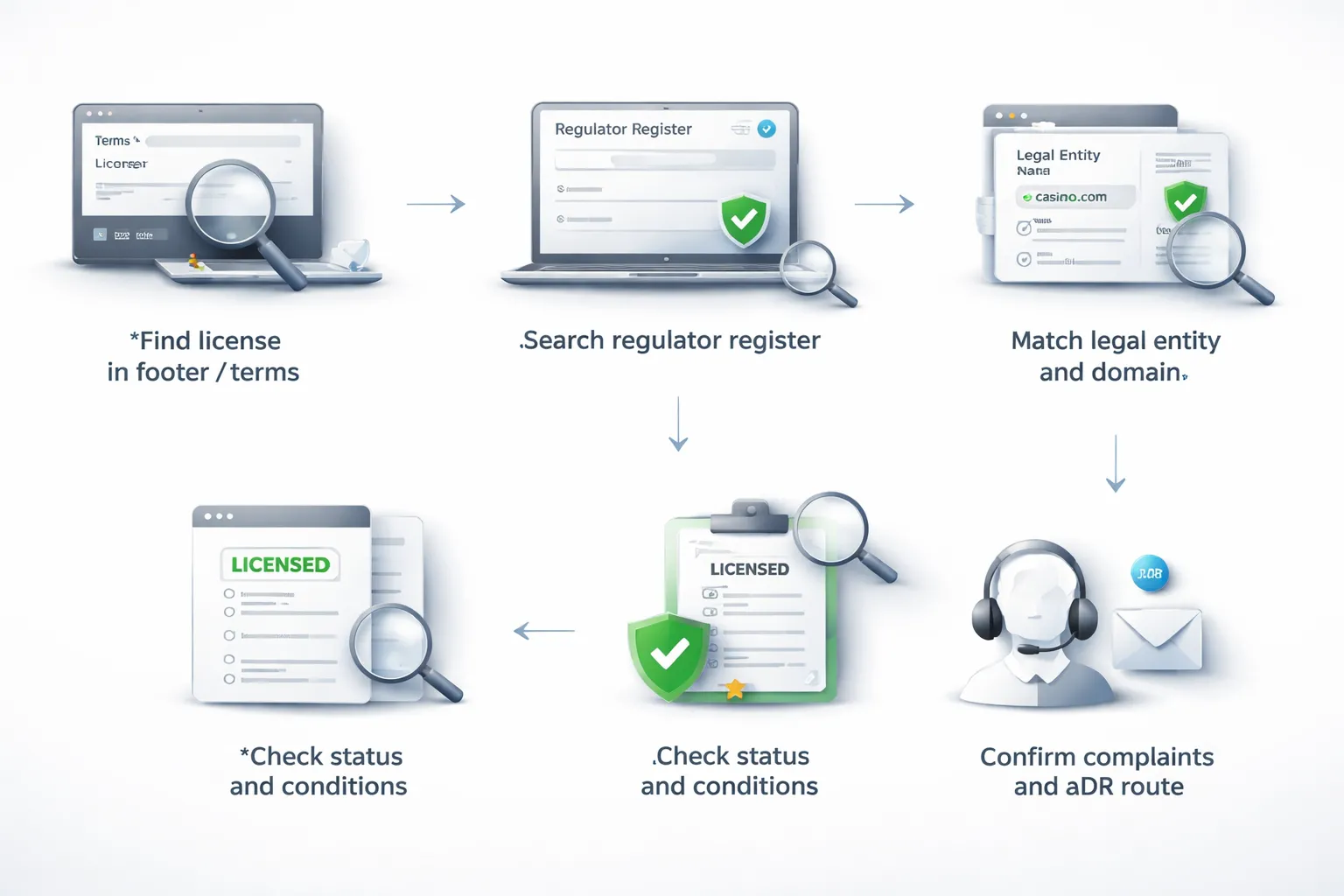
1) Locate the license details on the casino site
Start on the pages the operator controls. Do not trust ads, affiliate pages, or app store text.
- Footer: look for “Licensed and regulated by” plus a license number.
- Terms and Conditions: find the operator’s legal name, company number, and registered address.
- About: check the ownership statement and corporate group details.
- Responsible Gambling: look for regulator references, player protection tools, and help contacts.
Copy the license number and the full legal entity name. You need both for verification.
2) Match the legal entity to the license holder
Brands and domain names change. Licenses attach to legal entities.
- Match the company legal name on the site to the name shown on the regulator record.
- Check the registered address. Mismatches matter.
- Look for “operated by” language. Some sites show a brand, but a different company runs the gambling service.
- If the site lists multiple entities, identify which one holds the gambling license for your country.
If the casino only shows a logo badge with no entity name or license number, treat that as a red flag.
3) Use the regulator’s official register
Verify on the regulator site, not on the casino site.
- Go to the regulator named in the casino footer or terms.
- Open the licensee register or public register.
- Search by license number first. If that fails, search by legal entity name.
- Open the result and confirm the entity details match what you copied from the casino site.
If the regulator has no searchable register, you cannot independently confirm the claim. Use a different casino.
4) Confirm domain coverage and approved URLs
A license often applies only to specific domains. Clones and mirror sites are common.
- In the regulator record, find the website address, domain list, or approved URLs.
- Match the exact domain you use, including the top-level domain and spelling.
- Check if the regulator lists separate domains for different countries. Use the one that matches your location.
- If the casino pushes you to a different URL at checkout, re-check that domain in the register.
5) Check license status, conditions, and enforcement notes
A valid license must be active and in good standing.
- Confirm the status shows active or current.
- Avoid operators marked suspended, revoked, expired, or surrendered.
- Read the license conditions. Some licenses restrict products, territories, or payment methods.
- Look for public warnings, penalties, or compliance actions tied to the entity or its domains.
If the operator claims one regulator, but the register shows a different one, trust the register.
6) Verify complaint routes and ADR options
Licensed operators must offer clear dispute paths. The regulator usually lists the correct route.
- Check the regulator record for complaints guidance and any required ADR, ombudsman, or mediation scheme.
- Confirm the casino lists the same dispute route in its terms or responsible gambling pages.
- Save the regulator complaint page link and the license record page for your records.
Before you deposit, also check whether the operator offers reachable help channels and clear escalation paths. Use this checklist alongside your review of online casino customer support.
Quick verification checklist
Red flags: signs a casino may be unlicensed, unsafe, or misleading
Fake badges, copied seals, or no link to the regulator’s domain
- License “badges” that do not click through to the regulator site.
- Badges that link to the casino’s own page, a PDF on its server, or a generic homepage.
- Regulator names shown as plain text with no verifiable reference.
- Seals that look official but appear on many unrelated sites with the same image file.
- Typos in the regulator name, country, or license type.
License number doesn’t match the operator, or is missing from the register
- No license number, only a claim like “licensed and regulated” in the footer.
- License number exists but the register shows a different legal entity name.
- Register entry shows a different brand list than the casino brand you use.
- Your exact domain does not appear on the regulator record.
- Register status shows lapsed, surrendered, suspended, or revoked.
- Casino shows a “pending” license as if it equals approval.
Unclear ownership and missing corporate details
- No legal entity name, or it changes across the footer, terms, and checkout pages.
- No physical address, or only a mailbox style address with no company identifiers.
- No company number, VAT number, or registration jurisdiction where one should exist.
- Support emails use free domains with no matching corporate contact details.
- Terms mention one company, payment pages show another, and the regulator record shows a third.
Terms that undermine withdrawals
- Bonus clauses that let the casino cancel winnings for broad reasons like “irregular play” with no definition.
- Rules that allow the casino to change wagering terms after you accept a bonus.
- Unlimited verification timelines, or repeated requests for the same documents.
- Withdrawal limits that appear only after you request a cashout.
- Policies that allow account closure while funds stay “under review.”
- Terms that block withdrawals until you complete extra deposits or “activity” goals.
Poor support and dispute handling
- No clear complaints process, only a generic contact form.
- No named ADR provider, or the ADR link does not work.
- No response times stated for support and complaints.
- Support refuses to give the licensed operator name or license number.
- Only one channel offered, with no ticket ID or written record.
- For support expectations, use this guide on online casino customer support.
Payment and banking red flags
- Untraceable payment methods pushed as the main option, with no clear processor details.
- Deposits route to unrelated merchants, personal names, or changing descriptors.
- Frequent changes to payment processors, especially around withdrawal requests.
- Extra “processing” fees added only at cashout stage.
- Withdrawals limited to methods you did not use for deposit, with no clear reason.
- Requests to move funds off-platform to “speed up” withdrawals.
Licensing vs. player safety: what a license can and cannot guarantee
What licensing typically improves
A real license sets basic rules. It gives you a regulator to point to when a casino breaks them.
- Game fairness oversight. Licensed casinos usually must use approved game providers, control game changes, and keep RNG and game settings under documented procedures. Some regulators require independent testing for key games.
- Complaints path. You often get a formal dispute process. The casino must answer within set timeframes and keep records that the regulator can review.
- Accountability. A license ties the casino to a legal entity. It must publish company details, follow AML and KYC rules, and accept audits or inspections. Regulators can fine, suspend, or revoke the license.
- Basic player controls. Many licensing regimes require deposit limits, timeouts, and self-exclusion tools, plus safer gambling messaging.
What licensing cannot guarantee
A license reduces risk. It does not remove it.
- No guarantee you will get paid fast. Regulators rarely promise a specific payout speed. A casino can still take days or weeks if its terms allow more checks.
- No protection from every dispute. If you accepted a vague bonus rule, the casino may enforce it. A regulator may treat it as a contract issue unless the term is clearly unfair or misleading.
- No prevention of problem gambling. Tools help, but you still make the bets. If you see early warning signs, use a plan and support. Read problem gambling signs.
- No guarantee against messy payment processing. A licensed casino can still use third-party processors. You can still see changing descriptors, extra cashout fees, or withdrawal routing rules. A regulator may act only if it sees a pattern or a clear breach.
- No promise of “safe” bonuses. A license does not stop high wagering requirements, max cashout limits, or short withdrawal windows.
Why two casinos with the same regulator can feel different
- Management choices. Some operators invest in risk teams and fast payouts. Others push delays to reduce fraud exposure or cash strain.
- Terms and rule design. One casino writes clear rules and enforces them evenly. Another uses broad clauses that let it deny withdrawals after the fact.
- Support quality. Response times, escalation, and record keeping vary. Weak support often turns small issues into long disputes.
- Payments setup. Processor quality and banking access differ. The same license does not mean the same withdrawal rails.
Extra checks beyond licensing
Use licensing as a starting filter. Then verify behavior.
- Reputation and complaint patterns. Look for repeated reports about stalled withdrawals, KYC loops, or bonus traps. One-off complaints happen. Consistent patterns matter.
- Payout speed signals. Check if the casino publishes expected withdrawal times by method, and whether players report it matches reality.
- Ownership history. Find the operator name and search it, not just the brand. Rebrands happen. Past sanctions and closed sites matter.
- Audit and testing proof. Look for named testing labs, dated certificates, and clear scope. “Tested” without details means little.
- Terms that affect cashouts. Scan for withdrawal limits, fees, verification triggers, bonus max cashout, and “irregular play” clauses.
- Support responsiveness. Test live chat and email before you deposit. Save transcripts and ticket numbers.
Country-by-country legality: how to know what applies to you
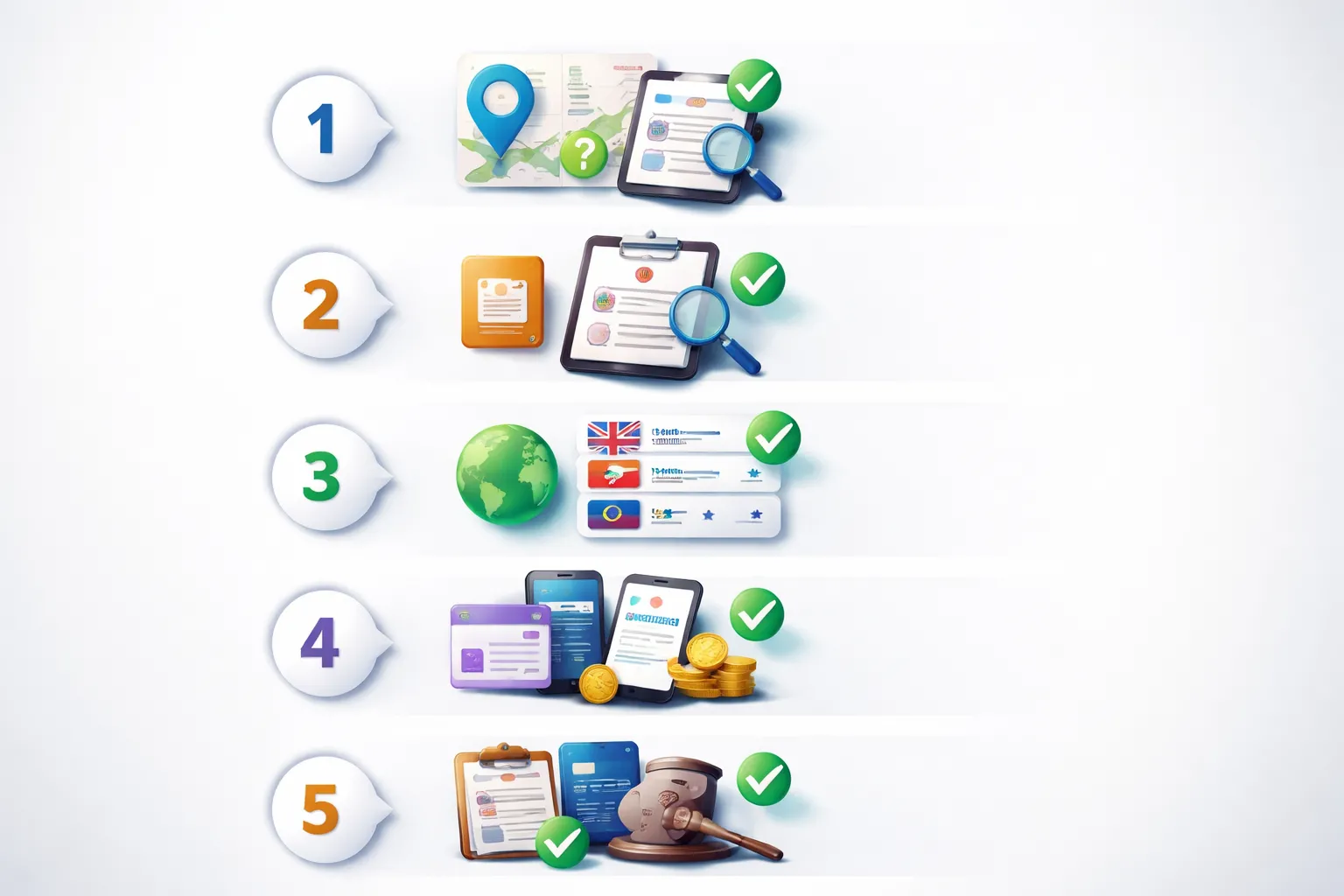
How geoblocking and regulated markets work
Online casino rules depend on where you are when you play. Regulators tie access to your location, not your passport.
In regulated markets, the operator needs a local license. The regulator sets game rules, ads rules, KYC rules, and dispute routes. The casino must follow them or lose access.
Geoblocking enforces those borders. Casinos block or allow traffic by IP location, GPS checks in mobile apps, SIM country, address checks, and payment screening. A site can still show up in search, but it can block registration, deposits, or withdrawals once it detects your location.
- Local licensing requirement. Some countries require a domestic license to offer real money play. A foreign license does not qualify.
- Ring-fenced player pools. Some regulators require local servers, local payment rails, local game catalogs, and local responsible gambling tools.
- Different rules for casino vs sports. Your country may allow one and restrict the other. Do not assume both share the same status.
‘Licensed somewhere’ vs ‘licensed to serve you’
A license is not universal. A license only has force where the regulator has power, and where the operator has permission to target players.
- Licensed somewhere. The operator holds a license in at least one jurisdiction. That can still leave you outside its allowed market.
- Licensed to serve you. The operator holds the license your location requires, and it lists your country as an approved market or does not list it as prohibited.
- White-label setups. The brand name can differ from the licensed entity. Match the legal entity on the site footer to the entity on the regulator register.
- Game suppliers matter. A casino can hold a license, but specific games can lack approval in your market. That affects voids, removals, and payouts.
Practical check. Open the regulator register, search the legal entity, then confirm the domain name, the brand, and your country eligibility in the license details or approved markets list.
Tax, payment, and consumer-rights implications for players
Your legal status affects more than access. It changes your money flow, your tax position, and your leverage in disputes.
- Tax. Some countries tax player winnings. Some do not. Some tax only gambling income above thresholds. Track deposits, withdrawals, and net results. Keep statements and game history exports.
- Payments. Banks and card networks often block gambling codes in restricted markets. E-wallets can follow local rules even when the casino does not. Expect declines, freezes, or enhanced checks.
- Chargebacks and reversals. When you play in a market your bank flags as prohibited, you can face account reviews or blocked disputes. Card chargebacks rarely solve casino disputes and can trigger account closure at the casino.
- Consumer rights. In a locally regulated market, you can complain to the regulator or an approved ADR body. In an offshore market, you usually rely on the operator, its chosen ADR, or the license holder’s process.
- Data and KYC. Stronger markets set strict timelines and standards for verification. Offshore sites may demand extra documents later, often right before withdrawal.
If support refuses clear answers on eligibility, licensing entity, or withdrawal terms, treat it as a warning sign. Use your pre-deposit support test and save proof. See online casino customer support checks.
If your country has no clear framework, use a risk-based checklist
Some places sit in a gray zone. You still need a decision process. Use this checklist before you deposit.
- Step 1, confirm your location rule. Check your national regulator site, finance ministry, or published guidance. Look for rules on remote gambling and payment blocking.
- Step 2, check the casino’s allowed countries list. Read Terms, then the restricted territories page. Screenshot it.
- Step 3, verify the license on the regulator register. Match legal entity, license number, and domain. If the domain is missing, assume higher risk.
- Step 4, test withdrawals before you scale. Deposit small, complete KYC early, then withdraw. Do not chase bonuses until you prove cashout speed.
- Step 5, reduce payment risk. Avoid methods that can trigger bank issues in your country. Prefer methods with clear transaction labeling and reliable support.
- Step 6, check dispute routes. Find the listed ADR, complaint steps, and timelines. If the operator gives no route, you have little leverage.
- Step 7, set loss controls now. Use deposit limits, timeouts, and self-exclusion where available. If the site offers none, treat it as higher risk.
- Step 8, walk away on red flags. No register match, vague terms, delayed KYC, unclear cashout limits, or “we decide” clauses on withdrawals.
Practical checklist: quick license verification in under 5 minutes
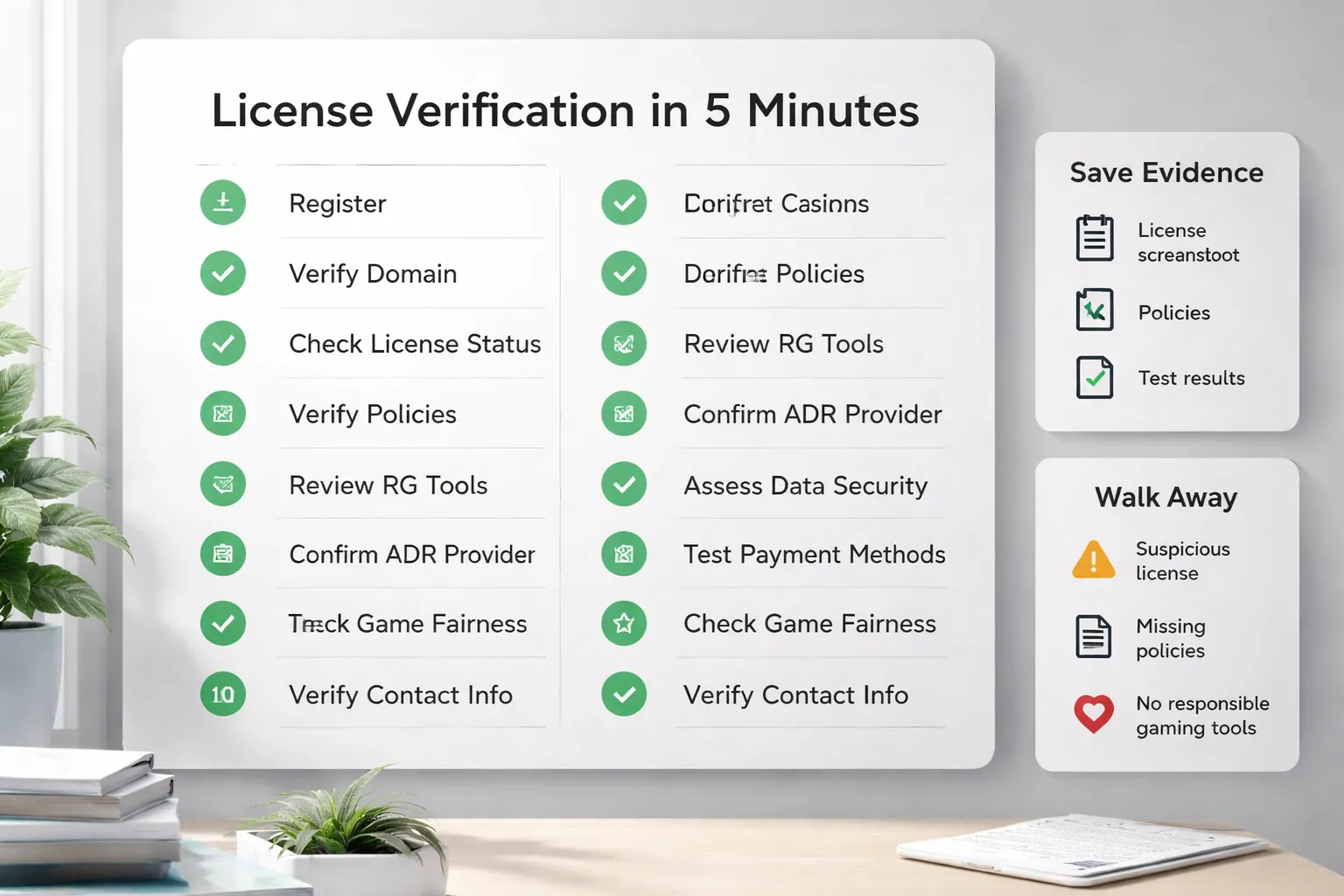
The 10-point checklist, quick license verification in under 5 minutes
- 1) Legal entity name. Find it in the footer, Terms, or About page. Copy it exactly. Watch for lookalike names.
- 2) License number. Get the full number or reference code. No number means no proof.
- 3) Regulator register match. Open the official regulator register. Search the entity name and license number. The register must confirm both.
- 4) Domain match. Check the register entry for approved domains. Your exact domain must appear. Subdomain tricks count as a mismatch.
- 5) License status. Confirm it shows “active”, “current”, or equivalent. Avoid “suspended”, “revoked”, “expired”, or “under review”.
- 6) Registered address. Compare the site’s address to the register. Mismatches, PO boxes only, or “virtual office” wording raise risk.
- 7) Key policies present. Find Terms, Privacy, KYC, AML, and Withdrawal policy. Look for clear timelines, fee rules, and document requirements.
- 8) Responsible gambling tools. Check for deposit limits, loss limits, time limits, cooling-off, and self-exclusion. If tools are missing or buried, treat it as higher risk. For a quick baseline, see responsible gambling tools.
- 9) ADR and complaints route. Confirm the operator lists the ADR provider or dispute body, plus steps and timelines. No route means weak leverage.
- 10) Basic security checks. Confirm HTTPS, a valid certificate, and consistent branding across login, cashier, and support pages. Avoid mixed domains at checkout.
Screenshots and record-keeping tips for disputes
Save proof before you deposit, and again before you withdraw. Keep it simple. Keep it dated.
- License claim. Screenshot the footer and the “Licensing” or “About” section showing the entity and license number.
- Register proof. Screenshot the regulator register entry with the entity, license number, status, and approved domains.
- Key terms. Save the Terms, Bonus terms, Withdrawal policy, and KYC policy. Download PDFs if available. If not, screenshot the sections on limits, fees, and timelines.
- Account details. Screenshot your profile page showing your country, currency, and verification status.
- Deposits and withdrawals. Screenshot the cashier pages showing amounts, timestamps, and transaction IDs.
- Game evidence. Screenshot the game history, bet history, and session logs if the site provides them.
- Support log. Export chat transcripts. Save emails. Screenshot ticket numbers and responses.
- Verification trail. Save the list of requested documents, upload confirmations, and any “pending” status screens.
- Promotions. Screenshot the promo page you used, plus the wagering status screen.
When to walk away immediately
- No regulator register entry for the entity or license number.
- Register entry exists, but your domain is missing or differs by one character.
- License status shows anything but active, including expired, suspended, revoked, or canceled.
- Entity mismatch. The site names one company, the register shows another, or the payment descriptor shows a third.
- No clear withdrawal rules, or terms that say the operator can void winnings “at our discretion”.
- Delayed or looping KYC after you request a withdrawal, with no fixed timeline.
- No ADR or complaint steps, or they hide them behind support that never answers.
- No responsible gambling controls, or self-exclusion does not cover the full account.
- Cashier redirects to unfamiliar domains or uses inconsistent branding during payment.
- Support refuses to confirm the legal entity, license number, or regulator link in writing.
FAQ
What is an online casino license?
A license is a legal permission to offer gambling to players in a defined market. It ties the casino to a named company, regulator rules, and oversight. A real license shows the license number, legal entity, jurisdiction, and a regulator link you can verify.
Who issues online casino licenses?
Government regulators and gaming commissions issue licenses. Some markets also allow state or provincial regulators. The regulator sets rules for AML, KYC, player funds, complaints, and responsible gambling. If no regulator name exists, treat the site as unlicensed.
What is the difference between B2C and B2B licenses?
B2C covers the casino that takes your bets and pays withdrawals. B2B covers suppliers like platform providers and game studios. A B2B license does not make the casino legal. You need the operator’s B2C license to protect your account.
How do you check if a casino license is real?
Find the license number and legal entity in the footer or terms. Open the regulator’s official register. Search the exact company name or license ID. Match the website domain listed on the register. Save screenshots of the register entry.
What details should match on a regulator register?
- Legal entity name and address.
- License number and status, active or suspended.
- Approved domains and brand names.
- License type, casino, sportsbook, or both.
- Effective dates and any sanctions.
Can a casino be legal without a license in your country?
Yes. A casino can hold an offshore license but still operate illegally where you live. You must check if the regulator covers your location and if the operator blocks restricted markets. Your bank and payment method can still refuse transactions.
What does a license usually cover, and what it does not?
It covers compliance checks, KYC, AML, game approval, reporting, and dispute steps. It does not guarantee you will win, or that every dispute ends in your favor. Enforcement strength varies by regulator and by your country.
Does a license guarantee fast withdrawals?
No. It can set rules for withdrawal processing and verification, but timelines differ. Check the casino’s withdrawal terms and the regulator’s guidance. If the casino gives no clear process, or changes it after you request a cashout, walk away.
What are red flags that the license claim is fake?
- No legal entity name, only a brand name.
- License number missing or does not match the regulator register.
- Regulator link goes to a non regulator domain.
- Domains differ during cashier or login flows.
- Support refuses to confirm the entity and license in writing.
What should you do if a licensed casino treats you unfairly?
Save evidence, terms, emails, and transaction IDs. Contact support and request a written decision. If unresolved, follow the regulator complaint route listed on the regulator site. Use the casino’s ADR process if the regulator requires it.
What responsible gambling tools should a licensed casino offer?
Expect deposit limits, loss limits, time limits, reality checks, and self-exclusion that blocks your full account. You should set controls before you play. Use responsible gambling tools to understand what each control does and how to apply it.
Conclusion
Conclusion
A license does not make a casino perfect, but it gives you a rulebook, an auditor, and a way to escalate disputes.
Before you deposit, run a quick check. Match the operator name, license number, and domain on the regulator’s register. Read the key terms that affect money, withdrawal limits, bonus rules, and dormant fees. Save screenshots.
Use responsible gambling tools from day one. Set deposit and time limits, and enable self-exclusion if you need a hard stop. If you want a deeper breakdown, see our responsible gambling tools guide.
Final tip. If the license details do not match the regulator listing, close the site and move on.
-
How to Set a Gambling Budget (That You’ll Actually Stick To)
6 months ago -
Online Casino Customer Support: What to Look For (Live Chat, Email, Response Times)
6 months ago -
Responsible Gambling Tools Explained: Deposit Limits, Self-Exclusion & More
6 months ago -
Online Casino Self-Exclusion: How It Works and What Happens Next
6 months ago -
Sign Up for an Online Casino: Create an Account in Minutes
6 months ago
-
- Full remote casino licenses vs sportsbook vs poker vs bingo
- Single-brand licenses vs multi-brand and white-label permissions
- Local market licenses vs international and offshore permissions
- Temporary, probationary, or limited licenses
- How sublicenses and master licenses work, and why verification is essential
-
- 1) Locate the license details on the casino site
- 2) Match the legal entity to the license holder
- 3) Use the regulator’s official register
- 4) Confirm domain coverage and approved URLs
- 5) Check license status, conditions, and enforcement notes
- 6) Verify complaint routes and ADR options
- Quick verification checklist
-
- What is an online casino license?
- Who issues online casino licenses?
- What is the difference between B2C and B2B licenses?
- How do you check if a casino license is real?
- What details should match on a regulator register?
- Can a casino be legal without a license in your country?
- What does a license usually cover, and what it does not?
- Does a license guarantee fast withdrawals?
- What are red flags that the license claim is fake?
- What should you do if a licensed casino treats you unfairly?
- What responsible gambling tools should a licensed casino offer?
-
- Full remote casino licenses vs sportsbook vs poker vs bingo
- Single-brand licenses vs multi-brand and white-label permissions
- Local market licenses vs international and offshore permissions
- Temporary, probationary, or limited licenses
- How sublicenses and master licenses work, and why verification is essential
-
- 1) Locate the license details on the casino site
- 2) Match the legal entity to the license holder
- 3) Use the regulator’s official register
- 4) Confirm domain coverage and approved URLs
- 5) Check license status, conditions, and enforcement notes
- 6) Verify complaint routes and ADR options
- Quick verification checklist
-
- What is an online casino license?
- Who issues online casino licenses?
- What is the difference between B2C and B2B licenses?
- How do you check if a casino license is real?
- What details should match on a regulator register?
- Can a casino be legal without a license in your country?
- What does a license usually cover, and what it does not?
- Does a license guarantee fast withdrawals?
- What are red flags that the license claim is fake?
- What should you do if a licensed casino treats you unfairly?
- What responsible gambling tools should a licensed casino offer?
-
Reload Bonus Explained: What It Is and When It’s Worth Claiming
4 months ago -
Best Live Dealer Casinos: Where to Play Live Blackjack, Roulette & More
6 months ago -
Best Online Casinos for High Rollers: VIP Perks, High Limits & Exclusive Bonuses
6 months ago -
Fast Payout Online Casinos: Best Sites for Quick Withdrawals
6 months ago -
Welcome Bonus vs No Deposit Bonus: Key Differences, Pros & Cons
6 months ago
-
Casino VIP & Loyalty Programs Explained: Points, Tiers, Rewards & Rakeback
6 months ago -
Are Online Casinos Legal? Complete Guide by State & Country
6 months ago -
How to Sign Up & Create an Online Casino Account (Step-by-Step)
6 months ago -
Online Casino Fairness Explained: RNG, RTP, House Edge & Provably Fair
6 months ago -
How to Withdraw Money from an Online Casino: Methods, Steps & Tips
6 months ago