Online Baccarat Guide: Rules, Bets, and Winning Basics

Online baccarat is a fast card game built on three outcomes, Player, Banker, or Tie. You do not play decisions like in blackjack. You choose a bet, then the dealer follows fixed drawing rules.
This guide shows you the rules, card values, and round flow. You will learn the main bet types, payouts, and what they mean for your bankroll. You will also learn which bets most players avoid and why, based on odds and house edge.
If you want the deeper math and common misconceptions, read our baccarat rules and odds breakdown.
Key Takeaways
- In het kort: You bet on Player, Banker, or Tie, then the dealer follows fixed drawing rules.
- In het kort: Card values stay simple, 2 to 9 count as face value, 10 and face cards count as 0, aces count as 1.
- In het kort: The goal is to finish closest to 9; totals reset after 9, so 15 becomes 5.
- In het kort: Banker and Player bets win most often; Tie hits less often and brings higher risk.
- In het kort: Banker usually gives the best long-run value, but you pay a commission at many tables.
- In het kort: Tie and common side bets come with a much higher house edge, so they can drain your bankroll fast.
- In het kort: Use flat stakes and set a stop-loss; baccarat has short-term swings even with low-edge bets.
- In het kort: For the exact house edge numbers and myths, read our baccarat rules and odds breakdown.
What Online Baccarat Is (and Why It’s Popular)
What Online Baccarat Is
Online baccarat is a fixed-rules card game where you bet on the outcome of a hand. You choose Player, Banker, or Tie. The dealer handles the cards. The system follows preset drawing rules. Your job stays the same each round, pick a bet, set your stake, confirm.
You can play two main formats. RNG baccarat deals cards with a random number generator. Live baccarat streams a real table with a human dealer and real cards.
How Baccarat Differs From Blackjack and Roulette
Baccarat gives you fewer decisions than blackjack. In blackjack, you choose to hit, stand, double, or split. Those choices change your edge. In baccarat, the draw rules stay fixed. You cannot improve your odds with play decisions. You manage risk with bet size and bet selection.
Baccarat also differs from roulette. Roulette gives you many bet types with different payouts and edges. Baccarat has three core bets. Two of them dominate for value, Banker and Player. Tie sits at a much higher house edge at most tables, so it costs more over time.
Why Players Choose Baccarat Online
- Speed. RNG tables can run fast. Live tables still move quicker than many blackjack games.
- Simplicity. You learn the core bets in minutes. The drawing rules run on autopilot.
- Low mental load. You avoid complex hand decisions. You can stick to flat staking and focus on bankroll control.
- Live dealer options. You get real-time dealing, chat, and table limits that often match land-based play.
- Lower-edge feel. Many players like that Banker and Player usually sit among the better-value table bets. See our low house edge game rankings for context across casino games.
Who This Guide Is For
- First-timers. You will learn the goal, card values, hand flow, and which bets to avoid.
- Land-based players moving online. You will learn how online tables work, what changes with live dealers vs RNG, and how to keep your staking disciplined when rounds come faster.
Baccarat Rules Explained: Objective, Hands, and Scoring
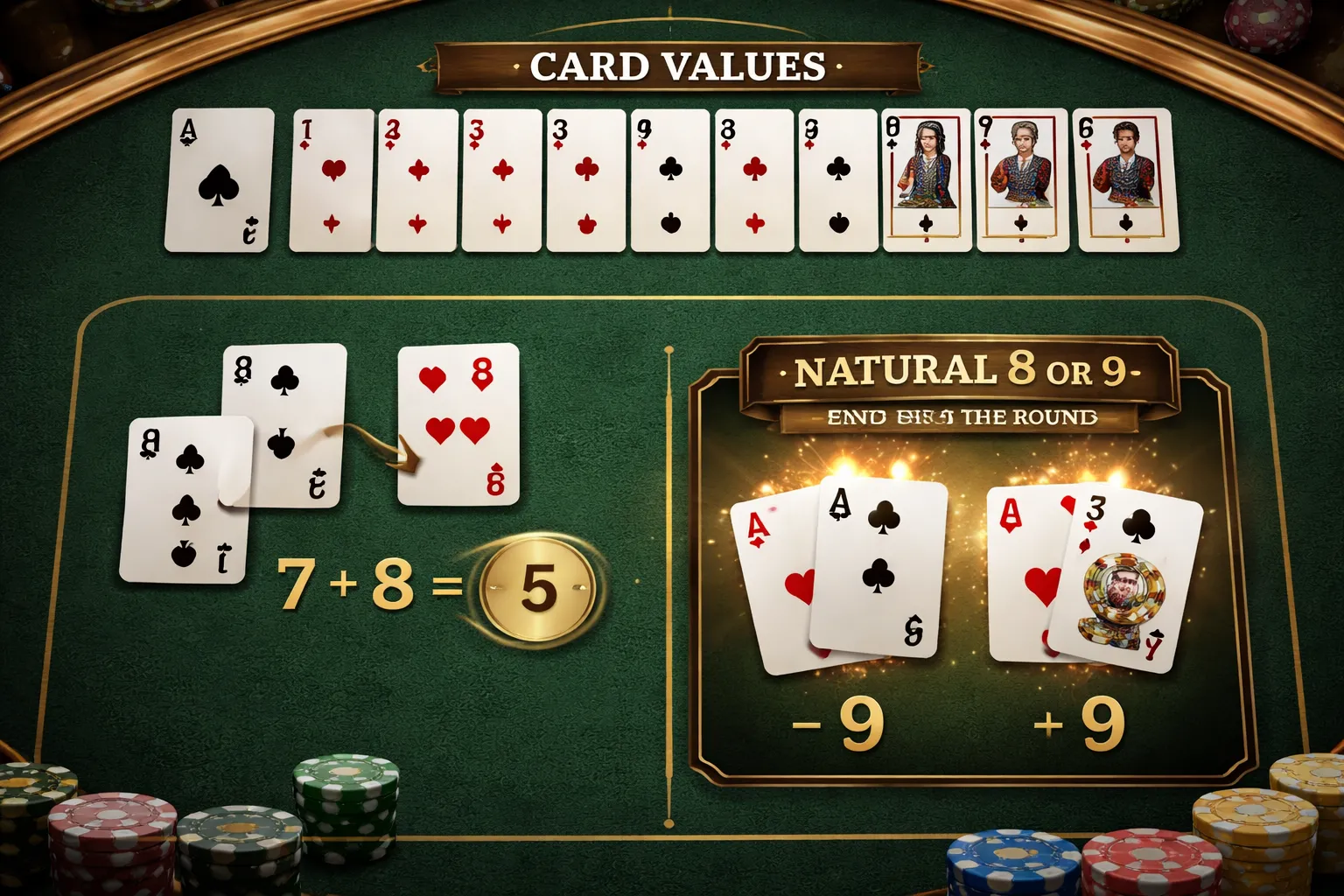
Objective, Hands, and What You Bet On
Each round has one goal. Get a hand total closest to 9.
You do not play your own hand. You bet on outcomes:
- Player, the Player hand finishes closer to 9.
- Banker, the Banker hand finishes closer to 9.
- Tie, both hands finish with the same total.
Card Values at a Glance
Baccarat uses simple card values. Tens and face cards count as zero.
| Card | Value |
| A | 1 |
| 2 to 9 | Face value |
| 10, J, Q, K | 0 |
Scoring, Totals, and the Modulo 10 Rule
Hands score from 0 to 9 only.
Add the card values, then keep the last digit. This is the modulo 10 rule.
- 7 + 8 = 15, total is 5.
- 9 + 6 = 15, total is 5.
- 10 or face card + 6 = 6, total is 6.
- 3 cards can still total 0 to 9. Example: 8 + 7 + 6 = 21, total is 1.
Naturals, 8 or 9 Ends the Round
A natural means a 2 card total of 8 or 9.
If either hand has a natural, the round ends right after the first two cards. No third card draws happen.
- Player natural beats Banker non-natural.
- Banker natural beats Player non-natural.
- Both natural, the result is a tie.
Why You Do Not Control Draws
You never choose hit or stand. The casino follows fixed third card rules.
That matters for your betting. You cannot change the deal by making “smart” decisions. You can only choose where your money goes, Player, Banker, or Tie.
If you want a game where you manage decisions through bet structure, roulette works better. See our online roulette guide for the basics.
How a Round Works: Step-by-Step Game Flow Online
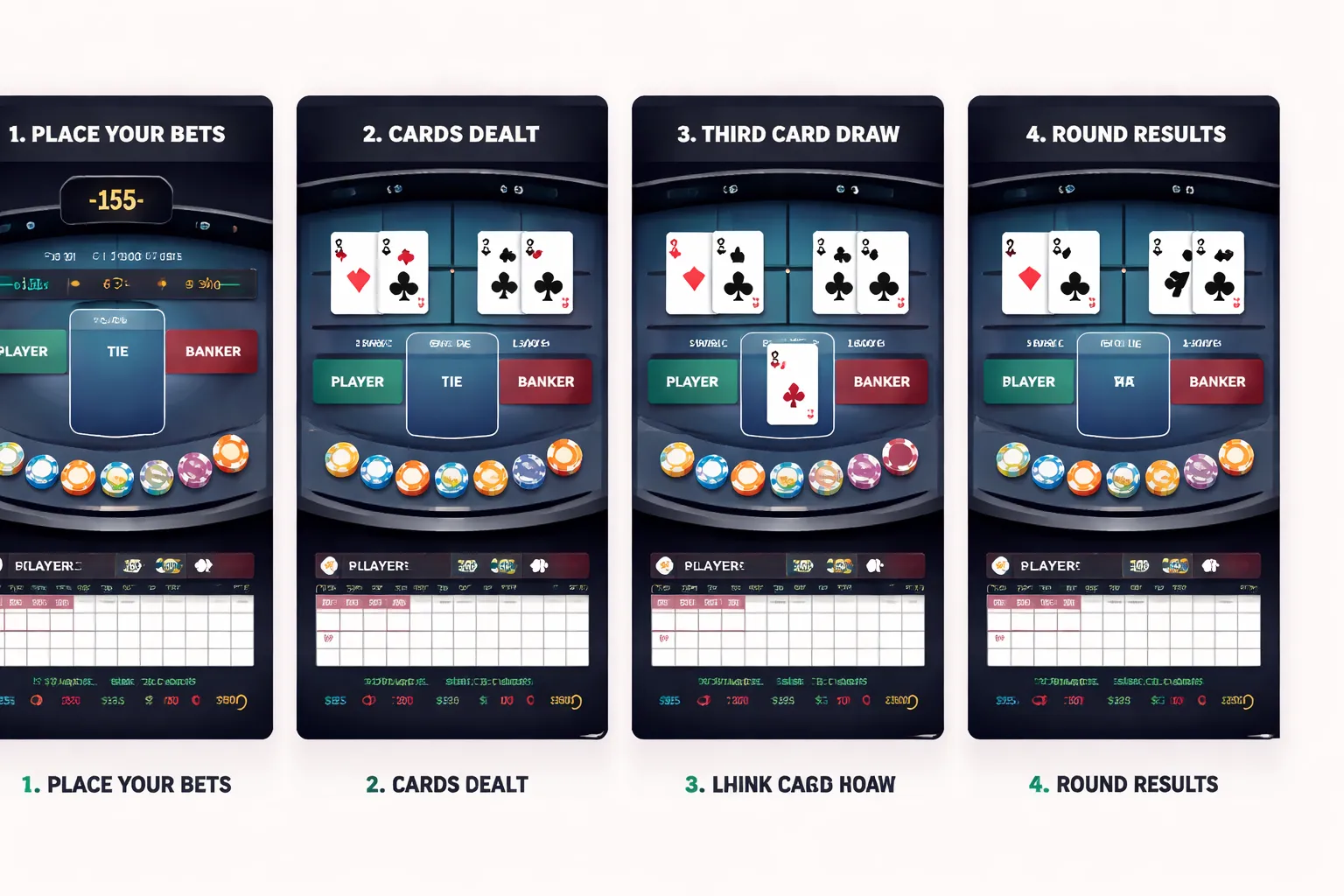
Placing Bets Before the Deal
You bet first. The deal starts after you lock a wager on Player, Banker, or Tie.
- Bet window: A timer shows how long you have to place chips. When time runs out, betting closes.
- Chip selection: You pick a chip value, then tap the betting area to add it. Many games let you stack multiple chips.
- Confirm: Some tables auto-confirm at countdown end. Others require a confirm button. If you see a confirm step, use it. An unconfirmed bet can fail to place.
- Cancel and re-bet: Many interfaces allow undo or clear before the timer hits zero. After betting closes, you cannot change anything.
- Limits: The table shows minimum and maximum stakes per bet spot. If you exceed a limit, the game rejects the wager.
Initial Two-Card Deal
After betting closes, the dealer deals two cards to Player and two cards to Banker. Online RNG tables show the cards on screen. Live dealer tables show the physical cards on video.
- Hands start with two cards each.
- The game totals each hand using baccarat scoring.
- If either hand has 8 or 9 on the first two cards, the round ends. The casino calls this a natural.
Third-Card Rules Overview
You do not choose draws. The table follows fixed third-card rules. The software applies them in the same order every round.
- Player draw trigger: Player draws a third card on low totals, and stands on higher totals.
- Banker draw trigger: Banker draws or stands based on its total and, if Player drew, the value of Player’s third card.
- Key practical point: Your only decision stays the bet selection. The draw rules do not change based on your wager.
Result Settlement and Payouts
After all required cards draw, the game compares totals. The higher total wins. Winning bets pay, losing bets clear, and your balance updates.
- Player wins: Player bets pay even money.
- Banker wins: Banker bets pay even money minus commission on many tables. Some tables use different payout rules, such as reduced payout with no commission.
- Tie: Tie bets pay at the posted odds. Player and Banker bets push on a tie on most standard tables.
- Commission handling: The table may deduct it each win or track it and collect later. The UI shows which method it uses.
What You See Online: Roadmaps, History, and Replays
Online baccarat gives you tools to track past outcomes. Use them for record-keeping, not prediction.
- Roadmaps: Bead Plate and Big Road style grids mark past Player, Banker, and Tie results.
- History: A list view shows recent hands, often with totals and card breakdowns.
- Replays: Many live tables offer short replays of the last hand. RNG tables may show an animation log or result recap.
- Table info: Look for limits, payout rules, and commission notes before you place a bet.
Bet Types and Payouts in Online Baccarat
Player Bet
You win if the Player hand total finishes closer to 9 than the Banker hand. A winning Player bet usually pays 1:1. A Tie result pushes your Player bet at most tables.
Player sits near the best value bets in baccarat. It still carries a house edge, but it is lower than most side bets.
Banker Bet
You win if the Banker hand total finishes closer to 9 than the Player hand. The standard payout is 1:1 minus commission, most often a 5% commission on wins. A Tie result usually pushes your Banker bet.
With the standard commission model, Banker typically offers the lowest house edge on the table.
Some sites offer no-commission baccarat. Read the table rules first. Casinos adjust the math in one of these ways.
- Reduced payout, often Banker wins pay 1:1 except a specific winning total pays 1:2 or pays even money with a rule penalty.
- Banker 6 rule, Banker wins on a total of 6 may pay 1:2, or it may count as a push, depending on the provider.
These variations can raise the house edge compared with standard commission baccarat.
Tie Bet
You win if Player and Banker finish with the same total. Tie payouts vary by table, most often 8:1 or 9:1.
Tie hits less often than Player or Banker. That gap drives a higher house edge. Expect bigger swings in your results. Treat Tie as a high-variance bet, not a core wager.
Popular Side Bets
Side bets sit outside the main three outcomes. Rules and payouts change by provider. Always check the paytable on the table screen.
- Player Pair, you win if the Player’s first two cards form a pair. Payouts often sit around 11:1.
- Banker Pair, you win if the Banker’s first two cards form a pair. Payouts often sit around 11:1.
- Perfect Pair, you win if a hand’s first two cards match in rank and suit or color, based on the rule set. Payouts vary, often higher than standard Pair.
- Dragon Bonus, you win based on the winning margin. Larger margins pay more. Natural wins can pay a separate amount. The paytable defines the steps.
- Panda 8, you win if the Player wins with a three-card total of 8. This bet usually pays a premium and loses often.
Most side bets carry a higher house edge than Player or Banker. Use small stakes if you play them.
Bet Types and Payouts Table
| Bet | What must happen | Typical payout | Volatility |
|---|---|---|---|
| Player | Player beats Banker | 1:1 | Lower |
| Banker | Banker beats Player | 1:1 minus 5% commission | Lower |
| Tie | Same total | 8:1 or 9:1 | High |
| Pair | First two cards form a pair | Often around 11:1 | High |
| Dragon Bonus | Win with a defined margin | Tiered paytable | High |
| Panda 8 | Player wins with 3-card total of 8 | Table dependent | High |
Minimum and Maximum Limits
Limits change by table and provider. Live tables often run higher minimums than RNG tables. VIP tables raise both the minimum and the maximum.
- Main bets, Player and Banker usually allow the highest maximums.
- Tie and side bets, these often carry lower maximums and tighter caps per hand.
- Commission rules, some tables set different limits for Banker on commission and no-commission variants.
Before you bet, check the table info panel for min, max, and the exact payout for Tie and side bets.
Online Baccarat Variants You’ll Encounter
Punto Banco
Punto Banco is the standard ruleset you see on most online tables. The house deals every hand using fixed drawing rules. You do not choose whether to hit or stand.
- Main bets: Player, Banker, Tie.
- Typical payouts: Player 1:1, Banker 1:1 minus commission on many tables, Tie 8:1 or 9:1.
- What to watch: Banker commission rate, Tie payout, and any side bets.
If you want the core game with the most predictable rules, pick Punto Banco.
Speed Baccarat
Speed Baccarat keeps the same core rules as Punto Banco. The difference is pace. The dealer moves faster, and your bet window stays open for less time.
- Shorter betting time: you need to place chips fast, or you sit out the hand.
- Faster session swings: you see more decisions per hour, so your bankroll can rise or drop quicker.
- Less time to track limits: confirm min, max, and side bet payouts before you start.
No-Commission Baccarat
No-Commission Baccarat removes the standard Banker commission. The casino replaces it with a lower Banker payout in specific outcomes, most often when Banker wins with a total of 6.
- Key rule: Banker usually pays 1:1 on most wins, but pays 1:2 when it wins with 6.
- What changes for you: Banker becomes less valuable than in commission games, since its best edge gets reduced by the 6 rule.
- What stays the same: the dealing and drawing rules still follow Punto Banco.
Read the table help for the exact Banker 6 payout rule before you treat Banker like the default best bet.
EZ Baccarat
EZ Baccarat is a no-commission format with special outcome rules. The most common version pushes your Banker bet when Banker wins with a total of 7 using three cards.
- Key rule: Banker 3-card 7 often results in a push, you get your stake back with no win.
- Why it matters: a push changes your win rate and session rhythm, even if it feels close to standard baccarat.
- Common add-ons: side bets like Dragon 7 or Panda 8 can appear, with high payouts and high house edge.
Check the exact push condition and side bet paytables. Versions differ by provider.
Live Dealer Baccarat vs RNG Baccarat
Both formats use the same hand totals and the same fixed drawing rules. Your main bets stay the same. The big differences sit in speed, limits, and table features.
- Live dealer: real cards, set dealing pace, chat, and table-specific rules like commission handling and side bets.
- RNG: faster hands, autoplay options, and often lower minimums, with fewer distractions.
- What does not change: you still win or lose based on Player, Banker, or Tie, and the draw rules still control third cards.
If you want more hands per hour, pick RNG. If you want a physical game flow and table feel, pick live dealer. For deeper odds details by bet type, use this baccarat odds breakdown.
How to Read the Baccarat Table and Interface Online
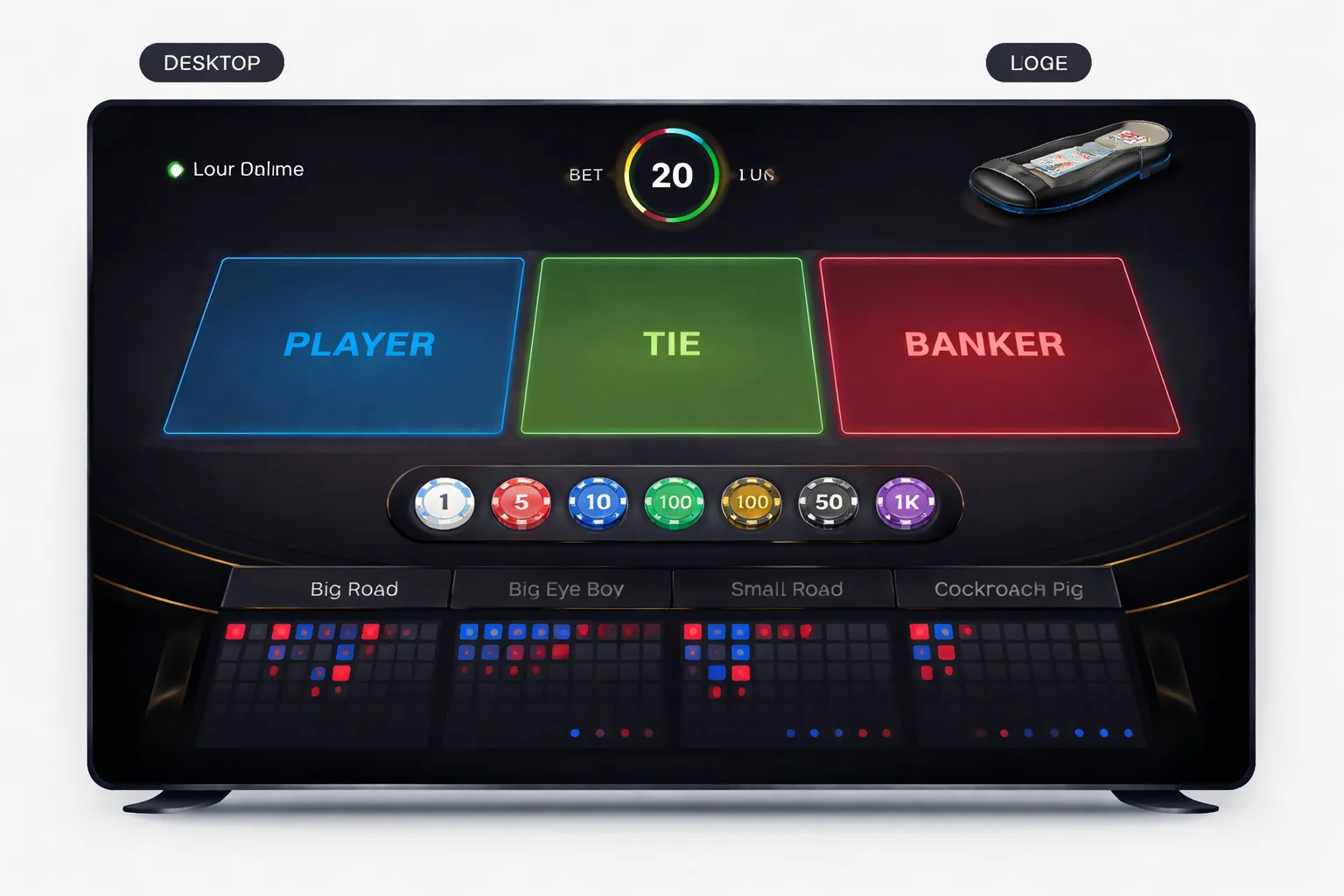
Understanding the betting layout
Online baccarat keeps the same three main bets. The interface just compresses them into buttons and panels.
- Player, usually on the left side of the betting area. Some lobbies label it as “P.”
- Banker, usually on the right side of the betting area. Some lobbies label it as “B.”
- Tie, usually in the center between Player and Banker.
- Pair side bets, if offered. You may see “Player Pair” and “Banker Pair” near their main bet zones.
- Commission note, many tables show “Banker pays 0.95:1” or “5% commission.” Some versions show “No Commission” rules.
Check the bet slip before you confirm. You should see your selected chip value, total stake, and any commission rules for Banker.
Roadmaps explained
Roadmaps show past results. They do not change your odds. Use them to track streaks and table pace, not to predict outcomes.
- Big Road, the main grid. It records Banker and Player results as a sequence. Ties usually mark the last result cell, often as a small line or number.
- Big Eye Boy, a derivative map. It compares recent patterns in the Big Road and marks consistency shifts. It does not show Player or Banker directly.
- Small Road, another derivative map. It reacts later than Big Eye Boy and highlights different pattern changes.
- Cockroach Pig, the most sensitive derivative map. It often looks noisy because it flags short-run changes fast.
If the screen feels crowded, collapse the roadmap panel. You need the bet buttons and the timer more than extra charts.
What the “shoe” means online and how reshuffles work
The shoe is the dealing sequence from multiple decks. Online baccarat shows it in different ways depending on game type.
- Live dealer, the shoe is a real card shoe. The UI may show a shoe icon, a “cards dealt” counter, or a cut-card marker. When the cut card appears, the dealer finishes that hand, then shuffles.
- RNG baccarat, many games simulate a shoe or reshuffle every hand. The “shoe” display may serve as theme only. Check the rules tab for the exact shuffle method.
- What to watch, a “New Shoe” or “Shuffle” notice. You may also see roadmap reset options that start a fresh tracking board.
If you track results, reset your notes when the platform starts a new shoe. Keep your bet sizing consistent. Do not change bets just because a shuffle happens.
Game settings to check
- Autoplay, set a hand limit and a loss limit if the casino offers them. Turn it off if you lose track of stakes.
- Chip values, set default chips that match your bankroll. Avoid large jump chips that push you into bigger bets fast.
- Table limits, confirm min and max for Player, Banker, Tie, and side bets. Side bet limits often differ from main bets.
- Bet timer, learn the countdown. Many tables lock bets a few seconds before the reveal.
- Sound and video, mute table sounds if they distract you. Lower video quality if your stream stutters.
- History and rules, open the “Rules” and “Help” tabs once. Confirm payouts, commission, and side bet paytables. For deeper odds details by bet type, use this baccarat odds breakdown.
Accessibility and mobile play tips for smoother sessions
- Use landscape mode, it usually shows full betting zones and the timer without scrolling.
- Enable one-tap chips, if available. It cuts input errors and late bets.
- Lock your screen orientation, it prevents mid-hand layout jumps.
- Stabilize your connection, use Wi-Fi or strong 5G. Avoid switching networks during a hand.
- Keep the table simple, hide chat, stats, and roadmaps if they slow your device.
- Use larger UI settings, increase font size and button size if the app supports it. Mis-taps cost money.
- Set a session reminder, use your phone timer. It helps you stop on schedule.
Winning Basics: Practical Strategy Without the Hype
Which Bets Are Mathematically Strongest
Your best long-run bet is usually Banker. It wins slightly more often because Banker acts second and draws under fixed rules that favor it over time.
Most online baccarat tables charge a commission on Banker wins, often 5%. Even after commission, Banker typically keeps the lowest house edge on standard rules.
- Banker: Lowest edge on most tables. Commission reduces payout but usually stays the best value.
- Player: Slightly higher edge than Banker. No commission on most tables.
- Tie: Highest edge by far. Big payout, poor value. Treat it as a high-cost side bet.
Side bets vary by casino and rule set. Many carry large house edges. If you care about value, skip them.
Why Betting Systems Do Not Change the House Edge
Progressions like Martingale, Fibonacci, and Paroli change bet sizing, not the math of the game.
Each hand still has the same expected loss rate. Over time, the house edge applies to the total amount you wager.
- Systems can create short-term swings that feel smoother or more exciting.
- Systems can also trigger large bets fast, which increases risk of a blow-up.
- Table limits and bankroll limits stop many progressions before they recover.
If you want lower edge overall, pick better bets and better games. Use this guide to compare low house edge casino games.
Simple, Low-Risk Approach for Beginners
Keep it boring. Keep it consistent.
- Flat bet: Use the same wager each hand. Do not chase.
- Small units: Set one unit at about 1% to 2% of your session bankroll.
- Stick to Banker or Player: Avoid Tie and most side bets if you want better odds.
- Plan for commission: If you bet Banker, track results after commission so your records stay real.
This approach does not make you win long-term. It reduces volatility and keeps mistakes smaller.
When to Stop: Session Goals, Timeboxing, Avoiding Tilt
You need hard stop rules. Decide them before you place a bet.
- Timebox: Set a fixed session length. Example, 20 to 40 minutes.
- Stop-loss: Quit if you lose a set amount, often 10 to 20 units.
- Win cap: Quit if you reach a profit target, often 5 to 10 units.
- Tilt triggers: Stop if you feel rushed, angry, or you increase stakes to get even.
Online speed makes tilt worse. Fewer hands per session helps.
What “Streaks” Mean in Independent Probability Games
Baccarat outcomes can cluster. You will see streaks. That does not mean the table is due for a flip.
- Past hands do not change the next hand’s probabilities.
- Roadmaps show history, not a prediction engine.
- Switching sides because a streak “must end” leads to random timing and bigger swings.
If you use patterns, use them as a structure for discipline, not as proof of an edge.
Bankroll Management and Responsible Play Essentials
Setting a budget, loss limit, and win cap before you start
Decide your baccarat bankroll before you log in. Treat it as spending money, not a bill.
- Session budget: the maximum you can lose in one sitting.
- Loss limit: a hard stop, usually 30 to 50 percent of your session budget.
- Win cap: a profit target that ends the session when you hit it, often 20 to 40 percent of your session budget.
- Exit rules: when you hit your loss limit or win cap, you stop. No extra deposits. No chasing.
Write these numbers down. If you cannot follow them, lower the stakes or do not play.
Choosing stake size: units, volatility, and expected swing
Use units. One unit is a small, fixed slice of your bankroll.
- Set 1 unit to 0.5 to 2 percent of your session bankroll.
- Bet 1 unit per hand as your default.
- If you raise stakes, do it by units, not by gut.
Baccarat has a low house edge on Banker and Player, but results still swing. Streaks can stack losses fast if your unit is too large.
| Bankroll setup | What it helps you do | Simple target |
|---|---|---|
| 100 to 200 units per session | Survive normal variance without forcing a stop | 1 unit = 0.5 to 1% of bankroll |
| 50 to 100 units per session | Short sessions with tighter limits | 1 unit = 1 to 2% of bankroll |
| Under 50 units per session | High risk of early busts from short downswings | Lower stakes or add units |
Avoid bet progressions that increase after losses. They multiply variance and can push you into table limits fast. Keep bets flat or near flat.
If you want a clear breakdown of volatility concepts, read high volatility vs low volatility. The same risk logic applies to bankroll sizing.
Using casino tools: deposit limits, time-outs, and self-exclusion
Use built-in controls before you feel pressure.
- Deposit limits: set daily or weekly caps. Match them to your budget.
- Loss limits: if offered, set them below your maximum session loss.
- Wager limits: cap total betting volume for the day. This reduces long-run exposure to the house edge.
- Time limits: set a session timer. Stop when it ends.
- Time-outs: lock yourself out for 24 hours to several weeks when you tilt.
- Self-exclusion: the strongest option. Use it if you keep breaking your limits.
Turn off autoplay. Turn off one-click rebet if it makes you play hands you did not choose.
Recognizing problem gambling signs and where to seek help
Stop and get support if you see any of these patterns.
- You chase losses or raise stakes to recover.
- You deposit more than planned or borrow to play.
- You hide gambling from people close to you.
- You feel restless or angry when you cannot play.
- You gamble to escape stress, debt, or low mood.
- You miss work, sleep, or obligations due to play.
If you need help, contact a licensed support service in your country. In the US, you can call or text 1-800-GAMBLER. In the UK, contact GamCare at 0808 8020 133. If you feel at risk, use self-exclusion and talk to a medical professional.
Common Mistakes and Myths About Online Baccarat
The gambler’s fallacy, past outcomes do not predict the next hand
Each baccarat hand is independent. The shoe has no memory. A streak does not make the opposite result “due.”
In live dealer baccarat, the probability can shift slightly as cards leave the shoe. You still cannot use recent results to predict the next outcome with reliable edge. Casinos already price the game with commission and house edge.
- Mistake: Switching to Player because Banker “has to lose soon.”
- Reality: Your last 20 hands do not force the next hand to change.
- Fix: Pick a bankroll plan, then make each bet decision without using the last result as a trigger.
Misreading roadmaps as signals instead of history
Bead plates, Big Road, Big Eye Boy, Small Road, and Cockroach Road show past outcomes. They do not forecast future hands. They can help you track what happened, nothing more.
- Mistake: Treating a pattern on the Big Road as a “system” that beats the house.
- Reality: Roadmaps summarize results, they do not change probabilities or payouts.
- Fix: Use roadmaps to stay organized, not to justify bigger bets.
Overusing Tie and side bets because the payouts look big
Tie and many side bets pay more because they hit less often. The tradeoff is a higher house edge. That cost adds up fast.
| Bet type | Why it tempts you | Common problem |
|---|---|---|
| Tie | High payout | Low hit rate, high long-term cost |
| Side bets | Bonus-style payouts | Rules vary, edge often worse than main bets |
- Mistake: Adding Tie “just in case” every hand.
- Reality: Frequent high-edge bets can outweigh any short-term wins.
- Fix: Treat Tie and side bets as rare, budgeted entertainment, or skip them.
Chasing losses by raising stakes after a downswing
Loss chasing breaks bankrolls. It also pushes you into rushed decisions. Baccarat variance can run for long stretches, even when you bet “correctly.”
- Mistake: Doubling after each loss to “get even.”
- Reality: A longer losing run can arrive before a win. Table limits and bankroll size will stop you first.
- Fix: Set a stop-loss and session length, then leave when you hit it.
- Fix: Use flat betting or small, planned adjustments only, never emotional jumps.
Assuming live dealer games are “due” because of shoe patterns
Live baccarat uses real shoes, but patterns still do not create a debt that must get paid back. A streak can continue. It can also end at any time. You cannot know which will happen next.
- Mistake: Waiting for a “perfect entry” after a long Banker run, then overbetting to catch the turn.
- Reality: A shoe can produce clusters and streaks without offering a predictable turning point.
- Fix: Bet sizes should match your bankroll plan, not the shape of the last 10 results.
- Fix: If you want a different decision-based game, learn the fundamentals in our online blackjack guide.
How to Choose a Safe Online Baccarat Site (E-E-A-T Checklist)
Licensing and regulation, what to look for and how to verify
Start with the license. A real license sets rules on payouts, player protection, and complaints.
- Find the license details in the footer and in the site’s terms. Look for the regulator name and a license number.
- Verify on the regulator site. Use the license number to search the official register. The operator name and domain should match.
- Check the entity name. The brand name can differ, the legal company name should stay consistent across the license, terms, and payment pages.
- Avoid “licensed” badges without proof. If you cannot confirm it in a regulator database, treat it as unlicensed.
- Know the common regulators. Stronger oversight usually comes from major jurisdictions with public registers and enforcement history.
Game fairness, RNG audits, live dealer studios, and reputable providers
Baccarat runs on either RNG software or live dealer streams. You should be able to check both.
- RNG baccarat. Look for third-party testing seals and audit reports. You want an independent lab name and a recent report date.
- Live dealer baccarat. Check the studio provider and table limits. Top studios publish game rules, dealing procedures, and sometimes stream integrity notes.
- Provider reputation. Stick to known game developers and live studios with long operating histories and clear rule sheets.
- Rule variations. Confirm payouts and side bet rules before you deposit. Small changes can swing the house edge.
Payment methods and cashout reliability, fees, speed, and KYC requirements
A safe site pays out on time. It also tells you what it needs before it pays you.
- Deposit and withdrawal methods. You should see the full list, including any method limits, before you fund your account.
- Cashout speed. Read the stated processing times for each method. Separate “casino approval time” from bank or wallet transfer time.
- Fees. Check for withdrawal fees, currency conversion fees, and inactivity fees in the terms.
- KYC rules. Expect ID checks. A reliable site explains what it needs, when it asks, and how long verification takes.
- Withdrawal limits. Watch for daily, weekly, and monthly caps that can slow access to your bankroll.
Bonuses and wagering terms that affect baccarat eligibility
Bonuses can reduce your flexibility. Baccarat often counts less toward wagering, or does not count at all.
- Game contribution. Find the bonus terms and look for “baccarat contribution.” Many sites count baccarat at a low percentage.
- Wagering requirement. Note the multiplier and the base. Some calculate on bonus only, others on bonus plus deposit.
- Max bet rules. Many bonuses cap your bet size while wagering. Breaking this can void winnings.
- Time limits. Check expiry dates for the bonus and for completing wagering.
- Cashout restrictions. Look for max cashout caps tied to the bonus.
If you want fewer restrictions, compare baccarat to other low house edge games and choose based on rules, not promo size.
Security and privacy basics, SSL, account protection, and 2FA
Security protects your money and your identity. You can confirm most basics in minutes.
- SSL encryption. The site should load on HTTPS with a valid certificate.
- Two-factor authentication. Use 2FA if the site offers it. It blocks many common account takeovers.
- Password standards. The site should support long passwords and password managers.
- Privacy policy clarity. Check what data it collects, who it shares with, and how you can request deletion where allowed.
- Login and session controls. Look for options like device management, logout-from-all-devices, and login alerts.
FAQ
What is the goal in online baccarat?
You bet on which hand finishes closer to 9, Player or Banker, or you bet on a Tie. The dealer draws cards by fixed rules. You do not choose when to draw. Your job is to pick a bet, set a stake, and manage bankroll.
What are the card values in baccarat?
Aces count as 1. Cards 2 to 9 count as face value. 10s, Jacks, Queens, and Kings count as 0. Add the hand total and drop the tens digit. Example, 7 plus 8 equals 15, your baccarat total is 5.
How does the drawing rule work?
The dealer follows preset rules. If Player or Banker has 8 or 9 on the first two cards, the round ends. Otherwise, Player may draw a third card based on total, then Banker draws based on total and Player’s third card.
What are the main baccarat bets and payouts?
- Banker: usually pays 1:1 minus 5% commission.
- Player: usually pays 1:1.
- Tie: often pays 8:1 or 9:1, check the table.
Which bet has the lowest house edge?
Banker usually has the lowest house edge, even after the 5% commission. Player sits slightly higher. Tie sits far higher and swings harder. If you want a simple default, you start with Banker and avoid Tie bets.
Why does the Banker bet charge commission?
Banker wins slightly more often due to the drawing rules. Casinos add a commission, often 5%, to balance the payout. Some games replace commission with a reduced payout like 0.95:1. Always read the bet panel before you play.
Does online baccarat use a real deck?
Live dealer baccarat uses physical shoe games with standard decks. RNG baccarat uses a random number generator to simulate dealing. Both can run fair games if licensed and tested. You should look for published audits or reputable live studios.
Can you use a strategy to beat baccarat?
No betting system changes the house edge. Progressions like Martingale change volatility and risk. They do not create an advantage. You get better results by choosing lower edge bets, setting limits, and quitting on schedule. See low house edge games.
Do trends and roadmaps predict outcomes?
No. Each hand resolves independently in RNG games. In live games, past results do not change the remaining shoe in a useful way for most players. Roadmaps help you track results and pace your betting. They do not forecast the next hand.
What is a good bankroll plan for baccarat?
Pick a session budget you can lose. Set a unit size, often 1% to 2% of bankroll. Use flat betting or small, controlled changes. Set a stop loss and a stop win. Quit when you hit either limit.
How do bonuses work in online baccarat?
Bonuses often exclude baccarat or count it at a low rate toward wagering. Some set max bet caps while you have an active bonus. Tie and side bets can count as zero. Check contribution, max bet, and expiry before you opt in.
What should you check before you play for real money?
- License: verify it in a public register.
- RNG or studio: find testing reports or reputable providers.
- Payments: fees, limits, and payout timelines.
- Security: HTTPS, 2FA, and session controls.
Conclusion
Baccarat stays simple when you keep your decisions tight. Learn the card values. Follow the deal order. Track your bankroll.
Base your play on the lowest house edge. Bet Banker more than Player. Skip Tie and most side bets unless you accept higher variance and worse value.
Control risk with rules you set before you sit down. Use flat stakes or small steps. Set a stop loss and a stop win. Quit when you hit either one.
Pick the site with the same discipline. Confirm the license, testing, payments, and security. If you want a deeper breakdown of edges, payouts, and common traps, read our baccarat odds guide.
Final tip. Set your session budget and your max bet before you place the first chip. Then stick to it.
-
Online Casino Fairness Explained: RNG, RTP, House Edge & Provably Fair
8 months ago -
Slot RTP Explained: What RTP Means and How to Use It
8 months ago -
How to Play Online Slots: Rules, Features & Beginner Tips
8 months ago -
How Slot Jackpots Work: Progressive Jackpots Explained
8 months ago -
How to Play Online Blackjack: Rules, Payouts & Quick Start Guide
8 months ago
-
- Licensing and regulation, what to look for and how to verify
- Game fairness, RNG audits, live dealer studios, and reputable providers
- Payment methods and cashout reliability, fees, speed, and KYC requirements
- Bonuses and wagering terms that affect baccarat eligibility
- Security and privacy basics, SSL, account protection, and 2FA
-
- What is the goal in online baccarat?
- What are the card values in baccarat?
- How does the drawing rule work?
- What are the main baccarat bets and payouts?
- Which bet has the lowest house edge?
- Why does the Banker bet charge commission?
- Does online baccarat use a real deck?
- Can you use a strategy to beat baccarat?
- Do trends and roadmaps predict outcomes?
- What is a good bankroll plan for baccarat?
- How do bonuses work in online baccarat?
- What should you check before you play for real money?
-
-
- Licensing and regulation, what to look for and how to verify
- Game fairness, RNG audits, live dealer studios, and reputable providers
- Payment methods and cashout reliability, fees, speed, and KYC requirements
- Bonuses and wagering terms that affect baccarat eligibility
- Security and privacy basics, SSL, account protection, and 2FA
-
- What is the goal in online baccarat?
- What are the card values in baccarat?
- How does the drawing rule work?
- What are the main baccarat bets and payouts?
- Which bet has the lowest house edge?
- Why does the Banker bet charge commission?
- Does online baccarat use a real deck?
- Can you use a strategy to beat baccarat?
- Do trends and roadmaps predict outcomes?
- What is a good bankroll plan for baccarat?
- How do bonuses work in online baccarat?
- What should you check before you play for real money?
-
-
Reload Bonus Explained: What It Is and When It’s Worth Claiming
6 months ago -
Online Casino Licensing Explained: Authorities, Licenses & How to Check One
8 months ago -
Best Live Dealer Casinos: Where to Play Live Blackjack, Roulette & More
8 months ago -
Best Online Casinos for High Rollers: VIP Perks, High Limits & Exclusive Bonuses
8 months ago -
Fast Payout Online Casinos: Best Sites for Quick Withdrawals
8 months ago
-
Online Casino Customer Support: What to Look For (Live Chat, Email, Response Times)
8 months ago -
Sign Up for an Online Casino: Create an Account in Minutes
8 months ago -
Online Casino Payment Safety Tips: How to Deposit and Withdraw Securely
8 months ago -
What to Do If an Online Casino Won’t Pay Out: Step-by-Step Actions
8 months ago -
How to File a Complaint Against an Online Casino (Plus ADR Explained)
8 months ago