How to Play Online Roulette: Rules, Bets & Payouts

Online roulette is a numbers game with fixed rules, fixed payouts, and a built-in house edge. You place chips on a virtual layout, the wheel spins, and the result settles your bets.
This guide shows you how to play step by step. You will learn the core rules, how the table layout works, when bets lock, and how winnings get paid. You will also get the key bet types, their payouts, and what each bet costs you in odds.
If you want the full math breakdown on every wager, see our roulette odds and bet types guide.
Key Takeaways
- In het kort: You place chips on the virtual table, bets lock when the countdown ends, the wheel spins, and the winning number and color settle your bets.
- Learn the layout first: Inside bets target specific numbers and pay more, outside bets cover larger groups and pay less.
- Know the core payouts: Straight up 35:1, split 17:1, street 11:1, corner 8:1, six line 5:1.
- Outside bets pay less but hit more: Red or black 1:1, odd or even 1:1, low or high 1:1, dozen 2:1, column 2:1.
- Zeros drive the house edge: European has 1 zero, American has 0 and 00, French often adds rules that cut losses on even money bets.
- Each spin is independent: Past results do not change the next outcome. Bet based on your budget, not the board.
- Check game settings: Look for the roulette variant, table limits, and bet timer before you stake.
- Use math, not vibes: If you want to compare value across tables, read our guide to RNG, RTP, and house edge.
What Is Online Roulette and How It Works
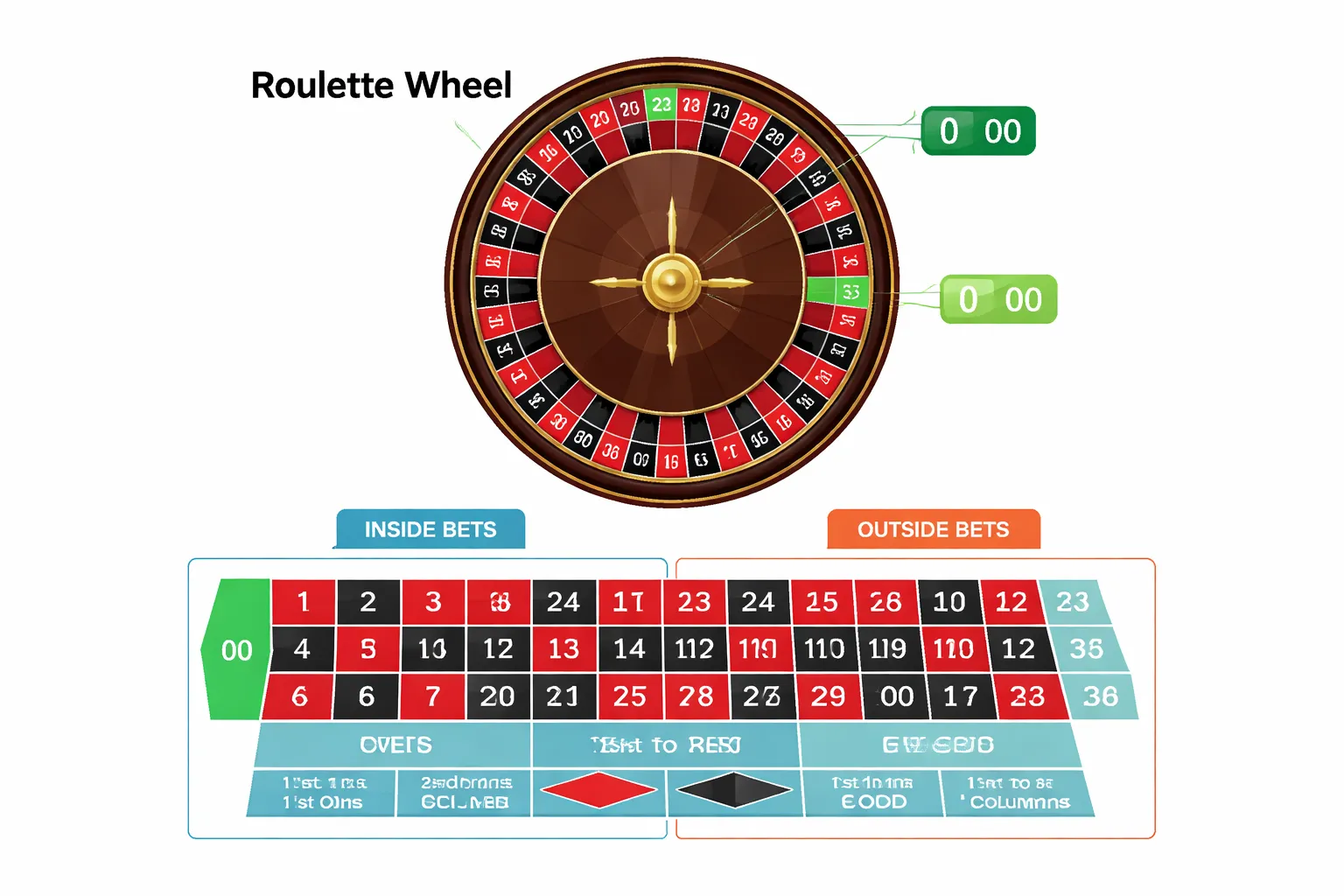
Roulette basics in one minute
Online roulette is a numbers game with a wheel, a ball, and a betting layout.
- The wheel has numbered pockets in red and black, plus one or more green zero pockets.
- The ball spins around the rim, then drops into a pocket.
- The winning number is the pocket where the ball lands. That single result settles every bet on the table.
- Zeros matter. They create the house edge. European roulette uses 0. American uses 0 and 00. Many French tables add rules that reduce losses on even money bets. Use our guide to European vs American roulette to compare them.
Online roulette formats, RNG vs live dealer
You can play online roulette in two main formats. The bets, payouts, and odds match the same roulette rules for that variant.
- RNG roulette uses software to generate the winning number each spin. Spins run fast. You can often use autoplay, adjust chip values, and clear or repeat bets with one click.
- Live dealer roulette streams a real wheel and dealer. You place bets in a timer window. The dealer spins, calls the result, and pays out. Pace is slower, and table limits are often higher.
What stays the same. The layout, bet types, and math. Inside bets still pay more and hit less. Outside bets still hit more and pay less.
What determines the outcome, randomness, wheel cycles, and game fairness
Each spin is independent. Past results do not change the next outcome.
In RNG roulette, the game uses a random number generator to pick the result. A fair RNG produces outcomes close to expected probabilities over large samples, not in short streaks. Casinos test RNGs through independent labs and publish the game provider and certification details in the help or info menu.
In live roulette, physical randomness drives the result. The ball speed, wheel speed, and release point vary each spin. Players sometimes talk about wheel cycles or repeat zones. You cannot rely on them online. Live wheels get maintained, replaced, and monitored. Any edge you think you see can disappear without notice.
Practical checks you can do before you bet.
- Confirm the variant and zero count.
- Check table limits and the bet timer.
- Look for game info pages that list provider, rules, and payout table.
Common terminology you will see
- Spin. The wheel is spun and a result is produced.
- Round. One full betting cycle, place bets, spin, settle, and clear.
- Call bets. Verbal bet groupings used in French roulette, like Voisins du Zéro, Tiers du Cylindre, and Orphelins. Online tables may offer them as one click bet buttons.
- Inside bets. Bets placed on the number grid, like straight up, split, street, corner, and six line.
- Outside bets. Bets placed outside the grid, like red or black, odd or even, low or high, and dozens or columns.
- Neighbors. A group bet that covers a number and the numbers next to it on the wheel, not on the layout.
Roulette Wheel Types and Which One to Choose
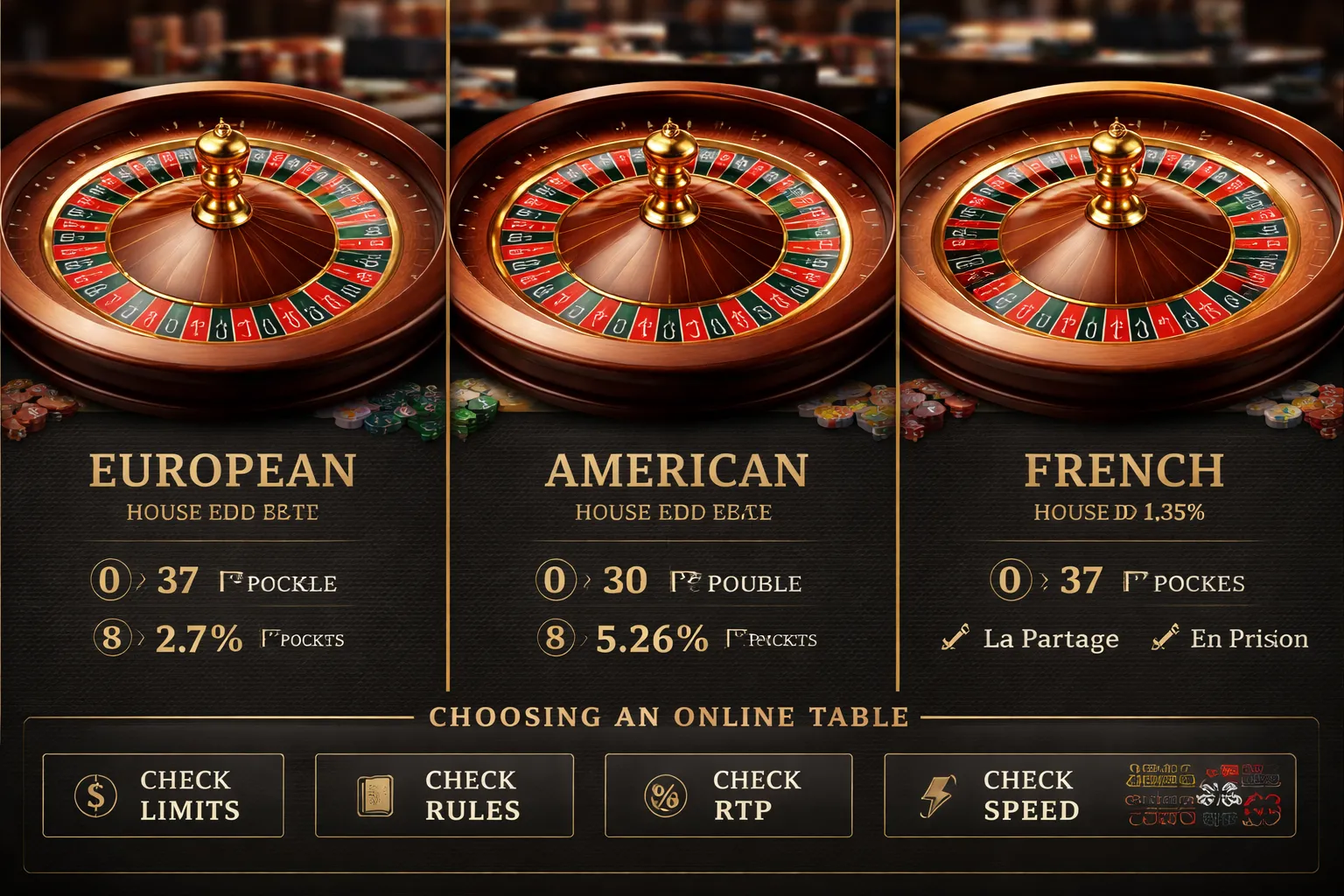
European Roulette (Single-Zero)
European roulette uses 37 pockets, numbers 1 to 36 plus a single zero.
This version gives you better odds than American roulette because it has fewer zero pockets.
- House edge: 2.70% on most bets.
- Best for: most players, most bankrolls, most sessions.
- What to check online: some games label themselves “European” but add side bets with a higher edge. Treat side bets as separate games.
American Roulette (Double-Zero)
American roulette uses 38 pockets, numbers 1 to 36 plus 0 and 00.
The extra zero changes the math. Your payout stays the same, but your chance to hit drops.
- House edge: 5.26% on most bets.
- What it means: you lose faster over time at the same stake size.
- When to play: only if you want the layout, the table limits, or a specific live dealer table.
French Roulette (La Partage, En Prison)
French roulette usually uses a single-zero wheel. The key difference is the rule set on even-money bets.
- La Partage: if the ball lands on 0, you lose only half your even-money bet (red or black, odd or even, low or high).
- En Prison: if the ball lands on 0, your even-money bet stays “in prison” for the next spin. If you win that next spin, you get your stake back. If you lose, you lose it.
Both rules cut the edge on even-money bets.
- House edge on even-money bets with La Partage or En Prison: 1.35%.
- House edge on other bets: usually stays 2.70% on a single-zero wheel.
- What to check online: the table rules panel. Some games offer French bet names but no La Partage or En Prison.
Mini Roulette and Other Variants
Mini roulette uses a smaller wheel, often 13 pockets, usually 0 to 12.
Payouts and odds can look familiar, but the probabilities change because the wheel has fewer numbers.
- Typical mini roulette house edge: often 7.69% if it has a single zero on a 13 pocket wheel.
- What this means: higher cost per spin than single-zero and double-zero roulette.
Other online variants can also change the value of the game.
- Triple-zero roulette (0, 00, 000): higher house edge, often 7.69%.
- Lightning or bonus roulette: boosted payouts on selected numbers, but the game usually collects a “fee” by reducing base payouts on straight-up wins. Check the rules page for the exact tradeoff.
- Multi-wheel or rapid roulette: faster results. Your risk per hour rises if you keep the same stake size.
Quick Checklist for Picking the Best Online Table
- Wheel type: pick single-zero first. Pick French with La Partage or En Prison if you plan to play even-money bets.
- House edge or RTP: look for 2.70% (European) or 1.35% on even-money bets (French rules). Avoid 5.26% and above unless you accept the higher cost.
- Table limits: match your bankroll. Check both minimum and maximum, and any cap on outside bets.
- Rules panel: confirm the zero count and any half-back rules. Do not rely on the game name.
- Side bets: treat them as optional. Many have a much higher edge than the main wheel.
- Speed: faster tables increase your spend rate. If you play fast, lower your stake per spin.
Roulette Table Layout Explained (So You Know Where to Bet)
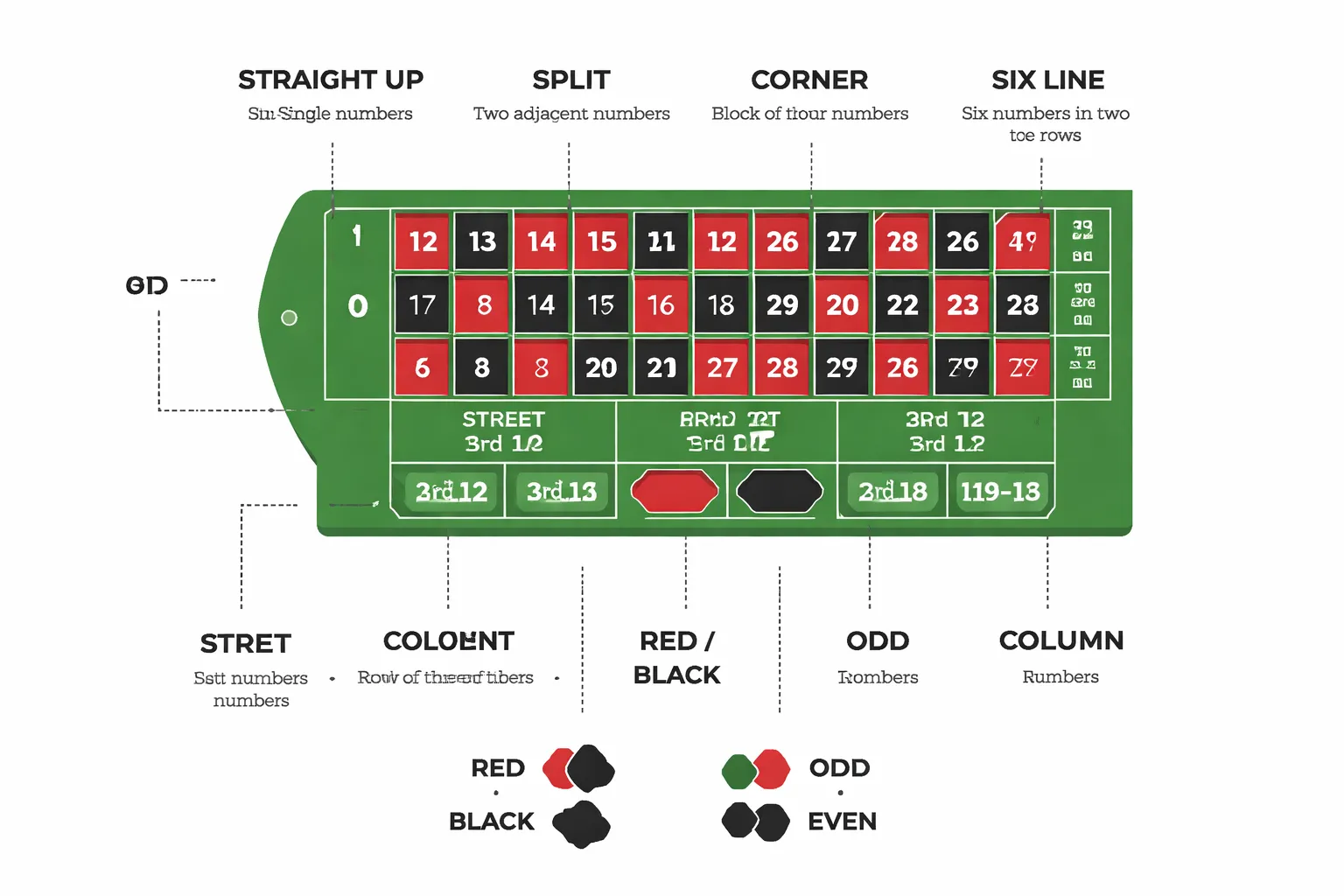
Number Grid vs Outside Betting Areas
The layout has two main zones.
- Number grid (inside area): the 0 (and 00 on American tables) plus numbers 1 to 36. You place precise bets on single numbers or small groups.
- Outside area: larger boxes that cover many numbers at once. You place simpler bets like red or black, odd or even, and dozens.
Inside bets trade higher payouts for lower hit rates. Outside bets hit more often but pay less.
Inside Bet Zones and Where Chips Go
Inside bets use the lines and corners between numbers. Your chip position defines the bet.
- Straight up: place your chip fully inside one number square.
- Split: place your chip on the line between two numbers, either side-by-side or stacked vertically.
- Street: place your chip on the outside edge at the end of a row of three numbers, such as 1-2-3.
- Corner: place your chip on the intersection where four numbers meet, such as 1-2-4-5.
- Six line (double street): place your chip on the line between two adjacent rows. It covers six numbers, such as 1-2-3-4-5-6.
Online tables usually highlight the covered numbers before you confirm. Use that preview, especially on splits and corners.
Outside Bet Zones: Color, Odd/Even, Low/High, Dozens, Columns
Outside bets sit around the grid.
- Red or Black: covers 18 numbers. Green zero does not count.
- Odd or Even: covers 18 numbers. Zero does not count.
- Low (1 to 18) or High (19 to 36): covers 18 numbers. Zero does not count.
- Dozens: 1 to 12, 13 to 24, 25 to 36. Each covers 12 numbers.
- Columns: three long columns that run down the grid. Each covers 12 numbers.
These zones reduce decision time. They also reduce payout size compared to inside bets.
Tracking Board and Spin History
The tracking board shows recent results, usually the last 10 to 20 spins, plus frequency charts.
- What it shows: recent numbers, red or black streaks, hot and cold counts, sometimes the last dozen and last column.
- What it does not mean: it does not change your odds on the next spin. Each spin stays independent.
Use it to confirm the game runs and to review outcomes. Do not use it as a signal that a number is due.
Mobile and Tablet Interface Tips
Mobile layouts compress the table. Most apps add controls to avoid misclicks.
- Toggles and zoom: switch between inside and outside views. Use pinch zoom if offered.
- Chip values: set your chip size first, then place multiple chips fast. Watch the total bet counter.
- Rebet: repeats your last betting pattern for the next spin. Check limits first, especially if the table minimum changed.
- Double: doubles all current placed chips. Use it only if it keeps you under max limits.
- Undo or clear: remove the last chip or wipe the board before you confirm.
If you play both European and American wheels, confirm the zero layout each time. Use the rules panel, not the table skin. See European vs American Roulette: Key Differences.
How to Play Online Roulette Step by Step
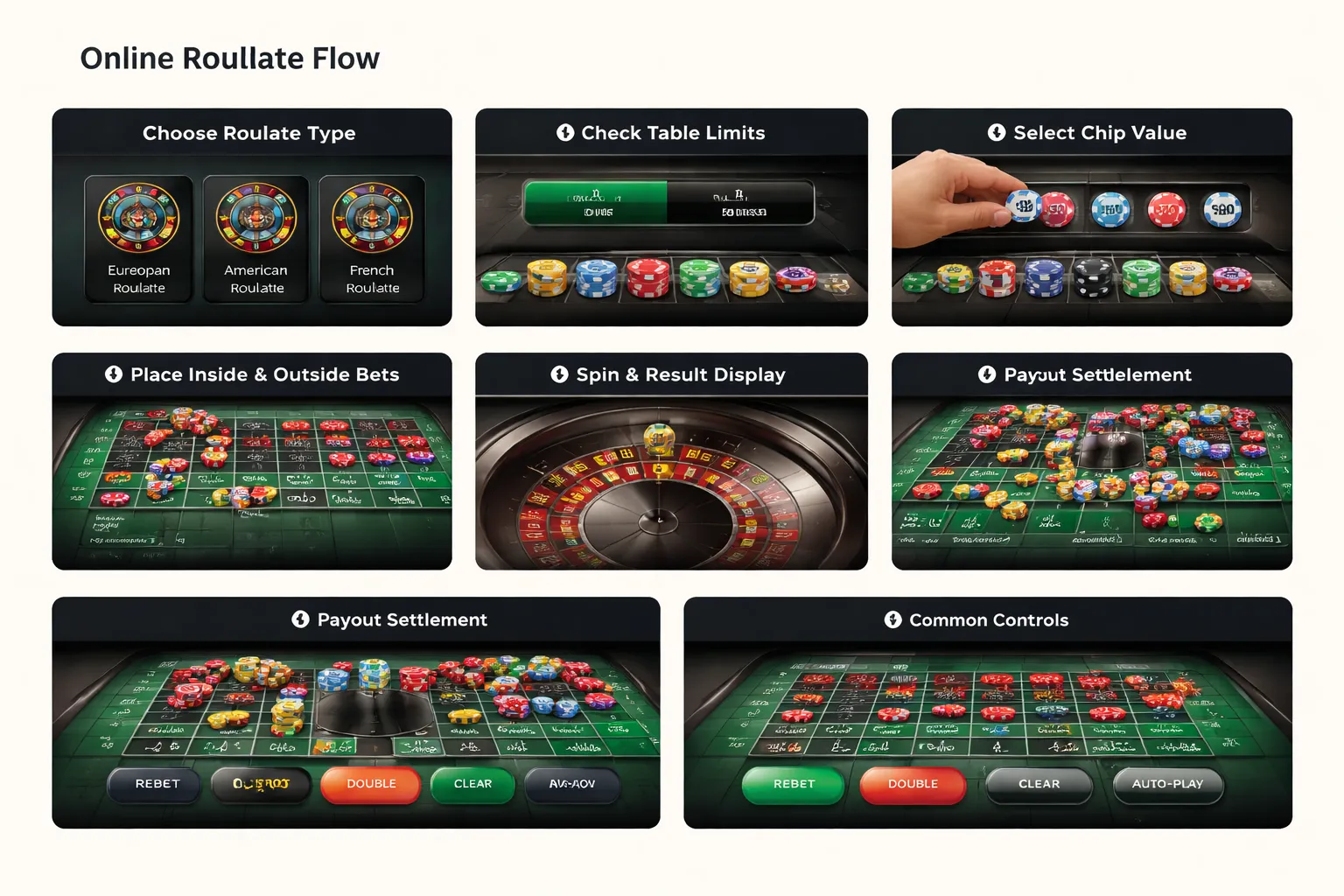
Setting up a session
- Choose a game type. Pick European, American, or French roulette. Confirm the zero layout and rules panel before you bet.
- Check table limits. Look at minimum and maximum bets for the table and for each bet type. Some tables cap inside bets lower than outside bets.
- Set your session size. Decide your buy-in and your stop point. Keep it separate from your total bankroll.
- Select chip size. Choose a chip value that lets you place the bets you want without hitting limits. If the minimum is $1 and you plan to cover many numbers, smaller chips keep you flexible.
Placing bets correctly before “no more bets”
- Place chips on the right spot. Inside bets go on numbers and lines in the grid. Outside bets go on the boxes below the grid, such as red, black, odd, even, dozens, and columns.
- Use the hover help. Most tables highlight the bet you are about to place. If the highlight does not match your intent, move your cursor and place again.
- Confirm your stake. Check the bet slip or total stake display. Many games show a breakdown by bet type and total amount.
- Beat the timer. Place and confirm bets before the cutoff. Once the game shows “no more bets,” any new clicks should not count.
- Avoid misclicks on corners and splits. Zoom the table if available. One pixel can change a straight-up bet into a split or corner.
What happens during the spin and how results display online
- The game locks bets. Your chips freeze on the layout. The stake total should not change.
- The wheel spins. In RNG roulette, the result generates digitally. In live roulette, the dealer spins the wheel and releases the ball.
- The winning number shows in several places. You usually see it on the wheel, a result banner, and the table highlight on the layout.
- Recent results update. The history bar logs the number and often the color and odd or even. Treat history as record keeping, not a predictor.
How winnings are calculated and credited
Roulette payouts quote profit, and you also get your original stake back on winning bets.
- Example, straight-up win (35:1). You bet $5 on a single number. If it hits, you win $175 profit and get your $5 stake back, $180 total return.
- Example, even-money win (1:1). You bet $10 on red. If it hits, you win $10 profit and get your $10 stake back, $20 total return.
- Partial returns happen when some bets win and others lose. If you cover multiple spots, the game settles each chip separately. Your balance change equals total returns minus total stakes.
- Credits post after settlement. Most games update your balance as soon as the result confirms. Live tables can take a few seconds longer due to dealer confirmation.
Using common controls safely
- Rebet or repeat. Re-applies your last confirmed bets for the next round. Use it only after you confirm limits did not change.
- Double. Doubles every chip on the layout. It can push you over a table max fast. Check the total stake before you confirm.
- Clear and undo. Clear removes all current unconfirmed chips. Undo removes the last chip you placed. Use these before you confirm, not after.
- Auto-play. The table repeats rounds for you. Set a loss limit, a win limit, and a max number of spins if the casino offers those controls. If it does not, avoid auto-play.
- Fast spin and animations. Faster settings reduce downtime but can hide mistakes. Keep normal speed until you trust your bet placement.
Roulette Bets: Inside Bets (Higher Risk, Higher Payouts)
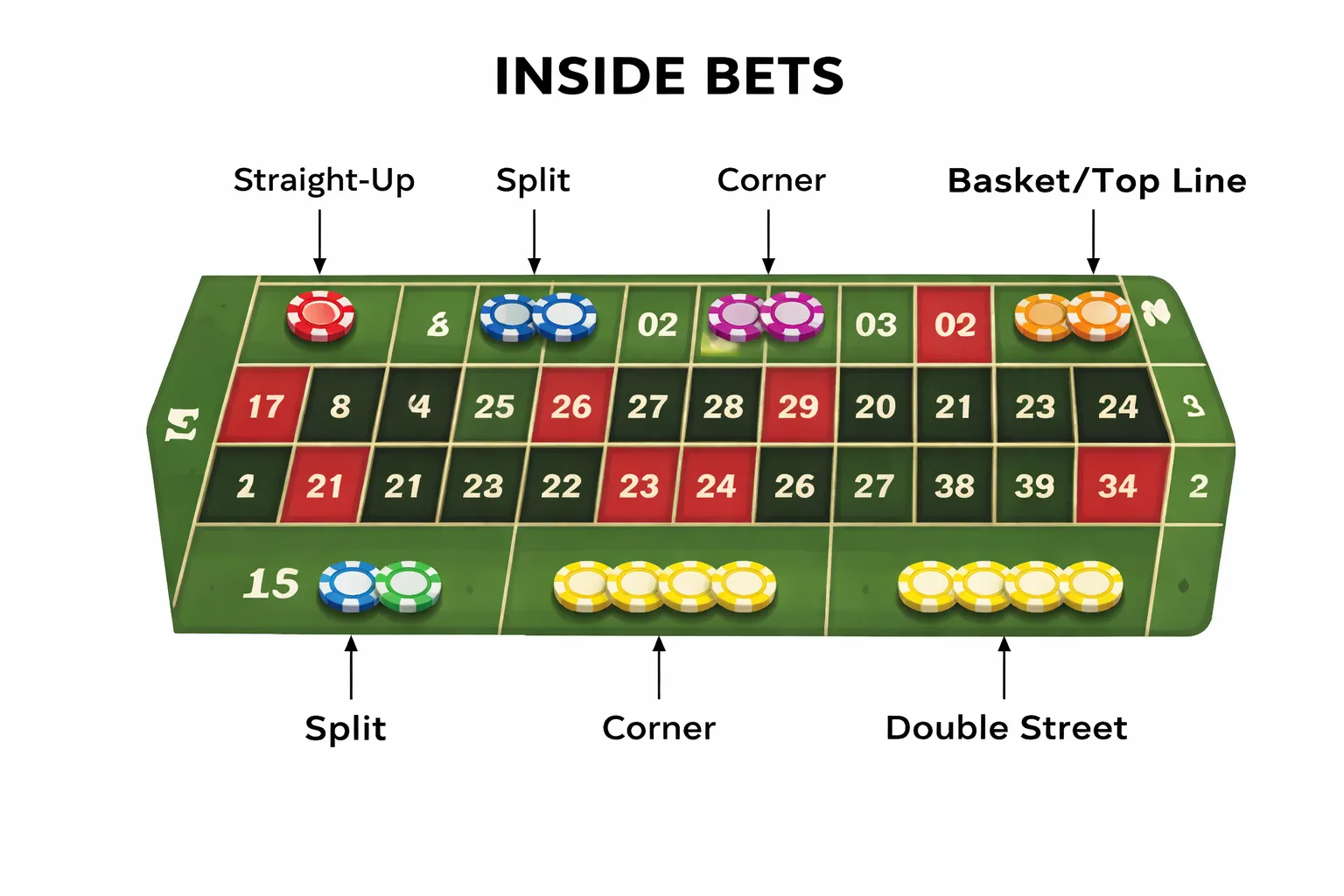
Straight-up bet (single number)
You bet on one exact number. You place your chip in the center of a numbered square.
This is the highest standard payout on the table.
- Payout: 35:1
- Covers: 1 number
- Typical use: When you want maximum payout per unit, and you accept frequent losses.
Split bet (two numbers)
You bet on two adjacent numbers. Place your chip on the line that separates the two numbers.
- Payout: 17:1
- Covers: 2 numbers
- How to place: Put one chip directly on the shared border line between the two squares.
- Tip: On mobile, zoom in. Misplacing a split turns it into a straight-up bet.
Street and double-street bets (rows)
A street covers a full row of three numbers. A double-street covers two rows, six numbers total.
- Street (3 numbers): Place your chip on the outside edge at the end of a row. Payout: 11:1
- Double-street (6 numbers): Place your chip on the outside corner where two rows meet. Payout: 5:1
- Best fit: Use streets when you want a mid-range hit rate with a stronger payoff than outside bets. Use double-streets when you want more coverage and smoother swings.
Corner bet (four numbers)
A corner bet covers four numbers that form a block. Place your chip on the intersection point where the four squares meet.
- Payout: 8:1
- Covers: 4 numbers
- When it makes sense: When you want tighter targeting than a street, but better coverage than a split. It also reduces placement mistakes versus thin split lines.
Basket or top line bet (0 and variants)
Basket bets depend on the roulette variant. Always check the table help before you use them.
- European roulette: Many tables offer a basket that covers 0-1-2-3. Payout: 8:1.
- American roulette: Many tables offer a top line that covers 0-00-1-2-3. Payout: 6:1. This bet usually has a worse house edge than standard inside bets.
- French layouts: You may see named zero-area bets placed as call bets. Some online tables convert them into normal chip placements.
| Inside bet | Numbers covered | Payout | How you place it |
|---|---|---|---|
| Straight-up | 1 | 35:1 | On a single number |
| Split | 2 | 17:1 | On the line between two numbers |
| Street | 3 | 11:1 | On the outside edge of a row |
| Corner | 4 | 8:1 | On the intersection of four numbers |
| Double-street | 6 | 5:1 | On the outside corner joining two rows |
| Basket (European) | 4 | 8:1 | On 0-1-2-3, if offered |
| Top line (American) | 5 | 6:1 | On 0-00-1-2-3, if offered |
Roulette Bets: Outside Bets (Lower Volatility, Smaller Payouts)
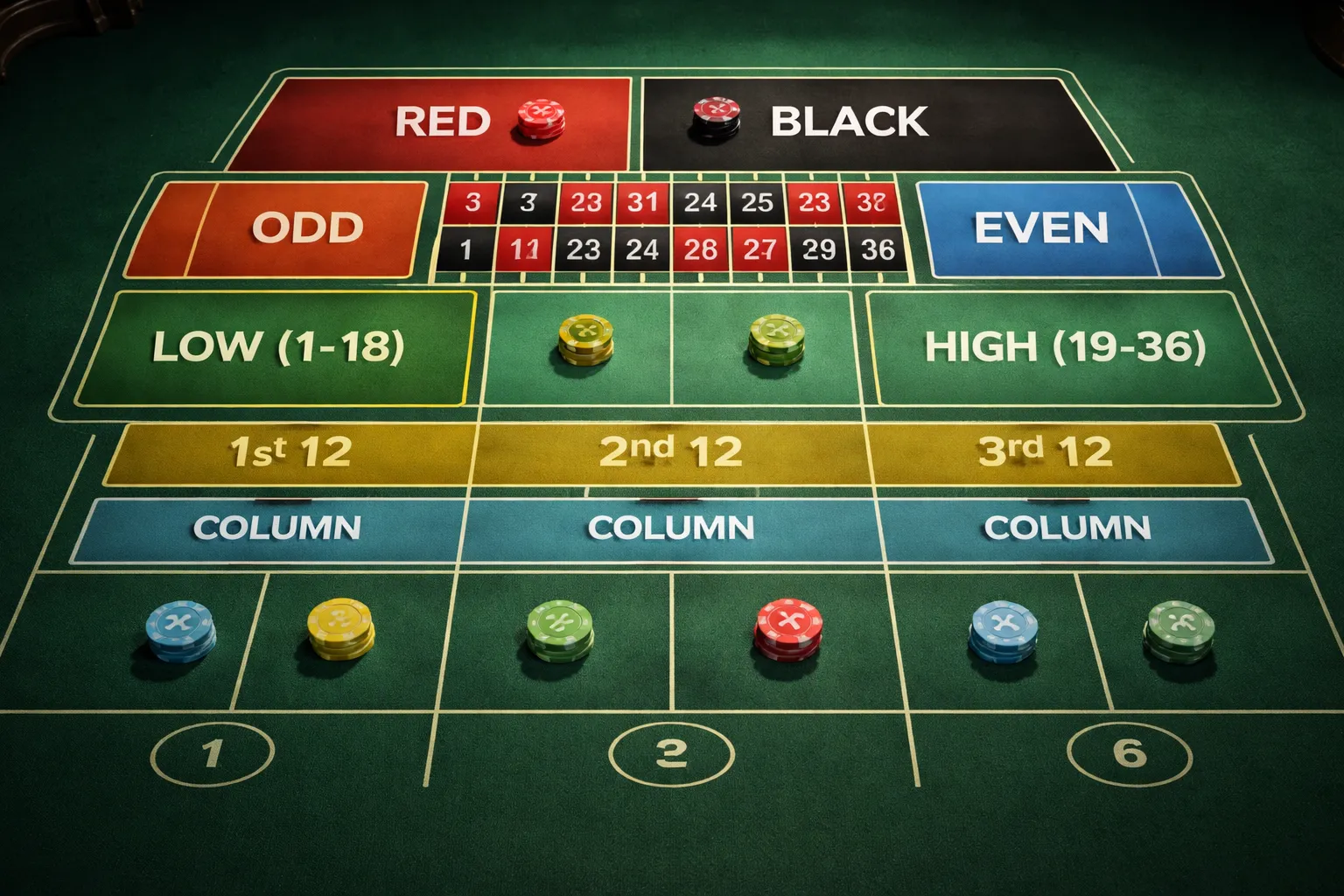
Outside Bets: Lower Volatility, Smaller Payouts
Outside bets cover large parts of the layout. You hit more often than inside bets, but you win less per hit. The house edge still comes from the zero pocket, and from 00 in American roulette.
Red or Black, Odd or Even
These bets cover 18 numbers. The payout is 1:1 because you almost win half the time. You do not, because zero is not red, black, odd, or even.
If the ball lands on 0, and 00 on American wheels, you lose. That missing outcome is why the bet is not true 50-50.
- Coverage: 18 of 37 numbers in European roulette, 18 of 38 in American roulette.
- Payout: 1:1 (even money).
- Key rule: 0 and 00 never count for these bets.
Low or High (1 to 18, 19 to 36)
Low covers 1 to 18. High covers 19 to 36. Both pay 1:1 and ignore zero.
- Example: You bet Low. The ball lands on 12, you win 1:1.
- Example: You bet High. The ball lands on 31, you win 1:1.
- Example: You bet Low. The ball lands on 0, you lose.
Dozens (1 to 12, 13 to 24, 25 to 36)
Dozen bets cover 12 numbers at once. They pay 2:1. Zero does not belong to any dozen.
- 1st 12: 1 to 12.
- 2nd 12: 13 to 24.
- 3rd 12: 25 to 36.
- Coverage: 12 of 37 (European) or 12 of 38 (American).
- Payout: 2:1.
Columns (2:1 Bets)
Columns also cover 12 numbers and pay 2:1. You place the chip in the column box at the bottom of the layout, marked 2 to 1.
Most layouts show three vertical columns. Each column includes 12 numbers. Zero sits outside the grid, so it is not in any column.
- How to choose: Look at the three boxes labeled 2 to 1 under the number grid, pick one, place your chip there.
- Coverage: 12 numbers.
- Payout: 2:1.
| Outside bet | Numbers covered (European) | Payout | Where you place it |
|---|---|---|---|
| Red or Black | 18 | 1:1 | On the Red or Black box |
| Odd or Even | 18 | 1:1 | On the Odd or Even box |
| Low (1 to 18) or High (19 to 36) | 18 | 1:1 | On the 1 to 18 or 19 to 36 box |
| Dozen | 12 | 2:1 | On 1st 12, 2nd 12, or 3rd 12 |
| Column | 12 | 2:1 | On a 2 to 1 box below the grid |
Call and Announced Bets (Live and French Tables)
Some live dealer and French roulette tables let you place announced bets. You call the bet name, or select it from a menu. The dealer places the chips for you. Online rules vary by provider, so read the bet help panel before you confirm.
- Voisins du Zéro: A wheel section around zero. The game splits your stake across specific splits and corners in that sector.
- Tiers du Cylindre: A wheel section opposite the zero side. The game spreads your chips across splits in that sector.
- Orphelins: The remaining numbers not covered by Voisins and Tiers. The game places a set of straight up and split bets.
These are still roulette bets, with the same zero disadvantage. They do not change the house edge. They change how you cover wheel sectors, and how your stake gets divided.
If you want lower house edge, pick the right wheel first. Use European or French rules when you can. See European vs American roulette odds.
Roulette Payouts, Odds, and House Edge (Made Simple)
Roulette payouts, what you win vs what you get back
Roulette payouts quote your profit. You also get your original stake back on a win.
| Bet type | Covers | Casino payout (profit) | Total return on win (stake + profit) |
|---|---|---|---|
| Straight up | 1 number | 35 to 1 | 36 to 1 |
| Split | 2 numbers | 17 to 1 | 18 to 1 |
| Street | 3 numbers | 11 to 1 | 12 to 1 |
| Corner | 4 numbers | 8 to 1 | 9 to 1 |
| Six line | 6 numbers | 5 to 1 | 6 to 1 |
| Dozen | 12 numbers | 2 to 1 | 3 to 1 |
| Column | 12 numbers | 2 to 1 | 3 to 1 |
| Even money (Red/Black, Odd/Even, High/Low) | 18 numbers | 1 to 1 | 2 to 1 |
True odds vs casino payouts, where the edge comes from
True odds come from the wheel. Casino payouts pay you less than true odds. That gap is the house edge.
- European and French wheels. 37 pockets. 0 to 36.
- American wheels. 38 pockets. 0 to 36 plus 00.
Example, straight up on a European wheel.
- True chance: 1 in 37.
- True fair payout would be 36 to 1 profit.
- Casino pays 35 to 1 profit.
- That missing 1 unit is the edge.
House edge by roulette variant
| Variant | Pockets | House edge | What changes it |
|---|---|---|---|
| European roulette | 37 | 2.70% | Single zero |
| French roulette (standard rules) | 37 | 2.70% | Same wheel as European |
| French roulette with La Partage | 37 | 1.35% on even money bets | Half your even money stake returns when 0 hits |
| French roulette with En Prison | 37 | 1.35% on even money bets | Your even money bet locks on 0, you resolve it next spin |
| American roulette | 38 | 5.26% | Double zero |
Inside bets and outside bets keep the same house edge on the same wheel. The wheel decides the edge. Rules like La Partage can reduce it for even money bets.
Probability examples, what 1 in 37 looks like over time
Each spin stays independent. Your long run results still drift toward the math.
- Straight up on European. You hit about 1 time per 37 spins on average. In 370 spins, you expect about 10 hits, but you can easily see 6 or 14.
- Red on European. You win 18 out of 37 spins on average, or about 48.65%. The other 19 outcomes are black or 0.
- Red on American. You win 18 out of 38 spins on average, or about 47.37%. The extra loss comes from 0 and 00.
If you care about lower cost per spin, choose a single zero wheel. If you play even money bets, prefer La Partage or En Prison when available. For more low edge picks across casino games, see best low house edge casino games.
Volatility and hit frequency, pick bets that fit your risk
Volatility is how swingy your bankroll gets. Hit frequency is how often you win a spin. Big payouts mean fewer hits. Small payouts mean more hits.
- Low volatility, high hit rate. Even money bets. You win often, but 0 or 00 still cuts into results.
- Medium volatility. Dozens and columns. Fewer wins than even money, bigger payouts.
- High volatility, low hit rate. Straight up, splits, and other inside bets. Long losing streaks happen. Your wins come in spikes.
Choose your bet size for the streaks you can handle. The edge stays the same, but your ride does not.
Practical Tips for Playing Online Roulette Better (Without Myths)
Start with low-volatility bets to learn the table
Use even money bets first. Red or black, odd or even, high or low. They pay 1:1 and hit often. You learn the interface, the chip values, and the betting timer without long dead stretches.
Move to dozens or columns next. They pay 2:1 and hit less. You start feeling variance without the long droughts you get from inside bets.
Leave straight-up and small inside bets for later. They pay more, but your sessions will swing harder. Your bankroll needs room for streaks.
Set a bankroll, a session budget, and stop points
Split money by purpose. Bankroll is your total for roulette. Session budget is what you can lose today. Keep them separate.
- Bankroll: the full amount you set aside for roulette over many sessions.
- Session budget: a fixed slice of your bankroll for one session. Do not reload when you lose it.
- Stop-loss: the point where you end the session if you go down. Set it before you bet.
- Stop-win: the point where you lock profit. It does not change the math, it controls your exposure.
Keep your base bet small. A simple rule works, your base bet should survive normal streaks. If a 10 to 15 unit downswing ends your session, your base bet is too big.
Avoid common misconceptions that cost money
- Hot and cold numbers: past spins do not change the next result on a fair wheel. A board shows history, not future value.
- Gambler’s fallacy: a run of red does not make black more likely next spin. Each spin stays independent.
- “Due” outcomes: roulette has no memory. The wheel does not balance your results.
What does matter is rules and wheel type. Single-zero games give you a better deal than double-zero. Read more in European vs American roulette.
Use demo mode to practice speed and payouts
Use free-play mode before you use real money. Practice these basics until they feel automatic.
- Place, clear, and re-place chips fast before the timer ends.
- Spot the difference between inside and outside bet zones.
- Confirm payouts by bet type. 1:1, 2:1, 35:1.
- Track results in units, not cash. It keeps decisions consistent.
Betting systems, when to use them and when to avoid them
Systems do not change the house edge. They only change bet sizing. They can help you follow a plan, but they can also push you into oversized bets.
| System | What it does | When it helps | Main risk |
|---|---|---|---|
| Martingale | Double after each loss, reset after a win. | Almost never. Only fits short sessions with strict table limits and a hard stop-loss. | Bet size explodes fast. Table limits and bankroll caps stop the recovery cycle. |
| Fibonacci | Increase bets along the Fibonacci sequence after losses, step back after wins. | When you want slower escalation than Martingale and you accept longer recovery. | Still ramps up. Long losing streaks create large bets and long grindbacks. |
| D’Alembert | Increase 1 unit after a loss, decrease 1 unit after a win. | When you want a simple pacing tool with small bet swings. | Does not “smooth” results enough to beat variance. It can keep you betting longer than planned. |
If you use any system, cap your bet size. Set a max step count. If you hit the cap, stop the session. Do not chase.
Online Roulette Safety, Fairness, and Responsible Play
How to verify an online roulette casino is legit
- License: Check the footer for a regulator name and license number. Open the regulator site and confirm the number matches the casino brand and URL. Avoid sites with “licensed” claims but no verifiable record.
- Ownership and contact: Find the operating company name, address, and support channels. Legit operators show them. Scam sites hide them.
- RNG certificate: For RNG roulette, look for an RNG testing certificate from a known lab. You want a current report, a clear scope, and the casino name.
- Game provider list: Check whether known providers supply the roulette games. Unknown clones and unbranded software raise risk.
- Payment and KYC policy: Read withdrawal rules, verification steps, and timeframes before you deposit. If the terms let the casino “void winnings at discretion,” leave.
- Independent audits: Some casinos publish regular payout and compliance audits. Treat missing audits as neutral, treat fake badges as a red flag.
RNG roulette fairness and what certificates mean
RNG roulette uses software to generate outcomes. A certificate does not promise you will win. It aims to prove the generator behaves as a random source within test limits.
- What to look for: The lab name, test date, the specific game or RNG module, and a pass statement.
- What it does not cover: Your bonus terms, withdrawal limits, or account closures. It also does not remove the house edge.
- Practical check: Play small first. Test deposits, gameplay, and a withdrawal. Do this before you scale up.
Live dealer integrity, studio controls, and streaming transparency
Live roulette adds a real wheel and a camera feed. You still need process controls.
- Studio oversight: Reputable studios run controlled tables, logged shifts, and monitored wheels. They track wheel maintenance and replace worn parts.
- Game history: Use the round history and result log. You want clear timestamps, table ID, and outcomes you can review.
- Streaming delays: Live streams often run on a short delay. That delay helps the studio lock bets before the result becomes obvious on the feed. Treat any “late bet” offer with caution.
- Bet cut off: The game should show a clear bet closing point. If the UI feels inconsistent, switch tables.
- Provider reputation: Stick to known live providers with regulated studio locations and published compliance standards.
Bonuses and wagering requirements, roulette value impact
Roulette has a built-in house edge. Bonus terms can make it worse by forcing extra volume or by limiting which bets count.
- Wagering requirement: A 30x requirement means you must stake 30 times the bonus amount before you can withdraw bonus funds, and often before you can withdraw winnings linked to it.
- Game contribution: Many casinos count roulette at a reduced rate, often 0 to 20 percent. That means roulette may barely reduce your wagering target.
- Bet limits during wagering: Terms often cap your max bet while a bonus is active. If you exceed it, they can void winnings.
- Restricted bets: Some terms ban low variance outside bets or specific patterns. If the rules mention “even money bets” limits, follow them or skip the offer.
- Cashback and rakeback: These can reduce loss rate, but they never remove the house edge. Treat them as rebates, not profit engines.
- Practical rule: If you cannot explain the wagering math in one minute, do not accept the bonus.
Responsible gambling tools you should use
Roulette can swing fast. You need hard limits, not willpower.
- Deposit limit: Set a daily or weekly cap. Match it to money you can lose without impact.
- Loss limit: Some sites let you cap net losses. Use it if available.
- Session time limit: Set a timer. Stop when it ends.
- Timeout: Take a short break option for cooling off. Use it after a bad run.
- Self-exclusion: Use multi-month or permanent exclusion if you keep breaking your rules.
- Reality checks: Enable popups that show time played and net results. They reduce autopilot play.
- Keep stakes boring: Pick a unit size, keep it stable, quit on your stop points. Systems do not change the math.
Age, legality, and regional availability
- Age: You must meet the legal gambling age in your region. Casinos verify this during KYC. Do not try to bypass it.
- Location rules: Legal status depends on where you are, not where the casino is based. A valid license in one market does not grant access everywhere.
- VPN risk: Many operators ban VPN play. They can withhold withdrawals if your location violates terms.
- Tax and reporting: Some regions tax gambling winnings or require reporting. Know your local rules before you play for real money.
- Game availability: Some jurisdictions restrict live dealer tables or certain roulette variants. Expect different lobbies and limits by region.
Pros and Cons of Playing Roulette Online
Advantages of Online Roulette
- Convenience: You can play on mobile or desktop. You can switch tables in seconds. You can play for fun or for real money.
- Table variety: You usually get European, French, and American roulette, plus many side bet tables. You can pick different limits and wheel speeds. You can also choose live dealer lobbies when available.
- Speed: RNG roulette runs fast. Auto re-bet and instant payouts reduce downtime. This suits short sessions and quick practice.
- Low minimums: Many RNG tables start at $0.10 to $1 per spin. Live dealer tables often start higher, commonly $5 to $10, but you can still find low-limit rooms at some sites.
Drawbacks of Online Roulette
- Fast pace can increase losses: More spins per hour means you can cycle your bankroll faster. If you raise stakes after losses, the damage ramps up fast.
- Bonus restrictions: Roulette often counts less toward wagering requirements than slots. Some bonuses exclude roulette or cap how much you can bet per spin while a bonus is active. Always check contribution rates, max bet rules, and game exclusions.
- Fewer social cues: You lose the floor atmosphere and table reads. Live chat helps, but it is not the same as in-person play. This matters if you use the table pace and dealer interaction to stay disciplined.
RNG vs Live Dealer Roulette, Pick the Right Fit
| Option | Best for | Trade-offs |
|---|---|---|
| RNG roulette | Low minimums, fast sessions, testing bet sizing, private play | Less social feel. Speed can push you into more spins and faster losses. Bonus rules can still limit roulette play. |
| Live dealer roulette | Real wheel feel, slower pace, clearer table rhythm, social chat | Higher minimums on many tables. Fewer variants in restricted regions. You depend on stream quality and table availability. |
If you want a structured, slower table game with clear decisions, compare roulette to online blackjack rules and payouts.
FAQ
What is the difference between European and American roulette?
European roulette has 37 pockets, 0 to 36. American roulette has 38 pockets, 0 to 36 plus 00. The extra 00 raises the house edge. Choose European when you can, it gives you better long-term value.
What is the house edge in roulette?
European roulette has a 2.70% house edge. American roulette has a 5.26% house edge. Single-zero beats double-zero on every bet type because payouts stay the same while the wheel adds one extra losing pocket.
What is the best bet in roulette?
Even-money outside bets give the lowest variance, red or black, odd or even, high or low. The house edge stays the same as other bets on the same wheel. Use them to control swings, not to change the math.
What is the highest paying bet in roulette?
A straight-up bet on one number pays 35 to 1. It has the highest payout and the highest variance. On a European wheel, your win chance is 1 in 37. On an American wheel, it is 1 in 38.
Do roulette systems work?
No system removes the house edge. Martingale and similar progressions can trigger table limits fast and can drain your bankroll during losing streaks. If you use a system, treat it as a staking plan, not a way to win.
Is online roulette fair?
Reputable sites use audited RNGs for digital roulette and regulated procedures for live wheels. You still need to verify the operator. Use this guide to understand testing, RTP, and house edge: online casino fairness.
Can you use “auto-roulette” or autoplay?
Yes on many RNG tables. It speeds up play and increases your bet volume per hour. That increases expected loss at the same house edge. Set a time limit and a loss limit before you use it.
What does “La Partage” and “En Prison” mean?
These rules apply to even-money bets on some European tables. If the ball lands on 0, La Partage returns half your stake. En Prison locks your bet for the next spin and returns it if you win. They cut the house edge on even-money bets to 1.35%.
Why do payouts say 35 to 1 when the odds are worse?
A straight-up win chance is 1 in 37 on European and 1 in 38 on American. True odds would pay 36 to 1. Casinos pay 35 to 1. That one-unit gap creates the house edge.
Do roulette bonus rules matter?
Yes. Many casinos restrict roulette for wagering, or count only a small percentage of your bets. Check the terms before you play. If roulette counts at 0% to 10%, your bonus may not be usable for your normal bet size.
Conclusion
Conclusion
Roulette is simple. You place a bet, the wheel spins, and the result pays based on the odds.
Your edge comes from two choices. Pick the right wheel, and pick bets that fit your budget.
- Choose European roulette when you can. It uses 37 pockets, and it beats American roulette at 38 pockets.
- Use outside bets to control swings. They win more often, but pay less.
- Use inside bets for higher payouts. They hit less often, and you will see bigger variance.
- Track the house edge. A straight-up bet pays 35 to 1, but true odds are 36 to 1. That gap drives the casino advantage.
- Check bonus terms before you deposit. If roulette counts at 0% to 10%, your wagering plan may not work.
Final tip. Set a stake per spin, set a stop loss, and do not raise your bet to chase losses.
-
Online Casino Fairness Explained: RNG, RTP, House Edge & Provably Fair
8 months ago -
Slot RTP Explained: What RTP Means and How to Use It
8 months ago -
How to Play Online Slots: Rules, Features & Beginner Tips
8 months ago -
How Slot Jackpots Work: Progressive Jackpots Explained
8 months ago -
How to Play Online Blackjack: Rules, Payouts & Quick Start Guide
8 months ago
-
- What is the difference between European and American roulette?
- What is the house edge in roulette?
- What is the best bet in roulette?
- What is the highest paying bet in roulette?
- Do roulette systems work?
- Is online roulette fair?
- Can you use “auto-roulette” or autoplay?
- What does “La Partage” and “En Prison” mean?
- Why do payouts say 35 to 1 when the odds are worse?
- Do roulette bonus rules matter?
-
- What is the difference between European and American roulette?
- What is the house edge in roulette?
- What is the best bet in roulette?
- What is the highest paying bet in roulette?
- Do roulette systems work?
- Is online roulette fair?
- Can you use “auto-roulette” or autoplay?
- What does “La Partage” and “En Prison” mean?
- Why do payouts say 35 to 1 when the odds are worse?
- Do roulette bonus rules matter?
-
Reload Bonus Explained: What It Is and When It’s Worth Claiming
6 months ago -
Online Casino Licensing Explained: Authorities, Licenses & How to Check One
8 months ago -
Best Live Dealer Casinos: Where to Play Live Blackjack, Roulette & More
8 months ago -
Best Online Casinos for High Rollers: VIP Perks, High Limits & Exclusive Bonuses
8 months ago -
Fast Payout Online Casinos: Best Sites for Quick Withdrawals
8 months ago
-
Online Casino Customer Support: What to Look For (Live Chat, Email, Response Times)
8 months ago -
Sign Up for an Online Casino: Create an Account in Minutes
8 months ago -
Online Casino Payment Safety Tips: How to Deposit and Withdraw Securely
8 months ago -
What to Do If an Online Casino Won’t Pay Out: Step-by-Step Actions
8 months ago -
How to File a Complaint Against an Online Casino (Plus ADR Explained)
8 months ago