Online Casino Fairness Explained: RNG, RTP, House Edge & Provably Fair

Casino fairness comes down to math and controls. You need to know what you can trust, and what you cannot.
This guide breaks down the four core pieces of online casino fairness. RNG decides outcomes in slots and most digital table games. RTP shows the average return over a large sample. House edge tells you the casino’s long-term advantage. Provably fair lets you verify results in some crypto games.
You will learn how each metric works, what numbers to look for, and how to spot weak claims. You will also see where fairness stops, like live dealer games where cameras and procedures replace RNG. If you play roulette, start with the odds, not the hype, see European vs American roulette odds.
Key Takeaways
Key Takeaways
- In het kort: RNG bepaalt elke uitkomst in slots en digitale tafelspellen, maar het zegt niets over hoe duur een spel is.
- In het kort: RTP is een langetermijngemiddelde, geen belofte voor jouw sessie. Gebruik het om spellen te vergelijken.
- In het kort: House edge is de kernmetric. Lager is beter, altijd.
- In het kort: Variantie bepaalt je swings. Hoge variantie betekent langere losing streaks en grotere pieken.
- In het kort: Provably fair laat je resultaten controleren in sommige crypto games. Check seed, hash, en verificatietool.
- In het kort: Live dealer games gebruiken geen RNG voor de uitkomst. Fairness hangt af van procedures, toezicht, en game rules.
- In het kort: Check claims op bewijs. Zoek onafhankelijke testen, licentie, en transparante game info.
- In het kort: Begin bij roulette met de wiskunde. Europees verslaat Amerikaans op house edge. Lees de details in onze Online Roulette Guide: How to Play, Bets, and Odds.
What “online casino fairness” really means (and what it doesn’t)
Fairness vs. “you can win”, separating randomness from profitability
Online casino fairness means the game follows its stated math and rules. It does not mean you will win. It does not mean you will break even.
A fair game can still have a house edge. That edge pushes your long-run results negative. Randomness decides short-term swings. The edge decides the long-term direction.
RNG fairness means each spin, deal, or roll stands on its own. No “due” outcomes. No patterns you can rely on. Your only real lever is game choice, and how much edge you accept.
If you want better long-run odds, focus on low house edge games and correct decisions. Use a blackjack basic strategy chart to cut avoidable mistakes.
The three pillars, randomness, transparency, and player protections
- Randomness. RNG games need independent testing and certified game builds. Live dealer games need strict dealing procedures, camera coverage, and table controls.
- Transparency. You should find RTP info, rules, bet limits, and payout rules before you deposit. Fair casinos publish this clearly and keep it consistent across desktop and mobile.
- Player protections. You need clear KYC rules, responsible gambling tools, and a real dispute path through a regulator or an ADR provider. If the casino can change terms fast or freeze funds without a process, fairness breaks in practice.
Common fairness red flags in shady casinos, terms, limits, and withdrawal friction
- Bonus terms that block cashouts. High wagering, short time limits, “max cashout” caps, and vague game contribution rules.
- Hidden withdrawal limits. Low weekly or monthly caps that turn a win into a slow drip.
- Withdrawal friction by design. Extra documents after you request a payout, repeated resubmissions, and long “security checks” with no timeline.
- Rule changes after you win. Retroactive term enforcement, sudden max bet rules, or new “abuse” clauses applied only at cashout.
- RTP confusion. No RTP shown, or multiple RTP versions with no clear default. Some slots ship in different RTP configs.
- Unclear game provider info. No studio name, no game ID, no license details, no third-party test references.
- Sharp limits on winning players. Stake cuts, bet delays, or feature blocks with no written policy.
Online casino fairness and RNG explained: the basics of randomness

What RNG stands for and why casinos use it
RNG means Random Number Generator. It picks numbers that decide game outcomes.
Online casinos use RNG because you need a fast, consistent way to deal cards, stop reels, and resolve bets. It also lets regulators and test labs check the math.
RNG does not make a game “good” for you. It makes outcomes unpredictable. The payout rate and house edge come from the game’s rules and payout table, not from the RNG itself.
Pseudo-random vs. true random, PRNGs, TRNGs, and entropy sources
Most online casino games use a PRNG, a pseudo-random number generator. It uses an algorithm to produce a long sequence of numbers.
A TRNG, a true random number generator, pulls randomness from a physical source. That source creates entropy, which means measurable unpredictability.
- PRNG. Algorithm-based. Fast. Auditable. Used in most slots and RNG table games.
- TRNG. Hardware-based. Uses physical noise. Often used to seed a PRNG, not to run every spin.
- Entropy sources. Thermal noise, electronic jitter, oscillator drift, and other hardware noise signals.
A fair setup does not require TRNG output on every bet. It requires a strong PRNG, good seeding, and independent testing.
Seeding, cycles, and why “patterns” are usually apophenia
A PRNG starts from a seed, which is an initial value. The seed plus the algorithm produces the number stream.
Good systems refresh seeds and mix in fresh entropy. That helps prevent prediction and repeatability.
Every PRNG has a period, also called a cycle length. After enough outputs, the sequence can repeat. In modern casino-grade PRNGs, the period is so large that you will not reach it in real play.
Players still see “patterns” because the human brain searches for order. That effect has a name, apophenia. In random sequences, streaks and clusters happen. They do not prove a rigged game.
- A run of bonuses does not mean a bonus “cycle.”
- A cold streak does not mean the slot “owes” you a hit.
- Short sessions create noisy results. The long-run math drives the real average.
Game mapping: turning random numbers into reels, cards, and outcomes
The RNG outputs numbers. The game maps those numbers to outcomes using fixed rules.
- Slots. The game uses the number to select a stop position on each virtual reel. Virtual reels can contain many weighted entries, not just the symbols you see. That weighting sets hit rate and volatility.
- RNG blackjack. The number maps to a shuffle and deal order. The rules then decide draws and outcomes.
- Roulette. The number maps to one of 37 or 38 pockets, depending on the wheel type.
Mapping matters because it sets your true odds. RNG randomness decides which outcome you get. The mapping and paytable decide how often each outcome can appear and what it pays. For a practical view of how slots work under the hood, see how to play online slots.
How RNG fairness is ensured: audits, labs, and certifications
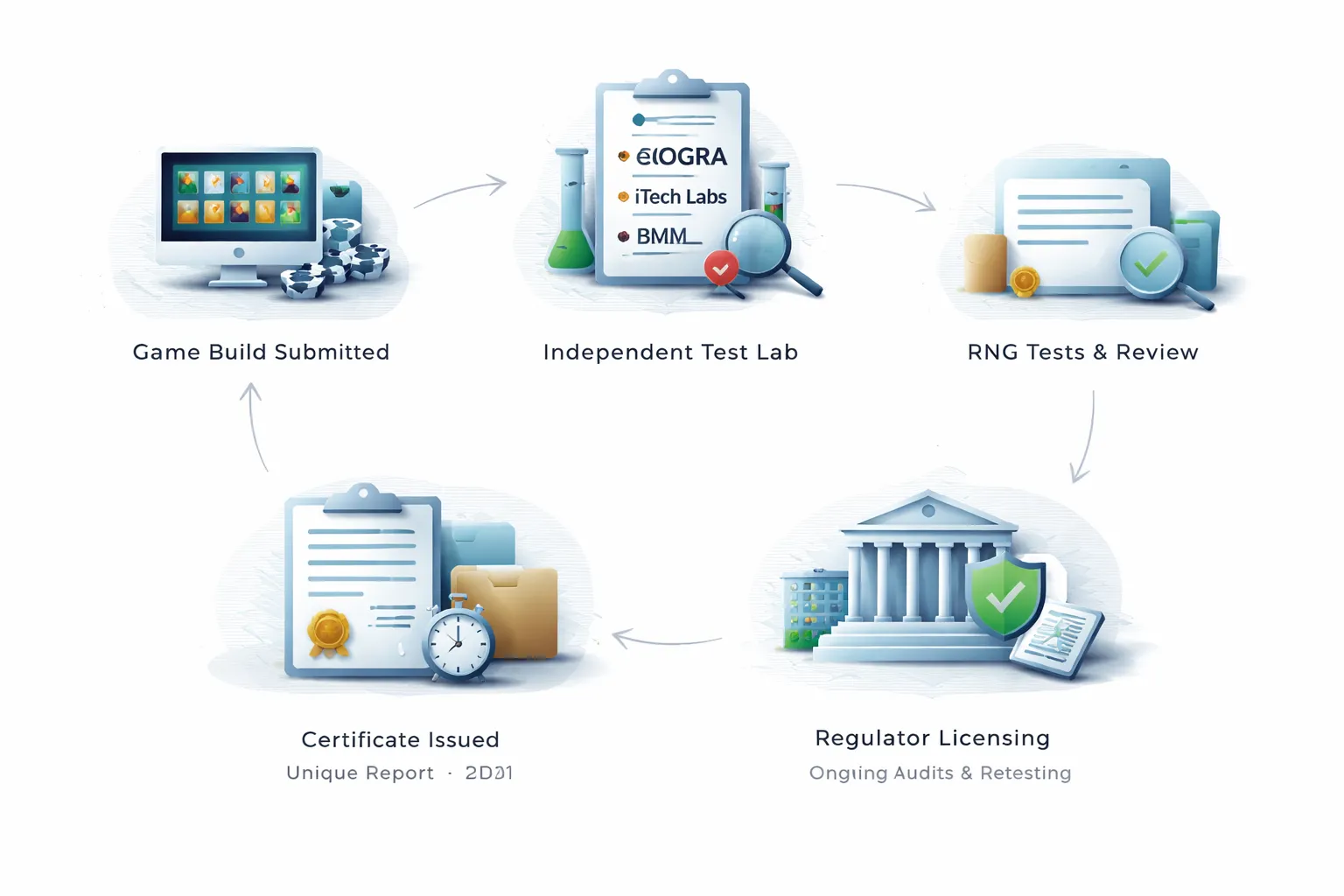
Independent test labs, what they verify
Serious casinos use third party labs to test RNG games before launch and after updates. The best known names include eCOGRA, iTech Labs, GLI, and BMM Testlabs.
- RNG quality. They test the random number generator and its output for statistical bias and predictability.
- Game implementation. They check the game uses the RNG correctly, including seeding, calls to the RNG, and mapping numbers to outcomes.
- Math model. They confirm the paytable and probabilities match the stated RTP and rules.
- Build control. They verify the approved game build matches what players receive, with checksums or version IDs.
- Ongoing checks. Many programs require periodic retesting, or retesting after any change to code, math, or RNG libraries.
What RNG testing checks in practice
Labs run test suites on large samples of RNG output and game simulations. The goal is to catch bias, patterns, and bad integration.
- Distribution. Output should match expected frequencies over large samples. For example, each roulette number should hit about 1 out of 37 times on a European wheel.
- Independence. One result should not help you predict the next. Labs test for correlation and serial dependence.
- Unpredictability. You should not infer future outputs from past outputs, even with a lot of data. Labs review algorithms and seeding, and they test for patterns attackers exploit.
- Repeatability controls. Developers use repeatable test modes in QA. Labs confirm production mode does not run with fixed seeds or debug settings.
- Implementation integrity. They check the game calls the RNG at the right time, uses the right ranges, and applies correct mapping. Bad mapping can create hidden bias even if the RNG output looks random.
Certificates and seals, how to validate them
A seal on a footer means little if you cannot verify it. You should validate four things, link, date, scope, and coverage.
- Link. The seal should link to a lab or regulator page, not a static image hosted by the casino.
- Date. Check the issue date and any expiry date. Old certificates may not cover the current game builds.
- Scope. Confirm it covers RNG testing and game fairness, not just business practices or payout processing.
- Game coverage. Some certificates cover a platform or a set of games, not the entire lobby. Look for a game list, version, or report ID.
If the certificate lacks a report ID, version, or clear coverage, treat it as a marketing badge.
Regulators and licensing, why jurisdiction matters
Testing works best when a regulator enforces it. Your risk changes by jurisdiction.
- Rules and standards. Strong regulators set technical standards for RNGs, change control, and incident reporting.
- Audit leverage. Regulators can demand logs, retests, and source evidence after complaints or anomalies.
- Enforcement. A real license means fines, suspension, or loss of license for non compliance.
- Dispute paths. Strong jurisdictions require player complaint handling, and they often recognize approved ADR bodies.
Check the license number in the casino footer, then verify it on the regulator site. Match the brand name and domain listed on the license to the site you use.
RTP explained: what it tells you, what it hides, and how it’s calculated
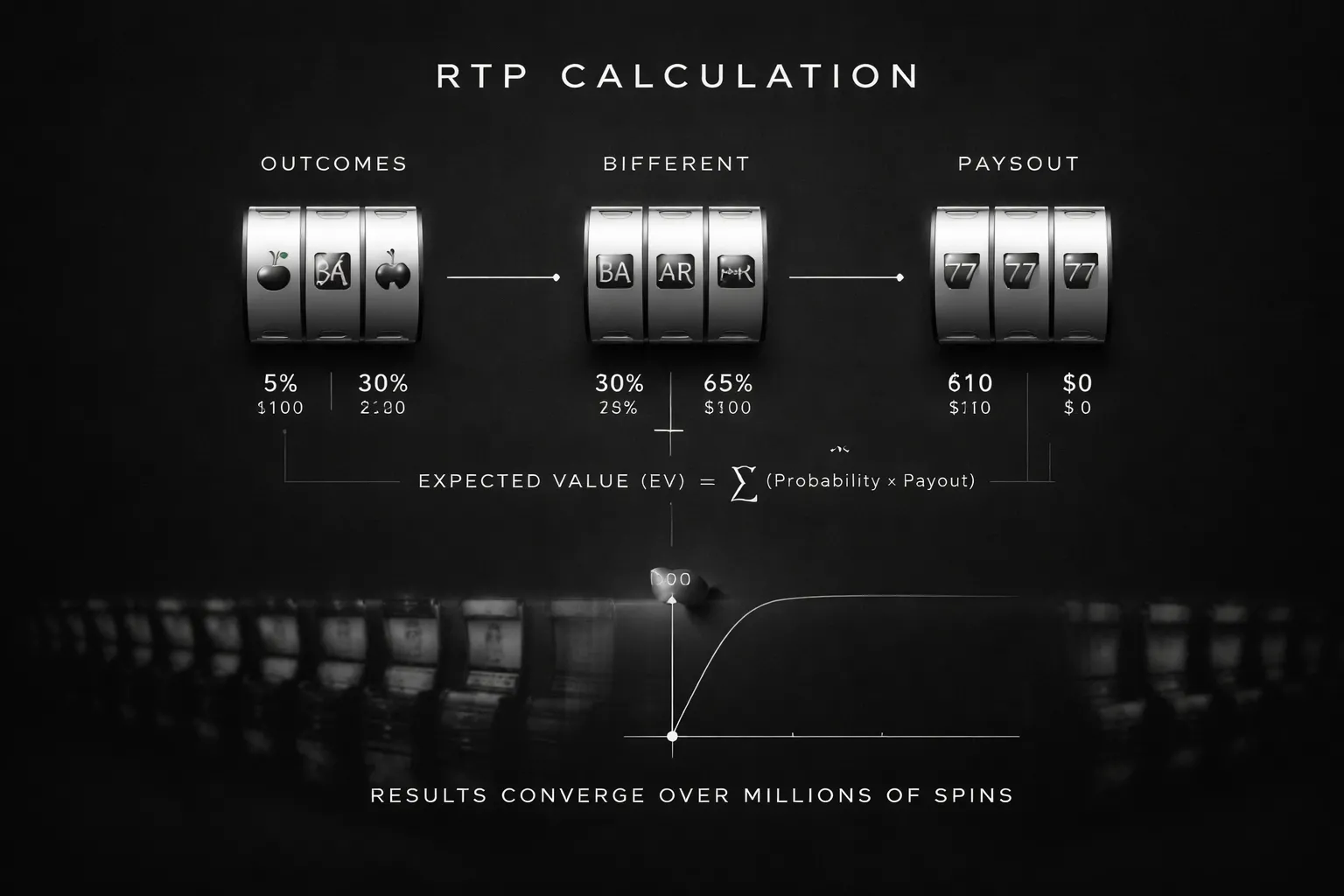
Definition in plain English
RTP means return to player. It is the expected share of stakes a game pays back over a very large number of rounds.
A 96% RTP slot targets about $96 returned for every $100 wagered, across millions of spins. You can still lose $100 fast, or win big, in the short run.
RTP does not predict your session. It describes the long-run average for the whole player pool.
What RTP tells you
- Baseline cost. RTP helps you compare games. Higher RTP usually means a lower built-in cost.
- Long-run expectation. It shows what the math aims for over massive volume, not what you will see today.
- House edge connection. House edge is the flip side of RTP. If RTP is 96%, the house edge is 4%.
What RTP hides
- Short-run results. RTP does not limit losing streaks. Variance can bury you before the average shows up.
- Payout distribution. RTP does not tell you how often you hit, or how large typical wins are.
- Feature behavior. Two games can share the same RTP but place it in different areas, base game hits, bonus rounds, or a rare jackpot.
- Game rules that change value. Bet size caps, bonus buy options, and side bets can shift the real return you experience.
RTP vs. volatility, why two 96% games feel different
Volatility describes how outcomes cluster.
- Low volatility. More frequent small wins. Your balance moves in smaller steps.
- High volatility. Fewer wins, larger spikes. Most sessions feel worse, a few feel great.
Both can still average 96% in the long run. One pays you back in many small chunks. The other saves most value for rare events. If you want to dig deeper, see high volatility vs low volatility slots.
RTP variants by region or operator
The same slot can run at different RTP settings. Providers often ship multiple approved versions, like 94%, 96%, or 98%.
- Region rules. Some markets push minimum returns or tighter disclosure, which limits the settings a casino can offer.
- Operator choice. A casino may select a lower or higher RTP version per game, based on margin goals.
- Game ID differences. Two entries with the same name can map to different math models behind the scenes.
Do not assume a slot’s RTP from a review site. Confirm the RTP on the casino you use.
Where to find RTP reliably
- Game paytable. Open the info panel, then look for RTP or return percentage. Some studios show it on the main screen.
- Help file. Many slots list RTP in the rules or help section, often near volatility and max win.
- Provider page. Some studios publish RTP ranges and default settings in official game sheets.
- Regulator disclosures. In stricter jurisdictions, casinos must display RTP, or publish game reports that include it.
If you cannot find RTP inside the game rules, treat any number you see elsewhere as unverified.
How RTP is calculated
Studios calculate RTP from the game’s full payout model, then verify it with simulation and lab testing.
- Step 1, define every outcome. Each reel stop or virtual outcome has a probability.
- Step 2, assign the payout for each outcome. That includes base game wins, bonuses, free spins, multipliers, and jackpots if they are part of the model.
- Step 3, compute the expected return. Add up probability times payout for all outcomes, then express it as a percentage of the stake.
- Step 4, validate with runs. Providers run huge simulations to confirm the target RTP, then test labs verify the final build matches the certified math.
RTP is math, not a promise. It helps you compare games, but it cannot protect you from variance.
House edge explained: the clearest way to compare casino games
Expected value and house edge, your long-term cost
House edge is the casino’s average cut. It shows up in expected value, or EV.
EV tells you what you get back per unit staked over a long run. If a game returns 99%, the house edge is 1%.
House edge = 100% - RTP.
Think in costs. If you stake $10,000 total over time on a 1% edge game, your expected loss is $100. Your results can sit far above or below that in the short term. The math still anchors the average.
The clearest comparison across games
RTP and house edge describe the same thing from opposite sides. House edge makes comparisons fast because it reads like a fee.
| Game | Typical house edge | What changes it |
|---|---|---|
| Blackjack | ~0.3% to 1.5% | Rules and your strategy |
| Roulette | 2.70% to 7.69% | Wheel variant |
| Baccarat | ~1.06% Banker, ~1.24% Player | Bet type |
| Slots | Often ~2% to 8%+ | Game RTP and features |
Examples that matter in real play
- Blackjack: With good rules and correct basic strategy, edge can sit under 1%. With weak rules or bad play, it climbs fast.
- Roulette: European roulette runs at 2.70%. American roulette runs at 5.26%. Triple zero roulette jumps to 7.69%.
- Baccarat: Banker bet sits near 1.06% after commission. Player bet sits near 1.24%. Tie bets carry a much higher edge and drain bankrolls.
- Slots: You cannot influence the edge. The math sits in the game’s RTP. Volatility decides how rough the ride feels, not the long-term cost.
Rule changes that quietly raise the edge
Casinos boost profit with small rule tweaks. You need to spot them.
- Blackjack 6:5 payouts: This is the big one. A natural pays less than 3:2. That single change can add around 1.3% to 1.4% to the house edge, depending on the rest of the rules.
- Roulette double zero and triple zero: Extra zero pockets raise the edge without changing how bets look.
- Blackjack side bets: Most carry high house edges. They can turn a low-edge table into a costly session even if you play perfect basic strategy on the main hand.
- Baccarat tie and side bets: These usually sit far above Banker and Player in house edge.
Skill vs. chance, where you can and cannot cut the edge
- You can reduce edge in blackjack: Use basic strategy. Pick tables with 3:2 blackjack, dealer stands on soft 17, double after split, and late surrender if available. Rule set matters as much as your decisions. Use a blackjack rules guide to check payouts and options before you sit down.
- You cannot reduce edge in roulette: All outside and inside bets carry the same house edge on the same wheel. Your bet pattern changes variance, not EV.
- You cannot reduce edge in slots: Every spin resolves from the RNG and paytable. Your only leverage is game selection, stake size, and feature use if the game offers real choices.
- You can avoid bad bets in baccarat: Stick to Banker or Player. Skip Tie and most side bets if your goal is lower cost per dollar wagered.
Which games use RNG—and which don’t (fully)
RNG-heavy games
Some games run almost entirely on an RNG. Each round resolves in software, then the game shows you the result.
- Slots. Every spin comes from the RNG and the game math. The reel animation is display. The paytable and feature rules set your RTP and volatility.
- RNG blackjack, roulette, baccarat, sic bo. The RNG replaces cards, dice, or the wheel. The payout table and rule set drive your house edge.
- Video poker. The RNG shuffles and deals a virtual deck. Your strategy changes RTP. Bad holds raise the house edge fast.
- Keno. The RNG draws numbers. Your ticket choice does not beat the math. It only changes variance.
- Crash style games. Most versions use an RNG or a cryptographic function to set the crash point. Your timing does not change the predetermined result. It only changes when you lock in or lose.
Live dealer games, physical randomness and where software still matters
Live dealer games use physical equipment for the outcome. The casino still uses software to run the game session.
- Live roulette. A real wheel and ball decide the number. Software tracks bets and settles payouts. Some studios add side bets or bonus features that resolve in software.
- Live blackjack. Real cards decide hands. Software handles timers, bet limits, and settlement. Rules still control your edge, such as number of decks, dealer hits soft 17, and payout on blackjack.
- Live baccarat. Real cards decide Banker and Player. Software handles bet acceptance and settlement. Side bets often carry a much higher edge than the main game.
Your key check in live games is rules and procedure. Look for the rule set, limits, and how the studio handles shuffles and shoe changes.
Hybrid systems, real hardware with RNG layers
Some games mix physical randomness with automation. Others look physical but still use RNG for parts of the result.
- Continuous shufflers. The dealer uses real cards, but the machine constantly returns and reorders cards. You cannot track depletion in a meaningful way. Basic strategy still applies in blackjack.
- Auto roulette. A physical wheel spins without a dealer. The ball and wheel produce the number. Software runs betting windows and settlement.
- RNG-driven bonuses in live games. Many live products add multipliers, jackpots, or random bonus events. The main result can be physical, but the extra feature can use RNG. Treat that feature like a side bet, high edge in many cases.
Progressive jackpots, contribution and hit logic
Progressives add a second layer of math. The base game still uses its own RNG and paytable. The jackpot system tracks contributions and triggers a hit.
- Contribution. A fixed percentage of each qualifying wager feeds the jackpot. The game rules state the qualifying bet and contribution rate.
- Hit frequency. Most progressives trigger by RNG at a defined probability per bet. Some use must-hit-by ranges, the jackpot must land before a ceiling value. The trigger still follows preset odds.
- What you can control. You can meet the qualifying bet. You can choose games with better base RTP and lower jackpot cost. You cannot time a jackpot.
Provably fair explained: verifiable randomness for players

Provably fair explained: verifiable randomness for players
Provably fair lets you verify each result with math. You do not need to trust a casino test badge. You check the inputs and the hash yourself.
Core concept: server seed, client seed, nonce, and hashing
- Server seed. The casino generates a secret value. It commits to it by publishing a hash of that seed before you play.
- Server seed hash. A fingerprint of the server seed, made with a one way hash function. You can confirm later that the casino did not change the seed.
- Client seed. A value you control. Many sites let you set it. Some auto generate it. It adds your input to the roll.
- Nonce. A counter. It increments each bet, like 0, 1, 2. It prevents reuse of the same inputs creating the same result.
- Hashing. The game combines server seed, client seed, and nonce, then hashes them to produce a number. The rules map that number to an outcome, like 0 to 99.99 for dice.
Step by step: how you verify a bet after the round ends
- Step 1. Before you play, the casino shows a server seed hash. Save it.
- Step 2. You set your client seed, or record the one the site assigns.
- Step 3. You place a bet. The nonce for that bet shows in the bet details or fairness page.
- Step 4. After the round, the casino reveals the server seed for that session, or after you rotate seeds.
- Step 5. Hash the revealed server seed with the same algorithm the casino claims. Confirm the output matches the saved server seed hash.
- Step 6. Recreate the roll. Use the published formula with server seed, client seed, and that bet nonce. You should get the same result shown in your bet history.
- Step 7. If any field differs, the bet fails verification. Treat that as a red flag.
| What you need to verify | Where you get it |
|---|---|
| Server seed hash | Shown before play in the fairness panel |
| Client seed | Your settings or bet receipt |
| Nonce | Bet details, usually per wager |
| Revealed server seed | After seed reveal or seed rotation |
| Hash algorithm and roll mapping | Provably fair help page, or game rules |
What provably fair does not guarantee
- Profitability. You can verify you lost fairly. You can also verify you won fairly. The math does not change variance.
- Low house edge. A provably fair game can still price the game badly. Check RTP, payout table, and fee mechanics.
- Honest bankrolls. Verification checks the roll. It does not prove the operator can pay large wins, or that withdrawals run smoothly.
- Fair game design. A casino can publish fair randomness and still use harsh rules, like high rake, caps, or limited max win.
Limitations and pitfalls you should watch
- Seed manipulation windows. If the casino can choose when to reveal or rotate the server seed, it controls timing. You want a clear commit, then play, then reveal flow.
- Weak client seed control. If you cannot set or change your client seed, you lose a key safeguard. Prefer games that let you edit it anytime.
- Opaque UX. Some sites bury the nonce, hide bet level data, or only show partial inputs. You need full fields for each bet.
- Incomplete disclosures. You need the exact hash function, the exact input format, and the exact mapping from hash to outcome. Without this, you cannot reproduce results.
- Selective coverage. A site may label only one game “provably fair.” That does not extend to slots, roulette, or live tables. For classic games, use rules and odds checks, like in roulette bet types and payouts.
Myths and misconceptions about RNG and casino fairness
“Hot” and “cold” machines
A real RNG does not “remember” your last spins. Each spin pulls a new random output and maps it to an outcome. The previous result does not change the next result.
You can still see streaks. Streaks happen in random data. They look meaningful because your brain searches for patterns. The math does not.
- Past spins do not make a win “due.”
- A long losing run does not mean the slot “turned cold.”
- If a game shows the same symbol pattern twice, it does not signal a cycle. It signals randomness.
“Bet size changes the odds”
For most RNG games, bet size does not change the underlying probability of each outcome. You just scale the payout up or down with your stake.
Bet size can still change your effective results when the paytable includes bet-gated features. Then the game does not change the RNG, it changes what outcomes can pay.
- False: Same paytable, same rules, same RTP profile. A $1 spin has the same odds as a $2 spin. You just win or lose twice as much.
- Effectively true: Some slots lock bonus rounds, top multipliers, or jackpot eligibility behind a minimum bet. Your access to high-end payouts changes, so your practical expected return changes.
- Progressives: Your bet can change your eligibility or your share of the jackpot contribution. That can change the value of the spin.
“Timing matters”
Playing at night does not change RNG outcomes. A regulated RNG does not use your local time to decide wins and losses.
What time can change is the environment, not the math. You might play longer when you are tired. You might tilt. You might chase losses. Those factors change your results, even when the odds stay fixed.
- RNG output does not get “looser” during off-peak hours.
- Game RTP does not rise because fewer people play.
- Network speed can change how fast you see results, not what results you get.
“Casinos can flip a switch”
In regulated markets, a casino cannot legally change a game’s RNG behavior on the fly. Labs test game builds. Regulators approve specific versions. Operators must run the approved version.
What a casino can do depends on the product.
- They can: choose which games to offer, set table limits, offer bonuses with wagering rules, and adjust promotions. They can also remove a game or replace it with another version that a regulator already approved.
- They cannot: change your odds mid-session, target your account with worse RNG, or “tighten” a single machine remotely in a regulated setup.
- They can in some jurisdictions: select from approved RTP configurations before deployment. That choice still applies to all players on that game instance, and it must match the certified configuration.
If you want a reality check on fixed-odds games, compare published payouts to known math, like in roulette odds and bet types. It exposes edge cases fast.
How to check if an online casino is fair: a practical checklist
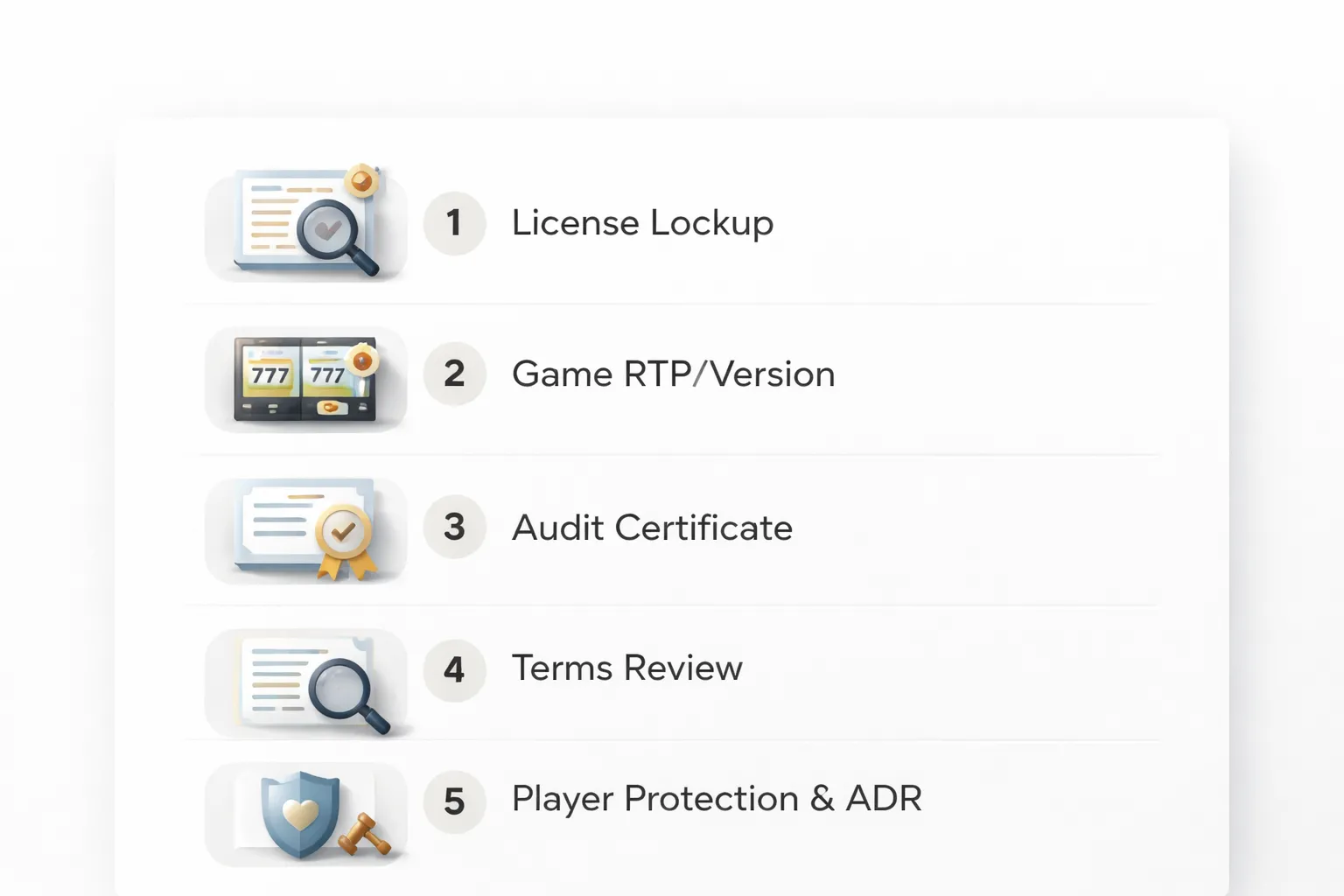
Verify the license
Start with the regulator, not the casino homepage. You want a real license, tied to the operator that takes your deposits and pays your withdrawals.
- Find the regulator name and license number in the footer or the terms. Copy both.
- Open the regulator database and search the license number. Do not rely on screenshots or badges.
- Match the legal entity on the regulator record to the casino’s terms. Check company name, address, and jurisdiction.
- Check license status. It should show active, not suspended, expired, or under review.
- Confirm the brand is covered. Some groups list multiple domains. Your exact site URL should appear on the regulator record or approved brand list.
- Look for public enforcement history on the regulator site. Repeated fines for payouts or AML failures are a warning sign.
Confirm game providers and game versions
Fair math depends on the exact game build. Providers can ship the same title with different RTP settings and regional rules.
- Identify the provider per game, not just the casino lobby list. Open the game, then check the info or help menu for the studio name.
- Locate the RTP disclosure inside the game rules. Record the percentage and whether it states a range or a fixed value.
- Check for multiple RTP variants like 96 percent, 94 percent, 92 percent. Some casinos choose the lower setting.
- Verify game build details when available, like game ID, version number, or release tag in the help screen.
- Compare RTP across casinos for the same title. If your casino shows a lower RTP than peers, treat that as a fairness cost. Use your own shortlist from best RTP slots to spot patterns fast.
- Be cautious with “exclusive” or “in-house” slots. You need stronger proof, like named labs and current certificates.
Find the audit trail
A fair casino can show who tested its RNG and game math, what got tested, and when.
- Find the testing section in the footer, FAQs, or terms. Look for audit firms and certificate links, not just logos.
- Check the lab name, then confirm it is a known test house used by regulators. Common examples include eCOGRA, iTech Labs, GLI, and BMM.
- Open the certificate and check the operator name. It must match the legal entity from the license.
- Confirm scope. The document should state RNG testing, RTP verification, or game compliance. “Security tested” alone is not enough.
- Check the last test date. Prefer recent coverage. Old certificates can miss platform changes, game updates, or new integrations.
- Look for game lists. Strong reports name specific games or game families, not generic “casino games.”
Review terms that impact fairness
Terms can change your expected value more than the published RTP. Read the parts that control payouts, bonuses, and account actions.
- Max cashout limits. Check caps on bonus wins, free spins, and specific games. A hard cap makes a high RTP less meaningful for big wins.
- Wagering rules. Note the wagering multiple, time limits, and which games count. Low contribution rates inflate real cost.
- Game exclusions. Casinos often block low house edge games from bonus play, or reduce their contribution to near zero.
- Voiding clauses. Watch for broad terms like “irregular play,” “bonus abuse,” or “risk-free bets.” If the casino can void wins without clear definitions, you carry extra risk.
- KYC timing. A fair operator asks for verification early, not after a big win. Check if it can delay withdrawals until “enhanced checks” finish, with no timeframe.
- Withdrawal rules. Look for minimums, maximums, and processing times by method. “Unlimited delays” signals trouble.
Player protection signals
Fair play includes how the casino handles losses, disputes, and problem gambling. Good operators make controls easy to use and complaints easy to file.
- Responsible gambling tools. You should see deposit limits, loss limits, session limits, time-outs, and self-exclusion inside your account.
- Reality checks. Look for optional or mandatory session reminders and spend summaries.
- Clear complaint path. The site should list support channels, escalation steps, and response time targets.
- ADR options. Check for an Alternative Dispute Resolution provider or an ombuds style process. Record the ADR name and link.
- Regulator escalation. The casino should tell you when and how you can contact the regulator if internal support fails.
- Transparent ownership and contacts. You should find the operator name, address, and company registration details without digging.
| Check | What to record | Red flag |
|---|---|---|
| License lookup | Regulator record, status, legal entity, approved domains | Badge with no database match |
| Game RTP build | RTP percent in game rules, game version or ID | RTP hidden, shown as a wide range only |
| Audit proof | Lab name, certificate scope, last test date, operator name | Logos only, expired or vague reports |
| Terms impact | Max cashout, wagering, exclusions, voiding clauses, KYC rules | Broad “void wins” language, heavy caps |
| Player protection | Limits, self-exclusion, complaint steps, ADR details | No limits, no ADR, unclear escalation |
Responsible play and realistic expectations (because fairness isn’t the same as safety)
Responsible play and realistic expectations (because fairness isn’t the same as safety)
RNG testing and published RTP help confirm fair math. They do not protect your bankroll. A fair game can still drain you fast if you play too long, bet too big, or chase losses.
Bankroll and session limits, align risk with volatility
Set two limits before you start. A session time limit and a money limit. Treat both as hard stops.
- Bankroll limit: Use money you can lose without affecting bills, debt, or savings.
- Session loss limit: Pick a number that ends the session when you hit it. Do not reload.
- Session win limit: Lock profits. Cash out when you reach it.
- Time limit: End the session when the timer hits, even if you feel “close.”
Volatility decides how rough the ride feels. High volatility means longer losing runs and fewer, bigger hits. Low volatility means smaller swings and more frequent small wins. Match your bet size to that reality.
- High volatility slots need a larger buffer. If you bet big, you shorten your runway and increase bust risk.
- Lower volatility games support steadier sessions, but they still carry a negative expected value.
If you want to learn the volatility basics, read high volatility vs low volatility slots.
Recognize problem gambling indicators and use support tools
Watch for behavior changes. These matter more than any single bad session.
- Spending more than planned, then raising limits to “fix” it.
- Hiding play from family or friends.
- Using gambling to escape stress, sleep problems, or low mood.
- Borrowing money, selling items, or missing payments to keep playing.
- Feeling irritated when you try to stop, then logging back in.
Use the tools your casino offers. If it does not offer them, leave.
- Deposit limits: Daily, weekly, monthly caps. Set them low enough to matter.
- Loss limits: Stops you from “one more buy-in.”
- Time limits and reality checks: On-screen reminders that break autopilot play.
- Cooling-off: Short blocks, 24 hours to several weeks.
- Self-exclusion: Longer blocks. Use it if you cannot stick to limits.
When to stop, losses chasing, tilt, and decision fatigue
Stop conditions keep you safe from your own impulses. Use simple rules you can follow mid-session.
- After a loss limit: End the session. No “recovery” plan. No stake increase.
- After a big win: Take a break. Big hits often trigger risk-taking.
- After a stake jump: If you increase your bet because you feel pressure, stop.
- After a long session: Decision quality drops. You start clicking faster and thinking less.
Common danger states:
- Chasing: You change stakes or games to win back losses. This increases variance and speeds up losses.
- Tilt: You feel anger or urgency. You stop following your own plan.
- Decision fatigue: You keep playing because stopping feels harder than continuing.
Choose entertainment value, match games and limits to your risk tolerance
Pick a format that fits your tolerance for swings and your preferred session length. Then set limits that match the pace of the game.
- Fast games: Slots and instant games burn through decisions quickly. Use lower stakes and shorter sessions.
- Slower games: Table games and live dealer play slow the cycle. You still face house edge, but you place fewer bets per hour.
- High edge side bets: Treat them as paid entertainment. Use small stakes or skip them.
Use realistic expectations. RTP describes long-run averages. Your session can land far above or far below it. You control only three things, your stake size, your time, and your stop point.
FAQ
What is an RNG in online casino games?
An RNG is software that generates unpredictable results. In slots, it picks each spin outcome. In RNG table games, it deals cards or selects numbers. Each bet uses a fresh result. Past outcomes do not change the next one.
Can a casino change the RNG to make you lose?
Licensed casinos use certified game builds. Labs test RNG behavior and game math. Regulators audit versions and updates. Risk rises with unlicensed sites, cloned games, and unknown providers. If you cannot verify a license, treat it as unsafe.
What does RTP mean?
RTP is the expected long-run return to players, shown as a percentage. A 96% RTP implies 4% average loss per wager over huge volume. RTP does not predict your session result. Variance can swing hard in the short run.
How does RTP relate to house edge?
House edge is the casino’s average advantage. For many games, house edge equals 100% minus RTP. Example, 97% RTP means 3% house edge. Table games often state house edge directly for a specific ruleset and strategy.
Does higher RTP mean you will win more often?
No. RTP measures average return, not hit rate. A game can have high RTP and still produce long losing stretches. Volatility drives how results cluster. If you want steadier sessions, choose lower volatility slots and avoid high edge side bets.
Why do live dealer games not use RNG?
Live dealer outcomes come from physical equipment and dealer actions. The stream uses cameras and game control systems, not an RNG for results. You still face house edge set by rules. Your bet speed stays lower than slots.
What is “provably fair”?
Provably fair lets you verify each result with cryptographic seeds and hashes. You can check that the casino did not change outcomes after you bet. It does not remove house edge. It mainly increases transparency for RNG style games.
How do you verify a provably fair result?
Save the server seed hash before play. After the session, reveal the server seed and use your client seed and nonce to recreate the roll. The recomputed outcome must match the game log. If the site cannot show this data, you cannot verify.
Which game types are usually fairest?
Look for low house edge games with clear rules and minimal side bets. Blackjack with correct play, baccarat, and some roulette variants can stay near 1% to 3% edge. Slots usually cost more per wager, even with high RTP.
How can you reduce your losses in practice?
Pick lower house edge games. Avoid side bets with high edge. Use smaller stakes, fewer bets per hour, and hard stop limits. Track total wagered, not just wins and losses. Your control points are stake size, time, and stop point.
Where can you compare baccarat odds quickly?
Use a simple rules and odds breakdown and stick to the main bets. See baccarat rules and odds for house edge ranges and common mistakes.
Conclusion
Conclusion
Fairness comes down to four numbers and one habit. RNG decides each result. RTP tells you the long run return. House edge tells you the long run cost. Variance tells you how wild the ride gets.
Your job is simple. Verify the basics before you deposit. Then control your exposure.
- Check the license and test reports, look for independent audits and clear game certificates.
- Read the RTP on the exact game and mode, slot versions and buy-bonus modes can differ.
- Use house edge to pick games, avoid side bets that spike the edge.
- Set hard limits, budget, time, and loss cap. Stick to them.
- Track total wagered, your expected loss tracks wagering volume, not your last result.
Final tip. Make one rule and follow it every session. Choose low edge games, cap your stake, cap your time, and stop on schedule.
-
Slot RTP Explained: What RTP Means and How to Use It
6 months ago -
How to Play Online Slots: Rules, Features & Beginner Tips
6 months ago -
How Slot Jackpots Work: Progressive Jackpots Explained
6 months ago -
How to Play Online Blackjack: Rules, Payouts & Quick Start Guide
6 months ago -
Slot Volatility Explained: Low vs High Volatility (and What to Play)
6 months ago
-
- Responsible play and realistic expectations (because fairness isn’t the same as safety)
- Bankroll and session limits, align risk with volatility
- Recognize problem gambling indicators and use support tools
- When to stop, losses chasing, tilt, and decision fatigue
- Choose entertainment value, match games and limits to your risk tolerance
-
- What is an RNG in online casino games?
- Can a casino change the RNG to make you lose?
- What does RTP mean?
- How does RTP relate to house edge?
- Does higher RTP mean you will win more often?
- Why do live dealer games not use RNG?
- What is “provably fair”?
- How do you verify a provably fair result?
- Which game types are usually fairest?
- How can you reduce your losses in practice?
- Where can you compare baccarat odds quickly?
-
- Responsible play and realistic expectations (because fairness isn’t the same as safety)
- Bankroll and session limits, align risk with volatility
- Recognize problem gambling indicators and use support tools
- When to stop, losses chasing, tilt, and decision fatigue
- Choose entertainment value, match games and limits to your risk tolerance
-
- What is an RNG in online casino games?
- Can a casino change the RNG to make you lose?
- What does RTP mean?
- How does RTP relate to house edge?
- Does higher RTP mean you will win more often?
- Why do live dealer games not use RNG?
- What is “provably fair”?
- How do you verify a provably fair result?
- Which game types are usually fairest?
- How can you reduce your losses in practice?
- Where can you compare baccarat odds quickly?
-
Reload Bonus Explained: What It Is and When It’s Worth Claiming
4 months ago -
Online Casino Licensing Explained: Authorities, Licenses & How to Check One
6 months ago -
Best Live Dealer Casinos: Where to Play Live Blackjack, Roulette & More
6 months ago -
Best Online Casinos for High Rollers: VIP Perks, High Limits & Exclusive Bonuses
6 months ago -
Fast Payout Online Casinos: Best Sites for Quick Withdrawals
6 months ago
-
Online Casino Licensing Explained: Authorities, Licenses & How to Check One
6 months ago -
Casino VIP & Loyalty Programs Explained: Points, Tiers, Rewards & Rakeback
6 months ago -
Are Online Casinos Legal? Complete Guide by State & Country
6 months ago -
How to Sign Up & Create an Online Casino Account (Step-by-Step)
6 months ago -
How to Withdraw Money from an Online Casino: Methods, Steps & Tips
6 months ago