Online Blackjack Guide: Rules, Odds, and How to Play

Online blackjack is a fast card game where you try to beat the dealer without going over 21. Your choices matter on every hand. The rules change by table, and small changes shift the house edge.
This guide shows you how to play step by step. You will learn the core rules, dealer actions, and hand values. You will learn the main moves, hit, stand, double, split, and surrender. You will learn how odds work, including why rules like blackjack payout, number of decks, and dealer hit or stand on soft 17 affect your results. You will also learn what to check before you bet, including limits, side bets, and game speed.
- In het kort: Learn hand values and the goal, beat the dealer without going over 21.
- In het kort: Use the core moves with purpose, hit, stand, double, split, and surrender, each choice changes your long-term cost.
- In het kort: Treat surrender as a first decision, you can only use late surrender on your first two cards.
- In het kort: Track the rules that change odds, blackjack payout, deck count, and whether the dealer hits or stands on soft 17.
- In het kort: Prefer 3:2 blackjack payouts over 6:5, 6:5 increases the house edge and cuts your expected return.
- In het kort: Fewer decks usually helps you, more decks usually hurts you, all else equal.
- In het kort: Know the dealer action rules, the dealer follows fixed rules so your edge comes from correct decisions, not dealer behavior.
- In het kort: Check table limits and speed before you bet, faster games raise your hourly risk even if the edge stays the same.
- In het kort: Treat side bets as separate products, they usually carry a higher house edge than the base game.
- In het kort: If you want a fast refresher on actions and payouts, use our quick start blackjack guide.
What online blackjack is (and how it differs from land-based play)
Online blackjack is the same core game as casino blackjack. You play against the dealer. You try to beat the dealer hand without going over 21. The difference is delivery. Online tables run on software or a live video feed, not a physical table in front of you.
RNG blackjack vs live dealer blackjack: gameplay, speed, and realism
- RNG blackjack uses a random number generator to deal digital cards. Results generate instantly. You play solo against the rules, not against other players. Expect fast hands and higher hands per hour.
- Live dealer blackjack streams a real dealer from a studio or casino floor. The dealer deals real cards. The game runs on a fixed pace. You often share the table with other players, which can slow rounds.
- Gameplay controls differ. RNG tables usually let you click decisions with no delay. Live tables add timers, seat limits, and bet windows.
- Realism differs. RNG feels like a card game app. Live feels closer to land-based play because you see the shuffle, the cards, and the dealer actions.
Common online table features: auto-play, side bets, and bet limits
- Auto-play can repeat bets and follow preset actions. It boosts speed and volume. That raises your hourly swings even if the house edge stays the same.
- Side bets show up more often online than in many local casinos. Treat each one as a separate wager with its own edge and variance.
- Bet limits vary by table, not by casino brand. Check minimums, maximums, and max bet behind or max hands if the table allows multi-hand play.
- Rule sets vary more online. Look for 3:2 vs 6:5 blackjack payouts, number of decks, dealer hits or stands on soft 17, and whether surrender is offered.
Fairness and transparency: RNG testing, live studio procedures, and audits
- RNG testing relies on independent labs. Licensed casinos publish audit partners and certification pages. Look for named testing firms and current reports, not generic claims.
- Live studios use fixed procedures. Dealers work under camera coverage. Tables use shoe changes, cut cards, and displayed game history. Many providers show round IDs so support can review disputes.
- Audits matter more than screenshots. Prioritize casinos with clear licensing, third-party game testing, and documented complaint channels.
If you want a quick walkthrough of basic actions and payouts before you choose a table, use our quick start blackjack guide.
Blackjack rules explained: objective, card values, and outcomes
Winning conditions
Your goal stays simple. Finish with a hand total closer to 21 than the dealer, without going over 21.
- You win if your total is higher than the dealer’s, and you stay at 21 or less.
- You lose if you go over 21. This is a bust. Your hand ends right away.
- You also lose if the dealer finishes higher than you, without busting.
- You push if you and the dealer finish on the same total. Your bet returns.
Card values and what an Ace means
Blackjack uses fixed card values. You add them to get your hand total.
- 2 to 10 count as their number.
- J, Q, K each count as 10.
- Ace counts as 1 or 11. The game picks the value that gives you the best total without busting.
An Ace changes how safe your hand is.
- Soft hand means your hand includes an Ace counted as 11. Example: A-6 equals soft 17. You can take a hit and you cannot bust with one card, because the Ace can drop to 1.
- Hard hand means no Ace, or your Ace must count as 1 to avoid a bust. Example: A-6-10 equals hard 17, because the Ace counts as 1.
Core outcomes and blackjack payout basics
You play each hand against the dealer’s final hand, not against other players.
- Win pays 1:1 in most games. Bet 10, you profit 10.
- Lose costs your bet. Bet 10, you lose 10.
- Push returns your bet. Bet 10, you get 10 back.
- Blackjack means an Ace plus a 10-value card as your first two cards. Many tables pay 3:2. Some pay 6:5, which increases the house edge.
If you and the dealer both have blackjack, you push. If you have 21 with three or more cards, it is not blackjack. It counts as a normal 21.
Dealer rules and why the dealer acts last
You act first. The dealer acts after all players finish. This creates a built-in disadvantage for you.
- If you bust, you lose even if the dealer later busts.
- The dealer follows fixed rules. You make choices, the dealer does not.
Most online tables use one of these dealer rules:
- Dealer stands on 17, including soft 17 at many tables. This improves your odds versus hit on soft 17.
- Dealer hits until 17 or more. If the table says hit soft 17, the dealer must take another card on A-6.
Always check the table rules panel before you sit. Blackjack payout rate and soft 17 rules change your expected return more than small side bet variations.
How to play online blackjack step by step
Placing bets and table minimums, maximums
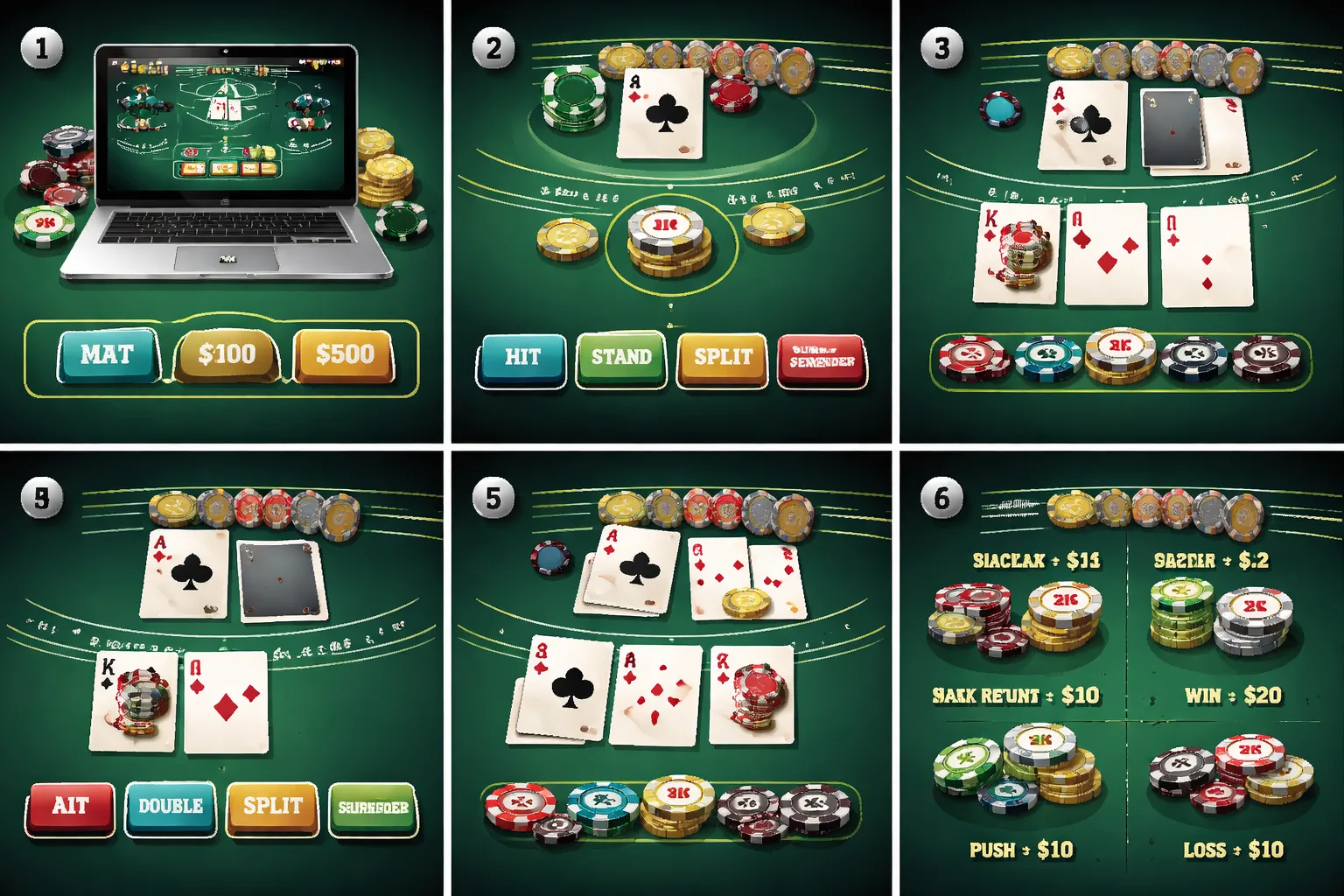
Pick a blackjack table. Open the rules panel first. Confirm blackjack pays 3:2, and check if the dealer hits or stands on soft 17.
Check the betting limits. Online tables show a minimum and maximum bet. Many also cap side bets and split hands.
- Minimum bet, the smallest stake you can place each hand.
- Maximum bet, the largest stake allowed on the main bet. Some tables also limit doubles and splits.
- Side bets, optional bets like Perfect Pairs. They have higher house edges than the main game at most casinos.
Set your chip value, then place your main bet inside the betting circle before the timer ends. If the table supports it, use rebet to repeat your last wager.
The initial deal and how decisions flow
After bets lock, the dealer deals two cards to you and two to the dealer.
- Your cards show face up in most online games.
- The dealer shows one upcard and one hole card in standard blackjack. Some games use no hole card and delay dealer blackjack checks, read the rules panel.
Your turn comes first. You act on your hand, then the dealer plays. If you bust, you lose your bet right away and the hand ends for you.
Player actions: hit, stand, double, split, surrender
- Hit. Take one card. Keep hitting until you stand or bust.
- Stand. Take no more cards. You lock your total and pass action to the next hand or the dealer.
- Double down. Double your original bet and take exactly one more card. Many tables allow doubling after a split, but some do not.
- Split. If your first two cards match in rank, split them into two hands. You place a second bet equal to the first. Each hand plays separately. Many tables limit the number of splits, and some restrict re-splitting aces.
- Surrender. If offered, you can forfeit the hand on your first two cards and lose half your bet. Late surrender only applies after the dealer checks for blackjack where a hole card exists.
Use the table help panel to confirm action rules. Small rule changes can block strong plays, like double after split or surrender.
How the round ends: dealer draw rules, settlement, payout examples
After you finish, the dealer reveals the hole card and draws based on the table rule.
- Dealer hits until at least 17.
- If the table says stand on soft 17, A-6 stays. If it says hit soft 17, A-6 draws another card.
Then the casino settles each hand.
- If you bust, you lose 1x your bet.
- If the dealer busts and you did not, you win 1x your bet.
- If your total beats the dealer without busting, you win 1x your bet.
- If the dealer total beats yours, you lose 1x your bet.
- If totals tie, you push and get your bet back.
- If you have blackjack, you win at the posted blackjack rate, often 3:2. Some tables pay 6:5, which cuts your return.
- $10 bet, you win a normal hand, you profit $10 and get $20 back total.
- $10 bet, you lose a normal hand, you lose $10.
- $10 bet, push, you get $10 back.
- $10 bet, blackjack at 3:2, you profit $15 and get $25 back total.
- $10 bet, blackjack at 6:5, you profit $12 and get $22 back total.
- $10 bet, surrender, you lose $5 and get $5 back.
Online blackjack odds and house edge (what actually affects your chances)
House edge vs RTP, what the numbers mean
House edge is the casino’s long-run advantage on your total action. If the house edge is 0.50%, you lose about $0.50 per $100 wagered over a large sample.
RTP is the flip side. RTP = 100% minus house edge. An RTP of 99.50% equals a 0.50% house edge.
Blackjack house edge depends on the exact rules and your decisions. Use basic strategy and the right table rules, or your edge swings fast.
Rule variations that move the needle
- Blackjack payout, 3:2 vs 6:5. This is the biggest common swing. 6:5 usually adds about +1.39% to the house edge versus 3:2. Avoid 6:5.
- Dealer hits soft 17 (H17) vs stands (S17). H17 typically adds about +0.20% to the house edge.
- Number of decks. More decks usually raise the house edge, even with perfect play. The jump from double deck to 6 to 8 decks often adds only a small amount if other rules stay strong.
- Doubling rules. Double on any two cards (DOA) beats double on 10 to 11 only. Restricting doubles can add roughly +0.10% to +0.30%, depending on the exact limit.
- Re-splitting and split rules. Re-split aces, more re-splits, and allowing double after split (DAS) reduce the house edge. No DAS and no re-split aces increase it.
- Surrender. Late surrender lowers the house edge by about 0.07% in many common games. You only get the option on your first two cards.
| Rule or feature | Typical effect on house edge | What to do |
|---|---|---|
| Blackjack pays 3:2 | Baseline | Prefer |
| Blackjack pays 6:5 | About +1.39% | Avoid |
| Dealer stands on soft 17 (S17) | Lower edge | Prefer |
| Dealer hits soft 17 (H17) | About +0.20% | Avoid if you can |
| Double after split (DAS) | Lowers edge | Prefer |
| No DAS | Raises edge | Accept only with strong other rules |
| Late surrender | About -0.07% | Use when basic strategy says so |
Why more decks usually increases house edge, and when it does not matter much
Extra decks dilute your advantage on player-friendly situations like blackjacks, doubles, and splits. Your strong starting hands show up slightly less often.
The deck count shift often matters less than the payout and soft 17 rule. A 6 to 8 deck game with 3:2 and S17 can beat a double deck game that pays 6:5 or uses weak split and double rules.
Use this priority order when you pick a table.
- First, blackjack pays 3:2.
- Second, S17 if available.
- Third, DAS and solid re-split rules.
- Then, fewer decks.
Volatility and variance, what to expect in short sessions vs long-term play
House edge tells you the long-run cost. Variance tells you how wild the ride feels.
Blackjack has high session-to-session swings because you face frequent close outcomes, doubles, splits, and occasional 3:2 blackjacks that spike results.
- Short sessions. Expect big up and down swings. A good game and perfect play do not stop short-run losing streaks.
- Long-term play. Your results drift toward the house edge. The more total money you wager, the more your average outcome matches the math.
- What changes variance. Doubling and splitting raise volatility. Flat betting reduces swings but does not change the house edge.
If you want lower volatility, avoid side bets. Many side bets carry a much higher house edge than the main hand.
Basic strategy: the best way to play blackjack online
What basic strategy is and why it works
Basic strategy is the set of plays that gives you the highest expected return for every hand.
It works because blackjack has limited options and fixed dealer rules. For each player total versus each dealer upcard, math can compare the long-run value of hit, stand, double, split, or surrender. The best play is the one that loses the least or wins the most on average.
Basic strategy does not beat the game by itself. It cuts the house edge to near the minimum for that rule set. In many common online games, correct basic strategy lands around a 0.5% house edge, and sometimes lower with player-friendly rules.
Decision priorities: surrender, split, double, hit, stand
Use this order. It prevents common errors.
- Surrender first, if the table offers late surrender and the chart says to use it. You can only surrender on your first two cards.
- Split next, when the pair rules and the chart favor it. Splitting can turn one bad hand into two better hands.
- Double next, when you have an edge on the hand or when doubling reduces your loss versus other options.
- Hit or stand last, when you cannot surrender, split, or double.
This order matters because a hand can qualify for more than one action. Example, a pair might also equal a strong double total. The chart already accounts for that. Follow the priority.
Soft totals, hard totals, and pair splits: the three strategy buckets
Every chart uses the same buckets. Pick the right one before you act.
- Hard totals. No Ace counted as 11. Example, 10-6 is hard 16. If you hit, you can bust.
- Soft totals. An Ace counted as 11. Example, A-6 is soft 17. If you hit, you cannot bust on one card because the Ace can drop to 1.
- Pairs. Two cards of the same rank. Example, 8-8. Treat pairs as a split decision first, not as a hard total.
Do not convert a pair into a hard total and then play it like a normal hand. You will misplay key spots like 8-8 and A-A.
How to use a basic strategy chart correctly at online tables
- Match the chart to the rules. You need the right chart for dealer hits or stands on soft 17, number of decks, double rules, re-split rules, and surrender rules.
- Start with the dealer upcard. Look at the dealer card that shows.
- Identify your bucket. Pair, soft, or hard.
- Use your first two cards. Many doubles and all surrenders only apply before you take a hit.
- Follow the exact action. If the chart says double and you cannot double, most charts require you to hit instead. Use a chart that states the fallback rule.
- Ignore side bets. The chart only applies to the main hand and standard actions.
Tip for speed. Keep a chart open in another tab or on a second screen. Online blackjack gives you enough time if you stay organized.
Most common strategy mistakes that increase house edge
- Using the wrong chart for the table rules. One rule change can flip several close decisions.
- Standing on hard 16 versus strong dealer upcards because it feels safer. It usually costs more over time.
- Failing to double on the key soft totals and strong hard totals. Skipping doubles lowers your long-run return.
- Misplaying soft hands by treating them like hard totals. Soft hands often want aggressive hits and doubles.
- Splitting the wrong pairs or refusing correct splits. Pair plays drive big swings in expected value.
- Taking insurance by default. Insurance is a separate bet with a built-in edge for the house unless you can count cards accurately.
- Chasing losses by changing bet size based on short-term results. It does not change the house edge and increases bankroll risk.
If you want a different odds profile, pick a different game. Blackjack rewards correct decisions. For pure chance games, see our roulette odds and bet types guide.
Advanced blackjack concepts (and what applies online)
Card counting overview, what it is and why it’s limited online
Card counting tracks the ratio of high cards to low cards left in the shoe. When the shoe turns rich in tens and aces, blackjack odds shift in your favor. You raise bets in those spots and lower them when the shoe turns cold.
This works only when you see enough of the same shoe to get a useful sample, and when the game deals deep before shuffling.
- Most RNG online blackjack reshuffles every hand. Counting cannot work because no deck composition carries over.
- Some RNG games use continuous shuffle. Same result, no lasting count value.
- Counting mainly applies to live dealer blackjack. Even then, conditions decide if it is worth your attention.
Live dealer counting realities, shoe depth, burn cards, and table speed
Live dealer blackjack uses real cards and a shoe, usually 6 to 8 decks. That makes counting possible in theory. In practice, the casino controls the key variables.
- Shoe depth. Deeper penetration helps you. Shallow penetration kills the edge because too many cards remain unseen when the shuffle hits.
- Shuffle timing. Many tables shuffle early or after a fixed number of rounds. You cannot change it.
- Burn cards. The dealer removes cards at the start of a shoe, and sometimes after shuffles. This adds uncertainty and reduces the value of early counts.
- Table speed. Live tables run slower than solo RNG hands. Fewer hands per hour means less profit potential even if you play well.
- Bet limits. Small max bets cap your ability to press an advantage. Tight min bets can force you to risk too much during bad counts.
- Heat and countermeasures. Live platforms can limit stakes, switch you to different tables, or restrict play when your betting pattern looks sharp.
If you want a real edge, conditions matter more than talent. Without deep shoes, reasonable bet limits, and steady game speed, counting returns collapse.
Bet sizing systems, what they can and can’t do (Martingale myths included)
Bet sizing changes risk. It does not change the math of the game. If you play a negative expectation game, any fixed system stays negative over time.
- Flat betting. Best for bankroll control. Lowest volatility for a given house edge.
- Proportional staking. Betting a small fixed percent of your bankroll reduces ruin risk, but it does not create an edge.
- Progressions. They create winning streak stories and losing session blowups. The house edge stays the same.
- Martingale. You double after losses to win one unit when you finally hit a win. This fails because you face table limits and finite bankroll. Long losing runs happen. When they do, the loss is large.
If you use any system, set a hard stop loss and a hard win cap. Treat it as a time and risk control tool, not a way to beat the game.
When deviations from basic strategy matter (and when they don’t)
Basic strategy gives the best play for each hand under a fixed ruleset. Most players lose edge by missing basics, not by missing advanced moves.
- Deviations matter when you have extra information. That means a reliable count in a live shoe game, plus the discipline to adjust bets and plays.
- Deviations do not matter in RNG games. No persistent shoe means no extra information. Stick to basic strategy.
- Rule mismatches matter more than tiny deviations. Dealer hits soft 17, payout 6:5, restricted doubling, and no surrender can move the house edge more than most small play errors.
- Side bets ignore your skill. They often carry high house edges and dilute the value of correct play.
Get basic decisions correct first. Use a blackjack basic strategy chart that matches the exact rules of the table you play. Add deviations only if you play live dealer, track the shoe, and can prove your approach with data.
Blackjack variants and side bets: which games to choose (or avoid)
Classic blackjack rules: which versions give you the best odds
Online blackjack uses a few common rule sets. Small changes shift the house edge.
| Game type | Typical rules you see online | What to choose |
|---|---|---|
| Classic (generic RNG blackjack) | Rules vary by lobby. Many tables hide weak rules behind a clean name. | Choose only after you confirm 3:2 blackjack, dealer stands on soft 17, double after split allowed, resplit aces allowed, late surrender available. |
| European Blackjack | No hole card. Dealer takes second card after players act. Often 2 decks. | Good if other rules stay strong. Avoid if it also blocks double after split or pays 6:5. |
| Atlantic City rules | Usually 8 decks. Dealer stands on soft 17. Double on any two. Double after split allowed. Late surrender common. | Usually strong. Prefer this set when you can get it with 3:2 payouts. |
| Vegas Strip rules | Usually 4 decks. Dealer stands on soft 17. Double on any two. Double after split allowed. No surrender is common. | Solid if it pays 3:2 and keeps double after split. |
If you want a quick sanity check, confirm the game uses a real RNG and publishes rule-based house edge or RTP. This ties into how online casino fairness and house edge work.
Popular online variants: what changes, what it costs
- Blackjack Switch. You play two hands and can swap the second cards. The catch matters more than the swap. Many versions pay 1:1 on blackjack, and dealer 22 pushes. These rules add house edge back fast. Play only if you see published low house edge rules and you accept higher variance.
- Double Exposure. Dealer cards show. You get more information. The game claws it back with worse pay rules, often 1:1 blackjack, dealer wins ties, or limits on doubles and splits. Usually a bad trade. The visible dealer hand looks strong, the rule changes cost more.
- Spanish 21. The game removes all 10s from the deck, but keeps face cards. You get player-friendly rules in return, often late surrender, more doubling options, and bonus payouts for certain 21s. Can be good if the bonus table stays fair and you use Spanish 21 strategy, not classic blackjack strategy.
- Pontoon. Close cousin of blackjack with different terms and different rules. Many versions require you to hit soft 17, restrict doubling, and treat dealer blackjack differently. Only play if you have a Pontoon strategy chart for that exact rule set. Do not freestyle it like blackjack.
Side bets: Perfect Pairs, 21+3, and Insurance
Side bets sit outside basic strategy. They usually carry a large house edge. They raise your bankroll swing and lower your long-run return.
- Perfect Pairs. You bet your first two cards form a pair. Expected value stays negative across common pay tables. House edge often lands in the high single digits to double digits, depending on payouts and deck count. Skip it unless you play for entertainment and accept the cost.
- 21+3. You combine your two cards with the dealer upcard to form a poker-style hand. Expected value is usually worse than the main game by a wide margin. House edge often sits around the high single digits or more, driven by the pay table. Skip it. The pay table decides everything and it rarely favors you.
- Insurance. Offered when the dealer shows an Ace. You bet the dealer has blackjack. Expected value is negative for most players. With no card counting, you do not have the information edge needed to make it profitable. Rule to use. If you play basic strategy only, decline insurance.
If you want a low-edge blackjack session, treat side bets as a separate game with a worse return. Put your money into the main hand, where correct decisions still matter.
Checklist: how to spot bad blackjack tables fast
- Blackjack pays 6:5. Avoid. This single rule change can add more house edge than most other rule tweaks.
- Dealer hits soft 17 and other rules also tighten. One weak rule is manageable, a stack of them is not.
- No double after split. Avoid if you care about low house edge.
- Split limits are tight. No resplits, no split aces, or one-card-only to split aces with no resplit. These cost you value.
- Late surrender missing. Not fatal, but you give up a useful option, especially in shoe games.
- Too many decks with no compensation. More decks usually hurt you unless the table gives back value with strong rules.
- Side bets pushed hard. A lobby that markets side bets over main rules often runs poor-value tables.
- Rules not shown. Avoid. If you cannot see payouts and options before you sit, you cannot protect your edge.
Bonuses, wagering requirements, and blackjack contribution
Bonuses and blackjack, why your contribution matters
Most casino bonuses exclude blackjack or cap its value. Casinos call this game weighting or contribution.
If blackjack contributes at 10%, you must bet $10 on blackjack to count as $1 toward the wagering target. If blackjack contributes at 0%, none of your blackjack action counts.
Always check the promo page and the terms page before you deposit. Look for the exact percentage for each blackjack type, including live dealer, RNG, and VIP tables.
Wagering terms to read first
- Wagering multiple. Example, 30x means you must wager 30 times the bonus, sometimes the deposit plus bonus.
- Game weighting. Blackjack often counts 0% to 25%. Slots often count 100%. This single line decides if the offer is usable.
- Max bet rule. Many bonuses set a cap like $5 per hand or per round. If you go over, the casino can void winnings.
- Time limit. Common windows are 7, 14, or 30 days. If you miss it, you lose the bonus and any attached winnings.
- Eligible tables. Some promos exclude low-edge rules, live dealer tables, or specific providers.
- Withdrawal limits. Some “free bonus” offers cap cashout. You can win more but you cannot withdraw it.
Typical blackjack contribution rates
Low-risk ways to use promos as a blackjack player
- Cashback. Prefer net-loss cashback over deposit match. It does not force high wagering. It also fits normal play.
- Reload bonuses with light terms. Small weekly reloads often come with lower wagering than big welcome packages.
- Live dealer offers with clear table eligibility. Use them only if live blackjack contributes at a stated rate and the max bet fits your stakes.
- Free bets or chips with no wagering. Treat them as a one-time boost, then go back to your normal bankroll plan.
Bonus traps that turn good strategy into bad math
- Chasing wagering on blackjack at low contribution. If blackjack counts 10%, you must play 10 times more to clear the same requirement. That increases expected loss.
- Raising your bet to beat the clock. Time limits push players to overbet. This breaks bankroll control and increases ruin risk.
- Breaking max bet rules. One oversized hand can void winnings. Keep a written max bet and stay under it.
- Switching to side bets to “count faster”. Side bets usually carry a large house edge. You pay for speed with worse odds.
- Playing excluded tables. Some casinos let you play but later count it at 0%. Verify the exact table list before you start.
- Assuming all blackjack variants qualify. Different versions can have different weightings, even inside the same lobby.
If a bonus forces you into higher stakes, higher volume, or side bets, skip it. Take offers that match your normal blackjack game and keep the math on your side.
How to choose a safe online blackjack casino
Licensing and regulation
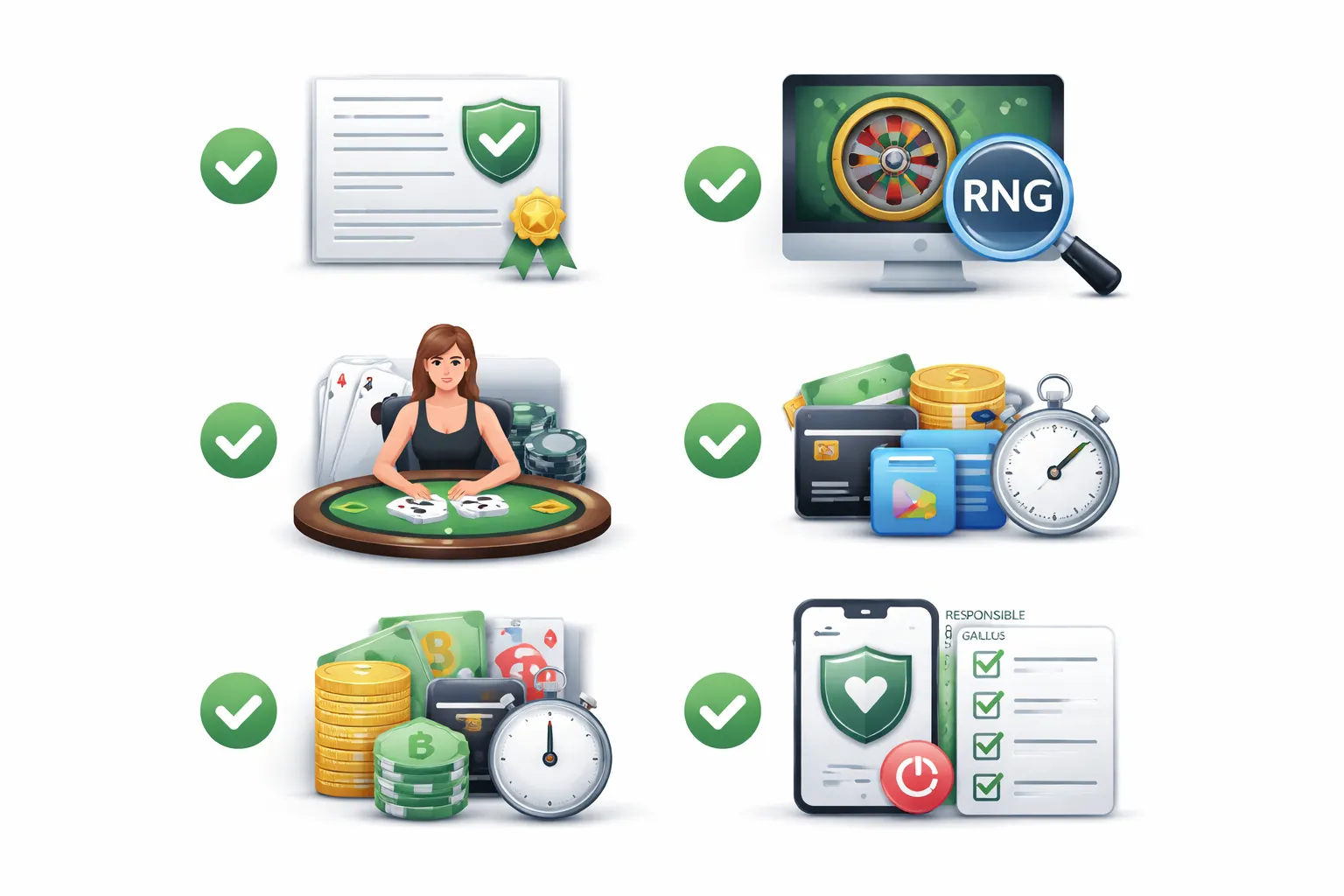
Start with the license. It sets the rules the casino must follow and who you can complain to if something goes wrong.
- Check the regulator name and license number in the footer. Open the regulator site and confirm the license matches the casino brand and domain.
- Prefer strict regulators that enforce audits and player protection. Examples include UKGC, MGA, and state regulators in the US.
- Read the key policies before you deposit. Focus on withdrawals, bonus terms, KYC, and self-exclusion. If terms look vague or missing, leave.
- Avoid mirror sites and copycat brands. If the domain changes often, or support cannot confirm the licensed entity, treat it as high risk.
Game providers and reliability
Blackjack safety comes down to fairness, game rules, and stable software.
- Stick to known providers for RNG and live blackjack. You want a track record and third-party testing.
- Check RTP and rule details per table. Look for 3:2 on blackjack, dealer stands on soft 17 where possible, and reasonable deck counts. Avoid tables that pay 6:5 unless you accept worse odds.
- Look for published testing from labs like eCOGRA, iTech Labs, or GLI. You want proof of RNG audits and ongoing checks.
- Test the UI before you play for real. You need clear chip values, visible hand history, and a bet confirmation step. Misclicks cost money.
- For live blackjack, check the studio. You want named studios, clear game rules on-screen, and a stable stream. If the feed drops or bets reject often, switch casinos.
Banking and payouts
Fast, predictable cashouts matter more than a big lobby.
- Review deposit and withdrawal methods. Use options you trust and can verify, cards, bank transfer, and major e-wallets.
- Check fees on both sides. Casinos may charge a withdrawal fee, your bank or wallet may charge more. Look for a clear fee table.
- Confirm processing times by method. Separate approval time from transfer time. A casino can approve in 24 hours and still take days to reach your bank.
- Read withdrawal limits. Watch for low daily caps and monthly caps. These slow down large wins.
- Look for clean rules on documents and source of funds. If a casino can ask for unlimited documents at any time, you risk delays.
Player protection
Good casinos protect your account and make it easy to control your play.
- KYC that matches the payment method. Expect ID, address, and card or wallet proof. A serious casino asks early, not after a big win.
- Responsible gambling tools. You want deposit limits, loss limits, session limits, time-outs, and self-exclusion in your account settings.
- Clear self-exclusion terms. The casino should state duration options and what happens to your account and marketing messages.
- Support quality you can test. Contact live chat before you deposit. Ask about blackjack rules, withdrawal time, and excluded tables for bonuses. You want direct answers and written confirmation.
- Security basics. Use two-factor login if available. Avoid casinos that allow weak passwords or share accounts across brands without clear consent.
If you want a fast refresher on table rules that affect safety and odds, use this online blackjack quick start guide before you choose a table.
Bankroll management and responsible play for blackjack
Setting a budget, total bankroll vs session bankroll
Your bankroll is money you can lose without affecting bills, debt payments, or savings goals. Set it before you log in.
- Total bankroll: Your full blackjack budget for a week or month. Keep it separate from your everyday accounts.
- Session bankroll: The amount you bring to one sitting. Treat it as spent once you start.
- Stop-loss: A hard limit for that session, often 50 percent to 100 percent of the session bankroll.
- Win cap: A profit target that ends the session, often 20 percent to 50 percent of the session bankroll.
Do not refill a session bankroll from your total bankroll on the same day. Rebuys turn a controlled loss into a chase.
Stake sizing for lower risk and longer playtime
Bet size controls volatility. Smaller units buy more hands and smoother swings.
- Pick a base unit you can repeat without stress.
- For longer sessions, keep your base bet at 1 percent to 2 percent of your session bankroll.
- If you want lower variance, aim for 0.5 percent to 1 percent.
- Avoid stakes above 5 percent per hand. A short downswing can end your session fast.
| Session bankroll | 0.5% unit | 1% unit | 2% unit | 5% unit |
|---|---|---|---|---|
| $100 | $0.50 | $1 | $2 | $5 |
| $250 | $1.25 | $2.50 | $5 | $12.50 |
| $500 | $2.50 | $5 | $10 | $25 |
| $1,000 | $5 | $10 | $20 | $50 |
Keep stakes flat if you play basic strategy. Many players raise bets after losses. That increases variance and speeds up bustouts.
Tilt control and decision discipline
Tilt costs more than the house edge. You feel it first, then you pay for it.
- Lock your bet size before the first hand. Do not change it because you feel “due”.
- Use one decision system for every hand. Use a basic strategy chart and follow it.
- Do not drink and play. Alcohol reduces discipline and raises average bet size.
- Pause after big swings. Take five minutes away from the table after a large win or loss.
- Stop if you start breaking your own rules. That is the signal that the session is over.
Responsible gambling resources and when to take a break
Use the tools casinos give you. Set them before you feel pressure.
- Deposit limits: Cap daily, weekly, and monthly deposits.
- Loss limits: Limit net losses for a time period.
- Time limits: Force an automatic log-out after a set number of minutes.
- Reality checks: On-screen reminders that show time played and net result.
- Self-exclusion: Block access for weeks, months, or longer.
Take a break if you chase losses, hide play from others, borrow to gamble, skip responsibilities, or feel angry while betting. If those signs repeat, stop and use formal help options such as your local self-exclusion program and national support services.
Practical examples: hands you’ll face and how to play them
Example hands, hard totals
Hard totals have no Ace counted as 11. Your default play comes from the dealer upcard.
- 12 vs dealer 2, hit. Your 12 loses too often if you stand, and the dealer bust rate on 2 is not high enough to justify standing.
- 12 vs dealer 3, stand. The dealer bust rate improves enough that standing beats hitting.
- 12 vs dealer 4 to 6, stand. These are strong dealer bust cards. You win more by letting the dealer draw.
- 16 vs dealer 10, late surrender if offered. If you cannot surrender, hit. Standing bleeds money long term.
Example hands, soft totals
Soft totals include an Ace counted as 11. You can take a card without busting right away, so you should press more often.
- A,7 (soft 18) vs dealer 2, stand.
- A,7 (soft 18) vs dealer 3 to 6, double if allowed, otherwise stand. You have enough equity to push an edge when the dealer is weak.
- A,7 (soft 18) vs dealer 7 or 8, stand. You often end up in a close race where extra risk does not pay.
- A,7 (soft 18) vs dealer 9, 10, or Ace, hit. Standing loses too often against strong upcards.
Example hands, pairs
Pairs change the math because splitting creates two hands. Do it when it raises your total expected return, not because it feels aggressive.
- 8,8 vs dealer 10, split. A hard 16 is a bad hand. Two 8s give you two chances to build to 18 to 21.
- 8,8 vs dealer 9, 10, or Ace, split even though you will lose plenty of the time. It still beats playing 16 as one hand.
- 10,10 vs dealer 6, stand. You already have 20. Splitting turns a near lock into two weaker hands.
- 10,10 vs dealer 5, stand for the same reason. Keep the 20.
Mini walkthrough, how rules change the correct play
The same hand can switch actions when the table rules change. Use this checklist in order.
| Situation | Rule set | Correct decision | Why it changes |
|---|---|---|---|
| Hard 16 vs dealer 10 | Surrender allowed (late surrender) | Surrender | You cap your loss at half a bet in a spot where you lose most full bets. |
| Hard 16 vs dealer 10 | No surrender | Hit | Standing loses too often. Hitting gives you more paths to 17 to 21. |
| A,7 vs dealer 6 | Double allowed on soft totals | Double | You gain more from a weak dealer upcard while your Ace protects you from an immediate bust. |
| A,7 vs dealer 6 | No double on soft totals | Stand | You lose the value of doubling, so you take the lower variance line and let the dealer draw out. |
| 8,8 vs dealer 10 | Resplit allowed, double after split allowed | Split | Extra options improve the split hand outcomes and reduce the penalty of bad draws. |
| 8,8 vs dealer 10 | No resplit, no double after split | Split | You lose some upside, but two hands still beat playing a hard 16 as one hand. |
Practice these spots until you act fast without guessing. Then apply the same logic to every hand: check surrender first, then split, then double, then hit or stand. If you play live, review our live dealer basics before you sit down.
FAQ
What are the basic rules of online blackjack?
You play against the dealer, not other players. Get closer to 21 than the dealer without going over. Face cards count as 10. Aces count as 1 or 11. You can hit, stand, double, split, or surrender if allowed. Dealer follows fixed rules.
What is the goal of blackjack?
Beat the dealer’s hand. You win if you have a higher total up to 21, or if the dealer busts. You lose if you bust, or if the dealer has a higher total. A tie is a push and you keep your bet.
How does the dealer play in online blackjack?
The dealer must follow house rules. Most games require the dealer to hit until 17. Some require hit on soft 17, called H17. Others stand on soft 17, called S17. S17 usually lowers the house edge versus H17.
What does blackjack pay?
Best games pay 3:2 on a natural blackjack. Some online tables pay 6:5, which costs you long term. Always check the payout line before you bet. Avoid 6:5 if you want the lowest house edge.
What is the house edge in online blackjack?
It depends on rules and your decisions. With strong rules and correct basic strategy, many games sit around 0.3% to 0.7% house edge. Bad rules, side bets, and strategy mistakes push it much higher.
Does card counting work online?
It rarely helps. Most online blackjack uses frequent shuffles or continuous shuffling, which kills counting value. Live dealer can allow counting, but only with deep penetration and stable rules. Even then, limits and heat reduce your edge.
Should you always follow basic strategy?
Yes, if you want the lowest expected loss. Basic strategy uses math to pick the best move for every hand. Learn it until you act fast. Use a blackjack basic strategy chart while you practice.
When can you surrender in blackjack?
Late surrender usually applies only on your first two cards. You give up the hand and lose half your bet. You cannot surrender after you hit. Check the table rules, since many games do not offer surrender.
What is the difference between hard and soft hands?
A soft hand includes an Ace counted as 11, like A,6 for soft 17. A hard hand has no Ace counted as 11, like 10,6 for hard 16. Soft hands have more room to hit because the Ace can drop to 1.
Which blackjack rules matter most for odds?
Focus on blackjack payout, dealer H17 or S17, number of decks, double rules, split rules, and surrender. 3:2 beats 6:5. S17 beats H17. More double and resplit options usually help you. Always read the rules tab.
Are side bets worth it in online blackjack?
Usually no. Most side bets carry a much higher house edge than the main hand. If you play them, treat them as entertainment and cap your spend. If your goal is better odds, skip side bets and stick to the base game.
Can you use a strategy calculator while playing?
In RNG blackjack, yes, if the casino allows outside tools. In live dealer games, many casinos ban real-time assistance. Read the terms. If rules allow it, a calculator reduces mistakes. If rules ban it, do not risk your account.
Conclusion
Conclusion
Online blackjack rewards discipline, not guesses. Pick a table with strong rules, low edge, and clear limits. Learn basic strategy for that exact ruleset, then follow it every hand.
- Choose the right game: Prefer 3:2 blackjack, late surrender, dealer stands on soft 17, and fewer decks.
- Control your cost: Skip side bets, they add variance and raise the house edge.
- Protect your bankroll: Set a session budget, a stop loss, and a win cap, then leave when you hit one.
- Verify the product: Check how the casino handles RNG, RTP, and house edge in this online casino fairness guide.
Final tip, treat blackjack as a repeatable process. One ruleset, one bet size, one strategy chart. Fewer decisions means fewer errors.
-
Online Casino Fairness Explained: RNG, RTP, House Edge & Provably Fair
8 months ago -
Slot RTP Explained: What RTP Means and How to Use It
8 months ago -
How to Play Online Slots: Rules, Features & Beginner Tips
8 months ago -
How Slot Jackpots Work: Progressive Jackpots Explained
8 months ago -
How to Play Online Blackjack: Rules, Payouts & Quick Start Guide
8 months ago
-
- What are the basic rules of online blackjack?
- What is the goal of blackjack?
- How does the dealer play in online blackjack?
- What does blackjack pay?
- What is the house edge in online blackjack?
- Does card counting work online?
- Should you always follow basic strategy?
- When can you surrender in blackjack?
- What is the difference between hard and soft hands?
- Which blackjack rules matter most for odds?
- Are side bets worth it in online blackjack?
- Can you use a strategy calculator while playing?
-
- What are the basic rules of online blackjack?
- What is the goal of blackjack?
- How does the dealer play in online blackjack?
- What does blackjack pay?
- What is the house edge in online blackjack?
- Does card counting work online?
- Should you always follow basic strategy?
- When can you surrender in blackjack?
- What is the difference between hard and soft hands?
- Which blackjack rules matter most for odds?
- Are side bets worth it in online blackjack?
- Can you use a strategy calculator while playing?
-
Reload Bonus Explained: What It Is and When It’s Worth Claiming
6 months ago -
Online Casino Licensing Explained: Authorities, Licenses & How to Check One
8 months ago -
Best Live Dealer Casinos: Where to Play Live Blackjack, Roulette & More
8 months ago -
Best Online Casinos for High Rollers: VIP Perks, High Limits & Exclusive Bonuses
8 months ago -
Fast Payout Online Casinos: Best Sites for Quick Withdrawals
8 months ago
-
Online Casino Customer Support: What to Look For (Live Chat, Email, Response Times)
8 months ago -
Sign Up for an Online Casino: Create an Account in Minutes
8 months ago -
Online Casino Payment Safety Tips: How to Deposit and Withdraw Securely
8 months ago -
What to Do If an Online Casino Won’t Pay Out: Step-by-Step Actions
8 months ago -
How to File a Complaint Against an Online Casino (Plus ADR Explained)
8 months ago