Roulette Odds & Bet Types Explained (Inside/Outside Bets)

Roulette looks simple. Your results come down to odds, payouts, and the house edge on each bet type.
This guide breaks down roulette bet types into two groups, inside bets and outside bets. You will learn what each bet covers on the layout, how it pays, and your true win odds on European and American wheels. You will also see how a single extra zero changes expected value.
By the end, you can pick bets based on math, not guesswork. If you want other low-edge options beyond roulette, see our best online casino games with low house edge.
- In het kort: Inside bets cover fewer numbers, pay more, and hit less often. Outside bets cover more numbers, pay less, and hit more often.
- In het kort: Your wheel choice matters more than your bet type. European roulette has 37 pockets, American has 38.
- In het kort: Most standard bets have the same house edge on the same wheel. The edge comes from the zero, not from the payout table.
- In het kort: European (single-zero) house edge is 2.70%. American (double-zero) house edge is 5.26%.
- In het kort: Avoid special American bets like the top line (0-00-1-2-3). It carries a higher edge than standard bets.
- In het kort: Pick bets based on variance. Outside bets smooth swings, inside bets create bigger swings.
Key takeaways
- On a European wheel, any standard bet that pays true odds except for the zero has a 2.70% house edge.
- On an American wheel, the same standard bets have a 5.26% house edge because of the extra zero.
- Inside bets increase payout size, not your long-term return. You trade win frequency for higher variance.
- Outside bets increase hit rate, not your long-term return. You trade payout size for lower variance.
- Use even-money bets (red-black, odd-even, high-low) when you want longer bankroll life. Use straight, split, street, corner, and line bets when you accept faster swings.
- Skip the top line bet on American tables. Its house edge is higher than 5.26%.
- If you need a full walk-through of layouts, payouts, and odds by bet, use our online roulette guide.
| Wheel | Pockets | House edge (standard bets) |
|---|---|---|
| European | 37 (0 to 36) | 2.70% |
| American | 38 (0, 00, 1 to 36) | 5.26% |
Roulette basics: wheel types, rules, and what “odds” really mean
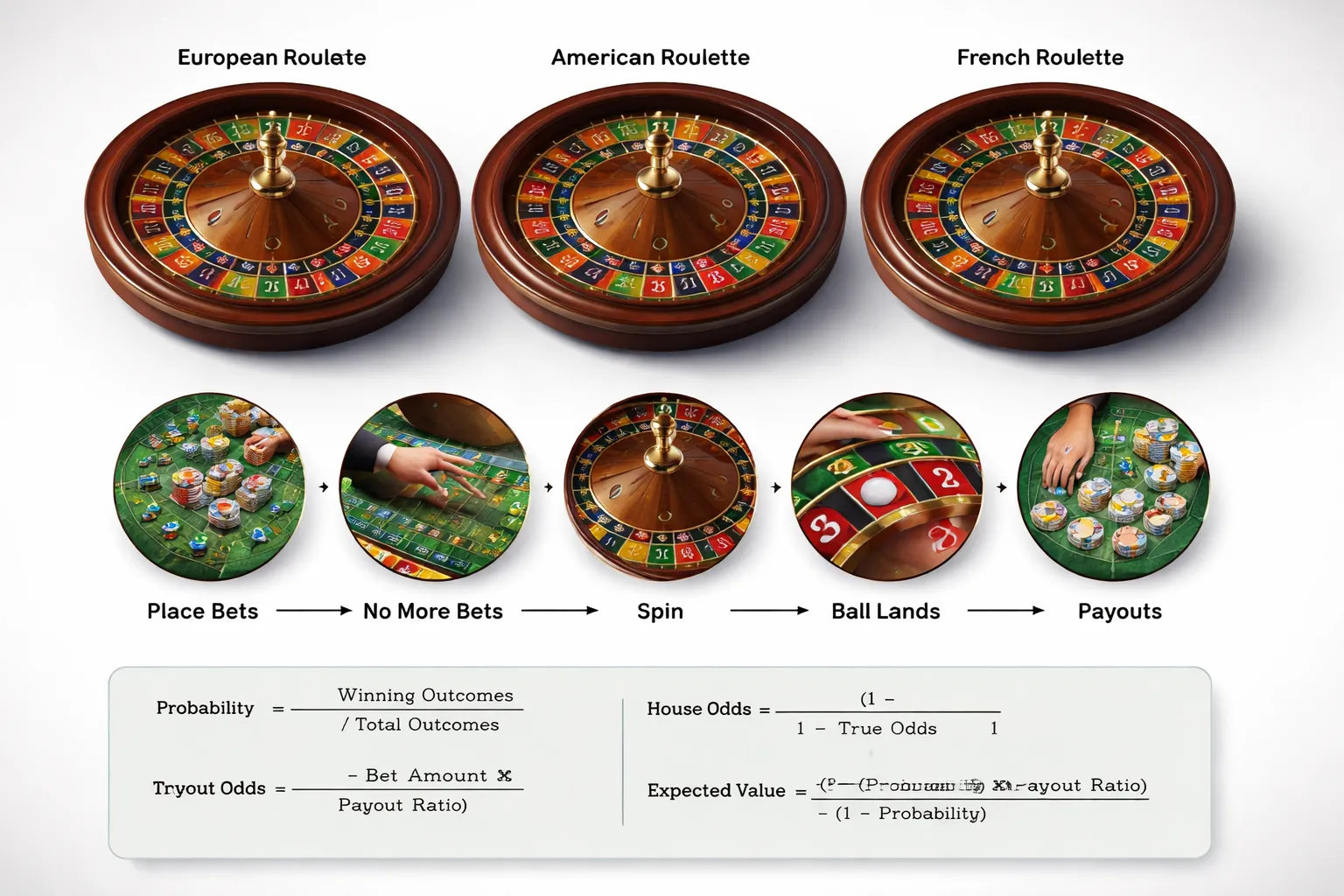
Roulette basics: wheel types, rules, and what “odds” really mean
European vs American vs French roulette
Roulette uses a wheel with numbered pockets and a table layout where you place chips. The wheel type sets the math.
| Wheel type | Pockets | Zeros | Standard house edge | Common special rules |
|---|---|---|---|---|
| European | 37 | 0 | 2.70% | None by default |
| American | 38 | 0, 00 | 5.26% | None by default |
| French | 37 | 0 | 2.70% on most bets | La Partage or En Prison on even-money bets |
French roulette usually means a European wheel plus extra rules on even-money outside bets like red or black, odd or even, and high or low.
- La Partage, if the ball lands on 0, you lose only half your even-money bet.
- En Prison, if the ball lands on 0, your even-money bet locks for the next spin. You get it back if it wins next spin, or lose it if it loses. Many casinos treat a second 0 as a full loss.
Both rules cut the even-money house edge to about 1.35% on a single-zero wheel.
How a roulette round works
- You buy chips and place them on the layout. Each chip position defines your bet type.
- The dealer calls no more bets. You stop placing or moving chips.
- The dealer spins the wheel and sends the ball the other way.
- The ball drops into a pocket. That number and color become the result.
- The dealer clears losing chips, then pays winning bets by the posted payout rules.
Your results do not change future spins. Each spin stands alone.
Key definitions: probability, payout, true odds, house edge, expected value
- Probability, your chance to hit a result. Example, a straight-up number on a European wheel hits 1 out of 37.
- Payout, what the table pays when you win. A straight-up pays 35 to 1.
- True odds, the fair payout based on probability, with no casino cut. For a European straight-up, true odds are 36 to 1 because you lose 36 times for each hit over the long run.
- House edge, the casino advantage as a percent of each bet over time. European standard bets sit at 2.70%. American standard bets sit at 5.26%.
- Expected value (EV), your average profit or loss per bet. EV equals (win probability × win profit) minus (loss probability × loss amount).
Example, $1 straight-up on European roulette.
- Win chance is 1/37, you win $35 profit.
- Lose chance is 36/37, you lose $1.
- EV = (1/37 × 35) - (36/37 × 1) = -1/37 = -$0.027.
That is the 2.70% house edge in dollar form.
Why the number of zeros drives the casino advantage
Zeros sit on the wheel but do not fit most even-money bets. They break the “fair” math.
- On a single-zero wheel, even-money bets win 18 numbers, lose 18 numbers, and also lose on 0. That extra losing pocket creates the 2.70% edge.
- On a double-zero wheel, you also lose on 00. Two extra losing pockets create the 5.26% edge.
The payouts rarely change when zeros increase. Your win rate drops, but the casino still pays the same. That gap is the house edge.
If you want the full breakdown by bet type, use our online roulette guide.
Roulette table layout and betting areas (inside vs outside)
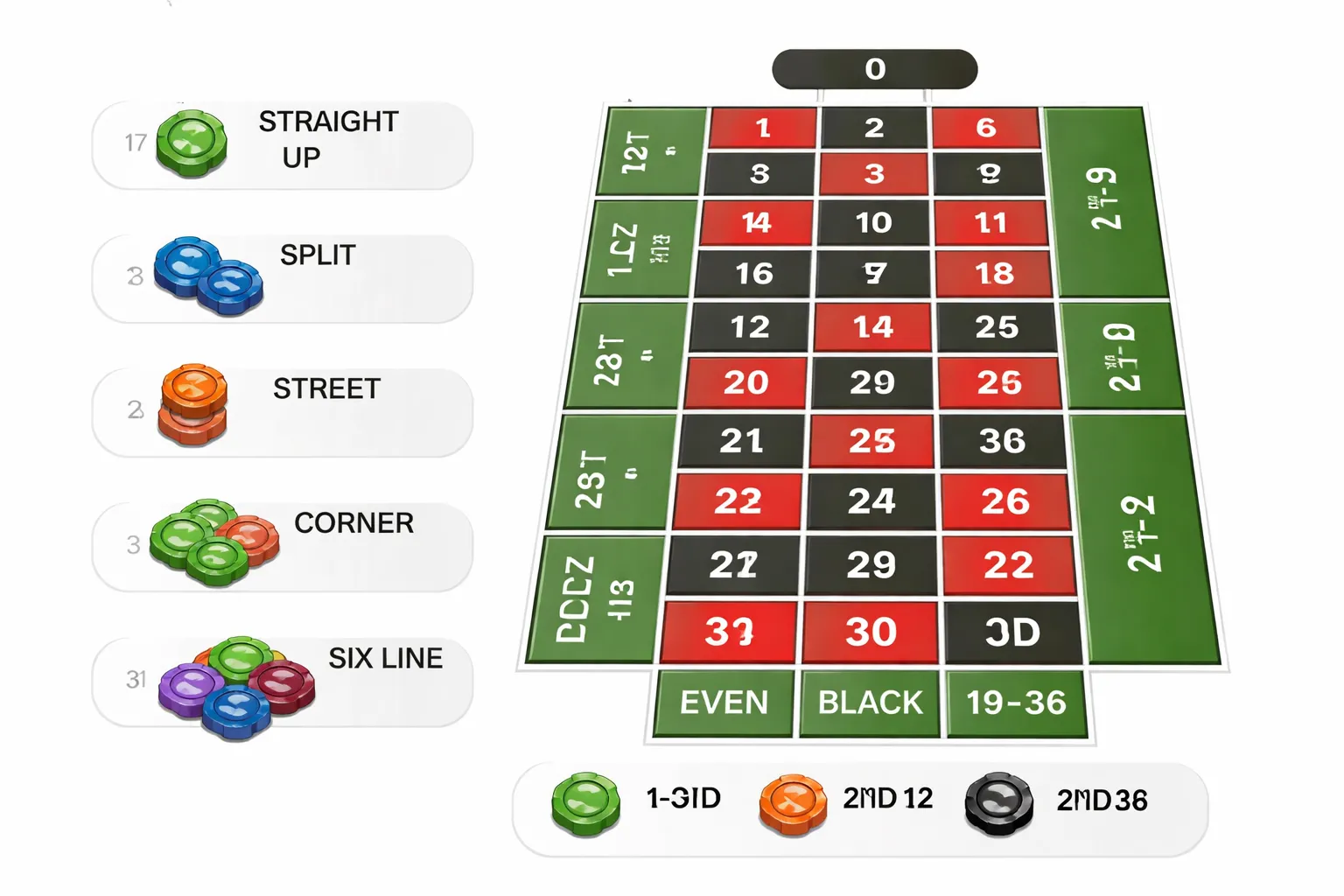
Reading the inside grid (numbers 1 to 36) and common chip placement
The inside area is the numbered grid. It holds 1 to 36 in three vertical columns. Each row has three numbers.
You place chips on lines and corners. The exact spot controls how many numbers you cover.
- Straight up, place your chip on a single number. One number.
- Split, place your chip on the line between two numbers. Two numbers.
- Street, place your chip on the outer edge of a row of three numbers. Three numbers.
- Corner, place your chip on the corner where four numbers meet. Four numbers.
- Six line, place your chip on the line between two adjacent rows. Six numbers.
Zeros sit outside the main grid. On European tables you see 0. On American tables you see 0 and 00. These pockets increase the house edge but do not improve payouts.
Understanding the outside track (dozens, columns, even-money bets)
The outside area wraps around the grid. These bets cover groups, so you win more often but get smaller payouts.
- Dozens, 1st 12, 2nd 12, 3rd 12. Each covers 12 numbers. Payout is 2 to 1.
- Columns, 2 to 1 boxes at the end of each column. Each covers 12 numbers. Payout is 2 to 1.
- Even money, Red or Black, Odd or Even, 1 to 18, 19 to 36. Each covers 18 numbers. Payout is 1 to 1.
Outside bets lose when the ball lands on 0 or 00. That is why your win rate drops compared to the listed coverage.
How to place bets cleanly in a live casino vs online interfaces
In a live casino, stack your chips in clean piles and keep them inside one betting spot. If you want the same bet for multiple spins, ask for it clearly and point to the area.
- Place one chip per spot, then add more chips on top of that same stack. Do not spread chips across lines unless you mean multiple bets.
- Use clear hand placement. Point with one finger and set chips with the other hand.
- Stop moving chips when the dealer calls no more bets. Late chips can get rejected.
Online, you click the exact bet zone. The interface highlights what you cover. Use the rebet button to repeat the same layout. Check the bet slip before you spin.
If you need a full list of bets and payouts by layout, use our online roulette guide.
Common beginner errors (misplaced chips, late bets, confusing 2-to-1 areas)
- Misplaced splits, you aim for a split but drop the chip on a number. You buy a straight up instead.
- Wrong street edge, you place a street chip inside the row. You can turn it into a split or corner by accident.
- Corner drift, you hit a corner but land closer to one line. The dealer may read it as a split.
- Confusing the 2 to 1 boxes, the 2 to 1 at the end of the grid is a column bet, not a dozen bet. Dozens sit below the grid in three long boxes.
- Forgetting zeros, you treat even money bets like true 50 50 bets. Zero and double zero break that math.
- Late bets, you add chips after the call. You risk a refused wager or a dispute.
If you want fewer mistakes at a live table, place fewer bet types at once. Build your layout one spot at a time.
Inside bets explained: types, payouts, and odds of winning
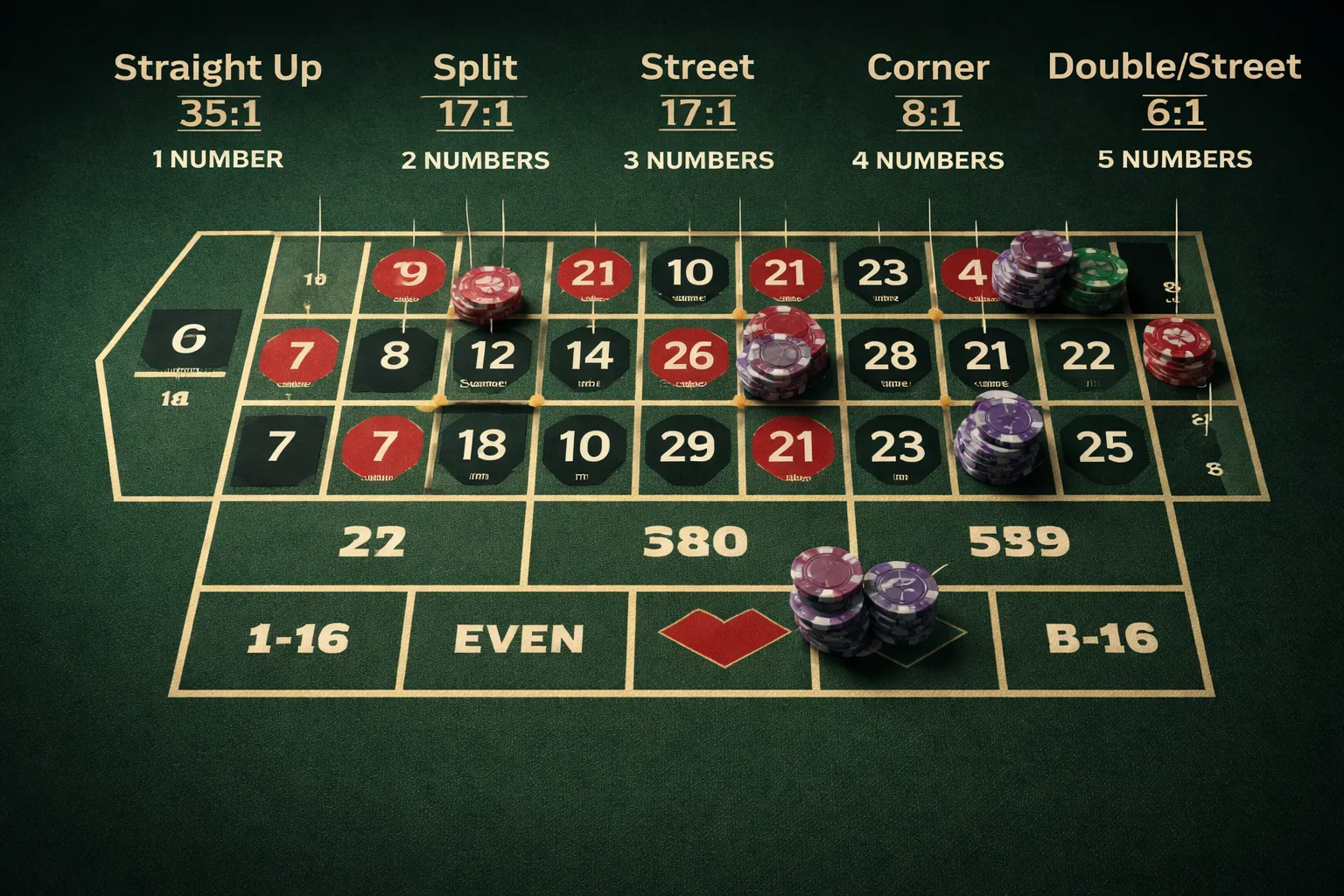
Straight up (single number)
You place one chip directly on a single number. You win if the ball lands on that exact number.
- Payout: 35 to 1 (you get your stake back plus 35x winnings).
- Win probability: 1 in 37 on European (2.70%). 1 in 38 on American (2.63%).
- Variance profile: Highest volatility. Long losing runs are normal. Big spikes when you hit.
Split bet
You place one chip on the line between two adjacent numbers on the grid. The bet covers both numbers.
- How to place it: Put the chip on the shared edge between the two numbers. For 0 and 00 splits, the placement depends on the layout, ask the dealer before you drop chips.
- Payout: 17 to 1.
- Win probability: 2 in 37 on European (5.41%). 2 in 38 on American (5.26%).
- Variance profile: Very high. Smoother than straight up, still swingy.
Street and double street
These bets cover full rows of numbers. They suit you when you want inside-bet payouts with more coverage.
- Street (3 numbers): Place the chip at the outer end of a horizontal row of three numbers. Payout: 11 to 1. Hit rate: 3 in 37 (8.11%) EU, 3 in 38 (7.89%) US.
- Double street (6 numbers): Place the chip on the line between two adjacent streets, at the outside edge of the grid. Payout: 5 to 1. Hit rate: 6 in 37 (16.22%) EU, 6 in 38 (15.79%) US.
- Typical use: Use street when you want a tighter target in one row. Use double street when you want more frequent hits but still want an inside bet.
Corner (square) bet
You place one chip on the point where four numbers meet. It covers that block of four.
- Placement rule: The chip must sit on the intersection of the four numbers. If it drifts onto a line, the dealer can treat it as a split.
- Payout: 8 to 1.
- Win probability: 4 in 37 on European (10.81%). 4 in 38 on American (10.53%).
- Payout math: You risk 1 unit to win 8 units, but you still lose on the other 33 or 34 outcomes.
- Variance profile: High. More stable than street, less stable than double street.
Top line and basket bets (read the layout sign)
Casinos use different names and placements for zero-area inside bets. Do not assume the rules match your last table.
- American roulette top line: Often a 5-number bet on 0, 00, 1, 2, 3. Payout: commonly 6 to 1. Hit rate: 5 in 38 (13.16%). This is one of the worst-value common bets on the layout.
- European roulette basket: Often a 4-number bet on 0, 1, 2, 3. Payout: commonly 8 to 1. Hit rate: 4 in 37 (10.81%).
- Other variants exist: Some tables offer special zero-area bets with different names and payouts. Your best move is to confirm the exact numbers covered and the payout before you place it.
Inside bet comparison table
| Inside bet | Numbers covered | Payout | Hit rate (European) | Hit rate (American) | Volatility |
|---|---|---|---|---|---|
| Straight up | 1 | 35 to 1 | 1/37 (2.70%) | 1/38 (2.63%) | Very high |
| Split | 2 | 17 to 1 | 2/37 (5.41%) | 2/38 (5.26%) | Very high |
| Street | 3 | 11 to 1 | 3/37 (8.11%) | 3/38 (7.89%) | High |
| Corner | 4 | 8 to 1 | 4/37 (10.81%) | 4/38 (10.53%) | High |
| Basket (European common) | 4 | 8 to 1 | 4/37 (10.81%) | Not offered | High |
| Top line (American common) | 5 | 6 to 1 | Not offered | 5/38 (13.16%) | Medium |
| Double street | 6 | 5 to 1 | 6/37 (16.22%) | 6/38 (15.79%) | Medium |
If you want a simple way to reduce swing, move up in coverage. Straight up and splits swing hardest. Double streets hit more often, but they still lose most spins.
Outside bets explained: types, payouts, and odds of winning
Outside bets sit on the outer areas of the layout. They cover large blocks of numbers. You trade payout size for more frequent hits.
Red or Black
You bet on the color of the winning number. Red has 18 numbers. Black has 18 numbers.
- Payout: 1 to 1
- Coverage: 18 numbers
- Zero behavior: 0 loses on European wheels. On American wheels, 0 and 00 lose.
- Hit rate: 18/37 (48.65%) European, 18/38 (47.37%) American
Odd or Even
You bet on whether the result is odd or even. There are 18 odd and 18 even numbers.
- Payout: 1 to 1
- Coverage: 18 numbers
- Zero behavior: 0 is neither odd nor even, it loses. On American wheels, 00 also loses.
- Hit rate: 18/37 (48.65%) European, 18/38 (47.37%) American
High or Low (1 to 18, 19 to 36)
You bet on the lower half or upper half of the numbers.
- Payout: 1 to 1
- Coverage: 18 numbers
- Zero behavior: 0 is outside both ranges and loses. On American wheels, 00 also loses.
- Hit rate: 18/37 (48.65%) European, 18/38 (47.37%) American
These even money bets feel steady, but the zero pockets drive the house edge. Your win chance stays under 50%.
Dozens (1st, 2nd, 3rd dozen)
You bet on a group of 12 numbers.
- 1st dozen: 1 to 12
- 2nd dozen: 13 to 24
- 3rd dozen: 25 to 36
- Payout: 2 to 1
- Coverage: 12 numbers
- Zero behavior: 0 loses, and 00 loses on American wheels.
- Hit rate: 12/37 (32.43%) European, 12/38 (31.58%) American
Columns (2 to 1 bets on the grid)
The main grid has three vertical columns. You place your chip at the end of a column, marked “2 to 1”. The bet covers the 12 numbers inside that column.
- 1st column: 1,4,7,10,13,16,19,22,25,28,31,34
- 2nd column: 2,5,8,11,14,17,20,23,26,29,32,35
- 3rd column: 3,6,9,12,15,18,21,24,27,30,33,36
- Payout: 2 to 1
- Coverage: 12 numbers
- Zero behavior: 0 loses, and 00 loses on American wheels.
- Hit rate: 12/37 (32.43%) European, 12/38 (31.58%) American
Outside bet comparison: coverage, payout, hit rate, volatility
| Outside bet | Numbers covered | Payout | Hit rate (European) | Hit rate (American) | Volatility |
|---|---|---|---|---|---|
| Red or Black | 18 | 1 to 1 | 18/37 (48.65%) | 18/38 (47.37%) | Low |
| Odd or Even | 18 | 1 to 1 | 18/37 (48.65%) | 18/38 (47.37%) | Low |
| High or Low | 18 | 1 to 1 | 18/37 (48.65%) | 18/38 (47.37%) | Low |
| Dozen | 12 | 2 to 1 | 12/37 (32.43%) | 12/38 (31.58%) | Medium |
| Column | 12 | 2 to 1 | 12/37 (32.43%) | 12/38 (31.58%) | Medium |
If you want lower swing, stick to even money outside bets. If you can handle longer losing streaks for bigger hits, use dozens or columns. For other low-edge options across casino games, see best online casino games with low house edge.
Payouts vs true odds: calculating house edge and expected value
Payouts vs true odds, why roulette payouts come up short
Roulette payouts track the true odds, but they never match them.
The gap comes from the zero pockets. They make you lose more often than the payout table “covers.”
If a bet has a true win chance of 1 in N, a fair payout would be (N minus 1) to 1.
- European roulette: 37 pockets, one zero.
- American roulette: 38 pockets, zero and double zero.
Those extra pockets do not increase payouts. They only reduce your win rate. That difference is the house edge.
Example calculations, European (37) vs American (38)
Use this formula for expected value (EV) per $1 bet.
EV = (win probability x profit if you win) minus (lose probability x 1)
| Bet | Payout | Win chance (EU) | EV per $1 (EU) | Win chance (US) | EV per $1 (US) |
|---|---|---|---|---|---|
| Straight up (1 number) | 35 to 1 | 1/37 | (1/37 x 35) - (36/37 x 1) = -1/37 = -0.02703 | 1/38 | (1/38 x 35) - (37/38 x 1) = -3/38 = -0.07895 |
| Red or Black | 1 to 1 | 18/37 | (18/37 x 1) - (19/37 x 1) = -1/37 = -0.02703 | 18/38 | (18/38 x 1) - (20/38 x 1) = -2/38 = -0.05263 |
- European house edge: 1/37 = 2.70%.
- American house edge (most bets): 2/38 = 5.26%.
- American straight up edge: 3/38 = 7.89%.
On a standard roulette wheel, most bets share the same long-run edge. The wheel decides the edge. Your bet type mostly decides variance.
Expected value by bet type, mostly the same within a wheel
On European roulette, almost every common bet has the same EV, about -2.70%.
On American roulette, almost every common bet has the same EV, about -5.26%.
That includes inside bets like splits and corners, and outside bets like red or black, dozens, and columns.
The practical takeaway is simple. Do not pick a bet because you think it beats the edge. Pick it for volatility and bankroll control.
If you want a game where your decisions can lower the edge, use a strategy chart in blackjack. See our blackjack basic strategy chart.
Variance and bankroll swings, why short-term results mislead
EV tells you the long run. Variance controls the short run.
- Outside even-money bets: You win more often. You also hit zeros that wipe the bet. Swings feel smaller.
- Dozens and columns: You win less often. You get paid 2 to 1. Losing streaks get longer.
- Inside bets: You win rarely. You can hit big payouts. Your bankroll can drop fast before a hit.
A “hot” run does not change the math. It just means variance landed in your favor for a while.
If you want steadier sessions, lower your unit size, stick to even-money bets, and avoid chasing losses. If you want bigger spikes, accept longer droughts and set a hard stop.
French roulette rules that change outcomes (and when they apply)
French roulette rules that change outcomes (and when they apply)
French roulette often adds rules that protect even-money bets when the ball lands on 0. These rules do not change payouts. They change what happens on 0.
La Partage (even-money only)
La Partage applies only to even-money outside bets, Red or Black, Odd or Even, High or Low.
If 0 hits, you lose only half your stake. The other half returns to you.
- You bet $10 on Red.
- 0 hits.
- You lose $5, you get $5 back.
En Prison (even-money only) and how it resolves
En Prison also applies only to even-money outside bets.
If 0 hits, your bet does not lose. The dealer “imprisons” it for the next spin.
Next spin resolution:
- If your bet wins, you get your original stake back, with no profit.
- If your bet loses, you lose the full stake.
- If 0 hits again, many tables keep it imprisoned again, others resolve as a loss. The table rules decide.
Net effect on a single 0 event usually matches La Partage. You either lose half now, or you face a delayed half-loss on average.
How these rules reduce house edge (European wheel numbers)
Assume a European wheel with 37 pockets, numbers 0 to 36.
| Rule set | Applies to | House edge on even-money bets |
|---|---|---|
| Standard European | All bets | 2.70% |
| La Partage | Even-money only | 1.35% |
| En Prison | Even-money only | About 1.35% in the common form |
These rules only help your even-money outside bets. They do nothing for inside bets, dozens, columns, or any other bet type. Those stay at 2.70% house edge on a European wheel.
When casinos label these rules differently (what to look for)
Online lobbies do not always show “French roulette” clearly. Some tables include the rules but list them under different names.
- Look for La Partage, En Prison, or French rules in the table help or game info.
- Check the 0 rule text. It should say “half back on 0” or “bet held for next spin” for even-money bets.
- Confirm it applies to Red/Black, Odd/Even, High/Low only.
- Read what happens if 0 hits twice while your bet is imprisoned.
- Avoid vague labels like “European Roulette” if you want the 1.35% edge. Standard European often has no half-back rule.
If you want lower variance and a lower edge on outside bets, pick a table that states La Partage or En Prison in writing.
Advanced and special roulette bets (what to know before using them)
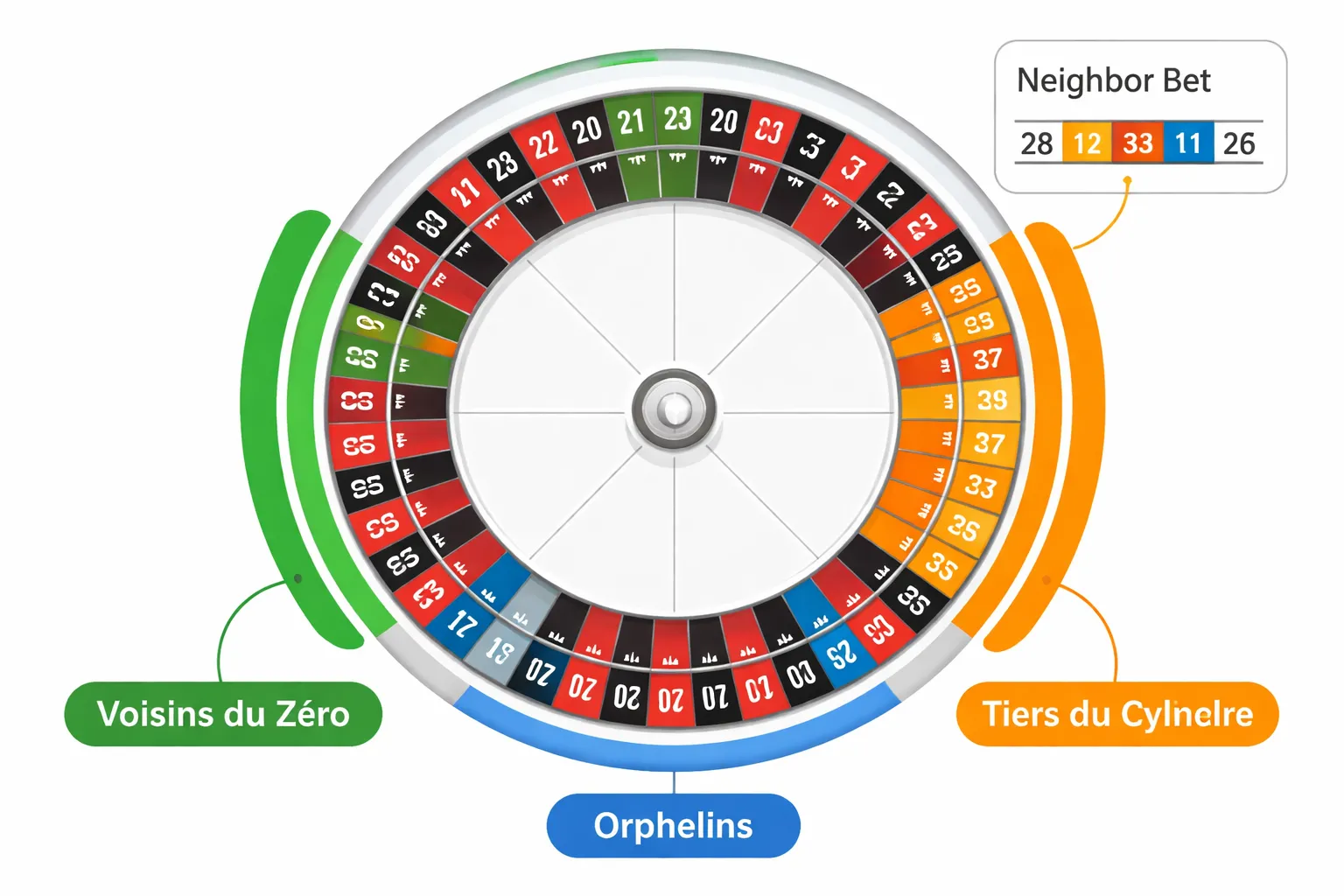
Call bets and racetrack bets (Voisins, Tiers, Orphelins) explained
Call bets are French-style bets you announce to the dealer. Racetrack bets are the same idea shown on a racetrack layout in many online casinos. They place multiple straight-up and split bets that cover a wheel sector.
| Bet | What it covers on the wheel | How many numbers | Total units staked | How it is built |
|---|---|---|---|---|
| Voisins du Zéro | Sector around 0 | 17 | 9 | 2 splits, 1 street, 3 corners, 1 straight-up |
| Tiers du Cylindre | One third of the wheel opposite zero | 12 | 6 | 6 splits |
| Orphelins | The remaining numbers not in Voisins or Tiers | 8 | 5 | 4 splits, 1 straight-up |
These are fixed recipes. You do not get a special payout table. Each piece pays as its normal bet type.
Neighbor bets and sector coverage, what you’re actually betting on
A neighbor bet covers one number plus adjacent numbers on the wheel, not on the table grid.
- Example: “5 and the neighbors” covers 24, 16, 33, 1, 20 in European wheel order.
- Most casinos place this as 5 straight-up bets. You stake 5 units total, 1 unit per number.
- Some layouts let you pick 2 neighbors, 3 neighbors, or more on each side. That changes the count and your total stake.
Sector bets like Voisins, Tiers, and Orphelins do the same thing at a larger scale. You buy coverage of a wheel slice using a bundle of inside bets.
Key point. Wheel coverage changes variance, not edge. You spread your stake across more numbers. You hit more often, but you win smaller when you hit.
Announced bets in live casinos vs shortcuts online
In live casinos, announced bets depend on house rules.
- The dealer may require a minimum for announced bets, even if the table minimum is lower.
- The dealer may require full-unit multiples because the bet is split into several pieces.
- If you say “neighbors,” you must specify how many neighbors on each side, or the house default applies.
- Placement can close earlier than simple outside bets. Late calls get refused.
Online, you usually place these bets in one click on a racetrack. The software applies a fixed recipe. You still place multiple standard bets. You just do it faster.
Some online “special” buttons add a twist, like automatic re-bets or progressions. Treat them as convenience tools. They do not change the math.
If you want to verify what you are buying online, use a site that shows the exact bet breakdown and rules. Read the RTP and wheel type in writing. See online casino fairness and house edge basics.
Why “special” bets don’t beat the house edge (but can shape variance)
Roulette edge comes from the zeros. Special bets do not remove them. They just repackage inside bets.
- On a single-zero wheel, every straight-up, split, street, corner, and line bet carries the same expected loss rate. About 2.70% of your stake.
- On a double-zero wheel, the expected loss rate rises. About 5.26% of your stake.
- Voisins, Tiers, Orphelins, and neighbors follow the same rule because they are made of the same parts.
What does change. Variance and bankroll swings.
- More coverage, like neighbors, hits more often. Your results look smoother. Your average loss rate stays the same.
- Less coverage, like a single straight-up, hits less often. Your results swing harder. Your average loss rate stays the same.
- Bundles that include more split and corner action can feel “steadier” than pure straight-ups, because they create more frequent small wins.
Use special bets only if you want wheel-based patterns, faster placement, or a specific risk level. Do not use them to chase a better edge. The edge does not move unless the wheel rules change, like La Partage or En Prison on even-money outside bets.
Inside vs outside bets: choosing the right bet for your goal
Best bets for lower volatility sessions (and why)
Outside bets give you more frequent wins. They pay less, but they keep your bankroll swings smaller.
- Even-money outside bets (red or black, odd or even, high or low): highest hit rate among standard bets. Lower variance than any inside bet.
- Dozens and columns: medium hit rate, 2 to 1 payout. Bigger swings than even-money, smaller than most inside bets.
- European rules matter: La Partage or En Prison can cut the house edge on even-money bets. Your outcomes stay similar, but you lose less over time on average.
If your goal is time on table and fewer steep drops, start with even-money bets. Add dozens or columns only if you accept wider bankroll swings.
Best bets for chasing higher payouts (and the tradeoffs)
Inside bets buy payout size with lower hit rate. You win less often, and your bankroll moves faster.
- Straight up: highest payout, lowest hit rate. Expect long losing stretches.
- Split and corner: smaller payouts than straight up, better hit rate. Still high variance.
- Street and double street: sit between splits and dozens for coverage. Variance stays high because many spins still miss.
If your goal is a big score, use inside bets with money you can lose quickly. Keep stake size tight. Variance will do the rest.
Mixing bets: common combinations and how they change coverage
Mixing bets changes your coverage and your payout shape. It does not change the house edge for that wheel and ruleset.
- Even-money plus a straight up: you chase a spike while keeping some regular hits. Your net result depends on whether the straight up lands before it drains the extra cost.
- Two dozens: covers 24 numbers. You win 2 to 1 on a hit, but your net profit is small because you stake two units to win two units. You lose both units on the missing dozen.
- Two columns: same idea as two dozens, different layout. Similar risk profile.
- Corner bundle: several corners across the layout. More frequent small wins than straight-ups, but you pay for coverage with lower payout per winning unit.
- Inside plus dozens: you smooth some variance with dozens while keeping high payout potential on a few numbers.
| Mix | Coverage | Typical result pattern |
|---|---|---|
| Even-money only | Large | Many small wins and losses, smallest swings |
| Dozens or columns only | Medium | Chunkier swings, regular misses |
| Straight-ups only | Small | Long droughts, rare large hits |
| Even-money plus straight up | Large plus a spike | Steadier base, occasional jump, higher cost per spin |
Decision guide: pick a bet type based on bankroll, risk tolerance, and session length
- Small bankroll, low risk tolerance, long session: even-money outside bets. Use the minimum unit. Prefer European rules with La Partage or En Prison when available.
- Medium bankroll, medium risk tolerance, medium session: dozens or columns. Keep to one per spin for cleaner variance. Add a second only if you accept bigger drops.
- Any bankroll, high risk tolerance, short session: inside bets. Favor splits and corners if you want more hits than straight-ups. Use straight-ups when you accept long losing runs for a larger payout.
- Want balance: one outside bet as a base, plus a small inside add-on. Cap the add-on so it does not dominate your total stake per spin.
If you need a refresher on payouts and the full bet menu, use this guide to online roulette rules and bets.
Common roulette strategies and myths (risk management vs “systems”)
Systems vs reality, what strategies can and can’t do
Roulette has a fixed house edge. No betting system changes it. A system can only change how your bankroll swings, how fast you reach a limit, and how often you bust.
On European roulette, the house edge is 2.70%. On American roulette, it is 5.26%. Those percentages apply no matter how you size your bets.
Martingale, double-up progression
Martingale doubles your stake after each loss, then resets after a win. Players use it on even-money outside bets.
- What it does: It creates many small wins, until a long losing run hits.
- What it can’t do: It cannot beat the house edge. It cannot prevent busting when losses stack.
- Why it breaks: Table limits cap your next bet, bankroll caps your next bet. A losing streak forces a huge stake to win back a small amount.
Example on a 1 unit base bet. After 6 losses you need 64 units on the next spin. Total staked across those 6 losing spins is 63 units. One more loss pushes the required next bet to 128 units.
Fibonacci progression
Fibonacci increases bets using the sequence 1, 1, 2, 3, 5, 8, 13, and so on. Many versions step back after a win.
- What it does: It ramps slower than Martingale at first. It still ramps hard during long losing runs.
- What it can’t do: It cannot turn negative expectation into positive expectation.
- Risk profile: Lower short-run pressure than doubling systems, similar long-run problem. Losing streaks still produce large stakes and large drawdowns.
D’Alembert progression
D’Alembert adds 1 unit after a loss and subtracts 1 unit after a win. It grows slower than Martingale and Fibonacci.
- What it does: It smooths bet sizing. It reduces the chance you hit table limits fast.
- What it can’t do: It cannot change your long-term loss rate. It cannot stop long downswings.
- Trade-off: You accept more time in the negative while chasing recovery with slightly larger average bets.
Past spins do not predict future outcomes
Each spin is independent. The wheel has no memory. A long run of red does not make black “due”. A cluster of high numbers does not make low numbers “due”.
This belief is the gambler’s fallacy. It pushes you to increase stakes at the worst time, when variance already runs against you.
Progression betting vs flat betting
Flat betting means you risk the same amount each spin. Progressions change your bet size based on wins or losses.
- Flat betting: Lower variance per session. Slower bankroll swings. Clear control of max loss per spin.
- Loss progressions: Higher variance and higher ruin risk. Your biggest bets happen when you are already down.
- Win progressions: You press when you run hot. You still face the same house edge. You mainly change the shape of your results.
Progressions can feel like control. In practice, they concentrate risk into fewer, larger bets. That raises the chance you hit a stop-loss or a table limit before variance swings back.
Practical bankroll rules, limits beat “systems”
- Set a stop-loss: Pick a fixed amount you can lose for the session. Stop when you hit it.
- Set a stop-win: Lock profit at a fixed target. Stop when you hit it. Do not give back a good run with larger stakes.
- Respect table limits: Before you play, check min and max bets. Any progression can fail fast if the max blocks your next step.
- Cap inside-bet add-ons: If you mix outside and inside bets, keep the inside portion small and consistent.
- Size your base unit: Choose a unit that lets you survive normal downswings without chasing.
If you want a simple way to think about risk, use the same mindset as high volatility vs low volatility games. Roulette systems do not change the edge. They only change how wild your results look.
How to find the best roulette odds in casinos and online
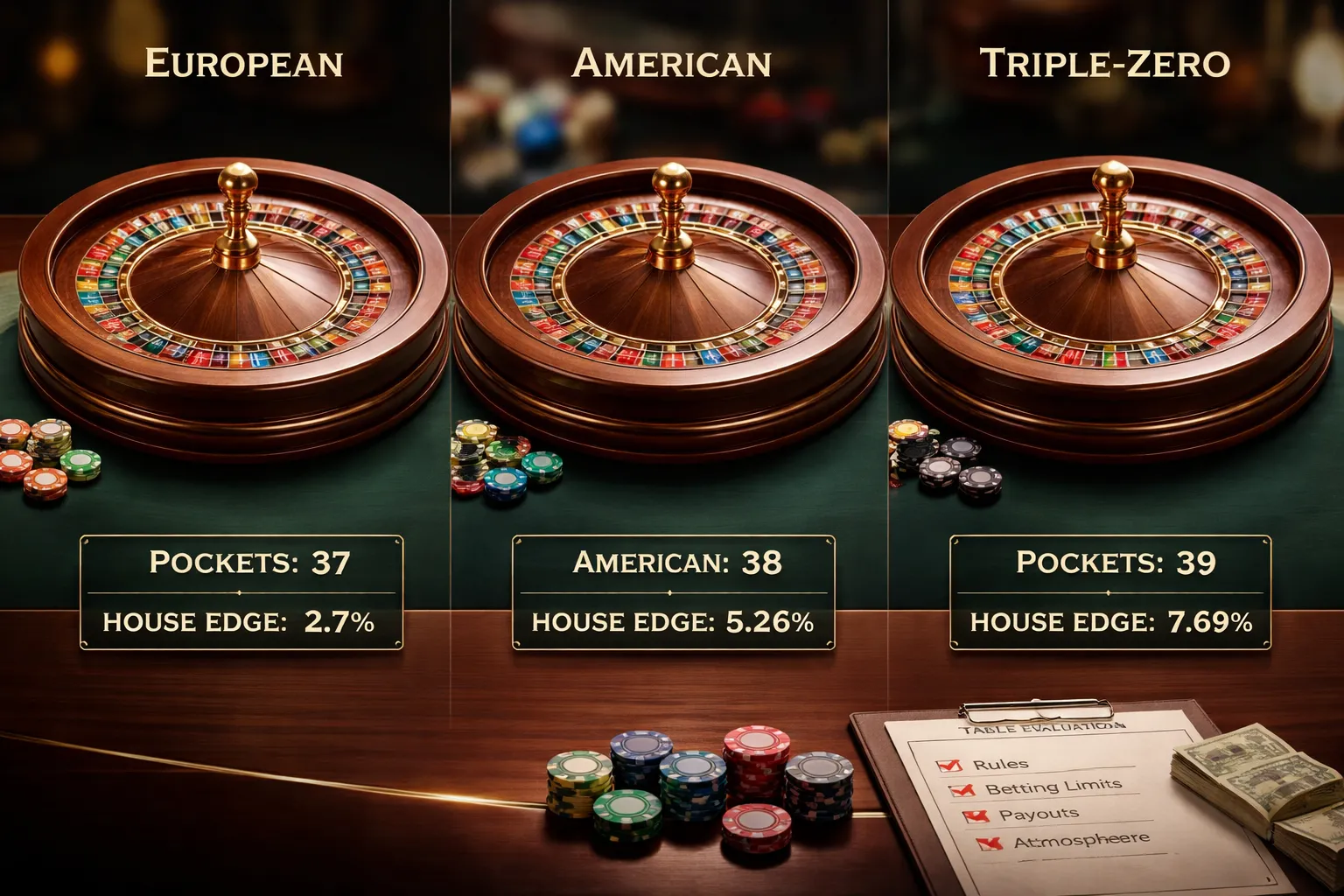
Choose the right wheel, prioritize single-zero and French rules
Your best odds start with the wheel type. The number of zeros drives the house edge.
- European roulette (single-zero, 37 pockets), house edge 2.70%.
- American roulette (double-zero, 38 pockets), house edge 5.26%.
- French roulette rules can cut the edge on even-money bets when the ball lands on zero.
- La Partage, on even-money bets you lose only half your stake when zero hits, house edge drops to 1.35% on those bets.
- En Prison, on even-money bets you leave the stake in place when zero hits, you either win it back next spin or lose it, long-run edge also 1.35% on those bets.
If you play even-money bets like red or black, La Partage and En Prison matter. If you mostly play inside bets, they do not change your odds.
For a deeper breakdown of wheel types and rules, see our European vs American Roulette: Key Differences.
Avoid high-house-edge options, triple-zero and most side bets
Some tables look familiar but carry worse math.
- Triple-zero roulette (000) uses 39 pockets, house edge 7.69%.
- Five-number bet (0, 00, 1, 2, 3) on many American tables pays 6 to 1, house edge 7.89%.
- “Top” and “side” bets often carry double-digit house edges. Treat them as entertainment spend, not core strategy.
When you compare tables, start with the base game. Extra bets can erase the advantage of finding a good wheel.
RNG vs live dealer roulette, fairness, pace, and typical limits
Online roulette usually comes in two formats. Both can be fair, but they play differently.
- RNG roulette uses software to generate results. Look for third-party testing certification and clear game rules. RNG plays fast, which increases how quickly your expected losses show up per hour.
- Live dealer roulette uses a real wheel and dealer on video. It plays slower. You often see lower minimums at shared tables, but max limits can be tighter.
- Rule differences show up more online. Some games add special multipliers, bonus rounds, or extra zeros. These often raise the house edge.
If you want the cleanest odds, pick standard European single-zero roulette, with no add-on features, and with La Partage or En Prison if available.
Quick checklist for evaluating a roulette table before you play
- Count the zeros, pick one zero, avoid two or three zeros.
- Check even-money zero rules, prefer La Partage or En Prison.
- Skip the five-number bet if the layout offers it.
- Read the side-bet paytable, avoid any bet with unclear odds or boosted payouts that do not match standard roulette.
- Confirm limits, minimum, maximum, and any max on outside bets if you plan to cover many numbers.
- Track pace, faster games burn bankroll faster. Choose a speed you can afford.
- Online only, verify the provider, licensing, and independent testing notes in the rules screen.
- Stick to one wheel, changing tables does not change the math, but it can push you into worse rules and higher limits.
FAQ
What are the odds on European vs American roulette?
European roulette has 37 pockets. Your straight-up win chance is 1/37, or 2.70%. American roulette has 38 pockets. Your straight-up win chance is 1/38, or 2.63%. The extra 00 raises the house edge from 2.70% to 5.26%.
Do inside bets have better odds than outside bets?
No. Outside bets win more often but pay less. Inside bets win less often but pay more. On the same wheel, both carry the same house edge. Your long-term loss rate tracks the wheel, not the bet type.
What is the house edge for common wheels?
European single-zero runs 2.70%. American double-zero runs 5.26%. French roulette is usually 2.70%, but rules like La Partage can cut some even-money bets to a 1.35% edge when the ball lands on zero.
How do roulette payouts work?
Most bets pay “to 1.” Straight-up pays 35 to 1, split 17 to 1, street 11 to 1, corner 8 to 1, six-line 5 to 1, dozen and column 2 to 1, even-money bets 1 to 1. Payouts stay fixed by rule.
What are inside bets?
Inside bets cover numbers in the main grid. Common types include straight-up, split, street, corner, and six-line. You trade hit frequency for higher payouts. You also face higher variance, so your bankroll swings faster.
What are outside bets?
Outside bets sit around the grid. They include red or black, odd or even, high or low, dozens, and columns. They hit more often than inside bets and pay less. They help you control variance and pace.
Is the “en prison” rule the same as La Partage?
No. Both apply to even-money bets on some French tables. La Partage returns half your stake on zero. En prison locks your bet for one spin. You win it back if the next spin wins, and lose it if it loses.
Does covering more numbers reduce the house edge?
No. It can smooth outcomes, but the expected loss stays the same for that wheel. When you place multiple bets, you often increase total money at risk per spin. That can make losses show up faster.
What is the best roulette bet?
The best bet is the one on the best wheel rules. Choose European or French over American. If you play even-money bets, prefer La Partage or en prison. Then size your bets to fit your bankroll and session limit.
What is the 5-number bet and should you use it?
The 5-number “basket” bet covers 0, 00, 1, 2, 3 on American roulette. It usually pays 6 to 1 and carries a higher house edge, often 7.89%. Skip it if you care about expected value.
How can you verify the rules in online roulette?
Open the game info screen and confirm the wheel type, payout table, and special rules on zero. Check min and max limits, plus any max payout cap. For live tables, review the studio rules and provider details.
Where can you learn the full roulette rules and bet map?
Use this guide for table layout, bet placement, and payout examples, how to play online roulette. It helps you place inside and outside bets correctly and avoid misclicks on mobile.
Conclusion
Conclusion
Roulette comes down to two decisions, wheel type and bet type.
Pick the best wheel first. European roulette has 37 pockets and a 2.70% house edge. American roulette has 38 pockets and a 5.26% house edge. That gap matters more than any bet pattern.
Then choose bets that match your goal. Inside bets pay more, hit less. Outside bets hit more, pay less. The odds do not change the house edge on a standard wheel, your variance changes.
- Use outside bets if you want steadier results and longer sessions.
- Use inside bets if you accept longer losing runs for higher payouts.
- Check the zero rule before you play. La Partage and En Prison cut losses on even money bets and lower the effective edge.
- Lock your limits. Set a stop loss and a take profit, then stick to them.
Final tip, start every session by confirming the wheel, the zero rules, and the table limits. If you want a deeper breakdown of wheel choice, read our European vs American roulette odds guide.
-
Online Casino Fairness Explained: RNG, RTP, House Edge & Provably Fair
8 months ago -
Slot RTP Explained: What RTP Means and How to Use It
8 months ago -
How to Play Online Slots: Rules, Features & Beginner Tips
8 months ago -
How Slot Jackpots Work: Progressive Jackpots Explained
8 months ago -
How to Play Online Blackjack: Rules, Payouts & Quick Start Guide
8 months ago
-
- What are the odds on European vs American roulette?
- Do inside bets have better odds than outside bets?
- What is the house edge for common wheels?
- How do roulette payouts work?
- What are inside bets?
- What are outside bets?
- Is the “en prison” rule the same as La Partage?
- Does covering more numbers reduce the house edge?
- What is the best roulette bet?
- What is the 5-number bet and should you use it?
- How can you verify the rules in online roulette?
- Where can you learn the full roulette rules and bet map?
-
- What are the odds on European vs American roulette?
- Do inside bets have better odds than outside bets?
- What is the house edge for common wheels?
- How do roulette payouts work?
- What are inside bets?
- What are outside bets?
- Is the “en prison” rule the same as La Partage?
- Does covering more numbers reduce the house edge?
- What is the best roulette bet?
- What is the 5-number bet and should you use it?
- How can you verify the rules in online roulette?
- Where can you learn the full roulette rules and bet map?
-
Reload Bonus Explained: What It Is and When It’s Worth Claiming
6 months ago -
Online Casino Licensing Explained: Authorities, Licenses & How to Check One
8 months ago -
Best Live Dealer Casinos: Where to Play Live Blackjack, Roulette & More
8 months ago -
Best Online Casinos for High Rollers: VIP Perks, High Limits & Exclusive Bonuses
8 months ago -
Fast Payout Online Casinos: Best Sites for Quick Withdrawals
8 months ago
-
Online Casino Customer Support: What to Look For (Live Chat, Email, Response Times)
8 months ago -
Sign Up for an Online Casino: Create an Account in Minutes
8 months ago -
Online Casino Payment Safety Tips: How to Deposit and Withdraw Securely
8 months ago -
What to Do If an Online Casino Won’t Pay Out: Step-by-Step Actions
8 months ago -
How to File a Complaint Against an Online Casino (Plus ADR Explained)
8 months ago