How to Play Online Blackjack: Rules, Payouts & Quick Start Guide

Online blackjack moves fast, and each choice you make changes your odds.
This guide gives you the rules, the key decisions, and the payouts you will see in real online tables. You will learn the goal of the game, card values, how the dealer plays, and what hit, stand, double, split, and surrender mean. You will also learn standard payout rates, including the common 3:2 and 6:5 on blackjack, plus how pushes work. You will get a quick start checklist so you can choose a table, set your stake, and play your first hands without mistakes. If you want another low edge table game, read our How to Play Baccarat Online guide.
In het kort:
- Doel: kom zo dicht mogelijk bij 21 zonder eroverheen te gaan. Versla de dealer, niet de tafel.
- Kaartwaarden: 2 tot 10 tellen als hun waarde. Boer, vrouw, heer tellen als 10. Aas telt als 1 of 11.
- Dealerregels: de dealer speelt volgens vaste regels. Jij kiest je acties op basis van je hand en de open kaart van de dealer.
- Jouw opties: hit voor een extra kaart, stand om te stoppen, double om je inzet te verdubbelen en één kaart te nemen, split om een paar te splitsen in twee handen, surrender om je hand op te geven waar toegestaan.
- Blackjack uitbetaling: standaard betaalt blackjack vaak 3:2. Veel 6:5 tafels betalen minder, vermijd ze als je lage house edge wilt.
- Push: bij gelijkspel krijg je je inzet terug. Je wint niet en je verliest niet.
- Quick start: kies een tafel met 3:2 payout, check de regels voor split en surrender, zet een vaste inzet per hand, speel je eerste handen rustig en consistent.
- Alternatief met lage edge: wil je een tweede eenvoudige tafelgame, lees dan onze How to Play Baccarat Online gids.
What Is Online Blackjack and How It Works
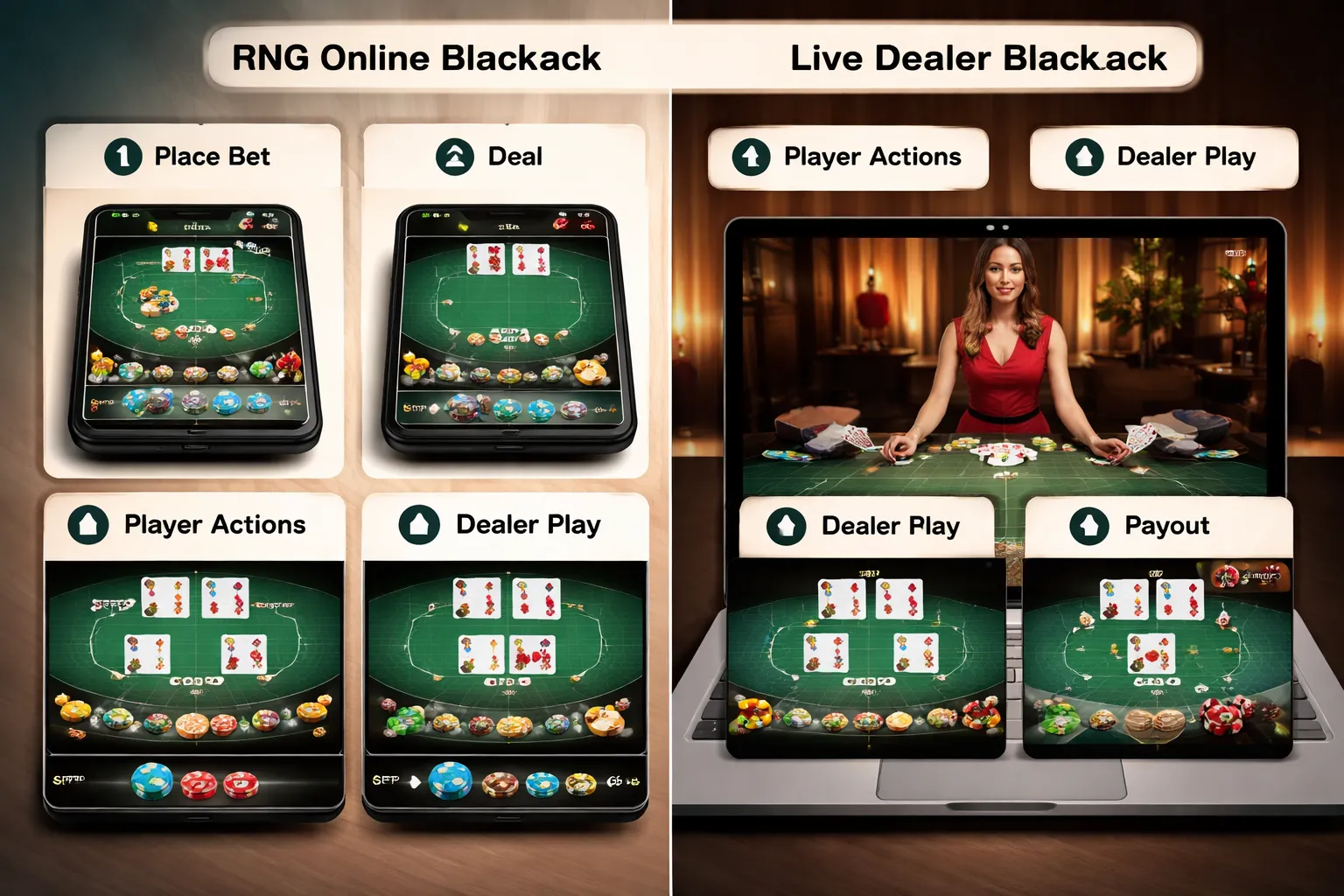
What online blackjack is
Online blackjack is blackjack played on a casino site or app. You place a bet, you get cards, you choose actions, the dealer plays last, then the game pays out or takes your stake. The goal stays the same, finish closer to 21 than the dealer without going over.
RNG blackjack vs live dealer blackjack
- RNG blackjack: Software deals digital cards using a random number generator. You play at your pace. Tables usually offer more rule variants and lower minimum bets.
- Live dealer blackjack: A real dealer runs the game on video. Cards come from a physical shoe. You act within a timer. The pace depends on the table and other players.
- What stays the same: Hand values, dealer rules, and your core options. Hit, stand, double, split, and sometimes surrender. Payout rules like 3:2 or 6:5 still matter.
- What changes: Speed, interaction, and waiting. RNG is fastest and has no seat pressure. Live tables can have limited seats and slower rounds.
How a typical round works from bet to payout
- You pick a table. You check the minimum and maximum bet, blackjack payout, and key rules.
- You set your stake and place your bet before the deal window closes.
- You receive two cards. The dealer gets two cards, one usually face up.
- You decide your action. Hit, stand, double, split, or surrender if allowed.
- Dealer plays after all players act, following fixed rules. Most tables hit on 16 and stand on 17, some hit soft 17.
- Payout resolves.
| Outcome | What happens | Typical payout |
|---|---|---|
| Blackjack | Your first two cards total 21 | 3:2 on many tables, 6:5 on weaker tables |
| Win | You beat dealer without busting | 1:1 |
| Lose | Dealer beats you or you bust | -1 stake |
| Push | Tie total | Stake returned |
If you want to understand how casinos generate outcomes and measure return, read our online casino fairness guide.
Common table limits, seats, and pace online
- Table limits: RNG tables often start low. Live tables often start higher. High-limit tables exist in both formats. Always check the max, splits and doubles can increase your total risk per round.
- Seat availability: RNG blackjack rarely has seat limits. Live dealer tables often cap seats. Some offer unlimited betting spots through bet-behind, you can bet on a seated player’s hand but you do not control decisions.
- Pace of play: RNG runs fast because you act instantly. Live dealer runs on a timer and table flow. Expect slower play when more seats fill.
Objective of Blackjack (Winning Conditions)
Beating the dealer
Your goal is simple. Finish the hand with a better result than the dealer without going over 21.
- Higher total: You win if your hand total beats the dealer’s total and you do not bust.
- Dealer busts: You win if the dealer goes over 21 and you do not bust.
- Blackjack: You win with an Ace plus a 10-value card as your first two cards. Most online tables pay 3:2 or 6:5. 3:2 pays more and lowers the house edge.
If you bust, you lose your bet. It does not matter what the dealer does after.
Pushes (ties) and what happens to your bet
A push means you and the dealer finish with the same total. Your bet returns to your balance. You win nothing and lose nothing.
- If you and the dealer both have blackjack, it is a push.
- If you have 21 with three or more cards and the dealer has blackjack, you lose. Blackjack beats any other 21.
Dealer constraints and why they matter
The dealer does not make choices. The table rules force the dealer to hit or stand. These constraints shape your odds and your best plays.
- Dealer stands on 17: The dealer stops at 17, including soft 17 if the rule says S17. This helps you.
- Dealer hits soft 17: The dealer must hit A-6. This helps the house and increases volatility.
- Fixed drawing rules: The dealer keeps drawing until the rules allow a stand. You can plan around this because the dealer cannot adapt to your hand.
Card Values, Hand Types, and Key Definitions
Card Values
Blackjack uses standard 52-card decks. Most online tables use 4 to 8 decks, but the values stay the same.
- Number cards (2 to 10). Count at face value. A 7 is worth 7.
- Face cards (J, Q, K). Each counts as 10.
- Aces (A). Count as 1 or 11. Your hand uses the value that gives the best total without busting.
Totals and Hand Types
Your goal is to finish closer to 21 than the dealer without going over.
- Total. Add card values. Example, 10 plus 6 equals 16.
- Hard hand. No Ace, or an Ace that must count as 1 to avoid a bust. Example, A-6-10 is hard 17 because 11 would bust.
- Soft hand. Includes an Ace counted as 11. Example, A-6 is soft 17. You can take a hit without immediately risking a bust.
Blackjack vs 21 Made With 3+ Cards
Blackjack means an Ace plus a 10-value card on your first two cards. Example, A-K.
A total of 21 made with three or more cards is not blackjack. Example, 7-7-7.
- Why it matters. Blackjack usually pays more than a normal win.
- Typical payout. Blackjack often pays 3:2. Some online tables pay 6:5, which reduces your long-term return.
- Push risk. If you make 21 with 3+ cards and the dealer has blackjack, you usually lose. If you have blackjack and the dealer has 21 with 3+ cards, you usually win.
Busting and Dealer Outcomes
- Bust. Your total goes over 21. You lose your bet right away, even if the dealer later busts.
- Stand. You keep your total and end your action.
- Push. You and the dealer tie. You get your stake back.
Key Definitions You See in Online Lobbies
- S17. Dealer stands on all 17s, including A-6. Better for you.
- H17. Dealer hits soft 17. Better for the house.
- Blackjack payout. Shown as 3:2 or 6:5. Higher is better.
- Insurance. Side bet offered when the dealer shows an Ace. It pays if the dealer has blackjack.
- Even money. If you have blackjack and the dealer shows an Ace, you can take a guaranteed 1:1 payout. It acts like blackjack plus insurance.
- Double. You double your bet, take exactly one more card, then stand.
- Split. If you get a pair, you split into two hands and place a second equal bet.
- Resplit. You can split again if you draw another pair. The lobby may show a limit, like “resplit up to 3 hands.”
- DAS. Double after split. This helps you.
- RSA. Resplit Aces. This helps you.
- No hole card. Common in European blackjack. The dealer does not take a second card until players finish their hands.
- Peek. Common in American blackjack. The dealer checks for blackjack when showing an Ace or 10-value card.
- Surrender. You give up the hand and lose half your bet. The lobby may show “LS” for late surrender.
- Min, Max. Table limits per hand.
- RTP. Return to player. A higher RTP means a lower house edge, assuming correct play.
Step-by-Step: How to Play Online Blackjack (Quick Start Guide)

Pick a table, rules snapshot to check before joining
- Blackjack payout: Look for 3:2. Avoid 6:5 if you want better value.
- Dealer stands or hits on soft 17: Prefer S17 over H17.
- Number of decks: Fewer decks usually means a lower house edge.
- Double rules: DAS lets you double after a split, it helps your long-term results.
- Splits: Check how many hands you can split to, and if you can re-split Aces.
- Soft hands: Check if the table restricts doubles on soft totals.
- Surrender: “LS” means late surrender. It can cut losses on bad matchups.
- Peek: Common in American blackjack. It changes how some hands resolve when the dealer shows an Ace or 10-value card.
- Side bets: Treat them as separate games. They often have a higher house edge.
- Limits and speed: Confirm min and max, and whether the table runs fast, standard, or slow.
If you want the best default decisions per hand, use a blackjack basic strategy chart and match it to the table rules you picked.
Place your bet and understand chip denominations
- Set your stake before the deal starts. You cannot change it after cards come out.
- Click chips to build your bet. Each chip has a fixed value shown on the chip or in the chip tray.
- Use clear and undo if the UI offers them. Do this before the timer ends.
- Check total bet on screen. Some tables show it as “Bet” or “Main bet.”
- If you play side bets, place them in the side bet spots. They do not change your main hand payout.
Receive cards and choose actions in the correct order
- You get two cards. The dealer gets one upcard, plus a hole card in many American-style tables.
- Check your total and whether it is hard or soft. Soft means an Ace can count as 11.
- Act only when the UI highlights your hand. Online blackjack locks the order, you cannot act out of turn.
- Hit: Take one card. Use it to improve totals below 17 in many spots.
- Stand: Take no more cards. Your total stays locked.
- Double: Double your bet, take exactly one card, then stand.
- Split: If you have a pair, split into two hands. Each hand needs an extra bet equal to your original.
- Surrender: If offered, you give up the hand and lose half your bet. The UI may show “Surrender” or “Late Surrender.”
- Insurance: If the dealer shows an Ace, the UI may offer insurance. It is a separate wager that pays if the dealer has blackjack.
Dealer play, settlement, and how results show in the UI
- After you finish all hands, the dealer reveals the hole card if used at that table.
- The dealer draws by fixed rules, usually hits to 17, then stands. The table decides H17 or S17.
- Settlement happens right after dealer play, or earlier if the dealer has blackjack and the table uses peek.
- Common result labels include Win, Lose, Push, Blackjack, Bust.
- Payouts post to your balance. Many UIs also show a hand summary, like “+1.00,” “-1.00,” or “Paid 3:2.”
- For split hands, the UI settles each hand separately. You can win one and lose the other.
Replay speed, autoplay, and avoiding misclicks
- Use standard speed until you stop making timing errors.
- If you use autoplay, set limits. Use stop conditions like max loss, max hands, or a time cap if the casino offers them.
- Confirm whether autoplay repeats side bets. Many players lose money by repeating side bets without noticing.
- On mobile, use landscape mode if it makes buttons larger. Avoid playing with one hand while moving.
- Wait for the action buttons to fully load before tapping. Do not tap the card area if the UI uses it as a hit shortcut.
- Use clear separation between hands when you split. Tap the highlighted hand only.
- Turn off “Quick Hit” or “Tap to Hit” if the table offers it and you misclick.
Player Actions Explained (Hit, Stand, Double, Split, Surrender)
Hit and Stand, manage your total and your range
Hit means you take another card. You risk busting if your total goes over 21.
Stand means you take no more cards. Your total stays locked.
Think in ranges, not single numbers. Your goal is to finish with a total that beats the dealer’s likely finish without busting.
- Hard totals have no Ace counted as 11. Example: 16 (10+6). Hard hands bust easily.
- Soft totals use an Ace as 11. Example: soft 17 (A+6). Soft hands can absorb a hit because the Ace can drop from 11 to 1.
- Dealer upcard sets the pressure. A strong upcard (7 to Ace) pushes you to improve more often. A weak upcard (2 to 6) pushes you to avoid busting and let the dealer break.
Practical baseline: stand more with made hands and weak dealer upcards, hit more with low totals and strong dealer upcards. Treat soft hands as safer to hit than hard hands.
Double down, one card, bigger bet
Double means you double your bet, take exactly one more card, then stand.
Casinos restrict doubling. Rules vary by table.
- Common offers: double on any first two cards, or only on 9 to 11.
- After split: some tables allow double after you split, some do not.
- One-card limit: you always get one card only. No extra hits after doubling.
Use doubling when you have an edge on the next card. The classic case is a starting total of 11. You gain the most when your hand has strong improvement odds and the dealer shows a weaker upcard.
Split pairs, you create two hands and add a bet
Split applies when your first two cards match in rank. You separate them into two hands.
- You must place a second bet equal to your original bet.
- Each split card becomes the first card of a new hand.
- The dealer deals one new card to each hand. You then play each hand in turn.
Table rules change split value.
- Resplit: some tables let you split again if you draw another pair.
- Split Aces: often you get only one card per Ace and cannot hit after.
- Blackjack after split: many tables pay it as a normal 21, not a blackjack payout.
- Double after split: may be allowed or blocked.
Splitting changes your risk. You trade one hand for two weaker starts. You also double your money in play. Use it when it improves your expected result, not just because you dislike a total.
Surrender, cut your loss when rules allow it
Surrender lets you forfeit the hand and lose half your bet. You end the hand immediately.
- Early surrender: you can surrender before the dealer checks for blackjack. This rule is rare and player-friendly.
- Late surrender: you can surrender only after the dealer checks for blackjack. This is more common online.
Surrender reduces losses in the worst matchups. You use it when you face a strong dealer upcard and your hand has a high bust risk or weak improvement path.
Insurance and even money, side bets with a cost
Insurance appears when the dealer shows an Ace. You can bet up to half your main bet that the dealer has blackjack. Insurance usually pays 2:1.
Insurance is separate from your hand. It does not protect you in most outcomes. It only pays when the dealer has blackjack.
Even money appears when you have blackjack and the dealer shows an Ace. You take a guaranteed 1:1 payout instead of risking a push if the dealer has blackjack.
You usually avoid both. They trade long-term value for short-term certainty. Unless you track the deck, insurance and even money tend to increase the house edge.
Rules Variations That Change Odds (Read This Before You Play)
Blackjack Payout Formats, 3:2 vs 6:5
Check the blackjack payout before you play a hand. It changes your expected return more than most other rules.
- 3:2 blackjack: Bet $10, win $15 when you get blackjack.
- 6:5 blackjack: Bet $10, win $12 when you get blackjack.
That $3 difference does not look big. It adds up fast because blackjack hands happen often. Switching from 3:2 to 6:5 typically increases the house edge by about 1.4%. Many “low minimum” tables pay 6:5. If you care about odds, avoid them.
Dealer Hits Soft 17 (H17) vs Stands on Soft 17 (S17)
Soft 17 means the dealer has 17 with an Ace counted as 11, like A-6.
- S17: Dealer stands on A-6. Better for you.
- H17: Dealer hits A-6. Worse for you.
H17 gives the dealer more chances to improve without busting. It usually raises the house edge by about 0.2% versus S17, assuming similar rules.
Number of Decks
More decks usually means a higher house edge and slightly different basic strategy plays. It also reduces the impact of card removal on future hands.
- Single deck: Often best odds, if paired with strong rules.
- Double deck: Still good, rule dependent.
- 6 to 8 decks: Common online and in live dealer games.
With standard rules, moving from fewer decks to more decks typically adds a small cost, often around 0.1% to 0.3% across common comparisons. Do not overfocus on decks while ignoring 6:5 payouts or H17. Those two hurt more.
Double Down Rules, Any Two Cards vs 9 to 11 Only
Doubling lets you increase your bet when you have an edge. Restrictions remove profitable doubles.
- Double on any two cards (DOA): Better for you.
- Double only on 9 to 11: Worse for you.
- Double after split (DAS): Better for you. It keeps more strong hands profitable after you split.
- No double after split: Worse for you.
As a rough guide, losing DAS often costs about 0.1% to 0.2%. Losing DOA can cost more, depending on what doubles the table blocks.
Resplitting Rules and Split Aces Limits
Splitting rules decide how often you can turn one good spot into two strong spots.
- Resplit up to 3 or 4 hands: Better for you than “no resplit.”
- Resplit aces allowed (RSA): Strong for you because aces create high value hands.
- No resplit aces: Common, worse for you.
Aces carry extra restrictions at many tables. Those restrictions increase the house edge because they cut off high value outcomes.
Can You Hit Split Aces
Most games force you to take one card on each split ace, then stand. Some tables let you hit split aces. That rule matters.
- One card only on split aces: Standard, worse for you than hitting.
- Hit split aces allowed: Better for you. You recover value when you catch low cards.
Quick Rule Check Table
If you want a fast filter, prioritize in this order. 3:2 over 6:5 first. Then choose S17 over H17. Then look at doubles and splits. Decks come after that.
Blackjack Payouts and Bet Types (Including Side Bets)
Standard outcomes and payouts
Your payout depends on the hand result and the table rules. The key number is the blackjack payout, 3:2 beats 6:5.
| Outcome | What it means | Typical payout |
|---|---|---|
| Win | Your total beats the dealer without busting | 1:1 |
| Lose | You bust, or dealer finishes higher | -1 unit |
| Push | Tie score, or both have blackjack | 0, you keep your bet |
| Blackjack | Ace plus 10-value on your first two cards | 3:2, or 6:5 on worse tables |
- 3:2 blackjack payout, bet 10, you win 15 profit.
- 6:5 blackjack payout, bet 10, you win 12 profit.
- Insurance is separate. It is a side wager on the dealer having blackjack. It usually pays 2:1.
How doubles and splits change your risk and return
Doubling and splitting do not change the payout rate. They change your total exposure. You put more money on the table, so swings get bigger.
- Double down, you add one extra bet equal to your original bet, then you take exactly one more card.
- If you win after a double, you win 2 units. If you lose, you lose 2 units. A push returns both bets.
- Split, you turn a pair into two hands. You place a second bet equal to your original bet.
- Each split hand settles at 1:1, except a blackjack after a split often pays 1:1, not 3:2. Many games treat it as a normal 21.
- Resplitting increases total exposure again. Every new hand usually requires another equal bet.
If you want correct double and split decisions, use a blackjack basic strategy chart. It matches your moves to the rules and upcard.
Common side bets and the volatility trade-off
Side bets can pay big. They also add house edge and increase volatility. Treat them as separate games, because they are.
- Perfect Pairs, you bet your first two cards form a pair. Common tiers include mixed pair, colored pair, perfect pair. Payouts vary by casino.
- 21+3, you combine your two cards with the dealer upcard and grade it like a 3-card poker hand. Typical winners include flush, straight, three of a kind, straight flush, suited trips.
- Bet Behind, you place a wager on another player hand, often with an option to copy their plays. Your result matches that hand. Rules differ by table and provider.
- Volatility, side bets hit less often. You can lose many small bets waiting for a payout.
- Bankroll impact, keep side bets small and separate from your main blackjack stake.
- Rule drift, side bet paytables change a lot. Do not assume they match another table.
Payout table checklist, what to confirm before you bet
Open the game info panel and confirm these items. Do it before you play for real money.
- Blackjack payout, 3:2 preferred, avoid 6:5.
- Dealer rule, stands on soft 17 or hits soft 17.
- Double rules, double on any two or limited to 9 to 11, 10 to 11, or hard totals only.
- Double after split, allowed or not.
- Resplit rules, how many times you can resplit, and whether resplitting aces is allowed.
- Split aces rules, one card only or hit allowed, and whether you can split aces again.
- Blackjack after split, pays 3:2 or pays 1:1 as a normal win.
- Number of decks, fewer decks usually helps, but payout and S17 matter more.
- Side bet paytables, Perfect Pairs and 21+3 payouts, plus table limits.
- Min and max bets, main bet, side bets, and any max payout cap.
Basic Strategy for Online Blackjack (Beginner-Friendly)
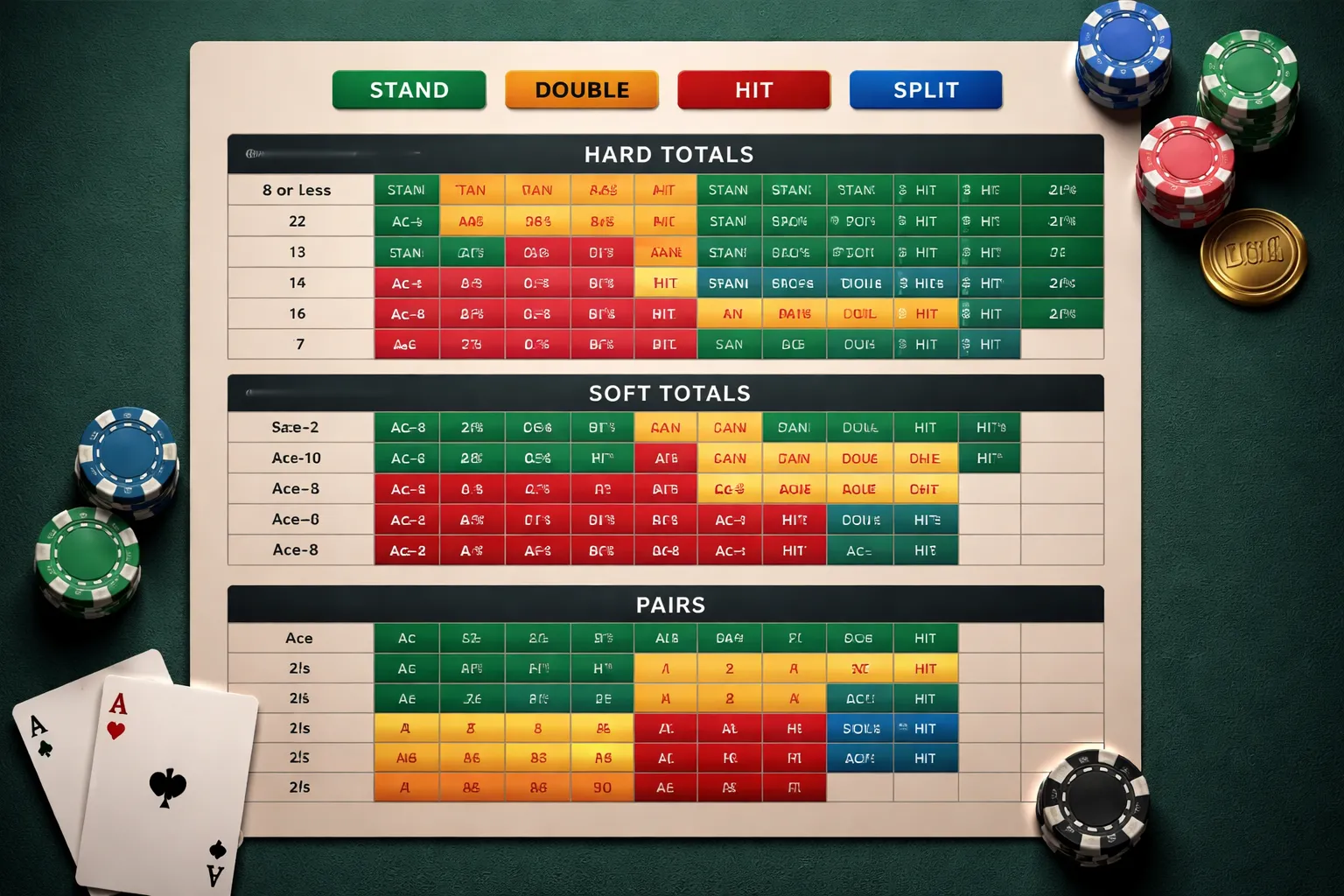
What a Basic Strategy Chart Is, and How to Use It
A basic strategy chart tells you the best move for every hand. It uses math, not guesses. It aims to cut the house edge as much as the rules allow.
You read the chart with two inputs. Your hand on one axis. The dealer upcard on the other. The cell shows the correct action, hit, stand, double, or split.
- Hard hands: No ace counted as 11, or you would bust if the ace counted as 11.
- Soft hands: An ace counted as 11, so you can take a hit without busting.
- Pairs: Two cards with the same rank, so you can split.
Use the chart that matches your table rules. Deck count, blackjack payout, and whether the dealer hits or stands on soft 17 change the correct plays.
Use it responsibly. Learn it for one ruleset, then stick to that game. If the casino uses different rules, switch charts. Do not mix them.
Core Rules of Thumb You Can Apply Fast
These rules cover most hands you see. They will not replace a chart, but they will keep you close.
- Stand on hard 17 or higher. You bust too often if you hit.
- Hit hard 8 or lower. You need cards. Standing burns value.
- With hard 12 to 16, the dealer upcard drives the hand. Stand more against dealer 2 to 6. Hit more against dealer 7 to ace.
- Double when you have an edge and can only take one card. Do it most with hard 9 to 11, and with some soft hands.
- Split to turn one weak hand into two better hands. Prioritize the pairs that gain the most.
Doubling basics you should know.
- Hard 11: Double against almost any dealer upcard in most rulesets.
- Hard 10: Double more when the dealer shows 2 to 9.
- Hard 9: Double more when the dealer shows 3 to 6.
- Soft 13 to soft 18: Many doubles happen against dealer 4 to 6, and sometimes 2 to 3, depending on the exact total.
Splitting priorities that usually matter most.
- Always split aces. One good card makes a strong hand.
- Always split 8s. Hard 16 is a problem hand. Splitting improves your outcome.
- Never split 10s. You already have 20. You do not need action.
- Never split 5s. Treat it like 10, you want a double opportunity.
Best and Worst Starting Hands, and What They Mean
- Best: Blackjack. You already won unless the dealer also has blackjack.
- Very strong: Hard 20. Stand.
- Strong: Hard 19. Stand.
- High value doubles: Hard 11, then hard 10, then hard 9 in the right spots.
- Good flexibility: Soft hands. You can hit without busting, and you can double in the right matchups.
The weak hands decide your long-term results. Learn these first.
- Hard 16: You face a high bust risk if you hit, but you often must hit against dealer 7 to ace.
- Hard 15: Similar to 16, but slightly less painful.
- Hard 12: Small swings, but many players misplay it. Your decision depends heavily on the dealer upcard.
- Pair of 8s: A key split spot. Many beginners freeze and stand. That costs you.
Common Beginner Mistakes That Raise the House Edge
- Playing without a rules-matched chart. One rule change can flip several key hands.
- Chasing “dealer bust” on every hand. Standing too much on hard 12 to 16 versus dealer 7 to ace gives up value.
- Skipping doubles. Doubling is where a lot of your edge comes from in good spots.
- Splitting the wrong pairs. Splitting 10s and 5s hurts. Refusing to split 8s and aces hurts.
- Misplaying soft totals. Soft hands are not “safe stands.” Many need hits or doubles to gain value.
- Taking insurance by default. Insurance is usually a bad bet unless you count cards.
- Changing bets based on streaks. Each hand is independent. Use a bankroll plan, not emotion.
- Adding side bets without tracking cost. Side bets often carry a much higher house edge than the main game.
If you want a different risk profile with fixed payouts and simple decisions, learn the basics of online roulette bets before you put money on side bets.
Bankroll Management and Responsible Play
Choose a session bankroll, then set hard stop limits
Pick a session bankroll. Treat it as money you can lose. Do not top up mid session.
Set two numbers before you play.
- Loss limit: the point where you stop for the day. Many players use 10 to 20 percent of their session bankroll.
- Win limit: the point where you lock a profit and leave. Many players use 20 to 50 percent.
Use time limits too. Put a cap on sessions, for example 30 to 60 minutes, then take a break.
Bet sizing that lowers risk of ruin
Your edge in blackjack is small. Your variance is not. Bet sizing controls how long you can stay in the game.
- Flat betting: use the same stake each hand. This gives the most stable results and the lowest risk of blowing up fast.
- Small proportional bets: keep each bet to about 1 to 2 percent of your session bankroll. Example, a $200 session bankroll fits $2 to $4 bets.
- Avoid progressions: systems that raise stakes after losses increase volatility. They do not change the house edge.
If you want a simple rule, use flat bets at 1 to 2 percent and raise stakes only when you start a new session with a larger bankroll.
Martingale, why it feels safe, and why it breaks
Martingale doubles your bet after each loss. One win should recover prior losses plus one unit.
It feels safe because most losing streaks are short. The problem is the rare long streak.
- Bet size grows fast: after 6 losses you need 64 units. After 10 losses you need 1,024 units.
- Table limits stop the system: online tables cap max bets. You can hit the cap before you recover.
- Your bankroll caps it too: even without table limits, your bankroll runs out first.
Martingale trades many small wins for occasional large losses. That loss can wipe out multiple sessions of profit.
Use casino tools, reality checks, and cooling off
Responsible play works best when you remove decisions from the moment.
- Deposit limits: set daily, weekly, or monthly caps. Match them to your budget, not your mood.
- Reality checks: turn on popups that show time played and net results. Use them as a stop signal.
- Loss limits and session limits: use platform controls if available, then follow your own rules too.
- Cooling off: take a forced break for 24 hours to several days if you chase losses or raise stakes under stress.
- Self exclusion: use it if you cannot stick to limits. It blocks access for a set period.
If you want a lower decision load with fixed bet types, review our online roulette guide before you add higher edge side bets to your blackjack sessions.
Choosing the Best Online Blackjack Table (Quality & Safety Checklist)
Licensing, Audits, and Fairness Indicators
Start with the operator license. Use the casino footer and the regulator site to confirm it.
- Tier 1 regulators: UKGC, Malta Gaming Authority, Gibraltar. Strong player protection and dispute handling.
- Mid tier regulators: Isle of Man, Alderney, Sweden. Solid oversight, varies by operator.
- Light oversight: Curacao. Common, but you need extra checks on audits, reputation, and payments.
Then check fairness proof. Blackjack uses two main models.
- RNG blackjack: Look for third party testing seals and reports from labs like eCOGRA, iTech Labs, GLI, or BMM. Find them in the footer, the game info panel, or the help section.
- Live dealer blackjack: Prefer studios with named providers and published standards. Look for clear rules on card dealing, shuffling method, and game protection. Prefer recognized suppliers like Evolution, Playtech, Pragmatic Play Live, or Authentic Gaming.
Red flags. Missing license details. No testing references. Broken links to certificates. Unclear ownership. Support that will not confirm rules and audits.
Game Speed, Interface, and Mobile Usability
Pick a table that matches your pace. Speed changes your hourly loss rate. Faster play means more hands per hour and more variance.
- RNG speed: Fast. Good for practice, bad for bankroll control if you tilt.
- Live speed: Slower. Better for discipline, but you wait on other players and the dealer.
Check the interface before you deposit.
- Bet controls: Clear chip values, one tap rebet, easy undo before deal.
- Decision aids: Hand history, last results log, and visible running balance.
- Table tools: Quick seat switch, limits filter, and stable reconnect on mobile.
On mobile, test portrait mode, button spacing, and scroll behavior. You need clean hit, stand, double, split controls with no overlap. Avoid games that hide rules behind multiple menus.
RTP and House Edge Transparency, Rule Sheets
Blackjack RTP depends on rules and your decisions. You need the rule sheet, not a single RTP number.
Find the rule sheet in the game menu. Look for an info icon, a help tab, or a rules link in the lobby.
Use this checklist. These items move the edge fast.
- Dealer stands on soft 17 (S17): Better for you than dealer hits soft 17 (H17).
- Blackjack payout: Prefer 3:2. Avoid 6:5 tables. 6:5 adds a large house edge jump.
- Double rules: Double on any two cards helps. Double after split helps.
- Split rules: More resplits helps. Re split aces helps. Hitting split aces helps if allowed.
- Surrender: Late surrender helps when offered.
- Deck count: Fewer decks usually helps, but rules matter more than decks alone.
- Side bets: Treat them as separate games with higher edge.
If the casino does not show rules per table, do not assume the best version. Pick another table.
Bonus and Wagering Requirements, When Promos Help vs Hurt
Most blackjack promos hurt value because casinos limit how much your blackjack play counts toward wagering.
- Check contribution: Many bonuses count blackjack at 0 to 20 percent. Slots often count 100 percent.
- Check wagering: High wagering plus low contribution makes clearing unrealistic.
- Check max bet rules: A low max bet during wagering can block basic stake sizing and force longer grind.
- Check game restrictions: Some terms ban specific blackjack variants, side bets, or live tables.
- Check time limits: Short expiry increases mistakes and tilt risk.
Promos help when the terms fit blackjack.
- Low wagering: Lower rollovers reduce expected cost.
- High contribution: 50 to 100 percent blackjack contribution makes clearing possible.
- Cashback: Loss rebates can reduce volatility if terms are simple and automatic.
If you want a low rules, fixed payout game for bonus clearing, use our online baccarat guide to compare promo fit by game type.
Live Dealer Blackjack Tips (Online-Specific Etiquette and Mechanics)
Betting Windows, Decision Timers, and Timeouts
Live blackjack runs on a clock. You bet first, then you act. Miss either window and the table moves on.
- Betting window: You get a short countdown to place chips. When it closes, you cannot change your bet. Late clicks do nothing.
- Auto rebet: Many tables let you repeat your last wager. Use it if you play steady stakes. Turn it off if you vary bets by count, promo, or bankroll.
- Side bets lock early: Side bets often close before main bets. If you do not see the chip land, assume it did not register.
- Decision timer: After the deal, you get a countdown for hit, stand, double, or split. The dealer cannot wait for you.
- If you time out: Most rooms force a default action. Usually it is stand on hard totals and hit on some soft totals, but rules vary by provider. Check the table help before you sit.
- Disconnects: If your stream drops mid-hand, the game resolves under the same timeout rules. Your bet stays live. The shoe continues.
Play one table at a time if you struggle with timers. Use stable Wi-Fi. Close other streams and apps.
Chat Etiquette and Common Table Norms
Chat does not change the cards. It can still get you removed.
- Keep it short: Dealers juggle dealing, cameras, and prompts. Long messages slow nothing down.
- No “deal faster” demands: Dealers follow studio pace and compliance steps. Spam can trigger a mute.
- No strategy policing: Do not attack other players for hits, stands, splits, or side bets. In live online blackjack, other players do not affect your cards anyway.
- Avoid personal info: Do not share names, emails, or payment details in chat.
- Follow language rules: Many rooms block profanity and some topics. Repeat violations lead to a chat ban or table removal.
If you need real help, use support. Chat is for simple dealer-facing notes, not account issues.
Bet Behind and Multi-Seat Play: How It Works and When It Makes Sense
Some live tables offer extra ways to bet without taking a main seat.
- Bet Behind: You place a wager on another player seat. You usually share the same outcome. You often do not control the decisions. In some rooms you can suggest actions, but the seated player makes the final call.
- When Bet Behind helps: Use it when seats are full, when you want lower effort play, or when you want exposure without managing decisions every hand.
- When Bet Behind hurts: Avoid it if you want full strategy control, especially for doubles and splits. Your edge comes from correct decisions.
- Multi-seat play: You occupy two or more seats at the same table. You make decisions for each hand. This increases hands per shoe for you, but it also increases variance and bankroll swing.
- When multi-seat makes sense: Use it if you have the bankroll for bigger downswings and you want more volume at the same rules and limits.
- When to avoid it: Skip it if you chase losses, play close to your bankroll limit, or rely on tight session stop rules. More hands can speed up losses.
If you want full control, take one seat and play clean basic strategy. For a rules refresher, see our online blackjack guide.
Pros and Cons of Playing Blackjack Online
Advantages
- Easy access. You can play anytime. You can switch stakes fast. You can leave after any hand.
- More table variety. You can choose live dealer or RNG tables. You can often find different rules, like dealer hits or stands on soft 17, double options, and surrender. You can also pick tables with side bets if you want them.
- Lower minimums. Many casinos run low-stakes tables that would not exist on a busy casino floor. That helps you practice without big swings.
- Learning tools. Many apps and casinos show hand history, recent results, and clear bet tracking. Some offer basic strategy hints in demo mode. Use them to build habits, then turn them off.
- More control over pace. In live dealer, you can often sit out hands. In RNG, you can slow down and think if you avoid auto-play style habits.
Drawbacks
- Fast pace can cost you money. RNG blackjack can run far more hands per hour than live tables. More hands means faster variance. It also means mistakes add up faster.
- Distractions hurt decisions. Tabs, phones, and multitasking lead to misclicks and rushed plays. Blackjack punishes sloppy choices.
- Promo pitfalls. Bonuses can come with high wagering requirements, game contribution limits, max bet rules, and short time windows. Blackjack often counts less toward wagering than slots. Read the terms before you deposit. If you want to chase promos, slots usually qualify better, see our online slots guide.
- Rule quality varies. Some tables use weaker rules for players. Watch for 6:5 blackjack payouts, limited doubling, and no surrender. These changes raise the house edge.
- Side bets increase risk. Most side bets carry a higher house edge than the main game. Treat them as entertainment spend, not a strategy.
Who Online Blackjack Is Best For, and Who Should Avoid It
- Best for you if: you play basic strategy, you track your bankroll, you prefer flexible stakes, and you want to compare rules before you sit down.
- Avoid it if: you tilt after losses, you rely on strict session stop rules you will not follow, or you tend to speed-play. Fast games amplify leaks.
- Best format match: choose live dealer if you want slower play and fewer hands per hour. Choose RNG if you want volume and you can stay disciplined.
FAQ
What is the goal in online blackjack?
Beat the dealer without going over 21. You win if your total is higher than the dealer’s, or if the dealer busts. You lose if you bust, or if the dealer finishes higher. A tie is a push.
What are the card values?
2 to 10 count as face value. J, Q, K count as 10. A counts as 1 or 11, whichever helps your hand without busting. A hand with an Ace counted as 11 is “soft”.
What is a blackjack and how does it pay?
A blackjack is an Ace plus any 10-value card as your first two cards. Standard payout is 3:2. Some tables pay 6:5, which cuts your expected return. Prefer 3:2 when you can.
When can you hit, stand, double, or split?
You hit to take a card. You stand to keep your total. You double to double your bet and take one card. You split when your first two cards match, you make two hands and add a second bet.
What does “dealer hits soft 17” mean?
Soft 17 is A-6 counting as 17. If the dealer hits soft 17, the dealer takes another card. This rule helps the house. If you can choose, take tables where the dealer stands on soft 17.
What is surrender and when does it matter?
Surrender lets you forfeit the hand and get half your bet back. Late surrender happens after the dealer checks for blackjack. It lowers the house edge when you use it with correct strategy. Not all tables offer it.
Are online blackjack games fair?
Licensed sites use RNGs audited by testing labs. Live dealer games use real cards and documented procedures. You still need to check the rules, payout, and limits. Avoid unknown casinos with no license details.
What is the fastest way to start playing?
Pick a 3:2 table with dealer stands on soft 17 if available. Set a bankroll limit and a stake size you can repeat for 50 to 100 hands. Use basic strategy, avoid side bets, then track results.
Should you play side bets?
Usually no. Side bets often carry a much higher house edge than the main game. If you play them, cap the size and treat them as entertainment spend. Do not use them to “recover” losses.
What is the difference between RTP and house edge?
RTP is the long-run return percentage. House edge is what the casino keeps on average. They add to 100 percent. If RTP is 99.5 percent, house edge is 0.5 percent. Learn the concept in this RTP guide.
Conclusion
You now know the core rules, the main payouts, and the bets that matter. Your edge comes from decisions, not from luck. Keep the game simple.
- Pick a table with dealer stands on soft 17, double after split, and late surrender if available.
- Avoid 6:5 blackjack payouts. Stick to 3:2.
- Use basic strategy every hand. Do not guess. Use a blackjack basic strategy chart.
- Set a session budget and a stop point. Quit when you hit either one.
- Skip side bets, or cap them to a small fixed amount.
Final tip. Choose one ruleset, learn it, and play it the same way every time. Consistency is what keeps the house edge low.
-
Online Casino Fairness Explained: RNG, RTP, House Edge & Provably Fair
2 months ago -
How to Play Online Slots: Rules, Features & Beginner Tips
2 months ago -
Slot RTP Explained: What RTP Means and How to Use It
2 months ago -
Slot Volatility Explained: Low vs High Volatility (and What to Play)
2 months ago -
How Slot Jackpots Work: Progressive Jackpots Explained
2 months ago
-
- What is the goal in online blackjack?
- What are the card values?
- What is a blackjack and how does it pay?
- When can you hit, stand, double, or split?
- What does “dealer hits soft 17” mean?
- What is surrender and when does it matter?
- Are online blackjack games fair?
- What is the fastest way to start playing?
- Should you play side bets?
- What is the difference between RTP and house edge?
-
-
- What is the goal in online blackjack?
- What are the card values?
- What is a blackjack and how does it pay?
- When can you hit, stand, double, or split?
- What does “dealer hits soft 17” mean?
- What is surrender and when does it matter?
- Are online blackjack games fair?
- What is the fastest way to start playing?
- Should you play side bets?
- What is the difference between RTP and house edge?
-
-
Reload Bonus Explained: What It Is and When It’s Worth Claiming
1 week ago -
Online Casino Licensing Explained: Authorities, Licenses & How to Check One
2 months ago -
Best Live Dealer Casinos: Where to Play Live Blackjack, Roulette & More
2 months ago -
Best Online Casinos for High Rollers: VIP Perks, High Limits & Exclusive Bonuses
2 months ago -
Fast Payout Online Casinos: Best Sites for Quick Withdrawals
2 months ago
-
Online Casino Licensing Explained: Authorities, Licenses & How to Check One
2 months ago -
Online Casino Bonuses Explained: How They Work + Terms You Must Know
2 months ago -
Casino VIP & Loyalty Programs Explained: Points, Tiers, Rewards & Rakeback
2 months ago -
Free Spins Bonus Explained: How Free Spins Work at Online Casinos
2 months ago -
Best Online Casinos for Blackjack: Best Tables, Rules & Bonuses
2 months ago