Casino VIP & Loyalty Programs Explained: Points, Tiers, Rewards & Rakeback

Casino VIP and loyalty programs change your real cost to play. They return part of your spend as points, perks, or cash. They can also lock value behind tiers, deadlines, and rules.
This guide breaks down how these programs work in plain terms. You will learn how points are earned and valued, how tier systems are structured, what rewards matter, and how rakeback and cashback differ. You will also learn what to check before you chase status, including expiry dates, minimum play, excluded games, and redemption limits.
Use this to compare casinos, estimate your return rate, and avoid programs that look generous but pay little. For a deeper look at cash returns, see our casino cashback guide.
Key Takeaways
- In het kort: Treat VIP and loyalty programs as a return-rate math problem, not a status chase.
- Points only matter when you know the conversion rate to cash, bonuses, or free spins.
- Tiers reward volume. The best perks usually sit behind high monthly wagering targets.
- Rakeback and cashback are different. Rakeback ties to the casino’s cut on each bet. Cashback ties to your net losses over a period.
- Check the fine print before you play. Look for expiry dates, minimum play, excluded games, and redemption caps.
- Estimate your true return by adding cashback or rakeback value to point value, then subtracting restrictions and playthrough costs.
- Compare programs on limits. Low caps and strict rules can erase a high headline percentage.
- Track your play. If you cannot hit the tier target without changing your bankroll plan, the tier is not worth it.
- Use the same checklist for bonuses. Many VIP rewards come with terms that work like bonus conditions, see casino bonus terms and conditions.
VIP and loyalty programs explained: what they are (and why casinos offer them)
VIP and loyalty programs explained: what they are (and why casinos offer them)
VIP and loyalty programs reward you for repeat play. You earn points from your real money stakes. Those points unlock cashback, comps, bonuses, and service perks.
Casinos run these programs for three reasons. Keep you playing. Get you to play more often. Collect better data on what you play, when you play, and what offers make you deposit.
The core goal: retention, higher play frequency, and better player data
- Retention. A steady drip of points and perks gives you a reason to stay instead of switching sites.
- Higher play frequency. Daily missions, weekly races, and tier deadlines push you to log in and wager on a schedule.
- Higher spend per player. Tiers and VIP hosts reward bigger bankrolls and higher stakes.
- Better player data. Your game choice, bet size, deposit pattern, and bonus use shape your future offers.
- Lower promo costs. Casinos can target rewards to players who will likely respond, instead of giving the same deal to everyone.
Key components you’ll see: points, status, perks, and targeted offers
- Points. You earn a set rate per wager or per house edge contribution. Slots often earn faster than table games. Some games earn zero.
- Status tiers. Bronze to Diamond style levels. Each tier sets a points target and a time window, often monthly or quarterly.
- Perks. Cashback, rakeback, free spins, bonus funds, reloads, faster withdrawals, higher limits, and a VIP host.
- Redemption rules. Points can convert to cash, bonuses, or comps. The value changes by tier, game, and redemption option.
- Targeted offers. Segmented promos based on your play, like slot reloads, live casino cashback, lossback weekends, or deposit match deals.
- Terms that reduce value. Caps, excluded games, max bet rules, and wagering requirements. Treat VIP rewards like bonuses and read the terms, see casino bonus terms and conditions.
VIP vs loyalty vs rewards: practical differences for casino players
- Loyalty program. The base system. You earn points from play and redeem them. Most players start here.
- Rewards program. The payout layer. It covers what you can exchange points for, plus recurring promos like cashback and weekly bonuses.
- VIP program. The high tier layer. You get better conversion rates, higher cashback caps, personal support, and custom offers. Entry usually requires high volume, high deposits, or consistent play.
For you, the difference comes down to two numbers. How fast you earn. How much you can actually cash out after caps and restrictions.
How casino loyalty points work: earning logic, rates, and conversions

What triggers point accrual
Casinos award loyalty points when you generate “coin-in”, the total amount you wager. Most programs use wagers as the main trigger. Some also add points for deposits or for specific promos.
- Wagers: Standard earn method. Every eligible bet adds to your point total.
- Deposits: Less common. Some sites give fixed points per $ deposited, often capped or promo-only.
- Promo play: Often excluded. Free spins, bonus funds, and wagered bonus balance may earn reduced points or zero points.
Check the loyalty and bonus rules together. Many operators block points on bonus play even if you can still wager. Use casino bonus terms and conditions to spot exclusions fast.
Typical point formulas, and why coin-in matters more than wins
Points usually follow a simple formula. Eligible wager volume times an earn rate.
- Example formula: 1 point per $10 wagered on slots.
- Alternative formula: $ wagered divided by a “base” amount, then multiplied by your tier rate.
Your wins do not drive points. Your wager volume does. If you win big early and stop playing, your points stay low. If you churn a large bankroll through many bets, your points climb.
Game weighting: slots vs table games vs live dealer vs video poker
Casinos weight games because house edge and bet volume differ. Slots usually earn full points. Tables usually earn reduced points.
| Game type | Typical point contribution | What to expect |
|---|---|---|
| Slots | 100% | Fastest point earn, most promos apply |
| Video poker | 25% to 100% | Often reduced, sometimes excluded at high RTP variants |
| Table games (RNG) | 0% to 25% | Lower earn rates, stricter max bet rules |
| Live dealer | 0% to 20% | Common exclusions, slow points, higher minimum bets |
Do not assume your biggest stakes earn the most points. Many programs cut earn rates hardest on blackjack, baccarat, roulette, and live tables.
Point-to-cash conversion models
Points become value in three common ways. Each changes what your points are worth.
- Fixed value: Points convert at a set rate, like 1,000 points = $1 cash or bonus. Simple, but often paired with strict caps.
- Tiered value: Higher tiers get better exchange rates, like 1,000 points = $1 at Bronze, $1.25 at Gold. Your effective rakeback improves with volume.
- Store pricing: Points buy items in a shop. Value shifts by item. Cash and bonus credit usually price worse than promo items.
Always translate the rate into a percentage of your wagering. If you earn 1 point per $10 wagered, and 1,000 points = $1, then $10,000 coin-in earns $1. That is 0.01% back. Change either number and the real return changes fast.
Hidden friction: caps, excluded games, max bet rules, minimum redemption
The headline rate rarely equals what you can withdraw. These rules decide your real value.
- Cashback and redemption caps: Weekly or monthly limits can crush returns if you play high volume.
- Excluded games: Live tables and certain RTP games may earn zero points or block redemptions.
- Max bet rules: Some sites void point earning, cashback, or promo eligibility if you bet over a limit during a promo window.
- Minimum redemption: You may need 5,000 or 10,000 points before you can exchange anything.
- Expiry: Points can expire after inactivity, sometimes in 30 to 90 days.
Track three numbers in your notes. Points per $ wagered for your main games. Points-to-cash rate at your tier. Caps and minimums that block cashouts.
Casino VIP tiers and status levels: how progression really works
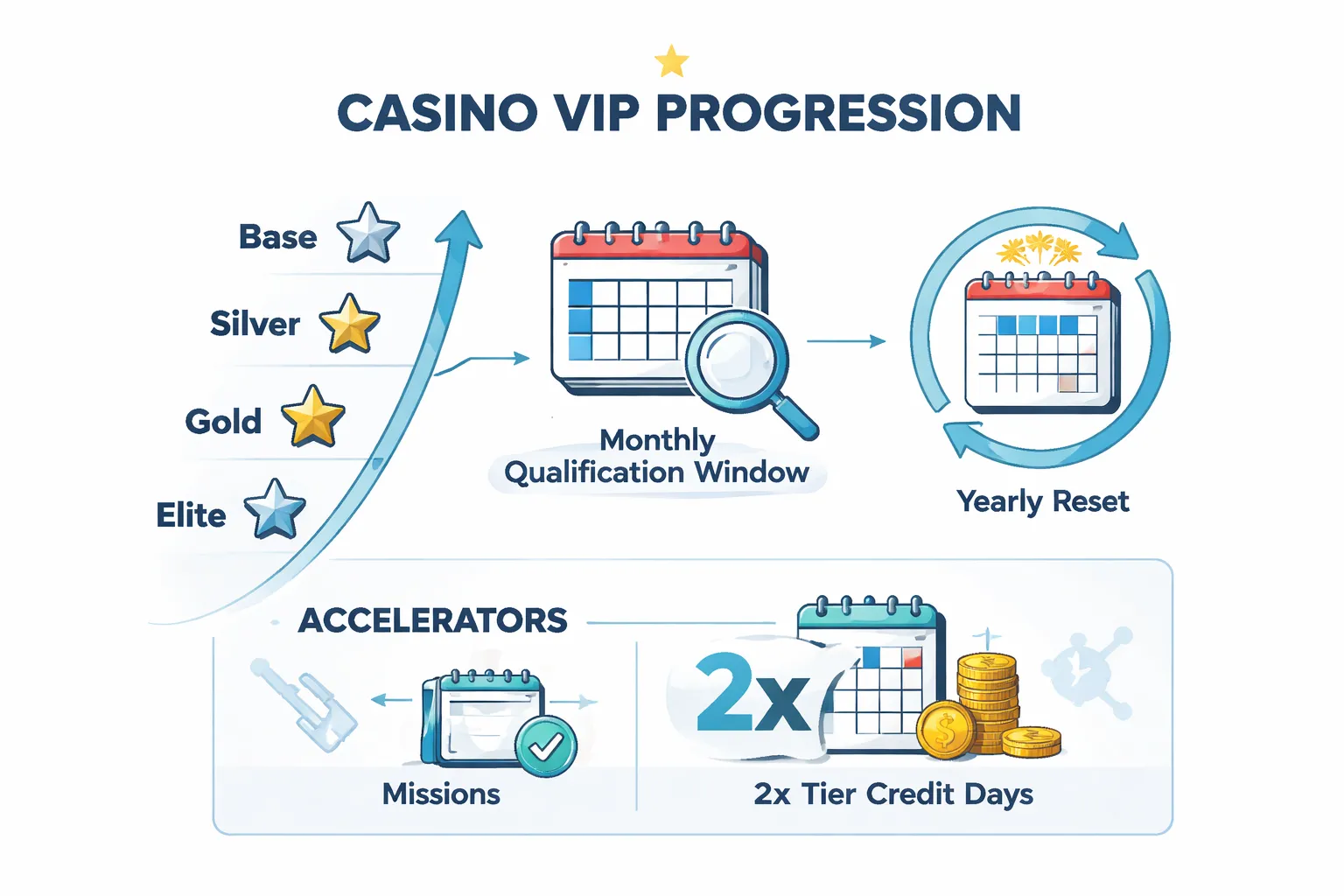
Common tier structures: entry levels through invite-only elite tiers
Most casino VIP programs use 4 to 8 tiers. You start at a base tier, then you climb through mid tiers, then you hit high tiers with better rates and faster service.
- Base tiers, open to everyone. Low points-to-cash rate. Few perks.
- Mid tiers, earned by steady wagering. Better conversion. More promos.
- High tiers, earned by high volume. Higher cashback caps. Faster withdrawals.
- Elite tiers, often invite-only. Personal host. Custom limits and perks.
Tier names vary. The mechanics stay the same. Your status sets your point earn rate, your redemption rate, and your promo access.
Qualification windows: daily, weekly, monthly tracking and yearly resets
The casino measures your activity inside a time window. You earn tier credits during that window. Miss the target, you stall.
- Daily tracking, good for “grind” models. A bad day hurts. A good day can jump you fast.
- Weekly tracking, smooths variance. One session will not decide your tier.
- Monthly tracking, most common. You can plan. You can pace your action.
- Yearly resets, common for top tiers. You keep perks for the year, then you requalify.
Check the counter rules. Some sites count wagers when you place them. Others count only settled bets. That changes how fast you progress during short windows.
Requalification and downgrades: what happens if you stop playing
Most programs do not let you keep a high tier forever. They re-check your activity and they adjust your status.
- Soft drop, you keep your tier until the next review, then you drop one level.
- Hard reset, you drop to base after an inactivity period.
- Grace periods, common at higher tiers. You get 1 to 3 months to recover activity.
- Benefits that vanish first, promo eligibility, cashback percentage, withdrawal speed, redemption rates.
Track the requalification threshold, not just the upgrade threshold. Some casinos make it easier to reach a tier than to keep it.
Tier accelerators: missions, boosted days, and limited-time multipliers
Casinos add accelerators to shape when and how you play. These can help, but they can also push you into higher house edge games.
- Missions, wager X on specific games to earn tier credits. Read the game list and the minimum bet rules.
- Boosted days, double or triple tier credits for a short window. Check if the boost applies to all games or only slots.
- Limited-time multipliers, extra tier points during promos. Watch for caps, max bet limits, and excluded rounds.
- Opt-in requirements, common. If you forget to opt in, you get nothing.
Do the math before you chase a boost. A 2x tier credit day does not matter if the casino cuts your point value or blocks redemptions with caps. If the accelerator sits inside a promo, confirm it stacks with your reload bonus rules.
What “invite-only” can mean: host assignment, manual reviews, and discretionary perks
Invite-only rarely means a single fixed requirement. It usually means the casino decides when you qualify.
- Host assignment, you get a manager who can approve bonuses, faster payouts, and tailored offers.
- Manual reviews, the casino checks net deposits, wagering patterns, and risk flags. Your raw wager number may not be enough.
- Discretionary perks, higher cashback caps, custom promos, fee refunds, event tickets. These can change month to month.
- Different math, some casinos weigh casino edge. Slots can count more than low edge table play.
Ask for the exact tracking metric the host uses. Get it in writing. If they will not share it, treat invite-only perks as temporary, not guaranteed.
Rewards you can get: bonuses, comps, service perks, and real-world benefits
Bonus credits and free spins: where value is won or lost in wagering terms
VIP rewards often arrive as bonus cash, free spins, or reloads. The headline amount means little. The terms set the real value.
- Wagering multiple. A $200 bonus at 40x needs $8,000 in wagering. A $200 bonus at 10x needs $2,000. The second offer can be worth more even if the bonus is smaller.
- What counts toward wagering. Some casinos exclude certain games or limit contribution. If your main games count at 10% to 25%, you will need far more play than you expect.
- Max bet rules. A low max bet can force long sessions and increase variance risk. Break the rule once and you can lose the bonus and winnings.
- Expiry time. Short windows push volume. That helps the casino. It can hurt your expected return.
- Free spins terms. Check coin size, number of lines, eligible slots, and max win cap. Some free spins pay as bonus funds with wagering, not as cash.
Before you accept, read the wagering terms line by line. If you want a deeper breakdown, use this guide on wagering requirements.
Cashback and loss-back promos: calculating the true percentage returned
Cashback sounds simple. It rarely is. You need the exact base and the cap.
- Base. Net losses for the day, week, or month. Some casinos use theoretical loss, not real loss. Some exclude bonus play.
- Rate and tier. 5% to 20% is common. Higher tiers can add caps or stricter rules.
- Caps. A 20% cashback with a $200 cap stops being 20% once your losses exceed $1,000 for that period.
- Form of payment. Cash, bonus funds, or free spins. Bonus funds can come with wagering, which cuts value.
- Timing. Daily cashback can feel better. Weekly or monthly cashback can come with bigger caps, but only if you keep qualifying.
Compute it as: (cashback you can actually withdraw) divided by (net losses the casino uses). Use the casino’s definition, not yours.
Rakeback explained for casinos: definitions, sources, and typical payout cadence
Casinos borrow the term rakeback. In casino VIP programs, it usually means an automatic return based on your tracked play, not on your losses.
- What it is. A percentage return paid from your tracked value, often based on theoretical loss or points earned.
- Where it comes from. The casino edge. Your play generates expected revenue. The casino shares a slice back as a rebate.
- How it differs from cashback. Cashback ties to net losses. Rakeback ties to volume and game weighting. You can get rakeback even in winning periods.
- Game weighting. Slots often earn more. Low edge tables often earn less. Some live dealer games earn close to zero.
- Payout cadence. Daily, weekly, or monthly. Daily feels better for cash flow. Monthly often pairs with tier reviews and discretionary boosts.
Ask for the formula. Ask for the tracking metric. If they only give a range, treat the top end as promotional, not guaranteed.
Comps and experiences: rooms, events, flights, dining, and gifting policies
Comps can beat bonus offers if you use them. They also come with rules that vary by property and by host.
- Rooms and resort fees. Some comps cover the room but not taxes and resort fees. Get the full out of pocket cost confirmed.
- Dining and beverage. You may need to charge to the room. Some comps exclude tips and alcohol. Some require pre approval.
- Events and tickets. Seats can depend on your tier, recent play, and availability. If you stop playing, you can lose access fast.
- Travel. Flights and transport usually require higher tiers and consistent tracked play. Many casinos reimburse after the trip, not before.
- Gifts and merch. Some programs run catalogs. Others use host discretion. Limited items can go to players with higher recent value, not higher lifetime status.
- Clawbacks. If your play drops during the trip, the casino can reduce future offers. Some properties can also remove future comp priority.
Operational perks: faster withdrawals, higher limits, priority support, and dedicated hosts
Service perks matter because they reduce friction and protect your time.
- Faster withdrawals. VIP lanes can cut payout time. You still face KYC checks. Ask if the speed applies to every withdrawal or only after manual approval.
- Higher limits. Bigger deposit and withdrawal limits help if you play high stakes. Check if limits differ by payment method.
- Fee refunds. Some tiers refund transaction fees or currency conversion fees. Confirm which fees qualify and the monthly cap.
- Priority support. Faster responses and higher quality case handling. Ask if you get a direct line or a generic VIP inbox.
- Dedicated hosts. A good host can add discretionary promos, fix account issues, and arrange comps. A host can also reduce offers if your tracked value falls.
- Verification handling. Some VIP programs pre clear documents to prevent payout holds. Ask if your account can be fully verified upfront.
Rakeback vs cashback vs comps: definitions, examples, and when each is best
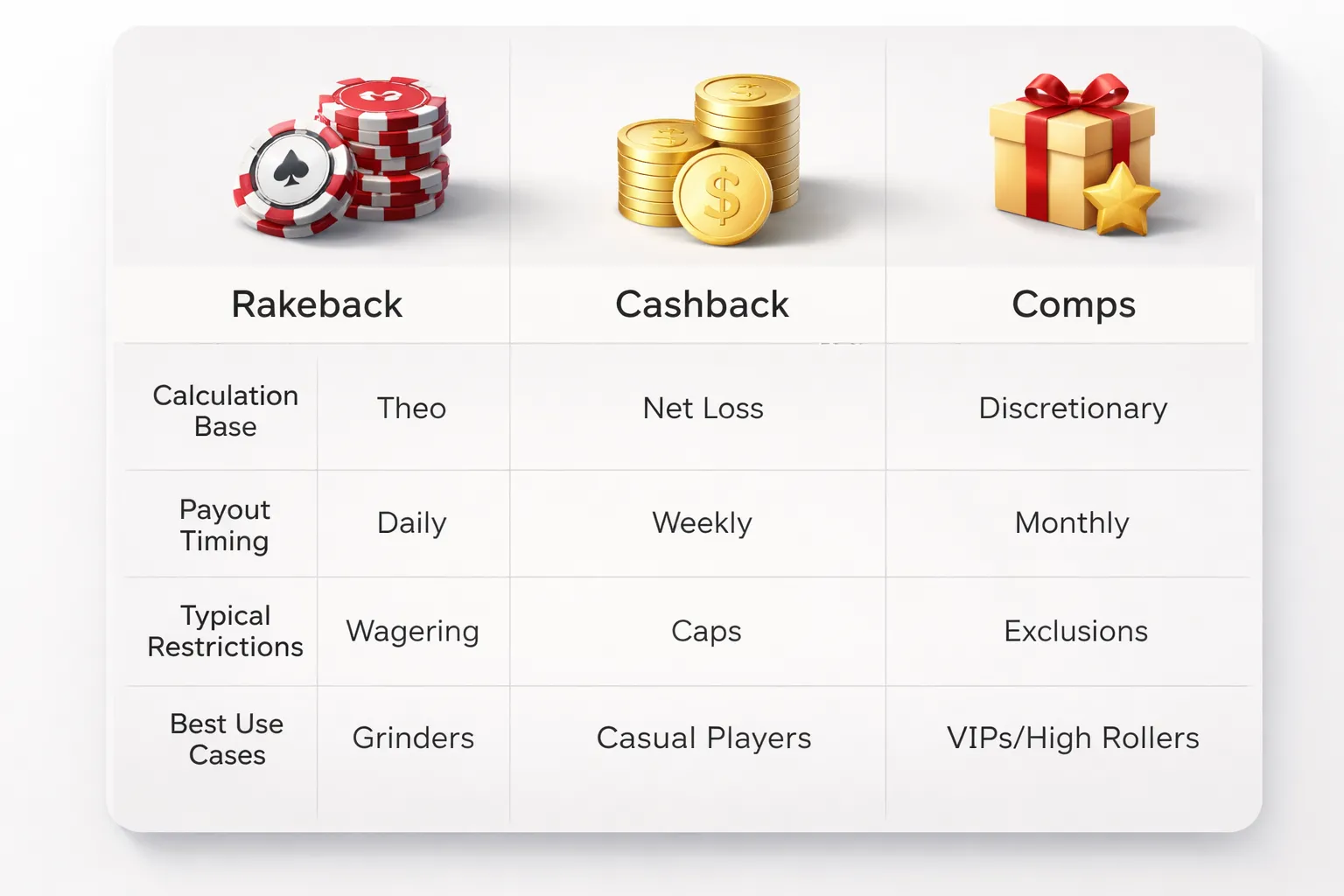
Clear definitions: what each reward type usually measures
Rakeback is a fixed percentage return of the casino’s theoretical profit from your play. Sites may call this “rebate,” “lossback,” or “VIP rakeback.” On slots, it usually ties to coin-in or theoretical loss. On table games, it often uses lower earn rates or excludes them.
Cashback is a percentage return based on your net losses over a period. It pays when you finish the day or week down. Many programs cap it, require opt-in, or apply it as a bonus with wagering.
Comps are discretionary value given as perks. Think free spins, bonus credit, fee refunds, event tickets, gifts, travel, and faster payouts. Comps often track your “theo,” then convert it into benefits the casino controls.
Example calculations: weekly cashback and monthly rakeback
| Reward type | Typical base | Common payout timing | What you must check |
|---|---|---|---|
| Rakeback | Theoretical loss or points earned | Daily, weekly, monthly | Game weighting, exclusions, negative carryover |
| Cashback | Net loss in a set window | Weekly, daily | Loss definition, caps, wagering, opt-in rules |
| Comps | Host discretion from tracked value | Anytime | Conditions, clawbacks, “bonus funds” limits |
Weekly cashback example. You deposit $500. You end the week with $120 cash balance. Your net loss is $380. The casino offers 15% weekly cashback with a $100 cap.
- Net loss = $500 - $120 = $380
- Cashback = $380 x 0.15 = $57
- If the promo pays as a bonus with 20x wagering, you must wager $1,140 before you can withdraw it.
Monthly rakeback example. The casino tracks “theo” at 3% of slot coin-in. Your monthly coin-in is $20,000. Your tier gives 25% rakeback on theo.
- Theo = $20,000 x 0.03 = $600
- Rakeback = $600 x 0.25 = $150
- If table games earn at 10% rate, $5,000 blackjack turnover might count as $500 for points, or as $0 if excluded.
Variance and EV: why high-volatility games change your realized benefit
Cashback swings with results. If you win big, you get little or nothing. If you lose big, you may hit a cap. High volatility slots can push you into both outcomes, so your realized cashback can differ from the headline percent.
Rakeback tracks play, not outcomes. It tends to stay steadier because it follows coin-in or theo. Your month can finish up, and you can still receive rakeback. That makes rakeback easier to model for expected value, but only if the site uses fair game weighting.
Comps depend on tracking. If your play spikes, a host may increase comps. If your results spike, a host may still cut offers if your tracked theo falls because you played lower-edge games or used promos that do not count.
Tax and withdrawal implications: when “cash” isn’t exactly cash
Cashback often pays as bonus credit. Bonus credit can carry wagering, max cashout limits, and restricted games. Your “cashback” can function like a reload bonus. For deeper rule detail, read our cashback bonus guide.
Rakeback may pay as cash or bonus. Some sites pay withdrawable cash. Others pay “promo balance” that you must convert by wagering. The label does not tell you the withdrawal status, the terms do.
Comps can create withdrawal friction. Free spins and bonus credits usually land in a bonus wallet. They can add wagering and delay cashouts until you clear requirements. In some jurisdictions, any gaming credit may still count as taxable winnings once converted or withdrawn. Rules vary, track your own records.
Edge cases: negative carryover, promo exclusions, and bonus clawbacks
- Negative carryover. Some cashback systems carry net wins forward. If you win $300 this week, and lose $300 next week, the site can treat your net as $0 and pay no cashback. Ask if the period “resets to zero.”
- Deposit and withdrawal adjustments. Many casinos compute net loss as deposits minus withdrawals, not deposits minus end balance. A midweek withdrawal can reduce or erase cashback even if you finish down.
- Promo exclusions. Wagering with bonus funds may not earn points, may not count toward rakeback, and may not qualify for cashback. Some casinos exclude specific providers, jackpot slots, and low-house-edge games.
- Caps and tier limits. Cashback often has a hard cap. Rakeback often has tier-based limits and game weightings that reduce the real percent.
- Bonus clawbacks. If you take cashback then chargeback, fail KYC, or breach promo rules, the casino can void the credit and sometimes remove winnings tied to it.
- Net loss definitions vary. Some sites count only “settled bets.” Others count all wagering. Some use “gross gaming revenue” formulas that you cannot verify without a detailed statement.
How to redeem points and rewards without losing value

Redemption options, pick the one with the highest real value
Casinos let you redeem points in a few ways. Each one changes your expected value.
- Cash credits. Best when the casino adds it to your withdrawable balance with no wagering. Confirm it is cash, not a “cashable bonus” that still has rollover.
- Bonus funds. Often looks bigger on paper, then loses value through wagering, max cashout caps, and excluded games. Treat it like discounted money, not real money.
- Free spins. Value depends on the slot, the coin size, and the spin count. Check if winnings land as cash or bonus, and what wagering applies to the winnings.
- Rewards shop. Convert points to items or gift cards only if the rate beats cash. Watch for shipping fees, out of stock items, and “suggested retail” pricing tricks.
Timing strategy, redeem when the rate works for you
- Use redemption multipliers. Some programs raise the point value on set days, or after opt-in promos. Do not redeem the day before a multiplier window.
- Do not redeem if it drops your tier progress. Some casinos calculate tier points on “net play” and remove progress when you convert points to cash or bonus. Read the rule before you cash out points.
- Redeem near a tier upgrade only when it helps. If a higher tier unlocks better exchange rates, fee waivers, or faster withdrawals, push to the upgrade first. If the tier clock resets monthly, do it before the reset.
- Stack benefits with care. If a site blocks promos after you take cashback or a points conversion, wait until you finish the promo cycle you want.
Expiry rules and inactivity policies, protect your balance and your status
- Track point expiry. Many programs void points after 30, 60, or 90 days of no activity, or at the end of a calendar quarter. Set a reminder tied to the earliest expiry date.
- Know what counts as activity. Some sites require a real-money wager, not a login. Others accept a deposit. Use the cheapest qualifying action before the deadline.
- Watch tier downgrades. VIP levels often drop after a month or quarter without enough tier points. If you want to keep perks, plan one session before the review date.
- Confirm what happens on account closure. Closing or self-excluding can void points and unclaimed rewards. Redeem first if you can, then lock the account.
Wagering requirements and game restrictions, spot low-value redemptions
- Check rollover on the redemption. A points-to-bonus conversion may carry 10x to 60x wagering. That can erase the value fast.
- Check game contribution. Slots may count 100%, roulette may count 0% to 20%, live games often count 0%. If your preferred games do not contribute, the bonus turns into dead weight.
- Check max bet rules. Many bonuses cap your bet size while wagering. If you break it, the casino can void winnings. Keep your stake under the limit from the first spin.
- Check max cashout caps. Some redemptions cap withdrawals at a fixed amount. If the cap sits near the bonus value, you carry risk with little upside.
- Check if winnings credit as bonus. Free spins often pay into bonus funds, then trigger more wagering. Treat that as a second layer of cost.
Use the same checklist you use for promos. If you need a refresher, see casino bonus terms you must know.
Verification and withdrawal workflow, avoid delays and clawbacks
- Do KYC early. Upload ID, proof of address, and payment method proof before you redeem a large reward. You reduce the risk of a payout freeze.
- Match your details. Your name, address, and date of birth must match across your account and documents. Small mismatches cause long back-and-forth.
- Use one payment method. Casinos often require withdrawals back to the same method used for deposits, up to the deposit amount. Switching methods late creates delays.
- Read the withdrawal limits. VIP tiers can raise limits, but some reward credits sit under separate caps. Confirm daily, weekly, and monthly limits before you convert points.
- Keep promo compliance clean. If the reward ties to cashback or a bonus, any breach of bonus rules can void the credit and related winnings. Screenshot key terms at redemption time.
How to compare casino VIP programs: a player-first checklist
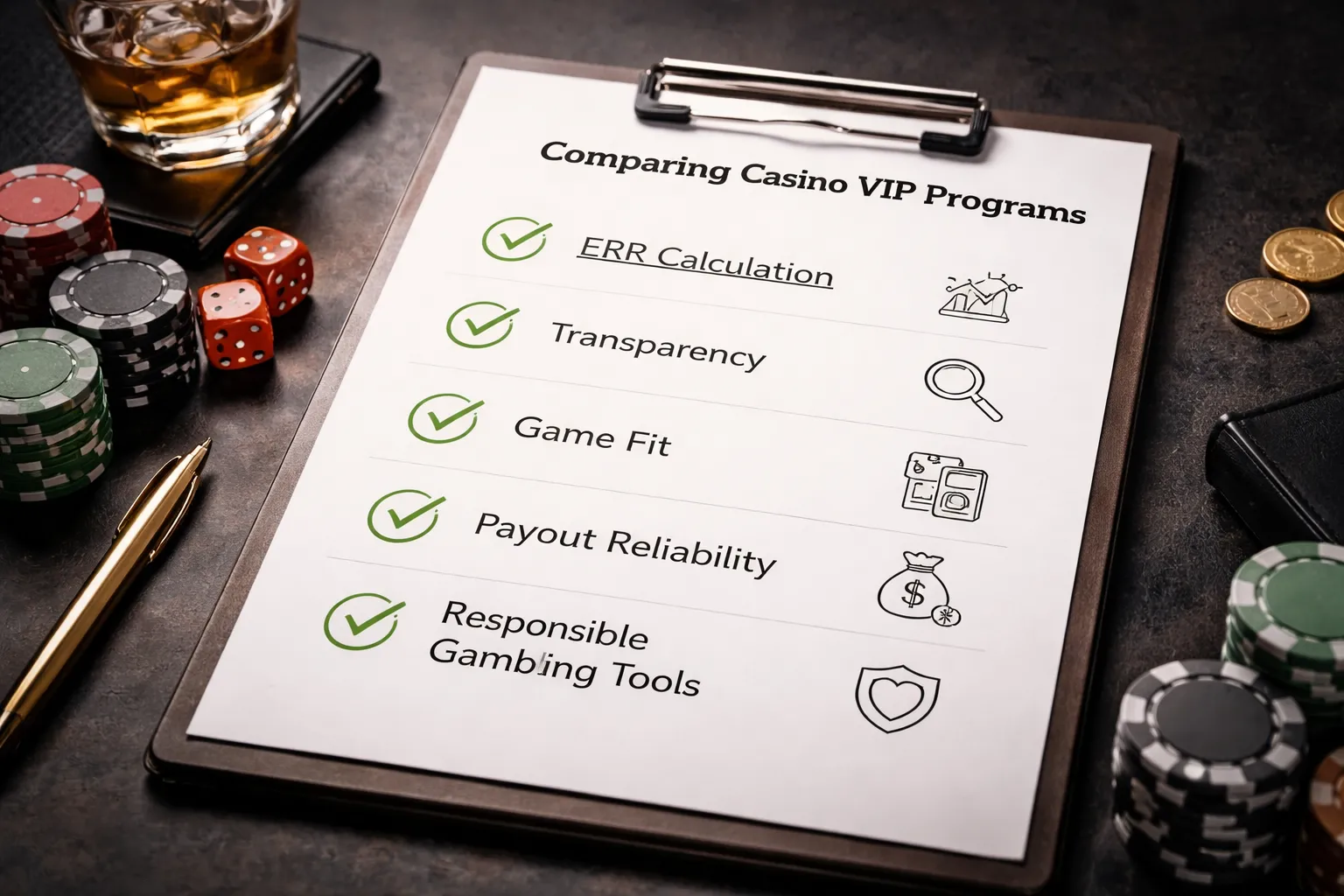
Effective reward rate (ERR), turn every perk into one number
Compare VIP programs with one metric. Your effective reward rate (ERR). It shows how much you get back per dollar wagered.
Step 1, convert points to cash value.
- Find the earn rate, points per $1 wagered, by game type if listed.
- Find the redemption rate, $ value per point, or points per $1.
- Compute points rebate %: (points earned per $1) x ($ per point) x 100.
Step 2, add cashback and rakeback.
- Use the real base, net losses, total wagers, or theoretical loss. Do not mix bases.
- Use the real cap. A 10% cashback with a $50 weekly cap stops being 10% fast.
- Compute cashback % on your play: (cashback you can actually receive) / (your total wagers) x 100.
Step 3, price promos as cash, then discount for strings.
- Free spins, bonus cash, and reloads have an expected value, not a face value.
- Apply a haircut for wagering and max cashout rules.
- Do not count any promo you cannot use on your games.
ERR formula you can use.
ERR % = (cash value of points + actual cashback or rakeback + realistic promo value) / total wagers x 100.
Transparency signals, spot the programs built to be compared
- Published earn tables. You should see points per $1 by game, not one vague line.
- Clear tier math. Tier points, reset dates, and maintenance rules should sit in one place.
- Cash value shown. A point should have a fixed rate, or a tight range with examples.
- Weighting disclosed. Slots, blackjack, roulette, and live games often earn at different rates. You need the list.
- Caps and exclusions listed. Cashback caps, minimum redemption, and excluded providers should be easy to find.
- Terms at redemption. You should be able to view and save terms before you click confirm. Use this guide on casino bonus terms as your checklist for wagering, max cashout, and game weighting.
Game selection fit, match the program to your RTP and edge profile
Your results depend on what you play. VIP math changes by game category.
- If you play slots. Check if all slots earn the same points. Many programs exclude high RTP slots or cap points on feature buys.
- If you play live casino. Expect lower point earn rates. Confirm if blackjack and baccarat earn at reduced rates or zero.
- If you play table games. Check contribution. A 10% contribution means you need 10x the wagering for the same points.
- If you mix games. Use your real split, for example 70% slots, 30% live. Compute ERR on that blend.
- Check promo eligibility. Many reloads and free spins apply to slots only. Do not count them if you mainly play tables.
Support and payout reliability, verify the basics before you value perks
- License and regulator. Identify the license, then verify it on the regulator site.
- RNG and game audits. Look for independent testing labs and recent audit statements. Avoid brands with missing audit info.
- Payout track record. Search for repeated patterns, delayed withdrawals, KYC loops, chargeback disputes.
- KYC clarity. You should see a clear list of documents and a timeline. VIP should not change KYC rules mid stream.
- Payment method stability. Check if your methods support both deposit and withdrawal. Avoid programs that push you to switch rails after you win.
- Support access. Confirm live chat hours, email response times, and whether VIP support has a direct channel.
Responsible gambling safeguards, VIP should never push you
- Hard limits. Deposit, loss, and wager limits should exist, be easy to set, and be hard to raise.
- Time tools. Session reminders, time outs, and self exclusion should sit in your account settings.
- No pressure mechanics. VIP should not require higher stakes, higher volume, or faster play to keep your tier.
- No coercive contact. A host should not chase you after losses, suggest loans, or frame losses as a path to perks.
- Cooling off respected. If you set a time out, support should not offer bonuses to reverse it.
Pros, cons, and responsible play considerations
Benefits for players: value, convenience, and service-level improvements
- Clearer value when it is cash-like. Points that convert to cash credits, cashback, or lower fees are easy to price. You can compare them to the house edge and your average loss rate.
- Faster, simpler redemptions. Auto-conversion, instant store credits, and one-click claims reduce missed rewards and support tickets.
- Better service levels. Higher tiers can mean faster withdrawals, higher limits, priority support, and fewer verification delays. These perks can matter more than small bonus rates.
- More stable promos. Some programs replace random offers with scheduled weekly cashback or fixed reloads. That makes your bankroll planning easier.
Common downsides: overspending risk, complicated terms, and promotional lock-in
- Overspending and higher session time. Tier progress bars and monthly resets can push you to play longer than planned. That usually costs more than the rewards return.
- Low real rebate after exclusions. Programs often exclude bonus play, certain game types, or high RTP titles from point earning. Your effective rate can drop fast.
- Complicated conversion rates. Points may convert at different values depending on the reward. Always check the cash equivalent and minimum redemption.
- Wagering and lock-in. Cashback and store credits can come with wagering requirements, expiry windows, and max cashout limits. Read the rules like any other promo, see bonus terms and conditions.
- Tier traps. Some programs give big perks only at levels that require unrealistic volume. You end up paying for perks with extra expected losses.
VIP pressure and ethics: recognizing unhealthy incentives and setting boundaries
- Track the “play more” signals. Any offer tied to keeping a tier, recovering a status drop, or hitting a weekly target pushes volume. Treat it as a cost, not a gift.
- Watch host behavior. A good host answers questions, fixes issues, and explains terms. A bad host pushes bigger deposits, suggests chasing, or contacts you right after losses.
- Set contact rules. Use email only, limit frequency, and opt out of calls and messages. Ask support to note your preferences.
- Use safer tools early. Deposit limits, loss limits, session reminders, time outs, and self-exclusion should stay in your account settings. Do not negotiate them for perks.
- Separate perks from play decisions. Pick games and stakes first, then accept whatever rewards follow. Do not change your play to suit the program.
Setting a rewards budget: when chasing tiers stops making financial sense
Rewards rarely beat the house edge. Treat VIP as a rebate on losses, not a profit plan.
- Price your tier chase. Find the extra wagering you need to reach or keep the next tier. Estimate expected loss for that extra play using the game’s house edge. Compare it to the value of the tier perks you will actually use.
- Use cash value, not headline value. Convert points to your best cash-like option. Ignore “up to” numbers, prize draws, and non-cash gifts you would not buy.
- Set a hard ceiling. Decide a monthly deposit and loss limit that fits your finances. If tier progress would push you past it, stop. Let the tier drop.
- Discount perks that depend on more play. If a perk requires weekly targets, reload wagering, or frequent deposits, count it at near zero. It increases your exposure.
- Quit the chase when the math flips. If the extra expected loss exceeds the perk value, the tier is overpriced. Keep your normal stakes and take whatever you earn.
Tips to maximize VIP value (without chasing losses)
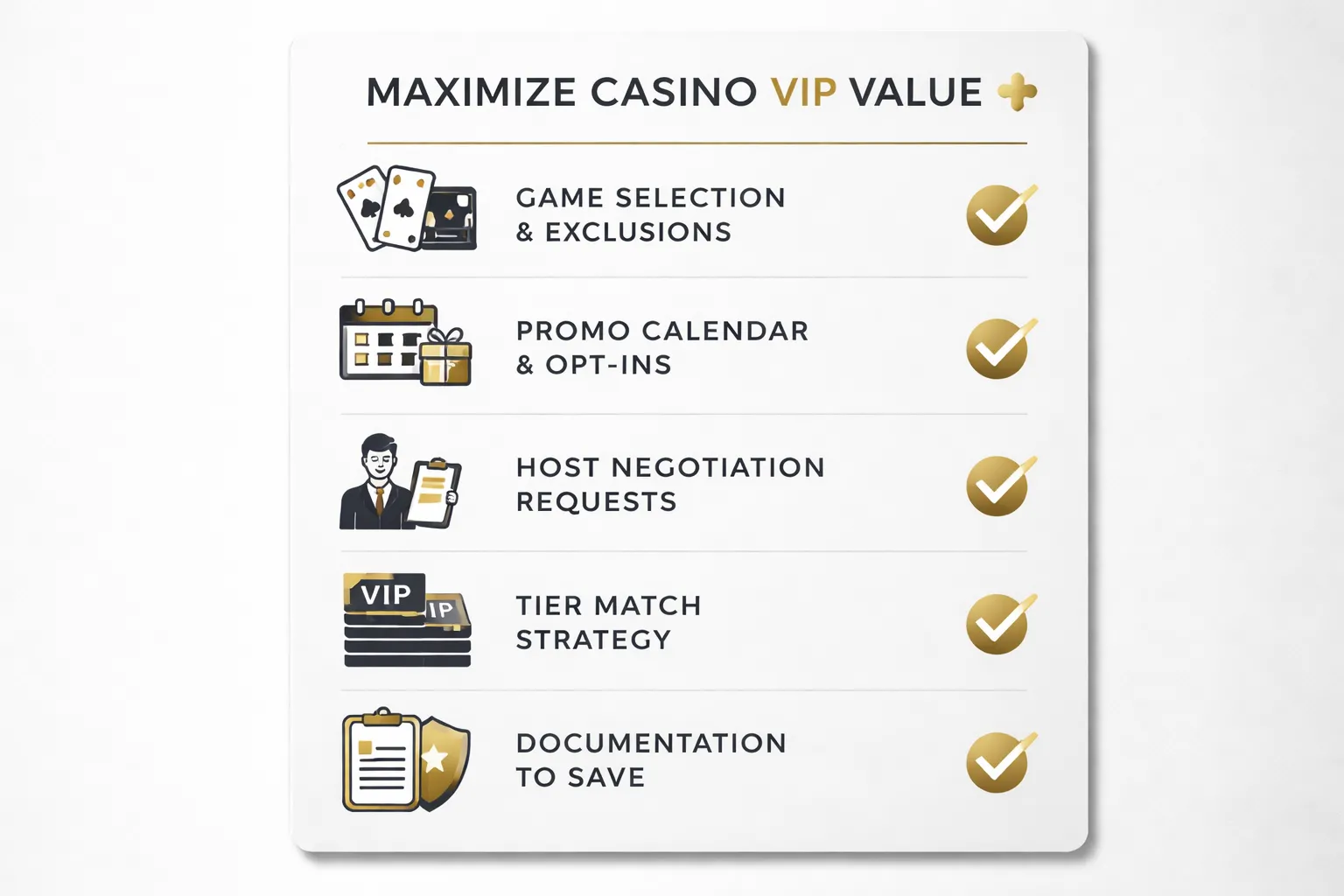
Choose high-contribution games and avoid excluded titles during point grinding
Read the earning chart before you play. Use it like a payout table.
- Prioritize high earn rates. Many programs award more points for slots than table games. Some award zero on low-edge tables.
- Check contribution rules for bonus wagering. If you grind points while clearing a promo, avoid games with low contribution. Low contribution stretches wagering and raises your expected loss.
- Watch for exclusions. Some titles earn no points, earn reduced points, or do not count toward tier. Many casinos exclude jackpots, feature buys, and some live dealer tables.
- Confirm the definition of “eligible wager”. Net losses, bonus funds, and free spins often earn at a different rate than cash play.
- Stop if the earn rate changes. Casinos adjust categories and exclusions. Recheck after updates and during major promos.
Track promos like a portfolio: stackable offers, calendars, and opt-in requirements
Treat promos as a schedule, not a surprise.
- Build a simple calendar. Note promo windows, deposit deadlines, and redemption expiry times.
- Confirm opt-in steps. Many offers require a button click before play, or a code at deposit. Miss it and you earn nothing.
- Log stack rules. Check if cashback stacks with reloads, if points earn on bonus wagering, and if VIP boosts apply during tournaments.
- Track caps and rate bands. Cashback often has max returns, tier-based percentages, and minimum loss thresholds. Use the exact numbers.
- Record effective value. Convert each offer to dollars after wagering requirements, max cashout limits, and game contribution. Use your normal stakes.
- Know how cashback really works. If you rely on it, read the mechanics in this cashback bonus guide.
Negotiate smartly with a host: what’s reasonable to ask for and when
Ask for things that reduce cost, not things that increase play.
- Time your ask after real volume. Request reviews after a solid month of your normal play, or after a large loss you would have taken anyway.
- Ask for clear, one-time comps. Lossback, deposit match, free spins, and fee reimbursements beat “play more to unlock” deals.
- Ask for better terms, not bigger targets. Lower wagering, higher contribution, longer expiry, or a higher max cashout can matter more than headline credit.
- Get the terms in writing. Confirm game eligibility, wagering, max bet rules, and whether the comp affects cashback or points.
- Decline quota-based deals. Weekly turnover targets and reload ladders push you into chase behavior. They often cost more than they pay.
Use tier-matching and transfer promos: how to leverage competition between casinos
Let casinos compete for your play. Do not pay to “prove” you deserve it.
- Collect your proof first. Download tier status, point history, and recent deposit and wager summaries.
- Request match before you deposit. Many operators match tiers or offer a starter bundle if you show status elsewhere.
- Compare on hard value. Use earn rates, cashback percentage, comp policy, and withdrawal speed. Ignore vanity perks.
- Use trial periods. Some matches last 30 to 90 days. Keep stakes steady. If the value is not real, walk.
- Do not chase requalification. If the matched tier requires heavy monthly targets, treat it as temporary.
Keep documentation: screenshots of terms, points history, and support conversations
Documentation protects your bankroll and your time.
- Screenshot promo pages. Capture the full terms, date, and any rate tables for points and tiers.
- Save opt-in confirmation. Keep proof you activated the offer before deposit or play.
- Export your points and tier logs. Store weekly snapshots. Note starting points, earned points, and adjustments.
- Archive support chats and emails. Save agent names, timestamps, and stated resolutions.
- Track disputes in one file. Include case numbers, promised credits, and deadlines. Follow up with the same thread.
Frequently Asked Questions
What is a casino VIP or loyalty program?
It is a tracking system that rewards your play. You earn points, climb tiers, and unlock perks. Rewards can include bonus credits, cashback, free spins, comps, and faster withdrawals. Terms set the earning rates, limits, and which games count.
How do loyalty points usually work?
You earn points from real money wagering, sometimes from deposits. Casinos set a formula, like points per $10 wagered. Slots often earn faster than table games. Points can expire. Always check the earn rate by game, the cap, and the expiry window.
What is the difference between points and tiers?
Points are the currency you spend or convert. Tiers are your status level. Tiers usually depend on points earned in a time window, like 30 days or a calendar year. Your tier controls perks like cashback rate, withdrawal speed, and promo access.
What is rakeback in casino VIP programs?
Rakeback is a scheduled return of part of your losses or wagering, usually as cash or bonus funds. Casinos may label it cashback, lossback, or weekly reload. Check if it uses net losses, total wagers, or theoretical loss, and if bonus play counts.
What is a good VIP deal?
A good deal has a clear earn formula, low restrictions, and rewards you can actually use. Look for cash rewards or low wagering requirements. Avoid programs with fast point expiry, high minimum redemptions, game exclusions, and vague rules on tier reviews.
Do table games earn VIP points?
Sometimes, but usually at a lower rate. Many casinos reduce table game contribution or exclude some games. Live dealer games often earn less than slots. Check the loyalty page or terms for each provider, then confirm with support in writing.
Can a casino change VIP rates or remove perks?
Yes. Most terms allow rule changes, tier rebalancing, and promo removal. You reduce risk by redeeming points regularly and keeping balances low. Save screenshots of the VIP page and your tier benefits. Log dates, point totals, and any changes you notice.
Why did my points or tier drop?
Common causes are tier reset dates, point expiry, chargebacks, bonus abuse flags, or manual adjustments. Some programs use rolling windows, so old play drops off. Export your point history and compare it to the stated formula. Escalate with your logs and timestamps.
How do I redeem points safely?
Redeem in smaller chunks. Check conversion rates and minimum redemption. Confirm whether the reward is cash, bonus funds, or free spins, and note the wagering requirement. If you redeem to bonus funds, track contribution rules. Use the same wallet and game set each time.
Is VIP cashback the same as a cashback bonus?
Sometimes. VIP cashback often runs automatically on a schedule. Cashback bonuses can be opt-in offers with separate wagering rules and caps. Always read the cashback terms and the bonus terms. Use one reference page for both, like cashback bonus rules.
What records should I keep for VIP disputes?
Keep proof of opt-in, screenshots of the VIP page, and your points and tier logs. Save weekly exports with starting points, earned points, and adjustments. Archive support chats and emails with agent names and timestamps. Track case numbers, promised credits, and deadlines in one file.
Conclusion
Conclusion
VIP and loyalty programs pay you back in points, comps, and cash-like rewards. They also add rules, caps, and expiry dates. If you do not track the math, the casino sets the value for you.
- Know your rate: Convert points to cash value and to a percent of your wagering. Compare it to your expected loss and your bonus value.
- Chase tiers only with a plan: If a tier needs extra play, price that play first. Do not “top up” volume without a clear net gain.
- Protect your value: Watch for point devaluations, redemption limits, and week-to-week rule changes. Screenshot the VIP page before you change your play.
- Read the terms that matter: Check wagering, max cashout, eligible games, and expiry before you redeem any offer. Use this guide to wagering requirements when a reward comes with playthrough.
- Keep clean records: Log starting points, earned points, adjustments, tier dates, and host promises. Store case numbers and deadlines in one file.
Final tip. Pick one primary site. Track your effective return weekly. Move your play fast when the numbers drop.
-
Cashback Bonus Explained: How Casino Cashback Really Works
6 months ago -
Free Spins Bonus Explained: How Free Spins Work at Online Casinos
6 months ago -
Reload Bonus Explained: What It Is and When It’s Worth Claiming
4 months ago -
No Deposit Bonus Explained: How It Works, Pros/Cons & Common Rules
6 months ago -
Online Casino Bonuses Explained: How They Work + Terms You Must Know
6 months ago
-
- Common tier structures: entry levels through invite-only elite tiers
- Qualification windows: daily, weekly, monthly tracking and yearly resets
- Requalification and downgrades: what happens if you stop playing
- Tier accelerators: missions, boosted days, and limited-time multipliers
- What “invite-only” can mean: host assignment, manual reviews, and discretionary perks
-
- Bonus credits and free spins: where value is won or lost in wagering terms
- Cashback and loss-back promos: calculating the true percentage returned
- Rakeback explained for casinos: definitions, sources, and typical payout cadence
- Comps and experiences: rooms, events, flights, dining, and gifting policies
- Operational perks: faster withdrawals, higher limits, priority support, and dedicated hosts
-
- Clear definitions: what each reward type usually measures
- Example calculations: weekly cashback and monthly rakeback
- Variance and EV: why high-volatility games change your realized benefit
- Tax and withdrawal implications: when “cash” isn’t exactly cash
- Edge cases: negative carryover, promo exclusions, and bonus clawbacks
-
- Redemption options, pick the one with the highest real value
- Timing strategy, redeem when the rate works for you
- Expiry rules and inactivity policies, protect your balance and your status
- Wagering requirements and game restrictions, spot low-value redemptions
- Verification and withdrawal workflow, avoid delays and clawbacks
-
- Effective reward rate (ERR), turn every perk into one number
- Transparency signals, spot the programs built to be compared
- Game selection fit, match the program to your RTP and edge profile
- Support and payout reliability, verify the basics before you value perks
- Responsible gambling safeguards, VIP should never push you
-
- Benefits for players: value, convenience, and service-level improvements
- Common downsides: overspending risk, complicated terms, and promotional lock-in
- VIP pressure and ethics: recognizing unhealthy incentives and setting boundaries
- Setting a rewards budget: when chasing tiers stops making financial sense
-
- Choose high-contribution games and avoid excluded titles during point grinding
- Track promos like a portfolio: stackable offers, calendars, and opt-in requirements
- Negotiate smartly with a host: what’s reasonable to ask for and when
- Use tier-matching and transfer promos: how to leverage competition between casinos
- Keep documentation: screenshots of terms, points history, and support conversations
-
- What is a casino VIP or loyalty program?
- How do loyalty points usually work?
- What is the difference between points and tiers?
- What is rakeback in casino VIP programs?
- What is a good VIP deal?
- Do table games earn VIP points?
- Can a casino change VIP rates or remove perks?
- Why did my points or tier drop?
- How do I redeem points safely?
- Is VIP cashback the same as a cashback bonus?
- What records should I keep for VIP disputes?
-
- Common tier structures: entry levels through invite-only elite tiers
- Qualification windows: daily, weekly, monthly tracking and yearly resets
- Requalification and downgrades: what happens if you stop playing
- Tier accelerators: missions, boosted days, and limited-time multipliers
- What “invite-only” can mean: host assignment, manual reviews, and discretionary perks
-
- Bonus credits and free spins: where value is won or lost in wagering terms
- Cashback and loss-back promos: calculating the true percentage returned
- Rakeback explained for casinos: definitions, sources, and typical payout cadence
- Comps and experiences: rooms, events, flights, dining, and gifting policies
- Operational perks: faster withdrawals, higher limits, priority support, and dedicated hosts
-
- Clear definitions: what each reward type usually measures
- Example calculations: weekly cashback and monthly rakeback
- Variance and EV: why high-volatility games change your realized benefit
- Tax and withdrawal implications: when “cash” isn’t exactly cash
- Edge cases: negative carryover, promo exclusions, and bonus clawbacks
-
- Redemption options, pick the one with the highest real value
- Timing strategy, redeem when the rate works for you
- Expiry rules and inactivity policies, protect your balance and your status
- Wagering requirements and game restrictions, spot low-value redemptions
- Verification and withdrawal workflow, avoid delays and clawbacks
-
- Effective reward rate (ERR), turn every perk into one number
- Transparency signals, spot the programs built to be compared
- Game selection fit, match the program to your RTP and edge profile
- Support and payout reliability, verify the basics before you value perks
- Responsible gambling safeguards, VIP should never push you
-
- Benefits for players: value, convenience, and service-level improvements
- Common downsides: overspending risk, complicated terms, and promotional lock-in
- VIP pressure and ethics: recognizing unhealthy incentives and setting boundaries
- Setting a rewards budget: when chasing tiers stops making financial sense
-
- Choose high-contribution games and avoid excluded titles during point grinding
- Track promos like a portfolio: stackable offers, calendars, and opt-in requirements
- Negotiate smartly with a host: what’s reasonable to ask for and when
- Use tier-matching and transfer promos: how to leverage competition between casinos
- Keep documentation: screenshots of terms, points history, and support conversations
-
- What is a casino VIP or loyalty program?
- How do loyalty points usually work?
- What is the difference between points and tiers?
- What is rakeback in casino VIP programs?
- What is a good VIP deal?
- Do table games earn VIP points?
- Can a casino change VIP rates or remove perks?
- Why did my points or tier drop?
- How do I redeem points safely?
- Is VIP cashback the same as a cashback bonus?
- What records should I keep for VIP disputes?
-
Reload Bonus Explained: What It Is and When It’s Worth Claiming
4 months ago -
Online Casino Licensing Explained: Authorities, Licenses & How to Check One
6 months ago -
Best Live Dealer Casinos: Where to Play Live Blackjack, Roulette & More
6 months ago -
Best Online Casinos for High Rollers: VIP Perks, High Limits & Exclusive Bonuses
6 months ago -
Fast Payout Online Casinos: Best Sites for Quick Withdrawals
6 months ago
-
Online Casino Licensing Explained: Authorities, Licenses & How to Check One
6 months ago -
Are Online Casinos Legal? Complete Guide by State & Country
6 months ago -
How to Sign Up & Create an Online Casino Account (Step-by-Step)
6 months ago -
Online Casino Fairness Explained: RNG, RTP, House Edge & Provably Fair
6 months ago -
How to Withdraw Money from an Online Casino: Methods, Steps & Tips
6 months ago