Online Roulette Guide: How to Play, Bets, and Odds

Online roulette is a numbers game. You place a bet, the wheel spins, and one pocket wins. Your edge comes from choosing the right roulette type and the right bets.
This guide shows you how online roulette works, step by step. You will learn the table layout, the spin process, and the main roulette variants. You will also learn the core bet types, inside and outside, and how payouts link to odds. We cover house edge by variant, so you can see what you give up with each wheel.
You will finish with a clear plan for playing: what to click, what to bet, and what the math says about your long-term cost. If you also play other table games, read our online blackjack guide for a fast rules and payouts refresher.
- In het kort: Pick European or French roulette when you can. They give you better odds than American.
- In het kort: Know the wheel. European has 37 pockets, American has 38. The extra 00 increases your long-term cost.
- In het kort: Learn the bet map fast. Inside bets cover specific numbers, outside bets cover larger groups.
- In het kort: Match payouts to probability. Higher payouts mean lower hit rates.
- In het kort: Use even-money bets for steadier swings, not better value. Red, black, odd, even, and 1 to 18, 19 to 36 still lose to the house edge.
- In het kort: Track house edge by variant. European is about 2.70%, American is about 5.26%. French rules like La Partage can cut the edge on even-money bets.
- In het kort: Ignore “systems” that promise profit. No betting pattern changes the math.
- In het kort: Set limits before you spin. Pick your stake size, stop loss, and stop win, then stick to them.
- In het kort: Play only at casinos you trust. Learn how RNG and house edge work so you know what you are paying for.
What Is Online Roulette and How It Works
Roulette basics, wheel, ball, and the numbered layout
Roulette is a number game built around a wheel and a betting layout.
- The wheel has numbered pockets. European wheels have 37 pockets, 0 to 36. American wheels have 38 pockets, 0 to 36 plus 00.
- The ball lands in one pocket. That final pocket sets the winning number and color.
- The layout shows the numbers and the bet zones you can pick. Your bet must match where the ball lands.
RNG roulette vs live dealer roulette, what happens behind the scenes
Online roulette comes in two formats. Your betting options look similar, the mechanics do not.
- RNG roulette uses software to produce outcomes. The game calls a random number generator, maps the result to a pocket, then shows a spin animation. The animation does not drive the result. The RNG result does.
- Live dealer roulette streams a real wheel from a studio or casino. A dealer spins the wheel and releases the ball. The result comes from the physical landing pocket. The platform reads the winning number and settles bets.
Pick based on what you value. RNG plays faster and usually has more table limits. Live dealer feels closer to a casino pace and includes table chat and real-time dealing.
The role of the roulette table layout and how numbers are organized
The layout groups numbers so you can bet on single outcomes or broad ranges.
- Inside bets sit on the numbered grid. They cover fewer numbers and pay more.
- Outside bets sit on the outer zones. They cover more numbers and pay less.
- Columns and dozens split the 36 numbers into 3 columns and 3 dozens.
- Even-money zones cover large groups like red or black, odd or even, 1 to 18, and 19 to 36.
European tables place the single 0 at the top. American tables add 00. That extra pocket changes the odds and raises the house edge. Use this guide on European vs American roulette odds to see the impact.
How a round plays out online, placing bets, spin timer, and settling outcomes
Each round follows the same steps.
- Select chips to set your stake size.
- Place bets by tapping or clicking the layout. Many games let you repeat or double your last bet.
- Watch the timer. When betting closes, you cannot change your positions.
- Spin and result. RNG games reveal the number after the RNG call. Live games show the wheel until the ball lands.
- Settlement. Winners get paid based on the bet type. Losing bets clear. The next round opens.
Common online features, autoplay, racetrack view, and statistics panels
- Autoplay places the same bets for a set number of spins. It saves clicks, not money. It does not change the edge.
- Racetrack view shows number groups in wheel order. It helps you place wheel-based bets faster, like neighbors and sectors in some games. It does not improve your odds.
- Statistics panels show recent results, hot and cold numbers, and color runs. They describe the past only. They do not predict the next spin. Each spin stays independent in both RNG and live formats.
Types of Roulette You Can Play Online (and Why It Matters)
The roulette type you pick sets your house edge, your available rules, and your betting tools. Your chips stay the same. The math does not.
European roulette (single zero)
European roulette uses 37 pockets, numbers 0 to 36. One zero cuts the casino edge versus American.
- Wheel: 37 pockets, single 0.
- Typical house edge: 2.70% on most bets.
- Common online rules: Many tables use “La Partage” or “En Prison” on even-money bets. When they apply, your edge drops on those bets.
- Best use: Default choice if you want lower edge with standard bet options.
American roulette (double zero)
American roulette uses 38 pockets, adding 00. That extra pocket raises the house edge on every standard bet.
- Wheel: 38 pockets, 0 and 00.
- Typical house edge: 5.26% on most bets.
- What it changes for you: Your bankroll lasts fewer spins at the same bet size, all else equal.
- When to play it: Only if you prefer the format, table limits, or a specific live dealer studio.
French roulette (single zero, rule variations)
French roulette usually uses the same 37-pocket wheel as European, but it may add rule options that cut losses on even-money bets when the ball lands on 0.
- Wheel: 37 pockets, single 0.
- Key rules to look for: “La Partage” or “En Prison” on red or black, odd or even, and high or low.
- House edge impact: With La Partage on even-money bets, the edge becomes 1.35% on those bets. Other bets usually stay at 2.70%.
- What it changes for you: Even-money bets become a better fit for low-volatility play.
Live roulette game shows and specialty tables (Lightning, Immersive, Auto Roulette)
These tables add features that change payouts, pacing, and variance. They can also add extra fees in the math.
- Lightning-style roulette: Random multipliers apply to selected numbers, but the game often charges a side-bet style fee or changes payouts. Your volatility jumps. Your long-run edge often increases versus standard European rules.
- Immersive and studio tables: You get multiple camera angles and faster dealing. Your odds stay tied to the wheel type and rules.
- Auto Roulette: A real wheel spins automatically. It runs faster than a human-dealt table. Faster pace increases your hourly swing because you place more bets per hour.
- What to check: Wheel type, zero count, any special payout rules, and the posted RTP or house edge if the lobby shows it.
Multi-wheel and rapid roulette (speed, variance, beginner fit)
Multi-wheel and rapid formats change your results per hour. They do not change independence. They do change how fast you can win or lose.
- Multi-wheel roulette: You bet once and the game spins several wheels at the same time. Your stake per round often multiplies across wheels. Your variance rises because more outcomes resolve at once.
- Rapid roulette: Shorter betting windows and faster spins. You face more decisions per hour, so bankroll swings come faster.
- Beginner fit: Start with single-wheel, standard-speed European or French. Use small flat bets until you can track your stake per spin and your session loss limit.
| Type | Pockets | Typical house edge | What matters most |
|---|---|---|---|
| European | 37 (0 to 36) | 2.70% | Lower edge, standard rules |
| French | 37 (0 to 36) | 2.70%, or 1.35% on even-money bets with La Partage | Rule options that cut zero losses on even-money bets |
| American | 38 (0, 00, 1 to 36) | 5.26% | Higher edge across the board |
| Specialty and game shows | Varies | Varies, often higher than standard | Extra features change payouts and volatility |
| Multi-wheel and rapid | Varies | Depends on wheel type | More results per hour, larger swings |
If you want a low-edge baseline, pick European or French with La Partage on even-money bets. For more low-edge options across casino games, see our low house edge games ranked guide.
Roulette Rules for Beginners
Understanding the betting window and when bets are locked
Online roulette runs on a timer. You place chips during the betting window. When the timer hits zero, bets lock. You cannot add, remove, or change chips after the lock.
- Live dealer: The dealer announces “no more bets” and the system locks your layout.
- RNG roulette: The bet button disables at lock, then the spin resolves.
- Autoplay and repeat: If you use rebet, the game places the same bets for the next round, but only if you confirm before the lock.
Act early. Last-second clicks often miss the lock and do not count.
Table limits explained, minimums, maximums, and why they affect strategy
Every table sets limits. You must meet the minimum total bet per spin. You must stay under maximums for each bet type or for the table.
- Minimum: The smallest allowed stake, often per chip or per total round.
- Maximum: The largest allowed stake, often different for inside and outside bets.
- Max payout cap: Some games cap total winnings per spin, even if the bet is allowed.
Limits shape your approach. A high minimum increases variance and bankroll swing. A low maximum blocks progression systems that need large late bets. If you plan to cover many numbers, check whether the table requires a minimum per bet or only a minimum total.
What happens if you disconnect mid-spin (typical casino policies)
If you disconnect after bets lock, the spin still completes on the casino server. Your wager stands.
- If you placed bets before the lock, the result settles as normal.
- If you disconnected before placing bets, you have no action for that spin.
- If you use autoplay, the game may continue to place bets until you stop it, hit a loss limit, or the session times out.
When you reconnect, check game history. Reputable casinos show the last results, your bets, and the settlement.
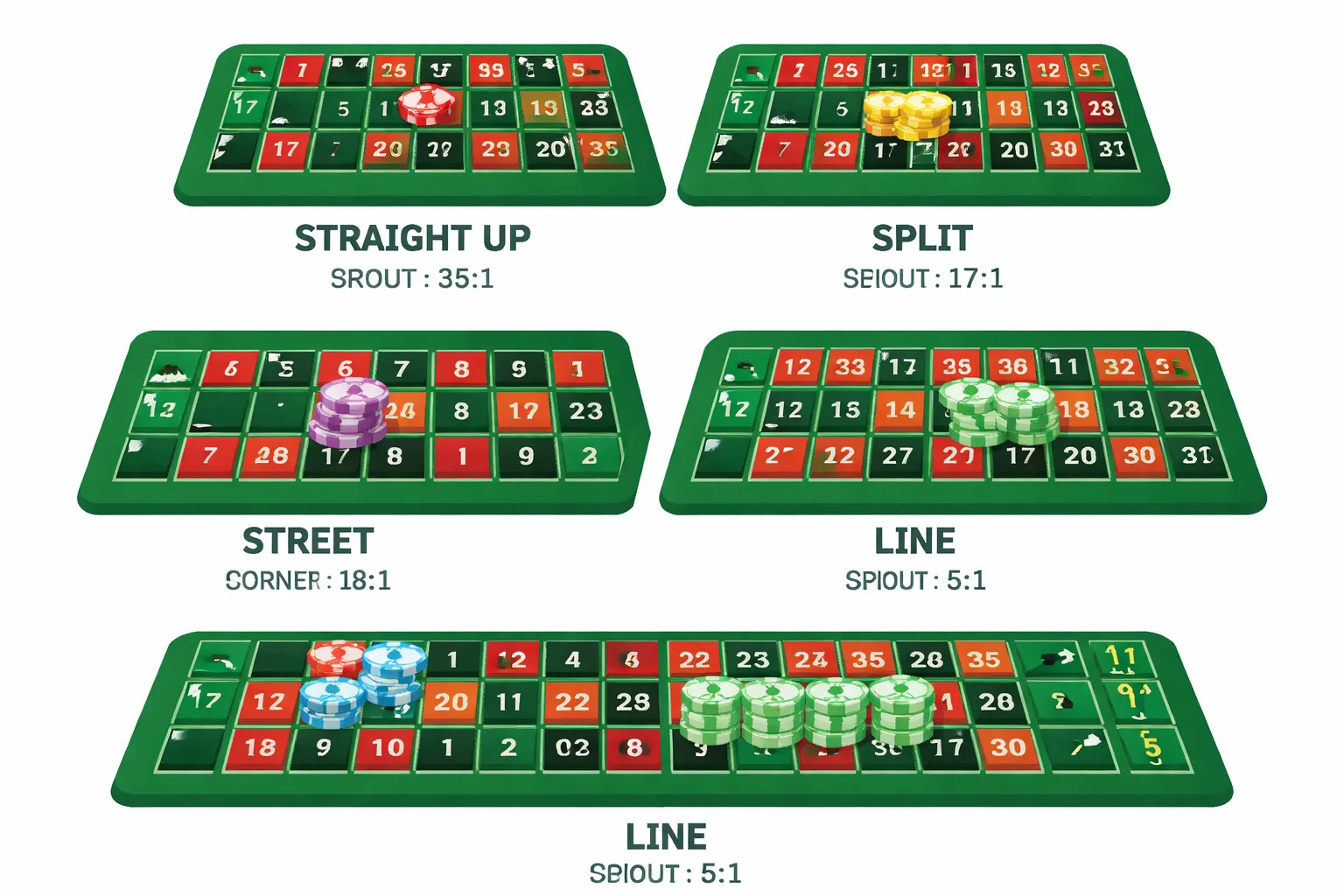
Key terminology, straight up, split, street, corner, line, and neighbors
These terms describe where you place chips and how many numbers you cover. They also map to standard payouts.
- Straight up: 1 number.
- Split: 2 adjacent numbers, placed on the line between them.
- Street: 3 numbers in a row, placed at the end of the row.
- Corner: 4 numbers in a block, placed on the intersection.
- Line: 6 numbers, two streets, placed on the line between the rows.
- Neighbors: A wheel bet that covers a number and the numbers next to it on the wheel, not on the layout.
For a full breakdown of inside and outside options, see our roulette odds and bet types guide.
How winnings are calculated and credited in online casinos
Roulette pays based on odds, not on how many chips sit on the table. Your profit equals payout odds times your stake, then the casino returns your original stake on winning bets.
- Straight up: 35 to 1
- Split: 17 to 1
- Street: 11 to 1
- Corner: 8 to 1
- Line: 5 to 1
- Even money bets: 1 to 1, may use La Partage or En Prison on some tables
Online casinos settle instantly after the result posts. They credit your balance with net profit plus returned stakes for winners, and remove stakes for losing bets. If you place multiple bets, the system calculates each one separately, then totals the outcome for the spin.
Roulette Bets Explained (Inside, Outside, and Call Bets)
Inside Bets
Inside bets sit on the numbered grid. You trade hit rate for payout. You win less often, but you get paid more when you hit.
- Straight up, 1 number, pays 35 to 1.
- Split, 2 numbers, pays 17 to 1.
- Street, 3 numbers, pays 11 to 1.
- Corner, 4 numbers, pays 8 to 1.
- Line, 6 numbers, pays 5 to 1.
Use inside bets when you want higher payouts and you can handle long gaps between wins. On European wheels, a straight up hits 1 time in 37. On American wheels, it hits 1 time in 38.
Outside Bets
Outside bets sit around the grid. You hit more often, but payouts stay small. These bets also qualify for La Partage or En Prison on some European tables.
- Red or Black, 18 numbers, pays 1 to 1.
- Odd or Even, 18 numbers, pays 1 to 1.
- Low (1 to 18) or High (19 to 36), 18 numbers, pays 1 to 1.
Outside bets work best for steady bankroll swings. They still carry the same house edge as other bets on the same wheel, unless special rules reduce losses on even money outcomes.
Dozens and Columns
Dozens and columns sit between inside and outside risk. They cover 12 numbers and pay 2 to 1.
- Dozens, 1st (1 to 12), 2nd (13 to 24), 3rd (25 to 36), pays 2 to 1.
- Columns, 12 numbers per vertical column, pays 2 to 1.
On a European wheel, a dozen hits 12 in 37 spins on average. On an American wheel, it hits 12 in 38. You can use two dozens or two columns to cover 24 numbers, but your net profit drops to 1 to 1 when you win and you still lose when the zero lands.
Call Bets and Racetrack Bets
Many European and live dealer interfaces let you place call bets from a racetrack panel. These bets cover sets of numbers based on their order on the wheel, not their position on the grid.
- Wheel sectors, you select a named group and the game places the chips for you.
- Finals, you bet endings like 0, 1, 2, 3, 4, 5, 6, 7, 8, 9, spread across the wheel.
- Neighbor bets, you pick a number and add neighbors on each side on the wheel, common options are 2, 4, or 6 neighbors total.
Check the table help for the exact chip layout. Racetrack layouts differ by provider and by wheel type. Some options only exist on European wheels.
Announced Bets and Special Sequences
French roulette often offers announced bets. The casino places a fixed pattern of splits and streets inside a wheel sector.
- Voisins du Zéro, covers the sector around zero, uses multiple splits plus a straight up on 0.
- Tiers du Cylindre, covers the opposite side of the wheel from zero, uses split bets.
- Orphelins, covers the remaining numbers not in voisins or tiers, often split into two parts, including a straight up on 1.
These bets simplify complex layouts. They do not change the house edge. They just change how you spread your stake across the wheel. If you want the full betting and settlement basics in one place, use this roulette rules and payouts guide.
Roulette Payouts, Odds, and House Edge
Payout table by bet type, what each bet pays and why
Roulette payouts follow a simple rule. You get paid based on how many numbers your bet covers. The more numbers you cover, the lower the payout.
| Bet type | Numbers covered | Casino payout | Why |
|---|---|---|---|
| Straight up | 1 | 35 to 1 | You hit 1 number out of the wheel. |
| Split | 2 | 17 to 1 | You cover 2 numbers. |
| Street | 3 | 11 to 1 | You cover 3 numbers. |
| Corner | 4 | 8 to 1 | You cover 4 numbers. |
| Six line | 6 | 5 to 1 | You cover 6 numbers. |
| Dozen | 12 | 2 to 1 | You cover 12 numbers. |
| Column | 12 | 2 to 1 | You cover 12 numbers. |
| Even money (red or black, odd or even, 1 to 18 or 19 to 36) | 18 | 1 to 1 | You cover 18 numbers, almost half the wheel. |
These payouts stay the same across standard online roulette tables. The real difference comes from the extra zero.
True odds vs casino payout odds
True odds reflect the wheel. Casino payouts pay a little less than true odds. That gap is the house edge.
- European and French roulette use 37 pockets, 0 to 36.
- American roulette uses 38 pockets, 0 to 36 plus 00.
| Bet | Wheel | True odds | Casino payout | What creates the edge |
|---|---|---|---|---|
| Straight up | European (37) | 36 to 1 | 35 to 1 | You get paid 1 unit short versus true odds. |
| Straight up | American (38) | 37 to 1 | 35 to 1 | You get paid 2 units short versus true odds. |
| Even money | European (37) | 19 to 18 | 1 to 1 | 0 breaks the 18 out of 36 symmetry. |
| Even money | American (38) | 20 to 18 | 1 to 1 | 0 and 00 break it harder. |
Pick bets based on the results you want, not because you think one bet pays better long term. On a standard table, the expected value stays the same within a variant.
House edge by variant
House edge depends on the number of zero pockets and any special rules.
| Variant | Pockets | House edge | What it means for you |
|---|---|---|---|
| European | 37 | 2.70% | You lose about 2.70 units per 100 units wagered over time. |
| French | 37 | 2.70% | Same base math as European, rules can cut the edge on even money bets. |
| American | 38 | 5.26% | You lose about 5.26 units per 100 units wagered over time. |
If you want the best baseline odds, stick to single zero games. For a deeper comparison, see European vs American roulette odds.
Rule modifiers that change the math, la partage and en prison
Some tables apply special rules on even money bets when the ball lands on 0. These rules do not affect inside bets.
- La partage. If you bet an even money option and 0 hits, you lose half your bet and get half back.
- En prison. If you bet an even money option and 0 hits, your bet stays locked for the next spin. If your bet wins next spin, you get your stake back. If it loses, you lose it. If 0 hits again, many tables keep it locked. Table rules vary.
| Variant and rule | Applies to | House edge on even money bets | Key point |
|---|---|---|---|
| European, no rule | Even money | 2.70% | 0 is a full loss. |
| French, la partage | Even money | 1.35% | 0 becomes a half loss. |
| French, en prison | Even money | 1.35% | 0 turns into a conditional second chance. |
If you play red or black often, la partage or en prison matters more than any staking system. You cut the edge in half on those bets.
Variance and volatility, why short term results can mislead
Variance is the swing in your results. Roulette has high variance on inside bets and lower variance on outside bets.
- Inside bets swing hard. Straight up and splits hit less often. You can go long stretches without a win, then spike upward on one hit.
- Outside bets smooth results. Even money bets win more often, but the payouts stay small. You still lose long term because of the zero.
- Sample size matters. A short session can look like a winning strategy. The edge shows up as you place more bets.
- Volatility does not change expected value. You can change how fast your bankroll moves, but you cannot change the math of the wheel.
Set your stake size to match the volatility you choose. Use smaller units for straight ups and other high swing bets. Keep your session limits tight if you want to control risk.
How to Play Online Roulette Step-by-Step
Choosing a roulette game
Start with the wheel type. It sets your base odds.
- European roulette: 1 zero. House edge 2.70 percent.
- American roulette: 0 and 00. House edge 5.26 percent.
- French roulette: 1 zero, often adds rules that cut losses on even money bets.
Check the table limits before you sit down. Look at the minimum, maximum, and any max payout cap on straight up bets. Match limits to your bankroll and the volatility you picked.
Scan the rules panel. Prioritize these items.
- En prison, la partage: changes how even money bets settle when the ball lands on zero. These rules can lower the house edge on even money bets.
- Auto play: avoid it if you use strict session limits. It makes overspending easy.
- Lightning, multipliers, side bets: adds variance and usually raises the cost of play.
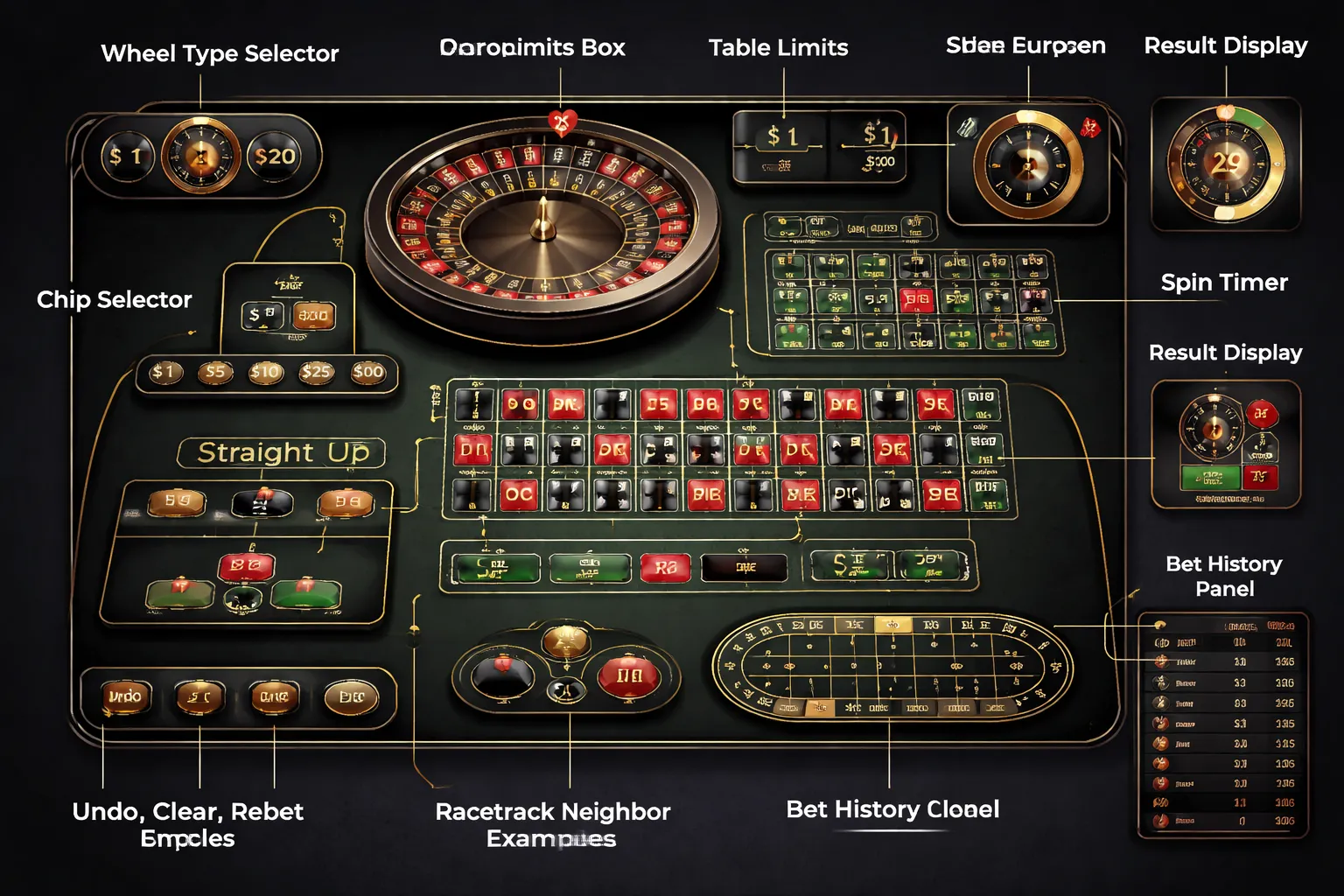
Placing your first bets with the table, chips, and undo
Pick a chip value first. Your chip value controls your unit size. Keep it small if you plan to use inside bets.
Place bets by clicking the layout.
- Straight up: click a single number.
- Split: click the line between two numbers.
- Street: click the outside edge of a row of three numbers.
- Corner: click the intersection of four numbers.
- Dozen, column, red black, odd even, high low: click the labeled outside boxes.
Use undo to remove the last chip. Use clear to remove all chips. Use rebet to repeat the last round. Rebet saves time, it also makes it easy to drift past your plan. Watch your total stake shown on screen.
If you need a refresher on payouts and coverage, use roulette bet types and odds.
Using the racetrack for neighbor bets
Some versions add a racetrack view. It places common wheel based groups fast. It does not change odds.
- Voisins du Zéro: covers numbers around zero on the wheel, placed as a preset bundle.
- Tiers du Cylindre: covers a section opposite zero.
- Orphelins: covers the remaining numbers not in the other two groups.
- Neighbors: lets you bet a number plus adjacent numbers on the wheel, often plus or minus 1 or 2.
Check the chip count the racetrack uses. Many neighbor bets place multiple splits. Your total stake can jump without you noticing.
Following the spin
Place bets before the betting timer closes. Online RNG games lock bets at the end of the countdown. Live dealer tables lock bets when the dealer calls no more bets.
After the spin, the game shows the winning number and color. It then settles your bets and updates your balance. Most interfaces also show these tools.
- Last number: the most recent result.
- History grid: recent results by number and color.
- Statistics: counts of red black, odd even, high low, dozens, columns.
- Bet history: your stakes, outcomes, and payouts per round.
Use bet history to verify what you actually risked. Do not rely on memory during a fast session.
Learning from outcomes without chasing patterns
Record sessions. Track what you can control.
- Game type and rules.
- Stake per spin and bet mix, inside versus outside.
- Spins played.
- Net result.
- Stop loss and stop win points, and whether you followed them.
Do not treat the history board as a signal. Past spins do not change the next spin in RNG roulette. In live roulette, the wheel has physical wear, but you cannot measure it well enough online to justify pattern betting. Use history for review, not prediction.
RNG vs Live Dealer Roulette: Pros, Cons, and Best Use Cases
Fairness and verification
RNG roulette uses software to produce each result. A reputable casino uses a certified RNG. Independent labs test it for randomness and publish audit reports. You can verify this in the casino footer or the game info panel. Look for current testing and named labs, not vague claims.
Live dealer roulette uses a physical wheel and ball. Fairness relies on studio controls, wheel maintenance, and operational audits. Reputable providers log every spin, monitor dealers, and use camera coverage across the wheel and table. You still trust the operator, but you can also watch the full spin cycle.
Best use case. Pick RNG if you want fast, repeatable play and easy rule checking. Pick live dealer if you value transparency of the spin and table feel.
Speed of play and bankroll risk
RNG plays fast. You can see 40 to 80 spins per hour, often more if you use auto-bet. More spins raise your hourly variance. Your bankroll can swing faster, even with low-risk outside bets.
Live dealer plays slower. Many tables land around 25 to 45 spins per hour due to betting windows and dealing pace. You take fewer decisions per hour. You also face fewer rapid-fire losses from overclicking or chasing.
Best use case. Use RNG when you want short sessions with tight stop-loss rules. Use live dealer when you want a slower pace and more time to think between bets.
User experience, social features, and controls
RNG gives you clean controls. You can place bets with one click, repeat, double, or clear fast. You often get more camera-free focus and fewer distractions. You also get features like instant rebet and detailed bet history.
Live dealer adds chat and real-time context. You can see the wheel, dealer, and table layout. This helps some players avoid misreading bets. It can also push you into longer sessions, side bets, and higher stakes if you follow the crowd.
Best use case. Use RNG if you want maximum control and minimum friction. Use live dealer if you want the social layer and the physical spin experience.
Betting limits and game availability
RNG roulette usually offers lower minimums and more table variants. You often find $0.10 to $1 minimums, plus many formats and custom side bets. Maximums depend on the casino, but high limits exist on many RNG tables.
Live dealer roulette often starts higher due to staffing and studio costs. Many tables run $1 to $5 minimums, with dedicated VIP tables for high rollers. Seat limits and table hours can restrict availability. RNG runs 24-7 with no seats.
Best use case. Use RNG for low-stakes practice and testing a staking plan. Use live dealer for premium tables, higher limits, and a more structured session.
| Factor | RNG roulette | Live dealer roulette |
|---|---|---|
| Verification | Lab-certified RNG, published audits | Studio audits, camera coverage, logged spins |
| Speed | Faster, more spins per hour | Slower, fewer spins per hour |
| Control | Fast rebet and clear UI | Bet window and table pacing |
| Limits | Often lower mins, many variants | Often higher mins, VIP options |
| Best for | Short, controlled sessions | Slower play and table feel |
Common pitfalls and how to avoid them
- Streaming lag in live roulette. Your video can run behind the server clock. Place bets early. Avoid last-second clicks. If the table often closes bets before your screen shows it, switch tables or use a lower-latency device and connection.
- Misclicks in RNG roulette. Small screens and fast controls cause errors. Turn on confirmation prompts if the casino offers them. Zoom in on mobile. Clear the layout before you rebet after a break.
- Auto-bet mistakes in RNG roulette. Auto-bet can burn a bankroll fast. Set a hard spin limit. Recheck your chip value before you start. Stop auto-bet after any stake change.
- Rebet errors in live roulette. Rebet can copy a prior layout that no longer fits your plan. Review the table every round. Do not rely on memory.
- Chasing due to pace and chat. Speed in RNG and hype in live chat both push bad decisions. Use fixed session rules and track results. If you need a reminder on long-run return concepts, review what RTP means and how to use it.
Online Roulette Strategies: What Works, What Doesn’t
Why systems cannot beat the house edge
Roulette payouts do not match the true odds. That gap creates the house edge.
Expected value tells you what you win or lose per unit bet over many spins.
- European roulette: 37 numbers. A straight-up win pays 35 to 1, but true odds are 36 to 1. Your expected loss stays about 2.70% on every bet type.
- American roulette: 38 numbers. The extra 00 raises the expected loss to about 5.26%.
Betting systems only change how your stakes move. They do not change the payout table. They cannot turn negative expected value into positive expected value.
Popular betting systems and their limits
- Martingale: You double after each loss and reset after a win. It can produce many small wins, then one large loss. Table maximums stop the recovery. Your bankroll also stops it.
- Fibonacci: You increase stakes using the Fibonacci sequence after losses. It grows slower than Martingale, but it still grows fast. Long losing runs still hit your bankroll and table limits.
- D’Alembert: You add one unit after a loss and subtract one after a win. It reduces variance versus doubling systems, but it still keeps the same house edge. It can trap you in long grind sessions.
- Labouchere: You set a target profit and bet the sum of the first and last numbers in a list. Losses add bets back into the list and can inflate stake size. A bad run can force bets that do not fit the table limits or your bankroll.
All four systems share the same failure point. They rely on a win arriving before your stake ladder breaks.
Flat betting vs progression betting
Flat betting uses the same unit each spin. It keeps variance lower. It helps you control session cost. It also makes tracking results simple.
Progression betting changes stakes after wins or losses. It increases variance. It can create higher short-term peaks, but it also increases the chance of a session-ending drawdown.
- Use flat betting when you want stable exposure and clean limits.
- Use mild progressions only if you accept higher swings and you set hard stop rules.
Session planning that actually helps
Session rules do not beat the game. They reduce mistakes and prevent stake creep.
- Stop-loss: Set a fixed amount you can lose, then leave. Tie it to units, not feelings.
- Win goal: Set a modest target, then quit when you hit it. Do not raise the goal mid-session.
- Time limit: Set a timer. Speed and repetition drive errors. Time limits cut fatigue.
- Unit size: Pick one unit for the whole session. Do not increase it to chase or to “press” a run.
- Game choice: Prefer European or French rules. Avoid American roulette if you care about expected loss.
If you need a quick refresher on return math, read what RTP means and how to use it.
When to avoid strategy content
- Table maximums: Any system that needs large recovery bets fails faster when max limits are low. Check min and max before you start.
- Tilt: If you feel urgency, anger, or relief chasing, stop. Strategy advice will not fix impulse play.
- Chasing losses: Chasing changes your plan after a bad run. It usually raises stakes, shortens decisions, and increases errors. End the session instead.
- Live roulette pace and chat: Do not copy bets because the table looks “hot.” Do not let chat pick your stakes. Follow your unit and limits.
Bankroll Management and Responsible Play
Setting a roulette bankroll
Set a bankroll for roulette only. Treat it as spent money. Do not borrow. Do not use bill money.
Split your bankroll into session stakes. A clean split is 5 to 10 sessions. If you bring $300, set $30 to $60 per session.
Pick a unit size before you bet. Use 1 to 2 percent of your session stake. If your session stake is $50, your unit is $0.50 to $1.
Set two hard limits.
- Stop-loss: 40 to 60 units. If you hit it, end the session.
- Stop-win: 30 to 50 units. If you hit it, lock the profit and leave.
Choosing bet sizing based on variance
Variance changes how fast your bankroll swings. Size your bets for the swing, not for the payout.
- Outside bets like red, black, odd, even, or 1 to 18 hit often. You can use a larger unit and still control drawdowns.
- Dozens and columns sit in the middle. Use a smaller unit than outside bets.
- Inside bets like straight, split, street, corner, and line miss often. Use the smallest unit here.
Use this as a sizing ladder for the same session stake.
| Bet type | Typical hit rate (European) | Suggested unit size |
|---|---|---|
| Outside (1:1) | 18/37, 48.65% | 1.0 unit |
| Dozen or column (2:1) | 12/37, 32.43% | 0.5 to 0.75 unit |
| Straight up (35:1) | 1/37, 2.70% | 0.1 to 0.25 unit |
Keep your unit fixed. If you want higher stakes, raise the session stake next time. Do not scale mid-session.
Using casino tools: deposit limits, reality checks, and self-exclusion
Turn on the tools before you play. Use them as guardrails, not as a rescue plan.
- Deposit limits: set daily, weekly, and monthly caps. Match the cap to your bankroll split. If you planned $60 per session and two sessions per week, cap deposits at $120 per week.
- Reality checks: set a timer at 30 to 60 minutes. When it pops, stand up and review your units, time, and stop-loss.
- Self-exclusion: use it if you break limits or feel loss of control. Pick a duration that blocks access long enough to reset habits.
Recognizing problem gambling signs and where to get help
Act on signs early. Do not wait for a crisis.
- You raise stakes to win back losses.
- You hide play or lie about money and time.
- You feel restless or angry when you try to stop.
- You use gambling to escape stress.
- You miss bills, work, or relationships because of play.
Get help fast if you see these patterns. Use national support lines and local services. If you are in the US, call or text 988 for the Suicide and Crisis Lifeline if you feel at risk. For gambling support, contact the National Council on Problem Gambling at 1-800-522-4700. In the UK, contact GamCare at 0808 8020 133.
Playing for entertainment: align expectations with probabilities
Roulette gives entertainment, not an edge. The house edge stays the same no matter your pattern.
Use the math to set expectations.
- European roulette: house edge 2.70%. Your expected loss is about $2.70 per $100 wagered over time.
- American roulette: house edge 5.26%. Your expected loss is about $5.26 per $100 wagered over time.
Outside bets feel smoother, but they do not change the house edge. If you want a game where decisions can reduce the edge, learn blackjack basic strategy and use strict limits there too.
Bonuses and Promotions: How to Use Them for Roulette
Roulette Bonus Eligibility: Why Some Bonuses Exclude or Restrict Roulette
Casinos limit roulette for one reason, it is easy to grind wagering with low variance outside bets. Many bonuses either exclude roulette or count it at a reduced rate toward wagering.
- Common rule: roulette counts 0% to 25% toward wagering.
- Less common: roulette counts 50% to 100%, usually on smaller promos or VIP offers.
- Table limits: some bonuses allow roulette, but only on specific variants or only on RNG tables.
If roulette contributes 0%, any roulette betting wastes time. If it contributes 10% to 25%, you need far more total betting to clear the same bonus.
Wagering Requirements Explained With Roulette Contribution Examples
Wagering requirements tell you how much you must bet before you can withdraw bonus money, and sometimes your deposit too.
Formula: Required wagering = bonus amount x wagering multiple. Then adjust for game contribution.
| Example | Bonus | Wagering | Roulette contribution | Total roulette bets needed |
|---|---|---|---|---|
| A | $100 | 30x | 100% | $3,000 |
| B | $100 | 30x | 25% | $12,000 |
| C | $100 | 30x | 10% | $30,000 |
Now connect that to house edge.
- European roulette: about $2.70 expected loss per $100 wagered.
- American roulette: about $5.26 expected loss per $100 wagered.
Example B on European roulette, $12,000 in bets implies about $324 expected loss over time. That does not mean you will lose exactly $324, it means the bonus needs to beat that cost to make sense.
Max Bet Rules and Withdrawal Limits to Watch For
Promos often cap how much you can stake per spin while the bonus is active. Casinos enforce this hard. Break it and they can void winnings.
- Max bet per spin: often $5 to $10, sometimes tied to your bonus size.
- Max win from bonus: common caps include 5x to 20x the bonus, or a fixed dollar limit.
- Withdrawal limits: some bonuses convert to cash, but restrict how much you can cash out per day or per week.
- Restricted bet types: some terms ban low risk coverage, like betting red and black across multiple bets, or placing both dozens, or using neighbor bets that reduce variance.
Max bet rules matter more in roulette because you can scale stakes fast. Keep your unit size small until you clear wagering.
Free Spins vs Bonus Funds vs Cashback: What Works for Roulette
Most casino promos target slots. Roulette value depends on the promo type.
- Free spins: usually slots only. They do not help roulette unless the promo grants a cash equivalent instead.
- Bonus funds: can work for roulette if roulette contributes to wagering at a decent rate and the max bet rules do not choke your play.
- Cashback: often the cleanest for roulette. It refunds a percentage of net losses over a period and usually has low or no wagering, but it may come as bonus credit with its own rules.
If you want promos designed for low house edge table play, compare how roulette terms look versus other table games. Baccarat often gets similar restrictions. Use this guide on baccarat rules and odds to sanity check house edge and typical promo treatment.
Reading Terms Like a Pro: Checklist Before You Opt In
- Game contribution: what percentage does roulette count, and does it differ by roulette variant.
- Wagering multiple: bonus only, or deposit plus bonus.
- Time limit: how many days you have to clear wagering.
- Max bet rule: per spin cap, and whether it changes with bonus size.
- Restricted play: any bans on outside bet hedging, covering many numbers, or opposite outcomes.
- Max cashout: cap on winnings from bonus funds, free spins, or cashback credits.
- Withdrawal conditions: verification steps, minimum withdrawal, and processing limits.
- RTP and variant limits: which roulette games qualify, and whether live dealer tables count.
- Sticky vs non-sticky bonus: whether you can withdraw your deposit while the bonus is active.
Run the math before you claim. If roulette contributes 10% to 25% and the wagering multiple is high, you will need massive total betting volume. That pushes your expected loss up fast.
Choosing a Safe Online Casino for Roulette
Licensing and regulation
Start with the license. If the casino will not name its regulator, leave.
- Look for: A current license number and a regulator you can verify on the regulator site.
- Why it matters: Regulators set rules for game fairness, player fund handling, KYC, and complaint channels.
- Stronger oversight: UKGC, Malta Gaming Authority, Gibraltar, Isle of Man.
- Weaker oversight: Licenses with low disclosure, unclear enforcement, or no public register.
Check the operator name on the license. Match it to the casino footer and the payment account descriptor. Mismatches signal risk.
Game provider reputation and independent testing
Roulette depends on RNG integrity for digital tables and on studio controls for live dealer games. You need both.
- RNG roulette: Prefer known providers and look for published RNG and game audits.
- Testing labs to recognize: eCOGRA, iTech Labs, GLI, BMM Testlabs.
- What to verify: The audit applies to the casino brand or platform, not a generic badge with no report date.
- RTP claims: Treat them as marketing unless the game rules show the wheel type and the payout table.
Confirm the wheel variant inside the game. European single zero typically gives you better odds than American double zero. Use this guide for details on European vs American roulette.
Payment methods, withdrawal speed, and verification requirements
Fast deposits mean nothing. Your bottleneck is withdrawals.
- Before you deposit: Read the withdrawal page. Check limits, fees, and processing times by method.
- Common methods: Cards, bank transfer, e-wallets, and crypto where legal.
- Typical friction points: Weekend processing, manual review, and per-withdrawal caps.
- KYC timing: Verify early. You will need ID, proof of address, and sometimes proof of payment method.
- Ownership rules: You must withdraw to accounts in your name. Third-party payments often trigger delays or rejection.
Watch for terms that let the casino change withdrawal limits after you win, or that add extra checks only at cashout.
Mobile performance, live lobby quality, and customer support
You will place most bets on a phone. Poor UX causes mistakes.
- Mobile checks: Fast load, stable connection handling, clear bet confirmation, and easy chip control.
- Live roulette checks: Table limits, camera angles, readable racetrack, and a clear history panel.
- Latency: You need enough time to place bets. Avoid lobbies that close betting early or lag during peak hours.
- Support: 24/7 live chat matters. Test it with one real question about roulette rules or withdrawals.
Red flags to avoid
- Unclear rules: No posted roulette rules, missing payout tables, or missing wheel type.
- Predatory terms: Max cashout caps on bonus wins, short expiry windows, or vague clauses like “we may void winnings at our discretion.”
- Misleading RTP: Advertising high RTP while pushing triple zero, side bets, or “special” rules that raise the house edge.
- Broken transparency: No company address, no license details, no responsible gambling tools.
- Withdrawal traps: Hidden fees, high minimum withdrawals, forced method changes, or repeated document requests without clear reasons.
Pick a casino that proves fairness, pays on time, and states rules in plain language. If any key detail stays vague, your risk goes up.
Common Roulette Myths and Mistakes to Avoid
Error: Invalid type for 'messages[1].content': expected one of a string or array of objects, but got a boolean instead.Quick Reference: Roulette Odds and Bet Cheat Sheet
Inside Bet Cheat Sheet, Payouts and Hit Rates at a Glance
Odds assume a fair wheel. Hit rate shows how often you win on a single spin.
| Inside bet | Covers | Payout | Hit rate (European 37) | Hit rate (American 38) |
|---|---|---|---|---|
| Straight up | 1 number | 35:1 | 1/37 (2.70%) | 1/38 (2.63%) |
| Split | 2 numbers | 17:1 | 2/37 (5.41%) | 2/38 (5.26%) |
| Street | 3 numbers | 11:1 | 3/37 (8.11%) | 3/38 (7.89%) |
| Corner | 4 numbers | 8:1 | 4/37 (10.81%) | 4/38 (10.53%) |
| Six line | 6 numbers | 5:1 | 6/37 (16.22%) | 6/38 (15.79%) |
Outside Bet Cheat Sheet, Simplest Options for Beginners
Outside bets hit more often. You trade frequency for smaller payouts.
| Outside bet | Covers | Payout | Hit rate (European 37) | Hit rate (American 38) |
|---|---|---|---|---|
| Red or Black | 18 numbers | 1:1 | 18/37 (48.65%) | 18/38 (47.37%) |
| Odd or Even | 18 numbers | 1:1 | 18/37 (48.65%) | 18/38 (47.37%) |
| High (19 to 36) or Low (1 to 18) | 18 numbers | 1:1 | 18/37 (48.65%) | 18/38 (47.37%) |
| Dozen (1 to 12, 13 to 24, 25 to 36) | 12 numbers | 2:1 | 12/37 (32.43%) | 12/38 (31.58%) |
| Column (1st, 2nd, 3rd) | 12 numbers | 2:1 | 12/37 (32.43%) | 12/38 (31.58%) |
- Fast start: pick one even-money bet, size it small, and track your results by spins, not feelings.
- Avoid “coverage” traps: more chips on more boxes does not change the house edge, it just changes volatility.
Best Variant for Lower House Edge, a Practical Recommendation
Play European roulette with a single zero. Skip American roulette with 0 and 00.
- European (single zero): house edge 2.70%.
- American (double zero): house edge 5.26%.
- Rule of thumb: if your lobby shows 00, leave.
- More detail: see European vs American roulette differences.
Example Bet Setups for Low, Medium, and High Risk Sessions
Use 1 unit as your base chip. Keep the same unit size for the whole session.
- Low risk: 1 unit on Red or Black. Same bet each spin.
- Medium risk: 1 unit on a Dozen plus 1 unit on a Column. You cover 24 numbers, payout 2:1 on a hit.
- High risk: 1 unit on a Straight up number plus 1 unit on a Split next to it. You aim for 35:1 or 17:1, you miss often.
If you want steadier swings, stick to even-money bets. If you want bigger spikes, use inside bets and accept longer losing runs.
Glossary of Roulette Terms Used in Online Lobbies
- American roulette: wheel with 0 and 00, 38 pockets.
- European roulette: wheel with 0 only, 37 pockets.
- Inside bet: bet placed on the number grid, covers 1 to 6 numbers.
- Outside bet: bet placed on areas like Red, Black, Odd, Even, dozens, columns.
- Straight up: one number.
- Split: two adjacent numbers.
- Street: three numbers in a row on the layout.
- Corner: four numbers meeting at one corner.
- Six line: two adjacent streets, six numbers total.
- Dozen: 12-number group, pays 2:1.
- Column: vertical 12-number group, pays 2:1.
- Even-money bet: pays 1:1, includes Red or Black, Odd or Even, High or Low.
- House edge: the casino’s built-in average advantage on your total amount wagered.
- RNG: random number generator used in digital roulette to produce outcomes.
FAQ
What is the best roulette version to play online?
Pick European roulette with one zero. It has a lower house edge than American roulette with two zeros. Lower edge means better long-term value for your bankroll. Read European vs American roulette key differences for a quick comparison.
What are the house edges for European and American roulette?
European roulette runs a 2.70% house edge with 37 numbers. American roulette runs a 5.26% house edge with 38 numbers. The extra zero drives the difference. If you care about odds, avoid American wheels.
Do online roulette results use a fair RNG?
Good casinos use audited RNGs that generate outcomes with uniform probability. You cannot predict spins. You can control risk by choosing lower-volatility bets and setting stop limits. Play only at licensed sites with third-party testing.
What is the best bet in roulette?
The best bet is any bet on a European wheel, since all bets share the same house edge. Choose even-money bets if you want lower variance. Choose straight-up numbers if you accept higher variance for bigger payouts.
Are outside bets better than inside bets?
Outside bets pay less but swing less. Inside bets pay more but swing more. The house edge stays the same within the same wheel type. Your choice should match your bankroll and how long you want to play.
What does 35:1 payout mean?
A 35:1 payout means you win 35 units of profit for every 1 unit you stake, and you also get your stake back. On a 1-unit straight-up win, you receive 36 units total return.
Can you use a strategy to beat roulette?
No betting system changes the house edge. Martingale and similar progressions increase bet size after losses, but they do not improve expected value. Table limits and bankroll limits usually end the system before it recovers.
What is the difference between European, American, and French roulette?
European uses one zero. American uses zero and double zero. French uses one zero and often adds rules like La Partage or En Prison on even-money bets, which can reduce the house edge on those bets.
How do La Partage and En Prison work?
On even-money bets, if the ball lands on zero, La Partage returns half your stake. En Prison locks your stake for the next spin, and you get it back if your bet wins. These rules lower the edge on even-money bets.
How much money do you need to play roulette online?
Start with at least 100 units of your base bet. Example: if you bet $1 per spin, start with $100. Use smaller bets if you want longer sessions. Avoid progressions that force fast bet increases.
Does live dealer roulette change the odds?
No. The wheel type sets the odds, not the format. Live dealer games can move faster or slower, which changes how quickly you cycle through your bankroll. Check for rules like La Partage and table limits before you play.
Can you predict roulette outcomes by tracking results?
No. Each spin is independent. Past outcomes do not change the next probability. Result boards can help you follow the game, but they do not create an edge. Focus on wheel type, limits, and bankroll control.
Conclusion
Online roulette stays simple. You place bets. The wheel resolves the spin. The house edge comes from the zero pockets, so the wheel type matters most.
- Pick the right game: European or French roulette beats American roulette on odds.
- Use low-edge bets: outside bets and simple even-money bets keep variance lower than straight-up numbers.
- Ignore patterns: result history does not change the next spin.
- Control your session: set a bankroll, a stop-loss, and a win cap. Use table limits to stay inside your plan.
Final tip. Treat roulette as a costed game. Choose a single-zero table with fair limits, then bet small enough to survive variance. If you want to check whether a casino game runs on real randomness and published math, read our guide to online casino fairness.
-
Online Casino Fairness Explained: RNG, RTP, House Edge & Provably Fair
8 months ago -
Slot RTP Explained: What RTP Means and How to Use It
8 months ago -
How to Play Online Slots: Rules, Features & Beginner Tips
8 months ago -
How Slot Jackpots Work: Progressive Jackpots Explained
8 months ago -
How to Play Online Blackjack: Rules, Payouts & Quick Start Guide
8 months ago
-
- Roulette basics, wheel, ball, and the numbered layout
- RNG roulette vs live dealer roulette, what happens behind the scenes
- The role of the roulette table layout and how numbers are organized
- How a round plays out online, placing bets, spin timer, and settling outcomes
- Common online features, autoplay, racetrack view, and statistics panels
-
- Understanding the betting window and when bets are locked
- Table limits explained, minimums, maximums, and why they affect strategy
- What happens if you disconnect mid-spin (typical casino policies)
- Key terminology, straight up, split, street, corner, line, and neighbors
- How winnings are calculated and credited in online casinos
-
- Roulette Bonus Eligibility: Why Some Bonuses Exclude or Restrict Roulette
- Wagering Requirements Explained With Roulette Contribution Examples
- Max Bet Rules and Withdrawal Limits to Watch For
- Free Spins vs Bonus Funds vs Cashback: What Works for Roulette
- Reading Terms Like a Pro: Checklist Before You Opt In
-
-
- What is the best roulette version to play online?
- What are the house edges for European and American roulette?
- Do online roulette results use a fair RNG?
- What is the best bet in roulette?
- Are outside bets better than inside bets?
- What does 35:1 payout mean?
- Can you use a strategy to beat roulette?
- What is the difference between European, American, and French roulette?
- How do La Partage and En Prison work?
- How much money do you need to play roulette online?
- Does live dealer roulette change the odds?
- Can you predict roulette outcomes by tracking results?
-
-
- Roulette basics, wheel, ball, and the numbered layout
- RNG roulette vs live dealer roulette, what happens behind the scenes
- The role of the roulette table layout and how numbers are organized
- How a round plays out online, placing bets, spin timer, and settling outcomes
- Common online features, autoplay, racetrack view, and statistics panels
-
- Understanding the betting window and when bets are locked
- Table limits explained, minimums, maximums, and why they affect strategy
- What happens if you disconnect mid-spin (typical casino policies)
- Key terminology, straight up, split, street, corner, line, and neighbors
- How winnings are calculated and credited in online casinos
-
- Roulette Bonus Eligibility: Why Some Bonuses Exclude or Restrict Roulette
- Wagering Requirements Explained With Roulette Contribution Examples
- Max Bet Rules and Withdrawal Limits to Watch For
- Free Spins vs Bonus Funds vs Cashback: What Works for Roulette
- Reading Terms Like a Pro: Checklist Before You Opt In
-
-
- What is the best roulette version to play online?
- What are the house edges for European and American roulette?
- Do online roulette results use a fair RNG?
- What is the best bet in roulette?
- Are outside bets better than inside bets?
- What does 35:1 payout mean?
- Can you use a strategy to beat roulette?
- What is the difference between European, American, and French roulette?
- How do La Partage and En Prison work?
- How much money do you need to play roulette online?
- Does live dealer roulette change the odds?
- Can you predict roulette outcomes by tracking results?
-
-
Reload Bonus Explained: What It Is and When It’s Worth Claiming
6 months ago -
Online Casino Licensing Explained: Authorities, Licenses & How to Check One
8 months ago -
Best Live Dealer Casinos: Where to Play Live Blackjack, Roulette & More
8 months ago -
Best Online Casinos for High Rollers: VIP Perks, High Limits & Exclusive Bonuses
8 months ago -
Fast Payout Online Casinos: Best Sites for Quick Withdrawals
8 months ago
-
Online Casino Customer Support: What to Look For (Live Chat, Email, Response Times)
8 months ago -
Sign Up for an Online Casino: Create an Account in Minutes
8 months ago -
Online Casino Payment Safety Tips: How to Deposit and Withdraw Securely
8 months ago -
What to Do If an Online Casino Won’t Pay Out: Step-by-Step Actions
8 months ago -
How to File a Complaint Against an Online Casino (Plus ADR Explained)
8 months ago