Are Online Casinos Legal? Complete Guide by State & Country

Online casino legality depends on where you live, what games you play, and which operator takes your bets. The rules change by state and country. They also change fast.
This guide shows you where online casinos are legal, restricted, or illegal. You will get a clear state-by-state breakdown for the US, plus a country-by-country overview for key markets. You will also learn the core laws that shape online gambling, how licensing works, and how regulators treat offshore sites, crypto casinos, and VPN use.
Use this page to check your location, avoid common compliance mistakes, and spot basic risk signals before you deposit. If you want to judge a site after you confirm legality, read how to read an online casino review.
Key Takeaways
Key Takeaways
- In het kort: Online casino legality depends on your location, your local license rules, and the operator’s license.
- Most places regulate online casinos through licensing. If a site has no valid license for your jurisdiction, you take the risk.
- In the US, legality works state by state. A legal site in one state can be illegal in another.
- In many countries, regulators focus on the operator, but you can still face account closures, confiscated funds, or tax issues.
- Offshore and crypto casinos often sit outside local enforcement. That does not make them legal where you live.
- VPN use can break casino terms and local law. It can also trigger KYC checks and payout blocks.
- Check your location first. Laws apply where you play, not where the casino claims to operate.
- Look for a local license. Use the regulator’s site when possible. Do not rely on a logo in the footer.
- Know the three common models. Fully licensed local markets, gray markets with limited enforcement, and banned markets.
- Understand the core rules. Licensing, KYC and AML checks, geolocation in regulated US states, and game testing standards.
- Spot basic risk signals. No license number, unclear operator name, weak terms on withdrawals, and no clear complaint channel.
- Plan for taxes. Some places tax winnings, some tax operators, some do both. Keep records of deposits, withdrawals, and net results.
- Read the fine print before you deposit. Bonus rules, wagering, withdrawal limits, and verification steps drive most disputes.
- Learn the basics of how sites work. See what an online casino is and how it works for games, payments, and safety checks.
What “Online Casino” Means (and Why Definitions Change Legality)

Casino Games vs Sports Betting vs Online Poker, What Counts Legally
Laws often split online gambling into separate boxes. One state may legalize online sports betting but ban online casino games. Another may allow online poker but block slots and table games.
- Online casino games, slots, blackjack, roulette, baccarat, live dealer games. These usually fall under “online casino” or “iGaming” laws. Many places treat them as the strictest category.
- Sports betting, bets on sports events, usually regulated under sports wagering laws. It often has different tax rates, licensing rules, and approved operators.
- Online poker, peer to peer poker against other players. Some laws treat poker as “casino,” others regulate it separately due to the player versus player format.
Definitions drive enforcement. If a law says “casino games” but excludes poker, a poker site may operate while a slots site cannot. If a law legalizes “sports wagering” only, a sportsbook can run legally but adding casino games can trigger illegal gambling claims.
Real Money Play vs Sweepstakes, Social Casinos, and Free to Play Apps
Many products look like online casinos but use different legal structures. The money flow matters more than the graphics.
- Real money casino, you deposit cash or crypto, you wager, you can withdraw winnings as money. This is the clearest trigger for gambling regulation.
- Sweepstakes casino, you can play with a free entry method, and you may redeem prizes under sweepstakes terms. These platforms often use two currency systems. One currency buys entertainment, the other acts like an entry token. Legality depends on how your location defines “consideration,” “chance,” and “prize,” and how the operator implements free entry.
- Social casino, you buy or earn virtual coins for gameplay. You cannot cash out. Regulators may still target these products if marketing implies real value, or if the virtual items get traded for money off platform.
- Free to play apps, no cash out, no prize of value. These usually avoid gambling laws, but ads, loot box mechanics, and payments can bring consumer protection rules into play.
Expect fast legal shifts here. Regulators update definitions when products exploit gaps. Courts also change outcomes when they interpret “value” and “payment” differently.
Key Terms to Know
- Licensing, the operator holds approval from a regulator to offer specific games in specific locations. A license usually ties to approved software, games, and payment methods.
- Geolocation, tools that confirm your physical location. Legal sites use it to block play outside approved borders. Expect location checks on login, deposit, and wager.
- KYC, Know Your Customer. Identity checks to confirm you are you, you meet age rules, and your payment method matches your name. You often complete this before your first withdrawal.
- AML, Anti Money Laundering controls. These include deposit and withdrawal monitoring, source of funds checks, and reporting rules for suspicious activity. Limits, holds, and document requests often come from AML triggers.
- RTP audits, Return to Player testing and certification. Labs test game math and randomness. Audits support fairness claims, but they do not guarantee you will win, and they do not replace licensing.
If you want a quick way to evaluate a site, focus on license details, allowed locations, KYC steps, and independent testing. This is also the core of how to read an online casino review without getting misled by marketing.
Is Online Casino Gambling Legal? The Short Answer (US vs Rest of World)
Is the legal question “Are online casinos legal?”, or “Is it legal where I am?”
Online casino legality depends on your location, not the casino’s marketing.
In the US, gambling law splits across federal rules, state law, and tribal compacts. Many states allow some forms of online gambling, but block online casino games.
Outside the US, most countries set rules at the national level. Some allow licensed operators. Some ban it outright. Many sit in the middle, legal in practice but tightly limited by licensing and payments.
Your checklist stays the same. Where are you physically located. Does your jurisdiction allow online casino play. Does the site hold a valid license that covers your location.
US vs rest of world, the short answer
| Topic | United States | Most other countries |
|---|---|---|
| Who makes the rules | States first, with federal overlays | National law, sometimes with regional rules |
| Typical outcome | Legal in some states, illegal in others | Often legal with a national license, or blocked |
| Access control | Strict geolocation and identity checks | Varies, often strong KYC where regulated |
| Main enforcement lever | Licensing, geoblocking, payment restrictions | Licensing, ISP blocking, payment restrictions |
How regulation typically works: licensing, taxation, and enforcement
Legal online casinos follow a basic structure.
- Licensing. A regulator approves the operator, games, and key vendors. The license defines where the casino can accept players.
- Taxation. The operator pays gaming taxes and fees. Many jurisdictions also require local partnerships or hosting rules.
- Player protections. Rules cover KYC, anti-money laundering, self-exclusion, deposit limits, and complaint handling.
- Game approval. Regulators or test labs verify RNG and payout math. Approval lists often differ by jurisdiction.
- Enforcement. Regulators target operators, not players, but they control access through licenses, penalties, and payment channels.
If a site cannot name its regulator, show a license number, and state where it accepts players, treat it as unregulated.
What players can usually do legally, and where the gray areas appear
What you can do depends on your location and the site’s license scope.
- In regulated markets. You can play on sites licensed for your jurisdiction. Expect geolocation, identity checks, and limits on bonuses or games.
- In restricted US states. You may find legal online sports betting or poker, while online casino games stay banned. The state draws the line.
- Offshore sites. Many accept players from places where local law does not license online casinos. This creates the common gray area. Access may work, but you lack local regulatory protection if disputes happen.
- VPN use. Casinos and regulators treat VPN location masking as a violation. It can trigger account closure and voided withdrawals.
- Crypto casinos. Crypto payments do not change legality. Your location and the operator’s licensing still control what is allowed.
Use one rule. Match your physical location to a licensed site that explicitly accepts players there. If you need workarounds to enter, you should expect withdrawal and account risk. For a fast primer on how platforms operate, read what an online casino is and how it works.
How Online Casino Laws Work in the United States
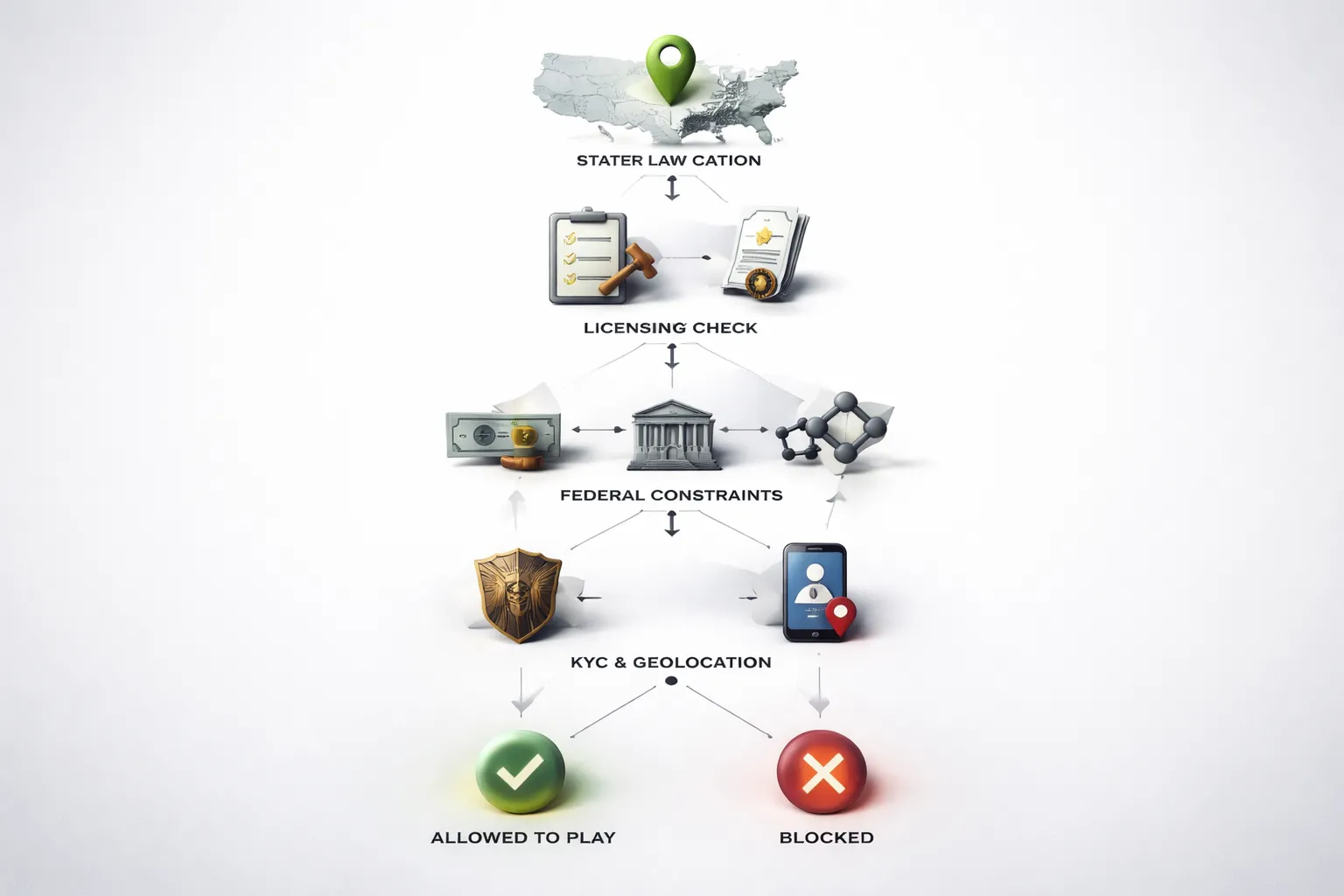
State-by-state model, licensing, enforcement, prosecution
Online casino legality in the United States runs state by state. One state can allow online slots and table games, another can allow only sports betting, and another can ban both.
- Who licenses. A state regulator issues permits and sets rules. In most legal iGaming states, the regulator is the state gaming commission or a similar gaming control board. Operators usually must partner with an in-state casino or tribal entity, then run under that license.
- Who enforces. The same regulator audits platforms, approves games, checks payment systems, and can fine or suspend licensees. States also use attorneys general, financial regulators, and geolocation vendors to help with compliance.
- Who prosecutes. State and local law enforcement handle criminal cases. That usually targets illegal operators, payment facilitators, or fraud. Player prosecutions are rare in legal-market states, but your account can still be closed and funds can be held if the site believes you broke terms or entered from the wrong place.
Practical rule. If the site does not hold a state license, and it does not list your state in its approved jurisdictions, treat it as illegal for you. Workarounds create payout risk.
Federal framework that impacts online gambling
No single federal law makes online casinos legal across the country. Federal law instead sets limits on how gambling can operate across state lines, how money moves, and how operators market.
- Wire Act. It targets certain interstate betting transmissions. It mainly affects sports betting risk and any system that routes bets or wagering data across state lines. States and licensees design systems to keep wagering activity intrastate.
- UIGEA. It restricts payment processing tied to unlawful internet gambling. It pushes banks and processors to block transactions tied to unlicensed or illegal operators. It does not legalize betting, and it does not ban all online gambling.
- Illegal Gambling Business Act. It can apply when an operation violates state law and meets federal thresholds. This is one reason offshore sites and payment networks face enforcement pressure.
- Money laundering and identity rules. Federal and state compliance standards require strong KYC, fraud controls, and reporting. This is why legal sites ask for documents, verify payment methods, and sometimes request proof of address.
Impact on you. A site can look professional and still sit outside the legal payment and licensing framework. That gap shows up in blocked deposits, delayed withdrawals, and limited consumer protection.
Tribal gaming and compacts
Tribal gaming adds a second layer in many states. Tribes operate under federal Indian gaming rules and state tribal-state compacts. Those agreements decide what types of gambling a tribe can offer and where.
- Compacts can expand access. Some states allow tribes to run statewide online betting or online casino games under compact terms or enabling state law.
- Compacts can limit access. A compact can grant exclusivity for certain games, which can block commercial iGaming or restrict it to a small number of brands.
- Litigation risk. When a state, a tribe, and commercial operators disagree on what the compact allows online, launches can pause or markets can change fast. Watch for regulator announcements, not marketing.
Practical check. If your state has tribal operators, confirm the site’s operator and license type. Tribal branding alone does not guarantee statewide legal access.
Age, identity, and location checks
You can still get blocked inside a legal state. Legal sites must prove you meet age rules, identity rules, and location rules every time you play.
- Age. Most states require 21+ for online casino play. Some products in some states use 18+ rules, but do not assume. The site enforces the state rule.
- Identity. Expect SSN verification, document uploads, and payment matching. If your name, address, or date of birth does not match records, withdrawals can pause until you fix it.
- Location. Geolocation tools use GPS, Wi-Fi, cell signals, and IP data. If you sit near a border, use a work VPN, or run remote desktop tools, the site can fail your location check.
- Device and network issues. Corporate Wi-Fi, hotel networks, or privacy settings can block geolocation. You may need to switch to mobile data or enable location services.
If you want a clearer view of how legal platforms operate day to day, read how online casinos work.
Federal US Laws That Commonly Affect Online Casinos (Plain-English Guide)
The Wire Act (1961), what it targets and what it does not
The Wire Act targets sports betting and the business of taking sports wagers across state lines.
It covers people and companies that run betting operations. It does not target you for placing a bet.
Common misconception, the Wire Act bans all online gambling. It does not.
Most states treat online casino games and online poker under state law. The Wire Act matters most when a sportsbook, payment flow, or data route crosses state borders.
- What it targets: interstate transmission of sports betting bets, wagers, or betting information.
- What it does not clearly cover: non sports casino games, when activity stays inside one state.
- Why you feel it: legal sites force in state play. They block out of state logins and out of state deposits.
UIGEA (2006), why banks and payment processing matter
UIGEA does not ban online gambling by itself. It bans payment processors from knowingly handling payments tied to unlawful internet gambling.
This law hits the money pipeline. That is why deposits and withdrawals tell you a lot about legality.
- If your state allows it: regulated sites work with banks, card networks, and approved processors. You get standard options like ACH, cards, PayPal style wallets, or cash at cage.
- If your state does not allow it: many banks decline transactions. Merchants may not process cards. Some sites push crypto or third party methods to avoid blocks.
- Practical takeaway: if a platform cannot offer clean, trackable payouts to your name and your bank, treat it as a risk signal.
For a safer baseline, stick to platforms that offer casino games online through your state regulated market.
Illegal Gambling Business Act (1970) and common enforcement tools
The Illegal Gambling Business Act, IGBA, targets gambling businesses that violate state law and meet scale thresholds. It focuses on operators, not casual players.
Federal enforcement often uses a bundle of tools. The goal is to disrupt the operation, not to chase individual bettors.
- IGBA: used when a gambling business breaks state law and operates like a real business.
- Money laundering laws: used when funds move through shell accounts, commingled wallets, or structured transfers.
- Bank fraud and wire fraud: used when a business mislabels transactions or deceives banks and processors.
- Asset seizure: used to freeze payment accounts, domains, and funds tied to the operation.
What this means for you, illegal sites can vanish fast. Payouts can stop. Support can go dark. Your funds can get stuck in limbo.
Interstate play and multi-state agreements, where they matter
Most legal online casino play stays inside one state. States require geolocation and in state servers or approved routing. This keeps activity out of federal cross border fights.
Multi-state agreements matter most for online poker. Poker needs liquidity. Shared player pools create more games and bigger tournaments.
- Poker compacts: states can link player pools under shared rules, reporting, and auditing.
- Casino games: usually do not share liquidity across states. Each state runs its own market.
- Sports betting: operators must avoid taking bets across state lines. Your location at the time of the bet matters.
Practical takeaway, if a site lets you play real money poker “from anywhere” in the US, it likely sits outside state regulation.
US State-by-State Legality: Online Casinos (iGaming) Status Map
US State-by-State Legality: Online Casinos (iGaming) Status Map
In the US, online casino legality depends on your state. There is no single federal license you can rely on. You need to match the site to your state rules and your physical location when you play.
States with regulated online casinos (iGaming)
In these states, you can play real money online slots and table games on state-licensed apps and sites. You get regulated payments, audited game testing, responsible gaming tools, and a state regulator you can contact.
- Connecticut, regulated online casino through tribal partners, limited number of licensed skins.
- Delaware, regulated online casino, state-supported market with limited operator choice.
- Michigan, regulated online casino with multiple licensed operators.
- New Jersey, regulated online casino with many licensed apps tied to land-based casinos.
- Pennsylvania, regulated online casino, large market with multiple operators.
- Rhode Island, regulated online casino with limited operator choice.
- West Virginia, regulated online casino, smaller market with limited brands live at times.
What you can do there.
- Play online slots, roulette, blackjack, baccarat, and other casino games for real money on licensed platforms.
- Use standard banking options offered by that regulated operator, including ACH and cards where supported.
- Expect strict geolocation checks. You must sit inside the state line to wager.
States with online sports betting but not online casino games
This causes the most confusion. A state can allow online sportsbooks and still block online casino games. A sportsbook app in your state does not mean you can legally play online slots there.
What this usually looks like in practice.
- You can place sports wagers in approved sportsbook apps while inside the state.
- The same brand may offer casino games in another state, but the casino tab will stay locked where iGaming is not legal.
- Some states allow online horse racing or lotteries. That does not convert into online casino legality.
States where online casino games are not regulated
Most states do not regulate online casino games. That does not always mean your play is a crime, but it does mean you have less protection.
What it usually means for you.
- You will not find a state-licensed online casino offering slots and table games.
- Many offshore sites still accept players. You take on the risk, including payment delays, account disputes, and weak oversight.
- Law enforcement focus, when it happens, usually targets operators, not individual players. Do not treat that as a safety guarantee.
If you want to understand the games themselves, including fairness and deal mechanics, read what is an online casino and how it works.
States with unique restrictions you should watch
- Limited operator choice, some states run tight markets. You may only see one or two apps.
- Tribal and compact-based models, access can run through tribal partners and approved brands only.
- Game catalog limits, some regulated markets offer fewer studios or fewer live dealer options than larger states.
- Geolocation is strict, even inside a legal state, weak GPS, VPN use, or border areas can block play.
- Account verification is mandatory, you must pass ID and age checks. Expect SSN last four digits or similar steps.
Quick-check criteria: confirm your state status in minutes
- Check your state regulator site, search your state name plus “gaming commission” or “casino control commission,” then find the list of licensed interactive gaming operators.
- Verify the operator license, scroll to the footer of the casino site or app listing. Look for the state, license holder, and regulator seal.
- Confirm geolocation rules, legal apps state it clearly. They will say you must be physically located in the state to wager.
- Ignore VPN advice, if a site or streamer pushes VPN play, treat it as a compliance red flag. It often points to offshore access, not state regulation.
- Differentiate product types, sportsbook approval does not equal online casino approval. Look specifically for “internet gaming,” “interactive gaming,” or “online casino” in official sources.
Legal Online Casino States in the US: What to Expect in Each Market
New Jersey: mature market, deep catalogs, clear rules
New Jersey runs the most mature legal online casino market in the US. You get broad game catalogs, steady platform performance, and consistent payment options.
- Game choice: Large slot libraries, many table variants, and strong live dealer coverage. Most top brands run multiple skins tied to Atlantic City license holders.
- Consumer protections: Clear identity checks, geolocation controls, and self-exclusion tools. Operators must follow strict advertising and responsible gaming standards.
- What you will notice: More competition means more promos, but bonus terms vary by brand. Read wagering rules and withdrawal limits before you deposit.
Pennsylvania: big market, higher taxes, wide operator mix
Pennsylvania is one of the largest online casino markets. The state tax structure shapes what you see, especially on promo intensity and game pricing decisions.
- Operator variety: Many national operators plus local casino brands. You will see more platform diversity than in smaller states.
- Tax effects: Higher effective tax pressure can mean tighter ongoing promos than you expect, even when welcome offers look strong.
- Payments and verification: Robust KYC is standard. Expect ID checks and occasional source of funds requests, especially after large wins or unusual activity.
Michigan: fast growth, promo guardrails, compliance focus
Michigan grew quickly and operators compete hard, but the state enforces clear compliance rules. You will feel that in onboarding, promos, and account reviews.
- Promotions: Frequent offers and aggressive acquisition campaigns. Expect stricter eligibility checks and limits tied to bonus abuse controls.
- Compliance highlights: Strong geolocation enforcement and identity verification. Multi-accounting and VPN-like location signals can trigger restrictions.
- Practical expectation: Keep your profile consistent. Use your real info, verify early, and do not switch devices and networks mid-session if you can avoid it.
Connecticut: limited operators, fewer choices, simpler comparisons
Connecticut runs with limited online casino operators. That reduces choice, but it can make quality control and comparison easier.
- Selection: Smaller catalog depth than larger states. Game availability depends on what the approved operators and their suppliers carry.
- Promos: Fewer competitors usually means fewer competing promo cycles. Welcome offers may exist, but ongoing deals can be less frequent.
- Your takeaway: Spend more time on game rules, payout speed, and support quality since you have fewer alternatives.
Delaware and Rhode Island: state-run, limited frameworks, tight availability
Delaware and Rhode Island use state-directed models with limited options. You get legal access, but not a wide open market.
- Operator access: Expect a small number of platforms, sometimes a single primary option. Brand variety stays limited by design.
- Game catalogs: Usually narrower than open-license states. Live dealer coverage can be limited or absent depending on the platform and approvals.
- Availability constraints: Fewer promos, fewer payment methods, and less innovation. The tradeoff is clear state oversight.
West Virginia: licensing structure, slower rollout, uneven depth
West Virginia authorizes online casino, but rollout realities matter. The legal framework exists, yet market depth depends on which operators launch and how they staff support and payments.
- Licensing structure: Online casino ties to approved entities, with skins possible. You may see recognizable brands, but not all will operate at the same scale.
- Rollout reality: Fewer platforms than larger states. Game catalogs and live dealer coverage can lag behind New Jersey or Pennsylvania.
- Your expectation: Check withdrawal times and game availability before you commit. Read review methodology so you can spot paid rankings and missing compliance details, see how to read an online casino review.
Where Online Casinos Are Not Legal (or Not Regulated): Player Risks and Realities
Where Online Casinos Are Not Legal (or Not Regulated): Player Risks and Realities
If your state or country has no licensed online casinos, you will see sites that claim to accept players anyway. Most of these are offshore. The risks shift to you. You lose the protections that come with local regulation, audits, and enforcement.
What “Offshore Casino” Means
An offshore casino is a site licensed in a foreign jurisdiction, or not licensed at all, that targets players outside its legal market. It often uses a Curaçao style license, or a similar light touch license, to market globally.
That is different from a regulated site in your state or country. Regulated operators must meet local rules on player verification, game testing, responsible gambling tools, complaint handling, and dispute resolution. Regulators can fine them, suspend them, or revoke licenses. Offshore sites usually answer to a distant authority, or to nobody you can reach.
Common Payout and Support Problems Players Report
- Slow withdrawals. Payouts can stretch from days into weeks, especially after a big win.
- Extra verification after you win. Sites can request new documents late in the process, then restart review timelines.
- Bonus terms used as a denial tool. Wagering rules, game restrictions, and max cashout caps can block withdrawals.
- Account closures with funds locked. Some players report closures tied to “risk checks” or “terms breaches” with limited appeal options.
- Weak customer support. Live chat may stall, email responses may stop, and escalation paths may not exist.
- Payment friction. Card deposits may fail, bank transfers may not exist, and crypto only flows can shift fees and exchange risk to you.
Legal Exposure: Operators vs Players
Enforcement usually targets operators, payment processors, and platforms that facilitate illegal gambling. That is where regulators can act at scale.
Your personal risk depends on your location and conduct. Some places focus on blocking access, seizing illegal revenue, or pursuing large scale promoters. Others can penalize individual play. You still face practical exposure even when criminal exposure stays low, including frozen withdrawals, closed accounts, and no effective dispute path.
VPN Use: Terms Violations, Confiscations, and Verification Failures
Many offshore casinos and crypto casinos ban VPN use in their terms. They use location checks, device data, and payment signals to detect mismatches.
- Terms breach. If the site flags a VPN, it can void bonuses, cancel winnings, or close your account.
- KYC failure. Verification often requires documents tied to your real address. A VPN location conflict can trigger extra checks or a denial.
- Geo mismatch triggers holds. Deposits, IP history, and login locations can conflict. The site can put withdrawals under “security review” with no fixed deadline.
- Payment reversals and chargeback disputes. If your payment method shows one country and your IP shows another, you can lose disputes and access.
If you still decide to play on an unregulated site, keep your exposure low. Test withdrawals early. Avoid large bonus traps. Document every transaction and chat log. If you want a safer way to start, use legal platforms or stick to lower stakes and small deposits, see low deposit online casinos.
Country-by-Country Guide: Online Casino Legality Around the World
Regulated markets: what “legal” looks like
In regulated countries, online casinos need a local license. The regulator sets rules for payouts, advertising, and player safety. You get clearer rights if something goes wrong.
- UK: Legal with a UK Gambling Commission license. Strong ID checks, responsible gambling tools, and dispute options.
- Malta: Legal with an MGA license. Common for EU-facing casinos. Solid compliance and complaint paths, but enforcement depends on where you live.
- Gibraltar, Isle of Man: Legal licensing hubs. Strong operational standards. Player protection still depends on your local law.
- Sweden: Legal with a Spelinspektionen license. Strict marketing rules and limits. Unlicensed sites get blocking pressure.
- Denmark: Legal with a Spillemyndigheden license. Active enforcement against unlicensed operators.
- Spain: Legal with a national license. Tight ad rules. Operators must follow local tax and consumer standards.
- Italy: Legal with an ADM license. Large regulated market. Licensed sites must meet technical and reporting rules.
- Netherlands: Legal with a KSA license. Strong duty of care rules. Aggressive action against illegal operators.
- France: Online casino games are largely not licensed. France licenses online poker and sports betting, not typical online slots and roulette.
- Canada: Varies by province. Ontario runs a clear legal market with iGaming Ontario. Other provinces often use government platforms, plus offshore access exists in practice.
- Australia: Online casino-style games are generally not legal to offer to Australians. Online sports betting is legal with licensed bookmakers. “Online casinos” targeting Australians raise major risk.
- New Zealand: No local licensing for online casinos. You will see offshore sites used. Local player protection stays limited.
Prohibited or heavily restricted markets: what enforcement looks like
In restricted countries, the law targets operators, payment rails, and ads. Some places also target players. Enforcement usually shows up as blocked sites, frozen payments, and account closures.
- United Arab Emirates: Gambling is prohibited. Enforcement can be strict. Do not expect payment access or dispute help.
- Qatar: Gambling is prohibited. High legal and personal risk.
- Saudi Arabia: Gambling is prohibited. Strong enforcement risk.
- Singapore: Tight controls. Only limited, state-linked options. Unlicensed online gambling can trigger penalties.
- Turkey: Most online gambling is prohibited outside limited state frameworks. Active blocking and payment restrictions.
- China: Gambling is heavily restricted. Offshore online casinos are illegal. Enforcement can include payment crackdowns and investigations.
Gray markets: unclear rules, outdated laws, mixed outcomes
A gray market means the law does not clearly allow online casinos, but it also does not fully stop offshore play. You face uneven enforcement and weak consumer protection. If a casino refuses to pay, you often have no practical remedy.
- Germany: Regulated framework exists, but rules can limit games, deposits, and features. You must confirm the operator holds the right German approvals for your state and game type.
- India: Rules vary by state and by game type. Some states restrict gambling heavily. Many operators position casino games as “skill” offerings, which can fail under scrutiny.
- South Africa: Online casino legality stays disputed and enforcement varies. You can see payment friction and limited recourse.
- Brazil: Sports betting regulation has moved faster than full online casino regulation. Expect shifting rules, new licensing, and crackdowns on unlicensed advertising.
- Mexico: Mixed interpretations and licensing pathways. You will see both local and offshore brands. Player protection can vary widely.
Cross-border play: “licensed elsewhere” can still be illegal for you
A Curacao or offshore license does not make a casino legal in your country. Your local law controls. Regulators and banks often treat offshore gambling as unlicensed activity even if the site holds a foreign permit.
- Access: Your ISP can block domains. Apps can disappear from local stores. Mirrors can break without notice.
- Payments: Banks can decline deposits. Withdrawals can trigger checks, reversals, or closures. Payment processors can freeze funds during “source of funds” reviews.
- Taxes: Some countries tax gambling winnings or require reporting. Offshore sites rarely help you file correctly.
- Disputes: A foreign license usually means foreign dispute channels. You may need to submit ID, bank statements, and chat logs, with no guaranteed outcome.
- Compliance checks: KYC rules can force you to prove your address and location. If your documents do not match your play location, you can lose access to funds.
| Country or region | Typical status | What to do before you deposit |
|---|---|---|
| UK | Regulated | Use UKGC-licensed sites only. Check self-exclusion tools and complaint routes. |
| EU regulated markets (varies) | Regulated or restricted | Confirm the license matches your country, not just the operator’s home base. |
| Canada | Province-based | Check your province rules. In Ontario, look for iGaming Ontario authorization. |
| Australia | Casino games restricted | Avoid sites offering online slots and roulette to Australians. Expect payment risk. |
| Gulf states | Prohibited | Avoid. High enforcement risk and no consumer protection. |
| Gray markets | Unclear | Keep deposits small, test withdrawals early, and verify support and KYC rules with how to read an online casino review. |
United Kingdom, Europe, and Other Major Regulated Regions
United Kingdom
The UK runs one of the strictest legal online casino systems. Look for a UK Gambling Commission license. UKGC sites must follow clear rules on verification, safer gambling, and fair play.
- UKGC licensing. The operator must hold a UKGC remote casino license. If the site targets UK players without it, you take higher payment and dispute risk.
- Verification. Expect identity checks early. Many sites require ID before you can deposit or shortly after signup. You also need KYC for most withdrawals.
- Responsible gambling. You will see deposit limits, time outs, and self exclusion. Operators must monitor risky play and may restrict your account if your spend looks unsafe.
- Promotions. UK sites must show clearer bonus terms and avoid misleading offers. You still need to read wagering rules and withdrawal caps.
European Union
EU membership does not give you one gambling law. Each country sets its own rules, taxes, licensing, and ad limits. A license in one EU country does not always let a casino legally serve players in another.
- Country licenses. Many countries require a local license to target local players. Others allow limited cross border access, but enforcement varies.
- Common player experience. Expect KYC, age checks, and AML reviews across most regulated markets. Expect different game limits and bonus rules by country.
- Practical check. Use the regulator logo, then confirm the license number on the regulator site. Do not rely on a footer badge alone.
Nordics and the Netherlands
These markets push channelization. That means regulators want most play to happen on licensed sites. They use payment controls, ad limits, and enforcement to reduce the black market.
- Channelization focus. Licensed operators must meet local rules on tax, reporting, and safer gambling. In return, they get legal access to advertise and operate.
- Black market controls. Expect ISP blocks, payment blocks, and enforcement against unlicensed operators in some jurisdictions. Results vary, but the pressure increases over time.
- Ad limits. You will see tighter rules on bonuses, influencer marketing, and aggressive acquisition. Some markets restrict timing, targeting, or content of ads.
- Player impact. You may get fewer promos, more limits, and more checks. You also get clearer dispute paths and local consumer protection.
Australia and New Zealand
Australia and New Zealand do not work like the UK or most of Europe for online casino games.
- Australia. You can legally bet online with licensed bookmakers. Online casino style games such as slots and roulette generally cannot get licensed for Australian customers. If a site offers them to you in Australia, expect higher risk on payments, support, and withdrawals.
- New Zealand. You can use overseas online casinos, but local licensing for full online casinos does not match the UK model. Expect fewer local protections and limited local dispute options.
Canada
Canada runs a provincial model. Provinces set rules, licensing, and consumer protection. Offshore sites still serve many Canadians, but the regulated provincial option keeps expanding.
- Provincial platforms. Many provinces offer government run or province managed online gambling. These sites follow local standards on KYC, AML, and player protection.
- Private regulated markets. Some provinces have moved toward regulated private operators under provincial oversight. This increases game choice while keeping local controls.
- Offshore access. Offshore casinos remain common in practice, but you take more risk on disputes, verification delays, and payment issues. Keep deposits small and test withdrawals early.
- What to check. Before you deposit, verify licensing, payout terms, withdrawal limits, and KYC rules. Use how to read an online casino review to spot weak terms and biased ratings.
Asia, Africa, and Latin America: Fast-Changing Legal Landscapes
India: State-Level Complexity, Skill vs Chance, and Player Pitfalls
India has no single, clear nationwide rule for online casinos. Most enforcement and permission decisions happen at the state level. One state can allow certain formats, another can ban them. Rules can also change fast after local court decisions or new state bills.
Many operators market games as “skill” to reduce risk. Courts and regulators often treat pure chance games differently from skill-dominant contests. You still face uncertainty because states and courts do not apply the same test in the same way.
- Common pitfall: You assume a national “legal” status, but your state rules control your risk.
- Common pitfall: You treat “skill-based” claims as proof. Marketing language does not protect you in a dispute.
- Common pitfall: You use offshore sites with unclear terms, then get stuck in KYC or withdrawal delays.
- Common pitfall: You ignore payment friction. Many banks and wallets block or flag gambling-coded transactions.
Philippines: Offshore Licensing History and What It Means for Players
The Philippines built a major offshore licensing model for years. That structure mainly served non-local players, with operations and support based in the country. Rules and government posture have shifted over time, including tighter oversight and periodic policy changes.
For you, the key point is simple. A license tied to an offshore framework can signal a real corporate footprint and compliance processes. It does not guarantee smooth payouts or fair dispute handling. You still need to read withdrawal limits, document rules, and account closure terms.
- Check: Which regulator issued the license, and which entity name appears on the site terms.
- Check: KYC triggers, source of funds checks, and withdrawal review timelines.
- Check: Game provider list and audited RNG claims, especially if the lobby looks cloned.
South Africa: Remote Gambling Restrictions and What Is Commonly Permitted
South Africa allows several forms of gambling, but it restricts remote casino-style gambling under national rules. Provincial licensing plays a major role for land-based gambling, while online casino offerings face tighter limits.
In practice, you will see legal online sports betting products offered by licensed operators. You will also see many offshore casino sites targeting South African players. That access does not equal local approval.
- Commonly permitted: Licensed online sports betting through approved operators.
- Higher risk area: Online slots and table games offered offshore, with limited local recourse.
- Action: Expect stronger KYC on larger withdrawals, and keep payment proof records.
Brazil: Evolving Regulation and Why Timelines Matter
Brazil has moved toward a more structured framework, but the timeline matters. A market can sit in a transition phase where some verticals operate under new rules while others wait for full licensing and technical standards.
You should treat any “legal” claim as time-specific. Operators change domains, entities, and payment flows during transition periods. That increases the chance of verification delays, bonus disputes, and sudden terms updates.
- Do: Confirm the operator’s current authorization status and entity name before you deposit.
- Do: Screenshot key terms on bonuses and withdrawals on the day you join.
- Do: Use small test withdrawals early, before you scale stakes.
Mexico and Colombia: Licensing Approaches and Market Maturity Differences
Mexico and Colombia both have regulated gambling structures, but they operate differently. Mexico uses a long-running licensing model tied to local permits and approved operators. Colombia built one of the clearer online licensing frameworks in the region, with a more visibly regulated online market.
For you, that difference shows up in how easy it is to verify an operator, how consistent the compliance standards feel, and how predictable payment processing is.
- Mexico: You will find legal operators, but you must verify the permit holder and local entity behind the brand.
- Colombia: You more often see direct, recognizable online licensing structure and consumer-facing compliance rules.
- Action: Match the casino’s license jurisdiction to your location, and read the withdrawal policy line by line.
Middle East: High Restriction Environments and Severe Penalty Considerations
Many Middle East jurisdictions restrict or prohibit gambling, including online casinos. Enforcement levels vary, but penalties can be severe. You can also face banking blocks, telecom blocking, and device or account scrutiny.
If you live or travel in a high restriction country, treat online casino play as a legal and personal risk issue, not a convenience issue. Avoid workarounds that create larger exposure, including identity mismatches, VPN reliance tied to account fraud flags, and unstable crypto ramps.
- Risk: Criminal penalties can apply, including fines and detention in some jurisdictions.
- Risk: Payment trails can trigger account freezes or compliance reviews.
- Action: If you choose to play at all, keep activity low, keep records clean, and stop if an operator requests unusual documentation.
Rules also affect game formats. Live dealer products can trigger different compliance and geolocation checks than RNG titles. Use what an online casino is and how it works to understand where licensing, game hosting, and payment processing create risk for you.
How to Check If an Online Casino Is Legal and Licensed (Step-by-Step)
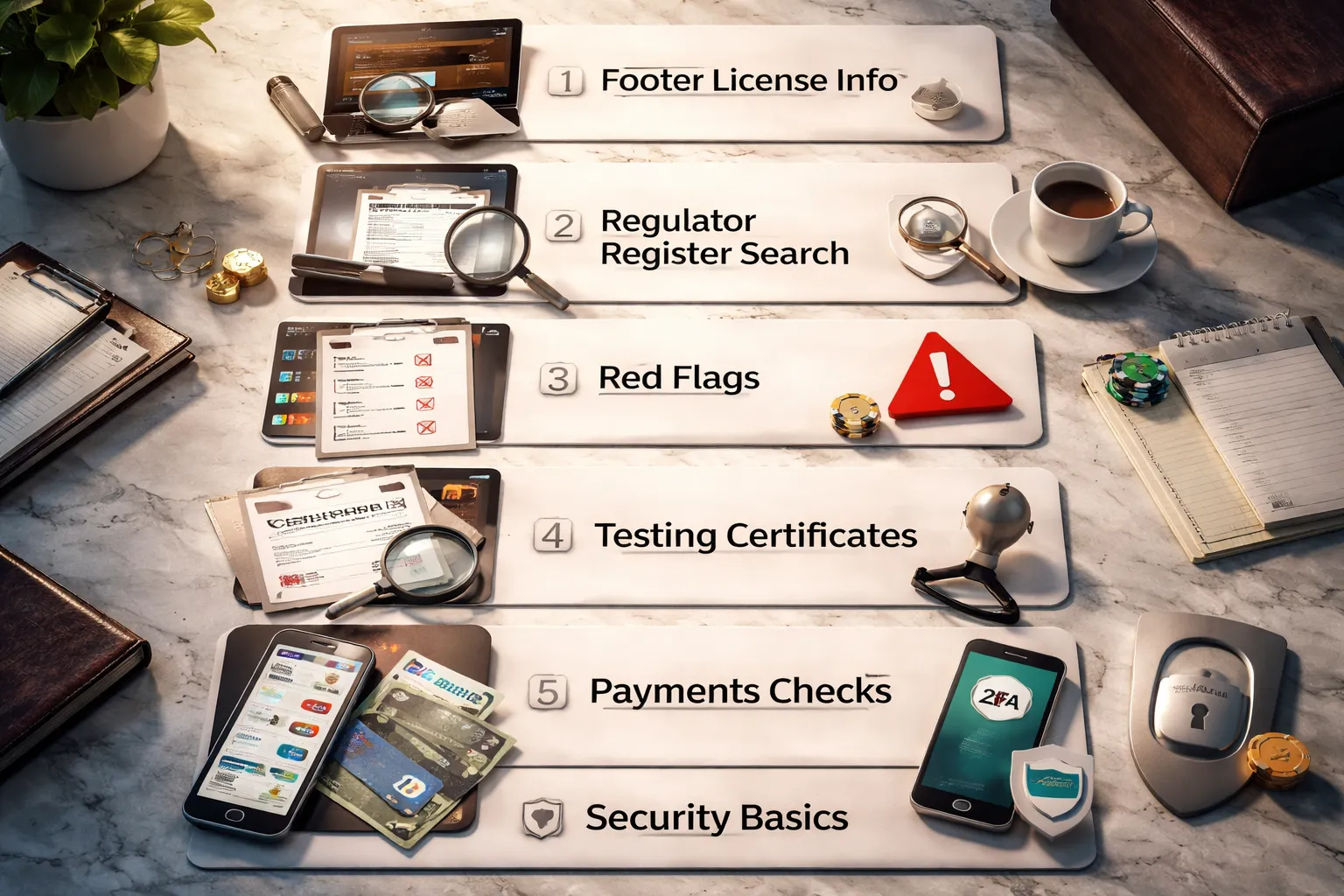
Step 1, Find the license details on the casino site
Start at the footer. Legal operators put licensing info there.
- Look for: legal company name, license number, licensing authority, registered address.
- Also check: Terms and Conditions, About, Responsible Gambling, Privacy Policy.
- Match names: the operator name in the footer should match the name in the Terms and the payments pages.
Step 2, Verify the license with the regulator
Do not trust a logo. Use the regulator register.
- Copy the license number and the operator name.
- Open the regulator website and find the licensee register or public database.
- Search the operator name. Then confirm the license number matches.
- Check the brand or website domain listed under that licensee, if the register shows it.
- Confirm the status shows active, not suspended, revoked, or expired.
- Check the license type covers online casino, not only sports betting or lottery.
If the regulator site does not list domains, contact the regulator. If the casino refuses to share the licensed entity name, move on.
Step 3, Spot red flags that often signal an unlicensed site
- Fake seals: a licensing badge that does not link to a regulator page, or links to an image file.
- Unverifiable numbers: a license number that does not appear in the regulator register.
- Wrong jurisdiction claims: “licensed in Malta” but no MGA listing, or a “UK licensed” claim with no UKGC entry.
- Mirrored sites: the same brand on multiple domains, with different footer company names.
- Geo workarounds: instructions to use a VPN, or to lie about your location.
- Shifting entities: deposits go to a different company name than the licensed operator.
Step 4, Check fairness signals and testing disclosures
Licensed casinos usually publish testing and audit details. You should be able to verify them.
- Independent test labs: look for labs such as eCOGRA, iTech Labs, GLI, or BMM.
- RNG certificates: the site should state which games or providers the certificate covers, plus the date.
- Audit reports: some operators publish payout data or compliance reports. Read the scope and period.
- Game provider list: real casinos list providers. Counterfeit sites often show icons with no working provider pages.
Do not treat an “RTP” claim as proof. Treat a current certificate from a recognized lab as a stronger signal.
Step 5, Review payments and withdrawals like a compliance check
Payments reveal how the operator handles risk and player protection.
- Clear withdrawal rules: processing times, limits, verification steps, and fees listed in one place.
- Consistent banking: deposit and withdrawal methods match, and the cashier shows the operator name.
- Reasonable verification: ID checks happen once, not after a big win. Requests stay specific.
- No pressure tactics: no forced “agent” deposits, no requirement to use a third party wallet you do not control.
- Support that can explain issues: a reliable site gives ticket numbers and written timelines. Use your customer support options as a test before you deposit.
Step 6, Confirm basic data security and account protection
- Encryption: the site should load on HTTPS. Your browser should show a valid certificate.
- Privacy policy: it should name the data controller, list what data they collect, and state retention periods.
- Account security: look for 2FA, login alerts, device management, and self exclusion tools.
- Clear KYC policy: the site should explain why it collects documents and how it stores them.
- No document overreach: avoid sites that ask for unrelated records, or request files by insecure channels.
Taxes, Winnings, and Player Responsibilities (US + International Overview)

United States: reporting winnings
In the US, gambling winnings count as taxable income. You report them even if the casino does not send a tax form. You report winnings from online casinos, sportsbooks, poker rooms, sweepstakes style platforms, and offshore sites the same way, as income.
You owe tax on net winnings for the year, but you must track them. Casinos report certain payouts to the IRS. Your job is to report all winnings and keep proof.
W-2G basics and common misunderstandings
Form W-2G is a reporting form for certain gambling winnings. A missing W-2G does not mean tax free. A W-2G also does not always mean you made a profit overall.
- You can owe tax without a W-2G. Many smaller wins never trigger a form.
- A W-2G does not equal net profit. It can reflect a single payout, not your session or year.
- Bonuses still matter. Some bonus payouts and promotional prizes can count as taxable winnings.
- Losses are not automatic. You need records to support any loss deduction, and rules differ based on your filing situation.
Withholding and documentation
US casinos and many regulated operators may withhold federal tax on certain payouts. They may also withhold when you cannot provide correct taxpayer details. Do not treat withholding as the final tax bill. It is a prepayment that you reconcile on your return.
Expect identity checks when you cash out. Operators may ask for extra verification when risk flags appear, or when rules require it.
- Large withdrawals, high win spikes, or unusual play patterns.
- Name mismatch across your account, bank, and ID.
- Multiple accounts, shared devices, or frequent IP changes.
- Chargebacks, disputed deposits, or failed payments.
- Source of funds checks for higher tiers, especially with crypto rails.
Send documents only inside the casino account portal. Avoid email attachments and chat uploads unless the operator uses a secure link and states how it stores files. If a site cannot explain its process, walk away.
International differences
Tax rules vary by country. Some places tax the operator, not you. Others tax you on winnings, or tax you only if gambling counts as a business. Some countries require you to report foreign gambling income even when the casino sits offshore.
- Player tax vs operator tax. In some jurisdictions, you pay nothing on winnings. In others, you report and pay yourself.
- Local licensing matters. Winnings from a locally licensed site can get different treatment than winnings from an offshore site.
- Withholding rules differ. Some countries require withholding at payout. Others use self assessment.
- Currency and crypto create extra steps. Exchange rates, transaction histories, and capital gains rules can apply.
If you play across borders, you need a clean paper trail. Keep timestamps, exchange rates, and wallet addresses. Use your own accounts. Do not route funds through friends.
Recordkeeping checklist
Good records protect you in audits, chargeback disputes, and account reviews. Save data as you go. Do not rely on a casino to keep it forever.
- Deposits. Amount, date, payment method, transaction ID.
- Withdrawals. Amount, date, destination account, transaction ID.
- Win and loss logs. Session dates, games played, starting and ending balance.
- Win loss statements. Download monthly and yearly statements when available.
- Bonuses and promos. Offer terms, wagering progress, and bonus conversions.
- Tax forms. W-2G, 1099 variants, withholding records, and any correspondence.
- Bank and wallet statements. Screenshots or PDFs that match casino transactions.
- Account verification. Copies of what you submitted, and the date you submitted it.
If you plan to play live tables, read how identity checks and payout flows work before you deposit. Use this guide on how live dealer casinos work to understand what you will see at the table and what the operator may log.
Responsible Gambling and Player Protection in Legal Markets
Self-exclusion, deposit limits, time-outs, and reality checks
Legal markets require tools that let you control access and spending. Use them before you chase losses.
- Self-exclusion. You block yourself from gambling for a set period. Common terms include 6 months, 1 year, 5 years, or permanent. In strong regimes, it covers every brand under the same license and can extend across the state or country program. You should not receive marketing during exclusion.
- Deposit limits. You cap what you can add to your account per day, week, or month. This is the most useful first step. Good operators apply it instantly when you lower a limit, and apply a cooling-off delay when you raise it.
- Loss limits. You cap net losses over a period. Some sites offer it, some do not. Treat it as a backup, not your main control, since game results can vary fast.
- Wager limits. You cap total stakes. This helps if you play high volume games.
- Time-outs. You lock the account for short breaks, often 24 hours to 6 weeks. Use this when you feel tilt.
- Reality checks. Pop-ups show time played and net results at set intervals. Strong versions require you to confirm and then give a clear exit path, not just a close button.
If a licensed site hides these settings, puts them behind support, or makes you call to apply them, treat that as a warning sign.
Problem gambling resources and how regulated sites must respond
In legal markets, operators must show safer gambling links, display risk messages, and train support staff. Many regulators also require monitoring for harm markers.
- Required support options. You should see links to national or state help lines, self-assessment checks, and clear steps for self-exclusion. These links should appear in the footer and in account settings.
- Operator duties. A regulated site should respond fast when you report loss of control. They should explain tools, apply limits on request, and stop marketing if you self-exclude.
- Risk detection. Some markets push operators to flag patterns like long sessions, repeated failed deposits, rapid deposit increases, and repeated cancel attempts. The best operators intervene with messages, limit prompts, or direct outreach.
- Support quality. You should get a written record of requests and actions taken. If support avoids clear answers, escalates slowly, or pushes bonuses during a safety request, leave.
If you need help, start with your account tools. Then contact support and ask for written confirmation. Learn what decent support looks like in this guide on online casino customer support.
Advertising and bonus rules, where regulation helps and where it fails
Rules vary by state and country. Enforcement also varies. Do not assume a license means clean marketing.
- Common restrictions. No targeting minors. No misleading “risk-free” language. Clear terms for bonuses. Limits on celebrity and influencer marketing in some regions. Responsible gambling messages in ads.
- Bonus transparency. Strong rules force clear display of wagering requirements, game contribution, max cashout limits, time limits, and withdrawal rules. Weak rules allow these terms to sit in long pages most players never read.
- VIP and high-value targeting. Some regulators allow aggressive retention as long as it is disclosed. This can increase harm for at-risk players. If you get frequent reload offers after heavy losses, treat it as a signal to set hard limits.
- Affiliate marketing gaps. Many harms come from third-party sites that overpromise and hide terms. Even in regulated markets, affiliates can slip through until complaints stack up.
How to spot predatory practices even on licensed platforms
Licenses reduce fraud risk. They do not remove pressure tactics. Watch for patterns that push you to spend more or delay withdrawals.
- Withdrawal friction. Sudden document requests only after you win, repeated “missing” files, or constant new checks. Legit KYC happens early and follows a clear checklist.
- Limit manipulation. Easy to raise limits, hard to lower them. Long waits to apply decreases. No visible history of changes.
- Bonus traps. Auto-applied bonuses that lock your balance, high wagering requirements, short deadlines, low max cashout, or withdrawal blocks until you “complete play.” Read the cashier and bonus terms before you click accept.
- Churn design. Fast re-deposit prompts after a loss, constant push notifications, and “one-click” top-ups. Turn off marketing and set deposit caps.
- Confusing net position. Missing session summaries, unclear win loss reporting, or no reality checks. You should always know time played and net results.
- Support scripts. If you mention risk or addiction and support answers with promotions, that is a hard stop.
Use legal market tools as defaults. Set a deposit limit. Enable reality checks. Schedule time-outs. If a site makes any of this hard, pick a different licensed operator.
Future Outlook: Where Online Casinos May Expand Next
US legislative trends, what drives iGaming legalization
Most states legalize online casinos for three reasons. Revenue, control, and politics.
- Budget pressure. States look for new tax streams without raising broad taxes. iGaming adds year-round revenue, unlike one-time license fees.
- Channelization. Lawmakers want players on regulated sites with age checks, deposit limits, and audit trails. That gives regulators leverage and reduces illegal market share.
- Sports betting momentum. Once a state builds licensing, geolocation, and responsible gaming rules for sports betting, iGaming looks like the next step.
- Local winners. Bills move faster when casinos, racetracks, and tribes agree on who gets licenses and how revenue splits.
Watch for states that already run legal online sports betting, have commercial casinos, and face budget gaps. Those conditions usually come first.
Why states delay, cannibalization fears, politics, tribal negotiations
- Cannibalization concerns. Retail casinos and local unions may argue online play will cut on-site jobs and foot traffic. Some states respond with higher tax rates, limited game types, or tethered licensing to land-based properties.
- Tax fights. Some lawmakers push for very high iGaming tax rates. Operators push back. Deals stall when the math kills investment and product quality.
- Tribal compacts. Tribes often hold exclusivity for certain casino games. iGaming can trigger renegotiation. If the state and tribes cannot agree on exclusivity, brands, and revenue share, nothing moves.
- Political risk. Election cycles slow bills. Leadership changes can reset committee priorities.
- Lottery positioning. Lotteries may resist casino-style games online, or they may seek control of the channel. That power struggle delays frameworks.
If you see public hearings focused on “protecting brick-and-mortar revenue” or “tribal exclusivity,” expect longer timelines.
Technology and compliance trends, geolocation, affordability checks, ID innovation
- Geolocation tightens. States keep improving location accuracy near borders. Expect more multi-signal checks using GPS, Wi-Fi, and device data. You will see fewer “close enough” logins.
- ID and age verification improves. Operators combine document scans, database checks, and device reputation. This speeds approval for most players and blocks high-risk accounts faster.
- Affordability checks expand. More regulators will require stronger financial risk controls. Expect clearer source-of-funds triggers, loss limits, and intervention rules for high spend patterns.
- Responsible gaming tooling becomes mandatory. Deposit limits, time-outs, and reality checks move from “available” to “required and easy to set.”
- Data reporting gets stricter. Regulators want standard reporting on net results, time played, and player interventions. This reduces loopholes and improves enforcement.
These changes favor licensed operators with mature compliance teams. They also reduce the value of offshore workarounds.
What you should watch, bills, regulator updates, rollout timelines
- Bill status. Track the bill number, committee assignment, and hearing dates. A bill that clears committee has real momentum.
- License model. Look for who can apply, casinos only, tribes, racetracks, or open licensing. The model predicts competition, bonuses, and game variety.
- Tax rate and fees. Extreme tax rates often lead to worse odds, fewer promos, or fewer operators. Balanced rates usually bring better products and faster rollouts.
- Regulator rules. Read draft rules on geolocation, KYC, withdrawals, and responsible gaming tools. Those details affect your day-to-day experience more than the headline law.
- Rollout timeline. Most markets follow a pattern, law passes, rules drafted, license applications open, soft launch, full launch. Expect months, not weeks.
If you want a baseline on how regulated platforms work before a new market launches, read what an online casino is and how it works.
FAQ
Are online casinos legal in the United States?
It depends on your state. Some states license real money online casinos, most do not. Federal law does not create a single nationwide system. You must follow your state rules, plus the casino’s licensing terms.
Which US states have legal online casinos?
As of 2025, real money online casino gaming is legal in Connecticut, Delaware, Michigan, New Jersey, Pennsylvania, Rhode Island, and West Virginia. Laws change. Check your state gaming regulator before you deposit.
Is online sports betting the same as online casinos?
No. Many states allow online sports betting but ban online casino games like slots and blackjack. Your state may have one, both, or neither. Read the license scope on the operator site and confirm with the regulator.
Can you play on offshore or crypto casinos from the US?
Most offshore sites are not licensed in your state. That means you lose state level protections for payouts, disputes, and game testing. A crypto payment does not make a site legal. If the site blocks your state, treat that as a warning.
Is using a VPN to access a casino legal?
A VPN can break a casino’s terms and can trigger geolocation checks. If you bypass location controls, the operator can void bonuses or refuse withdrawals. You also risk violating state rules. Use sites that accept your state without workarounds.
How do you verify a casino is legal in your state?
Check the state regulator list of licensed operators and approved brands. Match the exact brand name, URL, and license number. If you cannot confirm it on a regulator site, do not deposit.
What is the legal age to play online casino games?
Most regulated US online casinos require you to be 21. Some markets allow 18 for specific products, often lottery style gaming, not casino. The operator must verify your age and identity before you withdraw.
Do you pay taxes on online casino winnings?
Yes. In the US, gambling winnings are taxable income. Casinos may issue tax forms at certain thresholds, but you must report winnings either way. Keep records of wins, losses, deposits, and withdrawals.
What checks happen before you can deposit or withdraw?
Regulated casinos use geolocation, identity checks, and payment verification. You may need to upload ID and proof of address. Mismatched details can delay withdrawals. Use your real info and one consistent payment method.
What if a casino will not pay you?
With a regulated casino, you can file a complaint with the state regulator. With an offshore site, your options are limited. Before you play, confirm withdrawal rules and read the customer support options.
Are online casinos legal in other countries?
Rules vary by country and sometimes by region. The UK licenses online casinos nationally. Canada allows provincial platforms and gray market access in some areas. Many EU countries license and restrict operators. Check your local regulator and approved operator list.
How can you stay safe if your state is not regulated?
Avoid unlicensed sites that target your state. Do not use VPN workarounds. If you want a baseline on how regulated platforms work, read what an online casino is and how it works.
Conclusion
Conclusion
Online casino legality depends on where you live. In the US, states set the rules. In Canada, provinces control legal play. In the EU and many other regions, national regulators license and restrict operators.
Do this before you deposit. Find your regulator. Use the regulator’s approved operator list. Match the casino brand and domain to that list. If you cannot verify a license for your location, do not play.
Skip VPN workarounds and offshore sites that target your state or country. You risk account closure, withheld payouts, and no regulator support.
- Step 1: Confirm your exact state, province, or country rules.
- Step 2: Choose a licensed operator for your location.
- Step 3: Read the withdrawal terms, KYC steps, and game restrictions before you deposit.
- Step 4: Save support and complaint contacts from the operator and regulator.
If you want a clear baseline for how regulated sites operate, read what an online casino is and how it works.
-
Best Low Deposit Online Casinos: Play for Less with Small Minimum Deposits
6 months ago -
What Is an Online Casino? How They Work, Games, Bonuses & Safety
6 months ago -
Live Dealer vs RNG Casino Games: What’s the Difference?
6 months ago -
How Live Dealer Casinos Work (and What to Expect)
6 months ago -
Online Casino Customer Support: What to Expect (Live Chat, Email, Phone)
6 months ago
-
- US State-by-State Legality: Online Casinos (iGaming) Status Map
- States with regulated online casinos (iGaming)
- States with online sports betting but not online casino games
- States where online casino games are not regulated
- States with unique restrictions you should watch
- Quick-check criteria: confirm your state status in minutes
-
- New Jersey: mature market, deep catalogs, clear rules
- Pennsylvania: big market, higher taxes, wide operator mix
- Michigan: fast growth, promo guardrails, compliance focus
- Connecticut: limited operators, fewer choices, simpler comparisons
- Delaware and Rhode Island: state-run, limited frameworks, tight availability
- West Virginia: licensing structure, slower rollout, uneven depth
-
- India: State-Level Complexity, Skill vs Chance, and Player Pitfalls
- Philippines: Offshore Licensing History and What It Means for Players
- South Africa: Remote Gambling Restrictions and What Is Commonly Permitted
- Brazil: Evolving Regulation and Why Timelines Matter
- Mexico and Colombia: Licensing Approaches and Market Maturity Differences
- Middle East: High Restriction Environments and Severe Penalty Considerations
-
- Step 1, Find the license details on the casino site
- Step 2, Verify the license with the regulator
- Step 3, Spot red flags that often signal an unlicensed site
- Step 4, Check fairness signals and testing disclosures
- Step 5, Review payments and withdrawals like a compliance check
- Step 6, Confirm basic data security and account protection
-
- Are online casinos legal in the United States?
- Which US states have legal online casinos?
- Is online sports betting the same as online casinos?
- Can you play on offshore or crypto casinos from the US?
- Is using a VPN to access a casino legal?
- How do you verify a casino is legal in your state?
- What is the legal age to play online casino games?
- Do you pay taxes on online casino winnings?
- What checks happen before you can deposit or withdraw?
- What if a casino will not pay you?
- Are online casinos legal in other countries?
- How can you stay safe if your state is not regulated?
-
- US State-by-State Legality: Online Casinos (iGaming) Status Map
- States with regulated online casinos (iGaming)
- States with online sports betting but not online casino games
- States where online casino games are not regulated
- States with unique restrictions you should watch
- Quick-check criteria: confirm your state status in minutes
-
- New Jersey: mature market, deep catalogs, clear rules
- Pennsylvania: big market, higher taxes, wide operator mix
- Michigan: fast growth, promo guardrails, compliance focus
- Connecticut: limited operators, fewer choices, simpler comparisons
- Delaware and Rhode Island: state-run, limited frameworks, tight availability
- West Virginia: licensing structure, slower rollout, uneven depth
-
- India: State-Level Complexity, Skill vs Chance, and Player Pitfalls
- Philippines: Offshore Licensing History and What It Means for Players
- South Africa: Remote Gambling Restrictions and What Is Commonly Permitted
- Brazil: Evolving Regulation and Why Timelines Matter
- Mexico and Colombia: Licensing Approaches and Market Maturity Differences
- Middle East: High Restriction Environments and Severe Penalty Considerations
-
- Step 1, Find the license details on the casino site
- Step 2, Verify the license with the regulator
- Step 3, Spot red flags that often signal an unlicensed site
- Step 4, Check fairness signals and testing disclosures
- Step 5, Review payments and withdrawals like a compliance check
- Step 6, Confirm basic data security and account protection
-
- Are online casinos legal in the United States?
- Which US states have legal online casinos?
- Is online sports betting the same as online casinos?
- Can you play on offshore or crypto casinos from the US?
- Is using a VPN to access a casino legal?
- How do you verify a casino is legal in your state?
- What is the legal age to play online casino games?
- Do you pay taxes on online casino winnings?
- What checks happen before you can deposit or withdraw?
- What if a casino will not pay you?
- Are online casinos legal in other countries?
- How can you stay safe if your state is not regulated?
-
Reload Bonus Explained: What It Is and When It’s Worth Claiming
4 months ago -
Online Casino Licensing Explained: Authorities, Licenses & How to Check One
6 months ago -
Best Live Dealer Casinos: Where to Play Live Blackjack, Roulette & More
6 months ago -
Best Online Casinos for High Rollers: VIP Perks, High Limits & Exclusive Bonuses
6 months ago -
Fast Payout Online Casinos: Best Sites for Quick Withdrawals
6 months ago
-
Online Casino Licensing Explained: Authorities, Licenses & How to Check One
6 months ago -
Casino VIP & Loyalty Programs Explained: Points, Tiers, Rewards & Rakeback
6 months ago -
How to Sign Up & Create an Online Casino Account (Step-by-Step)
6 months ago -
Online Casino Fairness Explained: RNG, RTP, House Edge & Provably Fair
6 months ago -
How to Withdraw Money from an Online Casino: Methods, Steps & Tips
6 months ago