Reload Bonus Explained: What It Is and When It’s Worth Claiming

Reload bonuses reward you for depositing after your first sign up offer ends. Casinos use them to keep you playing. You use your own money, then the site adds extra bonus funds, free spins, or both.
This guide breaks down how reload bonuses work, the main types you will see, and the terms that decide if the deal has real value. You will learn how to compare bonus percent, max cap, wagering rules, eligible games, and time limits. You will also learn when to skip a reload bonus because the cost in wagering or restrictions outweighs the extra credit.
If you want to judge a reload offer fast, start with the wagering requirement. It usually decides your expected cost.
- In het kort: A reload bonus adds extra credit when you deposit again, but the terms decide the real value.
- Start with the wagering requirement. It usually drives your cost and risk.
- Check the bonus percent and max cap. A high percent means little if the cap is low.
- Review eligible games and game contribution. Low contribution can make the wagering target hard to clear.
- Confirm time limits. Short expiry windows increase bust risk and force higher stakes.
- Watch maximum bet rules while wagering. One wrong stake can void the bonus.
- Factor in withdrawal limits, restricted payment methods, and excluded countries if listed.
- Skip the offer when wagering is high, eligible games are narrow, or the cap and limits shrink your expected return.
- When you want deeper rule checks, read casino bonus terms and conditions.
Reload Bonus Explained: Definition and Why It Exists
What a reload bonus is
A reload bonus is a promotion you get after you already have an account. It triggers when you make a new deposit. The site adds extra value on top of that deposit, based on a set formula and terms.
You usually must opt in, deposit within a time window, then meet wagering or playthrough rules before you can withdraw the bonus value. Some reloads also apply to your deposit amount.
Reload bonus vs. welcome offer
- Timing: A welcome offer targets your first deposit. A reload targets later deposits.
- Goal: Welcome offers aim to convert you into a depositor. Reloads aim to keep you depositing.
- Value: Welcome packages often look bigger. Reloads tend to be smaller but appear more often.
- Rules: Reloads often come with tighter caps, shorter claim windows, and more specific game or bet limits.
- Targeting: Welcome offers are public. Reloads often depend on your activity, segment, or VIP tier.
Why casinos and sportsbooks offer reloads
- Retention: They reward regular deposits to keep your play on-site instead of with a competitor.
- Reactivation: They use time-limited reloads to pull you back after you go inactive.
- VIP behavior: They give better reload terms to higher value players to protect revenue and reduce churn. Many reloads tie into tier status and weekly cycles, similar to a casino VIP program.
- Deposit shaping: Caps and minimum deposits push you toward deposit sizes the operator prefers.
- Hold management: Sportsbooks use free bets and bonus cash to steer action into markets with predictable margins and limits.
Common reload bonus formats you will see
- Deposit match percentage: Example, 50% up to $200. You deposit $200, you get $100 bonus, cap applies.
- Fixed bonus: Example, deposit $50, get $25. You only qualify if you hit the exact threshold.
- Free spins: Deposit triggers a set number of spins, often on selected slots with capped winnings.
- Free bet: Sportsbook credit that must be wagered, stake often not returned in winnings.
- Bonus cash: Sports credit that behaves like cash but still has rollover and expiry rules.
How a Reload Bonus Works (Step-by-Step)
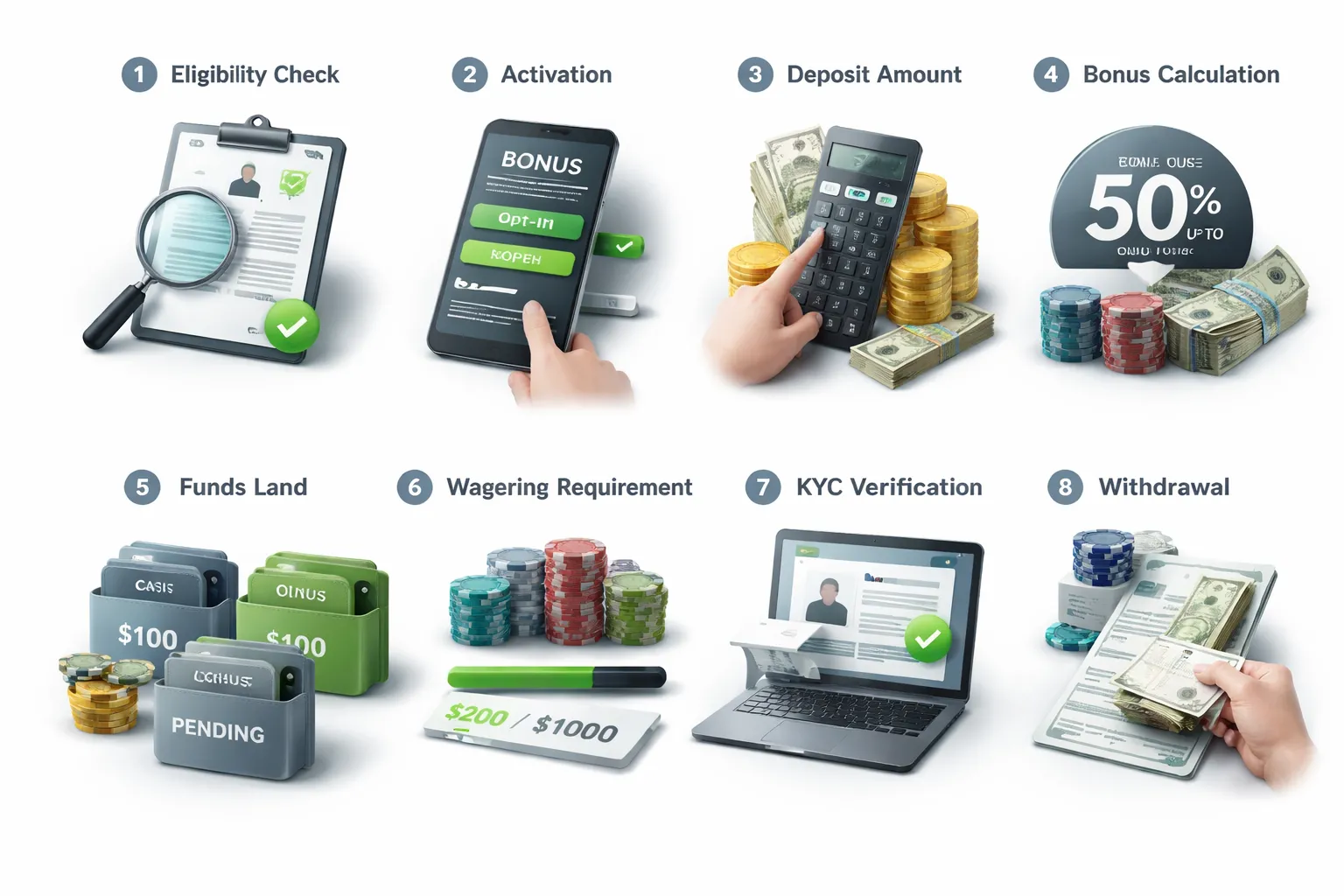
1) Check eligibility before you deposit
- Account status. You usually need a verified account, or at least a completed profile. Some sites block bonuses until you pass KYC.
- Location. Geo rules can exclude certain countries, states, or provinces.
- Payment method. Many casinos exclude prepaid cards, some e-wallets, or crypto for bonus eligibility.
- Bonus history. Some reloads target active players only. Others exclude anyone who claimed a similar promo that week.
- Game vertical. A casino reload may not apply to sportsbook deposits, and the reverse.
- Who often does not qualify. Self-excluded accounts, duplicate accounts in the same household, restricted jurisdictions, and deposits that miss the time window or minimum amount.
2) Activate the offer the right way
- Opt-in button. You click “Claim” in the promotions page, then deposit. If you deposit first, you may lose the bonus.
- Promo code. You enter a code during deposit or in the cashier. One typo can void the offer.
- Email or SMS link. You tap a unique link that tags your account, then deposit within the stated time limit.
- Auto-applied. The casino applies the bonus after your deposit, but only if you meet the minimum and use eligible banking methods.
3) Deposit, then the bonus calculates from simple rules
Most reloads use a match rate and a cap. Some use fixed thresholds.
- Match with cap. 50% up to $100. You deposit $80, you get $40. You deposit $300, you still get $100.
- Lower deposit still counts. 100% up to $50, minimum deposit $20. You deposit $20, you get $20. You deposit $10, you get $0.
- Fixed bonus. Deposit $50, get $25. Deposit $49, you get $0. Deposit $60, you may still get $25, or $0, based on terms.
- Free spins trigger. Deposit $30, get 30 spins on selected slots. Winnings may convert to bonus funds with a max cashout.
- Free bet trigger. Deposit $50, get a $25 free bet. Stake often does not return with winnings. Odds minimums can apply.
4) Know where the bonus lands in your account
- Bonus wallet. Your bonus sits separate from cash. You must meet wagering before you can withdraw bonus-derived winnings.
- Cash balance. Rare for reloads, but possible with “bonus cash.” You can wager like normal cash, but rollover and expiry still apply.
- Pending rewards. The site holds the bonus until you finish steps, like verifying ID, placing a qualifying bet, or meeting minimum odds.
- Locked vs unlocked. Some casinos lock the bonus amount but credit winnings as you play. Others lock both until completion.
5) Complete the flow, wagering, verification, then cashout
- Meet wagering. Example, $50 bonus with 30x wagering means $1,500 in eligible bets. Check game contribution since some slots count 100%, while table games may count 0% to 20%. For deeper terminology, see no deposit bonus terms.
- Follow time limits. Reloads often expire in 24 hours to 7 days. Wagering windows often run 7 days to 30 days.
- Respect max bet rules. Many promos cap your bet size while you clear wagering. Breaking the cap can void winnings.
- Complete KYC. Most sites require ID and payment verification before withdrawal. If you wait until cashout, you can hit delays or bonus expiry.
- Withdraw under the rules. Max cashout caps can apply to spins and some bonus cash. Some casinos remove remaining bonus and winnings if you withdraw early.
Types of Reload Bonuses You Can Get
Deposit match reloads
This is the standard reload. You deposit, the site adds a percentage, and you get a cap.
- Typical format: 50% up to $200, 25% up to £100, 100% up to €50.
- What decides value: wagering requirement, eligible games, max bet while clearing, and max cashout rules.
- Common limits: one claim per day or per week, minimum deposit, and opt-in before you deposit.
Free bet and site credit reload offers
Sportsbooks use these to drive repeat deposits. You stake a free bet, and you usually keep winnings only.
- Free bet: deposit $50, get a $10 free bet. Stake returns may not include the free bet amount.
- Bonus bet, bet credit, or site credit: works like a free bet but can have different expiry and stake return rules.
- Typical conditions: minimum odds, eligible markets, bet limits, and short expiry windows like 3 to 7 days.
Free spins and casino reload packages
Slots reloads come as free spins, a match bonus plus spins, or a tiered package.
- Free spins only: 50 spins on one slot, fixed coin size.
- Deposit plus spins: 50% up to €100 plus 100 spins, often split across several days.
- Check first: which slots qualify, whether wins credit as bonus funds, and any max win cap from spins.
Cashback and loss-back reloads
These return a percentage of your net losses over a set period. You may get cash, bonus cash, or free spins.
- Weekly cashback: 10% to 25% of net losses, credited every Monday, sometimes with a minimum loss threshold.
- Monthly loss-back: higher caps, longer tracking window, slower access to funds.
- Key detail: some promos pay only on slots or only on casino, and some require you to opt in before play.
Reloads for specific verticals
Some sites push reloads into one product. You get better terms, but fewer ways to use them.
- Live casino: match bonuses restricted to roulette, blackjack, baccarat, often with stricter max bet rules.
- Poker: deposit bonuses released in chunks as you earn rake, sometimes paired with tickets to tournaments.
- Bingo: bonus cash tied to bingo rooms, often with limited games and fixed schedules.
- Racing: free bets for horse or greyhound markets, usually with odds and market restrictions.
- Esports: free bets on esports markets only, sometimes limited to pre-match or specific leagues.
Recurring schedules and timed campaigns
Sites use schedules to build habits. You should treat these as rotating offers, not permanent value.
- Daily reload: smaller caps, faster expiry, often one claim per 24 hours.
- Weekend reload: higher caps, sometimes split Friday to Sunday with separate codes.
- Happy hour: short claim window, strict deposit timing, and faster expiry on the bonus.
- Seasonal campaigns: holiday, major sports events, or anniversary reloads, often with unique game lists.
If you need a quick refresher on wagering, game weighting, and cashout caps, use this guide on how casino bonus terms work.
Key Terms and Conditions That Decide the True Value
Wagering requirements and the real cost
Wagering, or playthrough, tells you how much you must bet before you can withdraw bonus funds and any bonus winnings.
Use this quick formula to price the requirement.
- Wagering amount = (deposit + bonus) x wagering multiple.
- Example: Deposit $50, get a 50% reload ($25), wagering 35x. Wagering amount = ($50 + $25) x 35 = $2,625.
- Expected cost = wagering amount x (house edge adjusted for game contribution).
- Rough example: If your eligible game mix acts like a 3% house edge, $2,625 x 0.03 = $78.75 expected loss to clear.
Compare that number to the bonus value. If the expected cost exceeds the bonus, you pay for the “reward.”
For a deeper breakdown, use this guide on casino bonus terms and conditions.
Game, market eligibility, and contribution rates
Casinos rarely count all bets the same way. Your game choice can double your workload.
- 100% contribution: Each $1 wager counts as $1 toward wagering.
- Partial contribution: Slots might count 100%, table games might count 10% to 25%.
- Excluded games: Some slots, live dealer, and side bets count 0%.
Compute the effective wagering when contribution drops.
- Effective wagering = required wagering ÷ contribution rate.
- Example: You must wager $2,625. You play a 20% contribution game. Effective wagering = $2,625 ÷ 0.20 = $13,125 in bets.
Always check the eligible list before you deposit. A reload can look strong, then collapse once you see the excluded games.
Max bonus, minimum deposit, and max bet limits
Three caps decide what you can actually collect and how safely you can clear.
- Max bonus: A 50% reload up to $100 gives the same bonus at $200 and at $500. Extra deposit adds risk without increasing the bonus.
- Minimum deposit: If the minimum sits above your usual deposit, you may force higher stakes to access the offer.
- Max bet while wagering: Many casinos cap spins or hands, often $5 to $10 per bet. If you bet higher, the casino can void the bonus or winnings.
If a max bet cap feels tight, the reload loses value. You need more time to clear, and you risk mistakes.
Time limits and expiring bonus funds
Deadlines change your strategy. They can also wipe the value to zero.
- Claim window: Some reloads require a deposit within hours, especially happy hour promos.
- Wagering deadline: Common ranges run from 1 to 30 days. Short deadlines push you to higher volume and higher variance.
- Expiry behavior: Some sites remove only the bonus, others remove bonus winnings, some lock the balance until you meet terms.
Match the deadline to your normal play pace. If you cannot complete the wagering on schedule, skip the reload.
Sportsbook odds restrictions and settlement rules
Reloads tied to sports betting often add extra filters.
- Minimum odds: Bets must meet a minimum, like -200 or 1.50 decimal, to count.
- Eligible bet types: Some promos exclude live bets, cashout bets, parlays, or certain markets.
- Settlement timing: Only settled bets count. Long futures can trap your wagering progress past the expiry date.
- Void and push rules: Voids often do not count toward wagering, and can reset progress on some offers.
Read the settlement rule first. It decides whether your volume counts before the deadline.
Withdrawal rules: bonus-first vs cash-first, sticky vs non-sticky
Withdrawal rules decide how much of your balance you can keep.
- Bonus-first wagering: You must clear wagering before any withdrawal. Any early cashout can forfeit the bonus and winnings.
- Cash-first wagering: You can sometimes withdraw your deposit first, but the casino may remove the bonus when you do.
- Sticky bonus: You cannot withdraw the bonus amount. You can only withdraw winnings after you clear wagering.
- Non-sticky bonus: The bonus acts like cash while you play, and may be withdrawable once cleared, subject to caps.
Sticky terms cut upside. If the bonus has a low max cashout, treat it like a rebate, not a bankroll boost.
Country, state, and payment-method exclusions
Eligibility rules can block the promo after you deposit.
- Location limits: Some reloads exclude certain countries, US states, or provinces due to licensing rules.
- Payment exclusions: Many casinos block reload bonuses on deposits made with Skrill, Neteller, prepaid cards, or bank transfers.
- Mixed deposits: Split payments can cause partial bonus awards or bonus denial.
- Verification triggers: A win during a reload often triggers KYC. If you cannot verify fast, the expiry clock keeps running.
Before you deposit, confirm you qualify for the offer, and confirm your payment method qualifies. This prevents a “bonus applied: $0” outcome.
When It’s Worth Claiming a Reload Bonus (Decision Framework)
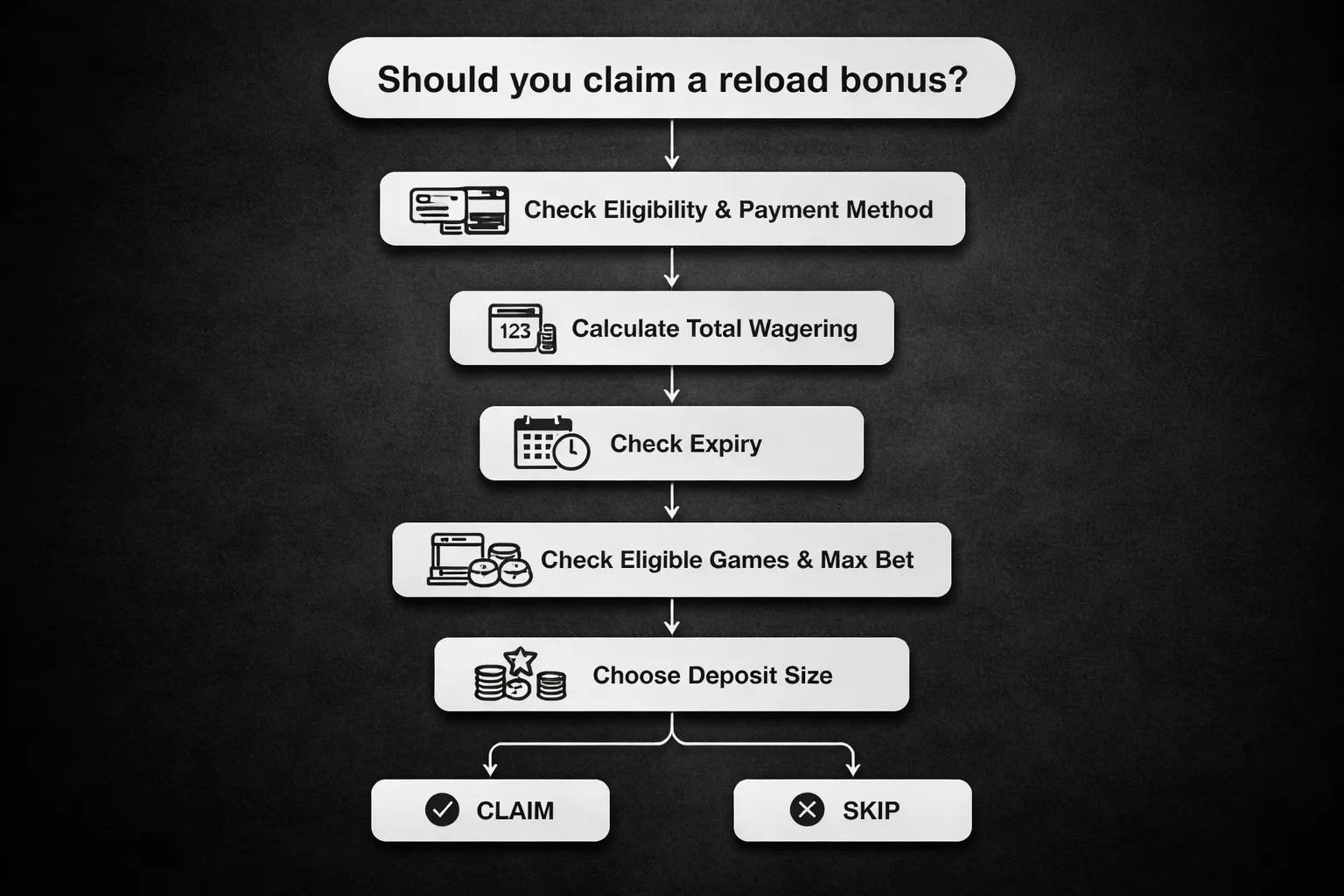
Quick checklist to decide in under 2 minutes
- Step 1, calculate the required wagering: (deposit + bonus) x wagering requirement.
- Step 2, check expiry: Can you finish that wagering before the deadline with your normal play?
- Step 3, confirm eligible games: Slots only, or also table games, live dealer, and jackpots.
- Step 4, check max bet rules: If your normal stake breaks the cap, skip the offer.
- Step 5, scan withdrawal limits: Any max cashout, or “bonus wins capped” terms.
- Step 6, check payment and country eligibility: Your method must qualify, your region must qualify.
- Step 7, compare to your alternatives: If cashback, odds boosts, or reduced juice give equal value with fewer strings, take those instead.
When reload bonuses tend to be high value
- Low wagering requirement: Lower WR reduces the time and variance you need to clear.
- Deposit-only wagering: If terms count only your deposit, value jumps. You keep upside without paying extra rollover on the bonus amount.
- Longer expiry: More days means you can play your normal sessions and avoid forced volume.
- Broad game contribution: 100 percent slots plus solid table game contribution beats “slots only, low RTP titles excluded.”
- Few or no stake limits: A reasonable max bet lets you keep your usual bankroll plan.
- Simple rules: No weird exclusions, no split-deposit problems, no brand-specific game bans.
- Clear max win terms: No cashout cap, or a cap that sits well above your realistic upside.
Red flags that usually make an offer poor value
- High WR on deposit + bonus: This inflates volume fast, and makes small bonuses expensive.
- Short expiry: Tight deadlines push you into chasing wagering. That is how mistakes happen.
- Low game contribution: 0 to 10 percent on tables, or a narrow list of eligible slots, kills flexibility.
- Strict max bet rules: Low caps can force you to play smaller than your normal plan, and extend clearing time.
- Max cashout limits: A hard cap can turn a good run into dead value.
- “Winning voids bonus” style clauses: Any term that lets the casino remove winnings based on vague “irregular play” language is a risk.
- Restricted payment methods: If only one method qualifies, you lose flexibility and may pay extra fees.
- Game exclusions that target high RTP: If the best-value games do not count, you will feel it in clearing cost.
Compare reload bonuses against alternatives
You should compare offers on expected value, and on friction. A smaller perk with clean terms often beats a bigger bonus with heavy rules.
- Cashback: Usually low friction. Often no wagering. Value feels smaller, but you can realize it fast and withdraw clean.
- Loyalty points and VIP deals: Best for steady volume players. Value depends on tier rate and redemption options. See casino VIP and loyalty programs for how points and tiers convert into real returns.
- Reduced juice: Strong if you already play a lot of house-edge sensitive games. It lowers cost every hand or spin, with no clearing task.
- Odds boosts: Great when you can use them on lines you already bet. Weak when they force low limits, short windows, or specific markets.
- Free spins reloads: Check eligible games and max win. Treat them like a capped rebate, not like cash.
Bankroll-fit assessment, pick a deposit size that does not trap you
A reload bonus looks best at the maximum match. That does not mean you should deposit the maximum.
- Deposit for clearance, not for the headline: Pick an amount where the total wagering fits your normal weekly volume.
- Avoid “forced play” deposits: If you must increase stakes or session length to meet expiry, reduce the deposit or skip the bonus.
- Use the minimum that unlocks the offer: If the bonus has a low minimum deposit, start there and scale only after you clear once.
- Plan for variance: If you cannot handle swings during clearing, a reload bonus can push you into bad decisions.
- Keep withdrawal flexibility: If you may need to cash out soon, avoid bonuses that lock your balance behind wagering.
- Rule of thumb: Claim a reload when you can clear it on your normal schedule, with your normal stakes, on eligible games, before expiry.
Worked Examples: Evaluating a Reload Bonus Like a Pro
Casino example: 100% up to $100 with 35x WR
Assume you deposit $100. You get a $100 bonus. You start with $200 to wager.
Assume the wagering requirement applies to bonus plus deposit. WR = 35x.
Total wagering needed = ($100 + $100) x 35 = $7,000.
Now estimate cost to clear. Use game RTP. RTP 96% means a 4% house edge.
Expected loss while clearing = $7,000 x 4% = $280.
Your expected bonus value = bonus amount minus expected loss = $100 - $280 = -$180.
That bonus fails on math alone. Even before variance.
If WR applies to bonus only, wagering needed = $100 x 35 = $3,500. Expected loss = $3,500 x 4% = $140. EV = $100 - $140 = -$40.
For a typical slot, you usually need either lower WR, higher RTP contribution, or a smaller required wagering base to make this worth it.
- Checklist: confirm WR base, eligible games, and expiry. Then run: Wagering x house edge.
- Quick break-even: break-even house edge = bonus amount ÷ wagering required.
Sportsbook example: 50% match up to $200 with 1x playthrough and minimum odds
Assume you deposit $400. You get a $200 bonus. Playthrough is 1x on the bonus.
You must place $200 in qualifying bets.
Minimum odds are -200 (1.50 decimal) or longer. You plan to bet near the minimum to reduce variance.
Use a simple expected cost: your average hold on these bets. Many bettors land around 3% to 7% depending on market and skill.
If your expected hold is 5%, expected loss to complete = $200 x 5% = $10.
Estimated EV = $200 - $10 = $190.
Now add constraints.
- If the bonus credits as non-withdrawable and only winnings withdraw, treat EV as lower. You risk the stake for smaller real value.
- If the offer requires specific markets or excludes cashout, your effective hold rises.
- If you must use parlays, your variance jumps. Your bankroll stress becomes the real cost.
For sportsbook reloads, low playthrough with a reasonable minimum odds rule often rates well. Your edge and betting volume decide if it fits your routine.
Free spins example: valuing spins via RTP, volatility, and max win caps
Convert spins into expected value. Start with coin value.
Assume 50 free spins at $0.20 per spin. Total spin value = 50 x $0.20 = $10.
Assume game RTP is 96%. Expected return from spins = $10 x 96% = $9.60.
Now apply terms that cut that value.
- Winnings wagering: If you must wager winnings 20x, estimate loss on that wagering. Example: expected winnings $9.60, WR 20x, wagering = $192. At 4% house edge, expected loss = $7.68. Net EV ≈ $1.92.
- Max win cap: If max cashout from spins is $50, you cap the upside. This hurts high volatility slots most. Your average may stay similar, but your best outcomes disappear. Treat this as an EV haircut.
- Spin stake cap: Some promos force low stakes. That lowers variance, but it also limits the chance to spike a big win.
If the spins come with zero wagering and no cap, your EV stays close to RTP. If winnings face WR plus a cap, value can drop fast.
Cashback example: expected return based on your weekly volume
Cashback looks simple. You still need to calculate what you actually get.
Assume 10% weekly cashback on net losses, paid as bonus with 5x WR. Eligible games are slots only.
You typically wager $1,000 per week on slots. Assume RTP 96%. Expected net loss = $1,000 x 4% = $40.
Expected cashback = 10% x $40 = $4.
If cashback credits as bonus with 5x WR, you must wager $4 x 5 = $20.
Expected loss to clear that cashback = $20 x 4% = $0.80.
Estimated net value = $4 - $0.80 = $3.20 per week.
Now check the fine print that changes the math.
- Caps: if cashback caps at $10, it will not matter at this volume. If it caps at $2, it cuts your value.
- Negative carryover: if losses carry week to week, you may wait longer to see cashback.
- Game eligibility: if your play includes table games and they do not qualify, your real volume drops.
For a deeper breakdown of terms that change payout and clearing, see cashback bonus rules.
How to Claim a Reload Bonus Safely (Practical Steps)

Pre-claim checklist
- Confirm you qualify. Check if the reload targets your account tier, region, or device, and if it excludes bonus abusers or recently self-excluded players.
- Check the opt-in rule. Some reloads require a click in Promotions before you deposit. If you deposit first, you may lose it.
- Verify the deposit window. Many reloads run on a timer, like 24 hours after opt-in, or only on specific days.
- Match the deposit range. Note the minimum deposit, any maximum qualifying deposit, and whether the bonus caps at a fixed amount.
- Confirm the payment methods allowed. Some casinos exclude e-wallets, prepaid cards, bank transfers, or crypto for reloads.
- Check game or market eligibility. Verify which slots, live casino, table games, or sports markets count toward wagering. Avoid play that contributes 0%.
- Know the wagering requirement and time limit. Record the rollover multiple, the deadline, and any max bet rule during wagering.
How to avoid common mistakes
- Deposit the exact amount you planned. If the offer says “100% up to $100” but the minimum is $20, do not deposit $19.99.
- Use the right payment method the first time. Switching methods mid-flow can break tracking. Use one approved method for the qualifying deposit.
- Opt in before you deposit. If the promo requires activation, do it first, then deposit, then confirm the bonus appears.
- Do not open multiple promos at once. A reload can conflict with cashback, free spins, or a code-based offer. Pick one and finish it.
- Stay inside eligible games and stake limits. One disallowed game, or one over-limit bet, can void winnings in some terms.
- Avoid fast withdrawals. Many casinos cancel active bonuses if you withdraw before clearing.
Tracking progress (so you do not guess)
- Check the wagering meter after each session. Confirm it moves when you play the games you picked. If it stays flat, stop and re-check eligibility.
- Use transaction history to verify the qualifying deposit. Save the deposit amount, timestamp, and payment method.
- Screenshot key states. Capture the promo terms page, your opt-in confirmation, the bonus credited balance, and the wagering meter at start and mid-way.
- Track bonus and cash balances separately. Some casinos spend bonus first, others spend cash first. This changes your risk and clearing plan.
- Log your deadline. Put the expiration time in your calendar. Clearing late often means forfeiture.
If the bonus does not credit
- Stop play and deposits. Extra activity can complicate support checks and promo eligibility.
- Re-check the three failure points. Missing opt-in, wrong deposit amount, wrong payment method.
- Gather evidence before you chat. Provide screenshots of the promo, your opt-in, and your deposit receipt, plus your username and the exact time of deposit.
- Ask for a manual review and a case ID. Request a written confirmation of the outcome and any adjusted wagering terms.
- Escalate if needed. If frontline support stalls, ask for a supervisor. If the casino has a formal complaints page, use it with your case ID and screenshots.
If your reload includes free spins, confirm if they credit instantly or after the deposit settles, and check the game list and stake size rules in our free spins bonus guide.
Strategies to Maximize Value Without Increasing Risk
Match Your Normal Play
Pick reloads that fit your usual stake size, session length, and games. Do not change your betting style to chase a deadline.
Forcing volume can backfire fast. You play more hands or spins than you planned. You increase total exposure. Your bankroll swings harder. You often end up depositing again to finish wagering.
- Set a max loss for the promo. If you hit it, stop, even if wagering remains.
- Size the deposit to your real bankroll. Never deposit “to the max” unless you can complete requirements with your normal play.
- Check the time limit first. Short windows push rushed play, rushed play drives mistakes.
Game Selection Basics: RTP, Volatility, and Contribution
Start with the contribution table. It decides which games count toward wagering and how much they count. A high RTP game helps you keep more of your balance while you clear requirements, but it only matters if it contributes.
- Prioritize high contribution. 100 percent slots beat 10 percent table games when you need to move wagering.
- Prefer lower volatility when you must grind wagering. You reduce the chance of busting before you finish.
- Use higher volatility only if you accept higher bust risk. It can spike a balance, but it also ends promos early.
- Avoid excluded games. Many reloads exclude live dealer, some jackpots, and some bonus buy features.
Check max bet rules. One oversize spin can void winnings. Keep your stake under the cap for the entire wagering period.
Sports Betting Approach: Meet Requirements While Controlling Variance
Use sports reloads to clear wagering with fewer, larger bets, but control variance with structure.
- Respect minimum odds. If the promo requires 1.80 or -125, do not force longshots to “speed it up.”
- Split staking. Use smaller unit sizes across more bets to smooth swings and protect your balance.
- Avoid high-variance markets. Long parlays and player props can spike variance and kill completion rates.
- Track settlement times. Futures and some props settle late and can push you past the expiry.
If cashout counts as a restricted action, do not use it. Some books void bonus eligibility when you cash out early.
Timing and Stacking Rules: Tournaments, Missions, and VIP Perks
Time matters because many casinos block stacking. You can lose value if you claim reloads in the wrong order.
- Read the “one bonus at a time” rule. If active bonuses lock withdrawals, plan your cash flow.
- Align reload play with tournament windows. If wagering counts toward leaderboards, you can double dip on volume you already planned.
- Check mission requirements. Some missions require specific games, others require real money only.
- Compare VIP earning rates during promos. Some sites reduce points on bonus funds, others award full points. Use your reload when your VIP track stays intact.
If your site offers tier perks, review how promos interact with your loyalty account in our Casino VIP and loyalty programs guide.
Responsible Play Guardrails: Limits, Cooling-Off Tools, and When to Skip Promos
Promos work best when you control inputs. Set limits before you deposit.
- Deposit limit. Lock your max reload spend for the week or month.
- Loss limit. Cap downside for the promo and stop when you hit it.
- Session limit. Prevent long chase sessions driven by a ticking timer.
- Cooling-off. Use it if you feel pressure to keep wagering “to finish.”
Skip the reload if you cannot meet wagering with your normal play, the max bet rule forces tiny stakes, the time limit is short, the contribution table excludes your games, or you already sit near your bankroll limit.
Reload Bonus vs Other Promotions (What to Choose and Why)
Reload bonus vs deposit bonus vs risk-free bet
These promos look similar. The mechanics differ. That changes your cost and your control.
- Reload bonus: Bonus money tied to a new deposit. You unlock it by meeting wagering rules within a time limit. Value depends on the match rate, cap, game contribution, max bet rule, and the wagering multiple.
- Deposit bonus (welcome or standard): Same core structure as a reload, but often larger and split across several deposits. You usually face stricter terms on the biggest offers. If you can meet the rules, a large deposit bonus can beat a small reload on raw EV.
- Risk-free bet (sports): You stake your own money, then get a refund if you lose. Most books refund as free bet credit, not cash. You still pay the cost of the free bet stake not being returned when you win. Your value depends on conversion rate and odds limits, not wagering multipliers.
Choose a reload when you already planned to deposit and you can clear wagering with your normal stakes. Choose a deposit bonus when the cap is large and you can keep volume steady. Choose a risk-free bet when you can place one clean, high-odds bet within the rules and convert the free bet efficiently.
Reload bonus vs no-deposit bonus
No-deposit bonuses feel safer because you do not fund them. The terms often erase that edge.
- Low caps: Many no-deposit offers cap winnings hard. You can win, then hit a ceiling.
- High wagering: Multipliers often run higher than reloads. Your expected loss can exceed the capped payout.
- Tight game lists: Contribution tables can push you into low-contribution games, which increases required turnover.
- Withdrawal friction: ID checks, minimum deposits, and max cashout rules can block small balances.
Pick a no-deposit bonus if you treat it as a low-stakes test of a site and you accept a capped upside. Pick a reload if you already trust the site, want a higher ceiling, and can meet the playthrough without changing games or bet size.
Reload bonus vs bonus buy-ins and rebates (casino and poker)
Many ecosystems reward volume better than one-off bonuses.
- Casino rebates: Cashback and loss rebates reduce variance. They usually avoid wagering traps, but they come with eligibility rules, excluded games, and limits per period.
- Loyalty points: Tier systems convert play into comps, cash, or perks. Value depends on your effective return rate and how fast you churn points. See casino VIP and loyalty programs for how tiers and rakeback style returns work.
- Poker bonuses: Deposit bonuses can exist, but rakeback, missions, and leaderboards often drive the real value. If you play high volume, consistent rewards can beat a small reload.
- Bonus buy-ins: Tickets and discounted entries can carry strong value if you would enter anyway. They carry weak value if they push you into higher buy-ins or formats you do not beat.
Use reloads to reduce the cost of deposits you already planned. Use rebates and loyalty when you play often and want predictable returns that do not force fast wagering.
Which promo fits your player profile
- Casual player: Small reloads with low wagering and long deadlines. Avoid promos with strict max bet rules and short timers.
- High-volume player: Large deposit bonuses if you can clear terms without changing your game mix. Track contribution and max bet rules, they cap throughput.
- VIP and grinder: Prioritize cashback, rakeback style rewards, and tier benefits. Add reloads only when the incremental EV beats your usual offers.
- Low-risk mindset: Choose rebates, low-wager reloads, and risk-free bets with clear refund rules. Avoid high-multiple playthrough and capped withdrawal offers that force long sessions.
If you want a quick terms refresher before you pick, use this guide on how casino bonuses work and the terms that matter.
Legality, Fairness, and Player Protection Considerations
Regulated vs unregulated operators
Regulated casinos answer to a named authority. You get published rules, audits, and a defined complaints process. Terms still vary, but enforcement follows a framework.
Unregulated sites can change, interpret, or apply promo rules with less oversight. You may face vague terms, sudden limits, or slow payouts. Your dispute options shrink, and chargebacks often become your only leverage.
- What to check: license issuer, license number, and a working link to the regulator record.
- Why it matters for reloads: reload bonus disputes often involve wager tracking, max cashout, and withdrawal blocks. Regulators force clearer evidence trails.
KYC and anti-fraud checks that affect bonus withdrawals
Most reload bonuses trigger compliance checks at withdrawal. Expect KYC and source of funds review on larger cashouts or unusual play patterns.
- KYC basics: ID, proof of address, payment method verification. Some operators ask for a selfie or video check.
- Payment matching: you often must withdraw to the same method used to deposit. Mismatches can delay or void bonus-linked withdrawals.
- Timing risk: if you claim a reload and then rush a cashout, you increase the chance of manual review. Plan for delays.
- Practical move: complete KYC before you take reload bonuses seriously, and keep documents current.
Bonus abuse rules and account restrictions
Reload promos come with abuse controls. Operators look for patterns that turn bonuses into near risk-free extraction.
- Common risk flags: multiple accounts in one household, shared devices, shared payment methods, VPN use, rapid deposit and withdraw cycles, minimal play outside bonus requirements.
- Betting pattern flags: very low variance play to clear wagering, switching to high stakes near the end of playthrough, or “bonus hunting” only on reload days.
- Game restrictions: wagering on excluded games can void the bonus. Slots often count 100%. Table games often count 0% to 20%.
- Operator actions: bonus removal, winnings confiscation, stake limits, promo bans, withdrawal holds, or account closure.
If you want a deeper grip on caps, wagering, and contribution rules, read no deposit bonus terms explained. The same mechanics show up in reload promos.
How to read promo terms critically
Read reload terms like a checklist. Look for measurable rules and clear enforcement.
- Clarity: exact match percent, max bonus, eligible deposit range, and start and end times with a time zone.
- Cost: wagering multiple, game contribution, bet size limits, and any “minimum odds” or “minimum lines” rules.
- Limits: max cashout, withdrawal lock conditions, and whether you must wager the deposit plus bonus or bonus only.
- Expiry: bonus expiry date and wagering deadline. Short windows raise effective cost.
- Exclusions: restricted games, restricted countries, and payment method exclusions.
- Proof and tracking: where you can see progress, what counts as completed wagering, and what happens if a game disconnects.
- Dispute path: support channel, escalation steps, and regulator or ADR details for regulated sites.
Skip reloads with vague wording, missing max cashout terms, or unclear game contribution. You lose leverage when rules stay flexible.
Frequently Asked Questions
What is a reload bonus?
A reload bonus is a deposit offer for existing players. You deposit, the site adds bonus money or free spins. It usually comes with wagering requirements, time limits, and game restrictions. You get it on specific days, through VIP tiers, or via email and promo codes.
How is a reload bonus different from a welcome bonus?
A welcome bonus targets new accounts and often pays more. A reload bonus targets repeat deposits and shows up more often. Reload terms can be tighter, with lower caps and shorter expiry. For a wider comparison, see wagering requirements explained.
Do reload bonuses always require wagering?
Most do. Some free spin reloads still require wagering on winnings. Check if the requirement applies to bonus only or bonus plus deposit. Bonus plus deposit costs more. Also check game contribution, max bet rules, and whether jackpots count.
When is a reload bonus worth claiming?
Claim it when you already planned to deposit, the wagering fits your normal stakes, and the allowed games match what you play. Skip it if the time limit forces high volume. Skip it if the max cashout blocks the upside.
What terms decide the real value?
- Wagering multiple: lower is better.
- Wager base: bonus only beats bonus plus deposit.
- Cap: max bonus and max cashout.
- Time limit: enough days to clear naturally.
- Game contribution: slots often 100%, table games often reduced.
Can I withdraw my deposit with an active reload bonus?
Often no. Many sites lock withdrawals until you finish wagering or forfeit the bonus. Some let you withdraw but void the bonus and any linked winnings. Check the forfeiture rule before you opt in, especially on small deposits.
What happens if I use a promo code incorrectly?
The bonus may not credit. Some sites let support add it if you meet all rules and contact them fast. Others require a new qualifying deposit. Screenshot the promo page and keep the deposit receipt. Do not assume it will auto-fix.
Do reload bonuses apply on every deposit?
No. Most run on schedules or triggers. Common triggers include weekly reloads, weekend promos, VIP level perks, and targeted offers. Some apply only to one deposit per period. Others require an opt-in each time, before you deposit.
Which games usually count toward wagering?
Slots usually count the most. Live dealer and table games often count less, or not at all. Some providers get excluded. Progressive jackpot games often get excluded. If the casino lists game weights, use them. If it does not, skip the offer.
Can I claim multiple reload bonuses at once?
Usually no. Sites limit you to one active bonus at a time. If you claim a second offer, it may replace the first and you can lose progress. Check the bonus stacking rule and the order used. Keep only the offer you can clear.
Are reload bonuses safer on regulated sites?
Often yes. Regulated sites publish clearer rules, show bonus tracking, and give you a formal dispute path. You still need to read the terms. Regulation does not prevent strict max bet rules or low game contribution. It mainly improves enforcement and complaints.
Conclusion
Reload bonuses pay when the math works. You win value when the bonus percent and cap match your usual deposit, the wagering requirement stays low, and your games contribute at a high rate.
Skip the offer when you see red flags. High wagering, short expiry, low contribution, strict max bet limits, or a cap that forces you to over-deposit. If you cannot clear it on your normal bankroll, you will chase losses.
Use one rule before you click claim. Calculate your required play and compare it to your planned spend for this session. If it does not fit, walk away. If it fits, track progress and follow the max bet rule. For faster checks, use this guide on wagering requirements.
-
Casino VIP & Loyalty Programs Explained: Points, Tiers, Rewards & Rakeback
6 months ago -
Cashback Bonus Explained: How Casino Cashback Really Works
6 months ago -
Free Spins Bonus Explained: How Free Spins Work at Online Casinos
6 months ago -
No Deposit Bonus Explained: How It Works, Pros/Cons & Common Rules
6 months ago -
Online Casino Bonuses Explained: How They Work + Terms You Must Know
6 months ago
-
- Wagering requirements and the real cost
- Game, market eligibility, and contribution rates
- Max bonus, minimum deposit, and max bet limits
- Time limits and expiring bonus funds
- Sportsbook odds restrictions and settlement rules
- Withdrawal rules: bonus-first vs cash-first, sticky vs non-sticky
- Country, state, and payment-method exclusions
-
- What is a reload bonus?
- How is a reload bonus different from a welcome bonus?
- Do reload bonuses always require wagering?
- When is a reload bonus worth claiming?
- What terms decide the real value?
- Can I withdraw my deposit with an active reload bonus?
- What happens if I use a promo code incorrectly?
- Do reload bonuses apply on every deposit?
- Which games usually count toward wagering?
- Can I claim multiple reload bonuses at once?
- Are reload bonuses safer on regulated sites?
-
-
- Wagering requirements and the real cost
- Game, market eligibility, and contribution rates
- Max bonus, minimum deposit, and max bet limits
- Time limits and expiring bonus funds
- Sportsbook odds restrictions and settlement rules
- Withdrawal rules: bonus-first vs cash-first, sticky vs non-sticky
- Country, state, and payment-method exclusions
-
- What is a reload bonus?
- How is a reload bonus different from a welcome bonus?
- Do reload bonuses always require wagering?
- When is a reload bonus worth claiming?
- What terms decide the real value?
- Can I withdraw my deposit with an active reload bonus?
- What happens if I use a promo code incorrectly?
- Do reload bonuses apply on every deposit?
- Which games usually count toward wagering?
- Can I claim multiple reload bonuses at once?
- Are reload bonuses safer on regulated sites?
-
-
Online Casino Licensing Explained: Authorities, Licenses & How to Check One
6 months ago -
Best Live Dealer Casinos: Where to Play Live Blackjack, Roulette & More
6 months ago -
Best Online Casinos for High Rollers: VIP Perks, High Limits & Exclusive Bonuses
6 months ago -
Fast Payout Online Casinos: Best Sites for Quick Withdrawals
6 months ago -
Welcome Bonus vs No Deposit Bonus: Key Differences, Pros & Cons
6 months ago
-
Online Casino Licensing Explained: Authorities, Licenses & How to Check One
6 months ago -
Casino VIP & Loyalty Programs Explained: Points, Tiers, Rewards & Rakeback
6 months ago -
Are Online Casinos Legal? Complete Guide by State & Country
6 months ago -
How to Sign Up & Create an Online Casino Account (Step-by-Step)
6 months ago -
Online Casino Fairness Explained: RNG, RTP, House Edge & Provably Fair
6 months ago