How Slot Jackpots Work: Progressive Jackpots Explained

Slot jackpots fall into two buckets, fixed jackpots and progressive jackpots. Fixed jackpots pay a set top prize. Progressive jackpots grow as people play, then reset after a win.
This guide breaks down how progressive jackpots build, how much of each bet funds the prize pool, and what triggers a payout. You will also learn the key terms you see in game rules, seed amount, reset value, contribution rate, and networked progressives. We will cover how RNG-based triggers work, why bet size can matter, and how payout rules differ between online and land-based slots. For the math behind randomness and long-term returns, read online casino fairness explained.
Key Takeaways
- In het kort: A progressive jackpot grows when you and other players place bets, a fixed slice of each wager feeds the prize pool.
- In het kort: The rules show the seed amount and reset value, this tells you where the jackpot starts after a win.
- In het kort: The contribution rate controls how fast the jackpot climbs, higher traffic and higher bet volume usually grows it faster.
- In het kort: Networked progressives link many games or casinos, that shared pool can create larger jackpots.
- In het kort: Many jackpots use an RNG trigger, the hit can happen on any spin once the trigger condition exists.
- In het kort: Bet size can matter, some games require max bet or a minimum stake to qualify for the top prize.
- In het kort: Read the payout rules, online and land-based slots can differ on eligibility, payout timing, and how they display jackpot values.
- In het kort: Focus on terms in the game info, seed, reset, contribution, eligibility, and whether the jackpot is local or networked.
What slot jackpots are (and how they differ from regular wins)
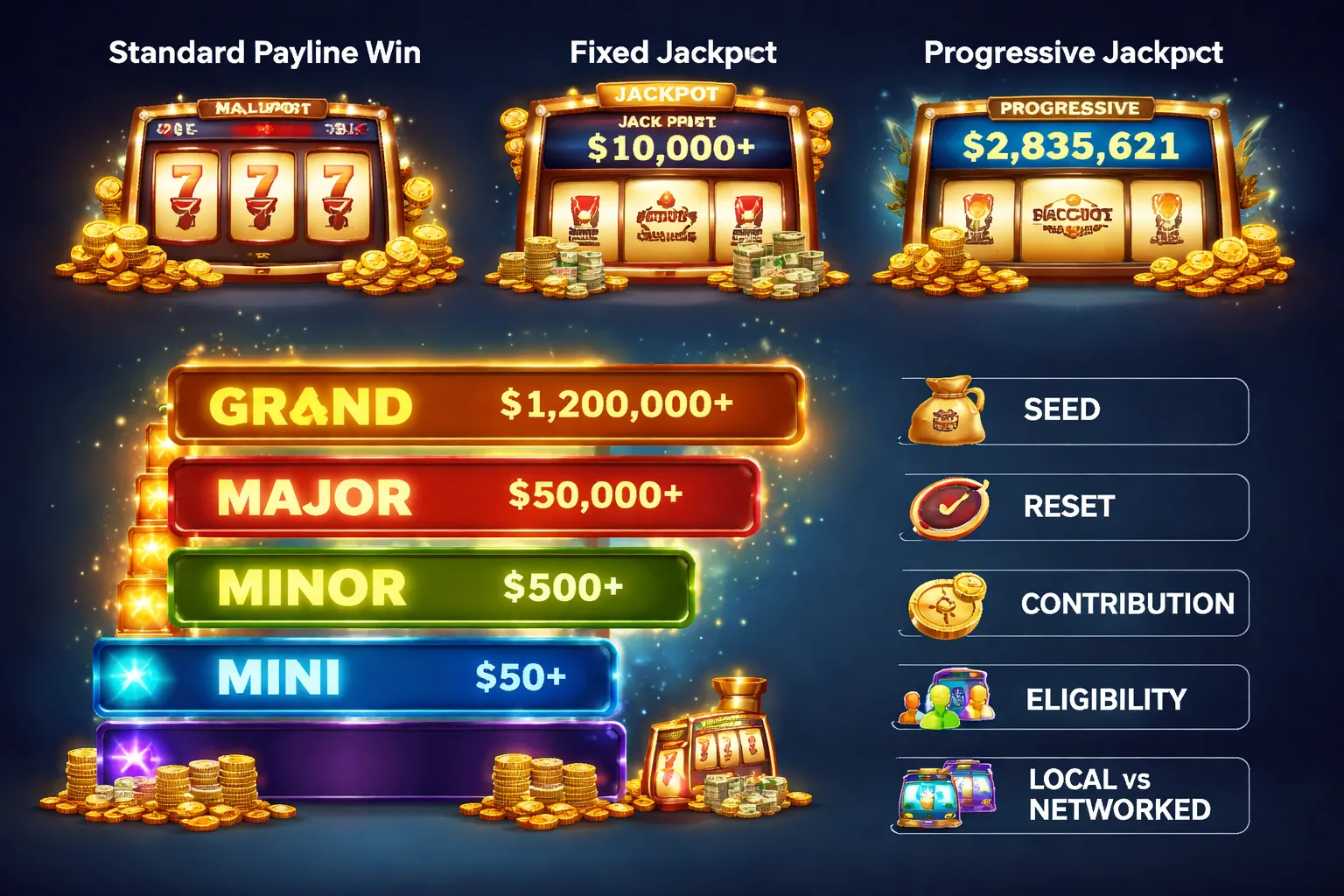
Jackpot vs. standard payline payouts
A regular win comes from the paytable. You hit a symbol combination on a payline or ways system. The game multiplies your stake by a listed value. You get a predictable range of outcomes.
A jackpot payout sits above normal line wins. It uses its own prize rule. You usually need a specific trigger, like a bonus feature, a jackpot symbol set, or a timed random trigger. The amount can be fixed or progressive. The game info tells you which.
Key difference: a payline win depends on the payout table. A jackpot depends on jackpot rules, and sometimes on bet size and eligibility settings.
Fixed jackpots (standalone top prizes)
A fixed jackpot has a predetermined top prize. It does not grow from other players’ bets. The slot can still have smaller wins and bonuses, but the jackpot amount stays the same until you win it.
- Where you see them: standalone slots, older cabinets, some online games marketed as “fixed jackpot.”
- What to check: required stake, trigger condition, whether max bet is required, and whether the prize equals a multiplier or a set currency amount.
- What it means for you: the top prize does not “run hot” by growing. Your chance stays tied to the game’s math.
Progressive jackpots (shared pools that grow)
A progressive jackpot grows over time. A small slice of each qualifying bet feeds a shared prize pool. The pool can sit on one machine, one casino, or a network across many sites.
- Local progressive: linked within one venue or one operator’s set of games. Smaller pool, often hits more often.
- Networked progressive: linked across many casinos or online brands. Larger pool, often larger top prizes.
- Seed and reset: the jackpot starts at a seed value. After a win, it resets to a set level and starts growing again.
- Eligibility: some progressives require a minimum bet or max bet to win the top tier. If you bet less, you may only qualify for lower tiers.
If you want the full foundation first, read our online slots guide for how paylines, RTP, and volatility work.
Common jackpot labels (Mini, Minor, Major, Grand)
Many slots split jackpots into tiers. Labels vary by provider. Amounts and odds also vary. Do not assume fixed meanings across games.
| Label | Typical role | What to verify in game info |
|---|---|---|
| Mini | Smallest jackpot tier, often hits most often. | Fixed or progressive, minimum bet, trigger method. |
| Minor | Low to mid tier jackpot, can be common on bonus wheels. | Whether it scales with bet, and if it caps. |
| Major | High tier jackpot, usually less frequent. | Eligibility rules, contribution rate, local vs networked. |
| Grand | Top jackpot tier, often the main progressive pool. | Max bet requirement, reset value, how it triggers, payout method. |
How slot jackpots work step by step
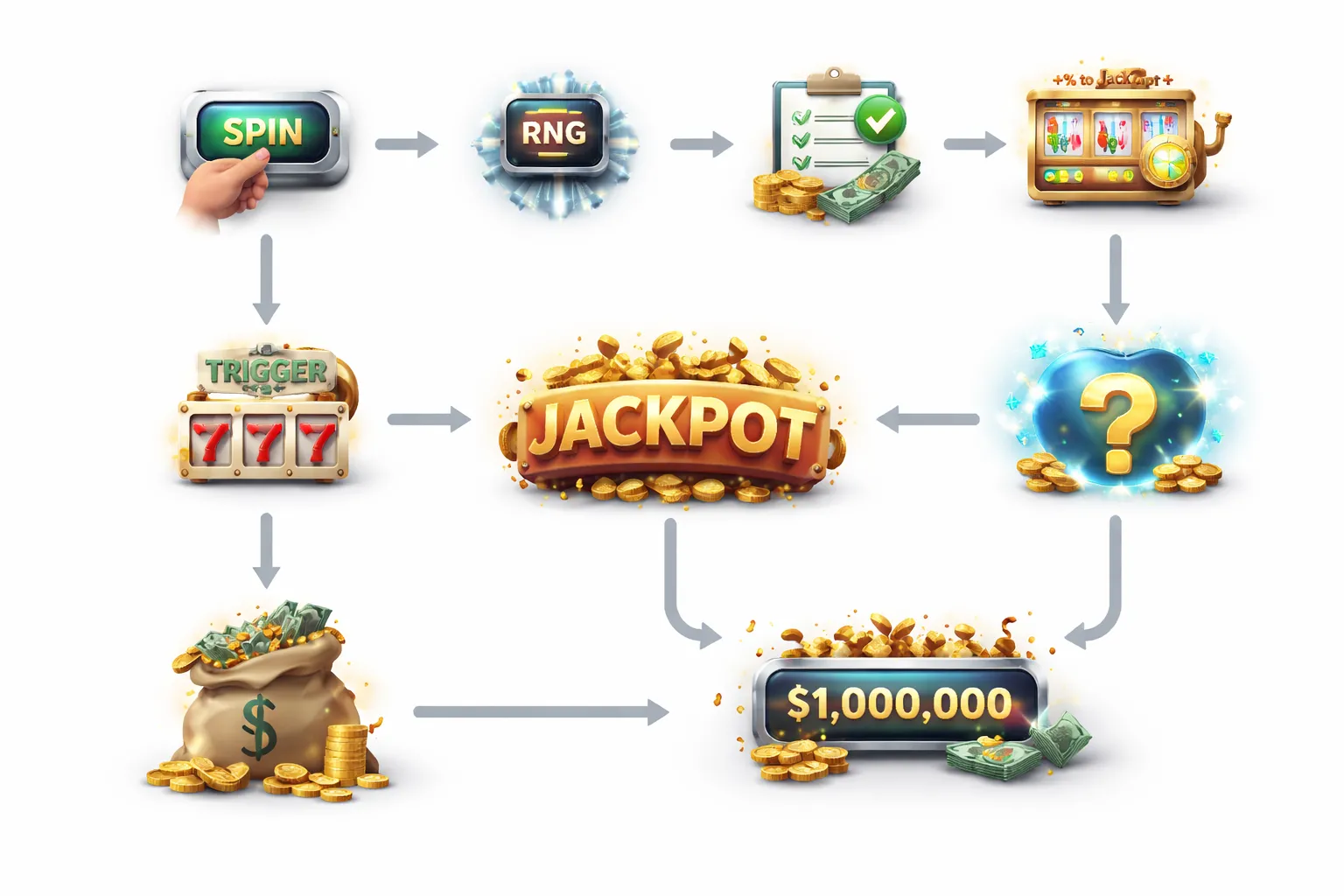
From spin to outcome, what happens when you press Spin
- Your bet locks in. The game records your stake, coin value, paylines, and any side bet for jackpots.
- Eligibility runs first. If the jackpot needs a minimum bet or max lines, the game checks it before it allows a jackpot win.
- The RNG picks the result. The random number generator selects an outcome for that spin. The reels then show a matching animation.
- The game scores the spin. It applies the paytable, bet multiplier, and any feature rules to calculate wins.
- The jackpot check runs. If you qualify, the game checks whether the jackpot condition triggered on that spin.
- Payout posts. Regular wins pay to your balance. A jackpot win pays based on the jackpot rules, local machine or shared network.
Where your wager goes, stakes, house edge, and payout allocation
Your wager does not sit in a simple pot. The game splits expected value across outcomes.
- Return to player (RTP). A fixed share of total wagers returns to players over time through all wins, including jackpots if the jackpot is funded from bets. See slot RTP.
- House edge. The remainder covers the casino and game costs, and profit.
- Payout allocation. The game assigns most RTP to frequent small wins, then holds a smaller share for rare big wins, including jackpot events.
Contribution rate, how a fraction of bets feeds the jackpot pool
Progressive jackpots grow because each qualifying wager adds a small amount to the pool.
- Contribution rate. A set percentage or fixed amount per spin goes to the jackpot meter.
- Qualifying bets only. Some games count every spin. Others count only spins that meet a minimum bet, max lines, or a side bet.
- Local vs networked pools. Local progressives grow from play on one machine or one casino. Networked progressives pool contributions across many games, casinos, or regions.
- Seed and reset. When someone wins, the jackpot resets to a starting value. The operator or provider funds that seed, then contributions build it again.
Eligibility checks, why bet size and paylines can matter
- Minimum bet rules. If you bet under the threshold, you can still win regular prizes, but you lose jackpot eligibility.
- Max lines rules. Some games require all paylines active to unlock the top tier, often the Grand.
- Side bet rules. Some progressives require a separate “jackpot bet” each spin. Skip it and you cannot trigger the jackpot.
- Tier scaling. Minor and Major tiers may scale with bet size. The Grand often does not, it either triggers or it does not, as long as you qualify.
What triggers the jackpot, fixed combination vs random trigger events
- Fixed combination. The jackpot triggers when a specific symbol pattern lands. Example: five special symbols on an active payline. You must meet the bet and payline rules.
- Random trigger. The game triggers a jackpot event independent of the visible symbols. The spin either hits the trigger or it does not.
- Bonus-linked trigger. The jackpot can trigger inside a bonus, such as a wheel, pick game, or jackpot ladder. Your entry depends on the base game result, then the jackpot result depends on the bonus rules.
- Must-hit-by jackpots. Some progressives include a cap range. The jackpot must pay out before it reaches a set top value, then it resets.
Progressive jackpots: the math and mechanics behind the big numbers

Jackpot “meter” logic, increment rules and real-time updates
A progressive meter grows from a fixed contribution taken from qualifying bets. The game defines what “qualifying” means, usually a minimum stake or a bet on a specific line or feature.
The basic math looks like this.
- Contribution per bet = your qualifying wager × contribution rate.
- Meter increase = sum of contributions from all qualifying bets in the pool.
Example. You bet $2.00. The contribution rate is 1%. You add $0.02 to the progressive pool for that spin. If 50,000 qualifying spins happen across the network in an hour, the meter increases by about $1,000 for that hour, before any funding rules and rounding.
The number you see updates from a jackpot controller, not from your specific machine. Online, it can refresh every few seconds. In a venue, it can refresh on a short delay. The displayed amount can include formatting and rounding. The underlying value lives in the controller’s ledger.
Seed and reset values, how progressives start over after a win
Every progressive has a seed or reset value. After a jackpot hit, the controller pays the current meter, then sets the new meter to the reset value.
- Seed is the starting amount that makes the jackpot worth playing from spin one.
- Reset is the amount the meter returns to after a win. It can match the seed or differ by level.
Funding the seed comes from the operator and the game economics. Some games also use a small slice of ongoing contributions to maintain guarantees, fees, or reserve balances. These details vary by jurisdiction and supplier.
Must-hit-by (MHB) progressives, how capped ranges change hit frequency
An MHB progressive has a current meter and a must-hit-by ceiling. The jackpot must pay before the meter reaches that ceiling. This changes the distribution of hit times.
- You still need the trigger condition to enter the jackpot event.
- The controller also tracks the meter’s position in the allowed range.
- As the meter climbs closer to the ceiling, the effective chance of a hit increases to force a payout before the cap.
Practical takeaway. MHB jackpots tend to hit more regularly than open-ended progressives. The meter also carries more information. A jackpot at 98% of its MHB ceiling usually implies higher near-term hit pressure than one sitting near reset.
If you want the foundation concepts behind hit rates, RNG selection, and payout math, read our guide to RNG, RTP, and house edge.
Stand-alone vs. local-area vs. wide-area networks (WAP), how pools are shared
Pool size drives meter speed and typical jackpot size. The network type tells you how many players feed the same meter.
- Stand-alone. One machine, one meter. Lower volatility. Smaller top values. The meter grows only from play on that game instance.
- Local-area. A bank of machines in one venue shares one meter. Faster growth than stand-alone. Still limited by foot traffic.
- Wide-area (WAP). Many venues or many online clients share one meter through a central controller. Highest contribution volume. Biggest meters. Longer average time between hits, unless the design uses higher trigger rates or MHB rules.
A larger network does not mean you personally “compete” with other players for a fixed number of wins. It means the meter grows faster and hits can occur more often in calendar time, because more qualifying spins occur.
Multi-level progressives, how multiple jackpot tiers are funded and awarded
Many games split the progressive into tiers, often called Mini, Minor, Major, and Grand. Each tier has its own meter, reset value, and trigger rules.
Your bet funds the levels through a contribution split.
- Total progressive contribution = your qualifying wager × total progressive rate.
- Level funding = total contribution × that level’s allocation percentage.
Example. Your bet is $5.00. Total progressive rate is 2%, so $0.10 goes to progressives. The game allocates 50% to Grand, 30% to Major, 15% to Minor, 5% to Mini. That spin adds $0.05, $0.03, $0.015, and $0.005 to each tier.
Award rules vary.
- Some games award one tier per trigger event using weighted selection.
- Some lock the tier based on your bet size or eligibility settings.
- Some run a bonus that reveals a tier through picks, wheels, or ladders.
Practical takeaway. Multi-level progressives give you more frequent smaller jackpots while preserving a high top prize. The smaller tiers often reset higher relative to their size and can hit more often, because the game can set higher trigger rates for them.
Random number generators (RNG) and fairness: what actually determines a jackpot hit
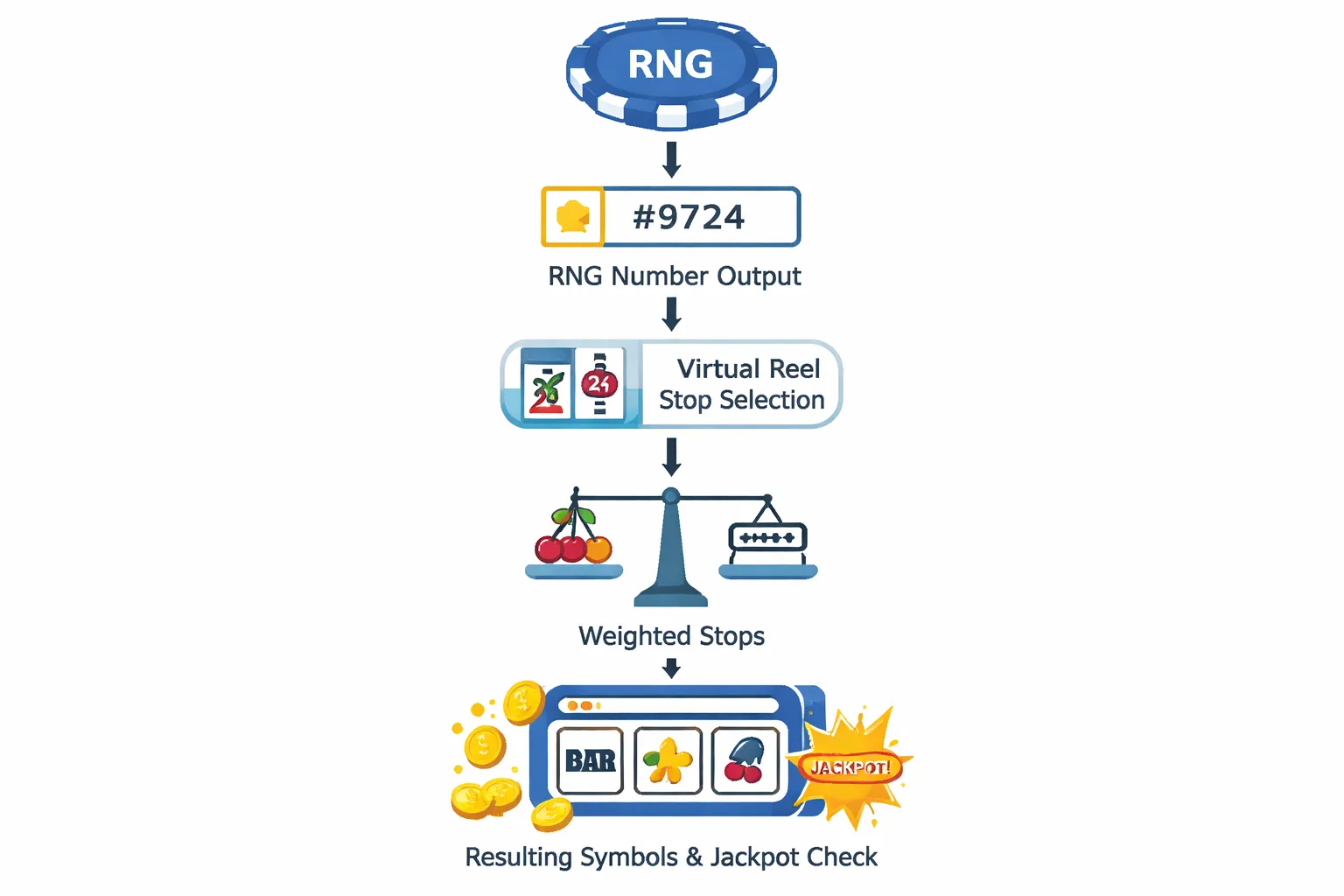
RNG basics, independent spins and why outcomes do not “due”
Every spin runs through a random number generator, called an RNG. The RNG outputs numbers constantly, then the game uses the number it reads at the instant you press spin.
Each spin stands alone. Your last results do not change your next result. A long losing streak does not make a jackpot more likely on the next spin. A recent jackpot hit does not make another hit less likely on your next spin.
Practical takeaway. Judge a jackpot game by its published math and your bankroll, not by patterns you think you see on the screen.
Virtual reels and weighting, why top prizes are rare
Modern slots use virtual reels. Each reel has a large list of stops, often hundreds or thousands. The game maps those virtual stops to the symbols you see on the smaller “reel window.”
Developers weight stops. Common symbols get many stops. Jackpot symbols get very few. That weighting drives rarity.
- More stops for a symbol means you see it more often.
- Fewer stops for a symbol means it lands less often.
- Multiple conditions can stack, like specific symbols plus a bonus trigger, which makes the top prize even rarer.
Practical takeaway. Big progressive totals do not mean “close to hitting.” The hit chance stays the same unless the game uses a must-hit-by range, which the rules will state.
RTP vs. volatility, how they relate to jackpot frequency
RTP tells you how much the game returns over a very long sample, like millions of spins. It does not tell you when you will hit a jackpot.
Volatility describes how results cluster. High volatility games pay less often, then pay bigger when they do. Low volatility games pay more often, but with smaller wins.
- High RTP can still pair with a very rare jackpot if the game funds returns through smaller, frequent wins.
- Lower RTP can still offer a large jackpot, because the jackpot chance and the payback level are separate design choices.
- High volatility often means the jackpot or its triggering bonus sits deeper in the distribution, so dry spells can run long.
Practical takeaway. If you chase progressives, check both RTP and volatility. If you want fewer swings, pick lower volatility instead. For a deeper breakdown, see high volatility vs low volatility slots.
Game certification and testing labs, how regulators validate fairness
Licensed casinos and major studios submit games to independent testing labs. Regulators and labs focus on four checks.
- RNG quality, tests for randomness and repeatability issues.
- Math validation, confirms the stated RTP and paytable behavior match the underlying model.
- Progressive logic, verifies contributions, reset values, and trigger rules work as specified.
- Build integrity, checks the approved game version matches what the casino runs.
Practical takeaway. You can control one thing. Play only on regulated sites that publish game provider details and licensing information.
Different jackpot types you’ll see in casinos and online slots
Symbol-based jackpots
You win these by landing a specific symbol pattern. The game ties the jackpot to a payline, a reel set, or a screen position.
- Fixed payline combo. You must hit a rare combination on an active line, often five or more matching symbols.
- All reels requirement. The game demands the symbol on each reel, sometimes in any position, sometimes on a defined row.
- Bet qualification. Many games require max lines, a minimum coin value, or a specific stake to qualify for the top jackpot.
- Practical check. Open the paytable. Find the jackpot symbol. Confirm the exact reel count and the minimum bet rule before you spin.
Feature-based jackpots
You trigger these inside a bonus feature. The base game spin starts it, the feature decides the jackpot tier.
- Bonus rounds. Free spins, hold and win, or respins can award a jackpot at the end of the feature.
- Pick-em games. You choose items, the game reveals a jackpot tier or adds values until it completes a set.
- Jackpot wheels. A wheel spin lands on Mini, Minor, Major, or Grand, or it lands on a multiplier that boosts a meter win.
- Practical check. Read the feature rules. Look for “must collect X symbols” and “jackpot replaces coin values” rules, these change your outcome distribution.
Time-based or mystery jackpots
You do not need a specific symbol combo. The game awards the jackpot when a hidden trigger fires.
- Time window triggers. The jackpot must hit between two timestamps. If you play during the window, you have a chance.
- Coin-in window triggers. The jackpot must hit after a range of total wagers on that game or network.
- Stake impact. Some systems weight entries by bet size. Others treat every qualifying spin the same.
- Practical check. Find the posted rules for minimum stake and weighting. If the casino does not disclose them, treat the offer as marketing, not an edge.
Incremental jackpots
The meter grows, but it cannot run forever. The game caps the prize, then resets or converts the excess to other prizes.
- Capped meter. The jackpot climbs until it hits a maximum value. After that, it stays flat until someone wins.
- Must-hit-by style. Some games guarantee a hit before a ceiling. The meter increases faster as it approaches the cap.
- Practical check. Look for “must hit by” or a maximum. Your best value, if any exists, usually comes when the meter sits close to the cap and you still qualify at your stake.
Community and tournament jackpots
These pool results across players. Your payout depends on an event rule, not one spin outcome.
- Community jackpots. A portion of qualifying wagers funds a shared pool. A random trigger or scheduled drop pays one or more players.
- Tournament jackpots. The prize pool ties to a leaderboard. Points come from wins, multipliers, or mission tasks during a set window.
- Variance and cost. You may need higher volume to place. The expected cost comes from your wagers and the game RTP.
- Practical check. Read the scoring rules and entry requirements. If the tournament uses net losses or wager volume, you pay more to compete. Use the game RTP to estimate your expected cost, see how slot RTP works.
How jackpot payouts work in practice

Lump sum vs. installments
Most slot jackpots pay as a lump sum. You get the full amount in one payout, then you handle taxes and banking on your side.
Installments show up in two cases. Some wide-area progressives offer an annuity option. Some jurisdictions push structured payouts above a threshold. The casino or operator sets the schedule and paperwork.
- Lump sum: common for fixed jackpots, local progressives, and most online wins.
- Installments: more common for very large linked jackpots, when rules allow an annuity choice, or when local policy requires it.
- What you control: usually you only choose how you receive funds, cash, check, bank transfer, or e-wallet, not the payout type.
Verification process
Big jackpots trigger checks. The goal is to confirm the win, confirm your identity, and confirm the funds route.
- Land-based hand pay: the machine locks. Staff verifies the game state and calls a supervisor. You show ID. You sign forms. You get cash or a check, based on casino policy and amount.
- Online verification: the win logs instantly, but withdrawals can pause until KYC finishes. You submit ID, address, and payment method proof. Some sites ask for a selfie or source of funds for large amounts.
- Disputes: the operator pulls logs, RNG records, and session data. On a physical machine, they also use the machine event log and surveillance. Keep your ticket, screenshots, and timestamps.
Before you chase jackpots, understand your expected cost and variance. Use RTP data to set limits, see our Online Slots Guide.
Online vs. land-based payout timelines
Land-based payouts happen at the cage. Online payouts move through payment rails and compliance checks.
- Land-based: smaller jackpots often pay fast. Larger hand pays can take longer due to approvals, paperwork, and check issuance.
- Online: the win credits your balance fast, but cashing out can take hours to days. First withdrawals take longer. Big wins can trigger manual review.
- Why it differs: casinos control cash on site. Online sites must clear KYC, fraud checks, and banking processing.
Jackpot splits and shared wins
Most jackpots pay one account or one player. Splits happen when the rules define shared eligibility.
- Team play and pools: tournaments and promotions can split a prize pool by rank or points. That is separate from a slot jackpot unless the rules say otherwise.
- Bonus buys: a bonus buy can still trigger a jackpot if the game allows it. Some operators exclude bonus buys from jackpot eligibility. Check the game and promo terms.
- Multi-user events: some network jackpots run as shared pools across many casinos. You still do not split the jackpot unless multiple winners hit the trigger in the same defined window, which depends on the provider rules.
What happens to the jackpot meter after a win
Progressive meters do not drop to zero. They reset to a seed value, then grow again from new wagers.
- Reset amount: the game shows a minimum value, called the seed. After a win, the meter jumps down to that number.
- Visible changes: the display updates right away. On linked jackpots, every connected game sees the reset.
- Multiple tiers: if the game has Mini, Minor, Major, Mega, only the tier that paid resets. Other tiers keep climbing.
What affects your chance of winning a slot jackpot (and what doesn’t)
House edge and long-run probability, set realistic expectations
Your chance of hitting any jackpot comes from math, not mood.
Every spin uses an RNG. The game does not remember your last results.
RTP tells you the long-run return. House edge tells you the long-run cost. Neither tells you when a jackpot will hit.
Progressives add another layer. Most of your expected value still comes from regular payouts. The jackpot adds rare, high variance outcomes.
If you want the basics on RTP, RNG, and house edge, read online casino fairness explained.
Bet size requirements, max bet myths vs true eligibility rules
Your bet size affects two things, your cost per spin and your eligibility rules.
- Fixed-trigger jackpots: some games require a minimum bet to qualify. If you bet under it, you can still win, but not the jackpot.
- Feature-based jackpots: some jackpots sit inside a bonus. If the bonus requires a certain bet level or side bet, you must meet it to access that path.
- Max bet myth: “max bet increases your odds” often means “max bet is required to qualify.” It does not mean the RNG becomes easier.
Check the paytable and rules screen. Look for “must bet X” or “eligible on bets of X or more.” That line matters more than any advice on the casino floor.
Denomination, lines, and multipliers, how they change cost and qualification
Denomination and bet configuration change your stake. They can also change which jackpots you can win.
- Denomination: a $0.01 game and a $0.10 game can show the same jackpot brand, but the bet levels and contribution can differ. Higher denom usually means higher cost per spin.
- Lines and ways: more lines or more ways raises your total bet. On many games, you qualify as long as you meet the minimum total bet or required feature bet, not because you picked a specific line count.
- Multipliers: some games let you add a multiplier as a higher stake option. Sometimes it only boosts regular wins. Sometimes it acts like an eligibility gate for a jackpot feature.
Do not guess. Read the rules for that specific title. Two games with similar branding can use different qualification logic.
Bankroll and session planning, reduce the risk of busting early
You cannot control variance. You can control how fast you run out of money.
- Set a loss limit: decide your maximum session loss before you start. Stop when you hit it.
- Pick a bet size you can sustain: higher bets buy more spins per hour, but fewer total spins before busting.
- Aim for more spins, not bigger spins: jackpots are rare. More spins gives you more attempts. It does not guarantee anything.
- Expect long droughts: many jackpot slots can go long stretches without a meaningful hit. Plan for that, or you will chase.
Myths to ignore, “machines that are due,” timing, and floor legends
- “This machine is due”: false. RNG outcomes stay independent. A cold streak does not make a win more likely.
- “Play after someone leaves”: false. The next spin has the same odds as any other.
- “Casinos tighten slots at night”: you cannot time your way into better RNG results. Any RTP settings, where allowed, change over long periods, not based on your arrival time.
- “Hit the button at the right moment”: the stop button only changes the animation on most modern slots. It does not change the outcome.
- “Near misses mean it is close”: near-miss designs exist to keep you playing. They do not signal higher jackpot probability.
Choosing a progressive jackpot slot responsibly
Reading the paytable, jackpot rules, contribution, and qualifying bets
Open the paytable and the info screen before you play. Do this every time. Rules vary by game and casino.
- Qualifying bet. Many progressives require max bet, all paylines, or a minimum coin value to win the jackpot. If you bet less, you may win a smaller fixed prize instead.
- Trigger condition. Some jackpots need a specific symbol combo. Others trigger at random after a qualifying spin. The paytable tells you which system the game uses.
- Jackpot contribution. The game may state that a percentage of each wager feeds the jackpot. If it does not, assume the cost sits inside the game’s math and your expected return.
- Network scope. Check if the jackpot is local to one casino, shared across a casino network, or shared across multiple operators. Wider networks often mean bigger prizes and more competition for each trigger.
- Reset value. Note the reset amount. A jackpot sitting near reset often offers less value than one far above reset, all else equal.
- Bet changes. Confirm whether changing stake changes your eligibility mid-session. Some games lock eligibility per spin, some per round type.
Comparing RTP and volatility across similar games
Use RTP to compare games, not to predict your next result. Higher RTP usually means lower long-run loss, but jackpots and bonus mechanics can shift where value sits.
- Prefer the highest available RTP setting. Some slots ship with multiple RTP versions. Your casino chooses the version.
- Compare like for like. Compare progressives to other progressives with similar stake ranges and features. A base game RTP can differ from the combined RTP that includes jackpot contribution, if the provider separates it.
- Respect volatility. High volatility means longer losing runs and rarer big hits. If your bankroll cannot handle long downswings, pick a lower volatility progressive or reduce stake.
- Check minimum bet. A high RTP does not help if the qualifying bet forces you above your comfort level.
If you need a refresher on paylines, stake controls, and features that affect cost per spin, read how to play online slots.
Jackpot size vs. hit rate trade-off
Bigger jackpots usually mean lower hit rates. You pay for the dream with time and variance.
- Large network progressives. Expect rare wins. Plan for many sessions with no meaningful return.
- Smaller local progressives. Often hit more often, at lower amounts. They can feel more realistic if you want a non-zero chance within a normal budget.
- Set a target experience. If you want entertainment and frequent outcomes, chase smaller progressives or standard slots. If you want a slim shot at a life-changing win, accept that most sessions end without it.
Use a simple rule. If the qualifying bet forces you to spend faster than your planned session budget, skip the jackpot and choose a different game.
Checking licensing and provider reputation
Progressives depend on software integrity and audited payouts. Trust signals matter.
- License disclosure. Look for a named regulator and a license number in the site footer. Avoid sites that hide this.
- Game provider branding. Reputable studios put their name on the loading screen and in the paytable.
- RTP and rules transparency. Legit games show RTP, volatility notes, and jackpot rules in the info panel.
- Audit seals. Look for third-party testing names and links you can click. A logo with no link proves little.
- Clear jackpot terms. The casino should state how jackpots pay, any bet requirements, and whether wins require verification steps.
Responsible gambling safeguards
Progressives tempt you to overplay. Use tools that stop escalation.
- Deposit limits. Set a daily, weekly, or monthly cap. Set it before you start. Do not raise it in the same day.
- Loss limits. Decide the maximum you will lose in a session. Stop when you hit it.
- Time limits. Set a hard session length. Long sessions increase risk of chasing.
- Reality checks. Turn on pop-ups that show time played and net spend. Treat them as stop signs, not reminders.
- Autoplay controls. If you use autoplay, cap the number of spins and set stop conditions.
- Self-exclusion. If you struggle to stop, exclude for weeks or months, not hours. Use operator tools and any national self-exclusion program available in your region.
Real-world examples of how progressive growth can work (illustrative)
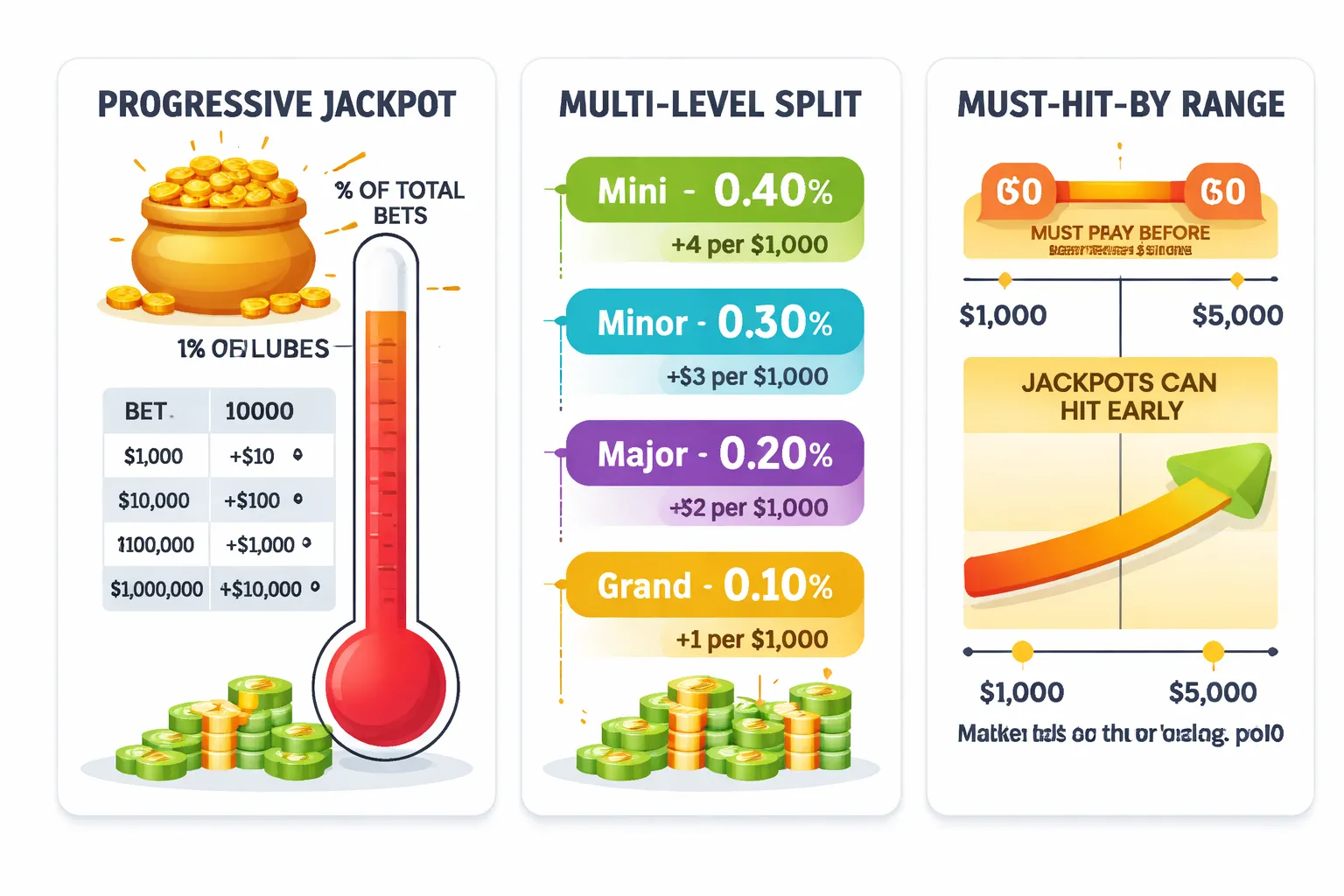
Example, a 1% contribution rate and steady pool growth
Each spin can add a small cut of your stake to the jackpot meter. The key variable is the contribution rate.
Illustration. A slot takes 1% of all qualifying bets and routes it to one progressive pot.
| Activity | Result |
|---|---|
| $1,000 in total qualifying bets | $10 added to the jackpot |
| $10,000 in total qualifying bets | $100 added to the jackpot |
| $100,000 in total qualifying bets | $1,000 added to the jackpot |
| $1,000,000 in total qualifying bets | $10,000 added to the jackpot |
If the game runs across many players, the total bet volume can get large fast. The pot can climb even if each player stakes small amounts.
Example, multi-level progressives and tier splits
Some games run more than one progressive at the same time. Your bet can feed several tiers, each with its own trigger and reset value.
Illustration. The game takes 1% total and splits it across four tiers.
| Tier | Share of total bets | Added per $1,000 in bets |
|---|---|---|
| Mini | 0.40% | $4.00 |
| Minor | 0.30% | $3.00 |
| Major | 0.20% | $2.00 |
| Grand | 0.10% | $1.00 |
This structure creates two effects. Small tiers refill quickly and pay more often. The top tier grows slower and can take longer to reach big numbers.
You still face the same core math. The RNG decides outcomes. Learn the basics in our online casino fairness guide.
Example, must-hit-by ranges and why jackpots can land early
Some progressives use a must-hit-by range. The jackpot can trigger at any time after it reaches the minimum. It must trigger before it passes the maximum.
Illustration. A jackpot starts at $1,000 and must pay by $5,000.
- The meter climbs from contributions.
- Once it passes $1,000, the game can award it on a qualifying event.
- As the meter rises, the chance of a hit increases based on the game design.
- If it reaches $5,000, the next qualifying event forces a payout.
This is why you often see wins below the cap. The cap limits the top end. It does not mean the jackpot will sit near the maximum for long.
Frequently Asked Questions
What is a progressive jackpot?
A progressive jackpot is a prize pool that grows with play. A fixed percentage of each qualifying bet adds to the meter. The jackpot can link to one game, one casino, or a network of casinos. After a win, it resets to a set start value.
Do all bets contribute to the jackpot?
No. The game rules decide which bets qualify. Many games require a minimum bet, specific coin size, or max lines. If you bet below the requirement, you still play the slot, but you do not fund or qualify for the progressive prize.
Can you win the jackpot on any spin?
It depends on the trigger type. Some progressives use a visible symbol combo. Others use a hidden RNG trigger that can hit on any qualifying spin. Some use a must-hit-by range, where the game guarantees a payout before the cap.
What does “must-hit-by” mean?
The jackpot has a minimum, a current meter, and a maximum cap. Once the meter passes the minimum, it can pay. If it reaches the cap, the next qualifying event forces a payout. It can still hit earlier based on the design.
Does a higher jackpot meter mean better odds?
Sometimes. In some must-hit-by designs, the hit chance can increase as the meter climbs. In other games, the odds stay fixed and only the prize grows. Your game info screen or paytable may state the trigger method.
Do progressive jackpots have a reset amount?
Yes. After a win, the jackpot resets to a seed value set by the operator or game provider. The seed can come from the casino, the provider, or a reserve fund. Then the meter starts growing again from contributions.
Are progressive jackpots random?
Yes, but the trigger rules matter. RNG controls outcomes on regulated slots. For symbol-based jackpots, you need the exact listed combo. For mystery jackpots, you need a qualifying spin. For must-hit-by jackpots, the cap sets a hard limit.
Can you improve your chance to win a progressive jackpot?
You can only control eligibility and volume. Meet the minimum bet and required settings. Play more qualifying spins if you choose to play. You cannot time the RNG. Learn the basics in how to play online slots.
How are progressive jackpots paid out?
Small progressives often pay instantly to your balance. Large awards may pay as a lump sum or installments, based on the casino rules and local law. Network progressives can add verification steps. Check the terms before you play.
Do you pay tax on progressive jackpot winnings?
It depends on your country and location. Some places withhold tax at payout. Others require you to report winnings yourself. Casinos may issue tax forms above set thresholds. Keep records of wins, dates, and game names for filing.
Conclusion
Conclusion
Progressive jackpots grow because each qualifying bet adds a set contribution. The trigger stays random. The reset value sets the floor after a hit. None of this changes your odds on the next spin.
Play progressives for the prize, not for steady returns. Control your risk. Set a budget and a stop time. Stick to the minimum bet that qualifies for the jackpot. Confirm the rules, the contribution rate, the reset amount, and the payout and tax process before you start.
- Qualify: Check the minimum bet and required paylines.
- Know the pool: Identify standalone, local, or network progressives. Wider pools usually mean rarer hits.
- Verify terms: Read the trigger rules, max win limits, and verification steps.
- Plan for payout: Ask about lump sum versus installments if offered, and keep records for taxes.
Final tip, pick one progressive you understand, verify the qualifying bet, then play within a fixed session budget. Leave when you hit your limit.
-
Online Casino Fairness Explained: RNG, RTP, House Edge & Provably Fair
2 months ago -
How to Play Online Slots: Rules, Features & Beginner Tips
2 months ago -
Slot RTP Explained: What RTP Means and How to Use It
2 months ago -
Slot Volatility Explained: Low vs High Volatility (and What to Play)
2 months ago -
How to Play Online Blackjack: Rules, Payouts & Quick Start Guide
2 months ago
-
- From spin to outcome, what happens when you press Spin
- Where your wager goes, stakes, house edge, and payout allocation
- Contribution rate, how a fraction of bets feeds the jackpot pool
- Eligibility checks, why bet size and paylines can matter
- What triggers the jackpot, fixed combination vs random trigger events
-
- Jackpot “meter” logic, increment rules and real-time updates
- Seed and reset values, how progressives start over after a win
- Must-hit-by (MHB) progressives, how capped ranges change hit frequency
- Stand-alone vs. local-area vs. wide-area networks (WAP), how pools are shared
- Multi-level progressives, how multiple jackpot tiers are funded and awarded
-
- House edge and long-run probability, set realistic expectations
- Bet size requirements, max bet myths vs true eligibility rules
- Denomination, lines, and multipliers, how they change cost and qualification
- Bankroll and session planning, reduce the risk of busting early
- Myths to ignore, “machines that are due,” timing, and floor legends
-
- What is a progressive jackpot?
- Do all bets contribute to the jackpot?
- Can you win the jackpot on any spin?
- What does “must-hit-by” mean?
- Does a higher jackpot meter mean better odds?
- Do progressive jackpots have a reset amount?
- Are progressive jackpots random?
- Can you improve your chance to win a progressive jackpot?
- How are progressive jackpots paid out?
- Do you pay tax on progressive jackpot winnings?
-
- From spin to outcome, what happens when you press Spin
- Where your wager goes, stakes, house edge, and payout allocation
- Contribution rate, how a fraction of bets feeds the jackpot pool
- Eligibility checks, why bet size and paylines can matter
- What triggers the jackpot, fixed combination vs random trigger events
-
- Jackpot “meter” logic, increment rules and real-time updates
- Seed and reset values, how progressives start over after a win
- Must-hit-by (MHB) progressives, how capped ranges change hit frequency
- Stand-alone vs. local-area vs. wide-area networks (WAP), how pools are shared
- Multi-level progressives, how multiple jackpot tiers are funded and awarded
-
- House edge and long-run probability, set realistic expectations
- Bet size requirements, max bet myths vs true eligibility rules
- Denomination, lines, and multipliers, how they change cost and qualification
- Bankroll and session planning, reduce the risk of busting early
- Myths to ignore, “machines that are due,” timing, and floor legends
-
- What is a progressive jackpot?
- Do all bets contribute to the jackpot?
- Can you win the jackpot on any spin?
- What does “must-hit-by” mean?
- Does a higher jackpot meter mean better odds?
- Do progressive jackpots have a reset amount?
- Are progressive jackpots random?
- Can you improve your chance to win a progressive jackpot?
- How are progressive jackpots paid out?
- Do you pay tax on progressive jackpot winnings?
-
Reload Bonus Explained: What It Is and When It’s Worth Claiming
1 week ago -
Online Casino Licensing Explained: Authorities, Licenses & How to Check One
2 months ago -
Best Live Dealer Casinos: Where to Play Live Blackjack, Roulette & More
2 months ago -
Best Online Casinos for High Rollers: VIP Perks, High Limits & Exclusive Bonuses
2 months ago -
Fast Payout Online Casinos: Best Sites for Quick Withdrawals
2 months ago
-
Online Casino Licensing Explained: Authorities, Licenses & How to Check One
2 months ago -
Online Casino Bonuses Explained: How They Work + Terms You Must Know
2 months ago -
Free Spins Bonus Explained: How Free Spins Work at Online Casinos
2 months ago -
Casino VIP & Loyalty Programs Explained: Points, Tiers, Rewards & Rakeback
2 months ago -
Best Online Casinos for Blackjack: Best Tables, Rules & Bonuses
2 months ago