How to Play Online Slots: Rules, Features & Beginner Tips

Online slots use a random number generator to decide every spin. You control the bet size and when you spin. You do not control the outcome.
This guide shows you how to play online slots step by step. You will learn the core rules, how paylines and symbols work, and how to read a paytable. You will also learn the key features that change results, including wilds, scatters, free spins, multipliers, and bonus rounds.
You will get beginner tips you can use right away. You will learn how RTP and volatility affect your expected returns and bankroll swings, how to set a budget, and how to pick stakes that fit your session. For the math behind RNG, RTP, and house edge, read our online casino fairness guide.
- In het kort: Online slots run on RNG. Each spin is independent.
- In het kort: Learn the paytable first. It tells you paylines, symbol values, and bonus triggers.
- In het kort: Your stake equals bet per line or ways, times bet size. Check how the game builds your total bet.
- In het kort: RTP sets your long-term expected return. Higher RTP usually means less house edge. Use slot RTP explained to compare games fast.
- In het kort: Volatility sets swing size. High volatility hits less often, pays bigger. Low volatility pays smaller, more often.
- In het kort: Wilds, scatters, free spins, multipliers, and bonus rounds drive most big wins. Know how each feature triggers and pays.
- In het kort: Set a session budget and a stop point. Pick stakes that give you enough spins for your budget.
- In het kort: Use demo mode to learn features and bet settings before you play with real money.
What Are Online Slots and How Do They Work?

What Online Slots Are
Online slots are digital slot machines. You pick a stake, press spin, and the game shows an outcome on the reels. If the symbols match a payline or pay pattern, you win based on the paytable.
The reels you see are an animation. The real result comes from the game’s math and its random number generator, called an RNG.
RNG Explained in Plain English
An RNG is software that outputs random numbers nonstop. When you hit spin, the game takes the next numbers in the sequence and uses them to select the symbols for that spin.
Each spin is independent. The game does not “remember” your last wins or losses. A long losing streak does not increase your next chance to win. A big win does not make a loss “due.”
How Outcomes Get Generated and Displayed
Most online slots use virtual reels, not physical reels. Each reel has a set of symbol positions with specific weights. Some symbols appear more often than others. That weight drives the odds.
- Math model: The game picks a reel stop for each reel based on weighted probabilities.
- Reel display: The game shows symbols landing on the screen to match the selected stops.
- Payout check: The game checks paylines or ways-to-win rules, then applies the paytable.
- Feature check: The game checks if scatters, bonus symbols, or other triggers appear, then runs the feature logic.
Designers can make a game look simple and still run complex math. The look does not tell you the odds. The RTP and volatility do.
RTP vs. House Edge
RTP means Return to Player. It is the long-run percentage of total stakes the slot pays back across a very large number of spins.
House edge is the long-run share the casino keeps. House edge equals 100% minus RTP.
What RTP means for you.
- Higher RTP usually means better long-run value per spin.
- RTP does not predict short sessions. You can win big on a low RTP slot, or lose fast on a high RTP slot.
- RTP does not tell you how often you win, only the long-run return.
If you want a shortlist of high-return games, use this best RTP slots guide.
Volatility and Variance Basics
Volatility, also called variance, describes how a slot distributes its payouts over time.
- Low volatility: More frequent small wins. Smaller swings. Lower top-end payouts in many games.
- High volatility: Fewer wins. Larger swings. More of the RTP sits in rare big hits and bonus rounds.
Two slots can share the same RTP and still feel very different. Volatility controls hit frequency and win size distribution. RTP controls the long-run average.
Why “Hot” and “Cold” Slots Are Myths
A “hot” slot means players think it will keep paying. A “cold” slot means they think it is due to pay.
Both ideas rely on the gambler’s fallacy. Past spins do not change the odds of the next spin in an RNG slot. Your best control comes from choosing RTP, volatility, and stake size. Not from chasing streaks.
Slots Glossary: Terms Beginners Should Know
Paylines, Ways-to-Win, and Clusters
Payline means a fixed path across the reels where matching symbols can pay. The game shows the active lines in the paytable or rules. More paylines increase how often you hit small wins, but they do not guarantee profit.
Ways-to-win means you win by matching symbols on adjacent reels, usually starting from the leftmost reel. You do not need the symbols to land on a line. A 5x3 game with 3 symbols per reel often shows 243 ways, but some games use 1024, 3125, or more.
Cluster pays means you win when a group of matching symbols touches. The shape varies by game. You will see a minimum count, like 5, 8, or 10 of a kind. These games often pair with cascades.
Symbols and Payouts
Low symbols pay smaller amounts and land more often. Many games use card ranks like 10, J, Q, K, A.
High symbols pay more but land less often. These are usually themed icons, like characters or premium items.
Payout table lists what each symbol pays at different match counts. It can also list special symbol rules, like how wilds substitute, or how scatters pay.
| Term | What to check |
|---|---|
| Paytable payout | Is it “per line,” “per way,” or “total bet” based. |
| Bet level | Does raising your stake change coin value, line bet, or total bet. |
| Max win | Look for a cap like 5,000x or 10,000x your stake. |
Wilds, Expanding Wilds, and Stacked Wilds
Wild substitutes for other symbols to help form a win. It usually does not replace scatters or bonus symbols. Some wilds also pay as a symbol.
Expanding wild grows to cover a full reel, row, or selected area when it lands. This can increase hit size, but it can also come with lower base game payouts in some designs.
Stacked wild means wilds can land in a vertical block on a reel. Stacks can be 2, 3, or full reel height, depending on the game.
Scatters and Bonus Triggers
Scatter pays or triggers features based on how many you land, often anywhere on the reels. Common triggers start at 3 scatters, with higher counts paying more or adding free spins.
Bonus trigger means the exact condition that starts a feature. Check the rules for what counts. Some games require scatters on specific reels. Others allow any position.
- Free spins give you spins without extra cost, usually with added rules like multipliers or extra wilds.
- Bonus game is a separate feature, like pick-and-win, wheel spins, or a hold-and-win round.
- Buy feature lets you pay a set price to enter a bonus. Check the listed RTP for the buy mode if the game shows it.
Multipliers
Multiplier increases a win by a set factor, like 2x, 5x, or 10x. Some apply to a single line or cluster. Others apply to the whole spin result.
Track where the multiplier applies. A 3x on one win differs from a 3x on total wins for the spin.
Tumbling or Cascading Wins, and Re-spins
Tumbling or cascading wins means winning symbols disappear, then new symbols drop in. One paid spin can produce multiple wins in a chain. Many games increase multipliers during a cascade streak.
Re-spin gives you another spin event without placing a new bet, usually with some symbols held in place. Common formats include hold-and-win, sticky wilds, or locked reels.
Progressive Jackpots and Seed Amounts
Progressive jackpot grows as players place bets. A small part of each wager feeds the pot. The amount keeps rising until someone wins, then it resets.
Seed amount is the reset value after a jackpot hit. You will often see it as the “starting at” amount. It can differ by casino, currency, and game network.
If you want the full mechanics, see how progressive jackpot slots work.
How to Play Online Slots Step by Step (Beginner Walkthrough)
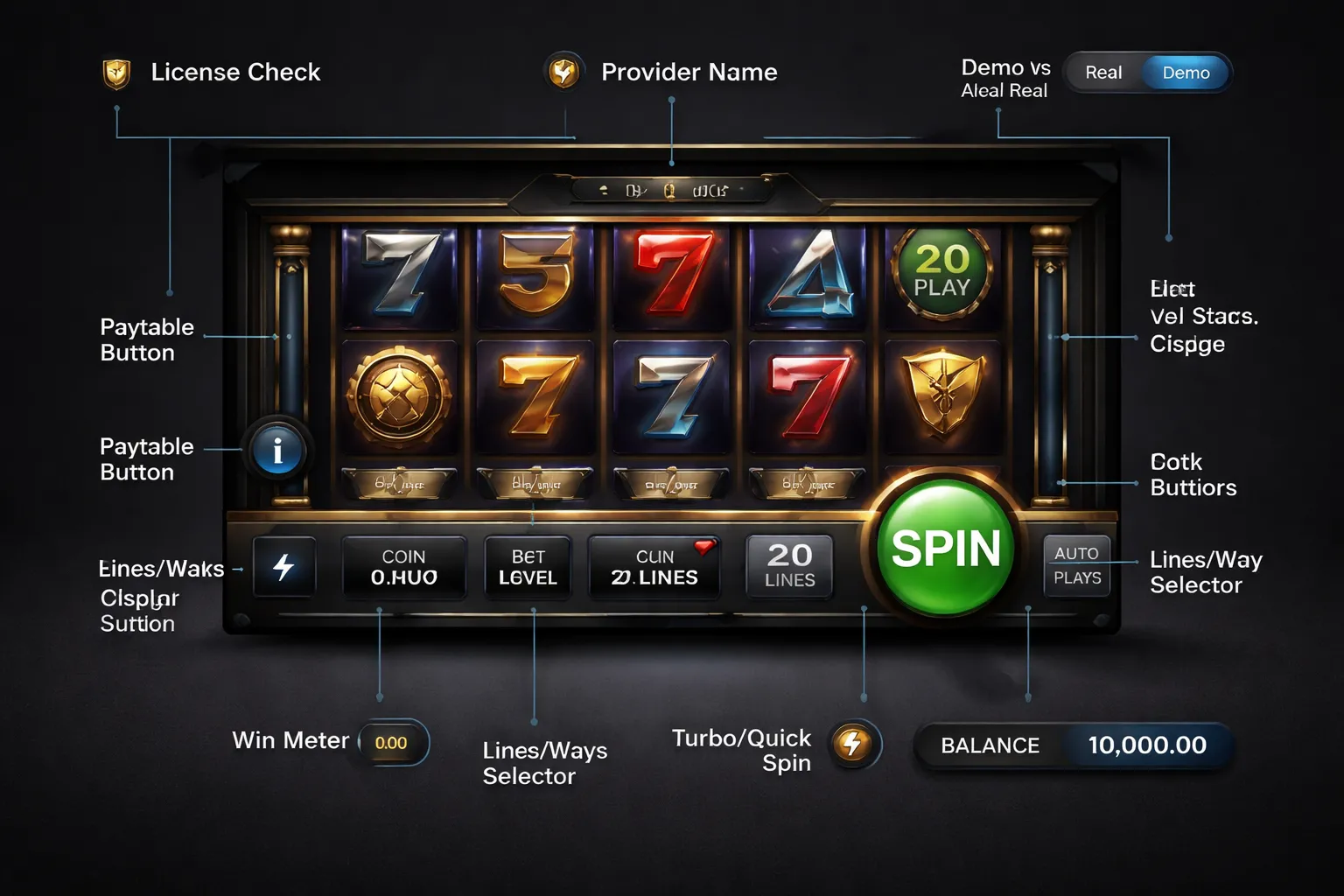
1) Choose a licensed casino and check the game provider
Start with the basics. Play only at a licensed casino. Look for the license details in the site footer and in the cashier terms.
- License: Verify the regulator name and license number. Avoid sites that hide it.
- Game provider: Open the slot info panel and find the studio name, for example, NetEnt, Play'n GO, Pragmatic Play. Stick to known providers with audited RNG games.
- Same game, different casino: RTP can vary by operator for some titles. Check the RTP inside the game, not in a lobby banner.
2) Open the game and pick demo or real-money mode
Most slots let you choose. Use demo mode to learn the layout and features. Switch to real-money only after you set a budget.
- Demo: No risk. You learn paylines, bonuses, and pace.
- Real money: Your balance changes with every spin. Confirm the currency, coin size, and stake before you start.
3) Read the paytable and rules panel before you spin
Open the paytable, sometimes labeled Info or i. This is where the real rules live.
- Symbols and payouts: Check what each symbol pays and what counts as a win.
- Wild and scatter rules: Confirm if wilds substitute, if they stack, and if scatters pay anywhere.
- Bonus triggers: Note how many scatters you need, and if retriggers exist.
- Bet range: Find the minimum and maximum stake per spin.
- RTP and volatility: Many games list RTP in the rules. Compare options in our best RTP slots guide if you want higher return profiles.
4) Set coin value, bet level, and total stake
Slots show your stake in different ways. Your goal is to know your exact cost per spin.
- Coin value: The value of one coin, for example, $0.01, $0.10, $1.
- Bet level: A multiplier that increases the wager across the game's structure.
- Total stake: The final amount you pay per spin. Treat this as the only number that matters for bankroll control.
Before you spin, confirm the total stake display. If the game uses multiple controls, change one setting at a time and re-check the total.
5) Select lines or ways and understand the cost per spin
Some slots use paylines. Others use ways, clusters, or all-ways systems. The betting logic changes.
- Paylines: You may be able to change the number of active lines. More lines usually increases the stake at the same coin value.
- All lines fixed: Many modern slots lock all lines or ways. You cannot reduce them, so you control cost through total stake only.
- Megaways or dynamic ways: The number of ways can change each spin. Your stake per spin can stay fixed, but hit frequency can vary because the reel setup changes.
Look for a stake breakdown in the bet menu, for example, coin value times lines times level. If the game does not show it, rely on the total stake readout near the Spin button.
6) Use Spin, Auto-Play, Turbo, and quick spin responsibly
These buttons change speed, not odds. Faster play increases the number of spins per hour, which increases how fast you can win or lose.
- Spin: One spin at your current stake.
- Auto-Play: A set number of spins. Use limits if offered, for example, stop on win, stop on feature, or stop if balance drops.
- Turbo or quick spin: Shorter animations. Your results still come from the RNG, the pace just increases.
If you use Auto-Play, set a hard loss limit first. Keep your stake consistent while you learn the game.
7) Read results, win lines, win meter, and balance updates
After each spin, the game reports outcomes in a few places. Learn where to look so you do not miss what happened.
- Highlighted wins: The game draws lines, ways, or clusters to show the winning pattern.
- Win meter: Shows the payout for that spin. Some games also show total win for a feature round.
- Balance: Updates after the spin resolves. For bonus rounds, balance may update at the end of the feature, not after each free spin.
- History: Many slots include a round history in the menu. Use it to verify stake, symbols, and payouts if something looks off.
Understanding Slot Features and Bonus Rounds
Free Spins Rounds
Free spins give you a set number of spins with extra rules. The stake may stay the same as your triggering bet, or switch to a fixed stake stated in the rules. Check this before you start.
- Sticky wilds: Wild symbols stay locked in place for the rest of the free spins, or for a stated number of spins. You want more reels covered early, since later spins build on that coverage.
- Retriggers: Some spins add extra free spins. Games often cap total free spins, or cap how many retriggers you can get.
- Multipliers: Many free spins add a win multiplier that stays flat, grows, or resets. Look for the reset rule. A reset-to-1 multiplier changes risk fast.
- Win caps: Some slots cap feature wins, often shown as a max win like 5,000x stake. Once you hit it, the feature ends or further wins pay zero.
Track your total feature win, not each spin. Many games show feature total separately and only update balance after the round ends.
Pick-and-Click Bonuses
Pick bonuses show a grid of items. You select until the round ends, or until you reveal a stop symbol.
- Fixed prizes: Each pick reveals a set coin value or multiplier. Your total equals the sum of revealed prizes.
- Weighted outcomes: The bonus often decides the result when it triggers, then reveals picks to match that result. Your choices change the animation, not the odds.
- Finish conditions: Common endings include finding 3 matching symbols, hitting 3 collect icons, or revealing a set number of stop symbols.
Play it fast and focus on the paytable. The key info is the prize range, any multiplier rules, and how the bonus ends.
Hold-and-Win and Cash Collect Mechanics
Hold-and-win locks special symbols on the reels and gives you a limited number of respins. A new special symbol resets the respin counter. A dead spin reduces it. When it hits zero, the round ends.
- Coin values: Each locked symbol carries a value. Your payout equals the total of all locked values at the end.
- Collect symbols: A collect adds all visible coin values to your total, sometimes with extra multipliers. Some games add multiple collects in the same round.
- Boosts and levels: Some versions increase coin values, add extra rows, or unlock jackpots after you fill positions or hit thresholds.
- Volatility note: These rounds often pay small totals most times, with rare big hits from full screens or stacked collects.
Megaways and Variable Reel Engines
Megaways and similar engines change the number of symbols per reel on every spin. That changes the number of ways to win per spin.
- More ways, not better odds: Extra ways increase hit frequency, but wins often skew smaller. Big totals still rely on multipliers and premium symbol density.
- Changing volatility: A high-way spin can lead to many small wins. A low-way spin can still pay big if multipliers or wild reels land.
- Feature overlap: These games often pair the engine with cascading reels, win multipliers, and free spins. Read the multiplier rule first, since it drives top-end payouts.
Buy Bonus Options
Buy Bonus lets you pay to enter a feature, usually free spins. The cost often ranges from 50x to 200x your base stake. Some games offer multiple buy levels with different volatility.
- What you control: You control entry, not outcome. The feature still uses the same RNG rules as a triggered bonus.
- Bankroll risk: Bonus buys increase variance fast. A few low-paying bonuses can wipe a small budget.
- RTP differences: Some games use a different RTP for bought bonuses versus normal play. Check the info screen if it lists separate RTP values.
- Session impact: Bonus buys reduce spin count. That limits how long your budget lasts and makes results swing harder.
If you want lower long-run cost per hour, compare slots and table games in our best low house edge games guide.
Gamble and Double-Up Features
Gamble features let you risk a win to double it, often with a red or black card pick or a coin flip. They usually apply only to your last win, not to bonus totals.
- When to avoid: Avoid gambling wins that came from a rare hit, a high multiplier, or a capped feature. You risk giving back your best result.
- House edge effect: These gambles typically add edge. Even if the gamble looks close to 50 50, ties and rule details can tilt it against you.
- Stake discipline: If you use it, set a hard limit like one gamble attempt per win, then stop. Chasing doubles turns small wins into long losing streaks.
How Wins, Payouts, and Jackpots Are Calculated
Where Wins Come From
Slots pay in a few main ways. You need to know which one the game uses, because it changes your hit rate and your win size.
- Line wins, symbols land on an active payline, in the required direction, usually left to right. You must bet on the line or on all ways for it to count.
- Scatter pays, specific symbols pay anywhere on the reels. They often trigger free spins or bonuses. They can pay even if no line connects.
- Feature pays, wins come from a bonus mechanic, like free spins, hold and spin, respins, expanding symbols, or a pick bonus. These often create the biggest multipliers, but they can also have caps.
Paytable Math, Stake, Coin Value, Multiplier
Slots usually show wins as a multiplier. Your payout equals your bet times that multiplier, unless the game uses coin values.
- Most modern slots, payout = total stake × win multiplier.
- Coin slots, payout = coins bet × coin value × paytable multiplier.
| Input | Example | Result |
|---|---|---|
| Total stake | $0.50 | Used for stake-based multipliers |
| Win multiplier | 120× | Payout = $0.50 × 120 = $60 |
| Coins bet | 25 coins | Used for coin-based paytables |
| Coin value | $0.01 | Stake = 25 × $0.01 = $0.25 |
| Paytable multiplier | 80× | Payout = 25 × $0.01 × 80 = $20 |
Always check what the multiplier applies to. Some bonuses pay on total stake. Some pay on line stake. If you guess wrong, you will misread the real value of a feature.
Minimum and Maximum Bet Limits
Every slot sets a bet range. This matters because it controls your cost per spin and your jackpot eligibility.
- Minimum bet, helps you test the game and survive variance. It also lowers your exposure while you learn how bonuses and symbols pay.
- Maximum bet, sets your ceiling. If you chase a top prize that scales with stake, this limit can block it.
- Stake scaling, if a game pays in multipliers, higher stake means higher cash wins. Your odds do not improve just because you bet more, but the money swing gets larger.
Use bet limits to protect your session. Set your stake so you can handle long dead runs without raising bets to recover losses.
Max Win and Win Cap Rules
Most slots show a max win, like 5,000× or 20,000×. That number sets the ceiling on what you can win from a single paid spin, including bonus results linked to that spin.
- Max win as a multiplier, max cash win = max win multiplier × your stake.
- Feature caps, some mechanics cap multipliers, symbol values, or the number of collected items. You can hit a ceiling even if the reels keep producing upgrades.
- Practical effect, a capped game can feel explosive, but it can also stop a run before it reaches the extreme outcomes you expect.
| Max win | Your stake | Max cash win |
|---|---|---|
| 5,000× | $0.20 | $1,000 |
| 5,000× | $2.00 | $10,000 |
Check this before you play. If you want true top-end potential, avoid games with low max win multipliers and tight feature caps.
Progressive Jackpot Rules
Progressive jackpots follow rules outside the base paytable. Read them before you assume you qualify. For a deeper breakdown, see how progressive jackpot slots work.
- Eligibility, some progressives pay only on specific bet levels, specific coin settings, or when you buy into a jackpot feature.
- Must-bet requirements, many games require max bet or a fixed minimum stake to unlock the top tier jackpot.
- Contribution, a small part of each wager feeds the jackpot pool. Your expected value comes from the base game plus the jackpot contribution, but you still pay variance through long dry spells.
- Trigger method, progressives can trigger through a rare symbol combo, a bonus wheel, or a random must-hit event. The trigger does not mean the base game RTP changes in your favor.
If you play below the required stake, you can still win regular prizes but miss the progressive tier. Confirm the bet rule on the info screen before you commit volume.
Choosing the Best Online Slots for Beginners
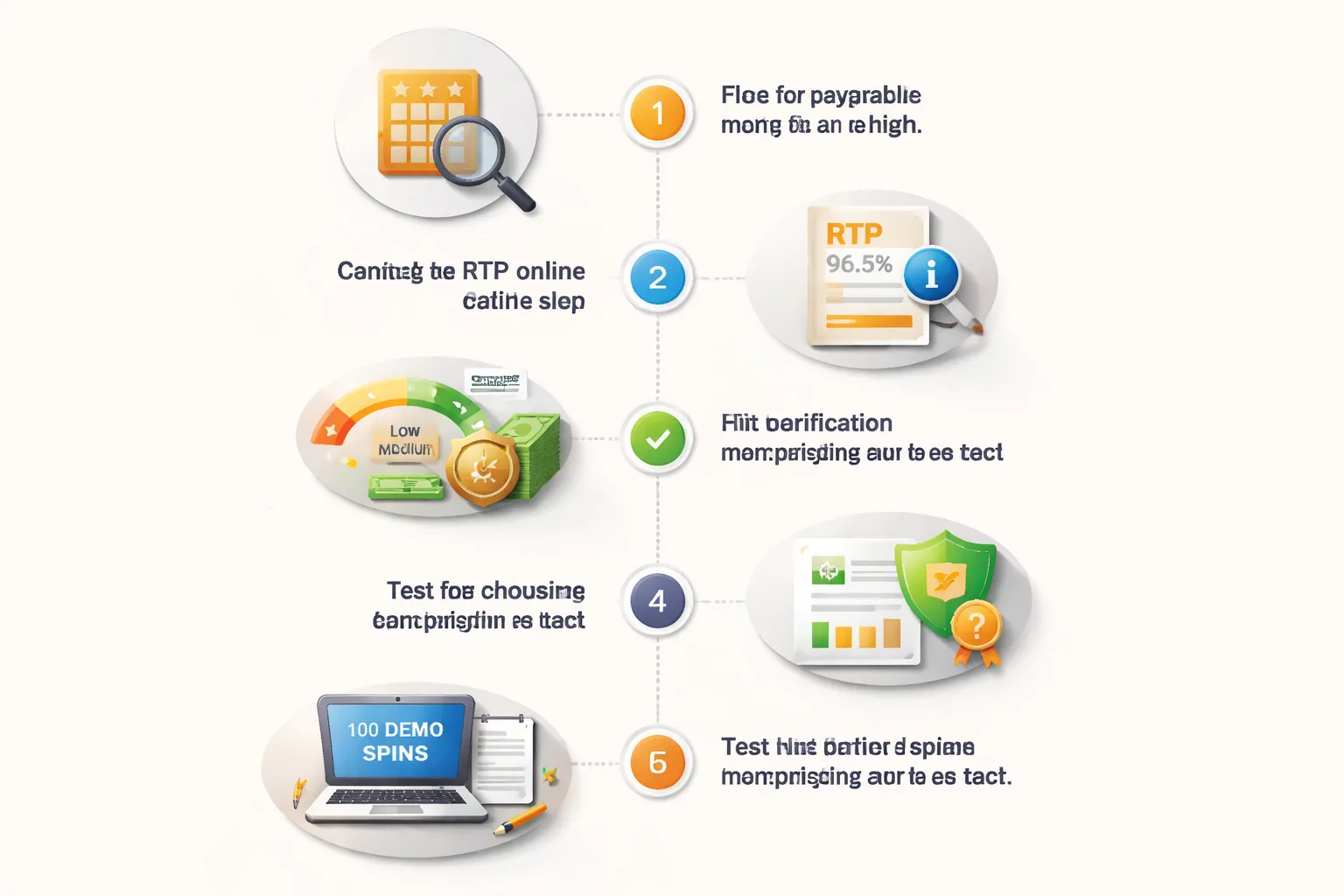
Pick Simple Slots First
Start with games that show you everything on one screen. Avoid heavy mechanic stacks until you understand the basics.
- Paylines and reels: Prefer fixed paylines or simple ways-to-win. Skip complex line toggles.
- Clear paytable: Check symbol values, wild rules, scatter rules, and bonus triggers.
- Fewer bonus layers: One free spins feature beats multiple meters, upgrades, and side bets.
- Bet controls: Use games with a single total bet slider. Avoid coin value math.
Select RTP Thresholds You Can Trust
RTP is the game’s long-run average return. You cannot force it in a short session, but you can avoid low RTP titles.
- Good RTP: 96% or higher.
- Strong RTP: 97% or higher.
- Low RTP: Below 95%.
Some slots offer different RTP versions. Confirm the exact RTP inside the game info panel, not a lobby label. For a deeper breakdown, use this online slots guide.
Match Volatility to Your Bankroll
Volatility controls how wins tend to land, not if you win. Your bankroll decides what you can handle.
- Low volatility: More small wins, smaller swings. Best for short bankrolls and longer play.
- Medium volatility: A mix of frequent hits and occasional bigger wins.
- High volatility: Longer dry spells, larger spikes. Best if you can handle long stretches without a payout.
| Play style | Best starting pick | Why |
|---|---|---|
| Small bankroll | Low volatility | Fewer long dead runs |
| Steady sessions | Medium volatility | Balanced variance |
| Big swings | High volatility | Higher top-end potential |
Choose Reliable Themes and Providers
Theme affects readability and comfort. Provider affects stability, rules clarity, and how often the game gets audited.
- Readability: Clear symbols, clear win highlights, simple bonus screens.
- Stability: Smooth spins on your device, no stutter, no crashes.
- Consistency: Well-known studios tend to document features and bet rules better.
- Fairness: Play at licensed casinos that publish game providers and testing details.
Check Hit Frequency and Volatility Info
Many games hide the most useful info in the rules menu. Look before you spin.
- Where to find it: Tap the info icon, paytable, or game rules.
- Terms to look for: volatility, variance, hit rate, hit frequency, win frequency.
- If the game does not show it: Use the paytable clues. Many small symbol prizes and frequent mini features often signal lower volatility. Big gaps between prizes often signal higher volatility.
Test in Demo Mode and Take Session Notes
Use demo mode to learn the rules fast, then decide if the pacing fits you.
- Run a fixed test: Set 100 spins at one stake level.
- Track basics: bonus triggers, biggest win, longest dead stretch, how often you get any win.
- Confirm mechanics: check if free spins add multipliers, if wins can retrigger, and if features need max bet.
- Stop signals: confusing rules, unclear bet requirements, or a pace that feels too swingy for your bankroll.
Bankroll Management and Responsible Play Essentials
Setting a session budget
Set a session budget before you spin. Use money you can afford to lose. Treat it as the price of entertainment.
- Separate funds: keep your slot bankroll away from bills, rent, food, and debt payments.
- Define the unit: decide if your budget covers one session, one day, or one week. Do not mix them.
- Lock the number: once you load your session budget, do not reload. If you bust, you stop.
Choosing a stake size rule of thumb
Pick a stake that gives you enough spins to absorb variance. More spins means more time to see the game’s normal swings.
- Baseline rule: aim for 200 to 400 spins in your session bankroll.
- Formula: stake per spin = session bankroll ÷ target spins.
- Quick examples: $100 bankroll, 300 spins, stake about $0.33. $50 bankroll, 250 spins, stake $0.20.
- Volatility check: if the slot feels swingy, push toward 400 spins. If it feels steady, 200 can work.
Do not raise your stake to chase a bonus. If you want higher stakes, plan it in the next session budget.
Stop-loss and stop-win limits
Set hard limits. Follow them even if the game feels “due”.
- Stop-loss: end the session after losing 30% to 50% of your session budget.
- Stop-win: end the session after winning 30% to 100% of your session budget.
- One change rule: if you hit either limit, you stop. You do not adjust the limit mid-session.
Practical setups:
- $100 session: stop-loss at $50 to $70. Stop-win at $130 to $200.
- $40 session: stop-loss at $20 to $28. Stop-win at $52 to $80.
Time management, breaks, and tilt prevention
Time is a bankroll multiplier. Longer sessions increase the chance you ignore your rules.
- Set a timer: 30 to 60 minutes per session.
- Use breaks: take a 5 minute break every 15 to 20 minutes.
- Spot tilt: fast clicking, raising stakes after losses, or trying to win back a specific amount.
- Reset rule: if you feel tilt, stop for the day. Do not “cool off” with more spins.
Responsible gambling tools
Use built-in controls. They work when willpower fails.
- Deposit limits: set daily, weekly, or monthly caps. Match them to your planned budget.
- Loss limits: cap losses for a set period. Use this if you struggle to stop at zero.
- Wager limits: restrict total stakes over time. Useful if you play long sessions.
- Reality checks: pop-ups that show time spent and net result. Turn them on.
- Cooling-off: short lockouts from 24 hours to a few weeks.
- Self-exclusion: longer blocks. Use it if you break limits more than once.
If you want a game with more player decisions and fixed odds, learn basic baccarat rules and compare how it feels to slots.
When to seek help
Get support early. Do not wait for financial damage.
- Money signs: borrowing to play, using bill money, hiding spending, or selling items to fund deposits.
- Behavior signs: failed attempts to stop, anger when you cannot play, lying about time or losses.
- Life impact: missed work, ignored relationships, sleep loss, or constant distraction.
- Control signs: you set limits and break them, then raise them.
Use self-exclusion and contact local gambling support services in your country. If you feel at risk of harm, tell someone you trust and get professional help.
Bonuses, Promotions, and Wagering Requirements (How to Use Them Safely)
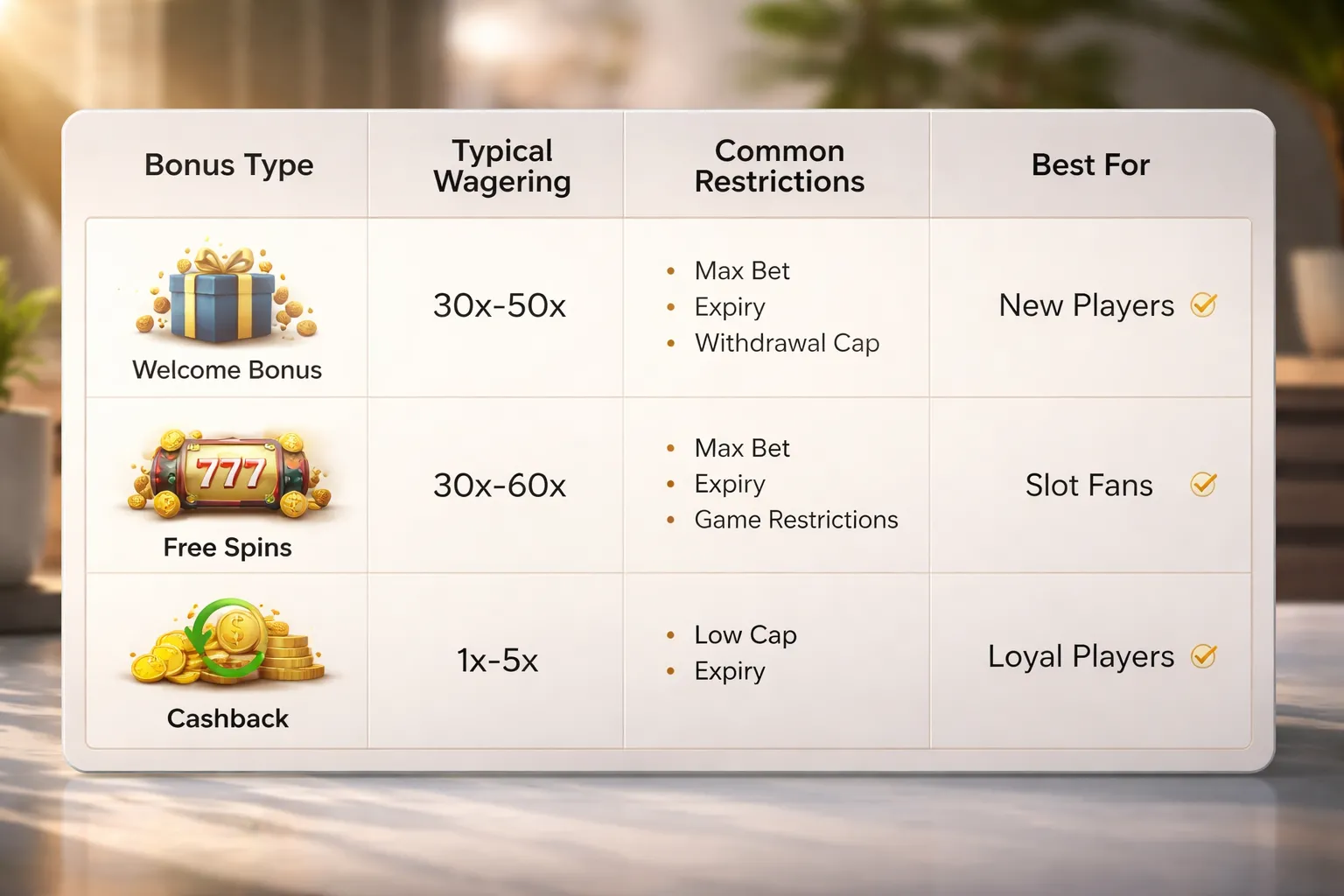
Bonus Types, What You Get, What You Risk
- Welcome bonus (deposit match). You deposit, the casino adds extra funds. Pro: bigger bankroll, more spins. Con: high wagering, strict rules, withdrawals may be capped.
- Free spins. You get a set number of spins on specific slots. Pro: no extra cost to try a game. Con: winnings often convert to bonus funds with wagering, the slot choice is fixed, max win caps are common.
- Cashback. You get a percentage of losses back, usually weekly or daily. Pro: clear value, sometimes low or zero wagering. Con: may exclude bonus play, may require opt-in, may cap the refund.
Wagering Requirements, Explained With Real Math
Wagering means you must place bets for a set total before you can withdraw bonus money, and sometimes bonus-related winnings.
Common formats:
- Bonus-only wagering. You wager the bonus amount.
- Bonus plus deposit wagering. You wager bonus plus your deposit. This costs more.
Example.
- You deposit $50.
- You get a 100% match bonus of $50.
- Wagering is 35x bonus.
- Required wagering: $50 x 35 = $1,750 in total bets.
If the terms say 35x (deposit + bonus), the math changes.
- Required wagering: ($50 + $50) x 35 = $3,500 in total bets.
Total bets means your stake per spin added up over time, not your net losses.
Game Contribution, Slot Weighting, and Why Some Spins Barely Count
Many casinos use contribution rates. They decide how much each wager counts toward clearing wagering.
- 100% contribution. Every $1 you bet counts as $1 toward wagering.
- 50% contribution. Every $1 you bet counts as $0.50. You need double the betting volume.
- 0% contribution. Your spins do not reduce wagering at all.
Casinos often apply lower contribution to high RTP slots, low volatility slots, or specific providers. This changes your cost to clear a bonus. If your bonus plan depends on a specific game, check its contribution first. Learn how volatility affects bankroll swings in our high volatility vs low volatility slots guide.
Max Bet Rules, How Players Get Disqualified
Many bonus terms set a maximum stake per spin while you have an active bonus. Common caps include $5, €5, or 10% of the bonus.
- If you exceed the cap, the casino can void the bonus and winnings.
- This can happen by accident if you raise coin value, enable a feature buy, or switch to a slot with a higher default bet.
Keep your stake fixed before you spin. Recheck it after changing games.
Expiry Dates, Time Pressure, and Missed Withdrawals
Bonuses and free spins expire. So do winnings from free spins.
- Free spins often expire in 24 to 72 hours.
- Welcome bonuses often expire in 7 to 30 days.
If you miss the deadline, you lose the bonus or the winnings tied to it. Do not accept a bonus you cannot finish within the time window.
Withdrawal Limits and Win Caps
Some promos limit what you can withdraw from bonus play.
- Max cashout. Example: “Max withdrawal is 5x bonus.” A $50 bonus caps cashout at $250, even if you win more.
- Free spins win cap. Example: “Max win $100.” Extra winnings get removed.
- Per day or per week cashout limits. You may need multiple withdrawals over time.
These caps can turn a strong-looking offer into a low-value one.
Sticky vs Non-Sticky Bonuses, What You Can Actually Withdraw
- Non-sticky. Your cash balance and bonus balance stay separate. You usually wager your cash first. You can often withdraw your deposit later if terms allow.
- Sticky. The bonus stays locked until you clear wagering. You typically cannot withdraw funds until you complete the requirements, and some wins may remain tied to the bonus rules.
If you want flexibility, avoid sticky bonuses. They reduce your exit options if the session turns bad.
Bonus Hunting Pitfalls, Terms That Look Good but Cost You
- High match percentage with high wagering. A 200% match can still be poor value if the wagering is 60x.
- Low contribution games. “Any slot counts” can hide a list where popular slots count 10% or 0%.
- Feature buys blocked. Buying bonuses may not count toward wagering, or may violate max bet rules.
- Short expiry. You rush, you raise stakes, you break rules.
- Max cashout caps. You take all the risk but keep limited upside.
- Minimum odds style rules. Some promos require specific bet types or exclude certain features.
- Country, payment, or game exclusions. The offer may not apply to your deposit method or your chosen slot.
How to Use Bonuses Safely
- Read five lines before you accept: wagering formula, contribution, max bet, expiry, max cashout.
- Use smaller stakes during wagering. Stay far under the max bet rule.
- Track progress and deadline. Stop if you fall behind and feel pressure to chase.
- Decline promos when you want a fast withdrawal. Playing without a bonus can be simpler.
- If a bonus pushes you to break limits, opt out and use responsible gambling tools.
Common Mistakes New Players Make (and How to Avoid Them)
Skipping the paytable and misunderstanding features
Most mistakes start before you spin. You skip the paytable, then you misread what the game can and cannot do.
- Know the bet rules. Check how paylines, ways to win, clusters, or scatter pays work. Your “match” logic changes by slot type.
- Confirm symbol values at your stake. Some games show payouts as multipliers, others as coin values. Make sure you know which you are viewing.
- Read feature triggers. Note how many scatters trigger free spins, whether they must land on specific reels, and if “anywhere” actually means anywhere.
- Check special symbol behavior. Expanding wilds, sticky wilds, multipliers, and re-triggers often have limits or only work in certain modes.
- Understand buy bonus costs and terms. Bonus buys raise variance. They can also break bonus max-bet rules at some casinos.
Chasing losses and increasing bets impulsively
Slots have fixed long-term math. Bigger bets do not “fix” a bad run. They only raise swing size.
- Set a loss limit and a time limit. Stop when either hits. Do not renegotiate mid-session.
- Use a stake plan. Keep your base bet steady. If you raise it, do it on a schedule, not after losses.
- Avoid recovery betting. Martingale-style jumps burn bankroll fast because slot outcomes cluster and dead spins happen.
- Track spend per minute. Fast spins plus higher stakes can drain a bankroll in minutes, especially on turbo mode.
Assuming Auto-Play changes odds (it doesn’t)
Auto-Play does not improve RTP, hit rate, or bonus frequency. It only changes how fast you place bets.
- Expect higher burn rate. More spins per hour means you reach limits sooner.
- Use stop settings. Set Auto-Play to stop on a single win size, a bonus trigger, or a loss threshold if the game supports it.
- Avoid Auto-Play when tilted. It removes friction. That makes impulsive sessions longer and more expensive.
Misreading RTP as a short-term guarantee
RTP is a long-run average across many spins. Your session can sit far above or below it.
- Do not pick a slot only by RTP. Volatility and feature design drive short-term swings more than a 1 to 2 percent RTP difference.
- Treat RTP as a comparison tool. Use it to compare similar games, then size your bet for the variance you can handle.
- Check the RTP variant. Some slots ship with multiple RTP settings. Casinos can choose a lower one. Confirm the displayed value in the game info.
- Learn the basics once. Use this guide to interpret RTP correctly: slot RTP explained.
Ignoring max win caps and bonus terms
Payout limits and promo rules can change what you can actually cash out.
- Check the max win. Many slots cap wins at a fixed multiple of your bet. If you chase a life-changing hit on a capped game, you cap your upside.
- Know the bonus max cashout. Some promos limit winnings from bonus funds, even if the slot itself has a higher max win.
- Respect max-bet rules. A single over-bet can void bonus winnings. Stay well under the limit if the terms feel unclear.
- Watch restricted games. Some slots do not count for wagering, or they count at a reduced rate.
- Confirm expiry. Wagering deadlines push you into bad decisions. If time is tight, stop or opt out.
Playing unlicensed casinos or unknown game providers
Game math matters less if the casino cannot pay, or if the games are not audited.
- Verify the license. Look for a real regulator, a license number, and a link you can check on the regulator site.
- Stick to known providers. Reputable studios publish RTP, volatility notes, and game rules. They also undergo third-party testing more often.
- Check payment reputation. Read recent withdrawal reports. Focus on timelines, KYC behavior, and complaint handling.
- Watch for fake games. Cloned slots often lack provider branding, rule sheets, or consistent RTP info.
- Use responsible gambling tools. Deposit limits, timeouts, and self-exclusion protect you if a site tries to push endless reloads.
Pros and Cons of Playing Online Slots
Advantages of Playing Online Slots
- Convenience. You can play any time. You can set deposit limits and session reminders before you start.
- Game variety. Online lobbies carry thousands of titles. You can filter by provider, RTP, volatility, paylines, and bonus type.
- Demo mode. You can test rules, paylines, and bonus triggers without risking money. Use demos to learn how often features appear and how big wins tend to cluster.
- More features. Online slots often include buy-bonus options, different reel sets, expanding symbols, and multi-stage free spins. These features change swing and bankroll needs.
Disadvantages and Risks
- High volatility. Many popular games pay small wins often, then keep the top prizes behind rare bonus rounds. You can burn a bankroll fast while you wait for a hit.
- Fast gameplay. Turbo spins and auto-play increase spins per hour. More spins per hour means more exposure to house edge in the same time window.
- Spending risk. Instant deposits, one-click rebuys, and bonus timers push you to reload. If you chase losses, you lock in bigger downswings.
- Feature traps. Bonus buys and side bets can raise cost per attempt. Some also lower base-game RTP. Always read the info screen.
Online vs. Land-Based Slots
Who Online Slots Are Best For, and Who Should Avoid Them
- Best for you if you want control. You use demos first. You set a budget. You pick games by RTP and volatility. If you want a shortlist, use our best RTP slots guide.
- Best for you if you like testing. You enjoy learning paytables, feature rules, and hit patterns. You accept that results stay random.
- Avoid if you chase losses. Fast spins and instant reloads punish impulsive play. If you already struggle with stop limits, step away.
- Avoid if swings stress you. High-volatility slots can run long without a meaningful win. If you need steady outcomes, you will not like the variance.
- Avoid if promos drive your decisions. If timers and bonuses make you deposit more, you will spend beyond plan.
Safety, Fairness, and Legal Considerations
Licensing and regulation checklist
Play only on sites that show a real license, a real operator name, and real contact details. If you cannot verify them fast, leave.
- License number and regulator: Look for the license at the footer. It should name the regulator and show a license ID.
- Operator identity: You should see the legal company name and registration address in the terms or about page.
- Jurisdiction match: The license should cover your country or state. Some brands run different sites under different licenses.
- Responsible gambling tools: Check for deposit limits, loss limits, session limits, time-outs, and self-exclusion.
- Clear policies: Read bonus terms, withdrawal terms, and the KYC section before you deposit.
- Complaint path: A licensed casino should list dispute options, sometimes with an ADR service.
Auditing and certification
Licenses set rules. Testing labs check that the games follow them. A seal does not guarantee you win. It signals the RNG and payouts get reviewed.
- eCOGRA: Known for compliance and player protection work. Many certified sites publish audit statements and standards coverage.
- iTech Labs: Tests RNG behavior and game math across many providers. You often see it referenced in game or platform certifications.
- GLI: One of the most used labs for regulated markets. It tests games and systems against specific jurisdiction standards.
If a site claims certification, confirm it. The seal should link to a verification page or a report reference. If it does not, treat it as marketing.
Secure payments and KYC
Verification happens because regulators require it. Casinos must stop fraud, chargebacks, and underage gambling. They also must follow AML rules.
- What you may need: ID photo, proof of address, and sometimes proof of payment method.
- Why it matters: It helps protect your balance and reduces stolen card use.
- How to avoid delays: Use accurate details, do KYC early, and withdraw to a payment method in your name.
- Watch for red flags: Sudden new documents after you request a withdrawal, unclear limits, or vague processing times.
Data privacy basics and account security
Assume your account has value. Treat it like online banking.
- Turn on 2FA: Use an authenticator app when available. SMS helps but stays weaker than app based codes.
- Use a unique password: Long, random, and never reused. A password manager solves this.
- Lock down your email: Your casino login often resets through email. Add 2FA to your email account.
- Check your sessions: Log out on shared devices. Avoid public Wi-Fi for deposits and withdrawals.
- Limit data sharing: Read the privacy policy section on third parties and marketing opt-ins.
Regional legality overview
Online slot rules change by country, state, and province. A license in one place can mean nothing where you live. Taxes can also apply, even if the casino operates legally.
- Start with your local regulator: Use official government or gambling authority sites. They list legal operators and player rights.
- Check the casino allowed markets: Reputable sites block restricted regions. If a site lets you register from anywhere, risk goes up.
- Know your payment rules: Some regions allow play but restrict deposits through banks or cards.
- Know reporting duties: Winnings may require tax reporting. Keep deposit and withdrawal records.
If you also play table games, legality and licensing checks work the same way for roulette, blackjack, and baccarat.
FAQ
How do online slots work?
A random number generator, or RNG, picks each result. Every spin stands alone. The reels and animations only show the outcome. The game pays based on its paytable, bet size, paylines, and bonus rules.
Can you influence the outcome of a slot?
No. You cannot time spins, stop reels, or use patterns to change results. Autoplay and manual spins use the same RNG. Focus on RTP, volatility, and bankroll limits instead.
What is RTP and why does it matter?
RTP, or return to player, is the long-run average payout rate. Higher RTP means lower house edge over many spins. It does not predict short sessions. Check the game info screen or the provider page.
What is slot volatility?
Volatility shows how a slot tends to pay. Low volatility pays smaller wins more often. High volatility pays bigger wins less often. Match volatility to your budget and session length.
How do paylines and ways-to-win differ?
Paylines require matching symbols along fixed or adjustable lines. Ways-to-win pays for symbol groups on consecutive reels, often left to right. Both use the paytable for payouts. More lines or ways raise your total bet if you do not adjust coin size.
What are wilds, scatters, and multipliers?
Wilds substitute for other symbols, except scatters in most games. Scatters often trigger free spins or bonus rounds and may pay anywhere. Multipliers increase a win by a set factor, such as 2x or 10x, when rules apply.
How do free spins and bonus rounds work?
Free spins give a set number of spins with the same bet size, unless the rules change it. Bonus rounds add features like pick games, expanding wilds, or extra reels. Read the feature rules, some bonuses have caps or different paylines.
What is a progressive jackpot?
A progressive jackpot grows as players wager. It triggers at random or by bonus conditions, based on the game rules. Some progressives require a minimum bet to qualify. Check the jackpot terms before you play.
How do max win caps work?
Many slots cap the top payout per spin or per bonus. The cap often shows as a multiple of your bet, like 5,000x or 10,000x. If a win would exceed the cap, the game pays only up to the limit.
Can you use a strategy to win?
You cannot beat the RNG with a system. You can lower risk with better game choice and bankroll control. Pick higher RTP when available. Set a loss limit, a win target, and a time limit. Stop when you hit one.
Is demo mode the same as real money?
Demo mode uses the same rules, but it may run on a different configuration than a specific casino version. Use it to learn features, bet controls, and pace. Do not use it to judge short-term payouts.
Are online slots legal where you live?
Rules depend on your country, state, or province. Check local gambling laws, and the casino license. Some sites block restricted regions, others do not. If your region restricts payments, you may not be able to deposit or withdraw.
How do withdrawals and taxes work?
Withdrawal rules depend on your casino and region. Expect ID checks and payment method limits. Some bonuses add wagering requirements that block withdrawal until you clear them. Track deposits, withdrawals, and net results. You may need records for tax reporting.
Do I need separate checks for table games?
No. Licensing and legality checks work the same way for slots and table games. If you move to roulette, learn the odds differences, see European vs American roulette odds.
Conclusion
Online slots run on RNG outcomes. You cannot predict the next spin. You control only game selection, bet size, and session length.
- Pick games with higher RTP and volatility that fits your bankroll.
- Use the paytable. Check paylines, ways, wilds, scatters, and bonus triggers.
- Set a hard budget and a stop point. Stick to it.
- Track bonus terms. Watch wagering, max bet rules, and withdrawal limits.
- Play in licensed casinos. Verify the regulator, payment methods, and support.
Your best final step is simple. Log your results for 20 to 50 sessions. Record game, RTP, volatility, bet size, bonus used, and net outcome. Use that data to adjust your game list and betting pace, or move to lower edge options in our best online casino games with low house edge guide.
-
Online Casino Fairness Explained: RNG, RTP, House Edge & Provably Fair
8 months ago -
Slot RTP Explained: What RTP Means and How to Use It
8 months ago -
How Slot Jackpots Work: Progressive Jackpots Explained
8 months ago -
How to Play Online Blackjack: Rules, Payouts & Quick Start Guide
8 months ago -
Slot Volatility Explained: Low vs High Volatility (and What to Play)
8 months ago
-
- 1) Choose a licensed casino and check the game provider
- 2) Open the game and pick demo or real-money mode
- 3) Read the paytable and rules panel before you spin
- 4) Set coin value, bet level, and total stake
- 5) Select lines or ways and understand the cost per spin
- 6) Use Spin, Auto-Play, Turbo, and quick spin responsibly
- 7) Read results, win lines, win meter, and balance updates
-
- Bonus Types, What You Get, What You Risk
- Wagering Requirements, Explained With Real Math
- Game Contribution, Slot Weighting, and Why Some Spins Barely Count
- Max Bet Rules, How Players Get Disqualified
- Expiry Dates, Time Pressure, and Missed Withdrawals
- Withdrawal Limits and Win Caps
- Sticky vs Non-Sticky Bonuses, What You Can Actually Withdraw
- Bonus Hunting Pitfalls, Terms That Look Good but Cost You
- How to Use Bonuses Safely
-
- How do online slots work?
- Can you influence the outcome of a slot?
- What is RTP and why does it matter?
- What is slot volatility?
- How do paylines and ways-to-win differ?
- What are wilds, scatters, and multipliers?
- How do free spins and bonus rounds work?
- What is a progressive jackpot?
- How do max win caps work?
- Can you use a strategy to win?
- Is demo mode the same as real money?
- Are online slots legal where you live?
- How do withdrawals and taxes work?
- Do I need separate checks for table games?
-
-
- 1) Choose a licensed casino and check the game provider
- 2) Open the game and pick demo or real-money mode
- 3) Read the paytable and rules panel before you spin
- 4) Set coin value, bet level, and total stake
- 5) Select lines or ways and understand the cost per spin
- 6) Use Spin, Auto-Play, Turbo, and quick spin responsibly
- 7) Read results, win lines, win meter, and balance updates
-
- Bonus Types, What You Get, What You Risk
- Wagering Requirements, Explained With Real Math
- Game Contribution, Slot Weighting, and Why Some Spins Barely Count
- Max Bet Rules, How Players Get Disqualified
- Expiry Dates, Time Pressure, and Missed Withdrawals
- Withdrawal Limits and Win Caps
- Sticky vs Non-Sticky Bonuses, What You Can Actually Withdraw
- Bonus Hunting Pitfalls, Terms That Look Good but Cost You
- How to Use Bonuses Safely
-
- How do online slots work?
- Can you influence the outcome of a slot?
- What is RTP and why does it matter?
- What is slot volatility?
- How do paylines and ways-to-win differ?
- What are wilds, scatters, and multipliers?
- How do free spins and bonus rounds work?
- What is a progressive jackpot?
- How do max win caps work?
- Can you use a strategy to win?
- Is demo mode the same as real money?
- Are online slots legal where you live?
- How do withdrawals and taxes work?
- Do I need separate checks for table games?
-
-
Reload Bonus Explained: What It Is and When It’s Worth Claiming
6 months ago -
Online Casino Licensing Explained: Authorities, Licenses & How to Check One
8 months ago -
Best Live Dealer Casinos: Where to Play Live Blackjack, Roulette & More
8 months ago -
Best Online Casinos for High Rollers: VIP Perks, High Limits & Exclusive Bonuses
8 months ago -
Fast Payout Online Casinos: Best Sites for Quick Withdrawals
8 months ago
-
Online Casino Customer Support: What to Look For (Live Chat, Email, Response Times)
8 months ago -
Sign Up for an Online Casino: Create an Account in Minutes
8 months ago -
Online Casino Payment Safety Tips: How to Deposit and Withdraw Securely
8 months ago -
What to Do If an Online Casino Won’t Pay Out: Step-by-Step Actions
8 months ago -
How to File a Complaint Against an Online Casino (Plus ADR Explained)
8 months ago