European vs American Roulette Odds: Which Roulette Is Better?

American and European roulette look similar, but the odds are not. The wheel decides your long-term cost. European roulette has 37 pockets. American roulette has 38. That extra double zero changes the math on every bet.
This guide compares the real numbers. You will learn the house edge for each wheel, the true win probability for common bets, and how payouts stack up against those probabilities. You will also see which bets give you the best chance to last longer, and which bets drain your bankroll faster. If you want other low-edge options, use our low house edge games ranking.
Key Takeaways
- In het kort: Play European roulette when you can, it has the lower house edge.
- In het kort: European roulette has 37 pockets, American roulette has 38. The extra double zero worsens every bet on the American wheel.
- In het kort: House edge, European: 2.70%. House edge, American: 5.26%.
- In het kort: You lose about 2.70 per 100 wagered on European roulette, and about 5.26 per 100 on American roulette, over the long run.
- In het kort: Outside bets give you the highest hit rate, but they do not change the house edge. American roulette still costs more per spin.
- In het kort: Treat “best bets” as bankroll management, not an advantage. Even money bets help you last longer, high variance bets drain your bankroll faster.
- In het kort: If you want a deeper breakdown of bet odds and payouts, use our roulette bet types guide.
European vs American Roulette Odds: What Changes and Why It Matters
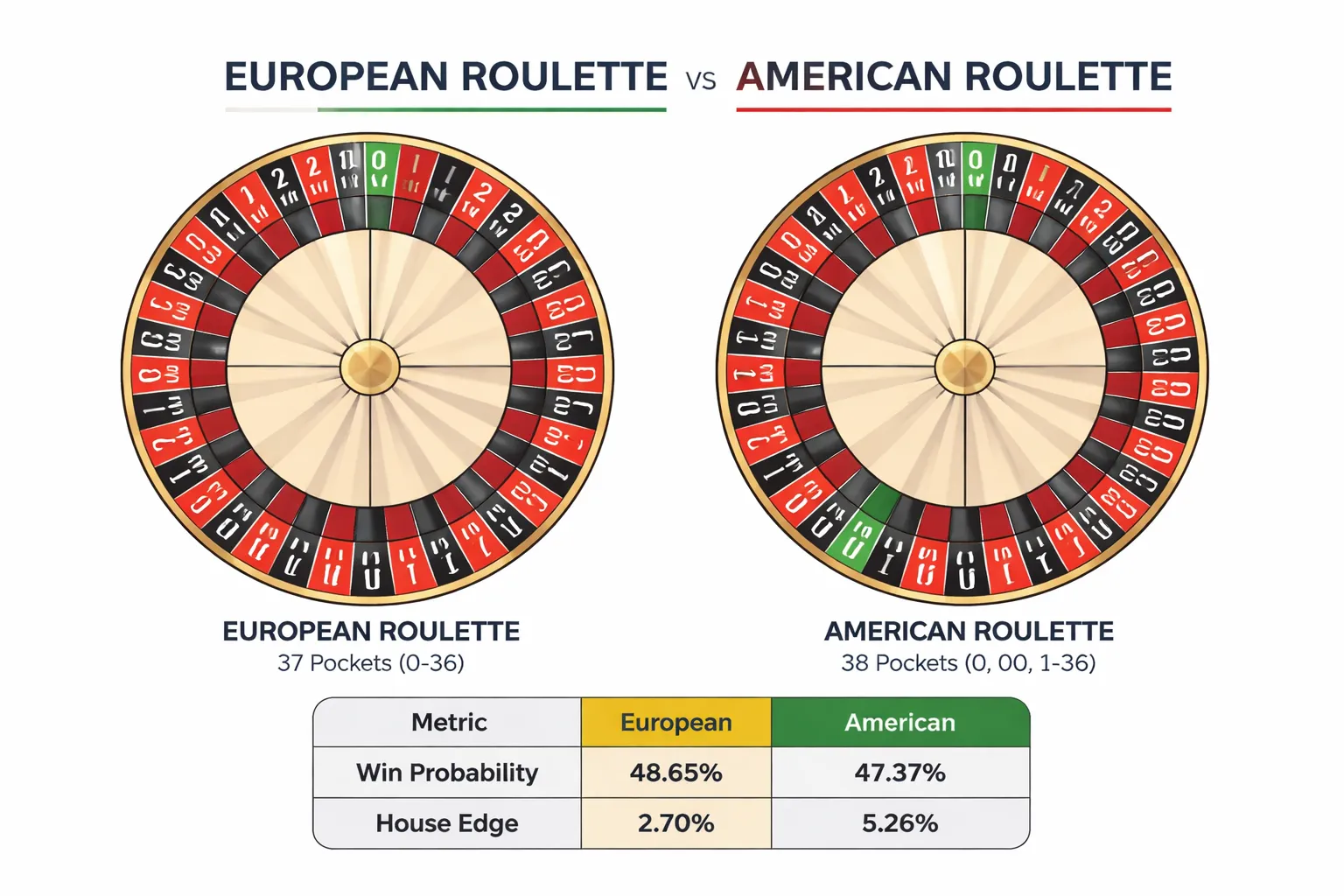
Odds vs house edge vs expected value
Odds tell you how often a bet wins. In roulette, that comes from the number of winning pockets divided by total pockets.
House edge tells you how much the casino expects to keep over time, as a percentage of your total bets. It comes from paying you less than the true odds justify.
Expected value (EV) is your average result per bet over the long run. In roulette, EV is always negative because payouts do not match the true probabilities.
Roulette uses fixed payouts. The wheel changes the probabilities. That mismatch drives the house edge. If you want the full background on how casinos measure this, see our RNG and house edge explainer.
How the extra 00 pocket changes every bet
European roulette has 37 pockets, numbers 0 to 36.
American roulette has 38 pockets, numbers 0 to 36, plus 00.
Most payouts stay the same in both games. The extra 00 does not add a new way to win on standard bets. It only adds a new way to lose.
- Straight up (single number) still pays 35:1.
- Red or black still pays 1:1.
- Dozen and column still pay 2:1.
Your win probability drops because the denominator increases from 37 to 38. Your payout does not increase to compensate. That gap raises the house edge on every standard bet.
Quick comparison
| Game | Pockets | Example bet | Win probability | House edge | Best for |
|---|---|---|---|---|---|
| European roulette | 37 (0 to 36) | Red | 18/37 = 48.65% | 1/37 = 2.70% | Lower cost per spin, longer bankroll life |
| American roulette | 38 (0 to 36, 00) | Red | 18/38 = 47.37% | 2/38 = 5.26% | Avoid if you can, higher edge on the same bets |
The key change is simple. American roulette adds one extra losing pocket while keeping payouts the same. Over many spins, that difference compounds. Your bankroll drains faster.
Wheel Layout and Pocket Count: The Core Difference
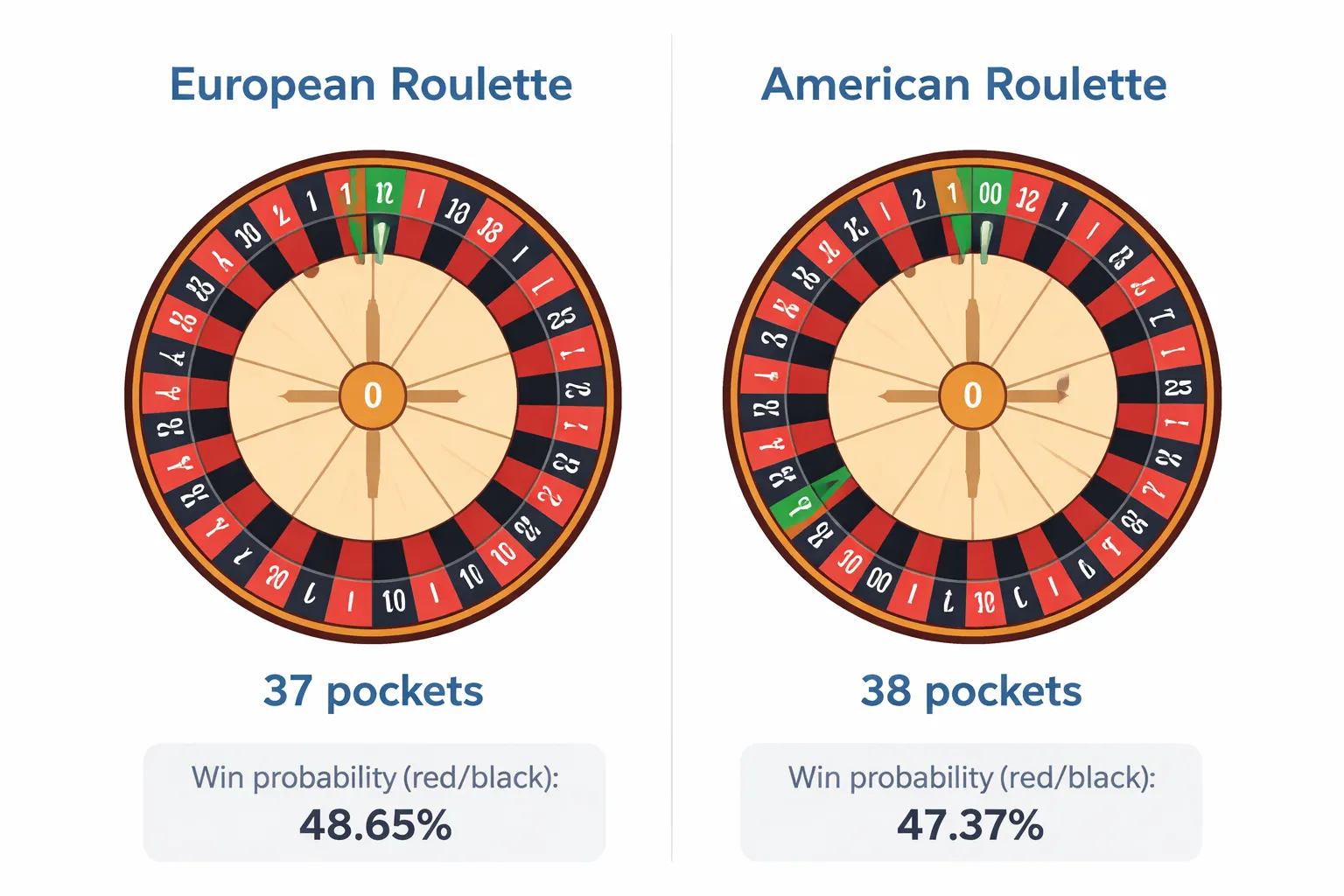
European wheel basics, 0 to 36
A European wheel has 37 pockets. Numbers 1 to 36 plus a single 0.
Every pocket has the same chance on each spin, 1/37, or 2.70%.
That single 0 drives the house edge. It turns many “even money” bets into slight losers over time.
- Red or black: 18 winning pockets out of 37. Win chance 48.65%.
- Odd or even: 18 winning pockets out of 37. Win chance 48.65%.
- High (19 to 36) or low (1 to 18): 18 winning pockets out of 37. Win chance 48.65%.
With standard payouts, the European house edge sits at 2.70% on most bets. That is the cost of the 0.
American wheel basics, 0 to 36 plus 00
An American wheel has 38 pockets. Numbers 1 to 36 plus 0 and 00.
Each pocket has a 1/38 chance, or 2.63%. Your problem is that you now face two zero pockets that usually make you lose.
The payouts do not improve to match the extra losing pocket. Your long-term results get worse on the same bets.
- Red or black: 18 winning pockets out of 38. Win chance 47.37%.
- 0 and 00: 2 pockets out of 38. Lose on most outside bets 5.26% of the time.
That change lifts the house edge to 5.26% on most bets. You pay almost double per spin compared to European roulette.
Number order myths, sequence does not change the math
The order of numbers around the wheel does not change the odds. Pocket count sets the probabilities.
Clusters like “hot” sections and patterns like “due numbers” do not alter the next spin. Each spin still lands on one pocket out of 37 or 38.
The layout can affect your perception and your bet choice, not the underlying math. Focus on the wheel type first, then the bet.
House Edge Comparison: European vs American Roulette
House edge math, in plain terms
House edge is your average loss over time, shown as a percentage of what you bet.
If the house edge is 2.70%, you lose about $2.70 per $100 wagered on average. If it is 5.26%, you lose about $5.26 per $100 wagered.
The bet type does not change the house edge in standard roulette. It changes volatility. You still pay the same edge on average.
European roulette house edge (2.70%), where it comes from
European roulette has 37 pockets, numbers 1 to 36 plus a single 0.
Most even money bets pay 1 to 1. The true odds are 18 winning pockets out of 37.
You win 18 times out of 37 and lose 19 times out of 37.
Your expected result per $1 on an even money bet is:
(18/37 x $1) - (19/37 x $1) = -1/37 = -2.70%
That single 0 creates the edge. Without it, the game would be fair.
American roulette house edge (5.26%), the hidden cost of 00
American roulette has 38 pockets, numbers 1 to 36 plus 0 and 00.
Even money bets still pay 1 to 1. The true odds are 18 winning pockets out of 38.
You win 18 times out of 38 and lose 20 times out of 38.
Your expected result per $1 on an even money bet is:
(18/38 x $1) - (20/38 x $1) = -2/38 = -5.26%
The 00 does not change payouts. It only adds another losing pocket. That doubles the edge.
Expected loss examples by bankroll size
| Total amount wagered | European (2.70%) expected loss | American (5.26%) expected loss | Extra cost of American |
|---|---|---|---|
| $100 | $2.70 | $5.26 | $2.56 |
| $500 | $13.50 | $26.30 | $12.80 |
| $1,000 | $27.00 | $52.60 | $25.60 |
| $5,000 | $135.00 | $263.00 | $128.00 |
| $10,000 | $270.00 | $526.00 | $256.00 |
If you care about value, pick the wheel with one zero. If you want even better odds across casino games, see our low house edge games ranked.
Odds by Bet Type: How Probabilities and Payouts Compare
Inside Bets Overview
Inside bets cover specific numbers and small groups. You get higher payouts, but you win less often.
- Straight up, 1 number.
- Split, 2 numbers.
- Street, 3 numbers.
- Corner, 4 numbers.
- Six-line, 6 numbers.
Outside Bets Overview
Outside bets cover larger groups. You win more often, but payouts stay small.
- Red or Black, 18 numbers.
- Odd or Even, 18 numbers.
- High or Low (1 to 18, 19 to 36), 18 numbers.
- Dozens (1 to 12, 13 to 24, 25 to 36), 12 numbers.
- Columns, 12 numbers.
European vs American Win Probabilities, With Formulas
European roulette has 37 pockets. American roulette has 38 pockets.
Your win probability uses the same rule for every bet.
- European probability = numbers covered / 37
- American probability = numbers covered / 38
Payouts do not change between wheels. The wheel size changes your odds.
Roulette Odds Chart, Probability, Payout, House Edge
The house edge stays constant within each wheel because payouts align to 36-to-1 odds, while the wheel includes zero pockets.
- European house edge = 1/37 = 2.70%
- American house edge = 2/38 = 5.26%
| Bet type | Numbers covered | Payout (to 1) | Win probability (European) | Win probability (American) | House edge (European) | House edge (American) |
|---|---|---|---|---|---|---|
| Straight up | 1 | 35 | 1/37 = 2.70% | 1/38 = 2.63% | 2.70% | 5.26% |
| Split | 2 | 17 | 2/37 = 5.41% | 2/38 = 5.26% | 2.70% | 5.26% |
| Street | 3 | 11 | 3/37 = 8.11% | 3/38 = 7.89% | 2.70% | 5.26% |
| Corner | 4 | 8 | 4/37 = 10.81% | 4/38 = 10.53% | 2.70% | 5.26% |
| Six-line | 6 | 5 | 6/37 = 16.22% | 6/38 = 15.79% | 2.70% | 5.26% |
| Red or Black | 18 | 1 | 18/37 = 48.65% | 18/38 = 47.37% | 2.70% | 5.26% |
| Odd or Even | 18 | 1 | 18/37 = 48.65% | 18/38 = 47.37% | 2.70% | 5.26% |
| High or Low | 18 | 1 | 18/37 = 48.65% | 18/38 = 47.37% | 2.70% | 5.26% |
| Dozen | 12 | 2 | 12/37 = 32.43% | 12/38 = 31.58% | 2.70% | 5.26% |
| Column | 12 | 2 | 12/37 = 32.43% | 12/38 = 31.58% | 2.70% | 5.26% |
If you want better value, your main lever is the wheel. The bet type changes variance, not the built-in edge. For alternatives, see our low house edge games ranked.
Even-Money Rules That Improve European Roulette Odds
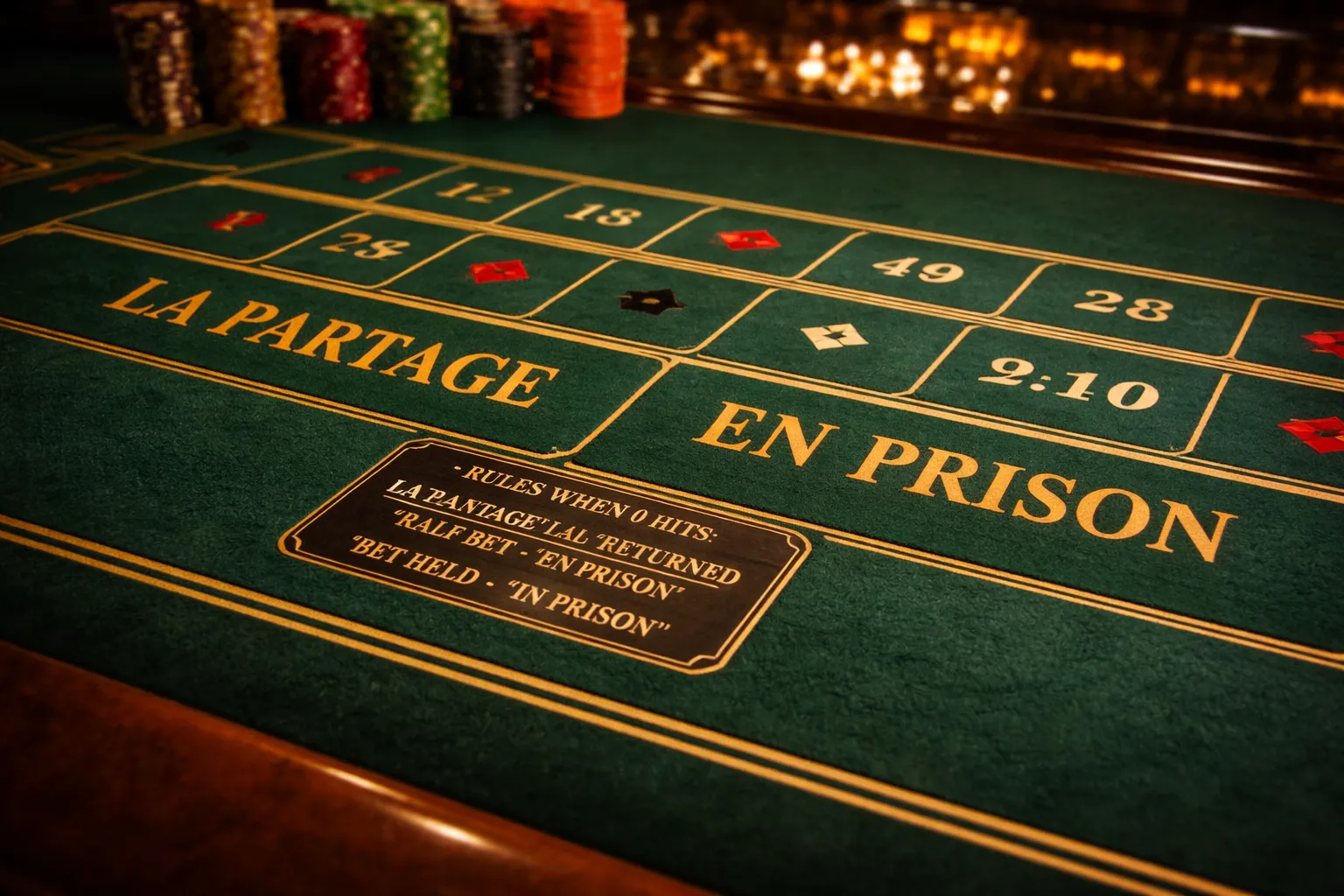
La Partage: the simplest odds boost on even-money bets
La Partage applies to even-money bets on European roulette, red or black, odd or even, high or low.
If the ball lands on 0, you lose only half your stake. The casino keeps the other half.
That single change cuts the house edge on qualifying bets from 2.70% to 1.35%.
| Bet type | Standard European edge | With La Partage | Applies to |
|---|---|---|---|
| Even-money (red/black, odd/even, 1-18/19-36) | 2.70% | 1.35% | Only when 0 hits |
En Prison: similar value, different mechanics
En Prison also targets even-money bets. It triggers when the ball lands on 0.
Instead of losing half right away, your even-money bet gets “imprisoned” for the next spin.
- If your bet wins on the next spin, you get your stake back. No profit.
- If it loses on the next spin, you lose the full stake.
- If 0 hits again, many tables keep the bet imprisoned again. Rules vary.
With standard handling, En Prison produces the same effective edge as La Partage on even-money bets, 1.35%.
If the table uses harsher handling on repeat 0 results, your effective edge can rise. Read the rule card.
Effective house edge with these rules
La Partage and En Prison help only the even-money bets.
They do not change the edge on dozens, columns, streets, corners, splits, or straight-up numbers.
| Bet | Qualifies | Effective edge on a single-zero wheel |
|---|---|---|
| Red or Black | Yes | 1.35% with La Partage or En Prison |
| Odd or Even | Yes | 1.35% with La Partage or En Prison |
| 1-18 or 19-36 | Yes | 1.35% with La Partage or En Prison |
| Dozen, Column | No | 2.70% |
| All inside bets | No | 2.70% |
If you plan to play even-money bets for lower variance, these rules give you the only meaningful edge reduction inside roulette. For other low-edge options, see our low house edge games ranked.
How to spot La Partage or En Prison in casinos and online
- Table signage: Look for “La Partage” or “En Prison” printed on the felt near the even-money areas.
- Rule plaque: Many casinos post a small rule card on the table. Check the 0 rule for even-money bets.
- Dealer confirmation: Ask what happens to red or black when 0 hits. You want “half back” or “imprisoned.”
- Online game info: Open the rules or info panel. Search for “La Partage,” “En Prison,” or “zero rules.”
- Provider variants: Some games label this as “French Roulette.” Verify the rule text, not the name.
Short-Term Results vs Long-Term Odds: What Players Actually Experience
Variance in Roulette, Why You Can Win Short-Term
Roulette has a house edge, but outcomes swing. That swing is variance.
In a short session, luck can beat the math. You can hit a few winners early and leave ahead. This happens more often on bets with frequent hits, like red, black, or dozens. It also happens on rare-hit bets when you spike a big payout, like a straight-up number.
Variance does not remove the edge. It delays it.
Sample Size, When the Edge Starts to Show
The house edge works per unit bet. It does not need a specific number of spins to exist. It needs spins to become visible.
Use expected loss as a simple guide:
- European roulette (single zero): about 2.70 units lost per 100 units wagered.
- American roulette (double zero): about 5.26 units lost per 100 units wagered.
If you bet 1 unit per spin, your long-run expectation looks like this:
Your actual result can sit far above or below those numbers. The longer you play, the more the average tends to drift toward them.
Bankroll Risk, Volatility by Bet Type
Bet choice changes volatility more than it changes the edge. The wheel still keeps its advantage.
- Outside bets (red or black, odd or even, high or low): smaller swings. More frequent small wins. Longer stretches where your bankroll moves slowly.
- Medium bets (dozens, columns): wider swings. Longer losing runs can hit. Wins come less often but pay more.
- Inside bets (straight-up, split, street, corner): high swings. You can lose many spins in a row. A hit can reset the session fast.
If you want fewer bankroll shocks, you trade payout size for hit frequency. If you chase bigger payouts, you accept longer droughts.
Common Misconceptions, Due Numbers and Streaks
- “A number is due”: past spins do not change future odds. Each spin stays independent.
- “Streaks must end”: a long run of red does not make black more likely on the next spin. You just notice the run because it feels rare.
- Gambler’s fallacy: you increase bets because you expect the wheel to correct itself. This raises bankroll risk without improving your odds.
If you want lower long-term cost, you pick the wheel with the smaller edge. European roulette usually wins. If it offers La Partage or En Prison on even-money bets, your long-run cost drops further.
Which Roulette Is Better for Different Player Goals?
Best for lowest cost of play, maximizing time at the table
Your main lever is house edge. Lower edge means you lose slower over time.
- Best default pick: European roulette (single zero). House edge is 2.70%.
- Worst common pick: American roulette (double zero). House edge is 5.26%.
- Best case for even-money bets: European with La Partage or En Prison. House edge on red, black, odd, even, high, low drops to about 1.35%.
Even-money bets also keep swings smaller than most inside bets, so your bankroll lasts longer at the same stake.
Best for high volatility thrills, larger swings vs smoother sessions
If you want bigger short-term swings, you change bet type more than you change wheel type.
- Higher volatility: straight up, split, street, corner. You hit less often, you see longer losing runs, your balance jumps when you land a win.
- Lower volatility: outside bets like red, black, odd, even, high, low. You hit more often, sessions feel smoother.
- Wheel choice still matters: American roulette pays the same but hits zeros more often, so you take more frequent losses. That raises cost, not excitement.
If you want action without doubling your long-run cost, play European roulette and use smaller units on inside bets.
Best for beginners, simplest bets with the most stable variance
Start with bets that are easy to track and easy to size.
- Use outside bets: red, black, odd, even, high, low.
- Prefer European roulette: lower edge reduces your learning cost.
- If available, use La Partage or En Prison: it protects you on even-money bets when zero hits.
- Avoid progressive systems: they do not change the edge and they can spike your required bankroll fast.
If you want a quick map of bet types and how they behave, use this roulette bet types breakdown.
Best for advantage-style approaches, what “best available odds” really means
Roulette rarely offers a real player edge. The payouts sit below the true odds, so the house keeps an edge on every bet.
- No betting pattern fixes the math: changing stakes changes variance, not expectation.
- The “best available odds” goal means: pick the lowest house edge game rules you can find.
- Best practical target: European single-zero with La Partage or En Prison on even-money bets.
- Avoid “special” wheels with extra pockets: any extra zero-style pocket raises the house edge.
If you want games where skill can matter, blackjack gives you more control over expected value than roulette.
Practical Checklist: How to Choose the Best Roulette Game (Online or Casino)
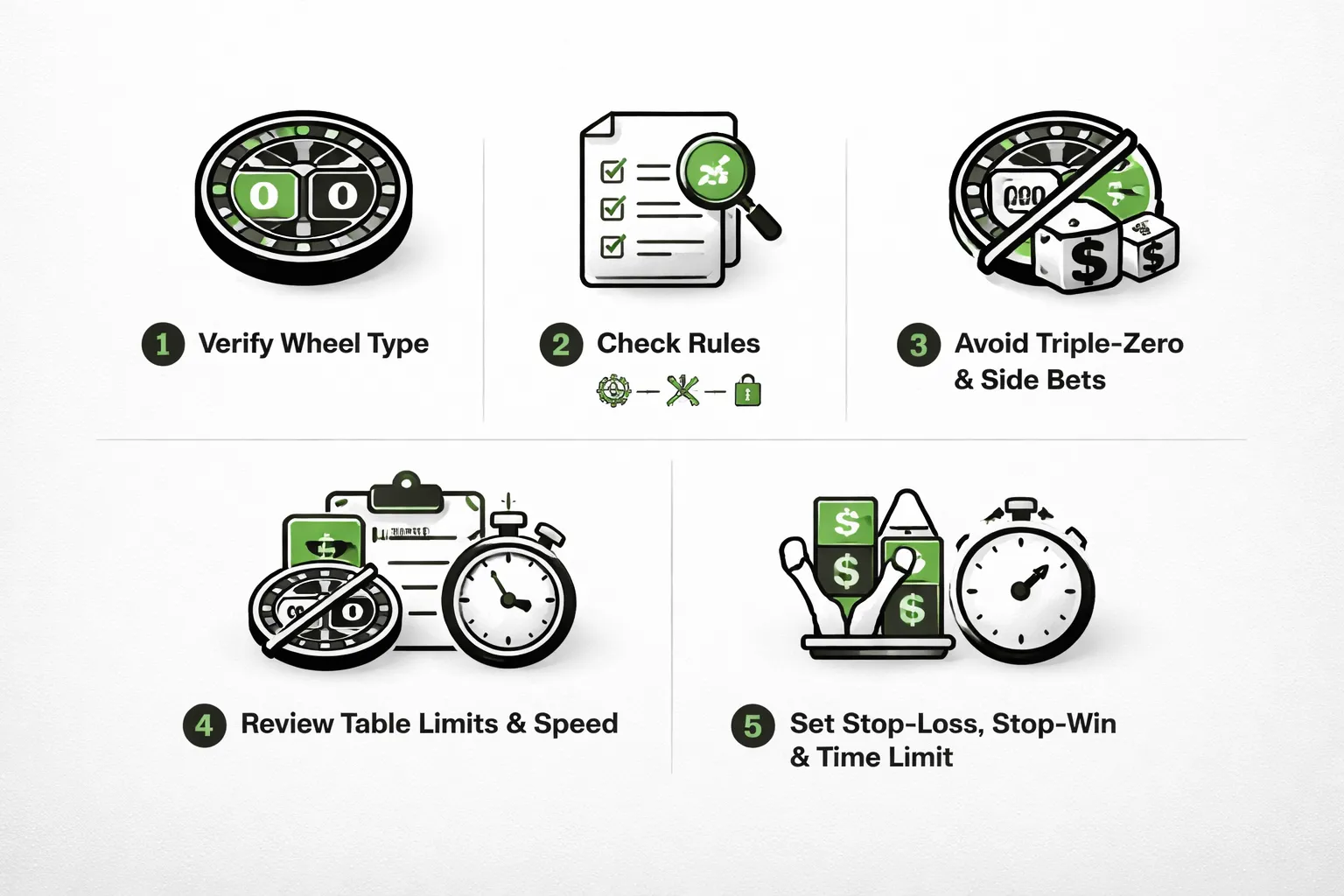
How to Confirm Wheel Type Before You Bet
- Look at the wheel first. Count the zero pockets. European has 0. American has 0 and 00.
- Online RNG game. Open the info, rules, or paytable tab. Find the wheel description. It should say European (single zero) or American (double zero).
- Live dealer game. Check the table name, the help tab, and the wheel view. Many studios label “European Roulette” or “American Roulette.” Verify anyway.
- Confirm the even-money rules. Look for La Partage or En Prison. If you do not see it, assume standard rules.
RNG vs Live Dealer Roulette: What Changes, and What Does Not
- The house edge comes from the rules, not the format. A single-zero wheel still beats a double-zero wheel, whether RNG or live.
- RNG games run faster. More spins per hour means your expected loss can stack faster at the same stake.
- Live dealer games run slower. Slower pace can reduce how much you cycle through the game in a session.
- Randomness is not your edge. Both formats keep the same payout structure. You still face the same math.
Beware of Extra-Zero Variants and Side Bets
- Avoid triple-zero and “special” wheels. 0-00-000 raises the house edge versus standard American roulette.
- Do not get distracted by branding. “Speed,” “VIP,” “Lightning,” and “Power” often add extra bets or rule tweaks that cost you.
- Watch for side bets. Many carry high house edges compared with core inside and outside bets.
- Check the paytable. If a side bet payout looks exciting, confirm the odds and the house edge before you place it.
Table Limits, Bet Minimums, and Speed of Play
Your expected loss scales with three levers, house edge, average bet, and number of spins. Use them to control damage.
| Factor | What to check | Why it matters |
|---|---|---|
| Table minimum | Base chip size and minimum bet per spin | Higher minimum forces higher average bet, your expected loss rises linearly |
| Table maximum | Max per bet type and max total per spin | Limits stop you from raising stakes to chase losses |
| Bet type limits | Max on straight up, splits, corners, outside bets | Can block your preferred staking plan and push you into higher variance bets |
| Game speed | Approx spins per hour, autoplay options | Faster games burn bankroll faster at the same average bet |
- Use a simple expected loss check. Expected loss = house edge × average bet × spins. Lower any of the three.
- Avoid autoplay if you chase volume. Autoplay makes it easy to double your spins without noticing.
- Pick limits that match your bankroll. If the minimum forces you to risk more than 1 to 2 percent of your session bankroll per spin, change tables.
Responsible Play Checklist for Roulette Sessions
- Set a hard stop-loss. Choose a number you can afford to lose. Stop when you hit it.
- Set a stop-win. Lock profit by ending the session when you reach your target.
- Set a time cap. Decide your session length before you start. Use a timer.
- Do not chase. If you feel pressure to raise stakes to get even, stop.
- Plan your next game choice. If you want better control over expected value, use a basic strategy approach in blackjack, see blackjack basic strategy.
FAQ
Which roulette has better odds, European or American?
European roulette gives you better odds. It has one zero, so the house edge is 2.70%. American roulette has two zeros, so the house edge is 5.26%. Over time, that difference cuts your expected loss almost in half.
Does the American wheel pay higher to offset the extra zero?
No. Payouts stay the same. A straight-up number still pays 35 to 1. The extra 00 pocket only lowers your win probability. That is why American roulette costs more per spin in expected value.
Do outside bets have better odds than inside bets?
Outside bets win more often, but the house edge stays the same within a given wheel type. On European roulette, every standard bet has a 2.70% house edge. On American roulette, every standard bet has a 5.26% house edge.
What are the exact odds for a straight-up bet?
European straight-up wins 1 in 37 spins, 2.70%. American straight-up wins 1 in 38 spins, 2.63%. You still get paid 35 to 1 either way, so the expected return drops on the American wheel.
What are the exact odds for red or black?
European red or black wins 18 in 37 spins, 48.65%. American red or black wins 18 in 38 spins, 47.37%. The zero, and 00 in American, is the reason you lose more often than a true 50-50 bet.
Is there any roulette strategy that beats the house?
No. Betting systems change variance, not expected value. Martingale and similar progressions do not remove the house edge, they increase bankroll risk. Your best control is game selection, pick European over American, and manage session limits.
What is the “en prison” rule, and does it help?
On some European tables, even-money bets that lose to zero get held for one spin. If your bet wins next spin, you get it back. This lowers the house edge on even-money bets from 2.70% to about 1.35%.
What is the “la partage” rule, and does it help?
On some European tables, if an even-money bet loses to zero, you get half your stake back. This also drops the house edge on even-money bets to about 1.35%. It does not change the edge on most inside bets.
Is the order of numbers on the wheel important for odds?
No. The wheel sequence does not change probabilities. Each pocket stays the same chance per spin, if the wheel is fair. Focus on the number of zero pockets and the table rules, since those drive expected value.
Where can you learn the roulette bet types and their odds?
Use this guide on roulette bet types and odds to compare inside and outside bets fast. It helps you match hit rate, payout, and bankroll swings to your session plan.
Conclusion
Conclusion
European roulette gives you better odds than American roulette. The single zero wheel has a 2.70% house edge. The double zero wheel has a 5.26% house edge.
If you can choose the game, pick European roulette. If the casino only offers American roulette, look for rules that soften the zero, like En Prison or La Partage.
- Best default move: Play European roulette, single zero.
- Rule check: Prioritize En Prison or La Partage on even money bets.
- Bet selection: Stick to outside bets if you want lower swings, use inside bets only if you accept higher volatility.
- Session control: Set a stop loss and a win cap, then leave when you hit either one.
If you want a game with a built in low house edge, compare roulette to baccarat in this baccarat odds guide.
-
Online Casino Fairness Explained: RNG, RTP, House Edge & Provably Fair
8 months ago -
Slot RTP Explained: What RTP Means and How to Use It
8 months ago -
How to Play Online Slots: Rules, Features & Beginner Tips
8 months ago -
How Slot Jackpots Work: Progressive Jackpots Explained
8 months ago -
How to Play Online Blackjack: Rules, Payouts & Quick Start Guide
8 months ago
-
- Which roulette has better odds, European or American?
- Does the American wheel pay higher to offset the extra zero?
- Do outside bets have better odds than inside bets?
- What are the exact odds for a straight-up bet?
- What are the exact odds for red or black?
- Is there any roulette strategy that beats the house?
- What is the “en prison” rule, and does it help?
- What is the “la partage” rule, and does it help?
- Is the order of numbers on the wheel important for odds?
- Where can you learn the roulette bet types and their odds?
-
- Which roulette has better odds, European or American?
- Does the American wheel pay higher to offset the extra zero?
- Do outside bets have better odds than inside bets?
- What are the exact odds for a straight-up bet?
- What are the exact odds for red or black?
- Is there any roulette strategy that beats the house?
- What is the “en prison” rule, and does it help?
- What is the “la partage” rule, and does it help?
- Is the order of numbers on the wheel important for odds?
- Where can you learn the roulette bet types and their odds?
-
Reload Bonus Explained: What It Is and When It’s Worth Claiming
6 months ago -
Online Casino Licensing Explained: Authorities, Licenses & How to Check One
8 months ago -
Best Live Dealer Casinos: Where to Play Live Blackjack, Roulette & More
8 months ago -
Best Online Casinos for High Rollers: VIP Perks, High Limits & Exclusive Bonuses
8 months ago -
Fast Payout Online Casinos: Best Sites for Quick Withdrawals
8 months ago
-
Online Casino Customer Support: What to Look For (Live Chat, Email, Response Times)
8 months ago -
Sign Up for an Online Casino: Create an Account in Minutes
8 months ago -
Online Casino Payment Safety Tips: How to Deposit and Withdraw Securely
8 months ago -
What to Do If an Online Casino Won’t Pay Out: Step-by-Step Actions
8 months ago -
How to File a Complaint Against an Online Casino (Plus ADR Explained)
8 months ago