Baccarat Rules & Odds Explained: Best Bets and Common Myths
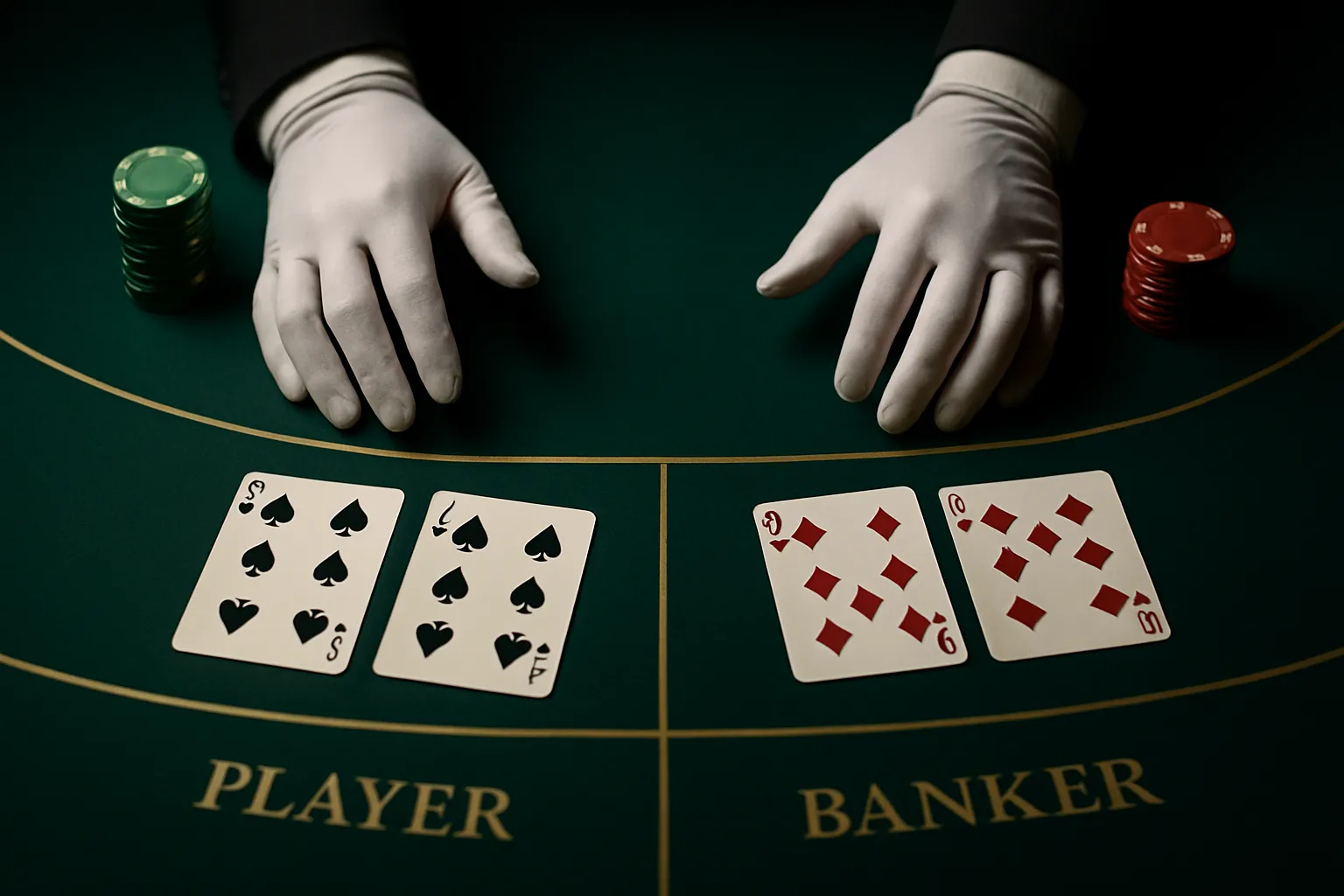
Baccarat looks complex. It is not. You bet on Banker, Player, or Tie. The dealer follows fixed drawing rules. Your only real choice is which bet to place and how much.
This guide breaks down baccarat rules, payouts, and odds. You will learn the house edge for each main bet, why Banker usually wins in the long run, and when Tie and side bets hurt your bankroll. You will also see common myths that push bad decisions, like “patterns” and “streak systems.”
If you play online, the odds stay the same. The deal speed changes. Learn what to expect from live tables in our live casino guide.
Key Takeaways
- In het kort: Bet on Banker for the lowest house edge, use Player as your backup, and avoid Tie and most side bets.
- Banker has the best long-run odds because the third-card rules help it slightly more often.
- Banker pays 1:1 minus commission, usually 5%. The commission is why it still stays the best main bet.
- Player pays 1:1. Its house edge is higher than Banker but still low compared to many casino games.
- Tie pays high but hits rarely. Its house edge is much worse than Banker and Player.
- Side bets vary by table. Most come with a high house edge and large swings. Treat them as entertainment, not strategy.
- Past results do not change the next hand. Patterns, streak systems, and shoe “reads” do not beat the math.
- Online baccarat uses the same rules and odds as land-based tables. Live dealer games mainly change pace, not probabilities.
What Baccarat Is (and Why Odds Matter)
Goal of the game
You bet on which hand ends closest to 9, Player or Banker, or you bet on a Tie.
Where baccarat sits among casino games
Baccarat gives you a low house edge on the two main bets. It also gives you high variance if you chase side bets and long-odds payouts.
- Player and Banker stay near the best odds you will find in table games.
- Tie and most side bets cost more in house edge and swing your results harder.
- You cannot change decisions during the hand in most casino versions, so your edge comes from bet choice, not tactics.
If you want a game where decisions change your odds, see our blackjack basic strategy chart.
Common formats you will encounter
- Punto Banco. The casino runs the game. The drawing rules stay fixed. You only choose your bet, Player, Banker, or Tie.
- Chemin de Fer. Players take turns acting as the bank. Some choices can vary by house rules, but the core scoring stays the same.
- Baccarat Banque. One player holds the bank for longer stretches. The table structure changes, but the scoring and draw logic stay close to the same family of rules.
Most online and most casino baccarat you see today uses Punto Banco rules. When people say “baccarat odds,” they usually mean Punto Banco.
What “rules and odds explained” should include
You need four things to understand baccarat results and money swings.
- Probabilities. How often Player, Banker, and Tie happen under fixed drawing rules.
- Payouts. What the casino pays for each bet, including Banker commission if the table uses it.
- House edge. The casino advantage after payouts, the single number that tells you what a bet costs long term.
- Variance. How wild your short-term results can get, which matters most on Tie and side bets.
Use odds to pick bets with the lowest house edge. Ignore scoreboards and streak stories. The rules set the probabilities, and the payouts set your expected loss.
Baccarat Setup: Cards, Values, and Table Layout
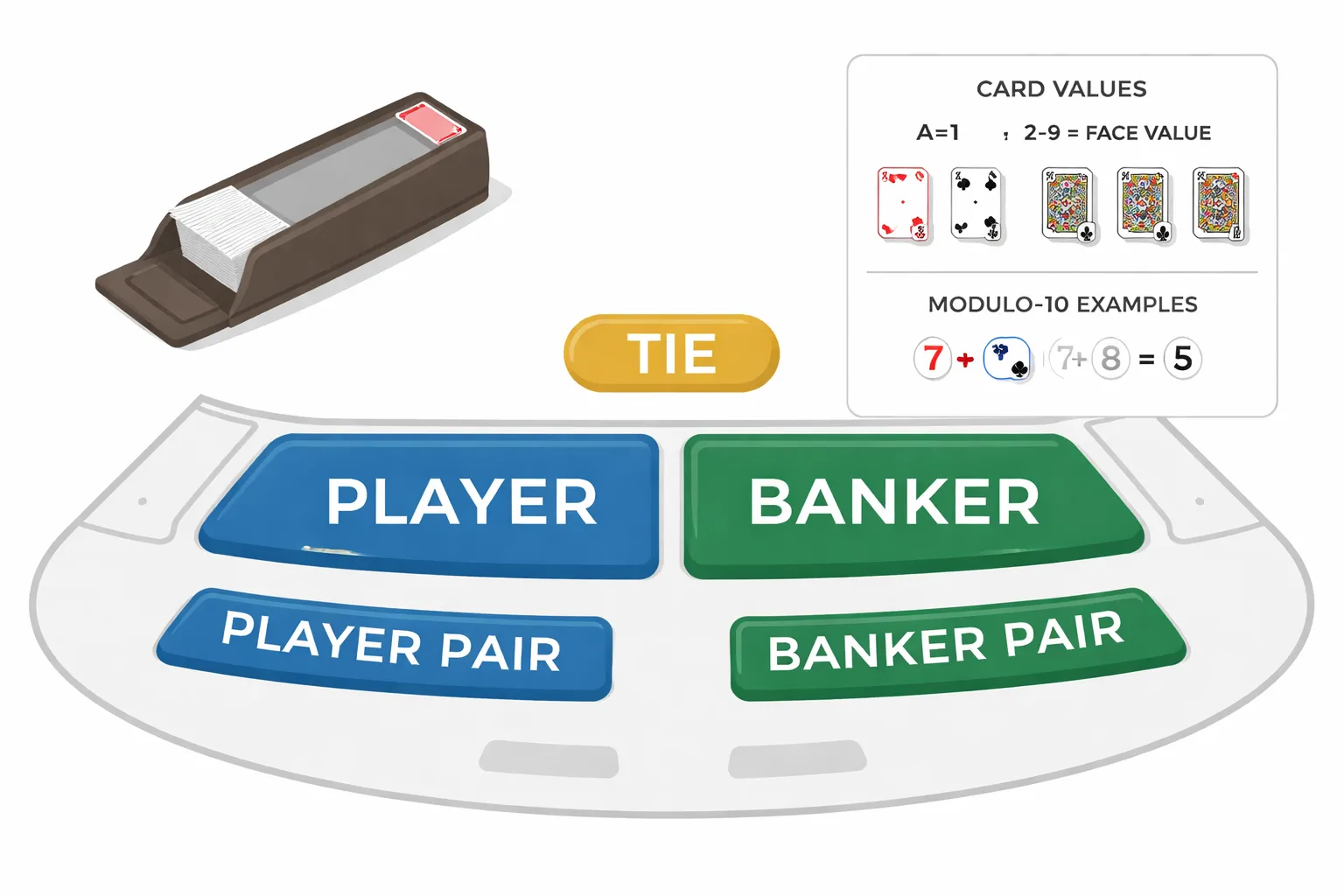
Card values and the modulo 10 total
Baccarat uses standard playing cards.
- A counts as 1.
- 2 to 9 count as their face value.
- 10, J, Q, K count as 0.
Your hand total always lands from 0 to 9. You drop the tens digit. This is modulo 10 scoring.
- 7 + 8 = 15, total is 5.
- 9 + 6 = 15, total is 5.
- 10 + 6 = 6, total is 6.
- K + 9 = 9, total is 9.
The highest total is 9. The lowest is 0, also called a baccarat.
How hands are dealt: two hands, fixed rules
You do not play a hand. You bet on outcomes.
- Player hand wins.
- Banker hand wins.
- Tie pays if both totals match.
The dealer deals two cards to Player and two cards to Banker. A third card may follow. The draw rules are fixed. You make no decisions during the hand.
This matters for odds. You cannot improve your edge with skill. Your only control is bet selection and bankroll sizing. For a quick comparison of how edge works across games, see our guide to RNG, RTP, and house edge.
Number of decks, the shoe, and penetration
Most casinos use 8 decks. Some use 6. Online live tables often use 8.
The dealer deals from a shoe. A cut card goes into the shoe to mark where the deal stops. The portion of the shoe dealt before the cut card ends play is called penetration.
- More penetration means more hands per shoe.
- Penetration does not create a reliable player edge in standard baccarat.
- It can change short-term results because the remaining card mix shifts as cards come out.
Scoreboards and “streak” tracking do not change the next hand. The shoe only affects composition, and the rules still drive the outcomes.
Table layout, minimums, maximums, and what they do to you
A baccarat layout shows three main betting areas: Player, Banker, and Tie. Many tables also list side bets. Side bets vary by casino, so always read the printed paytable.
Limits shape your risk more than your strategy.
- Minimums set your cost per decision. Higher minimums increase your hourly expected loss because you risk more each hand.
- Maximums cap how far you can press an advantage-free run. They also stop you from “chasing” with bigger bets, which helps your bankroll.
- High-variance bets like Tie and many side bets swing harder. Limits can drain your bankroll faster because downswings get large relative to your remaining funds.
If you want steadier results, keep your bet size small relative to your bankroll and stick to the main bets. Limits decide whether that plan is possible at your table.
Core Baccarat Rules: How a Hand Plays Out
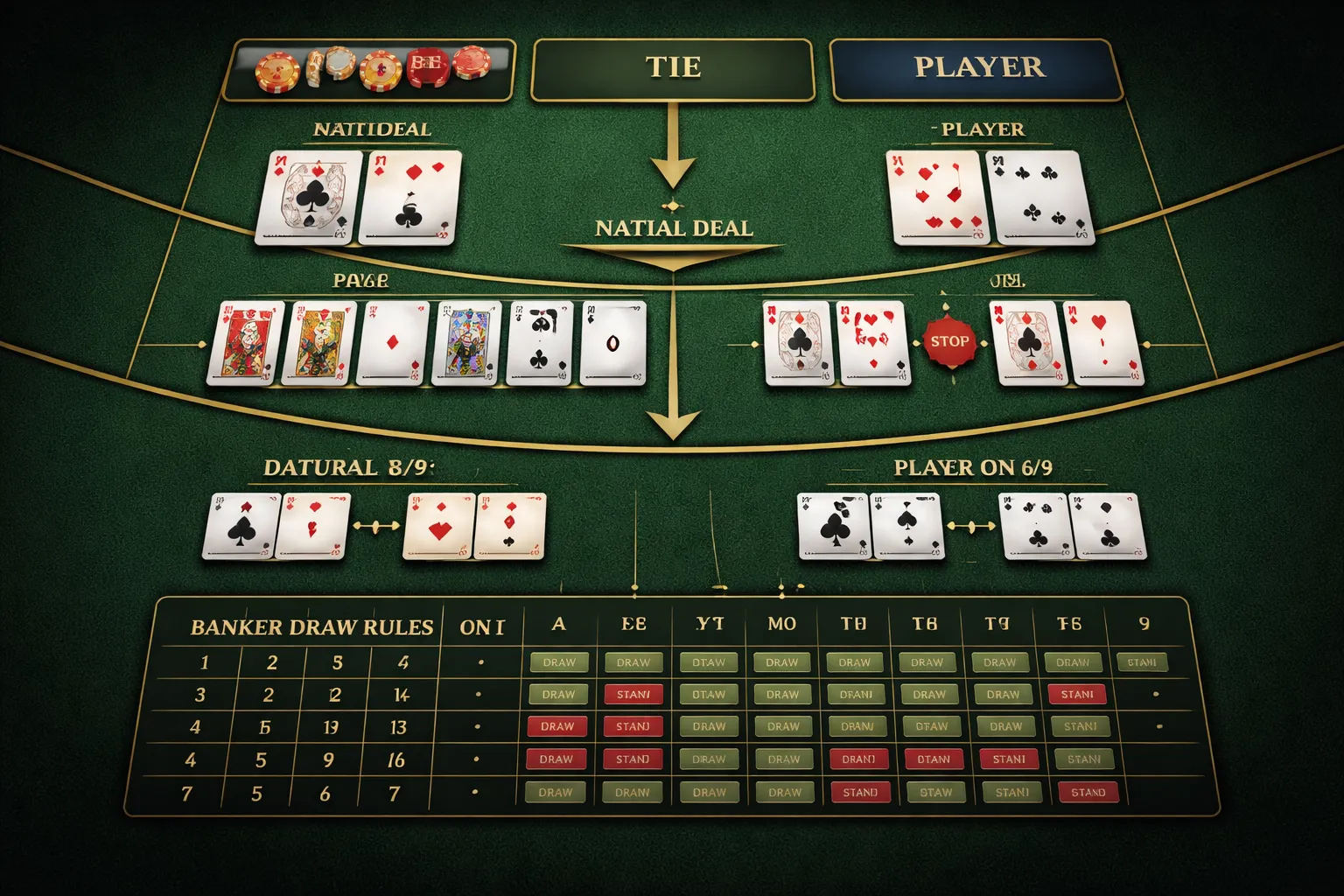
Placing Bets: Banker, Player, Tie, and Side Bets
You bet before any cards come out.
- Banker: You bet the Banker hand ends with the higher total. Most casinos pay 1:1, then take a 5% commission on winnings.
- Player: You bet the Player hand ends with the higher total. Pays 1:1.
- Tie: You bet both hands finish with the same total. Typical payout is 8:1 or 9:1, rules vary by casino.
- Common side bets: Banker Pair, Player Pair, Either Pair, Perfect Pair, Big, Small, and various bonus bets. Side bets have higher house edge in most games, check the paytable.
Card Values, Two-Card Totals, and “Naturals”
Baccarat totals run from 0 to 9.
- 2 through 9 count as their number.
- 10, J, Q, K count as 0.
- A counts as 1.
You add the cards and keep only the last digit.
- 7 + 8 = 15, total becomes 5.
- 9 + 6 = 15, total becomes 5.
- 10 + 6 = 6, because the 10 counts as 0.
A natural means a two-card total of 8 or 9 on the initial deal.
When Play Stops Immediately: Natural Resolution
If either hand has a natural, the hand ends right away.
- If one side has 9 and the other does not, that side wins.
- If one side has 8 and the other does not, that side wins.
- If both sides have naturals, you compare totals. If they match, the result is a Tie.
No third-card rules apply when a natural appears.
When Neither Side Has a Natural: How the Winner Gets Decided
If neither side shows 8 or 9 on the first two cards, the game may draw a third card. You do not choose. The rules do.
The sequence works like this.
- Both hands get two cards.
- Player acts first under fixed rules.
- Banker acts second under fixed rules, often based on Player’s third card.
- The higher total wins. Equal totals mean a Tie.
Player third-card rule stays simple.
- If Player has 0 to 5, Player draws a third card.
- If Player has 6 or 7, Player stands.
Banker third-card rules depend on whether Player drew.
- If Player stands on 6 or 7, Banker draws on 0 to 5 and stands on 6 or 7.
- If Player draws a third card, Banker follows a table that uses Banker’s total and Player’s third card.
| Banker total | Banker draws when Player’s third card is | Otherwise |
|---|---|---|
| 0 to 2 | Any card (0 to 9) | Never stands |
| 3 | 0,1,2,3,4,5,6,7,9 | Stands if Player’s third card is 8 |
| 4 | 2,3,4,5,6,7 | Stands if Player’s third card is 0,1,8,9 |
| 5 | 4,5,6,7 | Stands if Player’s third card is 0,1,2,3,8,9 |
| 6 | 6,7 | Stands if Player’s third card is 0,1,2,3,4,5,8,9 |
| 7 | Never | Always stands |
After draws finish, you compare final totals. Banker higher means Banker wins. Player higher means Player wins. Same total means Tie.
If you want the full walk-through with examples, see our online baccarat guide.
Third-Card Drawing Rules (Automatic, Not Optional)
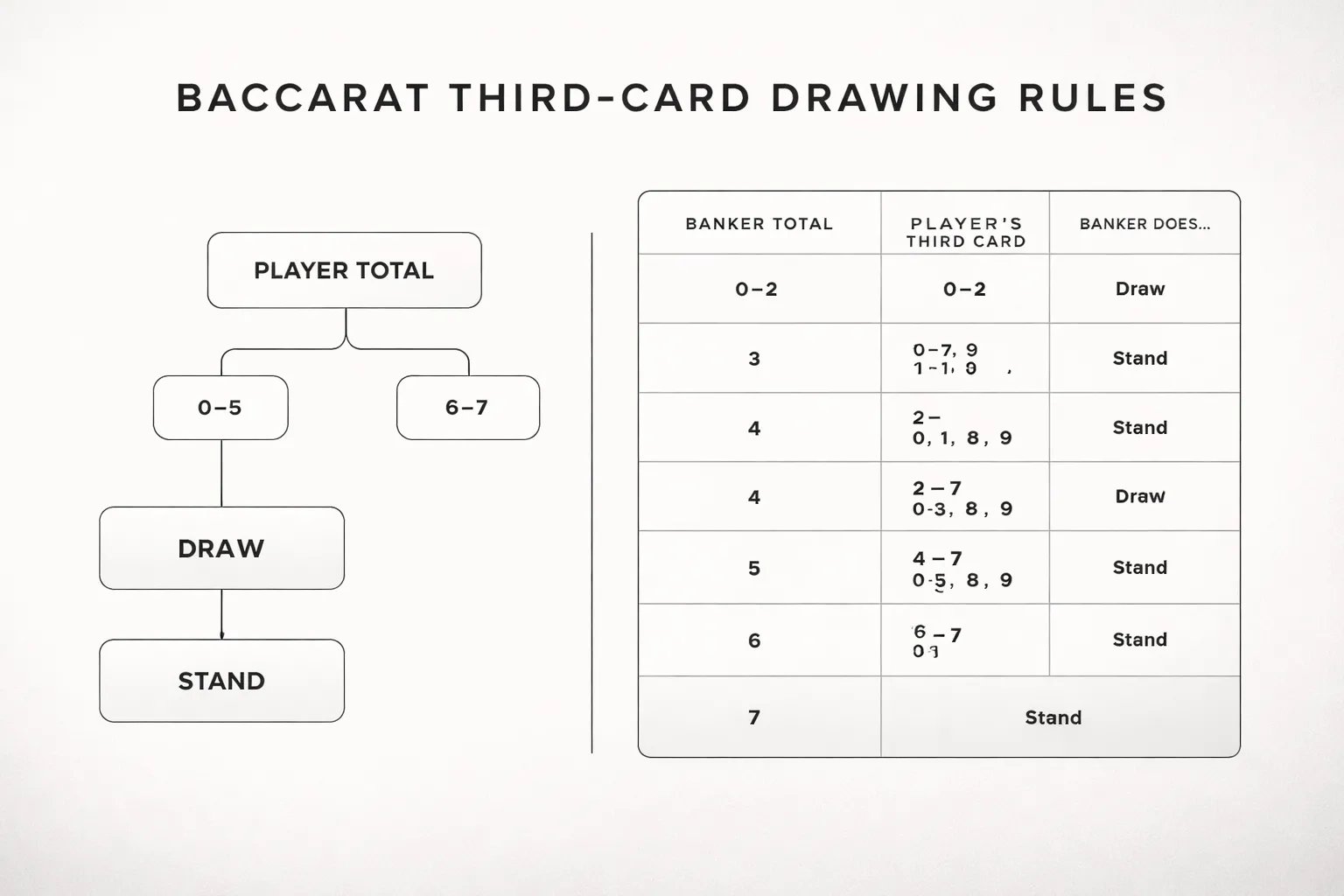
Player Third-Card Rule (Simple)
You do not choose to draw. The rules force it.
- If your Player total is 0 to 5, Player draws one card.
- If your Player total is 6 or 7, Player stands.
- If either hand totals 8 or 9 on the first two cards, it is a natural. Both stand.
Banker Third-Card Rule (Depends on Player’s Third Card)
The Banker hand follows a fixed chart. Your choice does not matter.
- If Player stands on 6 or 7, Banker draws on 0 to 5 and stands on 6 or 7.
- If Player draws, Banker uses Player’s third card to decide.
| Banker total | Banker draws when Player’s third card is | Banker stands when Player’s third card is |
|---|---|---|
| 0,1,2 | Always | Never |
| 3 | 0,1,2,3,4,5,6,7,9 | 8 |
| 4 | 2,3,4,5,6,7 | 0,1,8,9 |
| 5 | 4,5,6,7 | 0,1,2,3,8,9 |
| 6 | 6,7 | 0,1,2,3,4,5,8,9 |
| 7 | Never | Always |
Quick Reference: What to Memorize vs Look Up
- Memorize: Player draws on 0 to 5, stands on 6 to 7, naturals 8 to 9 stop all draws.
- Memorize: Banker draws on 0 to 2, stands on 7.
- Look up: Banker totals 3 to 6. These depend on Player’s third card.
Why These Rules Create the Banker Advantage
The Banker hand acts second. That matters.
- The Banker gets extra information when Player draws. Banker sees Player’s third card before deciding to draw or stand.
- The Banker draw rules protect weak 6 and 7 totals more often than the Player rules do.
- This structure pushes the Banker win rate slightly higher over the long run. The casino then takes a commission on Banker wins to keep its edge.
Payouts Explained: What You Actually Win (and Lose)
Standard payouts: what the table pays
Baccarat payouts look simple. The details change what you keep.
- Player bet: pays 1:1. Bet $10, win $10 profit. You get $20 back total.
- Banker bet: pays 1:1 minus commission. Bet $10, win $10 profit, then the casino takes a fee.
- Tie bet: usually pays 8:1 or 9:1. Bet $10, win $80 or $90 profit, depending on the casino.
Banker commission: how it works and why it exists
The Banker wins slightly more often. The commission removes that advantage from you and gives the house its edge.
- Most common fee: 5% of your Banker win.
- Example: you bet $100 on Banker. Banker wins. Your profit starts at $100. The casino takes $5. You net $95 profit. You receive $195 back total.
- How casinos collect it: some take it every Banker win. Some track it and collect when you leave or when you change bets. Either way, you pay it.
- Why it matters: that small fee is the difference between “Banker is best” and “Banker has no edge for you.”
Pushes and settlements: what happens on a Tie
A Tie changes how other bets settle.
- If you bet Player and the result is Tie: your bet pushes. You get your original stake back. No win, no loss.
- If you bet Banker and the result is Tie: your bet pushes. You get your original stake back. You do not pay commission because you did not win.
- If you bet Tie and the result is Tie: you win at the posted Tie payout, then you also get your original stake back.
Side bet payouts: common structures and why they vary
Side bets come with bigger payouts and bigger house edges. Casinos change payouts because small tweaks swing the math fast.
- Player Pair, Banker Pair: often pays 11:1. Some tables pay 10:1 or 12:1.
- Either Pair: often pays 5:1. Some pay 4:1 or 6:1.
- Perfect Pair (same rank and suit): often pays 25:1 or 30:1.
- Dragon Bonus, Panda 8, Lucky 6: paytables vary by casino and rule set. A small payout cut can turn a “maybe” side bet into a hard no.
Before you place side bets, read the felt or the paytable card. If you want the core bets explained step by step, use this baccarat betting basics guide.
Baccarat Odds and Probabilities (Player vs Banker vs Tie)
True outcome probabilities in standard Punto Banco
Most casino baccarat uses 8 decks and fixed drawing rules. That makes the outcomes stable. You can expect these long-run probabilities:
- Banker wins: about 45.86%
- Player wins: about 44.62%
- Tie: about 9.52%
Ties push Player and Banker bets. They do not count as wins or losses on those bets.
House edge by bet type and how expected value works
Expected value, EV, tells you what you lose on average per unit bet over time.
Use this simple form:
- EV = (win probability × win profit) − (loss probability × loss)
For Player and Banker, treat a tie as a push with 0 profit and 0 loss.
| Bet | Typical payout | Win probability | House edge |
|---|---|---|---|
| Banker | 1:1 minus 5% commission | ~45.86% | ~1.06% |
| Player | 1:1 | ~44.62% | ~1.24% |
| Tie | 8:1 most common, sometimes 9:1 | ~9.52% | ~14.36% at 8:1, ~4.84% at 9:1 |
Practical takeaway. Banker is usually your best core bet. Player sits close behind. Tie costs you fast.
Why Banker is statistically favored even with commission
Banker draws with a small rule advantage. The rules force Banker to take a third card in some spots where Player stands. That improves Banker’s final total slightly more often.
Without commission, Banker would be too strong. The casino charges 5% on Banker wins to pull the edge back into normal range.
Some tables change the commission rule. Example, Banker pays 1:1 except Banker wins with 6, then it pays 1:2. That often raises the house edge. Read the placard before you bet.
Tie bet math, big payout, low hit rate
Tie hits about 1 time in 10. That sounds frequent, but the payout rarely covers the miss rate.
- At 8:1: you risk 1 unit to win 8. You still lose about 0.1436 units per bet on average.
- At 9:1: the math improves, but you still lose about 0.0484 units per bet on average.
If you want low house edge play, stick to Banker or Player. For the core rules and betting flow, use this baccarat betting basics guide.
Best Bets in Baccarat (Evidence-Based Recommendations)
Banker bet: best choice, with one trade-off
The Banker bet gives you the lowest house edge in standard baccarat. In most games, it sits at about 1.06%. That makes it your default “best bet” when your goal is to lose the least over time.
The trade-off is commission. Most casinos pay Banker at 1:1 minus a 5% commission. That means a 1 unit win returns 0.95 units profit.
What to watch for:
- Commission rules. Some tables change the commission, cap it, or use “no commission” Banker pay tables. These changes can raise the house edge.
- Banker 6 rules. In some variants, Banker pays less when it wins with a total of 6. This usually makes the bet worse than standard Banker.
- Bankroll pacing. Lower edge helps, but you still face normal variance. Keep bet sizes steady.
Player bet: slightly higher edge, simpler payout
The Player bet is the cleanest wager. You win 1:1. No commission. No special payout rules on most tables.
The cost is a slightly higher house edge, usually about 1.24%. You pay for simplicity with a small long-run penalty.
Use Player when:
- You want fast, simple settlement and no commission math.
- The table uses a Banker pay rule that worsens Banker enough to narrow or flip the gap.
- You prefer cleaner bankroll tracking, especially with small stakes.
When Tie makes sense (bankroll and entertainment)
Tie looks tempting because it pays big. The math stays bad. In most games, Tie carries a high house edge.
Typical results:
- Tie pays 8:1: house edge about 14.36%.
- Tie pays 9:1: house edge about 4.84%.
Tie can still “make sense” in one narrow way. You treat it as an entertainment spend, not a serious bet. If you do it, use a strict cap.
- Keep Tie bets tiny, like one unit occasionally, not every hand.
- Set a hard limit for the session, then stop.
- Do not chase ties after a streak of near misses.
A simple default betting plan for beginners (rules-first)
- Step 1: Pick one main bet for the whole session. Choose Banker if the table uses standard 5% commission. Choose Player if you want the simplest payout.
- Step 2: Ignore Tie and side bets. Your long-run cost jumps fast when you add them.
- Step 3: Flat bet. Risk the same amount each hand, like 1 to 2% of your bankroll.
- Step 4: Set stop points before you start. Pick a loss limit and a win target, then leave when you hit either one.
- Step 5: Do not follow patterns on the scorecard. It tracks history, it does not predict the next hand.
| Bet | Typical payout | Typical house edge | Best use |
|---|---|---|---|
| Banker | 1:1 minus 5% commission | About 1.06% | Default best value on standard tables |
| Player | 1:1 | About 1.24% | Simplest payout, close to Banker |
| Tie | 8:1 or 9:1 | About 14.36% or 4.84% | Small, capped “for fun” shots only |
Side Bets and Their Odds: What Casinos Don’t Emphasize
Popular side bets and what you really buy
Side bets sit next to Banker, Player, and Tie. They pay big when they hit. They hit less often. The gap becomes casino profit.
- Pair bets. You bet Player or Banker gets a pair on the first two cards. Payouts vary by table.
- Perfect Pair. Same rank and same suit. Higher payout, lower hit rate.
- Big or Small. You bet the hand uses 4 cards total (Small) or 5 or 6 cards (Big). Rules differ by casino.
- Dragon Bonus. You bet Banker or Player wins by a large margin. Bigger margins pay more. Some tables also pay on certain ties.
- Panda 8. Player wins with a 3-card total of 8. Common in EZ Baccarat style games.
Typical house edges for common side bets
Casinos market payouts. They do not highlight the edge. Use ranges because paytables and rule tweaks change results.
| Side bet | Common payout examples | Typical house edge | What to know |
|---|---|---|---|
| Player Pair or Banker Pair | 11:1 (sometimes 10:1) | About 10% to 12% | Lower payouts usually mean a worse edge. |
| Perfect Pair | 25:1 to 30:1 | Often 10% to 15%+ | Big swings, long dry spells. |
| Big or Small | Small 1:1, Big 1:1 (varies) | Often 3% to 8%+ | Edges move a lot with small paytable changes. |
| Dragon Bonus | Tiered, up to 30:1 or 40:1 (varies) | Often 2% to 10%+ | Best-case paytables can look fair, most are not. |
| Panda 8 | 25:1 to 30:1 (varies) | Often 10% to 15%+ | High payout, low frequency. |
Compare that to the main game. Banker sits near 1.06% house edge on standard tables. Many side bets run 5 to 15 times higher.
Volatility and bankroll impact
Side bets feel exciting because they cluster value into rare hits. That creates variance. It also creates faster losses when you bet them every hand.
- More losing streaks. Rare events miss often. Your session swings harder.
- Higher average cost. A 10% edge means you give up about $10 per $100 wagered over time.
- Misleading “big win” memory. You remember the 25:1 hit. You forget the many small losses that funded it.
- Bankroll compression. If you add side bets to every hand, you raise your total action. Your expected loss rises with it.
How to evaluate any side bet quickly
You do not need the full math to protect yourself. You need the paytable and a simple checklist.
- Step 1, get the exact paytable. Do not rely on “up to” signs. Take the printed rules or on-screen help.
- Step 2, check if ties push or lose. Some side bets lose on ties. Some push. That changes the edge.
- Step 3, look for rule quirks. EZ Baccarat rules, commission-free Banker variants, and special Dragon Bonus tie pay rules change outcomes.
- Step 4, estimate the edge band. If the bet pays 25:1 or higher on a rare event, expect a double-digit house edge unless you have proof otherwise.
- Step 5, set a cap. If you still want action, treat side bets like the Tie bet. Small stakes, limited attempts, no chasing.
- Step 6, keep your main stake clean. Put most of your money on Banker or Player. Side bets should not drive your total wager per hand.
If you want a clean foundation for the main bets first, use this online baccarat guide and then decide how much side-bet cost you can accept.
Rule Variants That Change the Odds (and How to Spot Them)
No-Commission Baccarat: the Banker 6 rule changes your payout
Standard baccarat pays Banker at 1:1, then the casino takes a 5% commission. Many tables remove the commission and change the rules instead.
The most common version pays the Banker bet at 1:1, except a Banker win with a total of 6 pays only 1:2.
- What to look for: “No Commission,” “Banker 6 pays 1:2,” or a payout strip that shows a reduced Banker win on 6.
- Why it matters: Your best main bet loses value. The Banker edge gets worse than in standard commission baccarat.
- How to adjust: Still treat Banker and Player as your only serious options, but expect smaller long-run value from Banker compared to the standard game.
EZ Baccarat and other commission alternatives: watch for Banker pushes
EZ Baccarat is a popular no-commission format, but the rule twist can differ by casino. The common change is a push on specific Banker winning totals.
- Most common EZ rule: Banker wins with a total of 7 do not pay. Your Banker bet pushes.
- Other variants exist: Some rooms use different push totals, altered payouts, or combine a reduced payout with a push rule.
- What to look for: “EZ Baccarat,” “Banker 7 pushes,” “No Commission,” or a table placard that lists Banker exceptions.
Do not assume all “no commission” games work the same way. Read the payout and push rules before you buy in.
Tie payout differences: 8:1 vs 9:1 changes the cost
Casinos often change the Tie payout. The difference looks small. The math impact is not.
| Tie payout | What it means for you |
| 8:1 | Higher house edge on the Tie bet, worse value. |
| 9:1 | Lower house edge than 8:1, still a high-edge bet. |
- What to look for: The felt and the side display. Many tables print Tie as “8 to 1” or “9 to 1.”
- Action step: If you insist on Tie, take 9:1 over 8:1 every time, then keep stakes small and attempts capped.
Deck count and penetration: they matter less than most players think
Most baccarat uses 6 to 8 decks. The drawing rules are fixed. That keeps the core odds stable across shoes.
- Deck count: Changing from 6 to 8 decks shifts the Banker and Player edges only slightly. It does not flip the best main bet.
- Penetration: How deep the dealer goes before a shuffle has a small effect on exact probabilities. It rarely creates a practical edge for you.
- What to look for: “6D” or “8D” on signage, and how many cards remain when shuffles happen.
- What matters more: Payout rules. Banker exceptions, Tie payout, and side-bet paytables move your expected cost more than deck count does.
If you want a baseline for standard rules before you compare variants, use this online baccarat guide.
Common Baccarat Myths (and the Real Math Behind Them)
Myth: “Betting systems can beat baccarat”
Progressions do not change the math of a wager. They only change how fast your bet size grows.
Each bet still carries the same expected loss rate, based on the house edge of that bet. If you keep betting longer, your expected loss grows with your total amount wagered.
- Martingale (double after a loss). It assumes you can always double until you win. Table limits and bankroll limits stop you. The rare losing streak creates a huge loss that wipes out many small wins.
- Fibonacci (increase by the sum of the last two steps). It grows slower than Martingale, but it still escalates. A long bad run still forces large bets. The house edge still applies to every unit you wager.
- Labouchere (canceling system). You write a sequence and bet the sum of the ends. Losses make the sequence longer, which increases future bets. You can finish a cycle, but the risk piles up when variance hits.
Real math: If a bet has a negative expected value, changing bet sizes cannot turn it positive. Systems can reshape variance. They cannot remove the house edge.
Myth: “Streaks mean a side is due”
Past outcomes do not create a debt the game must repay.
In standard baccarat, each hand starts from a fresh shuffle state in a way that gives you no usable memory. Even within a shoe, the effect of previous hands on the next hand is too small to support “due” claims in any practical way.
- A long Banker streak does not make Player “more likely” next.
- A run of Players does not “force” a Banker correction.
- A cluster of Ties does not predict another Tie.
Real math: Your best baseline assumption is near independence from hand to hand. The next hand’s probabilities stay close to the long-run probabilities, not the last few results.
Myth: “Scoreboards predict the next hand”
Road maps show history. They do not reveal a hidden pattern.
- Big Road records runs of Banker and Player. It makes streaks easy to see.
- Big Eye Boy, Small Road, Cockroach Pig apply fixed comparison rules to past columns. They convert the same history into different marks.
These displays can help you track what happened. They cannot tell you what will happen. If roads created a consistent edge, casinos would remove them.
Myth: “Card counting works like blackjack”
Baccarat does not reward counting the way blackjack does.
You do not choose actions that change outcomes. You only choose a bet type. That removes the main advantage counting gives in blackjack, which is playing decisions and bet timing.
Counting can shift Banker and Player probabilities by tiny amounts when the shoe gets extreme. In most games, you still face these blockers.
- Low signal. The changes in edge are small and rare.
- No direct leverage. You cannot hit, stand, or split to exploit composition.
- Practical limits. Shuffles, cut card depth, table limits, and scrutiny reduce any potential gain.
If you want a game where visible composition and betting volatility matter more, compare how edge and variance work in roulette odds and bet types.
Reading Baccarat Scoreboards and ‘Roads’ Without Fooling Yourself
What baccarat scoreboards and “roads” record
Casinos show past outcomes. They do not show future odds.
Most displays track only three results, Banker, Player, Tie. Some also mark pairs or bonus side bets. The “roads” are different ways to compress that same history.
Big Road
What it records: Banker and Player results only. It ignores Tie for the main placement.
- Each column tracks a streak. Same result continues down the column.
- A change from Banker to Player, or Player to Banker, starts a new column.
- Ties usually mark the last cell with a small symbol but do not start a new cell.
What it is good for: You can see simple streak length and chop frequency. That is all.
Big Eye Boy
What it records: A derived pattern based on the Big Road’s structure. It does not record Banker or Player directly.
- It compares recent column lengths and placements to label the layout as “consistent” or “inconsistent.”
- Casinos usually show this with two colors. The meaning varies by house, but the input always comes from Big Road geometry.
What it is good for: It summarizes whether the Big Road has looked more like streaks or chops. It does not change the next-hand probability.
Small Road
What it records: Another derived pattern. It compares a different offset of Big Road columns than Big Eye Boy.
- It reacts later than Big Eye Boy in many layouts because it uses a wider comparison.
- It still reflects only the Big Road’s past shape.
What it is good for: It gives you a second “trend meter” for the same history. It does not predict.
Cockroach Pig
What it records: A third derived pattern based on an even wider offset of Big Road columns.
- It tends to be the slowest to change because it uses the largest comparison window.
- Like the others, it uses colors to mark a rule-based read of past structure.
What it is good for: It smooths the same information further. It still has no edge.
Why these visuals feel predictive
- Pattern perception: Your brain locks onto runs and clusters. Random sequences contain runs. You remember the runs that match your bet.
- Selective memory: You recall the times a “streak” continued. You discount the times it broke right after you followed it.
- Recency bias: You overweight the last few hands. Baccarat outcomes stay near the same probabilities hand to hand.
- Story building: Roads turn coin-flip-like noise into clean shapes. Clean shapes feel like information.
How to use roads responsibly
Use roads to track results, not to forecast.
- Use them for logging: If you test a staking plan, the Big Road helps you record Banker and Player outcomes fast.
- Use them for table feel, not edge: They can show pace, how often ties appear, and whether you face long streaks. That matters for bankroll swings, not for expected value.
- Avoid “confirmation betting”: Do not raise your bet size because the road looks clean. Clean roads happen in random data.
- Prefer math over screens: Banker remains the best main bet by house edge. Player is next. Tie is worst. Roads do not change that.
Stop-loss and stop-win beat chasing patterns
Chasing patterns usually means raising stakes after losses or after a “signal.” That increases variance without improving your odds.
- Set a stop-loss: Pick a fixed amount you can lose for the session. When you hit it, you stop.
- Set a stop-win: Pick a modest profit target. When you hit it, you stop.
- Use flat betting: Same stake each hand keeps swings predictable.
- Keep time limits: A clock stops tilt better than a roadmap does.
Bankroll, Risk, and Responsible Play (Practical, Not Preachy)
Volatility: Banker and Player Stay Steady, Tie and Side Bets Do Not
Banker and Player win often. Your swings stay smaller.
Tie and most side bets win rarely. Your swings get sharp. Long losing streaks are normal.
| Bet type | Win frequency | Typical session feel | Risk level |
|---|---|---|---|
| Banker | High | More small wins and losses | Lower |
| Player | High | More small wins and losses | Lower |
| Tie | Low | Many dead hands, occasional hit | High |
| Side bets | Low | Long droughts, big spikes | High |
If you want the calmest ride, keep most of your action on Banker or Player. Treat Tie and side bets like high-risk add-ons, not a plan.
Bankroll Sizing and Session Planning (Units, Limits, Timeboxing)
Start with a unit. A unit is your flat bet size.
- Set your unit at 1 to 2 percent of your session bankroll.
- If you brought $200, a $2 to $4 unit keeps swings manageable.
Build the session around hard limits.
- Stop-loss: 10 to 20 units. Hit it, end the session.
- Stop-win: 5 to 15 units. Hit it, end the session.
- Timebox: 30 to 90 minutes. End on the clock, not on a feeling.
Keep the math simple. Flat betting plus fixed limits controls damage. It does not change the house edge.
Avoiding Tilt: Spot Chase Behavior and Sunk-Cost Thinking
Tilt starts with small rule breaks. You can spot it fast.
- You raise your bet size to “get even.”
- You add Tie or side bets because Banker and Player feel “too slow.”
- You change systems mid-shoe after a loss.
- You keep playing because you already spent time or money.
Use one reset rule. When you break your plan once, pause for five minutes. If you break it twice, stop for the day.
When to Step Away and Where to Find Help
Step away when you lose control of pace or stakes.
- You bet more than your unit without a planned reason.
- You extend your session past your time limit.
- You hide losses or feel pressure to win them back.
If gambling stops feeling optional, get support. Use your casino or app tools first, then outside help.
- Set deposit, loss, and time limits in your account settings.
- Use self-exclusion if you cannot stick to limits.
- US and Canada: National Council on Problem Gambling, 1-800-522-4700.
- UK: GamCare, 0808 8020 133.
- Australia: Gambling Help Online.
If you play online, learn how house edge and game audits work so you pick licensed games with real oversight. See how online casino fairness works.
Quick Start: Step-by-Step Example Hand (From Bet to Payout)
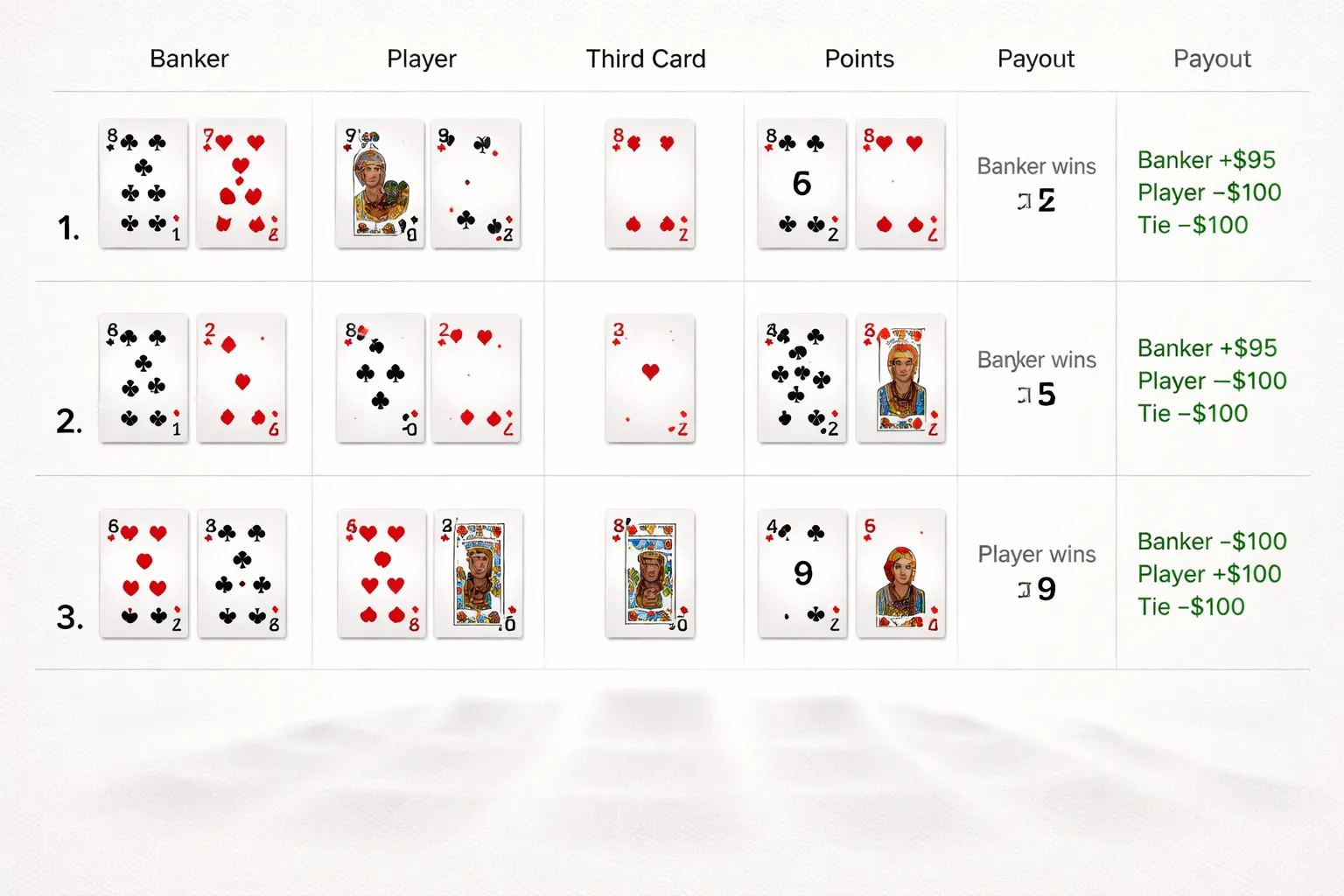
How to Read a Hand Fast
Baccarat uses point totals from 0 to 9.
- Cards 2 to 9 equal face value.
- 10, J, Q, K count as 0.
- A counts as 1.
- If the total is 10 or more, drop the first digit. Example, 7 + 8 = 15, so the total is 5.
You place one bet per hand, Banker, Player, or Tie.
Example 1: Banker Wins With a Natural (No Third Cards)
Step 1, place your bet. You bet $100 on Banker.
Step 2, first two cards dealt.
- Player gets 4 and 3. Total is 7.
- Banker gets 9 and 0 (K). Total is 9.
Step 3, check for a natural. A 8 or 9 on two cards is a natural. Banker has 9, so the hand ends.
Step 4, settle the bet. Banker wins. Standard payout is 1:1 minus 5% commission.
- Win amount: $100
- Commission: $5
- Profit: $95
- Total return: $195 (your $100 stake plus $95 profit)
Example 2: Third-Card Scenario (Banker Drawing Rules Applied)
Step 1, place your bet. You bet $50 on Player.
Step 2, first two cards dealt.
- Player gets 2 and 2. Total is 4.
- Banker gets 3 and 2. Total is 5.
Step 3, Player draws. Player draws a third card on 0 to 5. Player total is 4, so Player draws.
- Player draws a 6. New Player total is 4 + 6 = 10, so total is 0.
Step 4, Banker drawing rule check. Banker does not always draw based only on its total. It depends on Banker total and the Player third card.
Here Banker total is 5 and Player third card is 6. On a Banker 5, Banker draws when Player third card is 4, 5, 6, or 7. So Banker draws.
- Banker draws a 4. New Banker total is 5 + 4 = 9.
Step 5, settle the bet. Banker has 9 vs Player 0. Banker wins. Your Player bet loses.
- Result: -$50
Example 3: Tie Outcome and How It Settles Bets
Step 1, place your bet. You bet $20 on Tie.
Step 2, first two cards dealt.
- Player gets 7 and 1 (A). Total is 8.
- Banker gets 8 and 0 (Q). Total is 8.
Step 3, natural tie ends the hand. Both totals are 8, so the hand ends.
Step 4, settle all bet types.
- Tie bet: wins. Many games pay 8:1. Your $20 profit is $160, total return is $180.
- Player bet: pushes. You get your stake back.
- Banker bet: pushes. You get your stake back.
Common Beginner Mistakes (Shown in the Examples)
- Misreading totals. In Example 2, 4 + 6 = 10, so the total becomes 0. Many players call it 10 and get the winner wrong.
- Thinking Banker draw rules are simple. In Example 2, Banker total 5 does not mean automatic draw or stand. The Player third card decides it.
- Misunderstanding pushes on ties. In Example 3, Player and Banker bets do not lose on a tie. They push and you get your stake back.
- Forgetting Banker commission. In Example 1, a $100 Banker win pays $95 profit with a 5% commission, not $100.
Frequently Asked Questions
What is the best bet in baccarat?
Banker is the best main bet. It has the lowest house edge, about 1.06% with the usual 5% commission. Player sits around 1.24%. Tie is much worse, often above 14%.
Do Player and Banker bets lose on a tie?
No. A tie pushes Player and Banker bets. You get your stake back. Only Tie bets win on a tie.
How does the Banker commission work?
On a Banker win, the casino takes 5% of your profit. A $100 Banker bet wins $95 profit plus your $100 stake back. You do not win $100 profit on a standard table.
Should you ever bet the Tie?
Avoid it if you want the best odds. Tie pays well, often 8 to 1 or 9 to 1, but the true probability is low. The house edge is usually around 14% to 15%.
Do past results affect the next hand?
No. Each hand is independent in a properly shuffled shoe. Scoreboards and roads track history, not a real edge. Do not raise bets because you think a streak must continue or end.
Is counting cards useful in baccarat?
Almost never. Fixed draw rules limit decision points. Any counting edge is small and hard to keep after cut cards, shuffling, and table limits. Most players do better by sticking to Banker and controlling stake size.
Are the drawing rules simple?
Player draws on totals 0 to 5 and stands on 6 to 7. Banker rules depend on the Player third card. For example, Banker total 5 can draw or stand based on the Player third card value.
What are the odds of Banker, Player, and Tie?
Approximate probabilities in an 8 deck shoe are Banker 45.86%, Player 44.62%, Tie 9.52%. Banker wins slightly more often, which is why it stays the best value even after commission.
Can you change the outcome by squeezing cards?
No. Squeezing only reveals cards slowly. It does not change the cards already dealt. Treat it as a ritual, not a strategy.
Are side bets worth it?
Usually no. Many side bets carry a much higher house edge than Banker and Player. If you play them, keep stakes small and know the posted payout and rules for that specific table.
Conclusion
Baccarat rewards discipline, not clever tricks.
Stick to the two core bets. Banker gives you the best long-run edge even after the 5% commission. Player costs more over time. Tie burns bankroll fast.
- Default play: Bet Banker. Repeat.
- Skip: Tie bets and most side bets.
- Manage risk: Set a session budget, use flat stakes, stop when you hit your limit.
Track results if you want, but do not chase patterns. Cards have no memory. Your only real control is bet selection and bankroll control.
-
Online Casino Fairness Explained: RNG, RTP, House Edge & Provably Fair
8 months ago -
Slot RTP Explained: What RTP Means and How to Use It
8 months ago -
How to Play Online Slots: Rules, Features & Beginner Tips
8 months ago -
How Slot Jackpots Work: Progressive Jackpots Explained
8 months ago -
How to Play Online Blackjack: Rules, Payouts & Quick Start Guide
8 months ago
-
- What is the best bet in baccarat?
- Do Player and Banker bets lose on a tie?
- How does the Banker commission work?
- Should you ever bet the Tie?
- Do past results affect the next hand?
- Is counting cards useful in baccarat?
- Are the drawing rules simple?
- What are the odds of Banker, Player, and Tie?
- Can you change the outcome by squeezing cards?
- Are side bets worth it?
-
-
- What is the best bet in baccarat?
- Do Player and Banker bets lose on a tie?
- How does the Banker commission work?
- Should you ever bet the Tie?
- Do past results affect the next hand?
- Is counting cards useful in baccarat?
- Are the drawing rules simple?
- What are the odds of Banker, Player, and Tie?
- Can you change the outcome by squeezing cards?
- Are side bets worth it?
-
-
Reload Bonus Explained: What It Is and When It’s Worth Claiming
6 months ago -
Online Casino Licensing Explained: Authorities, Licenses & How to Check One
8 months ago -
Best Live Dealer Casinos: Where to Play Live Blackjack, Roulette & More
8 months ago -
Best Online Casinos for High Rollers: VIP Perks, High Limits & Exclusive Bonuses
8 months ago -
Fast Payout Online Casinos: Best Sites for Quick Withdrawals
8 months ago
-
Online Casino Customer Support: What to Look For (Live Chat, Email, Response Times)
8 months ago -
Sign Up for an Online Casino: Create an Account in Minutes
8 months ago -
Online Casino Payment Safety Tips: How to Deposit and Withdraw Securely
8 months ago -
What to Do If an Online Casino Won’t Pay Out: Step-by-Step Actions
8 months ago -
How to File a Complaint Against an Online Casino (Plus ADR Explained)
8 months ago