European vs American Roulette: Key Differences (and Which Is Better)

European and American roulette look similar, but the wheel design changes your long term cost. European roulette has 37 pockets, numbers 0 to 36. American roulette has 38 pockets, adding 00. That one extra pocket increases the house edge from 2.70% to 5.26% on most bets. Your payouts stay the same, so your expected return drops on the American wheel.
This guide breaks down the key differences that matter to you, wheel layout, house edge, betting options, and rules like en prison and the five number bet. You will learn which version gives you better odds, how much each bet type costs in expected value, and what to pick in live and online casinos. For a deeper primer on odds and house advantage, see our guide to RNG, RTP, and house edge.
- In het kort: Pick European roulette when you can. It cuts the house edge almost in half versus American.
- European wheel: 37 pockets, numbers 0 to 36. House edge is 2.70% on standard bets.
- American wheel: 38 pockets, numbers 0 to 36 plus 00. House edge is 5.26% on standard bets.
- Rule boost: If you get en prison or la partage on even money bets, your cost drops to 1.35% on those bets.
- Bet to avoid: The American five number bet (0, 00, 1, 2, 3) has a 7.89% house edge. It is one of the worst bets on the table.
- Payouts do not save you: Most bets pay the same in both versions. The extra 00 changes the math, not the payout.
- Best default choice: Play outside bets on European roulette, and use en prison or la partage when offered.
- Live and online tip: Check the wheel first. Single zero beats double zero every time.
- If you want lower edge games: See our best online casino games with low house edge list.
European vs American Roulette at a Glance
Quick comparison table
| Feature | European roulette | American roulette |
|---|---|---|
| Wheel pockets | 37 pockets, numbers 1 to 36, plus 0 | 38 pockets, numbers 1 to 36, plus 0 and 00 |
| House edge (standard rules) | 2.70% | 5.26% |
| Common rules you may see | La partage or en prison may apply to even money bets | Usually no la partage or en prison, check table rules |
| Signature bets | French call bets, like voisins du zéro, tiers du cylindre, orphelins | Five-number bet (0, 00, 1, 2, 3) often available |
What stays the same in both games
- Core bets: Inside bets like straight up, split, street, corner, and line. Outside bets like red or black, odd or even, and high or low. Dozens and columns.
- Payouts: Most payouts match across both versions. Straight up pays 35 to 1. Even money bets pay 1 to 1. The wheel changes the odds, not the payout.
- Randomness: Each spin stands alone. Your last result does not change the next one, online or live.
Why small rule changes create big expectation differences over time
The extra 00 adds one more losing pocket to every bet. That single pocket almost doubles the house edge, from 2.70% to 5.26%.
That difference compounds with volume. If you wager $10 per spin for 200 spins, your expected loss is about $54 on European roulette and about $105 on American roulette, under standard rules.
If a European table offers la partage or en prison on even money bets, your house edge on those bets drops to about 1.35%. That is why European roulette is the better default when you can choose.
Roulette Wheel Differences That Change the Odds
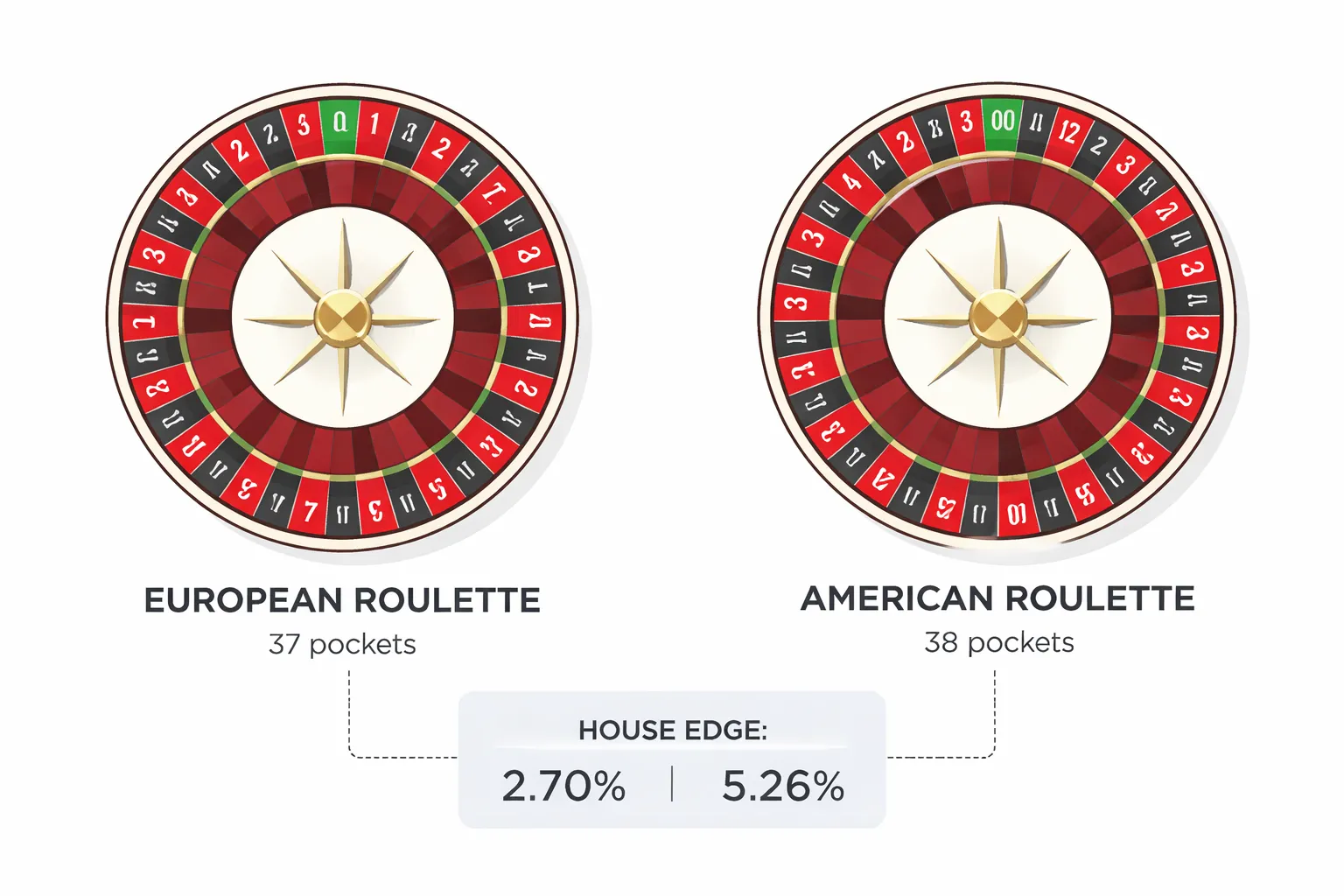
Pocket count explained, 37 (European) vs 38 (American)
European roulette uses 37 pockets. You get numbers 1 to 36, plus a single 0.
American roulette uses 38 pockets. You get numbers 1 to 36, plus 0 and 00.
That one extra pocket changes every probability. It raises the house edge on every standard bet.
The role of 0 and 00 in probability and expected value
Every bet pays as if you face 36 numbers, but the wheel can have 37 or 38 pockets. The extra zero pocket(s) create the edge.
For a straight-up bet on one number:
- European: win chance 1/37 (2.70%). Expected value per $1 bet is (35 × 1/37) - (1 × 36/37) = -1/37. House edge 2.70%.
- American: win chance 1/38 (2.63%). Expected value per $1 bet is (35 × 1/38) - (1 × 37/38) = -2/38. House edge 5.26%.
That same math hits the common bets you actually use.
| Bet type | Win condition | Payout | European house edge | American house edge |
|---|---|---|---|---|
| Even money (red, black, odd, even, 1 to 18, 19 to 36) | 18 numbers win | 1 to 1 | 2.70% | 5.26% |
| Dozen or column | 12 numbers win | 2 to 1 | 2.70% | 5.26% |
| Street (3 numbers) | 3 numbers win | 11 to 1 | 2.70% | 5.26% |
| Split (2 numbers) | 2 numbers win | 17 to 1 | 2.70% | 5.26% |
On a standard wheel, your bet choice changes variance, not the house edge. The wheel decides the long-run cost.
If you want a full breakdown of bets and payouts, use this roulette rules and payouts guide.
Number order on the wheel, sequences, symmetry, and why it matters (and mostly doesn’t)
The wheel order looks random, but it follows a fixed sequence.
European wheels typically place high and low numbers next to each other. They also spread reds and blacks around the rim.
American wheels use a different sequence, and 0 and 00 sit next to each other on many wheels.
This does not change the odds on a fair wheel. Each pocket still has the same chance on each spin.
The order can matter for two cases:
- Sector bets: Some players group neighbor numbers on the wheel, not on the table. The sequence affects which numbers fall into a sector.
- Biased wheels: If a wheel has physical bias, certain pockets can hit more often. The sequence can shape where clusters appear.
For typical casino and online play, assume no usable bias. Focus on pocket count and rules.
Single-zero, double-zero, and triple-zero, where each appears in casinos and online
Single-zero (0): Common in European casinos. Also common online, and it is the best default for lower house edge.
Double-zero (0, 00): Standard in many US casinos. Common online, often labeled American roulette.
Triple-zero (0, 00, 000): Shows up in some land casinos and in some online lobbies. It pushes the house edge higher.
Triple-zero uses 39 pockets. Under standard payouts, the house edge rises to about 7.69%. Avoid it if you care about expected value.
House Edge and RTP: The Math Behind Each Version
House Edge and RTP, Plain English
House edge is the casino’s average cut over time, shown as a percentage of every dollar you bet. If the house edge is 2.70%, you expect to lose about $2.70 per $100 wagered, over many spins.
RTP means return to player. It is the flip side of house edge.
- RTP = 100% minus house edge
- European roulette: 100% minus 2.70% equals 97.30% RTP
- American roulette: 100% minus 5.26% equals 94.74% RTP
This math assumes standard roulette payouts and a fair wheel. Your bet type does not change the house edge on a normal table. It changes variance, not the long-run percentage.
European Roulette House Edge, 2.70%
European roulette uses 37 pockets, numbers 1 to 36 plus a single zero.
On an even-money bet like red, you win 1 unit if you hit, and lose 1 unit if you miss.
- Win outcomes: 18 out of 37
- Lose outcomes: 19 out of 37, because the 0 is a loss
Expected value per $1 bet: (18/37 × $1) minus (19/37 × $1) equals -1/37, about -2.70%.
American Roulette House Edge, 5.26%
American roulette uses 38 pockets, numbers 1 to 36 plus 0 and 00.
On the same even-money bet like red:
- Win outcomes: 18 out of 38
- Lose outcomes: 20 out of 38, because 0 and 00 are losses
Expected value per $1 bet: (18/38 × $1) minus (20/38 × $1) equals -2/38, about -5.26%.
European vs American, Expected Loss Examples
House edge applies to total amount wagered, not your starting bankroll. If you wager $100 in total across your bets, here is the average expected loss:
| Total amount wagered | European (2.70%) | American (5.26%) |
|---|---|---|
| $100 | $2.70 | $5.26 |
| $1,000 | $27.00 | $52.60 |
If you play longer, your total amount wagered climbs fast. Example: 200 spins at $5 per spin equals $1,000 wagered. The wheel type then matters more than your “luck” on a short run.
Variance vs House Edge, Why Short-Term Results Mislead
House edge tells you the long-run average. Variance tells you how wild your results can swing in the short run.
- Single-number bets have high variance. You can win big early, then give it back fast.
- Even-money bets have lower variance. You see smaller swings, but the edge still applies.
- A short session can look “profitable” on either wheel. That does not change the math.
If you want lower expected loss, pick the lower house edge first. Then choose bet types based on the swing level you can handle, similar to how slot volatility changes your short-term results without changing the game’s built-in advantage.
Table Layout and Betting Mechanics
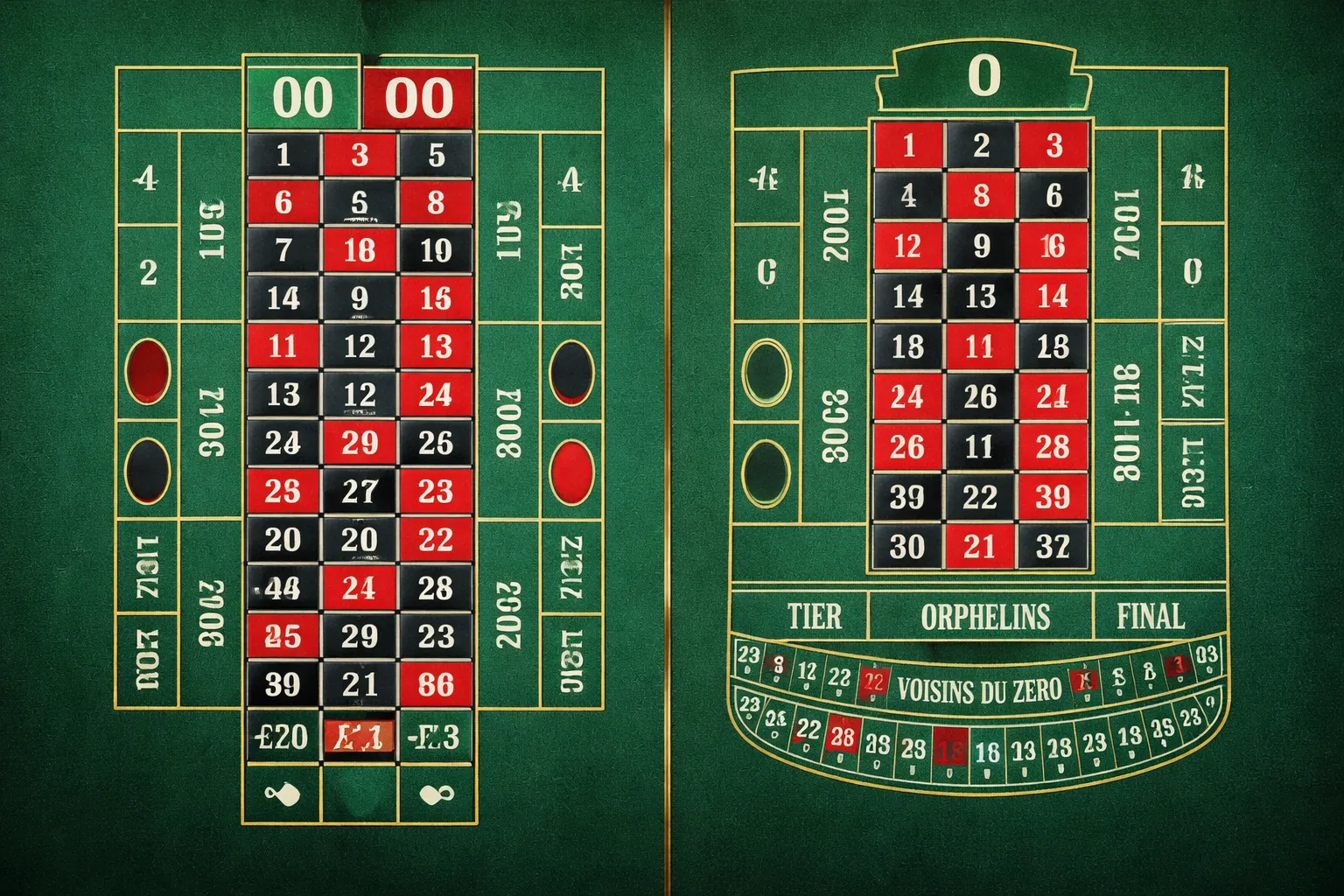
Inside vs outside bets and how they map to the felt
The felt splits bets into two zones. Inside bets sit on the number grid. Outside bets sit on the side boxes.
- Inside bets, you place chips on specific numbers or small groups. Examples include straight up (1 number), split (2), street (3), corner (4), line (6).
- Outside bets, you place chips in labeled boxes. Examples include red or black, odd or even, 1 to 18 or 19 to 36, and dozens and columns.
Inside bets give higher payouts and bigger swings. Outside bets give lower payouts and smaller swings. Your expected loss still tracks the wheel’s house edge.
American table layout differences and practical impact
American roulette adds a second zero. The layout includes both 0 and 00.
- The 0 and 00 sit at the top of the number grid, separate from 1 to 36.
- You can bet each zero directly with a straight up bet.
- Many American tables also offer the 5-number bet (0, 00, 1, 2, 3). It pays 6 to 1 on most layouts and carries the worst odds on the table.
Practical impact. The extra pocket increases the house edge across all standard bets. If you use the same bet sizes and session length, your expected loss rises versus single-zero play. Avoid the 5-number bet if it appears.
European table layout differences and the call-bet area
European roulette uses a single 0. The number grid runs 1 to 36 with one zero at the top.
- You get the same core inside and outside bet types, minus the 00 and the 5-number bet.
- Some tables include a call-bet area for announced bets. Common examples are sections of the wheel such as Voisins du Zéro, Tiers du Cylindre, and Orphelins.
Call bets do not change payouts. They package multiple inside bets into one instruction. This can speed up placement, but it can also lead you into larger total stakes than you planned if you do not track the chip count.
Dealer procedures and game speed, session length, and volatility
Table procedures affect how many spins you play per hour. More spins per hour means your results move toward expected loss faster.
- Betting window. Faster dealers and fewer players reduce time between spins. You get more decisions per hour.
- Announced bets. Call bets can speed up complex betting for experienced players, but the dealer may slow the game if the table is busy.
- Handling late bets. Strict “no more bets” calls reduce disputes and keep pace consistent.
Speed changes your session feel. A fast game can produce bigger short-term swings because you face more outcomes in the same time block. It also increases the rate at which the house edge grinds your bankroll. If you want a longer session, lower your stake per spin when the table runs fast.
Bet Types, Payouts, and Notable Rule Variations
Do payouts change between versions?
Most payouts stay the same in European and American roulette. The table pays fixed ratios for the same bet types. The wheel changes your odds, not the listed payout.
Example. A straight-up number bet usually pays 35 to 1 in both versions. Your chance to hit changes because European has 37 pockets and American has 38.
This creates a gap between payout and true odds. That gap is the house edge. It gets worse when the wheel adds 00.
- European (single zero): 1 winning pocket out of 37 for a straight-up bet.
- American (double zero): 1 winning pocket out of 38 for a straight-up bet.
- Payout stays: 35 to 1, so the extra pocket reduces your return in American roulette.
Some European tables add player-friendly rules on even-money bets. You may see la partage or en prison. These rules can cut the house edge on red or black, odd or even, and high or low. They do not change the printed payout, they change what happens when the ball lands on 0.
The five-number bet (0-00-1-2-3)
The five-number bet exists on many American roulette tables. It covers 0, 00, 1, 2, and 3. It often pays 6 to 1.
This bet has a reputation for a reason. It combines a low payout with a large disadvantage.
- Win probability: 5 out of 38.
- Typical payout: 6 to 1.
- Result: one of the worst-value standard bets on the layout.
If you want a similar feel with better value, use common inside bets instead. You can spread chips across straight-up or split bets and avoid the five-number payout trap.
European call bets (Voisins du Zéro, Tiers du Cylindre, Orphelins)
Many European tables offer call bets. You place them by naming a wheel section, not by placing chips on specific squares first. The dealer then places the chips for you as a preset group of bets.
- Voisins du Zéro: covers numbers near zero on the wheel using a fixed set of splits, corners, and a straight-up on 0.
- Tiers du Cylindre: covers a third of the wheel opposite the zero sector using a fixed set of split bets.
- Orphelins: covers the remaining numbers not in the other two sectors, using a mix of splits and a straight-up bet.
These bets do not give you better odds. They package standard bets in a convenient way. Your value still depends on the underlying bets and the wheel type. You see them more in European and French roulette, especially in live dealer rooms.
Racetrack betting online
Online European roulette often adds a racetrack panel. It lets you select call bets and wheel sectors with one click. The software converts your selection into the correct set of splits, corners, and straight-up bets.
This helps you bet faster on busy tables. It also makes it easier to repeat the same pattern every spin. Speed can raise your total money wagered per hour, so keep your unit size under control when you use racetrack presets.
If you play live dealer roulette, you can learn more about table flow and betting windows in this live casino guide.
Common side bets and bonus bets
Many online and live tables add side bets. These sit outside the base roulette math. They often pay with long odds and higher margins.
- Jackpot or multiplier side bets: can add extra house edge on top of the wheel edge.
- Hot and cold numbers: usually just shortcuts to place standard bets, but some versions attach a bonus feature with different odds.
- Call bet variants with bonuses: may look like traditional sectors, but the bonus paytable changes the expected return.
Base roulette already charges you through the zero pockets. Side bets can raise the total cost of play further. Treat them as separate games. Check the rules and payout table before you add them to your main bets.
Special European Rules: La Partage and En Prison
La Partage: half-back on even-money bets
La Partage applies only to even-money outside bets, red or black, odd or even, high or low.
If the ball lands on 0, you lose only half your stake. The casino keeps the other half.
This rule cuts the cost of those bets in half versus standard European roulette.
- Standard European (single 0) house edge: 2.70% on all bets.
- With La Partage on even-money bets: about 1.35% effective house edge.
En Prison: your even-money bet gets “locked”
En Prison also applies only to even-money outside bets.
If the ball lands on 0, your bet does not lose right away. The dealer “imprisons” it for the next spin.
- If your bet wins on the next spin, you get your stake back. You do not win extra.
- If your bet loses on the next spin, you lose the full stake.
- If 0 hits again, many tables keep the bet imprisoned again, but rules vary.
On a typical table, En Prison gives the same long-run value as La Partage for even-money bets, about a 1.35% effective house edge.
Where you will find these rules, and how to verify them
Brick and mortar European roulette often offers one of these rules. Online live dealer European roulette sometimes offers them. Many RNG versions do not.
Do not assume. Check the game help and paytable.
- Look for a line that says La Partage or En Prison.
- Confirm it applies to even-money bets only.
- Confirm what happens if 0 hits twice under En Prison.
- Confirm the game uses a single 0 wheel, these rules rarely appear on double 0 roulette.
When these rules matter most
They matter when you play even-money outside bets. They do not change inside bet odds.
| Bet type | Example | House edge impact from La Partage or En Prison |
|---|---|---|
| Even-money outside | Red, Odd, 1 to 18 | Big impact. Drops from 2.70% to about 1.35% on single 0 games that use the rule. |
| Other outside bets | Dozens, Columns | No change. Stays at 2.70% on standard single 0 rules. |
| Inside bets | Straight, Split, Street | No change. Stays at 2.70% on standard single 0 rules. |
If you mainly bet red or black, pick a single 0 table with La Partage or En Prison when you can. If you mainly play inside numbers, these rules do not help you.
Which Is Better: European or American Roulette?
Best choice for lowest house edge
If you care about value, pick European roulette. It has one zero, 37 pockets, and a 2.70% house edge on standard rules.
American roulette adds a second zero. That creates 38 pockets and a 5.26% house edge. You pay almost double for the same payouts.
If you bet outside even-money options like red or black, European roulette with La Partage or En Prison is the top choice. Those rules cut the house edge to about 1.35% on those bets.
If you mainly play inside bets, European still wins. La Partage and En Prison do not improve inside-bet odds.
When American roulette can be acceptable
Play American roulette only when you accept a higher cost per spin.
- Availability. Some casinos and some online lobbies push double-zero tables. If you cannot find single-zero, American may be your only option.
- Table limits. A low minimum on an American table can beat a high minimum on a European table if you need to manage risk per spin.
- Personal preference. If you play for pacing, social time, or side bets you enjoy, the higher edge may not change your goal.
Avoid the five-number bet on American roulette. It carries the worst value on the layout, at about 7.89% house edge.
Decision checklist
- Bankroll. Smaller bankrolls do better with lower edge. Pick single-zero. Use La Partage or En Prison when you mainly bet even money.
- Bet style. Outside-bet players gain the most from French rules. Inside-bet players should still choose single-zero, but do not expect extra help from those rules.
- Session goals. If you want more playtime per dollar, reduce the edge first. If you want higher variance, change bet sizing or bet type, not wheel type.
- Rule set. Confirm the wheel has one zero. Then check for La Partage or En Prison. If you must play American, skip the five-number bet and keep stakes tight.
Best variant alternatives
French roulette often offers the best value. It uses a single-zero wheel and commonly includes La Partage or En Prison, which improves even-money bets.
Single-zero live roulette is usually the best online substitute when you want real-dealer play. Look for a standard 2.70% edge, or better if the game includes French rules.
These variants win on value because they remove the double zero, and sometimes reduce the loss rate on even-money bets. That one change does more than any betting pattern.
Strategy and Bankroll Tips (Without Myths)
No strategy beats the edge long-term
Roulette has a built-in house edge. You cannot remove it with bet patterns.
Strategy can still help. It can control volatility, slow down losses, and keep you within your budget. It cannot turn a negative expectation into a positive one.
Expected loss stays simple.
- Expected loss = total amount you wager x house edge.
- European single zero, standard rules, 2.70% edge.
- American double zero, standard rules, 5.26% edge.
If you wager $1,000 in total on European roulette, your average loss is about $27. On American roulette, it is about $53. Variance decides the short-term result, the edge decides the long-term drift.
Choose bets by volatility, not “systems”
All standard bets on the same wheel carry the same house edge. What changes is volatility.
- Straight-up (single number). High volatility. Long losing streaks happen. Big swings. Good if you accept fast outcomes.
- Splits, streets, corners. Still volatile, but less extreme than straight-up.
- Outside bets (red-black, odd-even, high-low). Lower volatility. Smaller swings. More frequent small wins.
- Dozens and columns. Middle volatility. You win often enough, but losses still stack fast.
If your bankroll is limited, outside bets usually keep you in the game longer. If you want a shot at a large hit, use straight-ups, but size your stake down.
Progression systems raise risk, they do not raise RTP
Progressions change bet sizing after wins or losses. They do not change the math of the wheel.
- Martingale. You double after each loss on an even-money bet. It creates small frequent wins, then rare large crashes. A long losing streak will force huge bets.
- Fibonacci. You increase using a number sequence after losses. It grows slower than Martingale, but it still grows fast enough to break most bankrolls.
Table limits matter. So does your bankroll. A limit turns any progression into a capped plan that can still hit a point where you cannot place the next bet. When that happens, the “recovery” step stops, and the earlier small wins can vanish in one run.
Practical bankroll rules for real play
Set a session budget. Treat it as spend, not investment.
- Pick a unit size you can repeat many times. A simple target is 100 to 200 units for outside-bet sessions, more if you want to handle longer swings.
- Set a stop-loss. Commonly 20% to 40% of your session bankroll. Leave when you hit it.
- Set a stop-win. Lock a profit and exit. Use a fixed target like 10% to 30% of your session bankroll.
- Keep stake flat unless you planned a change before you started.
- Track total wager. Your risk comes from how much you cycle through the game, not just your buy-in.
If you want the key concept behind house edge and expected loss in plain terms, read our guide to RNG, RTP, and house edge.
Pick better tables, avoid hidden edge traps
Your best move is table selection.
- Choose single zero over double zero every time.
- Prefer French rules when you play even-money bets. Look for La Partage or En Prison.
- Avoid the five-number bet on American tables. It usually has a much higher house edge than other standard bets.
- Be cautious with side bets. Many carry a steep edge even when the main game is single zero.
- Check the rules panel before you sit down. Confirm the wheel type, the number of zeros, and any special payouts.
Where You’ll Encounter Each Version (Online and Land-Based)
Typical distribution by region
United States. You will see American roulette more often in land-based casinos. Many floors still run double-zero wheels as the default. You may find single-zero tables in bigger markets, on higher limits, or in dedicated roulette pits. Always check the wheel and the rules plaque.
Europe. You will usually find European roulette, with a single zero, as the standard in land-based casinos. In some venues, you also get French rules on even-money bets, like La Partage or En Prison. Those rules can lower the house edge on red or black, odd or even, and high or low.
Online casinos: RNG roulette vs live dealer roulette
RNG roulette. This is software-based roulette that uses a random number generator. You will often see many variants at once, European, American, French, and branded wheels with side bets. RTP and rules can change by title, even within the same casino. Some RNG games also add extra multipliers or bonus features, and those can shift the effective return.
Live dealer roulette. This uses a real wheel streamed from a studio or casino. European live tables are common, but many operators also offer American live tables. Live games often add optional side bets, like Lightning-style multipliers. Treat those as separate wagers with their own edge and variance.
If you need a quick refresher on standard bets and payouts, use this online roulette guide.
How to confirm the variant before you play
- Wheel graphic. Look for the number of zeros. One green zero means European or French. Zero and double zero means American.
- Rules panel. Check for La Partage or En Prison. Confirm whether the five-number bet exists, and whether any special rules apply to even-money bets.
- Paytable. Standard roulette pays 35 to 1 on a straight-up number. If you see non-standard payouts, you are not on a standard wheel, or you are looking at an added feature game.
Responsible play note
Set a budget before you play, and set a time limit. Use deposit limits and loss limits if the casino offers them. Stop if you chase losses, raise stakes to “get even,” or feel angry or numb while you play. Those are common warning signs that gambling stops being entertainment.
Frequently Asked Questions
What is the main difference between European and American roulette?
European roulette has 37 pockets, numbers 0 to 36. American roulette has 38 pockets, 0 to 36 plus 00. That extra 00 increases the house edge and lowers your long-term return.
Which roulette has better odds for you?
European roulette. The house edge is 2.70% on a single-zero wheel. American roulette is 5.26% on a double-zero wheel. Over time, the lower edge costs you less per bet.
Do payouts change between European and American roulette?
No. Standard payouts stay the same. A straight-up bet pays 35 to 1 on both wheels. The difference is your win chance, since American roulette adds one extra losing pocket.
What are the exact house edges?
European roulette: 1 divided by 37, or 2.70%. American roulette: 2 divided by 38, or 5.26%. Those numbers assume standard rules with no special zero-handling features.
What is the “five-number bet” in American roulette?
It covers 0, 00, 1, 2, and 3. It pays 6 to 1. The house edge is 7.89%, worse than most other bets. Avoid it if you want the best odds.
What are La Partage and En Prison rules?
They apply to even-money bets in some European games. If the ball lands on 0, you may get half your stake back, or have it “imprisoned” for one more spin. Either rule cuts the even-money house edge to 1.35%.
Does the number order on the wheel matter?
Not for standard odds. Each spin stays independent. Number sequence can matter only if you chase wheel bias in a physical casino, and you need large samples and strict logging. Online RNG wheels remove wheel-physics effects.
Are outside bets safer than inside bets?
They have higher hit rates, but the same house edge on a standard wheel. Outside bets reduce volatility, not the casino advantage. See roulette odds and bet types for exact probabilities.
Can any roulette strategy beat the house?
No. Betting systems change variance, not expected value. Martingale and similar progressions raise your risk of large losses and table-limit lockouts. You improve results only by choosing lower-edge rules and managing bankroll and session limits.
Conclusion
European roulette gives you better math. It uses one zero, so the house edge sits at 2.70%. American roulette adds 00, so the edge jumps to 5.26%. Your payouts stay the same. Your long-term loss rate almost doubles on the American wheel.
Pick the wheel first. Then pick rules that cut the edge on even-money bets. If the table offers la partage or en prison, use it. Avoid the five-number bet on American roulette. It carries the worst edge on the layout.
Keep your play simple. Use outside bets if you want lower variance. Use inside bets only if you accept bigger swings. Either way, your expected value stays negative.
Your best move stays practical. Choose single-zero roulette, set a stop-loss, set a win cap, then walk. If you want a quick refresher on variance control, see slot volatility and apply the same bankroll discipline.
-
Online Casino Fairness Explained: RNG, RTP, House Edge & Provably Fair
8 months ago -
Slot RTP Explained: What RTP Means and How to Use It
8 months ago -
How to Play Online Slots: Rules, Features & Beginner Tips
8 months ago -
How Slot Jackpots Work: Progressive Jackpots Explained
8 months ago -
How to Play Online Blackjack: Rules, Payouts & Quick Start Guide
8 months ago
-
- What is the main difference between European and American roulette?
- Which roulette has better odds for you?
- Do payouts change between European and American roulette?
- What are the exact house edges?
- What is the “five-number bet” in American roulette?
- What are La Partage and En Prison rules?
- Does the number order on the wheel matter?
- Are outside bets safer than inside bets?
- Can any roulette strategy beat the house?
-
-
- What is the main difference between European and American roulette?
- Which roulette has better odds for you?
- Do payouts change between European and American roulette?
- What are the exact house edges?
- What is the “five-number bet” in American roulette?
- What are La Partage and En Prison rules?
- Does the number order on the wheel matter?
- Are outside bets safer than inside bets?
- Can any roulette strategy beat the house?
-
-
Reload Bonus Explained: What It Is and When It’s Worth Claiming
6 months ago -
Online Casino Licensing Explained: Authorities, Licenses & How to Check One
8 months ago -
Best Live Dealer Casinos: Where to Play Live Blackjack, Roulette & More
8 months ago -
Best Online Casinos for High Rollers: VIP Perks, High Limits & Exclusive Bonuses
8 months ago -
Fast Payout Online Casinos: Best Sites for Quick Withdrawals
8 months ago
-
Online Casino Customer Support: What to Look For (Live Chat, Email, Response Times)
8 months ago -
Sign Up for an Online Casino: Create an Account in Minutes
8 months ago -
Online Casino Payment Safety Tips: How to Deposit and Withdraw Securely
8 months ago -
What to Do If an Online Casino Won’t Pay Out: Step-by-Step Actions
8 months ago -
How to File a Complaint Against an Online Casino (Plus ADR Explained)
8 months ago