Best Online Casino Games with Low House Edge (Ranked)

The house edge sets your long-term cost per bet. Lower is better. This guide ranks online casino games with the lowest house edge, using standard rule sets and optimal play where skill matters.
You will learn which games can drop below 1 percent, which ones sit in the 2 to 5 percent range, and which games can hit double digits. You will also see what moves the number, including rules, side bets, and payout tables. For blackjack, your decisions drive the edge, so use this blackjack basic strategy chart to cut mistakes.
Use the rankings to pick games that stretch your bankroll and avoid traps that look fair but cost more per spin or hand.
- In het kort: Pick games under 1 percent house edge, skip side bets, and check payout tables before you play.
- In het kort: Your choices matter most in blackjack, use basic strategy to keep the edge low.
- In het kort: Roulette depends on the wheel, European beats American by a wide margin.
- In het kort: Slots vary the most, use RTP to avoid low return games.
- Best bankroll stretch: Blackjack with basic strategy, baccarat banker bet, and low edge video poker variants.
- Fast ways to raise the edge: Side bets, bonus bets, and bad payout tables.
- Roulette rule: Play European wheels when you can. Avoid American wheels and most “special” bets. Use this European vs American roulette breakdown if you need the exact differences.
- Slot rule: Treat slots as a wide edge category. Use RTP as your filter and avoid low RTP games.
- Table rule: Read the rules screen. One line can change the edge, example 6:5 blackjack, or reduced payouts on baccarat ties.
- Simple process: Start with the lowest ranked games, remove side bets, confirm payouts, then set your stake size.
Best Online Casino Games with Low House Edge (Ranked Overview)
Ranking criteria
This ranking focuses on the edge you can realistically get online, not perfect lab conditions.
- Typical house edge ranges. We list a best case edge you can reach with the right rules and correct play. We also list a common edge you will see in most lobbies.
- Rules sensitivity. Small rule changes can swing the edge fast. Blackjack payouts, roulette wheel type, and baccarat tie pay rules matter.
- Strategy impact. Some games reward correct decisions. Others lock you into the math. If you will not use strategy, pick games with low edge even at basic play.
Quick comparison table
| Game | Best-case edge | Common edge | Difficulty | Volatility |
|---|---|---|---|---|
| Blackjack (3:2, good rules) | ~0.3% to 0.6% | ~0.6% to 1.5% | Medium | Medium |
| Baccarat (Banker bet) | ~1.06% | ~1.06% to 1.24% | Low | Low to medium |
| Video poker (full-pay tables) | ~0.5% or better | ~1% to 4%+ | High | Medium |
| Craps (best line odds) | ~0.3% to 0.6% (with odds) | ~1% to 2% (without odds or with bad bets) | Medium | High |
| European roulette | ~2.70% | ~2.70% | Low | Medium |
| Online slots (high RTP picks) | ~2% to 4% (96% to 98% RTP) | ~4% to 10%+ (90% to 96% RTP) | Low | High |
Use the best-case column as your target. Use the common edge column as your default expectation.
How to use this ranking
- If you want the lowest edge and you will learn strategy. Start with blackjack under 3:2 payouts. Avoid 6:5 tables. Use a basic strategy chart. Review the key rules in this online blackjack guide.
- If you want low edge with almost no decisions. Play baccarat Banker. Skip Tie and side bets. Confirm the tie payout does not include reduced rules that raise the effective edge.
- If you can handle swings for a lower long-run cost. Use games where the edge stays low but results vary. Craps with odds and high RTP slots fit here. Control your stake size, because volatility can drain your bankroll fast even with a lower edge.
- If you want stable results per bet. Use baccarat Banker or European roulette on outside bets. Expect slower bankroll swings, but remember the edge still grinds over time.
- If you do not want to study. Avoid video poker and blackjack. You will give back the edge through mistakes. Pick baccarat Banker or roulette instead.
Your order is simple. Start at the top. Confirm the rules and payouts. Remove side bets. Then size your bets so you can survive normal variance.
1) Blackjack (Lowest Edge With Correct Strategy)
Why blackjack can be a low-edge game
Blackjack can beat most table games on house edge because you make decisions. You choose when to hit, stand, double, or split. If you follow correct basic strategy and you play a good ruleset, the house edge can sit around 0.3% to 0.7%. Bad rules and bad play can push it above 2% to 5%+.
Paytables matter most. The blackjack payout sets the baseline. Rules then add or subtract small chunks of edge. Your choices decide the rest.
Best online blackjack rules to look for
- Blackjack pays 3:2. This is the big one.
- Dealer stands on soft 17 (S17). Better than dealer hits soft 17.
- Double after split (DAS) allowed. You gain more value on strong split hands.
- Double on any two cards. Avoid games that limit doubles to 9 to 11 only.
- Surrender available. Late surrender helps in a few high-loss spots.
- Reasonable split rules. Re-splitting pairs helps. Re-splitting aces can help when offered.
- Clear rules panel in the lobby. If the casino hides the rules, skip the table.
Worst rules to avoid
- Blackjack pays 6:5. This rule alone can add about +1.3% to +1.4% house edge.
- Dealer hits soft 17 (H17). This usually adds about +0.2% edge.
- No double after split (no DAS). This often adds about +0.1% to +0.2%.
- Restricted doubling. Limits like “double on 10 to 11 only” raise the edge and cut your best spots.
- No surrender. You lose one of your few damage-control options.
- Side bets. Most carry large edges. They drag your results even if your main game is strong.
- Continuous shuffling in live blackjack. It does not change basic strategy edge, but it kills any practical chance of tracking deck composition. If you care about that, avoid it.
Basic strategy essentials and what it does to the edge
Basic strategy is the correct play for every hand based on your total and the dealer upcard. It strips out most player error. With strong rules, it can drop the house edge to around 0.5% or lower.
You do not need to guess. Use a chart and follow it. Keep it open while you play if the casino allows it. Use this guide to lock it in: blackjack basic strategy chart.
Common player mistakes that raise the house edge
- Playing 6:5 tables. You give up the best payout in the game.
- Standing on 16 vs 10 without surrender. Many players freeze and bleed EV.
- Missing doubles. You must double in the right spots. Those hands carry your long-term value.
- Splitting the wrong pairs. Bad splits burn money fast.
- Insurance. It is usually a losing bet unless you have real information about the deck.
- Chasing side bets. They feel small, they cost big over volume.
- Changing strategy after a loss streak. Streaks are normal variance. Strategy does not change.
Live dealer vs RNG blackjack
RNG blackjack plays faster. Faster play means faster results, good or bad. It often gives you more tables and lower minimums. Rules vary by provider, so you still need to check payouts and options.
Live dealer blackjack plays slower. You see the dealing and the rules panel usually stays visible. Some live tables add side bets and lower blackjack payouts on “speed” or “promo” tables. Treat those as red flags.
If your goal is low edge, your priority stays the same in both formats. Find 3:2, remove side bets, then play strict basic strategy.
| Rule or choice | What it does to your edge |
|---|---|
| 3:2 blackjack payout | Keeps the game low-edge when combined with correct strategy |
| 6:5 blackjack payout | Adds about +1.3% to +1.4% house edge in many common rulesets |
| Basic strategy | Often gets you near 0.3% to 0.7% house edge with good rules |
| Side bets | Usually high edge, drags down your overall results |
2) Video Poker (When Paytables Are Player-Friendly)
Video poker can sit near the top of the low-edge list, but only when you play the right paytable and follow correct strategy. The machine sets the math. Your decisions decide if you keep it.
Paytables set your RTP, not the game name
Two “Jacks or Better” games can have different returns because the payout ladder changes. Small changes matter most on the top hands.
- Full house and flush payouts often separate strong games from weak ones.
- A common example: 9/6 Jacks or Better pays 9 for a full house and 6 for a flush. That paytable can return about 99.54% RTP with perfect play, around 0.46% house edge.
- Drop those payouts and the edge jumps. 8/5 Jacks or Better returns about 97.30% RTP, around 2.70% house edge with perfect play.
Best low-edge variants, when the paytable is right
- Jacks or Better (9/6). About 99.54% RTP with correct strategy.
- Deuces Wild (full-pay). Some full-pay schedules can reach about 100%+ RTP with perfect play. Many online versions do not offer these tables, so you must verify the paytable.
- Avoid “short-pay” versions. A game can keep the same name but cut key hands and add 1% to 3% house edge fast.
Strategy basics, where EV leaks happen
Video poker rewards precise holds. One wrong hold can cost more than several hands of correct play earns back.
- Prioritize made hands when the paytable favors them, but do not auto-hold everything. Example, some two-pair situations can beat weak four-card draws in certain games.
- Know your “core holds”. High pairs usually beat most draws in Jacks or Better. Four to a royal often beats everything except a made straight or better, depending on the exact table.
- Play max coins when the game boosts the royal flush payout at max bet. If you do not, you cut your long-term return.
- Use a strategy chart that matches the exact paytable. A chart for 9/6 does not fit 8/5.
How to spot good vs bad paytables online
Do this before you place real money bets.
- Open the Paytable or Info screen.
- For Jacks or Better, check the line for full house and flush. Look for 9 and 6.
- Check the royal flush payout at max coins. A strong table pays 4,000 for 5 coins on a royal.
- Confirm the game uses standard ranks and no hidden side features that change returns.
- If the casino lists RTP, treat it as a clue, then still verify the paytable. Providers can host multiple RTP settings.
Volatility and bankroll swings
Even with low house edge, video poker can swing harder than blackjack and baccarat.
- You rely on rare big hands to reach the advertised RTP. Long stretches without a big hit happen.
- Blackjack and baccarat usually produce smoother session results because outcomes cluster around smaller edges and steadier payouts.
- If you chase low edge, set a bankroll that can handle droughts. Your results depend on volume and discipline, not short sessions.
3) Baccarat (Simple Bets, Strong Odds)
3) Baccarat (Simple Bets, Strong Odds)
Best bet: Banker vs Player, and why the commission exists
Baccarat stays low edge because you only have two practical wagers.
- Banker: House edge sits around 1.06% in standard rules. Banker wins slightly more often because it acts last on some draws. Casinos charge a 5% commission on Banker wins to pull the edge back from near-even.
- Player: House edge sits around 1.24%. You avoid commission, but you give up the small math advantage Banker gets from drawing rules.
If you want the lowest edge, you bet Banker and you accept the commission. If your casino offers “no commission baccarat,” read the rule. Many versions pay Banker at 1:2 on a specific winning total, which raises the edge.
Why Tie and side bets usually carry a high edge
Tie looks tempting because it pays big, but it hits rarely. The payout usually does not cover the true odds.
- Tie bet: often carries a house edge around 14%+ under common payouts.
- Side bets: pairs, perfect pair, dragon, panda, and similar props often land in the 5% to 20%+ edge range, depending on paytable.
Avoid Tie and side bets if you chase low house edge. Treat them as separate high-cost wagers. Use them only if you set a strict cap per session and you accept the swing.
Mini-baccarat and live baccarat: what changes and what stays the same
Mini-baccarat keeps the same core math as standard baccarat. Your edge depends on rules and paytable, not table size.
- What stays the same: Banker and Player edges, draw rules, and the long-run advantage.
- What changes: speed and cost. Online RNG baccarat runs faster, so you cycle more hands per hour. Live dealer baccarat runs slower, but it can add limits, side bets, and commission handling that affect your results.
Check three things before you play. Banker commission rate, Tie payout, and any special “no commission” conditions. For deeper details, use this baccarat odds and best bets guide.
Bankroll and pacing tips for baccarat sessions
Baccarat gives you a low edge, but you still lose over time. Your job is to control exposure.
- Pick one main bet. Use Banker for lowest edge, or Player if you want zero commission hassle. Do not mix in Tie.
- Keep your unit small. Aim for 1% to 2% of your session bankroll per hand.
- Set a hand limit. Fast games can burn your bankroll through volume. Decide your maximum hands, then stop.
- Ignore streak charts. Past results do not change the next hand’s odds. Bet size changes only raise variance.
- Track commission. It reduces your net wins. It also affects bonus wagering math if your casino counts commission in unclear ways.
| Bet | Typical payout | Typical house edge |
|---|---|---|
| Banker | 1:1 minus 5% commission | ~1.06% |
| Player | 1:1 | ~1.24% |
| Tie | Varies by table | Often ~14%+ |
4) Craps (Low Edge—If You Stick to the Right Bets)
Core bets with the best odds
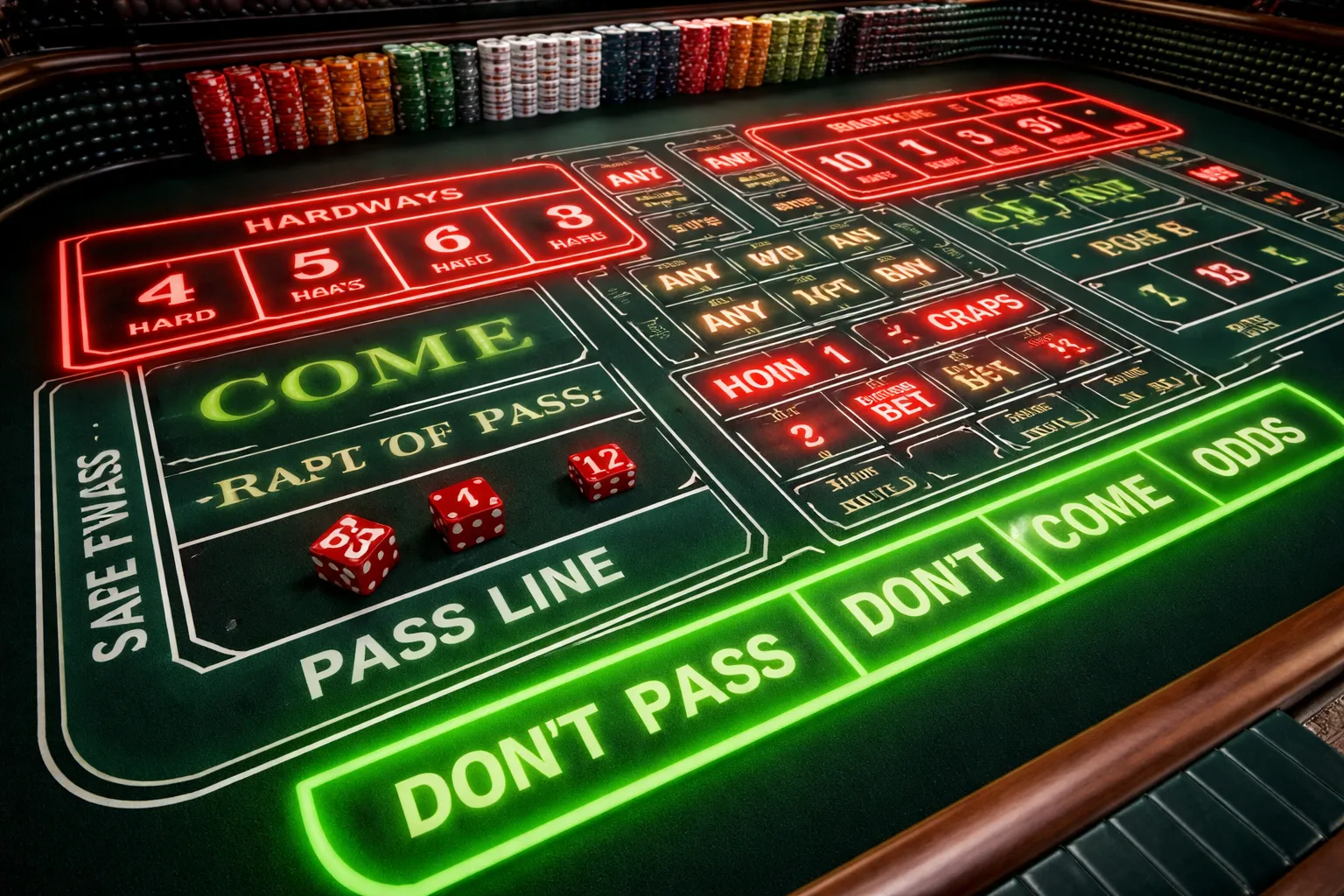
Craps can rank among the lowest edge casino games, but only if you bet like a grinder. You want the line bets and odds. You avoid the center of the table.
- Pass Line. House edge about 1.41%.
- Don’t Pass. House edge about 1.36%. Slightly better because 12 on the come-out pushes instead of losing.
- Come. Same math as Pass Line after the come-out, house edge about 1.41%.
- Don’t Come. Same math as Don’t Pass after the come-out, house edge about 1.36%.
- Odds bets. House edge 0%. You can place them only after a point sets on Pass, Don’t Pass, Come, or Don’t Come.
Understanding odds bets
Odds bets pay true odds. That is why the house edge is 0% on that part of your action.
Odds do not remove variance. They increase it. You risk more money per decision, so your bankroll swings harder.
Your combined edge depends on how much odds you take. More odds lowers the blended house edge, but it raises the size of wins and losses.
| Bet | Typical payout | Typical house edge |
|---|---|---|
| Pass Line | 1:1 | ~1.41% |
| Don’t Pass | 1:1 | ~1.36% |
| Come | 1:1 | ~1.41% |
| Don’t Come | 1:1 | ~1.36% |
| Odds (behind line bets) | True odds, varies by point | 0% |
Bets to avoid, proposition and hardway bets
The middle of the layout looks fun. It costs you money fast. These bets resolve often, but they carry high house edges.
- Any 7. Common house edge about 16.67%.
- Any Craps. Common house edge about 11.11%.
- Yo (11). Common house edge about 11.11%.
- Hardways. Often around 9% to 11%, depending on the number and payout.
- Horn and other multi-prop combos. You stack multiple high-edge props into one wager.
Skip these if your goal is low edge. They deliver casino profit through price, not through skill or timing.
Online craps vs live table craps
Online craps makes it easier to avoid bad bets, but only if you use the interface well.
- Use the bet menu or quick bets to place Pass, Don’t Pass, Come, or Don’t Come. Do not tap the center props by mistake.
- Turn on confirm bet if the game offers it. One misclick can put money on a high-edge prop.
- Check the table’s maximum odds rules. Some online games cap odds at 2x, 3x, or 5x.
- Look for labels like “Odds” or “Behind” after a point sets. Place odds only when the game allows it.
- Avoid side bet panels. Many “bonus” and “multiplier” side bets run like proposition bets with worse pricing.
Stick to line bets plus odds. That is where craps earns its low-edge reputation.
5) Roulette (Best When You Choose the Right Wheel and Bets)
European vs American Roulette, the Zero Changes the Math
Roulette looks simple. The wheel choice does most of the work.
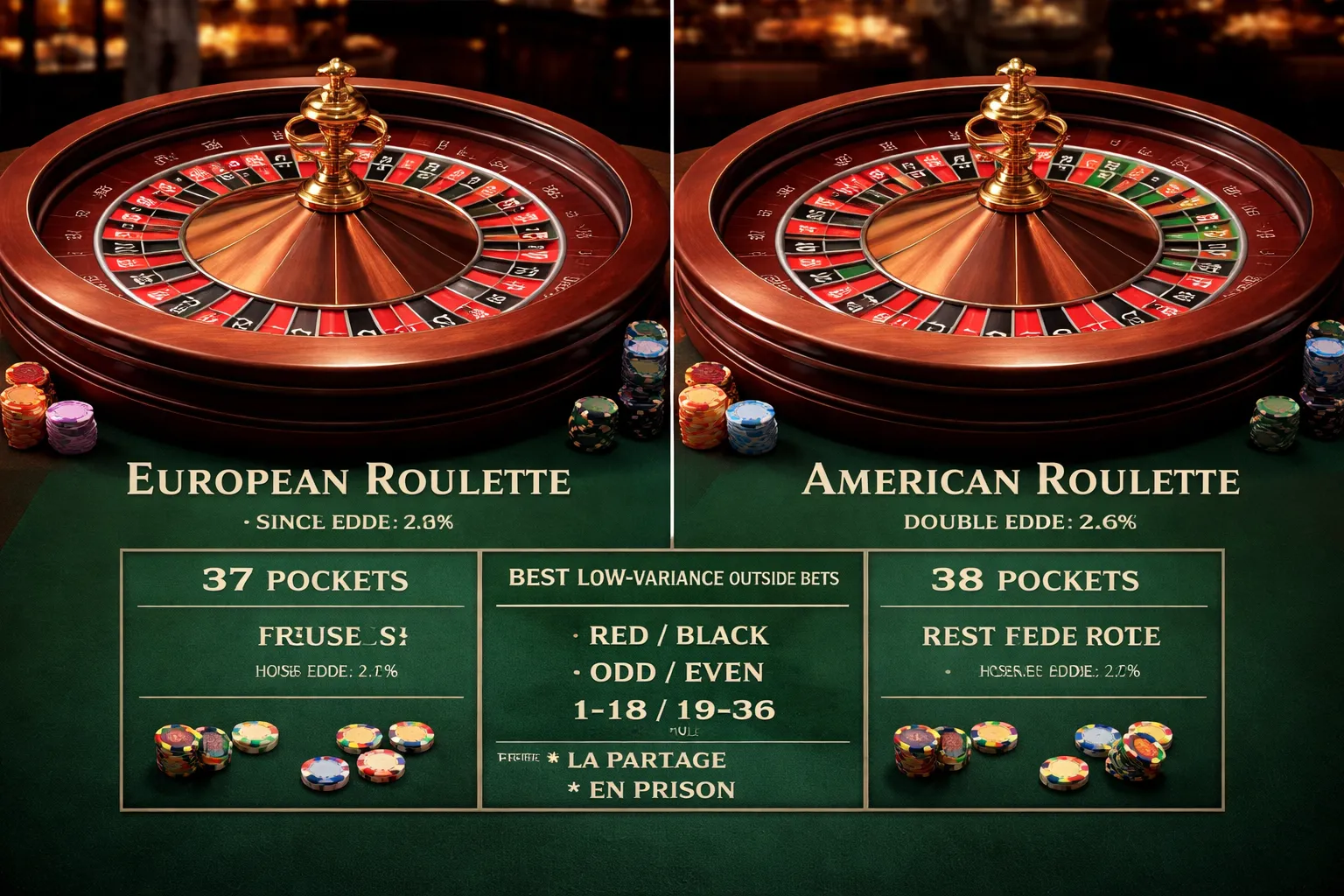
- European roulette uses 37 pockets, numbers 1 to 36 plus a single 0. House edge is 2.70%.
- American roulette uses 38 pockets, numbers 1 to 36 plus 0 and 00. House edge is 5.26%.
Both wheels pay most bets as if there are only 36 numbers. The extra zero adds losing outcomes without improving payouts. Your expected loss almost doubles on the American wheel.
Best Roulette Bets for Lower Edge
The house edge stays the same across standard bets on the same wheel. Your results change because variance changes.
- Outside bets last longer. Use red or black, odd or even, high or low, and dozens or columns. These bets swing less per spin.
- Inside bets swing harder. Straight up, split, street, corner, and six line can spike wins, but your bankroll drops faster during normal runs.
If you want lower stress, keep most of your stake on outside bets. If you want bigger hits, size down your inside bets and expect longer losing stretches.
French Roulette Rules That Cut the Edge
Some European tables add rules that help you on even money bets.
- La Partage. If the ball lands on 0, you lose only half your even money bet. House edge drops to 1.35% on red or black, odd or even, high or low.
- En Prison. If 0 hits, your even money bet “goes to prison” for the next spin. If it wins next spin, you get your bet back. If it loses, you lose it. This also yields 1.35% on even money bets in most implementations.
These rules do not change dozens, columns, or inside bets. They only improve even money bets.
Auto-Roulette and Live Roulette, Speed, Limits, and Bankroll
Game format changes how fast you cycle money through the edge.
- Auto-roulette runs fast. More spins per hour means the house edge hits your bankroll sooner. Use smaller unit sizes or fewer bets per spin.
- Live roulette runs slower. You get fewer decisions per hour, so your bankroll often lasts longer at the same bet size.
- Limits matter. Fast games often tempt you into higher stakes or more frequent re-bets. Set a fixed unit and stick to it.
If you want the best roulette value, pick a European wheel, then prefer La Partage or En Prison when you play even money bets. For bet types and payouts, use our online roulette guide.
6) Low-Edge Specialty Options (Often Overlooked)
6) Low-Edge Specialty Options (Often Overlooked)
These games can keep your expected loss rate low, but the rules and pace decide the real value. Check the pay table and the push rules before you bet.
Casino War (Low Edge, Rule Dependent)
Casino War looks simple, but the tie rule drives the math. Your main decision comes on ties. Some casinos force one option, some let you choose.
- Best rule: Tie pushes. You lose nothing on ties, and the edge drops.
- Common rule: Tie loses. Your edge jumps.
- Typical decision point: If the casino lets you choose, “war” usually costs more than surrendering. Read the table rules, then follow the lowest-cost option offered.
- Rule to avoid: Paying a fee or commission to go to war. That fee acts like a hidden edge.
Pai Gow Poker (Pushes Reduce Loss Rate, Slow Game)
Pai Gow Poker produces many pushes. That cuts the rate your bankroll drains. It does not remove the house edge. It just slows your loss per hour at the same unit size.
- Why it can feel “low edge”: Many hands push, so you do not pay the edge every hand.
- What rules matter: House commission, bonus side bets, and how the dealer qualifies. Side bets often carry a much higher edge than the base game.
- Main trade-off: Slow rounds. You see fewer decisions per hour. That lowers volatility, but it also slows your chance to realize any small mathematical edge you might have in rare rule sets.
- Practical play: Skip side bets if your goal is low edge. Use a consistent hand-setting method, or use “house way” if allowed to avoid costly mistakes.
Betting Exchanges and Peer-to-Peer Casino-Style Games (Edge Works Differently)
On exchange-style products, the “house edge” may not describe your cost. You usually pay a commission on net winnings, not a built-in game margin on every bet.
- What to check: Commission rate, minimum commission, and whether it applies per market, per day, or per bet.
- Liquidity matters: Thin markets create worse prices. Bad prices can cost more than a normal casino edge.
- Look for: Transparent odds, tight spreads, and clear fee terms. Treat fees and price slippage as your real cost.
Live Game Show Titles (Usually Higher Edge, Few Exceptions)
Most live game shows price entertainment into the math. The base game can look fair, then side multipliers and bonus rounds raise the edge.
- Why the edge runs high: Random multipliers, bonus wheels, and tempting side bets usually pay below true odds.
- How to spot better options: Find published RTP for the main bet, then compare it to the RTP of side bets. If the casino hides RTP or only markets max multipliers, assume a higher edge.
- Play rule: If you play, stick to the main bet with the highest stated RTP. Avoid add-ons unless you accept a higher expected cost.
| Option | Why it can be low cost | What usually ruins value |
|---|---|---|
| Casino War | Tie push rules reduce expected loss | Tie loses, war fees, forced war |
| Pai Gow Poker | High push rate lowers loss per hour | Commission, side bets, poor hand setting |
| Betting exchanges | Fees can beat built-in casino margins | High commission, bad prices, low liquidity |
| Live game shows | Rare high-RTP main bets exist | Side bets, bonus mechanics, hidden RTP |
Games That Usually Have a High House Edge (Avoid or Play for Fun)
Online slots
Slots usually carry a higher house edge than table games. Many online slots sit around 4% to 10%. Some go higher.
You also face extreme volatility. A slot can keep your losses small for a while, then hit long dry spells. Two slots with the same RTP can feel very different because variance drives the ride.
Slots also hide cost in mechanics. Bonus buys, feature spins, and side features often shift more money into high-variance payouts. That can raise your risk of busting fast, even if the posted RTP looks fine.
Keno and scratch-style games
Keno and instant scratch games usually punish you over time. Many keno paytables land around 20% to 35% house edge. Some “better” versions still sit near 10% plus.
Scratch-style games often run similar. The math stays rough, and the sessions end fast because outcomes resolve quickly and you repeat bets at high speed.
The core problem is simple. These games pay too little back on average, and they offer few or no player decisions to reduce the edge.
Side bets across table games
Side bets inflate the house edge, even when the main game ranks low-edge.
- Blackjack side bets often sit in the 5% to 25% edge range. The main hand can be under 1% with solid play, then the side bet wipes that out.
- Roulette side bets and “special” bets often keep the same core edge, but encourage higher volatility and faster loss. On American roulette, the base edge already runs 5.26%.
- Poker variants push side wagers hard because they spike revenue. Many carry double-digit edges.
If you want roulette, learn what each bet really costs. Use this roulette rules, bets, and payouts guide to spot which bets add risk without adding value.
When it still makes sense to play high-edge games
Sometimes you want entertainment, not efficiency. In that case, treat high-edge games like a paid activity.
- Set a fixed session budget. Assume you will lose it.
- Pick a time limit. Stop when the timer ends, not when you feel “close.”
- Use smaller stakes to buy more playtime.
- Avoid side bets if you want your bankroll to last longer.
- Do not chase losses. Do not raise stakes to “get even.”
Play slots, keno, and scratch games for fun. Play low-edge games when you care about long-term cost.
How House Edge Works (And What It Does—and Doesn’t—Mean)
House edge vs RTP vs variance, the three numbers players confuse most
House edge is the casino’s long-run advantage on each dollar you bet. A 1% house edge means you expect to lose $1 for every $100 wagered, over a large sample.
RTP, return to player, is the flip side. RTP = 100% minus house edge. A 99% RTP equals a 1% house edge.
Variance, also called volatility, describes how results swing around that average. High variance means bigger streaks, bigger upswings, bigger downswings. Variance does not change the math edge, it changes the ride. For slot-specific volatility terms, see high volatility vs low volatility slots.
| Metric | What it tells you | What it does not tell you |
|---|---|---|
| House edge | Your average cost per $1 wagered over time | What happens in your next 10 hands or spins |
| RTP | Your average return per $1 wagered over time | How often you will win, or how big wins will be |
| Variance | How wild the swings can get | Whether the game is “good value” by itself |
Expected value explained with a simple example
Expected value is the long-run average result if you repeat the same bet many times.
Example: you bet $10 per hand on a game with a 1% house edge.
- Your expected loss per hand is $10 x 0.01 = $0.10.
- Over 1,000 hands, you expect to lose about $100.
This is an average. You can lose less, lose more, or even win in that stretch. The bigger the sample, the closer results tend to move toward the expected loss.
Short-term outcomes, why you can win even with a high edge (and lose with a low edge)
House edge describes the average. It does not predict your session.
- You can win fast in a high-edge game if you hit a rare payout early.
- You can lose in a low-edge game due to normal downswings.
- Higher variance makes these swings larger and more common.
Use house edge to compare long-term cost. Use variance to judge how rough your bankroll ride can get.
Why hands and spins per hour change your expected losses
The house edge applies to every dollar you wager. Speed multiplies how many dollars you wager per hour.
Use this quick estimate.
Expected loss per hour = average bet x bets per hour x house edge
| Average bet | Bets per hour | House edge | Expected loss per hour |
|---|---|---|---|
| $10 | 60 | 1% | $6 |
| $10 | 300 | 1% | $30 |
| $10 | 600 | 1% | $60 |
- Faster games cost more per hour at the same edge and bet size.
- Autoplay and rapid-fire modes raise your hourly wagers.
- If you want lower cost, lower your bet size, slow the pace, or pick a lower-edge game.
What Changes the House Edge Online (Rules, Variants, and Bet Types)
Rule variations that move the edge
The same game can have different rules online. Small rule changes can double your cost.
- Blackjack payouts. 3:2 blackjack keeps the edge low. 6:5 blackjack raises the edge a lot, even with perfect play.
- Number of decks. Fewer decks usually lowers the edge in blackjack. More decks usually raises it.
- Dealer actions. Dealer stands on soft 17 helps you. Dealer hits soft 17 hurts you.
- Doubling and splitting limits. Double after split helps you. Fewer split options and no resplit of aces hurt you.
- Surrender. Late surrender lowers the edge. No surrender raises it.
- Baccarat commission. Standard Banker wins pay 0.95:1, with a 5% commission. Some tables remove commission but change payouts or add a side rule. Read the paytable.
- Roulette wheel type. Single zero roulette beats double zero roulette by a wide margin. Use this guide on European vs American roulette odds when you pick a table.
- Video poker paytables. The paytable is the game. Full pay versions can sit near 0.5% edge with correct strategy. Short pay versions can jump to 2% to 5% plus.
Bet selection, spot the trap bets
Many games offer side bets with a much worse edge. Avoid them if you want low cost per hour.
- Blackjack insurance. A bad default bet. Take it only when you count cards and the deck is rich in tens.
- Blackjack side bets. Perfect Pairs, 21+3, Match the Dealer, and similar bets often carry high house edge.
- Baccarat Tie. Usually one of the worst-value main-table bets.
- Roulette inside bets. Straight up and other high-volatility bets often have the same edge as other roulette bets, but you lose more often. That can push you into chasing losses and raising stakes.
- Slots bonus buys. Buying features can increase volatility and bankroll swings. The RTP may look similar, but your session risk rises.
Game speed and autoplay, why faster play costs more
House edge works per bet. Faster games mean more bets per hour. Your expected loss rises with speed.
- Autoplay increases volume. You place more wagers without thinking. Your bankroll drains faster at the same edge.
- Turbo and rapid modes do the same. Shorter spin and deal times raise bets per hour.
- Live dealer tables slow you down. That often cuts hourly loss, even if the edge matches a fast RNG version.
- Multi-hand play multiplies bets. Three hands of video poker at $1 per hand is $3 per round. Your edge applies to the total wagered.
Bonus wagering requirements, when promos raise your true cost
A bonus can add value, or it can lock you into extra wagers at a negative edge. You need the real math.
- Wagering multiplies your exposure. A $100 bonus with 40x wagering can force $4,000 in bets. Even a 1% edge implies about $40 in expected loss during the requirement.
- Game weighting changes the deal. Some casinos count slots at 100%, roulette at 0% to 10%, and blackjack at 5% to 20%. Your low-edge game may barely clear wagering.
- Max bet rules matter. If you break them, the casino can void winnings. Stay under the limit.
- Contribution caps push you to worse games. If your best games do not count, the bonus effectively raises your cost of play.
- Look for low wagering and clear rules. Lower multipliers, high game contribution, and no harsh caps keep the promo usable.
How to Choose a Legit Online Casino for Low-Edge Play (E-E-A-T Checklist)

Licensing and regulation, what to verify
Start with the license. Do not trust a footer logo. Verify it.
- Jurisdiction: Click the license number and match it on the regulator site. Prefer strict regulators with public enforcement and clear rules.
- Operator name match: Confirm the legal entity on the license matches the casino brand and the payment descriptor you see at checkout.
- Game supplier approval: Check that major studios list the casino as an approved operator. This reduces the risk of fake lobbies and altered games.
- Audits and compliance: Look for posted audit references, terms, and policies that name the operator, not a generic template.
- Dispute resolution: Find the complaints path in the terms. You want a clear escalation route, timelines, and an external ADR option if your region requires it.
RNG testing and game fairness, certifications to look for
Low house edge only matters if the games run as published. Your checklist is proof of testing, plus consistent RTP disclosure.
- Independent test labs: Look for recognized labs such as eCOGRA, GLI, iTech Labs, or BMM Testlabs. The casino should name the lab and scope.
- RTP display: The game info panel should show RTP for slots and tables where applicable. Avoid casinos that hide RTP or bury it in vague wording.
- Version control: Some games ship with multiple RTP settings. You want the exact RTP setting shown in-game, not a range on a marketing page.
- Live dealer integrity: Check the live provider, studio location, and game rules. Reputable providers publish rule sheets and limit tables.
If you want a deeper breakdown of what “fair” means in practice, read our online casino fairness guide.
Game rules transparency, where to find paytables and rule sheets
Rule details move the house edge. You need them before you bet.
- Table games: Open the “Game Rules” or “Help” panel inside the game. Confirm key rules like blackjack payouts, dealer stand rules, side bet paytables, and resplit limits.
- Video poker: Check the paytable in-game. A small paytable change can turn a good return into a bad one.
- Roulette: Confirm the wheel type and zero count. Make sure the rules state European, French, or American, plus any “la partage” or “en prison” rules.
- Slots: Open the info screen and read RTP, volatility notes, bonus buy terms, and max win limits. Do this on the exact device you will use.
- Accessibility: You should reach rules in two clicks, without a forced deposit or account lock.
Banking safety, withdrawal terms, and payout reliability
Low-edge play needs fast, predictable cashouts. Slow pay breaks your bankroll plan.
- Secure payments: Use well known methods, card networks, bank transfer options, and regulated e-wallets. Avoid processors with unclear branding.
- Withdrawal times: Find the stated processing window for your method and region. Separate “processing time” from “bank time.”
- Limits and fees: Check minimum and maximum cashout limits, daily and weekly caps, and any fees. Low caps can trap you during a good run.
- Verification rules: Read KYC and source-of-funds requirements. Expect ID checks, but avoid casinos that reserve broad rights to delay without timelines.
- Bonus impact: Confirm whether an active bonus blocks withdrawals and whether you can cancel it. Also check max cashout limits tied to promos.
- Chargeback and fraud language: Avoid terms that let the casino seize funds for vague “risk” reasons without an appeal path.
Responsible gambling tools, limits, self-exclusion, and support resources
Edge control fails if your session control fails. Use tools that protect your plan.
- Deposit limits: Set daily, weekly, and monthly caps. A legit casino enforces them with cooling-off rules.
- Loss and wager limits: Use loss limits and stake limits if available. These stop tilt betting that kills low-edge gains.
- Session and timeouts: Set session timers and short timeouts. You want friction when you chase.
- Self-exclusion: Look for multi-length options and clear reinstatement rules. Strong operators support national schemes where available.
- Reality checks: Enable pop-ups that show time played and net results.
- Support access: Confirm 24/7 live chat or fast email support, plus links to gambling harm support organizations.
Practical Tips to Keep the Edge Low (Strategy, Bankroll, and Discipline)
Use Strategy Aids That Lock In Correct Play
Low house edge games stay low only when you play close to optimal.
- Blackjack: Use a basic strategy chart for the exact rules you play. Match dealer hit or stand on soft 17, number of decks, doubling rules, and surrender. Do not guess. Use the chart every hand.
- Video poker: Pick a pay table with solid RTP first, then use a trainer or a printable hold chart for that exact variant. One wrong hold choice can erase the edge you gained from a good pay table.
- Baccarat: Bet Banker. Skip side bets. Keep it simple and repeatable.
- Craps: Stick to low edge core bets. Pass or Don’t Pass with odds, or Come or Don’t Come with odds. Avoid proposition bets.
- Roulette: Play European or French wheels. Avoid American roulette and most side bets.
Test yourself before you play for real money. Run 10 to 20 minutes in a free mode or trainer. Stop if you miss decisions.
Bankroll Rules That Reduce Damage
You cannot remove the house edge. You can limit how much time and money you expose to it.
- Set a session bankroll: Bring one fixed amount for the session. Do not reload when it is gone.
- Use a unit size: Keep your main bet at 1 to 2 percent of your session bankroll for lower swing games. Use less for higher swing games.
- Set a stop-loss: Pick a number you can accept losing, then stop when you hit it. Common ranges sit around 30 to 50 percent of your session bankroll for many players.
- Set a stop-win: Lock profits when you hit a target. Pick a target you will actually respect. Many players use 25 to 50 percent of session bankroll as a practical cap.
- Separate stakes: Keep bonus money, winnings, and cashouts separate in your head and in your wallet. Treat every dollar as real.
Track net results per session. Write down start bankroll, end bankroll, and game played. This keeps you honest.
Match Volatility to Your Budget and Your Temper
Two games can share the same RTP and still feel very different. Volatility decides how often you win and how large the swings get.
- If you tilt fast: Choose lower volatility options and smaller units. You want more frequent small outcomes and fewer long droughts.
- If your bankroll is small: Avoid high volatility slots and side bets. They stretch losing streaks and push you into chasing.
- If you play slots: Treat RTP and volatility as a pair. High RTP does not protect you from long dry spells. Use this guide on slot volatility to pick a fit.
Pick one game per session. Game hopping usually increases mistakes and increases spend.
Myths That Raise Your Cost Per Hour
- Martingale: Doubling after losses does not change the house edge. It increases variance and pushes you into table limits and bankroll failure.
- Hot tables and due numbers: Past outcomes do not change future odds in fair RNG games. Streaks happen. They do not predict reversals.
- Pattern betting: Systems that move chips around do not improve expected value in roulette, baccarat, or slots. They mainly increase bet size at the worst time.
- Side bet traps: Many side bets carry a much higher edge than the main game. If you want low edge play, skip them.
Discipline beats tricks. Use the best rules, correct strategy, and fixed limits. Then stop on schedule.
FAQ
What is house edge?
House edge is your long-run expected loss, shown as a percent of each bet. A 1% edge means you give up about $1 per $100 wagered over time. Short sessions can swing either way. The math still applies.
Which online casino games have the lowest house edge?
Blackjack with basic strategy, full-pay video poker, baccarat banker bet, and some craps bets. The exact edge depends on rules and pay tables. Check them before you play.
What is the lowest house edge you can realistically get online?
About 0.5% or lower in strong conditions. Examples include good blackjack rules with correct strategy, or full-pay video poker with perfect play. Most players land higher due to mistakes and bad tables.
Does using a strategy system beat the house?
No. Betting systems do not change expected value. They change variance and your risk of ruin. You improve outcomes by choosing low-edge rules and using correct strategy. Then you control stakes and session length.
Do live dealer games have lower house edge than RNG games?
Not by default. House edge depends on rules, payouts, and your decisions. Live and RNG blackjack can both be low edge with good rules and correct play. Live games can add higher minimums and slower pace.
How do blackjack rules change the house edge?
Rules like dealer hits soft 17, fewer decks, double after split, and late surrender can shift the edge. Bad rules can erase your advantage from good play. Use a blackjack basic strategy chart and pick the best table.
Why are side bets usually a bad choice for low edge play?
Side bets often carry a much higher edge than the main game. They look small, but they add a steady drag on results. If you want low edge, skip side bets and focus on the core wager.
Are slots ever low house edge?
Rarely. Slot RTP varies by game and sometimes by casino setting. Many slots sit far above table-game edges. You can reduce damage by picking higher RTP titles, but you still face large variance and no skill edge.
Is “0% house edge” real?
Usually no. When a casino advertises 0% edge, check the terms. Limits, wagering requirements, and restricted games often apply. Some promotions can create positive expected value, but they do not make the base game fair.
Conclusion
Conclusion
Low house edge comes from game choice and clean execution. Start with games where the math stays on your side, then remove mistakes that add extra edge.
- Pick the right games. Baccarat banker, European roulette, and blackjack with correct strategy sit near the bottom for house edge. Most slots do not.
- Control the rules. Avoid American roulette when you can. Skip blackjack tables with 6:5 payouts or weak doubling and splitting rules.
- Play the right way. Use basic strategy every hand in blackjack. Do not chase losses with bigger bets.
- Validate the offer. Treat “0% edge” claims as marketing until you read the terms, game restrictions, and wagering requirements.
Your best final move is simple. Choose one low edge game, set a session budget, then stick to the correct strategy and the best rules available. If you play roulette, start by comparing European vs American roulette and only play the version with the lower edge.
-
Online Casino Fairness Explained: RNG, RTP, House Edge & Provably Fair
8 months ago -
Slot RTP Explained: What RTP Means and How to Use It
8 months ago -
How to Play Online Slots: Rules, Features & Beginner Tips
8 months ago -
How Slot Jackpots Work: Progressive Jackpots Explained
8 months ago -
How to Play Online Blackjack: Rules, Payouts & Quick Start Guide
8 months ago
-
- What is house edge?
- Which online casino games have the lowest house edge?
- What is the lowest house edge you can realistically get online?
- Does using a strategy system beat the house?
- Do live dealer games have lower house edge than RNG games?
- How do blackjack rules change the house edge?
- Why are side bets usually a bad choice for low edge play?
- Are slots ever low house edge?
- Is “0% house edge” real?
-
- What is house edge?
- Which online casino games have the lowest house edge?
- What is the lowest house edge you can realistically get online?
- Does using a strategy system beat the house?
- Do live dealer games have lower house edge than RNG games?
- How do blackjack rules change the house edge?
- Why are side bets usually a bad choice for low edge play?
- Are slots ever low house edge?
- Is “0% house edge” real?
-
Reload Bonus Explained: What It Is and When It’s Worth Claiming
6 months ago -
Online Casino Licensing Explained: Authorities, Licenses & How to Check One
8 months ago -
Best Live Dealer Casinos: Where to Play Live Blackjack, Roulette & More
8 months ago -
Best Online Casinos for High Rollers: VIP Perks, High Limits & Exclusive Bonuses
8 months ago -
Fast Payout Online Casinos: Best Sites for Quick Withdrawals
8 months ago
-
Online Casino Customer Support: What to Look For (Live Chat, Email, Response Times)
8 months ago -
Sign Up for an Online Casino: Create an Account in Minutes
8 months ago -
Online Casino Payment Safety Tips: How to Deposit and Withdraw Securely
8 months ago -
What to Do If an Online Casino Won’t Pay Out: Step-by-Step Actions
8 months ago -
How to File a Complaint Against an Online Casino (Plus ADR Explained)
8 months ago