Slot RTP Explained: What RTP Means and How to Use It

Slot RTP tells you the long-run share of stakes a slot pays back to players. It shows expected return over a large sample of spins, not what you will get in one session. If a game lists 96% RTP, it returns about $96 for every $100 wagered across many spins and many players.
This guide explains what RTP means, how casinos and studios calculate and publish it, and how to use it when you pick games. You will learn how RTP links to house edge, why two 96% slots can still play very differently, and how RTP works with slot volatility when you manage your bankroll and risk.
Key Takeaways
- In het kort: RTP is a long-term average, not a promise for your session.
- In het kort: A 96% RTP slot returns about $96 per $100 wagered over many spins and many players.
- In het kort: House edge links directly to RTP, house edge is 100% minus RTP.
- In het kort: Use RTP to compare similar slots, but do not treat small differences as a guarantee of profit.
- In het kort: Two slots with the same RTP can feel very different because volatility and hit frequency can vary.
- In het kort: High volatility can mean bigger wins but longer losing streaks, plan your bankroll for swings.
- In het kort: Look for the exact RTP version your casino runs, some games offer multiple RTP settings.
- In het kort: Treat RTP as one filter in your game choice, pair it with volatility, budget, and stop limits.
Pick the highest RTP you can find within the type of slot you want to play. Then match volatility to your bankroll and risk tolerance. Use fixed session limits and stop rules, RTP does not protect you from short-term variance. For a deeper breakdown of risk and swing size, read our slot volatility guide.
Slot RTP explained: what RTP actually means (in plain English)
Return to Player vs house edge, turning percentages into cost
RTP means Return to Player. It is the share of total stakes a slot pays back over time.
If a slot has 96% RTP, it returns about $96 for every $100 wagered, in the long run. The other $4 is the casino’s expected share.
House edge is the flip side. House edge = 100% minus RTP.
- 96% RTP = 4% house edge
- 94% RTP = 6% house edge
- 98% RTP = 2% house edge
Think of house edge as your expected cost per dollar wagered, not per deposit. If you wager $1,000 total on a 96% RTP slot, the expected cost is about $40. Your actual result can be far above or below that.
Why RTP is “theoretical”, the long-run requirement
RTP comes from the game’s math model. It assumes huge numbers of spins across many players.
Your session is small sample. The slot can run hot or cold for long stretches and still match its RTP over time.
RTP also assumes you play the same way the math expects. If the slot has adjustable bets or bonus buys, RTP may change by mode, bet level, or feature.
Simple RTP examples, what 96% looks like at scale
Here is what “expected return” looks like when you repeat the same bet many times. These are averages, not guarantees.
| Total wagered | Expected return at 96% RTP | Expected loss (4% house edge) |
|---|---|---|
| $100 | $96 | $4 |
| $1,000 | $960 | $40 |
| $10,000 | $9,600 | $400 |
If you want RTP to matter more, focus on total wagered. More spins and higher stakes make the expected cost show up faster.
What RTP does NOT tell you
- Session outcomes. RTP does not tell you what happens in your next 50, 200, or 500 spins. You can lose fast on a high RTP slot.
- Hit frequency. Two slots can share the same RTP. One can pay small wins often, another can pay rarely.
- Max win potential. RTP does not tell you the top prize size. Check the max win multiplier and game rules.
- Risk and swing size. RTP does not measure volatility. Use it with bankroll rules and game features. If you need a refresher on the basics of paylines, bonus rounds, and betting, use our online slots beginner guide.
How RTP works inside a slot machine
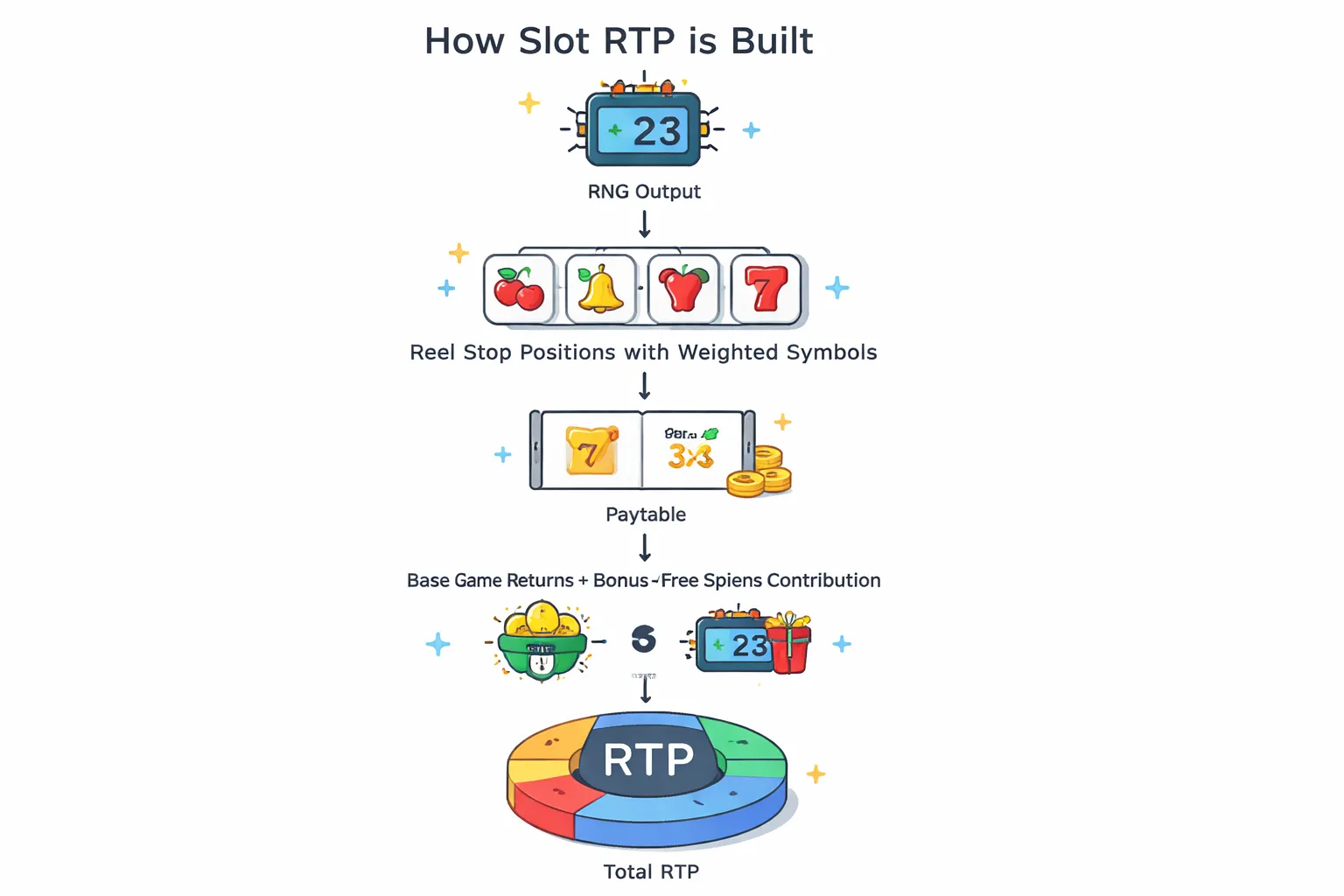
RNG basics, what happens on each spin
A slot uses a random number generator, or RNG. The RNG outputs numbers many times per second.
When you press spin, the game takes the next RNG result. It maps that result to a stop position on each reel.
Each spin stands alone. The slot does not track your last results. It does not “owe” a win. It does not “heat up” after losses.
RTP does not change the spin. RTP describes the long-run average return across a huge sample of spins.
Paytable and symbol weighting, where RTP gets built in
RTP comes from math design. The studio sets:
- Paytable payouts, what each symbol and combination pays.
- Hit rates, how often you land any win.
- Symbol weights, how likely each symbol is to appear on each reel.
Modern slots do not use equal odds for each symbol. Common symbols get heavy weight. High-paying symbols get light weight.
The studio then simulates millions to billions of spins. They tune weights and payouts until the average return matches the target RTP, such as 96%.
The casino edge comes from the gap between 100% and the RTP. A 96% RTP implies a 4% house edge over the long run.
Bonus features and free spins, how they change the total
Total RTP usually combines two parts:
- Base game RTP, wins from normal spins.
- Feature RTP, wins from free spins, respins, hold-and-win, and bonus rounds.
A slot can hold a high RTP while paying little in the base game. It does that by allocating more RTP to features.
This matters for your session results. If you miss the bonus triggers, you can run far below the stated RTP for a long time.
Some games add options that shift RTP. Examples include buying the bonus, adding an ante bet to raise feature frequency, or selecting feature modes. Always check the game info panel for the RTP tied to your chosen mode and bet.
Why two players can get very different results on the same slot
RTP works over extreme volume. Your session stays small by comparison.
- Short samples swing hard. A few hundred spins can land far above or below the target.
- Volatility drives the spread. High volatility concentrates more return into rare events, so outcomes vary more between players. For a deeper breakdown, read our slot volatility guide.
- Bonus timing changes everything. Two players can play the same bet size, one hits a feature early, the other never hits it.
- Bet size changes bankroll survival. Bigger bets reach bust or big hits faster, even if the RTP stays the same.
Use RTP as a filter, not a promise. It tells you what the math aims for over time, not what your next hour will look like.
How slot RTP is calculated and verified

The math model behind RTP, probabilities, payouts, and expected value
RTP starts as a math model. The game defines outcomes, their probabilities, and their payouts.
Each spin maps to a result. That result pays a fixed amount or triggers a feature with its own payout rules.
RTP equals the expected return per spin. In plain terms, you multiply each outcome payout by its chance, then add the results.
Simple example.
| Outcome | Probability | Payout (x bet) | Contribution to RTP |
|---|---|---|---|
| Lose | 0.90 | 0 | 0.000 |
| Win small | 0.09 | 2 | 0.180 |
| Win big | 0.01 | 50 | 0.500 |
| Total RTP | 1.00 | 0.680 or 68% |
Real slots add many more outcomes. They also split RTP across parts of the game.
- Base game RTP, the normal spins.
- Bonus RTP, free spins, respins, hold and win, or other features.
- Jackpot RTP, if the slot funds a fixed or progressive jackpot.
When you buy a bonus, the game still targets the same total RTP. It just shifts more return into the feature and less into the base game.
Simulations and cycle length, why some games need huge samples
Providers validate RTP with simulation. They run millions or billions of spins and compare the result to the target RTP.
This matters because modern slots can have long payout cycles.
- Rare features can take a huge number of spins to show their true average.
- High maximum wins usually mean lower hit rates and longer downswings.
- Progressive jackpots add extra variance, the jackpot may not drop in your sample.
Two tests can both look correct and still show different results. Small samples swing hard. Big samples tighten around the target.
Practical takeaway. Treat RTP as reliable only at scale. Your session stays noise. The math needs volume.
Who audits RTP, common testing labs and what certification means
Independent labs test the RNG and the payout model. They check that the game behaves like the submitted math.
Common labs include:
- eCOGRA
- GLI, Gaming Laboratories International
- iTech Labs
- BMM Testlabs
- Quinzel
Certification usually means the lab reviewed the RNG, verified game rules, and confirmed the RTP settings the operator runs match an approved configuration.
It does not mean you will see the posted RTP in short play. It means the game should converge to it over very large samples.
RTP disclosure by casinos and providers, where to find the official number
You should take RTP from the game itself, not from a listicle. Many slots ship with multiple RTP settings, and the casino can run a lower one.
Check these places:
- Game info panel, often behind an info icon, paytable, or settings menu.
- Help or rules screen, usually lists RTP and volatility.
- Provider page, some studios publish the default RTP range.
- Casino game details, sometimes shown next to min bet and max win.
If you cannot find an RTP number inside the game UI, treat it as unknown and move on. If you want a clearer edge on disclosed odds, live table games make it easier to verify what you face, see our live casino guide.
RTP vs volatility: the relationship most players miss
Volatility defined, how payout patterns change
RTP tells you the average return over a huge number of spins.
Volatility tells you how that return tends to arrive.
- Low volatility: more frequent small wins. Smaller swings in your balance.
- Medium volatility: mixed win sizes. Noticeable swings.
- High volatility: fewer wins, bigger jumps when they land. Large swings and longer losing runs.
Think of RTP as the long-run cost. Think of volatility as the ride.
High RTP plus high volatility vs lower RTP plus low volatility
A high RTP slot can still feel harsh if it has high volatility.
A lower RTP slot can feel smoother if it has low volatility.
If you chase big wins, you accept more dead spins. If you want longer play time, you trade away top-end payout potential.
Variance in practice, why high RTP can still mean long losing streaks
RTP does not protect your next 50 or 500 spins.
High volatility widens outcomes. You can sit on the wrong side of the average for a long time.
- Many high volatility slots concentrate value in rare bonus rounds.
- Until the bonus hits, your results can track below the stated RTP.
- Even after a bonus, one weak bonus can leave you down.
This is why “96 percent RTP” can still drain a bankroll fast. The game can pay back later, but later may not arrive in your session.
Match volatility to your bankroll and playstyle
Pick volatility first, then compare RTP inside that band.
- Short sessions: lean low to medium volatility. Use smaller stakes. Aim for steadier hit rates.
- Long sessions: you can absorb more variance. Medium volatility fits most bankrolls.
- Hunting big wins: use high volatility only with a bankroll built for losing streaks. Drop your bet size to extend your runway.
If you need help reading slot features that drive volatility, see how to play online slots.
What is a good RTP for slots (and what’s typical)
Common RTP ranges online and in land-based casinos
RTP varies by channel and by game version.
- Online slots: Many modern titles sit around 95% to 97%. You will also see lower settings in some markets and some studios.
- Land-based slots: RTP often runs lower on average, commonly around 88% to 94%, depending on venue rules and local regulation.
Do not compare two games unless you know you are looking at the same RTP setting. Some slots ship with multiple RTP configurations.
Benchmarking slots: what “above average” looks like today
Use simple tiers.
- Below average: under 94%.
- Typical: 94% to 96%.
- Good: 96% to 97%.
- Very good: 97%+.
A 1% RTP gap matters over volume. If you stake 1,000 units total, a 96% game implies 40 units expected loss, a 95% game implies 50. Variance will dominate in the short run, but the edge compounds over time.
When a lower RTP might be acceptable: entertainment value and feature preference
Sometimes you trade RTP for a specific play experience.
- You value features over grind: You may accept a lower RTP if you care more about bonus frequency, bonus style, or buying features.
- You play short sessions: RTP has less time to show. Volatility and hit rate will shape your results more than the published percentage.
- You get clear value back: A weaker RTP can still feel fine if the game delivers the pacing you want, and you keep stakes small.
Keep it practical. If the RTP sits under 94%, shorten your sessions or lower your bet size. Treat it as entertainment spend, not value hunting.
Regional and regulatory differences: why RTP availability varies by market
RTP transparency depends on where you play.
- Regulated online markets: RTP often appears in the help file or game info panel, but the rules can differ by jurisdiction.
- Multiple RTP versions: The same slot may run at different RTPs across casinos or regions. Operators can select a permitted configuration.
- Land-based rules: Some regions set minimum payout requirements, others allow wider ranges. That changes what “typical” looks like locally.
If you cannot find RTP in the game info, assume it may vary. Use the slot’s help menu first, then check the casino’s game details page. For a quick guide to where RTP and key mechanics show up, see how to play online slots.
How to use RTP to choose better slot games
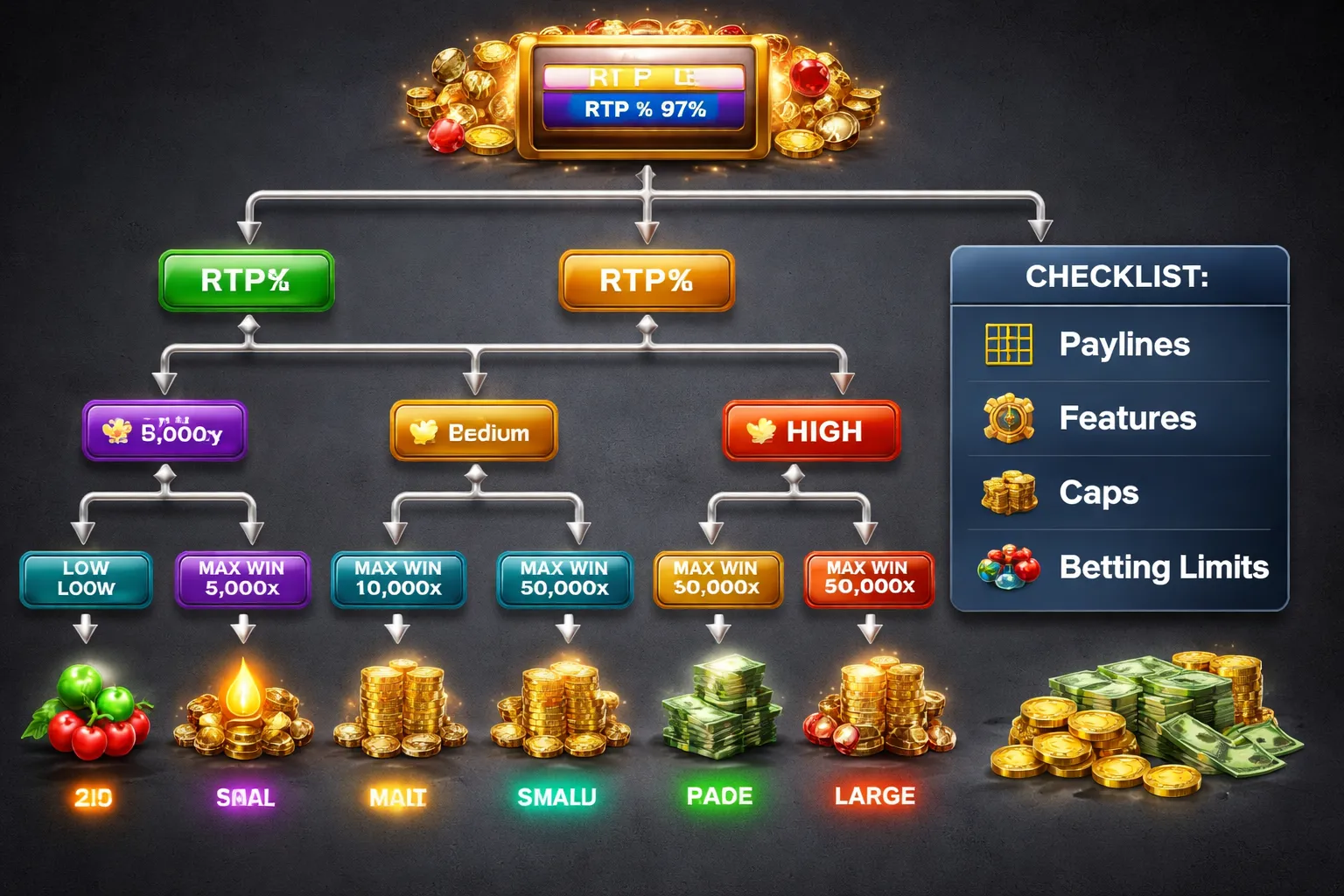
A quick decision framework, RTP plus volatility plus max win plus budget
Use RTP as your baseline. Then filter by risk and fit.
- RTP: Treat higher RTP as a better long-run deal. Use it to compare games in the same category.
- Volatility: Match risk to your bankroll. Low volatility pays smaller wins more often. High volatility pays less often but can hit bigger.
- Max win: Check the advertised maximum payout, like 5,000x or 50,000x. A higher max win often pairs with higher volatility.
- Your budget: Plan a session size and a spin count. If you want 200 spins, pick a stake that lets you reach it, even during a cold streak.
Picking games for different goals
Pick one main goal per session. Then choose RTP and volatility to match it.
- Steady play: Choose higher RTP and low to medium volatility. You trade peak wins for longer playtime.
- Bonus hunting: Look for games with frequent features, like free spins, hold and win, or bonus buy if you use it. Keep RTP high, accept medium to high volatility, and track how often you actually reach the bonus.
- Big jackpots: Expect high volatility. Check whether the game uses a progressive jackpot and what share of bets funds it. Read how progressive jackpot slots work before you chase one.
Comparing similar titles, why small RTP differences can matter
A 1 percent RTP gap looks small. Over many spins, it adds up.
| Example | Game A | Game B | Difference |
|---|---|---|---|
| RTP | 96% | 95% | 1% |
| Expected loss on $1,000 wagered | $40 | $50 | $10 |
| Expected loss on $10,000 wagered | $400 | $500 | $100 |
Keep the comparison fair. Compare similar volatility and feature sets. A slightly lower RTP slot can still suit you if it offers a higher max win or a feature you value, but you should know the trade.
Checklist before you spin, paylines, features, caps, and betting limits
- Confirm the RTP version: Some slots ship with multiple RTP settings. Make sure the casino lists the exact one you will play.
- Check volatility rating: Use the info screen. If the game does not show it, search the provider’s game sheet.
- Paylines and ways: Know whether you play fixed paylines, adjustable lines, or ways. This changes hit rate and how often small wins land.
- Feature rules: Read how free spins, multipliers, expanding symbols, and respins trigger. Look for caps on feature wins.
- Max win and win cap: Note both the headline max win and any hard cap in money terms, if your stake can reach it.
- Betting limits: Check min and max bet, coin value steps, and whether max bet changes feature odds.
- Bonus buy terms: If you use bonus buys, check cost, whether RTP changes, and whether you can buy different feature tiers.
- Session control: Set a stop loss and a cashout point. Keep stake size stable, unless your budget plan includes changes.
Finding a slot’s RTP (and spotting misleading info)
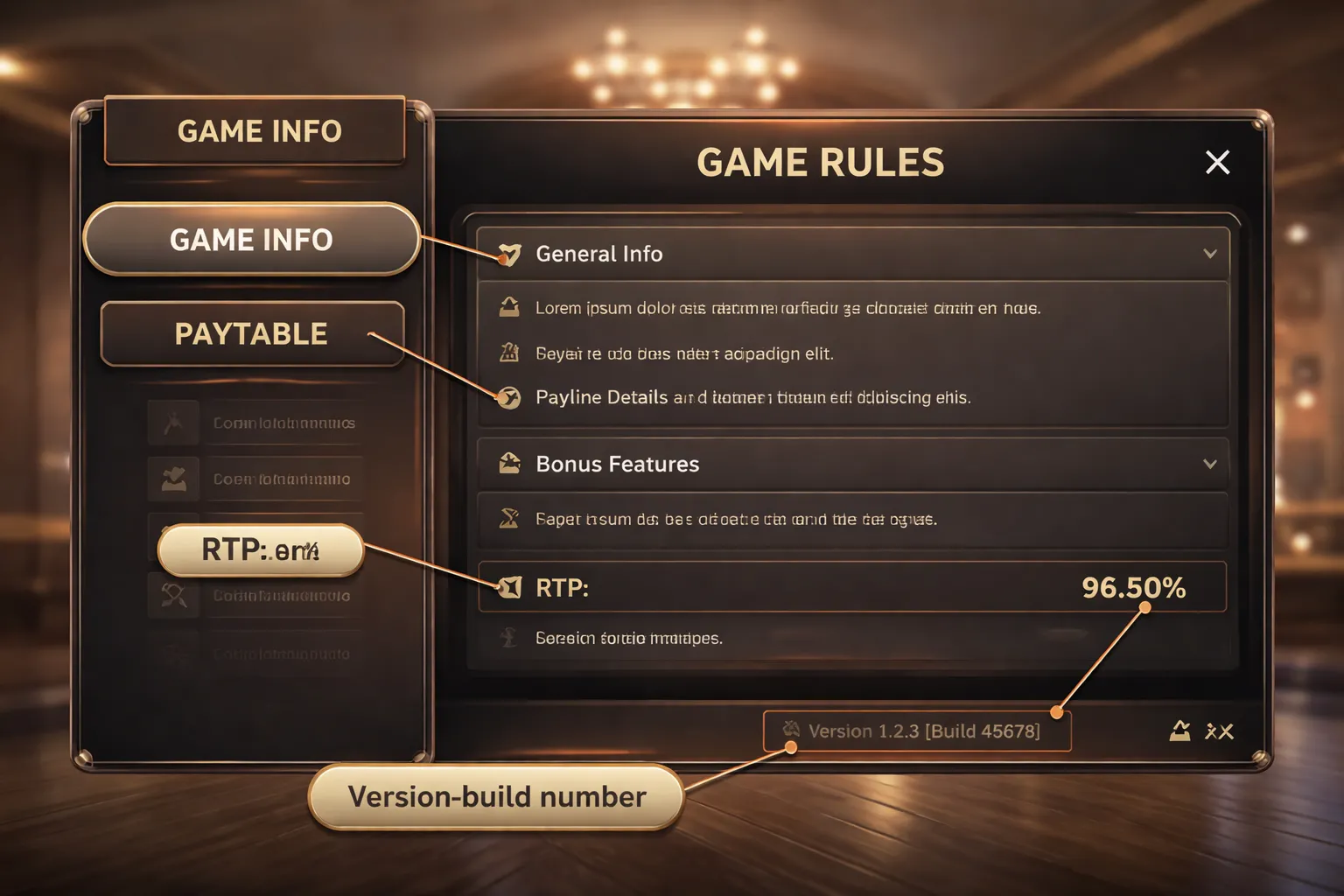
Where RTP is listed
Start with the sources tied to the game build you are playing. Ignore random lists until you confirm the number.
- Game info panel. Open the menu, then Info or Game Rules. Look for “RTP,” “Return to Player,” or “Theoretical payout.” Some games show several RTP options here.
- Paytable and rules. Check the full rules, not the small paytable popup. Some studios place RTP near the bottom with the legal text.
- Provider page. Use the developer’s official site or press kit. This often shows default RTP options, not the one your casino chose.
- Casino help and game page. Some casinos list RTP on the game tile, the info icon, or a “Game details” panel. Some list it in general help pages, which can be wrong for a specific slot build.
Configurable RTP versions and why they exist
Many modern slots ship with more than one RTP setting. The casino can select one when it deploys the game.
- Studios offer multiple RTPs to fit different markets, licensing rules, and commercial deals.
- One slot name can exist in several builds with different RTPs, hit rates, or feature frequencies.
- Bonus buy modes can have a separate RTP from base play. Some games disclose both. Some do not.
Do not assume the highest RTP you see online applies to your session. Treat it as an option list until you verify the active setting.
How to confirm the RTP you are actually playing
- Open the slot inside your casino, then open Info or Game Rules. Find the RTP line and note the exact percent.
- Screenshot the RTP line and the game name. Keep it with your session notes.
- Switch devices or browsers and check again. The RTP should match if you play the same casino and same game instance.
- If the slot offers an RTP selector in the menu, check which option is selected. Most games lock this to the casino setting, you cannot change it.
- If you use bonus buys, check the rules for a separate “Feature RTP” or “Buy bonus RTP.” Record both numbers.
- Compare the in-game RTP to the casino’s game details panel. If they differ, trust the in-game rules first, then ask support for the deployed RTP version.
Red flags and misleading RTP info
- Third-party RTP lists with no source. If a page does not cite the in-game rules or the provider, treat it as unverified.
- Outdated data. A slot can launch with one RTP set, then a casino deploys a different one later. Old reviews often keep the launch figure.
- “Estimated RTP” claims. You cannot estimate true RTP from short-term results. This label usually means the site guessed or scraped incomplete data.
- RTP ranges without the active setting. “96 to 92” tells you nothing about what you are playing right now.
- Confusing RTP with jackpot odds. A slot can show a high RTP and still have low odds of hitting rare top prizes. If a game includes a progressive, read how it works and what drives its value in this guide: how progressive jackpots work.
RTP and bonuses: what changes (and what doesn’t)
Does RTP change with free spins or bonus buys?
Game RTP stays tied to the game and the active RTP setting. A free spins round inside the game uses that same math model.
What changes is your cost and your variance. Free spins can remove the stake for some spins. Bonus buys move a large part of the RTP into the feature and increase volatility.
Promotional free spins can differ. Some promos use fixed coin values, fixed bets, or a reduced RTP version of the game. Always check the promo terms and the game info screen.
- In-game free spins: part of the slot. Same RTP setting.
- Bonus buy: same RTP setting, different bankroll path. Higher swing risk.
- Promo free spins: can use different stakes, caps, or excluded RTP variants.
Separate game RTP from promo EV
RTP describes the long-run return of the slot. A bonus offer has its own expected value, based on wagering, time limits, game contribution, caps, and which games you can use.
Two offers with the same bonus amount can have very different value, even if you play the same RTP slot.
Wagering requirements and contribution
Wagering drives how much you must bet before you can cash out. Contribution tells you how much each bet counts toward that target.
- High wagering: more spins. More exposure to variance and house edge.
- Low contribution: you bet more than you think to clear the requirement.
- Time limits: force higher bet sizes and increase bust risk.
If you want lower house edge while clearing wagering, use games with strong rules and low edge, see best low house edge casino games.
Max bet rules, win caps, and excluded games
Terms change real outcomes more than a 0.5 percent RTP difference.
- Max bet: if you exceed it, the casino can void winnings from the bonus balance.
- Max cashout: caps your withdrawal even if you win more.
- Win cap per spin: limits large hits on promo free spins.
- Excluded games: you might lose access to the RTP and volatility profile you planned to use.
- Game weighting: some slots count 0 to 20 percent toward wagering.
Bankroll planning during promos
Plan around survival, not peak RTP. Your goal is to finish wagering without going broke.
- Use the max allowed bet as your hard ceiling, then stay below it.
- Pick a lower volatility option when clearing wagering. It reduces ruin risk.
- Keep bet size small enough to handle swings. Avoid increasing stakes to chase progress.
- Track remaining wagering after each session. Stop if the required pace forces bigger bets.
- Do not mix bonus and cash play. Treat the bonus as a separate bankroll.
Common misconceptions about slot RTP
Myth: a slot is “due” after losses
RTP is a long-run average across a huge number of spins. It does not “pay back” because you just lost.
Each spin uses an RNG. The next result does not care about your last 10 spins, or your last 10,000. Loss streaks can keep going. Win streaks can stop fast.
Practical takeaway. Stop treating recent results as a signal. Set a session budget and a stop point, then stick to them.
Myth: switching machines changes your odds
Switching games can change your expected return if the games have different RTP settings. Switching because you feel “cold” does nothing by itself.
- What can change: the game’s RTP percentage, volatility, and bonus features. The operator can also offer the same game with different RTP versions.
- What does not change: your odds on the next spin from the same RTP version just because you moved, refreshed, or swapped seats.
Practical takeaway. If you switch, switch for a reason you can verify, like a higher listed RTP or lower volatility. Learn how volatility impacts bankroll swings in slot volatility.
Myth: bet size changes RTP
On most slots, RTP stays the same across stake sizes. You just scale the size of wins and losses. Bigger bets raise variance in money terms, not the game’s math.
- At $0.20 per spin, a 100x hit pays $20.
- At $2.00 per spin, the same 100x hit pays $200.
- The chance of that hit usually stays the same.
Watch for exceptions. Some games require full bet to unlock certain features, paylines, or bonus eligibility. If you do not qualify, your effective return can drop.
Practical takeaway. Pick a stake you can sustain through long downswings. Do not raise bets to “force” a result.
Myth: strategies can beat RNG
You cannot outplay a proper RNG slot. No pattern, timing method, or stop rule changes the next spin’s probabilities.
Skill still matters in limited ways.
- What you can control: game selection, RTP version, volatility choice, bet size, session length, and bonus terms.
- What you cannot control: when wins land, how long a dry spell lasts, and whether the next spin hits a feature.
Practical takeaway. Use “strategy” for risk control, not prediction. Your edge comes from choosing better conditions, then protecting your bankroll from variance.
Responsible play: using RTP without falling into traps
Setting limits, time, deposit, and loss limits based on your risk tolerance
RTP helps you compare games. It does not protect your bankroll. Limits do.
- Time limit: Set a hard stop in minutes. Use a timer. When it ends, you stop, even if you feel close to a win.
- Deposit limit: Set a fixed session budget before you open the game. Treat it as spend, not an investment.
- Loss limit: Set a maximum loss that ends the session. Keep it below your deposit limit so you can quit early.
- Bet sizing rule: Keep your base bet small enough to survive variance. A simple guardrail is 200 to 500 spins of bankroll at your base bet.
If you choose high volatility, tighten limits. If you choose low volatility, you can usually play longer at the same budget. Volatility drives the swing size more than RTP does. See high volatility vs low volatility slots.
Understanding expected loss, using house edge to budget entertainment spend
Use RTP to estimate your average cost. Do not treat it as a promise for your session.
House edge equals 100% minus RTP.
| RTP | House edge | Expected loss per $100 wagered |
|---|---|---|
| 94% | 6% | $6 |
| 96% | 4% | $4 |
| 98% | 2% | $2 |
Apply it to your own plan.
- Estimate your total wager, bet size times number of spins.
- Multiply total wager by house edge to get expected loss.
- Set your budget so the expected loss fits what you can afford to spend.
Example. You spin $0.50 per spin for 600 spins. Total wager equals $300. On a 96% RTP slot, expected loss equals $300 times 4%, or $12. Your real result can sit far above or below that.
Recognizing harmful patterns, chasing losses and over-relying on “high RTP”
High RTP can still produce long losing runs. Many players misuse RTP as a reason to keep playing.
- Chasing losses: You raise bets to win back money faster. This increases variance and speeds up ruin.
- RTP rationalizing: You tell yourself a 97% slot means you are “due” or “safe.” RTP does not work that way.
- Switching games to reset luck: You bounce between slots after losses. Your odds do not improve from switching.
- Bonus bait: You accept high wagering terms because the game has high RTP. Wagering usually dominates RTP in the final cost.
Use RTP for selection at the start. After you begin, use limits to control damage.
When to stop, practical session rules that reduce downside
- Stop-loss: End the session at your loss limit. No exceptions.
- Win cap: Set a cashout point, such as 2x to 5x your session deposit. Bank it. Do not “press” because the slot feels hot.
- Feature rule: If you hit a bonus and your balance drops below a preset level afterward, you stop. This prevents a fast giveback.
- Time stop: Quit when the timer ends, even if you sit near break-even.
- Version check: If the casino offers multiple RTP versions, confirm you play the higher RTP version before you start. Do not switch mid-session.
RTP improves your baseline. Limits control your outcome range. Use both. Do not use either to justify longer play.
FAQ
What does RTP mean in slots?
RTP means return to player. It is the long-run percentage a slot pays back across many spins. A 96% RTP implies about $96 returned per $100 wagered over a very large sample. It does not predict your next session.
Does higher RTP guarantee you will win?
No. RTP sets your baseline expected return over time. Variance and volatility drive short-term results. You can lose fast on a high RTP slot. You can win big on a low RTP slot. Treat RTP as a filter, not a promise.
How many spins does RTP need to “work”?
Usually far more than you will play. RTP targets millions of spins. Your session might be 200 to 2,000 spins. Short sessions swing hard. Use RTP to compare games, then use stop rules to cap damage.
Is RTP the same as hit frequency?
No. RTP measures total return. Hit frequency measures how often you get any payout. A slot can hit often with tiny wins and still have average RTP. Another can hit rarely with larger wins and the same RTP.
How does volatility relate to RTP?
RTP and volatility are different knobs. RTP affects expected return. Volatility affects how wide your swings get. High volatility means longer losing stretches and bigger spikes. If you need steadier play, pick lower volatility and still target higher RTP.
Can casinos change RTP?
Sometimes. Some providers ship multiple RTP versions. The casino chooses which one to run. You cannot change it mid-game. Check the paytable, info screen, or game rules for the RTP number before you deposit or start a session.
Do bonuses and free spins change RTP?
They can, depending on how the game models bonus features. Some slots publish base RTP and total RTP including features. Promotions from the casino do not change the game RTP, but they can change your effective value after wagering terms.
What is a good RTP for slots?
Many modern online slots sit around 95% to 97%. Treat 96%+ as a solid target. Below 94% is usually weak unless you have a strong promo edge. Always compare RTP within the same game type and stakes.
Is RTP the same as house edge?
They are linked. House edge equals 100% minus RTP. A 96% RTP implies a 4% house edge. This is why higher RTP matters. If you want a clearer comparison across games, use house edge.
Should you chase RTP by playing longer?
No. Longer play increases the amount you expose to the house edge. RTP does not “catch up” to repay you. Use RTP to choose better games. Use time and loss limits to control how much you risk.
Is RTP more reliable than table game odds?
Table games usually have fixed rules and published odds, so the edge is clearer. Slots use RNG and feature math, so outcomes swing more. If you want simpler, stable odds, learn a table game like roulette, see online roulette guide.
Conclusion
Conclusion
RTP tells you the long-run payback of a slot, not what you will get in your next session. Treat it as a filter, not a promise.
- Pick higher RTP games. If you can choose between similar slots, take the higher number.
- Match RTP with volatility. RTP can look good while swings stay brutal. Use a volatility check before you commit.
- Set hard limits. Decide your spend and stop point before you spin. Stick to both.
Your best move is simple. Choose a higher RTP slot with a volatility level you can handle, then play with a fixed budget and a fixed stop.
-
Online Casino Fairness Explained: RNG, RTP, House Edge & Provably Fair
8 months ago -
How to Play Online Slots: Rules, Features & Beginner Tips
8 months ago -
How Slot Jackpots Work: Progressive Jackpots Explained
8 months ago -
How to Play Online Blackjack: Rules, Payouts & Quick Start Guide
8 months ago -
Slot Volatility Explained: Low vs High Volatility (and What to Play)
8 months ago
-
- What does RTP mean in slots?
- Does higher RTP guarantee you will win?
- How many spins does RTP need to “work”?
- Is RTP the same as hit frequency?
- How does volatility relate to RTP?
- Can casinos change RTP?
- Do bonuses and free spins change RTP?
- What is a good RTP for slots?
- Is RTP the same as house edge?
- Should you chase RTP by playing longer?
- Is RTP more reliable than table game odds?
-
- What does RTP mean in slots?
- Does higher RTP guarantee you will win?
- How many spins does RTP need to “work”?
- Is RTP the same as hit frequency?
- How does volatility relate to RTP?
- Can casinos change RTP?
- Do bonuses and free spins change RTP?
- What is a good RTP for slots?
- Is RTP the same as house edge?
- Should you chase RTP by playing longer?
- Is RTP more reliable than table game odds?
-
Reload Bonus Explained: What It Is and When It’s Worth Claiming
6 months ago -
Online Casino Licensing Explained: Authorities, Licenses & How to Check One
8 months ago -
Best Live Dealer Casinos: Where to Play Live Blackjack, Roulette & More
8 months ago -
Best Online Casinos for High Rollers: VIP Perks, High Limits & Exclusive Bonuses
8 months ago -
Fast Payout Online Casinos: Best Sites for Quick Withdrawals
8 months ago
-
Online Casino Customer Support: What to Look For (Live Chat, Email, Response Times)
8 months ago -
Sign Up for an Online Casino: Create an Account in Minutes
8 months ago -
Online Casino Payment Safety Tips: How to Deposit and Withdraw Securely
8 months ago -
What to Do If an Online Casino Won’t Pay Out: Step-by-Step Actions
8 months ago -
How to File a Complaint Against an Online Casino (Plus ADR Explained)
8 months ago