Why Was My Casino Withdrawal Rejected? Common Reasons & What to Do

Your casino withdrawal got rejected. That means the site blocked the payout at a specific checkpoint. Most rejections come from failed identity checks, payment method rules, bonus terms, or mismatched account details. Some come from withdrawal limits, pending chargebacks, or compliance reviews.
This guide breaks down the most common rejection reasons and the fastest fixes. You will learn what to check in your account, which documents casinos usually require, how to spot bonus and wagering traps, and what steps to take before you contact support. You will also learn how to reduce future rejections by choosing the right banking option. See our online casino payment methods compared guide for practical differences in speed, limits, and verification.
- In het kort: Withdrawal rejections usually come from KYC gaps, payment method mismatches, bonus rules, or account limits.
- Match your withdrawal method to your deposit method, casinos often enforce “return to source” rules.
- Finish verification before you withdraw, upload clear ID, address proof, and any requested payment proof. Use our KYC guide if you need the full checklist.
- Check bonus terms, unmet wagering requirements, max cashout limits, and restricted games can trigger a rejection.
- Confirm your details, wrong name, address, IBAN, card status, or wallet email causes failed payouts.
- Watch for account flags, duplicate accounts, VPN or location conflicts, and chargeback history can block withdrawals.
- Know the limits, minimum and maximum withdrawal amounts, daily caps, and method limits must line up.
- Act fast with support, send the exact documents requested, ask for the specific rejection reason, and keep screenshots and timestamps.
- Reduce future rejections by picking payment methods with faster checks, clear ownership proof, and higher limits.
What “Withdrawal Rejected” Actually Means (and How It Differs From Pending or Reversed)
Rejected vs pending vs reversed vs canceled
Withdrawal status labels tell you where your cashout sits in the payment chain. The label matters because the fix depends on who still holds the funds.
- Pending. Your request sits in a review queue. The casino has not approved or sent the payment yet. You can often edit or cancel it, depending on the casino.
- Processing. The casino approved the withdrawal and started the payout. Some casinos still let you cancel here, many do not.
- Rejected. The casino declined the request before it completed. The funds should return to your casino balance, usually fast. You must submit again after you fix the trigger, like KYC, limits, or method mismatch.
- Reversed. A payment moved forward, then got pushed back. The casino or payment provider pulled it back, or it bounced. This can happen after approval if the provider blocks it or the details fail.
- Canceled. You or support stopped the request. This usually returns funds to your casino balance right away.
- Completed or paid. The casino sent it. If you still do not see funds, the delay sits with your bank, wallet, or blockchain confirmations.
Typical processing timelines by payment method
Timelines vary by casino checks and your provider. Use these ranges as a practical baseline.
| Method | Casino review and approval | After approval to reach you | Common delay points |
|---|---|---|---|
| Cards (Visa, Mastercard) | 0 to 48 hours | 1 to 7 business days | Issuer declines, name mismatch, refund only rules, card not eligible for payouts |
| E-wallets (Skrill, Neteller, PayPal where supported) | 0 to 24 hours | Minutes to 24 hours | Wallet not verified, wallet country blocks, wallet name mismatch |
| Bank transfer | 0 to 72 hours | 2 to 10 business days | Incorrect IBAN or routing, intermediary bank checks, compliance holds |
| Crypto (BTC, ETH, USDT) | 0 to 24 hours | 10 minutes to several hours | Wrong network, wrong address format, minimum withdrawal not met, extra compliance checks |
If your status stays pending for longer than the casino’s stated review time, treat it like a support issue. If it shows completed but you have no funds, treat it like a provider issue.
Where to find the exact rejection reason
You usually get the real reason in one of three places. Check all three because casinos often show a short label in the cashier but send the details by email.
- Cashier, Withdrawals, or Transaction History. Open the rejected withdrawal entry. Look for a note like “KYC required”, “method not allowed”, “limit exceeded”, or “invalid details”.
- Email from the payments team. Search your inbox for the casino name plus “withdrawal”, “payout”, “rejected”, “failed”, “verification”, “KYC”. Check spam and promotions folders.
- In-app messages or support ticket center. Some casinos post document requests and the rejection code there, not in email.
If you only see a generic label like “rejected”, ask support for the specific reason code and the exact rule it triggered. Ask them to confirm whether the funds sit in your casino balance or already left their side.
When it is a casino issue vs a bank or payment provider issue
Use the status plus the money location to pinpoint responsibility.
- It is a casino issue if the status stays pending or rejected, or the funds return to your casino balance. Common causes include KYC not complete, bonus wagering not finished, withdrawal limits, payment method mismatch, or name and address mismatch.
- It is a bank or provider issue if the status shows completed but the money does not arrive, or it shows reversed after approval. Common causes include issuer declines, AML checks, wallet restrictions, bank transfer routing errors, or crypto network problems.
Match your withdrawal amount to method caps and account limits before you resubmit. If you need a refresher on caps, see withdrawal limits.
Top Reasons Why a Casino Withdrawal Was Rejected
KYC not completed or documents not accepted
Most rejections start here. The casino must verify your identity before it pays out.
- Missing documents. You did not upload ID, proof of address, or proof of payment method.
- Document quality issues. Blurry images, cropped edges, glare, or unreadable text.
- Expired or invalid documents. Out of date ID, unsupported document types, or screenshots when photos are required.
- Details do not match your account. Different name, date of birth, or address than your profile.
- Payment method verification not done. The casino asks for a card photo with digits hidden, or a wallet ownership proof.
Fix: update your profile first, then upload clear files that match it. Use the exact document type the casino lists.
Payment method mismatch and closed-loop withdrawal rules
Many casinos follow closed-loop rules. You must withdraw back to the same method you used to deposit, up to the deposited amount. The casino may send profits to another verified method after that.
- You picked a different payout method. Example, you deposited by card and requested a bank transfer.
- Your deposit method cannot receive payouts. Some prepaid cards, vouchers, and some wallets block inbound transfers.
- The method sits in another name. Joint accounts and third-party wallets usually fail.
- The method is not verified. The casino asks you to verify the card or wallet before it allows withdrawals.
Fix: request the payout to your last used deposit method first. If the method cannot accept withdrawals, add and verify an alternative method the casino supports. For method rules, fees, and limits, see payment methods and their fees and limits.
Bonus terms not met, wagering not finished, or restricted games used
Bonuses come with conditions. The casino can reject a withdrawal until you meet them.
- Wagering still active. You have not completed the required playthrough.
- You mixed cash and bonus funds. The system blocks cashouts until it clears bonus restrictions.
- Restricted games contributed. Some slots contribute 100%, table games may contribute less, some games contribute 0%.
- Max cashout rules hit. Your bonus limits the amount you can withdraw.
- Time limits expired. You missed a deadline to complete wagering.
Fix: check your bonus page for remaining wagering, eligible games, max bet limits, and max cashout rules. If you want to cash out now, cancel the bonus if the casino allows it, then recheck your balance and withdrawal eligibility.
Incorrect or incomplete banking details
Bank transfers fail when your details do not match or routing data is wrong. The casino rejects the request to avoid a misdirected payment.
- Name mismatch. Your bank account name does not match your casino profile.
- IBAN errors. Wrong length, wrong country code, or a single digit off.
- SWIFT or BIC issues. Wrong code, missing intermediary bank info for some routes.
- Address mismatch. Your bank address data differs from your casino profile in markets that require it.
- Unsupported account type. Some banks block gambling-related inbound transfers, or your account cannot receive international wires.
Fix: copy details directly from your online banking page. Update your casino profile to match your bank records. If your bank blocks gaming transactions, switch to another verified method.
Responsible gambling triggers and affordability checks
Limits and compliance checks can block payouts.
- Deposit or withdrawal limits. Your account limit prevents the payout size or frequency.
- Time-outs and self-exclusion. An active lock can stop transactions.
- Affordability checks. Some regulators require income or source of funds proof before continued play or withdrawals.
Fix: check your responsible gambling settings and account status. If an affordability review starts, send the requested documents fast and keep your data consistent across records.
Account security flags
Risk systems reject withdrawals when they see patterns linked to fraud or account takeover.
- Multiple accounts. Same device, IP, address, or payment method across accounts can trigger a block.
- VPN or proxy use. Masked location raises risk and can break geolocation checks.
- Unusual login locations. Sudden country or region changes can freeze withdrawals.
- Device fingerprint changes. New device plus high value cashout can trigger manual review.
Fix: stop using VPNs. Use your normal network and device. Complete any security steps, then contact support with your account details.
Chargebacks, disputed deposits, or negative balance
If you reversed a deposit or your bank pulled funds back, the casino can reject a withdrawal to cover the loss.
- Chargeback on a card deposit. The casino treats it as unpaid funds.
- Disputed wallet transfer. A provider dispute can freeze payouts.
- Reversed deposits create a negative balance. Your cashout fails until the balance returns to zero or the case closes.
Fix: resolve the dispute with your bank or provider. Do not open new disputes while you try to withdraw. Ask the casino what balance and transaction IDs it needs to clear the account.
Country, state, or jurisdiction restrictions and geolocation failures
Casinos must follow licensing rules. If your location does not match allowed regions, the system can reject or freeze withdrawals.
- You are in a restricted area. Some countries and states block play or payouts.
- Travel triggered a location change. You played in one place and tried to withdraw from another.
- Geolocation failed. Wi-Fi routing, GPS settings, or browser permissions can misreport your location.
Fix: disable VPNs, enable location services if required, and use a stable connection. If you moved permanently, update your address and provide new proof of residence.
Minimum and maximum cashout limits, caps, and fee shortfalls
Limits apply at method level and account level. Fees can also push you below the minimum.
- Below the minimum withdrawal. Your request does not meet the method minimum.
- Above the max per transaction. You exceeded the method cap.
- Daily, weekly, or monthly caps. You hit a rolling limit set by the casino or payment provider.
- Fee-related shortfall. A bank fee or provider fee reduces the net amount and breaks minimum rules.
Fix: adjust the amount to fit the method range. Split one large withdrawal into smaller requests if the casino allows it.
Duplicate withdrawal requests or overlapping pending transactions
Many cashier systems allow only one pending cashout per method, or one total at a time.
- You submitted the same request twice. The system rejects the duplicate.
- A previous withdrawal still shows pending. The casino blocks new requests until it clears.
- You changed details mid-process. Editing a payment method can cancel or reject an in-flight request.
Fix: wait for the pending item to complete or cancel it, then submit one clean request with the final method and amount.
Technical, payment gateway errors, and maintenance windows
Sometimes the casino approves the payout but the provider fails the transfer, or the cashier has an outage.
- Gateway timeouts. The payment processor cannot confirm the transaction.
- Provider downtime. Bank, wallet, or crypto service maintenance blocks payouts.
- Compliance queue delays. Manual reviews back up during peak periods.
Fix: retry later. Take screenshots of status messages and timestamps. If it keeps failing, ask support for the transaction reference and the exact failure reason.
Verification (KYC) Problems: The Most Common Cause of Rejected Cashouts
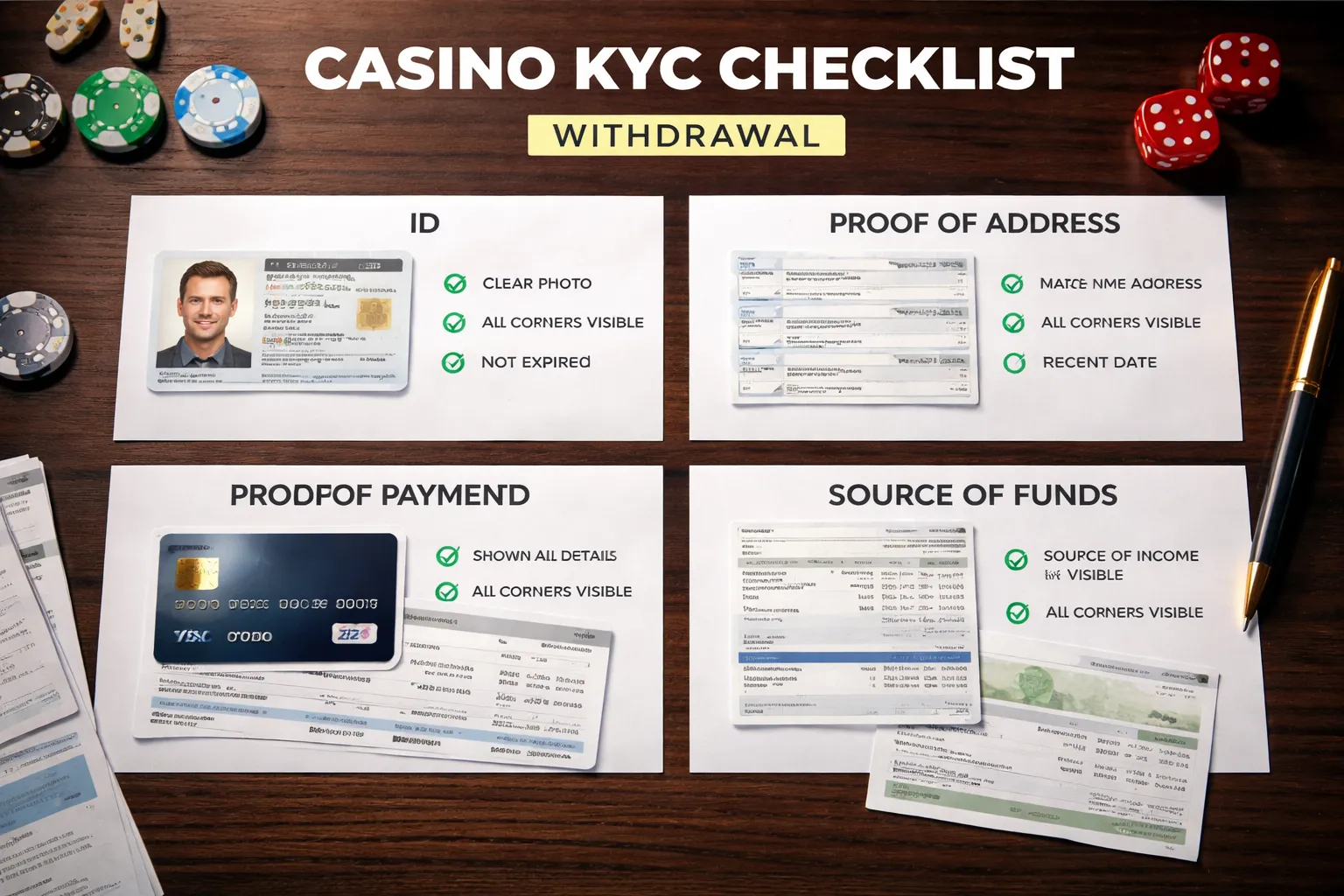
Verification (KYC) Problems: The Most Common Cause of Rejected Cashouts
Most rejected withdrawals happen because your account fails a verification check. Casinos must confirm who you are, where you live, and that your payment method belongs to you. If anything looks unclear, expired, or inconsistent, they stop the cashout.
What casinos typically require
- Photo ID: Passport, national ID card, or driving licence. Must be valid and readable.
- Proof of address: Utility bill, bank statement, tax letter, or government letter. Usually dated within the last 90 days.
- Payment method proof: Screenshot or photo that shows you own the card or e-wallet. For cards, many casinos ask for the first 6 and last 4 digits only, with the middle digits covered.
- Source of funds or source of wealth: Payslips, bank statements, business income documents, or tax returns. This triggers more often after larger wins, higher deposit volume, or unusual patterns.
How to submit documents that get approved the first time
- Upload in the format the casino requests, usually JPG, PNG, or PDF.
- Use high resolution. No blur, glare, shadows, or heavy compression.
- Show all four corners. Do not crop key details.
- Match details exactly. Same full name, same address format, same date of birth.
- Check expiry dates. Expired ID almost always fails.
- Submit one clean file per document. Avoid stitched collages unless support tells you to.
- Use the casino uploader when possible. Email often slows checks and creates missing file issues.
- For payment proof, hide only what you must. Keep your name and the visible digits clear.
Name and address mismatches: how to fix discrepancies
Mismatches cause fast rejections. Fix the mismatch, then resubmit with a short note to support.
- Different name: Update your casino profile to your legal name. If you changed your name, provide a supporting document, for example a marriage certificate or deed poll, plus new ID.
- Address formatting differences: Use the same address everywhere, including unit number, street spelling, and postcode. If your document shows an old address, submit a newer proof of address and update your profile.
- Country mismatch: Do not try to verify a country you do not live in. Ask support what they accept if you recently relocated.
- Payment name mismatch: Withdraw to a method in your name. Joint accounts often fail. Business accounts often fail for personal casino play.
How long KYC should take, and when delays become unreasonable
Many casinos verify basic documents within 24 to 72 hours. Backlogs happen on weekends and after big events. Enhanced checks can take longer, especially if they request source of funds.
- If your status stays unchanged for 3 business days, contact support and ask for the exact missing item or failure reason.
- If they keep resetting your queue after you upload, ask them to confirm each file is readable and attached to your case.
- If your withdrawal shows pending while KYC runs, review the common timing issues in why your online casino withdrawal is pending.
What to do if the casino keeps asking for more documents
- Ask for a complete checklist in one message. Push for one final list, not one request per day.
- Ask what rule triggered the request, source of funds, payment proof, or address verification.
- Ask for the acceptable document types and date range, for example bank statement within 90 days.
- Send a short cover note with each upload, listing what each file is and the date on it.
- Keep copies of every upload, plus timestamps and ticket numbers.
- If the requests repeat with no clear reason, ask for escalation to the compliance team and request a written explanation of what still fails.
Bonus Terms That Block Withdrawals (and How to Check Them Fast)
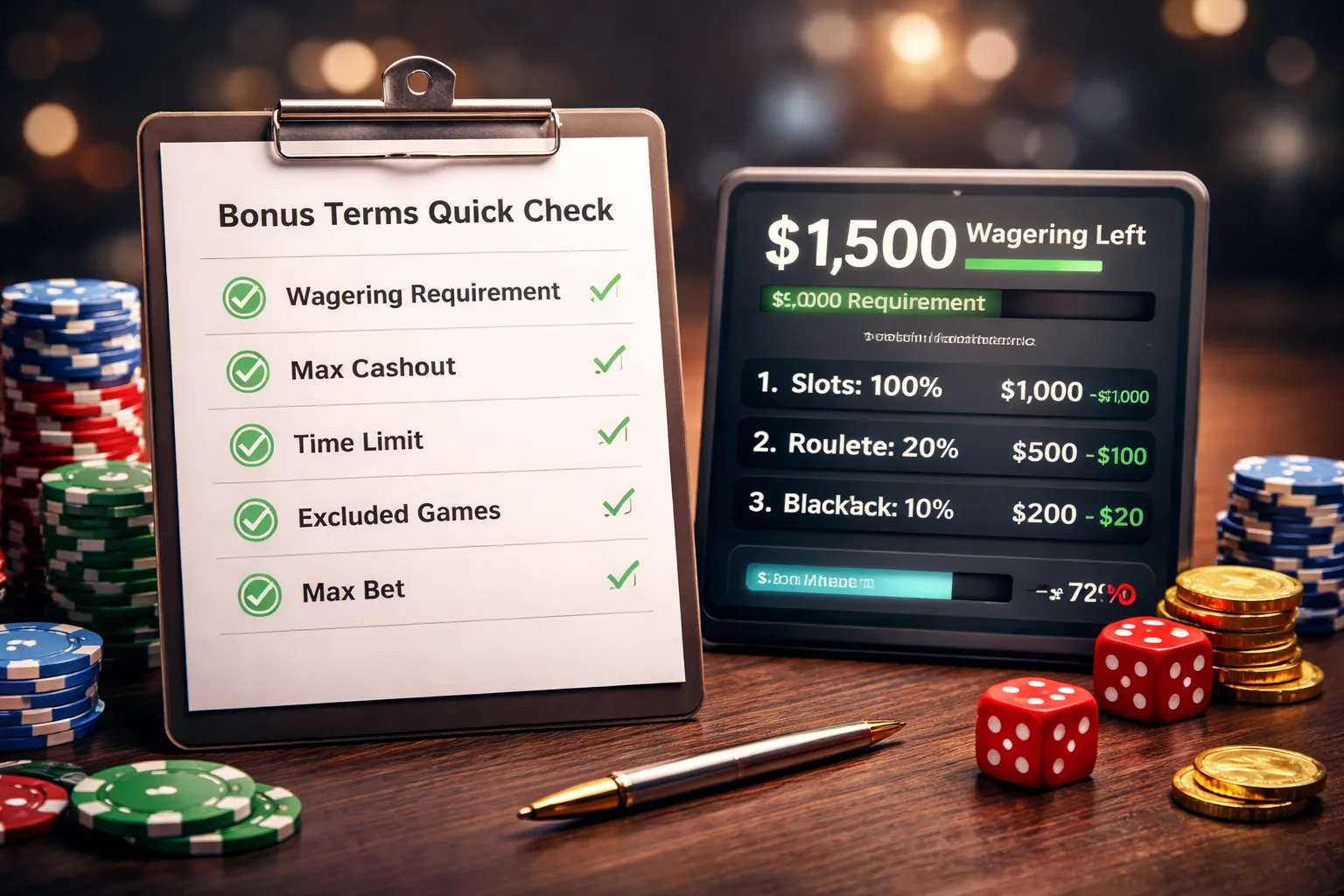
Reading Bonus Terms That Block Withdrawals (and How to Check Them Fast)
Bonus terms can lock your balance. Casinos reject withdrawals when you miss one rule. Check these items first. Do it before you contact support.
- Wagering requirement: You must stake a set multiple of the bonus, the deposit, or both. Example formats include 35x bonus, 40x bonus plus deposit, or 10x winnings.
- Max cashout cap: Some bonuses cap withdrawals, for example “max cashout 5x bonus” or “max withdraw $200.” Any excess gets removed.
- Time limit: Many bonuses expire in 7, 14, or 30 days. If the timer runs out, the casino can void winnings and block cashout.
- Excluded games: Slots may count 100%, but roulette, blackjack, baccarat, and live games often count 0% to 20%. If you wager on excluded games, you may not clear wagering.
- Max bet rule: Some terms limit your stake per spin or hand while a bonus is active, for example $5. A single higher bet can trigger confiscation.
- Bonus active on withdrawal: Many casinos require you to finish wagering or forfeit the bonus before you can withdraw.
Fast check method. Open “Promotions” or “My bonuses.” Click the active offer. Find “wagering,” “contribution,” “max cashout,” “max bet,” and “expiry.” Screenshot the full page. Save the time and date.
Sticky vs Non-sticky Bonuses, and Why They Change Your Cashout Amount
Bonus type changes what you can withdraw.
- Sticky bonus: The bonus stays locked. You wager with it, but you cannot withdraw it. Many sticky offers also cap what you can cash out from winnings.
- Non-sticky bonus: The bonus behaves like cash after you meet the rules. You can usually withdraw bonus funds and winnings, subject to max cashout terms.
Typical outcome. With a sticky bonus, your withdrawal may get rejected or reduced because the cashier shows “bonus balance” and “real balance” separately. The casino pays only the withdrawable part. It removes the rest under the promo rules.
Bonus Abuse and “Irregular Play” Clauses, What Triggers Them and How to Respond
Many terms let a casino void winnings for “bonus abuse” or “irregular play.” The wording is broad. These behaviors often trigger it.
- Low-risk betting to convert bonus: Hedging on opposite outcomes, matched betting patterns, or switching games to reduce variance.
- High stakes during bonus: Exceeding the max bet limit, even once.
- Rapid stake changes: Jumping from small bets to large bets after a win.
- Game contribution manipulation: Playing games that contribute 0% or very low percent, then claiming wagering is complete.
- Multiple accounts or shared devices: Same IP, same device, same payment method, same household details, or similar identity data.
- Deposit and withdraw patterns: Depositing to claim a bonus, then trying to withdraw quickly with minimal play.
How to respond. Ask support to cite the exact clause and the exact bets that breached it. Request a bet log export with timestamps, game names, stake sizes, and bonus status. Keep your reply factual. Do not argue intent. Focus on data. If they refuse to provide details, ask for escalation and a written decision.
How to Calculate Remaining Wagering Requirements Correctly
Do your own math. Casino trackers can lag. Use this method.
| Step | What to do |
| 1 | Find the wagering base. It is usually bonus, deposit plus bonus, or winnings. |
| 2 | Multiply by the wagering multiple. Example: $100 bonus at 35x equals $3,500 required. |
| 3 | Apply game contribution. If a game counts 20%, then $100 wagered reduces wagering by $20. |
| 4 | Subtract any “non-counting” bets. Many live tables and some slots count 0%. |
| 5 | Check max cashout. If your winnings exceed the cap, assume the excess is not withdrawable. |
Example. Requirement is $3,500. You wager $1,000 on slots at 100% contribution. You have $2,500 left. If you then wager $500 on roulette at 0%, you still have $2,500 left.
When It’s Smarter to Forfeit a Bonus to Unlock Your Withdrawal
Forfeiting can beat waiting. Do it when the bonus terms cost you more than they help you.
- You sit far from completion, and your remaining wagering is large relative to your real-money balance.
- You hit a max cashout cap, and extra wagering cannot increase what you can withdraw.
- You need fast access to funds, and the bonus forces more play or a longer timeline.
- You already placed bets that may breach max bet or excluded game rules, and you want to limit risk.
Before you forfeit, check what you lose. Some casinos remove bonus funds only. Others also remove bonus-linked winnings. Confirm in the promo terms and in the cashier screen. Take screenshots. If the site offers a “Cancel bonus” button, use it. If not, ask support to cancel the bonus and confirm, in writing, what balance will remain withdrawable.
If you unlock withdrawal but get hit with extra charges, read this guide on online casino fees and transaction charges.
Payment Method Rules and Bank/Processor Rejections
Why casinos make you withdraw to the same method you used to deposit
Most casinos enforce a “return to source” rule. It reduces fraud and supports AML checks.
- Chargeback risk control. If you deposited by card, the casino limits withdrawals to that card to prevent you from withdrawing, then disputing the original deposit.
- Stolen payment method defense. Matching deposit and withdrawal methods helps stop a thief from moving money to a new account.
- Name matching. Your payment account name must match your casino profile. Banks and payment processors reject mismatches fast.
- Audit trail. A clean deposit to withdrawal path makes compliance reviews easier, especially on larger cashouts.
If your cashier forces a method, follow it. If it offers multiple methods, pick the one that matches your last successful deposit method.
Card withdrawals often process as refunds, and refunds have limits
Many card “withdrawals” are not true payouts. They run as refunds back to your card.
- Refunds cap at your deposit total. You can usually receive refunds only up to the amount you deposited on that card. Example, you deposited $200, you can get up to $200 back to the card.
- Profits go elsewhere. If your balance exceeds refundable deposits, the casino may push winnings to bank transfer, e-wallet, or another approved method.
- Issuer rules vary. Some banks block gaming related credits, even if they allowed the deposit. That creates “rejected by issuer” results.
- Expired or replaced cards. Refunds can still land on the underlying account, but some issuers reject or delay them. Update the card details if your casino allows it, then ask support which routing they use.
E-wallet and bank transfer rejections, the common pitfalls
Bank and e-wallet payouts fail when details do not match, or when the route cannot handle the currency or compliance checks.
- Unsupported currency. Your casino sends in one currency, your wallet or bank account only accepts another. The processor rejects, or converts with extra checks.
- Beneficiary name mismatch. Your bank account holder name must match your casino name. Even missing middle names can trigger rejection in stricter regions.
- Wrong account format. IBAN length, SWIFT/BIC, routing number, sort code, or account number errors cause instant fails.
- Missing intermediary bank path. Some international wires need intermediary bank details. If the processor cannot route it cleanly, it bounces.
- Bank blocks gaming credits. Some banks accept deposits to casinos but block incoming transfers tagged as gambling.
- Wallet account restrictions. Some e-wallets require verification, limits removal, or a minimum account age before accepting certain credits.
Use the exact name on your bank statement. Copy and paste bank details where possible. If the transfer is cross-border, ask your bank for the correct incoming wire instructions, including intermediary details if required.
Crypto withdrawals, whitelist rules, network errors, compliance holds
Crypto adds speed, but you must get the details right. Small mistakes lead to rejection or a compliance review.
- Wallet whitelisting. Some casinos require you to pre-approve your withdrawal address. If you skip it, the system rejects the cashout.
- Wrong network selection. USDT is the common trap. ERC-20, TRC-20, BEP-20 are different rails. Pick the same network your wallet address supports.
- Address format checks. Some processors reject addresses that fail checksum rules, or addresses tied to high-risk activity.
- Travel Rule and source-of-funds checks. Larger withdrawals can trigger extra questions, even if you already passed ID checks.
- Exchange wallet limits. Some exchanges block certain tokens or networks for deposits, or require memo and tag fields. Missing memo equals a failed credit, or a long recovery process.
Match token and network first. Then confirm if your casino requires address whitelisting. If you withdraw to an exchange, confirm memo and network support before you submit.
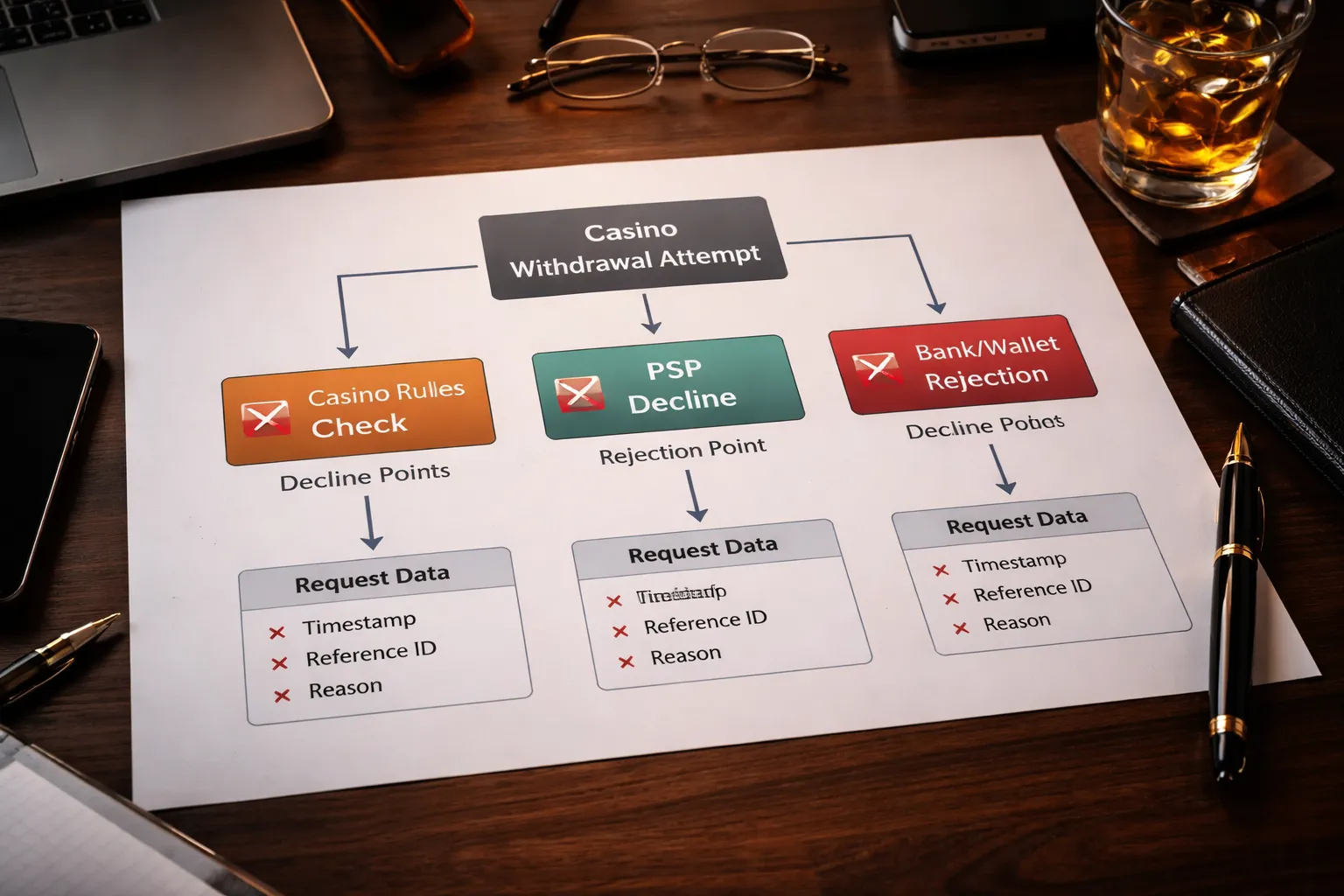
How to tell if the rejection came from the casino, the PSP, or your bank
You need the source of the reject to fix it fast. Ask for specific evidence.
- If the casino rejected it. You see an instant “Rejected” status in the cashier, often with a rule-based reason like method mismatch, verification required, or limits.
- If the PSP rejected it. The cashier may show “Failed” after some processing time. Support can see a processor decline code. Ask for the decline reason text and the timestamp.
- If your bank rejected it. The casino marks it as sent or processed, but the funds bounce back later. Ask your bank for the reject reason, and provide the bank with the reference number, amount, and date.
When you contact support, request three items, the exact rejection reason, the payment rail used, and any reference IDs. Then compare that with your bank or wallet logs. If you need to switch methods, use a supported option listed in the cashier, or review your choices in this guide on online casino payment methods.
Policy Limits, Compliance Checks, and Account Restrictions
AML and source-of-funds checks
Casinos must follow anti money laundering rules. They check where your money came from, how you funded your play, and whether your activity matches your profile. If your withdrawal hits a trigger, the casino can pause or reject it until you pass checks.
Send clean, readable evidence. Use files that show your name, date, and the full document.
- Source of funds: recent bank statements, payslips, tax returns, benefits letters, pension statements, business accounts, or proof of savings.
- Source of wealth: property sale completion statement, inheritance paperwork, investment statements, dividend statements, or audited business documents.
- Deposit trail: screenshots or PDFs that link your deposit method to you, plus transaction IDs from your bank or wallet.
- Card proof: photo of the card with only last 4 digits visible, name visible, and CVV covered, if the casino asks.
Fixes that help. Keep one funding method. Avoid third party payments. Match your casino details to your bank or wallet name. If you changed your name, provide proof.
Withdrawal limits and batching
Many casinos cap withdrawals per day, week, or month. A big win can exceed the cap. The casino then splits your payout into installments. Some operators also batch withdrawals and process them on set schedules.
- Check the cashier and the withdrawal terms for your current tier and payment method.
- Ask support for your exact limit and your next payout date in writing.
- Submit withdrawals that match the cap to avoid repeated rejections.
For a full breakdown of caps by period and method, use this guide on withdrawal limits.
Dormant accounts, security reviews, and temporary holds
Casinos flag dormant accounts and sudden changes. A long gap in play, a new device, or a new IP can trigger a review. Password or email changes often trigger an automatic hold to stop account takeovers. Some casinos also pause withdrawals after you update personal details.
- Wait out the security window if support confirms one, then re-submit the withdrawal.
- Verify your email and phone again if the casino asks.
- Do not open multiple tickets. Keep one thread with support and ask for the hold reason and end time.
- Keep your device and browser consistent until the payout completes.
Shared devices and households
Casinos watch for multi-account patterns. Shared WiFi, shared devices, and shared payment methods can look like duplicate accounts or bonus abuse. This can block withdrawals even if you acted in good faith.
- Do not share cards, e-wallets, or bank accounts with anyone else on the site.
- Use your own device. If you must share a network, avoid logging in on the same device.
- Keep your ID and address details consistent and real across your account.
- If support flags it, provide proof you are a separate person, ID, address, and your own payment method.
Geo-restrictions and travel
Licensing rules restrict where the casino can accept play. If you log in or place bets from a blocked location, the casino may freeze withdrawals. A VPN can also trigger geo and fraud flags.
- Turn off VPN and proxy tools before you log in.
- Use your normal home connection when you withdraw.
- If you traveled, tell support your travel dates and current location.
- Be ready to confirm location with standard checks, such as address proof or device verification.
If the casino confirms a location breach, stop play and ask for the allowed path to withdraw, including any verification steps and timelines.
Step-by-Step: What to Do After Your Withdrawal Is Rejected

Step 1: Pause new deposits and play
Stop deposits, bets, and bonus claims until you fix the rejection.
- New play can change your balance source and trigger extra checks.
- New deposits can create payment method conflicts.
- Bonus activity can add new wagering rules or withdrawal limits.
Step 2: Find the exact rejection reason
Get the casino’s stated reason in writing. Do not guess.
- Check your cashier history for a status label, code, or note.
- Check the email tied to your account, including spam and promotions.
- Check the site message center and your support ticket list.
- Write down the withdrawal amount, date, method, and any reference number.
If the withdrawal shows as “rejected” but you see no reason, request the reason code and the rule behind it.
Step 3: Gather evidence before you contact support
Collect proof while the logs and screens still show the same data.
- Screenshots of the rejection status and any reason code.
- Withdrawal request details, including amount, method, and timestamp.
- Deposit and withdrawal transaction IDs from the cashier and your payment provider.
- Copies of KYC documents you uploaded, plus upload timestamps and file names.
- Chat logs, emails, and ticket numbers.
- The bonus name, bonus terms shown in your account, and your wagering progress screen.
- The terms page version or URL you saw at the time of withdrawal, if available.
Step 4: Contact support with a tight message and specific questions
Send one clear request. Ask for exact requirements and deadlines.
Template message
Subject: Withdrawal rejected, request reason code and next steps
Message: My withdrawal was rejected. Account email: [email]. Username: [username]. Withdrawal amount: [amount] on [date/time] via [method]. Withdrawal ID: [ID]. Status shows: [status/code]. Please confirm the exact rejection reason code, the rule or policy it relates to, and the specific actions required to approve a new withdrawal. If you need documents, list the document types, accepted formats, and any limits. Please confirm the expected review timeline once I submit everything.
- Ask if you must withdraw back to the same deposit method.
- Ask if any bonus restriction blocks withdrawals and what “eligible to withdraw” means in your account.
- Ask if any verification step remains, including source of funds or payment ownership checks.
Step 5: Fix the issue, then submit a clean re-request
Make one change at a time so you can prove what fixed the rejection.
- KYC issue: Upload the exact documents requested. Match your name and address across documents. Use clear, uncropped images. Avoid screenshots for ID unless the casino allows them.
- Payment method issue: Use a method in your name. Withdraw to the same method you used to deposit when the casino requires it. Remove old methods you no longer control, if the cashier allows it.
- Bank details issue: Recheck account number, IBAN, routing, and beneficiary name. Do not use business accounts unless the casino allows them.
- Bonus issue: Confirm wagering completion, max cashout limits, and excluded games. If allowed and you want speed, ask support to forfeit the bonus in writing and confirm what happens to your balance.
- Limits issue: Split the withdrawal to fit per transaction limits. Stay within daily or weekly caps.
After you correct the issue, submit a new withdrawal. Keep the amount and method consistent with support’s instructions. If you need a refresher on the standard withdrawal flow, use this guide on how to withdraw money from an online casino.
Step 6: Track timelines and get written confirmation
Run your case like a checklist. Keep everything time stamped.
- Log every contact, including date, agent name, and ticket number.
- Ask support to confirm the next step in writing after each upload or change.
- Request the expected review window and the payment processing window.
- If the casino claims you failed a check, ask which check failed and what fixes it.
- If you resubmit, ask support to confirm they see the new request and that it sits in the correct queue.
If your withdrawal changes from rejected to pending, treat it as a new stage. Keep tracking until you see an approval message and a provider reference number.
Escalation Path If the Casino Still Won’t Pay
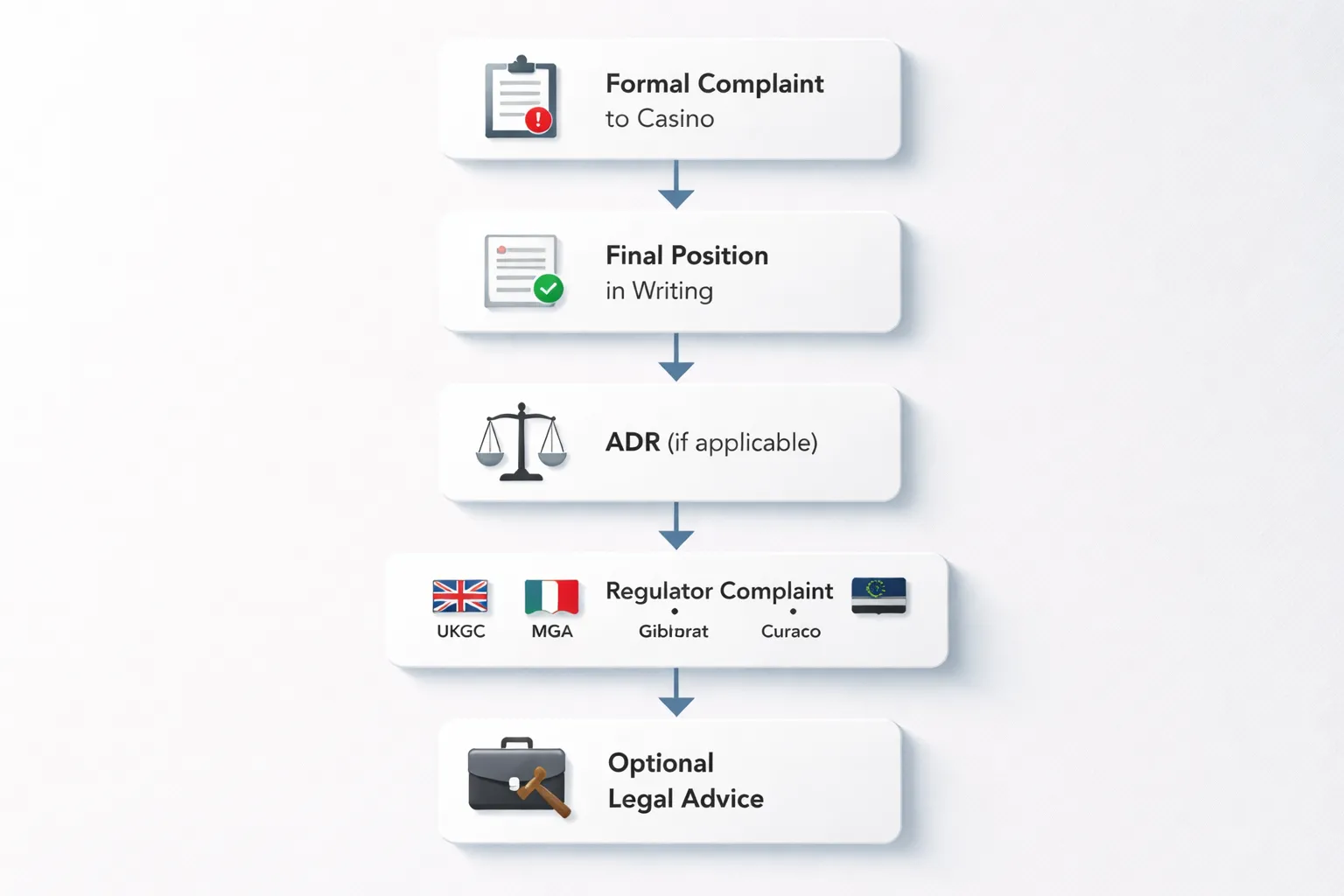
Use the Casino’s Formal Complaints Procedure
Switch from live chat to a formal complaint. Casinos treat complaints as compliance work. You want a case file, not a chat log.
- Find the official route. Use the site footer, Terms, or Responsible Gambling page. Look for “Complaints,” “Disputes,” or “Alternative Dispute Resolution.”
- Send one clear email. Use your account email. Add “Formal Complaint” in the subject line.
- Include the essentials. Full name, username, registered email, country, withdrawal amount, currency, date submitted, method, and any transaction IDs.
- Attach proof. Screenshots of the rejection message, chat transcripts, KYC upload confirmations, and any emails from the casino or payment provider.
- State your timeline. List dates and what happened at each step. Keep it factual.
- Ask for a specific fix. “Approve the withdrawal,” or “confirm the exact failed check and the required documents,” or “return funds to balance so I can withdraw via an eligible method.”
- Set a deadline. Ask for a response within the timeframe in their terms. If they do not state one, use 7 to 14 days.
Ask for a Final Position in Writing, and ADR Details
If support loops you, force a decision. You need a final answer you can escalate.
- Request a “final position” letter. Ask them to confirm, in writing, whether they will pay, and why they will not.
- Ask for the evidence they rely on. Which rule, which clause, which KYC check, which fraud flag, which payment rule.
- Ask for ADR information. If the casino operates under a licence where ADR applies, request the ADR entity name, website, and your complaint reference number.
- Do not rewrite your story each time. Reply in the same email thread. Keep one timeline and one set of attachments.
File a Complaint With the Gambling Regulator
Regulators do not solve every player dispute. They can pressure licence holders, track patterns, and act on systemic breaches. Send a clean file.
- UK (UKGC). The UKGC usually expects you to use the operator’s complaints route and then ADR. Use the UKGC to report the operator if you suspect rule breaches, unfair terms, or repeated non-payment behaviour.
- Malta (MGA). Use the MGA player support channels for guidance and to submit a report. Provide your case number, the operator name, and your timeline.
- Gibraltar. Submit a complaint to the Gibraltar licensing authority. Include the operator’s licence details and all correspondence.
- Curaçao. Outcomes vary. Start with the operator’s licence issuer if you can identify it, then submit a complaint with your evidence pack. Expect slower timelines and weaker enforcement in many cases.
- Other jurisdictions. Find the licence number on the casino site footer. Match it to the regulator site. Use the regulator’s complaint form or official email.
Send the same core pack every time. Timeline, rejected withdrawal details, KYC submissions, terms clause cited, and the final position in writing.
When Legal Advice Makes Sense, and When It Does Not
Legal action can work when the claim size justifies it and the operator sits in a strong jurisdiction. It often fails when the casino hides behind offshore structures.
- Consider legal advice if: the amount is large, you have a clear contract breach, you passed KYC, you have a final refusal in writing, and the casino holds a reputable licence.
- Skip it if: the amount is small, you accepted a bonus with unclear restrictions, you cannot prove source of funds, or the operator uses a weak offshore setup with no practical enforcement.
- Try a lower-cost step first. A short lawyer letter can trigger payment. Full litigation usually costs more than most withdrawals.
Warning Signs of a Rogue Casino, and How to Protect Yourself
Some casinos delay until you quit. Treat these signals as risk markers.
- No clear licence details. Missing regulator name, licence number, or legal entity.
- Shifting reasons for rejection. Today it is KYC, tomorrow it is “payment provider rules,” then it is “security review,” with no written specifics.
- Endless “verification.” They keep requesting new documents without explaining what failed and what passes.
- Bonus terms used as a trap. They cite obscure clauses after you win, not when you deposit or claim the offer.
- Deposit works, withdrawal fails. They push you to deposit more to “unlock” withdrawals or change status.
- Support refuses a final answer. They will not confirm “pay” or “no pay” in writing.
- Protect yourself now. Stop depositing. Save every email and screenshot. Keep your documents ready. Track dates and amounts.
- Use proven withdrawal steps. Follow a clean process and keep your payment details consistent. See how to withdraw money from an online casino.
- Move on after you get paid. Withdraw, close the account if needed, and avoid the same operator group.
How to Prevent Future Withdrawal Rejections
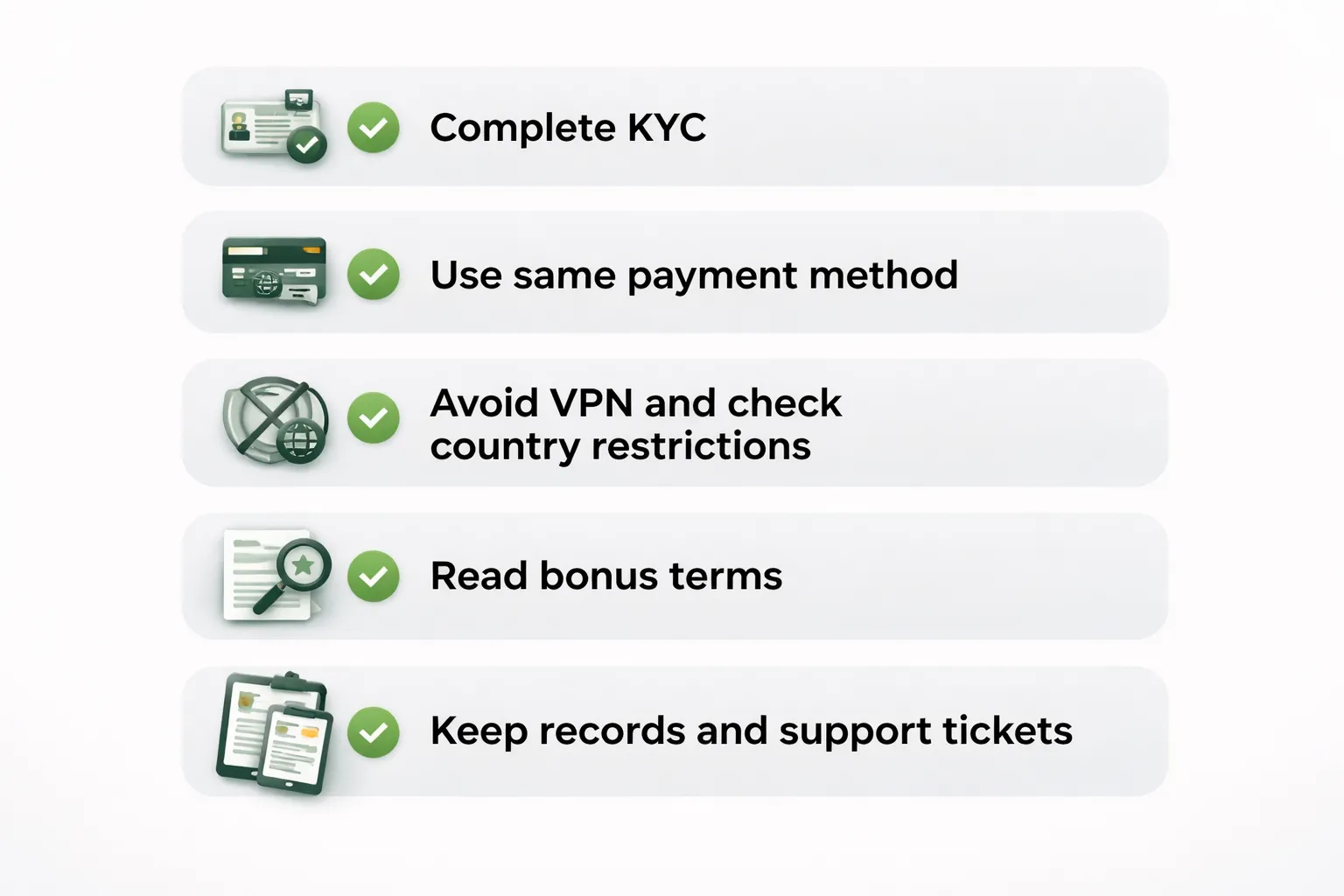
Complete KYC before you deposit
Verify your account early. Do it before your first deposit or right after you register.
- Upload ID, proof of address, and payment proof.
- Make sure names, dates, and addresses match across all documents.
- Use clear photos. No glare. No cropped corners.
- Ask support what else they need for your country and payment method.
- Do not wait until you request a large withdrawal. Casinos often trigger extra checks then.
Follow the same standards casinos use for AML checks. Use this guide for details on documents and timelines, online casino KYC explained.
Keep your deposit and withdrawal methods consistent
Use one method. Keep it in your legal name. Match your casino profile.
- Deposit and withdraw using the same method when possible.
- Do not mix cards, e-wallets, and crypto without checking the rules first.
- Do not use a friend’s card, partner’s wallet, or business account.
- If your method cannot receive payouts, confirm the casino’s fallback option in writing.
Avoid VPNs and proxies. Check location rules before you travel
Casinos track IP, device, and location signals. A mismatch can freeze payouts.
- Turn off VPNs, proxies, and remote desktops when you log in and withdraw.
- Check the casino’s restricted countries list before you deposit.
- If you travel, check again before you play. Some operators block play and payouts from certain regions.
- If you must travel, withdraw first. Then play later after you confirm access rules.
Read bonus terms before you claim
Most rejected withdrawals tie back to bonus rules. Treat bonus terms like payment terms.
- Check wagering requirements and the deadline to complete them.
- Check max cashout limits on bonus winnings.
- Check game restrictions. Some slots or live tables may not count, or count at a lower rate.
- Check max bet rules during wagering. A single over-limit bet can void winnings.
- Do not switch between bonus and cash play unless the casino explains how it tracks each balance.
Maintain clean records you can send in one reply
Support moves faster when you give proof fast. Build a simple file for each casino.
- Save deposit receipts, transaction IDs, and bank or e-wallet statements.
- Save crypto records, wallet addresses used, and tx hashes.
- Save screenshots of withdrawal requests, timestamps, and status updates.
- Keep every support ticket number and email thread in one folder.
- Write a short log: date, amount, method, and the exact message shown in cashier.
| Risk | What you do | Result |
|---|---|---|
| Late KYC | Verify before you deposit | Fewer payout holds |
| Name mismatch | Use accounts in your name only | Lower fraud flags |
| Method switching | Deposit and withdraw with one method | Faster cashier review |
| VPN or travel IP | Play and withdraw from allowed locations | Avoid geo blocks |
| Bonus term breach | Check max bet, max cashout, game rules | Avoid voided winnings |
| Weak documentation | Save receipts, tx IDs, tickets, screenshots | Quicker dispute handling |
Pros and Cons of Different Resolution Options
Working With Support
This is your fastest option when the issue is simple, a document mismatch, a payment rule, a limit, or a blocked transaction.
- Pros: Quickest timelines in most cases. You can fix errors the same day if you have clean proof. Clear path if your account needs KYC or a payment source check.
- Cons: Results depend on your documentation quality. Missing bank statements, blurred photos, or unmatched names slow everything down. Support may repeat scripted checks before they escalate.
- Best use: First attempt for any rejected withdrawal. Include your withdrawal ID, method, amount, date, and screenshots.
Forfeiting Bonuses
Dropping a bonus can remove wagering locks and bonus limits. It can also cut your payout.
- Pros: Can unlock withdrawals if your balance sits in a locked bonus wallet. Ends bonus rule conflicts fast. Useful when the bonus terms block cashout until you finish playthrough.
- Cons: You may lose bonus funds and bonus winnings. Some sites remove all winnings tied to the bonus. You may also lose loyalty points and future promo access.
- Best use: When you value speed and certainty over maximum payout. Confirm what you forfeit in writing before you accept.
Switching Payment Methods
Changing methods can bypass a failing processor or a method that the casino cannot pay out to.
- Pros: Helps when a bank blocks gambling payouts, an e-wallet account fails checks, or your card cannot receive credits. Can speed up approval if the new method has cleaner verification.
- Cons: Can trigger new checks. Expect fresh proof of ownership and sometimes new KYC. It can also create a mismatch if you deposited with one method and try to withdraw to another.
- Best use: After support confirms the original method cannot receive the payout. Keep deposits and withdrawals on one method when possible.
Regulator or ADR Escalation
Escalation adds leverage when support stalls or gives inconsistent answers. It also takes time.
- Pros: Stronger pressure to follow license rules, publish clear reasons, and handle your case on record. Helps if you have full evidence and a clear timeline of events.
- Cons: Slow. Many regulators and ADR services take weeks, sometimes longer. They may reject cases with missing documents, unclear claims, or open bonus disputes.
- Best use: After you complete the casino complaint path and you can show proof, dates, and ticket numbers.
| Option | Speed | Risk to your payout | What you must have |
|---|---|---|---|
| Work with support | Fast | Low | Clear docs, tx IDs, screenshots |
| Forfeit bonus | Fast | High | Written confirmation of what you lose |
| Switch payment method | Medium | Medium | Verified ownership of the new method |
| Regulator or ADR | Slow | Low | Complaint trail, evidence pack, clear claim |
If your rejection links to delays rather than a hard refusal, see why your online casino withdrawal is pending before you escalate.
Frequently Asked Questions
Why did my casino reject my withdrawal?
Most rejections come from failed KYC, mismatched details, bonus term breaches, payment method rules, or chargeback risk. Check the exact reason in your account messages or email. Save screenshots. Ask support for the rule clause they used and what document or action clears it.
What does “withdrawal rejected” mean?
The casino cancelled your cashout and returned the balance to your casino account, or voided it under terms. It differs from “pending”, which still processes. Check your cashier balance and transaction log. If funds vanished, request a full statement showing bets, bonuses, and adjustments.
Can a casino reject a withdrawal after I win?
Yes, if you breached terms, failed verification, or used an invalid payment method. They must explain the reason and apply rules consistently. Ask for a written decision and timestamped account history. If you used a bonus, request the bonus ledger and wagering record.
How long should a rejected withdrawal take to return?
Rejected withdrawals usually return to your casino balance fast, often same day. Bank reversals can take longer. If your balance does not update within 24 hours, contact support with the transaction ID. Ask whether the rejection happened before or after payment processing.
What documents do casinos ask for to approve withdrawals?
Expect ID, proof of address, and proof of payment method ownership. Some casinos request source of funds for larger totals. Upload clear images and matching details. Use the same name and address across your profile and documents. See how to verify your identity at an online casino.
Can a casino reject my withdrawal because of a bonus?
Yes. Common triggers include unmet wagering, restricted games, max bet breaches, or bonus stacking. Check the bonus terms you accepted, plus your bet history. Ask support for the specific rule and the bets that breached it. Request the recalculated withdrawable amount.
Why did my withdrawal fail due to the payment method?
Casinos often require you to withdraw to the same method you used to deposit. Some methods block withdrawals, or require verification first. If your card expired or an e-wallet name differs, the casino may reject it. Update details, then retry with an approved method.
Can I switch withdrawal methods after rejection?
Sometimes. Casinos may allow a new method only after you verify ownership and show you cannot use the original method. Expect extra checks and longer handling. Provide a screenshot or statement proving the old method is closed or unavailable, plus verification for the new method.
What should I do first when a casino rejects my withdrawal?
Stop depositing. Collect evidence, screenshots, emails, transaction IDs, and chat logs. Ask support for the exact rejection reason, the policy clause, and the fix required. Re-submit only after you correct the issue. Keep all communication in writing.
When should I escalate to the regulator or ADR?
Escalate when support gives no clear reason, applies terms inconsistently, or ignores you after you provide documents. First, finish the casino’s complaints process. Then file with the listed ADR or regulator using a timeline, evidence pack, and the exact remedy you want, usually release of funds.
Conclusion
A rejected withdrawal usually comes down to one of four issues, KYC not complete, bonus terms not met, payment method mismatch, or a risk flag on your account. Fix the exact cause, then resubmit. Do not keep making new requests or switching methods. That creates more checks and more delay.
- Collect proof first. Save the rejection message, screenshots of the cashier, and your full transaction history.
- Match the rules. Clear wagering, remove restricted funds, and use the same method you deposited with.
- Finish verification. Upload clean documents, keep names and addresses consistent, and respond fast to follow-ups.
- Keep it in writing. Ask support for the exact clause, the exact missing item, and a timeline to release funds.
- Escalate with a file. If they stall or contradict their terms, complete the complaints process and submit your evidence pack to ADR or the regulator.
Final tip. Send one clear message that lists your withdrawal ID, your deposit method, your submitted documents, and the remedy you want, release of funds or a written reason tied to a specific term. If you still cannot access your account, fix access first using these online casino login troubleshooting steps.
-
Online Casino Payment Safety Tips: How to Deposit and Withdraw Securely
8 months ago -
What to Do If an Online Casino Won’t Pay Out: Step-by-Step Actions
8 months ago -
How to File a Complaint Against an Online Casino (Plus ADR Explained)
8 months ago -
How to Sign Up & Create an Online Casino Account (Step-by-Step)
8 months ago -
Online Casino Login Problems: Fixes for Common Sign-In Issues
8 months ago
-
- KYC not completed or documents not accepted
- Payment method mismatch and closed-loop withdrawal rules
- Bonus terms not met, wagering not finished, or restricted games used
- Incorrect or incomplete banking details
- Responsible gambling triggers and affordability checks
- Account security flags
- Chargebacks, disputed deposits, or negative balance
- Country, state, or jurisdiction restrictions and geolocation failures
- Minimum and maximum cashout limits, caps, and fee shortfalls
- Duplicate withdrawal requests or overlapping pending transactions
- Technical, payment gateway errors, and maintenance windows
-
- Verification (KYC) Problems: The Most Common Cause of Rejected Cashouts
- What casinos typically require
- How to submit documents that get approved the first time
- Name and address mismatches: how to fix discrepancies
- How long KYC should take, and when delays become unreasonable
- What to do if the casino keeps asking for more documents
-
- Reading Bonus Terms That Block Withdrawals (and How to Check Them Fast)
- Sticky vs Non-sticky Bonuses, and Why They Change Your Cashout Amount
- Bonus Abuse and “Irregular Play” Clauses, What Triggers Them and How to Respond
- How to Calculate Remaining Wagering Requirements Correctly
- When It’s Smarter to Forfeit a Bonus to Unlock Your Withdrawal
-
- Why casinos make you withdraw to the same method you used to deposit
- Card withdrawals often process as refunds, and refunds have limits
- E-wallet and bank transfer rejections, the common pitfalls
- Crypto withdrawals, whitelist rules, network errors, compliance holds
- How to tell if the rejection came from the casino, the PSP, or your bank
-
- Why did my casino reject my withdrawal?
- What does “withdrawal rejected” mean?
- Can a casino reject a withdrawal after I win?
- How long should a rejected withdrawal take to return?
- What documents do casinos ask for to approve withdrawals?
- Can a casino reject my withdrawal because of a bonus?
- Why did my withdrawal fail due to the payment method?
- Can I switch withdrawal methods after rejection?
- What should I do first when a casino rejects my withdrawal?
- When should I escalate to the regulator or ADR?
-
-
- KYC not completed or documents not accepted
- Payment method mismatch and closed-loop withdrawal rules
- Bonus terms not met, wagering not finished, or restricted games used
- Incorrect or incomplete banking details
- Responsible gambling triggers and affordability checks
- Account security flags
- Chargebacks, disputed deposits, or negative balance
- Country, state, or jurisdiction restrictions and geolocation failures
- Minimum and maximum cashout limits, caps, and fee shortfalls
- Duplicate withdrawal requests or overlapping pending transactions
- Technical, payment gateway errors, and maintenance windows
-
- Verification (KYC) Problems: The Most Common Cause of Rejected Cashouts
- What casinos typically require
- How to submit documents that get approved the first time
- Name and address mismatches: how to fix discrepancies
- How long KYC should take, and when delays become unreasonable
- What to do if the casino keeps asking for more documents
-
- Reading Bonus Terms That Block Withdrawals (and How to Check Them Fast)
- Sticky vs Non-sticky Bonuses, and Why They Change Your Cashout Amount
- Bonus Abuse and “Irregular Play” Clauses, What Triggers Them and How to Respond
- How to Calculate Remaining Wagering Requirements Correctly
- When It’s Smarter to Forfeit a Bonus to Unlock Your Withdrawal
-
- Why casinos make you withdraw to the same method you used to deposit
- Card withdrawals often process as refunds, and refunds have limits
- E-wallet and bank transfer rejections, the common pitfalls
- Crypto withdrawals, whitelist rules, network errors, compliance holds
- How to tell if the rejection came from the casino, the PSP, or your bank
-
- Why did my casino reject my withdrawal?
- What does “withdrawal rejected” mean?
- Can a casino reject a withdrawal after I win?
- How long should a rejected withdrawal take to return?
- What documents do casinos ask for to approve withdrawals?
- Can a casino reject my withdrawal because of a bonus?
- Why did my withdrawal fail due to the payment method?
- Can I switch withdrawal methods after rejection?
- What should I do first when a casino rejects my withdrawal?
- When should I escalate to the regulator or ADR?
-
-
Reload Bonus Explained: What It Is and When It’s Worth Claiming
6 months ago -
Online Casino Licensing Explained: Authorities, Licenses & How to Check One
8 months ago -
Best Live Dealer Casinos: Where to Play Live Blackjack, Roulette & More
8 months ago -
Best Online Casinos for High Rollers: VIP Perks, High Limits & Exclusive Bonuses
8 months ago -
Fast Payout Online Casinos: Best Sites for Quick Withdrawals
8 months ago
-
Online Casino Customer Support: What to Look For (Live Chat, Email, Response Times)
8 months ago -
Sign Up for an Online Casino: Create an Account in Minutes
8 months ago -
Online Casino Payment Safety Tips: How to Deposit and Withdraw Securely
8 months ago -
What to Do If an Online Casino Won’t Pay Out: Step-by-Step Actions
8 months ago -
How to File a Complaint Against an Online Casino (Plus ADR Explained)
8 months ago