Online Casino Withdrawal Limits Explained (Daily/Weekly/Monthly Caps)

Withdrawal limits decide how fast you can get your money out. Casinos set caps per day, week, or month. They can also cap each transaction. These rules hit your bankroll planning and your cash flow.
This guide breaks down the main limit types, how casinos apply them, and where the numbers usually differ by payment method and player status. You will learn how to find the limits before you deposit, how bonuses and wagering rules can block withdrawals, and how KYC checks can slow or raise your caps. Use this to pick safer payment options, avoid payout surprises, and plan realistic withdrawal schedules.
If you want to speed up approvals, start with how to verify your identity at an online casino.
- In het kort: Withdrawal limits come in daily, weekly, and monthly caps. Casinos can apply all three at the same time.
- Limits change by payment method, casino policy, and your player status. Check each method before you deposit.
- Bonuses can block cash-outs. You must meet wagering rules and any max cash-out terms first.
- KYC can slow your first withdrawals. Verified accounts often get higher caps and faster approvals.
- Plan withdrawals around caps. Split large amounts into scheduled payouts to avoid delays.
- Fees and processing times matter as much as caps. Use a method with clear terms and reliable support.
- Track “pending” time separately from the cap. A casino can approve late even if you stayed under the limit. See online casino payout times.
Online casino withdrawal limits explained: what they are and why they exist
Definition of withdrawal limits
Withdrawal limits are rules that cap how much money you can cash out. Casinos apply them in two main ways.
- Per-transaction limit, the maximum you can withdraw in one request. Example, max $5,000 per withdrawal.
- Time-based cap, the maximum you can withdraw over a period. Most casinos set daily, weekly, and monthly caps. Example, max $10,000 per week even if each request stays under $5,000.
Some casinos stack these limits. You may face a per-withdrawal max and a weekly cap at the same time. Your payment method can change the numbers. Your account level can change them too.
Why casinos impose caps
- Risk management. Casinos limit exposure to stolen accounts, bonus abuse, and irregular betting patterns. Smaller payouts reduce loss when something looks wrong.
- Liquidity control. A casino needs enough cash available for many players at once. Caps spread large payouts across days or weeks.
- Compliance. Casinos must follow AML and KYC rules. Limits give them time to review identity, source of funds, and unusual activity.
- Fraud prevention. Fraud often shows up at cashout. Caps slow down fast exits and create checkpoints for verification.
- Operational workload. Reviews, bank checks, and payment routing take staff time. Caps keep queues manageable.
Limits often tighten when you request your first withdrawal, change bank details, use a new device, or trigger extra verification.
How withdrawal limits differ from deposit and betting limits
- Deposit limits cap what you can add to your balance. They protect your spend and support responsible gambling tools. They do not guarantee fast withdrawals.
- Betting limits cap stake size or loss per session, game, or day. They control wager risk, not cashout speed.
- Withdrawal limits cap what leaves the casino. They affect cash flow, fraud checks, and processing queues.
You can hit a withdrawal cap even if you never hit a deposit or betting limit.
Key terms to know
- Pending withdrawals. Your request sits in a queue before approval. Many casinos count pending amounts toward your cap, even before the money moves.
- Processing time. The time the casino takes to review and approve. This differs from bank or wallet transfer time. See online casino payout times.
- Rollover. A wagering requirement tied to bonuses or some deposits. If you have rollover left, the casino can block or reduce a withdrawal until you meet the terms.
- Chargeback risk. Card deposits can get reversed. Casinos limit withdrawals to reduce losses when they suspect disputed deposits or third-party payment use.
- Payout schedule. The casino’s set rhythm for approvals and releases. Some pay daily, others process in batches, and some stagger large wins across a schedule.
Types of withdrawal limits (and how they interact)
Per-transaction maximums and minimums
Most casinos set a minimum and a maximum per withdrawal request.
- Minimum payout. Often $10 to $50. Some methods run higher, like bank transfer.
- Maximum per transaction. Often $2,000 to $10,000 for cards and e-wallets. Bank transfer and crypto can go higher.
- Method-specific rules. Each payment method has its own floor and ceiling. Your chosen method can tighten your effective limit even if the casino headline limit looks high.
Per-transaction limits control how big each cashout can be. Time-based caps control how many cashouts you can complete in a period. You usually have to follow both.
Daily withdrawal caps, common ranges and typical reset times
A daily cap limits the total you can withdraw in a 24-hour window.
- Common ranges. $1,000 to $5,000 per day for many casinos. VIP tiers can reach $10,000+.
- Reset times. Many reset at 00:00 in the casino’s stated time zone. Others reset 24 hours after your last approved payout.
- Approval timing matters. Some casinos count the limit when you request the withdrawal. Others count it when they approve or process it.
If you plan multiple cashouts, line them up with the casino’s reset rule, not your local clock.
Weekly withdrawal caps, rolling 7 days vs calendar week
A weekly cap limits withdrawals across a week, but casinos define “week” in two ways.
- Calendar week. Resets on a set day, often Monday 00:00, in the casino time zone.
- Rolling 7 days. Always looks back 7 x 24 hours from the current moment. Each payout stays in the window for a full 7 days.
Rolling caps feel stricter. You can hit the limit even after a “new week” starts on your calendar.
Monthly withdrawal caps, calendar month vs rolling 30 days
Monthly caps work the same way as weekly caps, just on a longer window.
- Calendar month. Resets on the first day of the month, usually at 00:00 casino time.
- Rolling 30 days. Counts the last 30 x 24 hours. Large withdrawals keep blocking new ones until they age out of the window.
Rolling 30-day caps can delay payouts longer than you expect after a big win late in the month.
Combined-cap scenarios, how caps stack and restrict payouts
Casinos apply the tightest limit at each step. Transaction caps and time caps stack.
- Scenario 1. Max per transaction $2,000. Daily cap $3,000. You cannot withdraw $3,000 in one request. You must do $2,000, then $1,000, and you stop for the day.
- Scenario 2. Daily cap $5,000. Weekly cap $10,000. You withdraw $5,000 on Monday and $5,000 on Tuesday. You hit the weekly cap. You wait for the reset, even though your daily cap still allows more.
- Scenario 3. Rolling 7-day cap $7,000. You withdraw $3,500 on Friday and $3,500 on Saturday. You cannot withdraw again until the first $3,500 drops out of the rolling window next Friday.
- Scenario 4. Monthly cap $20,000. Per-transaction max $5,000. You win $40,000. Even with four $5,000 withdrawals, you still stop at $20,000 for the month. The rest waits for the next reset window.
- Scenario 5. Method max $1,000 per withdrawal on a card. Casino daily cap $5,000. Your real daily limit becomes $1,000 per request, times however many requests the casino allows before it flags or queues them.
Before you request a payout, check the per-transaction limit, the method limit, and the active time window. If the casino applies limits in a way that contradicts its terms, follow the documented steps in our guide on how to withdraw money from an online casino.
Typical withdrawal limits by payment method
Cards (Visa and Mastercard)
Card withdrawals often run through a refund or reversal flow. Many casinos must send money back to the same card first, up to the amount you deposited. Profits then go to another method, often bank transfer or an e-wallet.
- Refunds-first rule: Expect the casino to refund deposits to your card before it pays winnings elsewhere.
- Reversals vs withdrawals: A reversal can look like a refund and may follow different caps than a standard cashout.
- Typical caps: Lower per-transaction limits than bank transfer or crypto. Common ranges sit around $200 to $2,000 per request, with stricter daily or weekly caps at some casinos.
- Practical tip: If you plan to cash out large wins, add a second payout method early so you do not get stuck after refunds hit the deposit ceiling.
E-wallets (PayPal, Skrill, Neteller)
E-wallets tend to get faster casino approval because they confirm ownership and route funds without bank wiring steps. Limits usually land in the mid-to-high range, but they vary by wallet brand, your account tier, and your verification status.
- Typical caps: Often $1,000 to $10,000 per transaction, with daily and weekly caps that can match or exceed cards.
- Speed: Casino-side approval can be quick, then the wallet credit usually posts fast once processed.
- Fees: The casino may charge nothing, but the wallet may charge for currency conversion or moving funds to your bank.
- Practical tip: Verify your wallet account early. Unverified wallets commonly trigger lower caps or manual review.
Bank transfer
Bank transfer usually offers the highest ceiling. It also brings the most friction. You deal with casino processing time, intermediary bank handling, and your bank’s own rules.
- Typical caps: Commonly $5,000 to $50,000+ per transaction at casinos that support higher-tier payouts.
- Bank-side limits: Your bank can cap incoming transfers, flag large credits, or require extra checks based on jurisdiction and account history.
- Processing: Expect longer time windows than cards or e-wallets due to batching and bank cut-off times.
- Practical tip: Keep your bank details exact. Name mismatch, missing intermediary data, or wrong routing codes cause returns and reset your payout clock.
Cryptocurrency
Crypto payouts depend on the casino’s method cap, the coin you pick, and network confirmations. You also take price risk between approval and the moment you convert.
- Typical caps: Often mid-to-high. Some casinos set $2,000 to $25,000 per transaction, with higher caps for VIPs.
- Confirmations: The casino may wait for a set number of confirmations before it marks the payout complete.
- Volatility: Your payout value can move between request time and the time you sell. Stablecoins reduce this risk.
- Method-based caps: Limits can differ by coin. BTC and ETH can have different ceilings than USDT or LTC.
- Practical tip: Use the correct network every time. A wrong chain selection can cause loss or long recovery processes.
Prepaid vouchers and alternative methods
Many prepaid products work for deposits only. When withdrawals exist, casinos often switch you to another method for payouts.
- Deposit-only risk: Paysafecard and similar vouchers often cannot receive withdrawals.
- Redirected payouts: The casino may require bank transfer, cards, or an e-wallet to pay winnings.
- Typical caps: If available, limits tend to be low and approvals can involve manual checks.
- Practical tip: Do not rely on a voucher as your only method. Add a withdraw-capable option before you deposit again.
Mini comparison framework
| Method | Speed after approval | Typical fees | Typical limits | Verification friction |
|---|---|---|---|---|
| Cards | Medium | Usually low | Low to mid | Medium, refunds-first checks |
| E-wallets | Fast | Wallet fees possible | Mid to high | Low to medium, depends on wallet KYC |
| Bank transfer | Slow | Bank fees possible | High | High, bank-side compliance |
| Crypto | Fast to medium | Network fees | Mid to high | Medium, wallet ownership checks vary |
| Prepaid and alternatives | Often not available | Can be high in total cost | Low or none | Medium, method switching required |
If your chosen method shows as available but the cashier blocks it at payout time, document the messages and move fast. Use our guide on what to do if an online casino won’t pay out to escalate in the right order.
What determines your personal withdrawal limit at a casino
Account verification level (KYC) sets your ceiling
Casinos tie higher withdrawal caps to higher verification status. If you stay on basic KYC, expect lower daily and monthly limits, more manual reviews, and stricter method rules.
- Unverified or partial KYC, small caps, slower approvals, more payout declines.
- Standard KYC complete, higher caps, fewer holds, more methods unlocked.
- Enhanced KYC, highest caps, required for large withdrawals, common after a big win.
Most casinos increase caps after you pass ID, address, and payment ownership checks. Some require source of funds checks once you cross internal thresholds. See our KYC and verification guide for what they ask for and why.
Player status and VIP tiers change limits fast
Many casinos set one limit for regular accounts, then raise it for higher tiers. VIP limits can be bespoke, but they still depend on KYC and payment method risk.
- Higher tier, larger daily and weekly caps, fewer payout batches.
- Dedicated manager, faster document reviews, but also closer monitoring.
- Negotiated limits, possible after consistent play and clean payment history.
Jurisdiction and licensing rules override casino policy
Your location and the casino license set hard boundaries. A casino can promise high caps, but local compliance can force extra checks and slower releases.
- AML triggers, extra documents after large deposits or withdrawals.
- Age and identity rules, limits stay low until you meet the full standard.
- Local payment rails, bank and wallet rules can cap transaction size.
Game and provider rules can cap payouts
Some limits come from the product, not the cashier.
- Jackpots, fixed payout schedules, staged payments, or provider approval.
- Bonus terms, max cashout limits can apply even if your cashier limit is higher.
- Game-specific rules, some titles restrict max win per spin or per round, which affects what you can withdraw from that session.
Payment processor constraints and anti-fraud triggers
Your payment method has its own caps. Processors also flag patterns that force smaller batches.
- Method limits, card networks, e-wallets, and bank rails set per-transaction ceilings.
- Ownership mismatches, different name, shared card, or business account can block higher payouts.
- Rapid changes, switching methods during payout cycles can reduce caps or pause withdrawals.
- Velocity checks, many small withdrawals, or many failed attempts, can trigger lower limits.
Casino risk scoring can lower caps temporarily
Casinos score accounts for fraud and chargeback risk. That score can change your personal withdrawal limit even if the published limits stay the same.
- New account plus large win, common trigger for manual review and staged payouts.
- Deposit and withdrawal loop, repeated small deposits then quick cashouts can cut caps.
- Multiple devices or locations, logins from different countries or frequent IP changes can reduce limits.
- Chargeback history, past disputes can lead to tighter withdrawal controls.
- Bonus hunting signals, patterns tied to promo abuse can cause lower caps and extra checks.
If the casino drops your limit, ask support for the exact constraint, KYC, method, processor, or risk review. Get it in writing and keep screenshots of cashier messages.
Bonus terms that can restrict or delay withdrawals
Wagering or rollover requirements, when your cashout gets blocked
A bonus can lock your balance until you meet the wagering requirement. Casinos track this as “wagering left” or “bonus progress” in the cashier.
- Bonus funds vs cash funds. If you play with bonus funds, the casino can block withdrawals until you finish wagering or forfeit the bonus.
- Mixed balances. Some casinos force you to wager your cash deposit first after claiming a bonus. Others lock the whole balance until you clear rollover.
- Minimum odds, bet sizes, and bet types. Sports bonuses often require minimum odds and limit cashout bets. Casino bonuses can cap max bet per spin or hand.
- Time limits. Many bonuses require completion within a set number of days. If you miss it, the casino can remove the bonus and any linked winnings.
- KYC timing. Some casinos let you play first, then require verification before the first withdrawal. Build this into your timeline when you plan a cashout.
Maximum cashout clauses, promo caps vs normal withdrawal limits
A maximum cashout clause caps what you can withdraw from bonus play. This cap can sit on top of normal daily, weekly, or monthly withdrawal limits.
- Example structure. Bonus terms say “max cashout 5x bonus” or “max cashout $500.” Your account also has a daily withdrawal limit, like $2,000. The bonus cap wins, you can only withdraw up to the bonus cap from that bonus cycle.
- Applies to winnings, not just the bonus. Many casinos cap the total withdrawal from that bonus, including your stake and winnings generated under the promo.
- Cap can depend on bonus type. Free spins often have a fixed cashout cap. No deposit bonuses often have the tightest caps and the strictest checks.
- Separate limits can stack. You can hit a max cashout cap, a method limit, and an account limit at the same time. The lowest number controls what you receive now.
Game contribution and excluded games that slow completion
Contribution rules decide how fast your play reduces wagering. Low contribution slows completion. Excluded games can waste time and bankroll if you do not notice the rule.
- Common contribution ranges. Slots often count at 100%. Table games often count at 0% to 20%. Live dealer often counts at 0%.
- Excluded games. Many bonuses exclude blackjack, roulette, baccarat, and some high RTP slots. If you play them, wagering may not move at all.
- Weighted slots. Some casinos set specific slot titles to 10% to 50%. You can spin for hours and still have large wagering left.
- Provider blocks. A bonus may exclude a whole provider library. This matters if your favorite games come from that studio.
Withdrawal cancels and re-wager rules, why reversing a cashout can hurt
Some casinos treat a canceled withdrawal as a reset event. If you cancel and keep playing, they can apply new wagering rules or new checks.
- Re-wager trigger. Terms may say any canceled withdrawal requires you to wager a set multiple again before you can withdraw.
- Bonus reattachment. If you cancel a cashout after completing a bonus, the casino may reattach the bonus conditions to your balance when you resume play.
- Payment method locks. A canceled withdrawal can push you into a different method flow. Some casinos then require you to withdraw back to the last deposit method first.
- Extra reviews. Multiple cancels can flag your account for manual approval and longer processing times.
Red flags in bonus T&Cs to spot before claiming
- Max cashout language. Look for “maximum withdrawal,” “maximum cashout,” “winnings cap,” and “limited to X times the bonus.”
- Max bet rules. Watch for low caps like $5 per spin or “no feature buys.” A single over-limit bet can void winnings.
- Short expiry windows. Tight deadlines increase the chance you miss wagering and lose attached winnings.
- 0% contribution lists. If most games you play count at 0%, the bonus will delay your withdrawal.
- Vague fraud clauses. Terms that let the casino void winnings for “irregular play” without clear definitions increase dispute risk.
- Withdrawal fee plus bonus cap. A capped cashout combined with high fees cuts what you receive. Compare methods before you claim the offer. Use a payment method guide when you create an online casino account so you know your withdrawal path upfront.
How to find and verify withdrawal limits before you play
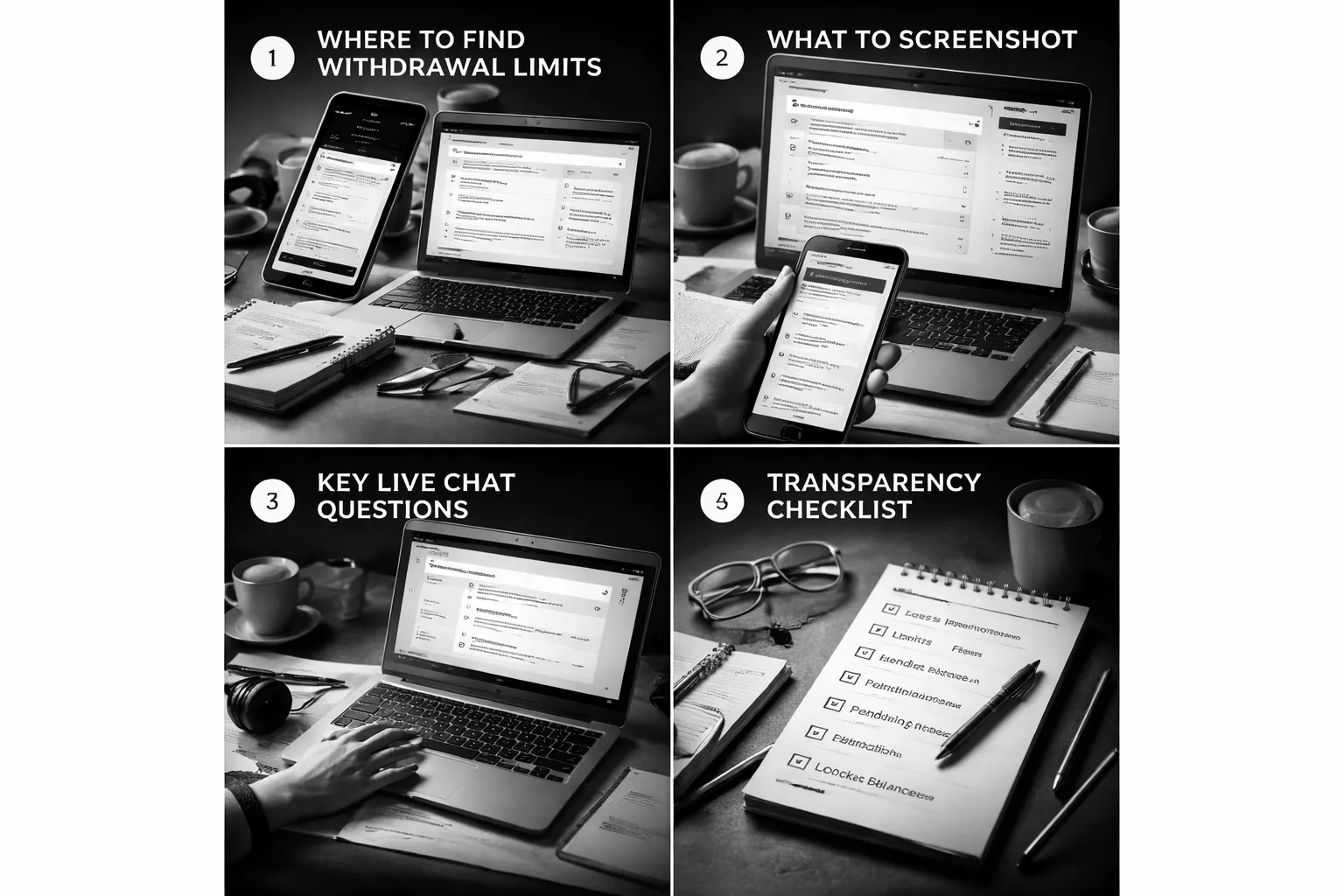
Where withdrawal limits show up
Check three places. Do it before you deposit and before you claim a bonus.
- Cashier page. Open Withdraw, then pick each payment method. Many casinos show method limits only after you select the rail.
- Banking FAQ. Look for a table that lists minimums, maximums, fees, and processing times by method.
- Terms and Conditions. Search for “withdrawal limit”, “maximum cashout”, “cashout cap”, “per day”, “per week”, “per month”, “rolling”, and “pending withdrawals”. Check the bonus terms too. Some caps apply only to promo winnings.
What to screenshot or save
Save proof while you can still access the exact wording. You need clear timestamps and the method name.
- Cashier limits screen for each withdrawal method you plan to use.
- Banking limits table that shows daily, weekly, and monthly caps.
- Fee lines for withdrawals, currency conversion, and inactive account charges.
- Reset rule text. Calendar day, rolling 24 hours, rolling 7 days, or “per week” with no definition.
- Pending withdrawal rule text. Whether pending requests count against your cap.
- Bonus cashout cap clause and the wagering requirement line.
- Support chat transcript or email confirmation if an agent gives a limit number.
Questions to ask live chat, get numbers and reset times
Ask for specific amounts and clear timing. Ask the agent to confirm in writing.
- Caps: “What is the maximum I can withdraw per day, per week, and per month for Visa, bank transfer, and e-wallets?”
- Reset time: “Do limits reset at 00:00 in my time zone, your time zone, or on a rolling basis?”
- Pending rule: “If I have a withdrawal pending, does it reduce my remaining daily or weekly limit?”
- Fee rule: “Do you charge a withdrawal fee per request, and does the payment provider charge a separate fee?”
- Request rule: “Is there a maximum number of withdrawals per day or per week?”
- Verification rule: “Can you hold or cap withdrawals until KYC is complete, and what documents do you require?”
Handle verification early. Use your first deposit as a trigger to submit documents, not your first big win. See KYC requirements so you do not hit a limit wall later.
Check method-specific limits inside your wallet or provider account
Some limits sit outside the casino. Your provider can block or delay transfers even if the casino approves them.
- E-wallets: Log in, open Limits or Profile, then check send, receive, and withdrawal caps. Unverified accounts often have low ceilings.
- Bank cards: Check card payout limits and bank transfer limits in your banking app. Some banks cap incoming credits or flag gaming payouts.
- Bank transfer: Check your bank’s incoming transfer limits, intermediary bank fees, and any same-day or weekend restrictions.
- Crypto: Check exchange withdrawal limits, address whitelisting, and network fees. Also check if the casino caps by coin and by chain.
Match both sides. The real limit equals the lower number, the casino cap or the provider cap.
Transparency checklist for a player-friendly casino
- Limits appear in the cashier before you deposit.
- Limits list exact time rules for daily, weekly, and monthly caps.
- Fees show per method and include provider fees where possible.
- Pending withdrawals rule is stated in one place, with clear examples or definitions.
- Bonus cashout caps sit next to bonus terms and use hard numbers, not vague phrases.
- KYC requirements are specific and available before you request a withdrawal.
- Support confirms limits in writing and does not dodge reset times.
- Method rules match reality when you cross-check inside your wallet or bank.
How withdrawal limit resets and queues actually work
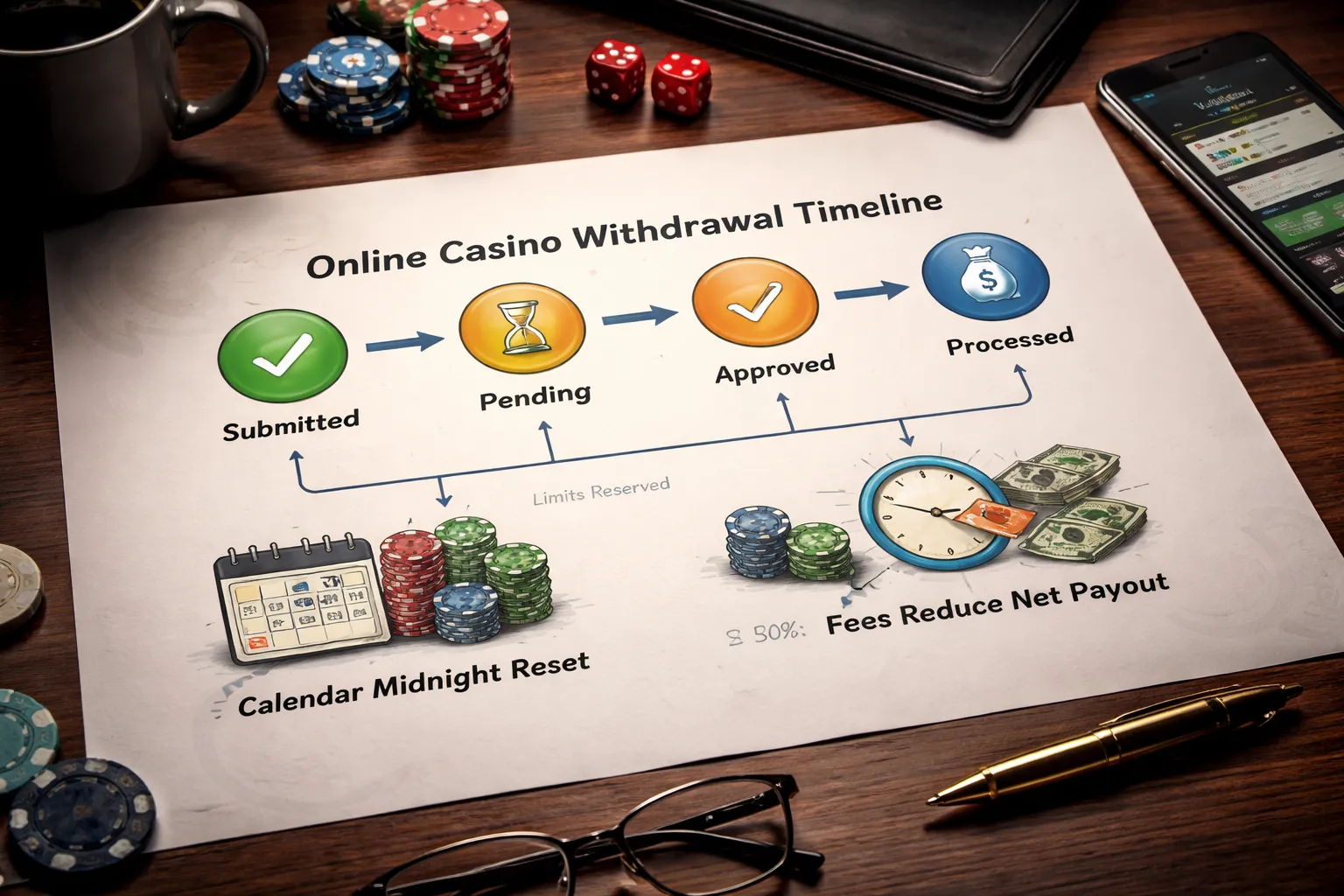
Reset timing, midnight local time vs 24-hour rolling windows
Casinos reset limits in two common ways. The difference changes when you can cash out again.
- Calendar reset, the limit resets at a set time, often midnight in the casino’s stated time zone. Example, a $2,000 daily cap used at 11:50 PM may reset 10 minutes later.
- Rolling window, the limit resets 24 hours after each approved or submitted withdrawal, depending on the rule. Example, you withdraw $2,000 at 3:15 PM on Monday, you get that $2,000 room back at 3:15 PM on Tuesday.
Check the casino time zone inside the cashier, terms page, or support transcript. If you play while traveling, your device clock does not matter. The casino system clock does.
Approval queues and “pending” states, why your limit may look used up
Most casinos count withdrawals against your limit before the money leaves. They do it when your withdrawal enters a queue.
- Submitted, you placed the request. Many sites reserve your limit at this point.
- Pending, the cashier team or payment team has not approved it yet. Your available limit can still show as reduced.
- Approved, the casino released it to the payment processor or bank rails. Some sites count the limit here instead of at submission.
- Processed or paid, the money left the casino side. Your bank or wallet speed controls the final arrival.
- Rejected or canceled, the reserved amount should return to your available limit. Some systems take minutes, others take hours.
If you hit your cap and your withdrawal still sits in pending, you usually need the first request to clear or cancel before you can create a new one. For the common causes and fixes, see why your online casino withdrawal is pending.
Split withdrawals, when multiple smaller cashouts help (and when they don’t)
Splitting a withdrawal can help if the casino caps each transaction but allows more than one withdrawal in the same period.
- Helps when you face a per-transaction limit. Example, max $1,000 per withdrawal, but $5,000 per week. Five $1,000 requests can work.
- Does not help when you face a hard daily or weekly cap that totals all withdrawals. Example, $2,000 per day total. Two $1,000 requests still equal $2,000.
- Can slow you down if the casino processes withdrawals in order. More tickets can mean more queue time.
- Can cost more if fees apply per withdrawal. Splitting can increase total fees.
Check two fields before you split. “Max per withdrawal” and “Max per day or week.” If the terms mention “aggregate,” the casino totals everything.
Batch processing days and bank holidays, planning around delays
Queues do not move at the same speed every day. Many casinos run withdrawals in batches.
- Weekends, some teams approve fewer withdrawals. Banks may not move transfers until Monday.
- Bank holidays, card refunds and bank transfers often pause. E-wallets may still move, but approval can still wait.
- Cutoff times, requests after a certain hour may shift to the next business day. The site may call this “processing time” or “finance hours.”
Plan your cashout before weekends if you rely on bank transfer. If you need faster access, check if the casino offers an e-wallet option with higher processing priority.
Fees and currency conversion, hidden factors that reduce net payout
Your withdrawal limit usually applies to the gross amount you request. Your net amount can be lower.
- Withdrawal fees, some casinos charge a flat fee or a percentage. Some payment methods charge their own fee.
- Intermediary bank fees, bank transfers can lose value on the way if a correspondent bank takes a charge.
- Currency conversion, conversion can happen at the casino, the processor, or your bank. Each layer can add spread and fees.
- Dynamic exchange rates, the rate can change between approval time and settlement time on the bank side.
To estimate your real take-home amount, note the currency in your casino balance, the currency of your withdrawal method, and any listed per-withdrawal charges. Small fees matter more when you split withdrawals.
Practical strategies to cash out faster and avoid cap frustration
Complete KYC early
Most cap problems start with KYC. Casinos slow or block payouts until they can verify you.
- Documents you usually need: government ID (front and back), proof of address (utility bill or bank statement, usually dated within 90 days), payment method proof (card screenshot with middle digits hidden, e-wallet account page, bank statement showing your name and IBAN), source of funds in higher tiers (payslip, tax return, bank statements).
- Upload quality rules: full document visible, no cropped corners, no blur, no glare, color images, file size within limits.
- Details must match: same name order, same address format, same date of birth across casino profile and documents.
- Common rejection reasons: expired ID, address document too old, mismatch between account name and withdrawal method, edited images, partial screenshots, unsupported file type, different country than your registration, multiple accounts.
- Timing strategy: verify before your first big win. Do it when you have time to respond to requests.
Choose payout methods with higher ceilings and fewer reversals
Your withdrawal method can set your real ceiling even when the casino limit looks high.
- Bank transfer: higher typical caps, fewer failed payouts, slower settlement. Best when you cash out large amounts.
- E-wallets: fast processing, solid limits at many casinos, but you can hit wallet tier limits. Upgrade your wallet account level early if needed.
- Cards: more reversals and partial returns, more issuer declines, lower practical limits. Cards also trigger extra checks when the casino must refund deposits first.
- Crypto (where offered and legal): often high caps and fast settlement, but rate swings and network fees can shrink your take-home amount.
- Fee math: if the casino charges per withdrawal, fewer larger withdrawals cost less. If you face strict per-transaction caps, pick the method with the best mix of ceiling and fee.
For a broader breakdown of speed, limits, and fees by method, use this payment methods comparison.
Plan withdrawals around cap windows
Caps reset on a schedule. You need the reset time, not guesses.
- Daily caps: ask support what “day” means, calendar day, rolling 24 hours, or casino time zone. A rolling window changes your schedule.
- Weekly caps: confirm the week start day and time zone. Some casinos reset Monday 00:00 casino time, others use a rolling 7-day window.
- Monthly caps: confirm if it resets on the 1st, every 30 days, or on your signup date. Monthly caps create the most frustration if you miss the reset by hours.
- Scheduling rule: submit right after the reset, not before. Many casinos count the request time, not the approval time.
- Split plan: if you must split, keep the number of withdrawals as low as the caps allow to reduce per-withdrawal fees and extra checks.
Keep a clean transaction trail
Clean trails get approved faster. Messy trails trigger reviews, reversals, and new limits.
- Use one method per currency when possible: constant switching increases manual checks.
- Withdraw to an account in your name: third-party payouts often fail. Joint accounts can also cause issues if the casino cannot match the primary holder.
- Match your profile details: your casino name, bank name, and wallet name must align. Fix typos before you submit.
- Avoid “deposit then withdraw” patterns: rapid in and out activity can trigger AML flags and slow future withdrawals.
- Keep records: save deposit receipts, wallet statements, and bank confirmations. Support resolves faster when you attach proof.
Escalation path when caps or delays feel unreasonable
You get better results when you escalate in order and keep it factual.
- Step 1, support ticket: ask for the exact cap, reset schedule, and the reason your payout cannot proceed. Request the policy link or terms clause.
- Step 2, compliance or payments team: ask support to route the case. Provide timestamps, withdrawal IDs, and screenshots of limits shown in your account.
- Step 3, formal complaint: follow the casino complaints process listed in the footer or terms. Use one thread. Set a clear deadline for response.
- Step 4, ADR or regulator: if the casino is licensed, you can escalate to its listed Alternative Dispute Resolution provider or the regulator. Include your case number, full timeline, and documents.
- Key tip: do not submit repeated withdrawals while a review runs. Some systems reset the queue position or trigger additional checks.
Responsible gambling and player protection controls
Voluntary limits and how they can affect withdrawals
Many casinos let you set responsible gambling limits. These controls can change how much you can cash out, and when.
- Deposit limits. You cap how much you can add to your bankroll per day, week, or month. This does not usually block withdrawals, but it can reduce chasing losses that lead to larger withdrawal limits later.
- Loss limits. You cap net losses in a period. When you hit the cap, the site can block new bets. It can still allow withdrawals, but some casinos pause activity until the limit period resets.
- Wager limits. You cap stake size. This lowers session volatility and helps you keep withdrawals aligned with your normal cash flow.
- Session limits. You cap time on site. These do not change cashout caps, but they reduce impulsive re-deposits while you wait for a payout.
- Withdrawal limits you set. Some sites let you cap your own withdrawals, or lock “reverse withdrawals” so you cannot cancel a cashout to keep gambling.
Use limits as a planning tool. If you already face daily, weekly, or monthly payout caps, add your own caps that match your budget and your expected payout schedule.
Cool-off periods and self-exclusion, what happens to pending withdrawals
Cooling-off and self-exclusion stop play. They can also change how the casino handles a withdrawal that sits in review.
- Cool-off. You take a short break, often 24 hours to 30 days. Betting stops. Withdrawals often still process, but support may require you to wait until checks finish.
- Self-exclusion. You block your account for months or years. The casino must enforce it. You cannot reopen the account early.
Pending withdrawals can fall into three common outcomes. The exact rule depends on the casino and the regulator.
- Withdrawal continues. The casino completes KYC and pays you out to your verified method.
- Withdrawal pauses. The casino stops the cashout until it confirms your identity or resolves a security flag. You can still submit documents during exclusion in many systems.
- Withdrawal cancels and balance locks. Some operators return funds to your casino balance but block gameplay. You then withdraw after verification.
Do not cancel a cashout to keep playing. If the site offers a “no reverse withdrawal” setting, turn it on.
Budgeting your bankroll with payout schedules in mind
Withdrawal limits create a payout timetable. Build your budget around that timetable.
- Map your casino cap to your needs. If the casino pays $2,000 per week and you need $6,000, plan for at least three cycles.
- Keep a cash buffer outside the casino. Do not treat pending withdrawals as spendable money.
- Pick one method and keep it stable. Method switching can trigger checks and delays.
- Avoid last-minute changes. New bank accounts, new cards, and new crypto addresses can slow reviews.
- Track your requests. Log date, amount, method, and status. It helps if you must escalate.
When to seek help, links and resources to include on-page
Get help fast if gambling harms your money, sleep, work, or relationships. Use these resources.
- UK: GamCare (https://www.gamcare.org.uk), National Gambling Helpline: 0808 8020 133
- US: National Council on Problem Gambling (https://www.ncpgambling.org), Helpline: 1-800-GAMBLER
- EU: Gamblers Anonymous (https://www.gamblersanonymous.org) and local national health services
- Blocking tools: GAMSTOP (UK, https://www.gamstop.co.uk), BetBlocker (https://betblocker.org), Gamban (https://gamban.com)
If you worry about account security during a withdrawal, follow basic protection steps. Use two-factor authentication, verify the correct payout method, and avoid public Wi-Fi. See our online casino payment safety tips for a clean checklist.
Common myths and mistakes about withdrawal limits
Myth: “A high VIP limit guarantees instant payouts”
VIP limits set a cap. They do not remove checks.
Most casinos still run manual review on higher amounts, first-time withdrawals, or unusual play. KYC, payment verification, and fraud screening can still apply. A bigger daily or monthly cap just means you can request more once the payout gets approved.
If you want speed, focus on process. Finish KYC early, use one verified payment method, and avoid last-minute changes that trigger a new review.
Mistake: switching payment methods midstream and triggering extra checks
Changing your withdrawal method often resets verification.
Casinos match deposits to withdrawals to manage chargeback risk and fraud. If you deposit by card, then try to withdraw to an e-wallet or bank account, the casino may ask for extra documents or reject the method.
- Pick one primary method before you deposit.
- Verify that method in your profile.
- Withdraw to the same method when the casino requires it.
- If you must switch, expect extra checks and extra time.
When you see a long review, use our payout times guide to separate normal processing from a real delay.
Myth: crypto always means unlimited withdrawals
Crypto payouts still have limits.
Many casinos set daily, weekly, or monthly caps per coin, per account, or per VIP tier. Some also limit withdrawals until you pass full KYC, even if you deposit in crypto.
Also check practical caps outside the casino. Network fees, wallet limits, and exchange compliance rules can slow transfers or block large conversions.
Mistake: ignoring max cashout clauses in bonus promotions
Bonuses can cap what you can withdraw.
A common rule is “max cashout” or “maximum winnings from bonus.” Example, a bonus may limit withdrawals to a fixed amount or a multiple of the bonus.
- Read the bonus “max cashout” line before you opt in.
- Check whether the cap applies to the bonus only or to all winnings made while the bonus is active.
- Confirm the cap resets after you finish wagering and switch back to cash play.
If you plan to win big, bonuses with strict caps can cost you more than they give.
Myth: casinos can’t change limits (what the T&Cs typically allow)
Most casinos reserve the right to change limits.
Terms often allow changes to withdrawal caps, processing rules, and verification requirements. Casinos may also apply lower limits case-by-case for responsible gambling controls, fraud risk, or payment channel constraints.
Protect yourself with simple habits.
- Screenshot the limits and the cashier page before you deposit.
- Save the promo terms for any bonus you accept.
- Check the T&Cs section on withdrawals and “right to amend.”
- If limits change, contact support and ask for the rule text and the effective date.
FAQ
What do daily, weekly, and monthly withdrawal limits mean?
They cap how much you can cash out in a set window. Daily resets each day, weekly resets on a fixed weekday, monthly resets on a fixed date. Some casinos use rolling windows, like the last 24 hours or last 30 days. Check the cashier rule text.
Are limits per withdrawal or total across the time period?
Both exist. A per-transaction limit caps each payout. A daily, weekly, or monthly limit caps your total approved withdrawals in that period. If you hit the cap, the casino may queue the rest for later or reject extra requests.
Do limits apply to my balance or only to approved withdrawals?
Most casinos apply caps to approved or processed withdrawals, not to your account balance. If a payout stays pending, it may still count against your cap. Ask support if the cap counts on request time or approval time.
Why did my withdrawal get split into smaller payments?
The casino may split payouts to fit per-transaction caps, payment rail limits, or internal risk rules. You still receive the total amount, but in parts across days. Track each transaction ID and the timestamps for your records.
Can I increase my withdrawal limits?
Sometimes. Higher limits may require full KYC, proof of address, and a clean withdrawal history. VIP status can help, but it is not guaranteed. Ask support for the exact criteria and the new limits in writing.
Do bonuses change withdrawal limits?
They can. Some bonuses add a max cashout cap, lower your withdrawal limit until wagering clears, or require specific payment methods. Save the promo terms before you opt in. If a max cashout applies, it overrides normal limits.
How do payment methods affect withdrawal limits?
Cards, e-wallets, bank transfers, and crypto each have different caps and processing rules. Card withdrawals often face tighter per-transaction limits. Bank wires may allow larger totals but take longer. Crypto limits depend on network rules and casino policy.
What should I do if the casino changes limits after I deposit?
Take screenshots of the cashier limits and the relevant T&Cs. Contact support and request the rule text, the effective date, and how it applies to your existing balance. If you need escalation, follow a formal process.
Where can I learn about fees tied to withdrawals?
Check the cashier page, your payment provider, and the casino fee table. Fees can come from bank wires, currency conversion, or crypto network charges. Use this guide on online casino fees and transaction charges to spot common costs before you cash out.
Conclusion
Conclusion
Withdrawal limits shape your cashout timeline. Daily, weekly, and monthly caps can stack, and the lowest cap controls your next payout.
Check three numbers before you play. The per transaction maximum, the rolling daily or weekly cap, and the monthly cap. Match them to your expected win size and your payment method.
- Plan around rolling windows. A 24-hour or 7-day clock starts at approval time in many casinos, not at midnight.
- Watch for bonus caps. Wagering rules can add a separate maximum cashout.
- Assume KYC can gate large withdrawals. Keep your ID and proof of address ready, and verify early.
- Track fees and net amount. Focus on what hits your account, not the headline withdrawal.
Your final step. Screenshot the limits page and fee table before your first deposit, then keep a simple log of requests and approvals. If a payout fails, use this checklist on why your casino withdrawal was rejected and escalate with dates, amounts, and proof.
-
Online Casino Payment Safety Tips: How to Deposit and Withdraw Securely
8 months ago -
What to Do If an Online Casino Won’t Pay Out: Step-by-Step Actions
8 months ago -
How to File a Complaint Against an Online Casino (Plus ADR Explained)
8 months ago -
How to Sign Up & Create an Online Casino Account (Step-by-Step)
8 months ago -
Online Casino Login Problems: Fixes for Common Sign-In Issues
8 months ago
-
- Wagering or rollover requirements, when your cashout gets blocked
- Maximum cashout clauses, promo caps vs normal withdrawal limits
- Game contribution and excluded games that slow completion
- Withdrawal cancels and re-wager rules, why reversing a cashout can hurt
- Red flags in bonus T&Cs to spot before claiming
-
- Reset timing, midnight local time vs 24-hour rolling windows
- Approval queues and “pending” states, why your limit may look used up
- Split withdrawals, when multiple smaller cashouts help (and when they don’t)
- Batch processing days and bank holidays, planning around delays
- Fees and currency conversion, hidden factors that reduce net payout
-
- What do daily, weekly, and monthly withdrawal limits mean?
- Are limits per withdrawal or total across the time period?
- Do limits apply to my balance or only to approved withdrawals?
- Why did my withdrawal get split into smaller payments?
- Can I increase my withdrawal limits?
- Do bonuses change withdrawal limits?
- How do payment methods affect withdrawal limits?
- What should I do if the casino changes limits after I deposit?
- Where can I learn about fees tied to withdrawals?
-
- Wagering or rollover requirements, when your cashout gets blocked
- Maximum cashout clauses, promo caps vs normal withdrawal limits
- Game contribution and excluded games that slow completion
- Withdrawal cancels and re-wager rules, why reversing a cashout can hurt
- Red flags in bonus T&Cs to spot before claiming
-
- Reset timing, midnight local time vs 24-hour rolling windows
- Approval queues and “pending” states, why your limit may look used up
- Split withdrawals, when multiple smaller cashouts help (and when they don’t)
- Batch processing days and bank holidays, planning around delays
- Fees and currency conversion, hidden factors that reduce net payout
-
- What do daily, weekly, and monthly withdrawal limits mean?
- Are limits per withdrawal or total across the time period?
- Do limits apply to my balance or only to approved withdrawals?
- Why did my withdrawal get split into smaller payments?
- Can I increase my withdrawal limits?
- Do bonuses change withdrawal limits?
- How do payment methods affect withdrawal limits?
- What should I do if the casino changes limits after I deposit?
- Where can I learn about fees tied to withdrawals?
-
Reload Bonus Explained: What It Is and When It’s Worth Claiming
6 months ago -
Online Casino Licensing Explained: Authorities, Licenses & How to Check One
8 months ago -
Best Live Dealer Casinos: Where to Play Live Blackjack, Roulette & More
8 months ago -
Best Online Casinos for High Rollers: VIP Perks, High Limits & Exclusive Bonuses
8 months ago -
Fast Payout Online Casinos: Best Sites for Quick Withdrawals
8 months ago
-
Online Casino Customer Support: What to Look For (Live Chat, Email, Response Times)
8 months ago -
Sign Up for an Online Casino: Create an Account in Minutes
8 months ago -
Online Casino Payment Safety Tips: How to Deposit and Withdraw Securely
8 months ago -
What to Do If an Online Casino Won’t Pay Out: Step-by-Step Actions
8 months ago -
How to File a Complaint Against an Online Casino (Plus ADR Explained)
8 months ago