Best Online Casinos for Roulette: Best Wheels, Limits & Live Options

Roulette online looks simple. Your results depend on the wheel type, the limits, and how the casino runs the game.
This guide lists the best online casinos for roulette. You will learn which sites offer single-zero and double-zero wheels, which ones fit low-stakes and high-limit play, and where live dealer roulette runs smooth. We also cover key checks that affect your edge and your time, including RTP, game speed, mobile play, and payout reliability.
If you want a broader shortlist across all casino games, use our best online casinos guide.
- In het kort: Pick single-zero roulette when you can, it cuts the house edge versus double-zero.
- In het kort: Avoid wheels with extra numbers like 00, 000, or bonus pockets, they raise the house edge fast.
- In het kort: Match the table limits to your bankroll, look for low mins if you grind, high limits if you chase volume.
- In het kort: Use live dealer roulette for steadier rules and a real wheel, but expect slower hands per hour.
- In het kort: Check the RTP and the rule set before you deposit, rules change more than people think.
- In het kort: Prioritize smooth mobile play, roulette sessions run long and bad UI costs you time and bets.
- In het kort: Treat payout speed and support as part of the game, slow cashouts are a real cost.
- In het kort: If you want a wider shortlist across all games, use our best online casinos guide.
Best Online Casinos for Roulette (Top Picks by Player Type)
Best overall roulette casino
Pick this type if you want balance. Solid roulette catalog, sensible limits, usable promos, and withdrawals that do not drag.
- Game variety: European roulette is the baseline. Add French roulette, multi-wheel, and a small set of variants you will actually use. Skip sites that push only American roulette.
- Limits: Look for low minimums on standard tables, plus at least one higher-limit table for when you scale up. Check max payouts, not just max bets.
- Promos: Read bonus terms for roulette contribution. Many bonuses count roulette at 0 to 20 percent. Low contribution makes the promo close to useless for roulette.
- Payouts: Prefer casinos with clear processing times by method, plus a visible withdrawal status page.
Best for low house edge
Chase rules, not marketing. You lower the edge by choosing the right wheel and the right rule set.
- Best baseline: European roulette at 2.70 percent house edge. Avoid American roulette at 5.26 percent.
- Best rules: French roulette with La Partage or En Prison. These cut the edge on even-money bets to about 1.35 percent.
- Transparency: The table info should show wheel type, rule set, and bet limits before you sit. If you cannot verify rules fast, leave.
- Variant control: Watch for side bets and special racetrack bets. They often carry a higher edge.
Best for live roulette
Live roulette lives or dies on stream quality and table access. You need stable video, fast UI, and enough tables at your stake.
- Studios: Prioritize casinos that run top live providers and show the provider name on each table.
- Stream stability: Look for adaptive streaming, low-latency mode, and quick reconnect. Test on mobile before you deposit.
- Table availability: You want multiple tables per limit band. One or two tables leads to queues and rushed bets.
- Betting window: Check how long you get to place bets and whether the UI supports quick repeat and double.
Best for high rollers
You need high limits, fast handling, and real support. VIP branding means nothing without terms.
- Max limits and max payout: Confirm the table max and the per-spin maximum payout. Some tables cap winnings even if bets look high.
- VIP value: Look for fee-free withdrawals, higher cashout limits, and a dedicated account manager who can solve payment holds.
- Private tables: Some casinos offer invite-only live tables with higher limits and fewer interruptions. Ask support before you deposit.
- Compliance: High deposits trigger checks. Use casinos with clear verification steps so you do not get stalled at cashout.
Best for beginners
Your first goal is clean play. Low stakes, clear rules, and a layout you can read without friction.
- Low minimum bets: Target tables with $0.10 to $1 minimums in RNG, and accessible low-limit live tables.
- Simple navigation: You should find European roulette in two clicks, with filters for limits and provider.
- Help content: Look for a short rules panel inside the game, plus bet explanations for inside and outside bets.
- Safer onboarding: Use a casino with clear licensing, secure payments, and visible support. Use this guide on casino safety checks if you are unsure.
Best for fast withdrawals
Speed comes from process. The best roulette casinos publish timelines and stick to them.
- Same-day methods: Instant bank transfers, e-wallets, and some crypto rails often clear faster than cards.
- Clear terms: Check withdrawal limits, fees, and required playthrough. Watch for rules that delay cashouts until bonus completion.
- KYC timing: Verify early. The fastest casinos approve ID checks before your first withdrawal request.
- Status tracking: You want timestamps for submitted, approved, and paid. No updates usually means slow handling.
Best for crypto roulette
Crypto adds speed and privacy, but only if the casino supports the coins you use and confirms deposits fast.
- Coin support: Check the exact network for each coin. A coin match is not enough if the chain does not match.
- Confirmations: Look for posted confirmation counts per coin, plus estimated credit times.
- Fees: Watch withdrawal fees and minimum cashout sizes. These matter more on smaller bankrolls.
- Provably fair: Some crypto casinos offer provably fair RNG roulette. Verify that you can audit seeds and outcomes inside the game interface.
How We Evaluate Roulette Casinos (Our Testing Criteria)

Licensing and player protection checks
We start with the license. We confirm the operator, the jurisdiction, and the regulator site listing. We look for clear ownership and a real address.
- Jurisdiction fit: We prioritize strict regulators. We flag weak oversight and unclear corporate structures.
- KYC and AML rules: We review sign-up flow, ID requirements, and source of funds triggers. We note when KYC blocks withdrawals.
- Responsible gambling tools: We check deposit limits, loss limits, time-outs, and self-exclusion. We look for easy access inside your account.
- Dispute channels: We check for an internal complaints path, regulator contacts, and third-party ADR options when offered.
Fairness verification
We verify that roulette outcomes follow the posted rules. We treat RNG and live wheels as separate products.
- RNG certificates: We check for current lab reports from recognized testers, plus accessible links and dates.
- Live wheel standards: We look for reputable studios, wheel maintenance notes, and clear game rules in the lobby.
- Audit history: We scan for regulator actions, public incident reports, and repeat player complaints that show a pattern.
- Game transparency: We check RTP display when available and confirm the wheel type, zero count, and side bet rules.
Roulette catalog depth
We score the range of roulette types and the number of tables that stay active at peak hours.
- Core variants: European, French, American.
- Live options: Standard live tables, VIP live tables, and branded studio tables.
- Feature games: Lightning Roulette, multi-wheel, mini roulette, and other high-volatility formats.
- Provider mix: More providers usually means better uptime and better limits spread.
Rule-sheet review
We read the rule sheet for every featured roulette title. We confirm what the UI actually enforces.
- French rules: La Partage and En Prison details, plus when they apply.
- American rules: Double-zero presence and any extra side bet conditions.
- Surrender rules: We check for surrender availability and edge impact when offered.
- Bet types: We verify racetrack bets, neighbor bets, and call bets, plus any table-specific limits.
Limits and staking flexibility
Limits decide who a table works for. We test real minimums and maximums in the lobby and at the table.
- Minimum bets: We record the lowest inside and outside bet minimums. We note when minimums jump in live games.
- Maximum bets: We log max per number, max per outside bet, and any table cap rules.
- Side bet caps: We check feature-game side bets, including Lightning multipliers, bonus bets, and top bet caps.
- VIP tables: We confirm invite rules, higher ceilings, and whether limits scale with your account tier. If you play big, see our high roller casino guide.
Bonus value for roulette
Most bonuses look better than they play. We translate terms into what you can actually clear with roulette.
- Wagering contribution: We record roulette contribution rates, including exclusions on live roulette and feature variants.
- Max bet rules: We check max stake per spin while a bonus is active. We flag rules that make roulette clearing unrealistic.
- Time limits: We note expiry windows and what happens to winnings on timeout.
- Game eligibility: We confirm which roulette titles count and which do not.
Payments scorecard
We test deposits and withdrawals with real methods when possible. We focus on cost, speed, and reliability.
- Methods: Cards, bank transfer, e-wallets, and crypto options when available.
- Fees: We check deposit fees, withdrawal fees, and hidden conversion spreads.
- Processing times: We record pending times, approval steps, and average payout speed by method.
- Withdrawal caps: We review daily, weekly, and monthly limits, plus VIP cap changes.
Mobile UX and performance
Roulette needs fast loading and clean bet placement. We test on modern iOS and Android browsers, plus apps when offered.
- Load speed: We time lobby load, game launch, and re-entry after a disconnect.
- Filters: We check roulette-specific filters, provider filters, and live table sorting by limits.
- Portrait mode: We verify usable portrait play and readable bet layouts.
- Stability: We test session drops, video quality on live tables, and recovery after a freeze.
Customer support quality
Support matters when a withdrawal stalls or a round disputes. We test the channel, speed, and roulette competence.
- Availability: We check live chat hours, email response times, and phone support where offered.
- Roulette knowledge: We ask about limits, rule variations, bonus eligibility, and game providers. We score accuracy.
- Escalation process: We confirm ticket tracking, supervisor access, and written resolutions for disputes.
- Evidence handling: We check if they request round IDs, screenshots, and game logs, and how fast they act on them.
Roulette Game Types That Matter (And Which to Choose)
European vs American roulette, the extra zero changes everything
Most roulette choices come down to one factor, how many zero pockets the wheel has.
- European roulette: 37 pockets, one zero. House edge is 2.70% on even money bets and most standard bets.
- American roulette: 38 pockets, zero and double zero. House edge is 5.26% on even money bets and most standard bets.
That difference is permanent. Your bet size does not change it. Your strategy does not change it. If you care about value, pick European rules over American rules.
French roulette rules that improve RTP, La Partage and En Prison
French roulette often uses European wheels, plus rules that cut the loss on even money bets when the ball lands on zero.
- La Partage: On even money bets, if zero hits, you lose half your stake and get half back.
- En Prison: On even money bets, if zero hits, your stake stays “in prison” for the next spin. If your bet wins next spin, you get your stake back. If it loses, you lose it. If zero hits again, rules vary by casino.
With either rule, the house edge on even money bets drops to about 1.35%. This applies only to even money bets like red or black, odd or even, and high or low. It does not improve straight up or split bets.
Live dealer roulette vs RNG, realism, pace, and control
RNG roulette runs on software. Live dealer roulette streams a real wheel with a dealer.
- Pace: RNG plays faster. Live takes longer per spin due to betting windows and dealer workflow.
- Limits: RNG often offers lower minimums. Live tables often start higher, but some studios run low limit tables.
- Control: RNG gives you quick re bet, auto play, and fast session volume. Live gives you table choice, dealer speed, and a visible wheel, but you accept the studio’s betting timer.
- Rule clarity: RNG posts rules on the info panel. Live tables can vary by studio, check wheel type, zero count, and any special rules before you sit.
If you want speed and low minimums, pick RNG. If you want a real wheel and a slower rhythm, pick live. For more table options, see our best live dealer casinos guide.
Lightning and Power roulette, higher variance and what multipliers really cost
Lightning, Power, and other multiplier roulette games change the risk profile. They pay multipliers on a small set of straight up numbers each round.
- What you gain: A chance at large payouts on straight up hits.
- What you give up: These games usually add a fee or reduce returns to fund the multipliers. The RTP drops versus standard European roulette.
- What it means for you: Bigger swings. Longer losing stretches. Higher bankroll pressure.
Pick multiplier roulette when you accept higher variance and you plan your session around it, smaller base stakes, fewer spins, and tighter stop loss rules.
Auto roulette and multi wheel roulette, speed focused formats and suitability
Auto roulette uses a real wheel without a dealer. Multi wheel roulette lets you bet on several wheels at once.
- Auto roulette: Faster than standard live tables. Good if you want a real wheel but less downtime.
- Multi wheel roulette: Increases spin volume fast. You can spread one stake across multiple wheels, but you also increase variance and bankroll burn.
- Best fit: Pick these formats when you value speed and you track your bankroll closely. Avoid them if you chase losses or you tilt under pressure.
Mini roulette and specialty wheels, when novelty games are worth it
Mini roulette and specialty wheels cut the number range or add side bets and features. They look simple, but they often cost more in edge.
- Mini roulette: Fewer numbers, often 0 to 12. The house edge can be higher than standard roulette. Bet limits can feel friendly, but the math usually is not.
- Specialty wheels: Bonus sectors, side bets, and branded rules can push RTP down. Read the paytable and the help screen before you commit.
Pick novelty roulette when you play for variety and you treat it like a higher cost game. If you play for long term value, stick to European roulette, or French roulette with La Partage or En Prison on even money bets.
Roulette Wheel Quality, RNGs, and Live Dealer Integrity

Wheel quality and software integrity
Roulette breaks in two ways. Physical wheels can drift. Digital games can use weak or manipulated random number generation. Your job is to verify controls for the version you play.
What “provably fair” means for roulette
Provably fair applies to some crypto roulette, not most regulated casino roulette. It lets you verify that the result came from a pre committed seed and that the casino did not change it after you placed your bet.
- Commitment: the casino publishes a hash of a server seed before the spin.
- Reveal: after the spin, the casino reveals the server seed so you can confirm the hash matches.
- Your input: you set or influence a client seed. Some games also use a nonce counter.
- Verification: you can reproduce the number using the published formula and confirm the outcome.
Limits matter. Provably fair does not prove fair payouts, honest rules, or a correct mapping from RNG output to wheel numbers. It also does not apply to live dealer roulette. Use it as one check, not as a full audit.
RNG testing labs and certificates to look for
For digital roulette in licensed casinos, you want independent testing and regulator oversight. Look for a test lab name, a report reference, or a certificate link in the footer, rules screen, or help menu.
- eCOGRA: RNG and payout testing, plus ongoing audits for some operators.
- iTech Labs: RNG certification and game testing for many major providers.
- GLI, Gaming Laboratories International: compliance testing used by many regulators.
- BMM Testlabs: compliance and RNG testing for regulated markets.
- UKAS or ISO references: accreditation signals process quality, not a guarantee of game value.
Also check the regulator. Examples include the UK Gambling Commission, Malta Gaming Authority, Gibraltar, Isle of Man, and state regulators in the US like the New Jersey Division of Gaming Enforcement. A real license lists the operator name, license number, and a link to verify it.
Live dealer wheel maintenance and bias prevention
Live roulette adds hardware and human handling. Serious studios run repeatable procedures to reduce bias and catch faults early.
- Wheel inspection: staff checks frets, pockets, rotor level, and spindle wear.
- Ball control: they rotate balls, replace worn balls, and track ball age.
- Clean and calibrate: they remove debris, check tilt, and confirm rotor speed ranges.
- Wheel rotation: some studios rotate or swap wheels on schedule to avoid long term drift.
- Result validation: cameras capture the landing pocket, the dealer calls it, and the system reconciles the call with video.
- Table security: pit style supervision, restricted access, and tamper seals in studio environments.
You can judge quality fast. Look for clear camera angles of the wheel, clean audio calls, and a stable result confirmation process. If the feed cuts during spins or the number confirmation looks inconsistent, move on.
Game history, result boards, and pattern traps
Roulette history helps you confirm that results post correctly. It does not help you predict the next spin.
- What history is good for: dispute checks, timing checks, and spotting display errors.
- What history cannot do: change the odds of red, black, odd, even, or any number on the next spin.
- What can mislead you: streak charts and “hot” and “cold” labels. They sell action, not accuracy.
If you use statistics, use them to measure the game, not to chase patterns. Focus on rules, wheel type, and RTP.
Red flags you should not ignore
- Missing rule sheet: you cannot confirm wheel type, payouts, or special rules.
- Unclear RTP or house edge: no stated return, or marketing claims without math.
- Inconsistent limits: the lobby shows one range, the table uses another, or limits change mid session without notice.
- Non standard payouts: anything other than 35 to 1 on a straight up bet needs an explanation.
- Hidden bet rules: odd “max win” caps, auto split rules, or side bet changes with no disclosure.
- Broken UX signals: result boards that do not match the wheel, missing game ID, or no visible time stamp on rounds.
If you play on mobile, you need clean rule access and stable live video. Use a casino app that keeps rules one tap away and does not bury limits in submenus. See our best mobile casino apps guide for picks that handle live tables well.
Table Limits & Betting Options: Finding the Right Fit
Low-limit roulette tables for casual play
Low limits keep swings small. They also hide bad deal setups if you do not check the math.
Use these checks to spot true micro stakes.
- Minimum bet vs chip size. A table can show $0.10 chips but enforce a $2.00 minimum. The minimum controls your cost per spin.
- Minimum inside bet. Some games set a higher minimum for straight-up and split bets than for outside bets.
- Bet cap on outside bets. Some “low limit” tables cap red, black, odd, even at a low number. That blocks simple stake ramps.
- Auto-rebet rules. Check if the game allows rebet and double. If it does not, you will tap more and miss rounds.
- RNG speed. Fast RNG roulette can run many spins per hour. That raises your hourly risk even with small bets.
Micro-stake roulette usually starts at $0.10 to $1.00 minimum per spin. Live roulette “low limit” often means $1 to $5 minimum. Always verify the table card.
High-limit and VIP roulette tables
High-limit tables matter for two reasons, max bet and max payout. Both can cut off your upside.
- Max bet. This is the ceiling per bet type, not just a single overall limit. A table can allow $5,000 on red but only $200 on straight-up.
- Max payout. Some live tables cap total winnings per spin. If you hit a high-paying number, the casino pays up to the cap and voids the rest.
- Session policies. VIP tables often add rules for table access, reserved seats, or approval for large bets. Some require a host to raise limits.
- Bet acceptance timing. Live dealers close betting on a timer. High-limit players should avoid lag and late bet rejections.
Before you sit down, read the limit panel for each bet type and confirm the max payout line in the rules.
Inside vs outside bets: risk and typical use
Inside bets pay more but hit less. Outside bets hit more but pay less. Your variance changes fast.
| Bet type | Typical bets | Payout | Hit rate feel | Common use |
|---|---|---|---|---|
| Inside | Straight, split, street, corner, line | Higher | Lower | Short bursts, number hunting, smaller base stake |
| Outside | Red/black, odd/even, high/low, dozens, columns | Lower | Higher | Lower volatility play, steadier bankroll pacing |
If you want longer sessions, keep most of your action on outside bets. If you want bigger single hits, use inside bets but cut unit size. On European wheels, the house edge stays the same across standard bets. Your risk changes, not the edge.
Racetrack and call bets
Racetrack is a layout shortcut. It places preset splits and corners around sections of the wheel. Call bets are named patterns the dealer or UI can place fast.
- Voisins du Zéro. Covers the zero side of the wheel with a fixed set of splits, streets, and a corner.
- Tiers du Cylindre. Covers the opposite side of the wheel with multiple splits.
- Orphelins. Covers the remaining numbers with splits and a straight-up.
- Jeu Zéro. A zero-focused pattern that uses splits and a straight-up.
Support depends on the game.
- Most common in European live roulette. Many Lightning-style and standard live wheels include racetrack.
- Less common in American roulette. Double-zero layouts often drop call bets or limit them.
- RNG varies. Some RNG games include racetrack, others do not. Check the UI before you deposit for that table.
Call bets can also have higher table minimums because they place multiple chips at once. Verify the total stake before you confirm.
Side bets in live roulette
Side bets add volatility. They often raise the house edge. Treat them as a separate game.
- Multiplier games. Lightning or similar formats boost payouts on selected numbers, but they also change the cost structure with extra fees or reduced base payouts.
- Dealer side bets. Some tables add bets tied to last digit, color streaks, or special zones. These usually pay on rare events.
- Higher variance. You can go long stretches with no return. Your bankroll needs more buffer.
- Rules and limits differ. Side bets may have separate minimums and a lower max payout than main roulette bets.
If you care about withdrawals and cashout timing, use casinos known for fast processing. See our fast payout online casinos guide.
Live Roulette Options: Studios, Features, and Game Shows
Top live roulette providers and what sets them apart
Most live roulette runs on a small group of providers. Your table rules, bet limits, and video quality often come from the provider, not the casino.
- Evolution. The widest live catalog in most lobbies. Strong stream stability, clean interface, and many table types, including game-show roulette formats. Good choice if you want more than standard European roulette.
- Playtech. Reliable live casino core with a focus on classic tables and branded environments. Often offers clear table info and solid bet controls. Availability depends more on your region and casino partnerships.
- Pragmatic Play Live. Simple UI and quick navigation. Common pick for players who want fast loading on mobile and straightforward tables without extra layers.
- Authentic Gaming. Specializes in streaming real roulette wheels from land-based casinos. Best when you want a real casino floor feel and real wheel identity, not a studio set.
- Lucky Streak. More budget-friendly studio production. Often appears at casinos that need broad coverage with lower operating costs.
Studio tables vs land-based streamed tables
You will usually see two live roulette types. Studio tables run in dedicated broadcast rooms. Land-based streams come from real casino floors.
- Studio tables
- Pros. Cleaner audio, fewer interruptions, consistent lighting, clearer overlays, and faster dealing pace.
- Cons. Less atmosphere. Some tables feel identical across casinos.
- Best for. Volume play, lower distraction, and quick sessions.
- Land-based streamed tables
- Pros. Real venue context, real wheel identity, and a true casino backdrop.
- Cons. More noise, more downtime, and camera angles can vary. Table limits can skew higher.
- Best for. Slower play and a casino floor experience.
Availability depends on licensing and location. Some casinos show studio-only lobbies in certain regions.
Key live roulette features to compare
Small interface details change your results. Prioritize what helps you place bets accurately and on time.
- UI clarity. You need a readable racetrack, clear chip values, and a visible countdown. Avoid cluttered layouts that hide table limits or side bets.
- Bet history and last results. Look for a simple results strip and your recent bets. It helps you track exposure and stop duplicate clicks.
- Statistics. Providers often show hot and cold numbers, sector stats, and odd or even runs. Use these as display tools, not an edge. They do help you spot how the table is trending in pace and volatility.
- Multi-camera views. Useful if you want a clear view of the wheel and the dealer. The best streams show the spin, the drop, and the result without cutting away.
- Chat. Good for quick dealer interaction and basic support. You can mute it if it distracts you or slows your decisions on fast tables.
Peak-time seating and table capacity
Live roulette has a hard ceiling on seats. Peak hours can lock you out or force you into higher limits.
- Standard live tables. Many providers cap seats per table. Once full, you wait or move.
- Unlimited roulette variants. These remove seat limits because you play against a shared stream. You still get a live spin, but your betting interface runs independently. This is the simplest fix for full-table frustration.
- Lower-limit tables fill first. If you want low stakes, join early, favorite the table, and keep a backup option in the lobby.
- Check max bet speed. Crowded tables can increase misclick risk if you rush. Use tables with a clear timer and fast chip controls.
Game-show roulette formats
Game-show roulette mixes roulette with random bonus events. You get higher swings and less control over variance.
- Who they suit. You want bigger hit potential and do not mind long dry spells. You prefer entertainment over steady bankroll pacing.
- What to expect. Bonus multipliers, special rounds, and extra side bets. Payouts can spike, but your session can turn cold fast.
- What to check before you play. Minimum bet on side bets, max payout caps, bonus trigger rules, and the base game type, European or American. Treat them as separate products, not standard roulette.
If you play live roulette on your phone, prioritize providers with a clean mobile layout and fast loading. Use our best mobile casino apps guide to compare app quality and performance.
Bonuses for Roulette: What’s Worth Claiming (And What Isn’t)
Why roulette often contributes less to wagering requirements
Casinos rate roulette as a low-edge game. They lower its contribution to protect their margin.
You will see roulette listed at 0%, 5%, 10%, or 20% toward wagering. Slots often count at 100%.
This matters more than the headline bonus size. A $200 bonus with 10% roulette contribution can turn into a grind you cannot clear in time.
Best bonus types for roulette players
- Cashback. You get money back based on net losses. No game contribution math. Check the cap, the time window, and whether it pays as cash or bonus funds.
- Loss insurance. Similar to cashback, but tied to your first day, first deposit, or first session. Best when it pays cash or has low wagering on the returned amount.
- Low-wager deposit offers. Look for 5x to 15x. You can clear these with roulette even with reduced contribution. Avoid 30x to 50x unless roulette counts high.
- Live roulette promos with low playthrough. Some sites run live-dealer reloads with smaller bonuses and easier rules. These often beat large welcome packages for roulette.
Terms that can void winnings: max bet clauses and restricted strategies
Most bonus disputes come from two rules. Max bet limits and strategy restrictions.
- Max bet clauses. Common limits are $5, $10, or 10% of your bonus per spin or round. If you bet above it, the casino can void bonus winnings. This includes side bets and neighbor bets if they push total stake over the cap.
- Restricted strategies. Many terms ban low-risk hedging. Examples include betting red and black at the same time, covering most of the table to lock small variance, or using opposite bets across multiple tables. Some also flag rapid bet pattern changes tied to bonus progress.
- Game weighting by bet type. Some casinos treat outside bets differently from inside bets for contribution or limits. If the rules separate them, follow the strictest line.
If you plan to play roulette on a bonus, read the bonus terms inside the cashier, not the promo banner. If you want a safer baseline, start with our best online casinos list and filter by clear bonus rules.
Free spins vs roulette bonuses: when cross-product promos still help
Free spins can still add value, even if you only play roulette.
- Good use case. The free spins winnings convert to cash or have low wagering, and roulette play stays separate. You can clear the spins, withdraw, then fund roulette normally.
- Bad use case. Free spins winnings become bonus funds with a high playthrough, and roulette counts at 0% to 10%. You can get trapped in wagering you cannot clear with your game.
- Check the conversion. Look for whether winnings credit as cash, bonus, or sticky bonus. Sticky bonuses often remove the bonus on withdrawal, leaving only winnings.
How to calculate real bonus value using contribution rate and expected wagering
Use one simple formula. It tells you how much roulette volume you must play to clear the offer.
Required roulette wagering = (Bonus amount x Wagering multiple) / Contribution rate
- Example A. $100 bonus, 30x wagering, roulette contributes 10%. Required roulette wagering = (100 x 30) / 0.10 = $30,000.
- Example B. $100 bonus, 10x wagering, roulette contributes 20%. Required roulette wagering = (100 x 10) / 0.20 = $5,000.
Then sanity-check it against your bankroll and limits. If your average bet is $5, a $30,000 target means about 6,000 spins. That is not realistic for most players, and it increases your chance of hitting max bet or time-limit issues.
Finally, compare against cashback. If a site offers 10% cashback up to $100, you know the ceiling. You do not need to clear a large playthrough to see value.
Payments, Payout Speed, and Fees (What Roulette Players Should Check)
Deposit Methods That Fit Roulette Bankroll Control
Pick deposit options that let you fund in small, repeatable amounts. This keeps your session size stable and reduces tilt deposits.
- Debit card: Good for routine deposits. Watch for bank declines and daily caps.
- E-wallets: Strong for bankroll control. You can separate your casino balance from your bank and move fixed amounts.
- Instant bank transfer: Works for larger, planned deposits. Avoid it if you tend to chase losses.
- Prepaid cards and vouchers: Strong control tool. You can only spend what you load. Some sites block withdrawals back to prepaid.
- Crypto: Fast funding and strong privacy. You take on price swings and network fees.
Match your method to your habits. If you want discipline, use prepaid, vouchers, or e-wallets with set top-ups. If you want speed, use e-wallets or crypto.
Fast Withdrawals and Typical Timelines by Method
Payout speed depends on two things. The casino review time and the payment rail. You control the second part by choosing the right method.
| Method | Typical casino processing | Typical delivery time | Notes for roulette players |
|---|---|---|---|
| E-wallet | 0 to 24 hours | Instant to 24 hours | Often the fastest for fiat. Low friction for repeat cashouts. |
| Crypto | 0 to 24 hours | Minutes to a few hours | Speed varies by network and fee level. Confirmations matter. |
| Debit card | 1 to 48 hours | 1 to 5 business days | Reliable but slower. Some banks label returns as refunds. |
| Bank transfer | 1 to 72 hours | 2 to 7 business days | Best for larger withdrawals. Highest chance of extra checks. |
| Check | 3 to 7 days | 7 to 21 days | Slow. Avoid unless you have no other option. |
For live roulette, speed matters more. Your swings run bigger and you will cash out more often. If you play live tables, use a method that can pay daily or near-daily. For more live options, see our best live dealer casinos guide.
Crypto Payments: Volatility, Network Fees, and Confirmation Delays
Crypto can cut payout time, but it adds variables you must manage.
- Volatility: Your balance can change value between withdrawal approval and when you swap to cash. If you want stable value, convert to a stablecoin where supported, or cash out quickly after you receive funds.
- Network fees: You pay miner or validator fees. They change by chain load. A low fee can delay your transfer.
- Confirmations: Casinos wait for on-chain confirmations before they credit deposits. Some networks confirm in minutes, others can take longer during congestion.
- Address mistakes: One wrong character can lose funds. Save whitelisted addresses and test with a small transfer first.
If you use crypto for roulette, plan for fees in your bankroll. A $10 fee on a $100 cashout is a big hit. Use fewer, larger withdrawals if fees stay high.
Withdrawal Limits, Pending Periods, and Verification Bottlenecks
Two rules decide if you can access your money fast. The site withdrawal limits and the site approval queue.
- Minimum cashout: Some casinos set $20 to $100 minimums. This matters if you grind low stakes roulette and cash out often.
- Maximum per transaction: Common caps range from a few thousand to five figures. You may need multiple withdrawals for a big win.
- Daily and weekly caps: VIP tiers often raise these limits. Read the cashier terms before you deposit.
- Pending periods: Many sites place withdrawals in a pending state. During this window, they can request documents or reverse the cashout back to your balance.
- KYC checks: Expect ID, proof of address, and sometimes payment method proof. Do it early, not after a big roulette hit.
- Method match rules: Some sites return funds to the original method up to the deposit amount, then pay the rest by another method. This can slow you down if you deposit by card and want an e-wallet payout.
Before you commit to a site, check three numbers in the cashier. Minimum withdrawal, max per week, and typical review time. Those numbers matter more than any marketing claim.
Security Basics: Encryption, 2FA, and Account Safety
- Use 2FA: Turn on app-based 2FA if the casino supports it. Avoid SMS 2FA if you can.
- Use a unique password: Do not reuse your email password. Use a password manager.
- Check HTTPS: Your cashier and login pages should use HTTPS. Do not log in on public Wi-Fi without a VPN.
- Lock your email: Your email controls resets. Secure it with 2FA and a strong password.
- Withdraw to your own accounts: Do not use third-party wallets or bank accounts. It triggers delays and KYC issues.
- Keep device clean: Update your phone and browser. Avoid installing unknown extensions.
Payment speed starts with account trust. If you keep your profile verified and your login secure, you reduce the chance of slowdowns when you want to cash out.
How to Play Roulette Online (Quick Start for Beginners)
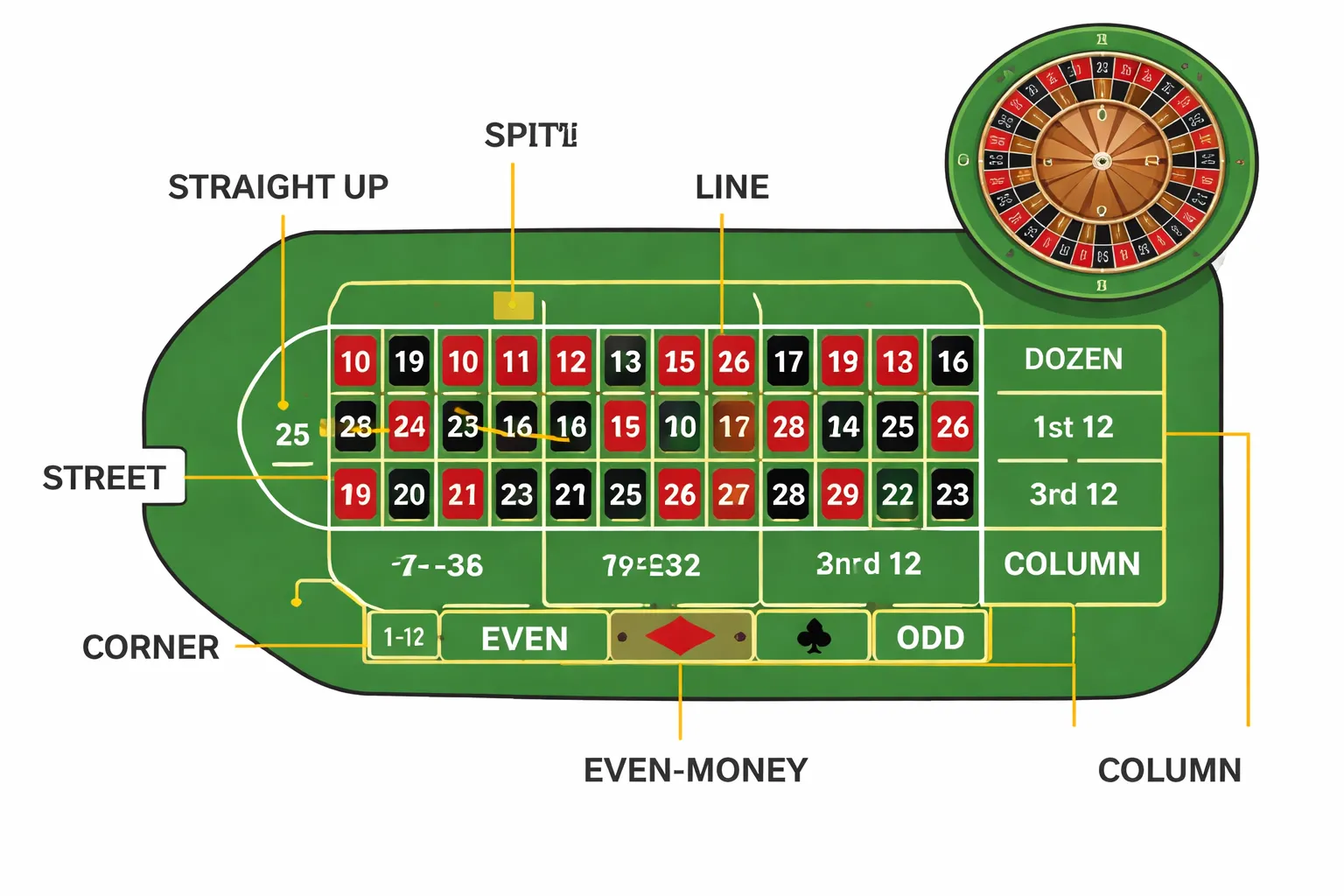
Step-by-step, place chips, pick bets, confirm
Online roulette runs fast. You need a repeatable routine.
- Pick your table. Check wheel type, limits, and whether it is live or RNG.
- Set your chip value. Tap the chip selector. Choose a stake that fits the table minimum.
- Place chips. Tap the layout where you want to bet. Each tap adds one chip at your current value.
- Use controls. Use Undo, Clear, and Rebet to manage your slip. Rebet repeats your last round bets.
- Confirm your wager. Some tables auto-lock at the timer. Others require a Confirm button. After bets lock, you cannot change them.
- Watch the result. The game resolves, then credits winnings automatically.
Betting layout explained, inside and outside bets
The layout splits into inside bets on single numbers and groups, and outside bets on larger groups. Inside bets carry higher variance. Outside bets hit more often but pay less.
- Straight up. One number.
- Split. Two adjacent numbers. Place the chip on the line between them.
- Street. Three numbers in a row. Place the chip on the outer edge of the row.
- Corner. Four numbers in a block. Place the chip on the corner point where they meet.
- Line. Six numbers, two streets. Place the chip on the line between the two rows.
- Dozen. 1 to 12, 13 to 24, 25 to 36.
- Column. One of the three vertical columns.
- Even-money bets. Red or Black, Odd or Even, 1 to 18, 19 to 36.
Understanding payouts and odds, what the table implies
Payouts look generous. The wheel math sets the edge.
| Bet | Covers | Payout | Win chance (European, 1 zero) | Win chance (American, 0 and 00) |
|---|---|---|---|---|
| Straight up | 1 | 35:1 | 1/37, 2.70% | 1/38, 2.63% |
| Split | 2 | 17:1 | 2/37, 5.41% | 2/38, 5.26% |
| Street | 3 | 11:1 | 3/37, 8.11% | 3/38, 7.89% |
| Corner | 4 | 8:1 | 4/37, 10.81% | 4/38, 10.53% |
| Line | 6 | 5:1 | 6/37, 16.22% | 6/38, 15.79% |
| Dozen | 12 | 2:1 | 12/37, 32.43% | 12/38, 31.58% |
| Column | 12 | 2:1 | 12/37, 32.43% | 12/38, 31.58% |
| Even-money | 18 | 1:1 | 18/37, 48.65% | 18/38, 47.37% |
House edge depends on the wheel.
- European roulette (single zero). House edge 2.70%.
- American roulette (zero and double zero). House edge 5.26%.
- French roulette with La Partage. On even-money bets only, house edge drops to 1.35%.
- French roulette with En Prison. On even-money bets only, expected loss similar to 1.35%, but some rules return the stake only on the next round win.
Ignore streak logic. Each spin stays independent. Focus on wheel type, limits, and rules.
Live roulette etiquette, timing, chat, tipping norms
Live tables run on a clock. If you miss the window, you miss the spin.
- Bet early. Place bets in the first half of the countdown. Avoid last-second taps.
- Do not spam chat. Keep it short. Skip dealer requests and complaints.
- Respect table flow. Rebet is fine. Constant clear and re-place slows you down and increases misclick risk.
- Tipping. Some studios offer a tip button or tip bet. Tip only if you want to. It does not change outcomes.
Practice modes and demos, use them without bad habits
Demos help you learn the layout and pace. They can also teach mistakes if you treat them like real money.
- Practice placement. Use demos to learn where splits, streets, corners, dozens, and columns sit.
- Match real limits. Set a pretend bankroll and stake size that matches what you will deposit. Do not use max chips in demo.
- Track results. Record 100 to 200 spins if you test a staking plan. You will see variance fast.
- Switch to real play slowly. Start at table minimum. Increase only after you confirm you can follow your own stop-loss and time limits.
If you also play slots, use a separate bankroll and pick high RTP games from high RTP slots casinos.
Strategy, Bankroll & Responsible Play (Practical Guidance)
House edge vs variance, why “safe bets” still lose over time
Roulette has a built-in house edge. Bet type does not remove it.
- European roulette (single zero): 1 losing number out of 37. House edge is 2.70%.
- American roulette (double zero): 2 losing numbers out of 38. House edge is 5.26%.
Outside bets like red, black, odd, even, and 1 to 18 pay 1:1. They feel steady, but they still carry the same edge as every other bet on the wheel. You trade higher hit rate for smaller payouts.
Variance decides what happens in the short run. You can win for hours on simple outside bets, then hit a streak that wipes the session. The edge decides what happens in the long run. More spins means your results drift toward a loss equal to the edge.
Use a simple expectation check to stay grounded. If you stake $10 per spin on European roulette for 200 spins, you wager $2,000. Your expected loss is about $54. For American roulette, it is about $105. Variance can hide this in one session. It will not hide it forever.
Bankroll sizing and session limits, simple rules for risk control
Pick a bankroll for roulette only. Do not mix it with rent money. Do not borrow.
- Set a unit size: 1 unit equals 1% to 2% of your roulette bankroll.
- Play near the table minimum: It keeps your unit stable and limits damage during bad runs.
- Cap total exposure per spin: Keep your combined bets at 1 to 3 units. Avoid covering many numbers at once.
- Set a hard session loss limit: Stop at 10 to 20 units down. Do not raise stakes to “get it back.”
- Set a time limit: 30 to 90 minutes. End the session when the timer ends, even if you feel “close.”
Plan for streaks. On even money bets, long runs happen. A 10 loss streak is rare, but it is normal over enough sessions. Size your unit so a streak does not force you to break rules.
Popular systems (Martingale, Fibonacci, D’Alembert), pros, cons, and pitfalls
- Martingale: Double after each loss on an even money bet. Pro: Small wins can feel frequent. Con: One long losing streak causes a huge bet fast. Table max limits and bankroll limits break the system. Your risk spikes while your profit target stays small.
- Fibonacci: Increase bets using 1, 1, 2, 3, 5, 8, 13, and so on after losses. Pro: Slower growth than Martingale. Con: It still ramps up to large bets. A bad run still crushes you, just later.
- D’Alembert: Add 1 unit after a loss, subtract 1 unit after a win. Pro: Smooth progressions and lower spikes. Con: No system changes the house edge. You can grind for a while, then give it back.
If you use a system, treat it as a structure tool, not an advantage. Test it with 100 to 200 spins on paper first. Then set a hard stop when the next step exceeds your planned max bet.
When to stop, setting win goals, loss limits, and time boundaries
Stopping rules protect you from tilt and from overplaying wins.
- Win goal: Aim for 10 to 20 units. Stop when you hit it.
- Loss limit: 10 to 20 units. Stop when you hit it.
- Time boundary: Set a timer. Stop when it ends.
- Max bet ceiling: Pick a number before you start. Stop if your plan demands a larger bet.
Do not move the line mid session. If you want to play more, start a new session later with the same rules.
Responsible gambling tools, deposit limits, cool-offs, self-exclusion, and support
Use casino tools before you feel out of control. They work best when you set them early.
- Deposit limits: Set daily, weekly, or monthly caps that match your budget. Use the lowest limit you can stick to.
- Loss limits and wager limits: If available, set them. They reduce damage from long sessions.
- Session reminders: Turn on reality checks. They break autopilot play.
- Cool-offs: Lock your account for 24 hours to several weeks. Use this after rule breaks.
- Self-exclusion: Block access for months or longer. Use it if you chase losses or hide play.
Keep payments simple. If you use e-wallets, pick one and track deposits and withdrawals in one place. See our guide to best PayPal casinos if PayPal helps you stick to limits.
If gambling stops feeling like entertainment, get support. Use your local problem gambling service, or talk to a qualified counselor. Do it early.
Choosing a Safe Roulette Casino: Licensing, Legality, and Trust Signals

How to verify a casino license and what it covers
Start with the footer. A safe roulette casino lists its license holder name, license number, and regulator.
- Match the operator name. The license should cover the same legal entity that runs the site, not a different brand group.
- Check the regulator site. Search the license number on the regulator’s public register. Confirm status shows active, not suspended or expired.
- Confirm the domain. Some regulators list approved URLs. Your exact site address should appear.
- Check game testing. A license does not prove each roulette game is fair. Look for independent testing labs listed on the site, and confirm the lab name is real and current.
- Know what the license covers. It usually covers identity checks, anti money laundering controls, complaint paths, and basic game integrity rules. It does not guarantee fast payouts, good support, or generous limits.
Jurisdiction differences, what “legal in my location” typically means
“Legal” depends on where you are when you play, not where the casino sits. Many sites accept some countries and block others.
- Regulated markets. Places like UK, parts of the EU, and some US states require a local license. You should play only on locally licensed sites. You get clearer dispute paths and stronger enforcement.
- Offshore licensing. Some casinos run under Curaçao or similar frameworks. You may access them, but you often get weaker oversight and fewer tools if a payout dispute happens.
- Geo checks. The casino may allow sign up, then block you at withdrawal if your location fails checks. Read the terms for restricted countries and states before you deposit.
- Game availability. Live roulette tables, limits, and side bets can change by region due to local rules or supplier contracts.
Player reviews vs affiliate bias, how to interpret feedback reliably
Most roulette casino pages earn money from referrals. Assume bias, then validate.
- Prioritize specific complaints. Look for details like withdrawal method, amount, dates, and the reason support gave. Vague rants add little value.
- Separate casino issues from user errors. Many “scam” reports come from failed verification, bonus misuse, or chargebacks. Check if the reviewer mentions KYC, wagering rules, or restricted locations.
- Watch for repeated patterns. One bad review means little. Many reports of delayed withdrawals, voided winnings, or closed accounts for the same reason matter.
- Check the response behavior. A reputable operator replies, asks for a ticket ID, and gives a path to resolution. Silence and copy paste replies are a bad sign.
- Use one neutral reference. Cross check claims with an independent roundup like our online casino reviews.
Data privacy and compliance, what to expect from reputable operators
A safe roulette casino treats your data like a regulated financial service.
- Encryption. The site should run on HTTPS on all pages, not only the cashier.
- Clear privacy policy. It should state what data they collect, why they collect it, and who they share it with, including payment processors and game providers.
- KYC checks. Expect ID and address checks before large withdrawals. This protects against fraud and forced chargebacks.
- Account security. Look for two factor authentication if available, and session controls like device management.
- Responsible gambling tools. Deposit limits, loss limits, timeouts, and self exclusion should sit in your account settings, not behind support tickets.
Complaint handling, mediation, regulators, and documentation tips
Do not rely on chat promises. Build a record and escalate fast.
- Start with a written ticket. Use email or a support form. Ask for a case number. Keep all replies.
- Document everything. Save screenshots of balances, withdrawal requests, bonus terms, and any rule the casino cites. Export transaction history.
- Stick to timelines. Many regulated operators publish target times for verification and withdrawals. If they miss them, ask for a written reason.
- Escalate to the right body. Locally licensed casinos usually list a regulator and an ADR or mediation service. Submit your case there with your evidence pack.
- Use the regulator register. Confirm the license, then file the complaint under the same legal entity name shown on the license.
- Do not threaten chargebacks first. It can trigger account locks and slow resolution. Use it only after you follow the formal process.
FAQ
Which roulette version gives you the best odds?
European roulette. It uses one zero, 2.70% house edge. American roulette uses double zero, 5.26% house edge. French roulette can match European odds and may add rules like La Partage or En Prison that cut losses on even-money bets.
Do live dealer wheels have different odds than RNG roulette?
The math stays the same for the wheel type, European or American. Differences come from rules, zero count, and side bets. Live tables often run higher limits. RNG tables offer more low-stake options and faster spin volume.
What bet has the lowest house edge?
Even-money outside bets, red or black, odd or even, high or low. On European wheels, they sit at 2.70% house edge. On French tables with La Partage or En Prison, the edge drops to about 1.35% on those bets.
What bankroll should you use for roulette?
Set a session bankroll of 50 to 100 units. Keep your unit at 1% to 2% of that bankroll. This gives you room for variance. Do not raise stakes to chase losses. Stop when you hit your preset loss cap.
How do table limits affect your strategy?
Limits control how long you can play and whether you can cover numbers. With low max limits, you cannot use large cover bets late in a session. With high minimums, variance hits harder. Pick limits that fit your unit size.
Are roulette bonuses and promos worth it?
Only if wagering terms fit roulette. Many casinos count roulette at 0% to 20% toward wagering. Check max bet rules during bonus play. If terms block roulette, skip the promo or use a different game with full contribution.
How can you check if a roulette casino is legit?
Match the casino legal entity to the license register. Confirm the regulator, license number, and domain coverage. Check the ADR or dispute service. Read withdrawal terms, KYC rules, and max cashout limits before you deposit.
Why did your roulette withdrawal get delayed?
KYC checks, mismatched documents, bonus reviews, or payment method limits. Upload clear ID and proof of address. Use the same name on your account and wallet. Avoid multiple payment methods. Keep chat logs and email receipts.
What is the fastest way to resolve a roulette dispute?
Build an evidence pack, screenshots, dates, transaction IDs, chat logs, and terms text. File a complaint under the licensed entity name. Use the listed ADR if needed. For more vetting tips, use our online casino reviews.
Conclusion
Conclusion
Pick a roulette casino that matches how you play. Start with wheel type, then set your bankroll rules, then lock in payout speed.
- Wheel first. Choose European for the lower house edge. Avoid Triple Zero unless you play for short sessions and accept higher cost.
- Limits next. Check the table minimum and maximum, and confirm they fit your unit size and your stop loss.
- Live vs RNG. Use live tables for dealer pacing and social play. Use RNG for faster volume and easier limit control.
- Verify payouts. Read the withdrawal terms before you deposit. Check KYC rules, processing times, and daily or weekly caps.
- Track everything. Save screenshots of limits, bonus terms, and game rules. Keep deposit and withdrawal receipts.
Your final step is simple. Deposit with one method, complete KYC early, then test one small withdrawal. If it clears fast and clean, scale up. If it drags, move on and use our best online casinos list to compare safer options.
-
Best Online Casinos for Blackjack: Best Tables, Rules & Bonuses
4 months ago -
Fast Payout Online Casinos: Best Sites for Quick Withdrawals
3 months ago -
Best Online Casinos (2026): Top-Rated, Safe & Trusted Picks
4 months ago -
Best PayPal Online Casinos: Top Sites That Accept PayPal Deposits & Withdrawals
4 months ago -
Best Online Casinos for High Rollers: VIP Perks, High Limits & Exclusive Bonuses
3 months ago
-
- European vs American roulette, the extra zero changes everything
- French roulette rules that improve RTP, La Partage and En Prison
- Live dealer roulette vs RNG, realism, pace, and control
- Lightning and Power roulette, higher variance and what multipliers really cost
- Auto roulette and multi wheel roulette, speed focused formats and suitability
- Mini roulette and specialty wheels, when novelty games are worth it
-
- Why roulette often contributes less to wagering requirements
- Best bonus types for roulette players
- Terms that can void winnings: max bet clauses and restricted strategies
- Free spins vs roulette bonuses: when cross-product promos still help
- How to calculate real bonus value using contribution rate and expected wagering
-
- House edge vs variance, why “safe bets” still lose over time
- Bankroll sizing and session limits, simple rules for risk control
- Popular systems (Martingale, Fibonacci, D’Alembert), pros, cons, and pitfalls
- When to stop, setting win goals, loss limits, and time boundaries
- Responsible gambling tools, deposit limits, cool-offs, self-exclusion, and support
-
- How to verify a casino license and what it covers
- Jurisdiction differences, what “legal in my location” typically means
- Player reviews vs affiliate bias, how to interpret feedback reliably
- Data privacy and compliance, what to expect from reputable operators
- Complaint handling, mediation, regulators, and documentation tips
-
- Which roulette version gives you the best odds?
- Do live dealer wheels have different odds than RNG roulette?
- What bet has the lowest house edge?
- What bankroll should you use for roulette?
- How do table limits affect your strategy?
- Are roulette bonuses and promos worth it?
- How can you check if a roulette casino is legit?
- Why did your roulette withdrawal get delayed?
- What is the fastest way to resolve a roulette dispute?
-
- European vs American roulette, the extra zero changes everything
- French roulette rules that improve RTP, La Partage and En Prison
- Live dealer roulette vs RNG, realism, pace, and control
- Lightning and Power roulette, higher variance and what multipliers really cost
- Auto roulette and multi wheel roulette, speed focused formats and suitability
- Mini roulette and specialty wheels, when novelty games are worth it
-
- Why roulette often contributes less to wagering requirements
- Best bonus types for roulette players
- Terms that can void winnings: max bet clauses and restricted strategies
- Free spins vs roulette bonuses: when cross-product promos still help
- How to calculate real bonus value using contribution rate and expected wagering
-
- House edge vs variance, why “safe bets” still lose over time
- Bankroll sizing and session limits, simple rules for risk control
- Popular systems (Martingale, Fibonacci, D’Alembert), pros, cons, and pitfalls
- When to stop, setting win goals, loss limits, and time boundaries
- Responsible gambling tools, deposit limits, cool-offs, self-exclusion, and support
-
- How to verify a casino license and what it covers
- Jurisdiction differences, what “legal in my location” typically means
- Player reviews vs affiliate bias, how to interpret feedback reliably
- Data privacy and compliance, what to expect from reputable operators
- Complaint handling, mediation, regulators, and documentation tips
-
- Which roulette version gives you the best odds?
- Do live dealer wheels have different odds than RNG roulette?
- What bet has the lowest house edge?
- What bankroll should you use for roulette?
- How do table limits affect your strategy?
- Are roulette bonuses and promos worth it?
- How can you check if a roulette casino is legit?
- Why did your roulette withdrawal get delayed?
- What is the fastest way to resolve a roulette dispute?
-
Reload Bonus Explained: What It Is and When It’s Worth Claiming
1 month ago -
Online Casino Licensing Explained: Authorities, Licenses & How to Check One
3 months ago -
Best Live Dealer Casinos: Where to Play Live Blackjack, Roulette & More
3 months ago -
Best Online Casinos for High Rollers: VIP Perks, High Limits & Exclusive Bonuses
3 months ago -
Fast Payout Online Casinos: Best Sites for Quick Withdrawals
3 months ago
-
Online Casino Licensing Explained: Authorities, Licenses & How to Check One
3 months ago -
Are Online Casinos Legal? Complete Guide by State & Country
4 months ago -
Casino VIP & Loyalty Programs Explained: Points, Tiers, Rewards & Rakeback
4 months ago -
Online Casino Fairness Explained: RNG, RTP, House Edge & Provably Fair
4 months ago -
Free Spins Bonus Explained: How Free Spins Work at Online Casinos
4 months ago