Online Casino Bonuses Explained: How They Work + Terms You Must Know

Casino bonuses can boost your bankroll, or lock it behind rules you did not expect. This guide breaks down how online casino bonuses work, and what the fine print really means for your cashout.
You will learn the main bonus types, how casinos fund them, and how you claim them without mistakes. You will also learn the terms that decide if you can withdraw, including wagering requirements, max bet limits, game weighting, sticky vs cashable bonuses, and expiry dates. You will get a simple checklist for comparing offers fast, so you can spot value and avoid traps.
For the most common pitfalls and clauses, read our casino bonus terms and conditions guide.
- In het kort:
- Bonus value comes from the full rule set, not the headline amount.
- Check wagering requirements first, they decide how hard it is to withdraw.
- Track the max bet limit, one oversized spin can void your bonus.
- Know game weighting, it changes how fast your play counts toward wagering.
- Confirm if the bonus is sticky or cashable, it changes what you can cash out.
- Watch expiry dates, many bonuses die before you can clear them.
- Compare offers with the same checklist every time, you will spot traps faster.
- If you play no deposit offers, read no deposit bonus terms before you claim.
Online casino bonuses explained: what they are and why casinos offer them
What an online casino bonus is
An online casino bonus is extra value the casino adds to your account. You get more play for the same money, or you get a small amount of play without a deposit.
You pay for that extra value with conditions. The casino sets rules that control how and when you can turn bonus value into withdrawable cash.
The basic value exchange, extra play vs. conditions
Most bonuses follow the same trade.
- You get: bonus money, free spins, cashback, or a prize that increases your bankroll.
- You accept: wagering requirements, time limits, game restrictions, and payout caps.
If you play within the rules, the bonus can raise your session length and lower your risk of busting early. If you ignore the rules, you can lose the bonus and any linked winnings.
How bonus funds differ from your cash balance
Your wallet usually separates cash and bonus. Cash acts like normal money. Bonus value comes with controls.
- Cash balance: you can withdraw it, subject to KYC and minimum cashout rules.
- Bonus balance: you must meet bonus terms before you can withdraw bonus winnings.
- Locked winnings: wins from bonus play may stay locked until you clear wagering.
- Max cashout limits: some promos cap what you can withdraw from bonus-derived winnings.
Always check whether the casino treats the bonus as separate funds, or blends it into your cash balance. That one rule changes your risk when you place bets.
Why casinos offer bonuses
Bonuses are marketing tools with measurable goals. Casinos use them because they can track cost, conversion, and player value.
- Acquisition: sign-up and first deposit offers reduce friction and push you to register and fund your account.
- Retention: reload bonuses, cashback, and missions give you a reason to return before you churn.
- Player segmentation: casinos tailor promos by deposit size, game choice, and play frequency to spend less on low value traffic and more on proven players.
The business logic stays the same. The casino trades short-term value to you for a chance at long-term revenue. Your job is to measure the terms and decide if the trade favors you.
If you claim free money offers, learn the common traps first in our no deposit bonus terms guide.
Types of online casino bonuses (with who they’re best for)
Welcome match bonuses (first deposit deals)
You deposit. The casino matches part of it as bonus funds, sometimes adds free spins.
- Common formats: 100% up to $200, 50% up to $500, or multi-step packages across 2 to 5 deposits.
- How you get value: Higher match percent and lower wagering. Check max bet limits and game contribution.
- Best for: New players planning to deposit and play enough to clear wagering.
- Skip if: You want quick withdrawals, or you play games with low contribution to wagering.
No-deposit bonuses (bonus funds vs. free spins)
You get a small bonus without depositing. Casinos use it to acquire new players and filter who converts.
- Bonus funds: A small balance, often $5 to $50. Usually comes with high wagering and a strict max cashout.
- No-deposit free spins: A set number of spins on one slot. Winnings often convert to bonus funds, then face wagering and max cashout.
- Best for: Testing a site, payment flow, and game library with low risk.
- Watchouts: Verification deadlines, max withdraw caps, and restricted games. Many offers lock you into one slot.
If you plan to claim one, read the fine print first in no deposit bonus terms.
Free spins offers (bundled, standalone, and “extra spins” promos)
Free spins look simple. The terms decide the real value.
- Bundled: Comes with a deposit match. Often lower risk than pure bonus funds because spins can add early value.
- Standalone: Spins only. Usually tied to one slot, with a fixed stake per spin.
- “Extra spins”: Triggers after activity, like deposit $20 and get 20 spins, or play $50 and get 25 spins.
- Key terms: Stake per spin, eligible games, expiry, and whether winnings go to cash or bonus balance.
- Best for: Slot players who already play the featured games.
- Skip if: The slot has low RTP, or the spins credit winnings as bonus funds with high wagering.
Reload and recurring deposit bonuses
These target existing players. You deposit again. You get a smaller match than a welcome deal.
- Common formats: 25% to 75% up to a cap, weekly reloads, or “happy hour” limited-time boosts.
- How you get value: Compare effective value after wagering. Lower match can still beat a large bonus with harsh rules.
- Best for: Regular players who already deposit on a schedule.
- Watchouts: Short expiry windows, higher minimum deposits, and lower game contribution than welcome bonuses.
Cashback and loss-back promotions
You get a percentage of your net losses back as cash or bonus. This changes your bankroll swing more than your long-term edge.
- Common formats: 5% to 20% weekly cashback, daily loss-back, or “insurance” on a session.
- Cash vs. bonus: Cash cashback matters more. Bonus cashback often adds wagering, which cuts real value.
- Best for: High-volume players who want smoother variance.
- Watchouts: Caps, excluded games, and “net loss” math that subtracts bonus winnings.
VIP, loyalty points, and comp systems
You earn points from play, then trade them for bonuses, spins, cash, or perks. Casinos use this to drive retention.
- Points model: You earn per dollar wagered, with different rates by game. Slots usually earn faster than table games.
- Tier model: Higher tiers unlock better conversion rates, higher withdrawal limits, and faster support.
- Comps: Non-cash perks like gifts, event tickets, or personalized reloads. Value varies, terms vary.
- Best for: Players who stick to one casino and play frequently.
- Watchouts: Point expiry, poor redemption rates, and reduced earn rates on low-margin games.
High roller and bespoke offers
These offers target players with large deposits and consistent action. You often negotiate terms through a host.
- Common formats: Higher caps on match bonuses, tailored cashback, faster withdrawals, and custom tournaments.
- What changes: Caps rise, but the casino may tighten max bet rules and eligibility by game.
- Best for: Players with stable bankrolls who can absorb variance and meet volume targets.
- Watchouts: Higher playthrough expectations, tighter “bonus abuse” monitoring, and bespoke clauses you must read line by line.
Referral and friend-invite promotions
You invite a friend. You get a reward when they register, deposit, or reach a play threshold.
- Common formats: $10 to $100 per referral, a percentage of the friend’s losses, or spins after a qualifying deposit.
- Best for: Players with a real audience, or friend groups that already gamble.
- Watchouts: KYC requirements for both users, same household restrictions, and delayed payouts until the friend clears milestones.
Tournaments, missions, and prize drops (gamified promos)
These promos reward activity with leaderboards, tasks, or random drops. The value depends on how the rewards distribute.
- Tournaments: You compete on a leaderboard, usually based on points per wager or per win. Top-heavy payouts favor high-volume play.
- Missions: Complete tasks like play X spins or wager Y amount. Good for structure, bad if it pushes you into low-value games.
- Prize drops: Random rewards during eligible play windows. Value depends on drop frequency and the total prize pool.
- Best for: Players who already play during the promo window and can stick to eligible games.
- Watchouts: Hidden cost from chasing rank, minimum bet requirements, and prizes paid as bonus funds with wagering.
Bonus buys: wagering-free promos and why they’re rare
Some casinos sell a “wagering-free” bonus. You pay a fee or accept a worse exchange rate for removing playthrough.
- How it works: You buy a fixed bonus, or you accept smaller bonus value in exchange for cashable winnings.
- Why casinos limit them: They reduce the casino’s margin and increase arbitrage risk across payment methods, games, and regions.
- Best for: Players who want simple math and fast withdrawals, and accept lower headline value.
- Watchouts: Tight max cashout rules can still apply, and some “wagering-free” deals restrict game choice.
How casino bonuses work step-by-step (from claiming to withdrawing)
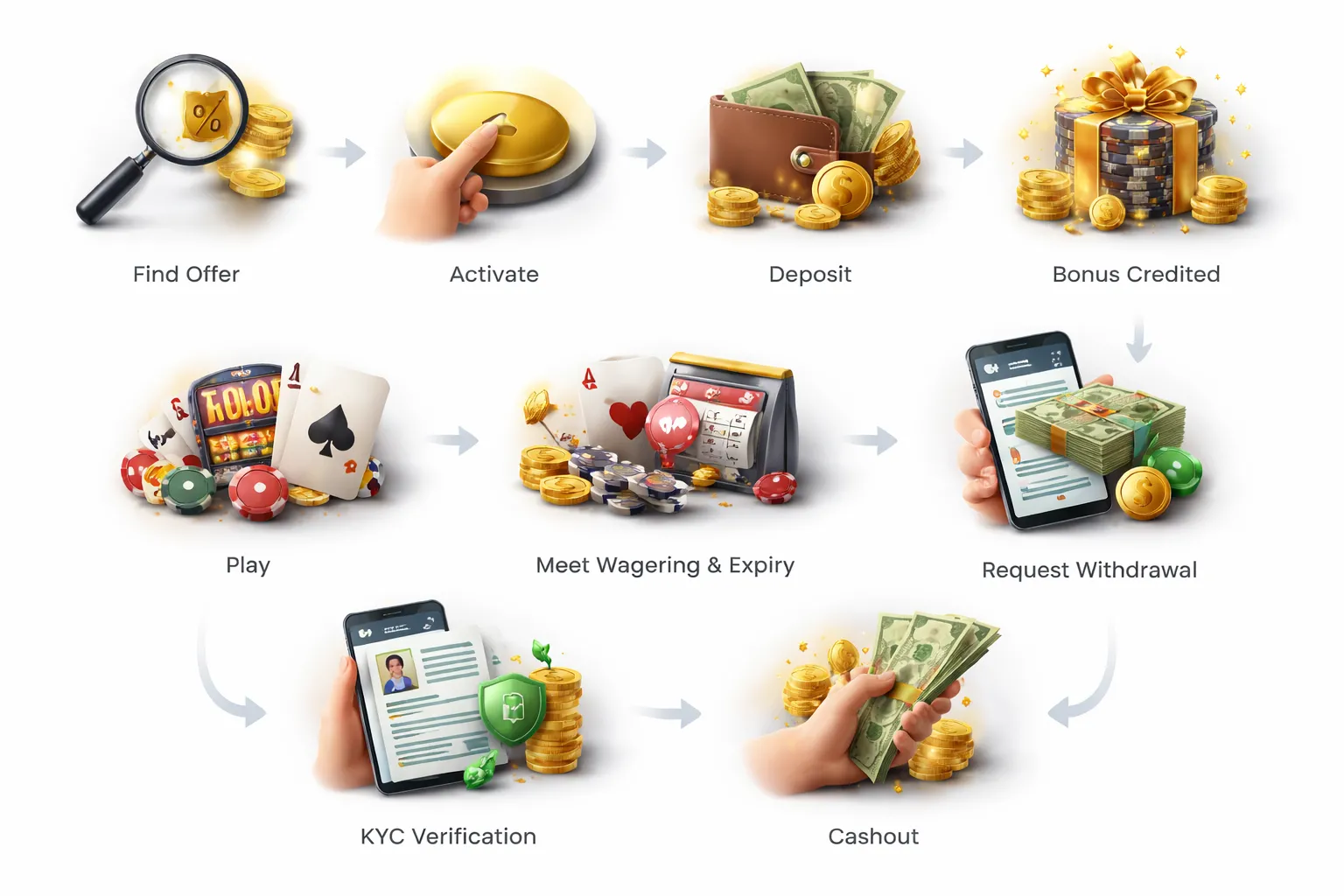
Finding the bonus
You will usually see bonuses in four places.
- Promo pages, the public list of current offers.
- Sign-up flow, the welcome offer shown during registration or first deposit.
- Email and SMS, targeted reloads, cashback, and free spins.
- In-lobby offers, bonuses shown after you log in, often tied to your play history.
Take screenshots of the offer and terms before you claim it. Casinos change promo pages. Your proof helps if a dispute starts later.
Activation methods
Casinos activate bonuses in three main ways.
- Opt-in button, you click “Claim” before you deposit or before you play.
- Bonus code, you enter a code at checkout or in the cashier.
- Auto-credit, the casino applies the bonus when you meet the trigger.
Common failure points are simple.
- You missed the opt-in step.
- You used the wrong code, or used it in the wrong field.
- You deposited before activation, and the system did not apply the offer retroactively.
Deposits, minimums, and payment method exclusions
Most deposit bonuses have a minimum deposit. Some also set a maximum bonus cap. Both matter for expected value.
- Minimum deposit, the smallest deposit that triggers the bonus.
- Bonus cap, the largest bonus amount you can receive, even if you deposit more.
Many casinos exclude certain payment methods from bonus eligibility. Typical examples include prepaid cards, some e-wallets, and some local instant bank transfers. If you use an excluded method, you may still get credited, then lose bonus funds and winnings during review.
Where the bonus lands, sticky vs. non-sticky crediting
After you claim, the bonus usually lands in one of three places.
- Bonus balance, locked funds you must wager before withdrawal.
- Cash balance, withdrawable money, sometimes tied to “wagering-free” rules.
- Pending, the casino marks the bonus as earned but releases it later, often after deposit settlement.
How the casino spends balances matters.
- Sticky bonus, the casino uses your cash first. You cannot withdraw cash while the bonus remains active, and withdrawals often cancel the bonus.
- Non-sticky bonus, the casino uses bonus funds first. You can usually remove the bonus and keep your cash, but you lose bonus funds and any linked bonus winnings.
Playing with bonus funds or free spins, and how winnings are treated
Bonuses often limit what you can play, and how much you can bet per spin or round.
- Game contribution, slots may count 100%, table games may count 0% to 20%, some games may count 0%.
- Max bet, a cap like $5 per spin while the bonus is active. Exceed it and you risk confiscation.
- Session rules, some casinos block certain features like bonus buys or side bets.
Free spins follow a specific flow. The casino credits spins on selected games, then converts winnings into bonus funds or cash, depending on the promo. Many free spins have a win cap or a fixed coin value per spin. If you want the full breakdown, read our free spins bonus guide.
Meeting the requirements and requesting a withdrawal
Most bonuses tie your withdrawal to a checklist. You finish it in this order.
- Wagering requirement, you generate a target amount of bets, often written as 30x or 40x.
- Time limit, you complete wagering before expiry, often 7 days, 14 days, or 30 days.
- Max cashout, you can withdraw only up to a set amount from bonus play, even if you win more.
- Withdrawals and cancellations, many casinos cancel the bonus if you request a withdrawal before you finish wagering.
After you meet the rules, you request a withdrawal. The casino may move bonus winnings into your cash balance, or mark them as withdrawable after review.
Verification (KYC) and why it can delay cash-outs
KYC stands for know your customer. Casinos use it to prevent fraud, chargebacks, duplicate accounts, and underage play. It often triggers at withdrawal, not at deposit.
You usually need these items.
- ID, passport or driver’s license.
- Address proof, utility bill or bank statement, often within 3 months.
- Payment proof, card photo with digits masked, or a wallet account screenshot.
KYC delays happen for predictable reasons.
- Your documents do not match your registration details.
- You used a payment method that does not match your name.
- You opened multiple accounts from the same device or IP.
- Your deposit method sits on a bonus exclusion list, and the casino flags your play.
Send clear images, match names exactly, and verify early if the casino allows it. You cut withdrawal time and reduce the risk of a bonus dispute.
Casino bonus terms you must know (plain-English glossary)
Wagering requirements (playthrough), what 35x really means
Wagering tells you how much you must bet before you can withdraw bonus money, and often your deposit too.
35x means you must place bets equal to 35 times the amount the casino counts for wagering.
- Bonus only: You take a $100 bonus with 35x wagering. You must wager $3,500 before you can withdraw bonus winnings.
- Deposit plus bonus: You deposit $100 and get a $100 bonus. The terms say 35x on deposit + bonus. You must wager $7,000.
- Wagering applies to winnings: Some promos apply wagering to winnings from free spins. A “$20 win with 35x” becomes $700 wagering.
Check what amount the multiplier applies to. That one line can double your required play.
Game contribution, why slots may count 100% but roulette may not
Game contribution tells you what percentage of each wager counts toward meeting wagering.
- Slots 100%: Bet $10, $10 counts.
- Roulette 10%: Bet $10, only $1 counts.
- Blackjack 0%: Bet $10, $0 counts, you make no progress.
Low contribution games slow your progress and raise your real cost. Casinos do this to limit low house-edge grinding.
Maximum bet rules during wagering, breaches can void winnings
Many bonuses set a max stake per spin, hand, or bet while you have active wagering.
- Typical caps: $5, €5, or 5% of the bonus balance per spin.
- What counts as a breach: A single spin above the limit can trigger a “bonus violation,” the casino can remove bonus funds and related winnings.
- Auto-features still count: Autoplay, turbo, and double bet can push you over the cap fast.
Set your stake before you start. Keep it locked.
Expiry dates and time windows for completion
Bonuses come with a countdown. When it ends, the casino can cancel the bonus and confiscate bonus winnings.
- Claim window: You must opt in within a set time, often 24 to 72 hours after registration or deposit.
- Wagering window: You must finish wagering within a set time, often 7, 14, or 30 days.
- Free spins expiry: Free spins often expire in 24 to 7 days, and winnings may have a separate wagering clock.
If you cannot meet the clock, skip the bonus. Play with cash.
Maximum cash-out and withdrawal caps on bonus winnings
Some bonuses cap how much you can withdraw from bonus-derived winnings.
- Example: “Max cash-out 5x bonus.” You take a $100 bonus. Your max withdrawal from that bonus is $500, even if you win more.
- No deposit caps: These often cap withdrawals at $50 to $200.
Always look for “max withdrawal,” “max cash-out,” and “cashout limit.” For deeper definitions, see our no deposit bonus terms guide.
Min-odds rules and prohibited strategies for sports-linked promos
Sportsbook-linked promos add betting rules that can void the bonus if you break them.
- Minimum odds: Each selection must meet a minimum, such as 1.70 decimal, or the bet does not count.
- Accumulator rules: Some promos require parlays with 3 to 5 legs, and set a minimum combined odds.
- Prohibited strategies: Hedging, matched betting, arbitrage, and “risk-free” offsetting bets across markets or accounts. Terms often label this as “bonus abuse” or “irregular play.”
- Cashout rules: Using early cashout or partial cashout can make the wager ineligible.
If the promo ties casino and sports together, read the sports terms too. They often control eligibility.
Restricted games, providers, and bet types
Terms often ban specific games or categories during wagering.
- Restricted games: Live dealer tables, jackpots, megaways, or high volatility slots can be excluded or capped.
- Restricted providers: A casino may exclude whole studios from bonus play.
- Restricted bet types: Roulette outside bets, low-risk blackjack plays, or certain side bets may be banned or reduced in contribution.
Do not assume your favorite game qualifies. Check the excluded list before you spin or bet.
Country and jurisdiction restrictions
Bonuses often depend on where you live and which license covers your account.
- Availability: A bonus may not apply in your country, even if the casino site loads.
- License rules: Some jurisdictions require different bonus terms, different limits, or different verification steps.
- VPN risk: Using a VPN can trigger location flags. The casino can refuse the promo, freeze withdrawals, or ask for extra proof of residence.
Use your real country and real address. If the casino cannot serve you, do not deposit.
Bonus abuse, multi-accounting, and “irregular play” definitions
Casinos reserve broad rights to cancel bonuses if they think you exploited the promo.
- Multi-accounting: More than one account per person, household, device, IP, or payment method. Many casinos treat this as abuse.
- Bonus abuse: Repeatedly claiming promos in a pattern the casino flags as non-recreational, including back-to-back bonus hunting and coordinated play.
- Irregular play: Low-risk wagering, stop-start play to minimize variance, or switching stakes to manipulate bonus conversion. Definitions vary, and the casino usually decides.
Protect yourself. Stick to one account, one identity, and one payment profile. Avoid patterns that look like hedging or exploitation.
Dormant account fees and balance forfeiture clauses
Some casinos charge inactivity fees or wipe balances after a period with no login or no transactions.
- Inactivity fees: A monthly fee after 6 to 12 months of inactivity.
- Forfeiture: The casino can remove bonus funds, and sometimes real money balances, after a long dormant period.
- Charge order: Fees may come from your real balance first, then bonus balance.
If you plan to stop playing, withdraw your funds and close the account in writing.
How to calculate a bonus’s real value (so you can compare offers)
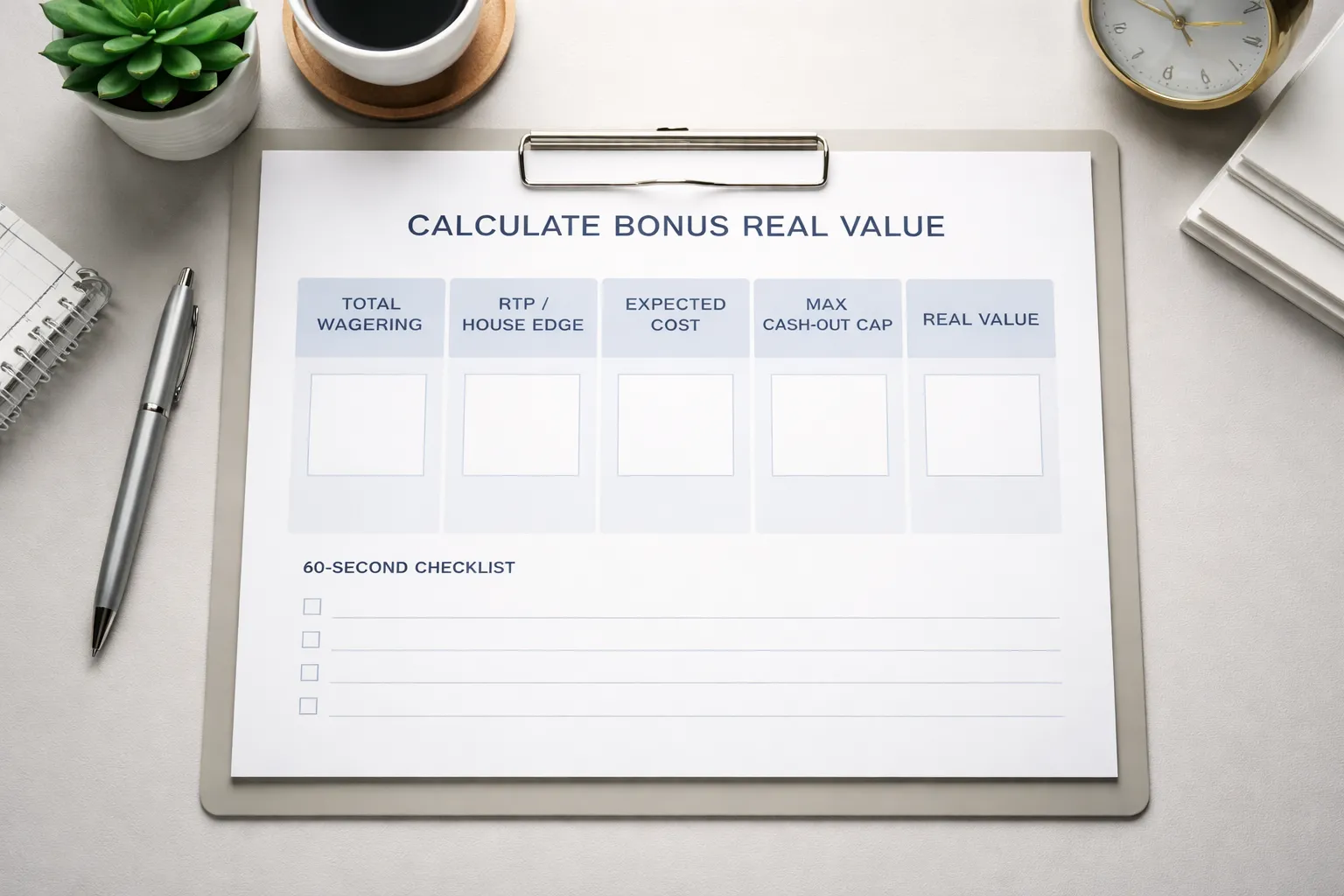
Effective wagering cost, estimate how much you must stake
Start with the number that decides everything, total wagering.
- Total wagering = (bonus amount + deposit amount, if both count) x wagering multiplier.
- If the terms say bonus only, use bonus amount only.
- If the terms say deposit + bonus, use both. This often doubles the workload.
Then adjust for what you can actually play.
- Game contribution changes the real multiplier. Example, slots 100%, roulette 10%.
- Real multiplier = stated wagering multiplier divided by contribution rate.
- Example, 30x on roulette at 10% becomes 300x.
Finally, estimate what it costs to clear.
- Expected cost = total wagering x house edge.
- House edge = 1 minus RTP. Example, 96% RTP equals 4% house edge.
RTP, house edge, and variance, how they affect bonus clearing
RTP tells you the average loss per dollar staked. It does not tell you the path.
- Higher RTP lowers expected cost. It also raises your chances of reaching the wagering finish line.
- Lower RTP raises expected cost. It increases the risk you bust before you clear.
- Variance controls swing size. High variance slots can spike your balance early or kill it fast.
Use RTP for math. Use variance for survival.
- If you must hit a large wagering target, you need time and balance. Lower variance helps you last.
- If the bonus has a low max cash-out, high variance can help you hit the cap fast, but it can also zero you quicker.
Worked examples, match bonus vs free spins vs cashback
Use the same method on every offer. Convert everything into expected value and limits.
| Offer type | What you compute | What can kill the value |
|---|---|---|
| Match bonus | Total wagering, expected cost, max cash-out | High wagering, low contribution games, strict cap |
| Free spins | Spin value, count, expected return, wagering on wins | Low RTP slot, high wagering on winnings, short expiry |
| Cashback | Net loss x cashback rate, wagering on cashback | Cashback only on losses, caps, wagering on credited amount |
Example 1, 100% match up to $100, 30x bonus only, slots 96% RTP
- You deposit $100. You get $100 bonus.
- Total wagering = $100 x 30 = $3,000.
- Expected cost = $3,000 x 0.04 = $120.
- Real-world result depends on variance. Many players bust before clearing because the expected loss exceeds the bonus.
- Quick read, this offer needs either lower wagering, higher RTP, or extra value like low cap-free withdrawals.
Example 2, 50 free spins at $0.20, wins wagered 20x, slot RTP 96%
- Spin value total = 50 x $0.20 = $10.
- Expected return from spins = $10 x 0.96 = $9.60.
- Wagering applies to winnings, not the $10 face value. Assume you win $9.60.
- Total wagering = $9.60 x 20 = $192.
- Expected cost = $192 x 0.04 = $7.68.
- Expected leftover after clearing, about $9.60 minus $7.68 = $1.92, before any cap or game restrictions.
Example 3, 10% cashback on net losses, weekly cap $50, no wagering
- You lose $200 net for the week.
- Cashback = $200 x 0.10 = $20.
- Expected value is direct. No clearing risk if there is no wagering.
- If cashback has 10x wagering at 96% RTP, expected cost = ($20 x 10) x 0.04 = $8. This turns $20 into about $12 expected.
When a low max cash-out makes an offer effectively small
Max cash-out turns a large bonus into a small ceiling.
- If the bonus says max cash-out 5x bonus and you take a $100 bonus, your maximum withdrawal from bonus funds becomes $500.
- If the bonus says max cash-out $100, it does not matter if you run your balance to $1,000. You still only withdraw $100 from the bonus portion.
- A cap matters most on high-variance games. You can hit a big win and still get clipped at cash-out.
To compare caps fast, convert them into a percentage of what you had to risk.
- Cap ratio = max cash-out divided by total wagering required.
- A low ratio means you do a lot of work for a low ceiling.
Checklist, compare two bonuses in under 60 seconds
- Write down bonus amount, deposit required, and wagering multiplier.
- Confirm bonus only vs deposit + bonus.
- Check game contribution for your main games.
- Compute total wagering.
- Use a realistic RTP for allowed games. Convert to house edge.
- Estimate expected cost = total wagering x house edge.
- Find max bet while wagering. Low max bet slows clearing and can trigger confiscation if you exceed it.
- Find max cash-out and any win limits.
- Check expiry. Short time limits reduce your chance to clear.
- Pick the offer with lower expected cost, higher cap, and terms you can follow.
For a quick primer on how welcome promos differ by funding and risk, see welcome bonus vs no deposit bonus.
Common restrictions that surprise players (and how to avoid them)
Why your favorite game might be excluded or low-contribution
Casinos set game contribution to control bonus cost and risk. Slots usually count 100%. Many table games count less, or count as 0%.
- Excluded games. Common exclusions include roulette, baccarat, craps, Sic Bo, and some live dealer tables. Some casinos also exclude jackpot slots and branded slots.
- Low contribution. Typical examples: blackjack 10% to 25%, roulette 0% to 10%, video poker 0% to 20%. If you wager $100 on a 10% game, only $10 reduces the wagering target.
- Provider and RTP locks. Casinos may exclude specific studios, new releases, or high RTP variants. They do this to limit edge cases that reduce house advantage.
- Different rules for free spins. Free spins often work on a fixed slot list. Any play outside that list can void spin winnings or stop them from converting.
How to avoid it. Check the “excluded games” list and the contribution table before you opt in. If the casino hides it, skip the offer.
Session limits that change how you can play
Some bonuses cap the number of spins, hands, or total time per session. Casinos use this to reduce fast clearing and high-volume grinding.
- Spin and round caps. You might see limits like a maximum number of spins per hour, or a cap on feature buys.
- Stake change limits. Some terms restrict rapid bet-size changes, or ban “progressions” during wagering.
- Game switching limits. A few casinos track rapid switching across slots to chase volatility patterns.
How to avoid it. Keep your bet size stable. Avoid feature buys unless the terms allow them. If you plan to grind, pick a bonus with no session caps.
Max win limits and max cash-out caps
Some promos limit what you can keep, even if you win big. This shows up as a “max win” or “max cash-out” rule.
- Fixed cap. Examples include $100, $200, or $500 maximum cash-out from a no deposit bonus or free spins.
- Multiple of bonus. Some casinos cap winnings at 5x, 10x, or 20x the bonus amount.
- Win limit during wagering. Some terms cap your balance while the bonus is active. Any excess can get removed.
How to avoid it. Read the cap before you play. If the cap feels low for your bankroll and bet size, skip the promo and play cash.
Bonus-only spin values and why your “free” spins win less than expected
Many free spins do not use your normal stake. They use a fixed coin value set by the casino.
- Fixed stake per spin. Common values range from $0.10 to $0.50 per spin, even if the slot supports higher bets.
- Different multipliers. Some promos use “bonus spins” with a separate paytable, or restrict certain features.
- Win conversion rules. Winnings may convert to bonus funds, then face wagering and max cash-out limits.
How to avoid it. Find the exact value per spin and the conversion rule. Use free spins rules and terms if you need a quick checklist.
Payment method exclusions, and why casinos block e-wallets, prepaid, and crypto
Many welcome bonuses exclude specific deposit methods. Casinos do this to reduce fraud, chargeback risk, and bonus abuse.
- E-wallet exclusions. Skrill, Neteller, and similar wallets often fail eligibility because they allow fast movement of funds across accounts.
- Prepaid card exclusions. Prepaid cards and some gift cards often do not qualify because identity and funding source checks get harder.
- Crypto exclusions. Some casinos block bonuses on crypto deposits due to volatility, speed of transfers, and different compliance controls.
- Mixed-method funding. A deposit qualifies, but later deposits with an excluded method can break promo eligibility or reset future offers.
How to avoid it. Confirm eligible deposit methods before you fund. If you use an excluded method, assume you will not get the bonus.
Withdrawal locks that trap your deposit after you accept a bonus
Many bonuses lock withdrawals until you meet wagering, or you forfeit the bonus. Some casinos also restrict withdrawing your deposit while a bonus runs.
- “Sticky” bonus behavior. You must clear wagering before you can withdraw anything. If you withdraw early, you lose the bonus and related winnings.
- Deposit lock. Some terms block withdrawals of your cash deposit until you finish wagering, even if you want to abandon the promo.
- Partial withdrawal penalties. A partial withdrawal can cancel the bonus, remove winnings, and reset your progress to zero.
How to avoid it. If you want full control of your bankroll, do not opt in. If you opt in, treat your deposit as committed until you clear or forfeit under the stated rule.
Betting patterns flagged as “low risk” or “hedging” behavior
Casinos monitor play patterns that reduce variance while you clear wagering. These triggers often cause voided winnings or confiscation.
- Low-risk tables. Betting both sides in roulette options, or using strategies that flatten outcomes, can trigger terms on “even-money” or “low risk” play.
- Opposite betting. Placing opposing bets within the same game, or across linked products, can count as hedging.
- Arbitrage behavior. Using promotions, price differences, or bonus conditions to lock profit can trigger manual reviews.
- Volatility switching. Some casinos flag patterns like very low stakes to meet minimum activity, then sudden high stakes near completion.
How to avoid it. Play one side only. Avoid betting systems designed to reduce variance. Keep stakes within the max bet rule, and keep your play consistent from start to finish.
Smart strategies for using bonuses responsibly
Set a deposit budget and choose promos that match your bankroll
Treat a bonus as a plan, not extra money. Set a deposit limit before you claim anything. Pick offers where you can finish the wagering with your normal stakes.
- Size your deposit to the max bet rule. If the bonus caps bets at $5, do not deposit so much that you need $20 spins to clear wagering on time.
- Keep variance realistic. A small bankroll plus high volatility slots often leads to fast bust outs before you complete wagering.
- Prefer lower wagering over bigger match rates. A 50% match with 20x wagering often beats a 200% match with 60x wagering for most bankrolls.
Track key dates, activation, expiry, and wagering deadlines
Most bonus losses come from missed timing, not bad play. Track three dates and you avoid most mistakes.
- Activation window. Some promos require opt-in, email confirmation, or a deposit within a set period.
- Bonus expiry. Free spins can expire in 24 to 72 hours. Bonus money often expires in 7 to 30 days.
- Wagering deadline. Many casinos void remaining bonus funds, or winnings, if you do not finish wagering before the deadline.
Write these in one place. Include the max bet, eligible games, and any time-based rules like “must place one bet every 24 hours.”
Pick games that align with contribution and your risk tolerance
Game choice controls how fast you clear wagering and how much variance you take.
- Check contribution first. Slots often count 100%. Table games may count 0% to 20%. Some live games count 0%.
- Match volatility to your bankroll. Low to medium volatility helps you survive long wagering cycles. High volatility fits larger bankrolls and higher risk tolerance.
- Watch hidden exclusions. Some providers, jackpot slots, and feature buys can be excluded even if slots “count 100%.”
If you want the details on spin-based promos, use this guide on online casino free spins.
Use free spins efficiently, volatility and stake sizing
Free spins look simple. The terms decide the real value.
- Know the stake per spin. Many casinos fix it, like $0.10 or $0.20. If you can choose, pick a stake that fits your bankroll and the slot’s volatility.
- Do not chase features. Feature buys often do not count, or they trigger bonus abuse checks. Stick to standard spins.
- Check win caps and conversion rules. Some free spins pay “bonus winnings” that need wagering. Some cap maximum cashout from free spin wins.
- Use them early. Spins often expire fast. Use them before you start long wagering on a deposit bonus.
Know when to decline a bonus to keep withdrawals flexible
Sometimes the best move is to skip the promo. A bonus can lock your balance until you meet all requirements.
- Decline if you want to withdraw soon. If you plan short sessions, wagering can block cashouts and force extra play.
- Decline if the max cashout is low. A cap can turn a good run into a limited payout.
- Decline if rules are tight. Low max bet limits, short deadlines, or many excluded games increase breach risk.
- Decline if your play style will change. If you will need to switch games, raise stakes late, or play sporadically, you raise review risk.
Before you click claim, read the terms that control wagering, max bet, eligible games, and withdrawals. If the rules look hard to follow, play with cash and keep full control.
Pros and cons of online casino bonuses
Advantages
- Extended playtime. A matched deposit bonus increases your starting bankroll. You can place more bets before you hit zero, which gives you more time to find games you like and learn the interface.
- Reduced effective cost. If you would deposit anyway, a bonus lowers the cost per session. You get extra balance or spins for the same cash outlay, as long as you can meet the terms without breaking them.
- Extra entertainment. Free spins and promo funds add variety. You can sample slots you would not pay for, or use small-stake bonus play to extend a night’s budget.
Trade-offs
- Restrictions. You must follow rules on wagering, max bet, eligible games, and game contribution. One mistake can void winnings.
- Withdrawal delays. You often cannot withdraw until you clear wagering and pass verification. Some casinos also review play for term breaches before they approve a cashout.
- Capped upside. Many offers cap winnings, cap withdrawals, or convert bonus funds to cash at a limit. This matters most on no deposit and free spin promos. For deeper rules, see no deposit bonus terms.
- Short deadlines. Expiry windows push you to play faster than you want. That can lead to higher stakes, longer sessions, or poor game choices.
Who should avoid bonuses
- You want full withdrawal control. If you may need to cash out fast, a bonus adds friction.
- You play high stakes. Max bet rules can force you to bet smaller than your normal size, or risk a breach.
- You switch games often. Excluded games and contribution rates punish mixing slots, live casino, and table games.
- You play in short bursts. Tight expiry dates and wagering targets do not fit sporadic play.
- You chase low house edge games. Many bonuses restrict blackjack, roulette, and live tables, or count them at a low percentage toward wagering.
- You dislike compliance steps. If KYC checks or source of funds requests will frustrate you, skip the bonus and play with cash.
Safety, legitimacy, and E-E-A-T checks before claiming any bonus
Licensing and regulation, what to check before you claim
Start with the footer. A legit casino shows its license holder name, license number, and regulator. It also shows its registered company and address.
- Match the details. The license holder name should match the operator name in the Terms and Conditions.
- Verify the regulator. Click the license link if the site provides one. Confirm the license status on the regulator site.
- Check your jurisdiction. A license does not always cover players in your country or state. If you play from a blocked region, the casino can void the bonus and winnings.
- Read the KYC section. Look for clear rules on ID checks, payment verification, and source of funds. Assume you will complete KYC before any withdrawal.
Fairness tools, RTP disclosures and audit seals
Bonuses change your risk. You need proof the games run as advertised.
- RTP visibility. The casino should show RTP per game, or at least link to game info pages. Avoid sites that hide RTP or use vague claims like “high RTP slots” with no numbers.
- Independent testing labs. Look for named auditors such as eCOGRA, iTech Labs, GLI, or BMM Testlabs. The seal should link to a valid verification page, not just an image.
- Game provider list. Reputable studios publish their own RTP ranges and rules. Unknown providers are not auto-bad, but you take more risk if you cannot verify testing.
- Provably fair claims. If a casino pushes “provably fair”, it should explain the method and let you verify results. If it stays vague, treat it as marketing.
Support quality and dispute paths
Bonus disputes happen. You need fast, logged support and a clear escalation route.
- Test support before you deposit. Ask one direct bonus question. Example: “Do blackjack and live roulette contribute to wagering, and at what percentage?” Save the transcript.
- Check support channels. Live chat plus email beats live chat only. Phone support helps, but not required.
- Look for complaint steps. The site should list a formal complaint process and expected response times.
- ADR options. Strong operators name an Alternative Dispute Resolution provider or regulator complaint path. If you cannot find any dispute route, you have weak leverage.
Responsible gambling resources
Bonuses push higher volume. You need controls you can set without begging support.
- Deposit limits. Daily, weekly, monthly. You should set them from your account.
- Loss limits and wager limits. Useful during wagering requirements.
- Session limits and reality checks. Timed reminders reduce overspend while chasing targets.
- Cooling-off and self-exclusion. The casino should offer both, with clear durations and reactivation rules.
- Links to support orgs. Look for local help resources and clear policy wording, not a token logo.
Red flags that should stop you from claiming the bonus
- Vague bonus terms. Missing wagering number, missing expiry date, or missing eligible games list.
- Unclear max cash-out rules. If a no deposit or free spins offer caps winnings, the cap must show as a number and include how it applies to bonus and winnings. See our no deposit bonus terms guide if you need the full checklist.
- Conflicts between promo page and T&Cs. If the banner says one thing and the terms say another, assume the terms win.
- Unrealistic promos. Huge multipliers with tiny fine print often hide strict game restrictions, low contribution rates, or hard caps.
- Short expiry with high wagering. This setup forces speed. Speed increases mistakes and losses.
- “We can void at our discretion” wording. You want specific reasons, not open-ended discretion.
- Withdrawal barriers. Limits that force odd payment methods, high fees, or repeated KYC after every cash-out.
FAQ
What is a wagering requirement?
It is the playthrough you must complete before you can withdraw bonus money or bonus winnings. Example, a 35x requirement on a $100 bonus means you must wager $3,500. Check if it applies to bonus only or bonus plus deposit. See wagering requirements explained.
What does “bonus funds” vs “cash funds” mean?
Cash funds are your deposit and winnings you can withdraw. Bonus funds are restricted promo credits. Casinos usually spend cash first or bonus first. The order matters because bonus wagering and game limits can trigger once bonus funds become active.
How do game contributions work?
Each game type counts differently toward wagering. Slots often count 100%. Roulette, blackjack, and baccarat can count 0% to 20%. Some casinos exclude specific slot titles. Always check the contribution table before you play.
What is a max bet rule?
It caps how much you can stake per spin or hand while a bonus is active, like $5 or $10. If you break it, the casino can void the bonus and winnings. Lower max bets make high wagering harder to clear.
What is a max cash-out cap?
It limits what you can withdraw from bonus play, like 5x the bonus amount or a fixed sum. Anything above the cap gets removed. Caps often apply to no deposit bonuses and free spins, even after you meet wagering.
How do free spins winnings work?
Free spins can pay as cash, bonus funds, or a capped amount. Many convert winnings into bonus credit with its own wagering requirement and expiry. Check the coin value, eligible games, and whether you can change the stake.
How long do casino bonuses last?
Expiry ranges from hours to 30 days, sometimes less on free spins. Once it expires, the casino can remove bonus funds and related winnings. Short expiry paired with high wagering forces higher stakes or longer sessions.
Can a casino void my bonus “at its discretion”?
Some terms give the casino broad power to cancel a bonus or winnings. You should look for specific triggers, like max bet breaches, excluded games, or delayed KYC. Avoid offers that do not list clear, testable reasons.
What is KYC, and when should you do it?
KYC is identity verification, usually ID, proof of address, and payment method proof. Do it early, before you chase wagering. Late KYC can block withdrawals and cause expiry issues. Repeated KYC checks can delay cash-outs.
Can you withdraw your deposit with an active bonus?
Often no. Many casinos lock your balance until you finish wagering or cancel the bonus. Cancellation can remove bonus funds and sometimes winnings tied to the bonus. Check the withdrawal rule and “bonus abandonment” policy.
What is a “sticky” vs “non-sticky” bonus?
Sticky means you cannot withdraw the bonus itself, only winnings after wagering. Non-sticky means the bonus becomes withdrawable cash after you meet terms, or you can withdraw your deposit without losing all winnings. Sticky bonuses usually carry tighter caps.
Conclusion
Bonuses can add value, or they can lock up your bankroll. Your edge comes from reading the terms before you deposit.
- Do the math first. Convert the offer into a real target, bonus amount times wagering requirement. Then check any max bet rule that can void winnings.
- Check the two caps that matter. Max cashout and game contribution. A big bonus means little if slots count 100 percent but your preferred games count 10 percent.
- Control your exit. Confirm the withdrawal rule, sticky vs non-sticky behavior, and the bonus abandonment policy before you start wagering.
- Track the clock. Expiry dates force bad decisions. Skip time-limited offers you cannot clear with your normal stakes.
Final tip. Build a one-page checklist and use it every time. If you want a deeper breakdown of the key clauses, read our no deposit bonus terms guide.
-
Casino VIP & Loyalty Programs Explained: Points, Tiers, Rewards & Rakeback
2 months ago -
Free Spins Bonus Explained: How Free Spins Work at Online Casinos
2 months ago -
No Deposit Bonus Explained: How It Works, Pros/Cons & Common Rules
2 months ago -
Cashback Bonus Explained: How Casino Cashback Really Works
2 months ago -
Casino Bonus Terms & Conditions: The Tricky Rules to Watch Out For
2 months ago
-
- Welcome match bonuses (first deposit deals)
- No-deposit bonuses (bonus funds vs. free spins)
- Free spins offers (bundled, standalone, and “extra spins” promos)
- Reload and recurring deposit bonuses
- Cashback and loss-back promotions
- VIP, loyalty points, and comp systems
- High roller and bespoke offers
- Referral and friend-invite promotions
- Tournaments, missions, and prize drops (gamified promos)
- Bonus buys: wagering-free promos and why they’re rare
-
- Finding the bonus
- Activation methods
- Deposits, minimums, and payment method exclusions
- Where the bonus lands, sticky vs. non-sticky crediting
- Playing with bonus funds or free spins, and how winnings are treated
- Meeting the requirements and requesting a withdrawal
- Verification (KYC) and why it can delay cash-outs
-
- Wagering requirements (playthrough), what 35x really means
- Game contribution, why slots may count 100% but roulette may not
- Maximum bet rules during wagering, breaches can void winnings
- Expiry dates and time windows for completion
- Maximum cash-out and withdrawal caps on bonus winnings
- Min-odds rules and prohibited strategies for sports-linked promos
- Restricted games, providers, and bet types
- Country and jurisdiction restrictions
- Bonus abuse, multi-accounting, and “irregular play” definitions
- Dormant account fees and balance forfeiture clauses
-
- Why your favorite game might be excluded or low-contribution
- Session limits that change how you can play
- Max win limits and max cash-out caps
- Bonus-only spin values and why your “free” spins win less than expected
- Payment method exclusions, and why casinos block e-wallets, prepaid, and crypto
- Withdrawal locks that trap your deposit after you accept a bonus
- Betting patterns flagged as “low risk” or “hedging” behavior
-
- What is a wagering requirement?
- What does “bonus funds” vs “cash funds” mean?
- How do game contributions work?
- What is a max bet rule?
- What is a max cash-out cap?
- How do free spins winnings work?
- How long do casino bonuses last?
- Can a casino void my bonus “at its discretion”?
- What is KYC, and when should you do it?
- Can you withdraw your deposit with an active bonus?
- What is a “sticky” vs “non-sticky” bonus?
-
-
- Welcome match bonuses (first deposit deals)
- No-deposit bonuses (bonus funds vs. free spins)
- Free spins offers (bundled, standalone, and “extra spins” promos)
- Reload and recurring deposit bonuses
- Cashback and loss-back promotions
- VIP, loyalty points, and comp systems
- High roller and bespoke offers
- Referral and friend-invite promotions
- Tournaments, missions, and prize drops (gamified promos)
- Bonus buys: wagering-free promos and why they’re rare
-
- Finding the bonus
- Activation methods
- Deposits, minimums, and payment method exclusions
- Where the bonus lands, sticky vs. non-sticky crediting
- Playing with bonus funds or free spins, and how winnings are treated
- Meeting the requirements and requesting a withdrawal
- Verification (KYC) and why it can delay cash-outs
-
- Wagering requirements (playthrough), what 35x really means
- Game contribution, why slots may count 100% but roulette may not
- Maximum bet rules during wagering, breaches can void winnings
- Expiry dates and time windows for completion
- Maximum cash-out and withdrawal caps on bonus winnings
- Min-odds rules and prohibited strategies for sports-linked promos
- Restricted games, providers, and bet types
- Country and jurisdiction restrictions
- Bonus abuse, multi-accounting, and “irregular play” definitions
- Dormant account fees and balance forfeiture clauses
-
- Why your favorite game might be excluded or low-contribution
- Session limits that change how you can play
- Max win limits and max cash-out caps
- Bonus-only spin values and why your “free” spins win less than expected
- Payment method exclusions, and why casinos block e-wallets, prepaid, and crypto
- Withdrawal locks that trap your deposit after you accept a bonus
- Betting patterns flagged as “low risk” or “hedging” behavior
-
- What is a wagering requirement?
- What does “bonus funds” vs “cash funds” mean?
- How do game contributions work?
- What is a max bet rule?
- What is a max cash-out cap?
- How do free spins winnings work?
- How long do casino bonuses last?
- Can a casino void my bonus “at its discretion”?
- What is KYC, and when should you do it?
- Can you withdraw your deposit with an active bonus?
- What is a “sticky” vs “non-sticky” bonus?
-
-
Reload Bonus Explained: What It Is and When It’s Worth Claiming
1 week ago -
Online Casino Licensing Explained: Authorities, Licenses & How to Check One
2 months ago -
Best Live Dealer Casinos: Where to Play Live Blackjack, Roulette & More
2 months ago -
Best Online Casinos for High Rollers: VIP Perks, High Limits & Exclusive Bonuses
2 months ago -
Fast Payout Online Casinos: Best Sites for Quick Withdrawals
2 months ago
-
Online Casino Licensing Explained: Authorities, Licenses & How to Check One
2 months ago -
Casino VIP & Loyalty Programs Explained: Points, Tiers, Rewards & Rakeback
2 months ago -
Free Spins Bonus Explained: How Free Spins Work at Online Casinos
2 months ago -
Best Online Casinos for Blackjack: Best Tables, Rules & Bonuses
2 months ago -
Best Online Casinos for Roulette: Best Wheels, Limits & Live Options
2 months ago