Online Casino KYC Explained: Verification Process, ID Checks, Age Rules & AML

Online casino KYC means Know Your Customer. It is the identity and risk checks a casino uses to confirm you are real, old enough to gamble, and not moving illegal funds.
This guide breaks down the full verification process. You will learn what casinos check, which documents they ask for, how proof of address works, and why age rules matter. You will also see how KYC connects to AML, fraud prevention, and withdrawal approvals. If you want faster payouts, read this alongside our Why Is My Online Casino Withdrawal Pending? guide.
You will get clear steps, common failure points, and practical tips to pass checks on the first try.
- In het kort: KYC is the identity check casinos use to confirm who you are, where you live, and if you meet age rules.
- You usually complete KYC at signup, before your first withdrawal, or after a risk trigger like a big win, a new device, or a payment change.
- Casinos check your name, date of birth, address, and document validity. They also compare your details with your payment method to spot fraud.
- Expect three document types, ID, proof of address, and sometimes payment proof. Send clear, full-frame photos that match your account data.
- Proof of address needs your full name, address, issue date, and issuer. Many casinos reject documents that are too old or cropped.
- Age rules are strict. If you fail age verification, you can lose access, and you can delay or lose withdrawals depending on the operator rules and local law.
- KYC supports AML checks. Casinos must flag suspicious patterns, verify source of funds when needed, and keep audit trails.
- Most failures come from mismatched details, blurry images, expired documents, old address proof, or using someone else’s payment method.
- For faster payouts, verify early, keep your profile consistent, and use one payment method in your own name. Also review our online casino payout times guide.
KYC for online casinos explained: what it is (and what it isn’t)
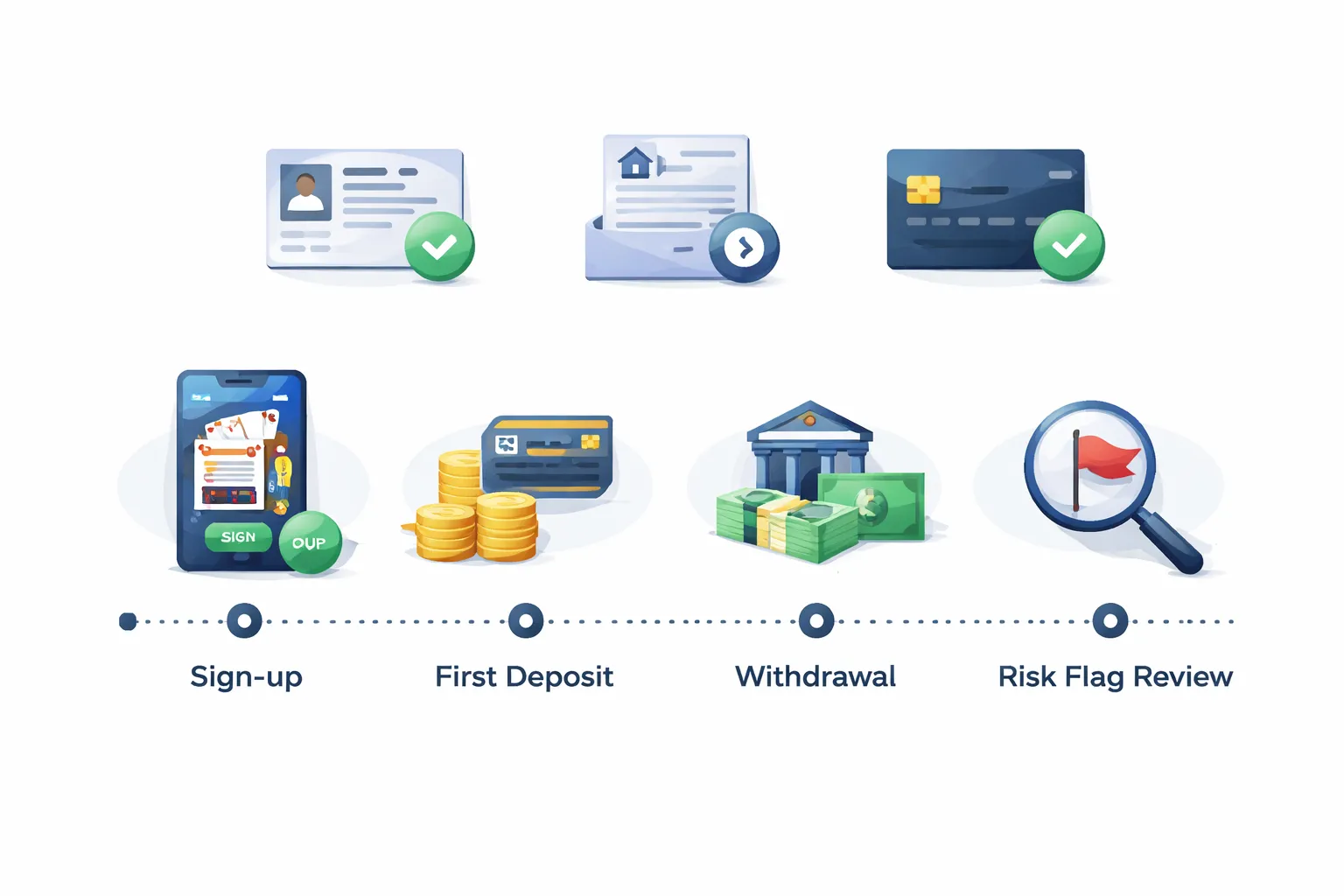
What KYC means in online gambling
KYC means Know Your Customer. It is the identity and risk checks a casino uses to confirm you are real, you are old enough, and you control your account and payment method.
KYC is not the same as creating an account. Sign-up collects details. KYC proves them.
- Sign-up: email, password, basic profile fields.
- KYC: verified identity, verified age, and sometimes verified address and payment ownership.
What KYC is not
KYC is not a marketing step. It does not exist to slow withdrawals.
KYC is not one single document. It is a set of checks that can change based on your country, payment method, and risk level.
KYC is not a guarantee of instant payouts. You can still face delays if your documents expire, your details do not match, or your payment method sits in another name.
KYC vs AML vs responsible gambling checks
These terms overlap, but they are not the same.
- KYC confirms who you are. It covers identity, age, and basic account integrity.
- AML means Anti-Money Laundering. It focuses on where money comes from and where it goes. It can trigger source of funds checks, enhanced due diligence, and transaction monitoring.
- Responsible gambling checks focus on player safety. They can include affordability reviews, spend limits, self-exclusion, and problem gambling interventions.
A casino often uses KYC data to support AML and responsible gambling decisions. One data set, different goals.
Why reputable casinos verify, even when it feels inconvenient
Verification protects the casino and protects you.
- Stops underage gambling and ID fraud.
- Reduces chargebacks and stolen card use.
- Prevents account takeovers and bonus abuse rings.
- Supports AML reporting and audit trails.
- Helps ensure payouts go to the real account holder.
Casinos that skip KYC often shift risk to you. You can see more failed payments, more blocked withdrawals, and more disputes. If you want fewer issues, use one payment method in your name and keep your profile details consistent. For options and tradeoffs, see our online casino payment methods compared guide.
When verification happens
Casinos can verify you at different points. Timing depends on local rules, operator policy, and your risk profile.
- At sign-up. Some brands run instant checks before you can play.
- Before the first deposit. Common with certain payment methods and higher risk regions.
- At withdrawal. The most common point. Payout triggers full KYC for many casinos.
- After a risk flag. Larger deposits, fast deposit then cashout, multiple accounts, device changes, VPN use, mismatched names, or unusual patterns can trigger extra checks.
If you want fewer delays, complete verification early and update your details before you deposit again.
Why online casinos require verification: legality, safety, and fairness
Regulatory compliance: licensing rules and auditability expectations
Casinos verify you because their license requires it. Regulators expect operators to know who plays, where funds come from, and where money goes.
- Identity checks. The casino must link your account to a real person.
- Age checks. The casino must block underage gambling.
- Location checks. The casino must enforce country and state restrictions.
- Payment trail. The casino must match deposits and withdrawals to you, your payment method, and your account history.
- Record keeping. The casino must store verification and transaction logs for audits and disputes.
If a casino fails these checks, it risks fines, payment processor bans, and loss of its license. That risk drives strict KYC at signup, before higher limits, or at withdrawal.
Anti-fraud goals: stopping identity theft, bonus abuse, and chargebacks
Fraud costs casinos money fast. Verification cuts the most common attacks.
- Identity theft. A fraudster uses stolen IDs or cards to deposit, then tries to cash out.
- Stolen payment methods. Banks reverse card deposits through chargebacks. The casino then eats the loss.
- Bonus abuse. One person opens many accounts to claim welcome offers and reload deals.
- Account takeovers. Someone hijacks your login and changes withdrawal details.
KYC helps the casino match your name, date of birth, and address to your payment method. It also helps them spot duplicate accounts and risky patterns. If you hit a verification wall, follow the same details you used during account creation, mismatches trigger delays.
Player protection: preventing underage play and safeguarding vulnerable customers
Verification supports safer gambling rules. It helps the casino enforce limits and stop access when required.
- Underage prevention. Age checks block minors and reduce fake signups.
- Self-exclusion enforcement. Identity checks help match you to exclusion lists where the law requires it.
- Problem gambling controls. Verified accounts make it harder to dodge deposit limits and cooling-off periods by opening new accounts.
- Secure payouts. The casino can pay winnings to the right person and reduce withdrawal fraud.
Game integrity: reducing multi-accounting and collusion risks
Casinos also verify to keep games fair. This matters most in poker, live dealer tables, and promotions.
- One player, one account. KYC reduces multi-accounting that skews bonuses, leaderboards, and VIP programs.
- Collusion detection. Linked identities, devices, and payment methods help flag coordinated play.
- Bot and syndicate control. Stronger identity checks raise the cost of running large account networks.
Fair play checks protect your bankroll. They also protect the casino from voided games, payment freezes, and regulator action.
The online casino verification process step-by-step
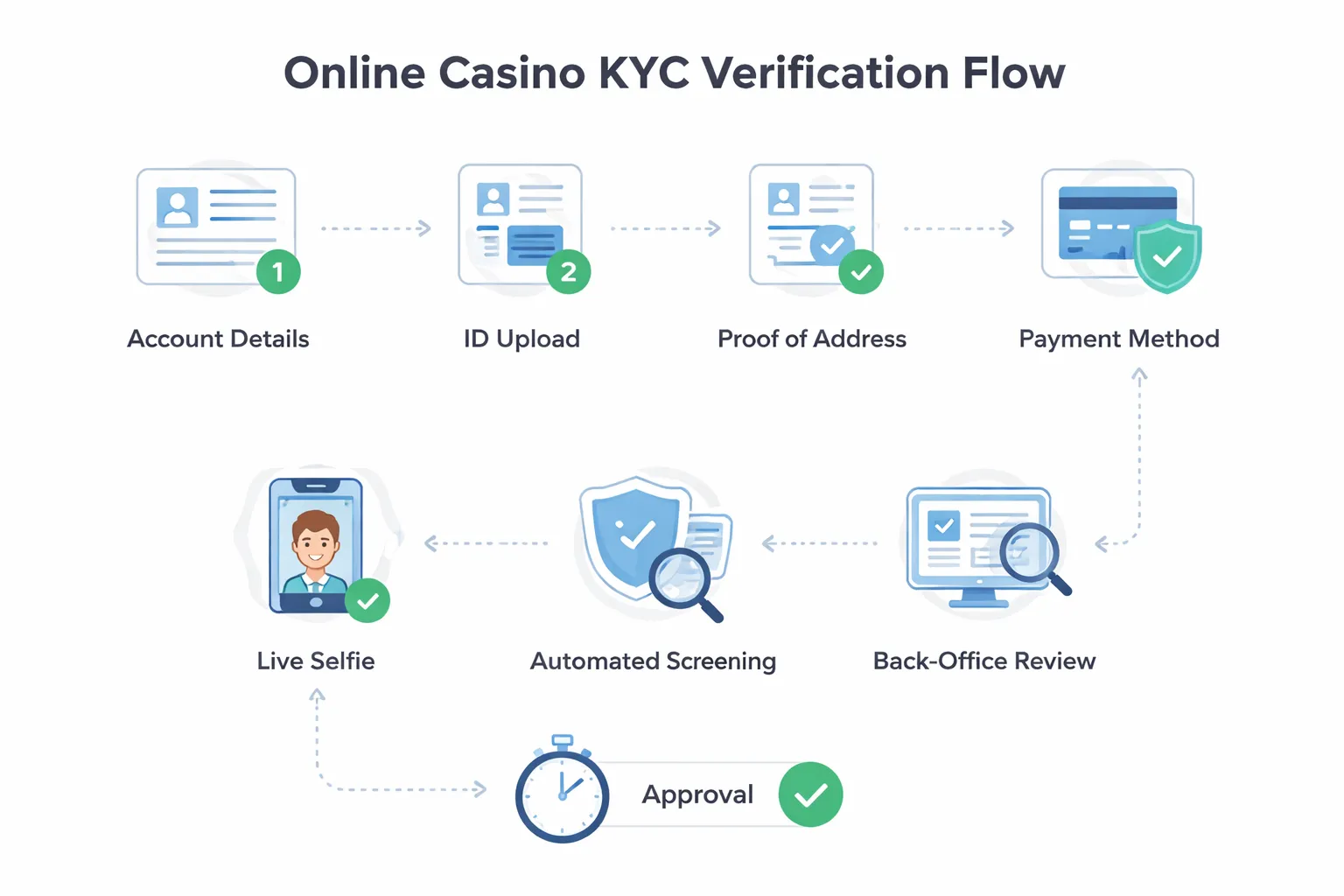
1) Create an account and enter your personal details
You start with a registration form. You enter data that must match your documents and payment details.
- Full legal name. Use the exact spelling on your ID. Include middle names if your ID shows them.
- Date of birth. It must confirm you meet the casino age rule for your jurisdiction.
- Residential address. Use your current home address, not a PO box.
- Email and phone. You confirm them by code or link.
- Country and citizenship. Some casinos block restricted regions.
Mismatch drives delays. If your bank profile uses a different name or address, update it before you verify.
2) Submit identity documents
Most casinos prompt KYC when you request a withdrawal, hit a deposit threshold, or trigger a risk flag. Some ask right after signup.
Typical upload flow:
- You open the cashier or verification page.
- You pick a document type and issuing country.
- You upload images or scan the document with your phone camera.
- You review the preview and submit.
Common accepted IDs:
- Passport. Photo page.
- National ID card. Front and back.
- Driver’s license. Front and back.
Common file rules:
- Formats. JPG, PNG, PDF.
- Quality. Sharp focus, no glare, no cut edges, readable numbers.
- Integrity. No edits, filters, watermarks, or blacked-out fields unless the casino tells you to mask data.
3) Proof of address checks
This step confirms where you live. The casino compares your document address to your profile address.
Most casinos accept documents dated within the last 60 to 90 days.
- Utility bill. Electricity, gas, water, internet.
- Bank or card statement. Full name and address visible.
- Government letter. Tax notice, benefits letter, residency letter.
What they check:
- Your name matches your account and ID.
- Your address matches your profile.
- The issue date meets the freshness rule.
- The document looks complete, not cropped.
4) Payment method verification
This step confirms you own the deposit method. Casinos use it to reduce chargebacks, stolen cards, and third-party deposits.
- Cards. You may upload a photo of the card. The casino may ask you to cover the middle digits and CVV. They often want the first 6 and last 4 digits visible, plus your name and expiry.
- E-wallets. You may upload a screenshot showing your name, wallet email or ID, and recent transactions.
- Bank transfers. You may upload a bank statement that shows the account holder name and IBAN or account number.
Many casinos require you to withdraw back to the same method you used to deposit, when the method supports it. For deposit walkthroughs, see online casino payment methods compared.
5) Live selfie and liveness checks
Some casinos use a live selfie step. You take a photo or short video in-app.
- Face match. Software compares your selfie to the ID photo.
- Liveness. You follow prompts like turning your head or blinking. This blocks printed photos, replay attacks, and many deepfake attempts.
- ID present. Some flows ask you to hold the ID next to your face.
Use good lighting. Remove hats and dark glasses. Keep your face centered. Do not use beauty filters.
6) Back-office review and automated screening
After you submit files, automated checks run first. Then a compliance agent may review the case.
- Document authenticity checks. The system looks for tampering, missing security features, and data inconsistencies.
- Sanctions and watchlist screening. The casino checks names and dates of birth against AML lists and PEP databases.
- Fraud signals. They review device, IP, geolocation, and account links to spot multi-accounting and bonus abuse.
- Payment risk checks. They compare the payment owner to the account holder and track chargeback patterns.
If anything triggers a hit, the casino asks for more evidence. You may need a higher quality scan, a different proof of address, or a bank source document.
7) Approval timelines and manual review
Fast approvals can take minutes. Manual reviews take longer. Expect longer waits during weekends, large events, or high withdrawal volume.
- Auto approval. Often same day when documents scan clean and data matches.
- Manual review. Common when images look unclear, names differ, or the address document fails the date rule.
- Enhanced due diligence. Possible for high-value play. The casino may request source of funds or source of wealth documents.
What you should do during review:
- Answer requests in one reply. Send exactly what the casino asks for.
- Upload full-page documents. Avoid screenshots that cut headers or dates.
- Keep your details consistent across your casino profile, ID, and payment accounts.
- Do not create a second account to “start fresh”. That can lock both accounts.
Documents and data casinos may ask for (ID checks explained)
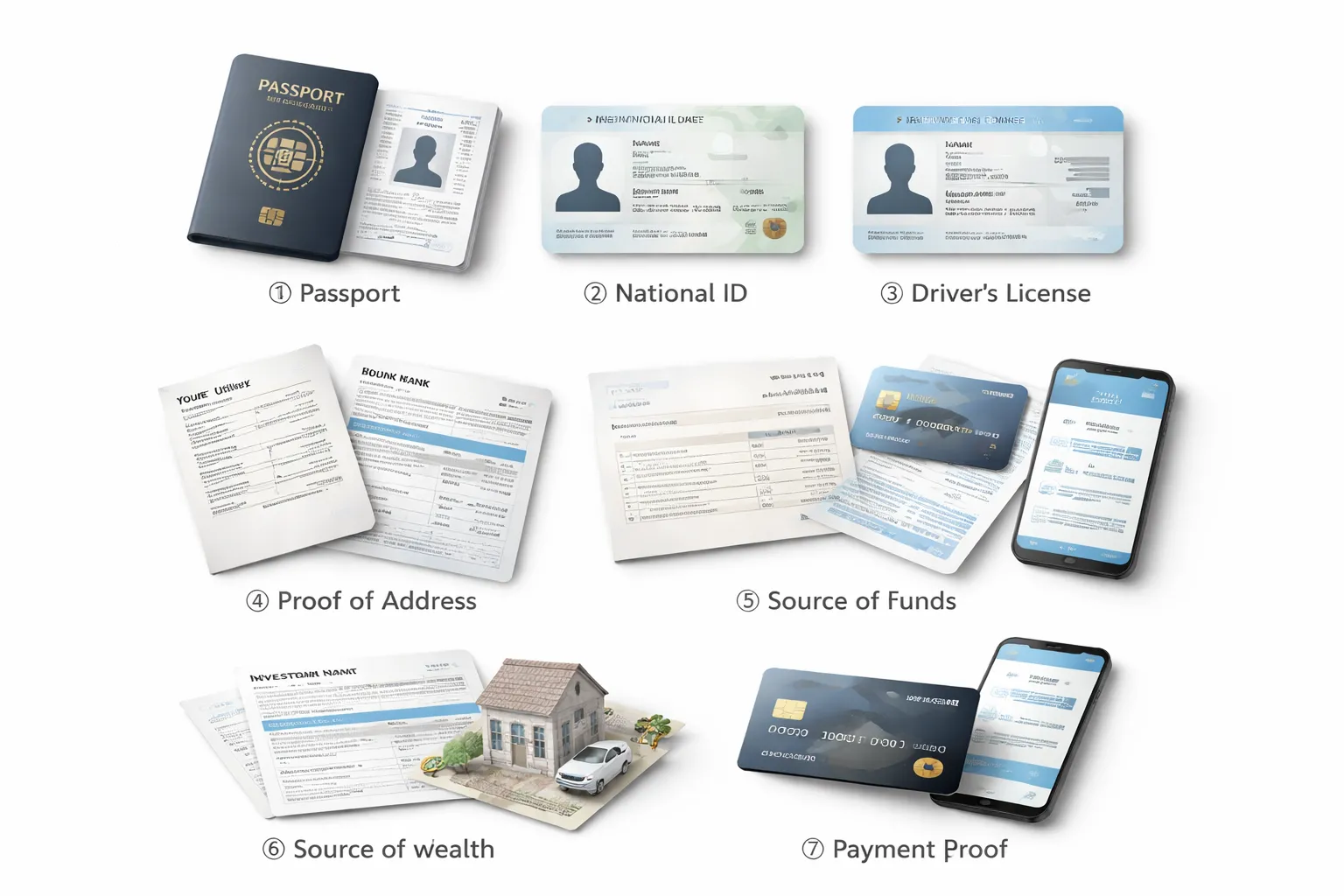
Government ID options
Casinos use ID checks to confirm your identity, age, and basic account details. They usually accept one of these documents.
- Passport. Strongest option for cross border checks. Clear photo and machine readable zone. Some casinos reject damaged covers or worn photo pages.
- National ID card. Common in many countries. Often faster to approve than a driver’s license. Some cards lack an address or have older photo quality.
- Driver’s license. Easy to provide if you do not have a passport. Many licenses show an address. Approval can fail if the license has no issue and expiry dates on the same side, or if the photo and details sit on separate sides and you upload only one.
Many casinos also ask for a selfie or short video with your ID. They use it to match your face to the document and block stolen ID use.
Proof of address examples
Address checks confirm where you live. Casinos usually require a recent document, often dated within the last 90 days, and showing your full name and full address.
- Utility bill. Electricity, gas, water, or landline. Mobile phone bills often fail because they can be prepaid or easy to change.
- Bank statement. PDF statement from online banking works if it shows your name, address, statement date, and the bank logo.
- Tax letter or government correspondence. Strong evidence and often accepted when bills are in a landlord’s name.
- Tenancy documents. Lease agreement or rental contract. Some casinos accept this only with a supporting bill or letter.
Avoid edited PDFs. Do not crop out logos, page numbers, or dates.
Source of funds and source of wealth evidence
Casinos request these when your activity crosses risk triggers. Typical triggers include large deposits, large withdrawals, repeated high value play, or payment methods that raise fraud or AML flags.
- Source of funds. Shows where the money you use for gambling comes from now. Examples include payslips, recent bank statements showing salary credits, dividend statements, pension statements, or a sale proceeds statement.
- Source of wealth. Shows how you built your overall financial position. Examples include annual tax returns, business ownership records, inheritance documents, property sale contracts, or long term investment statements.
Casinos ask because AML rules require them to understand the origin of funds and spot laundering patterns. If you cannot show a clear trail, they may cap withdrawals or hold payments until you do.
Payment proofs
Casinos use payment proofs to confirm you control the deposit method and to prevent chargebacks and third party funding.
- E-wallet or bank transfer proof. Screenshot or PDF showing your name, the account identifier, the casino transaction, the date, and the amount. Include the transaction reference or transfer ID.
- Card proof. Photo of the card if the casino asks. Mask safely. Show only the first 6 and last 4 digits. Hide the middle digits. Hide the CVV. Do not cover your name and expiry date unless the casino tells you to.
- Deposit receipt. Confirmation email or in app receipt can help when the casino cannot match a payment quickly.
If your withdrawal sits in checks after you submit payment proofs, use this guide on why your withdrawal is pending.
Enhanced due diligence cases
Enhanced due diligence means deeper checks. Casinos apply it when risk rises.
- High withdrawals. Big cashouts, sudden jumps in stake size, or frequent withdrawals near limits can trigger extra review.
- High risk geographies. Connections to sanctioned regions, restricted countries, or higher risk jurisdictions can lead to more questions and stricter document standards.
- Unusual patterns. Rapid deposit and withdraw cycles, multiple cards, third party funding signs, VPN use that conflicts with your stated location, or many failed payment attempts.
During enhanced checks, expect more detailed bank statements, clearer transaction trails, and stronger source of funds proof. Send complete files. Keep names and addresses consistent across all documents.
Age verification rules for online casinos
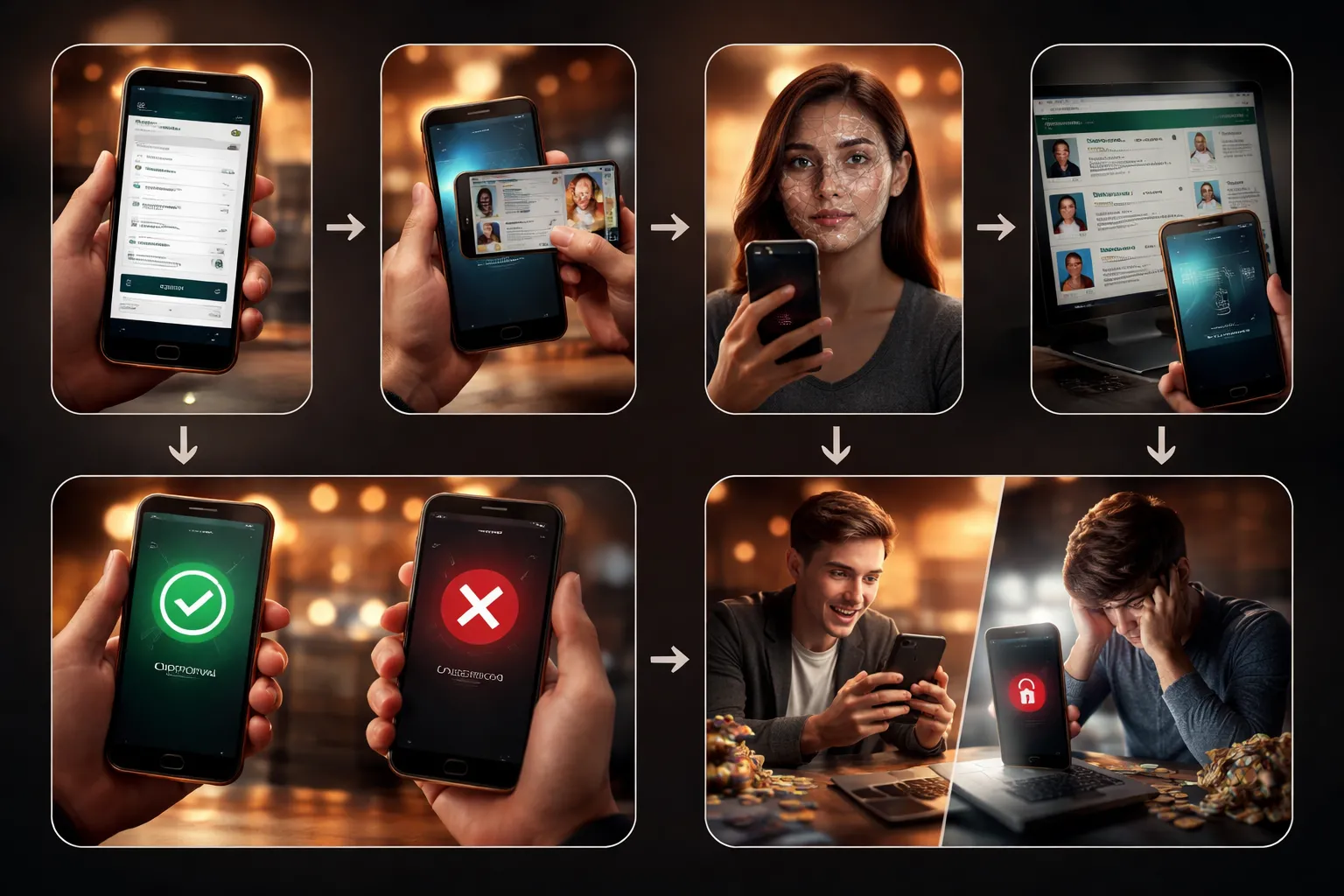
Minimum age rules, 18+ vs 21+
Online casinos must block underage play. The legal minimum age depends on where the casino is licensed and where you play from.
- 18+. Common across many European and international regulated markets. It often covers casino, sports betting, and poker, but local exceptions exist.
- 21+. Common in parts of the United States. Many US-regulated states set 21+ for online casino games, even when other gambling products differ.
- Mixed rules in the same country. Age can change by product type, state, province, or territory. Your casino applies the strictest rule tied to your location and its license.
- Geolocation matters. If you use a VPN or your device location conflicts with your profile, the casino may block access and trigger extra checks.
How casinos verify your age
Age checks usually start at signup, then tighten before your first withdrawal. Some operators verify earlier if your deposit method or behavior raises risk.
- Date of birth match. The casino compares the date of birth you enter with your ID document.
- ID document checks. You upload a passport, national ID card, or driver’s license. The casino checks your name, photo, date of birth, document number, and expiry date.
- Liveness and selfie checks. You take a selfie, sometimes a short video. The system matches your face to the ID photo and looks for signs of spoofing.
- Database lookups. Some casinos use credit header data, electoral registers, or other approved identity databases to confirm age and identity details.
- Address consistency. If your proof of address and ID show different details, age verification can stall until you correct your profile.
If your withdrawal stays stuck during these checks, see why your online casino withdrawal is pending.
What happens if a minor registers or plays
If the casino finds you are underage, it will act fast.
- Account closure. The operator closes or permanently blocks the account.
- Verification failure record. The casino may log the failed KYC result and block future accounts tied to the same identity, device, or payment method.
- Fund handling. The casino often voids winnings. It may return deposits to the original payment method where rules allow. If AML or fraud concerns exist, it may hold funds until it completes required checks and reports.
- Reporting. In regulated markets, the casino may report the incident to its regulator and, when required, to payment providers or financial crime teams.
Practical tips for parents and guardians
You reduce risk by controlling access points. Focus on devices, payments, and visibility.
- Lock devices. Use separate user profiles, strong passcodes, and biometric locks. Disable guest profiles on shared tablets and PCs.
- Use app and web filters. Turn on Screen Time, Google Family Link, or router-level filtering. Block known gambling categories.
- Control payments. Do not store card details in browsers. Disable one-click purchases. Use child accounts for app stores. Set card and wallet limits, and turn on transaction alerts.
- Watch for risk signals. New e-wallet apps, unexplained small deposits, gift cards converted to cash-like balances, and frequent failed payment attempts.
- Check email and SMS alerts. Many casinos and payment services send login codes and deposit confirmations. Treat repeated codes as a red flag.
AML in online gambling: how casinos detect money laundering
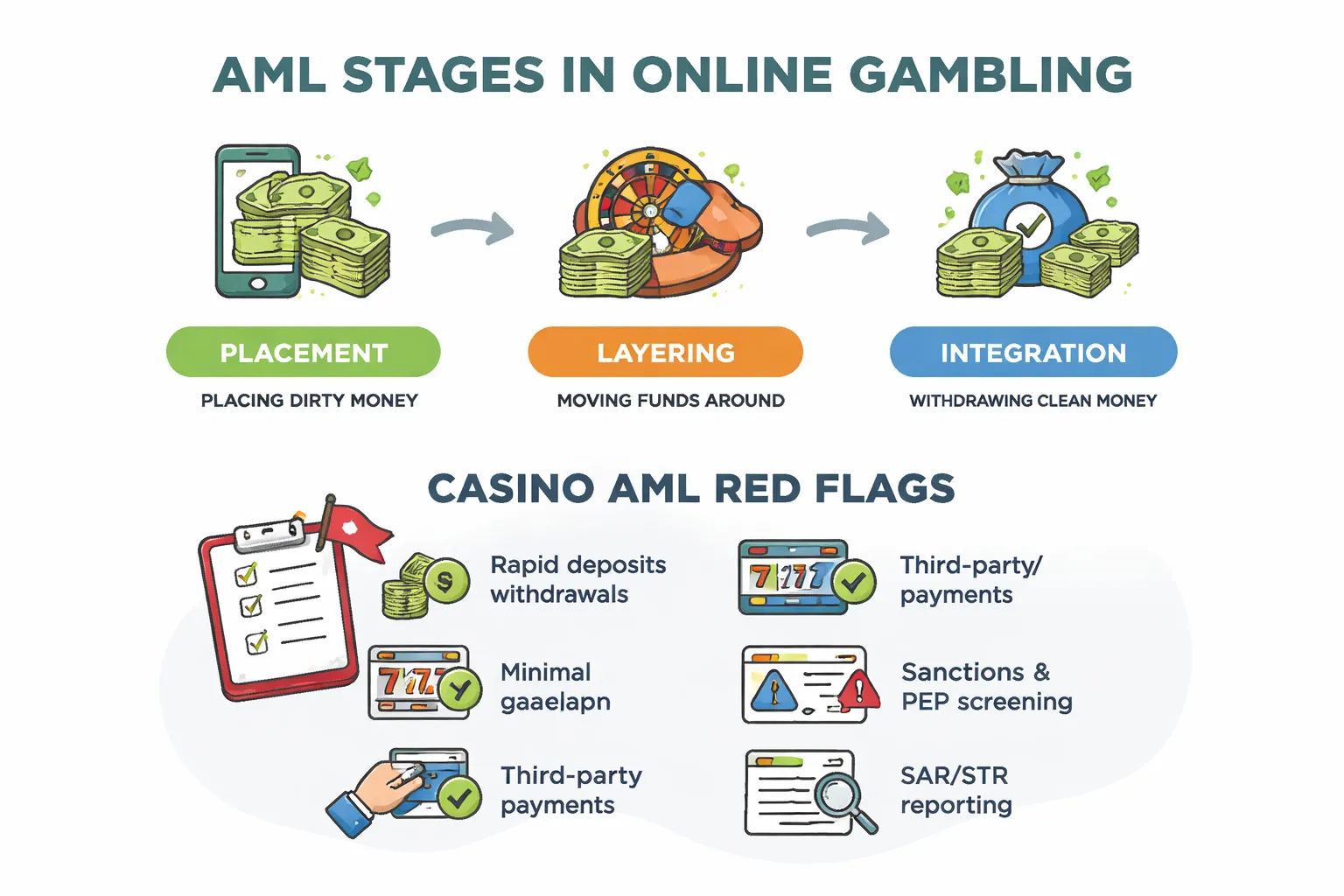
AML in online gambling: how casinos detect money laundering
AML means anti-money laundering. Casinos must spot dirty money, stop it from moving through the site, and report some activity to regulators.
Core AML concepts in plain English
- Placement: Someone puts money into the system. In casinos, this often means deposits through cards, bank transfers, e-wallets, crypto, vouchers, or prepaid tools.
- Layering: Someone tries to break the trail. They move funds through many deposits, withdrawals, games, wallets, and accounts to make the source harder to track.
- Integration: Someone cashes out and claims the money is “winnings.” The goal is clean-looking funds in a bank account.
Risk scoring and monitoring: what behaviors trigger scrutiny
Most operators use automated risk scoring. Your profile risk goes up when your behavior looks like fund movement, not play.
- High deposits soon after signup, especially before any play.
- Many payment methods on one account, or frequent switching between methods.
- IP, device, or location changes that do not match your usual pattern.
- Account links, shared devices, shared cards, shared wallets, or repeated logins from the same network.
- Rapid changes in limits, large failed deposits, or repeated chargeback history.
- Using higher risk rails, or mixing rails, for example card deposit then e-wallet withdrawal.
Transaction patterns that raise flags
- Rapid deposit then withdrawal: You deposit, place little or no play, then request a payout fast.
- Low gameplay: You wager a small amount relative to deposits, then cash out. Casinos track turnover, bet size, and game choice.
- Minimal-risk betting: You place bets designed to reduce variance, or you spread bets to preserve value, then withdraw.
- Structured amounts: You split deposits into many small transactions to avoid checks or limits.
- Third-party funds: The deposit name does not match your name, or the card or wallet belongs to someone else. This includes “friend” payments and business accounts.
- Round-tripping: Money goes in and out through the same rails with little play, or cycles through multiple casinos.
- Bonus abuse patterns: You take bonuses, meet minimum wagering in the fastest way, then withdraw. This can look like laundering even when it is only promo grinding.
Casinos also check payment method rules. Many require you to withdraw to the same method you used to deposit. This reduces third-party payouts and fund routing. For more detail on rails, limits, and typical controls, see online casino payment methods.
Sanctions and PEP screening: what casinos check and why it matters
Casinos screen customers against restricted lists. They do this at signup, at KYC, and often on an ongoing basis.
- Sanctions: They check if you match national or international sanctions lists. A match can block deposits, play, or withdrawals.
- PEP status: They check if you are a politically exposed person, or a close associate or family member. PEP status does not mean wrongdoing, but it raises corruption risk. Operators must apply stronger checks.
- Adverse media: Some operators also scan for credible reports tied to fraud, laundering, or financial crime.
SAR and STR reporting basics
When activity looks suspicious, an operator may file a SAR or STR, the name depends on the jurisdiction. The report goes to a financial intelligence unit or regulator.
- They may file when they see fund movement with no gambling purpose, unclear source of funds, third-party funding, or patterns tied to known laundering typologies.
- They may freeze withdrawals, request extra documents, or ask for source of funds and source of wealth proof.
- They will not tell you they filed a report. Many laws ban “tipping off.” You usually only see delays, extra checks, or account restrictions.
Privacy, data security, and your rights during KYC
What data casinos collect, and how long they keep it
KYC can involve identity, contact, and financial data. You usually provide it during signup, your first withdrawal, or after a risk trigger.
- Identity data: full name, date of birth, nationality, ID number, ID issue and expiry dates, ID images, selfie or video check.
- Contact data: address, phone, email, proof of address documents.
- Payment data: card details (often masked), bank account details, e-wallet identifiers, deposit and withdrawal history.
- Device and access data: IP address, device ID, login history, geolocation signals, fraud flags.
- AML checks: sanctions and PEP screening results, adverse media flags, risk scores, source of funds and source of wealth evidence if requested.
Retention depends on your regulator and the casino’s legal duties. Many licensed operators keep KYC and transaction records for several years after your last activity or after account closure. They keep it longer if they must defend legal claims, resolve disputes, or comply with AML rules.
Encryption, secure uploads, and where your files go
Good operators encrypt data in transit and at rest. You usually see this as HTTPS in your browser and a secure upload portal inside your account.
- In transit: TLS encryption protects files when you upload them.
- At rest: encrypted storage reduces risk if systems get accessed without permission.
- Access controls: staff access should be limited by role, logged, and reviewed.
Many casinos use third-party verification vendors. They do this to run document authenticity checks, face matching, liveness tests, and database screening. It can speed up approval and reduce fraud. It also means your data may move between the casino, its KYC provider, and sometimes payment processors or risk tools.
Before you upload, check the domain and the in-account flow. Avoid sending ID files over email or chat unless the casino support page tells you to use a specific secure ticket system.
Your GDPR and UK GDPR-style rights during KYC
If GDPR or similar rules apply, you have rights over your personal data. Compliance rules can limit how far those rights go during AML and gambling regulation.
- Access: you can ask for a copy of the data the casino holds, and where it came from.
- Correction: you can fix wrong details. Do this fast if your name or address changed, or your documents do not match your profile.
- Deletion: you can request deletion, but AML and licensing rules often force the casino to keep core KYC and transaction records for a set period.
- Restriction and objection: you can ask to limit some processing, but the casino may still process data needed for legal compliance, fraud prevention, and responsible gambling duties.
- Portability: this sometimes applies to data you provided, in a usable format.
If a casino delays withdrawals due to checks, keep your requests specific. Ask what exact documents they need, what fields must match, and where to upload them. If they still stall, follow the steps in what to do if an online casino won’t pay out.
How to spot unsafe KYC requests and phishing
- Off-platform requests: treat WhatsApp, Telegram, and random email threads as high risk. Use the casino’s logged-in upload page.
- Urgency pressure: scammers push fast action and threats. Real support staff give clear steps and timeframes.
- Overreach: casinos may need source of funds proof, but they do not need your full email password, full card PIN, or remote access to your device.
- Link and domain mismatch: check the exact domain, spelling, and HTTPS. Do not open shortened links for “verification.”
- File handling red flags: avoid sending unencrypted attachments. Do not upload to public file shares.
- Document tampering requests: if anyone tells you to edit dates, change addresses, or “adjust” screenshots, stop. That can trigger account closure and reports.
Protect yourself by using the same email you registered with, enabling two-factor authentication, and keeping copies of what you submitted. Record the date, the file names, and the support ticket number.
Common reasons casino KYC gets rejected (and how to fix each)
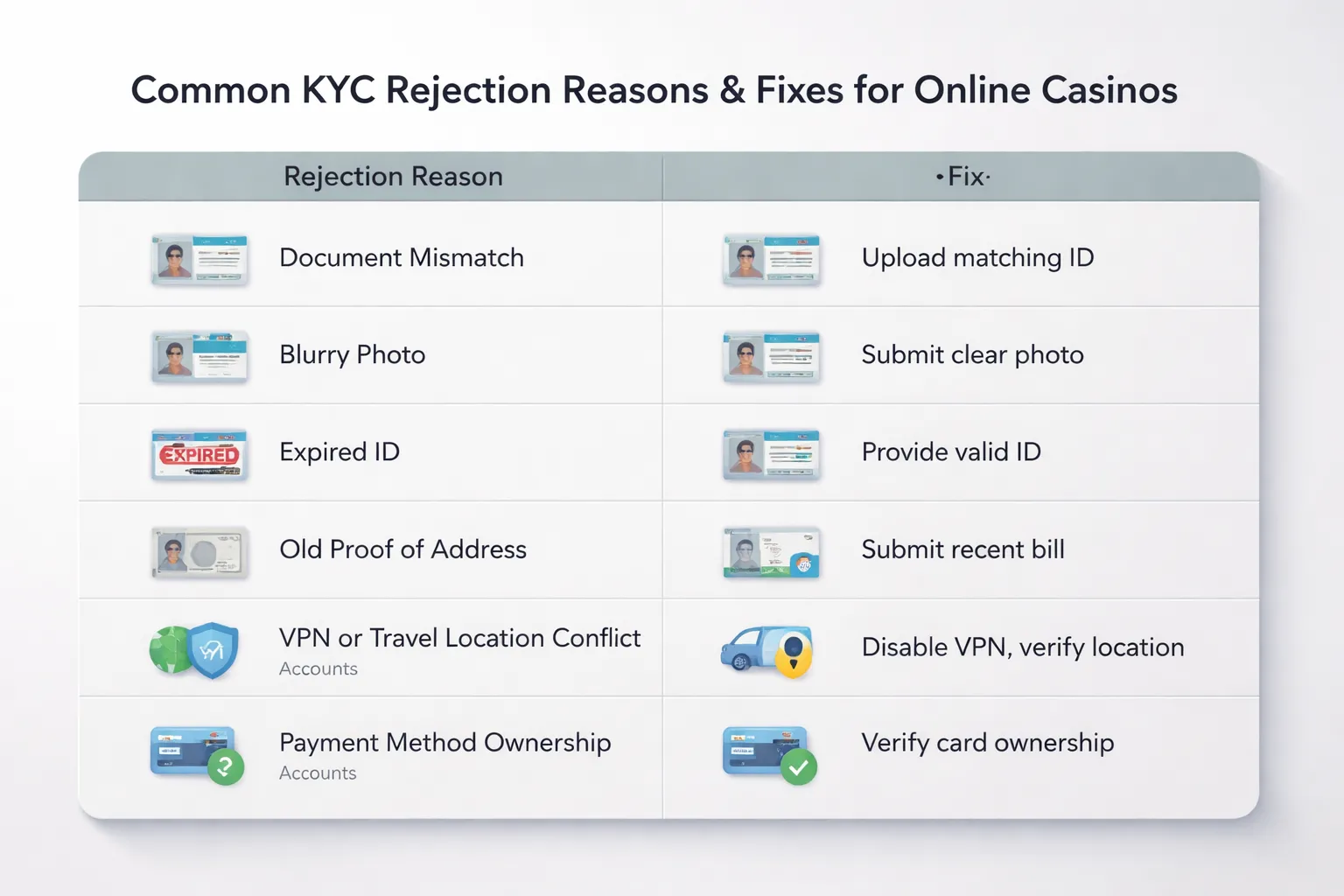
Mismatched name, address, or date of birth across documents
Casinos match your profile details to your ID and proof of address. Any mismatch can trigger a rejection or a manual review.
- Common causes: nicknames, missing middle names, different spelling, old address on your account, different date format, marriage name change.
- Fix: update your casino profile to match your government ID exactly, including full legal name and date of birth.
- Fix: if your name changed, submit a supporting document the casino accepts, such as a marriage certificate or legal name change document.
- Fix: if your address changed, upload a current proof of address that matches your account address, then update the account address if the site allows it.
- Fix: do not edit documents. Ask support what they need instead.
Blurry images, glare, cropped corners, or unsupported file types
KYC tools read documents automatically. Poor images fail OCR checks and force rejection.
- Common causes: motion blur, low light, flash glare, reflections on laminated IDs, cropped edges, screenshots instead of photos, compressed files, unsupported formats.
- Fix: retake photos in bright natural light, turn off flash, and place the document on a dark flat surface.
- Fix: capture all four corners and the full document frame. Keep text sharp and readable.
- Fix: upload the file type the casino asks for, usually JPG, PNG, or PDF. Use the original file, not a messenger download.
- Fix: if they require a selfie or liveness check, follow prompts exactly and remove hats, masks, and tinted glasses.
Expired IDs and out-of-date proof of address
Many operators reject expired IDs by policy. Proof of address often has a strict age limit.
- Common causes: expired passport or license, temporary ID not accepted, proof of address older than the site limit, usually 60 to 90 days.
- Fix: renew your ID, then resubmit. Do not upload an expired document “for now”.
- Fix: use an accepted proof of address, such as a utility bill, bank statement, or government letter, dated within the allowed window.
- Fix: if you use online statements, download the original PDF from your bank portal. Avoid screenshots unless the casino allows them.
Using a VPN or traveling, geo inconsistencies and location conflicts
Casinos compare your IP location, device signals, and registration country. Conflicts trigger AML and licensing checks.
- Common causes: VPN or proxy use, frequent country switching, signing in from a restricted region, mismatched country between your account and your ID.
- Fix: turn off VPNs and privacy relays. Sign in from your normal connection and device.
- Fix: if you travel, tell support before you deposit or submit KYC. Ask what country rules apply to your account.
- Fix: do not create a new account to “match” your location. That can trigger multi-account flags.
Payment method problems: third-party deposits, prepaid cards, or unverifiable e-wallets
Casinos must confirm you control the payment method. Many reject anything that looks like third-party funding.
- Common causes: deposits from someone else’s card or bank, shared e-wallets, prepaid cards with weak identity links, missing name on wallet profile, chargeback history.
- Fix: deposit and withdraw using a method in your legal name. Keep the same method where possible.
- Fix: if they request card proof, cover the middle digits and CVV, show the first 6 and last 4, and keep your name visible if printed.
- Fix: for e-wallets, verify your wallet account, then upload a wallet statement or profile page that shows your name and email.
- Fix: if you already used a third-party method, stop deposits and contact support with a clear explanation and receipts.
Multiple accounts and bonus-related flags: what to do before contacting support
Risk systems flag duplicate accounts, bonus abuse patterns, and linked devices. KYC often fails until you clear the flag.
- Common causes: old account you forgot, family members on the same device or IP, multiple sign-ups for welcome bonuses, creating a new account after a login issue.
- Do this first: stop play and deposits. Do not open more accounts.
- Do this first: collect facts, usernames, registered emails, dates, device used, and any bonus codes applied.
- Do this first: check whether you can recover the original account instead of starting over. Use identity verification steps that reduce rejections and keep one clean submission.
- Fix with support: ask them to close duplicates and confirm which account remains active. Provide your ID once, then follow their instructions.
How to pass KYC faster: practical checklist for players
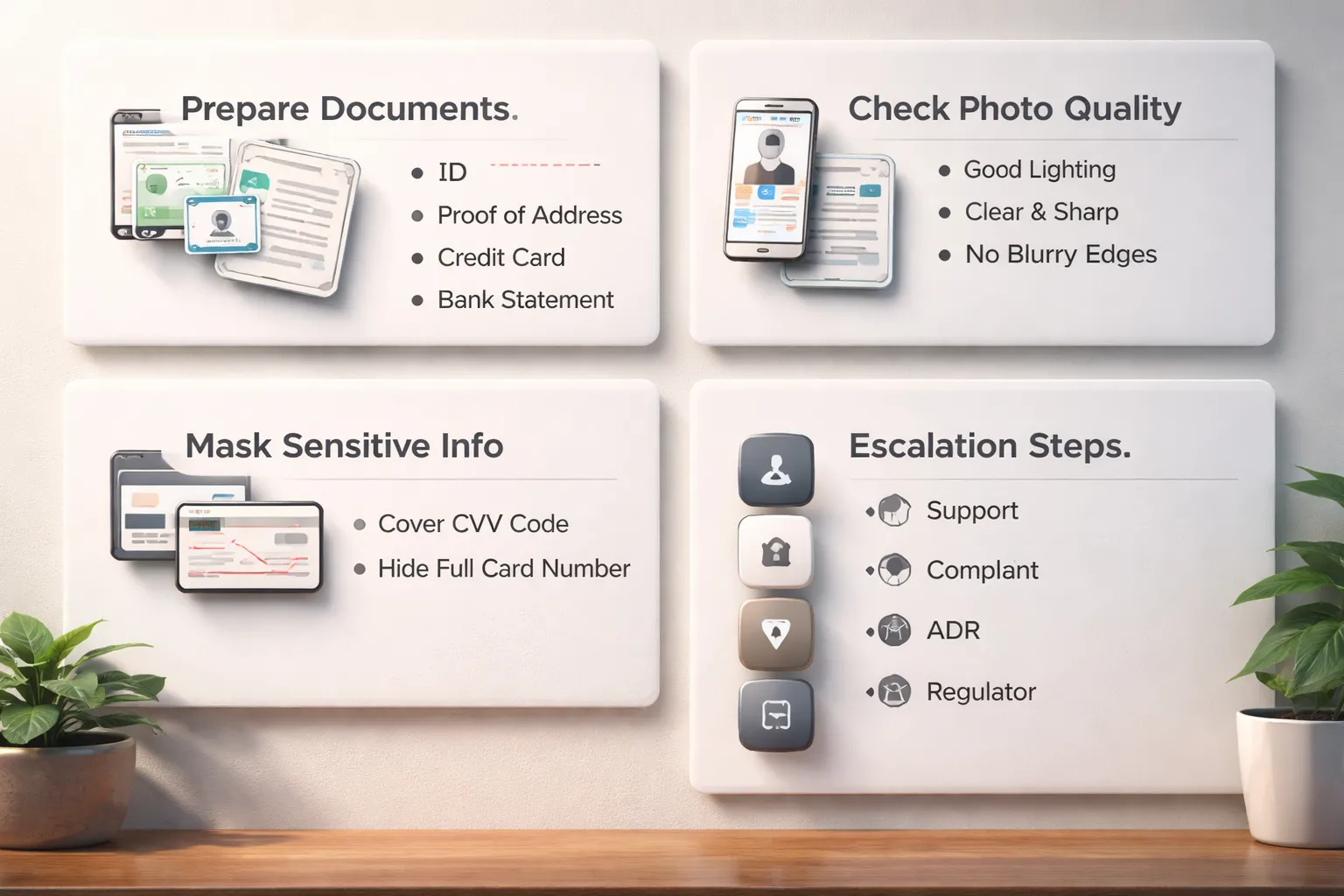
How to pass KYC faster, practical checklist for players
Before you upload, get your documents ready
- Use the same name everywhere. Match your casino profile, payment method, and ID. Include middle names only if your ID shows them.
- Check expiry dates. Do not upload expired IDs, cards, or proof of address files.
- Use one address format. Pick one format and keep it consistent across your profile and documents. Keep spelling, unit numbers, and postcodes the same.
- Confirm your document type fits the rule. Proof of address often needs to be recent. Many casinos accept 90 days, some require 30 to 60. Check your casino KYC page before you upload.
- Use documents issued to you. Do not use a partner’s bill or a shared household bill unless the casino states it accepts it.
- Avoid edited files. Do not crop, compress, add filters, or convert screenshots into PDFs unless the casino asks for it.
- Prepare the exact set. Typical set: ID, selfie or liveness check, proof of address, and payment proof for withdrawals.
Best practices for photos and scans
- Use strong, even light. Avoid glare on holograms and glossy cards. Turn off flash if it creates hotspots.
- Capture the full document. Show all four corners. Keep edges visible. Do not cut off the MRZ line on passports.
- Keep text readable. Use the rear camera. Hold still. Tap to focus on the text area.
- Use high resolution. Upload the original file if possible. Avoid messaging apps that downscale images.
- Use a plain background. Contrast helps. Do not place documents on patterned surfaces.
- Match the required orientation. Do not rotate sideways. Keep the document level.
- For selfies. Remove hats and tinted glasses. Face the camera. Keep your face and ID in frame if the casino requests a selfie with ID.
Safe masking rules for cards and statements
- Only mask what the casino allows. Some casinos reject masked files. Check their instructions first.
- Cards, what to hide. Hide the CVV and most digits. Keep the last 4 digits visible.
- Cards, what must stay visible. Your name, card type, and expiry date often need to show. Keep the issuing bank logo visible if present.
- Bank statements, what to hide. You can usually hide transaction details that reveal unrelated merchants.
- Bank statements, what must stay visible. Your full name, address, account identifier, statement date, and bank name or logo.
- Use solid blocks. Use a clean black box. Do not blur. Do not use transparent highlights.
Communicating with support effectively
- Send one clear message. Include your username, registered email, country, and the exact error text or status.
- List what you uploaded. Example: Passport, proof of address dated 2026-01-12, card ending 1234.
- Ask for the specific fail reason. Request the rejection code or the exact field that did not match.
- Keep a timeline. Note submission time, rejection time, and any requested re-uploads.
- Do not share secrets. Never send your password, full card number, CVV, or one-time codes.
- Use official channels only. Reply inside the casino helpdesk or from the verified support email domain.
If you are stuck, escalate the right way
- Stop re-upload loops. Repeated submissions can trigger extra checks. Ask support to confirm the required format before you upload again.
- Request manual review. Ask for a compliance team review if automated checks keep failing.
- Ask for a clear checklist. Request the exact document type, date range for proof of address, and file requirements.
- Use a formal complaint. If support stalls, submit a written complaint to the operator, and ask for a case reference number.
- Escalate externally when needed. If you get no resolution, use the operator’s listed ADR option, or contact the regulator shown in the casino footer for your jurisdiction.
- Withdrawals delayed by KYC. Follow the operator process first, then use the same escalation path. See why your online casino withdrawal is pending for common causes and fixes.
| Common rejection | Fast fix |
|---|---|
| Name or address mismatch | Update your profile to match your ID, then resubmit the same address format on proof of address. |
| Blurry image or glare | Retake in daylight, no flash, rear camera, full corners visible, focus on text. |
| Expired or out of date proof | Use a recent statement or bill within the casino date window. |
| Masked data rejected | Follow the casino masking policy, or submit an unmasked file through their secure upload tool if required. |
| Payment method does not match account | Use a payment method in your name, then upload the matching payment proof. |
No-KYC casinos and ‘instant withdrawal’ claims: risks, trade-offs, and realities
Why some platforms market reduced verification and what it usually means in practice
No-KYC marketing targets one pain point. You want to deposit, play, and withdraw fast.
Most licensed casinos still must follow AML and age rules. So “no KYC” usually means one of these:
- KYC on demand, they skip checks at signup, then ask later.
- Lower-friction checks, they use automated ID tools or database checks instead of manual review.
- Crypto-first flow, they avoid card chargebacks and reduce payment disputes, but they can still verify you.
- Offshore model, they operate under weaker rules, or outside strong regulators.
If a site claims “instant withdrawals” with “no verification ever,” treat it as a claim, not a guarantee. A casino controls payouts. Regulators and banks also create delays.
Withdrawal time vs verification timing, ‘KYC later’ and transaction limits
Many platforms move KYC from signup to withdrawal. This changes the timeline, not the requirement.
- Fast deposits do not prove fast withdrawals. Deposits usually clear first. Withdrawal checks often start after you request a payout.
- Limits drive the process. Small withdrawals may pass with minimal checks. Larger totals trigger ID and source of funds requests.
- One-time “instant” payouts happen. You might get an early withdrawal approved, then face full KYC on the next one.
- Weekends and queues matter. Even automated checks can stall if staff must review flags.
| Claim you see | What it often means | What you should expect |
|---|---|---|
| No KYC | KYC deferred until a trigger | ID checks when you withdraw, hit limits, or get flagged |
| Instant withdrawal | Fast approval for low-risk payouts | Delays if you need verification or manual review |
| Withdraw in minutes | Processing speed, not receipt speed | Network and banking time still applies |
| Anonymous casino | Less data at signup | Data requests later, or higher account risk |
Safety and licensing considerations: how to evaluate legitimacy
Reduced-KYC offers come with trade-offs. Your main risk is not privacy. Your main risk is payout problems and weak dispute options.
- Check the license. Verify the license number on the regulator site, not only in the footer text.
- Read the withdrawal and verification terms. Look for clear triggers, timelines, and document lists.
- Look for payment transparency. You should see fees, limits, and processing times per method.
- Confirm support access. Test live chat or email before you deposit.
- Search for consistent payout reports. Focus on patterns, frozen accounts, repeated “verification loop,” and long delays.
If you want a safety-first approach, follow practical deposit and withdrawal hygiene from online casino payment safety tips.
When reduced-KYC models still require checks
Even platforms that start with minimal data often verify you when risk rises. Common triggers include:
- Large withdrawals or high lifetime totals. Casinos set internal thresholds. You may not see them listed.
- Suspicious activity flags. VPN patterns, device changes, multiple accounts, or unusual play can trigger checks.
- Chargebacks and payment disputes. Card and wallet providers push casinos to prove identity and ownership.
- Bonus abuse reviews. Casinos verify identity to enforce one-account rules and bonus limits.
- AML source of funds requests. You may need to show where funds came from if amounts or behavior raise flags.
Plan for this before you deposit. Keep your ID valid. Use payment methods in your name. Save statements. If you do not, “no KYC” can turn into a locked withdrawal until you comply.
Choosing a trustworthy casino: KYC as a quality signal
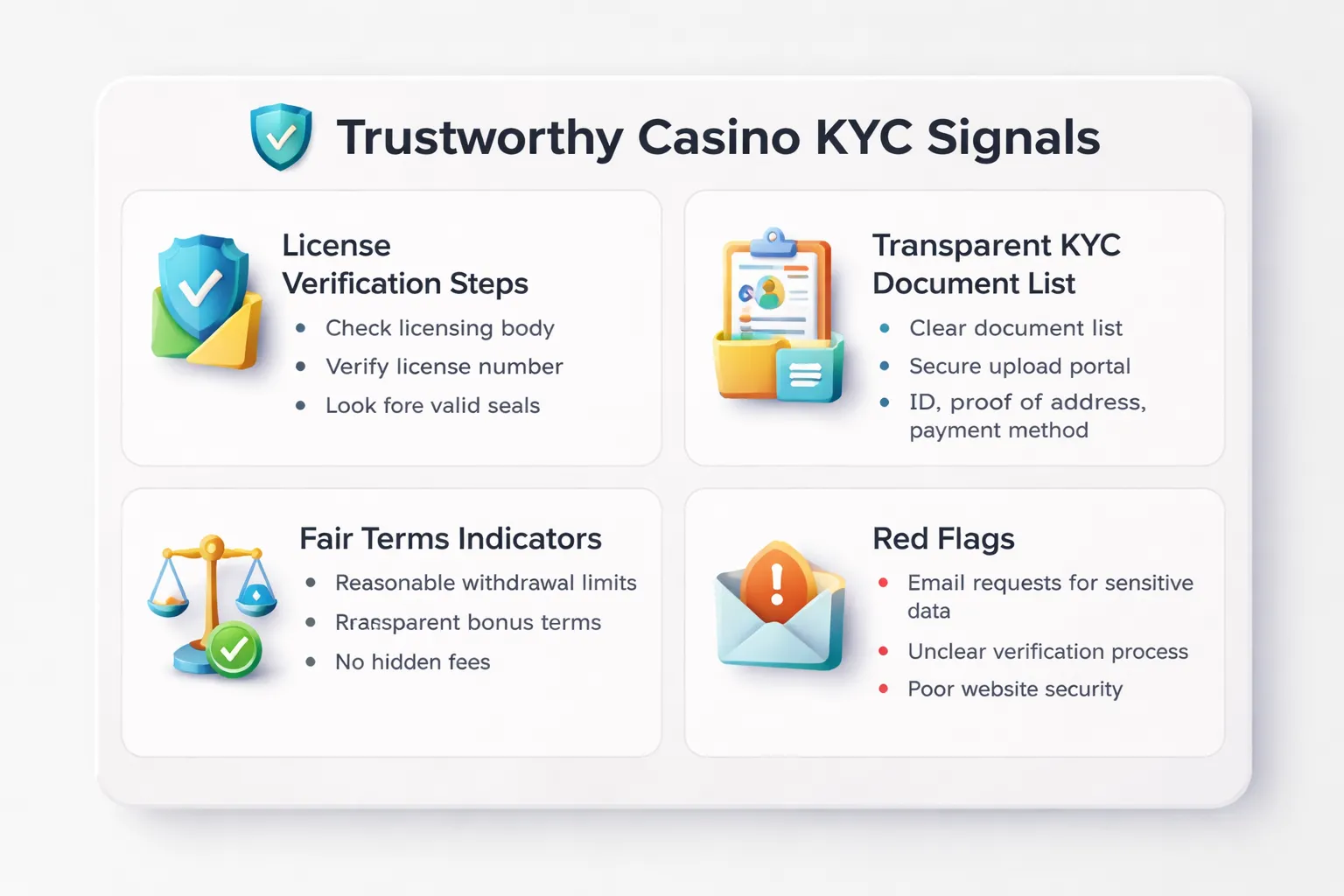
Licensing and regulator checks
KYC works best when a regulator forces standards. Start with the license.
- Find the license details in the site footer and in the Terms and Conditions. You should see the operator name, license number, and licensing authority.
- Verify on the regulator site using the license number or company name. Confirm the status shows active and matches the brand and website domain.
- Check the legal entity behind the brand. Your contract sits with the company, not the marketing name.
- Look for a complaints path listed by the regulator or in the casino terms, including ADR details and timelines.
Transparency signals that KYC will not block your withdrawal
A trustworthy casino tells you what it will ask for, when it will ask, and how long it takes.
- Clear KYC and AML policy with triggers. Examples include first withdrawal, high limits, changes to personal data, or unusual payment activity.
- Plain document list with accepted formats. Typical items include ID, proof of address, and payment method proof.
- Withdrawal rules in one place with processing times, limits, and any internal review steps.
- One account rule and bonus limits stated clearly, since these drive many verification disputes.
- Data handling basics such as where you upload documents, who can access them, and retention period.
If you want fewer KYC surprises, choose payment methods that match your name and cardholder details. Use a method with clean records. For a quick overview, see online casino payment methods compared.
Fair terms: what good KYC clauses look like
Terms set the power balance. Read the KYC section before you deposit.
- Specific requests like “government ID, proof of address dated within 3 months, payment method proof,” instead of open-ended language.
- Reasonable deadlines to provide documents. Avoid short windows that set you up to fail.
- Clear outcomes if you do not comply. A fair policy explains account limits, withdrawal holds, and when funds may get returned.
- Defined review times for verification and enhanced checks. You need stated targets, not silence.
- Matched names rule explained upfront. If the casino requires same-name deposits and withdrawals, it should say so.
| Good signal | Risky signal |
|---|---|
| Lists required documents and accepted alternatives | “We may request any documents at any time” with no examples |
| States standard review time and escalation path | No timelines, only “as long as necessary” |
| Explains source of funds triggers and what counts as proof | Asks for “financial documents” without defining scope |
| Explains how to update details and re-verify | Blocks changes with no process, support gives mixed instructions |
Red flags during KYC and support
Bad operators use KYC as a delay tool. Watch for patterns.
- Requests for sensitive data by email such as full card numbers, CVV, or bank login details. A secure upload area should handle documents.
- Pressure tactics like “send documents in 24 hours or lose funds,” especially after you request a withdrawal.
- Shifting requirements where support asks for new documents each time you comply, with no clear reason.
- Inconsistent answers on limits, timelines, or what counts as proof. Save screenshots and ticket numbers.
- Mismatch between terms and practice such as “instant withdrawals” marketing but repeated manual reviews without stated triggers.
FAQ
What does KYC mean in online casinos?
KYC means Know Your Customer. You prove your identity, age, and payment ownership. Casinos use KYC to meet licensing and AML rules, reduce fraud, and stop underage play. Most casinos run it at signup, before withdrawals, or after risk triggers.
What documents do online casinos ask for?
Most ask for a government ID, proof of address, and proof of payment method. ID can be a passport or driver’s license. Address proof can be a utility bill or bank statement. Payment proof can be a card photo or e-wallet screenshot.
How old do you need to be to pass casino KYC?
You usually need to be 18+. Some jurisdictions require 21+. The casino checks your date of birth on your ID. If your age does not meet the legal minimum for the license region, the casino must block play and withdrawals.
How long does casino verification take?
Simple checks can clear in minutes to 48 hours. Manual reviews often take 1 to 5 business days. Weekends, holidays, poor images, and extra AML checks add time. For payout timing after approval, see Online Casino Payout Times Explained.
Why do casinos ask for KYC when you withdraw?
Withdrawals raise fraud and chargeback risk. Many casinos complete KYC when money leaves the platform, not at signup. Large withdrawals, new payment methods, bonus use, or unusual play can trigger extra checks. This helps meet AML and responsible gambling controls.
What is AML and how does it affect KYC?
AML means Anti Money Laundering. AML rules push casinos to verify who you are, where funds come from, and where winnings go. Higher risk profiles can lead to enhanced checks, extra documents, and longer review times.
What is a source of funds check?
It is proof your deposits come from a legitimate source. Casinos may request payslips, bank statements, tax documents, or sale contracts. Triggers include high deposits, big withdrawals, frequent payment method changes, or links to high risk regions.
Can you refuse KYC and still withdraw?
No. If you refuse KYC, the casino can freeze withdrawals and restrict your account. Licensed casinos must verify you before paying out in many cases. If you want fewer delays, complete KYC early and keep your details consistent.
Why does the casino keep asking for more documents?
Common causes include unclear photos, expired documents, mismatched names or addresses, payment method changes, or missing pages. Some requests follow AML escalation. Ask support to list exact requirements in one message and save ticket IDs and screenshots.
What causes KYC failure?
Expired ID, low quality images, cropped corners, glare, different spelling, wrong address format, or using someone else’s payment method. VPN use can also trigger review. Upload original files, show all corners, and match your account profile to your ID.
Is KYC safe for your privacy?
It depends on the operator. Use licensed casinos with clear privacy terms and secure upload portals. Avoid sending documents over public chat or unsecured email. Watermark copies with the casino name and date if the casino accepts it.
Do crypto casinos still require KYC?
Many do. Crypto does not remove AML duties for licensed operators. Some platforms apply KYC only after certain limits or withdrawal sizes. Expect checks if you move large amounts, use mixed funds, or trigger risk flags.
Can you speed up casino verification?
Upload documents in color, high resolution, and unedited. Use the same name and address across your account and payment method. Verify email and phone first. Submit proof of address dated within 3 months unless the casino states otherwise.
Conclusion
Conclusion
KYC protects the casino and protects your payouts. It checks your identity, your age, and the source of your funds. It also supports AML rules that casinos must follow.
Plan for verification before you deposit or chase a big bonus. Keep your account details consistent, use one payment method, and submit clear documents early. If you want fewer delays at cashout, verify right after sign-up and before you hit higher limits or larger withdrawals. Use this guide on how to verify your identity at an online casino to get approved faster.
- Match your name, date of birth, and address across your profile, bank, and e-wallet.
- Upload a valid ID and a recent proof of address, usually dated within 3 months.
- Use color photos, high resolution, no edits, no cropped corners.
- Verify email and phone, then keep your payment method unchanged.
- Expect extra checks if you withdraw large sums or trigger AML risk flags.
-
Online Casino Payment Safety Tips: How to Deposit and Withdraw Securely
8 months ago -
What to Do If an Online Casino Won’t Pay Out: Step-by-Step Actions
8 months ago -
How to File a Complaint Against an Online Casino (Plus ADR Explained)
8 months ago -
How to Sign Up & Create an Online Casino Account (Step-by-Step)
8 months ago -
Online Casino Login Problems: Fixes for Common Sign-In Issues
8 months ago
-
- Mismatched name, address, or date of birth across documents
- Blurry images, glare, cropped corners, or unsupported file types
- Expired IDs and out-of-date proof of address
- Using a VPN or traveling, geo inconsistencies and location conflicts
- Payment method problems: third-party deposits, prepaid cards, or unverifiable e-wallets
- Multiple accounts and bonus-related flags: what to do before contacting support
-
- What does KYC mean in online casinos?
- What documents do online casinos ask for?
- How old do you need to be to pass casino KYC?
- How long does casino verification take?
- Why do casinos ask for KYC when you withdraw?
- What is AML and how does it affect KYC?
- What is a source of funds check?
- Can you refuse KYC and still withdraw?
- Why does the casino keep asking for more documents?
- What causes KYC failure?
- Is KYC safe for your privacy?
- Do crypto casinos still require KYC?
- Can you speed up casino verification?
-
- Mismatched name, address, or date of birth across documents
- Blurry images, glare, cropped corners, or unsupported file types
- Expired IDs and out-of-date proof of address
- Using a VPN or traveling, geo inconsistencies and location conflicts
- Payment method problems: third-party deposits, prepaid cards, or unverifiable e-wallets
- Multiple accounts and bonus-related flags: what to do before contacting support
-
- What does KYC mean in online casinos?
- What documents do online casinos ask for?
- How old do you need to be to pass casino KYC?
- How long does casino verification take?
- Why do casinos ask for KYC when you withdraw?
- What is AML and how does it affect KYC?
- What is a source of funds check?
- Can you refuse KYC and still withdraw?
- Why does the casino keep asking for more documents?
- What causes KYC failure?
- Is KYC safe for your privacy?
- Do crypto casinos still require KYC?
- Can you speed up casino verification?
-
Reload Bonus Explained: What It Is and When It’s Worth Claiming
6 months ago -
Online Casino Licensing Explained: Authorities, Licenses & How to Check One
8 months ago -
Best Live Dealer Casinos: Where to Play Live Blackjack, Roulette & More
8 months ago -
Best Online Casinos for High Rollers: VIP Perks, High Limits & Exclusive Bonuses
8 months ago -
Fast Payout Online Casinos: Best Sites for Quick Withdrawals
8 months ago
-
Online Casino Customer Support: What to Look For (Live Chat, Email, Response Times)
8 months ago -
Sign Up for an Online Casino: Create an Account in Minutes
8 months ago -
Online Casino Payment Safety Tips: How to Deposit and Withdraw Securely
8 months ago -
What to Do If an Online Casino Won’t Pay Out: Step-by-Step Actions
8 months ago -
How to File a Complaint Against an Online Casino (Plus ADR Explained)
8 months ago