Slot Volatility Explained: Low vs High Volatility (and What to Play)

Slot volatility tells you how a game pays. It does not change the long-term return. It changes the ride to get there.
Low volatility slots pay smaller wins more often. High volatility slots pay fewer wins, but bigger spikes. Your bankroll, bet size, and session length decide which one fits.
This guide breaks down what volatility means in plain terms. You will learn the key metrics that signal volatility, hit rate, win size, and payout range. You will see a low vs high comparison, with clear play scenarios. You will also learn how to spot volatility in the paytable and game info, and what to do if a casino does not list it.
For a deeper side-by-side, see high volatility vs low volatility slots.
Key Takeaways
- In het kort: Low volatility means more frequent small wins, smaller swings, and a steadier bankroll.
- In het kort: High volatility means fewer wins, bigger payout potential, and larger swings.
- In het kort: Use hit rate, typical win size, and max win range to judge volatility when it is not listed.
- In het kort: Pick volatility based on your session length, budget, and how much variance you can handle.
- Low volatility: Play when you want longer playtime on a fixed budget. Expect many small hits and fewer long losing streaks.
- High volatility: Play when you can handle dry spells and you chase large wins. Keep bets smaller to protect your balance.
- Hit rate matters: Higher hit rate usually signals lower volatility. Lower hit rate usually signals higher volatility.
- Win size matters: If most wins sit near 0.2x to 2x stake, you get lower volatility. If wins cluster in larger jumps, volatility rises.
- Payout range matters: Very high max wins often pair with high volatility, especially when the base game pays little.
- Paytable clues: Many small line pays and frequent low symbols point to lower volatility. Heavy reliance on bonus rounds, multipliers, and rare premium hits points to higher volatility.
- If the casino does not list volatility: Check the game info, paytable, and feature rules. If you still cannot verify it, treat the slot as unknown risk and lower your stake.
- Bankroll rule: High volatility needs more buffer. If your balance cannot cover longer downswings, switch to lower volatility.
- If you want lower house edge instead of more action: Use games where the math stays tighter, see best online casino games with low house edge.
Slot volatility explained: what it means in plain English
Volatility vs variance, the terms casinos and providers use
Slot volatility tells you how bumpy the results can get in the short run. It describes swing size, not the long-term return.
Variance means the same thing in most slot docs. Some providers say “volatility,” some say “variance,” and some use both.
RTP is different. RTP is the expected long-term payback if you spin for a huge number of rounds. Two slots can show the same RTP and still feel totally different because their volatility differs.
- RTP answers, “What is the long-run average?”
- Volatility and variance answer, “How wild can the ride get before you reach that average?”
Why volatility matters to players more than most “strategies”
Volatility controls what you experience per session. It affects how fast your balance can drop and how long you may wait for a meaningful win.
- Low volatility tends to pay smaller wins more often. Your bankroll usually lasts longer at the same bet size.
- High volatility tends to pay fewer wins, but bigger ones. Your bankroll can fall faster, then recover on one hit.
Most slot “strategies” do not change the math. Volatility changes what your bankroll must handle. If you want a tighter edge instead of a different ride, focus on game type, see best low house edge casino games.
A quick mental model, frequency of wins vs size of wins
Think in two simple levers. How often you win, and how big the wins are when they land.
- Win frequency comes from the hit rate and how often the game triggers small pay combos.
- Win size comes from paytable scaling, multipliers, bonus features, and top prizes.
Low volatility slots lean on higher win frequency and lower win size. High volatility slots lean on lower win frequency and higher win size. Bonus buys, bonus rounds, and high multipliers usually push a game toward higher volatility.
| Type | Win frequency | Typical win size | What your session feels like |
|---|---|---|---|
| Low volatility | Higher | Smaller | Steadier balance, fewer long dead streaks |
| High volatility | Lower | Larger | More dead spins, bigger spikes when it hits |
The core math behind volatility (without the headache)
RTP vs volatility, same destination, different journey
RTP tells you the long-run return. If a slot has 96% RTP, it pays back about $96 for every $100 wagered, over a massive sample.
Volatility tells you how rough the ride is on the way there. Two slots can both target 96% RTP, but one can drip small wins often, while the other stays cold then lands rare big hits.
RTP answers, “How much does the game keep?” Volatility answers, “How long can you wait for returns, and how deep can the dips go?”
Hit rate and payout distribution, where “feel” comes from
Hit rate is how often you see any payout. Many games publish it as “hit frequency” or “wins 1 in X spins.” Higher hit rate usually feels smoother.
Payout distribution is where the RTP comes from. A slot can pay its 96% RTP through lots of small wins, or through a small number of large wins.
- Low volatility usually means more frequent small payouts. Your balance moves in smaller steps.
- High volatility usually means fewer payouts, but a bigger share of RTP sits in bonuses and big multipliers. Your balance swings harder.
Watch what most spins do. If base game wins often return tiny amounts and the real money sits in features, you should expect higher volatility.
Standard deviation and why two 96% RTP slots can play wildly differently
Standard deviation measures how spread out results are around the average. Higher standard deviation means bigger swings around the same RTP.
That is why RTP alone does not tell you session risk. A 96% slot with low spread can keep you afloat longer. A 96% slot with high spread can drain you fast, then spike.
- Lower standard deviation, tighter results, more predictable sessions.
- Higher standard deviation, wider results, longer losing runs, larger wins when they come.
Some providers publish volatility or variance ratings instead of the standard deviation number. Treat those as the same idea. The rating describes the swing size, not the long-run return.
Max win, top prizes, and why they often signal higher risk
Max win is the biggest possible payout, often shown as “10,000x” or “50,000x.” Big max wins usually mean the game stores a lot of its RTP in rare outcomes.
- Higher max win often comes with lower hit rate on meaningful wins.
- More RTP sits in bonus rounds, free spins, and high multipliers.
- You get more dead spins and more sessions where you leave without a big feature landing.
Use max win as a quick risk flag. If a slot advertises extreme top prizes, expect higher volatility unless the paytable shows frequent mid-sized hits that support your balance.
Low volatility slots: who they suit and what to expect
Typical gameplay pattern: more hits, smaller payouts
Low volatility slots pay more often, but they pay less when they hit.
You get more small wins that recycle your stake. You see fewer long dry spells. Your balance moves in smaller steps.
Expect many outcomes like 0.2x to 2x your bet, plus occasional 5x to 20x hits. Big wins can happen, but they land less often and usually cap lower than high volatility games.
Hit rate varies by game, but low volatility often sits in a higher hit-rate band, commonly around 25 to 45 percent of spins producing any win. That includes tiny “wins” that still lose money after the bet size.
Best for: longer sessions, smaller budgets, casual play
- Longer sessions. More frequent hits help you stay in the game with fewer sharp swings.
- Smaller budgets. Lower bankroll stress, fewer rapid bust-outs when you size bets sensibly.
- Casual play. You see features and small payouts more often, so the game feels active without chasing rare spikes.
- Wagering targets. More stable balance movement can help you grind through volume, but only if the RTP and rules stay solid.
Trade-offs: why low volatility can still be unprofitable short-term
Low volatility does not mean “safe.” The house edge still applies every spin.
Many low volatility slots deliver frequent micro-wins that pay less than your stake. You see green numbers on the screen, but your balance still drops.
Bonus rounds can also pay small. A “feature” that returns 3x to 8x your bet may feel like progress, but it may not cover the cost of the spins it took to trigger it.
Low volatility can also mask losses. If you rely on frequent hits, you can overplay and bleed your bankroll slowly.
Common design traits: stacked small symbols, frequent mini-features
- Stacked low-value symbols. More line hits, but most pay small.
- High ways count or many paylines. More combinations that produce low payouts.
- Regular mini-features. Small respins, sticky wilds, or “collect” mechanics that trigger often but pay modestly.
- Bonus frequency over bonus size. More free spins triggers, but fewer big multipliers.
- Lower max win. Many low volatility games advertise a smaller top prize, which usually signals less extreme swings.
High volatility slots: who they suit and what to expect
Typical gameplay pattern, long droughts, then spikes
High volatility slots pay less often. Your balance drops in steady steps. Most hits sit below 1x to 5x your bet. Many spins return zero.
When the game pays, it can pay hard. You see fewer medium wins. You wait for one bonus, one multiplier chain, or one rare line hit that lifts the session.
Expect longer losing runs than on low volatility games. Expect bigger single wins when the swing turns.
Best for, bonus hunting and shot-taking sessions
- Bonus hunting: You want one feature to change the session. You accept that it may not land for a long time.
- Jackpot chasing: You play for the top end, not for steady balance. Learn how progressive jackpots work before you commit to this style.
- Short sessions: You take a defined number of spins, then stop. You treat it as a high risk attempt, not a grind.
- Bigger bankroll buffers: You can handle variance. You can sit through downswings without raising stakes to recover.
Trade-offs, bankroll swings and tilt risk
Your bankroll moves fast. A normal run can wipe out many bets with no meaningful return. If you play the same stake as you do on low volatility slots, you last fewer spins.
Tilt risk rises. Dry spells push you to chase. Near-misses push you to keep spinning. Many games design frequent “almost” outcomes. Treat them as noise. They do not signal a win is due.
Set limits before you start. Fix your stake size. Fix your spin count. Stop on schedule.
Common design traits, rare bonuses and high max wins
- Rare free spins or bonus rounds: Fewer triggers, but each trigger can carry higher win potential.
- Big multipliers: Random multipliers, bonus multipliers, or end-of-feature multipliers that create the top wins.
- Expanding mechanics: Expanding wilds, expanding symbols, or expanding reels that can turn one hit into a large payout.
- Win-cap focus: Higher stated max win, often 5,000x to 20,000x or more, with most sessions never getting close.
- Low base-game value: Many base hits pay small amounts to fund the rare spike.
Low vs high volatility: side-by-side comparison
Low vs high volatility: side-by-side comparison
Volatility controls two things, how often you get paid, and how large the biggest wins can be. RTP can stay the same in both cases. Your session can still feel completely different.
| Factor | Low volatility | High volatility |
| Hit frequency | Higher. You see more paying spins. | Lower. You see more dead spins. |
| Average win size | Smaller. Many wins sit near your bet size. | Bigger when it hits, but it hits less often. |
| Big-win rate | Lower. Large multipliers are less common. | Higher. Fewer chances, but more extreme outcomes. |
| Drawdowns | Shallower on average. Slower bankroll bleed. | Deeper and faster. Long losing runs show up often. |
| Recovery | More gradual. Many small hits can stabilize you. | More sudden. One feature can reset the session. |
| Session length per bankroll | Usually longer at the same bet size. | Usually shorter at the same bet size. |
| What wins look like | Entertainment value. Frequent feedback. | Lottery ticket feel. You wait for one spike. |
| Best use | Time on device, steady play, smaller bankrolls. | Chasing a big payout, bonus hunting, larger bankrolls. |
| Common mistake | Raising stakes too fast because you “keep getting hits”. | Overbetting, then busting before the feature lands. |
Bankroll behavior: drawdowns, recovery, and session length
- Low volatility: Your bankroll tends to move in smaller steps. You still lose over time, but you often get small returns that slow the drop. This supports longer sessions at a given bet.
- High volatility: Your bankroll often drops in chunks. A single bonus or multiplier chain can recover a full downswing, but you may not reach it in your session. Plan for shorter sessions unless you lower your stake.
- Practical rule: If you hate cutting a session early, lean low volatility or reduce your bet size before you play high volatility.
Win experience: “entertainment value” vs “lottery ticket” feel
- Low volatility: You see more “something happened” spins. Many wins are small, so your balance still trends down, but the play feels active.
- High volatility: Most spins do nothing. When the game finally connects, the win can matter. Your mood swings with features, not with base hits.
Which volatility fits different goals
- Play longer on a fixed budget: Choose low volatility, or play smaller stakes on medium volatility.
- Chase one big cashout: Choose high volatility, keep stakes low enough to survive dead stretches.
- Steady small withdrawals: Low volatility fits better. High volatility clusters returns into rare spikes.
- Compare games fairly: Check volatility, then compare RTP. Use your RTP knowledge to avoid paying extra house edge for the same risk profile. See what slot RTP means.
Decision table: pick volatility in under a minute
| If you want | Pick | Set your play like this |
| Long sessions on a small bankroll | Low volatility | Normal stakes, simple stop-loss, stop when the game turns flat. |
| Frequent small wins and steady feedback | Low volatility | Play for base hits and smaller bonuses, avoid chasing. |
| A chance at a very large multiplier | High volatility | Lower stakes, larger bankroll buffer, strict session limit. |
| Bonus-focused sessions | High volatility | Expect many dead spins, plan for variance, stop before tilt. |
| A “balanced” feel | Medium volatility | Use moderate stakes, aim for a mix of base wins and features. |
How to tell a slot’s volatility before you play

Where to find official ratings
Start with the slot itself. Most games show volatility in one of these places.
- Paytable. Open the paytable and look for “Volatility,” “Variance,” or a bar with low, medium, high.
- Info menu. Tap the info icon, then check the rules, game info, or help screens.
- Provider notes. Check the provider site or game sheet. Providers often label volatility and max win in the specs.
If you cannot find a volatility label, you can still estimate it from the paytable and features. You will just need more caution.
Reading the paytable like a pro
Use the paytable to judge how the game spreads returns across base hits and bonuses.
- Symbol values. Low volatility games pay more often in the base game. You will see more mid-tier line pays that matter at your stake. High volatility games often show weak regular symbol payouts, with most of the upside pushed into features.
- Bonus payout ranges. If the rules mention a wide range like “win up to 10,000x” and give little detail on typical bonus outcomes, expect higher volatility. If the game spells out steady feature wins and frequent small boosts, expect lower volatility.
- Max win. This is a strong clue. Very high max wins usually come with higher volatility. Many games with 5,000x to 50,000x maximum payouts deliver long dry stretches at normal stakes.
Do not confuse RTP with volatility. RTP tells you the long-run return. Volatility tells you how rough the path can feel. Use both, see what slot RTP means and how to use it.
Clues from features
Some mechanics push a slot toward higher volatility because they concentrate value into rare chains.
- Big multipliers. Large, stackable, or escalating multipliers often mean the best wins come from rare setups. Expect higher volatility.
- Retriggers. Free spin retriggers can create huge top-end results, but they may come rarely. That usually raises volatility.
- Cascading wins. Cascades can increase hit frequency. That can lower perceived volatility, but many cascade slots still rely on multipliers or feature chains for real profit. Judge the whole package.
- Buy bonus. A buy button does not prove volatility. It does signal the game revolves around the feature. Many buy-heavy slots play high volatility in normal spins.
Testing quickly with low stakes
Run a short test before you raise your bet. Keep it simple and track a few numbers.
- Spin count. Do 50 to 100 spins at the lowest stake you will tolerate.
- Dead spins. Count how many spins pay zero. A high share of dead spins often points to higher volatility.
- Small hit pattern. Note if you see frequent 0.2x to 1x wins, or long gaps followed by bigger hits.
- Feature proximity. Track how often you see 1 to 2 scatters, or near-miss bonus setups. It helps you gauge how “bonus gated” the game feels.
- Largest win. In 100 spins, a low volatility slot often shows a few decent base wins. A high volatility slot may show nothing meaningful until a feature hits.
Do not treat 100 spins as proof. Use it as a filter. If the pattern looks too dry at minimum stake, it will feel worse at your real stake.
Why casino staff and reviews can be wrong (and how to verify)
Casino labels and reviews often mix up RTP, hit rate, and volatility. Some writers guess based on one session. Some casinos use their own tags and keep them after game updates.
- Verify inside the game. Trust the paytable and info screens first.
- Confirm max win and feature design. If a review calls a 20,000x max win slot “low volatility,” ignore it.
- Cross-check the provider. If the provider lists volatility, treat that as the primary source.
- Use your test spins. Your quick low-stake run will catch obvious mismatches fast.
Volatility and bonus features: what changes the risk profile
Free spins and multipliers, why they can spike volatility
Bonus features move value from the base game into rare events. When most of the RTP sits inside free spins or a bonus round, you get longer dry runs and bigger pay spikes.
- Free spins with added mechanics, extra reels, expanding wilds, retriggers, and feature upgrades, push more payout into fewer rounds. Your average session becomes less stable.
- Multipliers increase the top end fast. A 10x or 50x multiplier inside a bonus can turn a normal hit into a session-changing win, but you will see it less often.
- Stacked features matter most. Free spins plus multipliers plus retriggers often signals a high-variance slot, even if the base game hits often.
- Read the max win. A very high max win usually means the math allows extreme outcomes. Expect more zero-heavy stretches.
Cascades and avalanche mechanics, frequent hits can still mean high variance
Cascades create more “activity” per spin. One paid spin can chain into several drops. That raises hit frequency, but it does not guarantee lower volatility.
- Many small wins can mask risk. If payouts cluster at low multiples, your balance still bleeds during misses.
- Most value can sit in rare chains. If the big money requires long cascades plus multipliers, the slot can play like high volatility.
- Watch the win distribution in your test spins. If you see lots of 0.2x to 1x returns and few 10x+ hits, expect a grind until the feature lands.
Progressive jackpots, distorted bankroll expectations
Progressives change what “normal” results look like. They add a rare payout that can dominate the headline max win, while your day-to-day returns stay modest.
- Jackpot contribution can reduce what the base game returns in regular wins. You may feel more variance even at the same stated RTP.
- Two volatility layers can exist. The base game may behave like medium variance, but the jackpot creates extreme long-tail outcomes.
- Plan around the base game. Treat the jackpot as a lottery add-on, not a bankroll strategy. For mechanics and expectations, use how progressive jackpots work.
Bonus buy options, convenience vs volatility and cost concentration
Bonus buys compress many spins of risk into one purchase. You pay a fixed price to skip to the volatile part of the game.
- Higher stake density. A 100x bet bonus buy puts 100 spins worth of cost into one result window. Your bankroll swings harder.
- Outcome spread widens. Many buys return below cost. A few return far above. That is high variance by design.
- Compare buy price to typical bonus payout. If most bonuses land under 50x and the buy costs 100x, expect a high bust rate.
- Use strict limits. If you buy, cap the number of buys per session. Treat each buy as a full session decision, not a single spin.
What to play: matching volatility to your budget and style
If you want longer playtime: low to medium volatility picks and why
Pick low to medium volatility when you want more spins for your money. You trade peak wins for steadier returns.
- Look for frequent small hits. More base game payouts slow your bankroll bleed.
- Prefer cheaper features. If you use bonus buys, avoid games where the buy price often returns under cost.
- Choose simple pay tables. Many ways to win and smaller top prizes usually mean smoother sessions.
- Use smaller stakes. Your goal is time. Lower stake reduces the damage of a cold streak.
Low volatility suits you if you tilt when you miss. Medium volatility suits you if you can handle short dry runs but still want regular action.
If you want a shot at a big win: high volatility considerations
High volatility fits you when you accept long losing runs as the cost of access to rare, large payouts.
- Plan for a low hit rate. You can go many spins with little back.
- Expect many weak bonuses. In high variance games, most bonus rounds land below the headline potential.
- Set a hard session stop. Pick a loss limit before you spin. Follow it.
- Cap bonus buys. Treat each buy like its own session. Limit the count, then stop.
- Do not chase. A big win is not “due”. Your next spin has the same math as the last.
If you want more detail on how these swings behave in practice, read high vs low volatility slots.
If you’re new to slots: a safe learning path using medium volatility
Start with medium volatility. You get enough payouts to stay engaged, and enough variance to learn bankroll control.
- Step 1, pick one game. Play 200 to 500 spins on the same title. Learn its rhythm.
- Step 2, keep the stake small. Use a size that lets you survive a 100 spin cold run.
- Step 3, track simple stats. Note your biggest win, longest dead stretch, and how often features trigger.
- Step 4, add risk slowly. Move to higher volatility only after you can stick to limits without changing stake mid session.
This path teaches you what volatility feels like without forcing you into constant bust outs or tiny wins.
If you’re playing with a fixed daily budget: choosing stakes and volatility together
Budget and volatility must match. If one is too aggressive, you end the session early.
| Daily budget style | Stake rule | Volatility fit | Session rules |
|---|---|---|---|
| Small, want time | Keep stake low enough for 300+ spins | Low to medium | Stop at 50 to 100 spins if you break your plan, do not raise stake |
| Medium, balanced | Stake for 200 to 400 spins | Medium | One game per session, set a loss limit and a win lock rule |
| Small to medium, chasing a spike | Stake for 100 to 200 spins | High | No chasing, no stake increases, cap bonus buys |
| Large, controlled risk | Stake for 300+ spins even in high variance | Medium to high | Split play into blocks, stop after a preset number of blocks |
Use one simple rule. The higher the volatility, the more spins you need at your chosen stake to avoid fast ruin. If you cannot afford the swings, lower the stake or pick a lower volatility game.
Bankroll and session management by volatility (practical rules)
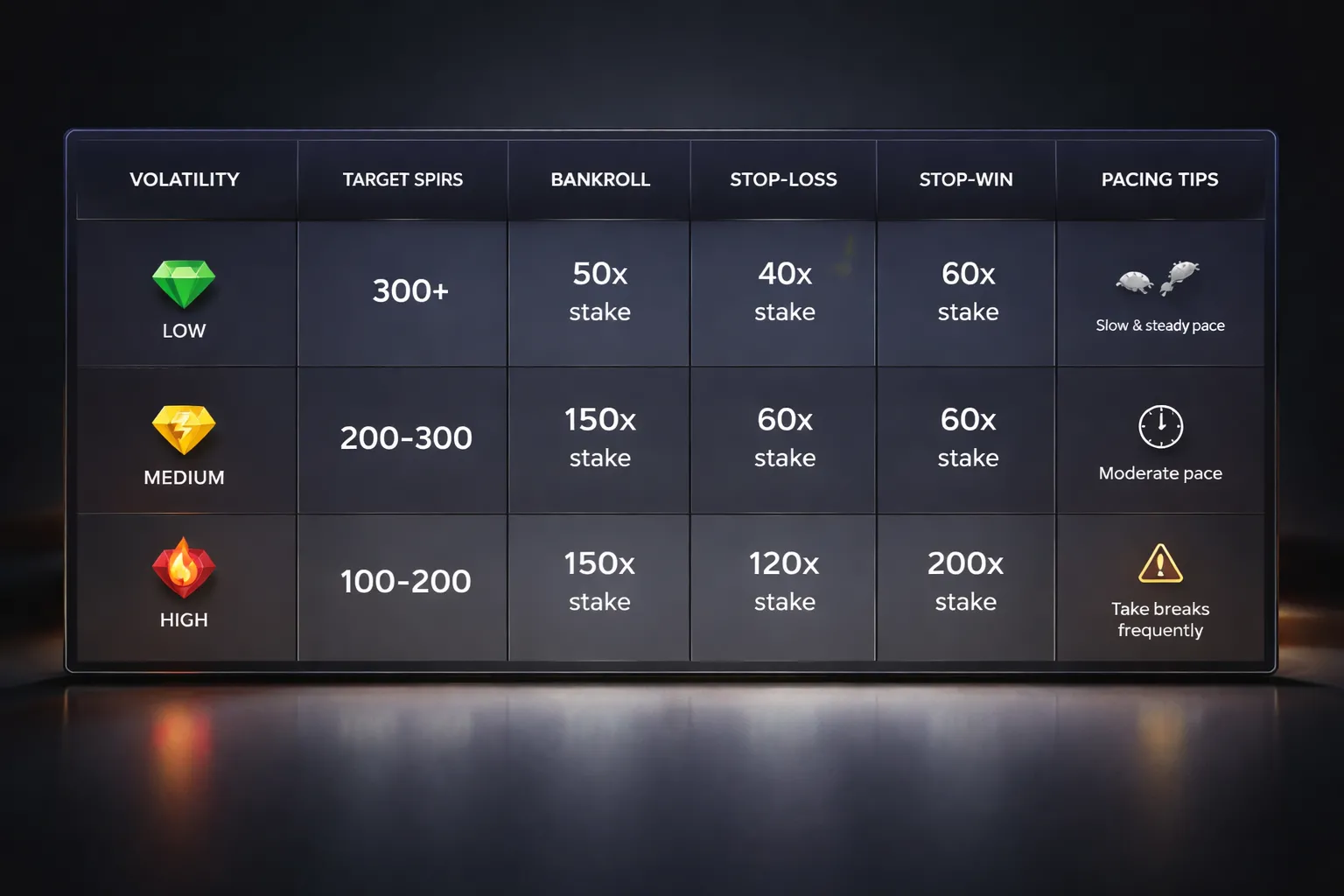
Bankroll sizing guidelines by volatility
Your bankroll decides your stake. Volatility decides how long it lasts.
Use a spin budget. Pick a stake that lets you cover the spin budget without reloads.
| Volatility | Target spins at your stake | Session bankroll guideline | What it protects you from |
|---|---|---|---|
| Low | 200 to 400 | 200x to 400x stake | Slow bleed, many small losses |
| Medium | 300 to 600 | 300x to 600x stake | Mixed runs, feature swings |
| High | 500 to 1,000+ | 500x to 1,000x+ stake | Long dead stretches, sharp drops |
If you cannot fund the spin budget, drop the stake or switch to lower volatility. Do this before you spin.
Bet sizing, when to scale down
Chasing fails because volatility clusters losses. Raising your stake inside a downswing increases ruin risk fast.
- Set one base stake for the whole session. Do not increase it after losses.
- Scale down when your bankroll drops by 25 percent. Cut stake by 30 to 50 percent to restore your spin budget.
- Scale down before bonus buys. Treat a bonus buy like a stake multiplier. If a buy costs 100x, your effective stake is 100 spins at once.
- Use a max stake cap. Keep your largest spin at 0.2 to 0.5 percent of your session bankroll in high volatility games.
If you need help setting a base stake and understanding features that change risk, read how to play online slots.
Stop-loss and stop-win plans
Plan exits before you start. You reduce emotional decisions and protect your bankroll.
- Stop-loss: 20 to 30 percent of session bankroll for low volatility, 30 to 50 percent for high volatility. High volatility needs wider bands or you will quit in normal noise.
- Stop-win: 20 to 50 percent of session bankroll for low volatility, 50 to 150 percent for high volatility. High volatility wins often come in one hit.
- One reset rule: If you hit stop-win, either cash out and end the session, or lock profit by removing at least 50 percent of the win from play.
Do not move the lines mid session. If you want different lines, start a new session later.
Pacing and break tactics during losing streaks
Losing streaks feel personal. They are normal variance. Your job is to keep decisions stable.
- Block your play. Use 50 to 100 spin blocks. Review bankroll only at the end of a block.
- Use a break trigger. Take a 5 to 10 minute break after two losing blocks in a row, or after any big win.
- Do not switch stakes to force action. If the session is going poorly, end it or drop stake on the next block.
- Set a time cap. 30 to 60 minutes for high volatility, 60 to 120 minutes for low volatility. Fatigue drives bad changes.
Online vs land-based slots: does volatility differ?
Online vs land-based slots: does volatility differ?
Volatility comes from game math. That math can exist online or on a casino floor.
The difference is access to information, stake rules, and how the venue controls your options.
Online game info makes volatility easier to research
Online, you can usually check the game details before you commit money.
- Volatility label. Many studios show “low, medium, high,” or a volatility meter.
- Paytable and feature rules. You can see if wins cluster in bonuses or drip in base game.
- RTP disclosure. Many online casinos show RTP, plus the game often lists it in the help file. Use RTP info to separate “pays back over time” from “how swingy it feels.”
In land-based casinos, you often get less. Some cabinets show paytables and top awards, but they rarely show a clear volatility rating. You end up judging by feel, which can mislead you over short sessions.
Denomination and bet limits change perceived volatility in casinos
Casino floors force bigger jumps in stake. That changes how volatility feels in your bankroll.
- Denomination traps. A 1 cent game can still cost $1 to $5 per spin if it forces 100 to 500 credits. Your losses arrive faster, even if the game’s underlying volatility stays the same.
- Minimum bets. Higher minimums shorten your test time. You see fewer spins for the same bankroll, so downswings look harsher.
- Bet ladders. Some cabinets push you into large steps, like $0.88 to $1.76 to $3.52. That makes you overbet without noticing.
- Max bet pressure. Some games lock features or jackpots behind max bet. That raises variance for your wallet because you must risk more per spin to access the best outcomes.
Online stakes usually scale in smaller steps. You can hold your bet steady and run longer blocks. That makes your read on volatility cleaner.
Regulation, testing labs, and what certifications actually mean
Both online and land-based slots use regulated RNGs in licensed markets. Labs test them, but those stamps do not tell you how volatile a slot feels.
- What labs verify. Random number generation, game rules, and that the configured RTP matches what the operator declares.
- What labs do not promise. That you will see “fair” win patterns in a short session, or that volatility labels match a single industry standard.
- Why volatility labels vary. “High volatility” can mean different things across providers because there is no universal public scale tied to one statistic.
Practical takeaway. Treat certifications as “the game should behave as coded.” Use paytable, bonus structure, and your stake size to judge how rough the ride will be for your bankroll.
Common myths and mistakes about slot volatility
Myth: a “due” payout after a cold streak
Slots do not track your last spins and “owe” you a win. Each spin uses the RNG to generate an outcome. Your recent streak does not change the next result.
- Mistake you make: you raise your stake to “get it back” because the game feels ready to pay.
- What happens: you increase your variance. Your bankroll can drop faster, especially on high volatility games.
- Do this instead: set a stop loss and a fixed stake size. If you want more upside, switch games. Do not chase inside the same session.
Myth: higher volatility means higher RTP
RTP and volatility measure different things. RTP estimates long run average return. Volatility describes how wide the swings can be on the way there.
- Reality: a low volatility slot can have 96 percent RTP. A high volatility slot can have 96 percent RTP. The ride changes, not the average.
- What to check: RTP, max win, bonus frequency, and whether a big share of RTP sits in rare bonus outcomes.
- Practical rule: pick RTP for efficiency. Pick volatility for bankroll stress.
Mistake: judging volatility from a single short session
Short sessions mislead you. Volatility shows up over many spins. A high volatility slot can look “dead” for 200 spins, then spike. A low volatility slot can run hot for 50 spins and still stay low volatility.
- What to track: spins played, total wagered, biggest single win, and how often you hit any payout.
- What to avoid: labeling a game “high volatility” because you lost fast, or “low volatility” because you hit three small wins early.
- Better method: read the paytable and bonus rules first, then test with a fixed stake over a larger sample.
Mistake: confusing frequent small hits with profitability
Many small hits can still drain your bankroll. A “hit” often pays less than your bet. These losses disguised as wins create the feeling of steady action while your balance drops.
- What to watch: average payout size relative to your stake. Count how many wins return less than 1x your bet.
- Why it matters: a slot can show a high hit rate but still have a strong house edge and low net return in your session.
- Do this instead: judge results by net profit and total wagered, not by win count. For the math behind this, see how RNG, RTP, and house edge work.
FAQ
What does slot volatility mean?
Volatility shows how a slot pays over time. Low volatility pays smaller wins more often. High volatility pays bigger wins less often. RTP tells long-term return. Volatility tells how rough your short-term swings can get.
Is volatility the same as RTP?
No. RTP is the average return over a huge number of spins. Volatility is the spread of outcomes around that average. Two slots can share the same RTP and feel very different in your session.
Is volatility the same as hit rate?
No. Hit rate measures how often any win lands. Volatility measures win size distribution. A slot can hit often but pay many wins under 1x your bet, so your balance still drops.
How do I find a slot’s volatility?
Check the game info panel, paytable, or provider stats. Look for “volatility” or “variance” ratings. If the game lists max win and bonus frequency, higher max wins and rarer bonuses usually signal higher volatility.
What bankroll do you need for high volatility slots?
Use more spins. Aim for 200 to 500 spins at your stake. Keep your bet small enough to survive long losing runs. If you cannot handle 50 to 100 dead spins, drop stake or pick lower volatility.
What should you play with a small bankroll?
Pick low to medium volatility. Use smaller stakes. Avoid games built around rare bonus triggers or huge max wins. You want steady returns and fewer sharp drops.
What should you play if you want big wins?
Play high volatility slots. Expect long dry periods. Use a strict stop loss and stop win. Do not raise stake to chase. Your edge does not improve when you bet bigger.
Do bonus buys change volatility?
Yes. They compress time and raise risk per minute. You pay for a shot at a high payout feature, but you can still miss. Treat each buy like a high-stakes session. Use a separate budget.
Does higher volatility mean better odds?
No. Odds come from RTP and the game’s rules. Volatility changes the ride, not the expected return. A high volatility slot can still have a low RTP.
Which volatility is best for steady play?
Low volatility. You get more frequent small wins and fewer deep drawdowns. It suits longer sessions and tighter budgets. For basics on RTP, features, and volatility labels, see the online slots guide.
Conclusion
Volatility tells you how a slot pays, not what it pays back over time. RTP and the rules set the long term return. Volatility sets your bankroll swings and how often you see wins.
- Pick low volatility if you want longer sessions, smaller swings, and more frequent small hits.
- Pick high volatility if you can handle long losing runs and you play for rare, larger payouts.
- Match your bet size to your bankroll. High volatility needs more buffer. Low volatility lets you bet closer to your comfort line.
Before you spin, check the RTP and the volatility label. Then set a stop loss and a profit target, and stick to them. If you want a quick refresher on picking between the two, read high volatility vs low volatility slots.
-
Online Casino Fairness Explained: RNG, RTP, House Edge & Provably Fair
8 months ago -
Slot RTP Explained: What RTP Means and How to Use It
8 months ago -
How to Play Online Slots: Rules, Features & Beginner Tips
8 months ago -
How Slot Jackpots Work: Progressive Jackpots Explained
8 months ago -
How to Play Online Blackjack: Rules, Payouts & Quick Start Guide
8 months ago
-
- What does slot volatility mean?
- Is volatility the same as RTP?
- Is volatility the same as hit rate?
- How do I find a slot’s volatility?
- What bankroll do you need for high volatility slots?
- What should you play with a small bankroll?
- What should you play if you want big wins?
- Do bonus buys change volatility?
- Does higher volatility mean better odds?
- Which volatility is best for steady play?
-
-
- What does slot volatility mean?
- Is volatility the same as RTP?
- Is volatility the same as hit rate?
- How do I find a slot’s volatility?
- What bankroll do you need for high volatility slots?
- What should you play with a small bankroll?
- What should you play if you want big wins?
- Do bonus buys change volatility?
- Does higher volatility mean better odds?
- Which volatility is best for steady play?
-
-
Reload Bonus Explained: What It Is and When It’s Worth Claiming
6 months ago -
Online Casino Licensing Explained: Authorities, Licenses & How to Check One
8 months ago -
Best Live Dealer Casinos: Where to Play Live Blackjack, Roulette & More
8 months ago -
Best Online Casinos for High Rollers: VIP Perks, High Limits & Exclusive Bonuses
8 months ago -
Fast Payout Online Casinos: Best Sites for Quick Withdrawals
8 months ago
-
Online Casino Customer Support: What to Look For (Live Chat, Email, Response Times)
8 months ago -
Sign Up for an Online Casino: Create an Account in Minutes
8 months ago -
Online Casino Payment Safety Tips: How to Deposit and Withdraw Securely
8 months ago -
What to Do If an Online Casino Won’t Pay Out: Step-by-Step Actions
8 months ago -
How to File a Complaint Against an Online Casino (Plus ADR Explained)
8 months ago