Online Slots Guide: How Slots Work, Features, RTP & Volatility

Online slots run on math, not hunches. Each spin uses a random number generator, then pays based on the game’s rules and paytable.
This guide breaks down how slots work and what the key numbers mean for your bankroll. You will learn how reels, paylines, and bet sizes interact, how common features like free spins and multipliers change payouts, and how to read RTP and volatility before you play. You will also learn how progressive jackpots fund their prize pools, and what that changes about risk and return.
If you want a deeper RTP breakdown, read our Slot RTP explained guide.
Key Takeaways
- In het kort: Slots use an RNG to pick outcomes on every spin, past results do not matter.
- In het kort: Your bet equals coin value times number of lines or ways, higher bets scale wins and losses.
- In het kort: Reels and paylines show wins, the paytable tells you what each symbol and combo pays.
- In het kort: Features change your payout profile, free spins, multipliers, wilds, and bonus rounds can shift where value comes from.
- In het kort: RTP estimates long-run return, higher RTP usually means a smaller house edge, it does not guarantee short-run results.
- In het kort: Volatility tells you bankroll stress, low volatility pays smaller wins more often, high volatility pays less often but can spike.
- In het kort: Progressive jackpots take a cut of wagers to fund the prize pool, jackpot chasing raises variance and usually lowers base-game value. Read our progressive jackpots explained guide.
What this online slots guide covers (and who it’s for)
This guide breaks down online slots as a math product. You will learn what drives results, what each feature changes, and what to expect from your bankroll over time. You will not find “winning systems” here.
What this guide covers
- How slots work: RNG basics, how outcomes get picked, and why past spins do not matter.
- Core numbers: RTP, house edge, volatility, and how they affect swings and session outcomes.
- Game features: paylines and ways-to-win, wilds, scatters, multipliers, free spins, and bonus buys. What they add, and what they usually cost in variance.
- Jackpots: fixed and progressive jackpots, contribution rates, and why jackpot chasing changes risk.
- How to read a game page: where to find RTP, volatility labels, max win, bet ranges, and feature rules.
- How to pick games: match RTP and volatility to your budget, goals, and tolerance for long losing stretches.
Who it’s for, and what you should aim for
- If you play for entertainment: use volatility to control bankroll stress. Pick lower volatility and set a hard stop time and spend limit.
- If you want to learn: focus on paytables, feature triggers, and betting options. Use demo play to see feature frequency without risking money.
- If you chase big hits or jackpots: expect long downswings. Use smaller bets, larger bankroll buffers, and clear session limits.
- If you already play a lot: use this guide to compare games on RTP, max win, bonus mechanics, and variance. Treat provider labels as rough, not exact.
What you can and can’t control in slots
- You can control: game choice, bet size, session length, stop-loss, win goals, and whether you use bonus buys.
- You can control: whether you pick higher RTP versions when a game has multiple RTP settings.
- You can’t control: RNG outcomes, timing, “hot” and “cold” streaks, and when a bonus triggers.
- You can’t control: the long-run house edge. RTP describes expected return over a huge number of spins, not your next 100.
How to use this guide to pick games and set expectations
- Start with your goal, entertainment, learning, or high-risk chasing.
- Set a bankroll for the session. Then choose a bet size that gives you enough spins to absorb variance.
- Filter games by RTP first. Then pick volatility based on how much swing you can handle.
- Read the feature rules before you play. Note retriggers, multipliers, and any cap on features.
- Use the numbers to set expectations, not to predict results. If you want a deeper breakdown of RTP and how to apply it, read our slot RTP guide.
What are online slots?
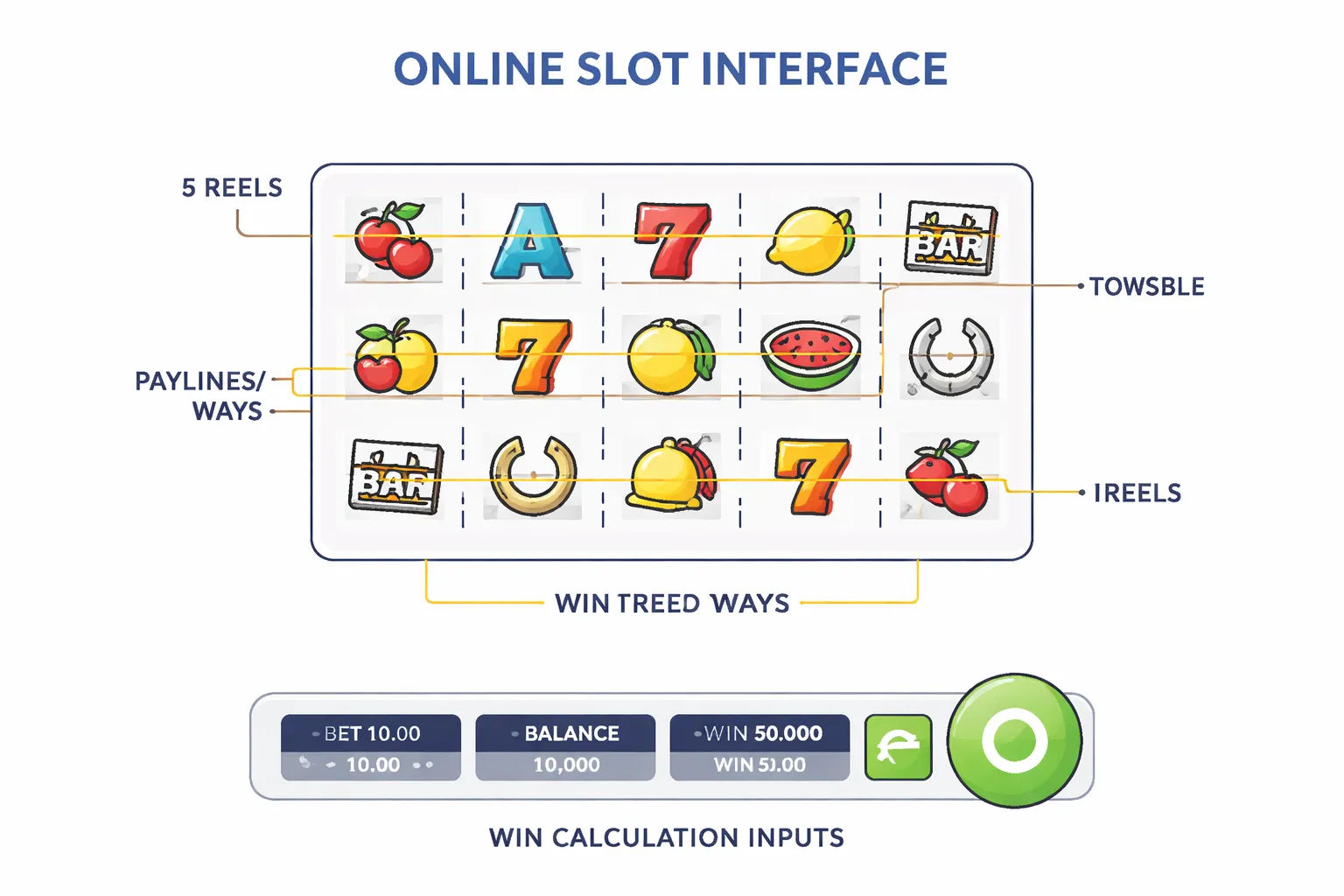
Core concept: reels, symbols, and winning combinations
Online slots are digital slot machines. You place a bet, spin reels, and get a result.
Each game shows a set of reels with symbols. A spin stops with a symbol grid on screen.
- Reels are vertical columns that display symbols.
- Symbols are the icons on the reels. Each symbol has a payout value.
- Paylines are fixed paths that can pay left to right, sometimes both ways.
- Pay ways pay when matching symbols land on adjacent reels, based on rules.
You win when the result matches the game’s pay rules. Most games use “ways” or paylines. Either way, you need matching symbols in the right pattern.
Your payout depends on four inputs: your bet size, the symbol payout table, the number of matching symbols, and any modifiers like multipliers.
How online slots differ from land-based machines
- Outcome generation. Online slots use software to generate results. Land-based machines use onboard hardware. Both rely on random number generation.
- Game variety. Online casinos host thousands of titles. You can filter by RTP, volatility, and features.
- Bet control. Online games often offer wider bet ranges and faster bet changes.
- Features. Online slots add bonus buys, complex bonus rounds, and more modifier mechanics.
- Speed. Autoplay and turbo spins increase spins per hour, which increases short-term swings.
- Transparency. Online slots often publish RTP variants, paytables, and feature rules in the help menu.
Online slots still work like slots. You trade a fixed house edge for entertainment and variance. RTP and volatility shape what you feel, not what you can predict.
Common myths vs reality (hot/cold, due wins, timing spins)
- Myth: A slot gets hot or cold. Reality. Each spin is independent. A long losing run does not make a win more likely on the next spin.
- Myth: You are due a win. Reality. Past results do not create “owed” payouts. RTP is a long-run average, not a schedule.
- Myth: Timing your spin changes results. Reality. The game determines outcomes from random generation, not your reaction time.
- Myth: Stopping the reels controls the outcome. Reality. The stop button changes animation speed. It does not change the result.
- Myth: Casinos can flip a switch to tighten a game mid-session. Reality. Reputable games run on tested configurations. RTP changes, if offered, come as separate versions, not live manipulation.
Use the numbers you can control. Pick RTP first, then choose volatility that fits your bankroll. For a tighter definition of volatility and what it does to your win pattern, read our high volatility vs low volatility slots guide.
How online slots work: RNG, math models, and fairness
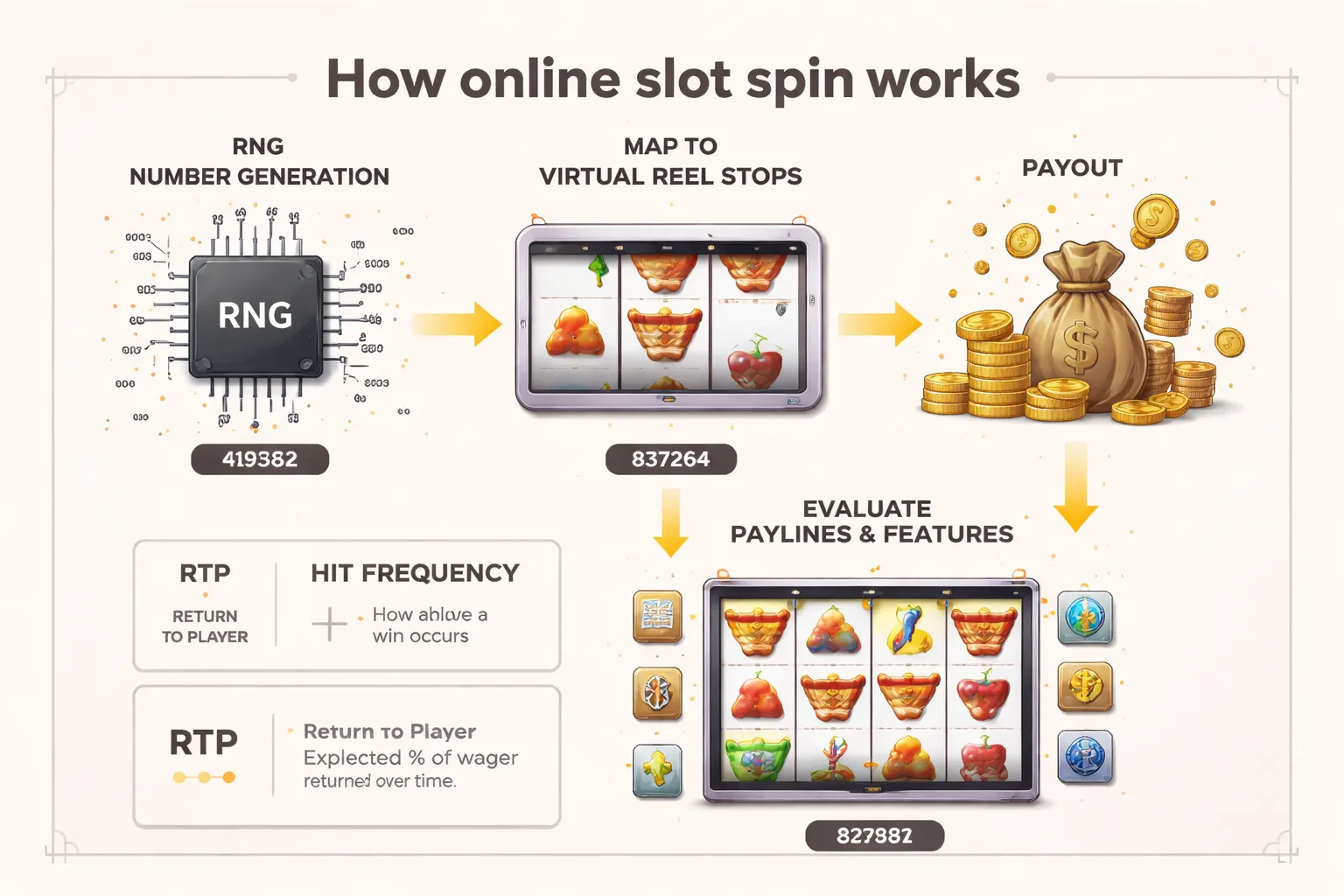
Random Number Generator, what it does and why spins stay independent
Online slots use a Random Number Generator, or RNG. The RNG outputs numbers thousands of times per second. When you hit spin, the game takes the next available numbers and converts them into a result.
Each spin stands alone. Your last win, last loss, or time since a bonus does not change the next output. The RNG does not track your session to “balance” results.
This is why “due for a win” thinking fails. The game does not owe you anything. Your next spin has the same math as your first spin, given the same bet and the same game version.
Reel mapping and virtual reels, why symbols do not have equal odds
Most online slots do not use simple, equal reels. They use virtual reels and reel mapping. Each reel has a list of stop positions. Symbols appear on that list at different frequencies.
Common symbols get more positions. High-paying symbols get fewer positions. This creates the real odds you experience.
Two symbols can look equally common on screen and still have very different underlying weights. You cannot estimate true odds by counting what you see in a short session.
Math models, game cycle, and how a spin becomes a payout
A slot runs on a math model. It sets symbol weights, paytable values, reel layouts, and feature triggers. The model targets a long-term RTP and a volatility profile.
- Step 1: RNG selects stop positions for each reel or selects outcomes through an equivalent weighted process.
- Step 2: The game builds the visible grid from those stops.
- Step 3: It checks wins using its rules, paylines, ways, clusters, or scatter pays.
- Step 4: It checks feature conditions, like scatters, bonus meters, or random triggers.
- Step 5: It applies multipliers, wild rules, cascades, and any bonus logic, then pays the final result.
Some games also use a “feature buy” option. That does not change the RTP target in a vacuum. It changes which parts of the model you reach faster, and it often shifts variance and bankroll risk.
Hit frequency, “game cycle,” and why pattern spotting fails
Hit frequency tells you how often you get any win, including small wins. It does not tell you how profitable those wins are. A slot can hit often and still drain your bankroll if payouts stay small.
Some players talk about a “game cycle,” meaning a full set of outcomes that must appear. Modern slots do not work like a fixed deck you can track. Even when designers can compute theoretical ranges, your session does not follow a predictable loop.
- Near-misses do not signal an approaching win.
- Long losing runs can happen in low and high volatility games.
- Short-term streaks do not prove a “hot” machine.
If you want a deeper breakdown of what fairness checks cover and what they do not, read our online casino fairness explained guide.
Provably fair vs audited RNG, what applies to casino slots
Most casino slots use audited RNG, not provably fair. Audited RNG means independent labs test the RNG and verify the game behaves like the submitted math model.
Provably fair usually applies to crypto-style games where you can verify each result with cryptographic seeds. Some slot-like games use it, but it is not the standard in regulated online casinos.
For most players, the practical check is simple. Use licensed casinos. Play slots from known studios. Look for published RTP versions and testing lab certificates.
Testing labs and certifications, what they verify
Reputable casinos and providers submit games to independent test labs. Common names include eCOGRA and iTech Labs. You may also see GLI and BMM in some markets.
Labs do not “guarantee you will win.” They verify technical and statistical fairness against a specification.
- RNG quality: randomness tests, independence, and lack of bias.
- RTP validation: the game returns the stated RTP over large simulations, within allowed tolerances.
- Rules accuracy: paylines, pays, wild logic, scatters, and feature rules match the documentation.
- Game integrity: no hidden outcome changes, correct handling of interruptions, and consistent payouts.
- Compliance: jurisdiction rules, reporting, and security controls, depending on the regulator.
When you pick games with clear RTP disclosure and credible lab testing, you remove the biggest fairness risk. What remains is variance. That part comes from the math, not manipulation.
Slot terminology you must know
Stake, coin value, bet per line, and total bet
Slots show your cost in a few different ways. You need to know which number actually controls your risk.
- Stake, the amount you set per spin. Some games call this “bet” or “wager.”
- Coin value, the cash value of one coin or credit. Example, coin value $0.01 means each “coin” equals one cent.
- Bet per line, how many coins you place on each active payline. Only applies to paylines slots.
- Total bet, what you pay for the spin. This is the key number for bankroll control.
Common calculations:
- Paylines slot, total bet = coin value × bet per line × number of active paylines.
- Ways-to-win slot, total bet usually equals coin value × bet level, or a direct currency amount you set.
- Bonus buy, a fixed multiple of your current total bet, often 50x to 200x. The base total bet still matters.
Paylines vs ways-to-win vs clusters
These formats decide how the game counts a win. They also change how often you see small payouts.
- Paylines, fixed lines across the reels. You win when matching symbols land on an active line, usually from left to right. Some games allow both directions. Lines can be straight or zig-zag.
- Ways-to-win, you win by landing matching symbols on adjacent reels, typically starting from the leftmost reel. Any position on a reel can count. A 5-reel, 3-row game offers 35 = 243 ways if all reels have 3 positions.
- Clusters, the game pays when a group of matching symbols touches. The required cluster size varies, often 5 or more. Many cluster games use cascades, where winning symbols disappear and new symbols drop in.
Wilds, scatters, and bonus triggers
- Wild, a symbol that substitutes for other symbols to complete a win. Wilds usually do not substitute for scatters or bonus symbols.
- Expanding wild, a wild that grows to cover a reel, row, or block. This boosts hit frequency on that spin.
- Sticky wild, a wild that stays for multiple spins, often during free spins.
- Scatter, a symbol that pays based on count anywhere on the screen, or triggers a feature. Position does not need a line or left-to-right connection.
- Bonus trigger, the condition that starts a feature. Common triggers include 3 or more scatters, special symbols on specific reels, or collecting a set number of items.
Paytable, payout values, and max win (win cap)
- Paytable, the game’s published list of symbols, win rules, and feature mechanics. Check it before you bet. It tells you what can actually happen.
- Payout values, what each winning combination pays. Games may show payouts as coins, credits, or multipliers of your total bet.
- Multiplier, a number that multiplies a win. Example, a 10x multiplier turns a $2 win into $20.
- Max win, the highest possible payout in the game, often shown as a multiple of your total bet, like 5,000x or 20,000x.
- Win cap, a hard limit that stops payouts above a set amount. A cap can come from the game rules, the casino’s maximum payout policy, or both. Read the paytable and the casino terms if you play high stakes.
Hit rate (hit frequency) vs volatility
These two stats get mixed up. They measure different things.
- Hit rate or hit frequency, how often the slot returns any win. Many sites count “any win” as a return greater than $0, even if it is smaller than your total bet.
- Volatility, how the slot distributes its payouts over time. High volatility means fewer but larger wins. Low volatility means more frequent but smaller wins.
Practical impact:
- A slot can have a high hit rate and still drain your balance if most wins are tiny.
- A slot can have a low hit rate but still pay well when it hits.
- Volatility affects bankroll swings. RTP sets long-run return. They are not the same. For the core math terms behind fairness and RTP disclosure, see our online casino fairness explained guide.
RTP explained: what it means and how to use it
RTP as a long-run average
RTP means return to player. It is the percentage of total bets a slot is designed to pay back over a very large number of spins.
An RTP of 96% means that, over the long run, the game returns about $96 for every $100 wagered. The other $4 is the house edge.
Your session will not match the RTP. Short runs swing hard. You can hit a big win early, or lose for hours, even on the same RTP. RTP describes the average across huge volume, not what you will see today.
Game RTP vs casino RTP variations
RTP is a game setting. Some slots ship with more than one RTP version, such as 96.5%, 95%, or 92%.
- One casino may run the higher RTP configuration.
- Another casino, or another region, may run a lower RTP configuration of the same slot.
- Two sites can show the same artwork and features, but your expected cost per $100 wagered can differ.
Do not assume RTP from a review or from a friend. Check the exact RTP shown on your casino, on your device, in your jurisdiction.
Where to find RTP, and what to do if it’s hidden
You usually find RTP inside the game UI.
- Open the menu, then tap Help, Paytable, Game Info, or an i icon.
- Look for a line like RTP 96.2% or Theoretical return 96.2%.
- Check the casino game page for a rules PDF, or a “Game rules” link.
If you cannot find RTP anywhere, treat it as a negative signal. Pick a slot that discloses it. If the casino support cannot confirm the exact RTP configuration, do not assume the best one.
RTP in base game vs bonus rounds
RTP covers the whole game, including the base spins and all bonus features.
Two slots can share the same RTP and still feel very different because they split that RTP differently.
- Some slots return more through small base game hits and frequent features.
- Others push a larger share of RTP into bonus rounds, free spins, or multipliers, with longer dry spells.
- Progressive jackpot slots often divert part of each bet to the jackpot pool, which can lower the base game RTP shown for non-jackpot returns.
This is why RTP alone does not tell you session swings. Pair RTP with volatility. Use a low volatility slot for steadier bankroll movement, and a higher volatility slot if you can handle longer losing runs. For more on the swing factor, see high volatility vs low volatility slots.
House edge in plain English
House edge is the cost of playing, on average, over the long run.
House edge = 100% minus RTP.
| RTP | House edge | Expected cost per $100 wagered |
|---|---|---|
| 98% | 2% | $2 |
| 96% | 4% | $4 |
| 94% | 6% | $6 |
| 92% | 8% | $8 |
Use RTP to compare slots on expected cost. Use volatility and hit rate to plan bankroll size and session length. Higher RTP helps, but it does not remove risk in the short term.
Volatility (variance) explained: choosing the right risk level
Volatility (variance) explained
Volatility tells you how a slot delivers its RTP. It does not change the long-term expected cost. It changes how results spread out in the short term.
Low volatility pays smaller wins more often. High volatility pays fewer wins, but bigger ones when they land. Medium sits between.
Low, medium, high volatility: win patterns and session feel
- Low volatility: Frequent small wins. Many spins return part of your bet. Your balance moves in smaller steps. You can play longer on the same bankroll.
- Medium volatility: Mix of small wins and occasional larger hits. Swings show up, but you still get steady feedback. Many popular video slots sit here.
- High volatility: Long dry spells. Most spins lose. A session can look bad until one bonus or premium hit lands. You need patience and a buffer.
Bankroll implications: why high volatility needs bigger buffers
High volatility increases your risk of going broke before the math has time to work. You can face long losing runs even on a high RTP game.
- Low volatility: Smaller bankroll works. Your main risk comes from slow bleed and normal variance.
- Medium volatility: Plan for swings. A bad stretch can still cut your bankroll fast if you bet too large.
- High volatility: Use a larger bankroll or a smaller bet size. Expect many sessions with no meaningful win. If you chase bonuses with a thin bankroll, you will bust often.
Simple rule: if you want to play a high volatility slot, lower your bet. Keep your bet size stable. Do not scale up after losses.
What drives variance: max win, bonus frequency, and symbol weights
- Max win (maximum payout): Very high max win designs push value into rare outcomes. That usually increases volatility.
- Bonus frequency: If the bonus triggers often and pays modestly, volatility drops. If it triggers rarely but can pay huge, volatility rises.
- Symbol weights and paytable shape: When low and mid symbols pay little and premiums pay most of the value, you get more dead spins and bigger spikes.
Two slots can share the same RTP and still feel nothing alike. One can drip small returns. The other can stay silent for hundreds of spins and then hit hard.
Volatility vs hit frequency: practical examples
Hit frequency means how often you get any win, even a small one. Volatility means how large and how uneven those wins are.
| Slot profile | Hit frequency | Typical win size | What you feel |
|---|---|---|---|
| High hit, low volatility | High | Small | Many small wins, slower swings |
| High hit, high volatility | High | Usually small, sometimes huge | Frequent hits, but big balance spikes and drops |
| Low hit, high volatility | Low | Large when it lands | Long dry spells, rare big outcomes |
Example: a slot can “hit” every 3 to 5 spins, but most hits pay less than your bet. Your balance can still fall fast. Another slot can hit less often, but when it hits it covers many losing spins at once.
Choosing volatility based on your goal
- Steady play and longer sessions: Pick low to medium volatility. Look for decent RTP and a higher hit rate. Keep stakes consistent.
- Bonus hunting with limited bankroll: Pick medium volatility with frequent features. Avoid extreme max win designs unless you can handle long droughts.
- Big-win hunting: Pick high volatility and accept the tradeoff. Use a smaller bet size and a larger bankroll. Treat most sessions as likely losses.
If you want a deeper breakdown of volatility labels and what they mean across providers, see our slot volatility guide.
Anatomy of a slot: reels, symbols, and payout structure
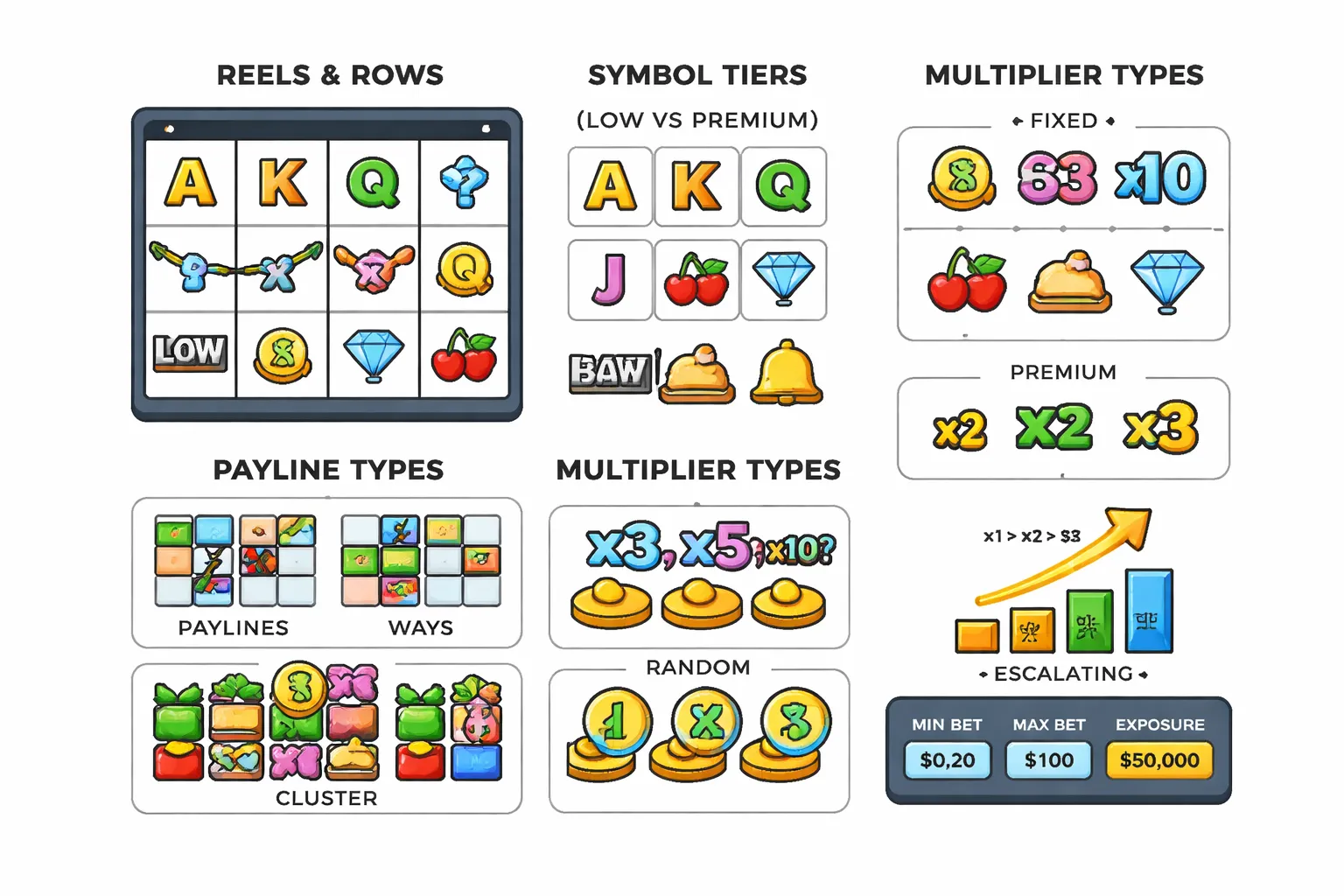
Reels and grid size, what changes mechanically
A slot shows results on a reel grid. Reel count and rows control how many symbol positions you get per spin. More positions usually means more ways to form wins and more variance in outcomes.
- 3-reel, often 3x3. Fewer symbol stops. Fewer win lines. Payouts tend to rely on line hits and basic features.
- 5-reel, common formats include 5x3 and 5x4. More lines or ways. More room for wilds, scatters, and feature symbols. Most modern mechanics target this layout.
- 6+ reels, often 6x4, 6x5, or grid-based systems. Providers add extra reels to support mechanics like cascading wins, expanding reels, or persistent symbols. This increases the number of symbol evaluations per spin and can shift more RTP into features.
Reel count alone does not tell you RTP or volatility. It tells you how the game builds wins. Always check the paytable and rules for how it counts combinations.
Symbols and payout tiers
Slots split symbols into tiers. Each tier changes how often you hit a win and how much each hit pays.
- Low-tier symbols, usually card ranks. They hit more often. They pay less per combination. They drive most small wins.
- Premium symbols, character or themed icons. They hit less often. They pay more on the same line length. They often anchor the biggest base game wins.
- Wilds, substitute for other symbols under specific rules. Some wilds stack, expand, or carry multipliers. These rules decide how much of the RTP sits in the base game versus the features.
- Scatters, pay anywhere or trigger bonuses. Scatter frequency is a key input to feature hit rate.
- Bonus symbols, trigger a separate mechanic like free spins, hold and win, or pick games. These symbols usually do not substitute and often do not pay on their own.
Premium symbols matter because they concentrate value. If a game pays most of its top line wins through premiums, your win rate can stay high while your profit rate stays low, since premiums do not land often enough to offset the many losing spins.
Payout structure, paylines, ways, and clusters
The payout structure defines what counts as a win. It also controls how often wins occur and how wins overlap.
- Paylines, fixed patterns across the grid. You win when matching symbols land on the same line, usually left to right. More paylines increases hit frequency but also spreads your stake across more lines.
- Ways to win, also called all-ways. You win when matching symbols appear on adjacent reels, across any row. More symbol positions per reel can raise hit frequency and increase variance in feature states.
- Clusters, you win when a symbol forms a connected group of a minimum size. Cluster systems often pair with cascades and multipliers, which moves more value into streaks.
Check whether wins pay per line, per way, or per cluster. Also check whether the game pays both directions or only left to right. These details change real hit rate.
Multipliers, fixed, random, and escalating
Multipliers change payout size without changing symbol value. They shape volatility by shifting more return into fewer outcomes.
- Fixed multipliers, always apply when a rule triggers, such as a wild that pays 2x. These create predictable uplift.
- Random multipliers, roll from a range, such as 2x to 100x, when certain symbols land. These raise top-end potential and widen the return distribution.
- Escalating multipliers, grow during cascades or free spins, such as +1 each win or doubling each cascade. These create streak dependence. Your session result can hinge on one extended chain.
Look for where multipliers can appear. Base game multipliers tend to smooth results. Feature-only multipliers concentrate value into bonus rounds.
Minimum bet, maximum bet, and max exposure per spin
Your risk per spin depends on bet range and what counts as a paid spin.
- Minimum bet, the smallest stake the game accepts. Use it to test hit rate and feature frequency without burning bankroll.
- Maximum bet, the cap per spin. This matters if you chase max win numbers, since many games cap your effective win at a multiple of stake.
- Max exposure per spin, your true cost when the game can add paid actions, such as bonus buy, side bet, or gamble features. A bonus buy can equal hundreds of base spins in one click. Treat it as a separate product with separate variance.
Always confirm whether the displayed stake is total bet or bet per line. Some older-style interfaces still show both and it can confuse your actual cost.
Return distribution, why many small wins can still be losing
A slot can show frequent wins while your balance drops. This happens when most wins return less than your stake.
- Hit frequency tells you how often you get any win. It does not tell you whether you profit on those wins.
- Net result per win matters. If you bet $1 and you “win” $0.20, you still lost $0.80 on that spin.
- RTP and volatility shape how returns arrive. Many slots push a large share of RTP into bonuses. That design can produce long losing stretches with occasional spikes.
Use the paytable to identify what the game calls a win. Track whether typical wins return less than your stake. If the game offers a progressive jackpot component, read the rules in our progressive jackpot guide.
Popular online slot types and formats
Classic 3-reel slots vs modern video slots
Classic 3-reel slots keep the structure simple. You usually get 1 to 5 paylines, fixed reel strips, and a small paytable. Features stay limited, often wilds and a basic bonus or none at all.
Modern video slots use 5 reels or more and many paylines, often 10 to 243 or ways-to-win systems. They add stacked symbols, expanding wilds, scatters, free spins, multipliers, and bonus buy options where allowed.
- What changes for you, hit pattern and bankroll swing. Video slots often pay small wins more often, but push a large share of RTP into bonus rounds.
- What to check, paylines or ways, minimum bet steps, bonus rules, max win cap, and whether the slot uses a variable bet per line or a total bet model.
Progressive jackpot slots: local vs networked progressives
Local progressives grow on a single game or operator network. Fewer players fund the pot, so the jackpot grows slower. You may see smaller jackpots more often.
Networked progressives link many casinos and large player pools. The jackpot can reach very large numbers, but hit frequency stays low.
- Contribution rate matters. A portion of each qualifying bet funds the jackpot. The game rules state if you must bet max to qualify.
- RTP split matters. Some RTP goes to the base game, the rest goes to the jackpot pool. That can reduce base game returns and increase variance.
- What to check, qualifying bet, jackpot tiers, reset value, and whether the jackpot triggers randomly or through a bonus feature.
For a deeper breakdown of triggers, contributions, and qualification rules, read our progressive jackpot guide.
Megaways and dynamic reels: what fluctuates each spin
Megaways and other dynamic reel systems change the number of symbol positions on each reel every spin. That changes your ways to win on that spin.
- What fluctuates, reel heights and total ways. Many games range from a few hundred ways up to 117,649 ways.
- What stays fixed, the RNG process, the published RTP for the game and the overall volatility profile for that version.
- Practical impact, payout distribution shifts. Large ways counts can increase the chance of any win, but wins often land as small returns unless a feature triggers.
- What to check, max ways, whether wild multipliers exist, and how multipliers grow during free spins.
Cluster pays and avalanche, cascades: how re-spins are created
Cluster pays replace paylines with groups of matching symbols that touch. The rules define the required cluster size, often 5 or more.
Avalanches or cascades remove winning symbols and drop new ones into the grid. That creates extra resolves from one paid spin.
- What creates re-spins, the game resolves a win, removes symbols, refills, then checks again. This repeats until no new win appears.
- Why it matters, many games attach multipliers that increase with each cascade. A single spin can carry most of its value in later cascades.
- What to check, minimum cluster size, whether multipliers reset each spin or persist in a feature, and whether special symbols can land only on certain cascades.
Branded slots: what licensing changes (theme) vs what stays (math)
Branded slots use licensed films, TV shows, music, or celebrities. Licensing mostly changes the theme layer, symbols, and audio.
- What usually changes, visuals, story-driven bonuses, branded mini-games, and collectible features designed to match the IP.
- What does not change, the core model. RTP, volatility, hit rate patterns, max win rules, and feature value drive your results, not the license.
- Practical check, do not assume a branded game pays better. Compare RTP, volatility notes, bonus rules, and max win caps the same way you would for any slot.
Bonus features that shape gameplay
Free spins rounds, retriggers, multipliers, sticky wilds
Free spins shift value into a separate mode. You usually keep your base bet size, but the feature changes the math. Read the rules for how wins scale and how the round can extend.
- Retriggers: Extra free spins extend your exposure to the feature. More retriggers often mean lower average base game hits or lower base game payout share. Track how often retriggers happen in demo. Do not assume they appear often because the game shows them.
- Multipliers: Multipliers raise top-end outcomes and push variance up. A flat multiplier, like 2x for all spins, feels steady. An increasing multiplier, like +1 per win, concentrates value into streaks and can create long dead runs.
- Sticky wilds: Sticky wilds turn one good spin into several high-value spins. They raise volatility. They also increase feature dependence, since sticky wilds usually do little without time left in the round.
Practical check. Look for these details in the paytable, feature screen, or rules. Is the multiplier applied to total win, line win only, or specific symbols. Do sticky wilds persist for the full round or reset on blanks. Can the feature retrigger without limit or with a cap.
Hold & Spin and respin features, prize collection rules
Hold & Spin uses locked symbols and a respin counter. You start with a few spins. Each new special symbol resets the counter. If the counter hits zero, the bonus ends and you collect what you locked.
- Prize types: Coins can hold fixed credit values, bet multipliers, jackpots, or upgrades. Fixed values drive small, frequent wins. Upgrades and jackpots drive rare, large wins.
- How collection works: Some games pay the sum of all locked values. Some pay per reel or per row. Some apply a bonus multiplier at the end. Know what stacks and what does not.
- Full screen rules: Many games pay extra when you fill the grid. This is often where most max win potential sits. If the grid is large, expect it to land less often.
Bankroll impact. Respin features can feel active but still produce long stretches of low returns if the coin values skew small. The main signal is the value table and the chance of upgrades or jackpots, not the animation.
Expanding wilds, walking wilds, stacked wild reels
Wild features change hit rate patterns and payout shape. They do not change RTP by themselves. They change how outcomes cluster.
- Expanding wilds: A wild can grow to cover a reel or a block. This increases the chance of full-line hits when it triggers. Designers often balance it by making the trigger rare or by lowering base symbol values.
- Walking wilds: A wild moves across reels for several spins. This can create a delayed payout effect, where value arrives later in the sequence. It raises variance because the best results need the wild to survive and align with premium symbols.
- Stacked wild reels: Whole reels of wilds create big swings. Some games cap how many wild reels can land at once. Check if wild reels can stack, stick, or respin.
Practical check. Verify where wilds can land, whether they appear on all reels, and whether they substitute for scatters or bonus symbols. These small rule lines change feature strength more than the theme.
Bonus buy and feature purchase, variance and bankroll impact
A bonus buy trades time for concentration. You pay a large multiple of your bet to enter a feature. You skip the base game cycle that normally feeds into it.
- Variance rises: You compress many spins of outcome range into one purchase. Your session result can swing fast, up or down.
- Bankroll drains faster: A few poor bonus outcomes can remove a large share of your bankroll. Treat each buy like a separate high-stake event, even if your base bet looks small.
- RTP can differ: Some games offer a lower RTP on bought bonuses. Some jurisdictions require disclosure in the info panel. Check the exact RTP for the buy feature if listed.
- Max win caps matter more: If the slot has a low max win limit, bonus buys hit the ceiling sooner. That reduces upside on high-cost entries.
If you use bonus buys, size your bet down. Keep a strict limit on number of buys per session. For a deeper breakdown of how feature-heavy games affect swings, use this slot volatility guide.
Gamble features, double-or-nothing risk trade-offs
Gamble features let you risk a win to try to increase it. The common formats are red or black, higher or lower, or pick-a-card.
- Expected value usually drops: The gamble step often adds extra house edge. Even when it feels fair, ties, zero outcomes, or rule quirks can tilt it.
- Variance spikes: You turn a secured win into a coin-flip style swing. This can push you into tilt and bad bet sizing.
- When to avoid: Avoid gambling when you play with a tight bankroll, when the win already covers a meaningful part of your session, or when you chase losses. Avoid it when the game caps how many gambles you can take, since the cap can trap you into uneven risk.
- When it fits: It only fits if you treat it as entertainment, you accept the higher risk, and you set a hard stop after one attempt.
Progressive jackpots: how they work and what to watch for
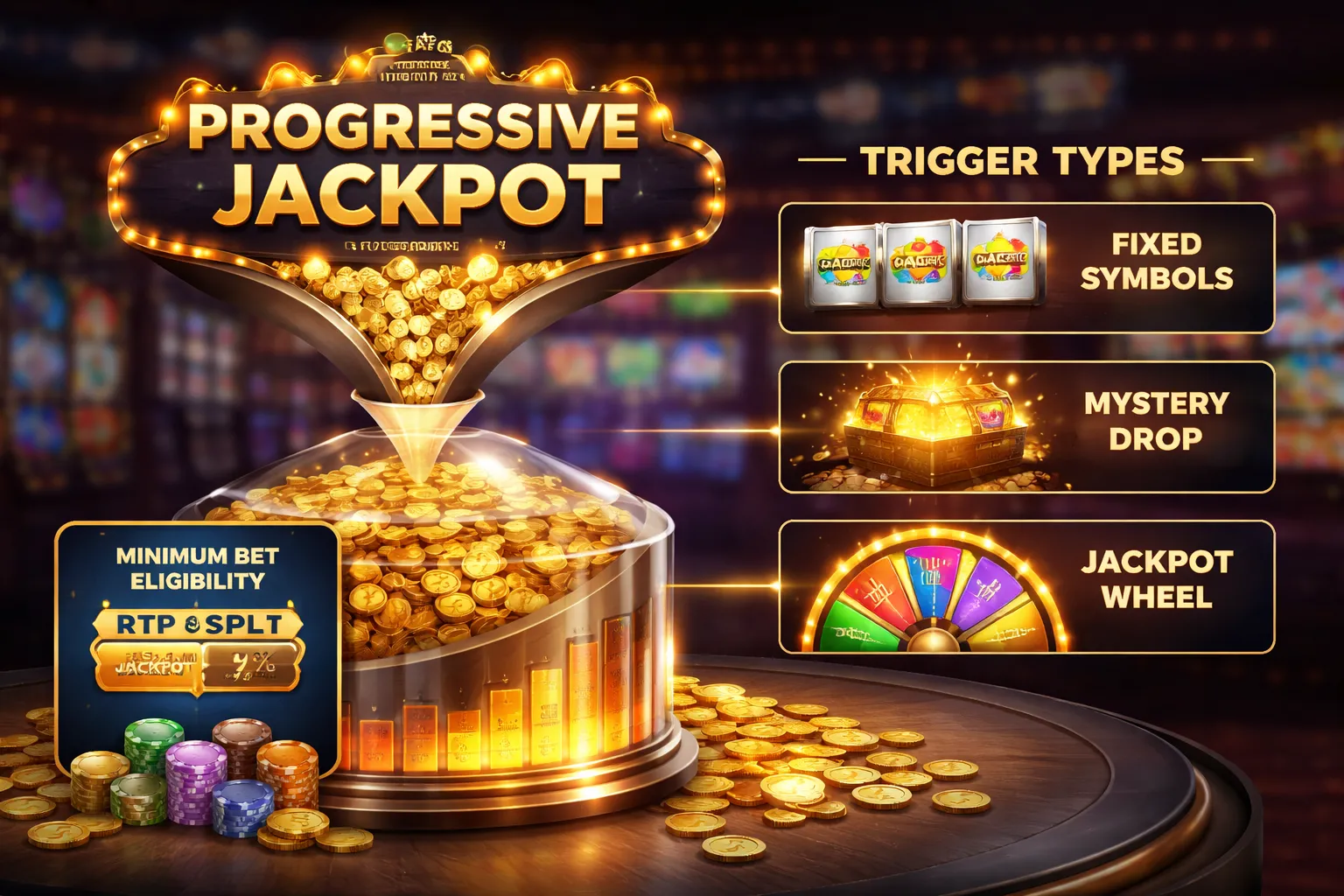
How progressive jackpots are funded and displayed
A progressive jackpot grows as players bet. The game takes a small cut of each qualifying wager and adds it to the jackpot pool. The casino or studio can also seed the pool with a starting amount.
You usually see the jackpot total on the game screen. Some games show several pools, often called Mini, Minor, Major, and Grand. Each pool can grow at a different rate and can have different trigger rules.
Two details matter. First, the contribution only applies on eligible spins. Second, the displayed number can update with a delay if the pool comes from a shared network across many casinos.
Trigger methods you will see
- Fixed symbols or fixed outcomes: You win when specific symbols land in a defined way. Example: five jackpot symbols on a payline, or a jackpot symbol collection to a target count.
- Mystery jackpots: The jackpot can drop on any qualifying spin. The reel result can look normal. The trigger comes from a separate random event.
- Jackpot wheels or feature picks: You enter a bonus, then a wheel or selection decides which jackpot tier you win. Many spins in the bonus do not award a jackpot.
RTP and why some progressives have lower base returns
A progressive can pull RTP out of the base game and move it into the jackpot. That often lowers the non jackpot return and can increase volatility.
Two common setups exist.
- Fixed RTP, with RTP allocated to the jackpot: The overall RTP may stay near the published number, but a slice sits in the jackpot component. Your short sessions feel colder unless you hit the jackpot.
- Lower base RTP plus external funding: Some networks fund the pool partly from wagers, partly from operators. The base game can still sit at a lower RTP than similar non progressive slots.
Do not assume a progressive gives you extra value. Check the listed RTP and compare it to non progressive games. For lower house edge options, use this guide to low house edge casino games.
Jackpot odds and what they imply
Progressive jackpots usually come with long odds. Many are designed as rare events, not steady value. You can play for hours and never see a top tier hit. Treat the jackpot as a bonus outcome, not a plan.
When the studio publishes odds or hit rates, use them. If it does not, assume the top tier sits at the far end of the distribution. That means high variance and large bankroll swings.
Eligibility bets and common T&Cs pitfalls
Most progressives require a minimum bet to qualify. If you bet below it, you either cannot win the jackpot or you only qualify for smaller tiers.
- Minimum bet rules: The Grand often needs max bet or a stated threshold. Read the paytable, rules, or info panel.
- Bet level changes: Switching stake can reset progress meters, symbol collections, or feature qualifiers in some games.
- Bonus buy and free spins: Some jackpots exclude bonus buys or free spin rounds. Others allow them but cap jackpot tiers.
- Max win limits: A max win cap can override a jackpot win or reduce the effective value. Check the game rules and the casino terms.
- Network rules and verification: Large wins can trigger checks. Delays are normal. If you play with bonuses, wagering rules can affect withdrawal timing.
When a progressive slot can make sense for entertainment value
It fits when you buy a small chance at a large payout and you accept the cost. Keep the decision simple.
- Set a fixed budget for jackpot chasing. Treat it as spent.
- Play at the minimum stake that qualifies for the jackpot tier you want, or do not play the progressive at all.
- Limit session length. Long sessions increase exposure to the house edge.
- Avoid progressives if you need stable bankroll time, or if you play for frequent smaller wins.
How to choose a slot: a practical checklist
Match RTP and volatility to your budget and time horizon
Start with two numbers, RTP and volatility. They control the long-run cost and the short-run swings.
- RTP sets expected cost. Higher RTP means lower average loss rate over many spins. Small gaps matter over time.
- Volatility sets bankroll stress. Low volatility pays smaller wins more often. High volatility pays less often and can run long dead spells.
- Short session, small bankroll: Favor higher RTP and low to medium volatility.
- Long session, larger bankroll: You can handle medium to high volatility, but keep RTP competitive.
- Decide a loss limit first. Then pick volatility that fits it. High volatility punishes thin bankrolls.
- Use RTP as a filter. If a game hides RTP or offers multiple RTP versions, treat it as a red flag unless you can confirm the exact setting.
For a deeper RTP breakdown, read what RTP means and how to use it.
Check max win, win cap, and bonus frequency signals
Do not pick a slot on theme. Pick it on payout shape.
- Max win (x bet): This tells you the ceiling. Higher max win usually comes with higher volatility. A 10,000x game can still pay nothing for long stretches.
- Win cap: Some games cap total wins per spin or per bonus. If a cap exists, find the number and decide if it kills the upside you want.
- Bonus frequency: Look for signals in the rules and paytable, not marketing.
- Clear frequency hints: “Average free spins trigger every X spins,” “bonus buy available,” or published hit rate data. If the game gives no clues, assume wide variance.
- Bonus buy impact: Bonus buys raise cost per attempt. They can speed up volatility. They also compress your bankroll faster.
Look for transparent rules: paytable, feature rules, and RTP disclosure
If you cannot verify how a slot pays, skip it.
- Paytable clarity: You should see symbol values, paylines or ways-to-win rules, and wild and scatter behavior.
- Feature rules: Check how free spins work, multipliers, reel modifiers, and whether wins can retrigger.
- Bet mechanics: Confirm what changes when you toggle ante bets, feature boosts, or side bets. These often trade higher cost for higher feature access.
- RTP disclosure: Look for an explicit RTP number inside the game info panel. If the slot has multiple RTP versions, confirm which one your casino uses.
- Volatility label: Treat it as a rough guide. Use it with max win and bonus behavior, not alone.
Provider reputation, licensing, and independent testing indicators
Your best protection is a clean chain, licensed casino, known provider, tested game.
- Provider track record: Stick to developers with long-running releases and broad distribution. Unknown studios can still be fine, but you take more risk on support and transparency.
- Casino license: Use regulated operators. You want enforceable rules on payouts, complaints, and game integrity.
- RNG testing: Look for independent testing mentions, such as eCOGRA, iTech Labs, GLI, or BMM. Do not treat logos as proof, verify them on the casino’s compliance pages when possible.
- Version control: A slot can exist in several RTP variants. The casino controls which variant it offers. Confirm the displayed RTP in the help menu.
Mobile performance, demo availability, and UX considerations
If the game runs poorly, you will make worse decisions and misclick bets.
- Demo mode: Use it to test pacing, feature clarity, and bet controls. Do not treat demo results as predictive.
- Load speed and stability: Avoid games that lag, crash, or desync. Crashes during features create disputes and stress.
- Bet control safety: Check coin value, total bet, and quick spin settings. Disable turbo if it makes you lose track of spend.
- Information access: You should reach paytable, RTP, and feature rules within one or two taps.
- Screen layout: On mobile, confirm you can see balance, bet, and win clearly. Poor UI hides cost.
How to play online slots step-by-step

Select a game and use demo mode first
- Pick a slot that fits your bankroll. Check RTP, volatility, and max win before you commit.
- Open the demo mode. Learn the reel layout, symbol set, and key rules without risking money.
- Do 50 to 100 spins in demo. Track how often you see any win and how often you see bonus symbols.
- Find the game rules and feature rules inside the menu. Read them now, not after you deposit.
Set your bet size, lines or ways, coin value, and pace
- Start with a small bet. Raise only after you understand the payout structure and feature triggers.
- On paylines games, set the number of lines and your bet per line. More lines usually means more frequent small wins, but higher cost per spin.
- On ways or Megaways style games, you usually cannot pick lines. You change total bet through coin value, coin size, or a bet slider.
- Check whether the slot uses coins, credits, or direct currency. Focus on total bet per spin, not the coin count.
- Turn off fast play at the start. Fast play increases spins per minute, which increases your hourly spend.
- If the slot offers a turbo mode, quick spin, or slam stop, treat it as a bankroll tool. Use it only when you already set strict limits.
Read the paytable before you spin, check these items first
- RTP. Use the highest available RTP version if the casino offers multiple versions. For deeper help, read our guide to slot RTP.
- Volatility. Match it to your budget. High volatility needs a larger bankroll and more patience.
- Max win and any win cap. Confirm the maximum payout, and check if the game caps wins during bonus rounds.
- Pay rules. Check left to right rules, adjacent pays, and whether you need paylines or any-position pays.
- Wild rules. Confirm where wilds appear, whether they stack, and whether they substitute in bonus rounds.
- Scatter and bonus rules. Confirm how many scatters trigger features, and whether the bet level changes feature payouts.
- Multipliers and special symbols. Check if multipliers apply to line wins, total wins, or bonus wins only.
Understand outcomes, wins, near-misses, and feature triggers
- Expect most spins to lose. Slots price in losses to fund feature payouts and larger wins.
- Small wins often return less than your stake. Treat them as partial refunds, not profit.
- Near-misses do not signal improved odds. Each spin runs independently.
- Learn the trigger symbols. Count how many you need and whether they must land on specific reels.
- Know what happens inside features. Check if free spins include retriggers, increasing multipliers, expanding wilds, or symbol upgrades.
- Watch for bet-dependent mechanics. Some slots change feature value at higher bets, others do not.
Use autoplay responsibly, set limits and stop conditions
- Use autoplay only after you set a session budget and a time limit.
- Set a loss limit that stops autoplay when you hit a fixed amount down.
- Set a win limit that locks in profit and ends the session when you reach it.
- Set a spin limit to cap volume. Volume drives total cost more than single-spin size.
- Turn off turbo during autoplay if you struggle to track spend. Slower pace reduces mistakes.
- Stop after any big win or bonus run. Recheck bet size and limits before you restart.
Bankroll, budgeting, and session planning
Setting a bankroll and choosing a stake size guideline
Your bankroll is the money you can lose without changing your plans. Set it before you open the game. Keep it separate from bills and savings.
Pick a stake that fits the session length you want. Most players go broke from volume, not from one big spin.
- Simple stake rule: set your base bet to 0.5% to 1% of your session bankroll.
- High volatility rule: 0.2% to 0.5% per spin. Big swings need more buffer.
- Hard floor: if you cannot afford at least 200 spins at your base bet, lower the stake or increase the bankroll.
| Session bankroll | 0.2% bet | 0.5% bet | 1% bet |
|---|---|---|---|
| $50 | $0.10 | $0.25 | $0.50 |
| $100 | $0.20 | $0.50 | $1.00 |
| $200 | $0.40 | $1.00 | $2.00 |
| $500 | $1.00 | $2.50 | $5.00 |
Time limits vs money limits, which is more effective and why
Money limits control risk. Time limits control pace. Use both, but treat money limits as the main guardrail.
- Money limits work because they cap downside. They also stop you from raising stakes to chase losses.
- Time limits help because slots run fast. Speed increases total bets, and total bets drive total expected loss.
- Best setup: a spend cap plus a timer. When either hits, you stop.
If you use autoplay or turbo, shorten the time limit. Faster spins can double your bet count with the same stake.
Stop-loss and stop-win, creating rules you can follow
Set rules that you will obey. Make them mechanical. Do not renegotiate mid-session.
- Stop-loss: stop at 30% to 50% of your session bankroll. Smaller limits reduce tilt decisions.
- Stop-win: stop at 20% to 40% profit. Lock profit and leave. Slots can give it back fast.
- One change rule: if you change any limit once, end the session. Limit changes usually mean loss chasing.
Keep stop-loss and stop-win tied to your session bankroll, not to your deposit amount. Deposits can vary. Risk rules should not.
Managing volatility with bet sizing, flat betting vs adjusting
Flat betting keeps your variance predictable. It also keeps you from turning a normal downswing into a bankroll wipeout.
- Use flat betting by default: same stake every spin, same lines and features.
- Adjust only with a plan: change stake in fixed steps, based on bankroll, not on feelings.
- Downshift rule: if you drop 25% from session start, cut stake by 25% to 50% or stop.
- Upshift rule: only raise after you lock profit with a stop-win reset, or after a cashout.
High volatility games punish aggressive increases. If you prefer higher swings, lower the base bet instead of trying to outpace the swings. For deeper detail, see slot volatility explained.
Tracking results, why short-term records can mislead and what to track instead
Short sessions tell you little about RTP. Variance dominates. A few bonuses can make you think a game is good. A long dead stretch can make you think it is bad.
Track process stats. They improve decisions even when results swing.
- Game and RTP: record the slot name, listed RTP, and any feature buys you used.
- Volatility notes: your longest dead stretch, bonus frequency, and typical bonus payout size.
- Spin volume: spins per session, and total bet size per session.
- Bankroll plan: starting bankroll, base stake, stop-loss, stop-win, and whether you followed them.
- Cost rate: average loss per minute or per 100 spins. This shows how fast you burn bankroll.
Judge your performance by rule compliance. If you stick to limits and stake rules, your risk stays controlled, even when outcomes run hot or cold.
Online slots tips: what helps (and what doesn’t)
Use high RTP as a filter, not a guarantee
RTP affects your long-run cost rate. Higher RTP usually means you lose less per 100 spins at the same stake.
Use RTP to screen games. Do not use it to predict short sessions.
- Filter: Prefer higher RTP when you have options, and avoid games with unknown or very low RTP.
- Reality check: A 96 percent RTP game can still run cold for hours. Variance drives short-term results.
- Do this: Track your loss per 100 spins across different games at the same bet size. Keep what burns slower.
If you want the mechanics and limits of RTP in plain terms, read what RTP means and how to use it.
Avoid ‘systems’ like Martingale, why it fails with balance limits and variance
Betting systems do not change RTP. They only change how fast you risk your bankroll.
- Table limits: Online slots cap max bet. After a streak, you hit the cap and the system breaks.
- Balance limits: Your bankroll hits zero before the math “recovers.” This happens often on high volatility games.
- Variance: Losing streaks cluster. A doubling plan turns a normal streak into a bankroll wipeout.
- House edge stays: Larger bets during bad runs increase expected loss per minute.
Replace systems with rules you can follow. Fixed base stake. Pre-set stop-loss. Pre-set stop-win. Same stake on every spin unless you planned otherwise.
Promotions and free spins, wagering requirements and value checks
Bonuses can lower cost if the terms favor you. Most offers do the opposite.
- Check wagering: High wagering turns small bonuses into large required turnover.
- Check contribution: Some slots contribute less than 100 percent, or not at all. That increases real wagering.
- Check max bet rules: If you exceed it, you risk voiding winnings.
- Check game eligibility: Free spins may lock you into low RTP titles or high volatility titles.
- Check win caps: A cap can erase the upside while keeping the full wagering burden.
Quick value test. Estimate expected bonus value as: bonus amount minus house edge on the required wagering. If the expected loss on wagering exceeds the bonus, skip it.
Know when to switch games, tilt, chasing losses, boredom
Switching games does not reset odds. Your reason for switching matters.
- Tilt signs: You raise stakes to “get it back,” you speed up spins, you ignore your stop-loss.
- Chasing losses: You change games after losses expecting a “due” hit. That is pure variance, not a signal.
- Boredom play: You keep spinning without tracking time or cost rate. Your session drifts past limits.
When you see these signs, stop the session. If you keep playing, drop to your base stake and set a short timer. Your goal is rule compliance, not recovery.
Recognizing misleading design, near-miss effects and celebratory losses
Slots use visual and audio cues to keep you spinning. These cues do not change RTP.
- Near-miss effects: Two bonus symbols land, the third “almost” hits. It feels close, but each spin stays independent.
- Celebratory losses: The game plays win sounds when you win less than your bet. You still lost money on that spin.
- Feature teasers: Progress bars and “one away” meters can push you to extend sessions past your plan.
Counter it with hard numbers. Track net result, average loss per 100 spins, and time. Mute sound. Turn off turbo if it makes you lose stake discipline.
Pros and cons of playing online slots
Advantages
- Variety. You get thousands of titles. You can filter by RTP, volatility, features, and paylines.
- Features. Modern slots add bonus buys, free spins, multipliers, and expanding symbols. You can pick games that match your risk tolerance and bankroll.
- Convenience. You can play on mobile, set your stake fast, and change games in seconds. You also get session history and transaction records.
- Demo play. You can test mechanics and pacing without risking cash. Use demos to learn bonus triggers and typical feature frequency before you deposit.
Downsides
- Speed of play. Online spins run fast. Fast spins increase total wagers per hour, which increases expected loss per hour at the same RTP.
- Higher session volatility. Many popular slots concentrate returns in bonus rounds. You can go long stretches with small or zero wins, then hit a large payout. This creates sharp bankroll swings. If you need steadier results, avoid high-volatility titles.
- Bonus terms. Wagering requirements, max bet rules, excluded games, and win caps can turn a good offer into a bad one. Slots often contribute 100% to wagering, which speeds completion, but you can still lose the balance during the grind.
When other casino games may suit you better
- You want more control. Choose blackjack with correct decisions. Start with a blackjack basic strategy chart and play tables with clear rules.
- You want lower variance per bet. Consider roulette bets with lower volatility than many high-volatility slots, and stick to simple outside bets.
- You want transparent math. Pick games where house edge and rules stay stable and easy to verify.
How to minimize drawbacks without reducing fun
- Set a spin budget. Decide max spins and max loss before you start. Example, 200 spins or 50 bets, whichever hits first.
- Track performance in plain numbers. Record deposit, cashout, and net result. Add average loss per 100 spins. This cuts through “near miss” effects and win sounds.
- Slow the game down. Turn off turbo and quick spin if they push you to raise stakes or chase losses.
- Mute sound and reduce visual triggers. Disable music and effects. Avoid games that use constant progress bars and “one away” meters.
- Match volatility to bankroll. Use smaller stakes on higher-volatility games. Use larger stakes only on lower-volatility games with calmer swings.
- Read bonus terms before you opt in. Check wagering, max bet, game restrictions, and withdrawal limits. Skip offers with unclear rules.
- Use stop rules. Stop after a set win, a set loss, or a fixed time block. Take breaks between blocks.
Responsible gambling and player protection
Built-in tools you should use
Slots run fast. You need hard limits, not willpower. Set them before you play. Keep them locked.
- Deposit limits. Cap how much you can add in a day, week, or month. Set a number that fits your budget, not your mood.
- Loss limits. Cap how much you can lose in a period. Treat it like a stop-loss, once it hits, you stop.
- Wager limits. Cap how much you can stake per spin or per session. This helps when you tilt after a loss.
- Reality checks. Get popups that show time played and net win or loss. Use them as a scheduled reset, then decide to continue or quit.
- Session time limits. Auto-logout after a set time. Long sessions raise spend because attention drops.
- Cooling-off. Lock your account for 24 hours to a few weeks. Use it after a bad session.
- Self-exclusion. Block access for months or years. Use it if you cannot stick to limits.
Set a simple protection plan
- Pick one bankroll for gambling only. Never use rent, bills, or debt money.
- Set three numbers. Max deposit, max loss, max time. Write them down and follow them.
- Turn off features that speed play. Disable turbo spins and autoplay if they push you past your limits.
- Use cash-out breaks. If you cash out a win, stop for at least a day. Do not recycle it into more spins.
- Track net results. Use a notes app. Log deposits, withdrawals, and net loss or gain per week.
Warning signs and what to do next
- You chase losses. You raise stakes or reload to get even. Stop play, set a cooling-off, then set stricter deposit and loss limits.
- You break your own rules. You extend sessions, ignore timers, or bypass limits with another payment method. Self-exclude and block gambling payments if your bank offers it.
- You hide play. You delete history, lie about spend, or play in secret. Tell one person you trust, then ask for help setting controls.
- You gamble when stressed. You use slots to numb anxiety, anger, or boredom. Replace the session with a fixed alternative, walk, workout, call someone, then reassess later.
- You borrow or use credit. You use loans, credit cards, or overdraft. Stop immediately and contact a support service the same day.
- You lose sleep or miss work. Time and focus break down first. Set strict session limits, then self-exclude if it continues.
Age, jurisdiction, and licensed operators
Play only if you meet the legal age in your location. Do not use VPNs or false details. Operators can void winnings if you breach rules.
- Choose licensed sites only. A license means audits, player fund rules, and formal dispute channels.
- Check the regulator. Look for the license number and the authority name in the footer, then verify it on the regulator site.
- Read key policies. Review withdrawal rules, KYC checks, bonus terms, and responsible gambling tools before you deposit.
- Use safer payments. Avoid credit. Use debit or e-wallets that let you control spend.
Where to get help
If gambling harms your money, health, or relationships, get support. Use a local service if possible. If you feel at risk right now, seek urgent help in your area.
| Region | Support | Website |
|---|---|---|
| US | National Council on Problem Gambling, confidential helpline and chat | https://www.ncpgambling.org/ |
| Canada | ConnexOntario, gambling and mental health support | https://www.connexontario.ca/ |
| UK | GamCare, advice, chat, and treatment options | https://www.gamcare.org.uk/ |
| UK | GambleAware, support and treatment finder | https://www.gambleaware.org/ |
| Australia | Gambling Help Online, counseling and chat | https://www.gamblinghelponline.org.au/ |
| New Zealand | Gambling Helpline, phone, text, and chat | https://www.gamblinghelpline.co.nz/ |
| Global | Gamblers Anonymous, peer support meetings | https://www.gamblersanonymous.org/ |
For a quick refresher on safer play basics, see our online slots beginner tips.
FAQ
What is an RNG in online slots?
An RNG is software that generates random results for each spin. It picks the stopping position on each reel. Each spin stays independent from the last. Licensed casinos use audited RNGs to confirm fairness.
Can you predict or influence slot results?
No. You cannot time spins, use patterns, or “warm up” a machine. Results come from the RNG at the moment you spin. Autoplay, turbo, and manual spins all use the same random process.
What does RTP mean, in plain terms?
RTP is the long-run percentage a slot returns to players across many spins. A 96% RTP means the game keeps about 4% on average. Your short-term results can sit far above or below RTP.
Does higher RTP mean you will win more?
It improves your expected return over time, but it does not guarantee profit. Variance still drives outcomes. Two slots can share the same RTP and feel very different in wins, losses, and streak length.
What is slot volatility?
Volatility describes how payouts cluster. Low volatility pays smaller wins more often. High volatility pays less often but can pay much bigger. Pick based on your bankroll and how long you want to play.
How do paylines and ways to win work?
Paylines pay for matching symbols on fixed lines. “Ways” games pay based on matching symbols on adjacent reels, often starting from the left. More lines or ways increase hit frequency, not your edge.
What are hit rate and return frequency?
Hit rate is how often you get any win, including tiny ones. It does not measure profit. Some slots show hit rate in the info screen. If it is hidden, you must judge it by play and payouts.
What is the difference between max win and RTP?
Max win is the top possible payout, usually shown as a multiplier like 5,000x. RTP is the long-run return. A slot can advertise a huge max win and still have average RTP and high volatility.
Do bonuses and free spins change the RTP?
The game RTP stays the same, but bonus terms can change your expected value. Check wagering requirements, max cashout, game weighting, and excluded games. Treat bonus funds as constrained money until cleared.
Can online slots have different RTP versions?
Yes. Some providers offer multiple RTP settings for the same title. Casinos choose which version to run. Check the game’s info panel for the exact RTP. If you cannot find it, pick a different slot.
How should you choose between low and high volatility slots?
Match volatility to bankroll and session goals. Low volatility suits smaller bankrolls and steadier play. High volatility suits bigger bankrolls and long losing runs. Use our slot volatility guide to pick faster.
What is the safest way to manage your bankroll?
Set a fixed session budget and a time limit. Use smaller stakes so you can survive variance. Avoid chasing losses. Stop when you hit your limit. If you play bonuses, separate bonus balance from cash balance.
Conclusion
Conclusion
Slots run on RNG. You cannot influence outcomes. Your edge comes from game choice and bankroll control.
- Check RTP: Higher RTP usually means lower long-term cost. Compare similar games and pick the higher number.
- Match volatility to your budget: Low volatility for longer sessions. High volatility only if you can handle long downswings.
- Know the feature rules: Read the paytable for paylines, ways to win, wilds, scatters, and bonus triggers. Check any caps and buy-bonus pricing.
- Protect your bankroll: Set a session budget and a time limit. Use stakes that let you survive variance. Stop when you hit your limit.
Final tip. Pick one slot with a known RTP and volatility, set your stake so you have at least 200 spins in your session bankroll, then stick to that plan. If you want a tighter house edge, switch to a table game like baccarat.
-
Online Casino Fairness Explained: RNG, RTP, House Edge & Provably Fair
8 months ago -
Slot RTP Explained: What RTP Means and How to Use It
8 months ago -
How to Play Online Slots: Rules, Features & Beginner Tips
8 months ago -
How Slot Jackpots Work: Progressive Jackpots Explained
8 months ago -
How to Play Online Blackjack: Rules, Payouts & Quick Start Guide
8 months ago
-
- Random Number Generator, what it does and why spins stay independent
- Reel mapping and virtual reels, why symbols do not have equal odds
- Math models, game cycle, and how a spin becomes a payout
- Hit frequency, “game cycle,” and why pattern spotting fails
- Provably fair vs audited RNG, what applies to casino slots
- Testing labs and certifications, what they verify
-
- Volatility (variance) explained
- Low, medium, high volatility: win patterns and session feel
- Bankroll implications: why high volatility needs bigger buffers
- What drives variance: max win, bonus frequency, and symbol weights
- Volatility vs hit frequency: practical examples
- Choosing volatility based on your goal
-
- Match RTP and volatility to your budget and time horizon
- Check max win, win cap, and bonus frequency signals
- Look for transparent rules: paytable, feature rules, and RTP disclosure
- Provider reputation, licensing, and independent testing indicators
- Mobile performance, demo availability, and UX considerations
-
- Setting a bankroll and choosing a stake size guideline
- Time limits vs money limits, which is more effective and why
- Stop-loss and stop-win, creating rules you can follow
- Managing volatility with bet sizing, flat betting vs adjusting
- Tracking results, why short-term records can mislead and what to track instead
-
- Use high RTP as a filter, not a guarantee
- Avoid ‘systems’ like Martingale, why it fails with balance limits and variance
- Promotions and free spins, wagering requirements and value checks
- Know when to switch games, tilt, chasing losses, boredom
- Recognizing misleading design, near-miss effects and celebratory losses
-
- What is an RNG in online slots?
- Can you predict or influence slot results?
- What does RTP mean, in plain terms?
- Does higher RTP mean you will win more?
- What is slot volatility?
- How do paylines and ways to win work?
- What are hit rate and return frequency?
- What is the difference between max win and RTP?
- Do bonuses and free spins change the RTP?
- Can online slots have different RTP versions?
- How should you choose between low and high volatility slots?
- What is the safest way to manage your bankroll?
-
- Random Number Generator, what it does and why spins stay independent
- Reel mapping and virtual reels, why symbols do not have equal odds
- Math models, game cycle, and how a spin becomes a payout
- Hit frequency, “game cycle,” and why pattern spotting fails
- Provably fair vs audited RNG, what applies to casino slots
- Testing labs and certifications, what they verify
-
- Volatility (variance) explained
- Low, medium, high volatility: win patterns and session feel
- Bankroll implications: why high volatility needs bigger buffers
- What drives variance: max win, bonus frequency, and symbol weights
- Volatility vs hit frequency: practical examples
- Choosing volatility based on your goal
-
- Match RTP and volatility to your budget and time horizon
- Check max win, win cap, and bonus frequency signals
- Look for transparent rules: paytable, feature rules, and RTP disclosure
- Provider reputation, licensing, and independent testing indicators
- Mobile performance, demo availability, and UX considerations
-
- Setting a bankroll and choosing a stake size guideline
- Time limits vs money limits, which is more effective and why
- Stop-loss and stop-win, creating rules you can follow
- Managing volatility with bet sizing, flat betting vs adjusting
- Tracking results, why short-term records can mislead and what to track instead
-
- Use high RTP as a filter, not a guarantee
- Avoid ‘systems’ like Martingale, why it fails with balance limits and variance
- Promotions and free spins, wagering requirements and value checks
- Know when to switch games, tilt, chasing losses, boredom
- Recognizing misleading design, near-miss effects and celebratory losses
-
- What is an RNG in online slots?
- Can you predict or influence slot results?
- What does RTP mean, in plain terms?
- Does higher RTP mean you will win more?
- What is slot volatility?
- How do paylines and ways to win work?
- What are hit rate and return frequency?
- What is the difference between max win and RTP?
- Do bonuses and free spins change the RTP?
- Can online slots have different RTP versions?
- How should you choose between low and high volatility slots?
- What is the safest way to manage your bankroll?
-
Reload Bonus Explained: What It Is and When It’s Worth Claiming
6 months ago -
Online Casino Licensing Explained: Authorities, Licenses & How to Check One
8 months ago -
Best Live Dealer Casinos: Where to Play Live Blackjack, Roulette & More
8 months ago -
Best Online Casinos for High Rollers: VIP Perks, High Limits & Exclusive Bonuses
8 months ago -
Fast Payout Online Casinos: Best Sites for Quick Withdrawals
8 months ago
-
Online Casino Customer Support: What to Look For (Live Chat, Email, Response Times)
8 months ago -
Sign Up for an Online Casino: Create an Account in Minutes
8 months ago -
Online Casino Payment Safety Tips: How to Deposit and Withdraw Securely
8 months ago -
What to Do If an Online Casino Won’t Pay Out: Step-by-Step Actions
8 months ago -
How to File a Complaint Against an Online Casino (Plus ADR Explained)
8 months ago