How to Play Baccarat Online: Simple Rules & Betting Basics

Baccarat online is a fast card game with three main bets, Player, Banker, or Tie. You do not make strategic play decisions during the hand. You bet, the cards deal, the rules handle the rest.
This guide shows you how online baccarat works, step by step. You will learn the goal of each bet, how the card totals get counted, when a third card draws, and what each payout means for your bankroll. You will also learn the basic betting facts that matter, like house edge ranges and why Banker usually wins more often than Player.
If you also play other table games, read our online blackjack rules guide for a clear side bet breakdown.
- In het kort: You bet on Player, Banker, or Tie. You do not play a hand.
- Goal: get closest to 9.
- Card values: A counts 1, 2 to 9 count face value, 10 and face cards count 0.
- Totals use the last digit only. 15 becomes 5.
- Two cards deal to Player and Banker. A third card may draw by fixed rules.
- Player and Banker payouts usually pay 1:1. Banker often adds a 5% commission.
- Tie often pays 8:1 or 9:1, but it usually has the highest house edge.
- Banker wins more often than Player in most shoes, but commission affects profit.
- Practical betting: default to Banker for the lowest typical house edge, avoid Tie for bankroll safety.
- Learn the cost of side bets before you use them. Many carry a much higher house edge than the main bets.
- Pick tables with clear rules and limits, especially commission, Tie payout, and side bet paytables.
- If you want more low-edge options, see our best online casino games with low house edge guide.
What Baccarat Is (and What It Isn’t)
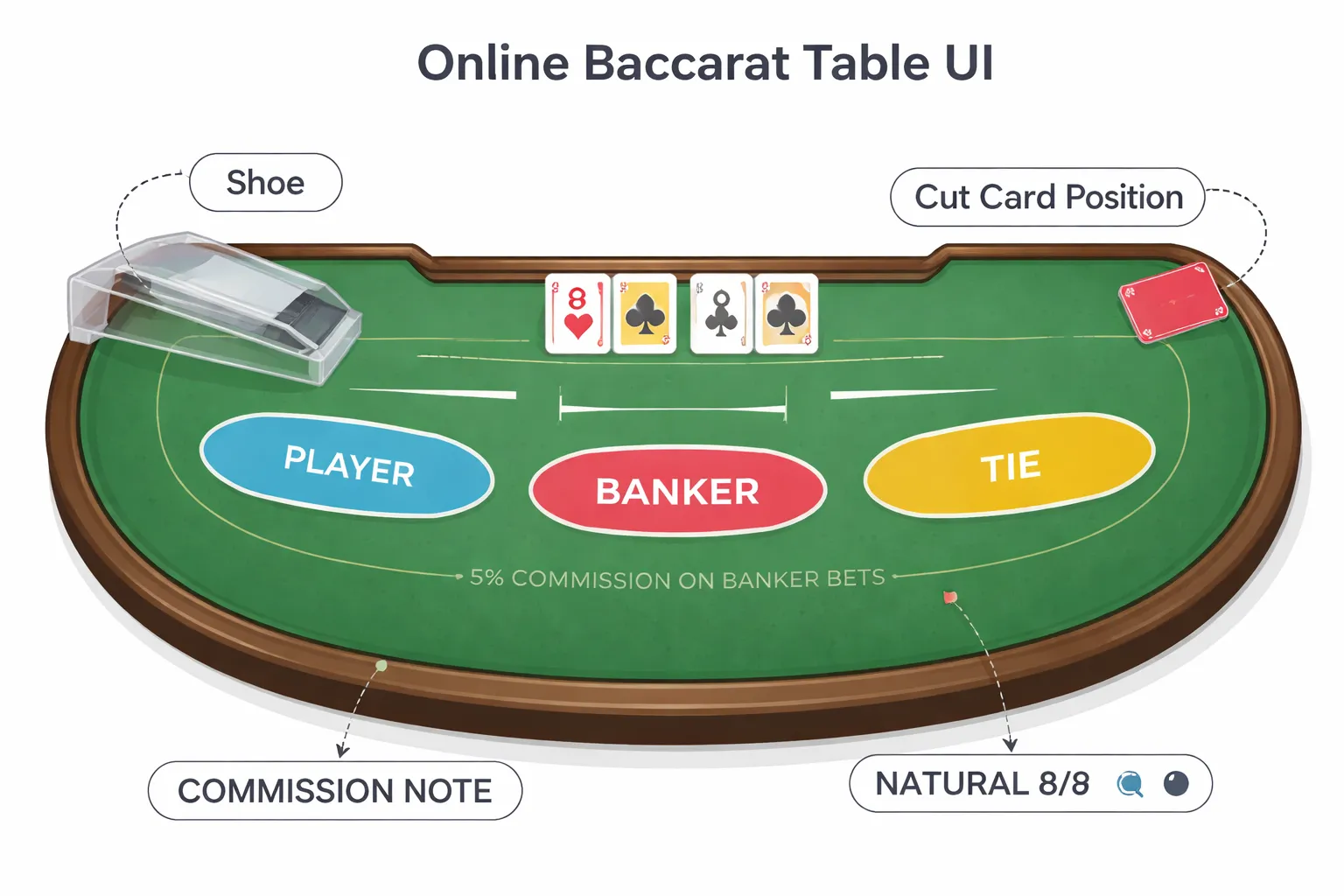
Why baccarat feels like a coin flip, but isn’t 50/50
You bet on which hand finishes closer to 9, Player or Banker. That sounds like a simple 50.50 coin flip.
It is not. The rules force extra draws, and those draws favor Banker slightly. Banker acts last under fixed rules, and it wins a bit more often over the long run.
Typical outcomes in standard online Punto Banco:
- Banker wins: about 45.86% of hands.
- Player wins: about 44.62% of hands.
- Tie: about 9.52% of hands.
Tie results do not count as a win for Player or Banker. On most tables, a Tie pushes Player and Banker bets, then the shoe continues. That push rate is why baccarat can feel streaky and why sessions can swing without many “decisions.”
Common baccarat variants you’ll see online
- Punto Banco: The standard version online. No choices on drawing. You only choose your bet, Player, Banker, or Tie, plus optional side bets.
- Mini Baccarat: Same rules as Punto Banco, usually lower table limits and a faster pace. Many sites label it “Mini” even though you play the same core game.
- Live Dealer Baccarat: A real dealer deals from a shoe on camera. You bet through the interface. Rules match Punto Banco, but table speed depends on betting timers and studio pace.
- Speed Baccarat: A faster live format with shorter betting windows. It increases hands per hour, which increases how fast variance hits your bankroll.
Most online “baccarat” is Punto Banco with different speeds, limits, and side bet menus. If you want the math and common myths in one place, see our baccarat rules and odds explained guide.
Key terms you’ll see in lobbies and at tables
- Shoe: The multi-deck dealing box. Baccarat commonly uses 6 or 8 decks. The shoe matters because the cut card triggers the shuffle point.
- Cut card: A plastic card placed into the shoe to mark when the dealer stops and reshuffles. Fewer hands before the cut means fewer rounds between shuffles.
- Commission: The fee charged on winning Banker bets, often 5%. Some tables offer “no commission” rules that change payouts or add conditions. Always check the Banker payout line.
- Natural: A two-card total of 8 or 9. Naturals usually end the hand with no further draws.
Objective of the Game and Winning Conditions
Objective of the Game
Your goal stays simple. Pick the outcome that ends closest to 9.
- Player, the Player hand finishes higher.
- Banker, the Banker hand finishes higher.
- Tie, both hands finish equal.
How Baccarat Hands Score From 0 to 9
Each hand uses a 0 to 9 total. Baccarat drops the tens digit. This uses modulo 10 math.
- Cards 2 to 9 score face value.
- 10, Jack, Queen, King score 0.
- Ace scores 1.
Add the card values. If the total hits 10 or more, subtract 10. Keep the last digit only.
- 7 + 8 = 15, score 5.
- 9 + 6 = 15, score 5.
- 10 + 6 = 6, score 6.
- Ace + 9 = 10, score 0.
What a Natural 8 or 9 Means
A natural means the first two cards total 8 or 9. This usually ends the round at once.
- If either hand has a natural, no more cards draw.
- If both hands have naturals, the higher natural wins.
- If both have the same natural, the result is a Tie.
Winning Conditions and What Happens on a Tie
The hand closest to 9 wins. If both hands land on the same total, the round ends as a Tie.
- If you bet Player and the result is a Tie, you get a push. The casino returns your stake.
- If you bet Banker and the result is a Tie, you get a push. The casino returns your stake.
- If you bet Tie and the result is a Tie, you win the Tie payout shown on the table. If no Tie happens, you lose the Tie bet.
Always check the payout line before you place a bet. Tie payouts vary by game, and they drive the house edge.
Learn what to expect in live dealer games if you plan to play baccarat in a live casino lobby.
Baccarat Online Setup: What You Need Before You Play

Choose Your Table, RNG or Live Dealer
Online baccarat comes in two formats. Pick the one that fits your pace, stakes, and device.
- RNG baccarat uses a random number generator to deal digital cards. It runs fast. It supports low minimums. It often includes speed controls, autoplay, and quick rebet.
- Live dealer baccarat streams a real table and a real dealer from a studio or casino. It runs slower. It usually has higher minimums. It feels closer to a land based game.
If you want volume and lower stakes, start with RNG. If you want the live table flow and real dealing, use live dealer.
Device, Internet, and Interface Basics
You need a stable connection and a clear layout. Baccarat moves fast when betting windows open and close.
- Desktop gives you more screen space. You can track the scoreboard, bet panel, and limits without switching views.
- Mobile works well for quick sessions. Use Wi Fi or strong 5G. Avoid weak signals in live dealer games, video drops can make you miss a betting window.
- Autoplay and rebet help in RNG games. Set tight limits. Turn it off if you tilt or chase losses.
- History panels show past results. Use them for record keeping only. Past hands do not change the next deal.
- Game speed varies by table. RNG can deal many hands per minute. Live dealer tables follow a fixed rhythm.
Deposits, Limits, and Table Minimums
Set your bankroll before you pick a table. Then match it to the minimum bet.
- Check the table limits before you sit down. Look for minimum and maximum on Player, Banker, and Tie.
- Plan for variance. Tie bets can swing hard. A low minimum helps you avoid large drawdowns if you use any side bets.
- Use a simple bankroll rule. Keep at least 50 to 100 base bets for the table minimum if you want a longer session. If you play $5 minimums, that means $250 to $500.
- Watch the commission rule on Banker bets. Many tables use 5% commission. Some use no commission with different payout rules. Limits can differ by bet type.
- Confirm deposit and withdrawal terms. Check minimum deposit, wagering rules, and withdrawal limits. These affect how quickly you can cash out.
Game Fairness, Testing, Licensing, and Providers
Fair baccarat depends on who runs the game and who checks it.
- RNG fairness depends on certified testing. Reputable casinos publish the game provider and licensing details. Labs test RNG outputs and report pass results to regulators.
- Live dealer fairness depends on licensing, studio controls, and game procedures. Look for clear operator licensing, visible dealing, and posted game rules inside the lobby.
- Game providers matter. Top providers supply both RNG and live tables. They publish rule sheets, payout tables, and table limit info inside the game.
- Check payouts on screen before you bet. Tie payouts and special Banker rules change the house edge.
If you want a broader view of baccarat rules, bet types, and payouts, read our online baccarat guide.
How to Play Baccarat Online: Step-by-Step Round Walkthrough

1) Place your bet before betting closes
Each round starts with a betting timer or a “Place Bets” phase. You pick one main bet.
- Player: You bet the Player hand finishes closer to 9.
- Banker: You bet the Banker hand finishes closer to 9. Many tables take a commission on Banker wins, often 5%. Some use “no commission” rules with different payouts on specific Banker totals.
- Tie: You bet both hands finish with the same total. Tie payouts vary by table.
The game locks bets when the timer hits zero or the screen shows “No More Bets.” After that, you cannot change or add chips. Some live tables also let you preselect chips for the next round, but the bet still needs to confirm before the lock.
2) Watch the deal and the totals on screen
The dealer or RNG deals two cards to Player and two cards to Banker. You see two hands side by side. The game then shows the running totals for each hand.
- Card values run 0 to 9.
- 10, J, Q, K count as 0.
- Only the last digit counts, so totals stay 0 to 9.
Online tables usually reveal cards one by one, then update totals. Live baccarat may also show a history strip and multiple roadmaps beside the table.
3) Understand third-card rules without overthinking them
After the first four cards, the game may draw a third card for one or both hands. You do not choose this. The table rules control it.
- If either hand has 8 or 9 on the first two cards, the round ends. No third cards.
- If Player has a low total, Player draws a third card.
- If Player stands, Banker may draw based on Banker’s total.
- If Player draws, Banker’s decision can depend on Banker’s total and the value of Player’s third card.
You do not need the full decision grid to play. You just need to know the draw rules stay fixed and the house edge comes from those rules, not from your timing.
4) See who wins and how payouts hit your balance
When drawing ends, the hand closer to 9 wins.
- If your side wins, the table pays you based on the payout shown on screen.
- If you bet Banker, the game may deduct commission from winnings, or apply a “no commission” rule that changes payouts on some Banker results.
- If the round ends in a Tie and you bet Player or Banker, most tables treat it as a push. Your stake returns. If you bet Tie, you win at the Tie payout.
Online games settle fast. Your balance updates right after the result banner. Live tables may take an extra second for confirmation.
5) Use the roadmap and scoreboards the right way
Most baccarat tables show roadmaps. The common ones are the Bead Plate and the Big Road.
- Bead Plate: A simple grid of past results in order. It helps you track what happened, round by round.
- Big Road: A grouped display of Player and Banker streaks. It makes runs and switches easy to spot.
Roadmaps do not predict the next hand. They show history only. Use them to stay organized, confirm results, and track your own betting plan. Do not treat patterns as a signal that odds have changed.
Baccarat Rules Made Simple: Scoring and Card Values
Card Values in Baccarat
Baccarat uses standard cards, but you score them in a simple way.
| Card | Value |
|---|---|
| A | 1 |
| 2 to 9 | Face value |
| 10, J, Q, K | 0 |
Why 10s count as zero: Baccarat totals use only the last digit. Tens do not change the last digit, so 10-value cards score as 0.
How Totals Work: Keep the Last Digit
You add the cards, then keep the last digit of the total.
- Totals always end from 0 to 9.
- If your total hits 10 or more, drop the first digit.
- This is why people say totals "reset" after 9.
Example: 7 + 8 = 15, so your baccarat total is 5.
Fast Total Examples
- 2 + 3 = 5
- 9 + A = 10, total = 0
- 6 + 4 = 10, total = 0
- 8 + 7 = 15, total = 5
- 9 + 9 = 18, total = 8
- 5 + K = 5 + 0 = 5
- 3 + Q + 8 = 3 + 0 + 8 = 11, total = 1
- A + 9 + 9 = 1 + 9 + 9 = 19, total = 9
Betting Basics: Payouts, Odds, and House Edge
Typical Baccarat Payouts
Online baccarat gives you three main bets. Player, Banker, Tie.
- Player: pays 1:1. Bet 10, win 10.
- Banker: pays 1:1 minus commission. Most games charge 5% commission. Bet 10, win 10, pay 0.50, net profit 9.50.
- Tie: usually pays 8:1. Some tables pay 9:1. Bet 10, win 80 or 90.
Player and Banker bets push on a Tie. Your bet returns with no win and no loss.
Odds and House Edge, What the Numbers Mean
House edge measures your long-term cost. Lower is better.
| Bet | Typical payout | House edge (8-deck, standard rules) |
|---|---|---|
| Banker | 1:1 minus 5% commission | ~1.06% |
| Player | 1:1 | ~1.24% |
| Tie | 8:1 (sometimes 9:1) | ~14.36% at 8:1, ~4%+ at 9:1 |
Why Banker Is Usually the Best-Value Bet
Banker wins slightly more often than Player because of the draw rules. The casino takes commission to balance that edge.
Even after commission, Banker still has the lowest house edge on most standard tables. If you want the best long-term value with simple play, bet Banker more than Player. Avoid Tie if you care about cost per bet.
How Rule Variants Change the House Edge
Always check the payout rules before you play. Small changes can spike your cost.
- Commission-free baccarat: many versions pay Banker 1:1, but add a catch. Common rule, Banker wins with a total of 6 pays only 1:2. This usually pushes the Banker house edge higher than standard baccarat. Player can become the better value depending on the exact rules.
- Tie payout changes: 9:1 Tie is better than 8:1, but Tie still carries a much higher house edge than Player or Banker on most tables.
- Side bets: often pay big, but they usually come with a large house edge. Treat them as high-cost, high-swing bets.
Volatility Basics, What Short Sessions Feel Like
Baccarat runs on streaks. You can hit long runs of Banker or Player in a short time. That creates swings, even with a low house edge.
- Player and Banker bets: lower volatility. Your results usually move in small steps, but streaks still drive short-term wins and losses.
- Tie bets: high volatility. Ties hit infrequently, so you can lose many bets in a row, then spike up on a hit.
If you want steadier sessions, stick to flat bets on Banker or Player. If you chase big hits with Tie or side bets, expect longer losing stretches.
For another quick odds refresher across table games, see our roulette odds and bet types guide.
Side Bets Explained (and When to Avoid Them)
Common side bets online
Online baccarat side bets change by casino and software, but these show up often.
- Player Pair, Banker Pair. You win if the first two cards on that hand form a pair. Most tables pay 11:1. Some pay 10:1.
- Perfect Pair. You win only if the pair matches rank and suit, like 7 of hearts and 7 of hearts. Common payout is 25:1 to 30:1, depending on the game.
- Dragon Bonus. You bet on Player or Banker to win by a specific margin. Payout steps up with the final point spread. Some versions pay on a Banker win by 9 points at the top end.
- Panda 8. You win if Player wins with a total of 8 using three cards. Common payout is 25:1.
Why side bets usually cost more
Main bets have tight math because the game rules force many outcomes toward a near coin-flip. Side bets target rare patterns. The casino prices that rarity with a bigger edge.
Typical house edges on a standard 8 deck game:
| Bet | Typical house edge |
| Banker | About 1.06% |
| Player | About 1.24% |
| Tie | About 14.36% (with 8:1 payout) |
Many popular side bets sit in the mid to high single digits. Some go higher. That gap matters. It raises your expected loss per dollar and increases session swings.
When a side bet can make sense
Use side bets only as paid entertainment. Treat them like a separate spend, not part of your core betting plan.
- Set a side-bet budget. Example, 5 to 10 units for the whole session.
- Cap frequency. Example, one side bet every 5 to 10 hands.
- Keep size small. Example, 0.25 to 0.5 units per side bet.
- Stop on budget, not on results. Do not increase after misses. Do not press after hits.
Avoid side bets if your goal is lower variance and longer bankroll life. In that case, keep your action on Banker or Player with flat stakes.
Smart Beginner Strategy for Online Baccarat
A simple, low-risk approach
Keep it simple. Bet Banker or Player. Skip Tie.
- Banker bet. Best default. Lowest house edge in most games, even after the commission.
- Player bet. Close to Banker. Use it if you prefer even payouts without commission.
- Tie bet. Avoid it. It has a much higher house edge than Banker or Player.
Use flat betting. Same stake each hand. Do not chase. Do not “switch” because of a few results.
Bankroll management rules
- Set a session budget. Pick a number you can lose. Treat it as spent.
- Use unit sizing. Set 1 unit at about 1% to 2% of your session bankroll. Example, $200 session, 1 unit equals $2 to $4.
- Flat bet. Bet 1 unit per hand. Keep it steady.
- Set a stop-loss. Example, stop at minus 20 to 30 units. Leave.
- Set a stop-win. Example, stop at plus 10 to 20 units. Leave.
- Control pace. Fewer hands means lower swing. Take breaks. Avoid long, fast auto-play runs.
How to use bonuses carefully
Read the bonus terms before you deposit. Baccarat often counts less than slots toward wagering. Some casinos exclude it.
- Check game contribution. Example, baccarat counts 10%, 20%, or 0% toward wagering. If it is 0%, skip the bonus for baccarat play.
- Check wagering requirement. High rollover turns a low edge game into a grind. Lower is better.
- Check max bet rules. Many bonuses cap your bet size. Break the rule and you can lose the bonus and winnings.
- Watch the commission rule. Banker commission can affect how the casino calculates wagering and bonus money balance.
If you want other low-edge options, see best online casino games with low house edge.
Common myths to ignore
- Streak betting. A run does not make the next result more likely. The odds stay close to the same each hand.
- Pattern “systems”. Roads and charts track history. They do not predict outcomes.
- Gambler’s fallacy. “Due” thinking burns bankrolls. Past hands do not fix future hands.
- Martingale. Doubling after losses can wipe your bankroll fast. Table limits also stop it.
Live Dealer vs Online (RNG) Baccarat: Pros and Cons
Live Dealer vs RNG Baccarat at a Glance
| Factor | Live Dealer Baccarat | Online (RNG) Baccarat |
|---|---|---|
| Speed | Slower. You wait for dealing, payouts, and other players. | Fast. You can play many more hands per hour. |
| Realism | Real cards, real dealer, real-time video. | Digital dealing. Results come from a random number generator. |
| Social features | Chat with the dealer and other players. Some tables feel busy. | Usually solo. Some games add chat, but it is limited. |
| Table availability | Limited seats. Popular tables can fill up. | Always available. You can start instantly. |
| Bet limits | Often higher minimums. High-limit rooms are common. | Often lower minimums. Good for small bankrolls. |
| Flow and control | You play on the table clock. You cannot speed it up. | You control pace more. Autoplay can speed up sessions. |
Speed, Social Features, and Realism
- Speed. RNG baccarat moves fast. That cuts downtime. It also raises your risk of overplaying. Set a hand limit before you start.
- Social features. Live dealer chat adds pressure. You may feel pushed to follow table talk or “roads.” Ignore it. Bet your plan.
- Realism. Live games show the shoe, the discard tray, and the dealer. That helps if you like a casino feel. It does not change the house edge.
Bet Limits, Table Availability, and Peak-Hour Issues
- Lower stakes. RNG tables often start at very low minimums. That makes bankroll control easier.
- Higher stakes. Live dealer tables often run higher minimums, especially branded tables and VIP rooms. Some studios also cap max bets lower than land casinos.
- Seat limits. Live tables can fill up at peak hours. You may end up waiting, switching tables, or playing a limit you did not plan to play.
- Table selection. RNG gives you more variants and limits at any time. Live dealer selection depends on what the studio runs.
Latency and Streaming Factors in Live Baccarat
- Video delay. Live streams add a short delay. Your bet window can close before you react. Place bets early.
- Connection swings. Wi-Fi drops, data throttling, and VPN lag can freeze video. That can cause missed bets or rushed choices when the stream returns.
- Device load. Older phones and low memory can stutter the stream. Close other apps. Use stable internet.
- Studio rules. If you disconnect, the table may keep your last bet or force a fold depending on casino policy. Read the live table rules before you stake real money.
Which Format Works Best for Practice vs Real-Money Play
- Best for practice. RNG baccarat. You get more hands per hour. You can drill the core bets and learn how payouts work without waiting on a table.
- Best for strict bankroll control. RNG with low minimums and fast exits. You can stop instantly when you hit your limit.
- Best for casino feel. Live dealer baccarat. You trade speed for atmosphere and social play. Treat it like entertainment. Keep your betting simple.
- Best for data tracking. RNG makes it easier to log sessions. Live tables add pauses and table changes that can distort your tracking.
Practice Options: Free Baccarat and Low-Stakes Tables

Where Free-Play Fits in Your Learning
Use free baccarat to learn mechanics. Focus on the deal order, third-card rules, and outcomes. Track results for 50 to 100 hands. Make sure you can score each hand fast and without guessing.
Then use free-play to build habits. Set a fixed session length. Set a fixed unit size, even if the chips mean nothing. Practice stopping on schedule. Practice ignoring side bets.
- Step 1: Learn outcomes, Player, Banker, Tie.
- Step 2: Learn third-card triggers so the flow feels normal.
- Step 3: Practice flat betting with one unit per hand.
- Step 4: Log hands and results to spot your leaks.
What Free Games Do Not Teach
Free-play does not create real pressure. You will not feel loss, urgency, or tilt. That changes your decisions.
- No real risk: You will call it a test, then chase anyway.
- No real stopping point: It is easy to play past your limit.
- Different table behavior: Free versions may push faster, add prompts, or steer you to side bets.
- Weaker discipline data: Your log looks clean because the stakes feel fake.
Treat free-play as rules training. Do not treat it as proof you can handle real money.
Choose Low-Minimum Tables to Transition Responsibly
Move to real money with the smallest stakes you can find. You want real emotion with small consequences. That is the bridge between practice and real play.
- Pick a low minimum: Start at the lowest table limit offered.
- Use a fixed unit: Bet one unit per hand. Avoid progressions.
- Set hard exits: Use a loss limit and a time limit. Leave when you hit either one.
- Avoid side bets: They raise volatility and make your results harder to read.
- Prefer RNG for reps: You get more hands per hour and cleaner tracking.
| Goal | Best Option | Why |
|---|---|---|
| Learn rules and flow | Free RNG baccarat | Fast hands, zero cost, repeatable practice |
| Build bankroll discipline | Low-minimum RNG table | Real stakes, high hand volume, easier logs |
| Get live casino pacing | Low-minimum live dealer table | Slower pace, social pressure, real table routine |
If you want to understand how casinos measure risk in other games, read this guide on RNG, RTP, and house edge.
Safety, Responsible Gambling, and Common Online Pitfalls
How to spot reputable casinos
- License and regulator. Check the footer for a license number and regulator name. Verify it on the regulator site. Avoid casinos that hide ownership details.
- Game audits. Look for independent testing from labs such as eCOGRA, iTech Labs, or GLI. You want published RTP and RNG testing, not marketing badges.
- Payout reputation. Read recent player reports focused on cashout times and limits. Watch for repeated complaints about stalled withdrawals, extra KYC demands, and “bonus abuse” accusations.
- Clear banking and limits. Find fee rules, withdrawal minimums, maximums, and processing times before you deposit. If terms stay vague, treat that as a warning.
- Support quality. Test live chat with a simple question about withdrawal timelines or document requirements. If they dodge, expect delays later.
Avoiding risky behaviors
- Chasing losses. Set a loss limit for the session and stop when you hit it. Do not “win it back” with bigger bets.
- Martingale traps. Doubling after losses grows fast and hits table limits. A short losing run can force a large bet, then you cannot continue the system.
- Side bet spirals. Many side bets carry a much higher house edge than Banker or Player. If you use them, cap it to a fixed small amount per session and log it separately.
- Speed control. RNG baccarat can run high hand volume. Add a hard cap on hands per session or time spent to prevent autopilot play.
Use responsible gambling tools
- Deposit limits. Set daily and weekly caps. Keep them below what you can lose without stress.
- Loss limits. Use them when available. They stop the worst pattern, increasing stakes after a downswing.
- Session and reality checks. Turn on popups that show time played and net results. Treat that number as the decision point, not your last hand.
- Cooling-off and self-exclusion. Use a short cooling-off period if you feel tilted. Use self-exclusion if you cannot stick to limits.
Privacy and account security basics
- Enable 2FA. Use an authenticator app, not SMS if you have the choice.
- Use strong, unique passwords. Store them in a password manager. Do not reuse your email password.
- Pick safer payment methods. Use trusted cards, bank transfers, or major e-wallets. Avoid unknown processors and crypto routes you do not understand.
- Avoid public Wi-Fi. Do not log in or cash out on café or airport networks. Use mobile data or a trusted VPN on a private network.
- Lock down your device. Keep your OS and browser updated. Do not install “predictor” tools or unofficial baccarat apps.
If you also play slots, learn how RTP and volatility shape risk in this online slots guide.
FAQ
What are the basic baccarat rules online?
You bet on Player, Banker, or Tie. Two hands get two or three cards. Totals use the last digit only. 10s and face cards count as 0, aces count as 1. Higher total wins. The game handles third-card rules for you.
Which baccarat bet is best?
Banker. It has the lowest house edge in most games. Player costs more over time. Tie has a high house edge and high variance. If you want fewer swings, skip Tie and stick to Banker or Player.
What is the typical house edge in baccarat?
In standard rules, Banker sits around 1.06% after commission. Player sits around 1.24%. Tie often sits near 14.36%. Always check the pay table and side bet rules, they can raise the edge fast.
Why does the Banker bet pay 0.95 to 1?
The Banker hand wins slightly more often due to the drawing rules. Casinos add a 5% commission on Banker wins to balance that advantage. Some games remove commission and adjust payouts or add rules that change your expected value.
How do you calculate baccarat card totals?
Add card values and keep only the last digit. Example, 7 plus 8 equals 15, so the total is 5. A 9 and a 6 equals 15, so 5. A 10 and a 4 equals 14, so 4.
Can you use a baccarat strategy to beat the house?
No strategy changes the math on fixed-odds bets. Betting systems only change bet size and variance. If you want better odds, choose lower-edge bets, avoid side bets, and manage your bankroll with firm stop limits.
Do baccarat patterns and roadmaps help?
No. Streak charts track history, not future probability. Each hand stays independent in RNG games. In live dealer games, the shoe changes probability slightly as cards leave, but roadmaps still do not predict outcomes well.
Is online baccarat fair?
It can be. Use licensed casinos with audited RNGs or reputable live studios. Check game rules, payout tables, and provider names. For the basics, read this guide to casino fairness, RNG, RTP, and house edge.
What is the minimum bankroll for baccarat?
Use at least 50 to 100 base bets for lower risk of busting early. Example, for $1 bets, bring $50 to $100. For $10 bets, bring $500 to $1,000. Set a stop-loss and stop-win before you start.
What side bets should you avoid?
Most of them. Many side bets carry 5% to 25% house edge. They can look cheap but drain bankroll fast. If you play them, treat them as entertainment, cap your stake, and do not chase losses.
What is the difference between mini baccarat and baccarat?
The rules and odds usually match. Mini baccarat runs faster and uses lower limits. Online, you mostly see mini baccarat rules with automated dealing or live dealers. Always confirm commission, Tie payout, and any no-commission rule tweaks.
Can you count cards in baccarat online?
Card counting has limited value because you cannot change the drawing rules and the edge shifts stay small. In live shoes, you might track composition, but it rarely beats fees and limits. In RNG baccarat, counting does nothing.
What are common baccarat mistakes online?
Overbetting, chasing streaks, and leaning on Tie and side bets. Ignoring fees on Banker in no-commission variants also hurts. You should read the pay table, keep bets flat, and quit when you hit your limit.
Conclusion
Conclusion
Baccarat online stays simple. You pick Player, Banker, or Tie. The hand closest to 9 wins. No skill choices change the result.
Your edge comes from bet selection and bankroll control. Banker usually gives the lowest house edge, but check the table rules first. Commission, no-commission triggers, and side-bet payouts can flip the math fast.
- Bet flat. Use one base unit. Avoid raising stakes to chase runs.
- Skip Tie and most side bets. They cost more in expected value.
- Read the pay table. Confirm Banker payout, commission, and any push rules.
- Set hard limits. Pick a stop-loss and a win cap, then quit.
Final tip. Treat baccarat like a low-decision game. Protect your bankroll, play the lowest-edge main bet your table offers, and stop on schedule.
-
Online Casino Fairness Explained: RNG, RTP, House Edge & Provably Fair
8 months ago -
Slot RTP Explained: What RTP Means and How to Use It
8 months ago -
How to Play Online Slots: Rules, Features & Beginner Tips
8 months ago -
How Slot Jackpots Work: Progressive Jackpots Explained
8 months ago -
How to Play Online Blackjack: Rules, Payouts & Quick Start Guide
8 months ago
-
- What are the basic baccarat rules online?
- Which baccarat bet is best?
- What is the typical house edge in baccarat?
- Why does the Banker bet pay 0.95 to 1?
- How do you calculate baccarat card totals?
- Can you use a baccarat strategy to beat the house?
- Do baccarat patterns and roadmaps help?
- Is online baccarat fair?
- What is the minimum bankroll for baccarat?
- What side bets should you avoid?
- What is the difference between mini baccarat and baccarat?
- Can you count cards in baccarat online?
- What are common baccarat mistakes online?
-
- What are the basic baccarat rules online?
- Which baccarat bet is best?
- What is the typical house edge in baccarat?
- Why does the Banker bet pay 0.95 to 1?
- How do you calculate baccarat card totals?
- Can you use a baccarat strategy to beat the house?
- Do baccarat patterns and roadmaps help?
- Is online baccarat fair?
- What is the minimum bankroll for baccarat?
- What side bets should you avoid?
- What is the difference between mini baccarat and baccarat?
- Can you count cards in baccarat online?
- What are common baccarat mistakes online?
-
Reload Bonus Explained: What It Is and When It’s Worth Claiming
6 months ago -
Online Casino Licensing Explained: Authorities, Licenses & How to Check One
8 months ago -
Best Live Dealer Casinos: Where to Play Live Blackjack, Roulette & More
8 months ago -
Best Online Casinos for High Rollers: VIP Perks, High Limits & Exclusive Bonuses
8 months ago -
Fast Payout Online Casinos: Best Sites for Quick Withdrawals
8 months ago
-
Online Casino Customer Support: What to Look For (Live Chat, Email, Response Times)
8 months ago -
Sign Up for an Online Casino: Create an Account in Minutes
8 months ago -
Online Casino Payment Safety Tips: How to Deposit and Withdraw Securely
8 months ago -
What to Do If an Online Casino Won’t Pay Out: Step-by-Step Actions
8 months ago -
How to File a Complaint Against an Online Casino (Plus ADR Explained)
8 months ago