Online Blackjack Rules & Side Bets Explained

Online blackjack runs on fixed rules. Side bets add extra wagers with separate odds and payouts. If you skip the details, you will misread your risk and overpay in house edge.
This guide explains the core online blackjack rules you must know before you play. You will learn hand values, the dealer rules, when you can hit, stand, double, split, or surrender, and how common rule tweaks change the math. You will also learn how side bets work, when you can place them, what triggers a win, and what payout tables usually look like. You will see the key tradeoff, side bets can pay big, but they often carry a higher house edge than the main game.
For main-hand decision making, use our blackjack basic strategy chart.
Key Takeaways
- In het kort: You win by beating the dealer’s hand without going over 21.
- In het kort: Your core moves are hit, stand, double, split, and surrender. Your EV depends on when each option is allowed.
- In het kort: Blackjack usually pays 3:2 or 6:5. 6:5 increases the house edge and cuts your long-run return.
- In het kort: Dealer rules matter. Dealer hits soft 17 (H17) raises the house edge versus stand on soft 17 (S17).
- In het kort: Deck count and penetration matter. More decks and less penetration hurt card counting, but basic strategy still applies.
- In het kort: Side bets are separate wagers. You place them before the deal, and they resolve based on specific card patterns.
- In het kort: Side bets can pay large multiples, but they often carry a higher house edge than the main hand.
- In het kort: Check the payout table and qualifying rules every time. Small tweaks change the odds fast.
- In het kort: If you want the best baseline, keep most of your bankroll on the main bet and use a basic strategy chart.
- In het kort: Learn the full flow in our how to play online blackjack guide.
Online Blackjack Basics: Objective, Card Values, and Win Conditions
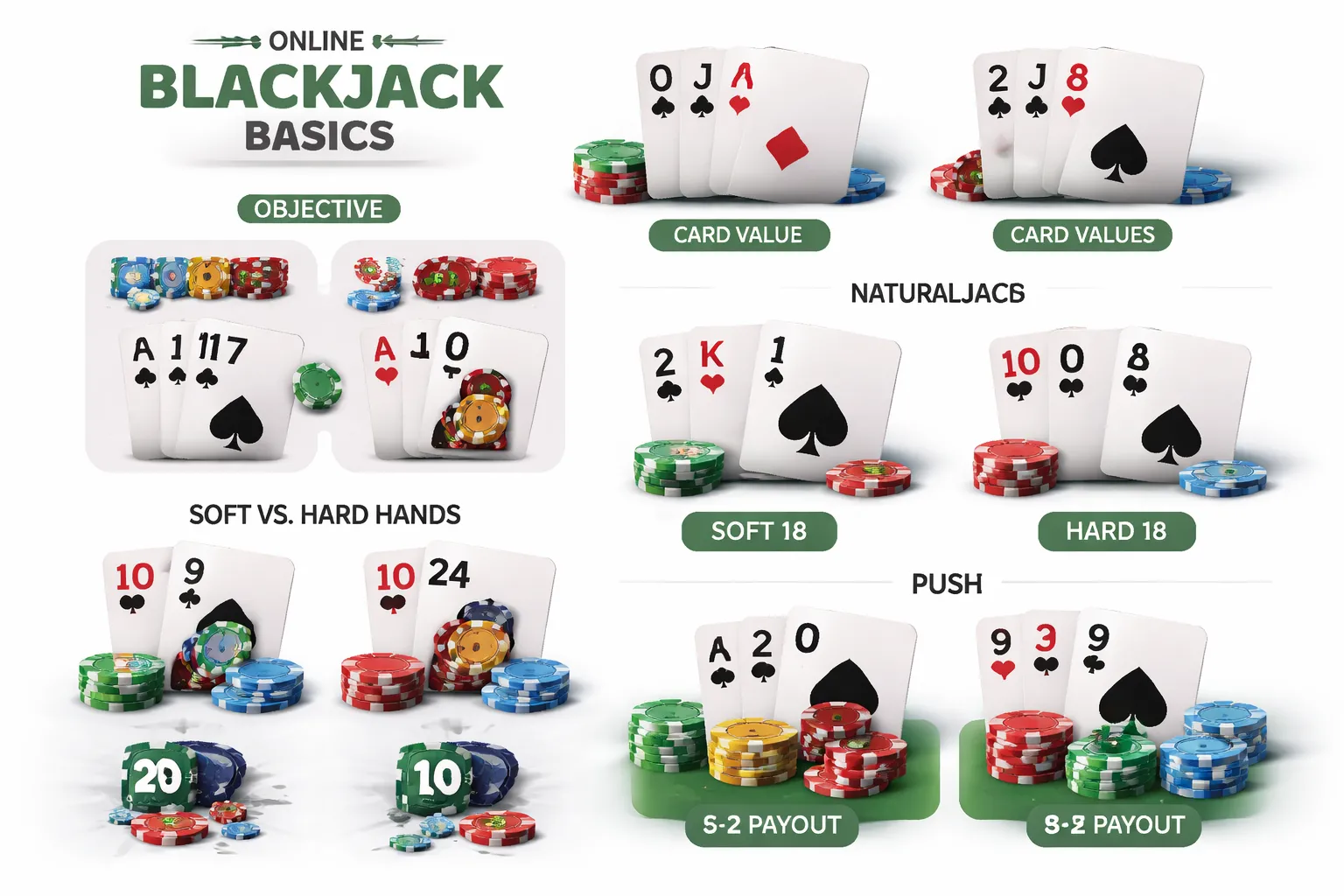
Goal of the game
You play your hand against the dealer. You do not play against other players.
Your goal stays simple. Make a hand closer to 21 than the dealer without going over 21.
- If you go over 21, you bust and lose your main bet.
- If the dealer busts and you do not, you win.
- If you and the dealer both avoid busting, the higher total wins.
Card values
- 2 to 10 count as their face value.
- Jack, Queen, King count as 10.
- Ace counts as 1 or 11, whichever helps your hand most.
Online blackjack uses the same values as land-based blackjack. The rules that change your results sit in payout tables and dealer action rules, not card values.
Soft hands vs hard hands, and what counts as a bust
A soft hand includes an Ace counted as 11. Example: A-6 is soft 17.
A hard hand has no Ace counted as 11. Example: 10-7 is hard 17. A-6-10 is also hard 17 because the Ace must count as 1.
- Soft hands give you more room to hit because the Ace can drop from 11 to 1.
- You bust when your total is 22 or higher after all Aces adjust to 1 where needed.
Natural blackjack and how it pays
A natural blackjack means you get 21 with your first two cards, an Ace plus any 10-value card.
- Most tables pay 3:2 on a natural blackjack.
- Some online tables pay 6:5. That smaller payout increases the house edge.
- If you and the dealer both have a natural blackjack, the hand is a push.
Check the payout line before you play. The blackjack payout rate is one of the biggest drivers of long-term cost.
Pushes, ties, and how dealer comparison works
A push is a tie. You keep your stake and win nothing.
The dealer compares hands only after you finish your actions. Then the dealer plays by fixed rules.
- If your final total is higher than the dealer without busting, you win.
- If the dealer total is higher without busting, you lose.
- If totals match, you push.
- If you bust, you lose even if the dealer busts later.
Core Online Blackjack Rules You Must Check Before Playing
Number of Decks and Why It Changes the Odds
Online blackjack usually uses 1, 2, 4, 6, or 8 decks. More decks help the casino. Fewer decks help you.
- Blackjack frequency drops as decks rise. You get fewer natural 21s because the shoe holds more non-Ace, non-10 cards relative to any single draw sequence.
- Doubling and splitting gain value in fewer decks. You hit strong two-card starts more often, and removal effects matter more.
- Rule changes stack with decks. A 6-deck game with player-friendly rules can beat a 1-deck game with bad rules. You must check both.
Dealer Rules, S17 vs H17
Check if the dealer stands or hits on soft 17.
- S17: Dealer stands on A-6. This helps you.
- H17: Dealer hits A-6. This helps the casino because the dealer improves more often without busting.
If you see H17, expect a higher house edge than the same game with S17.
Player Options You Must Confirm
Online tables label rules in the info panel. Read them before you bet.
- Hit: Take another card. You can hit until you stand or bust.
- Stand: Stop taking cards. Your total locks.
- Double down: Double your bet, take one card, then stand.
- Split: If your first two cards match in rank, split into two hands. You add a second equal bet.
- Surrender: Give up the hand and lose part of your stake, if the table offers it.
These options change correct play. Use a blackjack basic strategy chart that matches the exact rules.
Doubling Rules That Change Expected Value
Doubling is where rule restrictions hurt fast. Check these items.
- Double on any two cards (DOA): Standard and player-friendly.
- Double only on 9 to 11: Common restriction, reduces your best double spots.
- Double after split (DAS): Lets you double on hands created by splitting. This boosts the value of splits, especially against weak dealer upcards.
- No DAS: Cuts value from many split lines.
Splitting Rules That Decide How Far You Can Press an Edge
Splitting rules vary more online than most players expect.
- Maximum split hands: Many games allow up to 3 or 4 hands total. Fewer hands limit upside in high EV split spots.
- Re-splitting aces: Some tables allow it, many do not. No re-split lowers the value of receiving another Ace after you split.
- Hitting split aces: Most rules force one card only on each split Ace hand. If you cannot hit, you lose flexibility and value.
- Splitting unlike 10-value cards: Some games allow split on any 10-value pair, many restrict to exact ranks. This rule matters less for optimal play but changes what is possible.
Surrender Rules, Late vs Early and What You See Online
Surrender cuts losses in specific bad spots. Online, you usually see late surrender, if any.
- Late surrender: You can surrender only after the dealer checks for blackjack. This is the version most online tables offer.
- Early surrender: You can surrender before the dealer checks for blackjack. This is rare online and very strong for the player.
- When it appears: Usually as a button on your first decision only. If you hit or split, you lose the option.
Blackjack Payout, 3:2 vs 6:5
This is the first rule you should scan. It has a direct, measurable cost.
- 3:2 blackjack: Bet 10, win 15 on a natural. This is the standard payout in better games.
- 6:5 blackjack: Bet 10, win 12 on a natural. This boosts the house edge by about 1.39% versus 3:2, because blackjacks happen often enough for the payout cut to matter.
If you care about long-run value, avoid 6:5 tables.
How Online Blackjack Deals, Shuffling, and RNG/Live Play Work
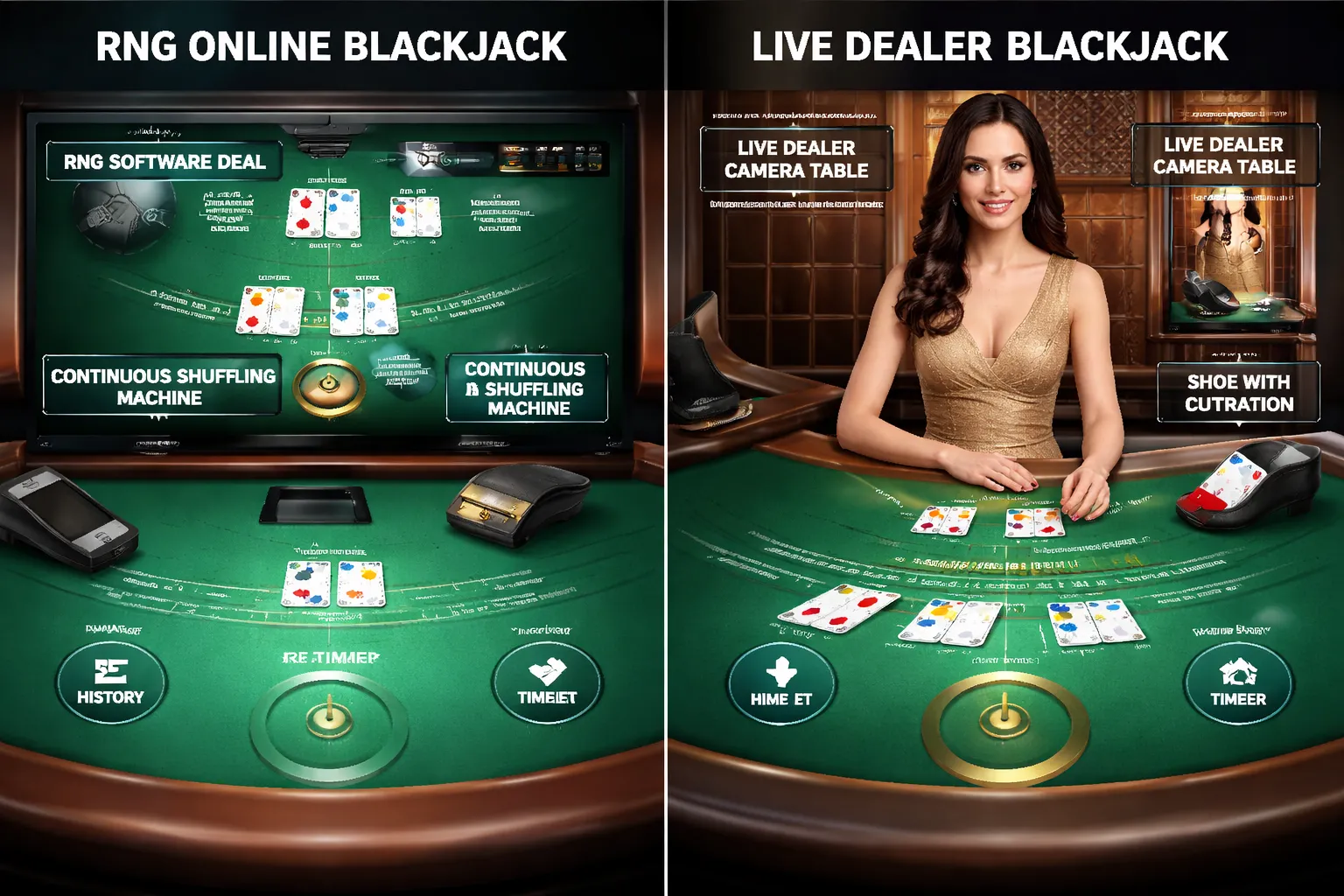
RNG Blackjack vs Live Dealer Blackjack, What Changes and What Doesn’t
Online blackjack comes in two formats.
- RNG blackjack. Software deals cards using a random number generator. You play alone or against a virtual table. Results resolve instantly.
- Live dealer blackjack. A real dealer runs a real game on camera. You place bets through the interface. The studio deals real cards from a shoe.
What stays the same. The core rules, payouts, and decision points. Hit, stand, double, split, surrender if offered. Dealer rules like hit soft 17 or stand on soft 17 still drive the house edge.
What changes. Speed, table limits, and how shuffling works. Live games add timers and table etiquette. RNG games add features like turbo and auto-play.
Shuffling, CSMs, and Shoe Penetration in Live Blackjack
Shuffling rules matter because they control how many cards you see before a shuffle.
- Traditional shoe. The dealer deals multiple hands from a 6 to 8 deck shoe, then shuffles when a cut card appears.
- Shoe penetration. This is how deep the dealer deals before shuffling. Deeper penetration means more cards dealt before the shuffle.
- CSM, continuous shuffling machine. Used at some live tables. The dealer feeds used cards into the machine during play. The machine continuously mixes cards back into the pack.
Practical impact.
- Most players should care more about payout rules and dealer rules than penetration.
- If you track cards, shallow penetration hurts you. A CSM usually kills any tracking edge because the deck effectively resets all the time.
- CSM tables often run faster. Faster hands per hour can increase your hourly losses if you play the same bet size without breaks.
RNG Shuffling and How the RNG Deal Works
In RNG blackjack, the game shuffles every hand by default, because the software generates outcomes from a fresh random state each round. You do not get meaningful “deck flow” in the way you would in a shoe game.
Some RNG tables show a virtual shoe or discard tray. Treat it as presentation unless the game rules state a finite deck with defined reshuffles.
Auto-Play, Turbo Mode, and Live Timing Rules
RNG blackjack can move as fast as you let it.
- Turbo mode. Shorter animations. Faster decisions. More hands per hour.
- Auto-play. You preselect actions, like always stand on 17+, always hit 11 or less. This can lock in bad decisions if the rules vary or if you misconfigure it.
- Instant re-bet. One click repeats your last wager and side bets.
Live dealer blackjack runs on a clock.
- Bet timer. You get a fixed window to place bets before “no more bets.” Late clicks do not count.
- Action timer. You must hit, stand, double, or split within the countdown. If you time out, the table uses a default action, often stand, sometimes hit, depending on the provider.
- Seat vs unlimited. Some tables use seats with optional betting behind. Others allow unlimited players with a queue. This affects how often you get a hand and how fast rounds run.
Common UI Features, Hand History, Stats, and Re-Bet Tools
Use the interface to reduce mistakes.
- Hand history. Check your last hands, bets, and outcomes. Useful for dispute resolution and bankroll tracking.
- Game info panel. Shows rules, payouts, and side bet paytables. Read it before you play.
- Statistics. Some games show recent outcomes like dealer upcards or player totals. This does not predict future results. It can help you spot table speed and rule changes.
- Re-bet and bet presets. Set fixed chip stacks so you do not misclick when the timer runs.
- Limits display. Live tables often have separate limits for main bets and side bets. Verify both.
If you also play slots, learn how published return metrics work. Use this guide on what RTP means and how to use it.
Fairness and Trust Signals, Licensing, Audits, and Certificates
Use hard checks. Skip vague “provably fair” claims unless you can verify them.
- License. Look for a known regulator and a license number you can click and verify on the regulator site.
- Independent testing. RNG games should list test labs like eCOGRA, iTech Labs, GLI, or BMM. Live studios should name their provider and jurisdiction.
- Game certificate. Many casinos host an audit report or a certificate page. It should show the game name, version, and test date.
- RNG provider and game version. Reputable casinos show the software provider and the exact title. Avoid unbranded games with no documentation.
- Live transparency. Look for clear table rules, readable dealing, and consistent procedures. A serious studio logs rounds and can review disputes.
Where Side Bets Fit In: What They Are and When You Place Them
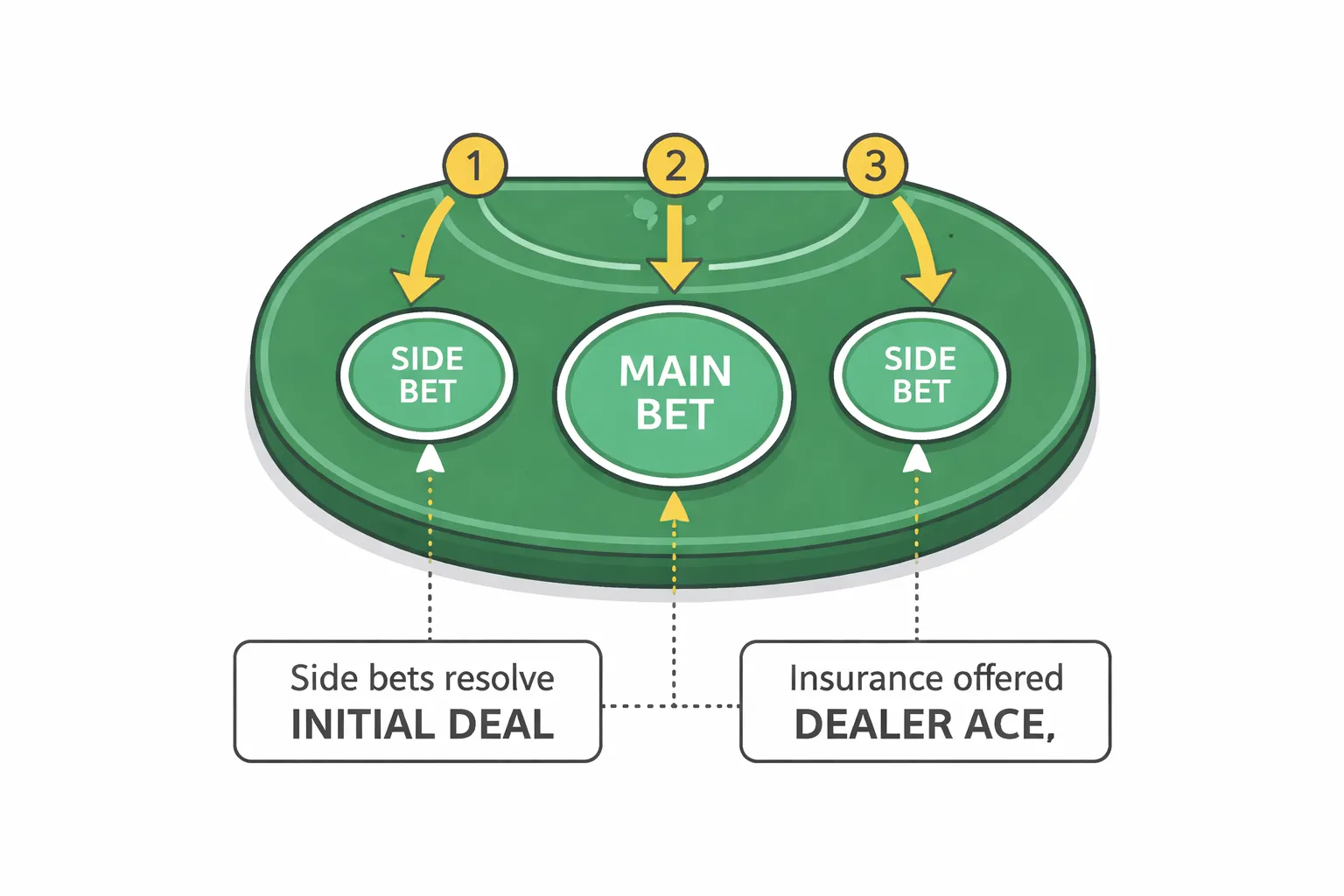
Definition, Side Bet vs Your Main Blackjack Wager
Your main bet drives the blackjack hand. It pays based on the hand outcome, win, lose, push, or blackjack. It also unlocks decisions like hit, stand, double, and split.
A side bet is a separate wager with its own rules and payout table. Most side bets grade on the first cards dealt, like your first two cards, or your first two plus the dealer upcard. Some side bets grade on a specific event later in the round, like a dealer blackjack for Insurance.
Side bets do not change basic blackjack odds. They add extra risk on top of your main hand.
Betting Sequence, When Side Bets Lock In and When They Resolve
- You place your main bet first.
- If the table offers side bets, you place them in the same betting window, before any cards deal.
- Once the dealer deals the first cards, side bets lock. You cannot add, remove, or change them.
- Most side bets resolve right after the initial deal. The game pays or collects them before you play your hand.
- Insurance is the common exception. You can only place it after the dealer shows an Ace. It resolves after the dealer checks for blackjack.
Why Side Bets Use Different Odds Than the Main Hand
The main game gives you choices. Your decisions change your expected return. Side bets usually give you no choices. You either hit the condition or you miss.
Side bets also target rare outcomes. Rare events need higher payouts to attract action. That payout ladder usually still leaves a bigger house edge than the base game.
Rule details shift the math. Deck count, whether the dealer hole card exists, and whether cards come from a continuous shuffle all change side bet frequencies. You should read the payout table and the rule notes before you bet.
If you want to focus on the base game edge, use a blackjack basic strategy chart and treat side bets as optional add-ons.
Live Dealer vs RNG, Availability and Rule Differences
RNG blackjack often offers more side bet variants. The software can support extra bet types and faster grading.
Live dealer blackjack depends on the studio and table layout. Many live tables include popular options like Perfect Pairs or 21+3, but not every table runs them.
- Card source: Live games use real shoe dealing. RNG games use a random number generator and virtual decks.
- Shuffle method: Live tables may reshuffle at a cut card. RNG tables may reshuffle every hand. Some live tables use a continuous shuffling machine, which can change side bet hit rates versus a hand dealt shoe.
- Hole card and peek rules: Some live tables deal a hole card and check for blackjack early. Some variants use no hole card. That can affect when certain side bets settle and how much risk you carry on doubles and splits.
- Payout tables: Two tables with the same side bet name can pay different odds. You should confirm the exact payout ladder in the UI.
Combining Multiple Side Bets, How Variance Spikes
You can place more than one side bet in the same round if the table offers them. Each one settles on its own condition. Your total risk becomes the sum of all those wagers.
Variance rises fast because side bets cluster around low hit rates. You will see longer losing streaks, then occasional spikes when one lands.
- If you bet $10 main plus $5 on two side bets, you risk $20 per hand.
- Your side bets can lose even when your main hand wins, and they can win when your main hand loses.
- You should size side bets smaller than your main bet if you want steadier results.
Insurance Explained (The Most Misunderstood Blackjack Side Bet)
What Triggers the Offer, Dealer Shows an Ace
Insurance is a side bet the casino offers only when the dealer’s upcard is an Ace.
You place it before the dealer checks for blackjack.
Your insurance bet usually equals up to half your main bet.
How Insurance Pays (2:1) and What You Really Bet On
Insurance pays 2:1 if the dealer has blackjack.
That is the entire bet. You bet that the dealer’s hole card is a 10 value card.
If the dealer has blackjack, you win the insurance bet. Your main hand then ends normally, you lose unless you also have blackjack.
If the dealer does not have blackjack, you lose the insurance bet. Your main hand continues.
Insurance does not protect your hand. It only pays on one dealer outcome.
| Dealer outcome | Insurance bet | Main hand |
|---|---|---|
| Dealer has blackjack | Wins 2:1 | Resolves as normal, usually a loss unless you also have blackjack |
| Dealer does not have blackjack | Loses | Continues |
Even Money vs Taking Insurance, The Difference
Even money shows up when you have blackjack and the dealer shows an Ace.
It pays you 1:1 immediately and ends your hand.
Even money equals taking insurance for half your bet while keeping your blackjack payout at 3:2 in the background.
If the dealer has blackjack, the insurance win cancels the push on your blackjack, you net 1:1.
If the dealer does not have blackjack, the insurance loses and your blackjack pays 3:2. Net result is still 1:1.
So even money is insurance packaged as a simpler option. The math is the same.
When Insurance Is Mathematically Justified
Insurance becomes positive only when the dealer’s chance of having a 10 value hole card is high enough.
At 2:1, you need that chance to exceed 1 in 3.
In most games it stays below that, so insurance has negative expected value.
You only gain an edge when the remaining deck is rich in 10 value cards.
That is a card counting situation. It does not happen often, and you need a reliable count and correct index plays.
If you do not track the deck, you should treat insurance as a losing side bet and decline it.
Common Misconceptions That Cause Negative EV Decisions
- “Insurance reduces risk.” It adds a separate bet with its own house edge. It increases total money at risk per hand.
- “I should insure because I have a strong hand.” Your hand strength does not matter. Only the dealer’s hole card matters.
- “Even money is safer than 3:2.” It is just insurance. You trade long term value for a smoother result.
- “Dealer blackjack is due.” Each hand stands on its own. Insurance stays negative without deck information.
- “Insurance is part of basic strategy.” Basic strategy usually says no. Learn the core decisions first, then add exceptions if you count cards. See a blackjack basic strategy chart.
Perfect Pairs: Rules, Qualifying Hands, and Payout Variations
How Perfect Pairs Works
Perfect Pairs is a side bet on your first two cards only.
You win if those two cards form a pair. You lose if they do not.
The dealer hand does not matter. Your hit, stand, double, or split decision does not change the side bet result.
Mixed, Colored, and Perfect Pairs
Casinos grade the pair by suit and color. The names stay the same, but the payout can change.
- Mixed pair, same rank, different colors. Example, 8 of hearts and 8 of spades.
- Colored pair, same rank, same color, different suits. Example, 8 of hearts and 8 of diamonds.
- Perfect pair, same rank, same suit. Example, 8 of hearts and 8 of hearts.
Some games use only two tiers, any pair and perfect pair. Others pay three tiers as listed above.
Typical Payout Tables and Why They Differ
Payouts vary by casino because the house edge comes from the paytable. Small changes swing the cost fast.
| Pair type | Common 3-tier paytable | Common 2-tier paytable |
|---|---|---|
| Mixed pair | 5:1 | Any pair 5:1 to 10:1 |
| Colored pair | 10:1 | Usually not used |
| Perfect pair | 30:1 | Perfect pair 25:1 to 30:1 |
You will also see tighter ladders like 4:1, 8:1, 25:1, or 6:1, 12:1, 35:1. Higher top payouts often come with lower payouts on the other tiers.
Variance and Why It Feels Streaky
Perfect Pairs hits rarely because you need a match on two specific cards.
Most hands lose. Wins arrive in clusters because short streaks happen in random runs.
This creates high variance. Your bankroll moves in jumps. Treat it like a high-volatility bet, similar to what you see in slot volatility.
If you play it, use a small, fixed stake. Do not raise bets to chase a miss streak.
What to Verify in the Rules
- Deck count, single deck, double deck, or shoe. More decks usually mean worse odds for perfect pairs.
- When it resolves, it should settle on your first two cards only. Confirm that split hands do not create extra pair chances.
- Paytable, confirm the exact ladder for mixed, colored, and perfect.
- Side-bet limits, minimum and maximum. Check if the side bet must match your main bet size.
- Ties and voids, ask what happens on misdeals, card exposure, reshuffles, or disconnects online. Some casinos void the side bet.
- Multiple hands, in online multi-hand blackjack, check if you can place Perfect Pairs on each hand and if limits apply per hand or per round.
21+3 and Other Poker-Style Side Bets
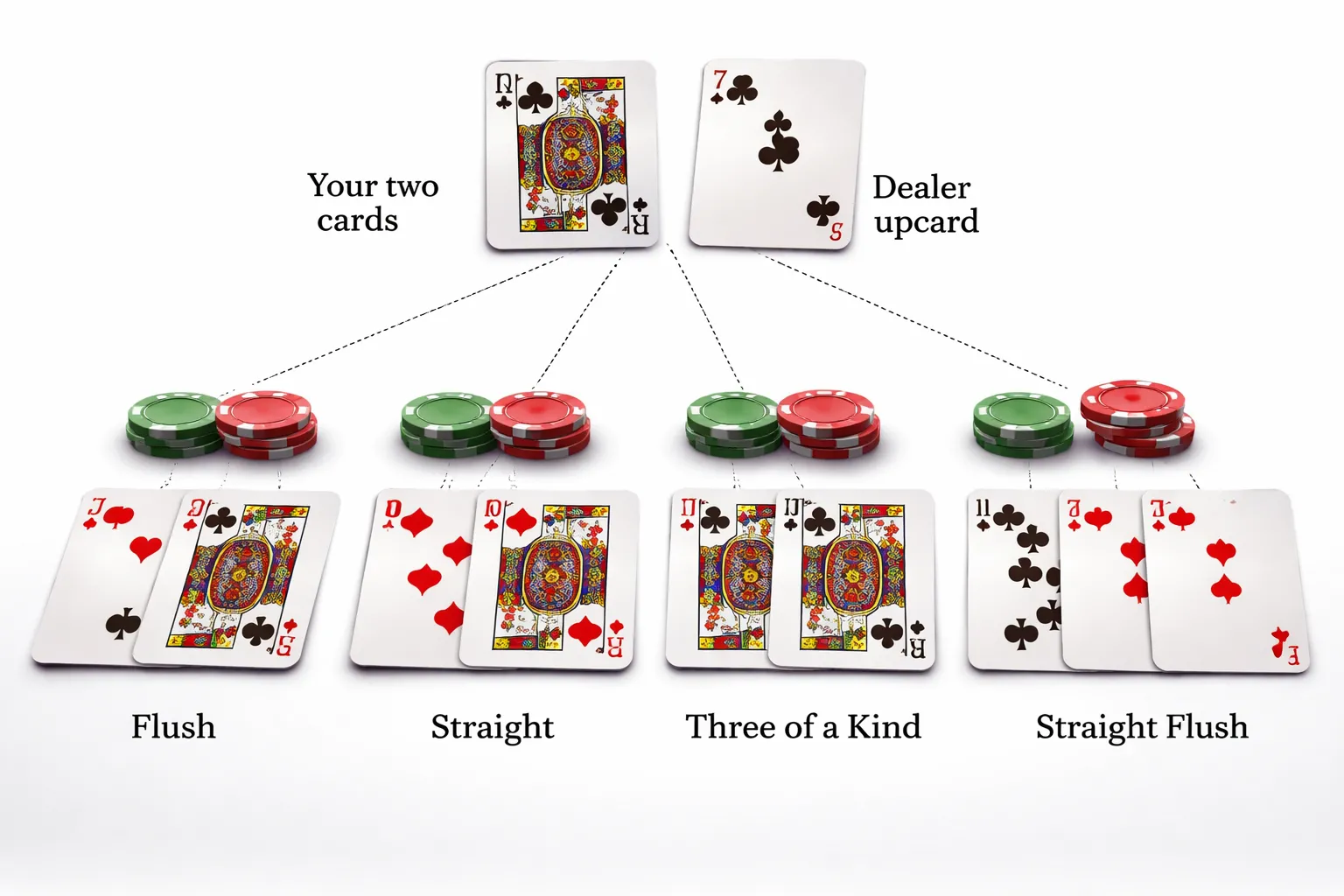
21+3, what it uses
21+3 is a poker-style side bet. It uses three cards, your two cards plus the dealer upcard. It ignores the dealer hole card and it ignores the rest of the blackjack hand.
You place the bet before any cards deal. The casino grades it as soon as it can see those three cards.
21+3 qualifying hands
- Flush: all three cards share a suit.
- Straight: three ranks in sequence. House rules may treat A-2-3 and Q-K-A differently, check the paytable.
- Three of a kind: three cards with the same rank.
- Straight flush: a straight and a flush.
- Suited trips: three of a kind in the same suit. This only exists in some versions, usually as a top prize.
Payout ladders and RTP, small changes matter
Casinos change the edge by tweaking payouts and by splitting hand categories. Read the paytable before you bet.
- Straight rules: if A-2-3 does not count, you lose some winners. RTP drops.
- Push handling: some tables pay 0 on a loss, others may “push” on specific dealer upcards in promo versions. This changes RTP fast.
- Paytable compression: a small cut, like straight flush from 40 to 30, or three of a kind from 30 to 25, has a direct impact because those hands drive most of the return.
- Deck count and rules: side bets can use the same shoe as blackjack. More decks usually reduce the frequency of suited combinations. That can hurt your return if the paytable does not adjust.
If you want the base game math first, use this online blackjack quick start guide and then treat side bets as extra cost.
Other poker-style side bets you will see online
- 13: pays when your two cards total 13, often with bonuses for suited or paired combinations.
- 19–21 (or 19–20–21): pays when your first two cards total 19, 20, or 21. Some versions add suited and pair boosts.
- Three Card Bonus: the same idea as 21+3, sometimes with extra tiers for mini-royal style hands. Rules vary by provider.
- Royal Match style bets: pays when your first two cards are suited, with a bigger payout for suited K-Q.
Fun, but expensive over time
These bets pay in bursts. You will miss more often than you hit. That creates bankroll swings and a higher long-term cost than flat blackjack play.
- Set a separate side-bet budget per session.
- Check if the side bet must match your main wager, some tables force it.
- Verify max payout and max bet, side bets often cap wins.
- Confirm the void rules online, disconnects and reshuffles can cancel side bets at some casinos.
Lucky Ladies, Royal Match, and Other Popular Specialty Side Bets
Lucky Ladies
Lucky Ladies pays when your first two cards total 20. Most versions pay more for specific 20s. Read the paytable before you bet, payouts change the cost fast.
- Base qualifier: Your first two cards must total 20. Some casinos require two-card 20 only, later hits do not count.
- Common bonus tiers: 20 with two queens, suited queens, and matched queens. Many tables reserve the top payout for two queen of hearts.
- Dealer-card modifiers: Some rules boost payouts if the dealer shows a blackjack or an ace. Others remove that feature.
- Main pitfall: You can hit 20 less often than most players expect. When you miss, you lose the side bet even if you win the blackjack hand.
Royal Match
Royal Match uses only your first two cards. You win if they match by suit. You win more if they form a “royal” suited combination.
- Standard win: Both cards share the same suit.
- “Royal” condition: Many casinos define it as a suited king and queen. Some define it as suited K-Q or suited A-K. Some include suited J-Q and suited Q-K, check the exact ranks.
- What does not count: Dealer cards. Extra cards after hits. Suits on a third card.
- Main pitfall: The name stays the same while the “royal” ranks change by casino, which changes your true odds.
Over/Under 13
Over/Under 13 scores your first two cards only. You pick whether their total lands under, over, or exactly on 13.
- Under 13: Your two-card total is 12 or less.
- Over 13: Your two-card total is 14 or more.
- Exactly 13: Your two-card total is 13.
- Where pushes happen: Many tables treat 13 as a push for Over and Under. Others make Over and Under lose on 13. The paytable will state “push on 13” or it will not.
- Ace handling: Most versions count aces as 1 for this bet. Some let aces count as 1 or 11. Check the rule text.
777-Style Side Bets
777 bets pay when sevens show up in specific ways. Rules vary more than the name suggests.
- Common patterns: A 7 in your first two cards, two sevens, three sevens after hits, or a three-card total of 21 made with sevens.
- Dealer involvement: Some versions include the dealer upcard or dealer hand. Others use only your cards.
- Suit requirements: Some pay extra for suited sevens, or for a specific suit combination.
- Main pitfalls: Many versions require exactly three cards, which means a natural blackjack can fail to qualify. Some require you to hit to three cards even when basic strategy would stand.
Same Bet, Different Name
Online casinos reuse side-bet mechanics under new labels. Do not trust the name. Trust the rule line and paytable.
- Lucky Ladies variants: Any bet that keys off a two-card total of 20, often with queen bonuses.
- Royal Match variants: Any bet that pays on two cards sharing a suit, with a premium tier for specific suited ranks.
- Over/Under variants: “Under/Over” or “13” bets that grade your two-card total, sometimes with a push rule on 13.
- 777 variants: Any bet that pays on sevens across your cards, sometimes tied to three-card totals or suited conditions.
- Practical check: Open the in-game help or side-bet info panel. Confirm what cards count, when the bet settles, and whether 13 or other edge totals push.
Side Bet Payouts, House Edge, and Volatility (What You’re Really Paying For)
How to read a payout table and spot bad versions
Start with the paytable. It tells you what you win for each result. It also tells you what you pay for, even when the game hides the math.
- Check the top prize. A bigger headline payout often comes with smaller payouts on common results, or tougher conditions like suited only.
- Look for “push” rules. Some Over/Under side bets push on 13. Some treat 13 as a loss. That single line can swing value.
- Confirm what cards count. Some bets use your two cards only. Others include the dealer upcard. Some use three cards. Odds change fast.
- Watch for “any suited” vs “same suit.” For suited side bets, the difference matters. “Suited” can mean same suit only, or any suited combo depending on the bet.
- Compare tables across casinos. If one version pays 9 to 1 and another pays 6 to 1 for the same named result, the lower table usually carries a higher house edge.
House edge vs RTP, quick definitions for blackjack players
- RTP (return to player) is your long-run expected return, as a percent. Example, 96% RTP means you get back $0.96 per $1 bet on average over a huge sample.
- House edge is the casino’s long-run expected win, as a percent. House edge = 100% minus RTP. Example, 96% RTP equals 4% house edge.
Main blackjack, played with correct decisions, often sits in a low edge range. Side bets usually do not. Treat them like a separate game with its own price tag.
Volatility and variance, what it does to your bankroll
Side bets tend to pay rarely and in chunks. That means high variance. You can run cold for a long time, even when you hit the same bet “sometimes.”
- Low volatility feel. Frequent small wins. Your balance moves in smaller steps. Many blackjack main bets behave closer to this.
- High volatility feel. Long losing streaks, then a spike when you hit a premium result. Many side bets behave like this.
Bankroll impact example. You bet $5 per hand on a side bet for 200 hands. You put $1,000 through it. With a 10% house edge, your expected loss is $100. Variance can dwarf that. You might lose $300 to $600 on a bad run, or show a profit if you hit a top payout early.
If you want a deeper volatility breakdown and how to size bets around it, see slot volatility explained.
Why side bets usually cost more than the main blackjack bet
- No player decisions. Many side bets resolve on the deal. You cannot reduce the edge with skill the way you can with correct hit, stand, and double choices.
- They pay for excitement. Casinos can offer big headline payouts because the hit rate stays low and the edge stays high.
- Rule tweaks are easy. A small change in what counts, suited requirements, or push rules can raise the house edge without changing the bet name.
- Side bets sit outside blackjack optimization. Even perfect main-hand play does nothing to fix a bad side bet.
Red flags you should treat as a “no”
- No paytable. If you cannot see exact payouts before you bet, skip it.
- Vague terms. Words like “special,” “premium,” “qualifying,” or “match” without definitions usually hide conditions.
- Unclear tie rules. For totals like 13, confirm whether you push or lose. Do not assume.
- Unclear settlement timing. Confirm if the bet settles after your first two cards, after dealer upcard, or after hits. This changes the odds.
- “Same name, different rules.” Perfect Pairs, 21+3, Lucky Ladies, and 777 often vary by casino. Read the panel every time.
Are Side Bets Worth It? Pros, Cons, and Decision Framework
Why Players Choose Side Bets
- Entertainment. You get extra decisions and extra sweat without changing the base game.
- Jackpot shots. Many side bets pay for rare hands with big multipliers. The top prize can dwarf your main bet win.
- Payout spikes. A good hit can cover many losing main hands in one result, even if the long-run math stays negative.
Downsides You Pay For
- Higher cost. Most blackjack side bets carry a much higher house edge than the main game.
- High variance. You will miss most rounds. Your bankroll swings harder and faster.
- More distraction. Extra bets pull your focus from clean main-hand play. That matters if you already make basic strategy errors.
- Rule drift. The same side bet name often uses different pay tables. The house edge can move a lot with one payout change.
A Practical “Worth It” Checklist
- Set your goal. If you want steady play and low loss rate, avoid side bets. If you want lottery-style spikes, accept the trade.
- Cap the stake. Keep side bets small versus your main bet. A simple rule is 5% to 10% of your main wager per hand, or less.
- Plan your session length. Short sessions can hide the cost. Long sessions expose it. The longer you play, the more the higher house edge matters.
- Check the pay table first. Do not play off the name. Confirm payouts, tie rules, and when the bet settles.
- Know your swing tolerance. If a fast 20 to 50 unit drop will tilt you, skip them.
When to Skip Side Bets Entirely
- Tight bankroll. If you brought the minimum you need for main-hand variance, side bets will drain it.
- Low tolerance for swings. Side bets produce long losing streaks. They feel worse than standard blackjack variance.
- You are still learning basic strategy. Fix your main game first. Side action will not compensate for strategy mistakes.
- You cannot verify the rules. If the table info panel is unclear, treat the side bet as a hard no.
How Side Bets Change Your Expected Loss Per Hour
Your expected loss depends on three inputs, your total amount wagered per hour, the house edge on each wager, and your hands per hour.
Rule of thumb: expected loss per hour equals hands per hour times the sum of each bet size times its house edge.
| Scenario | Hands per hour | Main bet | Main edge | Side bet | Side edge | Expected loss per hour |
|---|---|---|---|---|---|---|
| Main game only | 60 | $10 | 0.5% | $0 | 0% | $3.00 |
| Add a small side bet | 60 | $10 | 0.5% | $1 | 10% | $9.00 |
| Add a larger side bet | 60 | $10 | 0.5% | $5 | 10% | $33.00 |
In these examples, the side bet drives most of the cost. Even a $1 side bet with a 10% edge adds about the same expected loss as tripling your main bet at 0.5%.
If you want the cleanest blackjack value, keep your focus on the base game. For a refresher on core decisions and odds, see our online blackjack guide.
How to Play Smarter Online: Strategy, Bankroll, and Responsible Play
Basic strategy still matters
Your best lever is still the base game. Play correct basic strategy and you cut the house edge to a low level in good rulesets. Play by feel and you hand that edge back fast.
- Memorize the key actions. Hard 16 vs 10, hard 12 vs 2 to 3, soft 18 vs 9 to A, and all pair splits drive a lot of EV.
- Follow the table rules. Dealer stands on soft 17 helps you. Double after split helps you. Late surrender helps you. 3:2 blackjack matters more than any side bet.
- Do not mix side bet logic into main-hand decisions. A side bet does not justify a worse hit, stand, double, or split.
Staking approach, separate your main bets from side bet budget
Treat side bets like a separate spend. Set a side bet budget before you start. Keep it small and capped.
- Use two limits. One limit for main wagers, one for side bets. When the side bet limit hits zero, stop side betting.
- Track in units. Example, 1 unit = your main bet. Side bets should sit at a fraction of a unit.
- Expect higher variance. Most side bets pay rarely and swing hard. Plan for long dead stretches.
Bet sizing, flat betting and small entertainment side wagers
Flat betting keeps your risk stable. It also makes your results easier to control. Big bet jumps push you into high variance without fixing the edge.
- Default to flat bets. Pick a base unit you can afford for your full session and stay there.
- If you want side action, keep it tiny. Use a fixed small amount and never scale it up after losses.
- Do not chase payouts. A larger side bet increases your expected loss faster than a small increase on the main game, because side bet edges often sit far higher.
Manage tilt and control online speed
Online blackjack moves fast. Fast play hides losses and encourages bad clicks. Slow it down.
- Use a steady pace. Do not auto-repeat bets if you feel rushed. Recheck your wager box each hand.
- Set a loss stop and a win stop. Pick numbers you will obey. When you hit either, end the session.
- Take short breaks. After a bad beat or a side bet miss streak, step away for a few minutes.
- Avoid multitabling when you tilt. More hands per hour means more edge paid per hour.
Safer play tools, deposit limits, timeouts, and reality checks
Use the casino controls. Set them before you play, not during a hot streak.
- Deposit limits. Cap how much money can enter your account in a day, week, or month.
- Session time limits and timeouts. Force a stop when your time is up. Use a cooldown if you feel impulsive.
- Reality checks. Turn on popups that show time played and net results.
- Self-exclusion. Use it if you cannot stick to limits.
If you want a clear view of how online games generate outcomes and where the edge comes from, read our guide to RNG, RTP, and house edge.
Choosing the Best Online Blackjack Table for Rules and Side Bets
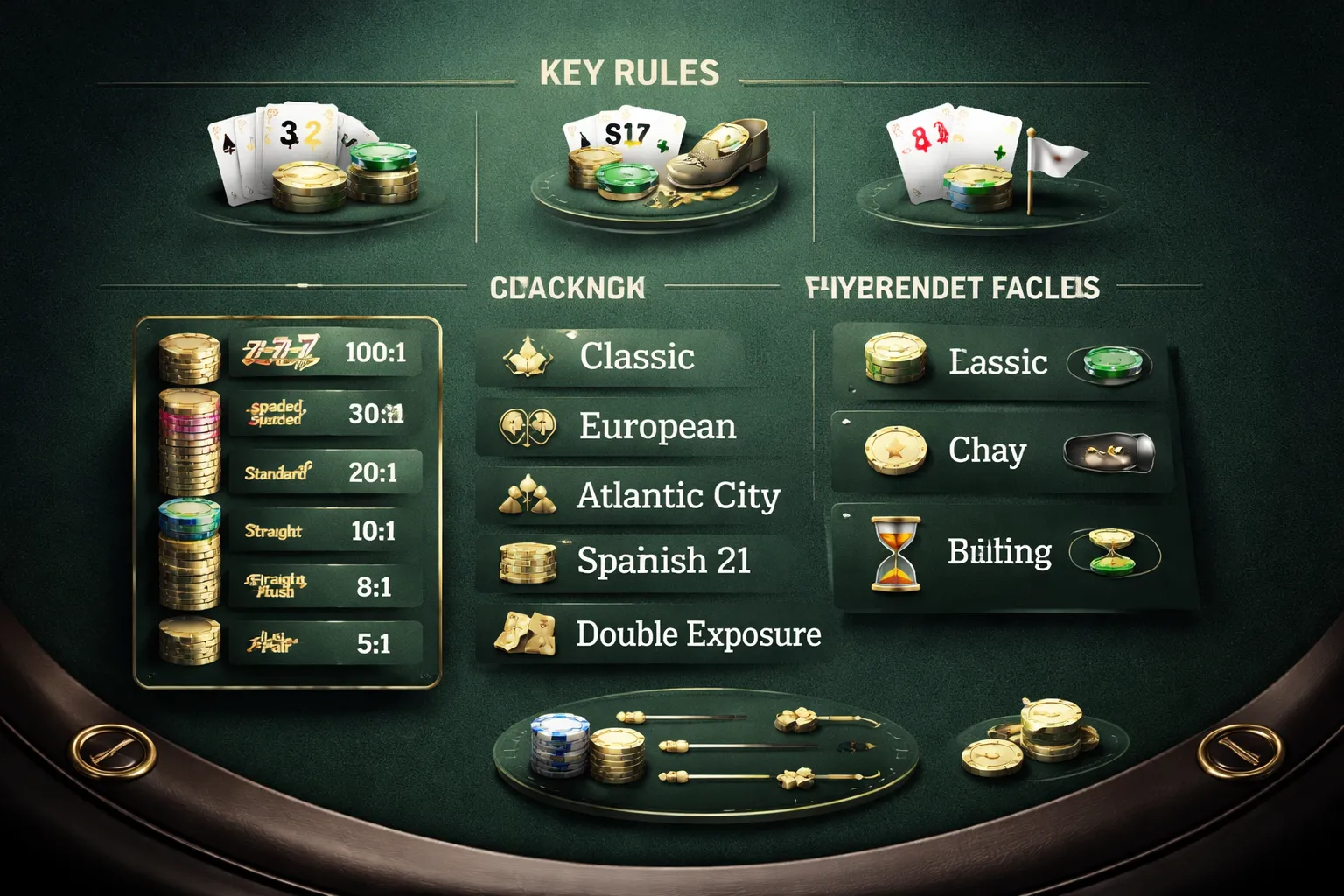
Priority Rules to Seek
- Blackjack pays 3:2. Avoid 6:5 tables. The payout cut raises the house edge fast.
- Dealer stands on soft 17, S17. Prefer S17 over H17.
- Surrender option. Look for late surrender. It cuts losses on bad matchups.
After those, check the rest of the rules as a package. Favor tables that allow doubling after split, allow resplitting pairs, and use fewer decks. Treat every rule change as part of the price you pay to play.
Side Bet Selection Criteria
- Transparency. You need clear win conditions and exact payouts before you bet. If the game hides details behind vague labels, skip it.
- Limits. Check the minimum and maximum for each side bet. Many tables keep the main bet small but let side bets run high.
- Payout ladders. Read the full ladder, not the top prize. A high headline payout often comes with many low tiers and long odds.
- Trigger and timing. Confirm when the side bet locks and what cards count, player cards only, dealer upcard included, or full hand.
Use side bets as optional action, not as part of basic blackjack strategy. If you cannot see the payout table in one screen, you cannot price the bet.
Game Variant Checklist
- Classic Blackjack. Best baseline for learning rules, payouts, and standard strategy. Start here when comparing tables.
- European Blackjack. Dealer usually takes no hole card. You can lose doubles and splits if the dealer has blackjack, depending on the rules. Check this before you play. If you also play table games like roulette, compare risk and edge across formats with our guide to European vs American roulette odds.
- Atlantic City Blackjack. Often has late surrender and dealer stands on soft 17. Still confirm deck count and doubling rules.
- Spanish 21. Removes 10s from the deck and adds bonus payouts and rule changes. Do not assume standard blackjack strategy applies.
- Double Exposure. Both dealer cards show, but the game charges you through weaker blackjack payouts and tighter rules. Read the full paytable first.
Live Dealer Considerations
- Table limits. Live tables often raise minimums at busy times. Check the current min and max before you sit.
- Side bet limits. Live games can price side bets differently than RNG versions. Verify the caps and the payout ladder.
- Dealing speed. Faster dealing means more hands per hour. That increases your exposure to variance and house edge per session.
- Chat and distractions. Turn off chat if it pushes you into rushed decisions or extra side bets.
- Decision time. Confirm the timer length. Short timers lead to mistakes on splits, doubles, and surrender.
Verification Steps Before You Bet
- Open the help file. Confirm payout for blackjack, soft 17 rule, surrender, doubling, splitting, resplitting, and deck count.
- Open the paytable. Check main game payouts and each side bet payout ladder. Look for tier gaps and low-tier frequency.
- Check the game info panel. Verify table limits, side bet limits, and any special rules for the variant.
- Match the rules to the table banner. Do not trust the lobby name alone. Some casinos list a “blackjack” table that runs 6:5 or H17.
| What to check | What you want | What to avoid |
|---|---|---|
| Blackjack payout | 3:2 | 6:5 |
| Soft 17 | S17 | H17 |
| Surrender | Late surrender available | No surrender |
| Side bet details | Full payout ladder shown | Hidden or unclear terms |
| Limits | Clear min and max for all bets | Side bet caps not listed |
Common Mistakes and Misconceptions About Online Blackjack Side Bets
Assuming side bets use the same odds as the main blackjack hand
Main-hand blackjack can run with a low house edge when you get 3:2, S17, and solid rules. Side bets do not follow that math.
Most side bets act like mini lotteries. They pay on rare card patterns. The hit rate stays low, and the house edge often lands in the high single digits or higher.
- What to do: Treat every side bet as a separate game with its own odds.
- What to check: The full payout ladder, the number of decks, and any exclusions.
- What to expect: You can play perfect basic strategy and still lose money fast if you add a high-edge side bet every hand.
Confusing “even money” with improved value
Some online tables offer “even money” when you hold blackjack and the dealer shows an Ace. Players treat it as a safer win. It is not a better deal.
Even money usually equals taking insurance while holding blackjack. Insurance is priced to favor the house.
- What happens: You lock a 1:1 result and give up the normal 3:2 payout.
- Why it matters: You trade long-term value for short-term certainty.
- Rule check: If the table calls it “even money,” read the tooltip or rules. It often routes through the insurance mechanic.
Overestimating “hot streaks” and ignoring variance
Side bets produce long dead stretches, then one spike. That pattern tricks you.
A short run of hits does not change the next hand’s probability. Variance stays high because the wins cluster and the losses feel steady.
- Common trap: You hit a suited pair or a 21+3 combo early, then keep firing because it “keeps coming.”
- Practical fix: Set a side-bet budget per session. Stop when you reach it, even if you feel close.
- Bankroll note: If you like high swing games, learn how volatility works in general, side bets behave closer to high volatility than standard blackjack.
Not noticing rule differences between similar side-bet names
Casinos reuse names. They change the rules. The house edge changes with them.
“Perfect Pairs,” “21+3,” “Lucky Lucky,” “Lucky Ladies,” and “Royal Match” can look identical across lobbies, but the payouts and qualifying hands often differ.
- Examples of differences to spot: Suited vs same-color vs mixed, payout for top tier hands, whether dealer cards count, and whether a push voids the side bet.
- Deck impact: Some side bets shift a lot when you move from 6 decks to 8, or from shoe to single deck.
- What to do: Read the paytable every time you switch provider or table, even if the name matches.
Chasing losses by increasing side-bet size
Players often keep the main bet steady and ramp the side bet after misses. That is the fastest way to blow up your bankroll.
Side bets miss often. If you scale up during the cold stretch, you lock in bigger losses before the next hit arrives, if it arrives at all.
- Bad pattern: $10 main bet, $1 side bet, then $2, $5, $10 after a few losses.
- Simple control: Keep side bets flat, or cap them at a small fixed share of your main bet.
- Better choice: If you want to increase action, increase the main bet only when your bankroll allows it, and keep the side bet optional and small.
Frequently Asked Questions
What are side bets in online blackjack?
Side bets are optional wagers placed beside your main blackjack bet. They pay based on specific card patterns, like pairs or poker-style hands. You win or lose the side bet separately from the main hand. Most side bets have a higher house edge than basic blackjack.
When do you place a side bet?
You place it before the deal, at the same time as your main bet. Once cards come out, you cannot add or change the side bet. If you miss the betting window online, the game locks the side bet off for that round.
Do side bets change blackjack rules?
No. Your main hand still follows standard blackjack rules like hit, stand, double, and split. The side bet runs as a separate wager with its own paytable. Always check the game info panel, side-bet rules vary by provider.
What is the house edge on most blackjack side bets?
It is usually much higher than the main game. Many common side bets sit around 5% to 15% house edge, sometimes more. Basic strategy blackjack can run near 0.5% or lower under strong rules. Side bets cost more over time.
Which side bets have the best odds?
Some versions of 21+3 and Perfect Pairs can be relatively lower than other side bets, but paytables decide everything. A small change in payouts can raise the house edge by several points. Use the posted paytable, not the name.
Is Insurance a side bet, and is it worth it?
Yes. Insurance bets that the dealer has blackjack when showing an Ace. It pays 2 to 1, but the true odds do not justify it for most players. Basic strategy takes Insurance only when you count cards and the deck is rich in tens.
Can you use blackjack strategy on side bets?
Almost never. Most side bets have fixed outcomes based on the first two cards, or the first three cards. You cannot change them with play decisions. Your only real control is whether you bet, and how much.
Do side bets affect your RTP or comp value?
They can. Higher house edge lowers your expected return and can raise your betting volume. Some casinos rate comps by total wager, including side bets. You still pay for those comps through the edge. Track net results, not points.
Do side bets trigger before or after splits and doubles?
Most trigger on the original deal only. Splits and doubles usually do not create extra side bet chances. Some games offer separate side bets tied to split hands, but that is uncommon. Read the specific rule text in the help screen.
Are online blackjack side bets fair?
They use the same RNG or live dealing as the base game. Fairness depends on licensing, game testing, and clear rules. Verify the provider, audits, and RTP disclosures. Use this guide on online casino fairness to check the basics.
How should you size side bets?
Keep them small and consistent. A common cap is 5% to 10% of your main bet, or a fixed amount you can lose without chasing. Avoid progressive increases after losses. If you want higher stakes, raise the main bet instead.
Why do side bets feel streaky?
They rely on rare events with high payouts. That creates long losing runs and occasional spikes. Variance rises fast, even with small stakes. Your short-term results swing more, while the long-term expected loss follows the higher house edge.
Conclusion
Conclusion
Side bets change blackjack from a low-edge game into a high-variance wager. You trade steadier results for rare payout spikes. Your bankroll feels the difference fast.
Use a simple rule. Treat side bets as entertainment spend. Keep them small. Cap them at a fixed amount per hand, or skip them.
If you want better long-term results, put your focus on decisions that matter every hand. Use a blackjack basic strategy chart. It cuts mistakes. It keeps your risk under control.
- Pick one table rule set and stick with it.
- Set a side bet limit before you play, then follow it.
- Raise stakes slowly based on bankroll, not on wins or losses.
- Quit on schedule, time cap, loss cap, win cap.
-
Online Casino Fairness Explained: RNG, RTP, House Edge & Provably Fair
8 months ago -
Slot RTP Explained: What RTP Means and How to Use It
8 months ago -
How to Play Online Slots: Rules, Features & Beginner Tips
8 months ago -
How Slot Jackpots Work: Progressive Jackpots Explained
8 months ago -
How to Play Online Blackjack: Rules, Payouts & Quick Start Guide
8 months ago
-
- RNG Blackjack vs Live Dealer Blackjack, What Changes and What Doesn’t
- Shuffling, CSMs, and Shoe Penetration in Live Blackjack
- RNG Shuffling and How the RNG Deal Works
- Auto-Play, Turbo Mode, and Live Timing Rules
- Common UI Features, Hand History, Stats, and Re-Bet Tools
- Fairness and Trust Signals, Licensing, Audits, and Certificates
-
- What are side bets in online blackjack?
- When do you place a side bet?
- Do side bets change blackjack rules?
- What is the house edge on most blackjack side bets?
- Which side bets have the best odds?
- Is Insurance a side bet, and is it worth it?
- Can you use blackjack strategy on side bets?
- Do side bets affect your RTP or comp value?
- Do side bets trigger before or after splits and doubles?
- Are online blackjack side bets fair?
- How should you size side bets?
- Why do side bets feel streaky?
-
- RNG Blackjack vs Live Dealer Blackjack, What Changes and What Doesn’t
- Shuffling, CSMs, and Shoe Penetration in Live Blackjack
- RNG Shuffling and How the RNG Deal Works
- Auto-Play, Turbo Mode, and Live Timing Rules
- Common UI Features, Hand History, Stats, and Re-Bet Tools
- Fairness and Trust Signals, Licensing, Audits, and Certificates
-
- What are side bets in online blackjack?
- When do you place a side bet?
- Do side bets change blackjack rules?
- What is the house edge on most blackjack side bets?
- Which side bets have the best odds?
- Is Insurance a side bet, and is it worth it?
- Can you use blackjack strategy on side bets?
- Do side bets affect your RTP or comp value?
- Do side bets trigger before or after splits and doubles?
- Are online blackjack side bets fair?
- How should you size side bets?
- Why do side bets feel streaky?
-
Reload Bonus Explained: What It Is and When It’s Worth Claiming
6 months ago -
Online Casino Licensing Explained: Authorities, Licenses & How to Check One
8 months ago -
Best Live Dealer Casinos: Where to Play Live Blackjack, Roulette & More
8 months ago -
Best Online Casinos for High Rollers: VIP Perks, High Limits & Exclusive Bonuses
8 months ago -
Fast Payout Online Casinos: Best Sites for Quick Withdrawals
8 months ago
-
Online Casino Customer Support: What to Look For (Live Chat, Email, Response Times)
8 months ago -
Sign Up for an Online Casino: Create an Account in Minutes
8 months ago -
Online Casino Payment Safety Tips: How to Deposit and Withdraw Securely
8 months ago -
What to Do If an Online Casino Won’t Pay Out: Step-by-Step Actions
8 months ago -
How to File a Complaint Against an Online Casino (Plus ADR Explained)
8 months ago