Best Online Casinos for Blackjack: Best Tables, Rules & Bonuses

Blackjack comes down to rules, tables, and math. Online casinos change all three. Payout rates, deck count, dealer stands, side bets, and table limits can shift your edge fast. Bonuses and wagering rules can also decide if you can cash out.
This guide lists the best online casinos for blackjack and shows you how to pick the right table. You will learn which rules cut the house edge, which blackjack variants to avoid, and what to check before you deposit. You will also see what to look for in bonuses, including wagering terms that apply to blackjack, max bet caps, and withdrawal limits. If fast cashouts matter, use our fast payout online casinos guide to compare withdrawal speed by site.
Key Takeaways
- In het kort: Play tables with low house edge rules, avoid bad variants, and treat bonuses as a contract.
- Pick blackjack with 3:2 payout on blackjack, not 6:5.
- Choose tables where the dealer stands on soft 17 (S17) when you can.
- Use games that allow double after split (DAS). Skip tables that restrict doubling to 10 or 11 only.
- Avoid variants with side bets as the main hook. They add edge and raise volatility.
- Before you deposit, verify the casino’s license, KYC, and payment rails. Use this guide on how to choose a safe online casino.
- On bonuses, check blackjack contribution, wagering, max bet caps during playthrough, and withdrawal limits.
- If blackjack counts 0% or very low toward wagering, the bonus will not help your blackjack bankroll.
- Set your own limits. Bet sizing matters more than chasing comps.
Best Online Casinos for Blackjack: How We Rank and Test Sites
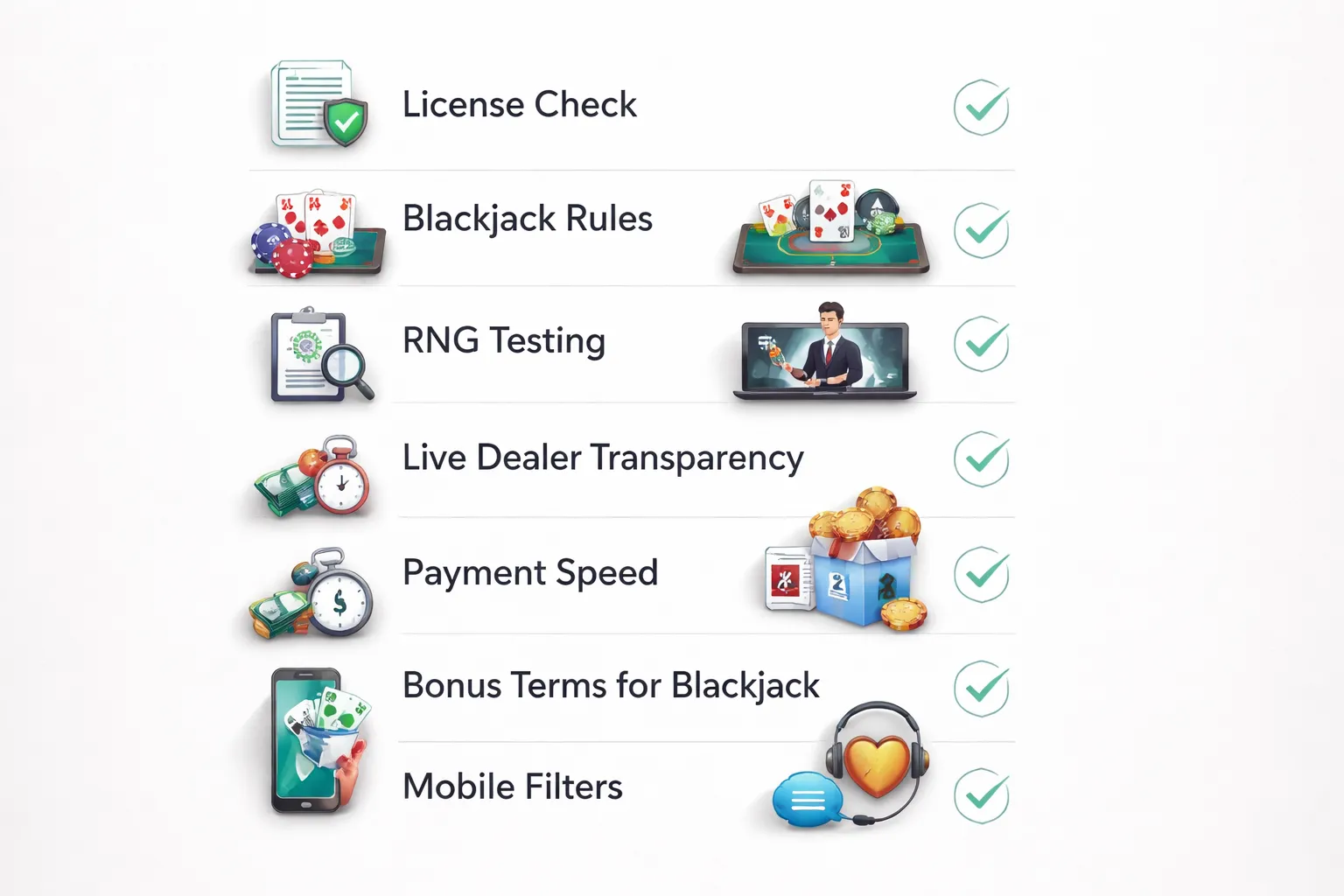
Licensing, Regulation, and Player Protection Checks
We start with legal status. We confirm the operator license, the regulator, and the license number. We check the domain matches the licensed entity.
- Regulator strength: We prioritize strict regulators with clear dispute paths.
- KYC and AML: We review ID checks, source of funds triggers, and how the site handles verification delays.
- Security: We confirm HTTPS, encryption, and account protections like 2FA where offered.
- Player protection: We check self-exclusion, deposit limits, timeouts, and reality checks.
- Complaint handling: We test escalation steps and response times when an issue needs a human.
Blackjack Game Catalog Quality, RNG vs Live Dealer
You need depth, not clutter. We rank casinos higher when they offer many blackjack variants with clear rules and stable performance.
- RNG blackjack: We check classic, European, and multi-hand options. We avoid sites that hide rules behind menus.
- Live dealer blackjack: We look for multiple studios, table limits across budgets, and stable streams at peak hours.
- Limits and pacing: We note minimums, maximums, and speed controls for RNG tables.
- Table availability: We test if you can actually find seats, not just see table listings.
Rules and Payout Standards That Move the House Edge
Rules decide your long-term cost. We score tables based on the most common house edge drivers. We prefer casinos that label rules clearly inside the game.
- Blackjack payout: We favor 3:2. We downgrade 6:5 tables hard.
- Dealer rules: Stand on soft 17 beats hit on soft 17.
- Double rules: Double after split helps. Double on any two helps more than 9 to 11 only.
- Splits: Re-splitting pairs helps. Re-splitting aces helps most. We check if you can hit split aces.
- Surrender: Late surrender helps when offered.
- Side bets: We treat them as separate products. We note availability and opt-out clarity.
Software Providers and Fairness Verification
We check who builds the games and how the casino proves fairness. You should not need to guess.
- Provider quality: We prioritize known studios with consistent blackjack math and clear rule sheets.
- RNG testing: We look for independent testing references and current audit statements.
- Live transparency: We check studio identity, game history access, and round logs where available.
- Game stability: We test load time, disconnect handling, and whether a hand resolves correctly after a drop.
Payment Methods, Withdrawal Speed, and Fees
Fast cashouts matter more than flashy promos. We test deposits and withdrawals where possible, then verify terms and real user constraints.
- Payment rails: Cards, bank transfer, e-wallets, and crypto where supported.
- Withdrawal time: We track stated processing times and typical ranges by method.
- Fees: We check casino fees, third-party fees, and FX costs for non-base currencies.
- Limits: We review minimum cashout, maximum cashout, and weekly or monthly caps.
- Verification friction: We note when KYC blocks withdrawals until you submit documents.
Bonuses, Relevance to Blackjack Players, and Terms That Matter
Most bonuses target slots. We grade promos on whether they support blackjack play without traps.
- Blackjack contribution: We check how much blackjack counts toward wagering. Low or 0% crushes value.
- Wagering requirement: We compare playthrough to bonus size, then adjust for blackjack contribution.
- Max bet rules: We check max stake during wagering. This can force tiny bets and slow clearing.
- Game restrictions: We confirm which blackjack tables qualify. Some promos exclude live or exclude 3:2 tables.
- Cashout limits: We check capped winnings, max withdrawal, and time limits to complete wagering.
- Bonus types: We separate match bonuses, reloads, cashback, and free bets. We state which ones fit blackjack.
Mobile UX, Table Filters, and In-Game Features
You need fast navigation and clear table selection. We test mobile first, then desktop.
- Table filters: We look for filters by limits, provider, rule set, and live vs RNG.
- Rule visibility: We check if payouts and key rules show before you bet.
- Bet behind: For live blackjack, we score casinos higher when bet behind works smoothly and shows limits.
- Statistics and history: We note hand history, session stats, and downloadable statements.
- Side bet toggles: We prefer clear on off controls and no forced side bet prompts.
- Performance: We test stream quality, latency, and battery drain on common devices.
Customer Support Quality and Responsible Gambling Tools
Support matters when a withdrawal stalls or a bonus term blocks cashout. We test real channels, not just claims.
- Support channels: Live chat, email, and phone where offered. We check hours and language coverage.
- Response quality: We measure time to first reply and whether agents answer blackjack specific questions.
- Dispute guidance: We check if the casino explains next steps and provides regulator or ADR contact info.
- Responsible gambling: Deposit limits, loss limits, session limits, timeouts, self-exclusion, and cooling-off tools.
How the Final Ranking Works
We score each casino across the same set of blackjack-first criteria. We then rank by total value for blackjack play, not by promo size.
- Safety and licensing: Must pass to qualify.
- Blackjack rules and payouts: Largest weight because it controls house edge.
- Cashout speed and fees: High weight because it impacts your access to funds.
- Game catalog and software trust: Medium to high weight based on breadth and transparency.
- Bonus usefulness for blackjack: Medium weight, adjusted for blackjack contribution and max bet limits.
- Mobile and support: Medium weight, with penalties for slow chat and weak RG tools.
If you want a broader view of operators we trust across game types, use our best online casinos list for cross-category picks.
Quick Comparison: What to Look for in a Blackjack-Friendly Casino
Use this checklist to spot blackjack tables that protect your edge, your bankroll, and your time.
Ideal rules checklist for low-edge play
- Dealer stands on soft 17 (S17). Avoid H17 when you can.
- Blackjack pays 3:2. Skip 6:5 tables unless you play for fun only.
- Double after split (DAS). This adds value and options.
- Late surrender (LS) if offered. Useful in specific bad spots.
- Resplit rules. Look for resplit to 3 to 4 hands. Aces resplit helps. Ace hit rules vary.
- Number of decks. Fewer decks usually helps, but rules matter more than deck count.
- Peek or hole card rules. Standard US style reduces some costly doubles and splits when dealer has blackjack.
- Reasonable penetration in live games. Deeper cuts give you more hands before shuffle, it matters for serious play.
Minimum and maximum table limits by player type
- Low bankroll. Target $1 to $5 minimums online, or $5 to $15 in live dealer. Avoid tables where side bets inflate the spend.
- Mid stakes. Look for $10 to $50 with rule choices and steady seat availability. You want consistent limits across sessions.
- High stakes. Check max bet per hand, max double, and max split exposure. Many tables cap these separately.
- Bonus hunters. Check max bet limits tied to wagering. A strong blackjack bonus can still fail if your allowed bet size stays low.
- Fast grinders. Pick tables with clear speed settings and stable limits. Slow live tables can cut hands per hour.
Live dealer studios vs digital tables: who each suits best
- Live dealer suits you if you want pace control and a table feel. You get real dealers, visible dealing, and social features. You accept higher minimums and slower hands.
- Digital suits you if you want volume and lower limits. You get faster play, more rule variants, and more $1 to $2 tables. You rely on the RNG and the game log for transparency.
- Check the provider and table label. Studios and RNG suppliers vary in rules, limits, and game stability.
Side bets and jackpot features: entertainment vs value trade-off
- Treat side bets as a separate game. Many carry a high house edge and swing your results.
- Track the cost. A $5 main bet plus $5 in side bets doubles your spend without improving your core odds.
- Jackpots can add fun. They rarely add value for disciplined blackjack play. Keep them small and optional.
- Watch bonus terms. Some promos push side bet volume but exclude side bets from wagering credit, or cap wins.
Regional availability and currency support (USD, EUR, crypto)
Blackjack Table Types Online (And Which One Is Best for You)
Classic RNG blackjack, fastest hands and lowest friction
RNG blackjack uses a random number generator. You play against software, not a dealer. You can play fast, pause anytime, and avoid table waits.
- Best for: Fast sessions, low stakes, bonus wagering volume.
- What to check: Rules (dealer hit or stand on soft 17), blackjack payout (3:2 or 6:5), double rules, surrender, number of decks.
- Why it matters: Rule tweaks move the house edge. 6:5 payouts and restricted doubles cost you more than most players think.
Live dealer blackjack, real-time dealing, chat, and table atmosphere
Live dealer blackjack streams a real table. A dealer deals real cards. You place bets through an interface. You get slower hands, more friction, and a more social feel.
- Best for: Players who want a real table, clear dealing, and less “slot-like” pacing.
- What to check: Table limits, seat availability, side bets, video quality, latency, studio provider, max bet behind.
- Speed note: Live tables often run 30 to 80 hands per hour. RNG can run several hundred hands per hour, depending on settings.
- Bonus note: Some casinos restrict live games for certain promos. Read the promo game weighting before you grind wagering.
Multihand and speed blackjack, volume play and variance considerations
Multihand lets you play two to five hands at once. Speed blackjack removes delays and pushes you to act fast. Both increase volume. Both increase bankroll swings.
- Best for: Players who track bankroll and want more hands per hour.
- What changes: You face more short-term variance because you put more money at risk per minute.
- Practical rule: If you multihand, lower your per-hand stake. Keep total money on the table close to your normal single-hand bet size, unless you accept bigger swings.
- What to check: Auto-play options, decision timers, rebet settings, and whether the game forces continuous shuffle rules.
VIP and high-limit rooms, limits, comps, and concierge expectations
High-limit blackjack raises table minimums and maximums. Some casinos add hosted service. Some just raise limits and change nothing else.
- Best for: Players who want higher stakes, faster handling of withdrawals, and tailored promos.
- What to check: Max bet, max payout per hand, withdrawal limits, deposit methods, and whether the casino caps wins on bonus play.
- Comps reality: VIP perks follow expected loss. Better rules and lower house edge can reduce comp value even when your stakes rise.
- Safety: High limits amplify risk. Use this fake online casino checklist before you move large bankrolls.
Blackjack tournaments, formats, entry fees, and scoring basics
Tournaments turn blackjack into a bankroll race. You play a fixed number of hands. You try to finish with more chips than your table, or the full field.
- Common formats: Sit-and-go tables, scheduled multi-round events, leaderboard series.
- Costs: Buy-in plus fee. Some add rebuys or add-ons.
- Scoring basics: Final chip count ranks you. Some formats score points per win or per finishing position.
- What to check: Starting stack, hands per round, elimination rules, late registration, payout structure, and whether pushes count as ties or advance rules apply.
Demo and free-play tables vs real-money tables, what actually changes
Demo blackjack helps you learn buttons and basic strategy flow. It does not test the real-money experience.
- What stays the same: Core rules, dealing flow, and strategy decisions, if the casino uses the same game build.
- What changes: Stakes pressure, session length, withdrawal friction, promo terms, and table availability for live games.
- What to verify before real play: The exact rule set, deck count, blackjack payout, and whether the real-money table uses different limits or side bets.
| Table type | Hands per hour | Best use | Main tradeoff |
|---|---|---|---|
| Classic RNG | High | Low friction, bonus volume, fast practice | Less “table feel” |
| Live dealer | Medium | Real dealing, social play, clear pacing | Slower, seat limits |
| Multihand or speed | Very high | Volume play | Higher variance, faster losses |
| VIP or high-limit | Medium | Big stakes, hosted perks | Bigger risk, stricter limits and policies |
| Tournaments | Fixed | Competitive formats | More volatility, fee reduces value |
| Demo | Any | Learning the UI and rules | No proof of cashout or promo value |
Blackjack Rules That Matter Most Online (House Edge Explained)
Payouts: 3:2 Beats 6:5 Every Time
Always check the blackjack payout before you play.
- 3:2 blackjack, a $10 blackjack pays $15.
- 6:5 blackjack, a $10 blackjack pays $12.
That $3 gap repeats all session. It does not depend on your skill.
Rule impact on house edge, all else equal.
- 3:2, baseline.
- 6:5, adds about +1.39% to the house edge.
If you play $10 a hand for 100 hands, 6:5 can cost about $14 more than 3:2 from this rule alone, depending on how often you hit blackjack.
Soft 17: Dealer Hits vs Stands
Soft 17 means the dealer has 17 with an ace counted as 11, like A-6.
- Dealer stands on soft 17 (S17), better for you.
- Dealer hits soft 17 (H17), better for the house.
H17 lets the dealer improve weak 17 totals more often.
Rule impact on house edge, all else equal.
- S17, baseline.
- H17, adds about +0.20%.
Strategy changes under H17 show up most with doubles against dealer 2 through 6 and some soft hands. Use the correct chart for the exact rule set.
Deck Count and Shuffle Method
More decks usually raise the house edge and reduce your advantage plays.
- Single deck, usually best odds.
- Double deck, still strong.
- 6 to 8 decks, common online live tables.
Rule impact from deck count varies by rules, but a rough guide is about +0.05% house edge per extra deck when other rules stay the same.
Shuffle method matters more than deck count for long-term edge tools.
- Shoe with cut card, you see penetration and the game plays normally.
- Continuous shuffle machine (CSM), the discard mixes back in fast. It kills card counting value and reduces predictable streaks.
If you care about advantage play, avoid CSM tables. If you only care about basic strategy EV, CSM does not change the core math much, but it often comes with worse side rules.
Double-Down Rules: Any Two Cards vs 9 to 11 Only
Doubling works because it lets you press your edge on strong hands.
- Double on any two cards (DOA), best for you.
- Double only on 9 to 11, weaker.
- Double only on 10 to 11, worse.
House edge impact depends on the rest of the rules, but restricting doubles commonly costs you around +0.10% to +0.30%.
Also check if you can double after a hit. Most online tables do not allow it, and that is normal.
Splitting Rules: Re-Split Aces, Double After Split, Split Limits
Splitting rules decide how much value you can extract from pairs.
- Re-splitting aces (RSA), good. It protects you from drawing another ace and getting stuck.
- Double after split (DAS), very good. It lets you press on strong split hands like 2-2 vs 5 or 6.
- Split limits, common caps are 3 or 4 hands total. Tighter caps reduce your upside in rare high-edge spots.
Typical house edge effects, all else equal.
- DAS, lowers house edge by about 0.10% to 0.15%.
- RSA, lowers house edge by about 0.05% to 0.10%.
Also check if the casino lets you hit split aces. Many tables do not. That rule matters.
Surrender: Early vs Late and When It Helps
Surrender lets you forfeit half your bet and end the hand.
- Late surrender (LS), you can surrender only after the dealer checks for blackjack.
- Early surrender (ES), you can surrender before the check. It is rare and very strong.
Rule impact on house edge, all else equal.
- Late surrender, reduces house edge by about 0.07% to 0.08%.
- Early surrender, can reduce house edge by 0.20% to 0.60%, depending on what it covers.
High-value late surrender spots in common multi-deck games include 16 vs 9, 10, A and 15 vs 10. Use the right strategy chart for your exact rules.
Blackjack on Split Aces and Other Ace Restrictions
Online rules often restrict split aces.
- One card only to each split ace, common.
- No re-split aces, common on weaker tables.
- 21 on split aces pays 1:1, standard. It does not count as blackjack.
These rules reduce upside on one of your best split situations. You can still split aces because the alternative is worse, but you should treat tight ace rules as a red flag when choosing a table.
European No-Hole-Card (ENHC) and the Risk to Doubles and Splits
Many online live tables use European rules. The dealer takes no hole card until you finish your hand.
That changes your risk when the dealer shows an ace or 10.
- If you double or split and the dealer later reveals blackjack, you can lose all the extra bets.
- With American hole-card rules, the dealer checks first. You avoid doubling or splitting into a dealer blackjack.
ENHC raises the house edge and forces strategy adjustments. The size depends on the rest of the rules, but it is often around +0.10% to +0.20% versus a similar hole-card game.
On ENHC tables, be stricter with doubles and some splits against dealer 10 and ace. Use an ENHC-specific chart, not a generic one.
If you fund your bankroll with plastic, use a Visa or Mastercard-friendly cashier so you can move in and out fast, see our best casinos for beginners guide for simple sign-up and payment tips.
Best Blackjack Variants to Play Online (Pros, Cons, and Who They Fit)
Online casinos offer many blackjack rule sets. Your edge swings on small details, deck count, dealer rules, and payout for blackjack. Use the variant that fits your goal, learning, low house edge, or fast play.
Classic Blackjack (Baseline)
- What it is: Standard blackjack with common rules. You will see 6 to 8 decks most often online.
- Pros: Easiest to learn. Most strategy charts match it. Many tables run clean rules and stable limits.
- Cons: Some “classic” tables hide bad rules, 6:5 blackjack, no DAS, or limited doubles.
- Best fit: Newer players and anyone drilling basic strategy.
European Blackjack (ENHC)
- What it is: European No Hole Card. Dealer takes no hole card until players finish.
- Pros: Common in live dealer lobbies. Often pairs with solid limits and steady game speed.
- Cons: Higher risk on doubles and splits against dealer 10 and ace. Your cost jumps if the table also restricts doubles or splits. Expect about +0.10% to +0.20% house edge versus a similar hole-card game.
- Best fit: Live dealer players who follow an ENHC-specific chart and keep doubles tighter.
Atlantic City Blackjack (Player Friendly, Where Available)
- What it is: A rules package linked to NJ-style blackjack. Many versions use 8 decks and stand on soft 17.
- Pros: Often includes late surrender and dealer checks for blackjack. These rules cut swing and protect doubles and splits.
- Cons: Not available at every casino. Some online versions change key parts, so you still need to confirm rules on the table screen.
- Best fit: Strategy-first players who want stable, low-drama rules and surrender access.
Vegas Strip Blackjack (Common “House” Rules)
- What it is: A popular rules family. Online versions often use multiple decks, with split limits that vary by casino.
- Pros: Easy to find. Many tables keep blackjack at 3:2 and allow doubling on any two cards.
- Cons: Split rules drive your long-term cost. Watch for “no resplit aces,” “hit split aces only once,” and “no DAS.” These hit your EV in real play.
- Best fit: Volume players who want lots of table choices and can quickly filter for good split rules.
Single-Deck and Double-Deck (Value If Rules Stay Clean)
- What it is: Fewer decks. This can lower house edge, but only if the table does not “pay you back” with worse rules.
- Pros: Strong potential value with 3:2 blackjack, stand on soft 17, and reasonable doubling and splitting rules. You also get clearer odds on specific hands.
- Cons: Many online single-deck games add harsh limits, 6:5 payouts, no DAS, or restricted doubles. Those changes can erase the deck advantage fast.
- Best fit: Detail-focused players who read the rules panel every time and avoid 6:5.
Blackjack Switch and Other Specialty Titles (Fun vs Edge)
- What it is: Rule twists. Blackjack Switch lets you swap top cards between two hands, but often pays blackjack at 1:1 and lets the dealer push on 22.
- Pros: High engagement. More decisions per round. Good for breaking boredom and extending session time at small stakes.
- Cons: Extra rules usually raise the house edge or increase variance. Bonus side bets often cost more than they return.
- Best fit: Entertainment-first players who accept a higher cost per hour and keep stakes controlled.
Spanish 21 and Non-Standard Decks (Strategy Changes)
- What it is: Spanish decks remove the 10 cards, but the game adds player-friendly rules and bonus pays on some hands.
- Pros: More double and hit freedom on many tables. Some rule sets let you double after splitting and late surrender. Bonuses can boost excitement.
- Cons: You cannot use standard blackjack charts. The missing 10s change hit, stand, and double points. Misplayed Spanish 21 gets expensive fast.
- Best fit: Players willing to learn a dedicated strategy chart and who like bonus-driven gameplay.
Double Exposure and Novelty Variants (Higher Payouts, Higher Catch)
- What it is: Dealer cards show face up, but the table takes value back through rule changes.
- Pros: More information on every decision. Strong “feel” for control. Easy to understand why a play works.
- Cons: Expect worse payouts on blackjack, more dealer wins on ties, or other penalties. These games can look soft while holding a bigger edge.
- Best fit: Players who want maximum visibility and do not mind paying for it. Keep stakes smaller until you confirm the full rules.
| Variant | Main Upside | Main Risk | Best For |
|---|---|---|---|
| Classic | Simple, charts match | Hidden bad rules, 6:5 | Learning and steady play |
| European (ENHC) | Common in live dealer | Costlier doubles and splits vs 10 or A | Live players using ENHC charts |
| Atlantic City | Often includes surrender and dealer check | Availability varies | Low-drama rule hunters |
| Vegas Strip | Many tables and limits | Split rules vary a lot | High-volume players |
| Single or Double Deck | Low-deck value if rules stay clean | Often paired with 6:5 or tight doubles | Rule readers and optimizers |
| Switch and specialty | More decisions and novelty | Extra rules raise edge or variance | Entertainment sessions |
| Spanish 21 | Player-friendly options and bonuses | Needs its own strategy | Chart users who like bonuses |
| Double Exposure | Dealer info is visible | Harsh payout and tie rules | Control-focused players |
If a table hides rules, walk away. If a casino feels off, use this guide on how to spot a fake online casino before you deposit.
Blackjack Bonuses and Promotions: How to Find Real Value
Deposit Match vs No-Deposit: What Helps Blackjack Players
Most deposit bonuses look big, then shrink fast at a blackjack table.
- Deposit match gives you more bankroll. It can help if the casino lets blackjack count at a fair rate and the wagering rules stay tight.
- No-deposit bonuses often cap winnings, cap cashout, and block blackjack or count it at 0% to 10%. Treat them as a trial, not value.
- Best fit for blackjack is a small to mid match with low wagering, clear max bet limits, and blackjack contribution of 20% or higher.
Wagering Requirements and Blackjack Contribution Rates
Two numbers decide your real cost. Wagering multiple and blackjack contribution.
- Wagering is the rollover. Example, 25x bonus means you must place bets equal to 25 times the bonus before you can cash out.
- Contribution is how much your blackjack bets count toward that rollover.
- Common ranges: blackjack counts 0% to 25%. Some casinos set specific tables to 0%.
Use this quick formula.
- Required blackjack action = (Bonus x Wagering) / Contribution rate
Example.
- $200 bonus, 30x wagering, blackjack counts 10%.
- Rollover target = $200 x 30 = $6,000.
- Required blackjack action = $6,000 / 0.10 = $60,000 in blackjack bets.
If blackjack counts 0%, you cannot clear the bonus with blackjack. Walk away.
Max Bet Rules and Game Restrictions That Void Winnings
Many blackjack bonus disputes come from one line in the terms. Max bet while a bonus is active.
- Max bet rule: a cap per hand, often $5 to $25 on low stakes promos.
- What triggers problems: raising stakes to speed rollover, side bets, or switching to excluded tables.
- Game restrictions: “classic blackjack only,” “no live dealer,” or “exclude European blackjack.” Some rules exclude any table with favorable payouts.
- Session rules: some casinos limit bet sizes after a win, or flag fast bet changes.
Track your active bonus and your table. If you cannot confirm the max bet and eligible games in writing, skip the offer.
Cashback, Rakeback-Style Deals, and Loss Rebates
Cashback can beat a match bonus for blackjack because it does not force rollover, or it sets a smaller one.
- Weekly cashback: a percent of net losses, often 5% to 20%.
- Loss rebate promos: a one-time refund up to a cap, sometimes as cash, sometimes as bonus funds.
- Check the base: some programs calculate cashback on your theoretical loss, not your real loss.
- Check the rollover: cashback paid as bonus funds can still carry 1x to 10x wagering.
For steady blackjack play, prefer cashback paid as cash, or bonus funds with 1x wagering and clear max bet limits.
VIP and Loyalty Programs: Comps, Cashback Tiers, and Reloads
VIP value comes from math, not status.
- Points earn rate: how many points you earn per $1 wagered, and whether blackjack earns at a reduced rate.
- Real redemption value: points to cash conversion.
- Tier perks: higher cashback, lower fees, faster payouts, higher limits, and reload bonuses.
- Reloads: smaller matches that repeat. They often beat one large welcome bonus if the wagering stays low.
If you play bigger stakes, compare programs built for high limits and fast cashouts. Use this guide on VIP perks for high rollers to benchmark tiers and reload value.
Free Bets, Insurance Promos, and Live Dealer Offers
Some promos change how you should bet. Read the settlement rules.
- Free bet: the stake often does not return with winnings. A “$25 free bet” can pay like a $25 profit-only coupon.
- Insurance promos: “insurance refunded” can reduce variance, but it can also push you toward taking insurance. Follow basic strategy, not the promo.
- Live dealer boosts: some casinos offer live blackjack leaderboards, streak races, or reduced wagering on live tables. Check max bet limits and table eligibility.
Promos tied to side bets usually carry higher house edge. They can erase any bonus value.
Bonus Examples: Calculate Expected Cost vs Upside
Use expected cost to see if a bonus helps you. Keep it simple.
- Step 1: calculate required blackjack action.
- Step 2: estimate house edge for your rules. Use 0.5% as a rough baseline for decent blackjack rules with correct play.
- Step 3: expected cost = action x house edge.
- Step 4: compare expected cost to the bonus, then adjust for max cashout caps.
| Offer | Key terms | Required action | Expected cost (0.5%) | Net value check |
|---|---|---|---|---|
| $200 bonus | 20x, blackjack counts 25% | $200 x 20 / 0.25 = $16,000 | $16,000 x 0.005 = $80 | Positive if no tight max bet and no low cashout cap |
| $200 bonus | 30x, blackjack counts 10% | $200 x 30 / 0.10 = $60,000 | $60,000 x 0.005 = $300 | Negative for most players |
| 10% cashback | Paid as cash weekly | No rollover | None from wagering | Strong for regular play, watch caps and eligibility |
Choose bonuses that lower your cost per dollar wagered. Skip bonuses that force huge action, restrict tables, or punish normal bet sizing.
How to Play Blackjack Online: Step-by-Step (RNG and Live Dealer)
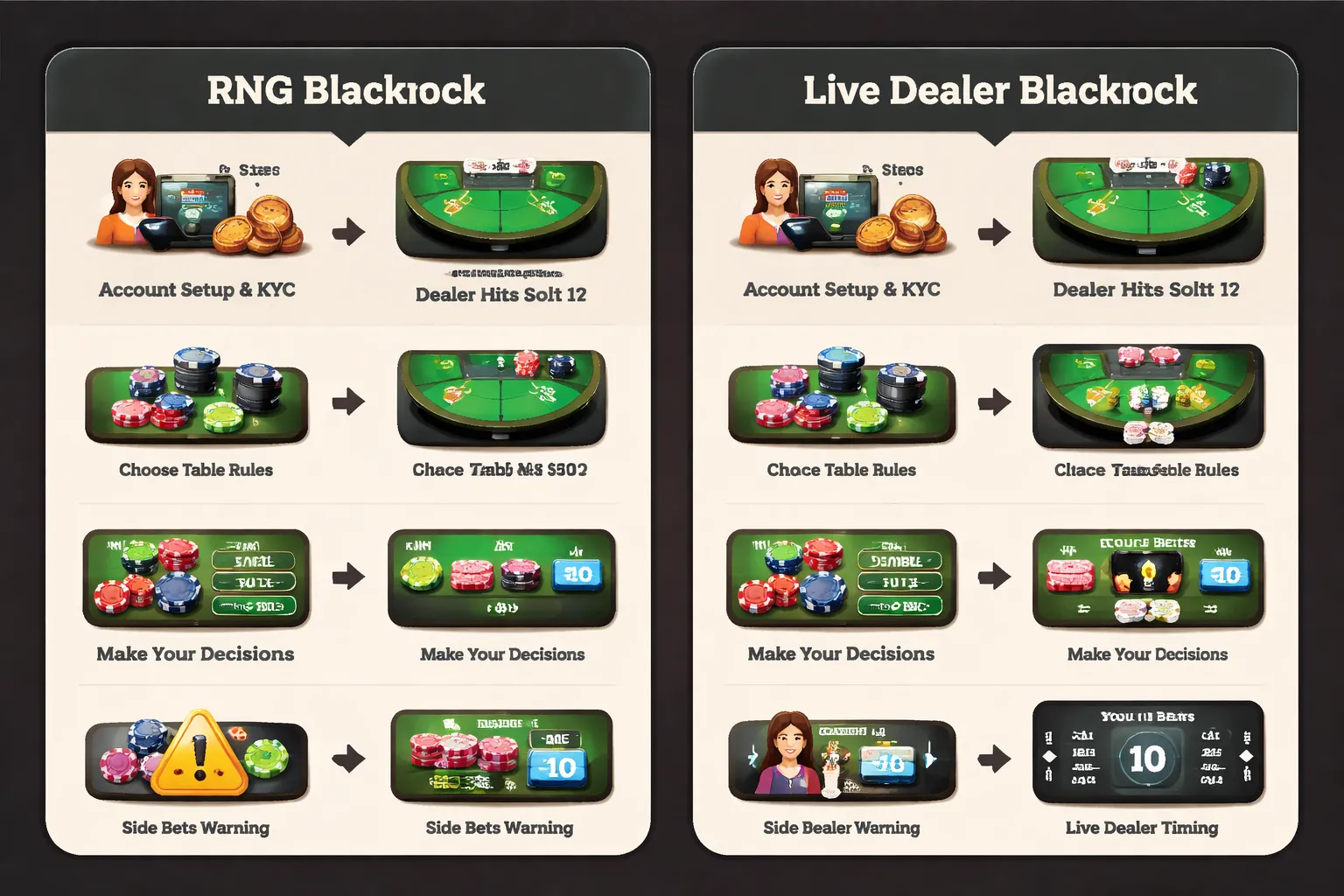
1) Set up your account and pass KYC fast
- Create your account. Use your real name and address. Match your bank or e-wallet details.
- Confirm email and phone. Do this before you deposit. It prevents lockouts during cashouts.
- Complete KYC early. Upload ID and proof of address right away. Do not wait until you win.
- Use clean documents. Clear photo, full corners visible, no glare, no blur. Use a recent utility bill or bank statement for address.
- Match your payment method. Many casinos require withdrawals to return to the same method you used to deposit.
- Plan for limits. Check daily and monthly cashout caps before you play, especially if you bet bigger stakes. Read more in high withdrawal limit casinos.
2) Pick RNG or live dealer first
- RNG blackjack. Fast hands, low table minimums, strong for practice and volume. You play against software. The shuffle is random every hand.
- Live dealer blackjack. Slower pace, real dealer, physical cards, real table rules. Best if you want a casino feel and clear table procedures.
3) Choose the right table, limits, rules, and seats
- Set your limits. Pick a table where the minimum bet fits your bankroll. Avoid tables that force you into a bet size you cannot sustain.
- Check the max bet. It matters if you use doubles and splits, your real exposure per hand can jump fast.
- Read key rules. Favor 3:2 blackjack payouts. Avoid 6:5 tables when possible.
- Look for surrender. Late surrender helps in bad spots. If the table offers it, use it correctly.
- Check double rules. Double on any two cards beats double on 9 to 11 only.
- Check split rules. More resplits help. Re-splitting aces helps. Hitting split aces helps, many tables do not allow it.
- Dealer rules. Dealer stands on soft 17 helps you. Dealer hits soft 17 hurts you.
- Live dealer seats. If seats are full, look for unlimited or behind-the-seat options if offered. If you can only bet behind, you do not control decisions.
4) Place bets, chips, and min to max basics
- RNG. Select your chip, click the betting circle, then confirm. Many games let you rebet the last amount.
- Live dealer. Place chips before the bet window closes. You cannot add chips after it locks.
- Chip values. The chip is just a unit. Your stake equals chip value times chip count. Check the chip selector before you click fast.
- Respect min and max. Your base bet must meet the minimum. Your total bet must stay under the max, including doubles and splits.
- Track your true risk. A hand can become 2 hands after a split, then double on each. Your exposure can reach 4x your original bet fast.
5) Play the core decisions, hit, stand, double, split, surrender
- Hit. Take another card. Use it when your total is too low to beat the dealer reliably.
- Stand. Take no more cards. Use it when another card is likely to bust you or when your total already pressures the dealer.
- Double. Double your bet, take one card, then stand. Use it on strong starting hands where one card can push you to a winning total.
- Split. If you have a pair, split into two hands. You place a second bet equal to the first. Your variance rises because you put more money in play.
- Surrender. Give up the hand and lose half your bet, if the table allows it. Use it to cut losses in the worst matchups.
- Use basic strategy. It cuts the house edge more than any other decision you make. Many RNG games include a strategy chart or hint toggle, use it if allowed.
6) Side bets, treat them as a separate game
- Know the tradeoff. Most side bets carry a higher house edge than the main hand.
- Set a hard rule. If you play side bets, cap them to a small fixed amount. Do not scale them with your main bet.
- Skip them during bonus clearing. Some bonuses exclude side bets from wagering, or count them at a reduced rate.
- Use them for entertainment only. If you want the best cost per dollar wagered, focus on the main hand.
7) Live dealer timing, etiquette, and decision clocks
- Respect the bet window. Place bets early. Do not wait for the last second, streams can lag.
- Watch the decision timer. You have a limited time to act. If you time out, the system will usually stand or follow a default rule.
- Keep chat clean. Do not spam. Do not argue about outcomes. Dealers cannot change results.
- Do not slow the table. Think before your turn. If you need time, move to RNG or a slower table format.
- Know what you control. If you are betting behind a seat, you usually cannot hit or stand. Your bet follows the seated player’s decisions.
8) Autoplay, quick seat, and stats panels, use them safely
- Autoplay. Set strict stop rules, stop-loss, stop-win, and max hands. Turn off side bets. Confirm the game uses basic strategy or your chosen rules, not random choices.
- Quick seat. It drops you into the next available table. Check rules and limits immediately. Do not assume you landed on 3:2 or your preferred stakes.
- Statistics panels. Past hands do not predict future hands. Use stats to verify rules, pace, and volatility, not to chase streaks.
- Speed controls. Faster hands increase hourly variance. If you tilt after a swing, slow the game down.
Blackjack Strategy Essentials (What Actually Works Online)
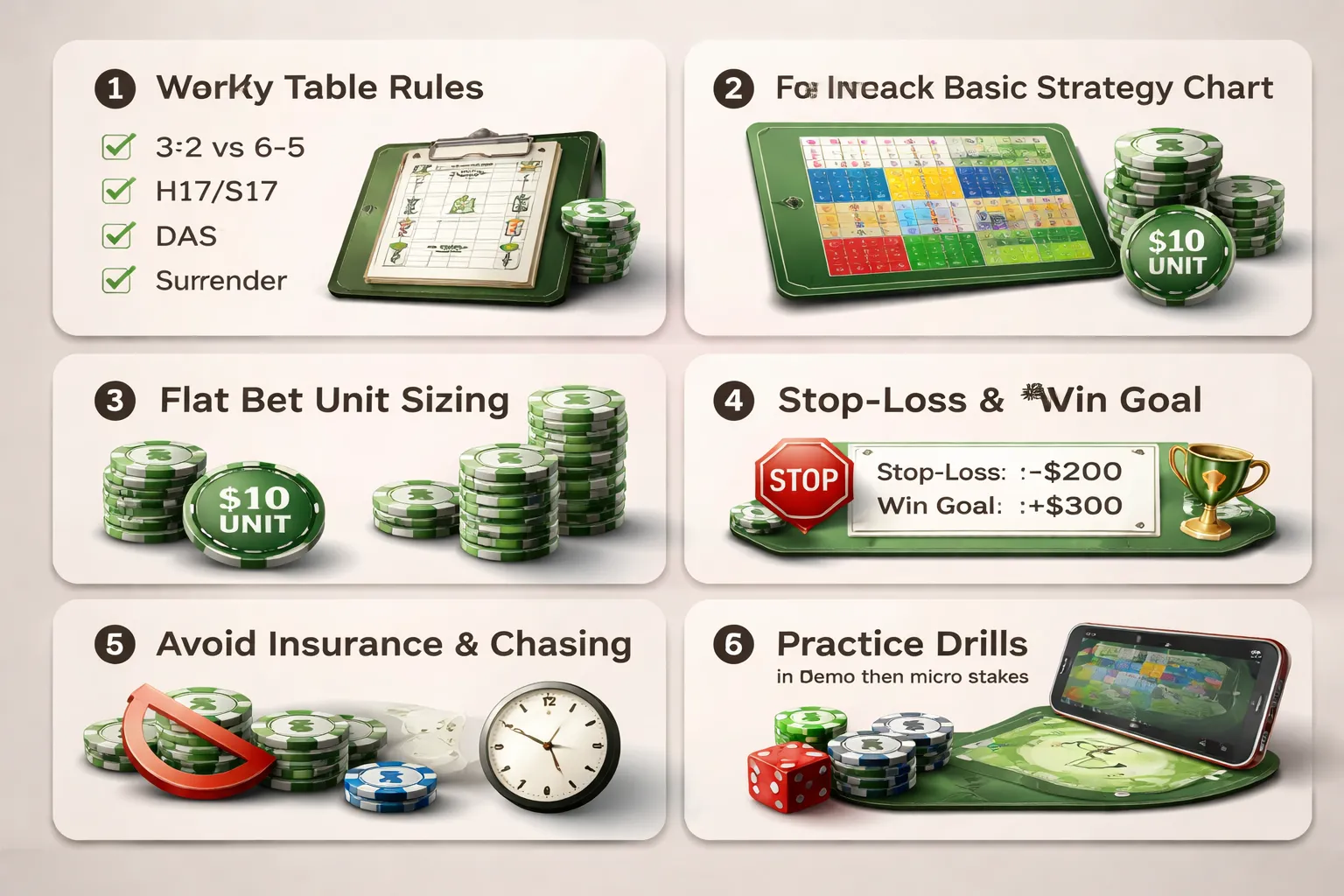
Basic strategy charts, use them by ruleset
Basic strategy cuts the house edge more than any other legal move you control. It only works if the chart matches the table rules.
- Lock the rules first. Payout (3:2 vs 6:5), dealer hits or stands on soft 17 (H17 or S17), number of decks, double rules (any two vs 9 to 11 only), doubling after split (DAS), resplit limits, surrender.
- Use the right chart version. A 6 deck H17 chart differs from a 2 deck S17 chart. Small rule changes shift key hands, mostly soft totals and doubles.
- Play the full chart. Do not memorize only hard totals. Most edge leaks come from soft hands and pair splits.
- Follow the chart even when it feels wrong. Basic strategy optimizes long run expected value, not the last few hands.
Rule priority: avoid 6:5 tables first. Then prefer S17 over H17. Then prefer fewer decks and DAS. These changes move the house edge by tenths of a percent, which matters over volume.
Bankroll management, session budgets, stop-loss, win goals
You cannot control variance. You can control exposure.
- Set a session budget. Treat it as spent the moment you sit down. Do not reload to chase.
- Use a hard stop-loss. Pick a number you will not cross. A common baseline is 20 to 40 units, based on your comfort with swings.
- Set a win goal, then leave. A small target prevents you from giving back profit during a hot run. Keep it realistic, like 10 to 20 units.
- Track units, not cash. A unit equals your base bet. This keeps decisions consistent across stakes.
If a casino pushes aggressive promos or unclear wagering terms, pick a safer operator. Use a vetted list like best online casinos and read the bonus rules before you play.
Bet sizing and volatility, why flat betting often wins
With basic strategy and no counting edge, bet sizing does not change the house edge. It changes variance and how fast you can lose.
- Flat bet by default. Same unit every hand keeps volatility lower and extends your session time.
- Avoid progressions. Martingale and similar systems increase risk of a large loss without improving expected value.
- Size for survival. If your budget is 100 units, a 1 unit flat bet gives you room for normal swings. A 5 unit bet does not.
- Adjust only for comfort. If pace is fast or you feel tilt, drop your unit or take a break.
Common mistakes that raise your house edge
- Buying insurance. Insurance is a side bet that usually favors the house. Basic strategy treats it as a no in almost all non-advantage situations.
- Ignoring 6:5. A 6:5 blackjack payout is one of the biggest edge boosts for the casino. Leave the table.
- Misplaying soft hands. Soft 18 and soft 17 decisions depend on dealer upcard and H17 vs S17. Do not guess.
- Refusing to split pairs. Some splits feel risky but they improve expected value. Follow the chart.
- Chasing losses. Increasing bets after losses raises variance and drives bankroll collapse.
- Tilting. Playing faster, skipping chart steps, and making emotional doubles kills your edge control.
When to walk away, variance vs poor decisions
Short runs lie. Your decisions show the truth.
- Variance signs. You followed the correct chart, you kept your unit size, you still lost. That is normal.
- Poor decision signs. You skipped chart checks, you changed bet size to get even, you took insurance, you played while angry or rushed.
- Exit triggers. You hit your stop-loss, you hit your win goal, you feel tilt, or you cannot focus on each hand.
Walking away is a skill. It protects your bankroll more than any single hand choice.
Practice approach, demo drills and gradual stake increases
- Start in demo mode. Pick one ruleset and stick to it. Drill until you stop hesitating.
- Use timed reps. Play 50 to 100 hands while checking a chart every time. Then repeat with fewer checks.
- Track errors. Write down the hands you miss, usually soft totals and splits. Drill those first.
- Move to micro stakes. Use the smallest unit available. Keep flat betting until you can play clean for multiple sessions.
- Increase stakes slowly. Only move up when your decisions stay stable under real money pressure.
Card Counting Online: What’s Possible, What Isn’t, and Alternatives
Why RNG blackjack can’t be counted in the traditional sense
Most online blackjack uses an RNG and deals from a virtual shoe. The software reshuffles every hand or uses an effectively infinite deck.
Card counting needs a finite deck and a memory. You track which cards remain so you can estimate when you have an edge. If the game resets each hand, your running count resets too.
Result, you can still play perfect basic strategy, but you cannot create a count-based advantage in standard RNG blackjack.
Live dealer counting: deck penetration and continuous shuffle realities
Live blackjack uses real cards and a real shoe. That makes counting possible in theory. Your edge still depends on deck penetration, how many cards get dealt before the shuffle.
- Good penetration: more rounds before the shuffle, more time for the count to matter.
- Poor penetration: early shuffles, your edge disappears fast.
- Continuous shuffle machines: many tables feed used cards back in. You cannot count these in any useful way.
Many live tables also cut deep for speed and risk control. You will often see shuffles before you reach the count zones that justify large bet changes.
Casino countermeasures: shuffling policies and bet-spread detection
Online casinos do not need pit bosses. They log every hand. They can flag your play with simple rules.
- Shuffle control: earlier shuffles, more frequent shuffles, or moving you to a continuous shuffle setup.
- Bet spread alerts: fast jumps from small bets to big bets when the shoe turns favorable.
- Correlation checks: your bet size tracks count swings, even if you keep your decisions basic-strategy clean.
- Table limits: low max bets cap your upside, high minimums raise your variance and bankroll risk.
Even if counting stays possible, these controls cut the number of hands where you can press a real edge.
Legal and terms-of-service considerations (what can get you restricted)
Card counting is not illegal in most places. A casino can still restrict you, because access is a private service and you agree to their terms.
- Account limits: lower max bets, lower table access, or removal from specific tables.
- Bonus blocks: promos removed if your play triggers internal risk rules.
- Withdrawal friction: extra verification requests if your account gets flagged for advantage play patterns.
Avoid tools that cross the line. Any bot, script, auto-clicker, or external software that interacts with gameplay can violate terms and get your account closed. Keep it manual.
Better EV-focused alternatives: rules shopping and bonus hunting
You get more reliable value online from game selection and promos than from trying to out-count short live shoes.
- Shop rules: pick games with blackjack paying 3:2, dealer stands on soft 17, double after split, and late surrender when available. Avoid 6:5 tables.
- Pick lower-edge variants: fewer decks and player-friendly rules reduce the house edge when you play basic strategy.
- Bonus hunt with math: focus on clear wagering terms, low contribution exclusions, and realistic time limits. Track your effective value after wagering.
- Rake-free comps: cashback, loss rebates, and VIP point systems can add steady value if the terms stay clean. For larger bankrolls, use casino VIP deals built for bigger action, see high-roller VIP perks.
If you want an edge you can control, treat blackjack like a low-edge game you optimize. Play perfect strategy, pick the best rules, and take only bonuses you can clear without forcing bad bets.
Payments, Payout Speed, and Security for Blackjack Players
Best payment methods for fast withdrawals
Your fastest cashouts usually come from e-wallets and crypto. Cards and bank transfers work, but they run slower and trigger more bank-side checks.
- E-wallets: Often the best mix of speed and low friction. Good for frequent cashouts and smaller to mid stakes.
- Crypto: Fast processing and fewer banking delays. Best when you can handle wallet basics and network fees.
- Cards: Simple deposits, slower withdrawals. Many casinos pay withdrawals back to the card only up to your deposit total, then send the rest by another method.
- Bank transfer: Best for larger withdrawals and regulated markets. Slowest option in most cases.
Typical withdrawal timelines and what delays them
Two clocks matter. The casino approval time, then the payment network time. You control part of both by keeping your account clean.
| Method | Typical casino approval | Typical delivery after approval | Common delay triggers |
|---|---|---|---|
| E-wallet | 0 to 24 hours | Minutes to 24 hours | First cashout, mismatched details, KYC pending |
| Crypto | 0 to 24 hours | Minutes to a few hours | Manual review, wrong wallet network, low confirmations |
| Card | 1 to 48 hours | 2 to 7 business days | Bank processing, weekends, refund routing rules |
| Bank transfer | 1 to 72 hours | 2 to 10 business days | Intermediary banks, holidays, compliance checks |
- KYC: Expect ID, proof of address, and card or wallet proof. Do it before your first withdrawal.
- Limits: Casinos set daily, weekly, and monthly cashout caps. High balances can force split payouts.
- Weekends and holidays: Bank rails slow down. Plan larger cashouts mid-week.
- Bonus checks: If you withdraw mid-wagering, the casino can void the bonus and related winnings. Read the cashout rules.
Fees, exchange rates, and minimum cashout thresholds
Fast payouts can still cost you money. Track three items, casino fees, payment network fees, and currency conversion.
- Withdrawal fees: Many casinos charge nothing on e-wallets, but some charge flat fees on bank transfers. Crypto withdrawals may include a network fee.
- FX spread: If you deposit in one currency and withdraw in another, the exchange rate can be your biggest hidden cost. Keep one base currency when you can.
- Minimum cashout: Casinos often set a floor. Small balances can get stuck until you reach it, or you pay a fee to withdraw.
- Max cashout per transaction: Large blackjack wins can come out in batches. Check the per-withdrawal cap before you deposit.
Security basics for blackjack bankrolls
Good payment options mean nothing if your account gets compromised. Use simple controls. Keep them on every device.
- SSL: Use casinos that load on HTTPS and never break the padlock during login or cashier steps.
- 2FA: Turn on two-factor authentication. Use an authenticator app if the casino supports it.
- Password hygiene: Use a unique password for each casino. Store it in a password manager.
- Mobile safety: Lock your phone, update the OS, and avoid public Wi-Fi in the cashier. If you play on mobile often, use a trusted app and keep permissions tight. See best mobile casino apps.
- Device checks: Log out after sessions, review active sessions if the casino offers it, and remove unknown devices.
Chargebacks, disputes, and keeping records
Use the right tool for the problem. Chargebacks can help with card deposits, but they can also freeze your casino account and trigger a payout hold.
- Card chargebacks: Use only for clear billing issues or fraud. Keep screenshots of the cashier, terms, and support messages.
- E-wallet disputes: Many e-wallets offer transaction disputes. They often move faster than bank channels.
- Crypto reality: Crypto transfers do not support chargebacks. Double-check the wallet address and the correct network every time.
- Keep records: Save deposit receipts, withdrawal confirmations, bonus terms at the time you accepted them, and your full chat or email threads with support.
- Escalation path: Start with casino support, then the payment provider, then the regulator or ADR body listed in the casino footer if the site is licensed.
Responsible Gambling and Player Safety
Setting deposit limits, time-outs, and self-exclusion tools
Set controls before you deposit. Do it in your account settings. Do it while you feel calm.
- Deposit limits: Cap how much you can add per day, week, or month. Use a number you can lose without changing your bills, rent, or savings plan.
- Wagering limits: Some casinos let you cap total stakes. This controls fast loss cycles in fast blackjack tables.
- Loss limits: Stop play after you drop a set amount. If the casino offers it, use it.
- Session time limits: Set a hard timer. End the session when the clock ends, even if you feel “close.”
- Reality checks: Turn on popups that show time played and net results. You need totals, not vibes.
- Time-out: Lock your account for 24 hours to several weeks. Use this when you feel tilted.
- Self-exclusion: Block access for months or years. Pick this when you cannot stick to limits.
If the casino lets you raise limits, expect a delay. If it does not, pick a different site. Strong tools matter more than promo codes. If you need small stakes to stay in control, use our low minimum-deposit casinos guide.
Recognizing problematic play patterns
Track behavior, not intent. These patterns signal risk.
- Chasing losses: You increase bets after a bad shoe to “get even.”
- Loss escalation: Your average bet size rises during the session, not because of strategy, but because you feel pressure.
- Long sessions: You keep playing past your stop time, then justify it with “one more hand.”
- Deposit stacking: You make multiple deposits in a short window. You treat deposits as ammo.
- Bonus-driven play: You play hours to clear wagering, even when you stop enjoying it.
- Hiding activity: You delete emails, use private browsing, or avoid bank statements.
Use simple checks. Record each session. Write down start bankroll, end bankroll, time played, and number of deposits. If you cannot keep the log, you likely need tighter limits.
Where to get help, reputable support organizations by region
Get help early. Use specialist services that handle gambling harm.
- US: National Council on Problem Gambling (NCPG), 1-800-GAMBLER, ncpgambling.org
- Canada: ConnexOntario (Ontario), 1-866-531-2600, connexontario.ca. Use your provincial program if you live outside Ontario.
- UK: GamCare, 0808 8020 133, gamcare.org.uk. National Gambling Helpline runs 24/7.
- EU and international: Gamblers Anonymous, gamblersanonymous.org. Many countries have local GA meetings and hotlines.
- Australia: Gambling Help Online, 1800 858 858, gamblinghelponline.org.au
- New Zealand: Gambling Helpline, 0800 654 655, gamblinghelpline.co.nz
If you use a licensed casino, the footer should list the regulator and the responsible gambling contact. Save those details before you play.
How to keep blackjack entertainment-focused
Blackjack has a house edge. You can lower it with basic strategy, but you cannot remove it. Treat each session as paid entertainment.
- Set a session budget: Pick an amount you can lose. Stop when you hit it.
- Set a win cap: Lock a profit target and leave. Wins feel “safer,” but they still drive overplay.
- Use fixed stakes: Bet the same size most hands. Avoid jump sizing when emotions spike.
- Avoid side bets when you want lower volatility: Many side bets carry a higher edge. They can drain bankroll fast.
- Pick table rules you understand: Confusion creates mistakes, mistakes create tilt, tilt creates bad decisions.
- Plan breaks: Stand up, drink water, and stop when you feel rushed or angry.
Pros and Cons of Playing Blackjack at Online Casinos
Advantages: convenience, table variety, and promos
- Play anytime. You can play from your phone or laptop. You can switch tables in seconds.
- More table options. You can find low-minimum tables, high-limit rooms, and multiple blackjack variants in one lobby.
- Fast seat changes. If a table has bad rules or a high minimum, you leave with one click.
- Promos can lower cost. Some casinos add match bonuses, reloads, or cashback that can offset losses if you meet the terms.
- Practice tools. Many sites offer free-play tables, hand history, and clear UI prompts that reduce misclicks once you learn the flow.
Downsides: faster play pace, bonus traps, and rule variability
- Faster pace burns bankroll. RNG blackjack can deal far more hands per hour than live tables. You can lose more in less time if you chase.
- Bonus wagering can erase value. Blackjack often counts less toward wagering than slots. Some casinos cap the stake per hand while a bonus is active. Both rules can turn a good promo into a bad deal.
- Rule sets vary a lot. Payouts, double rules, surrender, and how many decks can change by table. Small rule changes can raise the house edge.
- Autoplay and side bets tempt bad habits. One-click rebet speeds up mistakes. Side bets usually carry a higher edge and increase variance.
- App and connection issues. Lag and disconnects can create rushed decisions. You need clear rules on what happens if you drop mid-hand.
RNG vs live dealer blackjack: transparency, speed, and social factor
- Transparency. Live dealer play lets you see the shoe and the dealer. RNG play relies on audited software and certifications. Stick to licensed sites with third-party testing.
- Speed. RNG is the fastest. Live dealer is slower, which can help you control volume and tilt.
- Rules and features. RNG tables often offer more variants and lower minimums. Live tables may have side bets, table limits, and fewer rule choices.
- Social factor. Live dealer includes chat and a real dealer. RNG is solo and quiet, which helps focus but can make long sessions feel automatic.
- Decision quality. RNG gives you more time to think if you avoid autoplay. Live dealer has a timer, which can pressure you if you do not know basic strategy.
Who online blackjack is best for, and who should avoid it
- Best for you if you want control. You want to compare rules, pick limits that fit your bankroll, and leave bad tables fast.
- Best for you if you use a plan. You set a stop-loss, cap session length, and keep stakes fixed.
- Best for you if you value access. You want 24/7 tables, quick deposits, and mobile play.
- Avoid it if speed triggers tilt. If you chase losses or increase stakes after a bad run, RNG pace will punish you.
- Avoid it if you depend on bonuses. If you do not read terms, wagering rules and stake caps can trap your bankroll. If you want help picking safer sites, use our best online casinos list.
FAQ
What is the best online blackjack game for low house edge?
Play blackjack with 3:2 payouts, dealer stands on soft 17, double after split allowed, and late surrender. Avoid 6:5 tables. Skip side bets. These rule choices cut the house edge and protect your bankroll.
Is online blackjack fair?
It can be. Use licensed casinos with audited RNGs and published testing labs. Check game provider names and regulation details in the footer. If a site hides licensing or terms, treat it as a risk. Learn the main red flags in our fake online casino guide.
Can you count cards in online blackjack?
Card counting does not work in most RNG blackjack games because each hand reshuffles. Live dealer games use real shoes, but frequent shuffles and table rules limit any edge. You will get better results from basic strategy and strict bankroll limits.
What rules should you avoid?
Avoid 6:5 blackjack, dealer hits soft 17, no double after split, and resplitting not allowed. Avoid tables that restrict doubling to 10 or 11 only. These rules raise the house edge and reduce your best decisions.
How do blackjack bonuses work?
Most bonuses require wagering. Blackjack often counts less than slots toward playthrough, sometimes 5 to 20 percent, sometimes zero. Watch max bet limits during wagering. If you break them, the casino can void winnings.
Is live dealer blackjack better than RNG blackjack?
Live dealer suits you if you want slower pace and real table flow. RNG suits you if you want speed and many stakes. Rules vary on both. Always check payout, soft 17, and double and split options before you play.
What bankroll do you need for online blackjack?
Start with at least 50 to 100 units of your usual bet size. Example, if you bet $5, bring $250 to $500. This gives room for variance. Do not raise stakes to chase losses.
What is the best table for beginners?
Pick low limits, 3:2 payout, and clear rules. Use a basic strategy chart and keep side bets off. If you want simpler setup and support, use casinos built for new players with fast verification and simple cashier tools.
Conclusion
Conclusion
Blackjack stays beatable on paper because the rules stay fixed. Your edge comes from table selection and discipline.
- Pick the right payout. Play 3:2. Skip 6:5.
- Keep rules tight. Prefer dealer stands on soft 17, double after split allowed, resplit options, late surrender if offered.
- Use basic strategy every hand. Do not improvise. Do not chase losses.
- Control variance. Avoid side bets. Use a bankroll of 50 to 100 units and keep your unit size steady.
- Use bonuses with math. Read wagering terms, max bet rules, and game contribution before you deposit.
Final tip. Start at the lowest 3:2 table you can find, play 100 hands with a strategy chart open, then move up only after your results match your plan.
-
Fast Payout Online Casinos: Best Sites for Quick Withdrawals
3 months ago -
Best Online Casinos for Roulette: Best Wheels, Limits & Live Options
4 months ago -
Best Online Casinos (2026): Top-Rated, Safe & Trusted Picks
4 months ago -
Best PayPal Online Casinos: Top Sites That Accept PayPal Deposits & Withdrawals
4 months ago -
Best Online Casinos for High Rollers: VIP Perks, High Limits & Exclusive Bonuses
3 months ago
-
- Licensing, Regulation, and Player Protection Checks
- Blackjack Game Catalog Quality, RNG vs Live Dealer
- Rules and Payout Standards That Move the House Edge
- Software Providers and Fairness Verification
- Payment Methods, Withdrawal Speed, and Fees
- Bonuses, Relevance to Blackjack Players, and Terms That Matter
- Mobile UX, Table Filters, and In-Game Features
- Customer Support Quality and Responsible Gambling Tools
- How the Final Ranking Works
-
- Classic RNG blackjack, fastest hands and lowest friction
- Live dealer blackjack, real-time dealing, chat, and table atmosphere
- Multihand and speed blackjack, volume play and variance considerations
- VIP and high-limit rooms, limits, comps, and concierge expectations
- Blackjack tournaments, formats, entry fees, and scoring basics
- Demo and free-play tables vs real-money tables, what actually changes
-
- Payouts: 3:2 Beats 6:5 Every Time
- Soft 17: Dealer Hits vs Stands
- Deck Count and Shuffle Method
- Double-Down Rules: Any Two Cards vs 9 to 11 Only
- Splitting Rules: Re-Split Aces, Double After Split, Split Limits
- Surrender: Early vs Late and When It Helps
- Blackjack on Split Aces and Other Ace Restrictions
- European No-Hole-Card (ENHC) and the Risk to Doubles and Splits
-
- Classic Blackjack (Baseline)
- European Blackjack (ENHC)
- Atlantic City Blackjack (Player Friendly, Where Available)
- Vegas Strip Blackjack (Common “House” Rules)
- Single-Deck and Double-Deck (Value If Rules Stay Clean)
- Blackjack Switch and Other Specialty Titles (Fun vs Edge)
- Spanish 21 and Non-Standard Decks (Strategy Changes)
- Double Exposure and Novelty Variants (Higher Payouts, Higher Catch)
-
- Deposit Match vs No-Deposit: What Helps Blackjack Players
- Wagering Requirements and Blackjack Contribution Rates
- Max Bet Rules and Game Restrictions That Void Winnings
- Cashback, Rakeback-Style Deals, and Loss Rebates
- VIP and Loyalty Programs: Comps, Cashback Tiers, and Reloads
- Free Bets, Insurance Promos, and Live Dealer Offers
- Bonus Examples: Calculate Expected Cost vs Upside
-
- 1) Set up your account and pass KYC fast
- 2) Pick RNG or live dealer first
- 3) Choose the right table, limits, rules, and seats
- 4) Place bets, chips, and min to max basics
- 5) Play the core decisions, hit, stand, double, split, surrender
- 6) Side bets, treat them as a separate game
- 7) Live dealer timing, etiquette, and decision clocks
- 8) Autoplay, quick seat, and stats panels, use them safely
-
- Why RNG blackjack can’t be counted in the traditional sense
- Live dealer counting: deck penetration and continuous shuffle realities
- Casino countermeasures: shuffling policies and bet-spread detection
- Legal and terms-of-service considerations (what can get you restricted)
- Better EV-focused alternatives: rules shopping and bonus hunting
-
- What is the best online blackjack game for low house edge?
- Is online blackjack fair?
- Can you count cards in online blackjack?
- What rules should you avoid?
- How do blackjack bonuses work?
- Is live dealer blackjack better than RNG blackjack?
- What bankroll do you need for online blackjack?
- What is the best table for beginners?
-
- Licensing, Regulation, and Player Protection Checks
- Blackjack Game Catalog Quality, RNG vs Live Dealer
- Rules and Payout Standards That Move the House Edge
- Software Providers and Fairness Verification
- Payment Methods, Withdrawal Speed, and Fees
- Bonuses, Relevance to Blackjack Players, and Terms That Matter
- Mobile UX, Table Filters, and In-Game Features
- Customer Support Quality and Responsible Gambling Tools
- How the Final Ranking Works
-
- Classic RNG blackjack, fastest hands and lowest friction
- Live dealer blackjack, real-time dealing, chat, and table atmosphere
- Multihand and speed blackjack, volume play and variance considerations
- VIP and high-limit rooms, limits, comps, and concierge expectations
- Blackjack tournaments, formats, entry fees, and scoring basics
- Demo and free-play tables vs real-money tables, what actually changes
-
- Payouts: 3:2 Beats 6:5 Every Time
- Soft 17: Dealer Hits vs Stands
- Deck Count and Shuffle Method
- Double-Down Rules: Any Two Cards vs 9 to 11 Only
- Splitting Rules: Re-Split Aces, Double After Split, Split Limits
- Surrender: Early vs Late and When It Helps
- Blackjack on Split Aces and Other Ace Restrictions
- European No-Hole-Card (ENHC) and the Risk to Doubles and Splits
-
- Classic Blackjack (Baseline)
- European Blackjack (ENHC)
- Atlantic City Blackjack (Player Friendly, Where Available)
- Vegas Strip Blackjack (Common “House” Rules)
- Single-Deck and Double-Deck (Value If Rules Stay Clean)
- Blackjack Switch and Other Specialty Titles (Fun vs Edge)
- Spanish 21 and Non-Standard Decks (Strategy Changes)
- Double Exposure and Novelty Variants (Higher Payouts, Higher Catch)
-
- Deposit Match vs No-Deposit: What Helps Blackjack Players
- Wagering Requirements and Blackjack Contribution Rates
- Max Bet Rules and Game Restrictions That Void Winnings
- Cashback, Rakeback-Style Deals, and Loss Rebates
- VIP and Loyalty Programs: Comps, Cashback Tiers, and Reloads
- Free Bets, Insurance Promos, and Live Dealer Offers
- Bonus Examples: Calculate Expected Cost vs Upside
-
- 1) Set up your account and pass KYC fast
- 2) Pick RNG or live dealer first
- 3) Choose the right table, limits, rules, and seats
- 4) Place bets, chips, and min to max basics
- 5) Play the core decisions, hit, stand, double, split, surrender
- 6) Side bets, treat them as a separate game
- 7) Live dealer timing, etiquette, and decision clocks
- 8) Autoplay, quick seat, and stats panels, use them safely
-
- Why RNG blackjack can’t be counted in the traditional sense
- Live dealer counting: deck penetration and continuous shuffle realities
- Casino countermeasures: shuffling policies and bet-spread detection
- Legal and terms-of-service considerations (what can get you restricted)
- Better EV-focused alternatives: rules shopping and bonus hunting
-
- What is the best online blackjack game for low house edge?
- Is online blackjack fair?
- Can you count cards in online blackjack?
- What rules should you avoid?
- How do blackjack bonuses work?
- Is live dealer blackjack better than RNG blackjack?
- What bankroll do you need for online blackjack?
- What is the best table for beginners?
-
Reload Bonus Explained: What It Is and When It’s Worth Claiming
1 month ago -
Online Casino Licensing Explained: Authorities, Licenses & How to Check One
3 months ago -
Best Live Dealer Casinos: Where to Play Live Blackjack, Roulette & More
3 months ago -
Best Online Casinos for High Rollers: VIP Perks, High Limits & Exclusive Bonuses
3 months ago -
Fast Payout Online Casinos: Best Sites for Quick Withdrawals
3 months ago
-
Online Casino Licensing Explained: Authorities, Licenses & How to Check One
3 months ago -
Are Online Casinos Legal? Complete Guide by State & Country
4 months ago -
Casino VIP & Loyalty Programs Explained: Points, Tiers, Rewards & Rakeback
4 months ago -
Online Casino Fairness Explained: RNG, RTP, House Edge & Provably Fair
4 months ago -
Free Spins Bonus Explained: How Free Spins Work at Online Casinos
4 months ago