What to Do If an Online Casino Won’t Pay Out: Step-by-Step Actions

When a casino will not pay your withdrawal, you need a process. Delays and denials often come from KYC checks, bonus rules, payment limits, or account flags. Some players face this at least once, one report puts it at about 24%.
This guide shows you what to do next, step by step. You will learn how to document your case, check the exact rule the casino cites, fix common verification issues, and push the issue through the right channels. You will also learn when to escalate to the payment provider, the casino licensing authority, or an ADR body. If you need to confirm whether your case fits a known pattern, see why a casino withdrawal gets rejected.
- In het kort: Save proof first, screenshots, emails, chat logs, transaction IDs, and dates.
- In het kort: Read the exact rule the casino cites, then match it to your account activity and bonus history.
- In het kort: Fix KYC fast, submit clean documents, match your name and address, and use one payment method.
- In het kort: Check practical blockers, withdrawal limits, wagering, method mismatch, and restricted countries or VPN use.
- In het kort: Set deadlines in writing, ask for a specific reason, and request the case number.
- In het kort: Escalate in order, casino manager, payment provider, licensing authority, then ADR.
- In het kort: Stop deposits and extra play until you get a clear, written resolution.
Key takeaways: You win more disputes when you run a clean process. Document everything. Identify the exact reason for the refusal. Resolve verification and payment mismatches. Use written deadlines. Escalate through the correct channel with evidence attached. If you need a fast checklist of common failure points, read why a casino withdrawal gets rejected.
Understand Whether It’s a Payout Delay or a Non-Payment
Typical withdrawal timelines by method
Separate casino processing time from payment network time. Most delays happen before approval.
| Method | Typical casino processing | Typical delivery after approval | Notes |
|---|---|---|---|
| Cards (debit, credit) | 24 to 72 hours | 1 to 7 business days | Some banks post as a refund, not a transfer. Weekends slow posting. |
| E-wallets (Skrill, Neteller, PayPal where available) | 0 to 48 hours | Instant to 24 hours | Fast once approved. Holds happen if your wallet name or currency mismatches. |
| Bank transfer (wire, SEPA, local transfer) | 24 to 96 hours | 2 to 10 business days | Longest rails. Compliance checks and intermediary banks add days. |
| Crypto | 0 to 24 hours | 10 minutes to 2 hours | Network confirmations vary. Wrong network choice causes failed delivery. |
Use these ranges to classify your case. If you sit inside the range, you likely face a delay. If you exceed the range with no clear reason, treat it as a potential non-payment.
Pending vs. approved vs. reversed, what each status usually means
- Pending: The casino has your request but has not released funds. Common causes include KYC checks, manual review, or internal queues.
- Approved: The casino claims it sent the money to the processor or payment rail. Your next step is to track delivery time and request a transaction reference if it does not arrive.
- Reversed, canceled, declined: The casino stopped the payout and returned funds to your casino balance. This usually points to a rules issue, a verification problem, or a payment method mismatch.
If your withdrawal flips from pending to reversed more than once, stop re-requesting blindly. Ask for the exact rejection reason in writing and the exact fix required.
Common operational causes of delays
- Weekends and bank holidays: Banks and card rails do not process like normal business days. Expect pauses on Friday night through Monday.
- Processor outages: Payment providers fail, queue, or time out. Casinos often cannot resolve this fast, but they can confirm if it is a known incident.
- Manual reviews: Large wins, unusual play patterns, or first withdrawals often trigger checks. This can add 24 to 72 hours.
- Verification gaps: Expired ID, unclear proof of address, missing source of funds, or name mismatch between your account and payment method.
- Payment method mismatch: You deposited with one method and try to withdraw to another. Many casinos require withdrawal back to the same route first.
- Daily or weekly caps: The casino may split your payout into smaller withdrawals. This looks like stalling if they do not explain the schedule.
When you contact support, ask for two items. The current status and the remaining step they need from you. Get both in writing.
Red flags that suggest stalling tactics
- Moving goalposts: They request new documents after you submit valid ones, without explaining why the previous set failed.
- Vague replies: “Under review” or “security checks” with no timeline, no missing item list, and no owner assigned.
- Repeated “technical issue”: The same excuse across multiple days, with no incident ID, no workaround, and no estimated resolution time.
- Status loops: Your withdrawal stays pending for days, then reverses, then they tell you to resubmit, and the cycle repeats.
- Pressure to change behavior: They suggest you keep playing while you wait, or they imply faster payment if you deposit again.
If you see these signals, switch from waiting to controlling the process. Set a written deadline and ask for a specific reason code or policy clause tied to your case. For deeper troubleshooting, use this guide on common reasons withdrawals get rejected.
Most Common Reasons Online Casinos Withhold Withdrawals
Casinos rarely say, “We will not pay.” They delay, reject, or put your withdrawal “under review.” Most cases fall into a few buckets. Your job is to match the casino’s reason to a rule, then fix the one blocking item.
KYC not completed, or documents rejected
KYC is the top reason withdrawals get stuck. Casinos must verify your identity, age, and payment ownership before they pay.
- Missing documents. They want an ID, proof of address, and a payment method proof.
- Low quality uploads. Blurry photos, cropped corners, glare, expired ID.
- Address mismatch. Your profile address does not match your utility bill or bank statement.
- Name mismatch. Your casino name differs from your ID or your card wallet account.
- Duplicate verification. They ask for a selfie, video, or a fresh document dated within a set window.
Fix it fast. Ask support which document failed and the exact rejection reason. Use this guide on how to verify your identity to avoid repeat rejections.
Bonus and wagering requirements not met
Bonus rules block more withdrawals than players expect. The casino checks this when you request a cashout.
- Wagering incomplete. You did not meet the playthrough multiple on the bonus or deposit.
- Wrong games. Slots count 100%, table games may count 0% to 20%.
- Max bet breached. You bet over the allowed stake while a bonus was active.
- Max cashout rule. The bonus caps winnings, the casino trims your balance to the cap.
- Bonus still active. You must forfeit the bonus before withdrawing, or finish the terms.
Ask for a screenshot of your wagering tracker and the exact clause used. Do not accept a vague “bonus issue.”
Gameplay or bonus abuse allegations
Some casinos label activity as “irregular play” and freeze payouts. This often links to bonus terms and risk scoring.
- Prohibited strategies. Low risk hedging, bonus hunting patterns, or switching stakes to protect bonus value.
- Collusion. Coordinated play between accounts, referrals, or shared payment tools.
- Multi-accounting. More than one account in your household, device, or network.
- Game manipulation claims. Abnormal timing, repeated patterns, or suspected automation tools.
Request the specific rule breached, the game session IDs, and the time window they reviewed. Keep your replies short and factual.
Payment method issues
Withdrawal tools have strict matching rules. Casinos also block channels that fail compliance checks.
- Name mismatch on the payout method. The card or wallet must match your verified identity.
- Closed or expired card. The original deposit card no longer works for refunds or withdrawals.
- Unsupported withdrawal channel. Some methods allow deposits only, or work only in certain regions.
- Bank details errors. Wrong IBAN, routing number, SWIFT, or beneficiary address.
- Withdrawal priority rules. They require you to withdraw back to the same method used for deposits first.
Ask which payout method you must use and whether they require a “refund” route for prior deposits.
Account security flags
Security systems block withdrawals when they see account takeover risk or account linking.
- Shared IP or device. Multiple accounts log in from the same phone, laptop, or Wi-Fi.
- Multiple accounts. Even one extra account can trigger a full review.
- Compromised login signs. New device, new location, password resets, or failed login spikes.
- Chargeback history. Prior disputes can lock payouts until the casino finishes a review.
Provide device ownership proof if asked. Do not create a new account to “fix” the issue. That makes it worse.
Geolocation and restricted jurisdiction conflicts
If you play from a blocked region, the casino may void wins and stop payouts. Many casinos treat VPN use as a terms breach.
- Country not allowed. Your residency or your current location falls on their restricted list.
- VPN or proxy use. They detect masking tools and flag your session history.
- Travel conflicts. You signed up in one country and played while visiting another.
- Mismatch between ID and location. Your documents show one country, your IP shows another.
Ask for the restricted jurisdiction clause and the location evidence they rely on, IP logs, timestamps, and session records.
Responsible gambling or AML holds
Big wins and unusual deposit patterns trigger checks. Casinos must follow anti-money laundering rules and responsible gambling policies.
- Source of funds checks. They ask for payslips, bank statements, or proof of savings.
- Source of wealth checks. They want a broader explanation of where your money comes from.
- Large win review. Manual review of bets, game logs, and account history before they pay.
- Deposit velocity flags. Many deposits in a short time, or sudden jumps in amounts.
- Responsible gambling lock. Cooling-off, self-exclusion, or internal risk rules can pause withdrawals.
Send only what they request, with redactions for unrelated transactions if allowed. Ask for the review timeline and the exact document list.
| Reason category | What you ask for | What you do next |
|---|---|---|
| KYC | Exact rejection reason, required document specs | Resubmit clean docs, match profile details |
| Bonus rules | Clause number, wagering tracker status | Finish playthrough, or forfeit bonus in writing |
| Abuse claims | Rule breached, session IDs, review window | Respond with facts, stop changing play patterns |
| Payment method | Approved withdrawal methods for your account | Switch to verified bank transfer or matching wallet |
| Security | Flag type, required ownership proof | Secure account, verify device, avoid new accounts |
| Geo restrictions | Restricted list clause, IP and session evidence | Stop VPN use, clarify residency and travel |
| AML or RG hold | Document list, deadline, review timeframe | Provide proofs, keep copies, follow up on dates |
Step-by-Step Actions: What to Do If an Online Casino Won’t Pay Out
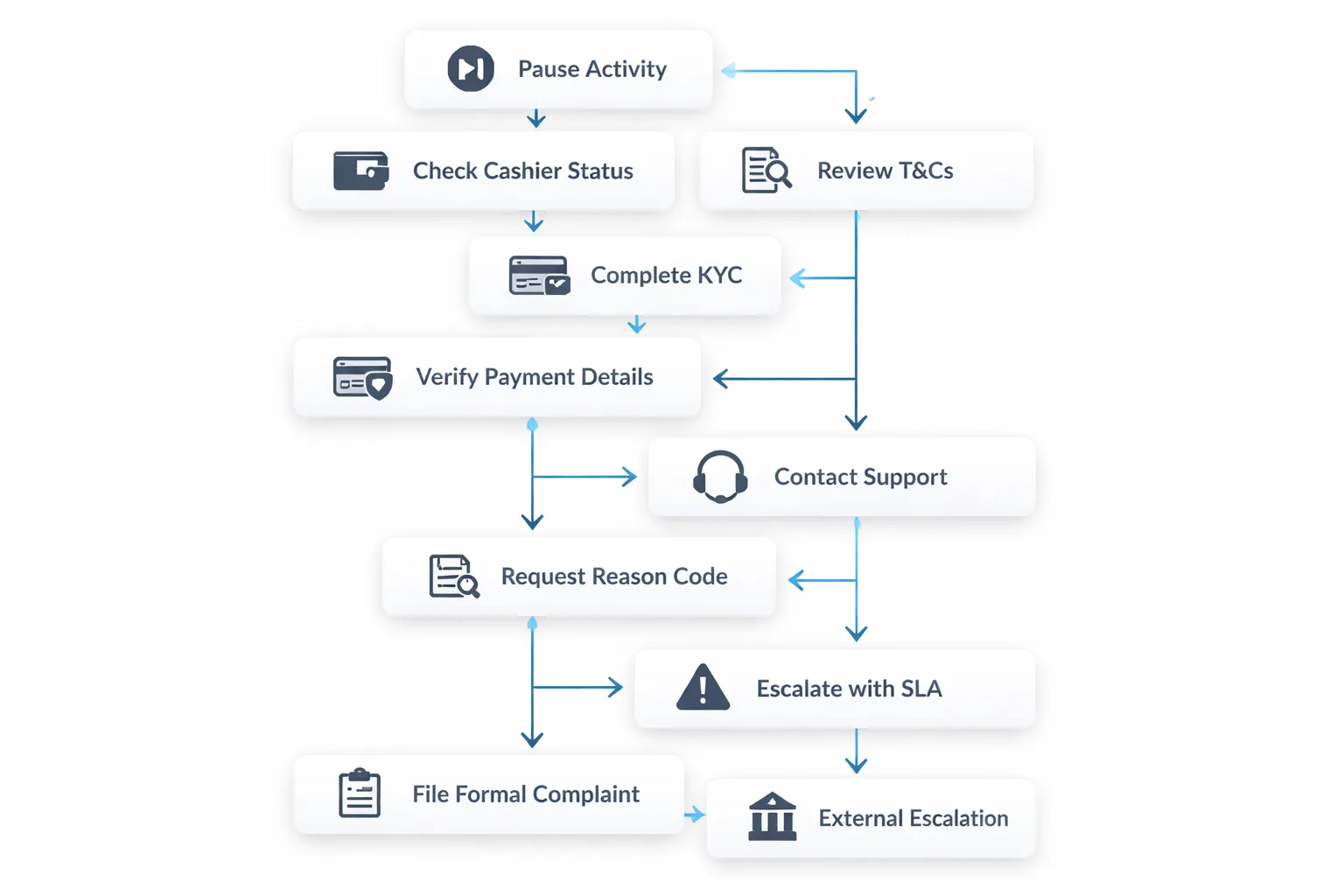
Step 1: Pause activity
Stop deposits. Stop claiming bonuses. Stop switching games to chase rollover.
Do not spam withdrawals. Multiple requests can reset queues, trigger extra checks, or create duplicate transactions.
- What you do now: take screenshots of your balance, withdrawal page, and any error messages.
- What you avoid: new payment methods, new devices, VPNs, and new accounts.
Step 2: Check the cashier for status and method eligibility
Open the cashier and the withdrawal history. Look for a clear status tag.
- Pending or Processing: the casino has not sent the payment yet.
- Approved: the casino claims it sent the payment.
- Rejected or Failed: the casino stopped the payout, usually due to rules, limits, or mismatched details.
Confirm the requested method can receive withdrawals in your country and in your account currency. Some methods allow deposits but block withdrawals. Some banks block gambling merchant codes.
If your withdrawal sits on pending, use this guide for quick checks: why your online casino withdrawal is pending.
Step 3: Re-read the exact T&Cs that apply
Use the rule set tied to your account status and your last deposit or bonus. Do not rely on memory or marketing pages.
- Withdrawal limits: per transaction, per day, per week, and per month.
- Wagering rules: bonus wagering, minimum odds for sports, excluded games, and contribution rates.
- KYC timing: whether verification must complete before any withdrawal.
- Maximum win caps: caps tied to bonus types, free spins, or promotions.
- Chargeback and fraud clauses: rules that let the casino freeze payouts after payment disputes.
Copy the exact clause text. Save the URL and date. You will use it in your complaint if needed.
Step 4: Complete KYC correctly
Submit what the casino requests. Submit it once, in the right format.
- Document quality: sharp, full frame, no glare, no cropped edges, no edits.
- Expiry dates: ID must be valid. If it expires soon, renew first.
- Proof of address: match name and address, show full page, show issue date, usually within 90 days.
- Selfie and liveness: follow the pose and lighting rules. Do not use filters.
- Consistency: your profile name, date of birth, and address must match your documents.
Keep copies of every file you send and the upload confirmation.
Step 5: Verify payment details match your identity
Match your withdrawal method to your verified identity. Most casinos require you to withdraw to a method you own and often to the same rail you used to deposit.
- Name match: your casino profile name must match the bank or wallet account name.
- Card ownership: the casino may ask for a photo of the card. Hide the middle digits. Show first 6 and last 4, plus your name and expiry.
- Bank transfers: confirm IBAN, SWIFT, and account holder name. Do not use a third party account.
- E-wallet rules: some wallets reject incoming gambling payments or require full verification on the wallet side.
- Crypto rules: confirm network, address format, and whether the casino requires the address to be tied to your account.
Step 6: Contact support with a structured request
Send one message with the full set of facts. Do not split details across chats and emails.
- Account: username and registered email.
- Withdrawal: amount, currency, method, request date and time.
- IDs: withdrawal ID, transaction ID, ticket ID.
- Timeline: when you requested it, status changes, any emails received.
- Your ask: “Confirm the exact reason the withdrawal has not been paid and the steps to release it.”
Ask for a written reply by email, even if you start in live chat.
Step 7: Ask for the internal reason code and written requirements
Support often uses internal tags. You need the exact tag and the exact requirement list.
- Reason code: request the internal reason code or category for the hold or rejection.
- Required action: ask for a checklist of what they need from you.
- Owner: ask which team owns the case, payments, KYC, fraud, or compliance.
- Deadline: ask when they will review your next submission.
If they refuse to share a code, ask them to state the reason in plain English and quote the related clause.
Step 8: Escalate to the payments or KYC team and request an SLA
Do not accept “we are checking” without dates. Request an SLA with a target completion date.
- Escalation request: “Please escalate to payments or KYC and confirm the expected completion date.”
- Case ownership: ask for the department name and a reference number.
- Review window: ask how long each step takes, KYC review, payment approval, provider processing.
If they miss the date, follow up once with the missed SLA and ask for a new firm date.
Step 9: Submit a formal complaint in writing and keep one thread
Move from support to a formal complaint route. Use email. Keep everything in one thread.
- Subject line: “Formal complaint, unpaid withdrawal, account [username], withdrawal ID [ID]”.
- Attach proof: screenshots of status, emails, KYC submissions, and payment details you provided.
- State the remedy: pay the full amount to the approved method, or give a written decision that cites the exact clause.
- Set a deadline: give a clear date for response, not “ASAP”.
Do not open new tickets unless the casino forces it. New threads slow audits and let details get lost.
Step 10: Prepare for external escalation if deadlines pass
If the casino misses your deadline or refuses to pay without a clear rule basis, escalate outside.
- Regulator or ADR: file a dispute with the licensing authority or the casino’s ADR partner.
- Payment provider: contact your bank or wallet provider for trace information if the casino claims it sent the funds.
- Evidence pack: export your chat logs, email thread, withdrawal receipts, KYC proof, and the T&C clauses you relied on.
- What you ask for: a decision and a payout timeline, or a written final position you can dispute.
Evidence Checklist: What to Document Before You Escalate
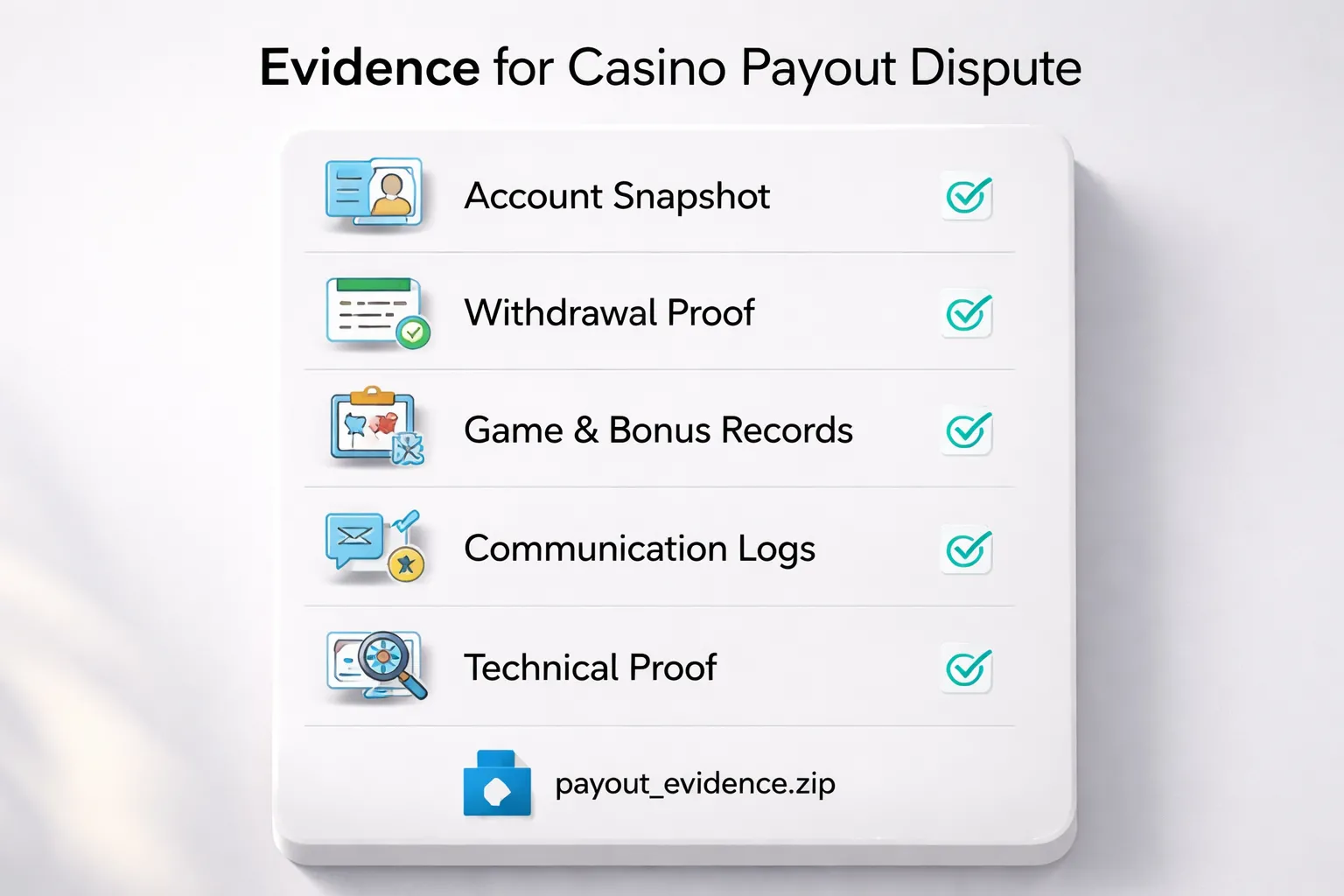
Account details snapshot
- Casino brand and URL: record the exact domain you used.
- Username and player ID: copy from your profile page if shown.
- Registered email and phone: screenshot the account settings page.
- Country and address on file: capture the profile and any “country locked” notices.
- Verification status: screenshot the KYC page that shows Approved, Pending, or Rejected.
- KYC files submitted: keep originals and upload confirmations, include filename and date sent.
- Account restrictions: note any limits, self-exclusion flags, or responsible gambling blocks shown in-app.
Withdrawal proof
- Withdrawal amount and currency: copy the exact figure.
- Date and time submitted: use the casino timestamp and your local time.
- Payment method: card, bank transfer, crypto, PayPal, Skrill, Neteller, plus masked account details.
- Transaction and reference IDs: capture withdrawal ID, processor reference, blockchain TXID if crypto.
- Status history: screenshot each change, Pending, Processing, Approved, Sent, Rejected, Reversed.
- Balance movements: show the debit from your casino balance and any later re-credit.
- Fees and limits shown: capture any fee line or “minimum withdrawal” message.
- Bank or wallet trace data: request ARN, RRN, or transfer reference if the casino claims it sent funds.
- Expected timelines: save the payout ETA shown at checkout, link it to your withdrawal ID. See payout times explained for what “sent” should mean by method.
Game and bonus records
- Bonus ID and name: screenshot the bonus panel and terms pop-up.
- Bonus start and end times: capture activation date and expiry.
- Wagering requirement: record the multiple and the required amount.
- Wagering progress: screenshot progress at the time you requested withdrawal.
- Max cashout terms: copy the clause and the cap amount.
- Game contribution rules: capture which games count, and at what percentage.
- Restricted games list: screenshot any prohibited games during wagering.
- Bet size and pattern limits: record any max bet rule and your bet history that shows compliance.
- Session history: export or screenshot game rounds around the disputed win, include round IDs where available.
Communication logs
- Live chat transcripts: export if possible, otherwise screenshot start to end.
- Emails: save the full thread, include headers, dates, and sender address.
- Support tickets: record ticket numbers, categories, and status updates.
- Agent names and departments: note who said what, and when.
- Timestamps: keep a simple timeline of each contact and each promise made.
- Key statements: capture exact wording about reasons for delay, KYC requests, or “funds sent” claims.
- Final position: ask for a written final decision, then save it.
Technical proof
- Error messages: screenshot the full page, include the URL bar and timestamp.
- Device and app version: record phone model or browser, OS, and casino app version.
- Connection details: note Wi-Fi or mobile data, and your city and country at the time.
- Geolocation prompts: capture any “location check” pop-up and the result.
- VPN disabled confirmation: screenshot VPN off status if the casino cites VPN use, include any device VPN settings page.
- Login and security events: save emails for new device logins, password resets, or 2FA changes.
- Files you uploaded: keep upload receipts and any “document rejected” reason codes.
How to Write an Effective Complaint to the Casino (Template + Tips)
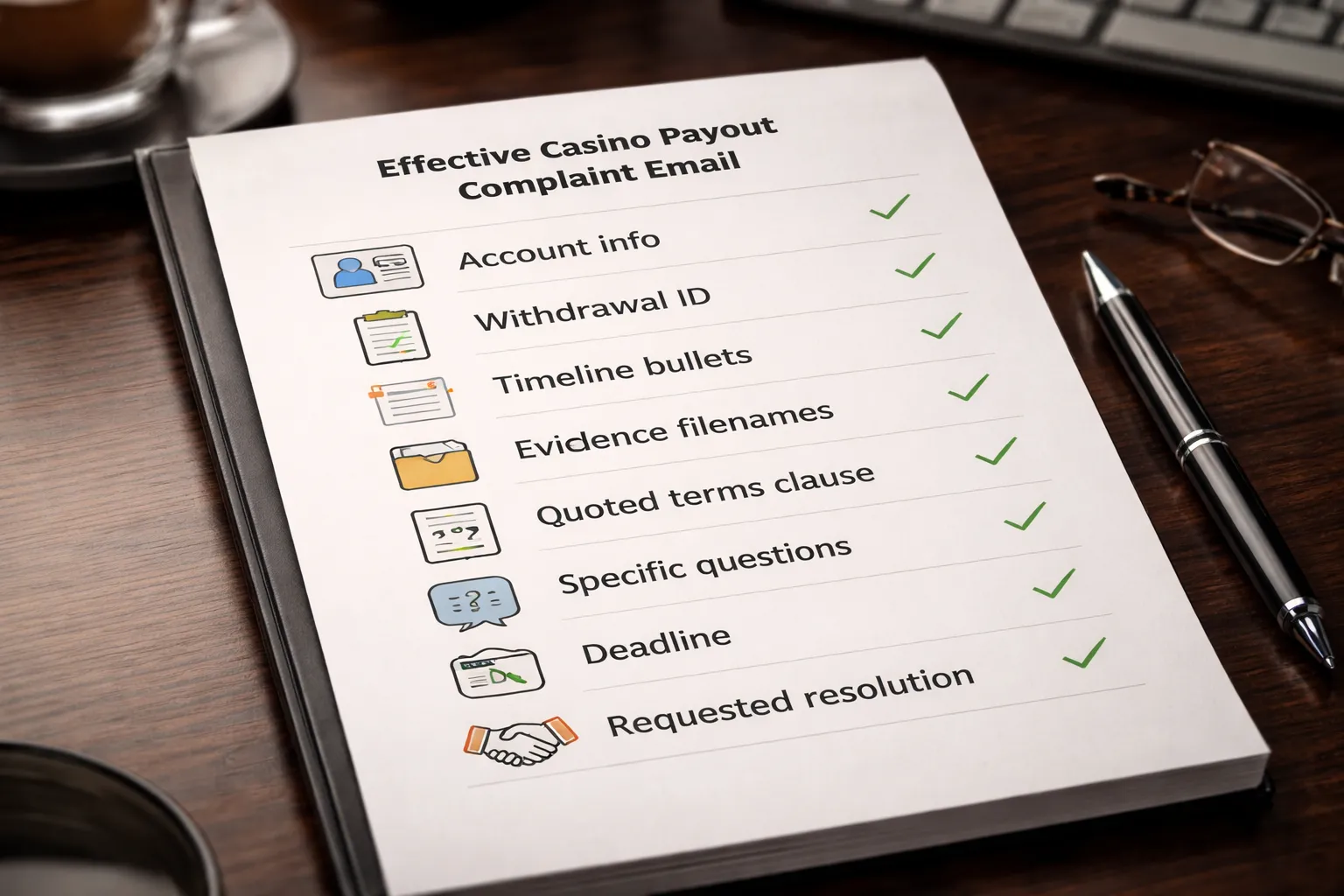
What to Include in Your Complaint
Your complaint must read like a case file. Keep it short. Keep it dated. Make it easy to verify.
- Account identifiers: username, registered email, country, last 4 digits of the payment method if safe to share.
- Withdrawal details: withdrawal ID, amount, currency, method, date and time submitted, current status.
- Concise timeline: 5 to 10 bullet points with dates, times, and what happened.
- Evidence index: list your screenshots and files by filename, include what each proves.
- Requested outcome: payout release by a specific date, or a written denial with the exact policy basis.
- Specific questions: ask for missing facts, not opinions.
Build a Simple Timeline That Support Can’t Ignore
- Day 1: Deposit made. Include transaction ID.
- Day 2: Bonus accepted or not accepted. Include bonus name and ID if shown.
- Day 3: Wagering completed. Include screenshots of wagering progress and balance.
- Day 4: KYC submitted. Include upload receipts and any rejection codes.
- Day 5: Withdrawal requested. Include withdrawal ID and status screenshot.
- Day 6+: Support replies. Include ticket IDs and timestamps.
Ask for a Clear Outcome and Clear Answers
State one primary outcome. Then ask 3 to 6 questions that force a concrete reply.
- Outcome examples: “Approve and pay Withdrawal ID 12345,” or “Issue a written final decision that cites the clause used.”
- Questions to use:
- What is the exact reason my withdrawal is on hold, in one sentence?
- Which term or policy clause applies, with the clause number and exact wording?
- What document or action is still required, if any?
- What checks are pending, and who owns them, KYC, payments, fraud, or risk?
- What is the expected completion time, and what triggers completion?
How to Cite Terms Without Sounding Emotional
Do not argue intent. Do not accuse. Quote the rule and tie it to a screenshot.
- Quote exactly: copy the clause text as written. Include section name and number.
- Match claim to proof: “Clause X says Y. Screenshot A shows I did Y on Date, Time.”
- Use neutral language: “Please confirm,” “Please clarify,” “Please provide the basis.”
- Request written specifics: ask for the exact reason code or internal note summary.
- Attach targeted evidence: do not dump 40 files. Send 6 to 12 key items first.
Set Reasonable Deadlines and Define “Resolution”
Give a deadline that fits normal withdrawal processing. Define what completion means.
- First complaint deadline: 72 hours for a detailed reply, or the casino’s stated support SLA if published.
- Payout deadline: use the casino’s published payout window. If they state none, use 7 calendar days after KYC approval as a practical benchmark.
- Define resolution: either (1) funds paid to your method with a transaction reference, or (2) a written final denial that names the clause, the evidence relied on, and the appeal route.
If your withdrawal sits in “pending” beyond typical timelines, cross-check expected ranges in online casino payout times.
Sample Email Template: Request Payout Release
Copy, fill, send. Keep the subject line specific.
| Subject | Withdrawal on Hold, Request for Release or Written Basis, Withdrawal ID [ID] |
| Message |
Hello Support Team, I am requesting a resolution for my withdrawal that remains on hold. Account: [Username], [Registered Email] Timeline (short): Requested outcome: Please approve and release Withdrawal ID [ID] by [Date, Time]. If you will not pay, please send a written final decision that includes the exact policy clause (number and wording) and the specific facts used to reach that decision. Questions: Attachments: [List 6 to 12 filenames and what they show] Thank you, |
Sample Follow-Up Template: When Support Sends Generic Replies
Use this when you get “We are checking” without details. Push for ownership, reason code, and a date.
| Subject | Follow-Up, Withdrawal ID [ID], Request for Specific Status and ETA |
| Message |
Hello Support Team, Following up on Withdrawal ID [ID]. Your last reply on [Date, Time] did not include the reason for the hold or an ETA. Please provide the following in writing:
If this cannot be completed by [Date, Time], please confirm whether you will issue a written final decision that explains the basis for non-payment. Regards, |
Escalation Options Beyond Customer Support (In the Right Order)
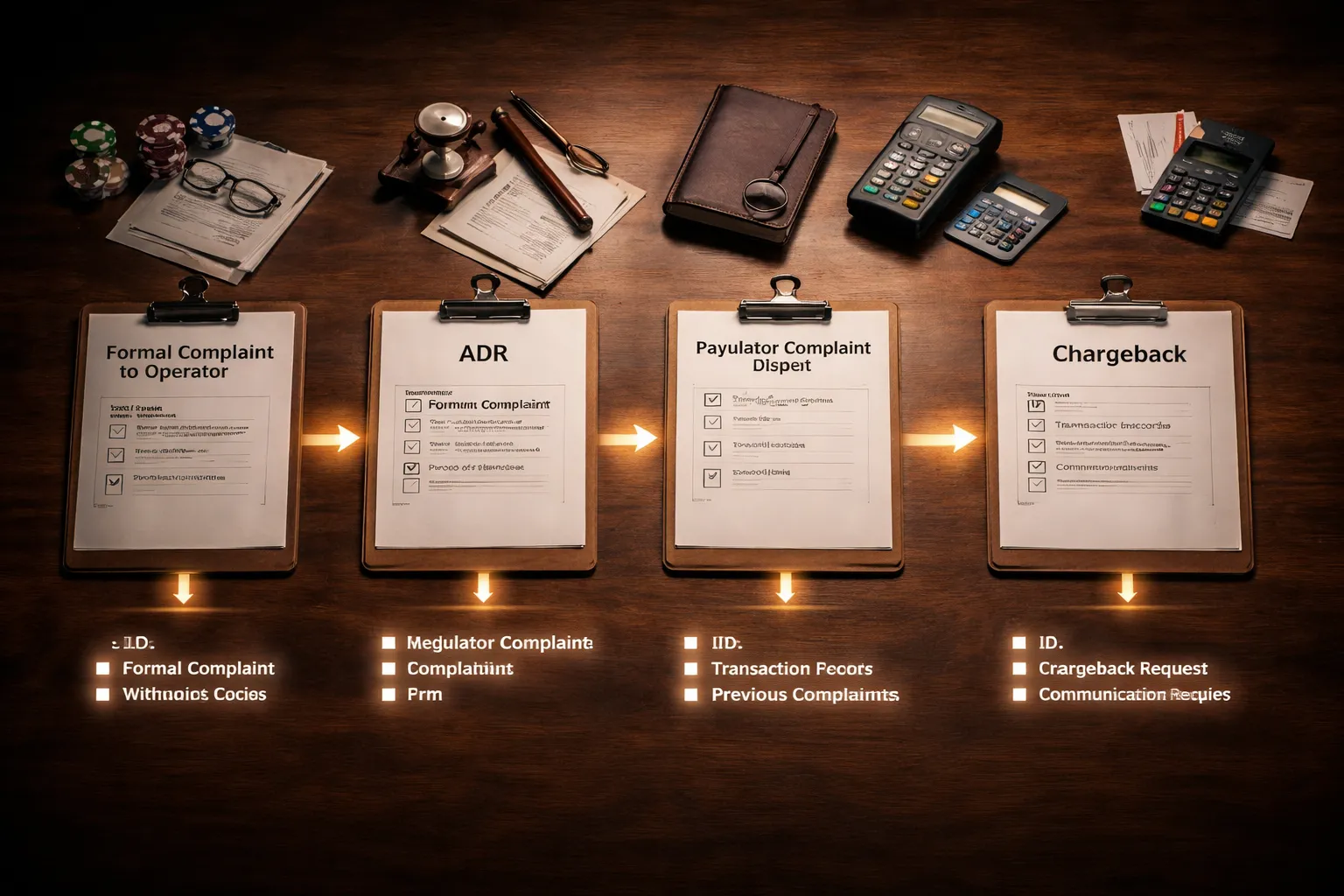
1) Use the casino’s official complaints process, identify the legal operator
Stop using live chat for escalation. Move to the formal complaints route in the casino terms.
- Find the complaints path: look for “Complaints,” “Disputes,” “Responsible Gaming,” or “Terms and Conditions.” Follow the steps and timeframes they list.
- Identify the operator entity: collect the legal company name, registration number (if shown), registered address, and the license number and authority.
- Check who actually holds your balance: the casino brand name can differ from the licensed operator. You need the entity that holds the license, not the marketing name.
- Send one structured complaint: include your account details, withdrawal amount, dates, and what you already provided for KYC. Ask for a written final decision if they will not pay.
- Keep a clean record: save emails, ticket numbers, chat transcripts, screenshots of withdrawal status, and the cashier history.
2) Alternative Dispute Resolution (ADR), when it applies, what to expect
ADR helps when the casino has a recognized dispute body tied to its license, and you already tried the operator complaint process.
- When ADR applies: the casino terms or footer lists an ADR provider, or the regulator requires one for player disputes. Many ADRs only accept cases after you receive a final decision, or after a set number of days.
- What ADR usually needs: your complaint summary, proof of deposits and withdrawals, the disputed amount, game IDs or bet history, KYC submissions, and the casino’s final decision or silence after the stated timeframe.
- Possible outcomes: payout order recommendation, partial payout, request for more evidence, or rejection if you breached rules like bonus abuse, multi-accounting, or restricted-country play.
- What ADR cannot do: force criminal enforcement, recover funds already sent to another party, or override a regulator’s legal process.
Use ADR when you have a clear paper trail and you can point to a specific term, transaction, or verification demand that you met.
3) File a regulator complaint, submit tight evidence
Regulators focus on licensing compliance. They respond better to clear timelines and documents.
- Licensing info you need: regulator name, license number, operator legal name, and website domain used to play.
- Evidence to attach: deposit receipts, withdrawal request screenshots, bank or e-wallet statements showing deposits, KYC upload confirmations, emails with support, and any “final decision” letter.
- What to write: a short timeline with dates, amounts, payment method, and what the casino claims. Avoid long stories. Stick to facts.
- What to expect: acknowledgement, a request for more documents, and a compliance check. Some regulators mediate. Some only log the report and audit patterns.
4) Dispute through the payment provider, use the right documents
If you cannot get paid, pressure often works best through the rails that moved the money.
- Card issuer: ask for the disputes team, not general support. Provide deposit transactions, merchant name, dates, and any proof the casino refused withdrawal or closed your account.
- E-wallet support: submit the transaction IDs, wallet statements, merchant identifier, and screenshots of the withdrawal rejection or pending status.
- Bank transfer: provide the transfer reference, account statements, and the beneficiary details shown in the casino cashier.
- Crypto exchange or on-ramp: you usually cannot charge back an on-chain transaction, but you can report fraud for off-chain card purchases or on-ramp transfers. Provide TXIDs, deposit addresses, and screenshots of the casino deposit confirmation.
Match your evidence to the method you used. If you need a quick refresher on method-specific limits and processing times, see payment method options and typical speeds.
5) Chargebacks, eligibility, time limits, and risks
Chargebacks can recover deposits in some cases. They can also end your casino relationship.
- Eligibility: strongest cases involve unauthorized transactions, incorrect amounts, or services not provided. “Casino will not pay winnings” can be harder, since the issuer looks at deposit delivery, not your expected payout.
- Time limits: card networks and issuers set strict windows. Start the dispute as soon as the casino misses its stated payout time, or after you receive a written refusal.
- What to submit: the casino terms on withdrawals, your withdrawal request proof, support messages, KYC submission proof, and account status changes like sudden closure.
- Risks: the casino can close your account, void bonuses, and freeze or reverse remaining balances. If you charge back deposits, they can treat the account as in debt and refuse future withdrawals.
- Do this first: withdraw any undisputed balance you can, and screenshot everything, before you file.
Special Cases: Unlicensed Casinos, Offshore Operators, and Rogue Brands
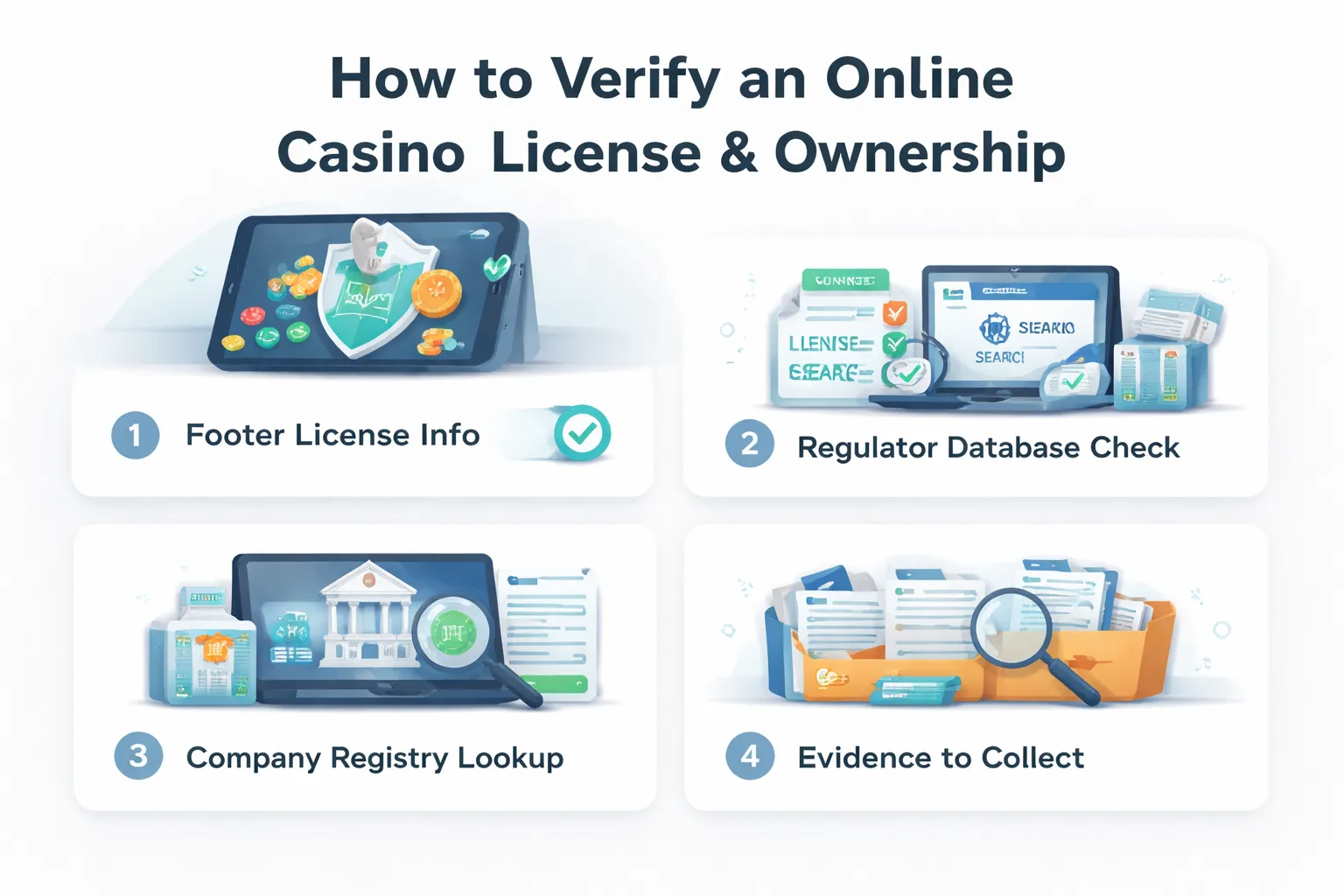
How to verify licensing and ownership
Start with the casino footer. Look for a license number, regulator name, and the legal company name. Treat logo badges without a license ID as marketing.
- Check the regulator database. Search the license number and brand name on the regulator site. Confirm the status shows active, and the domain matches the one you used.
- Match the legal entity. The company name in the footer should match the regulator record. If it does not, you have a higher risk case.
- Check the company registry. Use the jurisdiction listed in the terms or footer. Confirm the company exists, has a current status, and shows directors or a registered agent. Save screenshots.
- Identify the payment path. Check your card or wallet statement descriptor. It can reveal a parent company or payment intermediary. Keep it as evidence.
- Confirm the domain. Rogue groups clone brands and use similar URLs. The licensed domain list on the regulator site matters more than the casino logo.
Common patterns of rogue behavior
Rogue brands follow repeatable playbooks. Spotting the pattern helps you choose your next move.
- Endless KYC loops. They ask for one more document after you submit everything, then restart the review timer.
- Selective term enforcement. They ignore rules when you deposit, then enforce obscure terms when you withdraw, including bonus clauses and maximum cashout caps.
- Sudden rule changes. They change terms mid-withdrawal, then claim the new rule applies to your account.
- “Security review” with no timeline. Support repeats scripted replies and refuses written deadlines.
- Account restriction after winning. They limit games, block withdrawals, or close the account while keeping your balance.
- Pressure to cancel your withdrawal. They offer bonuses or “faster processing” if you reverse the cashout.
Track dates, ticket numbers, and exact wording. Keep your chat logs and emails. Do not rely on phone calls.
What recovery looks like with unlicensed or offshore casinos
Set your expectations early. Your options shrink when the casino has no meaningful regulator, no local presence, and no responsive banking partners.
- Unlicensed casinos. You have no regulator complaint route. Recovery depends on the payment method dispute process, pressure through public reporting, and any consumer protection body that will accept the case.
- Offshore licensed casinos. Some regulators act, many do not. Even when the regulator responds, enforcement can take months. Your leverage comes from clear evidence and a clean timeline.
- Rogue brand networks. They rotate domains and company names. You may win a complaint and still fail to collect if the operation shuts the site and reopens elsewhere.
If the casino cites “withdrawal limits” or caps, confirm the rule in writing and compare it to your account terms. Use your own screenshots. Also read our guide on online casino withdrawal limits.
In offshore cases, aim for outcomes you can control. Get any partial payout you can. Lock in written commitments. Stop depositing. Do not accept new bonuses tied to wagering.
Where to report, and how to do it evidence-first
Report in parallel. You want a paper trail that pressures the casino and supports any payment dispute.
- Regulator complaint portal. Use it only if you verified an active license and matching domain. Attach your timeline, screenshots, and KYC submission proof.
- Casino watchdog sites. Submit a factual complaint with dates, amounts, and your evidence. Avoid accusations you cannot prove.
- Player forums. Post your case summary and documents with sensitive data removed. Stick to verifiable facts, and update the thread if the casino responds.
- Consumer protection bodies. File with agencies that accept cross-border complaints in your country. Include the casino legal name, website, transaction references, and support transcripts.
- Payment provider dispute teams. If you used a card, wallet, or bank transfer, open a dispute with a clean dossier. Include proof of service denial, account restriction, and the casino refusal messages.
Use one document pack for every report. Include a one-page timeline, transaction list, KYC dates, withdrawal request dates, and the casino’s stated reasons for non-payment.
What NOT to Do (Mistakes That Can Hurt Your Chances of Getting Paid)
Threatening chargebacks or regulators too early
Do not start with threats. Do not tell support you will file a chargeback, contact the regulator, or “go public” in your first messages.
- You can trigger a security freeze. Many casinos lock withdrawals and block live support once you mention chargebacks or authorities.
- You can pause internal reviews. Some teams stop investigating and hand the case to risk, payments, or legal. That adds days or weeks.
- You can lose the chance to fix a simple issue. If the problem is missing KYC, a payment method mismatch, or a withdrawal limit, threats slow the fastest path to payout.
Escalate in steps. First, request a written reason, the exact rule cited, and the next action required from you. Then use your document pack for formal disputes.
Submitting altered documents or inconsistent information
Do not edit screenshots, crop out details, change file names to hide dates, or “touch up” documents. Do not send different versions to different teams.
- It looks like fraud. Even small edits can flag your account for manual review and extended holds.
- It creates contradictions. One wrong address format, mismatched dates, or a different spelling can restart verification from zero.
- It weakens every complaint. Dispute teams and mediators rely on clean, consistent evidence.
Send originals. Keep one version of every file. Match your account profile details to your ID and proof of address. If you need a KYC refresher, read our guide to online casino KYC.
Opening multiple accounts or using someone else’s payment method
Do not create a second account to “test” withdrawals. Do not ask a friend to deposit or withdraw for you. Do not switch to someone else’s card or e-wallet to speed things up.
- Casinos treat it as a breach. Duplicate accounts and third-party payments often violate terms and AML rules.
- It gives them a clean non-payment reason. They can void bonuses, confiscate winnings, or close the account.
- It complicates disputes. Payment providers and regulators will ask why the payer name does not match the account holder.
Use one account. Use payment methods in your legal name. Withdraw back to the same source when possible.
Using a VPN or proxy during play or withdrawal if it violates terms
Do not turn on a VPN “just in case” during gameplay, KYC, or withdrawal. Do not switch countries mid-session.
- It triggers location and fraud flags. A new IP or country can cause automatic withdrawal blocks.
- It can create a jurisdiction issue. If the casino does not accept players from your location, they can deny payouts and close the account.
- It breaks the evidence trail. Your logs, device info, and session history look inconsistent.
Use your normal connection and device. If you traveled, tell support before you deposit or withdraw, and keep the explanation consistent.
Public accusations without proof that undermine negotiations
Do not post “scam” claims without documents. Do not share edited screenshots. Do not name staff members. Do not publish private emails that show personal data.
- You lose leverage. Support stops cooperating once the discussion turns hostile or defamatory.
- You create legal risk. Public claims without proof can backfire and distract from the payout problem.
- You weaken mediator outcomes. Complaint handlers prefer structured evidence, not social pressure.
If you go public, post facts only. Use your timeline, transaction list, and direct quotes from support. Remove sensitive data. Keep the goal clear, release the funds or state the rule and evidence behind the refusal.
Prevention: How to Choose Casinos That Pay Reliably
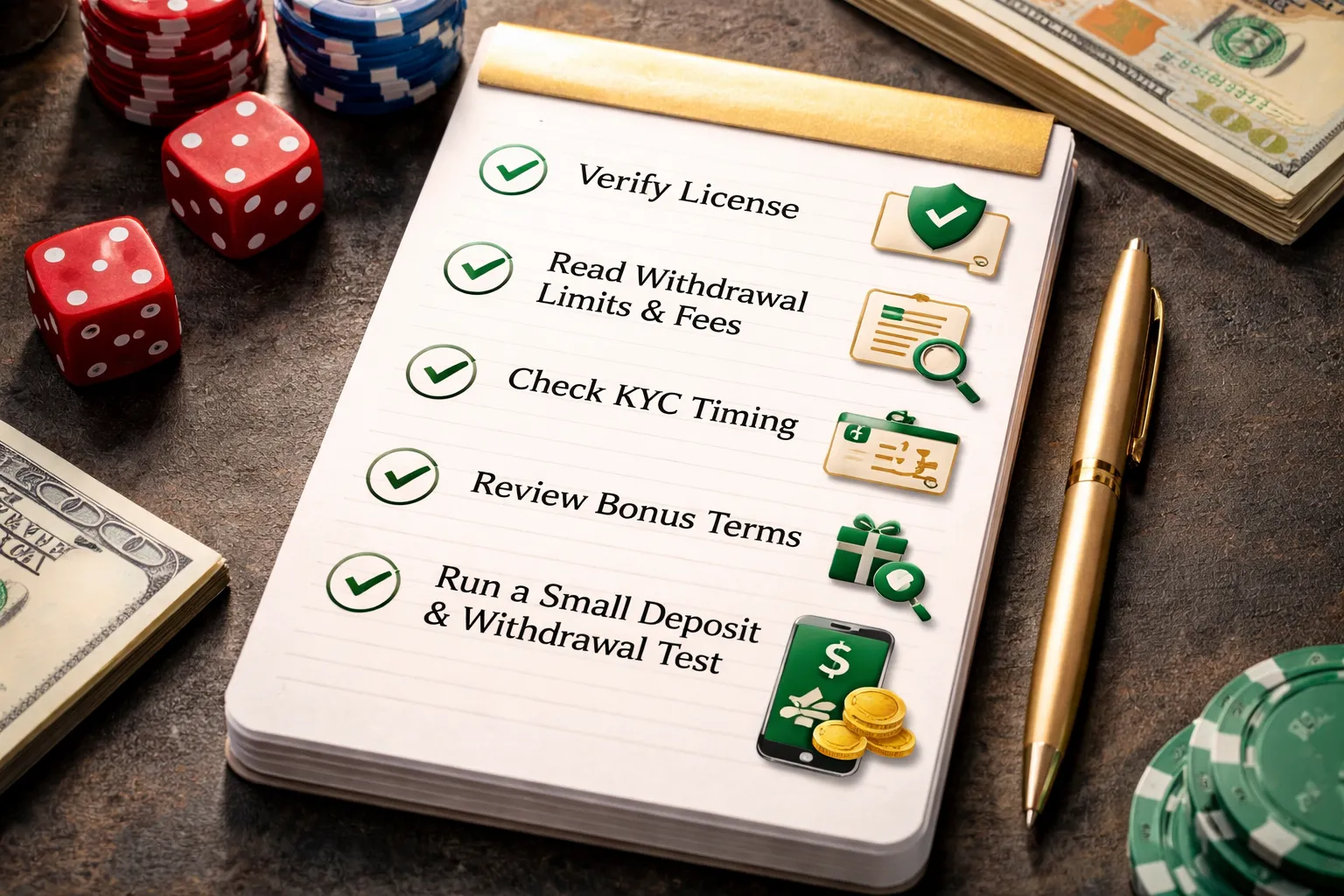
Reputation signals that predict reliable payouts
Start with the operator, not the welcome bonus. You want a casino that can prove it pays.
- Licensing quality. Check the footer for the license holder name and license number. Verify it on the regulator site. Avoid casinos that hide ownership or list no license details.
- Audited RTP and game testing. Look for independent test labs listed in the footer or terms. Find RTP reports by game provider. Skip sites that claim “certified” with no lab name or report.
- Payment history. Search for recent payout complaints with dates, amounts, and resolution updates. Focus on patterns like “KYC after withdrawal,” “endless delays,” or “closed account after win.”
- Transparency. A reliable casino publishes clear terms, withdrawal limits, KYC rules, fee policy, and processing times. If key rules sit behind vague wording, expect conflict later.
Withdrawal policy checks before you deposit
Read the withdrawal section before you fund your account. Most payout disputes start here.
- Limits. Check minimum and maximum per withdrawal, daily, weekly, and monthly caps. A low monthly cap can turn a win into months of waiting.
- Fees. Look for withdrawal fees, currency conversion fees, and “inactive account” fees. If fees apply, calculate the real cost of cashing out.
- KYC timing. Prefer casinos that let you verify before you deposit or before you request a withdrawal. Avoid sites that say they verify “when required” with no timing.
- Processing times. Separate “internal processing” from “payment method time.” If the casino gives no timeframe, treat it as a risk. Use one reference link for benchmarks, see online casino payout times.
- Method rules. Many casinos require you to withdraw to the same method you used to deposit. If you plan to use multiple methods, confirm the order and restrictions.
Bonus due diligence that prevents cashout traps
Bonuses create most “rule-based” payout refusals. Check the bonus terms before you opt in.
- Max cashout. Some bonuses cap winnings. If the cap sits below your target win size, skip the offer.
- Restricted games. Many promos exclude table games, live dealer, or specific slots. If you play excluded games, the casino can void the bonus win.
- Wagering contribution. Slots often count 100 percent. Other games can count 0 to 20 percent. Low contribution makes clearance unrealistic.
- Sticky bonuses. Sticky means you cannot withdraw bonus funds. You may also need to wager longer, with tighter limits.
- Bet size limits. A max bet rule during wagering is common. One oversized spin can trigger confiscation in strict terms.
Safer payment practices that reduce payout friction
Set your account up like you plan to withdraw. Do it before you win.
- Withdraw to the same method. Use one primary deposit method that you can also withdraw to. Avoid methods known for “deposit only” unless the casino states the withdrawal route.
- Verify early. Upload documents right after registration. Match your account name to your payment method name. Do not wait until you request a withdrawal.
- Keep records. Save deposit receipts, withdrawal requests, confirmation emails, and support transcripts. Screenshot key pages like limits and fees on the day you deposit.
- Use consistent details. Keep your address, phone, and email consistent across your casino profile and payment account. Small mismatches create KYC delays.
Bankroll and risk control when testing a new casino
Test payout behavior with small money. Treat the first deposit as a screening cost.
- Start small. Deposit the minimum you can play with. Avoid large first deposits, even if the match rate looks good.
- Run a withdrawal test. After a short session, request a small withdrawal. Track the timestamp, status changes, and any new document requests.
- Stop if they change the rules. If the casino adds new requirements after you request a withdrawal, pause deposits. Get the rule in writing in chat or email.
- Scale only after proof. Increase stakes and deposits only after you complete at least one clean cashout with no surprises.
| What to check | What you want to see | Red flag |
|---|---|---|
| License details | License number, legal entity, public register entry | No number, unclear owner, offshore claims with no verification |
| Withdrawals | Clear limits, fees, and timeframes | Vague “up to” times, hidden caps, unexplained fees |
| KYC | Allowed before deposit, clear document list | KYC only after withdrawal, shifting requirements |
| Bonus rules | Max cashout stated, game list, bet limits, contributions | Missing promo terms, broad “irregular play” clauses |
| First test | Small withdrawal approved on first try | Delay loop, repeated “under review,” account restrictions |
Frequently Asked Questions
How long should you wait before you escalate?
Follow the casino’s posted payout window. If it passes with no clear status update, escalate. Keep all chat logs, emails, and screenshots. Ask for a specific release date and the exact reason for the delay.
What proof should you collect to support your case?
Save withdrawal confirmations, timestamps, transaction IDs, and payment method details. Screenshot account balance and withdrawal status. Export chat transcripts. Keep bonus terms you accepted. Store KYC emails and every document you sent.
What should you send for KYC to avoid repeat requests?
Send clear color photos of ID, proof of address, and payment method proof. Match names and addresses across documents. Use the casino’s file type and size rules. Ask them to confirm your KYC is complete in writing.
What if the casino changes KYC rules after you request a withdrawal?
Ask for the exact policy section and the date you accepted it. Request a fixed checklist and a deadline for review. Do not resend the same files without a new written requirement.
What if the casino claims you broke bonus terms?
Ask which rule you broke, with bet history evidence. Check wagering, max bet, restricted games, and max cashout caps. If terms look vague, request a supervisor review and a written final decision.
Can a casino refuse to pay because you used a VPN?
Many casinos ban VPN use. If they cite it, ask for login records and the exact clause. Provide your real location proof if you played from an allowed country. Stop using VPN tools during the dispute.
What if they accuse you of having multiple accounts?
Ask which accounts they linked and why. Provide ID and a short statement confirming one account. If you share a device, Wi-Fi, or address with others, explain it. Request manual review instead of auto closure.
Should you charge back your deposit?
Use chargebacks as a last step. They can lock your account and void funds. First, push for a written resolution, then file complaints with the licensing body. If you charge back, keep full records and expect account closure.
Where do you complain if support stalls?
Complain to the casino first in writing. Then escalate to the regulator listed in the casino footer, plus any approved ADR if shown. Include your account ID, dates, amounts, and evidence pack.
How do you tell a real delay from a stalling loop?
A real delay has a clear queue, status, and expected date. A stall repeats “under review,” adds new KYC items, or blocks access after you request cashout. Compare with typical online casino payout times.
Can you withdraw to a different payment method?
Some casinos require the same method you used to deposit, until you clear refund rules. Ask support which methods you qualify for and why. Do not switch methods mid review unless they confirm it in writing.
What if the casino restricts your account after you request a payout?
Ask what restriction triggered and what action clears it. Request read-only access so you can download history and receipts. Keep communication in one ticket. If they refuse basic access, escalate to the regulator with timestamps.
Conclusion
Conclusion
A casino can stall or block a payout for many reasons. Your leverage comes from clean records and a tight process.
- Stop playing and stop depositing until the withdrawal clears.
- Lock your evidence, screenshot balances, withdrawal screens, KYC status, and every message with dates.
- Use one support ticket, ask for the exact rule they rely on, and request a written deadline for release.
- Complete KYC once, send clear files, and match your details to your payment method. Use this KYC guide if they claim a verification issue.
- Escalate fast when they miss their own timeline, file with the licensor or ADR, attach your full timeline and receipts.
Final tip, write a simple timeline before you escalate. One page. Dates, amounts, method, ticket numbers, and what they told you. Regulators act faster when you hand them a complete file.
-
Online Casino Payment Safety Tips: How to Deposit and Withdraw Securely
8 months ago -
How to File a Complaint Against an Online Casino (Plus ADR Explained)
8 months ago -
How to Sign Up & Create an Online Casino Account (Step-by-Step)
8 months ago -
Online Casino Login Problems: Fixes for Common Sign-In Issues
8 months ago -
How to Withdraw Money from an Online Casino: Methods, Steps & Tips
8 months ago
-
- Step 1: Pause activity
- Step 2: Check the cashier for status and method eligibility
- Step 3: Re-read the exact T&Cs that apply
- Step 4: Complete KYC correctly
- Step 5: Verify payment details match your identity
- Step 6: Contact support with a structured request
- Step 7: Ask for the internal reason code and written requirements
- Step 8: Escalate to the payments or KYC team and request an SLA
- Step 9: Submit a formal complaint in writing and keep one thread
- Step 10: Prepare for external escalation if deadlines pass
-
- What to Include in Your Complaint
- Build a Simple Timeline That Support Can’t Ignore
- Ask for a Clear Outcome and Clear Answers
- How to Cite Terms Without Sounding Emotional
- Set Reasonable Deadlines and Define “Resolution”
- Sample Email Template: Request Payout Release
- Sample Follow-Up Template: When Support Sends Generic Replies
-
- 1) Use the casino’s official complaints process, identify the legal operator
- 2) Alternative Dispute Resolution (ADR), when it applies, what to expect
- 3) File a regulator complaint, submit tight evidence
- 4) Dispute through the payment provider, use the right documents
- 5) Chargebacks, eligibility, time limits, and risks
-
- How long should you wait before you escalate?
- What proof should you collect to support your case?
- What should you send for KYC to avoid repeat requests?
- What if the casino changes KYC rules after you request a withdrawal?
- What if the casino claims you broke bonus terms?
- Can a casino refuse to pay because you used a VPN?
- What if they accuse you of having multiple accounts?
- Should you charge back your deposit?
- Where do you complain if support stalls?
- How do you tell a real delay from a stalling loop?
- Can you withdraw to a different payment method?
- What if the casino restricts your account after you request a payout?
-
- Step 1: Pause activity
- Step 2: Check the cashier for status and method eligibility
- Step 3: Re-read the exact T&Cs that apply
- Step 4: Complete KYC correctly
- Step 5: Verify payment details match your identity
- Step 6: Contact support with a structured request
- Step 7: Ask for the internal reason code and written requirements
- Step 8: Escalate to the payments or KYC team and request an SLA
- Step 9: Submit a formal complaint in writing and keep one thread
- Step 10: Prepare for external escalation if deadlines pass
-
- What to Include in Your Complaint
- Build a Simple Timeline That Support Can’t Ignore
- Ask for a Clear Outcome and Clear Answers
- How to Cite Terms Without Sounding Emotional
- Set Reasonable Deadlines and Define “Resolution”
- Sample Email Template: Request Payout Release
- Sample Follow-Up Template: When Support Sends Generic Replies
-
- 1) Use the casino’s official complaints process, identify the legal operator
- 2) Alternative Dispute Resolution (ADR), when it applies, what to expect
- 3) File a regulator complaint, submit tight evidence
- 4) Dispute through the payment provider, use the right documents
- 5) Chargebacks, eligibility, time limits, and risks
-
- How long should you wait before you escalate?
- What proof should you collect to support your case?
- What should you send for KYC to avoid repeat requests?
- What if the casino changes KYC rules after you request a withdrawal?
- What if the casino claims you broke bonus terms?
- Can a casino refuse to pay because you used a VPN?
- What if they accuse you of having multiple accounts?
- Should you charge back your deposit?
- Where do you complain if support stalls?
- How do you tell a real delay from a stalling loop?
- Can you withdraw to a different payment method?
- What if the casino restricts your account after you request a payout?
-
Reload Bonus Explained: What It Is and When It’s Worth Claiming
6 months ago -
Online Casino Licensing Explained: Authorities, Licenses & How to Check One
8 months ago -
Best Live Dealer Casinos: Where to Play Live Blackjack, Roulette & More
8 months ago -
Best Online Casinos for High Rollers: VIP Perks, High Limits & Exclusive Bonuses
8 months ago -
Fast Payout Online Casinos: Best Sites for Quick Withdrawals
8 months ago
-
Online Casino Customer Support: What to Look For (Live Chat, Email, Response Times)
8 months ago -
Sign Up for an Online Casino: Create an Account in Minutes
8 months ago -
Online Casino Payment Safety Tips: How to Deposit and Withdraw Securely
8 months ago -
How to File a Complaint Against an Online Casino (Plus ADR Explained)
8 months ago -
Online Casino Licensing Explained: Authorities, Licenses & How to Check One
8 months ago