Online Poker vs Casino Poker Games: What’s the Difference?

Online poker and casino poker look similar. They play by different rules in practice. Online poker runs on software, fast hands, set bet sizing, and fixed rake. Casino poker runs in a room with a dealer, slower pace, more table talk, and different fees.
This guide breaks down the difference in what matters to your results. You will learn how game speed changes variance, how player pools affect difficulty, how rake and tipping impact your hourly, and what tools and rules online sites allow or ban. You will also see where casino poker offers more edge, and where online poker offers more volume and table selection.
Key Takeaways
- In het kort: Casino poker gives you softer lineups and more live reads. Online poker gives you more hands, more tables, and faster learning.
- Speed drives variance. Online deals far more hands per hour, so your bankroll swings faster. Live deals fewer hands, so results show up slower.
- Player pools change difficulty. Online pools include more regulars and better selection tools, so average skill rises at many stakes. Live casino tables often include more casual players.
- Rake and tipping hit your hourly. Live games often add tipping costs. Online replaces that with rake, plus possible extra fees in some formats.
- Volume vs edge is the main trade. You can often win more per hand live, but you can play more hands per hour online. Your best choice depends on your win rate, table availability, and time.
- Tools and rules differ. Online sites may allow HUDs or tracking, or ban them, and they enforce strict timing and seating rules. Casinos rely on staff and social pressure, and you must handle chips, dealers, and table talk.
- Table selection is stronger online. You can filter limits, formats, and traffic fast. In casinos, you depend on waitlists and what runs in the room.
- If you want live dealer realism without a poker room, use live casino games. See the live casino guide for how those tables work.
What counts as “online poker” and “casino poker games” (avoid the common confusion)
What “online poker” means
Online poker is player vs player poker you play on a website or app. You sit at a virtual table. You play against other players. The site runs the game and takes a fee.
- Cash games: You buy in with money. Chips equal money. You can leave any time.
- Tournaments: You pay a buy-in. You get a fixed stack. Blinds rise on a schedule. You win by outlasting the field.
- Sit & Go (SNG): A small tournament that starts when enough players register.
- Fast-fold pools: You fold, then you get moved to a new hand at a new table. You play more hands per hour.
Online poker uses software for shuffling and dealing. Most rooms use an RNG and publish testing or audit notes in their terms.
What “casino poker games” means inside a casino
In a casino, “poker” can mean two different things. You need to separate them because the math, fees, and opponents change.
- Poker room tables (player vs player): Live Texas Hold’em and Omaha. You play other players. The casino makes money from rake or time charges.
- House-banked poker games (player vs house): Video poker machines and casino table variants like Caribbean Stud, Let It Ride, Three Card Poker, and Ultimate Texas Hold’em. You play the casino. A house edge applies.
Live dealer “casino poker” streams usually fall into the second group. They look like poker, but you play against the house rules, not a table of players. If you want a better baseline on house edge games, use this blackjack basic strategy chart as a reference point for how casino advantage works.
Player vs player vs house-banked, quick comparison
| Game type | Your opponent | Main cost | What decides results |
|---|---|---|---|
| Online poker | Other players | Rake, sometimes tournament fees | Your decisions vs other players, plus variance |
| Casino poker room (Hold’em, Omaha) | Other players | Rake or time charge, tips | Your decisions vs other players, plus variance |
| Video poker and casino poker variants | The house | Built-in house edge | Paytable, rules, and long-run math |
Quick glossary
- Rake: The fee the room takes from pots, or a timed seat fee. It is your main “cost of playing” in player vs player poker.
- Blinds: Forced bets posted each hand in Hold’em and Omaha. They create action.
- Ante: A smaller forced bet posted by all players each hand, common in tournaments and some cash games.
- Comps: Rewards from a casino, like food credit or points, tied to your hours played or estimated action.
- RNG: Random number generator. It shuffles and deals in online poker and many casino games.
- HUD: Heads-up display software that tracks opponents and shows stats. Sites may allow it, restrict it, or ban it.
- Variance: Short-term swing in results. It stays high in poker even when you play well.
Core gameplay differences that change how you win
Hands per hour and decision density
Online poker deals more hands per hour. You face more spots. You make more mistakes if you rush.
Live casino poker moves slower. Dealers shuffle. Chips get counted. Players tank. You get more time to track ranges, stack sizes, and payout pressure.
Speed changes how you win. Online rewards clean, repeatable decisions. Live rewards patience and exploiting obvious leaks over fewer hands.
| Factor | Online poker | Casino poker |
|---|---|---|
| Hands per hour | Higher volume, faster feedback | Lower volume, fewer samples |
| Decision density | More preflop spots, more marginal edges | More time per decision, fewer total spots |
| Win path | Small edges, repeated often | Bigger mistakes, punished over time |
Information sources
Online removes most physical reads. You work with bet sizing, timing, showdowns, and long-run patterns. You can take notes. Some sites allow a HUD. Some block it.
Live adds physical and social data. You see how a player handles chips. You hear table talk. You watch who stares at the board, who looks away, and who gets comfortable.
- Physical tells, live only. Use them as small inputs, not as proof.
- Timing tells, both. Online timing can come from multi-tabling, distractions, or connection. Live timing can signal confidence, confusion, or a rehearsed act.
- Bet sizing patterns, both. Online sizes often cluster. Live sizes vary more, and often reveal hand strength or fear.
- Note-taking, stronger online. You can tag players and record lines fast. Live note-taking stays mental unless you track it off-table.
Table dynamics
Casino games produce more multiway pots. Limping happens more. Players call wider. You win by value betting thin and charging draws.
Online tables play tighter preflop at many stakes. You face more 3-bets, more isolation, and more pressure in position.
Live also adds social pressure. People react to raises. They comment on hands. Some players avoid conflict and over-fold. Others chase action to look fearless. Online stays closer to anonymous. You see fewer emotion-driven decisions, and more pattern-driven ones.
Betting behavior
Online poker pushes standard bet sizes. Players click common numbers like one-third pot, half pot, or three-quarters. That makes ranges easier to model. It also makes bluffs and value lines look similar.
Casino poker gives wider sizing freedom. Many players bet by feel. They use odd sizes. They overbet with strong hands, or underbet to keep you in. You should track sizing tells, then respond with simple counter-lines.
- Against small live bets, you often get good direct odds. You can call more with draws and position.
- Against large live bets, you often face strength. You should demand strong blockers and clear reasons before you bluff.
- Against standardized online bets, you should build responses around range advantage and board texture, not gut feel.
Multi-tabling and focus
Online lets you play several tables. That raises volume. It also cuts attention per hand. Your edge drops if your decisions turn into autopilot.
Live keeps you on one table. You play fewer hands, but you can watch every pot. You can track who tilts, who avoids big pots, and who never bluffs.
If you want to win online, you need a focus plan. Fewer tables. Clear preflop ranges. Fast notes. Breaks to avoid fatigue. If you want to win live, you need stamina. Long sessions. Consistent value lines. Control of boredom and ego.
Strategy adjustments: online poker vs live casino poker rooms
Opening ranges and preflop aggression: tighter live fields vs tougher online pools
Online pools defend more. They 3-bet more. They punish loose opens fast. You need tighter opening ranges from early position and a clear plan versus 3-bets. Use size discipline, avoid limps, and track positions. If you open too wide, you bleed to rake and pressure.
Live games usually play looser and more passive. You see more limps and more calls. You can raise bigger for value and isolation. Build pots when you expect callers. Cut out thin steals that rely on folds, you will not get them.
- Online default: tighter EP, higher 3-bet frequency in late position, more 4-bet discipline.
- Live default: bigger iso-raises, more value opens, fewer light 3-bets.
Postflop play: exploiting calling stations live vs balanced lines online
Online opponents check-raise more and float more. Many use common solver lines. If you over-c-bet, they punish you. Use board-based c-bet plans. Check more medium strength hands. Protect your checking range on dynamic boards.
Live opponents call too much and fold too little on later streets. You win by value betting and sizing up. You lose by trying to run big bluffs into players who hate folding top pair. Keep your bluffs selective. Target specific players, not the whole table.
- Online: smaller c-bets on many boards, more turn checks, more delayed c-bets when ranges shift.
- Live: fewer multi-street bluffs, more thin value, more bet, bet, bet lines versus capped ranges.
Value betting and bluffing frequency: where each environment punishes mistakes
Online punishes sizing leaks. Players spot capped lines, missed value, and unprotected ranges. If you under-bluff, good players over-fold less and call you down right. If you over-bluff, they call wider and raise more.
Live punishes ego. If you bluff the wrong player, you light money on fire. If you fail to value bet, you miss the main edge. Your baseline should shift toward value. Use larger sizes with strong hands, especially on rivers where live callers pay off.
| Spot | Online adjustment | Live adjustment |
|---|---|---|
| River value | Use polar sizes when ranges support it, expect bluff-catchers | Go bigger versus stations, avoid thin value versus nits |
| Multi-street bluffs | Choose good blockers, follow credible lines | Reduce frequency, bluff players who can fold, not calling types |
| Bet sizing | Small sizes show up often, exploit timing and patterns | Exploit freedom to size up for value and deny odds |
Short-stack vs deep-stack realities: common stack depths and how to adapt
Online cash games often sit around 100 big blinds. You see more 3-bet pots and more stack-off spots. You need clean preflop charts and solid shove and call thresholds. Small mistakes repeat fast because you play more hands per hour.
Live cash often plays deeper. Many players buy in big and top up. 150 to 300 big blinds shows up often. Deep stacks reduce all-in pressure and increase implied odds. You should tighten marginal offsuit hands out of position. You should play more suited and connected hands in position, but only if you can win big pots and avoid reverse implied odds.
- 100bb: favor strong top pairs, simpler value lines, fewer thin calls versus big turn raises.
- 200bb+: value strong draws and nutted potential, avoid stacking off with one pair in tough spots.
Table image and meta-game: using perception live vs using data online
Live players watch you. They remember showdowns, chatter, and how you handle chips. You can shape action by showing one bluff or by staying quiet and tight for an hour. Use that image to get paid when you value bet, or to pick a rare bluff when your story fits.
Online players track stats and timing. They tag you. They note your 3-bet rate, c-bet frequency, and showdown patterns. Your edge comes from clean data use. Take fast notes. Mark hands. Review later. Build player-specific lines instead of guessing.
- Live tools: observation, seat selection, table talk control, showdown selection.
- Online tools: notes, hand histories, population reads, consistent ranges.
Costs, payouts, and expected value: rake, fees, comps, and jackpots
Rake structures: online caps vs casino drops and time charges
Rake is your main cost in cash games. It often decides if a small edge pays or dies.
- Online pot rake, most rooms take a percentage of the pot up to a cap. Small and mid pots hit the rake more often. Big pots hit the cap and stop.
- Casino drop, many live rooms take a set amount once the pot hits a trigger, then keep dropping until a cap. Some rooms add a promo drop for jackpots.
- Time rake, some casinos charge by the half hour or hour. It hurts tight players less, but it punishes you if you sit out, table change, or play short.
What to check before you sit. The rake percent, the cap, the promo drop, and the pot size where rake starts. Then estimate hands per hour. A lower rake can still cost more if the game crawls.
Tournament fees: buy-in vs entry fee, rebuys, and add-ons
Tournament price has two parts. The prize pool and the fee.
- Buy-in, the amount that goes to the prize pool.
- Entry fee, the amount the house keeps. Online fees often scale by stake and format. Live fees can look small, but you play fewer events per trip.
- Rebuys and add-ons, they grow the prize pool, but they also change variance and the skill edge. You need a bankroll plan before you register.
Rule to use. Compare tournaments by the fee rate, not the headline buy-in. A $200+$30 costs more than a $215+$15, even if the first one looks bigger.
Comps and promotions: casino rewards vs online bonuses
Promos cut your net rake, but only if you can clear them.
- Casino comps, you earn points for time played or rake paid. Value comes as food, hotel, and free play. It helps most if you already travel and stay on site.
- Online bonuses, you earn from rake or points, then unlock cash, tickets, or boosts. Read the release rate and time limit. If you do not hit the volume, the bonus is marketing, not value.
Track promos like costs and payouts. Convert them to dollars per hour or dollars per 100 hands. Do not guess.
Bad beat jackpots, high-hand bonuses, and progressive pools
Jackpots can swing your hourly, but only in the right room.
- Casino jackpots, many rooms fund them with an extra drop. You pay every raked pot, even when the jackpot never hits. The value depends on rules, frequency, and how the room spreads eligible hands.
- Online jackpots, formats vary. Some attach to specific tables or fast-fold pools. Some pay for all-in situations. Read the trigger conditions and the added rake or fee.
When they matter. They matter when the added drop is small and the jackpot rules create frequent, broad payouts. They do not matter when the room takes a big promo drop and the hit rate stays low.
Hidden costs: travel, tipping, food, and slow-game opportunity cost
Live poker has real-world friction. It hits your true win rate.
- Travel and parking, you pay them every session. They also add fatigue and time loss.
- Tipping, it acts like extra rake. If you tip per pot, it scales with your volume.
- Food and drinks, small costs compound over long sessions.
- Slow games, fewer hands per hour means higher cost per hand. A “softer” game can still pay less per hour if it runs at half speed.
Online has its own hidden costs. Withdrawal fees, currency conversion, and higher variance from faster volume. Your best control point stays the same in both. Track net results after every fee, drop, and tip.
Fairness, security, and regulation: what to look for in each environment
Online integrity checklist, what to verify before you deposit
- Licensing: Find the license number and regulator on the cashier page or footer. Verify it on the regulator website. Prioritize strong regulators with public enforcement actions and clear player complaint paths.
- RNG testing: Look for independent testing reports from labs such as eCOGRA, iTech Labs, or GLI. You want a current certificate that covers the poker RNG and shuffling, not a generic seal.
- Segregation of player funds: Check if the site states it holds player balances in segregated accounts. Strong jurisdictions require this and describe what happens if the operator fails.
- Encryption and account security: Use sites that enforce HTTPS, offer two factor authentication, and support strong password rules. Turn on login alerts. Do not share devices or store passwords in browsers on public machines.
Collusion, bots, and multi-accounting, online specific risks and mitigations
Online poker adds scale and anonymity. That increases three risks.
- Collusion: Two or more players share info and coordinate. Sites mitigate with network analysis, shared device checks, and hand history pattern detection. You mitigate by avoiding empty tables with the same names, staying away from private games you do not trust, and reporting odd checking down and soft play.
- Bots and real time assistance: Automated or assisted play can grind small edges at high volume. Better sites restrict software, scan for prohibited tools, and run statistical detection. You mitigate by picking regulated rooms, avoiding unknown skins, and sticking to stakes where enforcement pressure stays high.
- Multi-accounting: One person uses multiple accounts to game promotions or bypass bans. Sites mitigate with KYC checks, device fingerprinting, and withdrawal controls. You mitigate by avoiding games that rely on anonymous deposits and instant withdrawals with minimal verification.
Casino safeguards, what keeps live games honest
- Shuffling procedures: Many rooms use automatic shufflers, some hand shuffle. Either way, you want clear deck changes, proper wash and riffle practices, and a supervisor presence for unusual situations.
- Surveillance: Cameras cover tables, cages, and chip racks. Surveillance gives the casino a strong audit trail for disputes and cheating investigations.
- Dealer controls: Dealers follow standardized dealing, burning, and mucking procedures. Floors rotate staff and respond to irregularities. You should speak up fast if you see exposed cards, misdeals, or incorrect pot awards.
- Chip security: Casinos use RFID in higher stakes rooms, unique chip designs, and strict rack handling. Chips stay harder to counterfeit than online balances, but theft still happens. Keep stacks visible and count downs when you leave the table.
Dispute resolution and player protections
- Self-exclusion: Regulated online sites usually offer timeouts and exclusion tools inside your account. Casinos offer property wide bans and, in some regions, centralized exclusion lists.
- Deposit and loss limits: Online tools tend to be more granular, daily, weekly, monthly caps. Set limits before you play, not after you lose.
- Complaint channels: Online, you want a documented path, support ticket logs, and escalation to the regulator or an ADR service. Live, you start with the floor, then poker room management, then the gaming commission if the issue involves rules, payouts, or conduct.
- Evidence: Online gives you hand histories, timestamps, and transaction records. Live relies on surveillance review and dealer reports. Ask the floor to log the incident while it is fresh.
Geography and legality, why rules and availability differ
Online poker runs under local law, not global availability. Your location can change what you can play, how the site verifies you, and how you cash out.
- Jurisdiction controls game access: Some regions allow poker but restrict player pools to in state traffic. Others allow shared liquidity across borders. This impacts game selection and average skill.
- Tax and reporting rules vary: Some places tax winnings, some require operator reporting, some do both. Track withdrawals and session results to match your local requirements.
- Payment rails depend on regulation: Legal markets usually offer safer banking and faster dispute handling. Grey markets often rely on higher fee methods and weaker recourse if something goes wrong.
Skill level, competition, and game selection
Skill level and competition
At the same posted stakes, live casino games often play softer than online games. You see more limping, more multiway pots, and more players chasing draws. Many live players treat poker as entertainment first. That lowers the average technical level.
Online pools compress skill. You face more regulars, more volume players, and more people using training content. Even at low stakes, you run into tighter ranges, more 3-bets, and better value targeting.
Live games stop being soft when any of these show up.
- Strong local regs: A small player pool can mean the same good players in every lineup.
- High stakes: Bigger games attract pros and backed players.
- Series and weekends: Big events can bring strong travelers and tougher table mixes.
- Short-handed lineups: Fewer weak spots per table increases pressure on your edges.
Online game selection: stakes ladder, formats, traffic, tools
Online poker gives you a clean stakes ladder. You can move from micro to mid stakes in small steps. You can also switch formats fast without leaving the lobby.
- Stakes ladder: More buy-in levels, more table counts, more chances to find your best win rate.
- Formats: Cash, tournaments, sit and gos, fast-fold, heads-up, and mixed variants depending on the site.
- Traffic times: Games get softer when more casual players log in, often evenings and weekends in your target region.
- Table selection tools: Many sites show players per flop, average pot, and waitlists. Use these to avoid reg-heavy tables.
If your site limits seating scripts or player notes, you still control selection with session timing, stake choice, and quitting bad lineups fast.
Casino game selection: room quality, waitlists, rake, rules
Live selection depends on the poker room, not a global player pool. Two casinos in the same city can play very differently.
- Room quality: Look for consistent dealer speed, clear rules, and stable game offerings. Slow rooms cut your hands per hour.
- Waitlists: Popular games can mean long waits. Call-ahead lists and tracking apps help, if the room offers them.
- Rake impact: Live rake often uses a drop plus promotions. That hurts small-stakes win rates. Compare rake caps and promo drops before you sit.
- Table rules: Straddles, buy-in caps, rake structure, and bomb pots change the real game. Ask the floor and read the placard.
In live rooms, one good table can carry your whole session. One bad table can waste hours if you cannot get a seat change.
Format differences: cash, tournaments, fast-fold, mixed games
Cash games reward steady decision making and table selection. Your edge shows up over hands, not levels. Online cash runs more hands per hour. Live cash gives you deeper stacks more often and more social dynamics.
Tournaments reward patience, push-fold skill, and endgame pressure. Online tournaments offer more daily volume, more buy-in options, and larger fields. Live tournaments often have softer early levels but higher time cost and more variance per event.
Fast-fold changes everything. You play far more hands and face more solid ranges. Your leaks show fast. Your hourly can rise, but only if you keep mistakes low.
Mixed games vary by market. Online you might find scheduled mixed events or small niche pools. Live you may find stronger specialists, but also wealthy recreational lineups in certain rooms.
Learning curve: study, hand histories, coaching, review
Online learning is faster because you get data. You can track hands, tag spots, and review sessions with precision.
- Hand histories: You can replay hands, filter by position, and spot patterns in your leaks.
- Databases and HUD rules: If allowed, you can measure your win rate by stake, table type, and time of day.
- Coaching and training: Online communities, videos, and solver-based tools shorten the trial-and-error phase.
- Review habits: Mark tough hands during play, then review when you feel calm. Track one leak at a time.
Live learning depends more on note taking and memory. Track key hands right after the session. Write positions, stack sizes, bet sizes, and reads you saw. Then compare your lines to standard ranges and sizing rules you study elsewhere.
Tools and tracking: HUDs, solvers, hand histories, and etiquette

HUDs and trackers: what they do, what’s allowed, and why policies vary
A HUD overlays stats on your table. A tracker saves hands, builds a database, and produces reports.
- Common HUD stats: VPIP, PFR, 3-bet, fold to 3-bet, c-bet, fold to c-bet, aggression, steal, fold to steal.
- What you get: faster profiling, better table selection, cleaner volume-based decisions.
- What sites usually allow: post-game analysis, basic tracking, note features, simple HUDs on standard tables.
- What sites often restrict: HUDs on anonymous tables, dynamic popups that mimic coaching, seating scripts, data mining hands you did not play.
Policies vary because the games vary. Some rooms market a “recreational friendly” environment. They limit HUDs and third-party tools to reduce the edge of high-volume grinders. Other rooms allow more to attract serious players and stable liquidity.
Hand history review: the online advantage for improvement and leak-finding
Online gives you perfect records. You can filter, tag, and measure results by spot. Live play rarely gives you that precision.
- Build a review loop: mark hands, export sessions, review the same day, write one takeaway, then drill that spot.
- Find leaks with filters: losing in 3-bet pots, over-c-betting certain boards, calling too wide versus river bets, defending blinds too loose.
- Track process metrics: hands reviewed per week, number of marked hands, time in solver study, and repeat mistakes.
- Use ranges and sizings: compare your lines to your preflop charts and your standard flop sizes. Fix one node at a time.
Real-time assistance (RTA): what it is, why it’s prohibited, and how enforcement works
RTA means using tools or outside help during a hand to improve your decisions. That includes solvers running with current hand inputs, scripts that recommend actions, or a person feeding you plays.
Sites ban it because it breaks the skill test. It turns poker into assisted play and harms game integrity.
- Common RTA signals: perfect timing with balanced lines, unnatural bet sizes across many textures, instant decisions in complex spots, coordinated play between accounts.
- Enforcement methods: hand pattern analysis, device and process monitoring, restriction of prohibited software, security audits, reports from players, account reviews tied to withdrawals.
- Your safe rule: study tools before or after sessions. Use nothing that advises action during a live hand.
Live note-taking and memory systems: practical ways to capture reads ethically
In casinos, you rely on observation and recall. You can still track data without crossing lines.
- Use a simple format: player, position, stack, hand shown, line taken, sizing, timing, and any verbal tells.
- Write after the hand: wait until action ends. Do not slow the game or distract the dealer.
- Use short codes: “UTG limp, call 3x, fold to 1/2 pot c-bet” or “BTN overbet river as bluff, showed missed draw.”
- Build memory anchors: link the player to one clear tendency, then update only when you see it twice.
- Keep it ethical: no filming, no recording audio, no sharing hole cards or live strategy with someone off-table.
Casino etiquette: phones, filming, table talk, and behavior that gets you warned
Casinos protect game flow and player privacy. Staff will warn you fast if you create risk.
- Phones: keep them off the rail and away from chips. Do not use them while in a hand. Follow house rules on texting at the table.
- Filming: assume it is banned. Do not record dealers, players, or hands. Ask the floor if you need approval for any content.
- Table talk: do not discuss a live hand when you are not in it. Do not comment on possible holdings or action. Do not reveal folded cards.
- Behavior that triggers warnings: slow rolling, string bets, acting out of turn, splashing the pot, arguing with the dealer, excessive celebration, and repeated tanking without reason.
- Tip and pacing: tip when appropriate. Keep decisions steady. Protect your cards and your stack.
Bankroll, variance, and lifestyle: choosing what fits your goals
Variance by format: tournaments vs cash games in both settings
Variance decides how rough your results feel, even when you play well.
- Cash games: Lower variance than tournaments. You can quit anytime. Your edge shows up faster, but downswings still hit.
- Tournaments: High variance. Payouts cluster at the top. You can play well for weeks and still lose if you miss final tables.
- Online cash: More hands per hour. More short-term swings in a day. Your long-term edge can show sooner because volume is higher.
- Live cash: Fewer hands per hour. Swings feel slower. A single big pot can dominate your session.
- Online tournaments: Many events, large fields, and faster structures. Bigger score potential, longer stretches without a big cash.
- Live tournaments: Fewer events and slower pace. Travel costs add variance. One deep run can still cover months, but it is less frequent.
Bankroll guidelines: conservative ranges and when to move up or down
Set bankroll rules before you play. Follow them when you run bad.
- Online cash: Keep 30 to 60 buy-ins for your stake. Use the higher end if games are tough or you tilt.
- Live cash: Keep 20 to 40 buy-ins. Add extra if you pay for travel, tips, and long sessions.
- Online tournaments: Keep 150 to 300 average buy-ins. Use 300+ if you play large fields or turbos.
- Live tournaments: Keep 100 to 200 average buy-ins, plus a separate budget for travel, hotels, and food.
- Move up: Take shots only when you have at least the top-end bankroll for that stake and your recent play is stable. Use a cap, such as 2 to 5 buy-ins.
- Move down: Drop stakes when you fall below your minimum buy-ins. Do it fast. Protect your ability to keep playing.
- Stop mixing funds: Keep poker money separate from rent, bills, and debt payments.
Time management: session length, breaks, and avoiding fatigue-driven errors
Your win rate drops when you get tired. Plan your time like a schedule, not a mood.
- Online cash: Use shorter blocks, such as 60 to 120 minutes. Take 5 to 10 minute breaks between blocks. Quit when you lose focus, not when you feel bored.
- Live cash: Cap sessions, such as 3 to 6 hours. Stand up each hour. Eat and hydrate before you feel it.
- Tournaments: Expect long days. Bring food plans. Use every break. If you skip sleep, you pay for it late in the event.
- Review time: Reserve time off-table for hand review and tracking results. Do not “study” while you play.
Responsible gambling: limits, tilt control, and recognizing problem signs
Set limits that stop damage. Use rules you cannot talk yourself out of.
- Deposit and session limits: Set a weekly cap. Set a per-session loss limit you respect. If you hit it, you quit.
- Tilt protocol: If you feel anger, revenge thoughts, or panic, you stand up or sit out. You do not add tables. You do not raise stakes.
- Chasing: Do not chase losses with bigger games, extra bullets, or longer sessions.
- Warning signs: Hiding play, lying about losses, borrowing to play, skipping work, or using poker to escape stress. If you see these, stop and get help.
- House game note: If you also play casino games, treat them as entertainment. Learn how progressive payouts work before you chase jackpots, see how progressive jackpots work.
Who should choose what: beginners, recreational players, grinders, and travelers
- Beginners: Start with low-stakes online cash or small online tournaments. You get more reps and faster feedback. Add live low stakes later to learn etiquette and pacing.
- Recreational players: Choose the format that fits your free time. Online works for short sessions. Live works if you want a social night and can handle the slower pace.
- Grinders: Online favors volume and stable scheduling. Cash gives steadier income than tournaments. Live can offer softer lineups, but travel and time cost reduce hourly if you do not table select.
- Travelers: Online gives consistency if legal where you are. Live poker turns travel into an extra expense line. Track total trip cost as part of your poker results.
Side-by-side comparison table: online poker vs casino poker games
Side-by-side comparison table: online poker vs casino poker games
Use this table to pick the format that fits your schedule, bankroll, and edge. Focus on hands per hour, total fees, and game quality. Those three drive your hourly EV.
| Factor | Online poker | Casino poker games (live poker room) |
|---|---|---|
| Speed and volume |
|
|
| Skill environment |
|
|
| Cost structure |
|
|
| Convenience and access |
|
|
| Security and fairness |
|
|
Getting started: practical tips for your first online session or casino visit
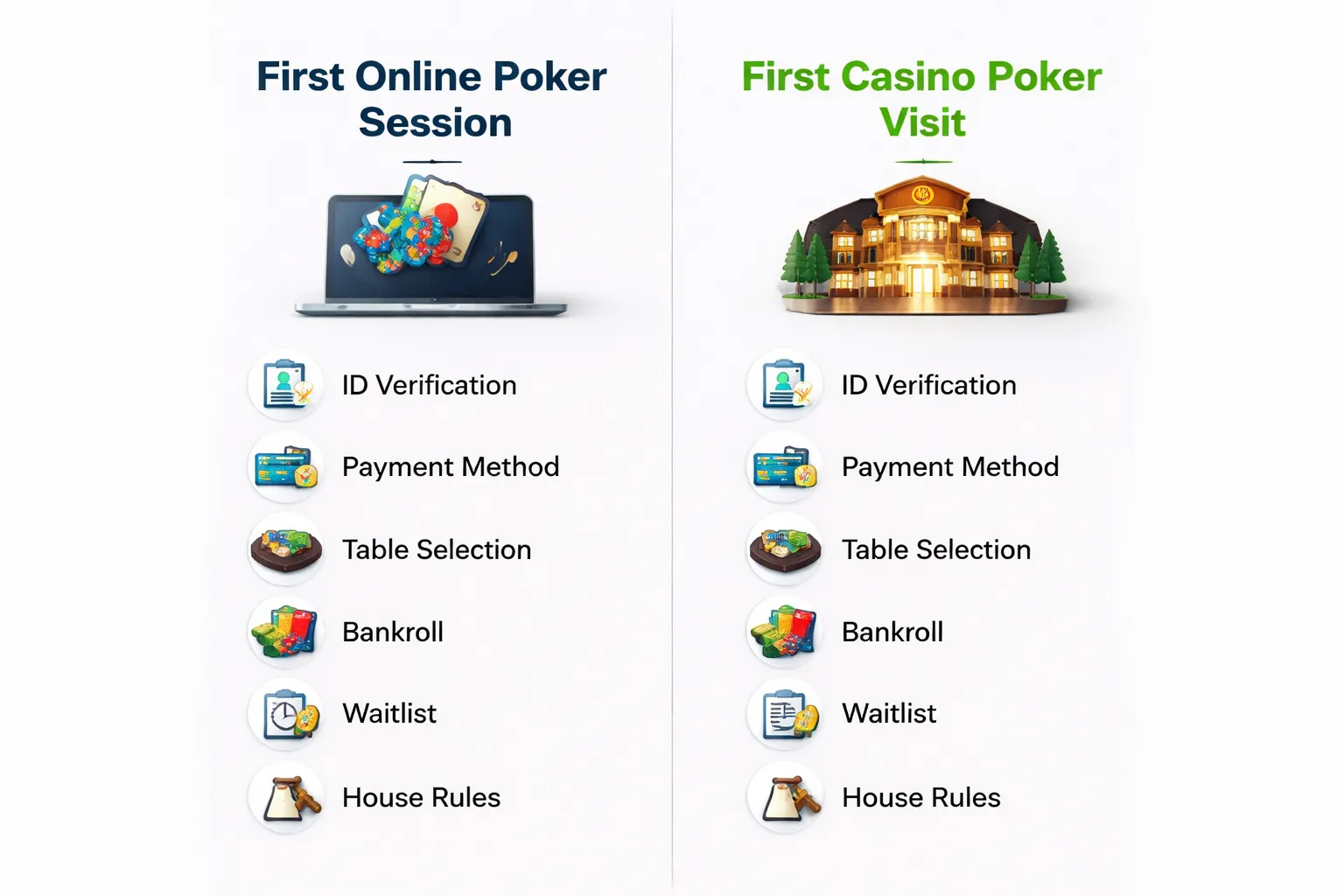
Online setup checklist
- Verify your account early. Upload your ID and proof of address before you deposit. Many sites freeze withdrawals until you pass checks.
- Use one payment method you trust. Pick a method with fast deposits, clear fees, and reliable withdrawals. Track deposit and withdrawal times. Keep screenshots of confirmations.
- Set limits first. Turn on deposit limits, loss limits, or time limits in your account settings. Use lower numbers than you think you need.
- Check the rake and fees. Compare cash game rake and tournament fees. Small differences change your long-term results.
- Start with one table. Multi-tabling increases mistakes. Your goal is clean decisions, not volume.
- Pick tables with fewer strong signals. Look for lower average pot size relative to blinds, fewer players seeing flops, and more short stacks. Avoid tables with many full stacks and high aggression.
- Use stable tech. Wired internet when possible. Close other apps. Turn off notifications. One disconnect can cost a full stack.
Casino visit checklist
- Bring ID and a plan. You need valid ID for the cage and rewards sign-up. Decide your stop-loss and stop-win before you walk in.
- Bring a bankroll that fits the game. For $1/$2 no-limit, many players bring 2 to 3 buy-ins. For $2/$5, bring more. You want enough to handle swings without chasing.
- Expect a waitlist. Ask the podium for the list, game type, and buy-in range. Get your name on early. Stay within earshot when they call.
- Know the minimum and maximum buy-in. Some rooms cap buys. Some allow match-the-stack. This changes strategy and variance.
- Ask about house rules. Straddles, run-it-twice, bomb pots, and rake structure vary by room. Ask before you sit.
- Handle chips and cards cleanly. Keep high-value chips visible. Protect your hand with a chip or card protector. Act in turn.
- Tip standards. Dealers often expect small tips on pots you win. Budget for it.
Beginner-friendly game recommendations
- Online cash. Start at the lowest stakes offered, often $0.01/$0.02 or $0.02/$0.05. Play one table. Use a simple opening range. Avoid marginal calls.
- Online tournaments. Choose low buy-in, slower structures when possible. Avoid re-entry events at first, they push you to spend more than planned.
- Casino cash. Start at $1/$2 no-limit if it runs. Buy in for an amount that lets you play normal pots without fear. Many rooms allow $100 to $300. Bigger stacks reduce shove-or-fold spots.
- Limit poker. If your room spreads fixed limit, it can reduce decision pressure. Costs still add up through rake and tipping.
- Avoid side games early. Skip table games between poker sessions. If you play blackjack, use a basic strategy chart and set a strict spend cap.
Common mistakes to avoid
- Chasing losses. Do not increase stakes to get even. Drop down or quit for the day.
- Playing too many hands. Most beginners leak money with weak offsuit hands and small pairs in bad spots. Fold more preflop.
- Ignoring costs. Online, rake and tournament fees reduce win rate. Live, rake plus tipping plus travel and time can turn a small win into a loss.
- Calling too much. Many players pay off obvious value bets. When action screams strength, believe it.
- Going on tilt. If your decisions speed up, you lost control. Sit out online. Rack up live.
- Skipping table selection. Your hourly rate depends on the lineup. Move tables if the game feels tight and aggressive.
Mini improvement plan
- Weekly study routine. Spend 60 minutes, three times per week. Split it into 30 minutes of preflop ranges and 30 minutes of common spots, like c-bets and facing raises.
- Review process. After each session, save three hands that felt close. Write what you held, positions, stack sizes, bet sizes, and your reason. Re-check the hands when calm.
- One focus per session. Pick one skill, like folding to river raises, or 3-betting less out of position. Track it.
- Measurable goals. Track these numbers for 30 days, sessions played, total hours, total buy-ins risked, and quit times you followed. Add one performance goal, like zero stake jumps, or no more than one table online.
Frequently Asked Questions
Is online poker the same as casino video poker?
No. Online poker is player vs player. You beat other players and pay rake. Video poker is player vs machine. You face a fixed paytable and a built-in house edge. Your long-term results depend on that edge, not opponent mistakes.
Which is tougher, online poker or casino poker?
Online is usually tougher at the same stakes. You see more hands per hour, and many players use tracking and study tools. Live games often have more casual players. Your edge can be higher live, but you play fewer hands.
How many hands per hour can you expect?
Online, about 60 to 100 hands per hour per table. More if you multi-table. Live, about 20 to 35 hands per hour. Faster volume online increases variance. It also speeds up learning if you review hands.
Is rake higher online or live?
Live rake is often higher per hand. Many rooms take a set amount plus jackpots. Online rake can be lower, but you pay it more often because you play more hands. Compare rake by big blinds per 100 hands, not dollars.
Can you use HUDs and trackers online?
Sometimes. Some poker sites allow HUDs. Others ban them. Always check the site rules. If allowed, use stats for ranges and tendencies, not to auto-play. If banned, keep notes and tag hands for review.
Are online poker games fair?
They can be. Pick licensed sites that publish audits and use strong game integrity controls. Avoid unlicensed rooms. Learn how RNG testing and operator audits work in this guide on online casino fairness.
What reads matter most online vs live?
Online, focus on bet sizing, timing patterns, and showdowns you record. Live, add physical tells, table talk, and chip handling. Do not overvalue tells. Your best read in both formats is action history and position.
Do you need a different bankroll for online vs live?
Yes. Online plays faster, so you face more short-term swings. Use more buy-ins online for the same stake level. Live has fewer hands but bigger single-pot mistakes. Keep your bankroll separate from your living money.
Which makes more money per hour?
It depends on your edge and game quality. Live can give a higher win rate per 100 hands. Online can give more hands per hour, plus multi-tabling. Track hourly profit over at least 50 hours per format before deciding.
Is multi-tabling a good idea online?
Only if you keep decision quality. Start with one table. Add one table after you can play without time pressure. If your redline drops and mistakes rise, cut tables. Your goal is strong decisions, not maximum volume.
What is the biggest mistake players make when switching formats?
They keep the same pace and assumptions. Online players bluff too much live and ignore calling stations. Live players play too many hands online and time out on hard spots. Adjust to speed, player pools, and bet sizing norms.
Conclusion
Conclusion
Online poker rewards volume, fast decisions, and tight execution. Casino poker rewards patience, table selection, and clean value betting. The skill sets overlap, but your win rate depends on how fast you adjust.
- Online: Expect higher hand volume, smaller edges, and stronger opponents at the same stakes.
- Casino: Expect fewer hands, more multiway pots, and more players who call too much.
- Costs: Track rake, tipping, and travel live. Track rake, fees, and game availability online.
- Environment: Control distractions online. Control emotions and physical tells live.
Your final tip is simple. Pick one format for the next 30 days. Track hands played, hourly profit, and your biggest recurring mistake. Fix one leak at a time, then scale up stakes or volume.
-
Online Casino Fairness Explained: RNG, RTP, House Edge & Provably Fair
8 months ago -
Slot RTP Explained: What RTP Means and How to Use It
8 months ago -
How to Play Online Slots: Rules, Features & Beginner Tips
8 months ago -
How Slot Jackpots Work: Progressive Jackpots Explained
8 months ago -
How to Play Online Blackjack: Rules, Payouts & Quick Start Guide
8 months ago
-
- Opening ranges and preflop aggression: tighter live fields vs tougher online pools
- Postflop play: exploiting calling stations live vs balanced lines online
- Value betting and bluffing frequency: where each environment punishes mistakes
- Short-stack vs deep-stack realities: common stack depths and how to adapt
- Table image and meta-game: using perception live vs using data online
-
- HUDs and trackers: what they do, what’s allowed, and why policies vary
- Hand history review: the online advantage for improvement and leak-finding
- Real-time assistance (RTA): what it is, why it’s prohibited, and how enforcement works
- Live note-taking and memory systems: practical ways to capture reads ethically
- Casino etiquette: phones, filming, table talk, and behavior that gets you warned
-
- Variance by format: tournaments vs cash games in both settings
- Bankroll guidelines: conservative ranges and when to move up or down
- Time management: session length, breaks, and avoiding fatigue-driven errors
- Responsible gambling: limits, tilt control, and recognizing problem signs
- Who should choose what: beginners, recreational players, grinders, and travelers
-
- Is online poker the same as casino video poker?
- Which is tougher, online poker or casino poker?
- How many hands per hour can you expect?
- Is rake higher online or live?
- Can you use HUDs and trackers online?
- Are online poker games fair?
- What reads matter most online vs live?
- Do you need a different bankroll for online vs live?
- Which makes more money per hour?
- Is multi-tabling a good idea online?
- What is the biggest mistake players make when switching formats?
-
- Opening ranges and preflop aggression: tighter live fields vs tougher online pools
- Postflop play: exploiting calling stations live vs balanced lines online
- Value betting and bluffing frequency: where each environment punishes mistakes
- Short-stack vs deep-stack realities: common stack depths and how to adapt
- Table image and meta-game: using perception live vs using data online
-
- HUDs and trackers: what they do, what’s allowed, and why policies vary
- Hand history review: the online advantage for improvement and leak-finding
- Real-time assistance (RTA): what it is, why it’s prohibited, and how enforcement works
- Live note-taking and memory systems: practical ways to capture reads ethically
- Casino etiquette: phones, filming, table talk, and behavior that gets you warned
-
- Variance by format: tournaments vs cash games in both settings
- Bankroll guidelines: conservative ranges and when to move up or down
- Time management: session length, breaks, and avoiding fatigue-driven errors
- Responsible gambling: limits, tilt control, and recognizing problem signs
- Who should choose what: beginners, recreational players, grinders, and travelers
-
- Is online poker the same as casino video poker?
- Which is tougher, online poker or casino poker?
- How many hands per hour can you expect?
- Is rake higher online or live?
- Can you use HUDs and trackers online?
- Are online poker games fair?
- What reads matter most online vs live?
- Do you need a different bankroll for online vs live?
- Which makes more money per hour?
- Is multi-tabling a good idea online?
- What is the biggest mistake players make when switching formats?
-
Reload Bonus Explained: What It Is and When It’s Worth Claiming
6 months ago -
Online Casino Licensing Explained: Authorities, Licenses & How to Check One
8 months ago -
Best Live Dealer Casinos: Where to Play Live Blackjack, Roulette & More
8 months ago -
Best Online Casinos for High Rollers: VIP Perks, High Limits & Exclusive Bonuses
8 months ago -
Fast Payout Online Casinos: Best Sites for Quick Withdrawals
8 months ago
-
Online Casino Customer Support: What to Look For (Live Chat, Email, Response Times)
8 months ago -
Sign Up for an Online Casino: Create an Account in Minutes
8 months ago -
Online Casino Payment Safety Tips: How to Deposit and Withdraw Securely
8 months ago -
What to Do If an Online Casino Won’t Pay Out: Step-by-Step Actions
8 months ago -
How to File a Complaint Against an Online Casino (Plus ADR Explained)
8 months ago