Online Casino Customer Support: What to Expect (Live Chat, Email, Phone)
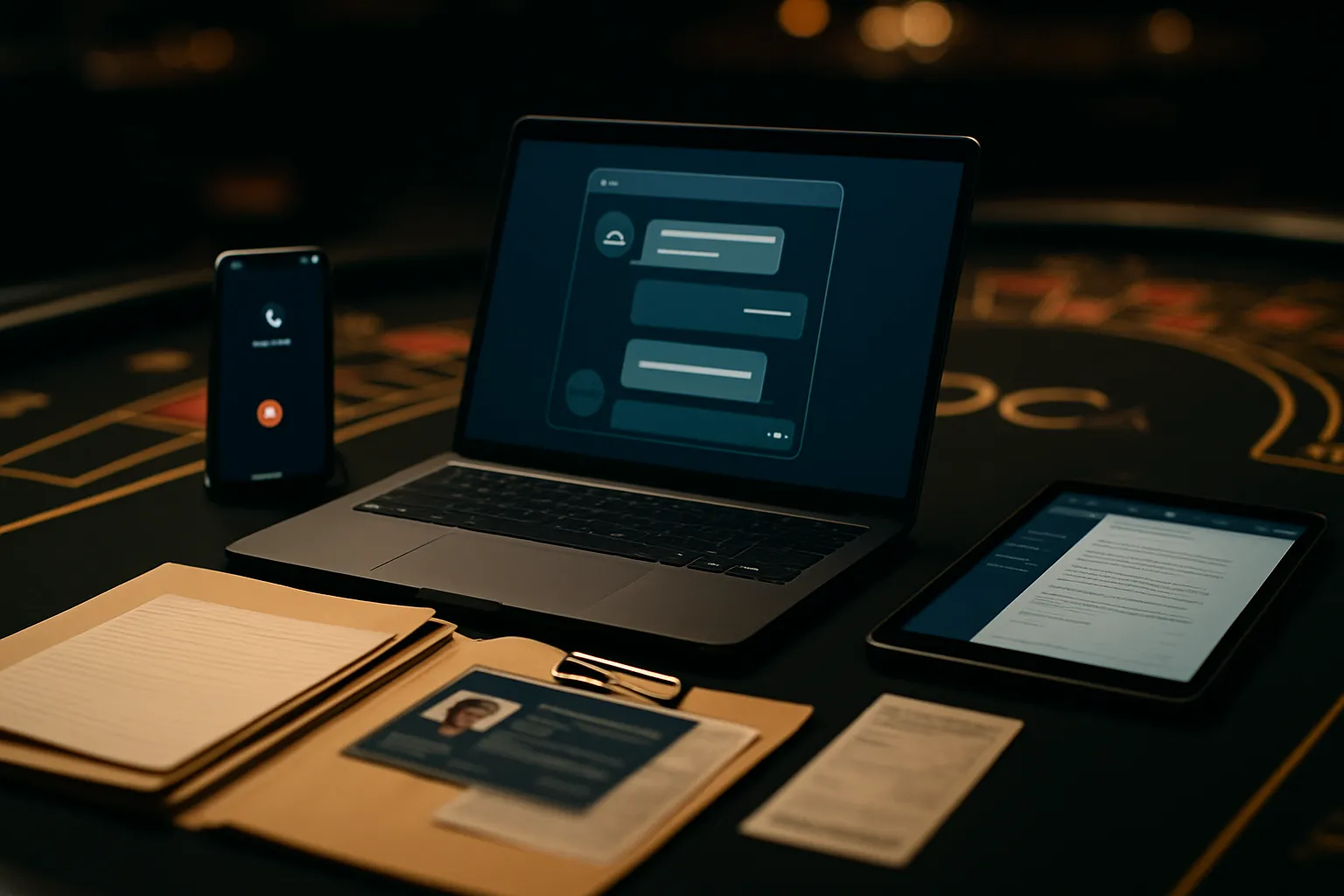
Customer support can decide how fast you get back to playing. It also affects how quickly you fix deposit holds, withdrawal checks, bonus issues, and account locks.
This guide explains what to expect from online casino support across live chat, email, and phone. You will learn typical response times, what each channel handles best, what details you should send to speed up a case, and red flags that signal weak support.
You will also see how support ties into licensing rules and dispute options, which matters if a casino refuses a payout. For the legal side, read are online casinos legal.
- In het kort: Use live chat for fast fixes and simple account questions.
- In het kort: Use email for withdrawals, KYC, and any case that needs files and a paper trail.
- In het kort: Use phone for urgent lockouts and high value payment issues, ask for a case number.
- In het kort: Send key details upfront, your username, transaction ID, dates, amounts, screenshots, and device and browser.
- In het kort: Track response times and consistency, delays and copy paste replies signal weak support.
- In het kort: Check licensing and dispute steps before you deposit, it matters if a payout stalls.
Best channel by issue
| Channel | Best for | What to include |
|---|---|---|
| Live chat | Login issues, bonus terms, game errors, deposit status | Username, device, browser, error message, time of issue |
| Withdrawals, KYC, chargebacks, complaints, account reviews | Case summary, transaction IDs, amounts, dates, attachments | |
| Phone | Urgent access problems, large payment delays, security concerns | Case number, identity details ready, timeline of events |
What good support looks like
- Clear answers that reference your account, not generic scripts.
- Next steps with timelines, what they need from you, and what they will do.
- A case ID you can quote across channels.
- Escalation options when first line support cannot fix it.
Red flags
- No case number, no written follow up after chat.
- Agents refuse to explain payout holds or ask for repeated documents without reason.
- Support pushes you to keep depositing while your withdrawal stays pending.
- Contact details hide behind forms, or phone support never answers.
One quick way to reduce delays
- Write one short timeline, what happened, when, the amounts, and what you already tried.
- Attach proof once, receipts, screenshots, and bank or wallet references.
- Keep all chat transcripts and emails, you may need them for a dispute.
Why online casino customer support matters (and what “good” looks like)
How support impacts withdrawals, trust, and player retention
Customer support is your fastest path to your money when something breaks. Withdrawals fail for common reasons, KYC checks, document mismatches, payment rails, bonus terms, and fraud filters. Good support spots the exact block and tells you what to send, where to upload it, and what the timeline looks like.
Bad support wastes time. You get copy-paste replies. You repeat details. Your withdrawal sits in “pending” with no owner and no deadline.
Support also shapes trust. If an agent gives clear steps, shares reference numbers, and follows up, you can keep playing with confidence. If they stall, dodge, or contradict past answers, you stop depositing and look for another site.
Support quality signals: speed, accuracy, empathy, and consistency
- Speed: You reach a human fast. You get a clear next step in the first message, not a generic apology.
- Accuracy: The agent understands payments, KYC, and bonus rules. They ask for the right proof once. They do not guess.
- Empathy: They acknowledge the impact, missing funds, locked account, urgent withdrawal. They stay direct and respectful.
- Consistency: Chat, email, and phone match. Different agents give the same policy and the same status. Your case history carries over.
Look for specific language. Case ID. Payment method and transaction reference. Exact document requirements. A time window you can hold them to.
Key metrics players notice: first-response time, time-to-resolution, and repeat contacts
You do not need a dashboard to judge support. You feel three metrics fast.
| Metric | What you notice | What “good” looks like |
|---|---|---|
| First-response time | How long you wait before a real agent engages | Live chat answers in minutes. Email replies the same day for money issues. |
| Time-to-resolution | How long it takes to fix the issue, not to “update you” | Clear steps, clear owner, and a firm timeline. Progress each day a case stays open. |
| Repeat contacts | How many times you must restate the same problem | One thread, one case ID, one set of documents. No reset when agents change. |
Repeat contacts matter most. Every re-explanation adds delay and increases the chance you miss a verification window or a chargeback deadline.
Regulated vs unregulated operators: what changes in support standards
Regulated casinos tend to run support like a controlled process. They follow documented rules. They log cases. They enforce KYC and responsible gambling checks. They also face oversight, which pushes clearer timelines and stronger complaint paths. If you play across borders, learn what licensing applies in your location, start with are online casinos legal.
Unregulated casinos can treat support as a wall. They can hide contact options behind forms. They can ignore emails. They can change terms without notice. If a dispute starts, you often have no independent regulator to review the case.
- In regulated markets: You usually get clearer identity checks, defined withdrawal rules, and a formal escalation route.
- In unregulated markets: You carry more risk. You need faster proof collection, stricter record keeping, and lower tolerance for delays.
Live chat support: what to expect in real time
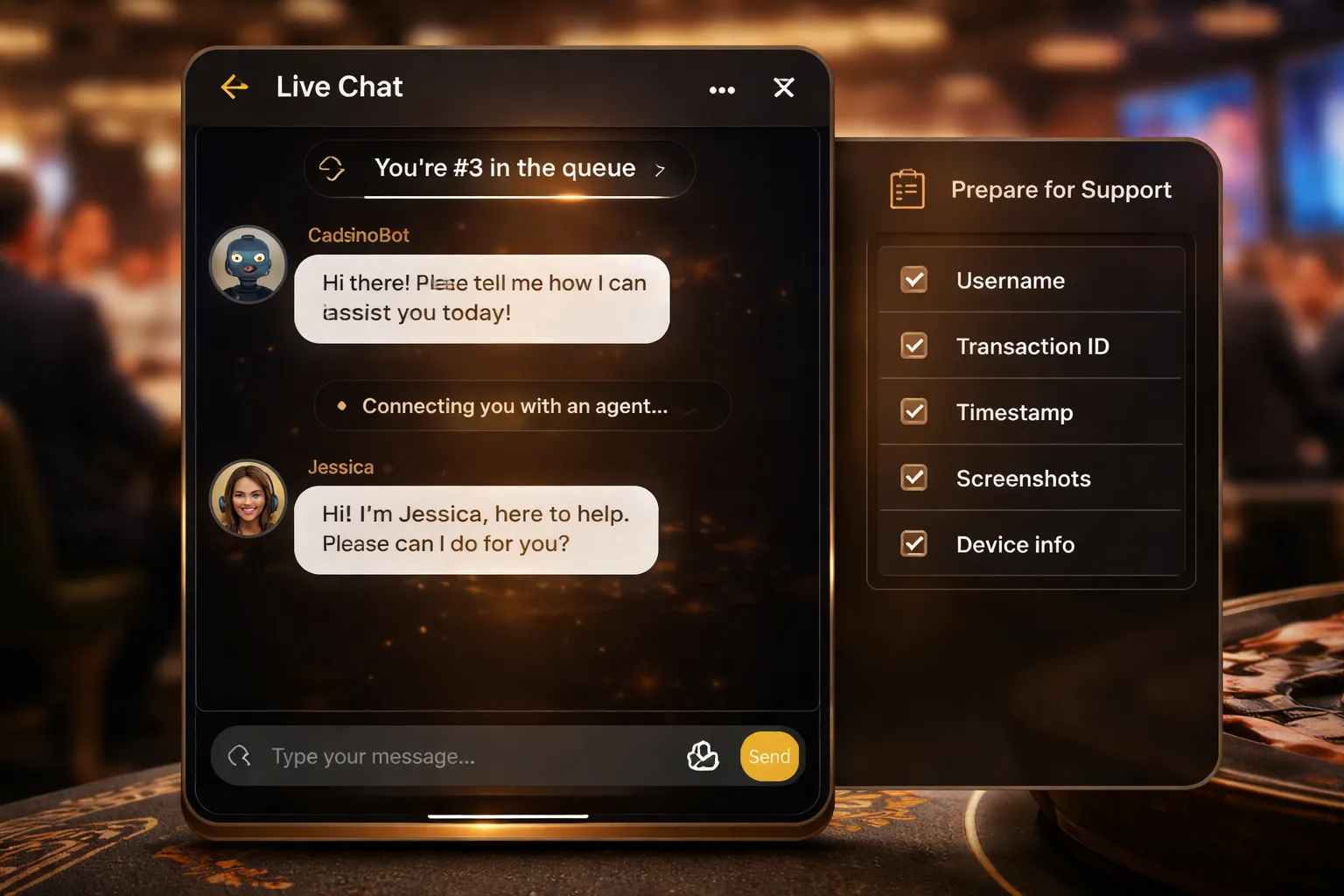
Typical availability and real wait times
Live chat works best when you need an answer now. Some casinos run it 24/7. Others limit it to business hours, or specific time zones.
Even with 24/7 labels, wait times change. Expect the longest queues during big sports events, weekend evenings, and major game launches. Regulated sites usually post clearer support hours and response targets. Unregulated sites may show “online” status but still stall.
Problems chat solves fastest
- Login access, password resets, locked accounts, 2FA issues.
- Game errors, frozen rounds, disconnects, missing spins, stuck bonus rounds.
- Payment status checks, deposit marked pending, basic withdrawal timeline questions.
- Bonus basics, wagering status, expiry time, opt-in steps, excluded games at a high level.
- Navigation help, where to find verification pages, limits, responsible gambling tools.
Use chat to get clear next steps and a case number. Do not rely on chat for final decisions on disputes.
Queues, bots, and handoff to an agent
Most chats start with a queue and triage questions. You may see a bot first. The bot usually handles simple tasks like FAQs, password links, and account navigation.
For anything involving money movement, identity checks, or a game investigation, you need a human agent. A good handoff includes a transcript transfer so you do not repeat your issue.
Watch for these patterns:
- Queue position and ETA. Useful when it stays stable. A jumping ETA can signal understaffing.
- Scripted replies. Fine for basic steps. A problem if the agent avoids specifics like timestamps, transaction IDs, or game round IDs.
- Forced escalation. Some agents can only log tickets, not solve the issue. Ask for the ticket number and the team name.
What to prepare before you start
You get faster results when you send proof early. Prepare it before you open the chat window.
- Account identifiers, username, registered email, and the last 4 digits of the payment method if relevant.
- Transaction details, amount, currency, time, payment provider, and any reference or order ID.
- Game details, game name, provider, bet size, and the exact time of the issue.
- Device info, phone or desktop, operating system, browser or app version, and your network type.
- Evidence, screenshots of errors, lobby messages, payment status, and bonus terms shown on your screen.
Ask the agent to confirm what they see on their side, and to note your evidence in the ticket. If the casino allows it, download or email yourself the chat transcript.
When live chat will not be enough
Some cases require email verification or a specialist team. Chat can start the process, but it rarely finishes it.
- KYC and account verification, ID checks, proof of address, source of funds, name changes.
- Withdrawal holds, enhanced due diligence, compliance reviews, payment provider investigations.
- Chargebacks and payment disputes, bank documentation, processor correspondence.
- Bonus disputes, confiscated winnings, rule interpretation, excluded games, multi-account flags.
- Technical investigations, missing bets, voided rounds, suspected glitches, game logs review.
In these cases, use chat to open the ticket, then move to email so you have a dated paper trail. If you need to judge how a casino handles disputes and rules, use a structured checklist like this guide on how to read an online casino review.
Email support: best for documentation and formal case tracking

Expected response times and how casinos prioritize tickets
Email runs on queues. You wait longer than live chat, but you get better case tracking.
- Simple account requests, password resets, bonus clarification. Often answered within 24 to 48 hours.
- Payments, failed deposits, pending withdrawals, chargeback risk. Often moved up the queue.
- Compliance checks, KYC, source of funds, AML flags. Slower, often 2 to 7 days, sometimes longer.
- Game disputes, missing rounds, suspected glitches. Slower, since support must request provider logs.
Casinos also prioritize by risk. Anything tied to payments, verification, or fraud flags tends to get faster attention than gameplay questions.
What a good support email should include to avoid back-and-forth
Write for someone who did not see your live chat.
- Subject line: include the issue and your account identifier. Example, “Withdrawal pending 5 days, username X, ticket 12345”.
- Account details: username, registered email, country, and the last 4 digits of the payment method if relevant.
- Timeline: date and time of key events, include your time zone.
- Amounts and references: deposit amount, withdrawal amount, transaction IDs, bank reference numbers, crypto TXID, game round ID if you have it.
- What you already tried: cache clear, app reinstall, alternative browser, payment method reattempt, so they do not repeat steps.
- What you want: refund, manual review, status update, escalation to payments team, or provider log review.
Keep it one issue per email thread. If you mix payout delays with bonus terms, you slow your own case.
Attachments and proof: acceptable file types, redaction tips, and security basics
Most casinos accept common formats. Keep files small and readable.
- Typical file types: JPG, PNG, PDF. Some accept CSV for transaction exports.
- What to attach: screenshots of error messages, cashier status, transaction confirmation, bank statement line items, blockchain explorer page, chat transcript.
- Redaction rules: hide full card numbers, CVV, full bank account numbers, and full document numbers. Leave your name, date, and the last 4 digits when needed.
- Security basics: send from your registered email, avoid public Wi-Fi, do not email passwords or 2FA codes, do not open unexpected attachments from “support”.
If they ask for sensitive KYC, use their secure upload portal when available, then confirm in email that you uploaded the files.
Ticket numbers, audit trails, and why email is useful for disputes
Email creates an audit trail. You get dates, timestamps, and a stable thread.
- Ticket number: ask for it if you do not have one. Put it in every reply.
- Case history: you can show what you reported, what they promised, and when.
- Escalation: you can forward the thread to a complaints address, licensing body, or ADR if needed.
This matters for bonus disputes, term interpretation, account restrictions, and payout delays. Email keeps the facts clean.
If the issue touches licensing, keep your notes aligned with the rules where you play. Use this guide on whether online casinos are legal in your state or country before you escalate.
How to recognize templated replies vs real investigation (and what to do next)
Templates save time. They also hide delays.
- Templated reply signs: generic wording, no reference to your amounts or dates, no ticket number, repeated FAQ links, requests for details you already sent.
- Investigation signs: they quote your transaction ID, request one missing item, confirm escalation to payments or risk, give a specific next update window, mention provider log review.
If you get a template, reply once with a tight recap and a checklist of what you already provided. Ask for the ticket number, the team handling it, and the next update time. If they miss that update, follow up in the same thread and request escalation.
Phone support: when speaking to an agent is the fastest route
Phone support, when speaking to an agent is the fastest route
Most online casinos do not run true 24/7 phone lines. Many push you to live chat first. Phone support shows up more often at regulated brands, large operators, and VIP focused programs.
Typical hours follow call center staffing. Expect business hours for one main region, and limited coverage on weekends. Some brands list a local number per country, others use one international line with set hours.
Who offers phone lines, and what hours usually look like
- Regulated, multi market casinos: More likely to publish a phone number and hours on the Contact page.
- VIP tiers: Often get a direct line or callback option, even when standard players do not.
- High volume offshore sites: More likely to offer email and chat only, or a number that routes to a general switchboard.
- Common hour patterns: 9:00 to 18:00 local time on weekdays, or split coverage like 8:00 to 22:00, fewer offer full 24/7 voice.
Identity checks on calls, and what you should never share
Expect quick verification before they discuss your account. You control the pace. If the agent pushes for sensitive details, end the call and switch to chat or email.
- What they may ask: full name, date of birth, username, registered email, last deposit amount, last 4 digits of a card, transaction ID, device type.
- What you should never share: your full password, one time codes, full card number, CVV, full bank login, recovery phrases, remote access to your device.
- Safer approach: ask the agent to read back non sensitive account markers, then you confirm. Request a ticket number before you give more data.
Best use cases for phone support
- Payment blocks and failed withdrawals: you can confirm the exact block reason, the team handling it, and the next update window while on the line.
- Chargeback concerns: you can ask for the correct dispute path, what evidence they need, and how a chargeback may affect your account access.
- Accessibility needs: phone can beat chat for speech to text users, hearing support relay services, or slower typing.
- Urgent account security: suspicious login, email change, or unexpected password resets. Ask for an immediate account lock and forced logout on all devices.
Call quality expectations, language options, recording, escalation
Expect a scripted intake. Good agents still solve problems fast if you keep it tight.
- Language: many lines offer 1 to 3 main languages. For others they switch to English or offer a callback with a different team.
- Recording: most calls record by default. Ask for confirmation, and ask them to add your key points to the ticket notes.
- Escalation: first line support logs the case, then routes it to payments, risk, or KYC. Ask for the team name, the current status, and the next update time. Ask what proof closes the case.
- What you should leave the call with: ticket number, exact issue label, missing requirement list, and a date and time for the next contact.
What to do if phone support is unavailable in your region
- Use live chat and request a callback: ask them to confirm your phone number on file, then set a time window.
- Switch to email for paper trail: send one message with your transaction ID, timeline, and the specific outcome you want, and request the ticket number.
- Check your access rules: some brands restrict voice support by country due to licensing and telecom rules. Use this guide to understand online casino legality in your region.
- Escalate through the right channel: ask support for the formal complaints process, then follow it. Save screenshots, emails, and chat transcripts.
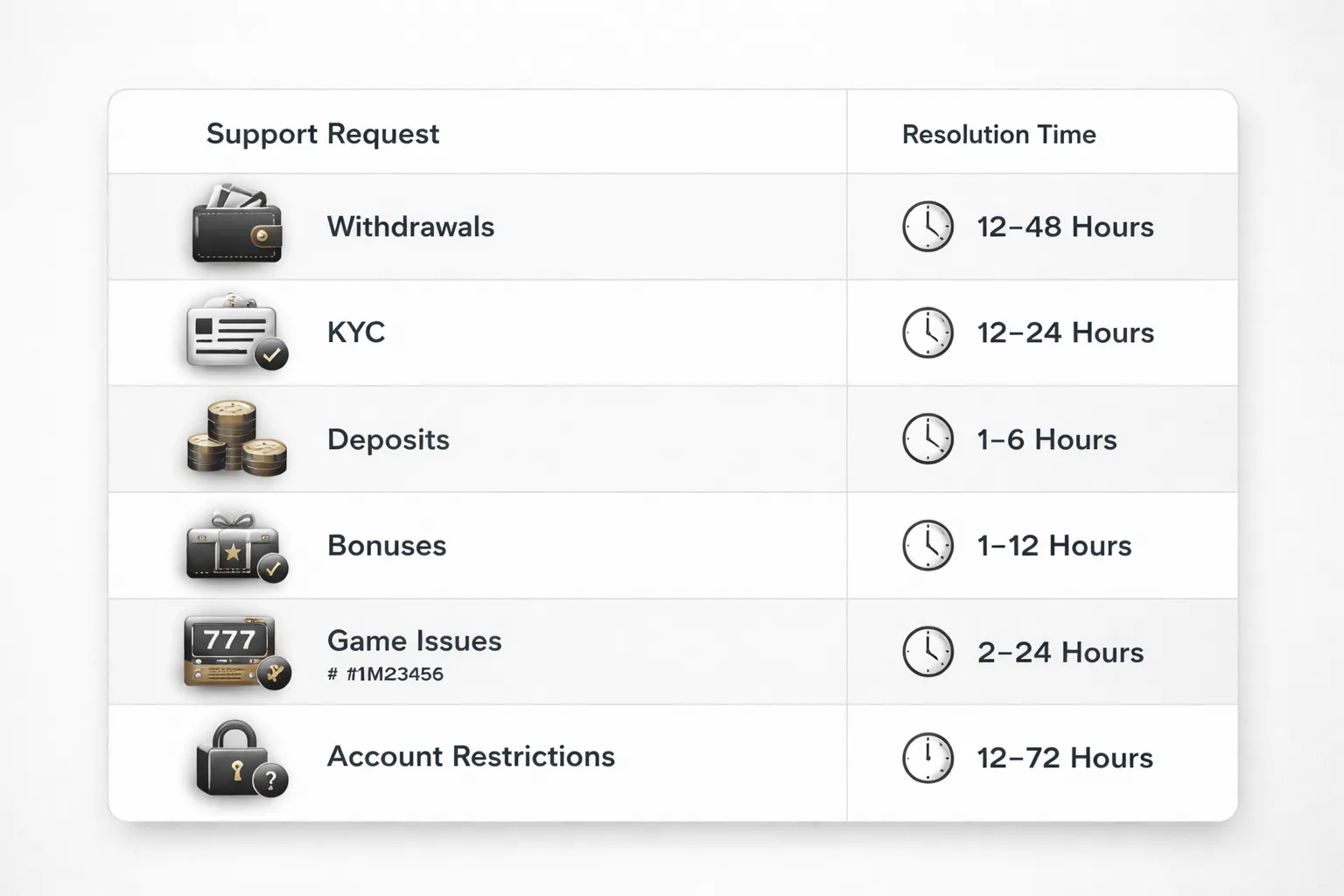
The most common support requests (and realistic resolution timelines)
Withdrawal pending: processing stages, internal reviews, and payment provider delays
Most “pending” withdrawals sit in one of three places.
- Casino processing queue. The site checks balance, bonus status, and basic account flags. This stage often clears within 0 to 24 hours.
- Internal review. Risk, fraud, or compliance teams review the withdrawal. Triggers include large wins, new payment methods, multiple accounts, or unusual play. Expect 24 to 72 hours. Some cases take 5 to 10 days if they request documents or source-of-funds.
- Payment provider processing. After approval, the casino sends the payout. Your bank, card issuer, or e-wallet controls the final speed. E-wallets often land in minutes to 24 hours. Bank transfers often take 2 to 5 business days. Cards often take 1 to 7 business days.
Ask support for the exact status, the approval timestamp, the payout method, and the payment reference number. Those details tell you where the delay sits.
KYC and verification: why it’s required and how long approval usually takes
Casinos must verify identity to meet licensing, anti-money laundering rules, and responsible gambling requirements. You pay for delays when your documents do not match your account details.
- Typical approval time. 1 to 48 hours after you submit clear documents.
- Realistic range. 2 to 5 days when teams run manual checks or request a second proof of address.
- Long cases. 5 to 15 days when they run enhanced due diligence, check source of funds, or resolve data mismatches.
Send what they ask for in one reply. Use full-color images, all four corners visible, no blur, no edits. Make sure your name, address, and date match your casino profile.
Deposit issues: missing funds, duplicate charges, and “stuck” transactions
Deposit problems usually fall into three buckets.
- Charged, but balance did not update. The payment went through, but the casino wallet did not credit. Many cases fix within 15 to 60 minutes. If it persists, expect 24 to 72 hours after they reconcile payment logs.
- Duplicate charge. You see two charges for one attempt. Support may need the payment provider to confirm the second charge. Expect 3 to 10 business days for a reversal, depending on your bank.
- Stuck or pending deposit. The bank shows pending and the casino shows nothing. Pending holds often drop within 1 to 7 business days if the transaction fails. If it completes, the casino should credit within hours, but some cases need manual reconciliation.
Give support the amount, time, payment method, last four digits where relevant, transaction ID, and screenshots from your bank or e-wallet. Ask them to confirm whether they see an authorization, a capture, or a failed transaction.
Bonus and wagering disputes: reading terms, contribution rates, and max cashout rules
Most bonus disputes come from terms you can verify fast.
- Wagering requirement and progress. Support can usually confirm within minutes on live chat. If the tracker looks wrong, expect 24 to 72 hours for a back-office check.
- Game contribution rates. Slots often count 100%. Table games often count 0 to 20%. If you wager on low-contribution games, your progress moves slowly. Resolution is often immediate once support points to the rule.
- Max bet rules. Many bonuses cap your stake per spin or hand. Breaches often trigger bonus removal or withdrawal limits. Reviews often take 24 to 72 hours because staff must check bet logs.
- Max cashout rules. Some bonuses cap winnings. Support can quote the cap quickly. Adjustments often post within 24 hours after approval.
Ask for the exact term, the rule section link, and the bet log window they used. Save the promotion page and your bonus ID before you start wagering.
Game problems: disconnects, crashes, and how game round IDs are investigated
Game issues require a paper trail. Support cannot guess outcomes.
- Disconnect during a round. Most games finish the round on the server. You either get a result or your stake returns. Basic checks often take 15 minutes to 24 hours.
- Crash or freeze. Support checks provider logs. Expect 24 to 72 hours for a provider response. Some cases take 5 to 10 days if they queue a formal dispute.
- Wrong result claim. They pull the round record from the game provider. Expect 2 to 7 days for a final answer.
Send your username, game name, provider, time of incident with time zone, stake size, and the game round ID from your history. If you play live tables, include table ID and hand number. If you want to understand why support escalations differ by format, read live dealer vs RNG casino games.
Account restrictions: self-exclusion, cool-off, source-of-funds checks, and risk flags
Restrictions often come from compliance rules. Support rarely overrides them on chat.
- Self-exclusion and cool-off. These blocks usually apply immediately. Most regulators require casinos to keep them in place until the period ends. Expect instant confirmation, but no early removal.
- Source-of-funds and source-of-wealth checks. Triggers include large deposits, large withdrawals, or payment pattern changes. Expect 3 to 10 days after you submit documents. Complex cases can take 10 to 30 days.
- Risk flags and security locks. Triggers include failed logins, VPN use, device changes, or linked accounts. Basic unlocks can take minutes to 48 hours. Linked-account investigations often take 3 to 10 days.
Ask support what rule triggered the restriction, what documents they need, and whether your balance and withdrawal remain accessible during review. Get the case ID and the team name handling it.
| Request type | Realistic timeline | What you should send |
|---|---|---|
| Withdrawal pending | Same day to 7 business days, longer if compliance review | Payout method, amount, approval time, payment reference |
| KYC verification | 1 to 48 hours typical, 2 to 15 days if enhanced checks | ID, proof of address, matching profile details |
| Deposit missing or stuck | 15 minutes to 72 hours, reversals 3 to 10 business days | Transaction ID, timestamps, screenshots, last four digits |
| Bonus dispute | Minutes to 72 hours, 2 to 7 days for bet log reviews | Bonus ID, promo link, terms screenshot, bet window |
| Game issue | 24 to 72 hours typical, 5 to 10 days with provider dispute | Game round ID, provider, time zone, stake, screenshots |
| Account restriction | Immediate for RG blocks, 3 to 30 days for compliance | Requested documents, device info, case ID |
How to contact support efficiently (step-by-step playbook)
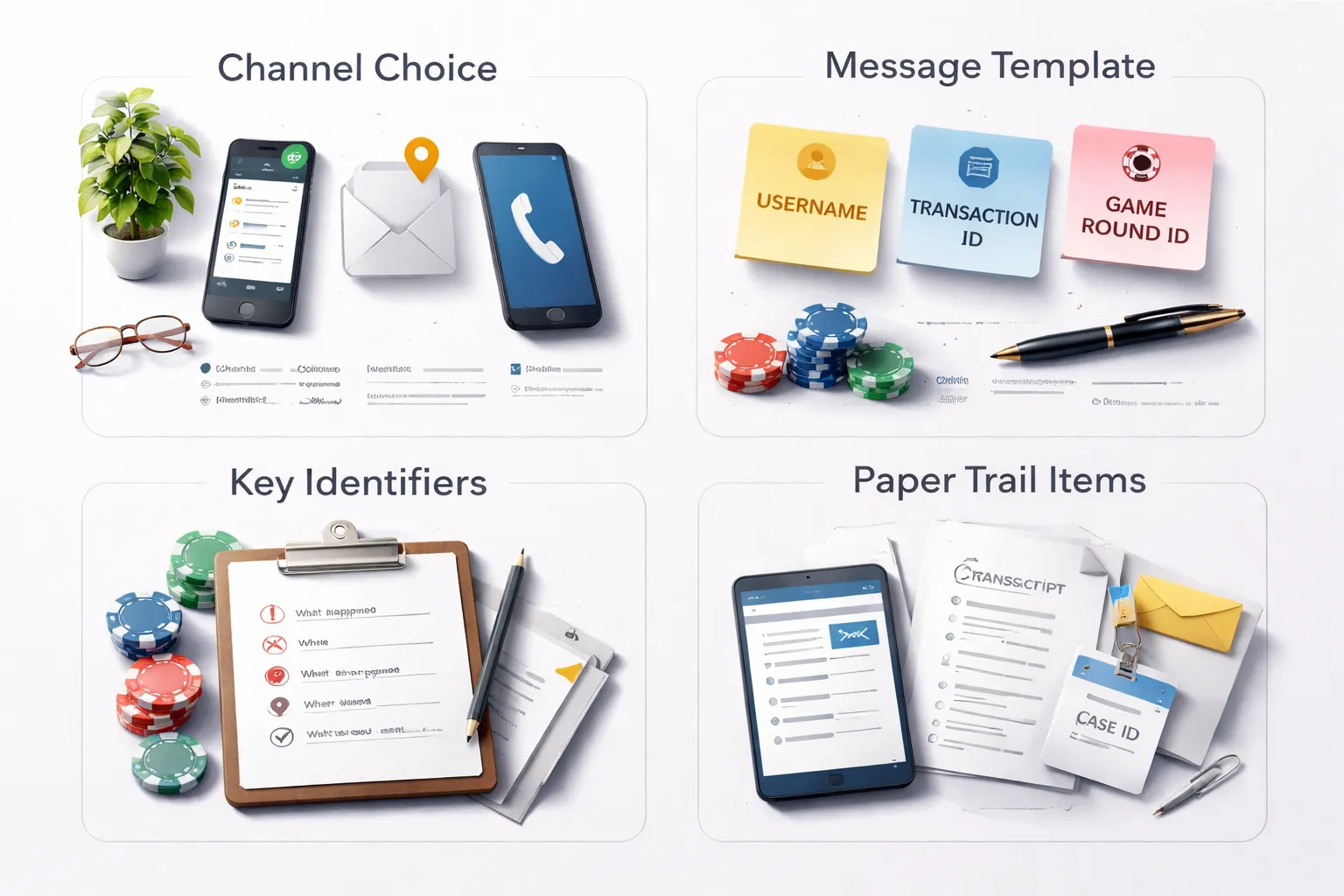
Pick the right channel fast
Match your channel to urgency and the proof you need to attach.
If your issue needs logs or a provider review, start with email. If your issue blocks play right now, start with live chat, then move to email once you have a case ID.
Use a clear issue template
Send one tight message. Do not write a story. Use this format.
- What happened: One sentence. Include the error text if you saw one.
- When: Date and exact time range. Add your time zone.
- Where: Game name, table, provider, sportsbook market, or cashier page used.
- What you need: The fix you want, refund, unlock, bet review, bonus credit, or status update.
- What you already tried: App restart, cache clear, different device, different payment method.
Keep it scannable. Agents triage faster when they can copy your facts into a ticket.
Send identifiers that cut resolution time
Always include identifiers in your first message. Missing IDs force back and forth.
- Account: username, registered email, country, and platform, web or app.
- Device: phone or desktop model, OS version, browser or app version, and network type.
- Payments: deposit or withdrawal amount, currency, method, and transaction ID. Add the processor reference if you have it.
- Games: game name, provider, stake, and the round ID or session ID. Add the exact timestamp and time zone.
- Sports bets: bet ID, selection, odds, settlement result shown, and any terms screenshot tied to the promo.
- Compliance: your case ID, document types requested, and the upload date.
If you do not know where to find these fields, check the casino help center and cashier history. A solid online casino basics guide can help you understand where logs and IDs usually sit in the account area.
Keep a paper trail from the first contact
Assume you will need to prove what you were told.
- Save screenshots: error messages, cashier status pages, bonus terms, and bet slips. Capture the full screen with the time and URL if possible.
- Export chat transcripts: use the email transcript option. If the site does not offer it, take screenshots before you close chat.
- Store emails: keep the full thread. Do not start new threads for the same issue.
- Track case IDs: write them in your subject line and your first sentence.
One folder per issue. One timeline. This prevents repeat verification and keeps agents aligned.
Follow-up etiquette that works
Follow up on a schedule. Do not spam. Spamming resets queues on some systems.
- Live chat: wait 10 to 20 minutes if an agent says they are checking. If the chat ends, reopen once and reference the case ID.
- Email or ticket: follow up after 24 hours for access issues, 48 to 72 hours for game issues, and 72 hours to 7 days for withdrawals and compliance checks, unless the casino gave a shorter window.
- Each follow-up: keep the same subject line. Add only new facts, new screenshots, or updated status from your bank or wallet.
- Escalation: ask for a supervisor only after you hit the stated timeframe or you have new evidence that changes the case.
Use one sentence to anchor the request. “Please confirm the current status and next action for case ID X. Last update received on DATE at TIME TZ.”
Escalations, complaints, and dispute resolution (what happens if support fails)
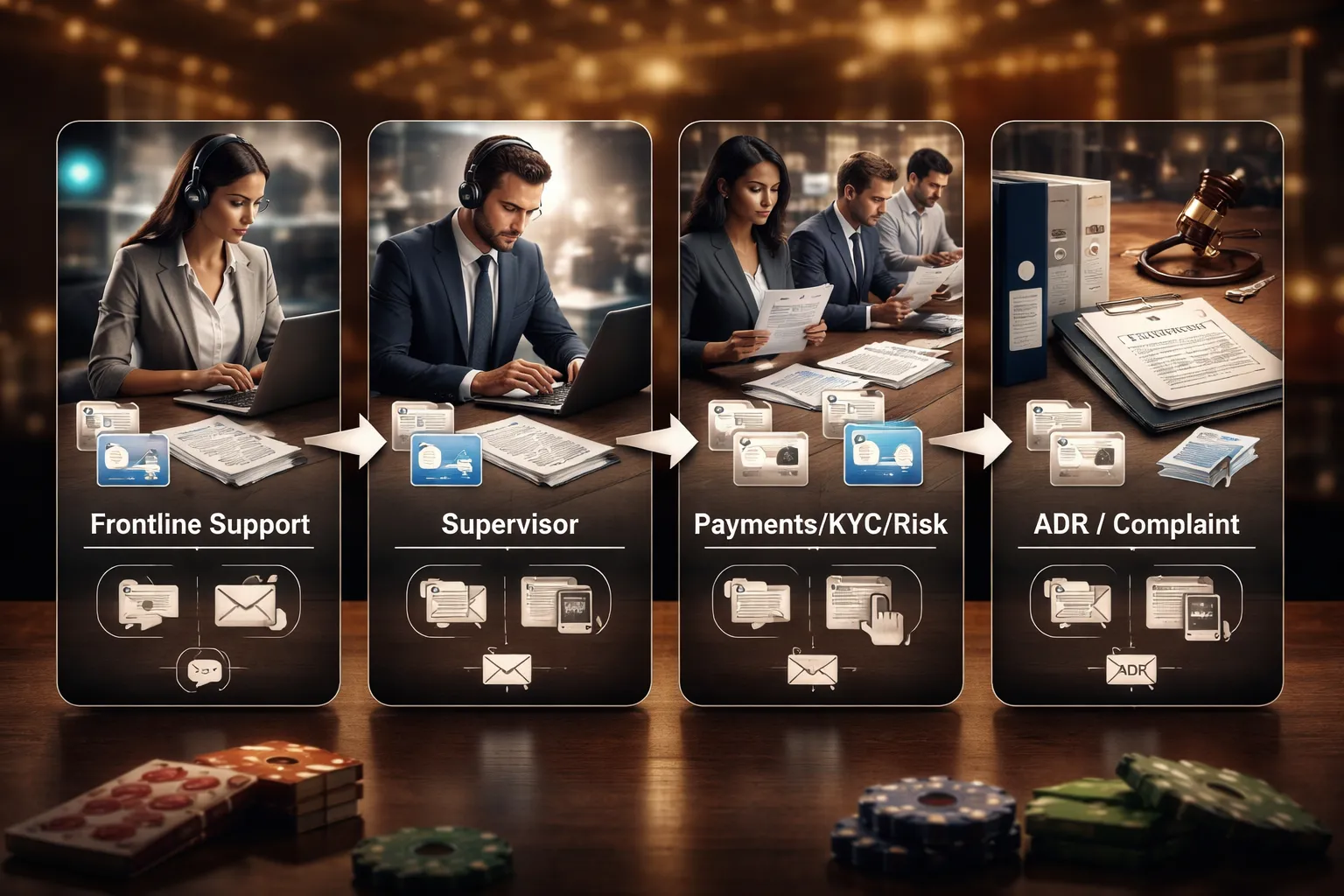
Internal escalation, who gets involved
When frontline support cannot fix your case, you need the right queue. Ask to route the ticket to the correct team, then ask for a supervisor only after the stated timeframe passes or you add new evidence.
- Supervisor or shift lead. Handles poor service, missing updates, and policy exceptions. They can force a callback, reopen a closed ticket, or set a firm deadline.
- Payments team. Checks deposit captures, failed withdrawals, pending bank transfers, and provider errors. They can trace transactions, request a processor reference, and confirm settlement status.
- KYC team. Reviews ID checks, proof of address, source of funds, and name mismatches. They decide whether your documents meet the rules and what else you must upload.
- Risk or fraud team. Reviews account flags, chargeback history, linked accounts, bonus abuse triggers, and device or IP patterns. They can freeze funds during review and may refuse to discuss details.
Use one sentence to anchor the request. Please confirm the current status and next action for case ID X. Last update received on DATE at TIME TZ.
Formal complaints, what to send and how long it takes
If escalation stalls, file a formal complaint. Use the casino’s complaints channel, not live chat. Put “Formal complaint” in the subject line. Ask for a written final response and a case reference.
- What to include. Your username, registered email, case IDs, a timeline with dates and times, the amount in dispute, and the exact remedy you want.
- What to attach. Screenshots of balances, game history, bonus terms as shown to you, KYC upload confirmations, and payment provider receipts.
- Timeframes you should expect. Many operators quote 24 to 72 hours for initial handling, then 7 to 14 days for a full response. Some extend to 28 days for complex payment or risk reviews. If they miss their own deadline, document it and request the final response.
Before you escalate externally, collect licensing details and complaint instructions from the site footer and terms, and validate them against the operator profile you see in a quality review. For more on reading those details, see what an online casino is and how it works.
Third-party resolution, ADR and regulators
If the casino gives you a dead end, move to third parties. Start only after you have a case ID and a final response, or after the stated complaint timeframe expires.
- ADR or mediator. Some licenses require an approved dispute body. ADR usually asks for your timeline, evidence, and the operator’s final position. ADR can take weeks, sometimes longer.
- Licensing authority. Regulators may not decide every player dispute, but they can pressure compliance and check if the operator follows its own terms and KYC rules. Provide license number, operator name, and your full paper trail.
- Ombuds options. In some jurisdictions, an ombuds can review fairness and process. Availability depends on where you live and where the casino holds its license.
Do not send partial claims to multiple bodies at once. Pick the correct path for the license. Keep your story consistent across every submission.
Chargebacks and bank disputes, when they fit and what they can trigger
A chargeback can solve a deposit dispute, but it can also end your relationship with the casino. Use it for clear payment errors, unauthorized charges, or failure to deliver the funded service.
- When it makes sense. Duplicate charges, card charged but casino balance not credited, provider confirms reversal but casino still shows captured, or unauthorized transactions.
- When it often fails. You deposited, played, and lost. Banks usually treat that as authorized use, not non-delivery.
- Common consequences. Account suspension, withdrawal holds, bonus removal, and permanent closure. The casino may lock funds until the chargeback closes.
- Timing risk. Card networks and banks have strict windows. Act fast, but gather evidence first. Keep all bank messages and reference numbers.
If your dispute concerns a withdrawal, a chargeback may not apply at all. Banks cannot reverse a withdrawal you never received unless an actual card or transfer transaction exists to contest.
Evidence that wins bonus and payout disputes
Support teams decide fast when you give clean proof. Your goal is to show terms, actions, and timestamps.
- Bonus terms at the time you accepted. Screenshot the offer page, wagering, max bet, game restrictions, max cashout, and expiry.
- Game history and bet logs. Export if possible. Include round IDs, stake size, and time. This matters for max bet and restricted games.
- Account ledger. Deposits, bonus credits, wagering progress, withdrawals, and reversals. One timeline, one currency.
- KYC proof. Upload receipts, document images, and the exact status shown in the cashier. Include any email that says “verified”.
- Payment proof. Bank statement lines, card authorization codes, e-wallet transaction IDs, and processor references from the casino.
- Device and access proof if relevant. Login alerts, IP mismatch notices, or proof you travel. Keep it factual. Do not speculate.
- Communication log. Chat transcripts, ticket numbers, and emails. Keep the subject line consistent. Add only new facts.
If the casino claims you breached terms, ask for the exact clause number and the specific event they say triggered it, including the timestamp and game or transaction ID.
Responsible gambling and safety support you should see
Responsible gambling tools you should be able to set fast
Support should guide you to controls you can set in minutes. You should not need a manager approval for basic limits. You should see these options in your account and via support.
- Self-exclusion: Blocks play and deposits for a fixed period or indefinitely. Support should confirm the start time, duration, and what access gets blocked.
- Time-out: Short break, often 24 hours to 30 days. Support should apply it immediately and confirm when your account reopens.
- Deposit limits: Daily, weekly, monthly caps. Support should explain when a limit starts, when it resets, and whether decreases apply instantly.
- Loss limits: Caps net losses for a set period. Support should define how they calculate losses, and whether bonuses count.
- Wager or session limits: Caps stake amount or session length. Support should show where you can set it, and how to view your current setting.
What good support does when you show signs of harm
Support should treat harm signals as a safety issue, not a retention issue. They should keep the tone calm and direct.
- They pause sales talk. No bonus offers, no VIP pushes, no win-back messaging.
- They offer self-exclusion and time-out first, then help you set limits.
- They explain how to stop marketing. You should be able to opt out of email, SMS, and push messages.
- They give clear next steps. Links, phone numbers, and what the casino can do on your request.
- They log the interaction. You should get a ticket number or transcript if you ask.
Independent help links and crisis resources you should see
Support should point you to independent help, not just internal tools. The site should list resources in the responsible gambling page and support replies.
- National and regional gambling support services for your location.
- Problem gambling screening and self-assessment tools.
- Crisis support options if you mention self-harm, panic, or immediate risk, including local emergency numbers and crisis hotlines for your country.
If the casino operates across regions, support should ask your country so they can provide correct resources. They should not collect extra personal details for that step.
Underage and identity protection, what support may ask for
Support should block underage access and protect your account from takeover. Expect direct questions and standard documents.
- Age and identity checks: Photo ID, proof of address, and a selfie or liveness check in some markets.
- Payment method checks: Proof you own the card or wallet used. They may ask for a redacted card photo or a screenshot that shows your name and last digits.
- Source of funds checks: Payslips, bank statements, or tax documents if required by their regulator, especially after large deposits or withdrawals.
- Underage concerns: They should suspend play during review. They should explain the process, timelines, and what happens to funds under local rules.
Support should tell you how to redact sensitive fields. They should never ask for your full password, full card PIN, or full security code.
Privacy and secure verification, what to expect
Support should handle your data with tight access and clear rules. You should see secure upload and limited sharing.
- Secure channels: Encrypted upload portal for documents. Live chat and email should not become a document dump.
- Data minimization: They ask only for what they need for the specific check. They should not request extra documents without a reason.
- Retention and deletion basics: Under GDPR or CCPA style rules, you should be able to request a copy of your data and ask for deletion where law allows. Support should route you to their privacy team and confirm the request ID.
- Access control: They verify you before they discuss balances, limits, or account actions. Expect date of birth, partial address, or security questions.
- Audit trail: They keep a record of safety actions, self-exclusion requests, and verification steps. You should be able to reference it by ticket number.
For licensing standards and what your operator must follow in your region, check where online casinos are legal.
Red flags vs green flags: how to judge support quality quickly
Green flags: transparent timelines, clear explanations, and written confirmations
- Clear timeframes. They tell you when you will get an update, and they stick to it. Example, “withdrawal review takes 24 to 48 hours.”
- Specific next steps. They list what you must do, what they will do, and what happens after. No guessing.
- Policy-based answers. They cite the exact rule, limit, or document requirement. They do not hide behind “company policy.”
- Written confirmation. They send a transcript, email summary, or ticket number for anything that changes your account, limits, or withdrawal status.
- Consistent identity checks. They verify you before balance, withdrawal, bonus, or responsible gambling actions. They explain why.
- Escalation path. They tell you who owns the case, what team reviews it, and how to follow up.
Red flags: vague answers, pressure tactics, or requests for passwords or OTP codes
- Vague replies. “Soon,” “we are checking,” “be patient,” with no timeframe and no owner.
- Looping scripts. They repeat the same copy, ignore your question, or avoid naming the rule that applies.
- Pressure to deposit. They push you to add funds or keep playing while a withdrawal, verification, or complaint stays unresolved.
- Requests for secrets. Any request for your password, one-time password codes, or full card PIN is a stop signal. Legit support does not need them.
- Off-platform contact. They ask you to move to WhatsApp, Telegram, or personal email to “speed things up.”
- No written trail. They refuse to provide a ticket number, chat transcript, or email recap.
- Blame shifting. They blame the payment provider or “the system” but provide no reference number, no timestamp, and no action you can take.
Consistency checks: compare terms, cashier info, and agent statements
Support quality shows up in consistency. Cross-check what you get in chat against what the site publishes.
- Match the withdrawal rules. Compare the agent’s claims to the withdrawal page, minimums, fees, and processing times shown in the cashier.
- Match bonus terms. If the agent mentions wagering, max cashout, or game contribution, confirm it matches the bonus terms in your account.
- Match verification rules. Check required documents and review timelines against the KYC policy.
- Check for contradictions across channels. Ask the same question by chat and email. Keep the answers. If they conflict, you have evidence.
- Track dates and numbers. Save transaction IDs, timestamps, and ticket numbers. Good teams use them without prompting.
If you want a faster way to validate claims, use the same approach you use when reading an online casino review. Look for concrete terms and documented limits, not vague reassurance.
Language and accessibility for international players
- Language coverage. They offer support in the language they market to you. If the site targets your country, support should handle your language for account and payment issues.
- Clear writing. You get short answers with labeled steps. You do not get unclear translations that change key terms like “pending,” “reversed,” or “void.”
- Timezone clarity. They state operating hours with a timezone. “24/7” should mean actual staffing, not a bot and an email form.
- Accessible alternatives. If live chat fails, they provide email and a working phone option where offered. They do not trap you in one channel.
Where to verify legitimacy: licensing info, help center depth, and policy clarity
- License details are easy to find. You can locate the regulator name, license number, and operator entity in the footer or About section.
- Policies are complete. You can find Terms, Bonus Terms, KYC and AML policy, Privacy policy, and Responsible Gambling tools.
- Help center has depth. You see real articles on deposits, withdrawals, verification, limits, and disputes. Thin FAQ pages often signal weak operations.
- Complaint route exists. They explain how to escalate, including timelines and what evidence you must provide.
- Brand and entity match. The company name on policies matches the name tied to payments and the licensing record.
Emerging tech in casino support (and what it means for players)
AI chatbots, faster triage and real risks
Many casinos now start support with an AI chatbot. You type your issue, the bot pulls account data, then it routes you to the right team.
This speeds up simple tasks. Password resets. Bonus terms. Deposit checks. Basic status updates.
The risk is wrong answers. Bots can misread bonus rules, withdrawal conditions, or verification steps. That can cost you time, or trigger mistakes you cannot undo.
- Use bots for: navigation, status checks, link to policy pages, ticket creation.
- Escalate fast for: withdrawals, KYC, chargebacks, bonus forfeits, account restrictions, self-exclusion.
- Protect yourself: ask for the policy link, take screenshots of key replies, then confirm with a human agent before you act.
Automated KYC, faster checks and more false flags
Casinos increasingly use automated KYC. You upload ID, take a selfie, and the system checks liveness, document validity, and data matches.
You often get faster approval when your documents are clean and your details match your payment method. You also see faster re-checks when you change address or card.
You also see more auto rejections. Glare on an ID photo. A nickname on your profile. A different billing address. A VPN login. A shared device. These can trigger a manual review and slow withdrawals.
- What speeds it up: exact legal name, current address proof, clear photos, matching card or e-wallet owner name.
- What slows it down: cropped images, expired ID, mismatched country, repeated uploads, inconsistent device or IP patterns.
- What to ask support: the specific missing item, the accepted formats, and the review timeline in hours or days.
In-app messaging, better tracking than email
More sites push support inside the app or your account dashboard. This keeps your case tied to your player ID and payment history.
It also creates a cleaner audit trail. You can see timestamps, agent names, attachments, and ticket numbers. That helps if you escalate a dispute later.
- Check for: file upload support, readable chat history, clear ticket status, and one thread per issue.
- Do: keep your messages short, include transaction IDs, and attach proof once.
WhatsApp and Telegram support, convenience vs security
Some casinos offer WhatsApp or Telegram. It feels fast, but it adds risk. You move outside the casino account environment and into third-party apps.
Impersonation also becomes easier. Scammers copy brand names and logos, then ask for documents or one-time codes.
- Safer use: start from the casino website or in-app link, verify the official number or handle, and keep the first message simple.
- Never share: passwords, 2FA codes, full card numbers, or seed phrases.
- Best practice: use WhatsApp or Telegram for updates, then move sensitive steps back to in-app messaging or email tied to your account.
Proactive notifications, fewer follow-ups
Support now blends with alerts. You get push, SMS, or email updates for deposits, withdrawals, verification, and limits.
Done well, this cuts down on repeated chats. You see where your withdrawal sits, when it moved to review, and when it paid out.
Serious operators also send incident alerts. Outages. payment delays. scheduled maintenance. Security events that force a password reset.
- What to look for: withdrawal status steps, estimated review windows, and clear next actions if something stalls.
- Red flag: vague alerts with no ticket link, no timestamps, and no way to reply.
Opt out of marketing, keep service messages
You can usually reduce promo noise without losing critical support and account notices.
- In account settings: turn off marketing email, SMS promos, and push offers.
- Keep enabled: security alerts, KYC requests, withdrawal updates, and responsible gambling messages.
- In email footers: use unsubscribe for marketing, then whitelist the casino domain for service notices.
- If support uses WhatsApp or Telegram: mute the chat, do not block it unless you have another confirmed support route.
If you want a deeper safety check beyond support tools, use the same discipline you apply when you spot biased ratings in casino reviews.
FAQ
What support channels should a legit online casino offer?
Expect live chat and email as baseline. Phone helps with urgent account access and payment blocks. Look for clear hours, a help center, and a visible license name. If the casino hides contact options or pushes only social apps, treat it as a risk.
Is live chat really 24/7?
Some casinos run 24/7 chat, others run limited hours with a bot after-hours. Test it before you deposit. Ask a simple account question and log the response time. If you wait over 10 minutes at peak time, use email for anything complex.
What should you send to support for faster help?
Send your username, the exact error text, device and browser, and a timestamp. For payments, add the method, amount, and transaction ID. Attach one screenshot. Keep it short. One message beats five follow-ups.
How long do email replies take?
Many casinos answer within 24 to 48 hours for standard issues. KYC and payment checks can take longer. If you have no reply after 72 hours, escalate via live chat and ask for a ticket number. Keep all email threads.
When should you use phone support?
Use phone support for locked accounts, suspected fraud, urgent withdrawal blocks, or chargeback threats. Ask for the agent name and case ID. Call from the same name holder as the account. Avoid sharing full card numbers.
What can customer support fix, and what can it not fix?
Support can reset access, explain rules, track payments, and update limits. Support cannot change game outcomes, reverse finished bets, or bypass KYC and AML checks. If an agent promises guaranteed wins or “manual payouts,” stop and document it.
What is a ticket number, and why does it matter?
A ticket number links your case to internal logs. It speeds up escalation and reduces repeat explanations. Ask for it in live chat and email. Save it with dates, names, and screenshots. Use it if you file a complaint with the regulator.
How do you spot fake support accounts on WhatsApp or Telegram?
Real support uses contact details listed on the casino site. Fake accounts push “verification fees” or ask for seed phrases and remote access. Never share one-time codes. If you must use messaging apps, confirm the contact via live chat first.
Can support help with responsible gambling?
Yes. Support should set deposit limits, loss limits, time-outs, and self-exclusion on request. It should also explain how reversals work and how long exclusions last. If support resists limit requests, treat it as a major safety warning.
What should you do if you think support is stalling a withdrawal?
Ask for the exact reason, the missing document list, and the review deadline. Request the policy link for KYC and withdrawals. Keep all proof. If delays pass the stated timeframe, escalate to the casino complaints channel and the license authority.
How do you verify support answers that sound biased?
Compare the agent’s claim with the casino terms, payment pages, and your transaction logs. If the answer conflicts, ask for a written confirmation by email. Use the same checklist you use to spot biased ratings in casino reviews.
Conclusion
Good support solves problems fast and leaves a paper trail. Live chat gives speed. Email gives proof. Phone helps when you need to explain a complex case.
Your final move is simple. Start every support contact like a dispute. Save chat transcripts. Screenshot error messages. Record dates, times, amounts, and your account email. Ask for a ticket number. If the agent gives a policy answer, request the exact terms section in writing.
When support stalls, switch channels. Move from chat to email. If the issue affects withdrawals or account access, escalate to the casino complaints team and the license authority. Keep your notes clean and consistent. You will resolve cases faster and avoid repeated back and forth.
If you need a quick safety checklist before you play, read what makes an online casino safe.
-
Are Online Casinos Legal? Complete Guide by State & Country
8 months ago -
What Is an Online Casino? How They Work, Games, Bonuses & Safety
8 months ago -
Best Low Deposit Online Casinos: Play for Less with Small Minimum Deposits
8 months ago -
Live Dealer vs RNG Casino Games: What’s the Difference?
8 months ago -
How Live Dealer Casinos Work (and What to Expect)
8 months ago
-
- Expected response times and how casinos prioritize tickets
- What a good support email should include to avoid back-and-forth
- Attachments and proof: acceptable file types, redaction tips, and security basics
- Ticket numbers, audit trails, and why email is useful for disputes
- How to recognize templated replies vs real investigation (and what to do next)
-
- Phone support, when speaking to an agent is the fastest route
- Who offers phone lines, and what hours usually look like
- Identity checks on calls, and what you should never share
- Best use cases for phone support
- Call quality expectations, language options, recording, escalation
- What to do if phone support is unavailable in your region
-
- Withdrawal pending: processing stages, internal reviews, and payment provider delays
- KYC and verification: why it’s required and how long approval usually takes
- Deposit issues: missing funds, duplicate charges, and “stuck” transactions
- Bonus and wagering disputes: reading terms, contribution rates, and max cashout rules
- Game problems: disconnects, crashes, and how game round IDs are investigated
- Account restrictions: self-exclusion, cool-off, source-of-funds checks, and risk flags
-
- Green flags: transparent timelines, clear explanations, and written confirmations
- Red flags: vague answers, pressure tactics, or requests for passwords or OTP codes
- Consistency checks: compare terms, cashier info, and agent statements
- Language and accessibility for international players
- Where to verify legitimacy: licensing info, help center depth, and policy clarity
-
- What support channels should a legit online casino offer?
- Is live chat really 24/7?
- What should you send to support for faster help?
- How long do email replies take?
- When should you use phone support?
- What can customer support fix, and what can it not fix?
- What is a ticket number, and why does it matter?
- How do you spot fake support accounts on WhatsApp or Telegram?
- Can support help with responsible gambling?
- What should you do if you think support is stalling a withdrawal?
- How do you verify support answers that sound biased?
-
-
- Expected response times and how casinos prioritize tickets
- What a good support email should include to avoid back-and-forth
- Attachments and proof: acceptable file types, redaction tips, and security basics
- Ticket numbers, audit trails, and why email is useful for disputes
- How to recognize templated replies vs real investigation (and what to do next)
-
- Phone support, when speaking to an agent is the fastest route
- Who offers phone lines, and what hours usually look like
- Identity checks on calls, and what you should never share
- Best use cases for phone support
- Call quality expectations, language options, recording, escalation
- What to do if phone support is unavailable in your region
-
- Withdrawal pending: processing stages, internal reviews, and payment provider delays
- KYC and verification: why it’s required and how long approval usually takes
- Deposit issues: missing funds, duplicate charges, and “stuck” transactions
- Bonus and wagering disputes: reading terms, contribution rates, and max cashout rules
- Game problems: disconnects, crashes, and how game round IDs are investigated
- Account restrictions: self-exclusion, cool-off, source-of-funds checks, and risk flags
-
- Green flags: transparent timelines, clear explanations, and written confirmations
- Red flags: vague answers, pressure tactics, or requests for passwords or OTP codes
- Consistency checks: compare terms, cashier info, and agent statements
- Language and accessibility for international players
- Where to verify legitimacy: licensing info, help center depth, and policy clarity
-
- What support channels should a legit online casino offer?
- Is live chat really 24/7?
- What should you send to support for faster help?
- How long do email replies take?
- When should you use phone support?
- What can customer support fix, and what can it not fix?
- What is a ticket number, and why does it matter?
- How do you spot fake support accounts on WhatsApp or Telegram?
- Can support help with responsible gambling?
- What should you do if you think support is stalling a withdrawal?
- How do you verify support answers that sound biased?
-
-
Reload Bonus Explained: What It Is and When It’s Worth Claiming
6 months ago -
Online Casino Licensing Explained: Authorities, Licenses & How to Check One
8 months ago -
Best Live Dealer Casinos: Where to Play Live Blackjack, Roulette & More
8 months ago -
Best Online Casinos for High Rollers: VIP Perks, High Limits & Exclusive Bonuses
8 months ago -
Fast Payout Online Casinos: Best Sites for Quick Withdrawals
8 months ago
-
Online Casino Customer Support: What to Look For (Live Chat, Email, Response Times)
8 months ago -
Sign Up for an Online Casino: Create an Account in Minutes
8 months ago -
Online Casino Payment Safety Tips: How to Deposit and Withdraw Securely
8 months ago -
What to Do If an Online Casino Won’t Pay Out: Step-by-Step Actions
8 months ago -
How to File a Complaint Against an Online Casino (Plus ADR Explained)
8 months ago