How Live Dealer Casinos Work (and What to Expect)

Live dealer casinos stream real tables from a studio or casino floor to your screen. You watch a human dealer run the game, you place bets in a digital interface, and the platform settles results in real time. This guide explains how the setup works, what tech sits behind the video feed, and how your bets move from the screen to the table.
You will learn what happens from the moment you join a table, how dealing and shuffling work, and how game speed differs from slot play. You will also learn what to expect from chat, limits, table rules, and common delays. We cover fairness controls, licensing, and where live play fits into local rules, with a link to our guide on online casino legality.
Key Takeaways
- In het kort: You place bets in the interface, the studio dealer sees them, then plays the hand on a real table.
- The video feed runs on a short delay. Expect a few seconds between your click and the dealer action.
- The game sets the pace. Blackjack and baccarat move by betting timers, roulette moves by spin cycles. You will play fewer rounds per hour than slots.
- Limits vary by table. You will see minimum and maximum stakes before you sit down. High limit and low limit tables run in parallel.
- Rules can change by table. Check side bets, number of decks, blackjack payout, blackjack hit rules, and roulette wheel type before you commit.
- Shuffling depends on the setup. Some tables shuffle by hand, some use automatic shufflers. Many blackjack tables use continuous shuffling machines.
- Chat is part of the product. You can talk to the dealer and other players, but moderation and table etiquette apply.
- Fairness relies on controls you can verify. Look for a licensed operator, game history logs, and audited streaming and randomization systems where used.
- Technical issues happen. The most common problems are buffering, disconnects, and table pauses. Most sites void or restore bets based on a clear disconnect policy.
- Local rules still matter. Your ability to play depends on where you live and the site’s license. Use our online casino basics guide for a quick safety checklist.
What a Live Dealer Casino Is (and How It Differs From RNG Games)

What a Live Dealer Casino Is
A live dealer casino streams real tables from a studio or casino floor to your device. You place bets in an interface, the dealer runs the game, and the result comes from physical equipment. You can usually chat with the dealer and other players.
This format sits between land based play and standard online casino games. You get real cards, wheels, and chips, with online access and digital betting tools.
Real Dealers, Real Equipment, Live Stream
- Dealer: A trained host deals cards, spins the wheel, and manages the pace.
- Table setup: Blackjack shoes, roulette wheels, baccarat layouts, and card decks match the land based versions.
- Cameras: Multiple angles capture the action. You see the shuffle, the deal, and the spin.
- Game capture: Sensors and computer vision read cards and winning numbers. The system syncs them to your screen.
- Betting: You tap or click within a timed betting window. The system locks bets when the dealer calls no more bets.
- Payouts: The platform settles results automatically based on the physical outcome.
How Live Results Differ From RNG Games
Both formats use software, but the source of the outcome changes.
| Type | Where the outcome comes from | What you can verify |
| Live dealer | Physical events, a wheel spin, a card draw, or dice throw where offered. | You can watch the action and see the exact result. The system then records it and pays you. |
| RNG game | A random number generator produces a result, then the game maps it to cards, reels, or roulette numbers. | You rely on testing labs and audits. You do not watch physical equipment. |
Live games still use software for timing, bet acceptance, and settlement. RNG games use software for both outcome and settlement.
Typical Live Dealer Game Catalog
- Blackjack: Classic tables, VIP limits, and side bets. Some tables use speed focused rules and shorter bet timers.
- Roulette: European and sometimes American layouts. Many sites label the wheel type and table limits.
- Baccarat: Banker and Player, plus common side bets. Often faster than blackjack.
- Poker variants: Casino Hold’em, Three Card Poker, Caribbean Stud, and similar table games against the house.
- Game shows: Wheel and card based formats with bonus rounds and multipliers. They run on fixed schedules or always on tables.
Why Players Choose Live Dealer Tables
- Immersion: You see a real table and a real dealer, not an animation.
- Transparency: You can watch the shuffle, deal, and spin, then match that to the result your account receives.
- Social interaction: Chat adds a human layer. It also helps you gauge table pace and dealer style.
customer support matters more with live games. When streaming lags or you disconnect, you want fast answers and a clear bet settlement policy.
The Live Dealer Setup: Studios, Tables, and People Behind the Scenes
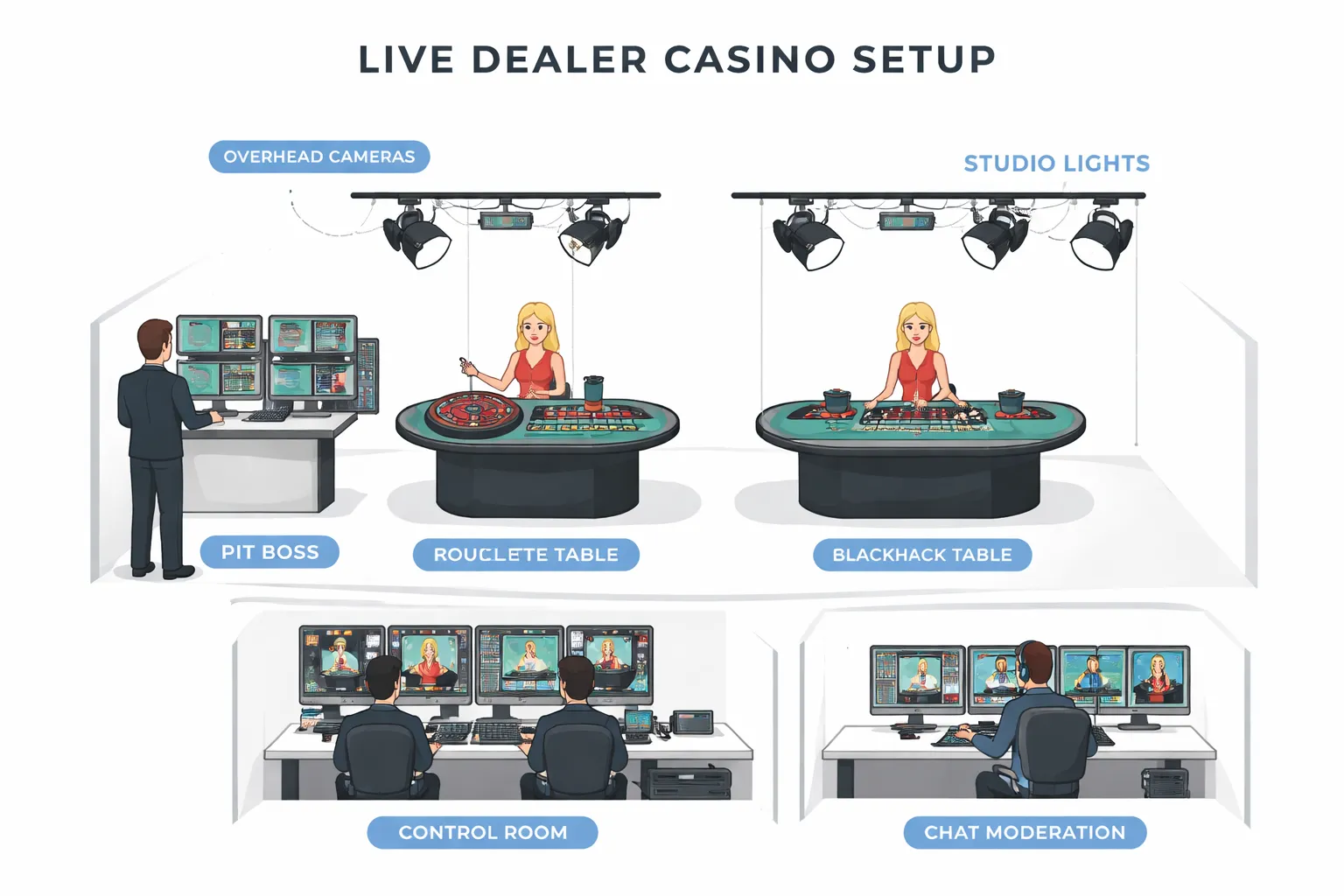
Dedicated studios vs streaming from land-based casino floors
Live dealer games stream from two setups, purpose-built studios and real casino floors. The setup affects video quality, table speed, and chat noise.
- Dedicated studios. Operators build a room for broadcast. You get controlled lighting, fixed camera angles, clear audio, and stable table pace. Studios also run many tables in one location, so the provider can scale faster.
- Land-based casino streams. A physical casino hosts the table. You may see more background movement and hear more ambient sound. The vibe feels more like a real casino, but crowd flow can change the feel of the stream.
- Branding and compliance. Studios often show provider branding and on-screen overlays. Casino-floor streams show the venue. Both still follow game logs, camera coverage, and dispute rules.
Dealer roles and training: presentation, dealing standards, and compliance
Your dealer runs the game, but the job is closer to broadcast work than a standard pit shift. Providers train dealers for speed, consistency, and on-camera behavior.
- Presentation. Dealers keep hands visible, announce key actions, and keep the game moving. Many follow a script for greetings, bets closed, and results.
- Dealing standards. Dealers use fixed procedures for shuffles, cuts, ball drops, and card handling. The goal is repeatability, so every round matches the ruleset and the video record.
- Compliance basics. Dealers follow strict steps around card exposure, shoe changes, and equipment checks. The studio records sessions and stores round data, so results match what you see on video.
Game presenters, pit bosses, and moderators: who does what
Most tables have more staff than the person you see on camera. Each role covers a different risk, pace, and player support need.
- Game presenter. The on-screen host. They handle the physical game actions and keep the table on schedule.
- Pit boss or floor supervisor. The rule enforcer. They watch multiple tables, confirm procedures, handle disputes, and approve corrections if something goes wrong.
- Game control room. Staff monitor video feeds, round logs, and system alerts. They can pause tables, switch cameras, and document incidents.
- Chat moderator. They manage chat conduct, remove spam, and protect the dealer and players from abuse. Some also answer basic table questions and direct you to support.
Table limits, seat counts, and VIP tables: how capacity is managed
Live tables have real capacity limits. Your access depends on seats, bet ranges, and how the provider manages traffic.
- Bet limits. Each table posts a minimum and maximum bet. Limits vary by table type, time of day, and demand. High-limit tables reduce crowding by raising minimums.
- Seat counts. Blackjack often uses fixed seats. When seats fill, you either wait or join another table. Roulette and baccarat often allow more players since you do not take a physical seat in the same way.
- VIP tables. Some rooms reserve access by minimum bet, loyalty level, or invitation. You get fewer players, faster rounds, and more consistent dealer attention.
- Queue and table switching. Platforms use waitlists and auto-seat tools to keep tables full. If you want a specific pace or limit, you may need to switch tables mid-session.
How Live Dealer Casinos Work Step by Step (From Click to Payout)
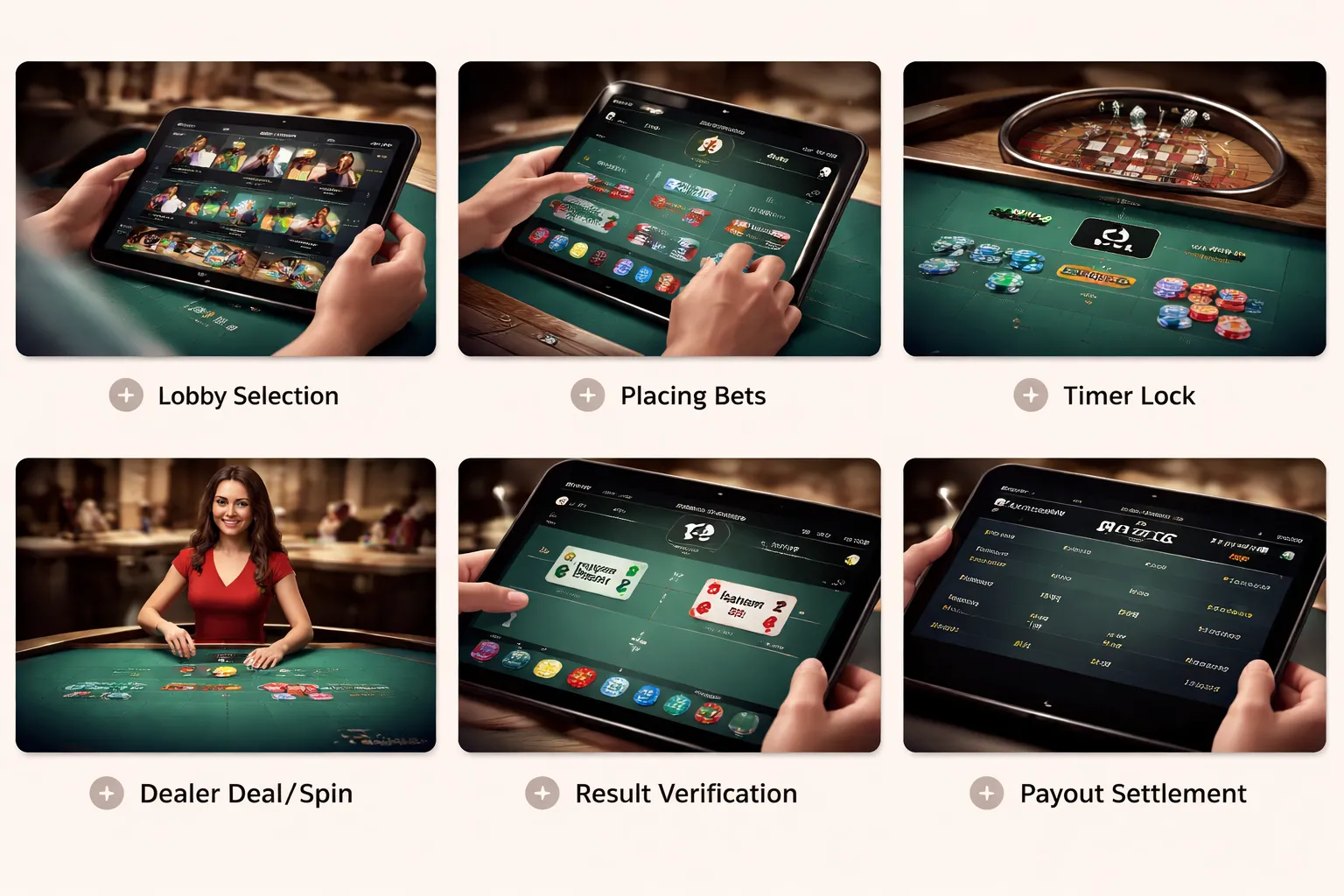
Joining a table, selecting stakes, language, and rules variants
You start in the live casino lobby. You filter by game type, table limit, and studio.
- Stakes: Check the minimum and maximum bet. Look at side bet limits too. Some tables cap side bets lower than main bets.
- Language: Many tables label the dealer language. Some rooms run multilingual chat, but the table label still matters for pace and clarity.
- Rules variants: Open the table info panel. Read the rule set before you join. Small rule changes can shift the house edge and your expected results.
- Seat and access: Some games use unlimited seats because you bet digitally. Some use limited seats, especially live poker. VIP tables may require higher minimum bets or a loyalty tier.
Placing bets with the digital UI, chips, spot selection, and confirmations
You do not hand chips to the dealer. You place bets on your screen.
- Choose a chip value: Tap a chip, then tap a betting area. Most UIs let you repeat the last bet, double, or clear.
- Select your spot: In roulette you pick numbers and sections. In blackjack you pick your seat and place your main bet, then optional side bets. In baccarat you choose Player, Banker, or Tie.
- Confirmations: Some casinos require a confirm tap for large bets or rapid changes. Others accept a bet as soon as you place it. Watch for a bet accepted indicator in the UI.
- Bet limits: The UI blocks bets outside limits. If your total exceeds table max, the interface rejects the extra amount.
Betting windows and timers, why you can’t bet at any moment
Live games run on fixed rounds. You can only bet during an open betting window.
- Timing: A timer shows seconds left. Once it hits zero, the system locks bets.
- Fairness: The lock stops late bets after cards show or the wheel slows. It keeps all players on the same timeline.
- Latency buffer: Platforms close betting slightly early for some players to account for stream delay and network lag.
- Practical tip: Place your bet with time to spare. If your connection stutters, last second bets may not register.
Dealing and spin flow, what happens after the timer closes
After betting closes, the dealer runs the physical game. Your screen stays in sync with that round.
- Blackjack: Dealer deals from a real shoe or continuous shuffler. The UI then opens decision buttons, hit, stand, double, split, and insurance when allowed. You must act within a decision timer.
- Roulette: Dealer spins the wheel and launches the ball. The system blocks new bets. The camera follows the wheel until the ball drops.
- Baccarat: Dealer draws according to fixed rules. You do not make play decisions. The UI only shows the sequence and totals.
- Game speed: Speed depends on table type, number of players, and decision timers. Higher traffic tables often run slower in blackjack because more players need to act.
Result capture and synchronization, how outcomes reach your screen
The platform must turn a physical outcome into a digital result.
- Outcome capture: Studios use sensors, computer vision, or dealer input tools to record results. Roulette often uses wheel sensors. Card games often use scanned cards or recognition systems.
- Validation: The system checks the result against game state and rules before it settles bets. If the system flags a mismatch, it can pause settlement.
- Stream delay: Your video feed can run a few seconds behind real time. The betting lock and result posting account for that delay.
- Display sync: Once confirmed, the UI highlights winning areas, updates roadmaps or histories, and moves to the next round.
Settlement and payouts, balance updates, bet history, and game logs
After the result posts, the system settles each bet and updates your account balance.
- Balance updates: You see your win or loss in the UI, then your cashier balance updates. Some sites show an immediate round result, then a confirmed balance a moment later.
- Payout rules: Payouts follow the table paytable, including side bets. Always check the info panel for any variant payouts.
- Bet history: You can open your bet history to see stake, selection, time, and outcome. This matters for disputes and for tracking your own play.
- Game logs: Many platforms show a round ID and a detailed log. Save the round ID if you contact support.
- Disputes: If something looks wrong, use the round ID, table name, and timestamp. For support expectations, see online casino customer support.
The Technology Powering Live Dealer Games
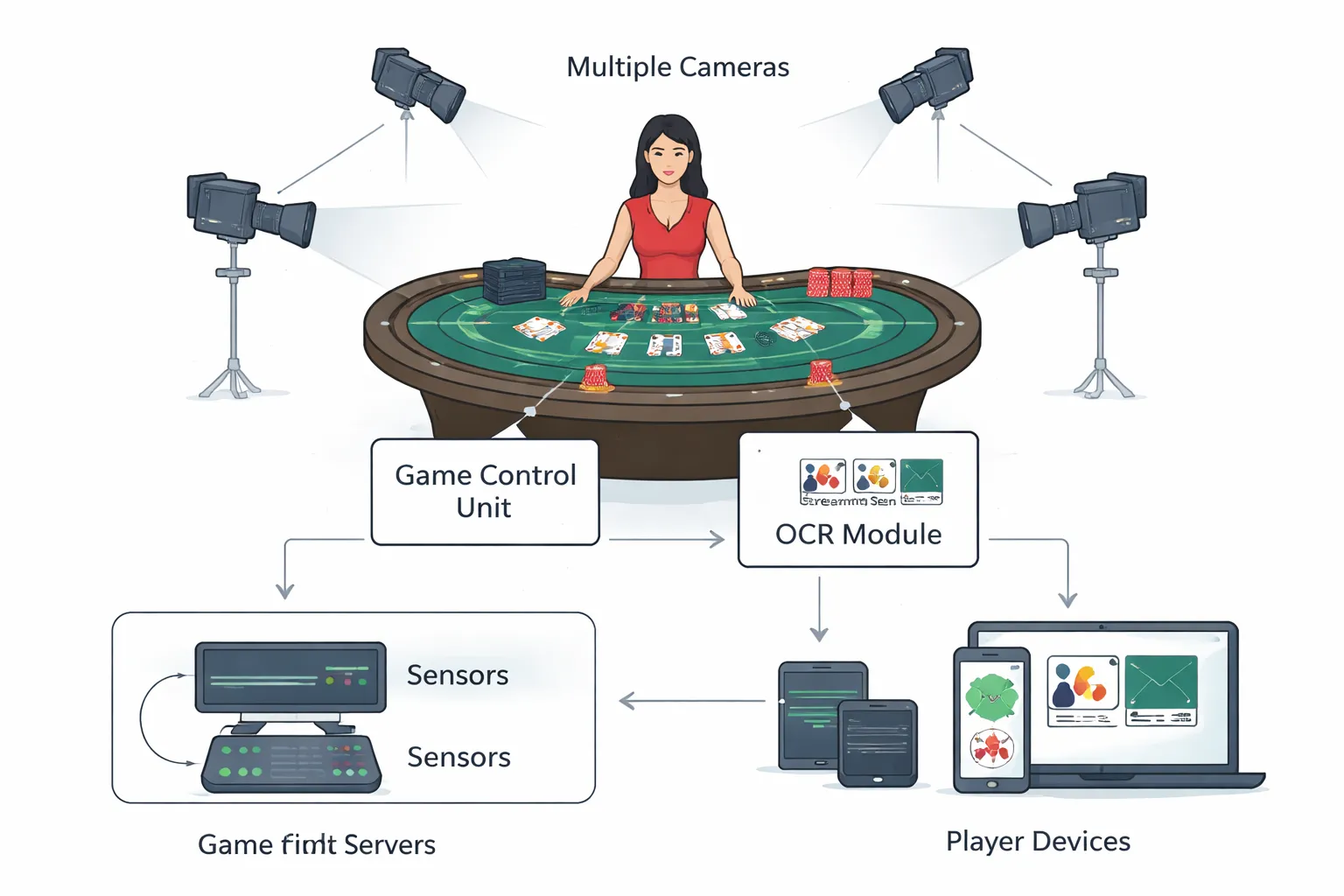
Multi-camera production
Live studios run like small TV sets. You see several camera angles on one table.
- Wide shot: shows the full table so you can track the full round flow.
- Close-ups: zoom on cards, dice, or roulette pockets. This supports result verification.
- Dealer view: shows hands and dealing motion to reduce blind spots.
- Table overlays: the stream adds digital layers like timer, recent results, and bet limits. The overlay comes from the game server, not from the physical table.
Streaming infrastructure
Your device receives a video stream plus a separate data feed for bets, timers, and results. The platform keeps both in sync.
- Bitrate: higher bitrate looks sharper but needs more bandwidth. If your connection drops, the stream lowers quality to avoid freezing.
- Adaptive streaming: the app switches between quality levels based on your current speed and stability. This reduces buffering during peak hours.
- Device compatibility: the provider serves formats that work across browsers and mobile apps. Older devices may cap at lower resolution or higher delay.
Game Control Unit (GCU) and sensors
The Game Control Unit links the physical table to the casino platform. It acts as the referee for inputs and timing.
- Bet window control: the GCU opens and closes betting on a fixed schedule. You see the same countdown the dealer follows.
- Event capture: sensors and table hardware detect actions like card delivery, shoe state, and roulette spin start and end.
- Result publishing: once the system confirms the outcome, it sends the result to the game server. Your balance updates after server confirmation, not after you visually see the outcome.
Optical Character Recognition (OCR)
OCR reads printed symbols on cards and sometimes roulette outcomes. It turns video frames into structured data.
- Cards: cameras capture card faces. OCR reads rank and suit, then the platform updates the game state.
- Roulette: systems use wheel cameras and ball tracking, then confirm the final pocket. Many studios also use a secondary check before posting the result.
- Error handling: if OCR confidence drops, the system can pause result posting for manual verification. That delay protects accuracy.
Randomness in live games
Live dealer games use physical randomness. Controls focus on procedure, maintenance, and audit trails.
- Shuffling: tables use manual shuffles, automated shufflers, or shoe swaps on set schedules. Many studios rotate decks and log changes.
- Wheel integrity: roulette wheels get inspection and cleaning. Studios track wear, level, and ball condition, then replace parts on a schedule.
- Procedural controls: dealers follow fixed steps for dealing, spinning, and handling cards. Surveillance and logs support review if a round gets challenged.
For a broader breakdown of how casino platforms run games and handle safety checks, see how online casinos work.
Why delays happen
Every live game has delay. You watch video, then you act. The system must also lock bets before the outcome becomes clear.
- Network latency: distance to the streaming server and mobile signal quality add time. Wi-Fi congestion can add spikes.
- Encoding and decoding: the studio compresses video, your device decompresses it. Higher quality settings can increase delay.
- Buffering: players get a small buffer to prevent stutter. A larger buffer reduces freezes but increases delay.
- Synchronization: the platform aligns video with game data so bets close at the right moment. This can add a controlled delay to keep timing fair.
- Load and routing: peak traffic can force a longer path through CDNs or regional servers.
- How casinos minimize it: they use regional studios, CDNs, low-latency streaming profiles, and adaptive bitrates. They also keep strict bet-close timers and publish round events in logs for review.
Fairness, Security, and Regulation: Can You Trust Live Dealer Casinos?
Licensing and oversight, what regulated operators must prove
A regulated live dealer casino answers to a gambling authority. You can verify this in the footer of the site and on the regulator’s register.
In most major jurisdictions, the operator must show:
- Identity and ownership checks, including beneficial owners and key staff.
- Player fund controls, such as segregation rules or defined handling of balances.
- AML and KYC programs, including age checks, source of funds controls, and reporting duties.
- Game and supplier approvals, meaning the studio and platform vendors must meet licensing or certification rules.
- Responsible gambling tools, like limits, time-outs, and self-exclusion handling.
- Complaint handling, with defined escalation and record keeping.
Licensing does not guarantee you win. It does set minimum controls and gives you a place to report issues.
Studio security and surveillance, monitoring, access control, and incident response
Live dealer studios run like controlled rooms. Security aims to stop tampering, theft, and dealer interference.
- Multi-camera coverage on tables, wheel, shoe, discard tray, and dealer hands.
- Restricted access with badges, logged entry, and separated secure areas.
- No personal items rules for dealers at tables, plus equipment checks.
- Supervisor oversight on the floor and in a surveillance room.
- Incident playbooks for disputes, suspected cheating, or technical faults, including round freezes and evidence export.
Anti-collusion measures, preventing team play and signaling at tables
Collusion risks look different in live games than in RNG slots. The goal is to block player coordination and dealer signaling.
- Table limits on seats and chat controls, including moderation and anti-spam filters.
- Network and account monitoring to flag shared devices, linked payment methods, or repeated joint play patterns.
- Bet pattern detection for synchronized wagers, unusual hedging, or repeated timing signals.
- Dealer conduct rules, plus rotation schedules and supervisor checks.
If a casino investigates, it can void bonuses, freeze withdrawals during review, or close accounts under its terms. Read those terms before you deposit.
Game integrity procedures, card changes, shuffles, wheel inspections, and logs
Trusted studios follow routine steps you can often see on camera.
- Card handling, sealed decks, scheduled deck changes, and controlled storage.
- Shuffles, either manual or with approved shufflers, with clear start and end points for each round.
- Roulette checks, wheel and ball inspections, level checks, and periodic maintenance.
- Round logs, timestamps for bets open and close, results, and any voided rounds with reasons.
- Dispute workflow, support can pull the round ID, event logs, and video clips for review.
You should see round history in the UI. Keep your round ID and time if you file a complaint.
Audits and certifications, what third-party testing typically covers
Independent testing labs and compliance firms usually focus on process controls and technical integrity.
- RNG testing for side features that use RNG, such as bonus wheels or random multipliers.
- Game logic checks for bet settlement, payout rules, and error handling.
- Streaming and data integrity to confirm the video and game server stay synchronized and bets close on schedule.
- Security reviews of access controls, change management, and incident records.
- Compliance checks for jurisdiction rules, including reporting and responsible gambling controls.
Look for named labs, dated certificates, and clear scope. A generic “certified” badge with no details means little.
Red flags to avoid, unlicensed sites, missing terms, and vague provider info
- No license number, or a license claim you cannot verify on a regulator site.
- Unknown live dealer provider, no studio name, no game supplier list, no regulator approval details.
- Missing or thin terms, especially around withdrawals, voided rounds, bonuses, and verification.
- Unclear payment rules, large fees, shifting minimum withdrawals, or “manual approval” with no timeline.
- No dispute path, no regulator contact, no complaint process, no audit references.
- Support that cannot answer basics, like where the studio is located or how round disputes get reviewed.
If you want a safer starting point, use regulated brands when you play casino games online and verify the license before you deposit.
What to Expect as a Player: Interaction, Etiquette, and User Experience
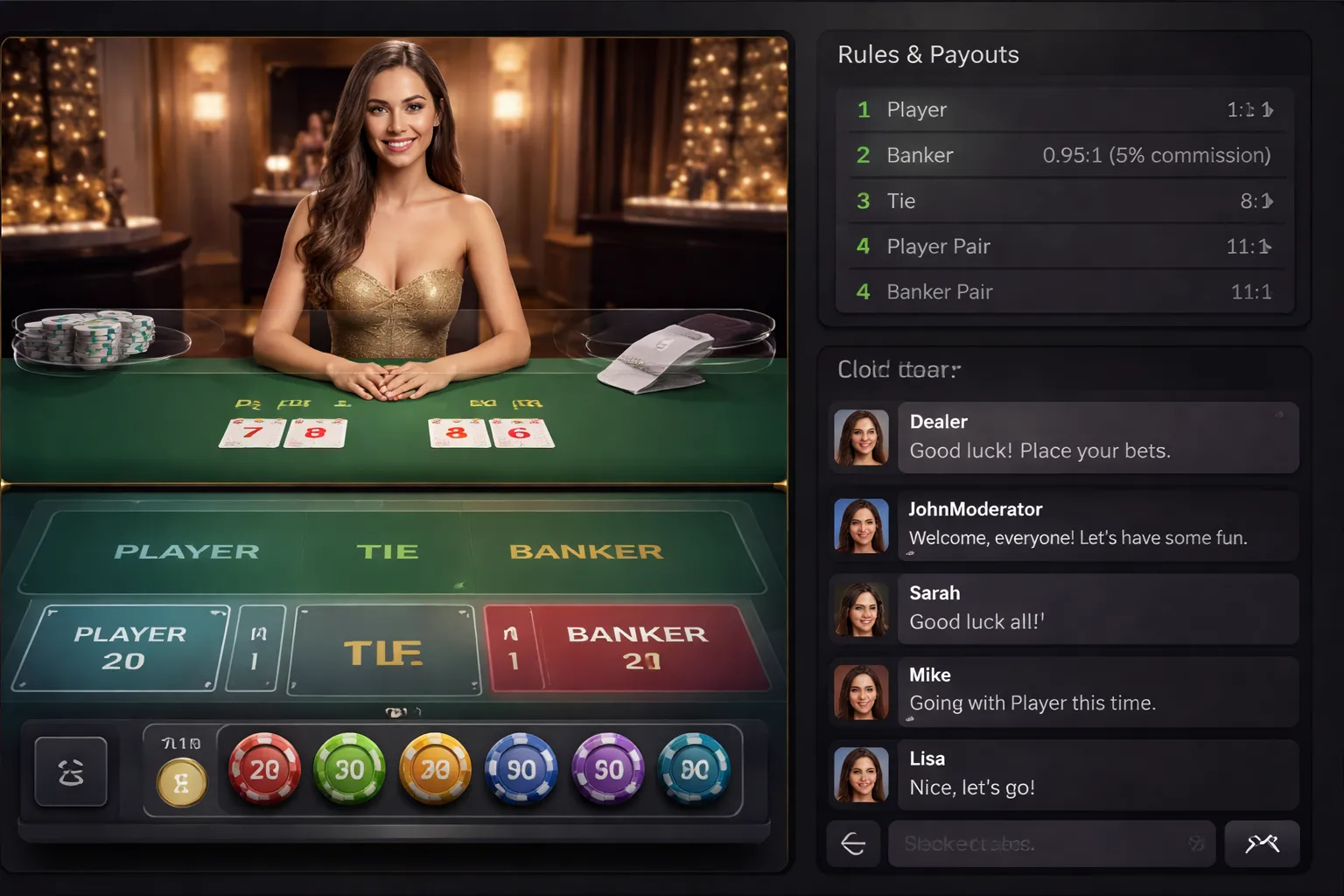
Chat features: dealers, moderators, and other players
Most live tables offer a chat box next to the video feed. You type messages; the dealer reads them when the game flow allows. Many studios also use a moderator. The moderator filters chat, answers basic questions, and flags issues to the dealer or pit staff.
- Dealer chat: Keep messages short. Expect delayed replies during busy moments.
- Moderator chat: Use it for table rules, bet limits, and technical problems.
- Player chat: Some tables show a shared chat. Some restrict chat to dealer only.
- Limits: Studios block spam, abusive language, and requests to change outcomes.
Table etiquette: do’s and don’ts that keep games moving
- Do place bets early. Late bets slow the table and may get rejected when betting closes.
- Do confirm the table rules before you sit down. Look for the rules icon or paytable tab.
- Do use chat for clear, simple requests. Example, “Please confirm blackjack rules on soft 17.”
- Do not ask the dealer to “hit,” “stand,” or “spin again” outside the rules. The system controls timing.
- Do not argue with other players in chat. Moderators will mute or remove you.
- Do not blame the dealer for outcomes. Dealers deal. The rules and RNG-free physical results decide.
Pace of play: hands per hour vs RNG speed
Live games move slower than RNG games. You wait for shuffles, spins, and betting windows. You also wait for other players.
| Game type | What sets the speed | What you feel as a player |
|---|---|---|
| Live roulette | Betting timer, spin time, result confirmation | Short bursts of betting, then a fixed wait |
| Live blackjack | Players making decisions, dealing speed, reshuffles | Slower when the table is full, faster heads-up |
| Live baccarat | Dealing speed, shoe depth, side bet settlement | Steady pace, less player decision time |
| RNG versions | Your click speed, autoplay settings | Much faster, no waiting for other players |
If you care about volume, choose less crowded tables and avoid peak hours. If you care about the live feel, accept the slower rhythm and plan your bankroll for longer sessions.
Side bets and rule variants: why payouts and house edge can change
Live tables often add side bets and house rule changes. These small differences change your expected cost per hand.
- Blackjack rules: Look for dealer hit or stand on soft 17, double rules, surrender, resplit limits, and blackjack payout. A 6:5 payout costs more than a 3:2 payout.
- Roulette wheel: Check if the table uses European (single zero) or American (double zero) layout. That change alone shifts the edge.
- Baccarat commission: Some tables use standard banker commission. Others use “no commission” rules with altered payouts on certain banker wins.
- Side bets: Treat them as separate games. They often carry a higher house edge than the main bet. Read the paytable, not the name of the bet.
Before you wager, open the rules and paytable panel and screenshot it for your records. This helps if a dispute comes up later.
Accessibility features: language tables, subtitles, and interface options
Studios build live products for mixed audiences. You can usually adjust the interface even if the dealer speaks another language.
- Language tables: Many lobbies group tables by dealer language. English, Spanish, and Portuguese are common.
- Subtitles and chat translation: Some providers offer canned dealer messages or translated system prompts. Full real time translation varies by studio.
- Interface options: You can often change chip sizes, toggle sound, hide chat, enlarge video, and switch camera angles when available.
- Mobile use: Expect a simplified layout. Test controls before you raise your stakes.
If you play while traveling, confirm legality and access rules where you are located. Use a regulated site that matches your region. See our guide on whether online casinos are legal.
Costs, Limits, and Odds: Understanding Value Before You Play
Table minimums and maximums
Live tables cost more to run than digital games. That pushes minimum bets up.
- Typical minimums: Blackjack and baccarat often start around $5 to $25. Roulette often starts around $2 to $10 per inside bet, with higher total bet minimums at some studios.
- Peak hours raise minimums: When tables fill up, casinos open fewer low limit seats. You see more mid stakes and high stakes tables.
- Maximums vary by table: Blackjack limits commonly range from $100 to $5,000+. Baccarat and roulette can run higher, especially on VIP tables.
- Table limits change your options: If your bankroll is small, you get fewer tables, fewer seats, and less rule choice. If you bet big, you get more VIP tables and often better rules.
House edge basics in live blackjack, roulette, and baccarat
Odds come from rules and payouts. Live dealer games often match land based rules, but each table can differ.
| Game | What drives value | Typical house edge range |
|---|---|---|
| Blackjack | 3:2 vs 6:5 payout, dealer hits or stands on soft 17, decks, double rules, surrender | About 0.5% to 2%+ depending on rules and your play |
| Roulette | Wheel type, bet choice | 2.70% on European, 5.26% on American |
| Baccarat | Commission and payout terms | Banker usually about 1.06%, Player about 1.24%, Tie about 14.36% |
These numbers assume standard rules. If the table pays less or adds special side rules, your value drops.
Rule variations that matter
Two tables can show the same game name and deliver different value. Check the rules panel before you sit.
- Blackjack payout: Favor 3:2. Avoid 6:5. That single change can raise the house edge by about 1.4% in many common rule sets.
- Number of decks: Fewer decks usually helps you, but rules matter more than deck count.
- Dealer soft 17: Dealer stands on soft 17 tends to be better for you than dealer hits.
- Double rules: Double on any two cards beats double only on 9 to 11. Double after split also helps.
- Roulette wheel type: Choose single zero when you can. Avoid double zero unless the table compensates with special rules you understand.
- Lightning and multiplier roulette: Multipliers look appealing, but they usually come with a higher house edge than standard European roulette.
Side bets and game shows
Side bets add swing. They also add edge.
- Blackjack side bets: Perfect Pairs, 21+3, and similar options often carry a much higher house edge than the main hand. Expect volatility. Expect longer downswings.
- Baccarat side bets: Pairs and bonuses can pay big, but they usually cost you more in expected value than Banker or Player.
- Live game shows: Games like Money Wheel and multiplier titles can move fast and pay huge. They also tend to price that excitement in. Treat them like high variance entertainment, not value play.
Bonuses and wagering requirements
Promos can help, but many do not apply to live dealer play. Check the terms before you deposit.
- Live games often contribute less: Many casinos count live bets at 0% to 20% toward wagering. Slots often count at 100%.
- Bet limits can void a bonus: Some promos set a maximum allowed bet per spin or hand while the bonus is active.
- Game exclusions are common: A bonus may exclude roulette, baccarat, or game shows, or exclude specific tables.
- Sticky vs cashable: Sticky bonuses remove bonus funds on withdrawal. Cashable bonuses let you withdraw bonus funds after you meet the terms.
- Time limits matter: If the wagering window is short, live tables with higher minimums can make clearing harder.
If you want to play live with small stakes, start with a site built for low minimums and simple deposits. See our guide to low deposit casinos.
Common Issues and Troubleshooting (So You Don’t Miss a Bet)
Stream freezes or lag, quick fixes and when to switch tables
- Check your connection first. Switch from mobile data to Wi-Fi, or from Wi-Fi to wired if you can.
- Close heavy apps. Streaming video, downloads, and VPNs can spike latency.
- Lower the video quality. If the player has a quality setting, drop it one level to stabilize the stream.
- Refresh once. Reload the table. Do not spam refresh, you can miss timer windows.
- Switch tables when lag repeats. If you freeze twice in 5 minutes, move. Pick a table with a lower player count and stable round pace.
- Use the lobby, not your browser back button. Exit via the casino lobby to avoid session errors.
Rule: If the stream breaks and the bet timer keeps running, switch tables. Do not chase the same seat.
Disconnected mid-hand, what usually happens to your bet
- Your last confirmed bet usually stands. If you placed it before the timer hit zero, the system keeps it.
- If the bet did not register, it will not count. You will see no wager in your bet history for that round.
- Most live platforms finish the hand server-side. When you reconnect, you should see the result and the settled payout.
- If you lose connection during a decision point, the game may auto-act. Common defaults are “stand” in blackjack or “no action” if the timer expires. This depends on the provider and table rules.
- Use the round ID. If you need support, give the table name, time, and round or game ID from your history.
What to do: Reconnect, check your bet history, then contact support only if the round shows “pending” for more than a few minutes.
Audio and video out of sync, device and network settings to check
- Restart the stream. Reload the table once. Sync issues often fix on a clean reconnect.
- Turn off Bluetooth audio. Wireless headphones can add delay and cause drift.
- Close other audio apps. Calls, voice chat, and screen recording can interfere with playback.
- Disable battery saver. Power saving can throttle video decoding on mobile.
- Update your browser or app. Old versions handle live video poorly.
- Change networks. High jitter causes desync. A stable Wi-Fi signal often beats fast but unstable mobile data.
Geolocation and verification problems, why access may be blocked
- Location rules can block you. Many licensed casinos must confirm you sit inside an approved state or country. If you travel, access can stop.
- VPNs often trigger blocks. Even if your account is fine, a VPN can cause a hard fail on location checks.
- Wi-Fi can misread your location. Public networks, corporate networks, and some ISPs route traffic in ways that confuse geolocation.
- Verification gaps stop cash play. If your identity, address, or age checks are incomplete, the casino can restrict deposits, live tables, or withdrawals.
- Fix steps: Turn off VPN, enable location services, switch to a different network, then retry.
- Document steps: Use clear photos of ID, a recent proof of address, and matching account details. Mismatched names and old addresses slow approval.
If you keep getting blocked, read our guide on online casino legality. It explains why access changes by location.
Payment delays and withdrawal checks, typical timelines and requirements
Delays usually come from checks, not “missing” money. Expect longer timelines for first withdrawals and larger cashouts.
| Step | What happens | Typical timing |
|---|---|---|
| Pending review | Security and KYC checks, bonus review, payment method checks | 24 to 72 hours, longer on first cashout |
| Approved | Casino releases funds to the payment processor | Same day to 24 hours |
| Processor delivery | Bank or wallet posts the funds | E-wallets: minutes to 24 hours, cards: 1 to 5 business days, bank transfer: 2 to 7 business days |
- Common requirements: Verified ID, proof of address, payment method ownership, and completed wagering if you used a bonus.
- Card withdrawals can be slow. Some casinos push withdrawals back to the original deposit method first, then send the rest by bank or wallet.
- Watch your limits. Daily and weekly caps can split one withdrawal into multiple payments.
- Keep records. Save confirmation emails, transaction IDs, and screenshots of your cashier status.
Fastest path: Verify your account before you withdraw, use one payment method, and avoid changing details right before a cashout.
Tips for First-Timers: Choosing a Table and Playing Responsibly

Picking the right stakes
Start at the lowest table limits. Learn the lobby, bet buttons, and timer first. Use the first 10 to 20 rounds to watch the flow and confirm you can place, double, split, or undo a bet before the clock hits zero.
Pick tables with simple bets. For roulette, start with outside bets. For blackjack, start with one hand. For baccarat, start with Player or Banker only.
- Check the minimum bet before you sit down.
- Watch the bet timer. Short timers increase mistakes.
- Avoid side bets early. They raise variance and drain bankroll faster.
Checking rules before betting
Open the table info panel in the game window. Casinos label it as Rules, Info, Table Limits, or the i icon. Read it once before you bet.
- Blackjack: dealer stands or hits soft 17, double rules, split rules, blackjack payout, surrender, peek rules.
- Roulette: single zero or double zero, bet limits by type, neighbor and racetrack bet rules if offered.
- Baccarat: commission on Banker, tie payout, side bet paytables.
If you play from a region with specific rules, confirm online casino legality where you live before you deposit.
Bankroll and session planning
Set a bankroll for the day. Then set a smaller session bankroll. Stop when either limit hits. Keep it simple.
- Session length: 30 to 60 minutes.
- Loss limit: 10 to 20 percent of your session bankroll.
- Win cap: 20 to 40 percent of your session bankroll, then cash out or step away.
- Bet sizing: keep your base bet at 1 to 2 percent of your total bankroll.
Avoid chasing. Do not raise stakes to recover losses. Do not increase bets after wins to force a profit.
Using demo or practice modes
Use demo mode when the casino offers it. Learn the interface without real money risk. Focus on speed and accuracy, not outcomes.
- Practice the controls: confirm, rebet, clear, undo, and chip values.
- Test your device: video quality, audio, and connection stability.
- Learn the pace: see how much time you get per round.
Responsible gambling tools
Use built-in tools before you start. Set limits while you still feel calm. Treat them as rules, not suggestions.
- Deposit limits: daily, weekly, or monthly caps. Best for stopping overspending at the source.
- Loss limits: blocks play after you lose a set amount in a period.
- Wager limits: caps total bets over time.
- Time limits: forces a logout after a set session length.
- Time-outs: short breaks, usually 24 hours to several weeks.
- Self-exclusion: longer blocks that can last months or years.
If you feel out of control, stop play and activate a time-out or self-exclusion immediately.
Pros and Cons of Live Dealer Casinos (Compared to Online and Land-Based Play)
Advantages of Live Dealer Casinos
- More transparency than RNG tables. You watch the shuffle, the spin, and the deal. It feels closer to land-based rules and pacing.
- Human dealing in real time. Live dealers follow standard procedures. You see errors, corrections, and table decisions as they happen.
- Social feel without travel. You can chat with the dealer and other players. You get table energy without casino noise, smoke, or crowds.
- Useful for learning table flow. You can track how rounds run, when bets close, and how payouts post. This helps if you plan to play in-person later.
Drawbacks of Live Dealer Casinos
- Slower pace. You wait for shuffles, spins, and player decisions. You play fewer hands or rounds per hour than RNG games.
- Table limits can block your budget. Many live tables set higher minimum bets than RNG versions. Some also cap maximum bets based on seat type or table rules.
- Your connection matters. Weak Wi-Fi, high latency, or device lag can cause stream freezes or delayed bet placement. If you miss the betting window, you sit out that round.
- Less control over speed and automation. You cannot autoplay. You cannot fast-forward animations. You must follow the table tempo.
- Fewer niche variants. You usually get core games and a limited set of side bets. RNG lobbies often offer more rule sets and stakes.
Live vs RNG vs Land-Based: Quick Comparison
| Factor | Live Dealer | RNG Online | Land-Based |
|---|---|---|---|
| Game speed | Medium to slow | Fast | Medium |
| Minimum bets | Often higher | Often lower | Varies by venue |
| Transparency feel | High, you watch the action | Lower, results come from software | High |
| Social interaction | Chat-based | Low | High, in-person |
| Convenience | High | Very high | Low to medium |
| Dependence on internet | High | Medium | None |
Best Fit Scenarios: Who Benefits Most From Live Tables
- You want to see the game run. Live tables suit you if visual proof and procedure matter more than speed.
- You prefer a calmer way to play. The slower rhythm can reduce rapid-fire betting and chase behavior.
- You like table etiquette. You get a more structured experience than most RNG lobbies.
- You want a casino-like session at home. Live works well when you want the feel of a real table without travel.
When RNG Online Casinos May Be Better
- You want speed. RNG blackjack, roulette, and baccarat run fast. You can finish a short session in minutes.
- You want autoplay. Slots and some RNG table games let you automate spins or hands, which live tables do not support.
- You need lower minimums. RNG games usually offer smaller stakes and more bet sizes. This helps if you play with strict bankroll limits.
- You want more formats. RNG lobbies often include more rule variants, side bets, and quick-play modes.
- You want to compare platforms first. Use a checklist approach and learn how to read an online casino review before you deposit.
FAQ
What is a live dealer casino?
A live dealer casino streams real tables from a studio or casino. A human dealer runs the game. You place bets in your browser or app. The dealer deals or spins on camera. Your results post to your account in real time.
How do bets and outcomes get verified?
Most providers use optical character recognition and sensors, like RFID, to read cards and wheel results. The system matches the video feed to the game server. Licensed sites also log game data for audits. You can review hand history in many clients.
Do live dealer games use RNG?
The deal or spin comes from physical equipment. The casino uses software to capture and display the result. Some hybrid titles use RNG for side features, like bonus wheels. Check the game rules panel for the exact method.
What is the typical table limit range?
It varies by game and operator. Common ranges run from about $5 to $25 minimum at standard tables. VIP tables often start at $100 or more. Some studios offer lower minimums at off peak hours, but availability changes.
How fast are live dealer rounds?
Live blackjack often runs 40 to 70 hands per hour. Live roulette usually spins every 45 to 90 seconds. Baccarat speed depends on the table and side bets. Speed tables move faster because betting time is shorter.
What internet speed do you need?
A stable connection matters more than peak speed. Aim for at least 5 Mbps for HD and consistent latency. Use wired or strong Wi-Fi. Close other streams. If the stream buffers, switch to lower video quality in settings.
Can you use strategies like basic blackjack strategy?
Yes. The rules match standard casino formats. Use basic strategy charts for the exact rules, like dealer hits soft 17 and number of decks. Do not assume one chart fits all tables. The rules screen shows key details.
Can you interact with the dealer or other players?
Most tables include a chat box. You can greet the dealer and ask simple questions. The dealer cannot give betting advice. Some tables let you toggle chat off. Chat gets moderated, and rule breaks can lead to removal.
Is live dealer fair?
Fairness depends on licensing, audits, and provider controls. Look for a licensed operator, published game rules, and reputable live studio brands. Avoid unlicensed sites. For compliance basics, see online casino legality by location.
What should you do if the stream disconnects mid hand?
The server still records your bet and the outcome. You usually reconnect to the same table, or you can check your game history. If a bet fails to place due to a disconnect, the system should not count it.
Do live dealer games have higher house edges?
The house edge depends on rules, not the live format. Roulette stays tied to wheel type. Blackjack edge changes with rules like payouts and deck count. Baccarat stays stable with standard rules. Always read the rule set before you play.
Conclusion
Conclusion
Live dealer casinos stream a real table, take your bets in a timed window, and settle results with the same game rules you see in land based play. The live format changes the feel, not the math. Your edge comes from rules, limits, and your own bankroll control.
- Pick the right table. Check minimum bet, max bet, and side bet costs before you sit down.
- Verify fairness basics. Look for licensed operators, game history logs, and clear rule sets.
- Protect your session. Use stable Wi Fi or wired internet, keep your app updated, and avoid switching networks mid hand.
- Know the disconnect policy. Confirm what happens if you drop during betting or during a hand.
Final tip, treat table rules like pricing. Read them first, then play. If you also need to confirm your local options, use this guide to online casino legality before you deposit.
-
Are Online Casinos Legal? Complete Guide by State & Country
3 months ago -
Best Low Deposit Online Casinos: Play for Less with Small Minimum Deposits
3 months ago -
What Is an Online Casino? How They Work, Games, Bonuses & Safety
3 months ago -
Live Dealer vs RNG Casino Games: What’s the Difference?
3 months ago -
Online Casino Customer Support: What to Expect (Live Chat, Email, Phone)
3 months ago
-
- Joining a table, selecting stakes, language, and rules variants
- Placing bets with the digital UI, chips, spot selection, and confirmations
- Betting windows and timers, why you can’t bet at any moment
- Dealing and spin flow, what happens after the timer closes
- Result capture and synchronization, how outcomes reach your screen
- Settlement and payouts, balance updates, bet history, and game logs
-
- Licensing and oversight, what regulated operators must prove
- Studio security and surveillance, monitoring, access control, and incident response
- Anti-collusion measures, preventing team play and signaling at tables
- Game integrity procedures, card changes, shuffles, wheel inspections, and logs
- Audits and certifications, what third-party testing typically covers
- Red flags to avoid, unlicensed sites, missing terms, and vague provider info
-
- Stream freezes or lag, quick fixes and when to switch tables
- Disconnected mid-hand, what usually happens to your bet
- Audio and video out of sync, device and network settings to check
- Geolocation and verification problems, why access may be blocked
- Payment delays and withdrawal checks, typical timelines and requirements
-
- What is a live dealer casino?
- How do bets and outcomes get verified?
- Do live dealer games use RNG?
- What is the typical table limit range?
- How fast are live dealer rounds?
- What internet speed do you need?
- Can you use strategies like basic blackjack strategy?
- Can you interact with the dealer or other players?
- Is live dealer fair?
- What should you do if the stream disconnects mid hand?
- Do live dealer games have higher house edges?
-
- Joining a table, selecting stakes, language, and rules variants
- Placing bets with the digital UI, chips, spot selection, and confirmations
- Betting windows and timers, why you can’t bet at any moment
- Dealing and spin flow, what happens after the timer closes
- Result capture and synchronization, how outcomes reach your screen
- Settlement and payouts, balance updates, bet history, and game logs
-
- Licensing and oversight, what regulated operators must prove
- Studio security and surveillance, monitoring, access control, and incident response
- Anti-collusion measures, preventing team play and signaling at tables
- Game integrity procedures, card changes, shuffles, wheel inspections, and logs
- Audits and certifications, what third-party testing typically covers
- Red flags to avoid, unlicensed sites, missing terms, and vague provider info
-
- Stream freezes or lag, quick fixes and when to switch tables
- Disconnected mid-hand, what usually happens to your bet
- Audio and video out of sync, device and network settings to check
- Geolocation and verification problems, why access may be blocked
- Payment delays and withdrawal checks, typical timelines and requirements
-
- What is a live dealer casino?
- How do bets and outcomes get verified?
- Do live dealer games use RNG?
- What is the typical table limit range?
- How fast are live dealer rounds?
- What internet speed do you need?
- Can you use strategies like basic blackjack strategy?
- Can you interact with the dealer or other players?
- Is live dealer fair?
- What should you do if the stream disconnects mid hand?
- Do live dealer games have higher house edges?
-
Reload Bonus Explained: What It Is and When It’s Worth Claiming
1 month ago -
Online Casino Licensing Explained: Authorities, Licenses & How to Check One
3 months ago -
Best Live Dealer Casinos: Where to Play Live Blackjack, Roulette & More
3 months ago -
Best Online Casinos for High Rollers: VIP Perks, High Limits & Exclusive Bonuses
3 months ago -
Fast Payout Online Casinos: Best Sites for Quick Withdrawals
3 months ago
-
Online Casino Licensing Explained: Authorities, Licenses & How to Check One
3 months ago -
Casino VIP & Loyalty Programs Explained: Points, Tiers, Rewards & Rakeback
3 months ago -
Are Online Casinos Legal? Complete Guide by State & Country
3 months ago -
Online Casino Fairness Explained: RNG, RTP, House Edge & Provably Fair
3 months ago -
Free Spins Bonus Explained: How Free Spins Work at Online Casinos
3 months ago