What Is an Online Casino? How They Work, Games, Bonuses & Safety

An online casino is a gambling site or app that lets you play real money casino games over the internet. You create an account, deposit funds, pick a game, place bets, and withdraw winnings. The casino runs the games with software, handles payments, and applies rules set by its license.
This guide breaks down how online casinos work behind the scenes, what games you can play, how bonuses and wagering requirements work, and how to judge safety. You will learn what RNGs do, how live dealer games differ from virtual games, what to check before you deposit, and which red flags signal a risky operator. For a deeper checklist, see how to read an online casino review.
Key Takeaways
Key Takeaways
- In het kort: An online casino is a licensed gambling site that runs games on RNG software or via live dealer studios.
- In het kort: Your results in slots and virtual table games come from an RNG, not from timing or patterns.
- In het kort: Live dealer games stream real tables, they use cameras and dealers, and they settle bets through the casino platform.
- In het kort: Bonuses look big, but wagering requirements decide what you can actually withdraw.
- In het kort: Safety comes from a real license, tested games, strong account security, and clear payout terms.
- In het kort: Red flags include unclear ownership, vague bonus rules, slow KYC, and repeated payout complaints.
- Check the license, regulator name, and license number. Verify it on the regulator site.
- Look for independent game testing info, such as eCOGRA or iTech Labs, and published RTP per game.
- Know what drives house edge. RTP, game rules, and volatility matter more than game count.
- Read bonus terms before you opt in. Focus on wagering multiple, max bet limits, game contribution, and time limits.
- Expect KYC. You will need ID and proof of address before large withdrawals.
- Use payment methods with clear chargeback or dispute processes where possible.
- Set limits in your account. Deposit, loss, and time limits reduce mistakes.
- Before you deposit, learn how to read an online casino review and spot biased ratings.
What Is an Online Casino? (Definition, Key Features, and How It Differs From Land-Based Casinos)
Definition, and who runs an online casino
An online casino is a gambling website or app that lets you wager real money on casino games through the internet. It handles your account, deposits, bets, and withdrawals inside one platform.
Most sites involve three roles. You often see them under one brand name, but they can sit behind the scenes as separate companies.
- Operator, the company that runs the business. It sets payments, bonuses, limits, and customer policies. It holds or rents the gambling license.
- Brand, the front end name and marketing you interact with. Some operators run many brands.
- White-label provider, a turnkey platform an operator rents. The brand can look unique, but the cashier, account system, and back office can match other sites using the same provider.
Key features you use as a player
You interact with the same core parts on most online casinos. Learn these screens and you will spot red flags faster.
- Lobby, the game catalog. It includes filters, search, and game providers. Some lobbies mix slots, RNG table games, and live dealer in one list.
- Cashier, where you deposit and withdraw. It shows payment options, fees if any, minimums, and processing times.
- Promotions page, where you find welcome offers, reloads, free spins, cashback, and VIP terms. It also links to bonus rules.
- Account area, where you set limits, manage verification, and review transaction and betting history.
- Support, usually live chat and email. Strong sites also show clear escalation steps and complaint paths.
How online casinos differ from land-based casinos
| Factor | Online casino | Land-based casino |
| Convenience | Play from your phone or computer. No travel. 24/7 access. | You must visit in person. Hours and location matter. |
| Game variety | Often thousands of slots plus many table variants. New titles launch weekly. | Limited by floor space. Fewer variants and new releases. |
| Payout speed | Withdrawals can take minutes to several days. Speed depends on KYC, method, and operator rules. | Cashouts can be instant at the cage, but large wins may trigger checks and paperwork. |
| Social experience | Mostly solo play. Chat exists in live dealer and some community games. | Face-to-face tables, crowds, and staff interaction. |
Real-money play vs demo mode, and why it matters
Online casinos usually offer two modes. They look similar, but they do not behave the same in practice.
- Real-money, you deposit and wager cash. You must pass KYC for larger withdrawals. Bonuses, wagering rules, game exclusions, and max bet limits apply. A mistake here costs money.
- Demo or free-play, you use play credits. You cannot withdraw winnings. Some games run in demo with different availability, stake limits, or feature access, depending on the provider and local rules.
Use demo mode to learn rules and volatility without risk. Treat real-money mode as a financial product. Read terms before you claim offers, and learn how to read an online casino review to avoid biased ratings.
Types of Online Casinos and Where You Can Play
Browser-based casinos, instant play across devices
Browser casinos run in your web browser. You play without installing software.
- Best for: fast access, shared computers, switching between phone and desktop.
- What you get: instant play, easy updates, fewer device-specific bugs.
- What to watch: older devices may lag, some providers limit features on certain browsers, session timeouts can happen on mobile networks.
- Practical tip: use a modern browser, keep one stable internet connection, and enable cookies for logins and payments.
Download clients, when they still matter
Download casinos use a desktop client you install. Many brands moved to browser-first, but clients still exist in some markets and poker networks.
- Best for: poker, multi-tabling, stable lobbies, heavier graphics, and long sessions.
- Benefits: smoother performance, fewer browser conflicts, better window and table management.
- Tradeoffs: installs take space, updates can interrupt play, some workplaces and schools block installs.
- Safety check: download only from the licensed operator site, scan files, and avoid “mirrors” and unofficial launchers.
Mobile apps vs mobile web, permissions and update tradeoffs
You can play on mobile through an app or a mobile site. Both can work well, but they behave differently.
- Mobile web: no install, no app store rules, quick access. You manage logins and security inside the browser.
- Apps: smoother navigation, faster re-entry, better push alerts. You accept device permissions.
- Permissions to review: notifications, location, camera for KYC, and storage. Deny anything you do not need.
- Updates: mobile web updates instantly. Apps need store updates, and some regions restrict real-money casino apps.
- Usability tip: if you play short sessions, mobile web often wins. If you play daily, an app can save time.
Crypto casinos vs fiat casinos, what changes and what does not
Crypto casinos let you deposit and withdraw in coins like BTC, ETH, or stablecoins. Fiat casinos use cards, bank transfers, and e-wallets.
- What changes: payment rails, speed, fees, and price risk. Crypto deposits can confirm fast, but network congestion can delay withdrawals.
- Volatility: your balance value can move between deposit and withdrawal. Stablecoins reduce this but add issuer risk.
- What does not change: you still face house edge, bonus terms, wagering rules, and game RTP. A coin deposit does not improve odds.
- Compliance: licensed crypto casinos still run KYC and AML checks. “No KYC” claims can mean higher risk for you.
- Player checklist: confirm chain and token, check minimums, and test a small withdrawal before you scale up.
Sweepstakes and social casinos, plus other alternatives
Sweepstakes and social casinos run under different legal models than real-money gambling. Availability depends on your location.
- Social casinos: you play with virtual coins. You cannot cash out. They focus on time-on-site and purchases.
- Sweepstakes casinos: you buy packages that include play credits, and you can redeem winnings as prizes under sweepstakes rules. Rules vary by state or country.
- Skill-based and hybrid games: some platforms mix skill elements with casino-style play, and classify the product differently in certain regions.
- Key nuance: “legal” can mean “allowed under promotions law,” not “regulated like a casino.” You may get weaker player protections.
- Before you play: read eligibility rules, redemption limits, verification steps, and prize conversion rates.
If you want a quick way to compare formats by device, payment method, and game availability, start here: play casino games online.
How Online Casinos Work Behind the Scenes
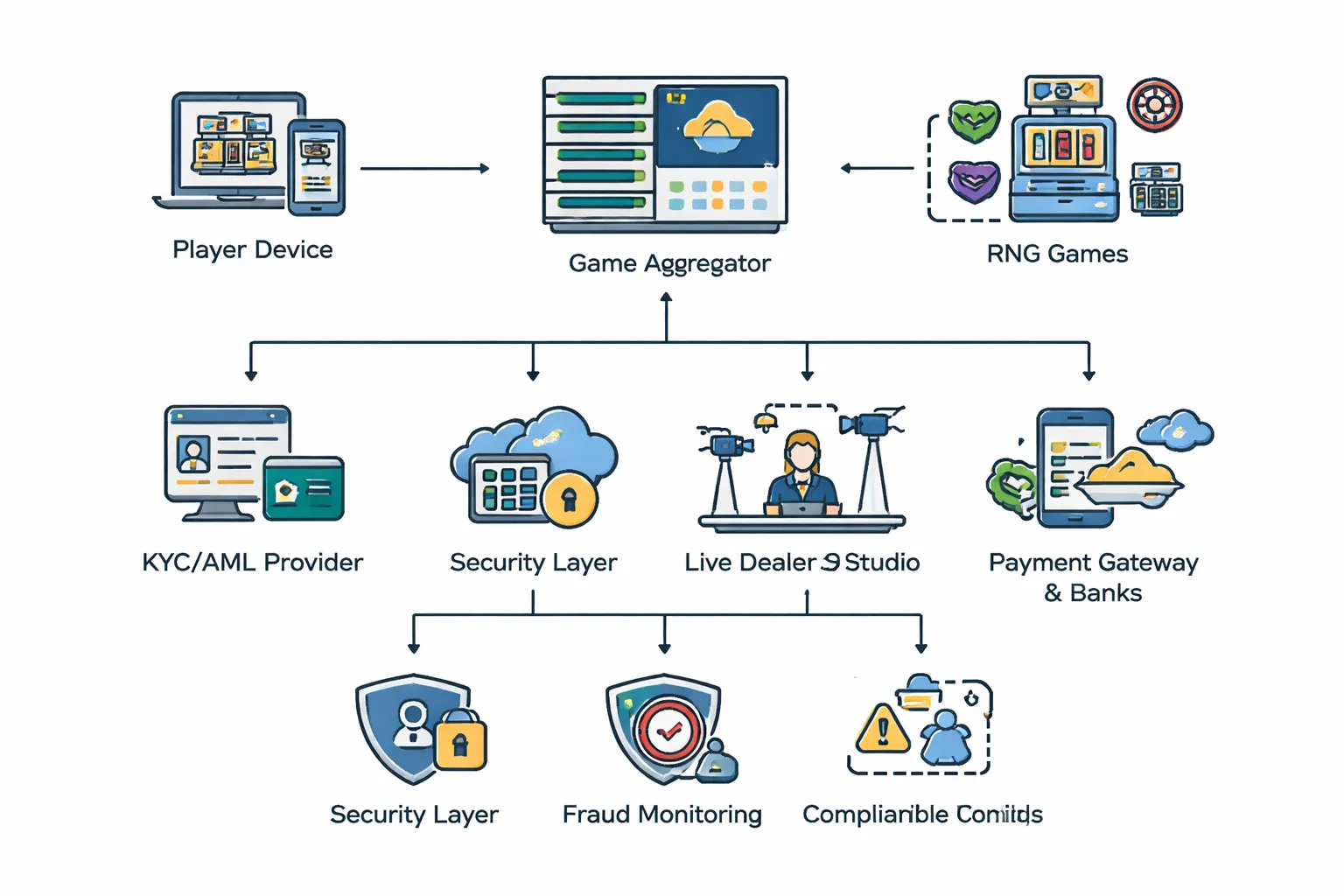
Casino software platforms and game aggregation
Most online casinos run on a platform. The platform handles your account, wallet, bonuses, limits, reporting, and compliance tools. The casino then connects to game providers through an aggregator or direct integrations.
- Platform, runs the site and back office.
- Game providers, build slots, table games, and live dealer products.
- Aggregator, pulls game catalogs into one feed and pushes them into the lobby.
- Lobby logic, decides what you see based on your country, device, and rules like bet limits.
That is why two casinos can show many of the same titles but still differ on availability, limits, and bonus eligibility.
RNG-based games, how randomness is generated and tested
Slots and most virtual table games use an RNG, a random number generator. The RNG produces a stream of numbers. Each spin or hand maps a number to an outcome, like reel stops or card order.
- RNG source, usually a software PRNG seeded from system entropy and internal state.
- Game math, a paytable and probability model that converts RNG output into wins and losses.
- Session events, the game records each bet, outcome, and balance change for audits and dispute handling.
Regulated markets require testing. Independent labs typically verify that the RNG behaves as expected, that outcomes match the published math model, and that the game does not change rules mid-session.
Live dealer gaming, streaming setup and dealing controls
Live dealer games run from a studio or a casino floor. You watch a video stream. You place bets in an interface. The studio runs strict procedures to keep dealing consistent.
- Streaming, multiple cameras, encoding, and low latency delivery to desktop and mobile.
- Game control unit, a device or system that captures results and feeds them to the game server.
- Result capture, card recognition, wheel sensors, or manual input with verification steps.
- Dealing procedures, shuffle policies, shoe changes, wheel checks, and incident logs.
Your bet locks at a cutoff time. The server confirms acceptance. The studio produces the outcome. The control unit records the result. The server settles the round and updates your balance.
If you want a deeper walkthrough of pacing, rules, and etiquette, see how live dealer casinos work.
RTP and house edge, simple examples
RTP, return to player, is the long-run percentage a game pays back across many bets. House edge is what stays with the house, also in the long run.
- RTP, expected return to you over time.
- House edge, 100% minus RTP.
| Game RTP | House edge | What it means on $100 total bets |
|---|---|---|
| 96% | 4% | About $96 returned, about $4 kept, on average over many bets |
| 99% | 1% | About $99 returned, about $1 kept, on average over many bets |
RTP does not predict short sessions. Variance and hit frequency drive how results feel. Two games can share the same RTP and still play very differently.
Player accounts, KYC verification, and age or location checks
When you register, the platform creates an account record and a wallet. Before you withdraw, and often before you deposit, the casino runs KYC, know your customer. KYC helps confirm identity, age, and funding legitimacy.
- Identity checks, name, date of birth, address, and document verification.
- Age checks, blocks underage play, may require database validation.
- Location checks, IP, GPS on mobile where required, and payment country signals.
- Risk scoring, flags unusual signups, linked accounts, and bonus abuse patterns.
If your details do not match your documents or payment method, expect delays. Keep your account info accurate before you deposit.
Payments infrastructure, deposits, withdrawals, settlement, and chargebacks
Online casinos connect to payment processors and banks through gateways. The platform tracks balances and triggers payouts. Your method affects speed and fees.
- Deposits, card payments authorize fast, bank transfers can take longer, e-wallets often clear quickly.
- Withdrawals, casinos review for KYC, fraud signals, and bonus terms before approval.
- Settlement times, card payouts often take days, e-wallet payouts can be faster, bank wires vary by country.
- Chargebacks, cardholders can dispute charges, casinos respond with logs and verification data.
Many casinos require you to withdraw back to the same method you used to deposit, when possible. This supports fraud prevention and AML rules.
Security stack, SSL or TLS, encryption, fraud monitoring, and account protection
A serious casino treats security as a layered system. You see some parts. Most run in the background.
- SSL or TLS, encrypts traffic between your device and the casino servers.
- Encryption at rest, protects stored sensitive data like documents and identifiers.
- Access controls, staff permissions, audit logs, and change tracking.
- Fraud monitoring, device fingerprinting, velocity checks, and behavior analytics.
- Account protection, strong password rules, login alerts, and 2FA where offered.
You reduce risk by using a unique password, enabling 2FA, and avoiding shared devices. You also reduce disputes by keeping deposit receipts and verification records.
Compliance tooling, AML checks, geo-blocking, and responsible gambling
Regulated casinos run compliance systems that enforce the rules of the license and the markets they serve. These systems often trigger reviews without warning.
- AML checks, source of funds reviews, transaction monitoring, and sanctions screening.
- Geo-blocking, blocks restricted regions using IP, GPS where required, and network risk signals.
- Responsible gambling, deposit limits, timeouts, self-exclusion, and reality checks.
- Bonus compliance, wagering tracking, max bet rules, and restricted games lists.
If the casino blocks you after signup, it often comes from location signals, payment country mismatch, or policy restrictions tied to the license.
Online Casino Games Explained (What You’ll Find in the Lobby)
Slots
Slots dominate most lobbies. They look simple, but the settings change your risk and your results.
- Paylines and ways to win. Older slots use fixed paylines. Newer games often use “ways” systems or clusters. More lines or ways usually means more frequent small wins, not better long-term value. Your bet often scales with the number of lines or the stake level you pick.
- Volatility. Low volatility pays smaller wins more often. High volatility pays less often, but wins can spike. High volatility also increases bankroll swings. It raises your risk of long losing streaks.
- Bonus features. Free spins, multipliers, expanding symbols, re-spins, and “buy bonus” options shift where payouts land. Many games push most value into the bonus round. Bonus buys create faster variance and higher loss speed if you chase features.
- Jackpots inside slots. Some slots include fixed jackpots. Others connect to progressives. Progressives usually trade some base-game return for jackpot funding.
- Risk check for your session. If you want steadier play, pick lower volatility and smaller bet sizes. If you want bigger top-end outcomes, expect fewer hits and longer droughts.
Table Games (Blackjack, Roulette, Baccarat)
Table games sit closer to fixed rules. Small rule changes can shift the house edge and your expected loss rate.
- Blackjack. Common variations include number of decks, dealer stands or hits on soft 17, double rules, resplitting limits, surrender, and whether blackjack pays 3:2 or 6:5. The 6:5 payout is a major downgrade. Side bets often carry a higher house edge than the main game.
- Roulette. The key difference is wheel type. European has one zero. American has zero and double zero, which increases the house edge. Some lobbies add “triple zero” variants. Many games offer “racetrack” or “neighbors” bets, they change bet structure, not the math in your favor.
- Baccarat. The core bets are Banker, Player, and Tie. Banker usually has the lowest house edge, but casinos take a commission, often 5 percent, on Banker wins. Tie bets tend to have a high house edge. Some variants change rules around drawing or commission to speed up play.
Live Dealer Tables
Live dealer games stream real tables from studios. You place bets through an interface. Results follow physical cards and wheels, not an RNG.
- Limits and pace. Live tables often have higher minimum bets than RNG versions, but some studios run low-limit tables. Games move on a timer. If you miss the betting window, you sit out the round.
- Game etiquette. Do not spam chat. Keep messages short. Do not ask the dealer to change procedures. The dealer follows studio rules and camera controls. If you play blackjack, act before the timer ends so you do not slow the table.
- Realism vs RNG tables. Live adds human dealing and physical outcomes. RNG tables offer faster play, more bet sizes, and features like auto-spin and quick rebet. Learn the core differences in live dealer vs RNG casino games.
- Game show titles. Many lobbies include wheel and multiplier games. They feel like live entertainment, but the math still comes from preset payout tables and multipliers.
Video Poker and Specialty Games
Video poker looks like slots, but the paytable drives the return. Two games that look identical can play very differently.
- Paytables set expected value. Small changes, like a lower payout for full house or flush, reduce long-term return. Always open the paytable before you play. If the casino hides it, treat that as a warning sign.
- Best-play matters. Video poker rewards correct decisions. Wrong holds and discards lower your return fast. Slots do not have that decision layer.
- Common specialty games. Keno, scratch cards, coin-flip titles, and instant-win games usually publish fixed odds and payout tables. They can run fast and burn bankroll quickly if you raise stakes without tracking loss rate.
Jackpots (Fixed vs Progressive)
Jackpots come in two main types. The difference changes how the prize grows and how often it hits.
- Fixed jackpots. The top prize stays at a set number. The game pays it when you hit the required combination. Funding comes from the game’s built-in payout structure.
- Progressive jackpots. The jackpot increases as players wager. A portion of each qualifying bet contributes to the pool. The contribution rate varies by game and network. Many progressives require a minimum bet to qualify.
- Network vs local progressives. Network jackpots pool wagers across many casinos or many games. Local progressives grow only inside one casino or one game group.
- What it means for your risk. Progressives add a high-variance outcome. You trade more frequent mid-size returns for a small chance at a large hit.
Demo Mode and Practice Play
Demo mode lets you test games without money risk. It helps with mechanics, not results.
- What you can learn. Rules, bonus triggers, betting controls, autoplay settings, game speed, and whether you like the volatility feel. You can also check the paytable, max win info, and bonus buy cost if offered.
- What you cannot learn. You cannot prove a game is “hot” or predict future outcomes. Short demo sessions do not tell you real variance. Demo mode can also differ from real play if the casino applies different jurisdiction settings, bet limits, or bonus restrictions.
- Practical tip. Use demo to set your session plan, stake size, and stop points before you deposit.
Bonuses and Promotions: How They Work and How to Evaluate Them
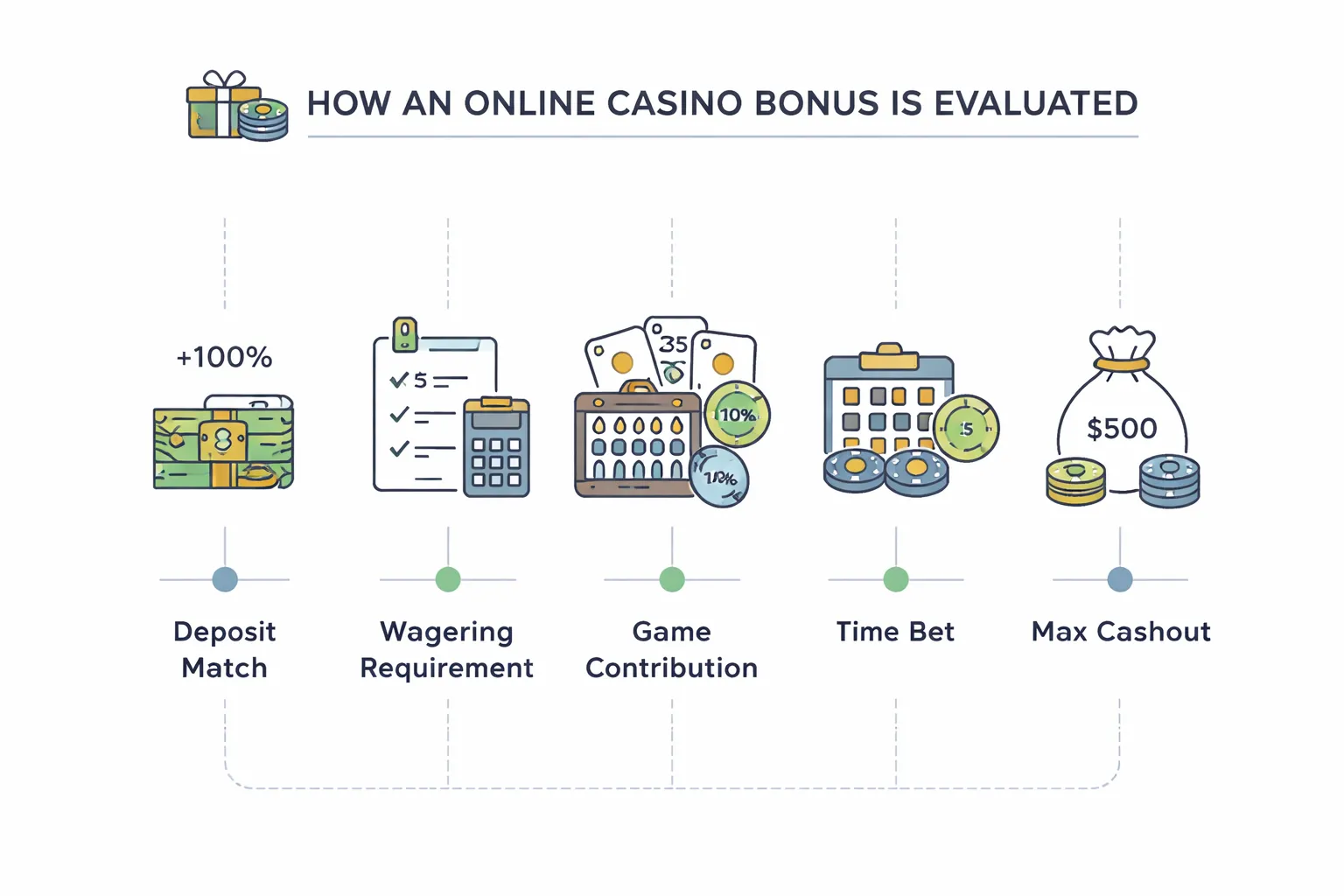
Bonuses and Promotions: How They Work and How to Evaluate Them
Casino bonuses look simple. Terms decide your real value. Read the bonus box, then open the full terms. Save screenshots of the offer page and your bonus confirmation.
Welcome offers: match bonuses, free spins, and tiered packages
Welcome offers usually combine a deposit match and free spins. Some split the package across your first two to five deposits. Your goal is to map the full path, cost, and limits before you claim.
- Match bonus. The casino adds a percentage of your deposit as bonus funds. Example, deposit $100, get 100% match, receive $100 bonus.
- Free spins. Spins apply to specific slots and fixed bet sizes. Winnings often convert to bonus funds with wagering.
- Tiered packages. Each deposit has its own rules. The first deposit may have higher match and lower restrictions. Later deposits often carry higher wagering or shorter time limits.
Check deposit minimums per tier, allowed payment methods, and whether you must opt in each step. Some casinos require a new claim button for each deposit.
No-deposit bonuses: typical caps, verification requirements, and restrictions
No-deposit bonuses trade convenience for tight limits. Expect small value and strict cashout rules.
- Max cashout. Commonly capped. You may win more, but you can only withdraw up to the cap.
- Verification. Many casinos require full ID checks before withdrawal. Some also require a first deposit.
- Restricted games. Often slots only. Live dealer and table games usually exclude.
- Country and device limits. Some offers apply only to specific regions or to new app installs.
If you want a low-risk test, compare these rules with low minimum deposit options. Use low deposit casinos to reduce upfront cost without heavy no-deposit restrictions.
Reloads, cashback, insurance, and loss-back promos: how value is calculated
These promos look like steady value. The math depends on what counts as qualifying play.
- Reload bonus. Works like a smaller welcome match. Value depends on match rate, max bonus, and wagering.
- Cashback. Usually a percentage of net losses over a period. Many casinos calculate by game category and exclude bonus play.
- Insurance. Often credits a portion of losses from a specific game or session type. It may pay as bonus funds, not cash.
- Loss-back. Similar to cashback but tied to a specific day, tournament, or mission. Check if it triggers only after you hit a play target.
| Promo type | What to check | What changes value most |
|---|---|---|
| Reload | Deposit minimum, max bonus, wagering, time limit | Wagering multiple and max bet |
| Cashback | Net loss formula, excluded games, payout form | Whether it pays as cash or bonus |
| Insurance | Eligible games, session limits, trigger rules | Caps and wager requirements on the credit |
| Loss-back | Qualifying window, opt-in, play targets | Whether losses from bonus play count |
VIP and loyalty programs: comp points, tiers, and benefits that matter
Loyalty programs reward volume. Many players overpay for points. Focus on benefits that reduce friction and improve withdrawals.
- Comp points. You earn points per wagered amount. Check conversion to cash and whether conversion has fees or minimums.
- Tiers. Higher tiers may improve withdrawal limits, processing speed, and support access. These matter more than gifts.
- Benefits that matter. Higher withdrawal caps, faster payouts, fewer document rechecks, better cashback terms, and clear host communication.
Ask how points accrue on low edge games versus slots. Some programs award fewer points on table games and live dealer.
Referral and affiliate-linked promos: eligibility rules and pitfalls
Referral deals can pay cash or bonus credits. They also create account flags if you break rules.
- Same household rules. Many casinos block referrals from the same IP, device, address, or payment method.
- Minimum activity. Your friend may need to deposit, wager, and complete verification before either of you qualify.
- Promo stacking limits. Referral rewards may not combine with welcome bonuses or may delay withdrawal until you finish wagering.
If a casino ties the referral to an affiliate code, read the eligibility line. Some codes exclude certain countries or payment methods.
Bonus terms that change everything: wagering, max bet, max cashout, time limits
These four terms decide whether a bonus helps you or traps you.
- Wagering. You must bet a multiple of the bonus, the deposit, or both. Example, $100 bonus with 35x bonus wagering means $3,500 in bets before withdrawal.
- Max bet. Casinos cap your stake while bonus funds stay active. If you exceed it, they can void winnings.
- Max cashout. Some bonuses cap the amount you can withdraw from bonus winnings, even after wagering.
- Time limits. Deadlines often run 3 to 30 days. If time expires, the casino removes bonus funds and related winnings.
| Term | Where you find it | What you should do |
|---|---|---|
| Wagering | Bonus terms, cashier, promo page | Compute total required bets before you claim |
| Max bet | Bonus rules, wagering section | Set your bet limit in the game and do not exceed it |
| Max cashout | Promo page fine print | Skip the bonus if the cap ruins your upside |
| Time limit | Bonus email, account bonus panel | Only claim when you can finish play in time |
Game contribution and excluded games: why some bets don’t count fully
Casinos assign contribution rates to games. A 100% slot contribution means each $1 wager counts as $1 toward wagering. A 10% contribution means each $1 wager counts as $0.10. Some games count as 0% and do not help at all.
- Slots. Often 100%, but not always. Some high RTP slots count less.
- Table games. Often 0% to 20%.
- Live dealer. Commonly excluded or very low contribution.
- Jackpots and bonus buys. Often excluded from wagering or restricted while a bonus stays active.
If you plan to play live games, check the excluded list first. Live play can burn through your bankroll without moving your wagering target.
Bonus abuse rules and disputes: what triggers confiscations and how to avoid them
Casinos enforce anti-abuse rules. They can remove bonus funds and winnings if they see patterns they classify as exploitation. You avoid most issues by keeping play simple and consistent with the terms.
- Max bet violations. The most common trigger. One oversized spin can void winnings.
- Irregular play patterns. Large stake jumps, low-risk hedging, or switching between opposite outcomes can trigger reviews, especially on table games.
- Multiple accounts. Same person, same household, or shared devices can lead to confiscation.
- Bonus stacking. Using overlapping promos against the rules, or claiming an offer you do not qualify for.
- Chargebacks and payment reversals. These often freeze accounts and void bonus winnings.
Protect yourself. Verify your account early. Use one payment method in your name. Keep copies of terms and chat logs. If a dispute starts, ask support to cite the exact rule and the specific bet history they rely on.
Legality, Licensing, and Regulation (What Players Need to Know)
How licensing works, and why jurisdiction matters
An online casino license ties the operator to a regulator. That regulator sets rules, audits compliance, and can fine or suspend the license.
Jurisdiction matters because rules and enforcement vary. Common licensing hubs include Malta and the UK. In the US, regulation often happens state by state. Each state regulator sets its own list of approved operators, games, and payment methods.
Check the footer of the casino site. You should see the license number and the regulator name. Verify it on the regulator website, not on the casino site.
- UK (UKGC). Strong consumer rules. Clear bonus and marketing standards. Formal dispute routes.
- Malta (MGA). Broad EU-facing licensing. Requires policies for player funds, complaints, and responsible gambling. Enforcement depends on the case and the operator.
- US state regulators. Tight market access. Strong payment controls. Clear tax and identity checks. Limited to approved states.
If a casino holds a license that does not cover your location, you carry more risk. A valid license means less if you cannot use the regulator in a dispute.
Regulated vs. unregulated casinos
Regulated casinos answer to a regulator. Unregulated casinos answer to themselves.
- Game fairness. Regulated sites must test RNGs and publish approved game providers. Unregulated sites can swap software, change terms, or run fake games.
- Player fund handling. Regulated sites must follow rules on how they hold player balances. Unregulated sites can delay or refuse withdrawals with limited consequences.
- Complaints and disputes. Regulated sites must offer a defined complaint path. Some markets require third-party dispute resolution. Unregulated sites often offer support chat only.
- Enforcement. Regulators can issue fines, force remediation, or revoke a license. With unregulated sites, you often have no practical leverage.
Before you deposit, confirm three items. A real license you can verify. Clear terms for withdrawals and bonuses. A track record you can cross-check in an independent review. Use this guide on how to read an online casino review to spot biased ratings.
Taxes and reporting basics
Tax rules depend on where you live and where the casino operates. Some places tax gambling winnings. Others tax only above certain thresholds. Some require the casino to report winnings. Others put the duty on you.
Do not assume withdrawals are tax-free. Keep your records.
- Save deposit and withdrawal receipts.
- Track wins and losses by session and by game.
- Store bonus terms you accepted and any changes shown in your account.
If your bank asks for source of funds, those records help. If your tax authority asks for proof, those records matter.
Advertising standards and bonus transparency
Reputable regulators set marketing rules. They target misleading bonuses, unclear wagering, and claims that hide limits.
- Clear key terms. Wagering requirements, max bet limits, eligible games, time limits, and withdrawal caps must appear before you claim.
- No deceptive “risk-free” language. Conditions must match the headline.
- Fair eligibility rules. Limits on countries, payment methods, and player types must be stated.
- Responsible gambling messaging. Self-exclusion and support links must be easy to find in regulated markets.
If a promo page hides key limits in deep links, or changes terms after you deposit, treat that as a warning sign. A serious operator makes the costs and constraints plain.
Safety Checklist: How to Choose a Trustworthy Online Casino
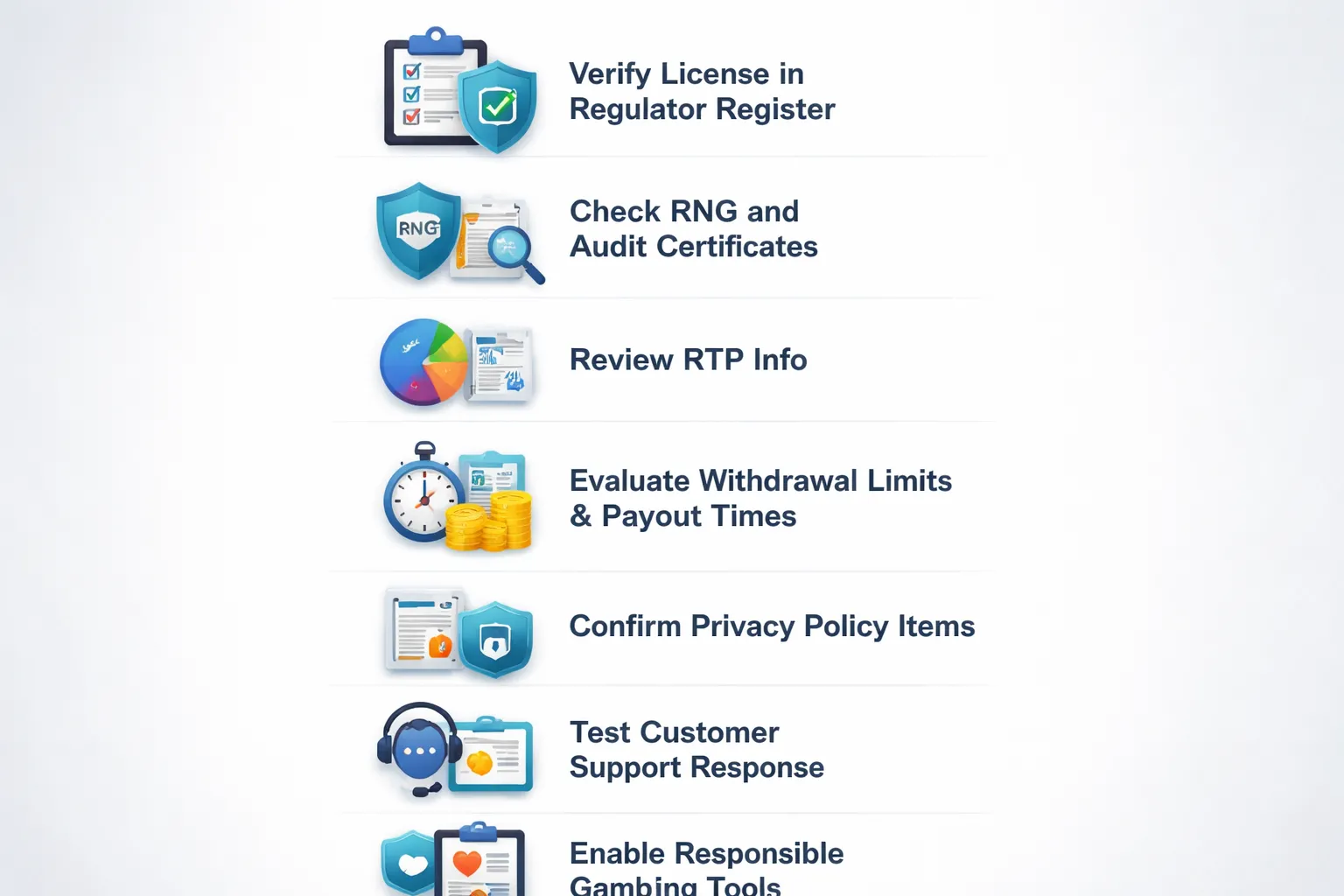
License verification steps
- Scroll to the footer. Find the license number, regulator name, and legal entity.
- Open the regulator link. It should lead to an official government or regulator domain, not a marketing page.
- Search the public register on the regulator site. Match the operator name, trading name, and license number.
- Check the status. It should show active, not suspended, revoked, or pending.
- Confirm the exact website domain appears on the license record. A license that covers a different domain does not protect you.
- Verify the company address and owner. Mismatched details signal a clone site.
Fairness signals
- Independent audits. Look for testing lab reports and seals, then confirm the lab exists and the certificate applies to the same domain.
- RNG certificates. Slots and virtual table games should show RNG testing and the date of the latest check.
- Published RTPs. Each slot should show its RTP in the game info panel or help file. Avoid casinos that hide RTPs or show only vague ranges.
- Game provider list. Recognized studios reduce risk. Unknown providers with no testing record raise it.
Reputation factors
- Find the operator group name. Search it, not just the casino brand.
- Check how long the brand has operated under the same owner and license.
- Read player complaints for patterns, not individual rants. Focus on delayed withdrawals, closed accounts after wins, and bonus term disputes.
- Look for clear dispute options. Regulated casinos usually point you to the regulator or an ADR process.
- If you want a framework, use how to read an online casino review to spot paid rankings and missing downsides.
Payment safety
- Withdrawal reliability. Read the cashier page for payout timeframes by method. “Up to” without specifics often means slow processing.
- Limits. Check minimum and maximum withdrawals, plus daily, weekly, and monthly caps. Low caps can trap balances.
- Fees. Look for withdrawal fees, conversion fees, and inactive account fees.
- KYC rules. Confirm what documents they request and when. A serious casino states that KYC can happen before first withdrawal.
- Method fit. Use payment methods you control. Avoid casinos that push only one obscure processor.
Privacy and data protection
- Read the privacy policy and terms in the footer. You should see the legal entity, contact details, and data controller information.
- Look for a clear list of data they collect, why they collect it, and who they share it with.
- Check retention periods. “We keep data as long as needed” without limits gives them room to store it indefinitely.
- Look for your rights, access, deletion, and objection, plus how to request them.
- Red flags. Selling data to “partners” without naming categories, unclear cross border transfers, or no security and breach process.
Customer support quality
- Availability. Prefer 24/7 live chat for real money play. Limited hours slow withdrawals and dispute handling.
- Channels. Live chat plus email. A phone line helps, but a ticket system with tracking matters more.
- Resolution standards. They should give a case number, timelines, and a written outcome. Vague replies signal weak escalation.
- Pre deposit test. Ask one specific question about withdrawals or bonus terms. Judge speed and clarity.
Responsible gambling tools
- Deposit limits. Set daily, weekly, or monthly caps inside your account.
- Loss limits and wagering limits. Strong casinos let you cap more than deposits.
- Timeouts. Short breaks you can activate fast, 24 hours to several weeks.
- Self-exclusion. A longer lock that blocks access and marketing. It should cover months and years, not just days.
- Reality checks. Session reminders that show time and spend.
- Support links. Clear links to problem gambling help groups and local resources.
Getting Started: Step-by-Step Guide to Playing at an Online Casino
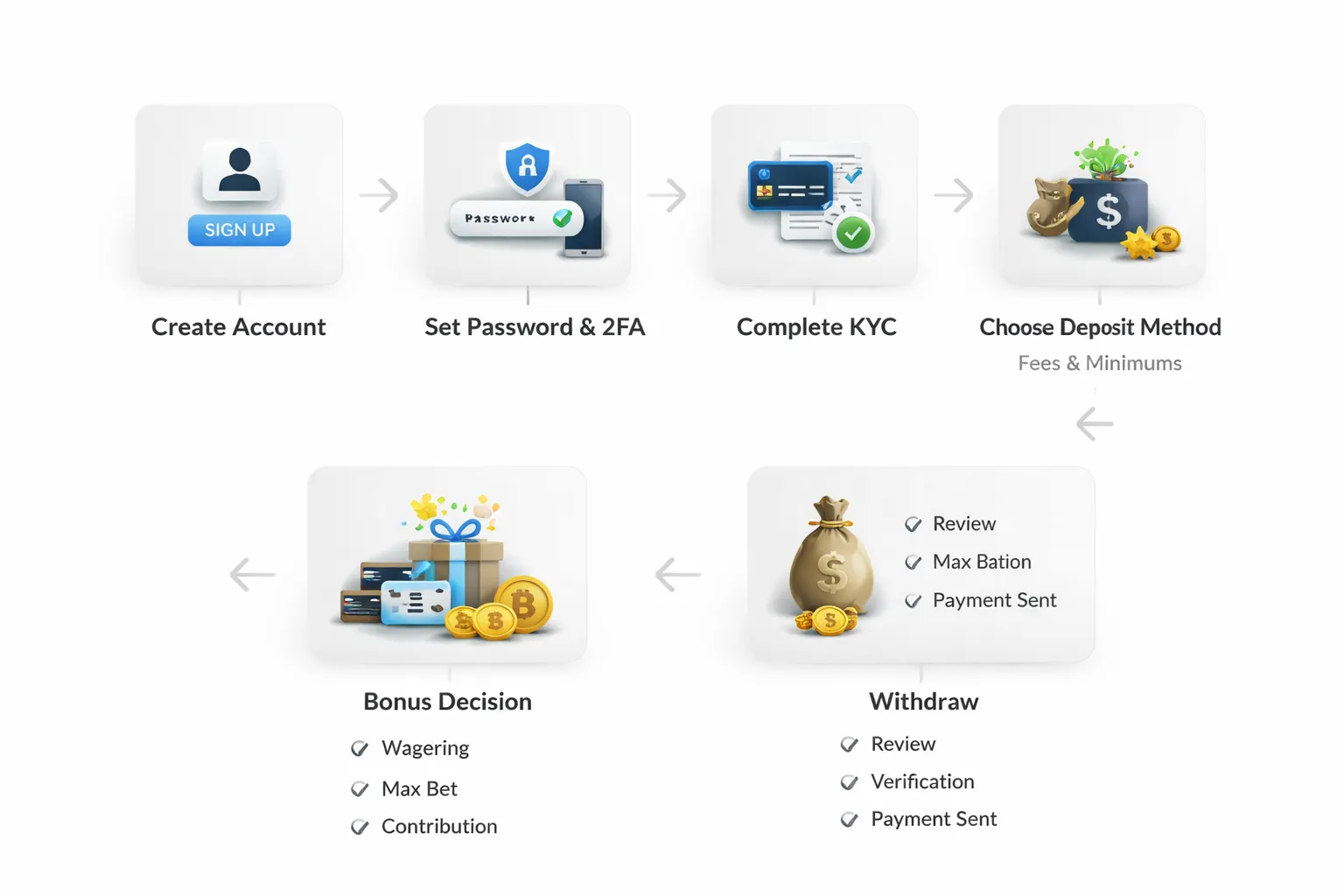
Account creation
- Use your real legal details. Match your name, date of birth, and address to your bank and ID records.
- Create a unique password. Use 12 to 16+ characters. Mix letters, numbers, and symbols. Do not reuse it.
- Turn on two-factor authentication if the casino offers it. Use an authenticator app when possible.
- Set your limits early. Deposit limit, loss limit, and session reminders reduce mistakes when you start playing.
- Save support contacts. If you need help later, use the casino’s official channels and bookmarked domain.
Identity verification (KYC)
Most licensed casinos verify identity to meet anti-fraud and anti-money laundering rules. You can often play before full verification, but withdrawals usually trigger checks.
- Common documents. Government photo ID, proof of address, and a payment method check.
- ID options. Passport, national ID card, or driver’s license. The photo and all corners must be visible.
- Proof of address. Utility bill, bank statement, or tax letter. Many casinos require it to be dated within 60 to 90 days.
- Payment verification. Card photo with middle digits covered, or an e-wallet account screenshot showing your name and email.
- Typical timelines. Many checks finish within 24 to 72 hours. Backlogs, unclear images, or mismatched details can push it to 5 to 10 business days.
Best practice, complete KYC before you deposit. It cuts withdrawal delays later.
Making a deposit
- Check minimums. Many casinos set minimum deposits from $10 to $20, some go lower. See low deposit online casinos if you want smaller minimums.
- Watch fees. Casinos often list deposits as free, but your bank, card issuer, or payment app can charge fees. Currency conversion can add 1% to 3% or more.
- Pick a method that matches your plan. Cards and instant bank transfer work fast. E-wallets can speed withdrawals. Crypto can be fast but adds price volatility and network fees.
- Deposit only what you can lose. Keep a separate budget. Do not chase losses with bigger deposits.
Claiming (or skipping) a bonus
Bonuses trade value for restrictions. Take them when the terms fit your game choice and withdrawal timeline. Skip them when they slow you down.
- Claim a bonus when you plan longer play sessions, you accept wagering requirements, and you play slots or eligible games.
- Skip a bonus when you want fast withdrawals, you mainly play table games, or the bonus limits your stake size and game choice.
| Bonus term | What it changes | What to check |
|---|---|---|
| Wagering requirement | How much you must bet before withdrawal | Total playthrough, time limit, and which games count |
| Max bet rule | How much you can stake per spin or hand | Exact cap, enforcement, and penalty for breaking it |
| Game contribution | How different games count toward wagering | Slots vs table games, live dealer exclusions |
| Withdrawal cap | How much you can cash out from bonus funds | Max cashout and whether winnings above the cap get removed |
Withdrawing winnings
- Expect verification triggers. First withdrawal, new payment method, large win, unusual deposit patterns, or a change in personal details can trigger review.
- Know the stages. Request submitted, internal review, KYC check, payment sent, provider settlement. Some casinos also batch payouts.
- Common delays. Incomplete KYC, address mismatch, blurry documents, pending chargebacks, bonus term disputes, or banking cut-off times.
- Reduce friction. Withdraw to a method in your name, keep one primary method, and avoid switching accounts mid-process.
- Track limits. Check minimum withdrawal, maximum per transaction, and daily or weekly caps. These rules affect how many payments you need.
If a payout timeline passes, contact support with your withdrawal ID and timestamps.
Pros, Cons, and Common Myths About Online Casinos
Advantages
- Game variety. You get slots, table games, live dealer tables, video poker, and jackpots in one place. You can switch games in seconds, without waiting for a seat.
- Promotions. Online casinos use bonuses, free spins, and cashback to acquire and keep players. These offers can add value if you read the rules and play within your limits.
- Flexible stakes. Many games offer low minimum bets. You can control session cost by lowering stake size, setting limits, and choosing lower volatility games.
- Accessibility. You can play on mobile or desktop, at any time. Deposits often support cards, bank transfer, and e-wallets, depending on your region.
Drawbacks
- Risk of overspending. Fast rounds, frictionless deposits, and constant offers can push you to chase losses. Use deposit limits, session limits, and timeouts before you start.
- Bonus complexity. Many offers include wagering requirements, game weighting, max bet rules, win caps, and time limits. Break one rule and you can lose bonus funds or winnings.
- Variable payout speeds. Some methods pay in minutes, others take days. Processing also depends on KYC checks, withdrawal limits, weekends, and bank cut-off times.
Common myths vs. reality
- Myth: Slots run hot or cold. Reality: Each spin is independent on RNG games. A long losing streak does not change the next result.
- Myth: A win is due. Reality: Probability does not “owe” you an outcome. Past results do not create a debt. Chasing losses usually increases risk.
- Myth: The casino can flip a switch on every spin. Reality: Legit casinos use certified RNGs and audited game builds. They can choose which games to offer and what RTP versions to host, but they do not control outcomes spin-by-spin on regulated platforms. Learn the difference between live dealer and RNG casino games because the tech and trust signals are not the same.
Understanding gambling risk
- Variance drives swings. RTP is a long-run average, not a short-session promise. High variance games can pay rarely and in bigger chunks, low variance games pay more often but smaller.
- Your bankroll will move. Normal outcomes include long stretches of losses, even on fair games. Plan for this with a fixed session budget and a stop point.
- Outcomes feel personal. Near-misses, streaks, and big wins trigger strong reactions. The math stays the same, but your brain searches for patterns and control. Stick to pre-set limits and avoid changing stakes to “get even.”
Responsible Gambling and Player Protection
Setting limits and bankroll rules that reduce harm
Use one rule, money you can lose without touching bills, rent, or debt payments. Treat that number as entertainment spend, not an investment.
- Set a session budget. Pick a fixed amount before you start. Stop when it is gone.
- Set a time cap. Use a timer. End the session when it rings.
- Set a loss limit. Choose a daily or weekly maximum loss. Do not raise it after a bad run.
- Set a win limit. Lock in wins. Cash out or stop when you hit it.
- Separate deposits from savings. Use a dedicated card or e-wallet with a small balance.
- Avoid chasing. Do not increase stakes to recover losses.
- Track net results. Log deposits, withdrawals, and losses. Net loss is what matters.
Bonuses can blur your real spend. Read wagering rules and expiry dates. If you feel pressure to keep playing to “clear” a bonus, skip it.
Recognizing problem gambling signs and when to seek help
Act early. Waiting usually raises the cost.
- You spend more than planned. You break your limits and keep going.
- You chase losses. You raise stakes or deposit again to get back to even.
- You hide play. You lie about time or money spent.
- You borrow or sell to gamble. You use credit, loans, or payday advances.
- You feel withdrawal. You get restless or irritable when you stop.
- You lose control of time. Sessions run longer than you intended, often late at night.
- Your life takes the hit. Work, study, sleep, and relationships suffer.
Seek help if you recognize these patterns, if you feel urges you cannot manage, or if gambling causes financial stress. If you feel unsafe or at risk of self-harm, contact local emergency services now.
Tools casinos should provide: cool-offs, exclusions, and affordability checks
Use operator tools. A good casino makes them easy to find, easy to set, and hard to override.
- Deposit limits. Daily, weekly, and monthly caps. Changes should apply after a delay.
- Loss limits. Stops play when you hit your maximum loss.
- Wager limits. Caps stake size per bet.
- Session limits. Ends play after a set time.
- Reality checks. On-screen prompts that show time played and net results.
- Cool-off periods. Short breaks, such as 24 hours to several weeks.
- Self-exclusion. Longer blocks, often months to years. It should cover both casino and sportsbook if offered.
- Account controls. Disable bonuses, marketing, and notifications.
- Affordability checks. Extra verification when spend patterns spike or risk flags appear. Legit operators may ask for income proof, bank statements, or source of funds details.
Self-exclusion works best when you apply it across operators. In many regions you can use a national scheme. Also block payments to gambling merchants through your bank, and use device blocking software.
Where to get support: guidance and reputable help resources by region
Start with two steps. Tell one trusted person what is happening, then put a hard barrier in place, self-exclusion and payment blocks.
- United States: National Council on Problem Gambling, 1-800-522-4700, ncpgambling.org. Crisis support, call or text 988, 988lifeline.org.
- Canada: ConnexOntario, 1-866-531-2600, connexontario.ca. Also check your province for free problem gambling programs.
- United Kingdom: GAMSTOP, gamstop.co.uk. GamCare, 0808 8020 133, gamcare.org.uk. National Gambling Helpline via GamCare.
- Ireland: Gamblers Anonymous Ireland, gamblersanonymous.ie. For urgent crisis support, contact your local emergency services.
- Australia: Gambling Help Online, 1800 858 858, gamblinghelponline.org.au.
- New Zealand: Gambling Helpline, 0800 654 655, gamblinghelpline.co.nz.
- Europe (varies by country): GamCare and national health services where available. If your casino is licensed, the regulator site usually lists approved support services.
- Global directories: Gamblers Anonymous, gamblersanonymous.org. BeGambleAware has tools and signposting, begambleaware.org.
If you need help understanding your legal protections, your regulator matters. Use our Are online casinos legal? guide to find the rules for your state or country.
Frequently Asked Questions
What is an online casino?
An online casino is a gambling site or app that lets you play casino games for real money or for free. You create an account, verify your identity, deposit funds, play games, and request withdrawals. Licensed casinos must follow rules on fairness, security, and player protection.
How do online casinos make games fair?
RNG games use certified random number generators. Labs test math models and payout rates, then issue reports. Live dealer games use studio controls, camera coverage, and game logs. You can check the casino footer for the testing lab and license details.
Are online casinos legal where I live?
Rules depend on your country, state, or province. Some places license and regulate online casinos, others ban them, and some allow offshore sites with limits on protections. Use our legal guide for your state or country to confirm your options.
How do deposits and withdrawals work?
You deposit with cards, bank transfer, e-wallets, prepaid vouchers, or crypto where allowed. Withdrawals go through the same or an approved method. Casinos run security checks before paying out. Processing time depends on your payment method and verification status.
Why do online casinos ask for ID?
They verify identity to meet KYC and anti-money laundering rules. You usually provide a photo ID, proof of address, and sometimes proof of payment method. Verification helps prevent fraud, stops underage play, and reduces chargebacks. It can also speed up withdrawals later.
What games can you play at online casinos?
Most sites offer slots, blackjack, roulette, baccarat, video poker, and specialty games. Many also offer live dealer tables with real dealers streamed from studios. Game availability varies by location, license, and software providers. Some games may have different rule sets.
What is a casino bonus and what are wagering requirements?
A bonus gives you extra credits, free spins, or cash back. Wagering requirements tell you how much you must bet before you can withdraw bonus funds. Example, 30x on a $50 bonus means $1,500 in bets. Always check max bet rules and game contribution.
Can you win real money at online casinos?
Yes, if you play with real money and follow the casino rules. Your long-term results depend on game house edge and your decisions. Slots use fixed RTP ranges, table games depend on rules and strategy, and bonuses change expected value through wagering limits.
How do you spot a safe online casino?
Check for a valid gambling license, clear terms, and strong account security. Look for HTTPS, 2FA options, and reputable payment methods. Confirm independent game testing and a working dispute process through the regulator. Avoid sites with unclear withdrawal terms or hidden limits.
What should you do if you think you have a gambling problem?
Use deposit limits, loss limits, timeouts, and self-exclusion tools. Block access with device or payment controls where available. Contact support services listed by your regulator. You can also use global directories like Gamblers Anonymous and BeGambleAware for help and referrals.
Conclusion
Conclusion
An online casino lets you place real money bets on digital versions of casino games. The site handles payments, runs games through RNG or live dealers, tracks your balance, and applies bonus rules.
Your results still depend on probability. Casino games run on a house edge. RNG games use audited math. Live games add real-time dealing, plus streaming and table limits.
Bonuses can help your bankroll, but they come with conditions. Always check wagering requirements, game contributions, max bet rules, time limits, and withdrawal caps before you claim.
Safety comes from licensing, independent testing, clear terms, and secure payments. Avoid casinos that hide limits, delay withdrawals, or change rules midstream.
Your final step before you deposit, read your key terms in this order, then act.
- License and regulator, confirm the site lists them and matches your location.
- Payout and limits, check withdrawal methods, fees, minimums, and maximums.
- Bonus terms, confirm wagering, eligible games, max bet, and expiry.
- Game fairness, look for RNG testing reports and provider names.
- Responsible tools, set deposit and time limits before your first session.
If you want a smaller first commitment, start with low deposit online casinos and keep your limits on from day one.
-
- Casino software platforms and game aggregation
- RNG-based games, how randomness is generated and tested
- Live dealer gaming, streaming setup and dealing controls
- RTP and house edge, simple examples
- Player accounts, KYC verification, and age or location checks
- Payments infrastructure, deposits, withdrawals, settlement, and chargebacks
- Security stack, SSL or TLS, encryption, fraud monitoring, and account protection
- Compliance tooling, AML checks, geo-blocking, and responsible gambling
-
- Bonuses and Promotions: How They Work and How to Evaluate Them
- Welcome offers: match bonuses, free spins, and tiered packages
- No-deposit bonuses: typical caps, verification requirements, and restrictions
- Reloads, cashback, insurance, and loss-back promos: how value is calculated
- VIP and loyalty programs: comp points, tiers, and benefits that matter
- Referral and affiliate-linked promos: eligibility rules and pitfalls
- Bonus terms that change everything: wagering, max bet, max cashout, time limits
- Game contribution and excluded games: why some bets don’t count fully
- Bonus abuse rules and disputes: what triggers confiscations and how to avoid them
-
- What is an online casino?
- How do online casinos make games fair?
- Are online casinos legal where I live?
- How do deposits and withdrawals work?
- Why do online casinos ask for ID?
- What games can you play at online casinos?
- What is a casino bonus and what are wagering requirements?
- Can you win real money at online casinos?
- How do you spot a safe online casino?
- What should you do if you think you have a gambling problem?
-
- Casino software platforms and game aggregation
- RNG-based games, how randomness is generated and tested
- Live dealer gaming, streaming setup and dealing controls
- RTP and house edge, simple examples
- Player accounts, KYC verification, and age or location checks
- Payments infrastructure, deposits, withdrawals, settlement, and chargebacks
- Security stack, SSL or TLS, encryption, fraud monitoring, and account protection
- Compliance tooling, AML checks, geo-blocking, and responsible gambling
-
- Bonuses and Promotions: How They Work and How to Evaluate Them
- Welcome offers: match bonuses, free spins, and tiered packages
- No-deposit bonuses: typical caps, verification requirements, and restrictions
- Reloads, cashback, insurance, and loss-back promos: how value is calculated
- VIP and loyalty programs: comp points, tiers, and benefits that matter
- Referral and affiliate-linked promos: eligibility rules and pitfalls
- Bonus terms that change everything: wagering, max bet, max cashout, time limits
- Game contribution and excluded games: why some bets don’t count fully
- Bonus abuse rules and disputes: what triggers confiscations and how to avoid them
-
- What is an online casino?
- How do online casinos make games fair?
- Are online casinos legal where I live?
- How do deposits and withdrawals work?
- Why do online casinos ask for ID?
- What games can you play at online casinos?
- What is a casino bonus and what are wagering requirements?
- Can you win real money at online casinos?
- How do you spot a safe online casino?
- What should you do if you think you have a gambling problem?
-
Online Casino Licensing Explained: Authorities, Licenses & How to Check One
3 weeks ago -
Best Live Dealer Casinos: Where to Play Live Blackjack, Roulette & More
3 weeks ago -
Best Online Casinos for High Rollers: VIP Perks, High Limits & Exclusive Bonuses
3 weeks ago -
Fast Payout Online Casinos: Best Sites for Quick Withdrawals
3 weeks ago -
Are Online Casinos Legal? Complete Guide by State & Country
4 weeks ago
-
Best Online Casinos for Blackjack: Best Tables, Rules & Bonuses
4 weeks ago -
Online Casino Bonuses Explained: How They Work + Terms You Must Know
4 weeks ago -
Fast Payout Online Casinos: Best Sites for Quick Withdrawals
3 weeks ago -
Online Casino Licensing Explained: Authorities, Licenses & How to Check One
3 weeks ago -
Best Online Casinos for Roulette: Best Wheels, Limits & Live Options
4 weeks ago