Best Low Deposit Online Casinos: Play for Less with Small Minimum Deposits

Low deposit online casinos let you start with a small minimum deposit, often $1, $5, or $10. You control your spend and test a casino before you commit more money. This guide shows you the best low deposit casinos, what their minimums are, and which payment methods support small deposits.
You will learn how to compare casinos on real criteria, including license and security, game range, bonus terms, wagering requirements, withdrawal speed, and deposit and cashout limits. You will also see how low deposit bonuses work, where they help, and where they add risk through strict playthrough rules. If you need the basics first, read our online casino guide.
- In het kort: Low deposit casinos let you start with $1 to $10, but the small buy-in does not reduce the need for strict checks.
- Pick licensed casinos with clear ownership, published security info, and fair game providers.
- Compare deposit methods that support small amounts, including cards, e-wallets, bank transfer, and crypto where legal.
- Read the bonus terms first. Focus on wagering requirements, max bet rules, game weighting, and time limits.
- Track limits. Look at minimum deposit, minimum withdrawal, max cashout, and daily or weekly withdrawal caps.
- Prioritize fast payouts. Check typical withdrawal times, KYC steps, and fee policy before you deposit.
- Use a low deposit to test the casino, support response, verification flow, and withdrawal process with less risk.
- If you need the basics on how casinos work and what to check, use our online casino guide.
Best Low Deposit Online Casinos (Top Picks for Small Minimum Deposits)
Quick comparison, low deposit casinos
Use this table to pick a site that fits your bankroll and your payout needs. Treat the welcome bonus as secondary. Banking and withdrawal rules matter more on small deposits.
| Casino (pick) | Min deposit | Welcome bonus (typical) | Wagering (typical) | Withdrawal time (typical) | Licenses (common) |
|---|---|---|---|---|---|
| Borgata Casino | $5 to $10 | Up to $1,000 match | 10x to 25x | Same day to 2 business days | NJ DGE |
| BetMGM | $10 | Up to $1,500 match | 10x to 25x | Same day to 2 business days | NJ DGE, PA PGCB, MI MGCB, WV, others |
| DraftKings Casino | $5 to $10 | Deposit bonus or casino credits | 1x to 15x, offer dependent | Same day to 2 business days | NJ DGE, PA PGCB, MI MGCB, WV, others |
| Caesars Casino | $10 | Up to $1,000 match | 10x to 25x | Same day to 3 business days | NJ DGE, PA PGCB, MI MGCB, WV, others |
| FanDuel Casino | $10 | Deposit match, offer varies | 10x to 25x | Same day to 2 business days | NJ DGE, PA PGCB, MI MGCB, WV, others |
| BetRivers | $10 | Up to $500 match | 10x to 25x | Same day to 2 business days | Multiple US regulators, state dependent |
| Stake.us | Varies, often low | Social promos, drop based | Promo dependent | Fast, method dependent | Not a regulated real money casino |
| Crypto casino (offshore) | $1 to $10+ | High match, high wagering | 30x to 50x+ | Minutes to 24 hours after KYC | Curaçao, Anjouan, other offshore |
Note: Minimum deposits, bonus terms, and withdrawal times change by state, payment method, and account status. Always check the cashier page and the bonus T and C before you deposit.
Best for $1 to $5 deposits
Your best option at $1 to $5 depends on where you live.
- If you play in a regulated US state: many top brands start at $5 for ACH, PayPal, or online banking, but some methods require $10. Use $5 to test deposits, limits, and support response.
- If you play offshore: you can often deposit $1 to $5 by crypto. You get low entry, but you take on higher risk, tougher bonus wagering, and stricter cashout rules.
- If you want low risk testing: skip the bonus on your first small deposit. A $5 deposit with no bonus gives you cleaner withdrawals.
Pick $1 to $5 deposits when you want to check KYC, withdrawal limits, and game availability before you scale up. If you need help confirming what is legal where you live, use our guide to online casino legality by state and country.
Best for $10 deposits
$10 deposits give you the best mix of bonus access and payment options. More casinos set $10 as the default floor for cards, PayPal, and branded wallets.
- Best balance: BetMGM, Caesars, DraftKings, FanDuel, and BetRivers usually pair a $10 deposit with solid game libraries and stable banking.
- Best for straightforward withdrawals: use the same method for deposit and withdrawal when possible. Casinos often force this to reduce fraud.
- Best way to use $10: place it on low volatility slots or low edge table games only if the bonus allows it. Many bonuses cap table game contribution at 0 to 20 percent.
On a $10 bankroll, avoid high wagering offers unless the bonus has clear, short playthrough and realistic max cashout rules.
Best for fast cashouts on small deposits
Fast withdrawals come from two things, clean verification and a payout friendly method.
- Fastest in regulated markets: PayPal, online banking, and ACH usually beat cards. Some brands process ewallet cashouts the same day once you are verified.
- Verification expectations: expect ID, proof of address, and sometimes a payment ownership check. Do this early, before you try to withdraw.
- Small deposit trap: watch minimum withdrawal rules. Some casinos set a $20 to $50 minimum cashout. Your $10 win can get stuck until you build balance.
- Fee check: most regulated casinos charge no withdrawal fee, but your bank or wallet can. Crypto networks always charge a miner fee.
If you want speed, deposit only after you confirm the minimum withdrawal, typical approval time, and whether the casino requires a first withdrawal review.
Best for mobile play with low deposits
Mobile matters more on small deposits. You need fast loading, stable login, and a clean cashier flow.
- What to look for: instant game loading, search that works, filters by provider and feature, and one tap access to limits and transaction history.
- Payment UX checks: clear min deposit per method, clear fees, and a simple path to set deposit limits.
- Best pick profile: big regulated brands usually deliver the smoothest mobile cashier and the fewest failed deposits.
Test mobile with your smallest deposit first. Make one deposit, play a short session, then request a small withdrawal if the casino allows it.
Best for crypto low deposits
Crypto can unlock $1 to $10 deposits, but you need to manage fees and price swings.
- Fees: use low fee networks for small deposits. Avoid high fee chains when your bankroll is tiny. A network fee can wipe out your edge.
- Confirmations: deposits can take minutes or longer depending on the chain and congestion. Withdrawals can also queue for manual review.
- Volatility: use stablecoins if the casino supports them. You reduce bankroll drift between deposit and withdrawal.
- Bonus reality: offshore crypto bonuses often carry 30x to 50x wagering and max cashout caps. Read both before you opt in.
If you plan to cash out small wins, prioritize low minimum withdrawals and clear KYC rules. Crypto does not always mean no verification.
Editors’ methodology, how we test low deposit casinos
- Bonuses: we read the full terms, wagering, game contribution, max bet rules, max cashout caps, and time limits. We score offers lower when a small deposit cannot realistically clear wagering.
- Banking: we check minimum deposit by method, minimum withdrawal, payout limits, and whether the casino supports the same path back for withdrawals. We also check fee disclosures.
- Payout speed: we measure typical approval time and method delivery time. We note first withdrawal delays and any extra steps.
- Game fairness: we verify licensed oversight for regulated markets. For offshore sites, we look for third party RTP and RNG audit signals, then we score conservatively.
- Support: we test live chat and email for response time, clarity, and resolution. We ask basic banking and bonus questions and track consistency.
What “Low Deposit” Means in Online Casinos (And What It Doesn’t)
Typical minimum deposit ranges by region and operator type
“Low deposit” usually means you can fund your account with $1 to $20. The exact floor depends on regulation, payment rails, and operator policy.
| Market | Regulated operators, typical minimum | Offshore operators, typical minimum | Common reasons |
|---|---|---|---|
| US regulated states | $10 to $20 | N/A | Banking fees, KYC checks, operator risk controls |
| Canada | $10 to $20 | $10 to $25 | Card and e-wallet processing costs |
| UK | £5 to £10 | N/A | Operator standards, responsible gaming tooling |
| EU (common regulated markets) | €5 to €10 | €10 to €25 | PSP rules, bonus compliance |
| Crypto-first casinos | Varies by license | $1 to $20 | Lower payment friction, but network fees can apply |
One more reality check. A casino can advertise a $5 deposit, then set higher minimums on the payment method you actually use. Always confirm the minimum for your specific method, not just the cashier headline.
Minimum deposit vs minimum bet, why both affect affordability
A low deposit does not guarantee low-cost play. The minimum bet decides how long your money lasts.
- Minimum deposit controls how little you can start with.
- Minimum bet controls your burn rate per spin or hand.
Example math. If you deposit $10 and the minimum bet is $0.20, you have 50 bets before you hit $0. If the minimum bet is $1, you have 10 bets. Same deposit, very different session.
Check minimums per game type. Slots often go lower than live dealer tables. Some blackjack or roulette tables start at $1 to $5 even when the casino lets you deposit $10.
Deposit limits vs withdrawal minimums, the overlooked constraint
Low deposit marketing focuses on getting money in. Your real friction often shows up when you try to cash out.
- Withdrawal minimums can sit at $20, $50, or higher. If you deposit $10 and win $15, you may not be able to withdraw yet.
- Method rules can force you to withdraw via the same rail you used to deposit, or block certain methods for cashouts.
- Fees can turn small withdrawals into bad value, especially with bank wires or certain crypto networks.
Before you deposit, check three numbers. Minimum withdrawal, any withdrawal fee, and any maximum daily or weekly cashout cap. That trio matters more than the deposit headline.
Low deposit vs no deposit bonuses, differences in risk and value
Low deposit offers and no deposit bonuses solve different problems.
- Low deposit bonus requires your money. You usually get a match, free spins, or both. You take more risk, but you often get higher bonus amounts and better game access.
- No deposit bonus gives you a small credit or free spins without funding. You take less risk, but you face tighter limits.
No deposit deals often include one or more of these constraints. Low max cashout, higher wagering, restricted games, or faster expiry. They can still work, but they rarely function like a normal bankroll.
When a “low deposit” offer isn’t really low, hidden requirements
Some offers look cheap at checkout, then get expensive in practice. Watch for these flags.
- Bonus triggers a higher minimum deposit. The casino may allow a $5 deposit, but the welcome bonus may require $20.
- Payment method minimums exceed the advertised minimum. Cards might start at $20 while crypto starts at $5, or the reverse.
- Wagering turns small deposits into large playthrough. A 35x bonus requirement on a $10 deposit plus $10 bonus means $700 in wagering.
- Game weighting reduces progress. Slots may count 100%, table games might count 10% or 0% toward wagering.
- Max bet rules limit your play style. A $5 max bet during wagering can block higher volatility strategies, and violations can void winnings.
- Withdrawal caps shrink the upside. A bonus can cap cashout at 5x to 10x the deposit, even if you win more.
- KYC timing blocks cashouts. You can deposit fast, but you may need full ID checks before any withdrawal.
Keep it simple. Treat “low deposit” as one number in a longer checklist. If you want the full framework, start with our guide to where online casinos are legal, then match deposit, bet, and withdrawal rules to your budget.
Pros and Cons of Low Deposit Casino Sites
Pros
- Better budget control. A $5 to $20 minimum deposit sets a hard cap on what you can load in one transaction. This helps if you tend to chase losses after a bigger top up.
- Lower variance sessions. Small deposits push you toward lower stakes. You can stretch your balance by using $0.10 to $0.50 spins, or low limit table games where available. Your bankroll lasts longer, and single swings hurt less.
- Easy testing. You can check game selection, payout speed, and support quality without risking a large first deposit. If the site feels slow or restrictive, you leave with less friction.
- More controlled bonus use. When you claim a deposit bonus on a small amount, your required wagering usually stays smaller in absolute terms. You can complete it faster, or you can skip it and play with cash.
Cons
- Smaller bonus ceilings. Many offers tie value to deposit size. A 100% match up to $1,000 does not help much if you deposit $10. You still face the same rules, including wagering and game weighting.
- Tighter promo limits. Low deposit offers can come with caps. Common ones include max bet limits while wagering, shorter time windows, and win caps on free spins packages.
- Lower withdrawal flexibility. Some sites set higher minimum cashout than the minimum deposit. A $10 deposit can still meet a $50 withdrawal minimum only after you build balance and clear any bonus rules.
Game access trade offs
- Promo exclusions. Bonuses often exclude certain titles. You may see restrictions on live dealer games, crash games, some jackpot slots, and some high RTP slots.
- Different contribution rates. Slots often count 100% toward wagering, table games may count 0% to 20%. If you prefer blackjack or roulette, a small deposit bonus can become hard to clear.
- Max bet enforcement. Many promos cap your stake size per spin or hand. If you exceed the limit, the casino can void bonus winnings.
- Live dealer limits. Live tables often have higher minimum bets than RNG tables. Learn what to expect before you deposit, see our guide on how live dealer casinos work.
Banking limitations
- Fees can erase small deposits. Some payment methods charge flat fees. A $2 to $5 fee hurts more on a $10 deposit than on a $100 deposit.
- Method mismatches. You may deposit with one method, then face limits on withdrawals to the same method. Some wallets and prepaid options support deposits better than cashouts.
- Minimum withdrawal thresholds. Common minimums range from $20 to $100. This matters if you plan short sessions and frequent cashouts.
- Pending times and holds. Low deposit sites can still run manual reviews. Withdrawals may sit in pending status until the casino checks ID, payment ownership, and bonus history.
Responsible gambling angle
- Low deposits reduce damage per session. You risk less per deposit and you can set smaller, clearer loss limits.
- They support planned play. If your budget is $20 for the week, a low minimum deposit lets you stick to that plan without loading extra.
- They do not fix bad controls. If you keep redepositing, a low minimum becomes irrelevant. Use deposit limits, time limits, and self exclusion tools when needed.
- Bonuses can push overspending. A small deposit bonus can still drive chasing behavior. If you feel pressure to clear wagering, skip the bonus and play cash.
How to Choose the Best Low Deposit Online Casinos (Buyer’s Checklist)
Licensing and regulation
Start with the footer. You want a clear license holder name, license number, and regulator.
- Check the footer, look for UKGC, MGA, Gibraltar, Isle of Man, or a local state or provincial regulator where you live.
- Match the operator name, the company in the footer should match the company in the terms, and the payment descriptor you see on your bank statement.
- Read the key terms, find rules for deposits, withdrawals, bonus limits, and account closure. Save a copy of the terms you accept.
- Avoid vague licensing, “licensed offshore” with no number, no regulator, or no verification path means higher risk.
Game fairness signals
Low deposits do not matter if games do not pay as stated. Look for hard signals, not marketing.
- RTP info, the casino should show RTP per slot, or the game provider should list it in game rules.
- RNG audits, look for testing labs like eCOGRA, iTech Labs, GLI, or BMM. Find links in the footer, terms, or “fair play” page.
- Reputable studios, stick with known providers that publish game specs and get audited. Avoid “house” games with no clear vendor and no test report.
Bonus quality
A low deposit bonus can still cost you more than it gives back. Judge the bonus by the rules.
- Wagering requirement, lower is better. Treat 20x to 35x as a common range. Be cautious above that.
- Max bet rules, many casinos cap bets during wagering, often around $5 per spin or hand. If you break it, they can void winnings.
- Time limits, short windows force high volume play. Look for at least 7 days, and preferably longer if wagering is high.
- Game contribution, slots often count 100%, tables can count 0% to 20%. If you play blackjack or roulette, confirm the rates.
- Max cashout limits, some small deposit bonuses cap withdrawals. If the cap is low, treat the offer as entertainment, not value.
Cashout reliability
Depositing $5 is easy. Getting paid fast is the real test.
- Withdrawal caps, check per transaction, per day, per week, and per month limits. A low monthly cap can trap large wins.
- Processing timelines, separate “pending time” from “payment time.” A solid casino states both.
- Reputation, search for patterns, not single complaints. Watch for repeated reports of slow KYC, missing documents, or rejected withdrawals.
- Withdrawal method rules, many casinos require you to cash out to the same method you used to deposit, up to the deposit amount.
Payment fit
“Low minimum deposit” varies by method. Your best option depends on fees and availability in your area.
| Payment method | Typical low deposit range | What to verify |
|---|---|---|
| Debit card | $5 to $20 | Card fees, bank declines, cashout back to card availability |
| E-wallets | $5 to $10 | Supported brands in your country, wallet fees, fast withdrawals |
| Bank transfer | $10 to $50 | Processing time, fee policy, higher withdrawal minimums |
| Prepaid vouchers | $10 to $20 | Deposit only, you still need a withdrawal method |
| Crypto | $1 to $20 | Network fees, confirmation times, coin support, exchange rate spread |
- Confirm your local availability, some methods show up only after geolocation and account verification.
- Check fees on both sides, the casino can be “no fee” while your bank, wallet, or network charges you.
- Watch minimums by method, a casino can advertise $5 minimum, but set $20 for cards and $10 for wallets.
Customer support standards
Support quality matters more at low deposit casinos because you will hit limits, KYC checks, and bonus rules.
- Channels, look for live chat plus email. Phone support helps, but many casinos skip it.
- Response time, test them before you deposit. Ask a simple question about withdrawal time and bonus max bet rules.
- Dispute handling, check if they name an ADR service or provide a complaint path via the regulator.
- Record keeping, keep chat transcripts, emails, and screenshots of key terms. This helps if a dispute escalates.
Security basics
Your account should stay private, your funds should move safely, and verification should follow clear rules.
- Encryption, look for HTTPS and a valid certificate. Do not log in on public Wi-Fi without a VPN.
- KYC practices, expect ID, proof of address, and payment method checks. A good casino explains what they need and when they need it.
- Safe account habits, use a unique password, enable 2FA if offered, and never share your login. Keep your contact details accurate to avoid withdrawal delays.
- Responsible gambling tools, you should find deposit limits, time-outs, and self exclusion in your account settings.
Bonuses at Low Deposit Casinos: How to Maximize Value on a Small Bankroll
Welcome bonus types explained
Low deposit casinos use the same bonus formats as bigger sites. The difference is how fast terms can drain a small bankroll.
- Match bonus. The casino matches a percent of your deposit. Example, 100% up to $100. If you deposit $10, you get $10 bonus funds.
- Free spins. You get a set number of spins on specific slots. Winnings often convert to bonus funds, then face wagering.
- Cashback. You get back a percent of net losses over a time window. Some cashback pays as cash, some pays as bonus with wagering.
- Deposit bonus series. Multiple bonuses across your first few deposits. Good for small deposits if each deposit qualifies at $5 or $10.
- No wagering offers. Rare, but valuable. You can withdraw winnings sooner. These often come with low max cashout rules.
Wagering math made simple
Your goal is to estimate the real price of a bonus in required play. Use two numbers, wagering and your total bonus package.
- Total funds subject to wagering. Bonus only, or deposit plus bonus. The terms tell you which.
- Wagering requirement. A multiplier like 30x or 40x.
Formula: Wagering to clear = (amount subject to wagering) x (wagering multiplier).
Example A, bonus only wagering. You deposit $10 and get a $10 match. Terms say 35x bonus. Required play = $10 x 35 = $350.
Example B, deposit plus bonus wagering. You deposit $10 and get a $10 match. Terms say 35x deposit+bonus. Required play = $20 x 35 = $700.
Free spins math uses the same idea. Treat the value of free spin winnings as the bonus amount that triggers wagering.
Quick rule for small deposits: If required play is 50x to 100x your deposit, the bonus can trap your bankroll unless you hit a strong early win.
Terms that matter most
- Max bet while wagering. Many casinos cap bets at $2 to $10. If you exceed it, they can void winnings. Set a manual bet limit and stick to it.
- Game contribution rates. Slots may count 100%. Table games often count 0% to 20%. If you play roulette at 10% contribution, a $10 bet adds $1 toward wagering.
- Restricted games. Some popular slots, live dealer titles, and low edge table games may not count at all. Check before you start. Learn the difference between live dealer vs RNG casino games since contribution rules often differ.
- Time limit. Many bonuses expire in 7 to 30 days. A small bankroll needs time, so short windows reduce your odds of clearing.
- Max cashout. Common on free spins and no deposit offers. Example, max withdrawal $50, anything above gets removed.
- Withdrawal rules. Some casinos require you to wager your deposit once before withdrawal if you used a bonus.
Low-deposit-friendly bonus strategies
- Take the bonus when wagering is low and clear. Look for 20x to 35x, bonus-only wagering, 100% slot contribution, and a max bet you can follow.
- Skip the bonus when terms force high volume. Avoid deposit+bonus wagering at 35x to 50x on a $10 deposit. Required play jumps fast.
- Use free spins when they fit your plan. Free spins work best when the game is one you would play anyway, and the winnings do not face harsh max cashout caps.
- Prefer cashback for low risk. Cashback often gives better value on small deposits because it does not force high wagering to unlock the offer. Read whether it pays as cash or bonus.
- Watch the bet size. Keep spins small during wagering. If the max bet is $5, aim under it, and avoid bonus buys and side bets unless terms allow them.
- Claim smaller, repeatable offers. A modest reload bonus with good terms can beat a huge welcome bonus you cannot clear.
VIP and loyalty programs on small deposits
With low deposits, VIP will not change your bankroll fast. Use it for steady value and perks you can actually reach.
- Expect slow tier progress. Points usually track wagered volume, not deposits. A $10 deposit can still earn points, but you need time.
- Focus on low-threshold rewards. Pick programs that offer small, frequent redemptions like $5 bonuses, free spins, or weekly cashback.
- Check point value. If 1,000 points = $1, you need a lot of play for a small return. Do not chase tiers by overbetting.
- Use promos stacking rules. Some casinos block loyalty points while a bonus is active. Others allow both. This changes your real return.
- Use VIP for support and cashout speed when available. Faster withdrawals matter more than gifts when your bankroll is small.
Best Payment Methods for Small Minimum Deposits
Debit and Credit Cards
Cards work almost everywhere, but they often require higher minimum deposits than other methods. Many casinos set card minimums at $10 to $20. Some accept $5, but do not count on it.
- Typical minimum deposit: $10 to $20.
- Best for: fast funding when you do not need extra privacy.
- Common problems: issuer declines, MCC blocks, 3D Secure failures, and name or address mismatches.
- Fees to watch: cash advance fees, foreign transaction fees, and exchange rate markups if the casino bills in a different currency.
Use the exact same name and address on your casino profile as your bank has on file. If your first deposit fails, do not spam attempts. Switch to an e-wallet or instant bank transfer to avoid risk flags.
E-wallets (PayPal, Skrill, Neteller)
E-wallets often support smaller deposits and reduce card declines. They also keep your bank details off the casino cashier. Deposit speed is usually instant.
- Typical minimum deposit: $5 to $10, varies by casino and country.
- Speed: deposits are instant, withdrawals are often faster than cards.
- Limits: low limits can apply until you verify your wallet account.
- Verification tips: complete ID checks early, confirm your email and phone, and add a funding source before you deposit.
Keep your casino and e-wallet details aligned. Same name, same country. Many cashiers reject mismatched profiles.
Instant Bank Transfer and Open Banking
Instant bank transfer tools can support low minimum deposits and reduce declines. You authenticate in your banking app and the deposit posts fast. Many casinos also push withdrawals through quicker with bank-linked methods.
- Typical minimum deposit: often $5 to $10.
- Speed: deposits in minutes, sometimes seconds, withdrawals can be same day depending on the bank.
- Best for: small bankroll play when you want low fees and fewer failed payments.
- What to check: supported banks, daily limits, and whether the casino requires a first deposit by card before bank withdrawals.
Prepaid Cards and Vouchers
Prepaid options help you control spend and add privacy. They also come with tighter limits and weaker cashout support.
- Typical minimum deposit: $10 is common, some accept $5.
- Privacy: you do not share bank details, but the casino still needs ID for withdrawals.
- Main constraint: you usually cannot withdraw back to a voucher. The casino will force a different cashout method.
- Fees to watch: voucher purchase fees and currency conversion markups.
If you deposit with a voucher, set up a supported withdrawal method before you play. Do not wait until you request a cashout.
Cryptocurrency
Crypto deposits can go very low, but network fees can erase the benefit on small amounts. Choose networks with low fees if the casino supports them.
- Typical minimum deposit: $1 to $10, depends on coin and casino.
- Network fees: can exceed your deposit on congested networks. This hits hardest on $5 to $10 deposits.
- Confirmation time: minutes to over an hour, depends on network load and required confirmations.
- Practical pick: use low-fee rails when available, and avoid high-fee chains for small deposits.
Send a small test transfer if it is your first time. Use the exact wallet address and memo rules the cashier shows.
Mobile Payments (Apple Pay, Google Pay)
Mobile wallets can make small deposits simple. They also reduce typos because you authenticate on your phone. Availability depends on region and casino licensing.
- Typical minimum deposit: often $10, sometimes $5.
- Setup: add a supported card to your wallet, then confirm your identity with your bank.
- Usability: fast deposits, fewer checkout steps, good for repeat small top-ups.
- Limits: bank and wallet limits can cap daily deposits, especially on new cards.
Mobile wallets still route through a card. If your bank blocks gambling transactions, Apple Pay or Google Pay will still fail.
Bankroll Management for Low Deposit Play (Practical Session Planning)
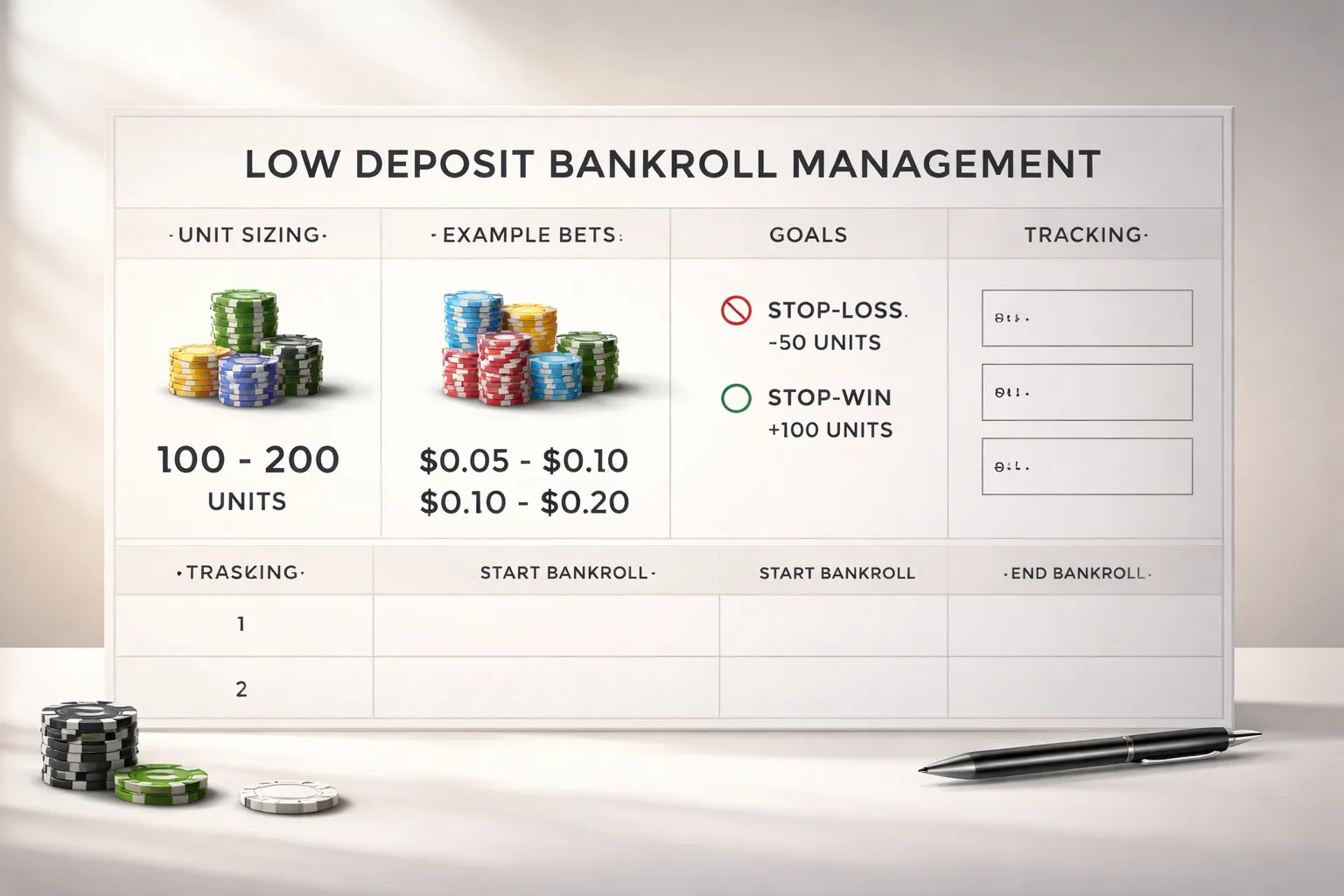
Choosing stakes, use units to extend playtime
Start by turning your deposit into units. One unit equals one bet. More units means more time and fewer forced all-in moments.
- Pick a unit size first: aim for 100 to 200 units for slots, 50 to 100 units for roulette and many table games.
- $10 bankroll examples: at $0.10 per spin you have 100 units, at $0.20 you have 50 units. The lower stake usually lasts longer.
- $5 bankroll examples: at $0.05 per spin you have 100 units, at $0.10 you have 50 units.
- Rule you can follow: do not raise stakes after losses. Raise only after you hit your stop-win, then cash out and start fresh next session.
| Deposit | Target units | Example bet size |
|---|---|---|
| $5 | 100 units | $0.05 |
| $5 | 50 units | $0.10 |
| $10 | 200 units | $0.05 |
| $10 | 100 units | $0.10 |
Volatility 101, why low variance games suit small deposits
Volatility drives how often you win and how big swings get. With a small deposit, big swings end sessions fast.
- Low volatility slots: more small wins, smaller drawdowns, steadier play. Better for $5 to $10 deposits.
- High volatility slots: fewer wins, larger droughts, bigger spikes. They can wipe a low bankroll before any feature triggers.
- Table games: blackjack and baccarat usually swing less per $1 wager than high volatility slots, but mistakes and side bets raise variance.
- Avoid variance traps: progressive jackpots, bonus buys, and high-multiplier features often demand larger bankrolls.
Stop-loss and stop-win rules you can actually follow
Write your rules before you deposit. Keep them simple. Follow them every session.
- Stop-loss: 40% to 60% of your deposit. With $10, stop at $4 to $6 lost. With $5, stop at $2 to $3 lost.
- Stop-win: 30% to 50% of your deposit. With $10, stop at $3 to $5 profit. With $5, stop at $1.50 to $2.50 profit.
- Time cap: 20 to 40 minutes. A time cap stops you from redepositing and speeds up decision fatigue.
- Cashout rule: if you hit stop-win, withdraw the profit. Do not recycle it into higher stakes.
When to switch games, managing tilt and chasing losses
Switching games does not fix losses. Use switches to reduce tilt, not to hunt a recovery win.
- Switch triggers: you break your unit size, you double your bet to chase, you feel rushed, you stop tracking spins or hands.
- What to switch to: a lower stake version of the same game, or a lower variance option. Drop side bets first.
- Hard stop trigger: if you consider redepositing during the session, end the session instead.
- Bonus warning: wagering requirements can push you into longer sessions and higher volatility games. Plan your bankroll around the required play, not the headline bonus.
Tracking results, simple spreadsheet or notes approach
Track sessions, not single spins. You want to see patterns in stakes, game choice, and session length.
- Minimum fields: date, deposit, game, stake, session minutes, start bankroll, end bankroll, profit or loss.
- Add two tags: volatility level and mood. Keep it to one word each.
- Weekly review: cut games that drain your bankroll fast. Keep games where you stay within your unit plan.
- Support note: if deposits fail or withdrawals stall, use live chat early. See our guide on online casino customer support.
Best Games to Play With a Small Deposit (And Which to Avoid)
Low-stakes slots: paylines, bet sliders, and RTP filters
Slots fit small deposits if you control stake size. Start by locking your unit. Set a max bet that equals 1 to 2 percent of your deposit. Keep it there.
- Paylines: More paylines can raise your total bet fast. Check the total bet before every spin. Do not assume a low coin value means a low stake.
- Bet sliders: Use the total bet display, not the coin size. Save a few preset stakes, then stop adjusting during the session.
- RTP filters: Sort for higher RTP when the lobby allows it. Treat RTP as a long-run edge, not a short-run shield.
- Volatility: Pick low to medium volatility when your bankroll is small. You get longer sessions and smoother swings.
Table games with low minimums: blackjack, roulette, baccarat basics
Table games can stretch a small deposit if you keep rules simple and stakes flat.
- Blackjack: Use basic strategy. Skip side bets. Avoid tables with weak rules like 6:5 payouts. Keep your bet flat. Do not chase losses with bigger bets.
- Roulette: Use even-money bets if you want lower variance. Stick to European or French wheels when possible. Avoid complex “systems” that raise stakes after losses.
- Baccarat: Bet Banker most of the time. It usually has the lowest house edge. Avoid Tie bets and most side bets, they spike variance and cost.
Live dealer on a budget: minimum bets, side bets, and pacing
Live dealer games add one problem for small deposits, time. Hands move slower. Your bankroll lasts longer, but your wagering can crawl if you play bonuses.
- Minimum bets: Check the table minimum before you sit. A $10 deposit and a $5 minimum leaves no room for swings. Look for $1 to $2 minimums when available.
- Side bets: Treat them as a separate budget. Most side bets run high house edges and high variance. Skip them if you want longer sessions.
- Pacing: Slow pace helps control losses, but it can increase boredom bets. Set a session timer. Leave when it hits zero.
- Game type: If you want the mechanics and speed differences, read our guide on live dealer vs RNG casino games.
Video poker for value: why paytables matter more than jackpots
Video poker can beat most slots for value, but only when the paytable stays strong. The paytable controls your RTP.
- Paytables first: Learn the common “good” tables for the variant you play. If the top hands pay less than expected, skip the game.
- Bet sizing: Many games require max coins to unlock the best royal flush payout. If max bet is too large for your deposit, switch games or lower the session length. Do not force it.
- Variance: Expect dry spells. Track hands per session and your win rate in your log. Cut games that drain you before you hit meaningful hands.
Progressive jackpots and bonus buys: why they can drain small balances fast
Progressives and bonus buys punish small deposits. They push variance up and shorten your runway.
- Progressive jackpots: You pay for the dream in every spin. You can go long stretches with weak returns. That kills small bankrolls.
- Bonus buys: They compress a long slot session into one hit. One purchase can equal 50 to 200 spins. If it whiffs, your session ends.
- When to avoid: Avoid both if your deposit cannot cover at least 200 to 300 base spins at your stake. You need volume to absorb swings.
| Game type | Best for small deposits | Avoid when |
|---|---|---|
| Low to medium volatility slots | Longer sessions, simple staking | Total bet creeps above 1 to 2 percent of deposit |
| Blackjack (rules checked) | Lower house edge with basic strategy | 6:5 tables, heavy side bet offers |
| Roulette (EU or FR) | Even-money bets keep swings smaller | Martingale or any stake ladder |
| Baccarat | Banker focus, simple decisions | Tie bets, side bets, high minimum tables |
| Video poker (good paytable) | Better value than most slots | Weak paytables, max bet too large for bankroll |
| Progressives and bonus buys | Rare big hits only | You need stable play time and bankroll control |
Safety, Legality, and Responsible Gambling for Low Deposit Casinos
How to verify a casino’s license and avoid clones
Start with the footer. A real casino lists a regulator, a license number, and a legal entity name.
- Match the operator name. The name in the footer should match the name on the regulator site and in the site terms.
- Check the license at the source. Use the regulator’s public register, search the license number and company name.
- Confirm the domain. The license record should list the same website URL you use. If it lists a different domain, treat it as a clone.
- Inspect the connection. You should see HTTPS, a valid certificate, and no browser warnings on login and cashier pages.
- Test support before you deposit. Ask one specific question about deposits or limits. Keep the chat transcript.
Red flags: no license details, a “pending” license claim, a license badge with no number, or terms that name a different company than the cashier.
KYC and verification, what documents you need and when
Low deposit casinos still run KYC. You often deposit first, then you must verify before a first withdrawal or after certain triggers.
- Proof of identity. Passport, national ID, or driver’s license. Front and back if the document has both.
- Proof of address. Utility bill, bank statement, or government letter. Many casinos require it to be recent, often within 90 days.
- Payment method checks. Card proof may require a photo that shows your name and last 4 digits only. E-wallets may require account screenshots.
- Source of funds or wealth. Some licensed casinos ask for payslips, tax forms, or bank statements if you hit higher limits.
Plan for KYC before you chase bonuses. If you cannot pass KYC, your withdrawal can stall. Use your real details, one account, one identity.
Fair play protections, dispute resolution, and self-exclusion
Fair play starts with the regulator and the game providers. A licensed casino should publish both.
- RNG and game providers. Look for known studios and an RNG testing seal in the terms or help pages.
- Clear bonus rules. Read max bet limits, restricted games, and withdrawal caps before you opt in.
- Dispute process. The casino should list a complaints path, a timeframe, and an external body, often an ADR service, if the issue stays unresolved.
- Self-exclusion. You should see options for temporary exclusion and long-term exclusion. A serious casino blocks deposits and marketing during exclusion.
Keep evidence. Save emails, screenshots of balances, and transaction IDs. Use written support channels for disputes.
Age and location rules, staying compliant where you live
You must meet the legal gambling age in your jurisdiction, often 18+ or 21+. The casino also restricts play by country and sometimes by state or province.
- Follow local law. Your location rules decide if online casino play counts as legal for you.
- Use accurate location data. Do not mask your location. A VPN can trigger account reviews and withdrawal delays.
- Check restricted territories. Casinos list excluded regions in the terms. If your region sits on that list, do not deposit.
If you want a broader safety baseline, read what makes an online casino legitimate and apply the same checks to low deposit sites.
Responsible gambling tools, deposit limits, reality checks, cool-offs
Low deposits help, but they do not control frequency. Use the tools that cap your behavior.
- Deposit limits. Set a daily, weekly, or monthly cap. Choose a number you can lose without borrowing.
- Loss limits and wager limits. Use them if available. They stop long sessions faster than deposit limits alone.
- Session limits and reality checks. Set time caps. Turn on popups that show time played and net results.
- Cool-off periods. Use short breaks, 24 hours, 7 days, or 30 days, when you feel tilt or chase losses.
- Self-exclusion. Use it when you cannot stick to limits. Pick the longest option you can commit to.
Track your total spend across sites. A $10 minimum deposit stays small only if you control how many deposits you make.
Common Low Deposit Casino Mistakes (And How to Avoid Them)
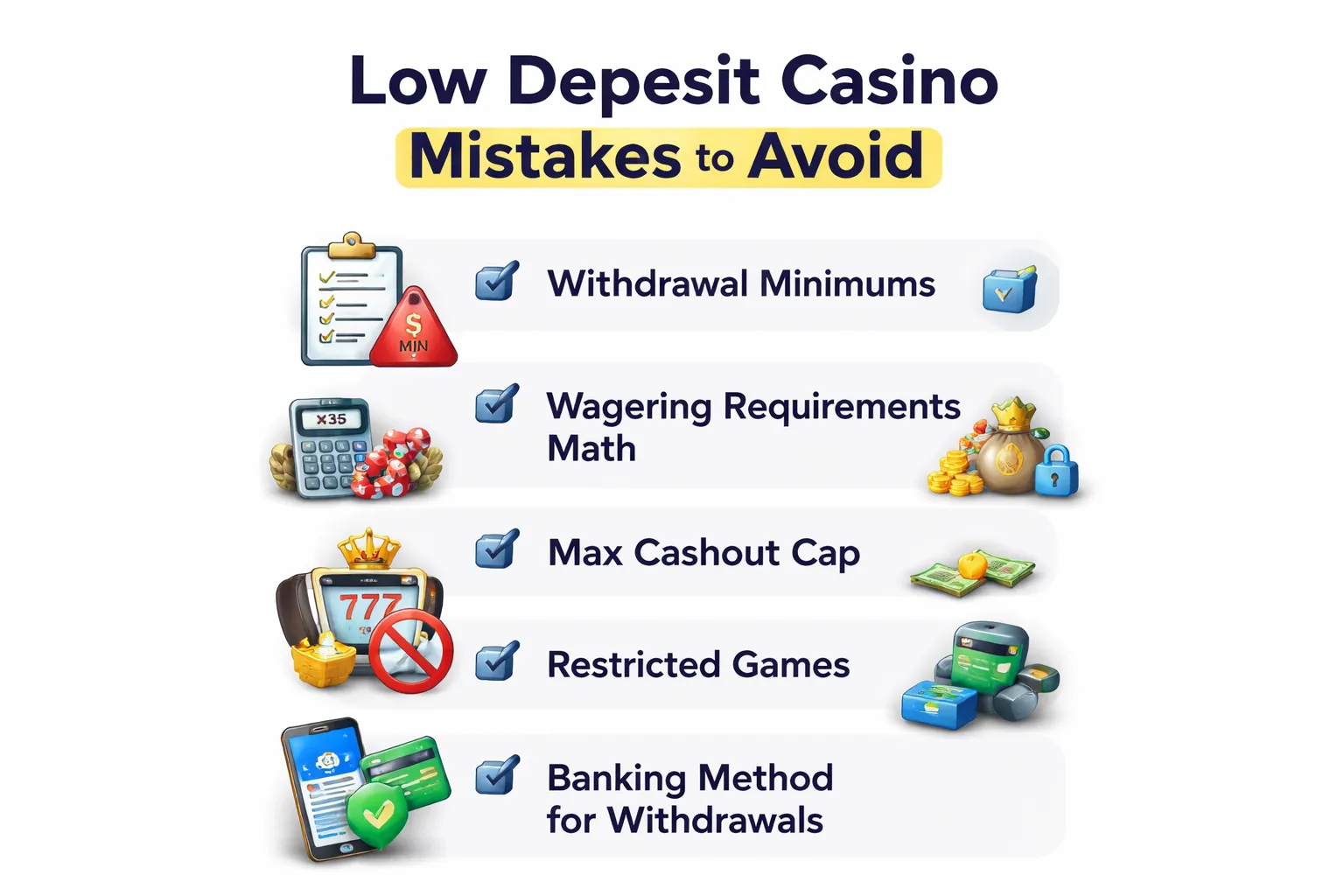
Ignoring withdrawal minimums and getting stuck under the threshold
Many low deposit casinos set a minimum cashout. Common ranges sit around $50 to $100. If you deposit $10, play, and end with $30, you may not qualify for a withdrawal.
- Check the cashier page first. Look for “minimum withdrawal” and “withdrawal limits.”
- Match your session to the threshold. If the minimum cashout is $100, do not plan to stop at $40.
- Watch fees and balance rules. Some sites charge fees for certain withdrawals, or require you to clear any bonus before you can cash out.
- Keep proof. Screenshot the withdrawal limits and payment rules before you deposit.
Accepting bonuses with unrealistic wagering for tiny deposits
Small deposits make high wagering harder to clear. A 50x wagering requirement on a $10 deposit plus a $10 bonus can mean $1,000 in required play. You will likely lose the balance before you finish.
- Calculate wagering in dollars. Bonus + deposit, then multiply by the wagering requirement.
- Prefer lower wagering or no wagering offers. If you cannot find them, skip the bonus.
- Check contribution rates. Slots often count 100%, table games may count 0% to 20%.
- Check time limits. A 7 day window can turn wagering into forced play.
Not checking max cashout caps on free spins or no-deposit style offers
Free spins and no-deposit bonuses often cap winnings. A common cap sits around $50 to $200. You can hit a good run and still lose the excess at cashout.
- Find “max cashout” before you claim. It usually sits in bonus terms, not the promo banner.
- Check if the cap applies after wagering. Some sites cap your withdrawal even if you clear wagering.
- Do not overplay to chase past the cap. Once you reach the limit, extra risk brings no extra payout.
Playing restricted games that void bonus winnings
Bonus terms often block certain games. Many casinos restrict live dealer tables, some slots, and high RTP titles. If you play a restricted game, the site can remove winnings or void the bonus.
- Read the “excluded games” list. If the casino hides it, skip the bonus.
- Check max bet rules. Many bonuses cap bets at $2 to $5 per spin or hand.
- Avoid switching games fast. Some systems flag unusual play patterns during a bonus.
- Confirm game contribution. A game that contributes 0% can waste your balance and your time.
Depositing without a cashout plan, choosing the wrong banking option
Low deposits feel simple until you try to withdraw. Some payment methods block cashouts, add fees, or slow verification.
- Use a method that supports both deposit and withdrawal. Do this before you fund your account.
- Check processing times. Cards can take longer than e-wallets. Bank transfers can take days.
- Match your KYC details. Your payment name must match your casino profile name.
- Plan your cashout route. Know where funds will land, how long it takes, and any fees.
- Confirm local rules. Some options depend on where you live. Use this guide on online casino legality to avoid avoidable banking issues.
FAQ: Best Low Deposit Online Casinos
What counts as a low deposit online casino?
A low deposit casino lets you fund your account with a small minimum, usually $1, $5, or $10. You can start real money play without a large upfront cost. Always check the cashier page, because minimums can vary by payment method and country.
What is the typical minimum deposit in 2026?
Most licensed casinos set minimum deposits at $10. Some drop to $5 or $1 on select methods like e-wallets or crypto. Card deposits often require higher minimums. Always confirm the minimum before you claim a bonus.
Which payment methods work best for small deposits?
E-wallets and crypto usually support the lowest minimums and fast processing. Debit cards often work, but may have higher minimums and slower withdrawals. Bank transfers tend to suit larger amounts due to longer processing times and possible fees.
Can you claim welcome bonuses with a low deposit?
Yes, but read the bonus terms first. Some bonuses require a minimum deposit higher than the cashier minimum. Check wagering requirements, game weighting, max bet limits, and withdrawal caps. If terms look vague, skip the offer.
Do low deposit casinos have higher fees?
Sometimes. Small deposits can trigger fixed processing fees, which raises your effective cost. Casinos can also add withdrawal fees or set minimum cashout limits. Review the cashier and banking terms before you deposit.
Are low deposit casinos safe?
Safety depends on licensing, security, and payment controls, not the deposit size. Look for a recognized regulator, HTTPS, clear terms, and strong KYC rules. Use a trusted review process, see what an online casino is and how it works.
What is the biggest trap with low minimum deposits?
The trap is the withdrawal side. Many casinos set higher minimum withdrawals than minimum deposits. You can also face long processing times if your KYC fails or your payment method does not support payouts. Plan your cashout before you play.
How fast can you withdraw winnings from a low deposit casino?
Payout speed depends on method and verification. E-wallets and crypto can pay in minutes to 24 hours after approval. Cards often take 1 to 5 business days. Bank transfers can take longer. KYC delays are common on first withdrawal.
Do small deposits change RTP or odds?
No. Your deposit size does not change RTP, house edge, or jackpot odds. Your bet size and game choice matter. If you play bonuses, the terms can change your effective value through wagering, max bet limits, and restricted games.
What should you check before you deposit $1, $5, or $10?
- Minimum deposit, by payment method.
- Minimum withdrawal and any withdrawal fees.
- Bonus minimum, wagering, and max bet rules.
- KYC requirements, name match, and document list.
- Payment support for both deposits and withdrawals.
Conclusion
Low deposit casinos let you test a site with less risk, but the smallest deposit is not the real cost. Fees, minimum withdrawals, bonus rules, and payment limits decide what you can actually play and what you can cash out.
- Pick your payment method first. Check its minimum deposit and whether it supports withdrawals.
- Match the bonus to your bankroll. If wagering and max bet rules do not fit a $1, $5, or $10 balance, skip the bonus.
- Verify the cashout path. Confirm the minimum withdrawal, processing fees, and required KYC documents before you deposit.
Final tip, run a quick test. Deposit the minimum, play a small stake, then request a small withdrawal as soon as you can. If the casino makes that process slow, expensive, or unclear, move on. For a deeper safety checklist, see what makes an online casino legit.
-
- Typical minimum deposit ranges by region and operator type
- Minimum deposit vs minimum bet, why both affect affordability
- Deposit limits vs withdrawal minimums, the overlooked constraint
- Low deposit vs no deposit bonuses, differences in risk and value
- When a “low deposit” offer isn’t really low, hidden requirements
-
- Low-stakes slots: paylines, bet sliders, and RTP filters
- Table games with low minimums: blackjack, roulette, baccarat basics
- Live dealer on a budget: minimum bets, side bets, and pacing
- Video poker for value: why paytables matter more than jackpots
- Progressive jackpots and bonus buys: why they can drain small balances fast
-
- Ignoring withdrawal minimums and getting stuck under the threshold
- Accepting bonuses with unrealistic wagering for tiny deposits
- Not checking max cashout caps on free spins or no-deposit style offers
- Playing restricted games that void bonus winnings
- Depositing without a cashout plan, choosing the wrong banking option
-
- What counts as a low deposit online casino?
- What is the typical minimum deposit in 2026?
- Which payment methods work best for small deposits?
- Can you claim welcome bonuses with a low deposit?
- Do low deposit casinos have higher fees?
- Are low deposit casinos safe?
- What is the biggest trap with low minimum deposits?
- How fast can you withdraw winnings from a low deposit casino?
- Do small deposits change RTP or odds?
- What should you check before you deposit $1, $5, or $10?
-
-
- Typical minimum deposit ranges by region and operator type
- Minimum deposit vs minimum bet, why both affect affordability
- Deposit limits vs withdrawal minimums, the overlooked constraint
- Low deposit vs no deposit bonuses, differences in risk and value
- When a “low deposit” offer isn’t really low, hidden requirements
-
- Low-stakes slots: paylines, bet sliders, and RTP filters
- Table games with low minimums: blackjack, roulette, baccarat basics
- Live dealer on a budget: minimum bets, side bets, and pacing
- Video poker for value: why paytables matter more than jackpots
- Progressive jackpots and bonus buys: why they can drain small balances fast
-
- Ignoring withdrawal minimums and getting stuck under the threshold
- Accepting bonuses with unrealistic wagering for tiny deposits
- Not checking max cashout caps on free spins or no-deposit style offers
- Playing restricted games that void bonus winnings
- Depositing without a cashout plan, choosing the wrong banking option
-
- What counts as a low deposit online casino?
- What is the typical minimum deposit in 2026?
- Which payment methods work best for small deposits?
- Can you claim welcome bonuses with a low deposit?
- Do low deposit casinos have higher fees?
- Are low deposit casinos safe?
- What is the biggest trap with low minimum deposits?
- How fast can you withdraw winnings from a low deposit casino?
- Do small deposits change RTP or odds?
- What should you check before you deposit $1, $5, or $10?
-
-
Online Casino Licensing Explained: Authorities, Licenses & How to Check One
3 weeks ago -
Best Live Dealer Casinos: Where to Play Live Blackjack, Roulette & More
3 weeks ago -
Best Online Casinos for High Rollers: VIP Perks, High Limits & Exclusive Bonuses
3 weeks ago -
Fast Payout Online Casinos: Best Sites for Quick Withdrawals
3 weeks ago -
What Is an Online Casino? How They Work, Games, Bonuses & Safety
4 weeks ago
-
Best Online Casinos for Blackjack: Best Tables, Rules & Bonuses
4 weeks ago -
Online Casino Bonuses Explained: How They Work + Terms You Must Know
4 weeks ago -
Fast Payout Online Casinos: Best Sites for Quick Withdrawals
3 weeks ago -
Online Casino Licensing Explained: Authorities, Licenses & How to Check One
3 weeks ago -
Best Online Casinos for Roulette: Best Wheels, Limits & Live Options
4 weeks ago