Live Dealer vs RNG Casino Games: What’s the Difference?

Live dealer and RNG games run on different systems. That changes pace, control, and what you can verify.
Live dealer games stream a real table. A dealer deals real cards or spins a real wheel. Results come from the physical game and the studio setup.
RNG games use software to generate each outcome. The casino audits the RNG and publishes return-to-player, or RTP, for each title.
You will learn how each type works, how odds and RTP get set, what affects speed and bet limits, and what “fair” means in practice. You will also learn where each format fits your goals, fast sessions, higher limits, social play, or strict control over game pace. For a broader primer, see how online casinos work.
Key Takeaways
- In het kort: Live dealer games run on real tables with a studio dealer; RNG games run on casino software and certified random number generation.
- In het kort: Your long-term cost comes from RTP and house edge in both formats; check the game’s posted RTP before you play.
- In het kort: Live dealer pace is fixed by the table and other players; RNG pace is set by you, you can play faster or slower.
- In het kort: Live dealer bet limits often skew higher, especially in VIP rooms; RNG games usually offer lower minimum bets and wider choice.
- In het kort: Live dealer feels more social and transparent, but you may face seating limits and wait time; RNG gives instant access and zero queues.
- In het kort: Bonuses and promos often exclude live dealer tables or contribute less to wagering; RNG slots usually count more.
- In het kort: “Fair” means different controls, live dealer relies on game procedures and studio oversight, RNG relies on independent testing and audits.
- In het kort: Pick live dealer for real table rules and a steady pace; pick RNG for speed, volume, and tight control over session length.
If you want a clearer view of table flow, limits, and game rules, read what to expect from live dealer casinos.
What Are Live Dealer Casino Games?
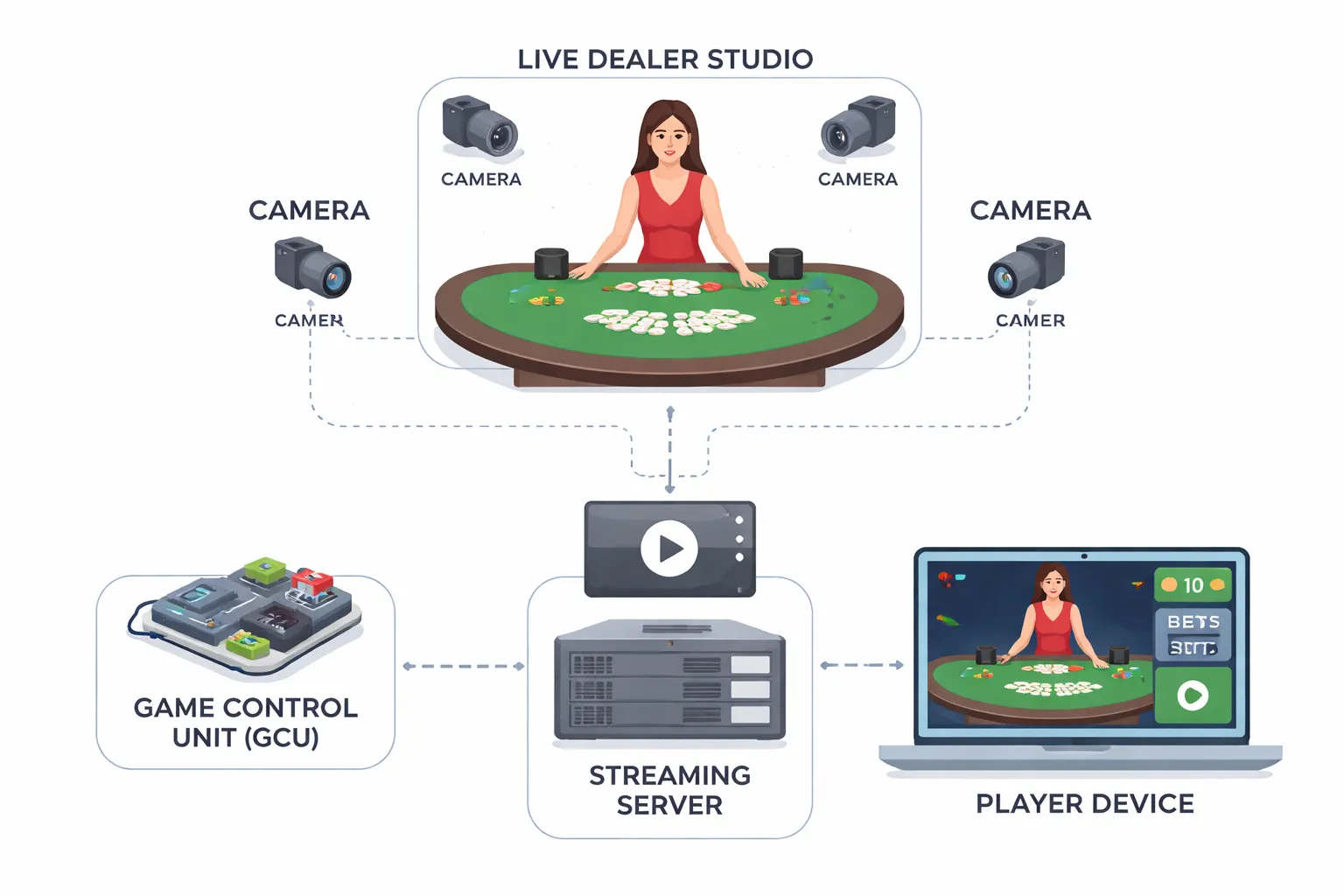
How live dealer tables work
Live dealer games stream a real casino table to your device. A dealer runs the game in a studio or partner casino. You place bets through an on-screen interface.
- Studio setup: A table, lights, and multiple cameras. One camera stays wide, others zoom on cards, wheel, or results.
- Game Control Unit (GCU): Sensors and tracking tools that capture outcomes. Examples include card recognition, roulette wheel tracking, and chip or bet verification systems.
- Video feed and UI: The video shows the table. The interface handles betting, timers, side bets, and history. The UI confirms your stake before the round closes.
Rounds follow a fixed cycle. Bets open, a countdown runs, bets lock, the dealer resolves the hand or spin, results post, then the next round starts.
Role of the dealer and player interaction
The dealer deals cards or spins the wheel. They follow the table rules and the studio procedures. You control your bets and, in some games, your decisions.
- Chat: You can message the dealer and other players. Many tables moderate chat and block spam.
- Etiquette: Keep chat short. Avoid sharing personal details. Do not ask the dealer to change outcomes or speed.
- Pacing: The table sets the pace. Expect a bet timer, then a short wait while the dealer completes the action.
In blackjack, you may get a decision timer for hit, stand, double, or split. If you time out, the game applies a default action, often stand.
Common live dealer titles and variants
- Blackjack: Classic, Infinite Blackjack, Blackjack Party, VIP tables. Rules can vary by table, check dealer stands on soft 17, double options, and split limits.
- Roulette: European, French, American. Some tables add Lightning-style multipliers or side bets.
- Baccarat: Punto Banco, Speed Baccarat, No Commission variants. Side bets often drive the volatility.
- Game shows: Monopoly Live, Crazy Time, Dream Catcher, Deal or No Deal-style formats. These use wheels, multipliers, and bonus rounds.
Side bets, table limits, and seat availability
Live tables publish limits on-screen. Limits shape your session more than game type. Always check them before you join.
- Side bets: Optional bets with separate payouts. They often carry higher house edge than the base game. Use them for volatility, not value.
- Table limits: Minimum and maximum bets apply per spot and sometimes per side bet. VIP tables raise maximums. Low-limit tables can sell out during peak hours.
- Seat availability: Some games use seats, mainly blackjack. If seats fill, you wait or join as a behind-player if the casino supports it.
- Unlimited seats: Many roulette and baccarat tables allow unlimited bettors since you do not take a physical seat.
If you want a deeper breakdown of table flow and what the interface shows during a round, see how live dealer casinos work.
Video latency and what it means for gameplay
Latency is the delay between the studio action and what you see on your screen. It affects timing, not fairness.
- Bet windows: Casinos add a buffer so your bet reaches the server before bets close. You still need to act before the countdown ends on your UI.
- Decision pressure: Higher latency can make blackjack decision timers feel tighter, since your screen updates later than the studio feed.
- Stream quality: If your connection drops, the game can reduce video quality. Your bets and results still run through the server, not your video.
For smoother play, use stable Wi-Fi or wired internet, close background streams, and avoid switching apps during bet timers.
What Are RNG Casino Games?
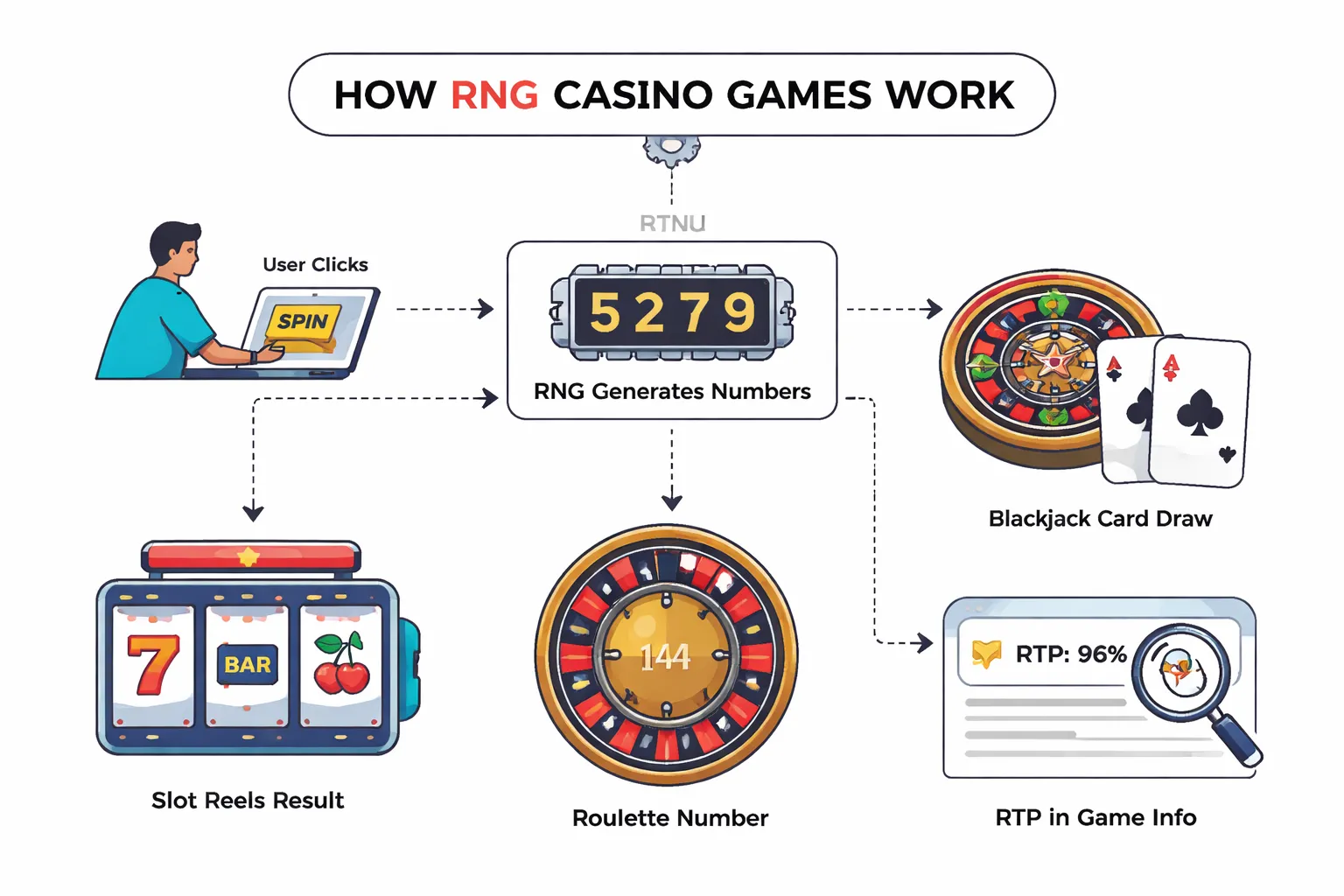
What a Random Number Generator Does
RNG casino games use software to create outcomes. The RNG produces a stream of numbers. The game maps those numbers to an in-game result, like a reel stop, a card draw, or a roulette landing position.
You do not wait for a dealer or a physical shuffle. Your click triggers the next valid outcome, based on the RNG and the game rules.
How Digital Reels, Wheels, and Cards Get Simulated
- Slots, the RNG picks the stop positions for each reel, then the game reads the symbols on the payline.
- Roulette, the RNG selects a number from the wheel set used by that game, like European 0, or American 0 and 00.
- Blackjack, the RNG selects card values from a virtual shoe, then the game applies blackjack rules for hits, stands, splits, and doubles.
The graphics can look like real hardware, but the outcome comes from code. The important part is the ruleset and the number set, not the animation.
Typical RNG Game Categories
- Video slots, classic, video, Megaways-style, and bonus-feature slots.
- Instant win games, scratch cards, mines, keno, plinko-style, and dice variants.
- Video table games, blackjack, roulette, baccarat, and video poker.
Autoplay, Turbo Mode, and Session Speed
RNG games run fast because they do not stream video. Many titles let you control speed.
- Autoplay repeats bets for a set number of rounds, sometimes with stop rules like win limits or loss limits.
- Turbo mode reduces animation time, so you reach results faster.
- Session pace can jump from a few bets per minute to dozens, depending on the game and settings.
Faster play increases how many bets you place per hour. That changes your short-term swings and how fast you cycle your bankroll.
Where RTP Is Shown, and Why It Matters
RTP means Return to Player. It is the average percentage a game pays back over a large number of bets. You usually find RTP in the game info screen, the paytable, or the rules menu.
- Check RTP before you commit to long sessions.
- Do not assume all versions match. The same slot can ship with multiple RTP settings.
- Use RTP to compare games, but also check volatility. RTP does not tell you how often you win, only the long-run average.
| Where to look | What you see | What to do |
|---|---|---|
| Paytable | RTP percent, symbol pays, bonus rules | Confirm RTP and learn the highest paying combos |
| Game rules | Table rules, bet limits, side bets | Check rule changes that affect house edge |
| Game lobby | Sometimes shows RTP and volatility | Compare versions before you open the game |
If you want to compare this with streamed tables, use this guide on how live dealer casinos work.
Live Dealer vs RNG Casino Games: The Core Differences

Outcome generation, physical equipment vs algorithmic draws
Live dealer games use real equipment. A dealer spins a physical roulette wheel, deals real cards, or uses a shoe. Cameras stream the result. The casino then pushes the outcome to your screen.
RNG games use software. A random number generator picks outcomes. The game maps those numbers to cards, wheel results, or slot symbols. You see the result after the draw.
For you, the key check stays the same. Verify the game uses licensed software, published RTP, and audited RNG for digital games. For live games, check the provider, studio, and table rules. If you want the full framework, see how online casinos work.
Pace of play and bets per hour
RNG games run fast. Many rounds take seconds. You can place far more bets per hour.
Live dealer games run at human speed. You wait for shuffles, dealing, spins, and payouts. Bet volume per hour drops.
This changes your time-to-result. More bets per hour means your bankroll swings faster. Slower rounds stretch your session and smooth short-term variance.
User experience, social presence, immersion, distractions
Live dealer tables feel social. You see a real dealer. You often get a chat box. That can help you stay engaged, but it can also pull you into longer sessions.
RNG games feel solo. You get clean UI and fast controls. You can play with fewer interruptions. That helps if you track bets, manage a target loss limit, or play in short bursts.
Accessibility, device load, data usage, connectivity
Live dealer games need stable internet. Video streaming uses more data and more battery. Weak Wi-Fi can cause freezes, lag, or disconnections.
RNG games run lighter. They use less data. They usually handle slower connections better. They also load faster on older phones and budget laptops.
Game availability, uptime, closures, peak-time limits
RNG games run 24/7. No dealer breaks. No table schedule. You can usually find the same game any time.
Live dealer tables follow a timetable. Studios can close tables. Some variants only run at set hours. Peak times can mean full seats, queues, or higher minimums.
Betting limits and bankroll flexibility
RNG games often give you wider control over stake size. Slots can start at very small bets. RNG table games also tend to offer low minimums.
Live dealer games often start higher. Many tables sit at $5 to $25 minimums, with higher limits in VIP rooms. Side bets can push your total risk per round up fast.
If you play with a small bankroll, prioritize low minimums and stable pacing. If you want higher maximums and a slower, structured session, live tables usually fit better.
Odds, RTP, and House Edge: What Actually Changes (and What Doesn’t)
Why live vs RNG does not set the house edge
Live dealer and RNG describe how the game runs. They do not set the math.
The house edge comes from rules, payouts, and fees. If a live blackjack table uses the same rules as an RNG blackjack table, the expected return stays the same. The same logic applies to roulette and baccarat.
What can change in practice is selection. Live lobbies may offer fewer variants. RNG lobbies may offer more rule sets, including worse ones, plus side bets with high house edges.
Blackjack rules that move the needle
Blackjack RTP depends on your decisions and the table rules. Small rule tweaks change the house edge.
- Dealer hits soft 17 (H17) vs stands (S17). S17 usually improves your odds.
- Double after split (DAS). DAS usually improves your odds.
- Surrender. Late surrender usually improves your odds when you use it correctly.
- Number of decks. Fewer decks usually improves your odds, if other rules stay equal.
- Blackjack payout. 3:2 beats 6:5 by a lot. Avoid 6:5 when you can.
Live blackjack often uses common casino-style rules and 8 decks. RNG blackjack can range from player-friendly to harsh. Always open the rules panel and confirm the blackjack payout first.
Roulette variants in both formats
Roulette house edge comes mainly from the number of zeroes. Live or RNG does not change that.
| Roulette type | Wheel pockets | Typical house edge | Notes |
|---|---|---|---|
| European | 37 (single zero) | 2.70% | Best standard option in both live and RNG. |
| French | 37 (single zero) | 2.70% base | Can improve on even-money bets if the table uses La Partage or En Prison. |
| American | 38 (zero and double zero) | 5.26% | Higher edge. Avoid when you can. |
Some live tables label the layout clearly but still use American wheels. Some RNG games hide the wheel type in the info tab. Verify the zero count before you bet.
Baccarat expectations and commission details
Baccarat has stable math across live and RNG, as long as the rules match. The key factor is commission and payout.
- Banker bet. Best standard bet, but most tables charge 5% commission on winnings.
- Player bet. Slightly worse than Banker in standard rules, no commission.
- Tie bet. High house edge on most tables. Treat it like a side bet.
- No-commission baccarat. Often pays Banker at 1:2 on a 6 or uses other rule tweaks. That changes the edge. Read the paytable.
Live baccarat often shows the commission clearly in the UI. RNG baccarat sometimes offers multiple variants with different commission rules. Do not assume they match.
Volatility and payout structure, why slots feel different
Slots feel different because of variance, not because they use RNG.
Table games have tighter outcome ranges. Your bankroll swings usually look smoother. Slots concentrate value in rare hits. You can lose for long stretches even on high RTP games.
- RTP. Long-run return. It does not tell you how rough the ride will be.
- Variance. How wide the outcomes spread. High variance means bigger swings and longer losing runs.
- Payout structure. Bonus features, multipliers, and jackpots shift more value into low-frequency events.
How to compare games using RTP, rules, and variance
- Step 1, confirm the variant. European roulette, 3:2 blackjack, standard baccarat.
- Step 2, read the rules. Check H17 or S17, DAS, surrender, decks, and any special side rules.
- Step 3, check the payout table. Look for 6:5 blackjack, triple-zero roulette, or altered baccarat payouts.
- Step 4, separate main bets from side bets. Many side bets carry a large house edge, even on good base games.
- Step 5, match variance to your bankroll. Use low-volatility options for small bankrolls and longer sessions.
If you plan to play small stakes, start with low minimums and predictable variance. Use a list of low deposit online casinos to find tables and slots that fit your bankroll and pacing.
Fairness, Safety, and Trust Signals (E-E-A-T Checklist)

Licensing and regulation, what to check in the footer
Start with the casino footer. A real operator shows its legal company name, license number, and the regulator that issued it. You should also see links to license details, terms, privacy policy, and responsible gambling support.
- License name and number: You need both. A logo alone proves nothing.
- Regulator link: Use it to verify the license on the regulator site.
- Operator identity: Look for a registered company and address. Avoid sites that hide ownership.
- Jurisdiction limits: If you play from a restricted country, you risk voided payouts.
- Game rules and payout rules: You need clear rules on withdrawals, bonus terms, and KYC checks.
Independent testing labs and what their seals mean
Testing labs check game math, RNG behavior, and system controls. You want proof the casino uses certified game builds and keeps certifications current.
- eCOGRA: Tests RNG games and audits payout reporting for some operators. Often publishes dispute support and audit statements.
- iTech Labs: Tests RNG implementations, game fairness, and platform security components for many suppliers.
- GLI: Heavy compliance testing, common across regulated markets. Focuses on technical standards and ongoing conformity.
What to do. Click the seal. Confirm it resolves to a real certificate page, with the operator or product listed, plus a date range.
Live dealer integrity, what keeps the game honest
Live tables rely on procedures and monitoring, not just math. Good studios document controls and store records.
- Card handling: New decks unsealed on camera. Scheduled deck changes. Clear burn and cut procedures.
- Shuffling: Manual shuffles follow a fixed routine, or shuffle machines run with visible feeds and set cycles.
- Roulette wheel checks: Regular inspections for level, speed consistency, and wear. Ball and wheel replacements on schedule.
- Multi-angle surveillance: Wide and close cameras, continuous recording, and restricted studio access.
- Game logs: Time stamped round history, bet acceptance times, results, and void rules for stream drops.
If you want deeper mechanics, read how live dealer casinos work.
RNG auditing basics, what gets tested and how often
RNG games use software to generate outcomes. Audits focus on unpredictability and on whether the game matches the certified math model.
- Seeding and entropy: The RNG needs a strong source of randomness. Weak entropy increases predictability risk.
- Statistical tests: Labs run large sample tests to check distribution, independence, and bias, across many game states.
- Build control: Labs certify a specific software version. Operators should not swap binaries without re-approval.
- Periodic re-certification: Re-tests happen after updates, supplier changes, or scheduled compliance cycles.
Practical check. Open the game info panel. Look for the game provider, RTP, and a reference to certification or tested RNG.
Responsible gambling tools and account protections
Strong sites give you controls you can set in minutes. Use them before you chase losses.
- Deposit limits: Daily, weekly, monthly caps. Set a number you can afford to lose.
- Loss limits and wagering limits: Stops spirals during long sessions.
- Session limits and reality checks: Time alerts and forced breaks.
- Cooling-off: Short lockouts when you feel tilt.
- Self-exclusion: Longer bans, with clear re-entry rules.
- Account security: 2FA, device checks, withdrawal confirmation, and clear KYC steps.
Red flags to avoid
- Unverifiable license: No license number, no regulator link, or details that do not match the regulator database.
- RTP missing: Slots and many RNG table games should disclose RTP. Missing RTP often signals low transparency.
- Unclear terms: Vague bonus rules, vague withdrawal clauses, or hidden max cashout limits.
- Broken certification links: Seals that do not click through to a real lab page.
- No dispute path: No clear complaints process, or no third-party ADR mention where required.
- Odd payment behavior: Delays with no reason, sudden extra documents, or changing rules after you win.
| Trust signal | What you should see | Why it matters |
|---|---|---|
| License | Regulator name, license number, operator legal entity | Sets minimum standards, gives you a place to verify |
| Testing | eCOGRA, iTech Labs, or GLI certification, with dates | Confirms game math and RNG controls got reviewed |
| Live controls | Visible procedures, recorded streams, round history | Reduces tampering risk and supports dispute review |
| RNG transparency | Game info panel with RTP, provider, rules | Lets you compare house edge and detect opaque games |
| Player protection | Limits, cooling-off, self-exclusion, 2FA | Helps you control losses and protect your account |
Bonuses, Promotions, and Wagering Requirements
Why live dealer wagering often counts less
Casinos price many bonuses around slots. Slots run fast and carry a higher built-in house edge. Live tables run slower and often have lower house edge. That makes live wagering cheaper for the casino to fund. So terms usually limit it.
- Lower contribution, live bets may count 0 to 20% toward wagering.
- Exclusions, some or all live dealer games do not count at all.
- Specific table bans, common examples include blackjack variants, baccarat, and game shows.
- Low edge strategy clauses, some terms limit play that reduces house edge, like certain blackjack approaches.
- Withdrawal limits while a bonus is active, you may need to finish wagering before you cash out.
Typical contribution rates and how to calculate the impact
Contribution decides how much of your betting reduces the wagering requirement. Use one simple formula.
Wagering progress = total bets x contribution rate.
| Game type | Common contribution range | What it means for you |
|---|---|---|
| Slots (RNG) | 80 to 100% | Your spins usually clear wagering fastest. |
| Roulette (RNG) | 10 to 50% | Often restricted or capped in many promos. |
| Live dealer tables | 0 to 20% | You may need much more total betting to clear the same requirement. |
| Live game shows | 0 to 10% | Common exclusion, especially for bonus hunts. |
Example. You need 30x wagering on a $100 bonus, so you must generate $3,000 in wagering progress. If your live table counts 10%, you need $30,000 in bets to reach $3,000 progress. If slots count 100%, you need $3,000 in bets.
Game weighting, max bet rules, and restricted games clauses
Promos usually stack multiple limits. You need to read them together.
- Game weighting, a casino can assign a different contribution rate to each game, even inside the same category.
- Max bet limits, common rules cap your stake per spin or hand while a bonus is active. If you exceed it, the casino can void the bonus or winnings.
- Restricted games, terms often list specific titles you cannot play with a bonus. Live tables and low edge RNG table games show up often.
- Bet type restrictions, some rules ban even-money roulette bets, side bets, or betting both outcomes to reduce variance.
- Time limits, you may need to finish wagering within a set number of days.
If you play live dealer games, check the promotion page and the full bonus terms. Then confirm the live tables you want actually contribute. Legal terms can differ by region, so check your local rules before you deposit. Use this guide on where online casinos are legal if you are unsure.
When no-deposit and free spins make sense
No-deposit bonuses and free spins can work, but only in narrow cases.
- They make sense when the wagering multiple is low, the max cashout is reasonable, and the spins apply to a game with normal RTP and full contribution.
- They do not when the promo has high wagering, short expiry, low contribution on everything except a few slots, or a tight max withdrawal cap.
- They rarely match live dealer play because free spins target slots and no-deposit terms often exclude live tables.
Practical bonus strategy by game format
- If the bonus favors slots, clear wagering with eligible RNG slots first. Play live dealer after you finish the bonus, or with real money only.
- If you prefer live dealer, look for promotions that explicitly list live tables as eligible and show a clear contribution rate. Avoid vague “selected games only” language.
- If max bet rules are strict, set your stake under the cap and keep it consistent. One over-limit hand can trigger a payout dispute.
- If restricted games lists are long, pick one or two allowed games and stick to them until you clear wagering.
- If contribution is low, run the math before you start. Low contribution can turn a small wagering requirement into a very large amount of total betting.
Pros and Cons of Live Dealer Games
Key Advantages: Realism, Transparency, and Social Engagement
- Real dealing and real pacing. You see the cards, wheel, or dice handled on camera. That feels closer to a physical casino than a fast RNG screen.
- Clear game flow. You can track the shuffle, the spin, and the dealer actions in real time. This helps you understand what happened on each round.
- Human interaction. You can chat with the dealer and other players. If you like table energy, this matters.
- Good for learning table etiquette. You follow the same steps you would in a casino. You pick up timing, bet placement, and common rules faster than in many RNG layouts.
Key Drawbacks: Slower Sessions, Higher Minimums, and Table Availability
- Slower hands per hour. Live blackjack and roulette run on real dealing time and player decision time. That lowers bet volume per hour, which can slow bonus wagering.
- Higher minimum bets. Many live tables start at $5 to $25. VIP tables can go higher. This raises variance and risk if your bankroll is small.
- Limited seats and table caps. Popular tables fill up. Some studios cap the number of players per table or per betting spot.
- Rule sets vary by table. Blackjack limits, side bet rules, and roulette variants differ by studio. You need to check the table info before you sit down.
| Factor | What it means for you |
|---|---|
| Speed | Fewer rounds per hour, slower wagering progress, more time per decision. |
| Minimum bet | Bigger swings, higher bankroll needs, fewer low-stake options. |
| Availability | Waits can happen at peak hours, you may need to switch tables. |
| Consistency | Different tables can use different rules, limits, and side bets. |
Best-Fit Player Profiles
- Social players. You want chat, a real dealer, and a shared table.
- Table-game learners. You want to see the full flow of blackjack, roulette, or baccarat, with real timing and clear bet windows.
- Realism seekers. You care more about the live feel than max speed. If you also need smaller stakes, start with low deposit casinos and filter for low-min live tables.
Common Technical Issues and Quick Fixes
- Lag during betting windows. Switch from Wi-Fi to wired if you can. Close other apps and streams. Drop video quality one level.
- Blurry or choppy stream. Set the stream to auto or 720p. Refresh the table. If it keeps happening, change to a different studio or table.
- Audio out of sync. Toggle audio off and on. Refresh the game. Avoid Bluetooth audio if you see delays.
- Disconnects mid-round. Reconnect fast and check the game history. Keep screenshots of the round ID and result. If the session did not log correctly, contact support with the round number and time.
Pros and Cons of RNG Games
Key advantages of RNG games
- Speed. Spins and hands resolve in seconds. You control the pace with autoplay and quick bet controls.
- Convenience. No camera, no chat, no waiting for other players. You can play on mobile with one hand.
- Wider game variety. You get thousands of slots, plus RNG versions of blackjack, roulette, baccarat, video poker, and instant-win games. You also get more themes, features, and volatility options.
- Clear testing standards. Reputable sites use audited RNGs and publish game providers, RTP, and sometimes variance info. You can compare games faster.
Key drawbacks of RNG games
- Less social proof. You do not see cards dealt or a ball spun. You must trust the software, the license, and third-party audits.
- Colder experience. No dealer, limited interaction, and less table atmosphere. Sessions can feel repetitive.
- Faster bankroll swings. High-speed rounds plus high-volatility slots can drain your balance quickly. The same speed can also spike wins, but variance can punish short sessions.
- More impulse risk. Quick reloads, autoplay, and rapid losses can push you into chasing.
Best-fit player profiles
- Value hunters. You shop RTP, volatility, and bonus terms. You test in demo, then commit. You avoid games with weak paytables.
- Multitaskers. You play in short bursts. You pause anytime. You do not want a live table countdown.
- Low-stakes players. You want $0.10 to $1 bets, smaller bankrolls, and fast game access. Slots and RNG tables usually give more low-limit options.
Managing session speed to avoid over-betting
- Set a spin or hand cap. Decide a hard number, like 100 spins or 50 hands. Stop when you hit it.
- Use time reminders. Set a 20 to 30 minute alarm on your phone. Take a break when it rings.
- Turn off autoplay. Manual play forces a decision each round. It slows loss streaks.
- Lower your default bet. Set your base stake at 0.5 to 1 percent of your session bankroll. Raise it only after a planned review, not after a loss.
- Use built-in limits. Set deposit, loss, and session limits in the cashier or responsible gaming menu. Lock them for a cooling-off period.
- Track outcomes. Screenshot big wins and big losses and note time and bet size. It helps you spot tilt patterns.
If you want more human context and pacing controls, read what to expect at live dealer casinos.
Which Should You Choose? A Practical Decision Guide
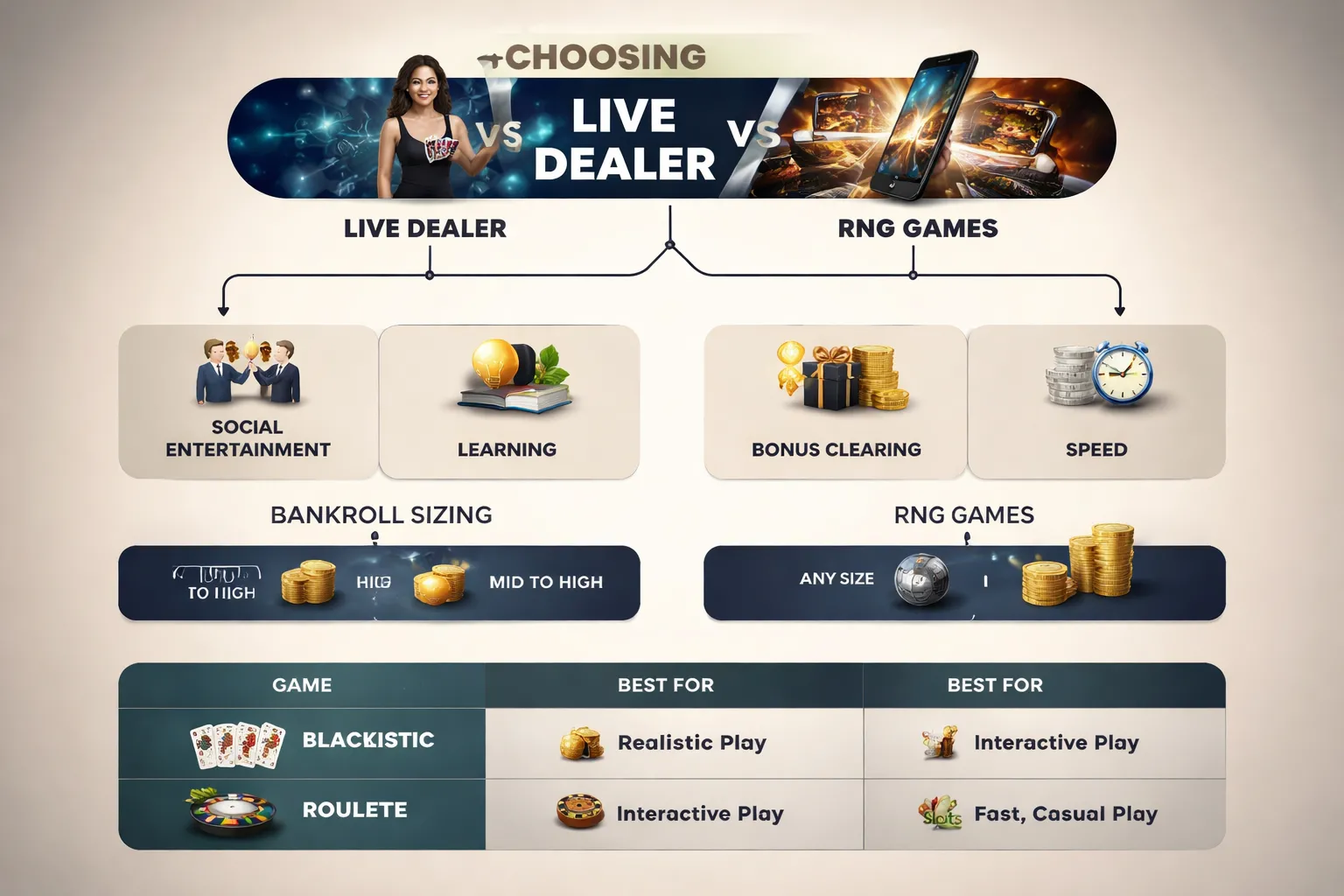
Choose Based on Your Goal
- Entertainment and social pace: Pick live dealer. You get real-time dealing, chat, and a fixed rhythm. You also face table rules and seat limits.
- Learning table games: Start with RNG versions of blackjack and roulette. You can slow down, read paytables, and repeat decisions fast. Move to live dealer after you know the rules and basic strategy.
- Comps and bonuses: Pick RNG first in most casinos. Slots and RNG tables often count more toward wagering than live dealer. Always check contribution rates in the bonus terms.
- Efficiency and volume: Pick RNG. You control speed, you can multi-table, and you avoid waiting for shuffles and other players.
Bankroll Planning by Format
Live dealer bankroll rules. Plan for fewer hands or spins per hour, but higher minimums. Variance still hits hard, especially in blackjack side bets and roulette. Use a larger buffer per session.
- Stake sizing: Keep your base bet around 0.5 to 1 percent of your session bankroll. Drop lower if you add side bets.
- Session length: Expect slower cycles. Build your session around time, not just number of bets. A long session can still mean fewer decisions than RNG.
- Table minimums: Many live tables start at $5 to $25. If that forces you to size up, your risk jumps.
RNG bankroll rules. Plan for more rounds per hour. That raises short-term swings, even with low stakes. You can control risk by controlling speed.
- Stake sizing: Keep your base bet around 0.25 to 0.75 percent of your session bankroll if you play fast. Raise only if you slow down.
- Session length: Set a round cap. Fast play can burn a budget in minutes.
- Volatility control: Choose low to medium volatility slots when you want longer sessions. High volatility needs a bigger bankroll and more patience.
If You’re New, Start Low Risk
- Use demos first: Learn rules, bet types, and paytables with no pressure. Focus on blackjack decisions and roulette bet mapping.
- Play low-limit real money: Use small minimum deposits and small stakes while you learn timing and bankroll control. Use low deposit casinos to keep the learning cost low.
- Skip side bets early: Side bets often carry a higher house edge and higher variance. Learn the base game first.
- Use built-in tutorials and help menus: Many RNG games show odds, payouts, and bet rules inside the interface. Read them before you raise your stake.
If You’re Experienced, Optimize for Rules, RTP, and Volatility
- Blackjack: Prioritize rules over format. Look for dealer stands on soft 17, double after split, re-split options, and late surrender where available. Avoid 6:5 tables. Keep side bets off if you want lower edge.
- Roulette: Choose European or French wheels when possible. Single-zero beats double-zero. If the table offers en prison or la partage, take it for even-money bets.
- Slots: Treat RTP as a long-run number, not a session promise. Volatility drives session results. Use high volatility only when you accept long losing stretches. If you chase bonuses, check if the slot counts 100 percent toward wagering.
- Speed and volume: RNG lets you push more decisions per hour. That helps with bonus clearing, but it also increases bankroll turnover. Use a fixed pace and hard stop rules.
- Live dealer edge cases: Some live tables use non-standard rules to speed the game. Check limits, payouts, and side bet paytables before you sit.
Quick Comparison Table: Best Use Cases by Game Type
| Game | Live Dealer is best for | RNG is best for |
|---|---|---|
| Blackjack | Real table rhythm, chat, and a clear dealing flow. Good if you play fewer hands and want less button clicking. | Practice and repetition, faster hands per hour, easy rule checking. Better for strategy drilling and bonus volume. |
| Roulette | Real wheel feel and pacing. Good if you like watching spins and sticking to a fixed tempo. | Fast bet cycling, quick testing of bet types, lower friction sessions. Better for controlled budgets and speed. |
| Slots | Not a core live category in most casinos. Live-style slot products vary and often add friction without better value. | Main slot selection, clear RTP and volatility info, autoplay controls in some jurisdictions. Best for bonuses and variety. |
Common Myths About Live Dealer and RNG Games (Debunked)
Myth: Live dealer is always more fair than RNG
Fairness comes from controls, not from video or a human dealer.
- Live dealer fairness depends on studio procedures, camera coverage, game rules, and how disputes get handled.
- RNG fairness depends on certified random number generation, tested game math, and ongoing audits.
- Both formats can run fair games, and both can run poor implementations if the operator cuts corners.
What you should check, licensing, independent testing disclosures, and clear game rules. If a casino hides those details, move on.
Myth: RNG games are rigged because outcomes are digital
Digital outcomes do not mean fixed outcomes. RNG games use mathematical models and controlled randomness.
- A proper RNG produces results you cannot predict, even if you track thousands of spins.
- Game math sets the long-term return and the house edge. That edge does not need rigging to make the casino money.
- RNG audits look for bias and repeatable patterns. Reputable casinos publish testing info or name the test lab.
If you want a practical filter, stick to known providers, check RTP and rules, and avoid unlicensed sites.
Myth: You can predict patterns in roulette or spot hot dealers
Roulette outcomes do not develop a memory. Past results do not change the next spin.
- In live roulette, tiny wheel quirks can exist, but regulated studios rotate wheels, monitor results, and correct anomalies.
- In RNG roulette, each spin draws from the same probability set. Streaks happen because randomness clusters.
- Dealer speed and style can affect your comfort, not the underlying odds.
Track results if it helps you stay disciplined, but do not treat it as an edge.
Myth: Betting systems overcome the house edge
Systems change variance, not expected value. The house edge stays.
- Progressions like Martingale can create frequent small wins and rare large losses.
- Table limits and bankroll limits break most progressions fast.
- Even flat betting loses in the long run if you play long enough, because the math stays negative.
If you use a system, use it for structure. Set a stop loss, set a win cap, and keep stakes small.
Myth: Faster play always means better value
Speed changes how quickly you realize results. It does not improve your odds.
- Faster RNG play can increase total bets per hour, which can increase expected losses per hour at the same stake size.
- Live dealer pace can slow losses, but it can also keep you in the seat longer, which still increases total exposure.
- Value comes from rules, RTP, and your total wagering, not from animation speed or dealer pace.
If you want control, pick games with clear RTP, use low stakes, and consider low minimum deposits when you test a new site, see low deposit casinos.
Frequently Asked Questions
Are live dealer games fair?
Yes, if you play at a licensed casino. Results come from real cards or wheels, plus studio procedures and third-party audits. Check the license, game provider, and published RTP. Avoid unlicensed sites and streams without clear regulation.
Are RNG casino games fair?
Yes, if the RNG and game math get tested by independent labs. Fairness depends on licensing and audits, not on how the game looks. Use games from known providers and avoid “in-house” titles on unregulated sites.
Which has better odds, live dealer or RNG?
Neither wins by default. Odds come from RTP and rules. Example, blackjack RTP changes with rule set and your decisions. Many RNG slots have lower RTP than table games. Always check RTP, rules, and side bet payouts.
Do live dealer games have higher RTP?
Sometimes. Live blackjack, roulette, and baccarat often sit near land-based math, but rules can vary by table. RNG versions can match or beat them, or be worse. Your best move is to compare RTP and table limits before you play.
Why do live dealer tables have higher minimum bets?
Live games cost more to run. A studio, dealer, cameras, and streaming support add overhead. Casinos use higher minimums and table limits to cover costs. If you need small stakes, RNG games usually give you more low-limit options.
Do bonuses work the same on live dealer games?
No. Many casinos restrict live dealer contributions for wagering requirements. Some count 0 to 20 percent, or exclude them. Always read the bonus terms for “game weighting” before you deposit, so your wagering plan stays realistic.
Can you use strategy in both?
Yes, but it depends on the game. Blackjack lets you reduce house edge with basic strategy in live and RNG. Roulette and baccarat have fixed odds, strategy mainly controls bet sizing. Slots have no decision-based edge to gain.
Is live dealer slower than RNG?
Yes. Live dealer games run fewer rounds per hour because of shuffling, bets, and player actions. RNG games run fast and can auto-play. Speed does not change the house edge, but it changes how much you wager per session.
Which is better for low deposits?
RNG games usually fit better because you can find lower minimum bets. If you want small bankroll testing, use a site with low minimum deposits and clear RTP, see low deposit casinos.
Conclusion
Conclusion
Live dealer games and RNG games can use the same rules and the same house edge. The difference is how you play.
- Pick live dealer if you want real-time play, social interaction, and you can handle higher minimum bets and slower rounds.
- Pick RNG if you want speed, lower stakes, and more control over session length and bet size.
Your best move is simple. Set a budget, set a time limit, then choose the format that matches your bankroll and pace. Check licensing, RTP, limits, and withdrawal terms before you deposit, see how online casinos work.
-
Are Online Casinos Legal? Complete Guide by State & Country
8 months ago -
What Is an Online Casino? How They Work, Games, Bonuses & Safety
8 months ago -
Best Low Deposit Online Casinos: Play for Less with Small Minimum Deposits
8 months ago -
How Live Dealer Casinos Work (and What to Expect)
8 months ago -
Play Casino Games Online: Start Playing Real Money & Demo Games
8 months ago
-
- Are live dealer games fair?
- Are RNG casino games fair?
- Which has better odds, live dealer or RNG?
- Do live dealer games have higher RTP?
- Why do live dealer tables have higher minimum bets?
- Do bonuses work the same on live dealer games?
- Can you use strategy in both?
- Is live dealer slower than RNG?
- Which is better for low deposits?
-
- Are live dealer games fair?
- Are RNG casino games fair?
- Which has better odds, live dealer or RNG?
- Do live dealer games have higher RTP?
- Why do live dealer tables have higher minimum bets?
- Do bonuses work the same on live dealer games?
- Can you use strategy in both?
- Is live dealer slower than RNG?
- Which is better for low deposits?
-
Reload Bonus Explained: What It Is and When It’s Worth Claiming
6 months ago -
Online Casino Licensing Explained: Authorities, Licenses & How to Check One
8 months ago -
Best Live Dealer Casinos: Where to Play Live Blackjack, Roulette & More
8 months ago -
Best Online Casinos for High Rollers: VIP Perks, High Limits & Exclusive Bonuses
8 months ago -
Fast Payout Online Casinos: Best Sites for Quick Withdrawals
8 months ago
-
Online Casino Customer Support: What to Look For (Live Chat, Email, Response Times)
8 months ago -
Sign Up for an Online Casino: Create an Account in Minutes
8 months ago -
Online Casino Payment Safety Tips: How to Deposit and Withdraw Securely
8 months ago -
What to Do If an Online Casino Won’t Pay Out: Step-by-Step Actions
8 months ago -
How to File a Complaint Against an Online Casino (Plus ADR Explained)
8 months ago