How to Read an Online Casino Review (and Spot Biased Ratings)

Casino reviews can save you money, or push you into a bad deal. Many ratings come from affiliate sites paid when you sign up. That creates bias.
This guide shows you how to read an online casino review with a checklist mindset. You will learn how to spot affiliate pressure, missing terms, and cherry-picked test results. You will learn which facts matter most, like license details, payout speed, withdrawal limits, bonus wagering rules, game provider lists, and complaint patterns. You will also learn how to compare scores across sites and ignore fake “expert” badges.
If you need the basics first, read how online casinos work.
- In het kort: Treat every review as a sales page until it proves otherwise.
- In het kort: Check the license, the operator name, and the regulator, do not trust badges.
- In het kort: Verify payout speed, withdrawal limits, fees, and KYC rules, not headline claims.
- In het kort: Read the bonus terms, focus on wagering, max bet, game contribution, and time limits.
- In het kort: Look for full game provider lists and payment methods, vague lists hide weak coverage.
- In het kort: Use complaint patterns and support quality as your fraud filter.
- In het kort: Compare scores across sites, big gaps signal affiliate pressure or lazy testing.
- In het kort: If you play with small bankrolls, use low deposit casinos and confirm minimum deposit and withdrawal rules.
What an online casino review is (and what it should include)
What an online casino review is
An online casino review is a structured check of a gambling site. It should tell you what the casino offers, what it costs, what can go wrong, and what proof backs the claims. You use it to decide if you should register, deposit, and play.
Editorial review vs user review vs sponsored advertorial
- Editorial review: Written by a site editor. It should follow a repeatable checklist and show evidence, like license data, payment limits, and bonus terms. Best for fast screening.
- User review: Written by players. It helps you spot real-world issues, like delayed withdrawals or support problems. Treat it as signal, not proof. Look for patterns across many comments.
- Sponsored advertorial: Paid promotion dressed as a review. It focuses on upsides, hides limits, and pushes a call to action. It can be accurate, but it exists to convert you.
What a high-quality review should include
- Licensing and ownership: License issuer, license number, operator name, and the legal entity. Links to the regulator register help. If the review stays vague here, skip it. For legal basics, use this legality guide.
- Payments and cashout rules: Deposit methods, withdrawal methods, fees, pending time, verification steps, minimum deposit, minimum withdrawal, and max cashout limits. A good review lists method-specific limits, not a generic “fast payouts” claim.
- Games and providers: Full provider list, not a few logos. Game mix, slots, table games, live dealer, and jackpots. If it lists “thousands of games” without providers, it hides weak coverage.
- Bonuses and terms: Bonus types, wagering requirement, max bet rule, eligible games, time limits, excluded providers, and withdrawal caps. The review should quote key terms and explain the impact in one line each.
- UX and performance: Mobile support, loading speed, navigation, search and filters, and stability. You care because bad UX causes mistakes, like wrong stakes or missed terms.
- Support quality: Live chat hours, email response time, phone options, and language coverage. A strong review includes a real test, like “chat answered in 2 minutes at 21:00 UTC”.
- Responsible gambling: Deposit limits, loss limits, timeouts, self-exclusion, reality checks, and links to help orgs. A review should confirm these tools exist in the account area, not only in a footer link.
Why rating numbers mislead without weighting and evidence
A single score hides tradeoffs. Some sites give 9.8 to a casino with weak withdrawal limits because the affiliate payout is high, or because they overweight bonuses.
Trust a rating only if the review shows two things. Category weighting and proof.
- Category weighting: You should see how much each area counts, like payments 30%, licensing 25%, bonuses 15%, games 15%, support 10%, UX 5%.
- Evidence: Each category should cite facts. License details, method lists, limits, screenshots of terms, and test results. If you only see opinions, the number is decoration.
When a review helps, and when to skip it
- Use a review when: you need to confirm license status, compare payment methods and limits, check bonus rules, verify game providers, and understand support quality.
- Skip a review when: it has no license details, no limits, no bonus terms, no provider list, or no testing notes. Also skip when every casino scores 9+ and the text reads like a promo.
Start with credibility: who wrote the review and why it exists
Author identity and expertise signals
Start with the byline. If you cannot find a real author, treat the review as marketing.
- Bio and track record. Look for a short bio, a profile page, and other published reviews. Names that appear once, or only on casino pages, carry less weight.
- Gambling knowledge. The author should use correct terms and show they understand licensing, KYC, wagering, RTP, max cashout rules, and game provider limits.
- Testing proof. Strong reviews explain what they tested and how. Weak reviews just claim “fast payouts” and “great support” with no method.
- Location relevance. A useful review states the country or state it targets, and matches that with the right license, banking options, and game availability.
- Update history. Look for a “last updated” date that makes sense. A 2 year old payment section is a risk.
Site ownership, transparency, and editorial standards
Check who runs the site. You want clear ownership and clear rules for how reviews get scored.
- About page clarity. Look for a company name, team info, and contact details. A hidden owner or no contact page is a warning.
- Editorial policy. Good sites explain ratings criteria and the weight of each factor, such as license, payments, bonus terms, game providers, and support.
- Conflict rules. Strong sites state whether advertisers can influence scores, placement, or wording. If they avoid the topic, assume they can.
- Corrections process. Reliable sites tell you how they handle errors and updates when casinos change terms.
Affiliate links and why disclosure matters
Most casino review sites earn money when you click a link and sign up. That model can still produce good reviews, but only with clear disclosure and solid testing.
- What an affiliate link does. It tracks referrals. The site may earn a fee based on signups, deposits, or player activity.
- Why it can bias ratings. If one casino pays more, the site has an incentive to rank it higher, or to hide weaker terms.
- What to look for. A clear affiliate disclosure near the top, plus a review that still lists hard limits and bad terms.
- What to avoid. “Editor’s choice” badges and top spots with no criteria, no proof, and no downsides listed.
Publishing red flags that signal low credibility
Bad review networks publish at scale. They use templates, thin checks, and shallow updates.
- Template pages. Same paragraphs across many casinos, with only the name swapped. You can spot this by repeated phrasing and identical pros and cons.
- Mass-produced lists. Hundreds of “best casinos” pages for every country, payment method, and game type, all published in a short time window.
- Thin updates. A new “last updated” date but old facts, old screenshots, or missing current bonus terms and withdrawal caps.
- Unrealistic scoring. Every casino scores 9.2 to 9.8, with no clear failures, no rejected brands, and no removed recommendations.
- No testing notes. No deposit and withdrawal walkthrough, no KYC timeline, no support transcript, and no mention of limits.
Check the review’s evidence and methodology (the “show your work” test)
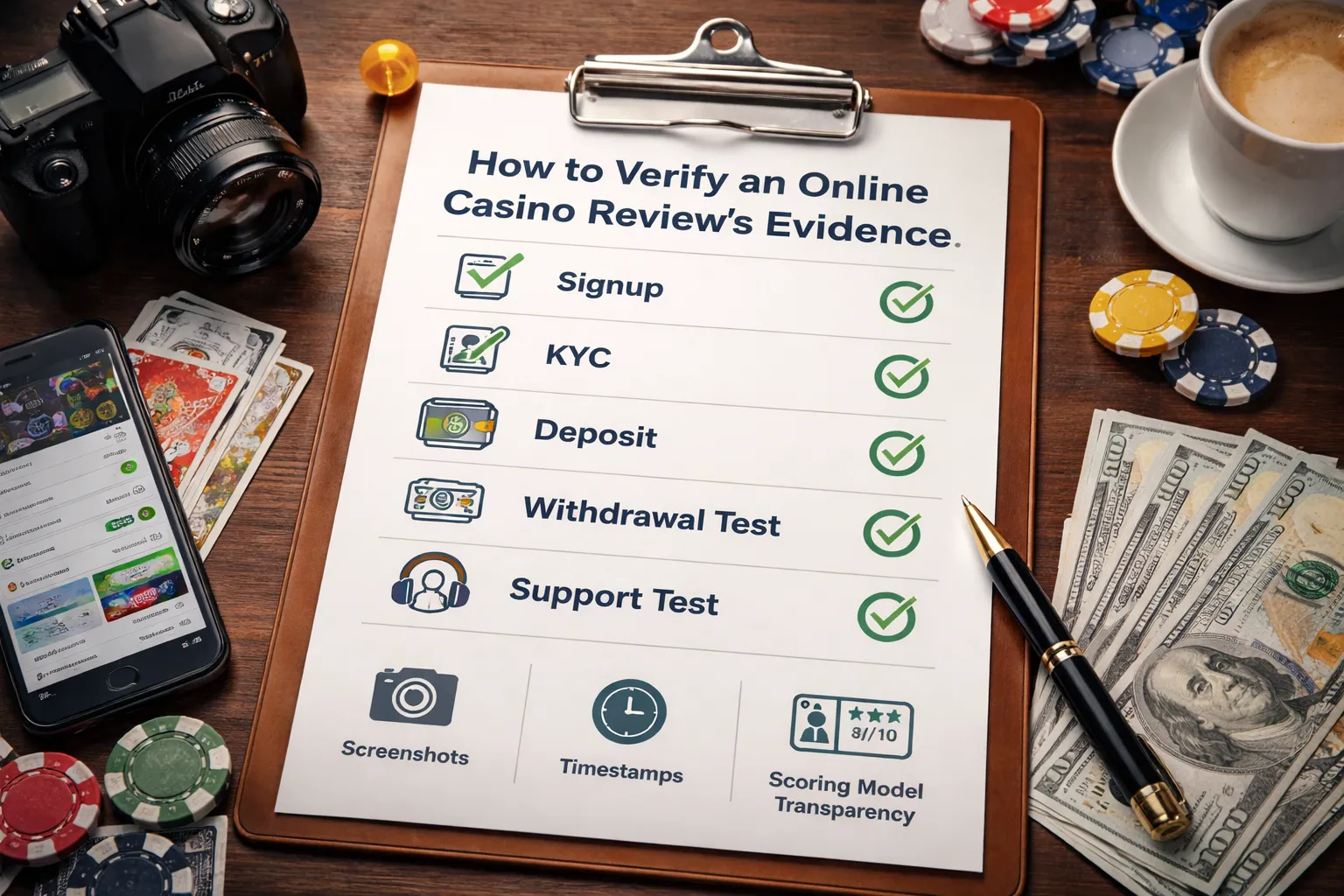
Check the review’s evidence and methodology (the “show your work” test)
A review needs proof. You should see what the writer did, when they did it, and what happened.
Testing claims you should see
- Signup: Date, country, device, and browser. Any blocks, errors, or forced redirects. Any email or SMS verification steps.
- KYC: What documents they submitted, how they submitted them, and how long approval took. Any rejected documents and the reason given.
- Deposits: Method used, minimum deposit, fees, processing time, and any “payment pending” issues. A note on whether the bonus applied or failed.
- Withdrawal attempt: A real cashout test, not a claim. Amount requested, method, withdrawal limits, fee, pending time, and final payout time. Notes on any extra KYC triggered at withdrawal.
- Support contact: Channel used, time to first reply, and whether the agent solved the issue. You should see a transcript, ticket ID, or chat screenshot.
Screenshots, timestamps, and versioning
- Screenshots: Real pages, not stock images. Look for account area screens, cashier screens, withdrawal flow, and terms pages.
- Timestamps: Testing dates for each step. “Reviewed in 2026” means little if the cashier screenshot shows an old UI.
- Versioning: A clear “last tested” date and what changed since the last update, such as new withdrawal caps, new bonus terms, or removed payment methods.
- Terms snapshots: Bonus terms, wagering rules, max cashout, and restricted games captured at the time of testing. If they quote terms, they should link to the exact terms page.
Separate first-hand testing from copied specs
- First-hand testing: “We deposited $20 with Visa, then withdrew $50 to the same card, payout in 26 hours.”
- Copied specs: Game counts, “instant payouts,” and generic licensing text with no proof. Treat these as marketing unless you see test notes.
- Provider lists: A long list means little. You want confirmation the games load in your region and on your device.
- Payment method claims: “Supports low deposits” should include the minimum by method. If you care about small bankroll play, use a guide to low deposit casinos and compare the stated minimums to the cashier screen.
How to interpret scoring models
A score without a model is a badge, not an assessment. You need weights, penalties, and deal-breakers.
| What the review should show | What it tells you |
|---|---|
| Category weights, such as payouts 30%, safety 25%, bonuses 20%, games 15%, support 10% | What drives the final rating. High bonus weight often inflates weak casinos. |
| Penalties, such as slow payouts minus 1 point, hidden fees minus 2 points | How they punish bad behavior. No penalties means soft scoring. |
| Deal-breakers, such as no license, broken withdrawals, predatory terms, fake RTP claims | Whether a casino can score high even when it fails core trust checks. |
| Raw notes behind the score, such as payout time logs and support transcripts | Whether the score comes from testing or opinion. |
If the review hides the model, expect the score to serve the affiliate link. If it shows the model, you can judge if the rating matches your priorities.
Safety and legitimacy checks every review must cover
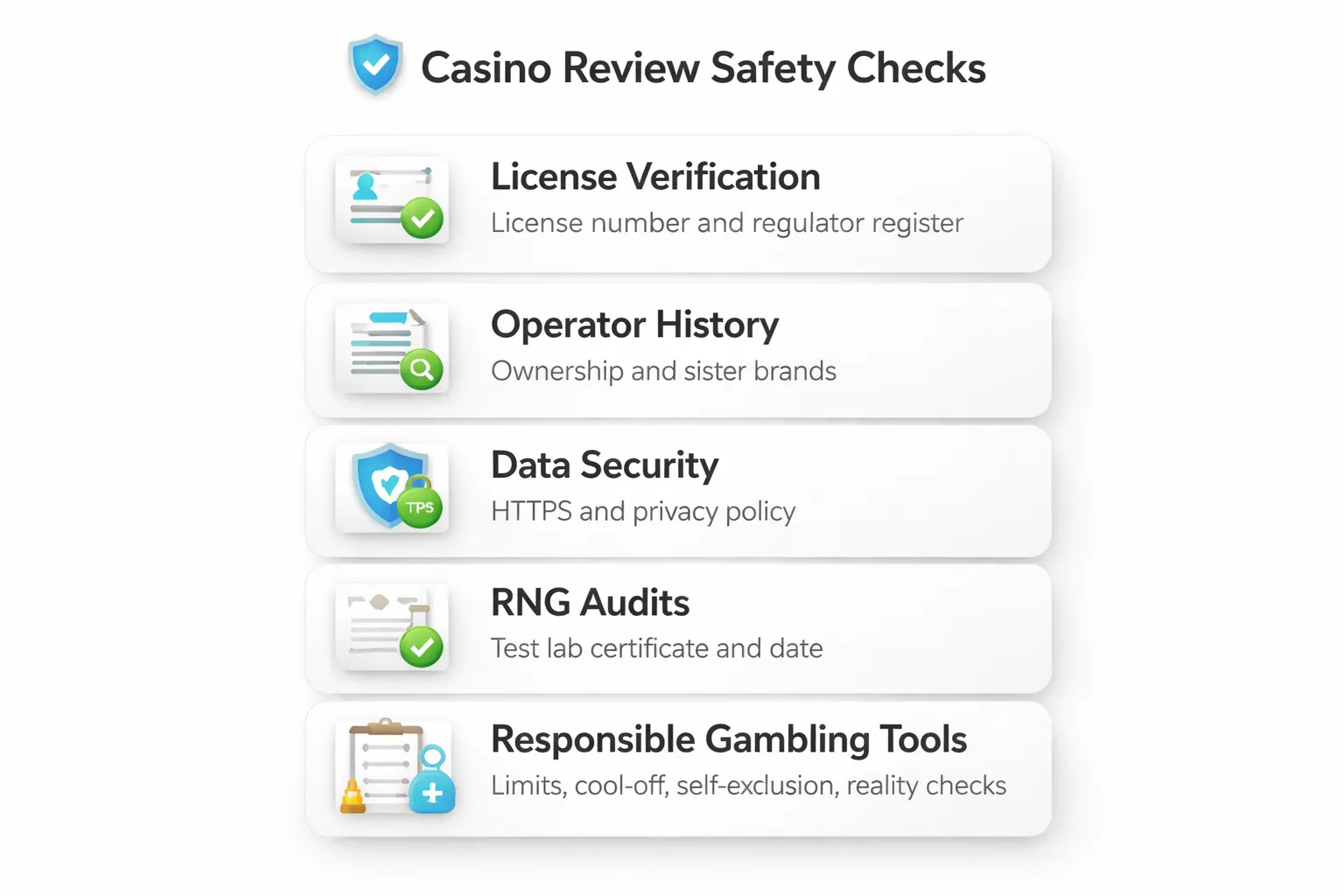
Licensing and regulator verification
A real review shows the license holder, license number, and regulator. You can confirm each piece.
- Find the license claim. Look in the site footer, Terms and Conditions, or the “About” page. Copy the license number and the legal company name, not the brand name.
- Check the regulator register. Use the regulator’s official website, then search the license number or company name. Do not trust screenshots or “licensed by” badges.
- Match the details. The operator name, domain, and status must match. Watch for “suspended,” “surrendered,” or “not authorized” notes.
- Confirm scope. A license can cover some products and not others. A sportsbook license does not always cover casino games.
- Confirm your location. A license does not mean the casino can legally accept you. Use a legality guide if needed.
Operator reputation and history
A solid review tracks who runs the casino and how that changed over time. Ownership matters because policies change with it.
- Identify the legal operator. The payment entity and license holder should match what the review names.
- Track ownership changes. A brand sale can reset support quality, KYC strictness, and withdrawal speed. A good review notes when the operator changed.
- Map the brand network. Many casinos share the same operator, platform, and support team. If one sister brand has repeated complaints, treat it as a signal.
- Check prior violations. Look for regulator actions, public enforcement notices, and published fines. A review should link to sources or name the exact action.
- Look for patterns. Repeated reports of slow payouts, closed accounts after wins, or unclear bonus terms matter more than one bad story.
Data security basics
Security checks should focus on what you can verify, not marketing claims.
- HTTPS on every page. The site should load with https and a valid certificate. Login, cashier, and support forms should never drop to http.
- Encryption claims. “256-bit encryption” is common copy. A review should treat it as a baseline, not a reason for a high score.
- Privacy policy sanity checks. You should see what data they collect, why they collect it, who they share it with, and how long they keep it.
- KYC and document handling. The policy should state what they may request and when. Vague language like “any documents at any time” can signal friction at withdrawal.
- Support channel integrity. If the review tested account questions, it should log response times and keep transcripts. For deeper checks, see what to expect from casino customer support.
Fairness and RNG audits
RNG certificates and lab audits help, but they do not prove fast payouts or fair bonus handling.
- What certifications mean. A test lab can verify the RNG behaves like a random generator under defined tests. It can also confirm game files match approved versions.
- What they do not mean. They do not guarantee you will win, do not prevent harsh bonus terms, and do not stop a casino from delaying withdrawals with extra checks.
- What the review must show. The lab name, report date, and what got tested. “Audited” with no lab and no date adds no value.
- RTP claims. A review should separate game RTP set by the provider from any casino-level settings, then cite where the RTP appears.
Responsible gambling tools
Responsible gambling should sit inside the account settings, not inside a blog post.
- Deposit limits. The casino should let you set daily, weekly, and monthly limits. A review should note if limits apply instantly or after a delay.
- Loss and wager limits. These help more than deposit limits for some players. A good review checks if the tools exist and if they work.
- Cool-off. You should be able to lock the account for a short period, such as 24 hours to a few weeks, without talking to support.
- Self-exclusion. The casino should offer long exclusions and clear reinstatement rules. The review should state if self-exclusion blocks marketing and login.
- Reality checks. Session timers and pop-up reminders help you track time and spend. The review should confirm you can turn them on and set intervals.
| Check | What a credible review shows | What a biased review does |
|---|---|---|
| License | License number, legal entity, regulator, and a way to verify | Badge image, no number, no regulator register link |
| Operator history | Ownership notes, sister brands, prior actions with dates | “Trusted brand” with no records |
| Security | HTTPS check, clear privacy policy summary, KYC expectations | “Military-grade encryption” as proof of safety |
| RNG and audits | Lab name, report date, scope, and limits of the certificate | “Certified fair” with no details |
| Responsible gambling | Tools list plus how to enable them and how they apply | Hotline links only, no account controls tested |
Payments and withdrawals: read beyond “fast cashouts”
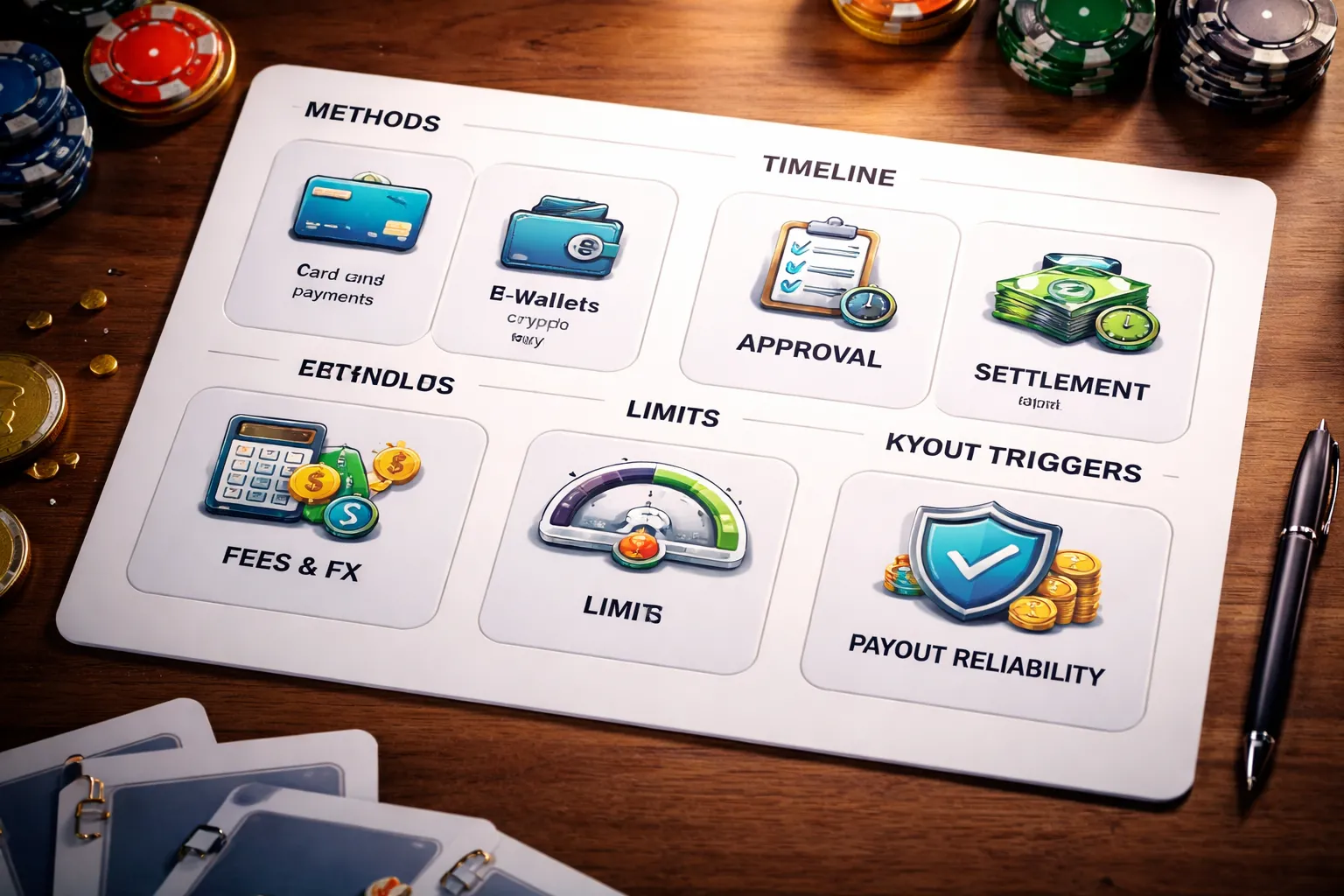
Deposit and withdrawal methods, look for real options, not logos
A review should list deposit and withdrawal methods separately. Many casinos accept more deposit methods than they pay out with.
- Cards: Visa and Mastercard often work for deposits. Withdrawals can fail or route to bank transfer. Look for country and bank restrictions.
- E-wallets: PayPal, Skrill, Neteller, and others can speed payouts. Some casinos block e-wallet withdrawals after card deposits.
- Bank transfer: Usually reliable, often slower. Reviews should state expected banking days and supported currencies.
- Crypto: Only where legal and supported by the operator. A good review names coins, networks, and whether the casino converts to fiat before paying.
Biased sign, the review shows payment logos but no notes on which methods work for withdrawals in your region.
Processing time is not payout time
“Fast cashouts” often means the casino approves withdrawals quickly. That is not the same as money in your account.
- Approval window: The casino checks your request. Reviews should state typical approval time, and whether it changes for first cashout.
- Pending period: Some casinos hold withdrawals in a reversible state for hours or days. A strong review tells you if you can cancel while pending.
- Weekends and holidays: Many finance teams pause manual checks. A good review says if payouts run 7 days a week or only business days.
- Method speed: E-wallets can settle faster than cards. Bank transfers can take extra banking days after approval.
Biased sign, the review lists “0 to 24 hours” with no split between approval and bank settlement.
Fees, conversion, and limits, read the small print
Reviews should break down the full cost of getting paid.
- Withdrawal fees: Some casinos charge per cashout, after a free monthly limit, or only on certain methods.
- Currency conversion: Watch for forced conversion to EUR or USD, bad exchange rates, and extra processor spreads.
- Minimum withdrawal: A high minimum can trap small balances.
- Maximum withdrawal: Check per transaction, per day, per week, and per month. Also check jackpot win caps if the review mentions promos.
Biased sign, the review claims “no fees” but does not mention conversion costs or third-party bank charges.
KYC triggers that delay payouts, and how to spot unfair rules
KYC delays most often hit at withdrawal. A useful review lists the triggers and the document rules.
- First withdrawal: Many casinos verify identity only when you cash out. Expect it. The review should say it clearly.
- Large win or limit threshold: Reviews should note if extra checks start at a specific amount.
- Method mismatch: Depositing by card and withdrawing by e-wallet can trigger checks or rejection.
- Bonus and wagering flags: Casinos may re-check activity when a bonus funds a withdrawal.
Watch for unfair requirements. These slow payouts and create excuses to refuse cashouts.
- Unclear document standards: No file types, no size limits, no guidance on address proof age.
- Open-ended review time: “Verification can take as long as needed” with no typical timeframe.
- Repeated verification: Asking for the same docs again without a reason, after approval.
- Source of funds demands for small amounts: Some checks make sense. A review should call out when it looks excessive.
Payout reliability signals, patterns beat promises
Good reviews look for evidence, not marketing.
- Complaint patterns: Look for repeated reports of “paid after weeks,” “endless verification,” “closed account after winning,” and “bonus terms used to void cashout.” One-off complaints matter less than a pattern.
- Proof-of-payment: Screenshots, timestamps, transaction IDs, and method used. A strong review shows examples, or explains why it could not verify them.
- Clear dispute routes: The review should name escalation steps, internal complaints, ADR where available, and regulator contacts tied to the license.
- Support quality around withdrawals: Slow or evasive support often matches slow payments. Use customer support expectations as a baseline when you judge payout issues.
Biased sign, the review awards a high “payments” score with no limits table, no KYC notes, and no complaint analysis.
| What the review says | What you should look for |
|---|---|
| “Fast cashouts” | Approval time, pending rules, weekend handling, method settlement time |
| “Many banking options” | Deposit and withdrawal methods listed separately, with region notes |
| “No fees” | Withdrawal fees, conversion spreads, bank charges, inactive account fees |
| “Secure verification” | KYC triggers, doc rules, typical timelines, clear rejection reasons |
| “Trusted payouts” | Complaint patterns, proof-of-payment, dispute and regulator routes |
Bonuses and promotions: how to decode the fine print
Wagering requirements, convert the headline into a number
Reviews often quote the bonus size. You need the playthrough to judge its real cost.
- Wagering (playthrough) means how much you must bet before you can withdraw bonus funds, and sometimes your deposit.
- Bonus-only wagering uses the bonus amount. Deposit plus bonus wagering uses both.
- Look for the base in the terms: “wager bonus” vs “wager deposit and bonus”.
Quick example calculation
- Deposit $100, get a 100% bonus, bonus = $100.
- Wagering = 35x bonus.
- Total wagering needed = $100 x 35 = $3,500 in bets.
- If the term says 35x deposit + bonus, total wagering needed = ($100 + $100) x 35 = $7,000 in bets.
When a review skips the base or the multiplier, treat the rating as incomplete.
Game contribution and restricted games, where wagering gets blocked
Clearing a bonus depends on what you play. Reviews should list contribution rules. Many do not.
- Slots often count 100% toward wagering.
- Table games often count 0% to 20%.
- Live dealer games often count low or zero, rules vary by provider. Use a separate guide like how live dealer casinos work if the review stays vague.
- Restricted games can void the bonus or winnings if you play them while the bonus is active.
Watch for terms like “excluded games”, “wagering excluded”, “low contribution”, and “irregular play”. A strong review names the main excluded categories and gives examples.
Max bet limits, the fastest way to void a bonus
Many bonuses set a maximum stake per spin or per hand while the bonus is active.
- Common limits sit around $5 to $10 per spin, sometimes lower.
- Some casinos apply a limit per bet, some per round, some per total across features like double-up and side bets.
- Some terms count auto-play and turbo play as normal, others flag high-speed play as “abuse”.
If a review says “fair terms” but does not state the max bet rule, you cannot verify that claim.
Time limits and “sticky vs non-sticky”, what you can withdraw
Bonuses expire. Reviews should state the clock and what happens to funds when you cash out.
- Time limits often run 7 days, 14 days, or 30 days. Miss the deadline and you lose the bonus, and sometimes winnings tied to it.
- Sticky bonus means you cannot withdraw the bonus itself. You can withdraw winnings after you meet wagering, but the bonus amount stays with the casino.
- Non-sticky (cashable) bonus means you may withdraw the bonus amount after you meet wagering, terms vary.
A biased review often calls all bonuses “withdrawable” without explaining sticky rules.
Withdrawal caps and void clauses, the traps behind “big wins”
Some bonuses cap what you can cash out. Others add clauses that let the casino void winnings.
- Max cashout can be a fixed amount, like $200, or a multiplier, like “5x bonus”.
- Withdrawal limits can apply per day, per week, or per month, even after the bonus clears.
- Payment method limits can force withdrawals back to the deposit method up to the deposit amount, then the rest by bank transfer.
- Void clauses often cite restricted games, max bet breaches, “bonus abuse”, linked accounts, or inconsistent KYC details.
VIP and loyalty programs, value signals vs retention traps
Reviews love VIP programs. You need numbers and rules.
- Value indicators include clear earn rates, transparent tier thresholds, and cash conversion rates for points.
- Also strong are published benefits, like faster withdrawals, higher limits, and dedicated support with defined hours.
- Retention traps include “invite-only” tiers with no criteria, rewards that require high turnover, and bonuses with higher wagering than public promos.
- Point expiry and inactivity resets reduce value, reviews should state both.
Trust reviews that show the earn rate, the redemption rate, and the key limits. Be cautious with reviews that only list perks and call them “exclusive”.
Games, RTP, and software providers: what matters to players
Provider quality signals, studios, licensing, integrity
Start with the software providers. They control the game math, features, and stability.
- Name the studios. A good review lists the main slot and live dealer providers, not “top providers” with no names.
- Check licensing coverage. Providers often restrict content by regulator. A review should state the casino license and the main market it serves.
- Look for game integrity proof. For RNG games, the review should mention independent testing labs and link to certificates when possible. For live casino, it should name the studio and tables available.
- Watch for “exclusive games” claims. Most casinos run the same provider catalog. If a review says “exclusive”, it should show the actual game list and the provider deal behind it.
RTP transparency, per-game RTP vs “site RTP”
RTP sits at the game level. It does not sit at the casino level.
- Trust per-game RTP listings. A solid review shows RTP per title, or it explains how you can find RTP in the game info panel.
- Be cautious with “site RTP” or “average RTP”. Casinos can curate the mix of games and promote a number that means little for your sessions.
- Check for RTP variants. Many slots ship in multiple RTP versions. A fair review states if the casino runs lower RTP configurations, or it tells you how to confirm the version on your device.
- Separate RTP from volatility. RTP does not tell you swing size. Reviews should label volatility, or at least flag high variance games as such.
Jackpots, live casino, sportsbook add-ons, regional coverage
Game availability changes by country and state. Reviews should treat this as a core detail.
- Jackpots. The review should say if jackpots come from a network provider, list a few headline titles, and note any bet size rules for eligibility.
- Live casino. Coverage differs by region. A good review lists live providers, table types, limits, and peak time performance. For live vs RNG basics, use live dealer vs RNG casino games.
- Sportsbook. Some “casino reviews” grade the sportsbook without checking market depth. Look for details like supported sports, bet types, cashout, live betting stability, and local league coverage.
- Language and currency. A review should state supported languages, currencies, and local payment rails, since these affect what products you can access.
Compatibility and performance, mobile UX, app vs browser, speed
Bad performance kills your session. Reviews should measure it.
- Mobile first checks. The review should test iOS and Android, not just desktop, and state if games run in portrait mode.
- App vs browser. If the casino pushes an app, the review should say what the app adds. If it is just a wrapper, browser play may work the same.
- Load time. Look for notes on lobby load speed, game launch time, and crashes. A vague “smooth gameplay” line tells you nothing.
- Filters and search. Strong lobbies let you filter by provider, RTP, volatility, and features. Reviews should show which filters exist and which do not.
Game availability caveats, geo-restrictions and provider blocks
A casino can advertise thousands of games, then block key providers in your region.
- Geo-restrictions. Reviews should state where the casino accepts players and where it does not. This ties directly to game access.
- Provider blocks. Some studios block specific countries, payment methods, or regulators. A good review warns you when major providers do not show up in certain markets.
- Bonus ties. Some bonuses exclude whole categories like live casino or jackpots. Reviews should list game contribution rules, since they change your real value.
- Reality check. Trust reviews that show a sample game list for each category, tested from the stated region.
| Review claim | What you should look for |
|---|---|
| “High RTP casino” | Per-game RTP, RTP variant notes, and where to verify in-game |
| “Top software providers” | Named studios, category coverage, and any missing major providers |
| “Huge jackpots” | Network name, jackpot titles, eligibility rules, and bet minimums |
| “Great on mobile” | iOS and Android testing, load times, portrait support, crash notes |
| “Available in your country” | Clear list of supported regions, plus provider blocks and product limits |
Customer support and user experience: the practical day-to-day tests
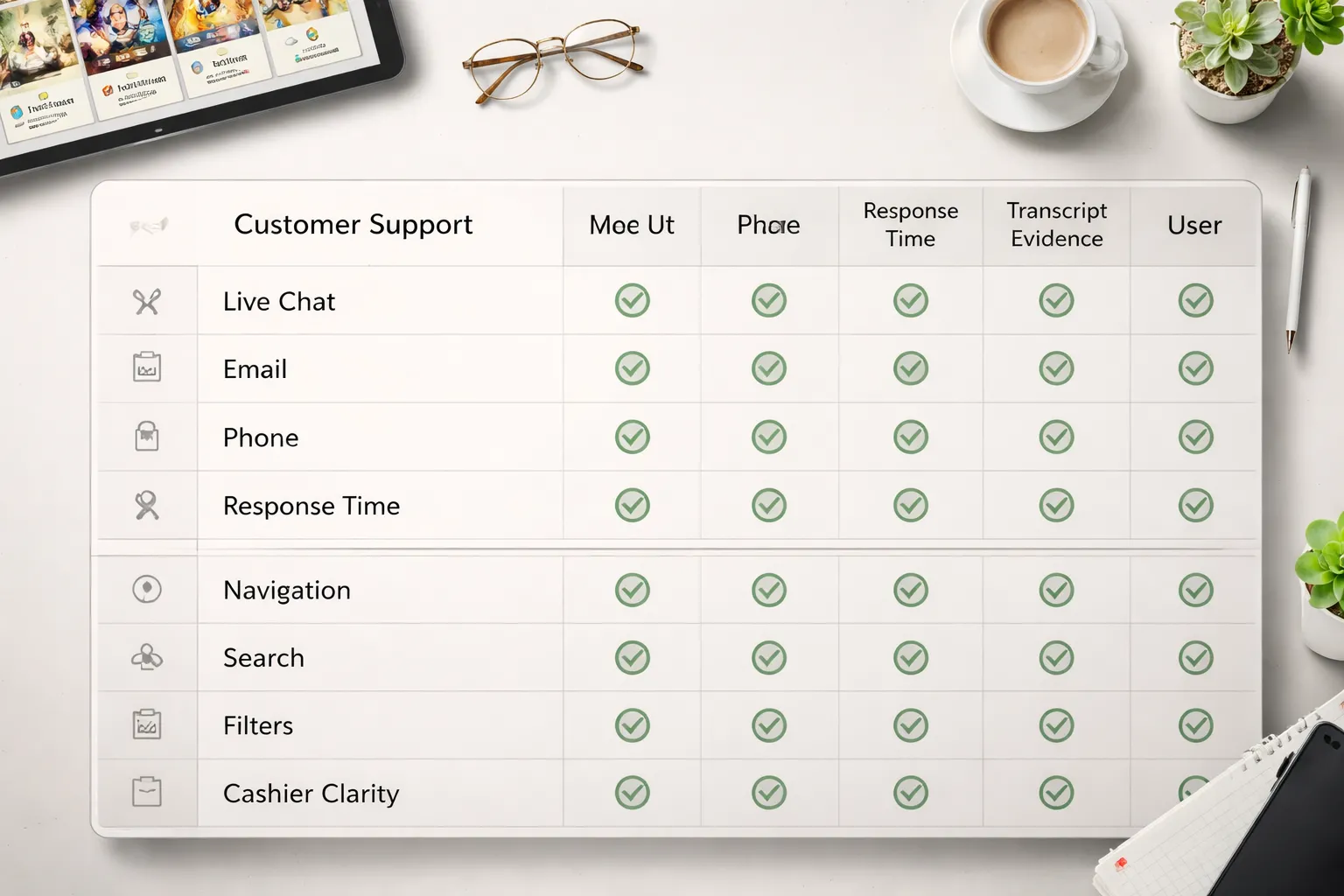
Support channels and hours: live chat, email, phone, and response-time expectations
Good reviews name the support channels. They list live chat, email, and phone. They also state the hours in your time zone.
Look for tested response times, not claims.
- Live chat: Expect a first reply in 30 to 180 seconds. If a review says “instant” with no stopwatch time, treat it as marketing.
- Email: Expect a human reply in 2 to 24 hours. Same-day replies matter more than auto-receipts.
- Phone: Many casinos do not offer it. If they do, the review should list the country code, hours, and hold time.
- Messaging apps: WhatsApp or Telegram support exists at some brands. The review should confirm the number, not just show an icon.
Check if the review tested support at different times. Weekends and late nights expose thin staffing.
Support quality checks: knowledge, escalation, and transcript evidence
A useful review shows what support did, not what it “felt like.” You want proof.
- Knowledge: The agent should answer basic questions without copy-paste filler. Examples include minimum deposit, withdrawal method limits, bonus wagering, and KYC steps.
- Escalation: The agent should escalate when needed. The review should note how long it took to reach a supervisor or specialist.
- Consistency: Ask the same question twice, two agents, same day. A good review reports if answers matched.
- Receipts: Look for chat transcripts, ticket numbers, or screenshots. If the review refuses to show evidence “for privacy,” it can still quote anonymized logs.
- Language support: If the casino targets your country, the review should confirm your language works in chat and in email.
Biased reviews skip the messy parts. They praise “friendly staff” and provide no transcript, no ticket ID, and no timeline.
Site usability: navigation, search, game filters, and cashier clarity
This is the day-to-day friction. A review should test common tasks and report the clicks.
- Navigation: You should reach Slots, Live Casino, and Promotions in one or two taps. Reviews should note if menus hide key categories.
- Search: The search bar should find games by title and provider. A good review tests five known titles and records misses.
- Filters: Filters should include provider, volatility, features, and RTP when available. At minimum, you should see provider and feature filters.
- Game pages: Look for clear rules, RTP display, and demo mode labeling. Reviews should flag missing RTP or unclear demo availability.
- Cashier clarity: Deposit and withdrawal pages should show fees, minimums, maximums, and processing time per method. If you must start a withdrawal to see limits, that is a red flag.
Strong reviews test the flow from lobby to cashier and back. They also note redirects, broken pages, and forced pop-ups.
Account management: limits, session tools, and closure process
Safety tools show how the casino treats you when you want control. Reviews should test them, not just list them.
- Deposit limits: The review should confirm you can set daily, weekly, and monthly caps. It should state when increases apply, often after a cooling period.
- Loss and wager limits: These matter more than deposit limits. The review should confirm they exist and work.
- Session tools: Look for session timers, reality checks, and time-out options. The review should state where the tools live in the account menu.
- Self-exclusion: The review should list durations and whether exclusion covers sister sites under the same license group.
- Account closure: The review should explain the steps. You should be able to close via settings or support, with a written confirmation.
If you plan to learn how online casinos work, pay extra attention to this section in any review. It shows whether the brand backs up its policies with usable controls.
How to spot biased ratings and manipulative review tactics
Overly positive language with no trade-offs, the “no cons” problem
Strong reviews list strengths and limits. Biased reviews read like ads.
- Zero drawbacks: If every section ends with praise, the writer avoided real testing.
- No specifics: Watch for claims like “fast payouts” with no timeframes, methods, or fees.
- No friction points: A real review mentions at least one of these, verification delays, withdrawal limits, bonus wagering, game restrictions, or support gaps.
- No policy citations: Look for links or quotes from terms, withdrawal pages, or responsible gambling tools.
Inflated scores driven by bonuses rather than safety and payouts
Some sites score a casino high because the bonus pays them more. You should weight safety and cashout performance higher than promos.
- Bonus-heavy scoring: If “Welcome bonus” drives most of the score, treat the rating as marketing.
- Missing payout metrics: A serious review states typical withdrawal times by method, plus limits and fees.
- Missing compliance checks: You should see licensing details, KYC requirements, and restricted countries or states.
- RTP and game fairness ignored: The review should name game providers, RNG testing, and where RTP info appears in-game.
| What should drive the score | What should not drive the score |
|---|---|
| License and regulator details | Bonus size alone |
| Withdrawal speed, limits, fees | “VIP” hype with no terms |
| Terms clarity, wagering rules, excluded games | Leaderboard rank and badges |
| Support response times and channels | Countdown timers |
Fake urgency and misleading claims, “exclusive”, “guaranteed”, “instant”
Urgency pushes you to click before you think. Treat absolute words as a red flag.
- “Exclusive”: Check if the same offer appears on other affiliate sites. If yes, it is not exclusive.
- “Guaranteed”: Casinos do not guarantee wins. The only “guarantee” you can verify is a bonus policy, and it still has terms.
- “Instant withdrawals”: Look for the qualifier. Many casinos mean instant approval, not instant arrival. KYC can add days.
- Hidden conditions: If the review highlights a bonus but skips wagering, max cashout caps, or game exclusions, it manipulates you.
Cherry-picked complaints and review gating, hiding negative user feedback
User feedback helps, but it gets abused. Some sites filter complaints to protect partners.
- Only easy complaints: “The app lagged” appears, but you never see cashout delays, closed accounts, or bonus confiscations.
- No pattern analysis: A good review groups issues by type and frequency. A biased review treats every complaint as “user error.”
- Missing timestamps: Without dates, you cannot tell if problems are current.
- Selective screenshots: Watch for cropped chats that omit the key part, withdrawal reason, rule cited, or final outcome.
Suspicious comparisons, always ranking the same partner brands at the top
Comparison tables often exist to route you to high-commission brands.
- Same winners every time: If the top three brands never change across multiple “best of” pages, expect commercial bias.
- Weak criteria: “Overall experience” and “fun” replace measurable items like payout times, limits, and licensing.
- Identical scores: Many casinos get 9.8 to 10 with no breakdown. Real scoring creates spread.
- No non-partners: A credible comparison includes strong competitors even if they do not pay affiliate fees.
- Affiliate links dominate: If every mention pushes a button and no section tests withdrawals or support, you are reading a funnel.
If you want context on game types and what reviewers should test, read live dealer vs RNG casino games.
Cross-check a casino review with independent sources
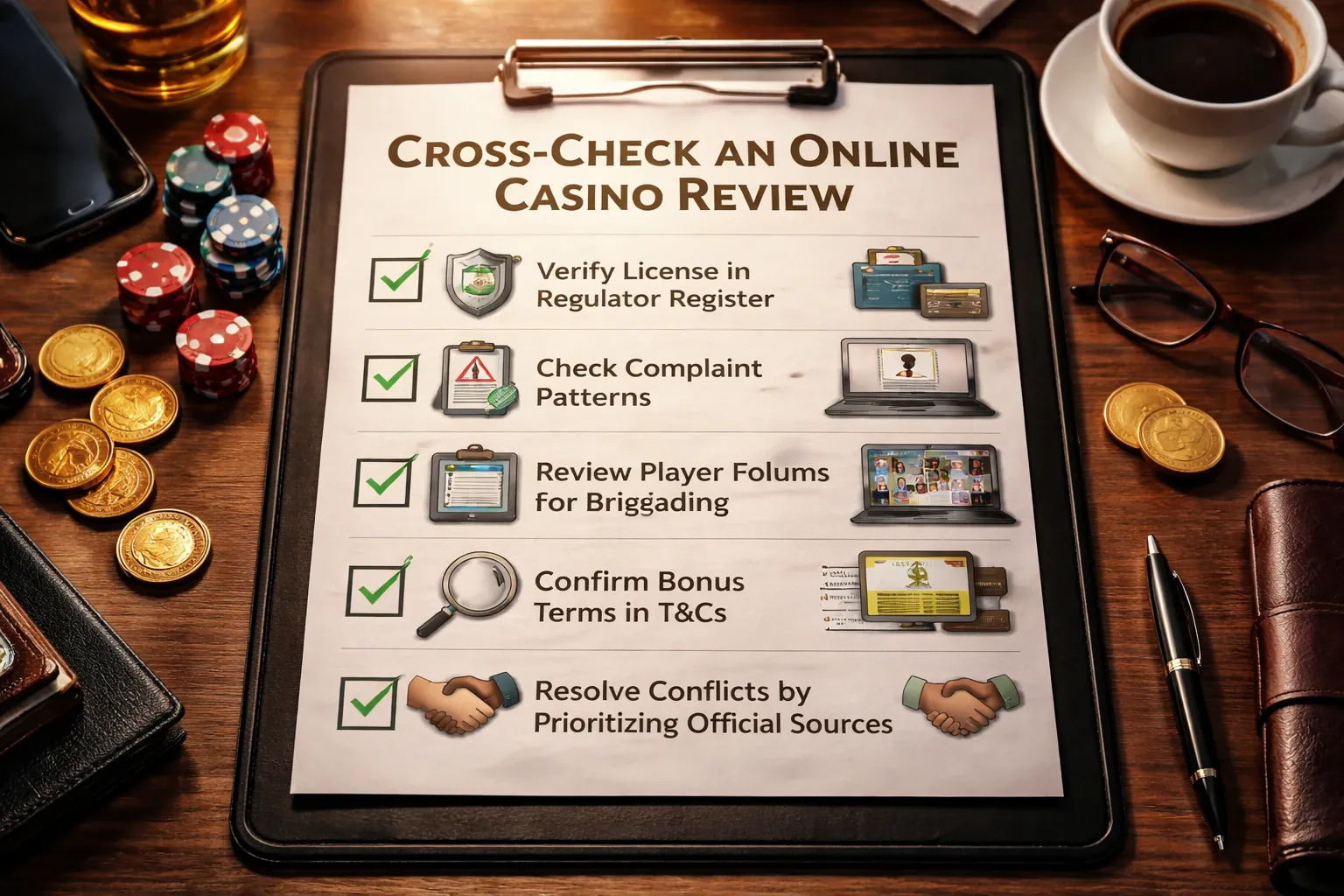
Cross-check a casino review with independent sources
Where to verify licensing and complaints
Start with the license. Do not take a badge or a logo as proof.
- Find the legal operator name. Check the footer, terms, or the “About” page. Copy the company name and license number.
- Use the regulator’s official register. Search the operator name, trading name, and license number. Confirm status, expiry, and approved domains.
- Check enforcement and warning lists. Many regulators publish sanctions, suspensions, and public warnings. Look for your casino brand and the parent company.
- Verify the domain. A valid company can still run unlicensed mirror sites. The exact domain you plan to use must appear in the regulator record.
Using player forums and review platforms responsibly
Forums and review sites help you spot patterns. They also contain noise. Treat them like leads, not verdicts.
- Look for repeat issues with details. Dates, screenshots, payment method names, and chat transcripts carry weight.
- Ignore one-line rage posts. “Scam” without evidence tells you nothing.
- Watch for brigading. Many new accounts posting the same praise or the same complaint in a short window signals manipulation.
- Check account history. Real users post across topics over time. Fake accounts often post only about one brand.
- Separate player error from operator behavior. Some disputes come from unmet wagering rules or failed identity checks. You still log them, but you label them correctly.
Search for patterns with targeted queries
Use simple searches to find recurring problems that a review may hide.
- Search the operator name plus key terms. Use “terms”, “complaint”, “payout”, “withdrawal”, “KYC”, “verification”, “closed account”, “bonus abuse”, “chargeback”.
- Search the parent company too. Many casinos share the same operator. Complaints often cluster at the operator level.
- Scan dates. A wave of recent payout or KYC complaints matters more than old issues from years ago.
- Compare across sources. If the same issue appears on forums, app stores, and watchdog sites, it is less likely to be random.
Confirm bonus terms in the casino’s own pages
Reviews often summarize bonuses. Summaries miss the traps. You need the primary source.
- Open the promo page. Confirm the exact bonus, wagering requirement, max bet, game contribution, and expiry.
- Open the full T&Cs. Search within the page for “withdrawal”, “maximum cashout”, “restricted games”, “void”, “confiscate”, “verification”, “dormant”.
- Check payment method rules. Some bonuses block certain deposit methods, or require withdrawal back to the same method.
- Match the review against the text. If the review claims “low wagering” or “fast cashouts”, verify the numbers and limits yourself.
What to do if information conflicts
Conflicts happen. Use a simple rule. Trust official records and primary documents over affiliate pages.
- Prioritize sources in this order. Regulator register, casino T&Cs, payment provider terms, then third-party reviews.
- Assume the stricter rule applies. If one page says max bet is $10 and another says $5, plan for $5.
- Verify with support in writing. Ask one clear question. Save the transcript or email. Do not rely on a phone call.
- Walk away if answers stay vague. If support will not confirm key terms, you will struggle in a dispute.
If you need a baseline on how casinos operate and where rules hide, read what an online casino is and how it works.
A practical checklist to read any online casino review in 10 minutes
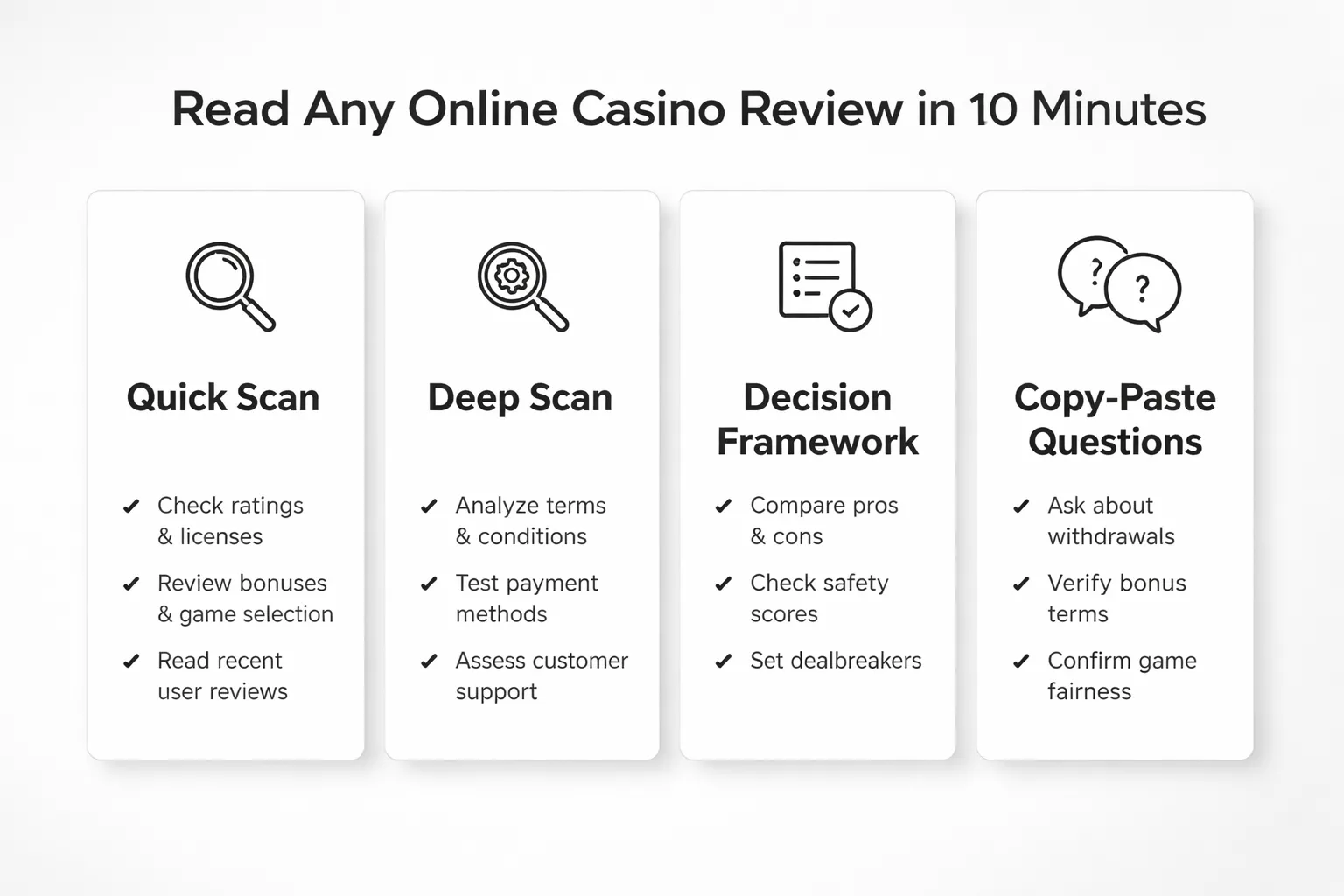
Quick scan in 2 minutes, disclosures, license, ownership, last updated
- Find the “last updated” date. If you cannot find it, treat the review as stale.
- Check affiliate disclosure. Look for “we may earn a commission” or “sponsored.” No disclosure, higher bias risk.
- Identify who owns the casino. The review should name the operator company, not just the casino brand. Search the operator name on the license register.
- Verify the license and regulator. The review should list the regulator and license number, or link to the regulator record. If it only says “licensed,” treat it as unverified.
- Confirm the market and legality. A solid review states where the casino accepts players. If it blurs locations, check your local status in this guide to online casino legality.
- Spot rating inflation. If every category sits at 9.5 to 10, the score tells you nothing. Move to the details and ignore the final grade.
- Look for test evidence. A good review states what the reviewer did, deposit method used, withdrawal amount, and withdrawal time.
Deep scan in 6 minutes, withdrawals, KYC, fees, limits, bonus restrictions
- Withdrawal timeline. The review should separate “processing time” from “bank or wallet time.” If it only says “fast,” you have no number.
- Withdrawal limits. Find per transaction, per day, per week, and per month caps. Treat missing limits as a risk.
- Fee list. Check for withdrawal fees, currency conversion fees, inactive account fees, and chargeback fees. If the review says “no fees,” look for fine print or exceptions.
- KYC triggers. The review should name when verification happens, first cashout, certain amount, change of payment method, large win. If it says “quick KYC,” look for document list and time estimates.
- Source of funds checks. Serious casinos may ask for proof of income for larger withdrawals. If the review hides this, you may face delays later.
- Payment method rules. Check if you must withdraw to the same method you used to deposit, and how they handle closed cards or expired accounts.
- Bonus wagering and time limits. Find wagering multiple, eligible games, contribution rates, expiry date, and max bet while wagering. Missing any one of these can change the value of the bonus.
- Max cashout and capped winnings. Some bonuses cap total withdrawable winnings. A review must state the cap and where it applies.
- Game restrictions. Look for rules on live dealer, jackpots, and low house edge games. Reviews often bury this.
- Bonus abuse clauses. Watch for vague terms like “irregular play” or “advantage play” with no definition. Treat broad clauses as a dispute risk.
- Support quality evidence. Look for real response times, channels tested, and whether agents answer policy questions. If you want a baseline, use your own test and compare with what online casino customer support should look like.
Decision framework in 90 seconds, deal-breakers vs nice-to-haves
| Player type | Deal-breakers | Nice-to-haves |
| Cashout focused | Low monthly withdrawal limits, unclear processing time, hidden fees, vague KYC rules, weak regulator | More payout methods, faster processing, clear escalation path for disputes |
| Bonus focused | High wagering, short expiry, low max bet, capped winnings, broad “abuse” clauses, restricted games list | Lower wagering on slots, transparent game contribution table, reload offers with the same terms |
| High stakes | Low max bet, low max cashout, strict per day limits, manual withdrawals only, inconsistent rule pages | VIP terms in writing, higher limits by tier, dedicated account contact who confirms policy by email |
| Casual | Hard to find terms, no clear license record, frequent complaints about blocked withdrawals | Simple app, good responsible gambling tools, stable game catalog |
| Privacy focused | Unclear data handling, unclear KYC scope, weak ownership transparency | Clear document checklist, predictable verification flow, secure account controls |
Template you can copy, questions to ask before you sign up
- License and operator: “What company operates this casino, and what is the license number and regulator?”
- Countries and restrictions: “Do you accept players from my location, and do you block any payment methods there?”
- Withdrawal timing: “What is your processing time for withdrawals for my payment method, and what are the typical delivery times after approval?”
- Limits: “What are my withdrawal limits per transaction, per day, and per month on my account level?”
- Fees: “Do you charge any withdrawal, conversion, or inactivity fees, and where are they listed in your terms?”
- KYC checklist: “What documents do you require for first withdrawal, and what triggers additional checks?”
- Source of funds: “At what withdrawal amount do you request proof of funds or proof of income?”
- Bonus rules: “If I claim this bonus, what are the wagering requirements, expiry date, max bet, and restricted games?”
- Max cashout: “Is there a max cashout or winnings cap for this bonus, and what is the exact amount?”
- Withdraw method rule: “Do I need to withdraw to the same method I used to deposit, and what if that method is no longer available?”
- Complaint path: “If we dispute a withdrawal, what is the escalation path, and do you provide written confirmation of decisions?”
FAQ
What should you check first in a casino review?
Check licensing and the regulator name. Check the withdrawal terms and timeframes. Check bonus wagering, game contribution, max bet, and max cashout. Look for clear payment methods and fees. If the review skips these, treat the rating as noise.
How can you spot a biased rating fast?
Look for missing cons, vague claims, and no numbers. Watch for “exclusive” bonuses with no terms shown. Check if every casino gets 9 or 10 out of 10. If the review pushes one brand across many pages, assume an affiliate goal.
What numbers should a good review include?
Licensing details. Minimum deposit and minimum withdrawal. Typical withdrawal time by method. Fees and limits. Bonus wagering requirement, max bet, wagering window, and max cashout. Game contribution rates. If you cannot find these, you cannot verify the offer.
How do you verify licensing claims from a review?
Find the license number in the casino footer. Match it on the regulator site. Check the company name and domain match. If the review shows a logo but no license data, ignore it. If the license does not cover your region, move on.
How do you judge payout speed claims?
Ignore “fast payouts” with no timeframe. Look for hours or days, split by method. Check if the review mentions verification and source of funds checks. Read player complaints for patterns, not one offs. Slow payouts often link to unclear bonus terms.
What bonus terms matter most when reading reviews?
Wagering requirement. Max bet during wagering. Game restrictions and contribution. Time limit. Max cashout cap. Withdrawal method rules. These terms decide if you can cash out. If the review highlights the bonus size and hides the terms, skip it.
How do you compare two reviews that disagree?
Compare what they measured, not the score. Use the same checklist. License, withdrawals, fees, limits, bonus rules, support, and complaints. Trust the review that shows terms, screenshots, and dates. Treat “trust us” reviews as ads.
Do user reviews matter more than expert reviews?
User reviews help you spot repeated issues, like delayed withdrawals or locked accounts. Expert reviews help you map terms and features. Use both. Give more weight to complaints that cite dates, methods, and amounts. Ignore one line rants and hype posts.
What support details should a review cover?
Channels, hours, and response times. Live chat test results. Email ticket handling. KYC and withdrawal escalation steps. Ask if they provide written decisions on disputes. For a deeper checklist, see what to expect from online casino customer support.
Conclusion
You do not need a perfect score. You need clean facts.
Treat every review as a data source, not a verdict. Pull out the numbers, terms, and limits. Then confirm them on the casino site.
- Licensing: Regulator name, license number, and a working register link.
- Bonuses: Wagering rules, max bet limits, game contributions, time limits, and withdrawal caps.
- Payments: Deposit and cashout methods, fees, minimums, maximums, and stated processing times.
- KYC: Required documents, trigger points, and how it affects first withdrawal timing.
- Complaints: Dates, amounts, screenshots, and clear timelines. Skip vague rants.
- Support: Channels, hours, response times, and escalation steps. Use this customer support checklist to verify what a review should show.
Final tip. Build your own one page scorecard. Use the same fields every time. If a review cannot fill them with evidence, ignore its rating.
-
Are Online Casinos Legal? Complete Guide by State & Country
8 months ago -
What Is an Online Casino? How They Work, Games, Bonuses & Safety
8 months ago -
Best Low Deposit Online Casinos: Play for Less with Small Minimum Deposits
8 months ago -
Live Dealer vs RNG Casino Games: What’s the Difference?
8 months ago -
How Live Dealer Casinos Work (and What to Expect)
8 months ago
-
- Wagering requirements, convert the headline into a number
- Game contribution and restricted games, where wagering gets blocked
- Max bet limits, the fastest way to void a bonus
- Time limits and “sticky vs non-sticky”, what you can withdraw
- Withdrawal caps and void clauses, the traps behind “big wins”
- VIP and loyalty programs, value signals vs retention traps
-
- Overly positive language with no trade-offs, the “no cons” problem
- Inflated scores driven by bonuses rather than safety and payouts
- Fake urgency and misleading claims, “exclusive”, “guaranteed”, “instant”
- Cherry-picked complaints and review gating, hiding negative user feedback
- Suspicious comparisons, always ranking the same partner brands at the top
-
- What should you check first in a casino review?
- How can you spot a biased rating fast?
- What numbers should a good review include?
- How do you verify licensing claims from a review?
- How do you judge payout speed claims?
- What bonus terms matter most when reading reviews?
- How do you compare two reviews that disagree?
- Do user reviews matter more than expert reviews?
- What support details should a review cover?
-
-
- Wagering requirements, convert the headline into a number
- Game contribution and restricted games, where wagering gets blocked
- Max bet limits, the fastest way to void a bonus
- Time limits and “sticky vs non-sticky”, what you can withdraw
- Withdrawal caps and void clauses, the traps behind “big wins”
- VIP and loyalty programs, value signals vs retention traps
-
- Overly positive language with no trade-offs, the “no cons” problem
- Inflated scores driven by bonuses rather than safety and payouts
- Fake urgency and misleading claims, “exclusive”, “guaranteed”, “instant”
- Cherry-picked complaints and review gating, hiding negative user feedback
- Suspicious comparisons, always ranking the same partner brands at the top
-
- What should you check first in a casino review?
- How can you spot a biased rating fast?
- What numbers should a good review include?
- How do you verify licensing claims from a review?
- How do you judge payout speed claims?
- What bonus terms matter most when reading reviews?
- How do you compare two reviews that disagree?
- Do user reviews matter more than expert reviews?
- What support details should a review cover?
-
-
Reload Bonus Explained: What It Is and When It’s Worth Claiming
6 months ago -
Online Casino Licensing Explained: Authorities, Licenses & How to Check One
8 months ago -
Best Live Dealer Casinos: Where to Play Live Blackjack, Roulette & More
8 months ago -
Best Online Casinos for High Rollers: VIP Perks, High Limits & Exclusive Bonuses
8 months ago -
Fast Payout Online Casinos: Best Sites for Quick Withdrawals
8 months ago
-
Online Casino Customer Support: What to Look For (Live Chat, Email, Response Times)
8 months ago -
Sign Up for an Online Casino: Create an Account in Minutes
8 months ago -
Online Casino Payment Safety Tips: How to Deposit and Withdraw Securely
8 months ago -
What to Do If an Online Casino Won’t Pay Out: Step-by-Step Actions
8 months ago -
How to File a Complaint Against an Online Casino (Plus ADR Explained)
8 months ago