Online Casino Customer Support: What to Look For (Live Chat, Email, Response Times)

When something breaks in an online casino, support decides how fast you get back to play, or how fast you get your money. You need clear ways to contact the site and predictable response times. This guide shows you what to check before you deposit. You will learn which support channels matter most, live chat versus email, what 24/7 really means, and which response time targets signal a well run operation. You will also learn what to look for in the first reply, how to test support in minutes, and how to spot red flags like scripted answers, missing escalation paths, and slow KYC help. If you need safer play basics too, read our guide to set a gambling budget.
In het kort:
- Check for three core channels, live chat, email, and phone or callback. Extra channels help, but these three solve most issues.
- Prefer live chat for urgent tasks, deposits, withdrawals, locked accounts, and bonus errors. Use email for documents, receipts, and a paper trail.
- Ignore “24/7” claims until you test them. Send a message at a low traffic time and log the first human reply.
- Use response time targets. Live chat should connect fast and resolve in the same session. Email should get a clear first reply within hours, not days.
- Judge the first reply. You want specific steps, case ID, timelines, and exact requirements. You do not want copy pasted policy text.
- Test support in minutes. Ask one simple account question and one payout or KYC question. Compare the answers for clarity and consistency.
- Watch for red flags. Scripted replies, no escalation path, no transcript, vague timelines, and slow KYC handling predict future payout delays.
- Pick casinos with strong responsible gambling support. Clear tools, fast self exclusion handling, and staff who can explain limits without friction.
- If you also need safer play basics, read our guide to set a gambling budget.
Why online casino customer support matters (and when you’ll need it most)
High-stakes moments: withdrawals, KYC verification, and bonus disputes
You feel support quality when money or access sits on the line. Most day to day questions do not matter. These do.
- Withdrawals. You need clear status updates, payment method rules, and exact timelines. Support should tell you what step your cashout sits in, what checks remain, and what document or action you still owe.
- KYC verification. Verification delays block withdrawals. You need a checklist, file requirements, and a realistic review window. Good agents explain why a document failed and what to resubmit. Bad agents repeat “pending” with no next step.
- Bonus disputes. Wagering rules create most arguments. You need support that can point to the exact term that triggered a restriction, the bet type that broke it, and the calculation behind your progress.
How support quality correlates with payout reliability and player trust
Support does not process every payment. It controls your path to a resolution.
- Speed reduces stuck withdrawals. Fast answers mean you fix missing details before your request times out or queues reset.
- Accuracy prevents repeat checks. Clear instructions lower the chance you upload the wrong document, use an excluded payment rail, or breach a withdrawal rule.
- Ownership predicts outcomes. When agents can escalate, log cases, and share reference IDs, your issue becomes trackable. Trackable cases get solved faster than vague chats.
- Policy clarity protects you. Good support can explain limits, chargeback rules, and account restrictions in plain terms, then show you where they sit in the T&Cs.
If you want fewer support contacts in the first place, set limits early. Use a gambling budget you will actually stick to.
Red flags that support is used to delay or deflect legitimate issues
- No case number. If you cannot reference a ticket, you cannot prove a timeline.
- No written transcript. If chat does not email a copy, you lose the record of promises and dates.
- Vague timeframes. “Soon” and “as fast as possible” signal delay. You need hours or days, plus the next checkpoint.
- Looping scripts. Copy paste replies that ignore your last message waste time and block escalation.
- Blame shifting. Agents who push you to your bank without confirming the casino side often stall payouts.
- New requirements added late. Repeated document requests after approval often mean weak processes or deliberate friction.
- Refusal to name the reason. If they cite “security” but will not state what failed, you cannot fix it.
- Escalation walls. No supervisor, no payments team contact, no compliance inbox, no dispute path.
Support channels explained: what each option is best for
Live chat, best for urgent, simple fixes
Use live chat when you need speed. Use it for login issues, bonus terms, game errors, and basic withdrawal status checks.
- Strengths: Fast replies, back and forth troubleshooting, quick account checks.
- Limits: Agents often cannot approve payouts, change KYC decisions, or override risk holds.
- Good signal: The agent gives a clear case number, a timeline, and the exact next step.
- Common trap: The agent tells you to “wait” without a date, or repeats scripts. Ask for the department handling it and the target time for an update.
Save the transcript. If the chat tool does not let you export it, take screenshots and note the date and time.
Email, best for complex cases and a paper trail
Use email for anything that needs documents, policy references, or escalation. Email creates a record you can forward to a regulator, payment provider, or dispute team.
- Best for: KYC and source of funds checks, chargeback evidence, withdrawal reversals, bonus disputes, account closures, security reviews.
- What to include: Username, registered email, last 4 digits of payment method, transaction IDs, dates, amounts, screenshots, and the exact outcome you want.
- Response time reality: Many casinos answer within 24 to 72 hours for standard tickets. Compliance and payments can take longer, especially during KYC.
- Quality signal: You get a ticket ID and a named team, plus a direct answer to each point you raised.
Keep one email thread per issue. Do not start new threads. It slows triage and resets context.
Phone support, best for high stakes issues if it is well run
Phone support can solve problems faster when you need identity checks, urgent account access recovery, or a clear explanation of a hold. It only helps if the casino staffs it with trained agents.
- Availability matters: Many online casinos offer limited hours or no phone line at all. If they do, check if you can reach a human without long menus.
- Quality signals: Short wait times, clear identity verification, the agent summarizes next steps, and you receive an email recap with a ticket ID.
- Common pitfalls: No written confirmation, vague promises, pressure to share sensitive data, or calls routed to third parties with no authority.
After any call, ask for a written summary by email. If they refuse, treat that as a risk sign.
Social media and messaging apps, best for nudges, not account details
Social channels can speed up attention when your ticket stalls. They also create public pressure. They also raise privacy risk.
- Use for: Getting a stuck case re-queued, asking where to send documents, confirming support hours or outage status.
- Avoid: Sending ID scans, payment details, full name, address, or account history in DMs.
- Safety checks: Confirm the handle links from the casino site. Watch for impostor accounts. Move to email for verification and documents.
Help center, FAQ, and chatbots, best for rules and how-to steps
Self serve tools work when the issue has a standard answer. They save time if the content stays current.
- Good for: Bonus wagering rules, withdrawal methods, minimum deposits, game troubleshooting, browser fixes, verification document lists.
- Limits: Chatbots fail on account specific holds, KYC loops, and payment reversals.
- Quality signal: Clear articles with dates, examples, and exact terms, plus an easy handoff to a human with your chat history attached.
If the help center pushes you into loops, switch to email and request escalation with a ticket ID.
What to look for in live chat support
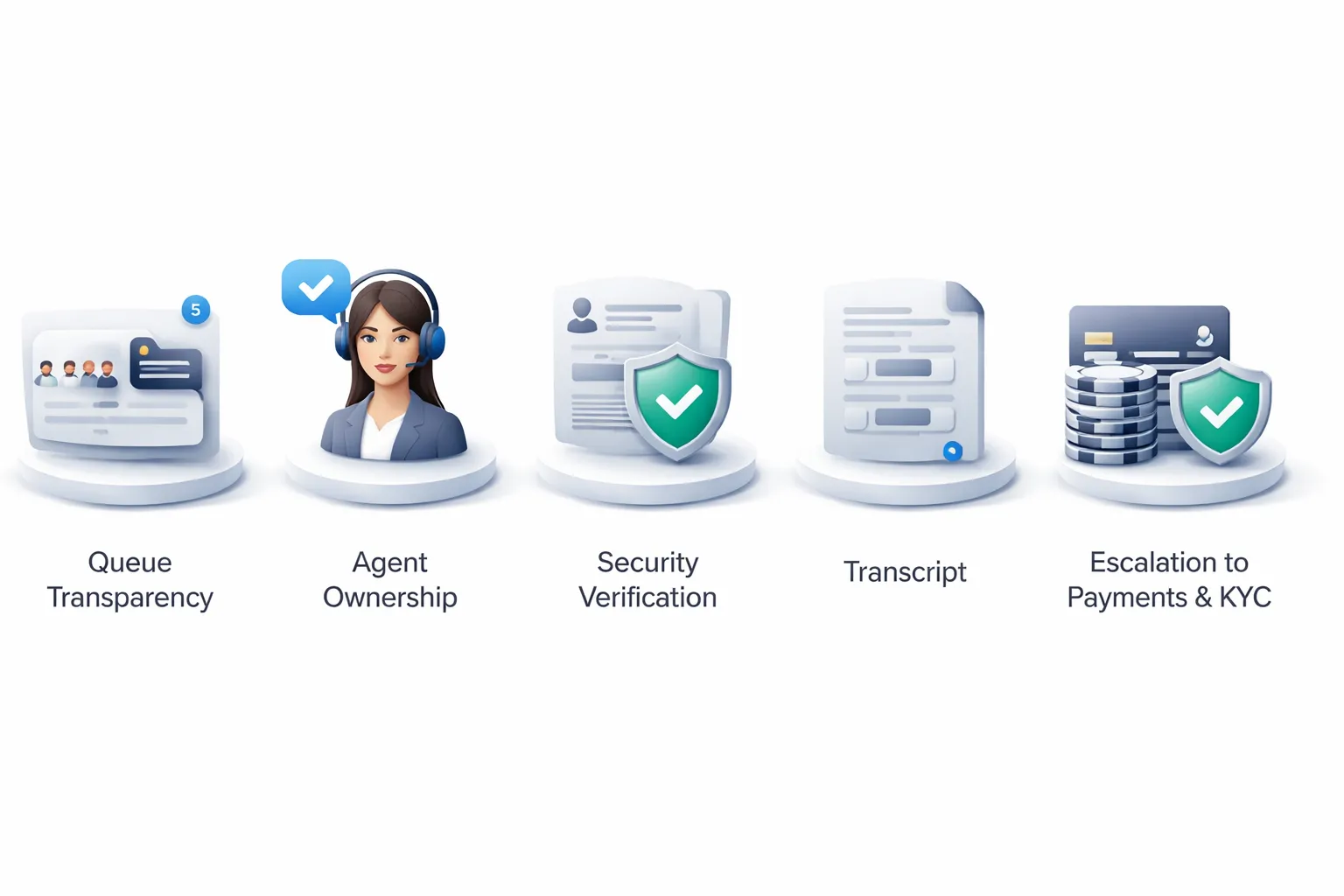
Wait times and queue transparency
Live chat works when you reach a human fast and the casino tells you what to expect.
- Published hours: Look for clear service hours by time zone. If support says 24/7, verify chat stays open on weekends and late nights.
- Queue position or ETA: The best chats show your place in line or an estimated wait. Avoid chats that only show “connecting” with no timing.
- Reconnect rules: Check what happens if the chat drops. You want auto reconnect, or a way to resume with the same case and transcript.
- Fast first response: Aim for under 2 minutes for the first human reply. If it takes 10 to 15 minutes often, use email for anything complex.
Agents who stay with you through resolution
Many chats answer one question then push you away. You want an agent who owns the issue.
- One thread, one owner: The agent should stay until you get a clear next step, a fix, or an escalation with a ticket ID.
- Clear resolution point: You should leave with an outcome, not “try again later.” If the fix needs time, you should get a timeframe and a follow-up plan.
- No bounce between departments: If payments or KYC needs a specialist, the agent should hand you off without making you restate everything.
Agent quality markers: accuracy, ownership, step-by-step guidance
Good agents ask for the right details, then give you actions you can follow.
- Accurate terms: They use exact words for statuses like “pending,” “reversed,” “chargeback,” “rollback,” “verification,” or “source of funds.” Vague language signals weak training.
- Ownership language: Look for “I will check,” “I will escalate,” and “I will update you,” plus a case reference. Avoid “you must wait” with no reason.
- Step-by-step fixes: For login, games, or browser issues, you should get numbered steps and what result to expect after each step.
- Targeted questions: They should ask for basics like your device, browser, error message, game name, transaction time, and payment method. Random questions waste time.
- Evidence-based answers: They should cite policy limits and timelines, like withdrawal review windows or KYC review stages, and explain what can extend them.
Security practices and identity checks
Chat support should verify you without pushing you to share sensitive data in the chat box.
- Safe verification: Expect checks like email confirmation, partial account details, or security questions. You should not need to send full card numbers or full bank details in chat.
- Document handling: If they need ID or proof of address, they should direct you to a secure upload area in your account, not ask you to paste documents into chat.
- Minimal data requests: They should ask only for what they need to locate the case, like username and transaction reference, not extra personal details.
- Account protection actions: If you report suspicious access, they should guide you to reset your password, enable 2FA if available, and lock withdrawals if the casino supports it.
Transcript access for disputes and follow-ups
Transcripts protect you when a timeline changes or a promise disappears.
- Auto email transcript: The best chats send a transcript to your email at the end. If they do not, ask for it before you close the chat.
- Ticket ID: You want a case number tied to the chat. Use it in every follow-up.
- Clear summary: Ask the agent to summarize the issue, the action taken, and the next step in writing. This matters for payment disputes and KYC loops.
Escalation handling to specialist teams
Chat should triage fast and escalate cleanly when the issue needs back office review.
- Payments escalation: The agent should confirm the transaction status, the processor name if applicable, and the expected review time. You should get a ticket ID and a timeframe for an update.
- KYC escalation: You should get a specific list of required documents, accepted formats, and rejection reasons if a file failed. Ask them to confirm what they see as “received” versus “approved.”
- VIP escalation: If you have a VIP manager, chat should connect you or create a callback request. You still want the ticket ID for tracking.
- Responsible gambling escalation: Chat should handle limit changes and self-exclusion fast and confirm the effective time in writing. Use responsible gambling tools if you need immediate control.
What to look for in email support

SLA clarity, realistic timelines beat vague promises
Email support works when the casino sets clear expectations and meets them. Look for a stated response time and a stated resolution time. “We will get back to you soon” tells you nothing.
- First reply SLA: A clear window like 2 hours, 12 hours, or 24 hours.
- Resolution target: A range tied to the issue type, for example payments, KYC, or account access.
- Business hours and time zone: Email queues often slow down overnight and on weekends. The casino should say this.
- Escalation trigger: A point where the case moves to a specialist, like payments or security, with a new ETA.
Ticketing hygiene, case numbers, updates, and one clear owner
Good email support behaves like a tracked case, not a loose conversation. You want a case number, consistent status updates, and continuity.
- Case number in the subject line: You can reference it in every reply.
- Status language you can act on: “Waiting for your documents,” “In review,” “Approved,” “Paid,” with dates and times.
- One agent or a clear handoff: If agents rotate, the new agent should summarize the case and confirm next steps.
- No duplicate tickets: A good system merges duplicates and keeps one timeline.
- Audit trail: Each update should include what changed, who did it, and what happens next.
Evidence-friendly communication, attachments and exact document rules
Email shines when you need to share proof. The casino should accept common formats and tell you what it needs the first time.
- Attachment support: PNG, JPG, PDF. Reasonable file size limits and a clear fallback if you exceed them.
- Screenshot standards: Full page shots that show URL, date, time, transaction ID, and error message.
- KYC requirements in plain terms: Which documents, which sides, freshness rules, and what must be visible. No guessing.
- Payment evidence checklist: Deposit receipt, withdrawal request ID, bank statement line item, wallet transaction hash when relevant.
- Security and privacy: Clear guidance on redacting sensitive fields you do not need to share.
Tone and accountability, direct answers beat templates
Email support should answer your exact issue. Templates are fine for structure, but the agent should still own the outcome.
- Direct decision: Approved or declined, with the specific reason.
- Concrete next step: One action for you, one action for them, with an ETA.
- No blame shifting: If they say “provider issue,” they should name the provider, the status, and when they will follow up.
- Policy quotes with links: If they cite terms, they should point to the exact section and apply it to your case.
- Responsible gambling requests handled fast: Limit changes and self-exclusion should get written confirmation and an effective time. Use dedicated tools when you need immediate control, see responsible gambling tools.
How to structure your email to speed up resolution
Your email should reduce back and forth. Put the facts up front. Attach proof. Ask for a specific outcome.
| Subject | Withdrawal pending 72h, Account ID 123456, Ticket request |
| Top line | State the issue in one sentence and the outcome you want. |
| Account details | Username, registered email, country, platform, desktop or mobile. |
| Timeline | Dates, times, time zone, what you did, what the site showed. |
| Transaction data | Deposit or withdrawal ID, method, amount, currency, provider reference. |
| Evidence | Screenshots, PDFs, statements, error codes, chat transcript if relevant. |
| Clear request | “Please confirm status, reason for delay, and ETA for completion.” |
Copy and send template:
Subject: [Issue] , [Account username] , [Transaction ID]
Message:
Hello Support,
Username: [ ]
Registered email: [ ]
Country: [ ]
Issue: [One sentence]
Started: [Date, time, time zone]
Transaction details: [Method, amount, currency, ID]
What I see on your site: [Status text]
What I need: [Exact outcome] and an ETA.
Attachments: [List files]
Please confirm a ticket number and the current case status.
Thank you.
Response times: benchmarks, metrics, and how to verify them
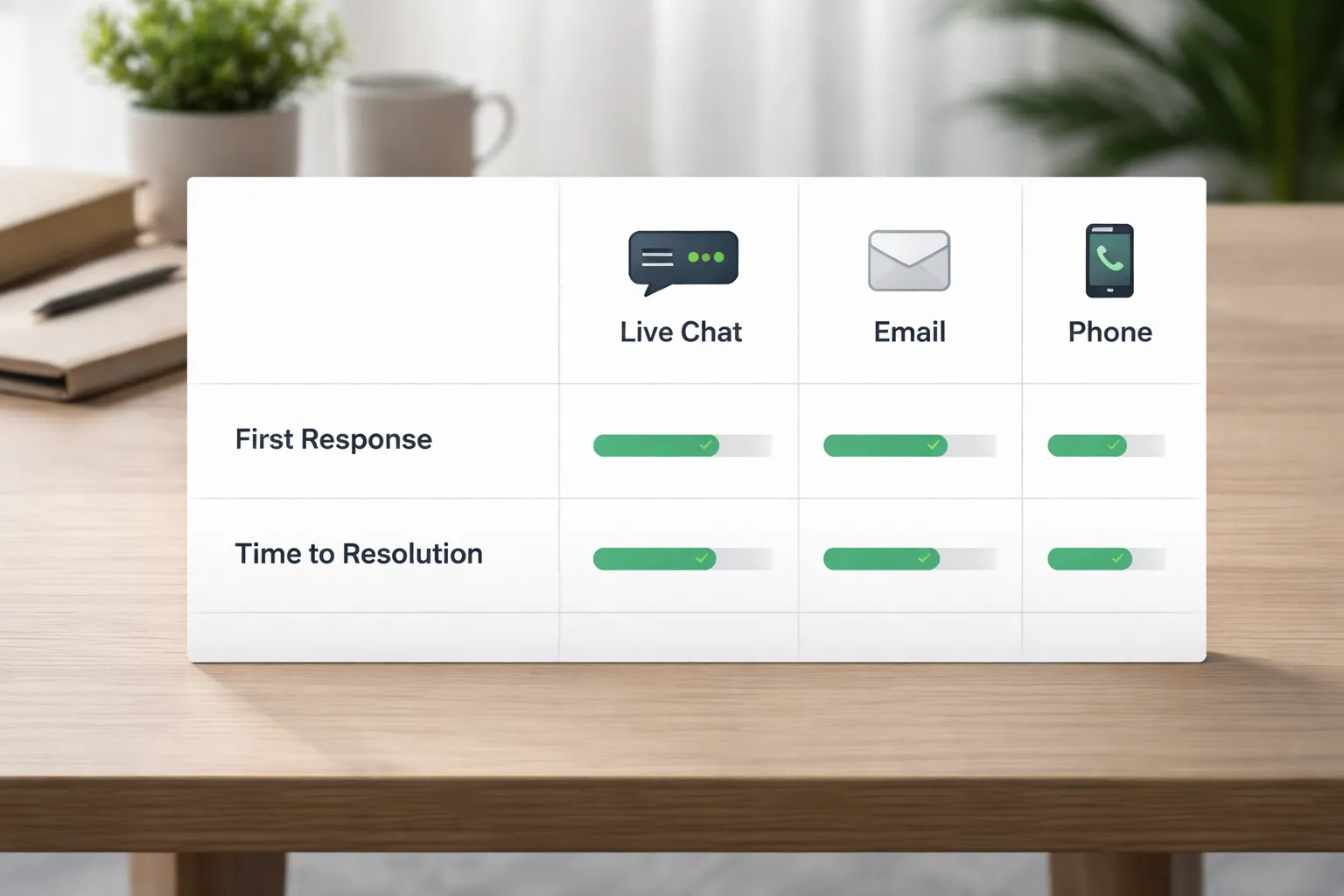
Key metrics that matter: first response, time to resolution, and first-contact resolution
First response time (FRT) is how long it takes to get a human reply after you submit your message. Fast FRT matters most for login, verification, and withdrawal status.
Time to resolution (TTR) is how long it takes to close the case. Casinos can reply fast and still drag the fix for days. Track both.
First-contact resolution (FCR) is whether support solves your issue in one interaction. High FCR usually means trained agents, clear tools, and fewer handoffs.
Ask for two things in every ticket. A ticket number. A stated ETA. If they refuse, you cannot measure progress.
Practical benchmarks by channel (chat vs email vs phone) for reputable casinos
| Channel | First response benchmark | Resolution benchmark | Best for |
|---|---|---|---|
| Live chat | Under 2 minutes, up to 5 minutes at busy times | Same session for simple issues, 24 hours for account cases | Login issues, bonus terms, basic withdrawal status |
| Under 12 hours, up to 24 hours | 24 to 72 hours for most account and payment cases | KYC, document review, chargeback related questions, long explanations | |
| Phone | Under 5 minutes to reach an agent | Same call for simple issues, 24 to 72 hours if escalated | Urgent account access, identity checks, complex payment holds |
Use these as filters. If a casino misses them before you deposit, expect worse after you win.
Peak-hour reality: weekends, big sports events, and new game launches
Support load spikes at predictable times. Weekends. Major football and UFC cards. Big jackpot promos. New slot launches. Payment providers also slow down on weekends.
What changes during spikes. Chat queues grow. More agents push you to email. More cases get escalated. More canned replies.
What you should demand during spikes. A ticket number. A written ETA. A clear next action. If they cannot give those, you risk limbo.
How to test response times before you deposit (a quick audit checklist)
- Test at two times, a weekday afternoon and a weekend evening.
- Start a live chat. Time to first human reply. Time to a clear answer.
- Email a simple question that needs a real lookup, like withdrawal fee policy for your payment method. Time the first reply and the final answer.
- Ask one compliance question, like what documents they accept for proof of address. Check if they list file types and age limits.
- Ask for escalation rules, what triggers it and how they notify you.
- Check if they provide a ticket number for chat follow-ups.
- Save transcripts and emails. You need proof if the story changes.
- Verify that support can reference your last message without asking you to repeat it.
When slow support becomes a risk factor for withdrawals and account access
Slow support becomes a money risk when the issue touches access, identity, or payouts.
- Withdrawal holds. If you cannot get a clear reason, document list, and ETA within 24 hours, expect a long delay.
- KYC loops. If they keep asking for the same files, your case lacks ownership. That can freeze payouts.
- Account lockouts. If you lose access and support cannot restore it quickly, you can miss verification deadlines or promo windows.
- Payment disputes. If billing issues take days to address, timelines with banks and card networks can work against you.
Slow support also increases stress. If you feel your play starts to depend on chasing losses or waiting on a payout, review the early warning signs of problem gambling and pause.
Problem-specific support quality checks (payments, bonuses, accounts)
Withdrawals and deposits
Support should give you a timeline in writing. You need separate timelines for review, processing, and the payment method itself.
- Expected timelines: Ask for the casino processing window and the typical delivery time for your method. Cards can take longer than e-wallets. Bank transfers can vary by bank and country.
- Pending states: Support should define each status and the next action. Common states include pending, processing, approved, sent, and failed. You should get the timestamp for the last status change.
- Payment method constraints: Support should confirm method rules before you deposit. Some casinos require you to withdraw to the same method you used to deposit. Some methods do not support withdrawals. Cards can allow deposits but route withdrawals to bank transfer.
- What to request: Transaction ID, payment provider reference, exact amount, currency, fee policy, and whether the request sits in a manual queue.
- Red flags: Vague answers like “soon,” no reference numbers, or repeated requests to cancel and resubmit without a clear reason.
KYC and verification
Good support prevents delays. It tells you what documents work, what fails, and how to submit them safely.
- Document standards: Support should give clear rules for file type, size, color, and full-frame images. It should specify acceptable proof of address dates and accepted issuers.
- Name and address matching: Support should tell you what to do if your profile differs from your documents. Examples include middle names, abbreviations, and recent moves.
- Privacy expectations: Support should explain where you upload files, how long the casino stores them, and who can access them. It should not ask you to send sensitive documents through public social media messages.
- Re-verification triggers: Support should warn you about common triggers. These include changing payment methods, large withdrawals, unusual login locations, device changes, or expired ID.
- What to request: A checklist for your account, the reason for any rejection, and the exact missing detail, such as cropped corners or unreadable text.
Bonuses and wagering
Support quality shows in how it explains terms using numbers from your account.
- Term clarity: Support should confirm wagering multiplier, eligible games, max bet, time limits, and withdrawal caps.
- Examples with your balance: Support should calculate a simple path. Example, “You claimed a $20 bonus with 30x wagering, you need $600 in eligible wagers.”
- Contribution rules: Support should state how each game type counts. It should name excluded games if they exist.
- Bet limit enforcement: Support should explain what happens if you exceed the max bet. You need to know if the casino voids the bonus, voids winnings, or issues a warning.
- What to request: The exact bonus name, the version of the terms, and a screenshot-ready summary in chat or email.
Game disputes
Support should treat game issues as evidence-based cases. You should not rely on memory.
- Lost connection cases: Support should explain what happens if you disconnect. Many games resume at the same state when you log back in. Some settle the round on the server.
- Rollback rules: Support should state whether the game can roll back a round and under what conditions. It should explain the difference between a visual glitch and a server result.
- Provider involvement: Support should tell you if it escalates to the game provider and how long that review takes. It should share a case number.
- What to provide: Game name, date and time with timezone, round ID, bet amount, device, browser or app version, and screenshots. Support should know where to find round IDs in your history.
- Red flags: No request for a round ID, or a refusal to escalate when you supply timestamps and transaction logs.
Account restrictions and safety holds
Restrictions can protect you or protect the casino. Support should tell you which one applies and what unlocks the account.
- Self-exclusion and cooling-off: Support should apply the tool fast and confirm the duration. It should explain what access stops, what happens to active bonuses, and whether withdrawals still process. Use the responsible gambling tools that fit your situation.
- Suspicious-activity holds: Support should explain the trigger category without giving security details. It should state what you must do next, such as password reset, device check, or extra verification.
- Time and scope: Support should confirm which actions are blocked, such as login, deposits, withdrawals, or gameplay. It should give an estimated review timeline.
- What to request: The hold reason code category, required steps, and the team handling the case. Ask for updates in writing with timestamps.
- Red flags: Indefinite holds with no checklist, or repeated requests for the same documents with no explanation.
Trust, safety, and compliance signals (E-E-A-T essentials)
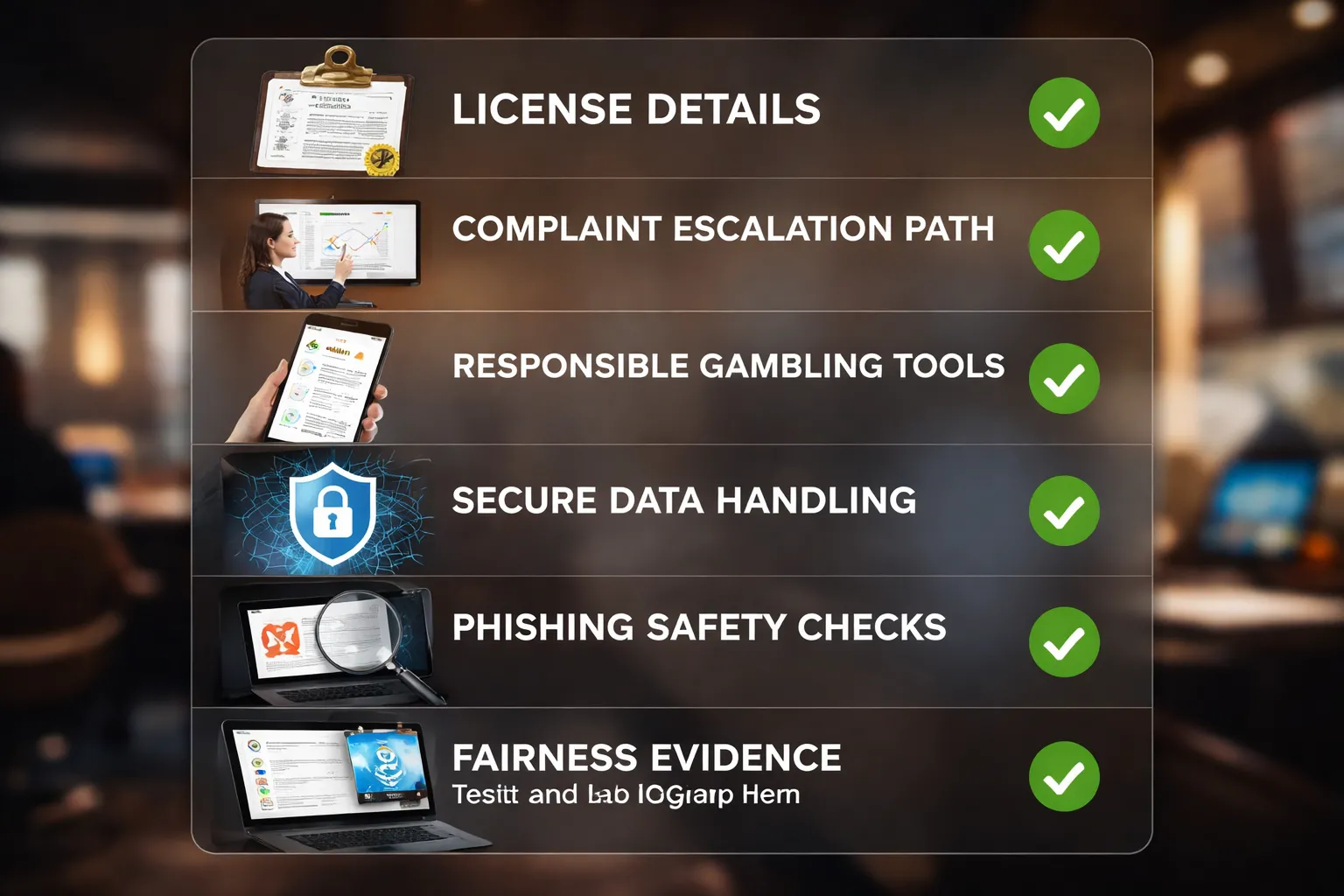
Licensing and dispute channels, what support should disclose and where to escalate
Support should state the operator’s legal entity name, license number, and licensing authority. It should match the footer and the terms. It should share a direct link to the regulator’s register entry. It should not hide behind a brand name.
Support should explain the complaint path in writing. It should include the internal complaint email, expected timelines, and the next step if you disagree. It should name the independent dispute channel, if one applies, and give the case handoff rules.
- Ask for: Legal entity name, license number, regulator name, register link, complaints email, complaint reference ID, and escalation steps.
- Escalate to: The regulator, the approved ADR body, or the payment provider, based on the issue type and jurisdiction.
- Red flags: No license details in writing, no complaint reference ID, or “we cannot share that” responses.
Use this guide to verify details yourself: how to check an online casino license.
Responsible gambling help, self-assessment, limits, and referral resources
Support should offer responsible gambling tools without delay. It should apply limits and exclusions fast, and confirm them in writing. It should not push you to keep playing.
- Self-assessment: Support should point you to an on-site self-check, and explain what the scores mean.
- Limits: Deposit, loss, wager, and time limits. Cooling-off periods. Session reminders. Reality checks.
- Self-exclusion: Clear durations, what access gets blocked, and whether exclusion covers sister sites.
- Referrals: Country-specific help lines and treatment resources, plus the National Problem Gambling Helpline in the US where relevant.
- Red flags: Delays, upsells, or staff suggesting “just set a small limit” instead of applying the restriction you requested.
Data protection, what “secure handling” should look like in practice
Support should collect the minimum data needed. It should tell you why it needs each item. It should tell you how it will store it and for how long.
- Document upload: Use an encrypted upload portal inside your account. Avoid email attachments for IDs unless the casino provides a secure channel and explains the risk.
- Access control: Support should confirm which team can view your documents and limit access to the case.
- Verification steps: Support should use knowledge checks and 2FA prompts before discussing account details.
- Privacy rights: Clear instructions to request a copy of your data, correct it, or delete it where allowed.
- Red flags: Requests for full card numbers, CVV, or passwords, and vague “send everything you have” ID demands.
Fraud and scam prevention, phishing awareness and official contact verification
Support should help you confirm you speak to the real casino. It should publish official contact channels, and it should stick to them.
- Official channel checks: Support should confirm the exact sender domains for emails and the official SMS short codes, if used.
- Safe verification: Support should never ask for your password. It should use ticket IDs and in-account messages for sensitive updates.
- Payment safety: Support should warn you about “agents” offering faster withdrawals for a fee, and any request to move funds to a new wallet address.
- What to do if targeted: Change passwords, enable 2FA, freeze withdrawals if possible, and ask support to log the incident with timestamps.
- Red flags: Pressure, urgency, or requests to install remote access software.
Fairness and transparency, how support explains RNG, audits, and game-provider responsibilities
Support should explain who runs the games. It should separate casino account issues from game math. It should not claim it can “fix” outcomes.
- RNG basics: Support should state that certified RNG governs results for RNG titles, and that each spin or hand stands alone.
- Audits: Support should name the testing lab or auditor used for RNG and payout testing, and point you to the report summary where available.
- Game provider roles: Support should name the provider for the specific game and explain who investigates disputed rounds.
- Dispute evidence: Support should offer round IDs, server logs references, timestamps, and the exact game version when you report a malfunction.
- Red flags: “Guaranteed win” language, refusal to provide round IDs, or generic replies that ignore your specific game session data.
How to evaluate a casino’s support before signing up (step-by-step)

Step 1, check the help center before you contact anyone
- Find the rules pages. Terms, bonus terms, withdrawals, KYC, complaints, and game rules.
- Look for specifics. Limits, fees, processing times, accepted documents, and who pays bank or crypto fees.
- Check for a dispute path. A clear complaint process, escalation steps, and an ADR or regulator contact if they offer it.
- Open the responsible gambling page. You want deposit limits, loss limits, time-outs, and self-exclusion options. Save the link for later. Use this guide if you want a quick checklist, responsible gambling tools.
Step 2, run pre-deposit test questions that expose weak support
Contact live chat first. Then email. Ask the same questions. Keep them short so you can compare answers.
- Payments and withdrawals. Ask for one method you plan to use and request exact timelines, fees, and limits. Example, “What is the minimum withdrawal for Visa, what is the fee, and what is the typical processing time after approval?”
- KYC and source of funds. Ask what triggers verification, which documents they accept, and whether they require proof of payment method ownership. Example, “Do you require KYC before the first withdrawal, and do you accept bank statements older than 90 days?”
- Bonus terms that usually cause disputes. Ask about wagering, excluded games, max bet, max win, and withdrawal limits while a bonus is active. Example, “What is the max bet while wagering, and which slots are excluded from wagering?”
- Game dispute handling. Ask who investigates, the game provider name, and what evidence they provide in disputes. Example, “If a round glitches, will you provide the round ID, timestamp, and game version?”
- Account security. Ask about 2FA, login alerts, and what happens after a suspected compromise.
Grade the answer. You want numbers, named policies, and links. You do not want vague “usually” language.
Step 3, measure response times with a simple repeatable test
- Live chat. Time to first human reply, and time to a complete answer. Start a timer when you send the first message.
- Email. Time to first reply, and time to resolution. Send your email during normal business hours and once outside peak hours if you want a realistic range.
- Track it. Log date, time, channel, agent name, and outcome. Keep it consistent across casinos.
Step 4, screenshot and save proof that gives you leverage later
- Chat transcript. Export it if possible. If not, screenshot the full thread, including agent name, date, and time.
- Email thread. Keep headers and message IDs. Save as PDF.
- Policy pages. Screenshot and save the URL for bonus terms, withdrawals, KYC, and max bet rules. Include the timestamp in your screenshot.
- Promotions you plan to claim. Save the promo page and the full terms. Many disputes come from changed or hidden terms.
- Support promises. If an agent confirms a limit, fee, or timeline, capture it. You can reference it in disputes.
Step 5, run consistency checks across channels
- Ask the same question in chat and email. Use the same wording.
- Compare details. Fees, limits, wagering rules, and KYC triggers should match.
- Watch for deflection. If chat tells you to email for basic policy answers, support likely lacks training or authority.
- Check link quality. Good support links you to the exact policy section. Weak support dumps a generic help center link.
Step 6, test accessibility and usability
- Language options. Confirm your language has real agents, not auto-translation.
- Operating hours. Check if “24/7” means full support or just intake that escalates later.
- Mobile experience. Open chat on mobile data. Test if the chat widget blocks buttons, reloads, or drops messages.
- Identity checks in support. Support should verify you before discussing account details. If they share account info without checks, treat it as a risk.
Scoring rubric, pass fail plus a weighted checklist
Use pass fail first. If a casino fails any item, move on.
- Pass fail gates. Refuses to share key terms, will not provide dispute evidence like round IDs when asked, contradicts its own policies, or gives “guaranteed win” language.
| Category | What you check | Weight | Score (0 to 2) |
|---|---|---|---|
| Accuracy | Clear, specific answers with numbers and policy links | 30 | |
| Consistency | Chat and email match on fees, limits, KYC, bonus rules | 20 | |
| Speed | Fast first reply and fast complete answer on both channels | 15 | |
| Evidence handling | Explains dispute process, provider roles, round IDs, logs, timestamps | 15 | |
| Transparency | Easy-to-find terms, readable rules, no hidden limits | 10 | |
| Accessibility | Language support, hours, and stable mobile chat experience | 10 |
How to use the score. Total possible weight is 100. A strong casino usually lands above 80. Anything below 70 signals future friction, especially on withdrawals and disputes.
Common customer support red flags (and what to do next)
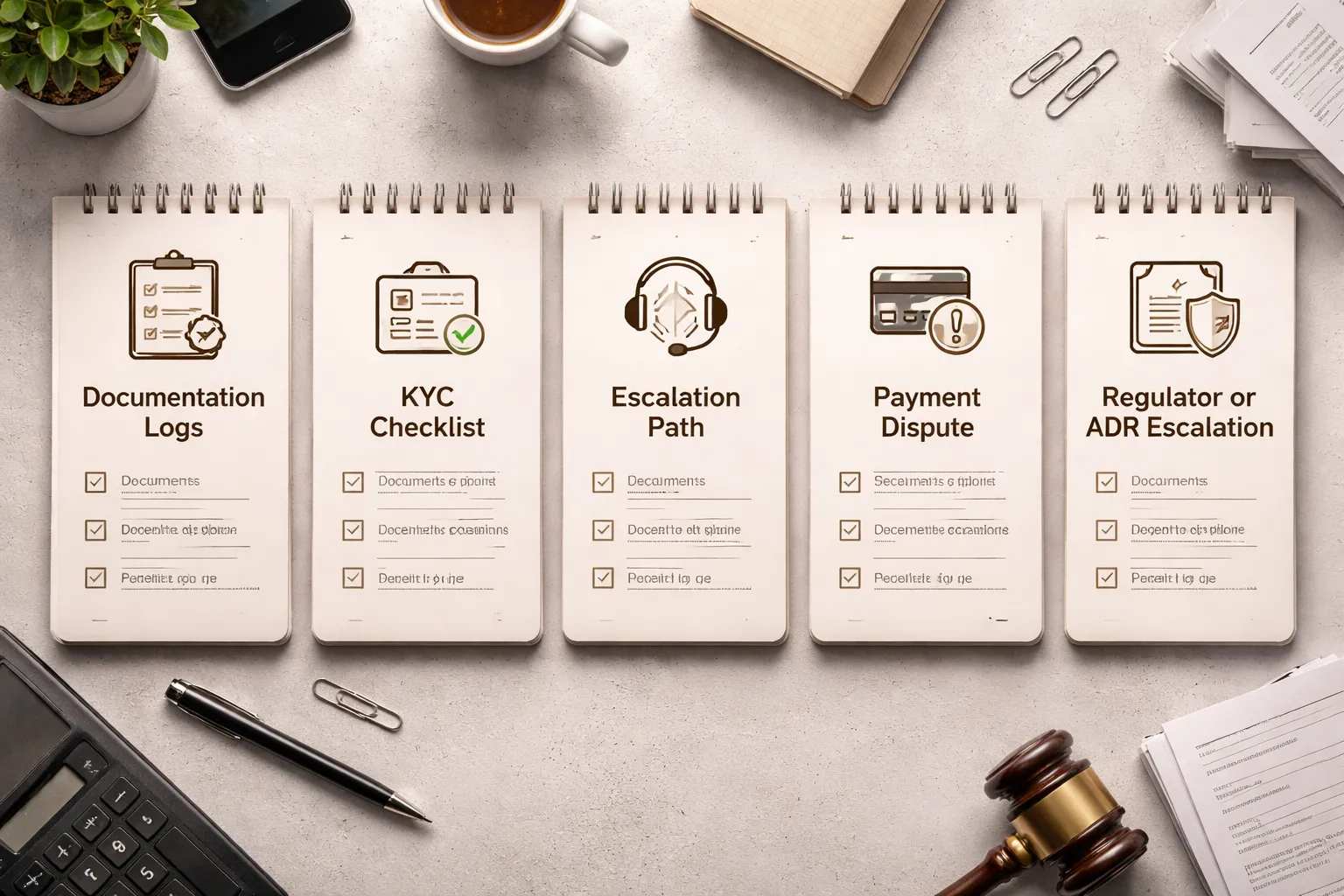
Endless copy-paste replies, vague explanations, and missing policy citations
Support that repeats scripts wastes your time and hides accountability. Treat it as a risk signal, especially if your issue involves withdrawals, bonuses, or account limits.
- Red flag: The agent answers a different question than the one you asked, then pastes the same paragraph again.
- Red flag: You get vague lines like “security reasons” or “system review” with no timeline.
- Red flag: They refuse to cite the exact rule, bonus term, or KYC clause they claim you broke.
- What to do next: Ask for a written answer by email that includes the policy name, section, and the date it took effect.
- What to do next: Request a case or ticket number and a clear ETA for the next update.
- What to do next: Keep screenshots of chat, emails, and any status pages. Log dates, times, and agent names.
Unreasonable document demands or repeated KYC loops
KYC checks happen. The red flag is when requests never end, or they change after you comply. This often shows up right before a payout.
- Red flag: They ask for documents unrelated to the payment method you used, with no explanation.
- Red flag: They reject clear documents without stating the exact issue, then ask you to resubmit.
- Red flag: They request the same files again after approval, or restart verification after you win.
- What to do next: Ask for a complete checklist in one message. Request file format, accepted proof types, and the review timeline.
- What to do next: Send documents once, then ask them to confirm receipt and completeness in writing.
- What to do next: If they add new requirements, ask for the written policy that allows it and the reason tied to your account.
Pressure tactics: pushing deposits or upsells during unresolved issues
Support should solve problems. If they push deposits while your withdrawal, verification, or dispute stays open, you face a higher risk of delay and friction.
- Red flag: The agent suggests you deposit again to “speed things up” or “unlock” a withdrawal.
- Red flag: They steer you to a bonus, VIP program, or higher wagering offer instead of resolving the ticket.
- Red flag: They imply your issue will go away if you keep playing.
- What to do next: Stop new deposits until the case closes and you receive a written resolution.
- What to do next: Set a hard limit for yourself. Use a simple plan from how to set a gambling budget.
- What to do next: If you feel pressure or loss of control, pause play and use responsible tools offered by your casino.
No escalation path: supervisors unavailable or complaints ignored
Good operators document complaints and escalate them. Bad operators trap you in first-line chat loops.
- Red flag: “No supervisor available” repeats for days, with no callback or email option.
- Red flag: They close tickets without solving the issue, then tell you to start over.
- Red flag: They refuse to provide a complaints process, a postal address, or a compliance contact.
- What to do next: Ask for the formal complaints procedure and the operator’s legal entity name.
- What to do next: Request escalation to the compliance team and ask for confirmation that your complaint is logged.
- What to do next: If they delay, start moving the case outside support channels.
Next steps: formal complaints, payment provider disputes, and regulator or ADR escalation
When support stalls, switch to structured escalation. Keep everything in writing and keep your timeline tight.
- Step 1: Send a formal complaint email. Include your username, ticket numbers, transaction IDs, dates, and the exact outcome you want.
- Step 2: Ask for a final response, a decision letter, or a “deadlock” confirmation. You need this for many ADR routes.
- Step 3: If a card, e-wallet, or bank transfer sits in limbo, contact the payment provider. Provide proof of balance, withdrawal request date, and any refusal message.
- Step 4: Escalate to the casino’s regulator or approved ADR. Attach your logs, screenshots, and the operator’s stated reason for delay.
- Step 5: If the license details look unclear or mismatched, verify them using how to check an online casino license before you continue.
FAQ
What support channels should a good online casino offer?
At minimum, you should get live chat and email. Live chat handles account access, bonuses, and quick checks. Email suits payments, KYC, and disputes because you can attach files. Phone support helps with urgent account lockouts, but many casinos skip it.
What live chat response time is acceptable?
Live chat should respond in under 2 minutes during peak hours. Under 30 seconds is strong. If you wait over 10 minutes more than once, expect slow handling on withdrawals and verification. Save the chat transcript and note the time you started.
What email response time is acceptable?
Email should get a first reply within 24 hours. Better operators answer within 4 to 12 hours. For payment or KYC cases, you should get a clear checklist and a case number. If you wait over 48 hours, escalate through a new ticket.
What should customer support ask you for on payment issues?
They should request your username, transaction ID, payment method, amount, and timestamps. For withdrawals, they should confirm status, pending reason, and expected processing time. If they ask for full card numbers or passwords, stop and use a safer channel.
How do you test support before you deposit?
Open live chat and ask two specific questions about withdrawal times and verification. Email them a basic query and check if you get a ticket number. Time both responses. If answers look copied or avoid your question, pick another casino.
What are red flags in casino customer support?
- They refuse to confirm withdrawal timeframes.
- They push you to cancel a withdrawal to keep playing.
- They give different answers in chat and email.
- They close chats without a resolution summary.
- They cite “technical issues” with no ETA.
What should you save when you contact support?
Save chat transcripts, email headers, and screenshots of balances, withdrawal status, and error messages. Record dates, times, and agent names. Keep file copies of KYC documents you sent. These records help if you need to escalate to the payment provider or regulator.
What can you do if support keeps stalling?
Switch channels and demand a written timeline. Ask for the exact policy section they rely on. Request a supervisor and a case number. If they cite licensing or complaints routes, verify the details. Use how to check an online casino license before you escalate.
When should you use self-exclusion or responsible gambling tools?
Use them if you chase losses, hide play, or fail to stick to limits. Support should explain limits, cooldowns, and self-exclusion without delay. If they resist or upsell bonuses, treat it as a risk signal and lock your account as soon as you can.
Conclusion
Customer support tells you how a casino will treat your money and your limits. Test it before you deposit.
- Start with live chat. Check if you can reach a human fast and get clear steps, not canned lines.
- Use email for anything that needs a record. Send one message with your username, device, payment method, amounts, dates, and screenshots.
- Track response times. Note the first reply and the time to resolution. Save transcripts and ticket numbers.
- Watch for red flags. Stalling, vague answers, bonus pressure, or refusal to explain limits.
Final tip. Run a two minute support test on a new site, then decide. If you see delays or resistance around responsible gambling tools, stop play and use self-exclusion. Read how self-exclusion works if you need the next steps.
-
Sign Up for an Online Casino: Create an Account in Minutes
8 months ago -
Online Casino Licensing Explained: Authorities, Licenses & How to Check One
8 months ago -
How to Set a Gambling Budget (That You’ll Actually Stick To)
8 months ago -
Responsible Gambling Tools Explained: Deposit Limits, Self-Exclusion & More
8 months ago -
Online Casino Self-Exclusion: How It Works and What Happens Next
8 months ago
-
- Key metrics that matter: first response, time to resolution, and first-contact resolution
- Practical benchmarks by channel (chat vs email vs phone) for reputable casinos
- Peak-hour reality: weekends, big sports events, and new game launches
- How to test response times before you deposit (a quick audit checklist)
- When slow support becomes a risk factor for withdrawals and account access
-
- Licensing and dispute channels, what support should disclose and where to escalate
- Responsible gambling help, self-assessment, limits, and referral resources
- Data protection, what “secure handling” should look like in practice
- Fraud and scam prevention, phishing awareness and official contact verification
- Fairness and transparency, how support explains RNG, audits, and game-provider responsibilities
-
- Step 1, check the help center before you contact anyone
- Step 2, run pre-deposit test questions that expose weak support
- Step 3, measure response times with a simple repeatable test
- Step 4, screenshot and save proof that gives you leverage later
- Step 5, run consistency checks across channels
- Step 6, test accessibility and usability
- Scoring rubric, pass fail plus a weighted checklist
-
- Endless copy-paste replies, vague explanations, and missing policy citations
- Unreasonable document demands or repeated KYC loops
- Pressure tactics: pushing deposits or upsells during unresolved issues
- No escalation path: supervisors unavailable or complaints ignored
- Next steps: formal complaints, payment provider disputes, and regulator or ADR escalation
-
- What support channels should a good online casino offer?
- What live chat response time is acceptable?
- What email response time is acceptable?
- What should customer support ask you for on payment issues?
- How do you test support before you deposit?
- What are red flags in casino customer support?
- What should you save when you contact support?
- What can you do if support keeps stalling?
- When should you use self-exclusion or responsible gambling tools?
-
-
- Key metrics that matter: first response, time to resolution, and first-contact resolution
- Practical benchmarks by channel (chat vs email vs phone) for reputable casinos
- Peak-hour reality: weekends, big sports events, and new game launches
- How to test response times before you deposit (a quick audit checklist)
- When slow support becomes a risk factor for withdrawals and account access
-
- Licensing and dispute channels, what support should disclose and where to escalate
- Responsible gambling help, self-assessment, limits, and referral resources
- Data protection, what “secure handling” should look like in practice
- Fraud and scam prevention, phishing awareness and official contact verification
- Fairness and transparency, how support explains RNG, audits, and game-provider responsibilities
-
- Step 1, check the help center before you contact anyone
- Step 2, run pre-deposit test questions that expose weak support
- Step 3, measure response times with a simple repeatable test
- Step 4, screenshot and save proof that gives you leverage later
- Step 5, run consistency checks across channels
- Step 6, test accessibility and usability
- Scoring rubric, pass fail plus a weighted checklist
-
- Endless copy-paste replies, vague explanations, and missing policy citations
- Unreasonable document demands or repeated KYC loops
- Pressure tactics: pushing deposits or upsells during unresolved issues
- No escalation path: supervisors unavailable or complaints ignored
- Next steps: formal complaints, payment provider disputes, and regulator or ADR escalation
-
- What support channels should a good online casino offer?
- What live chat response time is acceptable?
- What email response time is acceptable?
- What should customer support ask you for on payment issues?
- How do you test support before you deposit?
- What are red flags in casino customer support?
- What should you save when you contact support?
- What can you do if support keeps stalling?
- When should you use self-exclusion or responsible gambling tools?
-
-
Reload Bonus Explained: What It Is and When It’s Worth Claiming
6 months ago -
Online Casino Licensing Explained: Authorities, Licenses & How to Check One
8 months ago -
Best Live Dealer Casinos: Where to Play Live Blackjack, Roulette & More
8 months ago -
Best Online Casinos for High Rollers: VIP Perks, High Limits & Exclusive Bonuses
8 months ago -
Fast Payout Online Casinos: Best Sites for Quick Withdrawals
8 months ago
-
Sign Up for an Online Casino: Create an Account in Minutes
8 months ago -
Online Casino Payment Safety Tips: How to Deposit and Withdraw Securely
8 months ago -
What to Do If an Online Casino Won’t Pay Out: Step-by-Step Actions
8 months ago -
How to File a Complaint Against an Online Casino (Plus ADR Explained)
8 months ago -
Online Casino Licensing Explained: Authorities, Licenses & How to Check One
8 months ago