Responsible Gambling Tools Explained: Deposit Limits, Self-Exclusion & More

Gambling tools help you control time, spending, and access before a session gets out of hand. Most regulated casinos must offer these controls, and you can set them in minutes. This guide breaks down the main options, deposit limits, loss limits, wagering limits, session and timeout tools, reality checks, and full self-exclusion. You will learn what each tool does, when to use it, and the trade-offs to watch for, like limits that reset daily or weekly, and exclusions that you cannot reverse until the term ends. You will also learn where to find these settings in your account, and what to do if a site does not offer them, or makes them hard to use. For a deeper step-by-step on bans, see online casino self-exclusion.
Key Takeaways
- In het kort: Set deposit limits first; they stop overspending before it happens.
- In het kort: Use loss limits and session limits to control damage and time on site.
- In het kort: Use self-exclusion when you need a hard stop; you cannot cancel it early.
- In het kort: Check how limits reset; daily, weekly, or monthly resets can change your risk.
- In het kort: Pick limits based on your real budget, not on what you hope to win back.
- In het kort: If tools are missing or hard to use, treat it as a red flag and switch sites.
- Deposit limits control how much money enters your account. They work best as your main guardrail.
- Loss limits cap how much you can lose in a set period. They reduce harm but do not stop you from chasing on a new day after a reset.
- Session limits set a time ceiling. They help with long play sessions and impulse reloading.
- Reality checks and activity statements show time and spend. They help only if you read them and act on them.
- Self-exclusion blocks access for a fixed term. Use it when you cannot stick to limits, or when gambling starts to feel compulsive.
- Always confirm your settings in the account menu. Take a screenshot for proof if support disputes it.
- If you see early warning signs, act fast and tighten controls. Use this guide on problem gambling signs.
What “Responsible Gambling Tools” Means (and what they can’t do)
Definition and purpose
Responsible gambling tools are account controls that limit how you gamble. You set rules. The site enforces them.
They serve two jobs.
- Entertainment management: keep spending and time predictable. Use this when gambling feels fun but you want structure.
- Harm prevention: reduce access when control slips. Use this when you chase losses, hide play, or feel urges you cannot stop.
Most tools fall into a few buckets. Deposit limits cap how much money you can add. Loss and wager limits cap what you can lose or stake. Session limits cap time. Cooling-off locks your account for days. Self-exclusion blocks access for weeks, months, or years.
Tool options vary by operator and regulator. Check the site footer for the license, then verify what controls the license requires. Use this guide on how to check a casino license.
Who benefits most
- Casual players: deposit and session limits. You stop small overspends and late-night spirals.
- At-risk players: strict deposit limits, loss limits, cooling-off, and reality checks. You reduce damage during high-urge periods.
- People in recovery: self-exclusion plus payment blocks and device or browser blocking. You remove easy access and reduce relapse triggers.
What they can’t do
Tools reduce risk. They do not guarantee safety.
- They cannot change game math. The house edge stays.
- They cannot stop you from using other sites, other accounts, or other payment methods.
- They cannot fix debt, stress, or underlying mental health issues.
- They cannot force you to act on warnings. Reality checks work only if you log off.
Expect gaps. Some casinos let you raise limits with a waiting period. Some count deposits but not crypto transfers, bonuses, or manual adjustments. Some track time per session, not total daily time. Read the limit definitions before you rely on them.
Common myths that tools do not solve
- “I can win back losses.” Limits help you stop digging. They do not increase your chances. Chasing losses usually makes the hole deeper because variance swings harder when stakes rise.
- “I’ll stop after this bonus.” Bonuses extend play time and raise wagering. If you struggle with stopping, treat promotions as a trigger. Use tighter limits or self-exclude before you claim anything.
Deposit Limits: Your first line of financial control
Deposit Limits: Your first line of financial control
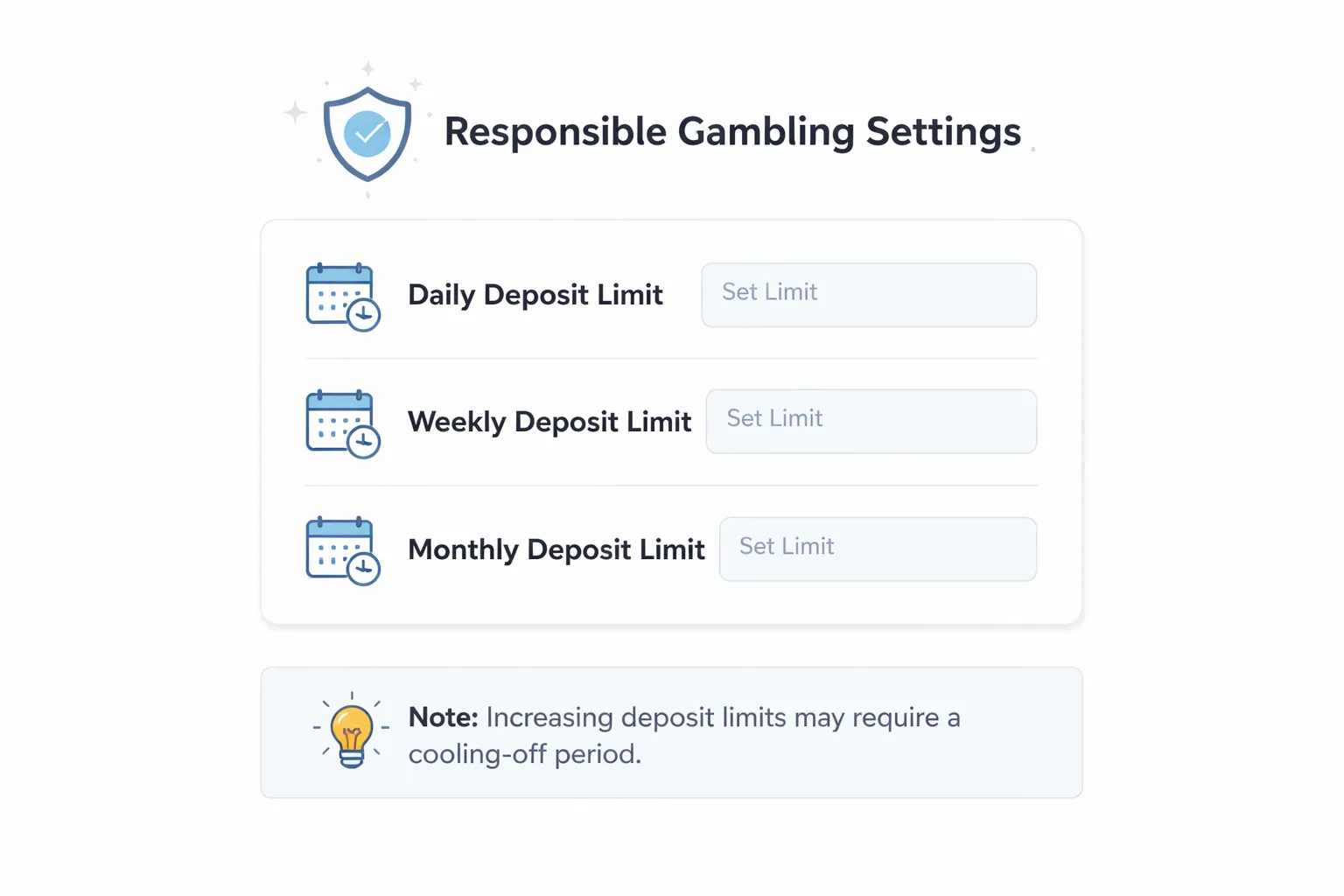
A deposit limit caps how much money you can add to your gambling account. It does not cap losses, it caps funding. Set it once, then let the system block extra deposits.
How deposit caps work across daily, weekly, and monthly periods
Most sites let you set one or more time-based caps. Each cap tracks deposits inside a rolling window or a fixed calendar period. Read the limit screen before you confirm, sites vary.
- Daily limit: Stops fast damage. Best for impulse control and late-night sessions.
- Weekly limit: Matches many pay cycles and helps you avoid weekend spikes.
- Monthly limit: Forces a long view. Useful if you tend to “top up” over and over.
Some operators apply the limit per product. Casino deposits and sportsbook deposits may track separately. Others apply one wallet limit across the whole account. Assume nothing, verify the rule on the limit page.
When to set limits for best results
- Before your first bet: Your best decision window. You still think in budgets, not emotions.
- Right after payday: Set a number that fits your bills first, then your entertainment spend.
- Before you claim a bonus: Bonuses raise time on site and can increase deposit pressure. Set tighter caps first.
- Before high-risk moments: If you drink, stay up late, or tilt after losses, set limits earlier in the day.
Pick a number you can lose without touching essentials. If you do not track a budget, start low. You can always reduce it later.
Raising vs. lowering limits: waiting periods and safer defaults
Lowering a deposit limit should take effect fast. Many sites apply decreases immediately. Raising a limit should trigger a cooling-off period. This delay reduces impulse increases after losses.
- Lowering: Treat as your default move. Drop limits when you feel pressure to deposit.
- Raising: Only do it after a calm review of your spending, not after a session.
- Safer default: Set a low daily cap and a moderate weekly cap. This blocks binge deposits while still allowing planned play.
If a site lets you raise limits with no delay, treat that as a risk signal. Check the operator’s controls and licensing details before you play, see how to check an online casino license.
Edge cases that break your plan
- Multiple payment methods: Limits usually track total deposits, not card-by-card, but exceptions exist. Confirm the cap applies across cards, e-wallets, and bank transfers.
- Multiple brands: A limit on one site rarely blocks deposits on sister sites, even under the same parent company. If you use more than one brand, set limits on each.
- VIP programs: VIP managers may offer faster withdrawals, higher limits, and more promos. If you struggle to stick to caps, opt out of VIP contact and tighten limits.
- Alternative rails: Crypto, vouchers, and instant bank options can make deposits frictionless. Friction helps you pause. If you use fast rails, set lower caps.
| Risk pattern | Limit setup that fits |
|---|---|
| Many small top-ups in one night | Low daily cap, lower than one “big session” budget |
| Weekend spikes | Weekly cap, set Monday or payday |
| Slow creep across the month | Monthly cap plus a daily cap to stop mid-month blowups |
| Switching sites to keep depositing | Limits on every brand, then add self-exclusion if needed |
Deposit limits work when you set them early, keep them low, and treat increases as a controlled exception.
Loss, Wagering, and Spend Limits: Different knobs for different risks
Loss limits vs. deposit limits, why both can matter
Deposit limits control how much new money you can add. They do not control what happens after you deposit.
Loss limits control how much you can lose in a time period. They still work even if you win first, then give it back.
- Deposit limit, stops repeated top-ups and “one more deposit” loops.
- Loss limit, stops long sessions where you churn winnings and end up down.
- Use both when you play longer sessions, play fast games, or tend to redeposit after a loss.
Wagering limits explained, controlling turnover even when you’re “recycling” funds
Wagering limits cap your total stakes. They target turnover, not net result.
This matters because you can place a lot of bets without depositing again. A small bankroll can fund many wagers if you keep winning small amounts or getting frequent returns.
- Deposit limit caps cash-in.
- Loss limit caps damage.
- Wagering limit caps speed and volume, even when your balance stays alive.
If you struggle with long “chase” sessions, wagering limits can cut the session off before losses pile up.
Net loss vs. gross spend, how operators calculate the numbers
Sites do not always calculate limits the same way. Read the tool description before you set it.
| Limit type | Common calculation | What can surprise you |
|---|---|---|
| Deposit | Total deposits made in the period | Withdrawals usually do not “free up” deposit capacity |
| Loss (net loss) | Deposits minus withdrawals, sometimes adjusted for starting balance | Big win can delay hitting the limit, but you can still give it back before the cap triggers |
| Spend (gross spend) | Total stakes placed, regardless of wins | You can hit it fast on high-frequency games even if you break even |
| Wagering | Total wagered amount, same idea as gross spend | Low house edge does not prevent high turnover |
Two checks you should do in the settings panel.
- Does “loss” mean net loss, or total stakes?
- Does it include bonuses and bonus wagers, or cash only?
Practical setup examples for low-, medium-, and high-variance games
Match the knob to the risk pattern.
Low-variance games, slower swings, longer play.
- Set a wagering limit to cap time on device. Example, daily wagering cap that equals 20 to 50 times your typical bet size.
- Set a loss limit to stop long grind sessions. Example, a daily loss cap near 1 to 2 session budgets.
- Keep a weekly deposit cap to stop extra top-ups across the week.
Medium-variance games, mixed swings, “one more” risk.
- Use deposit + loss together. Deposit blocks impulse reloads, loss blocks giving back a win.
- Add a daily wagering cap if you tend to extend sessions after a small win.
- Choose time windows that match your pay cycle, weekly if you get paid weekly, monthly if you get paid monthly.
High-variance games, sharp swings, fast tilt risk.
- Prioritize a tight loss limit. Big swings can erase your bankroll fast.
- Set a strict deposit limit to stop reloading after a big hit.
- Use a low wagering limit if you play rapid rounds or high stakes per spin.
If you keep adjusting limits upward, treat that as a warning flag and review problem gambling signs.
Time Limits, Session Timers, and Reality Checks
Session Time Limits vs. Daily Time Limits
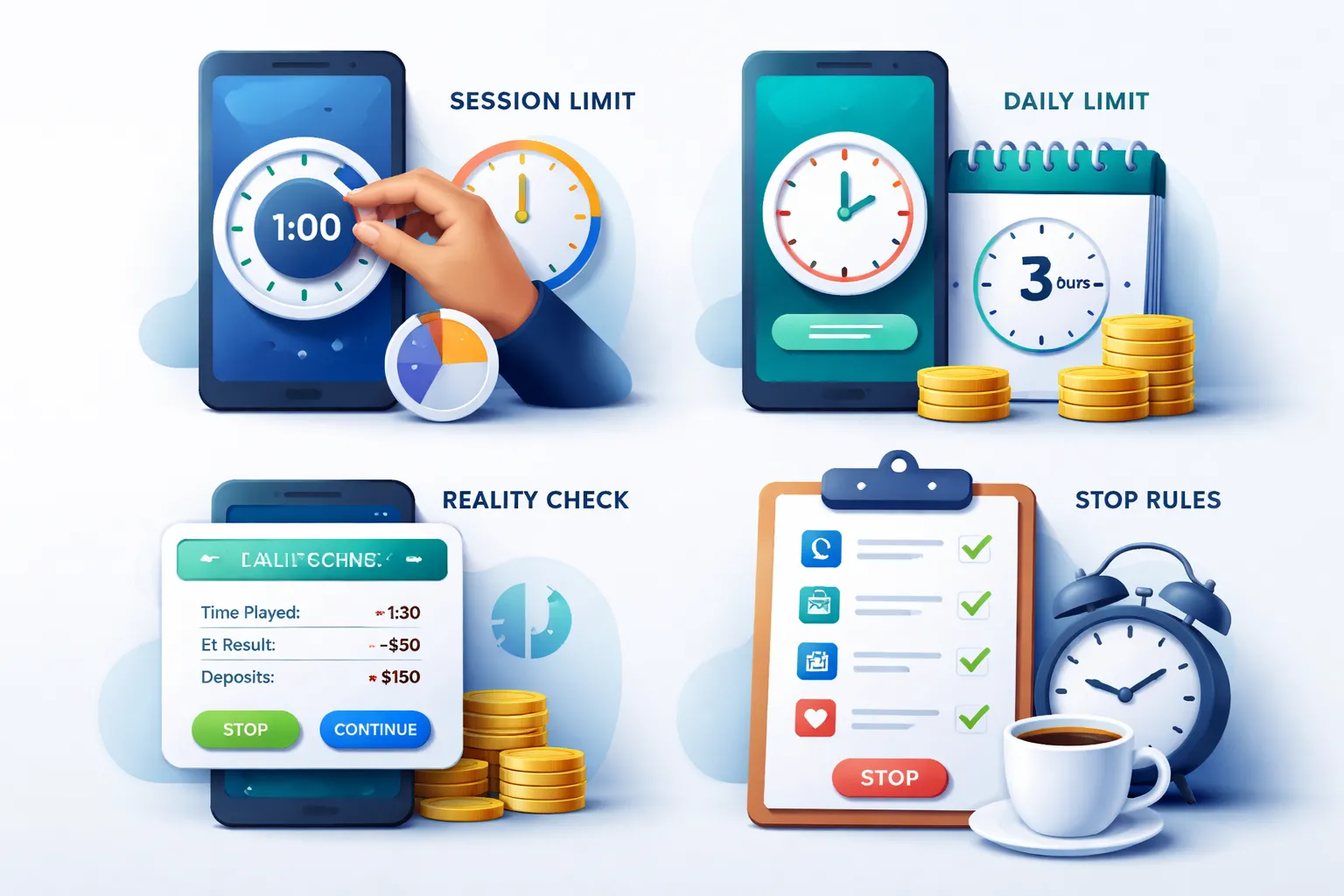
Session limits cap a single sitting. You set a maximum time, then the site logs you out or blocks betting when the timer ends. This prevents long, unbroken play where minutes turn into hours.
Daily limits cap your total play time across the day. This prevents repeat sessions after a loss, a win, or a stressful moment. It also stops “resetting” your behavior by taking short breaks and coming back all day.
- Use session limits if you binge, chase, or lose track of time once you start.
- Use daily limits if you keep returning for “one more” session, especially at night.
- Use both if you play fast games, use mobile, or gamble while tired.
| Tool | What it blocks | Best for |
|---|---|---|
| Session time limit | Marathon sessions, time-blind play | Slots, rapid casino games, live casino |
| Daily time limit | Multiple returns in one day, late-night drift | Habit loops, “check-in” gambling, boredom play |
Reality Check Pop-Ups, What a Useful Alert Looks Like
A reality check should interrupt play and show facts. If it only says “keep playing responsibly,” it does little.
- Time played in minutes and hours, since session start and for the day.
- Net result for the session, up or down, shown as a single number.
- Money in and money out so you see deposits, withdrawals, and net position.
- Clear actions like “Take a break,” “Set a limit,” “Log out,” and “Stop autoplay.”
- Forced pause for a few seconds before you can continue.
Set alerts for short intervals if you play fast rounds. Longer intervals work for slower games, but they still need to break your attention.
Interrupting Dissociation and Autoplay-Style Patterns
Long sessions can push you into a narrow focus. You stop tracking time, money, and decisions. Fast games and autoplay make this easier.
- Use shorter session caps for slots and rapid games. Speed increases risk.
- Disable autoplay when the site allows it. Autoplay removes decision points.
- Turn on frequent reality checks to force a reset of attention.
- Log out after each session so restarting takes effort.
If you notice you “come to” after a long stretch, treat that as a warning sign. Review early warning flags using problem gambling signs.
Pair Time Tools With Stop Rules
Time tools work best when they enforce hard boundaries you already respect. Set rules that match your real schedule.
- Set a firm bedtime cutoff. Block play at least 60 to 90 minutes before sleep.
- Block work hours. Use daily time limits that equal zero during your shift.
- Schedule breaks. Use a short session limit, then require a fixed break before any new session.
- Use “one session per day” rules. Pair a session limit with a low daily limit to prevent returning.
- Match time limits to money limits. Shorter time should mean lower spend exposure.
Do not raise time limits after a loss. Do not extend a session because you feel close to a win. Treat those urges as a stop signal.
Cooling-Off Periods vs. Self-Exclusion: Which one should you choose?
Cooling-off periods explained, short breaks to reset decisions
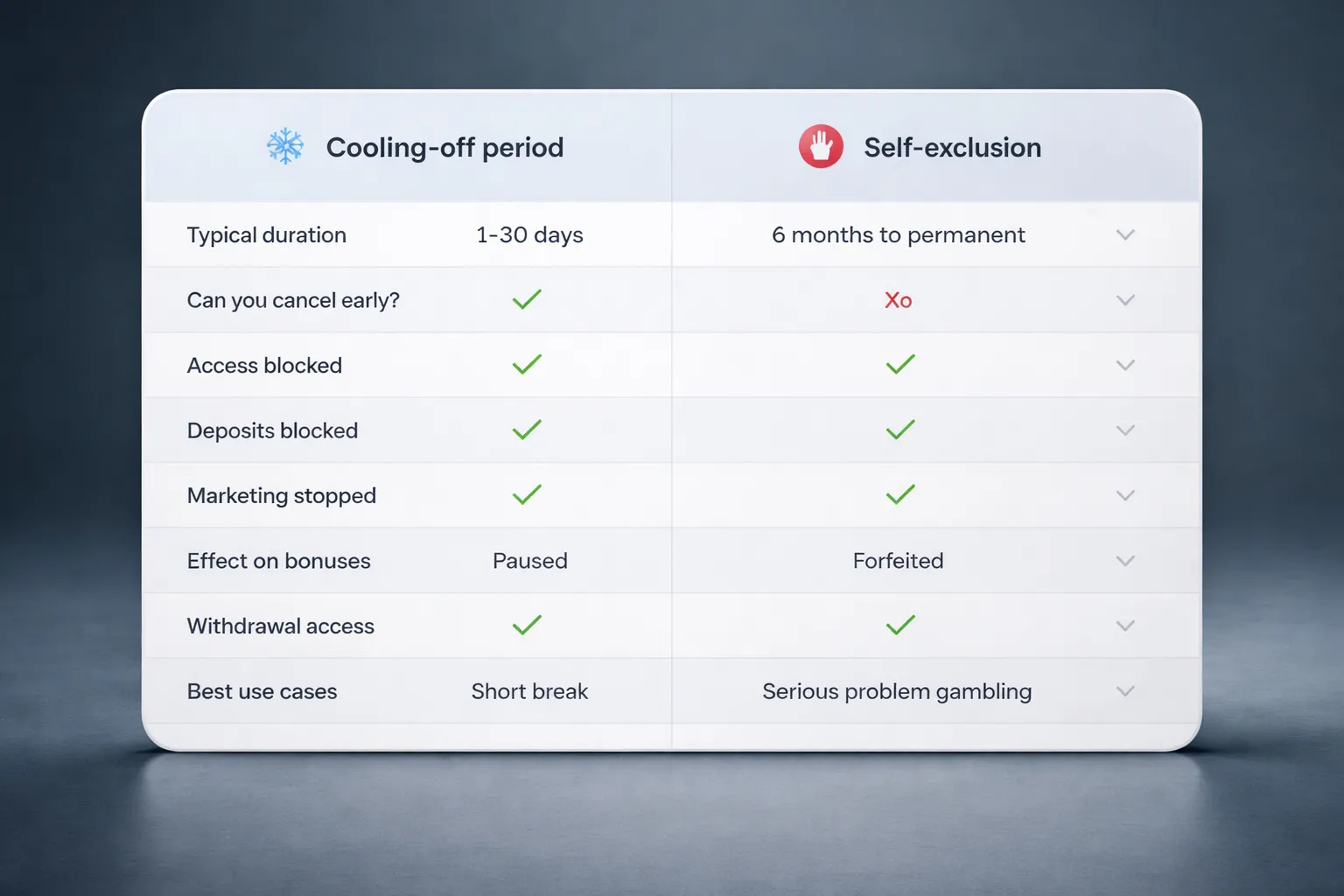
A cooling-off period is a short, forced break. It blocks play for a set time, usually 24 hours to 7 days. Some sites offer longer options.
Use it when you need distance, not a full lockout. It helps you stop chasing losses and stop impulse deposits. It works best when you set it before you feel out of control.
- Best for early warning signs, like longer sessions, higher stakes, or frequent top-ups.
- Good after a big win or a big loss, when your judgment shifts.
- Low friction, you can set it fast inside your account tools.
Self-exclusion explained, longer blocks with reactivation safeguards
Self-exclusion is a longer ban. It blocks access for a fixed term, often 6 months, 12 months, or multiple years. Some programs allow multi-operator or national exclusions.
It includes stronger safeguards. Most platforms will not reopen your account until the term ends. Many require a reactivation request, a waiting period, or contact with support. You cannot cancel it early on reputable sites.
- Best when you keep breaking your own limits.
- Best when you relapse after short breaks.
- Best when gambling harms your bills, work, sleep, or relationships.
Choosing a duration based on risk signals and relapse history
Pick the shortest option that still stops you from repeating the pattern. If you already tried that option and relapsed, move up.
- If you feel strong urges for one or two days after losses, set 72 hours to 7 days.
- If you return the moment the break ends, choose 6 months or more.
- If you hide gambling, borrow money, or miss payments, use long self-exclusion and block marketing.
- If you use multiple sites, use a multi-operator program where available, not a single-site break.
Track two numbers for two weeks, deposits per day and sessions per day. If either trend rises, extend the block. If you want a checklist of early risk signals, read problem gambling warning flags.
What happens to bonuses, deposits, and pending withdrawals during a block
Rules vary by operator and license, but most follow the same outcomes.
- Bonuses and free spins: you usually lose them. Bonus time limits keep running while you are blocked.
- Wagering requirements: you usually forfeit unfinished bonus wagering. The site will void the bonus balance under its terms.
- Real-money balance: you should still be able to withdraw, but you cannot keep playing. Some sites require you to contact support to process it.
- Pending withdrawals: they usually continue through standard checks. Expect delays if the site needs verification.
- New deposits: the site should block deposits and betting during the period. If deposits still go through, contact support and request a refund review.
- Marketing: self-exclusion should stop promos, but you may need to opt out of email and SMS inside settings.
Before you activate a long block, withdraw any available real-money balance and save proof of your request. Use a licensed operator with clear safer gambling rules, see how to check an online casino license.
Account Controls: Access restrictions beyond simple limits
Login blocks and “panic button” features
Limits control spend. Access controls stop play.
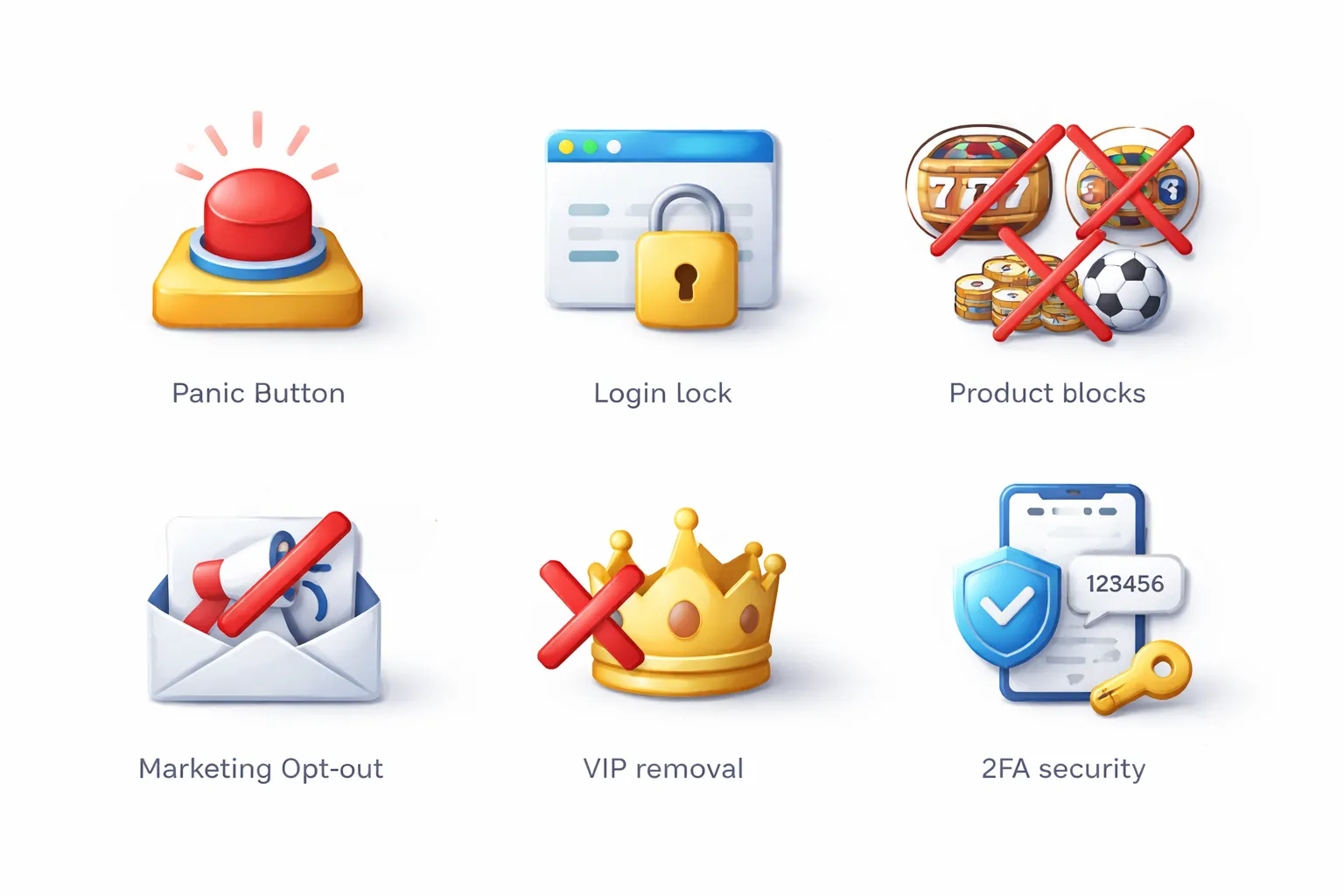
Common options include time-out, cool-off, and full account lock. Some sites also offer a one-tap “panic button” that logs you out and blocks re-entry for a fixed period.
- Time-out: short lock, often 24 hours to 7 days. You cannot log in or place bets.
- Cool-off: longer lock, often weeks. You lose access to gambling features and sometimes cashier access.
- Panic button: instant lock without forms. It should apply across all devices on your account.
Check the fine print before you rely on it. Some operators block wagering but still let you log in, browse, or deposit. You want a true login block.
Blocking specific products, slots vs. casino vs. sports
Product blocks help when one vertical causes most harm.
- Slots block: removes slot games while leaving table games or poker available.
- Casino block: removes all casino games, you may still access sports betting.
- Sports block: removes sportsbook markets and bet placement, you may still access casino.
- Live casino block: targets higher-speed play and higher session intensity.
Read the category list inside settings. Names vary by operator. “Casino” may include live dealer and RNG tables, or it may not. If you need a hard stop, ask support to apply a manual restriction and confirm it in writing.
Disabling promotions, marketing opt-outs, bonus bans, VIP removal
Promos can trigger relapse. Turn them off at the source.
- Marketing opt-outs: disable email, SMS, push notifications, and on-site inbox messages where available.
- Bonus ban: blocks bonus eligibility and free spins. It should also block “bonus buy-in” offers.
- VIP removal: requests removal from VIP lists and host contact. Ask to stop calls and direct messages.
- Personalized offers: request a stop to tailored promotions based on your play data.
Do not assume self-exclusion cancels all marketing instantly. Confirm each channel inside your account settings. If needed, ask support to suppress your profile. If the operator fails to honor opt-outs, treat it as a compliance issue and switch to a licensed brand with enforceable rules, see how to check an online casino license.
Two-factor authentication and security that reduce impulsive access
Security tools can add friction. Friction reduces impulse logins.
- Two-factor authentication (2FA): requires a code from an app or SMS. Set it for login and withdrawals if possible.
- New device approval: blocks quick access from a fresh phone or browser.
- Password manager: stores a long password so you do not remember it. It slows spur-of-the-moment logins.
- Session controls: auto-logout and single active session reduce binge switching across devices.
These steps do not replace exclusion tools. They help when your main risk is quick access during cravings.
Budgeting and Tracking Tools: Make gambling measurable
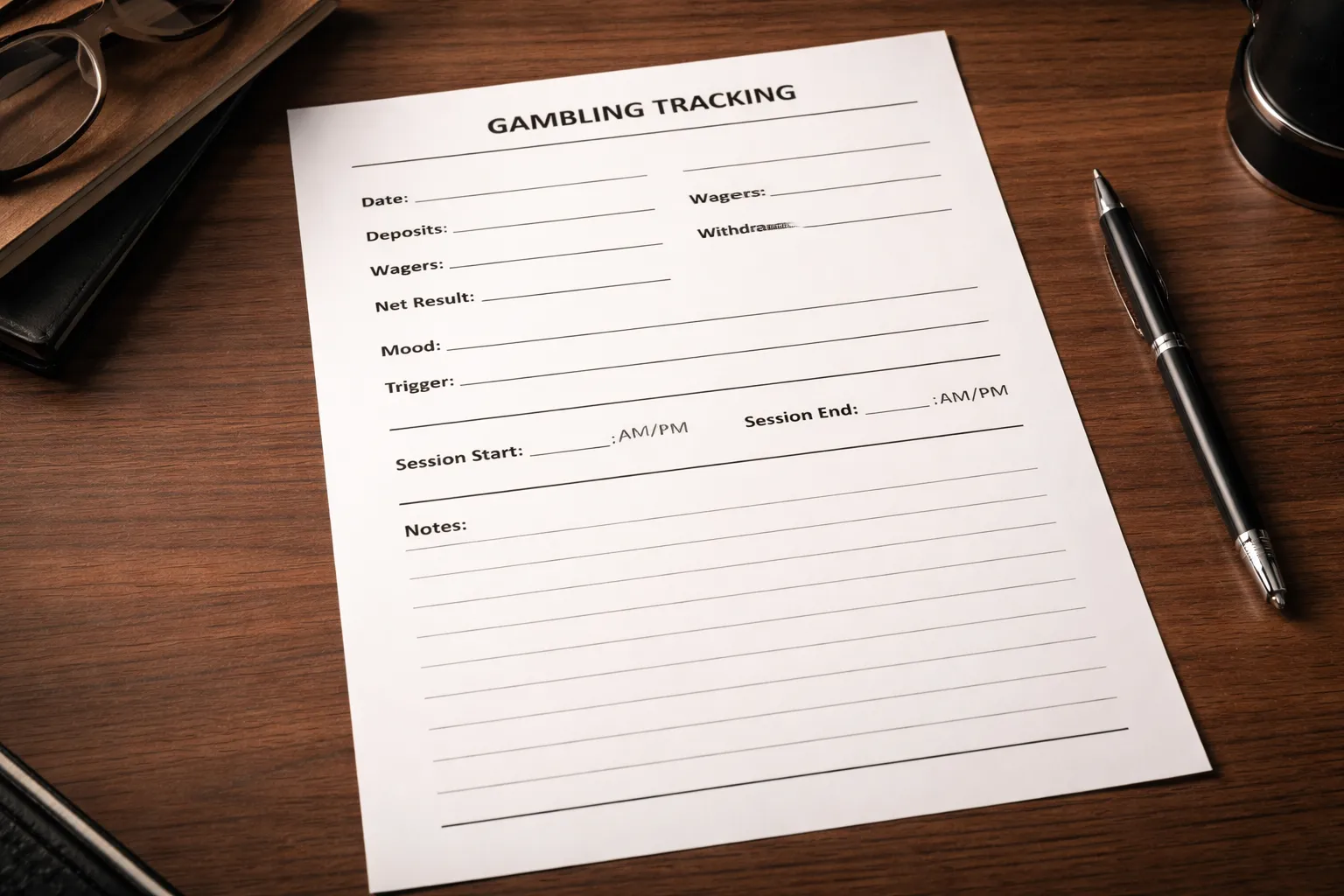
Activity statements: turn play into numbers
Your account statement is your baseline. Use it to see what happened, not what you remember.
- Deposits. Money you moved into the gambling account. Treat this as spending until you withdraw.
- Wagers. Total amount staked. It can be far higher than deposits because you can re-bet the same funds many times.
- Wins. Payouts credited to your balance. A win does not mean profit if you keep betting it back.
- Withdrawals. Money you moved back to your bank. This is the clearest proof of money leaving the gambling cycle.
- Net result. Use a simple formula, withdrawals minus deposits. Negative means you spent money overall. Positive means you cashed out more than you put in.
Track net result weekly and monthly. Daily numbers swing. Longer windows show your real pattern.
Set a gambling budget like entertainment spending
Budget gambling the same way you budget concerts or streaming. Use a hard ceiling. Do not chase losses. Do not borrow. Do not dip into bills.
- Pick a time period, weekly or monthly.
- Set a fixed maximum you can afford to lose. Treat it as already spent once you deposit.
- Split it into smaller blocks per session to avoid one long run.
- Stop when you hit the ceiling, even if you feel close to a win.
If you need a step-by-step method, read how to set a gambling budget.
Use bank alerts and spending categories to reinforce limits
Operator limits help. Bank tools back them up with a second barrier.
- Transaction alerts. Turn on instant notifications for card payments and transfers. You see deposits as they happen.
- Balance alerts. Set a low-balance warning so gambling does not crowd out essentials.
- Merchant categories. Put gambling in its own spending category if your bank app allows it. Review that line weekly.
- Hard blocks. Some banks let you block gambling merchants. Use it if cravings override your plan.
Use the same ceiling across tools. If your budget is $200 per month, set deposit limits and bank alerts around that number, not higher.
Keep a simple play log: triggers, mood, time, outcomes
Numbers show cost. A log shows cause. Keep it short so you keep doing it.
- Before. Note your mood in one word, the trigger, and the reason you opened the app.
- During. Record start time and a stop time you commit to.
- After. Write deposits, withdrawals, and net result. Add one line on whether you stuck to the plan.
Review your last 10 sessions. Look for repeat triggers, late-night play, or longer sessions after losses. Use what you find to tighten limits and change routines.
Third-Party Blocking Software and Device-Level Controls
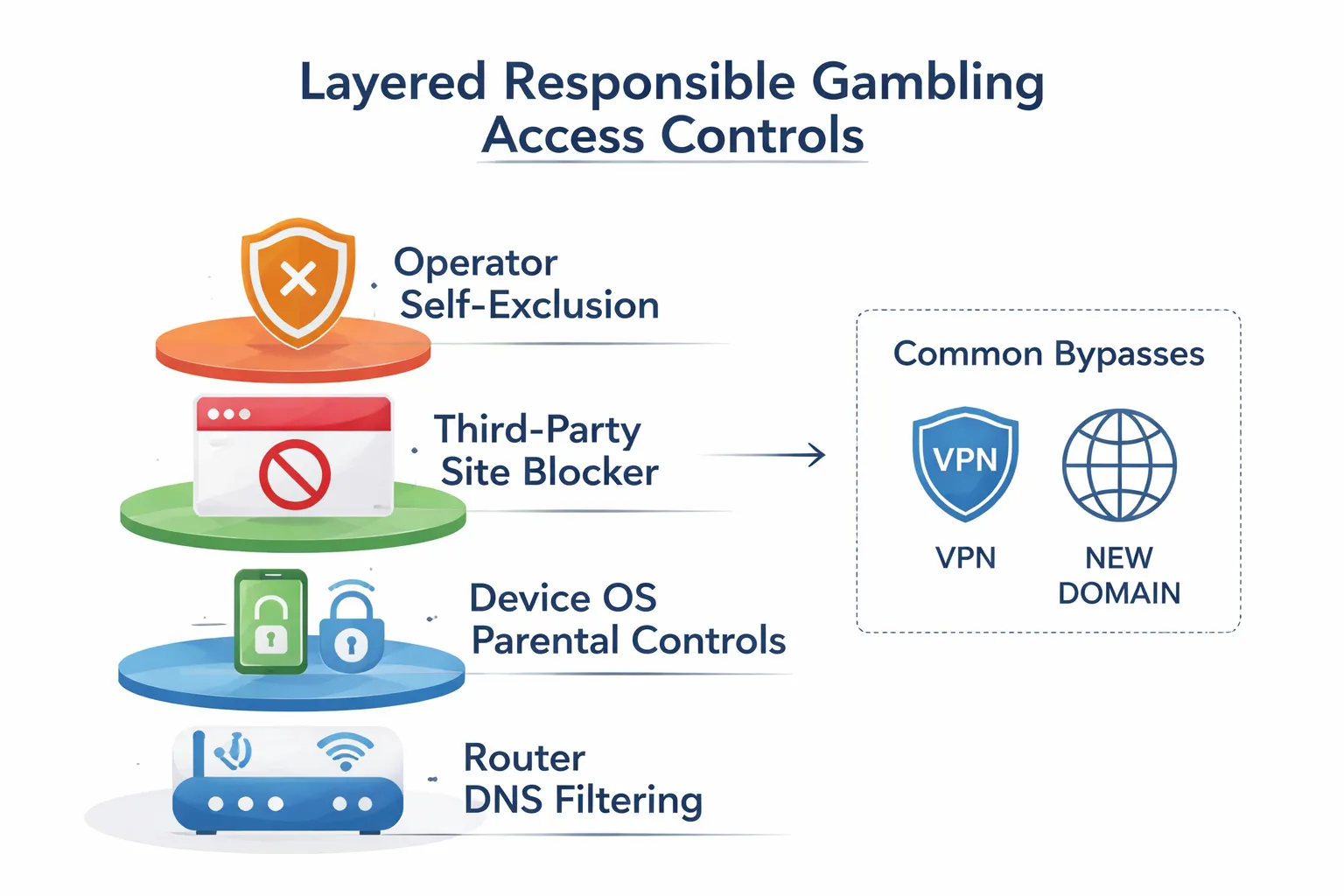
Gambling-site blockers, how they work and when they help most
Third-party blocking software sits between you and gambling content. It blocks access by domain, app category, or known gambling IP ranges. Some tools also block gambling ads and affiliate links.
You install it on the devices you use to gamble. You set a block list, then lock settings with an admin password. Some services let you sync one block across phone, tablet, and desktop.
Blockers help most when your risk window is predictable. Late-night browsing. Boredom scrolling. Drinking. Being alone. They also help when you chase losses and jump between sites. A fast block adds friction when your impulse is high.
- Best use case: You want a hard stop across many sites, including ones you have never used.
- Weak use case: You gamble through a single licensed operator that already offers strong self-exclusion and payment blocks.
Device-level blocks vs operator self-exclusion
Operator self-exclusion targets one brand or one network. Device-level blocks target your access point. They solve different problems.
- Device-level blocks: Reduce access across many operators. Work before you log in. Cover browsers and sometimes apps.
- Operator self-exclusion: Stops play at that operator even if you switch devices. Can block account marketing and logins. Can protect you from re-opening the same account.
Use both when you can. Self-exclusion closes the door at the casino. Device blocks reduce the number of doors you can reach.
| Tool | What it blocks | Strength | Main limitation |
|---|---|---|---|
| Operator self-exclusion | Your account at that operator | Strong enforcement at the source | Does not cover other sites |
| Third-party blocker | Many gambling sites and sometimes apps | Wide coverage, adds friction fast | Can be bypassed with device changes and network tricks |
| Device controls (OS, router) | Specific apps, categories, DNS domains | Good baseline, often free | Coverage varies by device and setup |
Coverage gaps you need to plan for
Blocking is never perfect. You need to know the failure points so you can close them.
- Mirror sites and new domains: Some operators rotate domains. A blocker may miss new URLs until its database updates.
- VPNs and proxy browsers: VPNs can route around DNS-based blocks. Some browsers include built-in VPN features.
- App installs and side-loading: Mobile blocks may not stop installs if you can download casino apps or install from files.
- New devices: A blocker on your phone does nothing on a new laptop or a work device.
- Data vs Wi-Fi: If you block only at the router, mobile data bypasses it.
Close gaps with layered controls. Block at the device and the router. Disable VPN installs with admin locks. Restrict app installs. Set separate limits at the operator and payment level.
Family controls and accountability setups
Controls fail when you can change them in one minute. You need an admin layer that you do not control during an urge.
- Shared admin password: Let a trusted person set the admin PIN for your blocker and your phone settings. You do not keep the code.
- Admin locks on installs: Require a password for app installs, app removals, and new browser installs. Lock changes to VPN settings.
- Screen time and content restrictions: Block gambling categories, adult content, and unknown app stores. Set downtime hours that match your risk window.
- Router-level DNS filtering: Add blocks at home Wi-Fi. Lock router admin access with a password you do not have.
- Accountability check-ins: Share a weekly screenshot of screen time, installed apps, and blocker status with the same person.
If you do not have a person to help, use a password manager with a long random password and store it in a place you cannot access during play. You can also lock it behind a trusted contact if your manager supports it.
Payment and Banking Safeguards
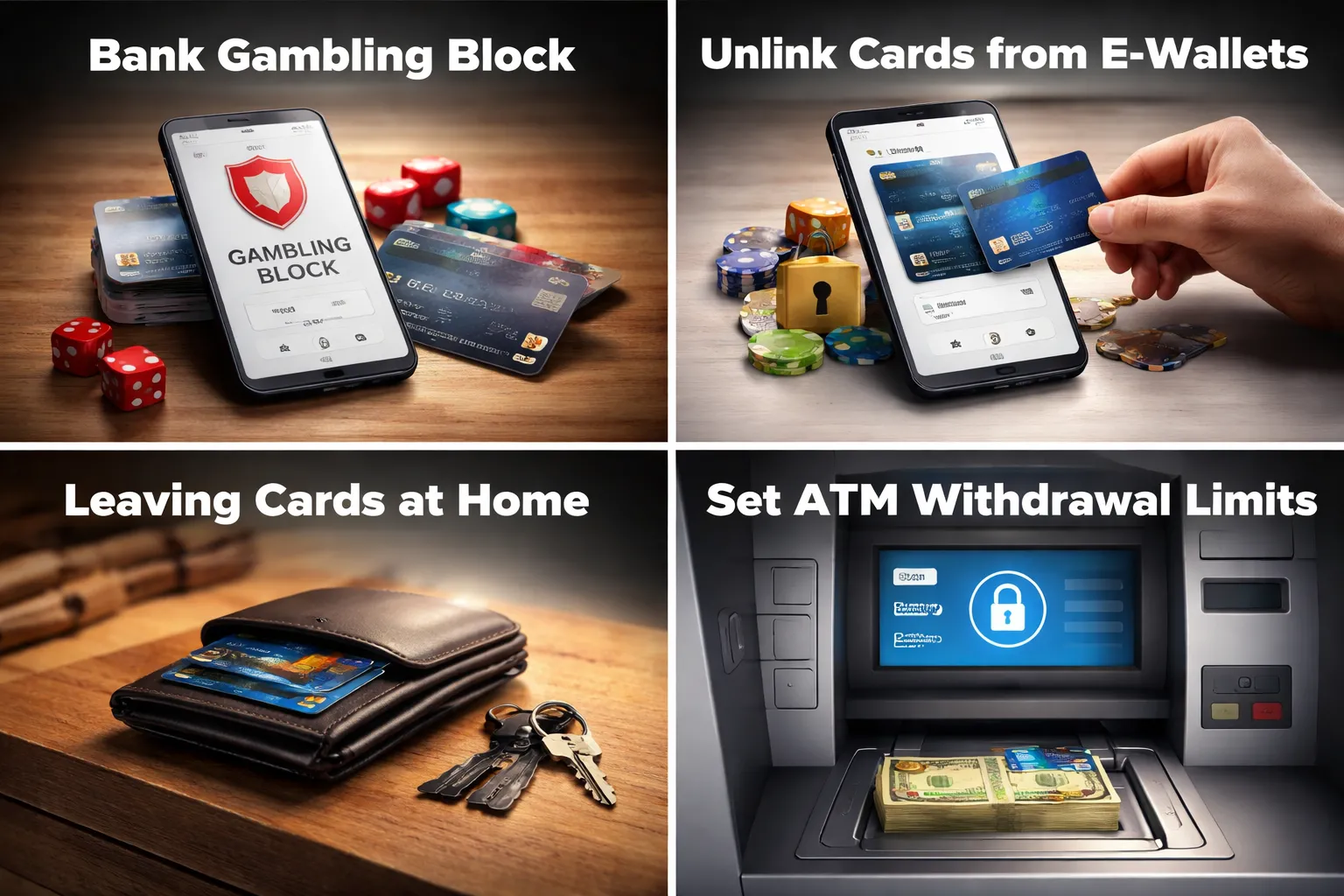
Bank gambling blocks and merchant category controls
Your bank can cut off gambling spend at the source. Many banks offer a gambling block, sometimes called a merchant block or category block. It stops payments coded as gambling.
- How it works: The bank declines transactions tagged with gambling merchant category codes (MCCs), commonly 7995 for betting and casinos.
- What it covers: Card payments, and sometimes bank transfers made through the bank app.
- What it may miss: Sites that route payments through other MCCs, crypto rails, money transfer services, gift cards, and some e-wallet funding paths.
- How to set it up: Use your banking app settings, or call support and ask for a gambling merchant block. Set it to require a waiting period to remove if your bank allows it.
- Best practice: Combine the block with low card limits and no overdraft. Blocks fail when credit and overdraft stay open.
Prepaid cards and e-wallet considerations: reducing friction vs. increasing risk
Payment tools change friction. Less friction increases risk. You want more steps between urge and spend.
- Prepaid cards: They can cap losses if you load a fixed amount and leave the top-up method at home. Risk rises when you can reload in-app, link a debit card, or buy top-ups online.
- E-wallets: They speed up deposits and can hide gambling lines inside a single wallet balance. Many wallets let you deposit in one tap once linked.
- Guardrails that work: Unlink cards from wallets, remove saved payment methods at casinos, disable one-click pay, and require app-level biometrics for wallet payments.
- Funding rule: Do not fund gambling from credit. If your wallet supports it, block credit funding and cash advances.
Chargebacks and disputes: why they’re not a responsible gambling strategy
Chargebacks do not work as a safety net for gambling losses. Use limits and blocks instead.
- Most gambling transactions do not qualify: Card disputes focus on fraud, billing errors, or non-delivery. Gambling results and regret do not meet the standard.
- Operators fight valid claims: Casinos can show login records, device IDs, KYC checks, and transaction logs. That evidence often defeats disputes.
- Timing hurts you: Deposits process fast. You usually act after the money is gone.
- Risk to your accounts: Repeated disputes can trigger account closures, payment restrictions, and slower access to banking services.
Cash-based guardrails: leaving cards at home, withdrawal limits, ATM avoidance
Cash can help if you force a hard stop. Cash can also fail if ATMs stay within reach.
- Leave cards at home: Take only the cash you planned to lose. Do not bring debit or credit cards. Do not bring a second phone with wallet apps.
- Set withdrawal limits: Lower your daily ATM limit in your bank app. If your bank supports it, set a weekly cash withdrawal cap.
- Disable cash advances: Ask your bank to block cash advances on credit cards. This closes a common “one more withdrawal” route.
- Avoid ATM access: Pick venues and routes without nearby ATMs. If you gamble online, do not keep cash in the house.
- Use a cash envelope rule: One envelope per session. When it is empty, you stop. No top-ups.
Behavioral Warning Signs and When Tools Aren’t Enough
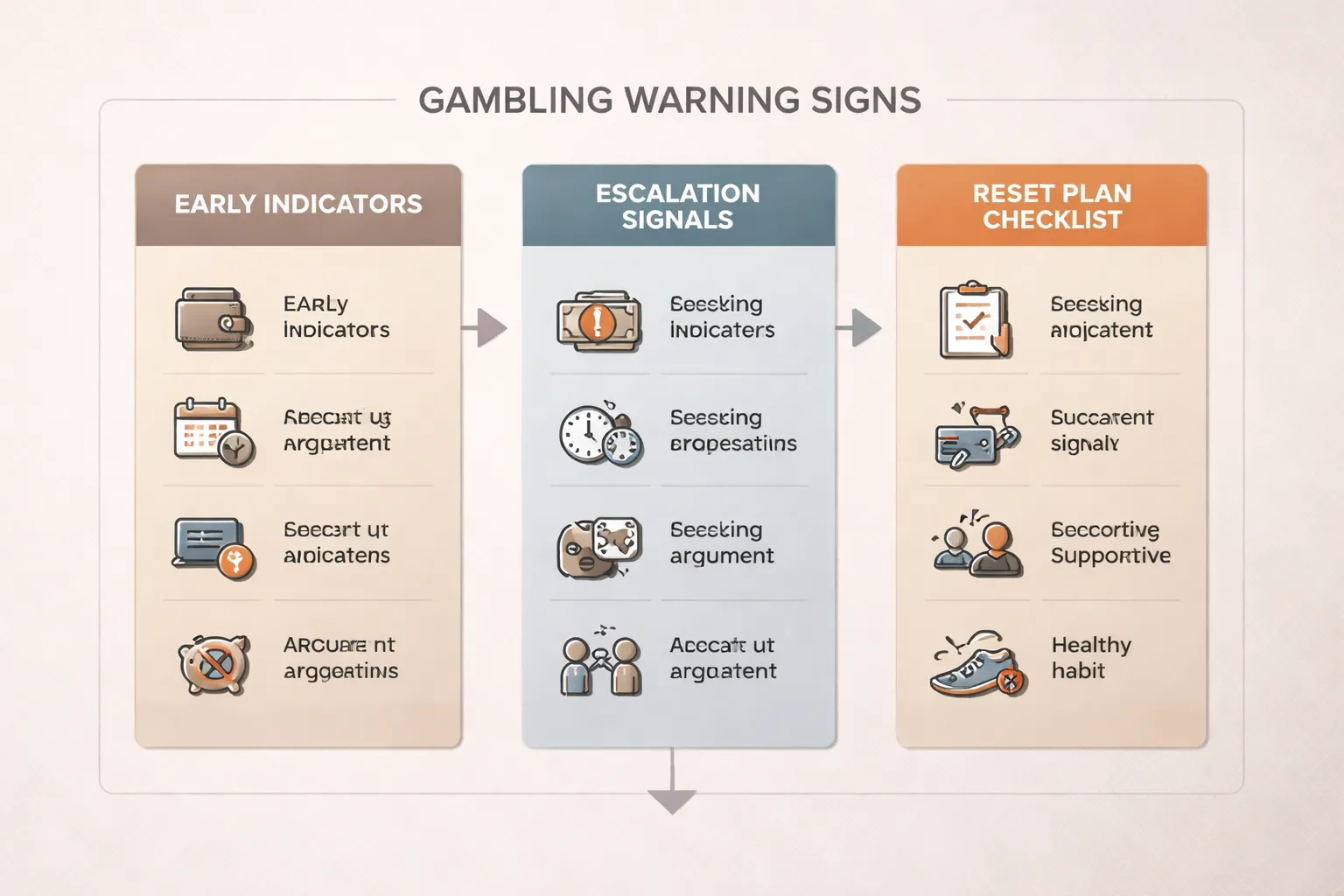
Behavioral warning signs
Tools help when you follow them. You need to spot the moments you start working around them.
- Chasing losses. You raise stakes or extend sessions to “get back” what you lost.
- Hiding play. You delete app history, use private browsing, or lie about time and money.
- Borrowing to gamble. You use loans, overdrafts, payday apps, credit cards, or money from friends.
- Mood swings tied to gambling. You feel tense before play, flat after, then restless until the next session.
- Time distortion. You plan a short session and stay much longer than you intended.
- Rule breaking. You ignore your deposit, loss, or time limits, or you open new accounts to bypass them.
If you want a broader checklist, read problem gambling signs.
Escalation signals that tools may not be enough
- Tolerance. Your old stakes do not feel “worth it,” so you bet more for the same feeling.
- Withdrawal-like irritability. You get angry, anxious, or restless when you try to stop.
- Impaired work or school. You miss deadlines, show up late, lose focus, or gamble during work hours.
- Relationship damage. You argue about money, withdraw from others, or break trust through secrecy.
- Financial spillover. You fall behind on rent, bills, taxes, or essentials to protect gambling funds.
- Loss of control. You make a plan, then you break it within days.
These signals mean you need stronger barriers and outside support, not better willpower.
If you break your limits, use a reset plan
Do the reset the same day. Keep it simple. Make it hard to repeat.
- Stop the session. Log out. Uninstall apps. Leave the venue.
- Freeze access for 72 hours. Turn on a short cool-off if available. If you cannot stick to that, move to self-exclusion.
- Remove payment routes. Delete saved cards, block gambling merchant codes if your bank allows it, and stop cash withdrawals tied to gambling.
- Write a one-line rule. “No gambling when I feel stressed,” or “No gambling after 9 p.m.” Keep one rule, then expand later.
- Set a check-in. Text a trusted person that you broke limits and what you changed. Ask them to follow up tomorrow.
- Track the trigger. Note the time, mood, and place. Use it to adjust limits and blocks.
- Escalate fast if you relapse twice. Switch from limits to exclusion, and book a support appointment.
How to talk to someone about gambling concerns
Pick a calm time. Use facts. Focus on impact. Ask for one specific action.
- Set the tone. “I care about you. I want to talk about something serious.”
- Use concrete observations. “I saw three cash withdrawals this week,” or “You missed work twice after late-night gambling.”
- Name the impact. “Bills are late,” “Our trust took a hit,” or “You seem on edge when you try to stop.”
- Ask for a clear step. “Will you set a deposit limit right now,” or “Will you self-exclude today,” or “Will you call a helpline with me.”
- Hold a boundary. “I will not lend you money for gambling,” or “I will not cover gambling debts.”
- Offer support, not control. “I can sit with you while you set blocks,” or “I can go with you to an appointment.”
| Situation | Script you can use |
|---|---|
| They minimize it | “I am not debating if it is a problem. I am telling you what I see and what it is costing you and us.” |
| They promise to stop | “I want that too. Let’s put one tool in place now so it does not rely on promises.” |
| They get angry | “I will pause this talk if we shout. I will come back to it tonight. This still needs a plan.” |
| They ask for money | “I will not give cash or cover losses. I will help you call support and set blocks.” |
| You are the one struggling | “I broke my limits again. I need help. Can you be my check-in person while I lock down access today?” |
How to Choose a Safer Gambling-Friendly Operator
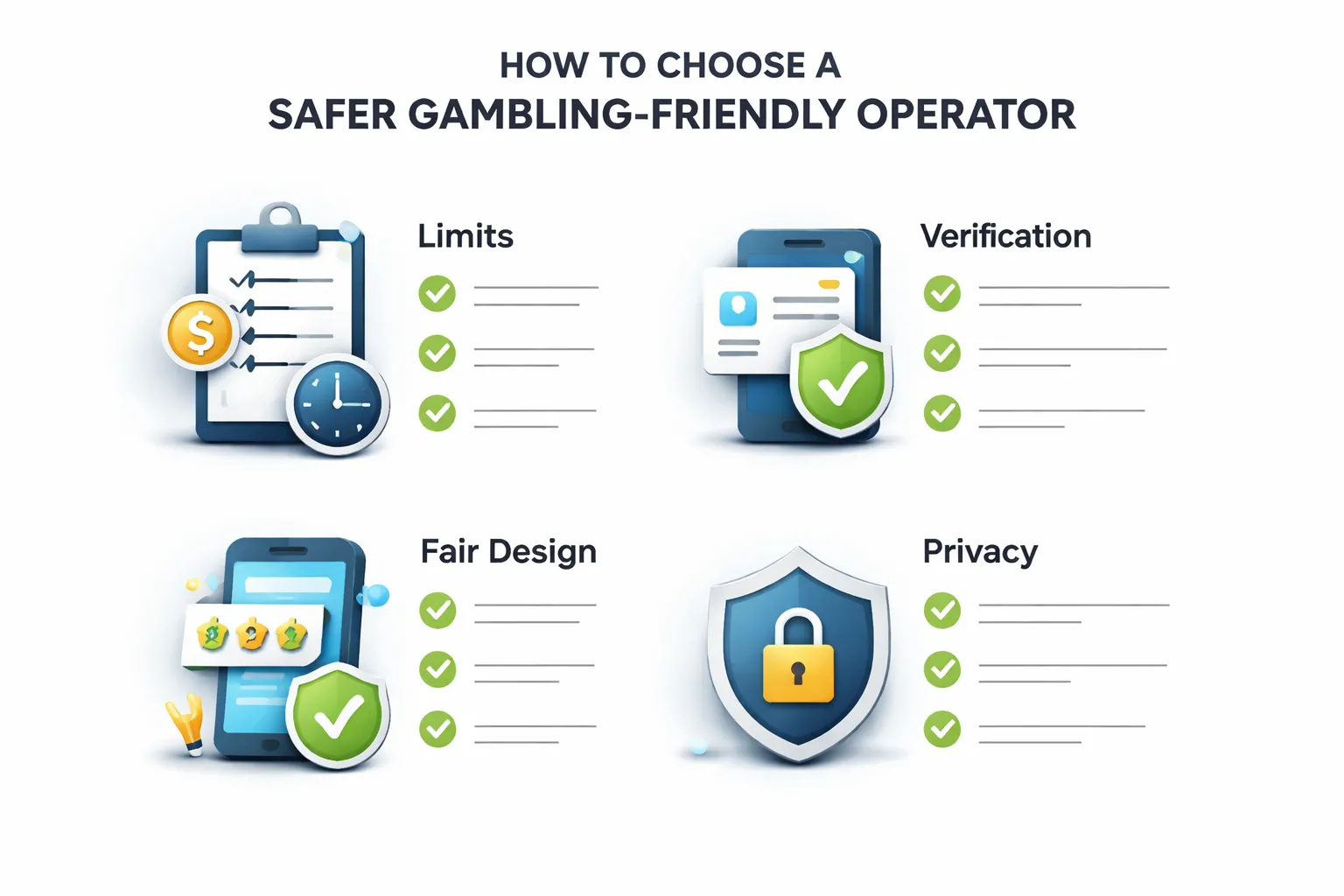
Checklist: transparent limit settings, instant visibility, and clear reactivation rules
- Limits must sit in your account menu. No hidden links. No support ticket needed.
- You must see your active limits at a glance. Deposit, loss, wager, and session limits should show on one screen.
- Changes must follow strict timing. Increases should trigger a cooling-off period. Decreases should apply right away.
- Reactivation rules must be written. The operator should state how long you must wait before a limit increase or account reopen takes effect.
- Limits must work across devices. Mobile and desktop should enforce the same cap.
- Reality checks must be configurable. You should set pop-ups that show time and net spend, with a one-click option to log out.
Verification and enforcement: identity checks, cross-brand links, and exclusion integrity
- They must verify identity early. KYC at signup or before first withdrawal reduces multi-account workarounds and stops underage access.
- They must block duplicate accounts. Look for device, email, phone, and payment method checks.
- They must honor national and regulator schemes. In the UK, that means GamStop. In other markets, check the local self-exclusion register.
- They must state if exclusion links across brands. Some groups run multiple sites. You need one exclusion to cover the whole network when possible.
- They must enforce exclusions with no exceptions. No “VIP manager” reinstatement. No manual overrides. No special access for “verified” players.
- They must prevent marketing during exclusion. If you self-exclude, you should stop receiving promo emails, SMS, push notifications, and retargeting.
If you want the details before you commit, read our online casino self-exclusion guide.
Fair design: avoiding dark patterns, autoplay pressure, and aggressive promos
- Avoid autoplay and rapid re-bet defaults. Fast loops raise spend speed. Safer operators keep control in your hands.
- Watch for forced friction on cash-out. One-click deposit plus multi-step withdrawal signals a revenue-first design.
- Check bonus terms for trap mechanics. High wagering, short expiry, and max-bet rules can push loss chasing.
- Look for promo controls. You should be able to opt out of bonuses and marketing inside your account.
- VIP pressure is a red flag. If hosts push “reload now” messages after losses, walk away.
- Losses should not trigger targeted offers. “Come back” free spins after a bad session signals risky segmentation.
Privacy and data: how responsible gambling monitoring should be handled
- They must say what they track. Session length, frequency, spend spikes, late-night play, and failed deposits often feed risk models.
- They must explain what happens when you flag. You should see clear steps, such as a check-in message, limit prompts, a cooldown suggestion, or a forced review.
- They must separate safety from marketing. Risk signals should not drive promotions, VIP invites, or retention campaigns.
- They must limit access internally. Only trained staff should see risk notes. VIP and sales teams should not use them.
- They must keep retention periods reasonable. The policy should state how long they store play data and RG interactions.
- They must give you control. You should access your history, download data, and manage contact preferences.
Step-by-Step: Setting Up a Responsible Gambling Toolkit (Quick Plan)
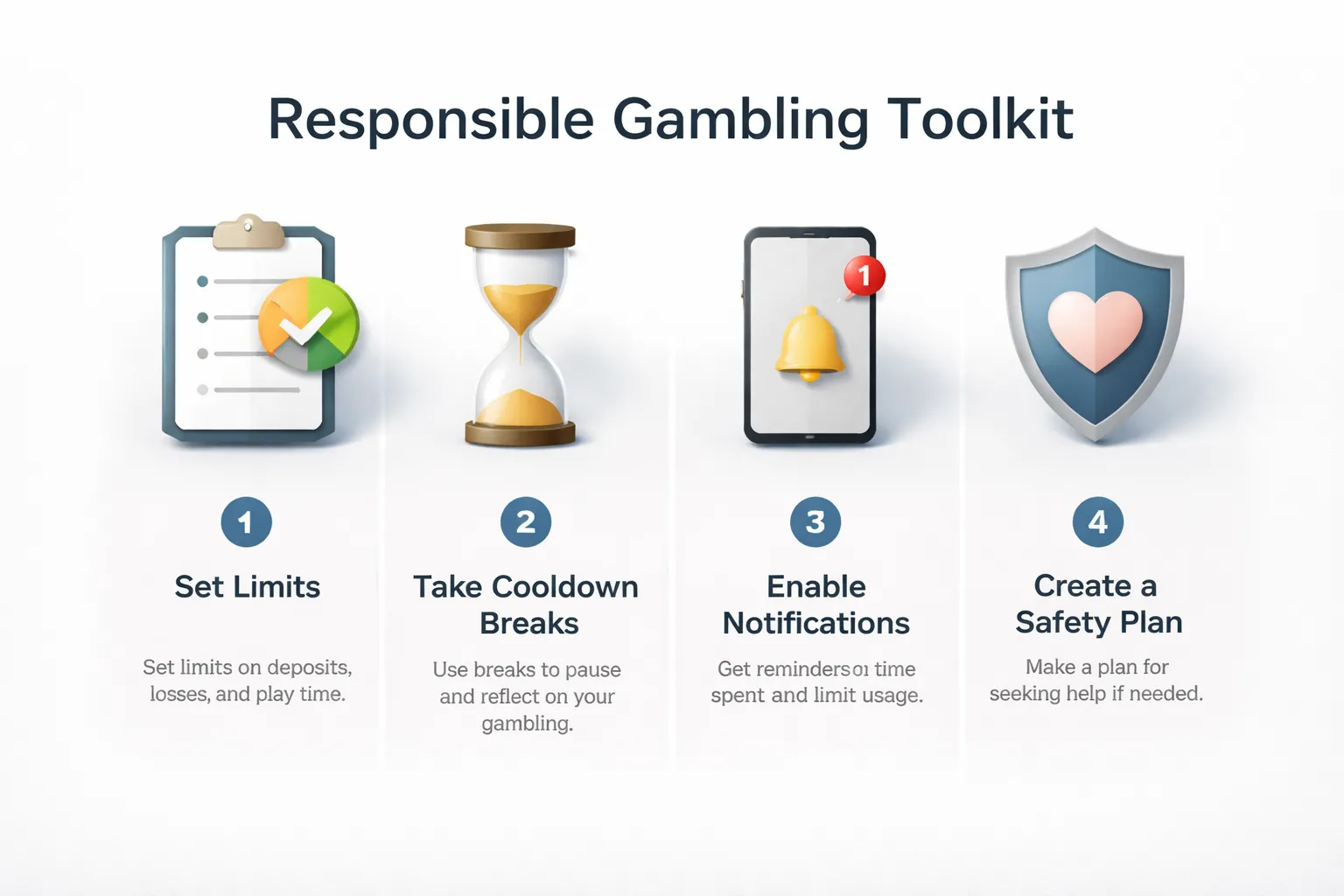
Pick your baseline, time, deposit, and loss limits in 10 minutes
Set limits before you play. Do it once, then lock it in.
- Time limit: Set a daily session cap. Start with 60 minutes. If you split sessions, set a hard stop time.
- Deposit limit: Set a weekly cap tied to your real budget. Use a number you can lose without touching rent, bills, or debt payments.
- Loss limit: Set a weekly max loss. Keep it at or below your deposit limit. If the site offers net loss across games, use that option.
- Reality check pop-ups: Turn them on. Set every 30 minutes. Read it and exit when it hits your limit.
If you need help picking numbers, use this guide on how to set a gambling budget.
Add friction, cooling-off, promo opt-out, and payment blocks
Friction reduces impulse. Use tools that slow you down.
- Cooling-off: Set a short break option you can trigger fast. Use 24 hours after a loss streak. Use 7 days after a big win.
- Self-exclusion: Use it if you keep breaking limits or chasing losses. Pick the longest period you will respect. Learn the mechanics in online casino self-exclusion.
- Promo opt-out: Turn off emails, SMS, push notifications, and VIP contact. Remove bonuses if they push you to play longer.
- Payment blocks: Block gambling transactions at your bank or card level. Add merchant category blocks if available. Remove saved cards and one click deposits.
- Withdraw friction: If the site offers a withdrawal lock or cancel window, disable any option that lets you cancel withdrawals.
Build visibility, weekly activity review and alerts
You cannot control what you do not track. Use a simple weekly review.
- Pick one day: Same day each week. 10 minutes. No play during the review.
- Check four numbers: Total deposits, total net loss, total time logged in, number of sessions.
- Compare to limits: If you hit 75 percent of any limit, stop for the week or trigger a cooling-off.
- Set alerts: Turn on deposit and loss notifications. Add bank alerts for gambling merchant charges.
- Export history: Download statements and play history monthly. Keep one folder. Make it easy to audit.
Create an “if-then” safety plan for high-risk moments
Write rules you follow when pressure hits. Keep them short. Put them in your notes app.
- If you feel angry, stressed, or numb, then you do not gamble for 24 hours.
- If you lose three bets in a row, then you end the session.
- If you raise your stake size to win losses back, then you log out and trigger cooling-off.
- If you break any limit, then you self-exclude for at least 7 days.
- If you hide gambling from anyone, then you stop and ask for support the same day.
Save this plan where you will see it. Use it as a rule set, not a suggestion.
FAQ
What is a deposit limit?
A deposit limit caps how much money you can add to your gambling account. You set it by day, week, or month. It blocks extra deposits once you hit the cap. Set it before you play, and keep it realistic for your budget.
How is a deposit limit different from a loss limit?
A deposit limit controls money going into your account. A loss limit controls how much you can lose in a set period. Deposit limits reduce overspending. Loss limits can still allow high deposits if you win and keep playing.
What is a wager or stake limit?
A wager or stake limit caps how much you can bet per spin, hand, or round. It reduces damage from impulsive big bets. Use it with a deposit limit. Set it at a level you can repeat without chasing losses.
What is a time limit or session limit?
A time limit caps how long you can stay logged in or keep playing in one session. Some sites log you out automatically. Use a hard stop. Long sessions increase risky decisions, especially after losses.
What is a cooling-off period?
A cooling-off period is a short break you trigger, often 24 hours to several weeks. You cannot gamble during that time. Use it when you feel loss-chasing, anger, or urgency. Trigger it early, not after damage.
What is self-exclusion?
Self-exclusion blocks you from gambling on a site for a fixed period, often months or longer. You cannot log in, deposit, or play. It is a stronger tool than cooling-off. Learn details in our online casino self-exclusion guide.
Can I cancel self-exclusion early?
Most regulated operators do not let you cancel early. You must wait until the period ends. Some require a cooldown step before reactivation. If a site offers instant removal, treat it as a red flag for weak protections.
What is reality check or pop-up reminders?
Reality checks show time spent, stakes, and results at set intervals. They break autopilot play. Turn them on. Read them. If you ignore them, lower your limits or stop the session.
Do responsible gambling tools guarantee I will not overspend?
No. Tools reduce risk, but you still make choices. You can gamble on other sites, or use other payment methods if you do not set wider blocks. Combine limits with a written budget and outside support if needed.
What should I do if a casino does not enforce my limits?
Stop playing and take screenshots of settings, deposits, and timestamps. Contact support and request an account block. Ask for a refund review. Then report the operator to its regulator. Do not keep testing the limit.
What is a payment block or bank gambling block?
A payment block stops gambling transactions at your bank or card level. It helps when site limits fail or you use multiple sites. It does not block all methods, like some transfers or crypto. Check which payments it covers.
How do I know if a casino is licensed and regulated?
Check the footer for a license number and regulator name. Verify it on the regulator’s website. Confirm the domain matches the license record. If details do not match, do not deposit. Use our licensing checker guide for steps.
Conclusion
Responsible gambling tools work when you set them before you play. Use deposit limits to cap spending. Use loss limits to stop chasing. Use time limits to control session length. Use reality checks to track hours and money. Use self-exclusion when you need a hard stop.
Do not rely on one tool. Stack them. Set limits at the casino and in your bank. Block ads and access if you struggle with triggers. If you play across multiple sites, repeat the setup on each site.
Your final step is simple. Set your limits now, then lock them in. If you cannot stick to them, stop playing and use problem gambling warning signs to check your risk level and act early.
- Before you deposit: Set deposit, loss, and time limits.
- After each session: Review your account history and reality check logs.
- If control slips: Activate cooling-off or self-exclusion.
-
Online Casino Customer Support: What to Look For (Live Chat, Email, Response Times)
8 months ago -
Sign Up for an Online Casino: Create an Account in Minutes
8 months ago -
Online Casino Licensing Explained: Authorities, Licenses & How to Check One
8 months ago -
How to Set a Gambling Budget (That You’ll Actually Stick To)
8 months ago -
Online Casino Self-Exclusion: How It Works and What Happens Next
8 months ago
-
- Checklist: transparent limit settings, instant visibility, and clear reactivation rules
- Verification and enforcement: identity checks, cross-brand links, and exclusion integrity
- Fair design: avoiding dark patterns, autoplay pressure, and aggressive promos
- Privacy and data: how responsible gambling monitoring should be handled
-
- What is a deposit limit?
- How is a deposit limit different from a loss limit?
- What is a wager or stake limit?
- What is a time limit or session limit?
- What is a cooling-off period?
- What is self-exclusion?
- Can I cancel self-exclusion early?
- What is reality check or pop-up reminders?
- Do responsible gambling tools guarantee I will not overspend?
- What should I do if a casino does not enforce my limits?
- What is a payment block or bank gambling block?
- How do I know if a casino is licensed and regulated?
-
-
- Checklist: transparent limit settings, instant visibility, and clear reactivation rules
- Verification and enforcement: identity checks, cross-brand links, and exclusion integrity
- Fair design: avoiding dark patterns, autoplay pressure, and aggressive promos
- Privacy and data: how responsible gambling monitoring should be handled
-
- What is a deposit limit?
- How is a deposit limit different from a loss limit?
- What is a wager or stake limit?
- What is a time limit or session limit?
- What is a cooling-off period?
- What is self-exclusion?
- Can I cancel self-exclusion early?
- What is reality check or pop-up reminders?
- Do responsible gambling tools guarantee I will not overspend?
- What should I do if a casino does not enforce my limits?
- What is a payment block or bank gambling block?
- How do I know if a casino is licensed and regulated?
-
-
Reload Bonus Explained: What It Is and When It’s Worth Claiming
6 months ago -
Online Casino Licensing Explained: Authorities, Licenses & How to Check One
8 months ago -
Best Live Dealer Casinos: Where to Play Live Blackjack, Roulette & More
8 months ago -
Best Online Casinos for High Rollers: VIP Perks, High Limits & Exclusive Bonuses
8 months ago -
Fast Payout Online Casinos: Best Sites for Quick Withdrawals
8 months ago
-
Online Casino Customer Support: What to Look For (Live Chat, Email, Response Times)
8 months ago -
Sign Up for an Online Casino: Create an Account in Minutes
8 months ago -
Online Casino Payment Safety Tips: How to Deposit and Withdraw Securely
8 months ago -
What to Do If an Online Casino Won’t Pay Out: Step-by-Step Actions
8 months ago -
How to File a Complaint Against an Online Casino (Plus ADR Explained)
8 months ago