Online Casino Self-Exclusion: How It Works and What Happens Next

Online casino self-exclusion blocks your access to gambling sites for a set time. You request it, the casino must enforce it, and you lose the ability to log in, deposit, or play. In many markets, exclusion can also extend across multiple operators through a national or state register.
This guide explains how self-exclusion works online, how to start it, what happens to your account and funds, and what limits still matter after you enroll. You will also learn common gaps, like offshore sites that ignore requests, and why checking a site’s license affects how well self-exclusion gets enforced. See how to check an online casino license.
- In het kort: Self-exclusion blocks you from gambling on a specific site, or across many sites if your country uses a central register.
- In het kort: You usually choose a fixed period, your access stays blocked until it ends, and many programs do not allow early reversal.
- In het kort: The casino must close your access, stop marketing to you, and block new accounts tied to your details.
- In het kort: Your balance does not vanish, but withdrawals can take longer due to checks and cooldown rules.
- In het kort: Self-exclusion does not always cover offshore and unlicensed casinos, enforcement depends on the license and regulator.
- In het kort: Extra limits still matter after you enroll, like deposit limits and reality checks, use them as backup.
Key takeaways
- Self-exclusion works at two levels, operator-only blocks and register-based blocks that apply across multiple licensed operators.
- You start it through your account settings, customer support, or a regulator portal, the fastest route depends on your jurisdiction.
- Expect identity checks. Casinos use your name, date of birth, address, email, phone, and payment details to match and block accounts.
- Your account access stops. You cannot log in, deposit, or place bets during the exclusion period.
- Marketing should stop. If promos keep coming, save evidence and report it to the regulator tied to the casino license.
- Withdrawals can stay available, but timing varies. Some operators pause payouts until they complete KYC, source-of-funds checks, or responsible gambling reviews.
- Bonuses and loyalty perks usually end. Most terms cancel active bonus offers once you self-exclude.
- Coverage gaps remain. Unlicensed and offshore sites can ignore requests, and you may need extra blocks at device, payment, or bank level.
- License checks matter. Use the regulator info to confirm if a site must enforce self-exclusion, see how to check an online casino license.
- Use layered limits. Pair self-exclusion with other tools so you still have guardrails if you return later or switch platforms.
What online casino self-exclusion is (and what it is not)
Definition and purpose in responsible gambling
Online casino self-exclusion is a formal block you place on your gambling account. You tell the operator to stop you from using the product for a set time.
On regulated sites, the operator must enforce the block. That usually means no logins, no betting, no deposits, and no marketing messages tied to that account.
Self-exclusion works best as part of a wider plan. Pair it with other limits and controls from responsible gambling tools.
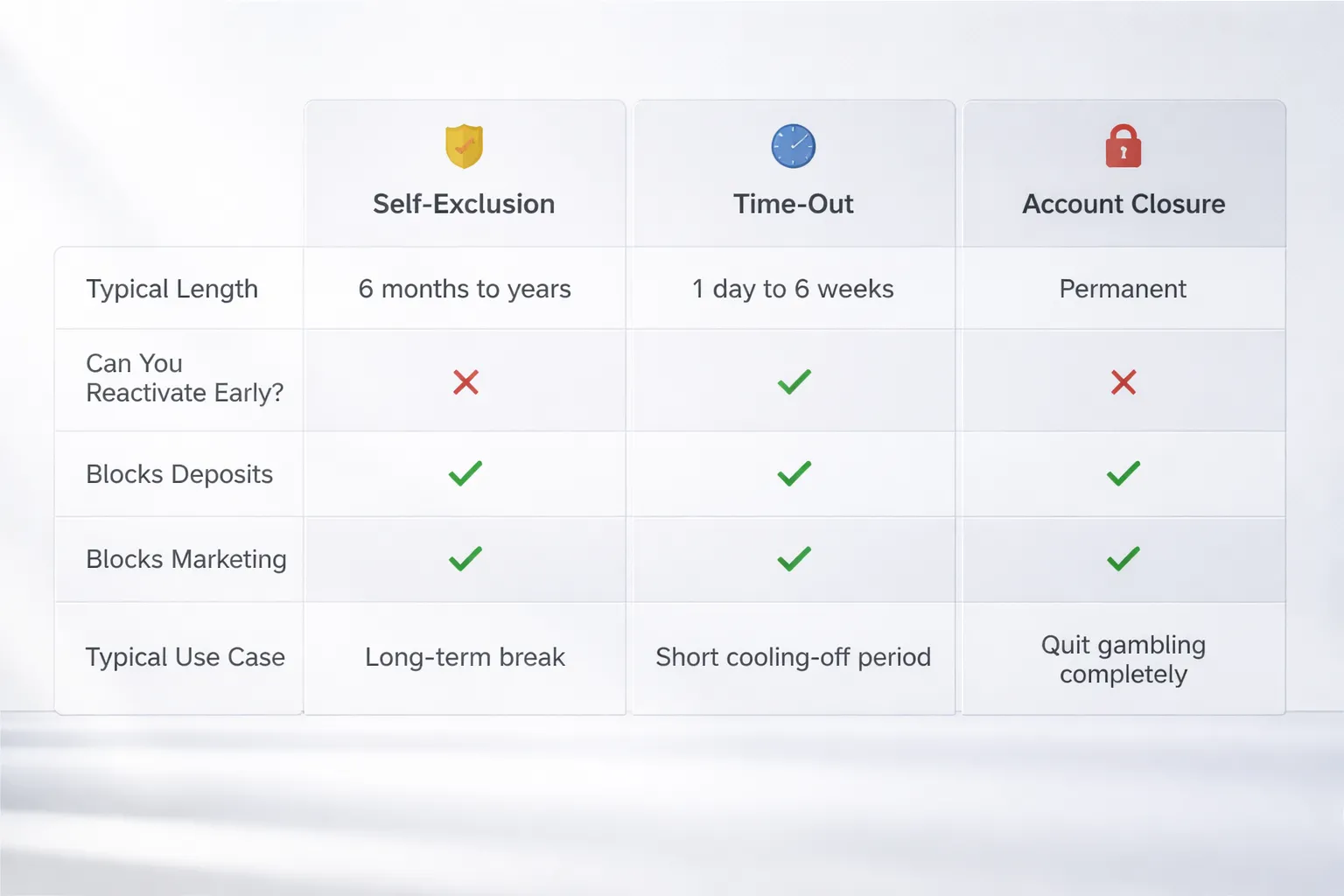
What it is not: time-out, cooling-off, and account closure
- Self-exclusion: A longer lock that you cannot simply switch off. Regulators often require a minimum term and a controlled return process.
- Cooling-off or time-out: A short break, often 24 hours to a few weeks. It may allow automatic return when the timer ends.
- Account closure: A customer service action that shuts an account. It may not block you from opening a new one with the same operator, unless the operator treats it as an exclusion.
If you want a hard stop, ask for self-exclusion by name. Do not rely on a time-out or a generic closure request.
Voluntary vs operator-imposed (involuntary) exclusion
- Voluntary self-exclusion: You request the block. You pick the term offered by the operator or the regulator scheme.
- Operator-imposed exclusion: The casino restricts you. Common triggers include failed age checks, fraud risk, chargeback patterns, AML concerns, or harmful play signals.
Operator-imposed restrictions protect the operator first. They may not give you the same support steps as a responsible gambling exclusion. If you want protection from future access, confirm the status in writing as self-exclusion, and confirm the duration.
Common eligibility and identity requirements
Most regulated operators ask for enough details to match you to your account and prevent re-registration.
- Basic account details: Full name, date of birth, email, phone number, and address.
- Identity checks: ID document upload, selfie checks, or database checks. Some sites require verification before they lock the account, others lock first and verify during the process.
- Scope selection: One operator brand, a group of brands, or a regulator-wide scheme, depending on your jurisdiction.
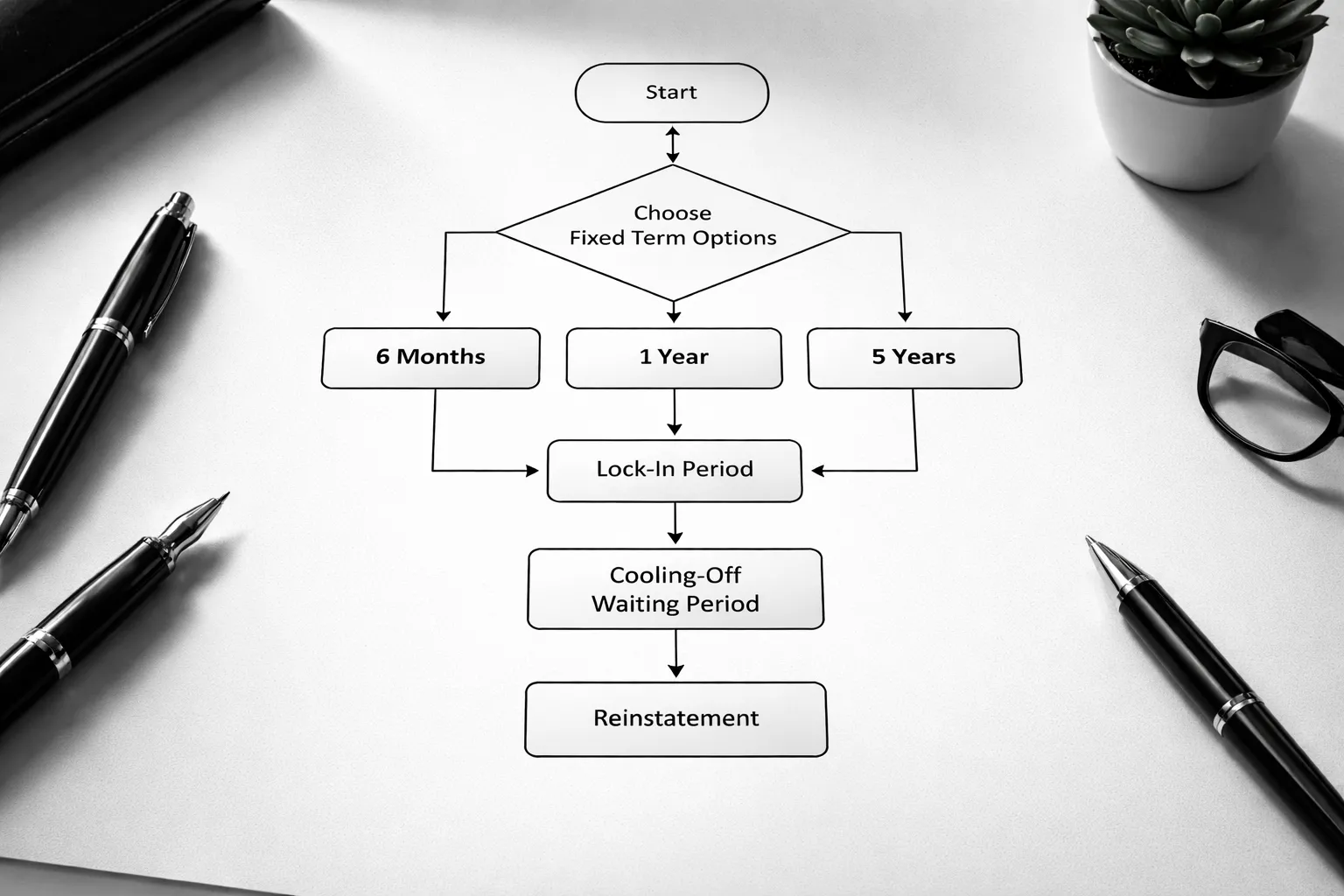
- Term selection: Fixed options such as 6 months, 1 year, or 5 years. Some schemes also offer indefinite exclusion.
Use the same personal details across accounts if you can. Matching works better when your name, date of birth, and contact details stay consistent.
How online casino self-exclusion works step by step
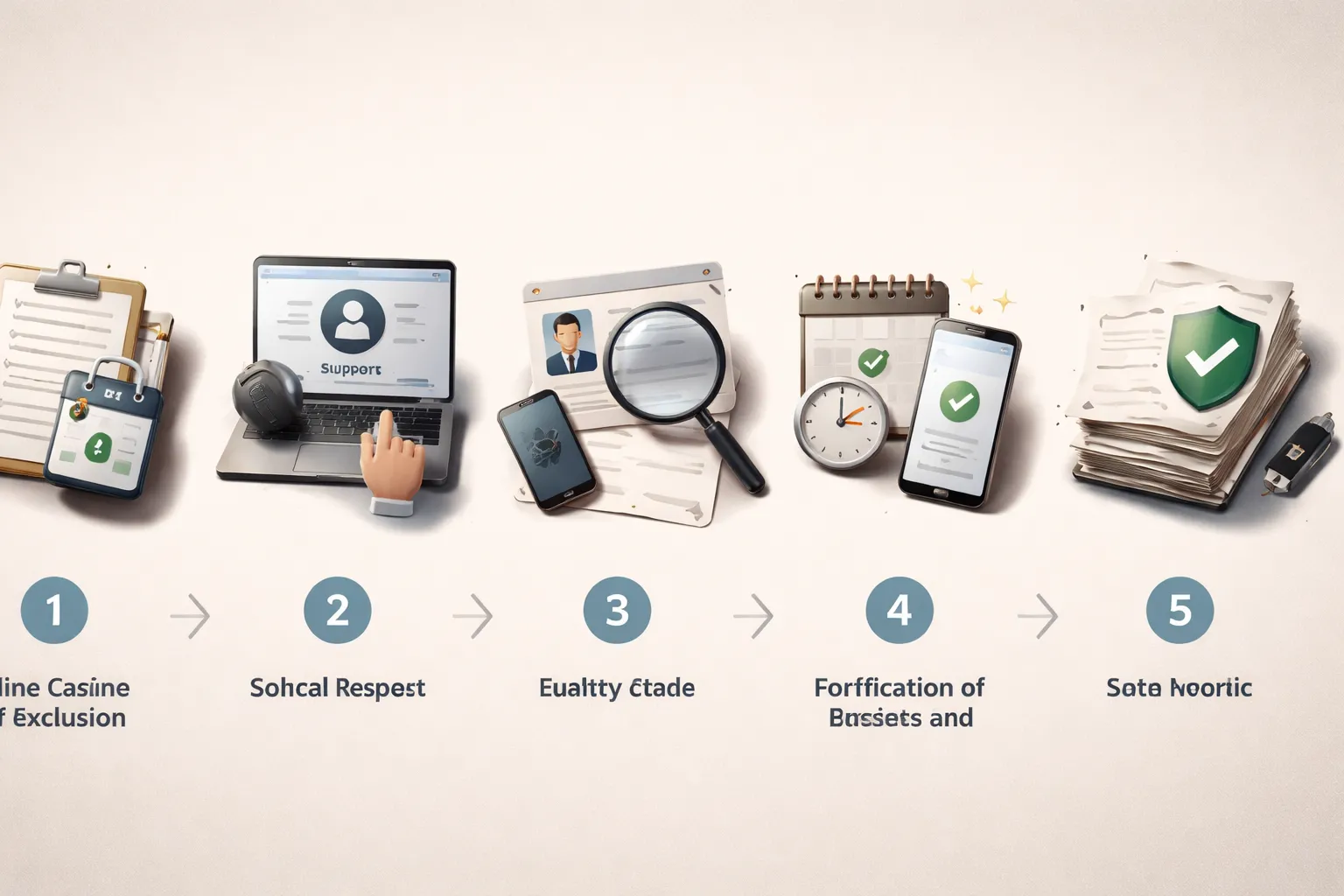
1) Choose the exclusion type and duration
Start by picking the scope. This decides where the block applies.
- Single operator, blocks one casino brand and its related sites under the same account system.
- Operator group, blocks a group of brands owned by the same company.
- Regulator-wide scheme, blocks all licensed operators in that jurisdiction that must honor the list.
Then pick the term. Most systems use fixed time options. Common choices include 6 months, 1 year, and 5 years. Some schemes offer indefinite exclusion. Many regulators treat fixed terms as binding. You often cannot shorten them once they start.
- Short term, useful if you need an immediate reset and clear boundaries.
- Multi-year, reduces relapse risk, removes the need to keep extending.
- Permanent or indefinite, best if gambling keeps causing harm. Some schemes still require a formal process to lift it later.
2) Initiate the request in your account or through support
Most online casinos let you self-exclude in one of two ways.
- Inside your account, go to Responsible Gambling, Safer Gambling, or Account Limits. Select Self-Exclusion, then choose scope and term. This route is faster when the tools work as designed.
- Through customer support, request self-exclusion in writing if possible. Ask the agent to confirm the scope, the exact duration, and the start time. Use a channel you can save, such as email or chat transcript. You can also check what good support looks like in online casino customer support.
If you cannot access your account, support becomes the default. This includes cases where you forgot login details, your account is locked, or you fear you will reverse course.
3) Complete identity checks and lock out account switching
Expect the casino, or the regulator scheme, to verify your identity. This protects you and reduces account switching.
- Basic matching, name, date of birth, address, email, phone number.
- Document checks, some operators ask for ID or proof of address, especially when you request support-led exclusion.
- Cross-account checks, operators may match on personal details, device signals, payment details, and IP history. Results vary by operator and jurisdiction.
Use the same personal details across your accounts. If you change details to bypass matching, you can still get caught later during verification or withdrawals. That can trigger delays and additional checks.
4) Get confirmation and note the effective date
Do not assume the block is active until you see confirmation. Confirm three points.
- Effective date and time, some systems apply instantly, others take effect after processing.
- Coverage, which brands and products the exclusion blocks, casino, sports, poker, bingo, and any apps.
- What changes, login blocked, deposits blocked, marketing opt-out, and whether withdrawals stay available.
If you still receive marketing after exclusion, report it to support. Keep a record of dates and messages. Regulators often treat post-exclusion marketing as a compliance issue.
5) Save records you may need later
Keep proof. It helps if something goes wrong and you need to escalate.
- Confirmation email or screenshot, show the term, scope, and start date.
- Chat transcript or ticket number, especially if you used customer support.
- Brand list, note every site or app covered, plus any operator group name.
- Payment and balance notes, record pending withdrawals and expected timelines.
If a casino fails to enforce your exclusion, you will need these records to support a complaint to the operator or the relevant licensing authority.
What happens immediately after you self-exclude

Login, deposit, and wagering blocks
Most sites apply the block as soon as they confirm your request. Some take longer, especially if a support agent must process it.
- Login: You may get logged out. Your next login attempt may fail, or you may get a message that your account is self-excluded.
- Deposits: The cashier should block new deposits. Saved cards, bank transfers, and e-wallet funding should fail or get rejected.
- Wagering: You should not be able to place casino bets, sports bets, or start paid games. If the app still lets you play, treat it as an enforcement failure and save proof.
- Account access: Some operators still let you log in to view balances and transactions. Others block all access. Either way, you should not be able to gamble.
- Marketing contact: Promotional emails and texts should stop, but delays happen. Save any messages you receive after the start date.
Bonuses, loyalty points, and VIP status
Self-exclusion usually freezes or ends rewards linked to play. Check the terms for the brand or operator group.
- Active bonuses: Bonus funds and active bonus offers often get voided. Bonus wagering progress usually stops.
- Future offers: Reloads, free spins, cashback offers, and VIP promos should stop during the exclusion period.
- Loyalty points: Points may freeze until you return, or expire on the normal schedule. Some sites remove points tied to bonus abuse rules, even if you did nothing wrong.
- VIP status: Hosts should stop contacting you. Tier status may pause, drop, or reset after a long exclusion.
Open bets, tournament entries, and unsettled wagers
Operators handle unsettled activity based on game type and local rules. Expect these common outcomes.
- Sports bets already placed: Many sites let existing bets stand and settle as normal. You still should not be able to place new bets.
- Casino rounds in progress: If a game round already started, the result may still resolve. The system may also void interrupted rounds and return the stake. Keep screenshots of any error messages.
- Tournaments and leaderboards: Entries may get removed. Prizes may get forfeited if play continues after the exclusion start time, even by system error.
- Pending withdrawals: A self-exclusion should not cancel legitimate withdrawals. Processing times may stay the same, or slow down if the operator adds extra checks.
Access to responsible gambling tools and support resources
Self-exclusion should not lock you out of help. You should still be able to get support for account closure, balances, and withdrawals.
- Support access: You should still reach customer support to confirm the exclusion, request a written confirmation, and resolve payment issues.
- Tool access: Some sites still show safer gambling settings such as deposit limits, loss limits, timeouts, and reality checks. For a full breakdown, see responsible gambling tools.
- Help links: The site should keep links to support services, including local problem gambling helplines and self-exclusion schemes where available.
- Data access: Many operators still allow access to account history on request. Ask for your transaction and betting records if you need them for budgeting, disputes, or treatment support.
Money and account outcomes: withdrawals, balances, and disputes
Withdrawing remaining funds, typical steps and timelines
Self-exclusion should block play, not trap your money. You usually keep the right to withdraw any cleared balance.
- Step 1, stop activity: Cancel any pending deposits. Do not try to place bets to clear wagering.
- Step 2, check your balances: Separate cash, bonus funds, and pending wins. Bonus funds often forfeit on exclusion under the bonus terms.
- Step 3, request a withdrawal: Use the cashier if it still allows withdrawals. If your login blocks all access, contact support and request a manual withdrawal.
- Step 4, confirm the method: Many operators send withdrawals back to the last deposit method where possible. Some limit options after exclusion.
- Step 5, track status: Keep screenshots or emails that show the request time, amount, and method.
Timelines depend on two parts. The operator review, then your payment provider processing. Expect longer waits if the site asks for documents or flags the transaction for review.
KYC and AML checks during withdrawal, and why they still apply
Self-exclusion does not remove ID checks. Operators still must follow KYC and AML rules before they pay out.
- Identity: Photo ID and a selfie or liveness check. This reduces fraud and account takeovers.
- Address: Utility bill or bank statement. Many sites require a recent document.
- Payment ownership: Proof you control the card, bank account, or e-wallet. This supports closed-loop payments.
- Source of funds, in some cases: Payslips, bank statements, or other proof if your activity triggers thresholds or risk checks.
Send clear files. Use the exact name on your account. Do not edit statements. If the operator rejects a document, ask for the specific reason and the exact format they accept.
Chargebacks, reversals, and financial institution considerations
A chargeback is a bank or card dispute. It does not replace the operator complaint process. Use it when you have a clear payment issue.
- Chargebacks: Best for unauthorized deposits, duplicated charges, or services not provided. Banks often reject disputes for transactions you authorized, even if you regret them.
- Reversals: Some card deposits can reverse if they still sit in a pending state. Contact your bank fast. Once settled, you usually need a chargeback route.
- Bank transfer and e-wallet disputes: Rules differ. Many transfers are hard to recall after completion. Ask your provider what protections apply.
- Account impact: Chargebacks can trigger account closure and withdrawal holds until the dispute ends. They can also create negative balances if the operator already paid winnings out.
Keep records before you file. Save deposit receipts, timestamps, chat logs, and your self-exclusion confirmation. If your goal is to stop gambling spend going forward, ask your bank about merchant blocks and limits. For spending control, see responsible gambling tools.
How to escalate issues, operator complaints, ADR, and regulators
Escalate in order. Write clearly. Stick to dates and amounts.
- Operator support: Ask for a written case number. State what you want, the exact amount, and the deadline you request.
- Formal complaint: Use the operator complaints channel. Request a final response in writing. Ask for the complaints policy if you cannot find it.
- ADR: If the site offers an Alternative Dispute Resolution provider, submit your file with evidence. ADR works best for clear disputes over balances, withdrawal delays, and term enforcement.
- Regulator: If the operator ignores you, breaches self-exclusion rules, or refuses to follow the complaints path, file a complaint with the licensing authority. Include your self-exclusion date, the account ID, and the full timeline.
Use a simple evidence pack. A timeline table helps.
| Item | What to include |
|---|---|
| Self-exclusion proof | Email confirmation, date and time, exclusion length |
| Balance proof | Screenshot of cashier, transaction history, pending withdrawals |
| Payments | Deposit receipts, bank statements with reference numbers |
| Comms | Chat logs, emails, ticket numbers, names of agents |
| Resolution request | Exact amount, preferred method, and where to send confirmation |
Self-excluding across multiple sites: operator lists vs national schemes

Single-operator exclusion and its limitations
Single-operator self-exclusion blocks you on that operator only. It usually covers its main site and any brands it owns under the same customer database. It does not cover other operators, even if they use the same game providers.
- What you get: account lock, marketing stops, deposit blocks, and a login block on that operator.
- What you do not get: protection from other sites in the same market, new brands, or unrelated casinos with similar names.
- Main weak point: you can still sign up elsewhere in minutes if no shared register applies.
Multi-operator databases and national registers, how coverage works
Shared schemes extend self-exclusion across multiple operators. Coverage depends on the license the casino uses and where you play from. The scheme checks your identity data, then blocks sign-ups and access across participating sites.
- Operator group lists: one company blocks you across its own brands. Coverage stays inside that corporate group.
- Industry databases: multiple operators connect to one platform. Coverage depends on which operators joined and whether the regulator requires it.
- National registers: the regulator sets the rules. Licensed operators in that jurisdiction must check the register and enforce the block.
You need to confirm which scheme applies to your account. Start with the license shown in the site footer and the operator name in the terms. If you cannot find it, use this guide on how to check a casino license.
| Option | Who runs it | Typical coverage | Your main risk |
|---|---|---|---|
| Single-operator exclusion | The casino operator | One site, sometimes its sister brands | Easy to switch to another operator |
| Operator group list | One company | That company’s brands on shared systems | Brands outside the group still accept you |
| Multi-operator database | Third party or industry body | Participating operators only | Gaps when operators do not participate |
| National register | Regulator | Licensed operators in that jurisdiction | Offshore sites and other jurisdictions still accept you |
Cross-brand risks, sister sites, white-label platforms, and affiliates
Branding can hide who you are dealing with. Your exclusion works best when the same legal operator controls the account system. It weakens when brands split across companies or platforms.
- Sister sites: two brands under one operator can share the same wallet or KYC profile. Your exclusion may carry over, but do not assume it. Ask support to list every brand covered.
- White-label casinos: a brand can run on another company’s license and platform. The marketing name may change while the operator stays the same, or the operator may differ by country. Your exclusion may apply in one market and fail in another.
- Affiliates: affiliate sites can send you to lookalike brands. They can also keep emailing you. Unsubscribe, then block at the operator level. Keep screenshots of the affiliate page and referral link if it keeps happening.
When you self-exclude, request an explicit coverage list. Ask for the legal operator name, license number, and all brands included. Save the reply.
Travel and multi-jurisdiction play, what changes by location
Self-exclusion follows the license and jurisdiction, not your intentions. When you travel, you may land in a different regulatory system. The same brand can route you to a different operator, with different rules.
- Same brand, new license: you can hit a different domain or app version tied to another jurisdiction. Your exclusion may not transfer.
- Different ID checks: some markets block by national ID, others by name and date of birth. Small mismatches can break matching.
- VPN and location tools: sites use geolocation. If you appear in another region, the site may present a different operator and different exclusion coverage.
If you travel or split time across countries or states, document your current jurisdiction, the site domain, the operator name, and the license. Then self-exclude under each relevant scheme. Do not rely on one request to cover every location.
How long self-exclusion lasts and whether you can reverse it
Minimum periods and mandatory lock-in rules
Self-exclusion is time-based. You pick a term from a fixed list. Most schemes offer short breaks and long bans. Common options include 24 hours, 7 days, 30 days, 6 months, 1 year, and 5 years.
Many regulators require a lock-in. Once you submit the request, you cannot cancel it during the term. Some programs also lock you out from shortening the term after activation. You can usually extend your exclusion at any time.
Operator-only exclusions can differ. A site may let you choose a shorter term, but it may still block term changes until the end date. Read the exact duration shown in your confirmation email or account notice. Save it.
Reinstatement and reactivation processes (if permitted)
Reactivation depends on the type of exclusion.
- Regulator or state-wide scheme. You follow the program rules. The operator cannot override them. You often must submit a formal request to remove yourself after the term ends.
- Operator or site-level exclusion. You follow that operator’s process. Some require you to contact support. Some restore access automatically when the term ends.
Expect identity checks. You may need to confirm your name, date of birth, address, and account details. Some programs require you to submit the request from a registered email or through a secure portal.
If the site tells you support can “lift” a regulator exclusion, treat that as a red flag. Ask for the regulator program name and your recorded end date. If you need help reaching the right channel, use the operator’s official support options, see our guide to online casino customer support.
Cooling-off requirements and waiting periods before returning
Many schemes add friction to prevent impulsive returns.
- Waiting period after the term ends. You may need to wait 24 to 72 hours before reactivation.
- Written request window. You may need to submit the removal request, then wait for processing.
- Mandatory contact. Some programs require you to speak with support or complete a reinstatement form.
- No same-day reversal. Many programs block reversals even if you made the request minutes ago.
Plan for delays. Do not assume access returns at midnight. If you use multiple sites, each operator and each scheme can run on a different clock.
Permanent exclusions: what “permanent” means in practice
“Permanent” usually means open-ended. It does not mean “until you feel better.” Some programs never allow removal. Others allow removal only after a long minimum period, often years, plus a formal reinstatement request.
In practice, permanent exclusions can still leave gaps.
- They may cover only one operator group, not every brand you can find online.
- They may apply only in one jurisdiction, not where you travel next.
- They may not block access to unlicensed sites.
If you choose permanent, document the scheme, the date, and the account details you used. If a future reinstatement path exists, it will depend on matching those details.
Limitations and loopholes to understand (and how to reduce them)
New accounts, alternate emails, and ID verification gaps
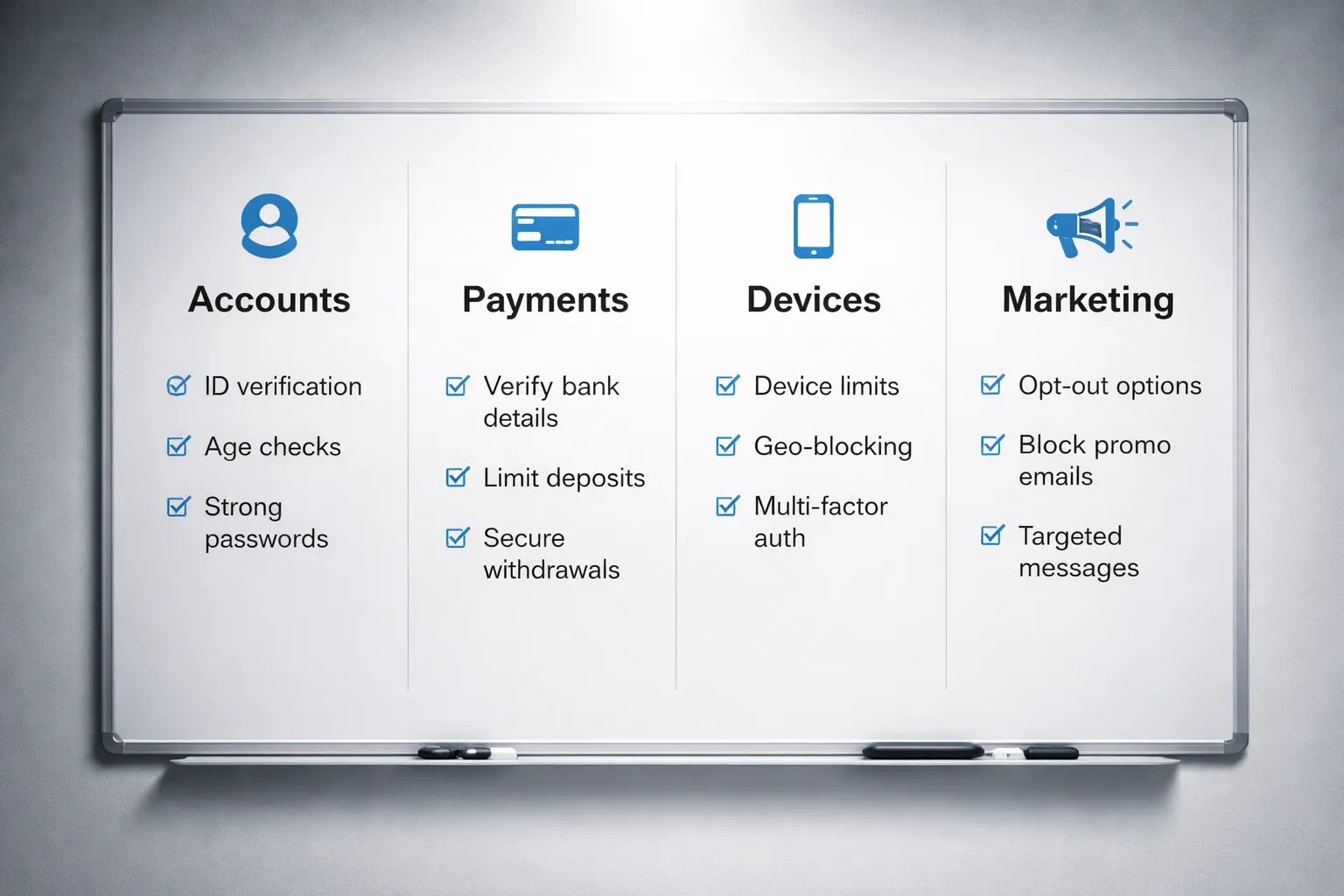
Most blocks work at the account level first. That creates a simple loophole. You open a new account with a new email, a new phone number, or a different username.
Some sites stop you when they match your identity. Others fail when they rely on weak checks, delayed checks, or no checks until withdrawal.
- Assume email-based blocks fail. Use the strongest option your operator offers, self-exclusion tied to verified identity, not just login details.
- Force earlier verification. Ask support to verify your account immediately, then apply self-exclusion. Early KYC reduces the chance a new account slips through.
- Write down your identifiers. Keep the exact name format, date of birth, address, phone, and email you used. Matching errors can weaken enforcement across related brands.
- Choose operator groups when possible. Exclude across the full brand group, not one casino. Some networks share KYC and risk tools, some do not.
- Avoid “test” sign-ups elsewhere. Each new registration trains your brain to restart the loop.
Crypto, gift cards, and alternative payments that bypass blocks
Payment blocks often trail behind account blocks. Some sites accept methods that skip bank-level controls. Crypto wallets, prepaid cards, and gift card style vouchers can reduce friction and hide spend.
- Block funding at the source. Ask your bank to block gambling merchant categories. Add card freezes where your banking app allows it.
- Cut off alternative rails. Remove saved cards from wallet apps. Disable crypto buying on your exchange account. Set exchange account locks if offered.
- Avoid prepaid and voucher products. Do not keep spare prepaid cards at home. Do not store voucher PINs in email or notes apps.
- Track cash leakage. Cash-to-crypto and cash-to-voucher routes are hard to trace. Treat cash like a high-risk channel and reduce access.
Unlicensed sites often lean on these payment methods. Licensing controls vary by regulator and region. Check licensing details before you sign up or deposit, using how to check an online casino license.
App and browser access, use device-level blocking tools
Self-exclusion does not stop you from reaching a homepage. You can still search, install an app, or follow a link. Device-level blocks reduce those paths.
- Use a DNS or content filter. Apply it on your phone and home router. Include gambling categories and manual domain lists.
- Block app installs. Turn on parental controls or screen time settings. Lock app installs with a PIN held by someone you trust.
- Block private browsing. Disable it where your device allows. It removes saved friction.
- Clean your browsers. Delete bookmarks, saved logins, and saved payment details. Remove casino apps.
- Make the block hard to undo. If your tool allows it, set an admin password you do not know, or store it out of reach.
Marketing exposure, stop emails, SMS, and retargeting ads
Marketing keeps the habit warm. Even after self-exclusion, some operators send messages because of delays, brand separation, or list errors. Retargeting ads can follow you across apps and sites.
- Opt out at the account level. Turn off email, SMS, push, and calls in each casino profile before you exclude, if you can.
- Unsubscribe and document it. Use unsubscribe links, then screenshot confirmations. Keep dates.
- Block senders. Add operator emails to your blocked list. Block SMS short codes and numbers.
- Limit ad tracking. Disable ad personalization on your phone and Google account. Clear ad identifiers where your device supports it.
- Clean remarketing signals. Clear cookies and site data. Use stricter tracking settings in your browser.
- Escalate if contact continues. Ask support to suppress all marketing under every brand in the group. Use the same identity details you used to self-exclude.
Self-exclusion works best when you add friction in three places, account access, funding, and exposure.
Best practices to make self-exclusion more effective
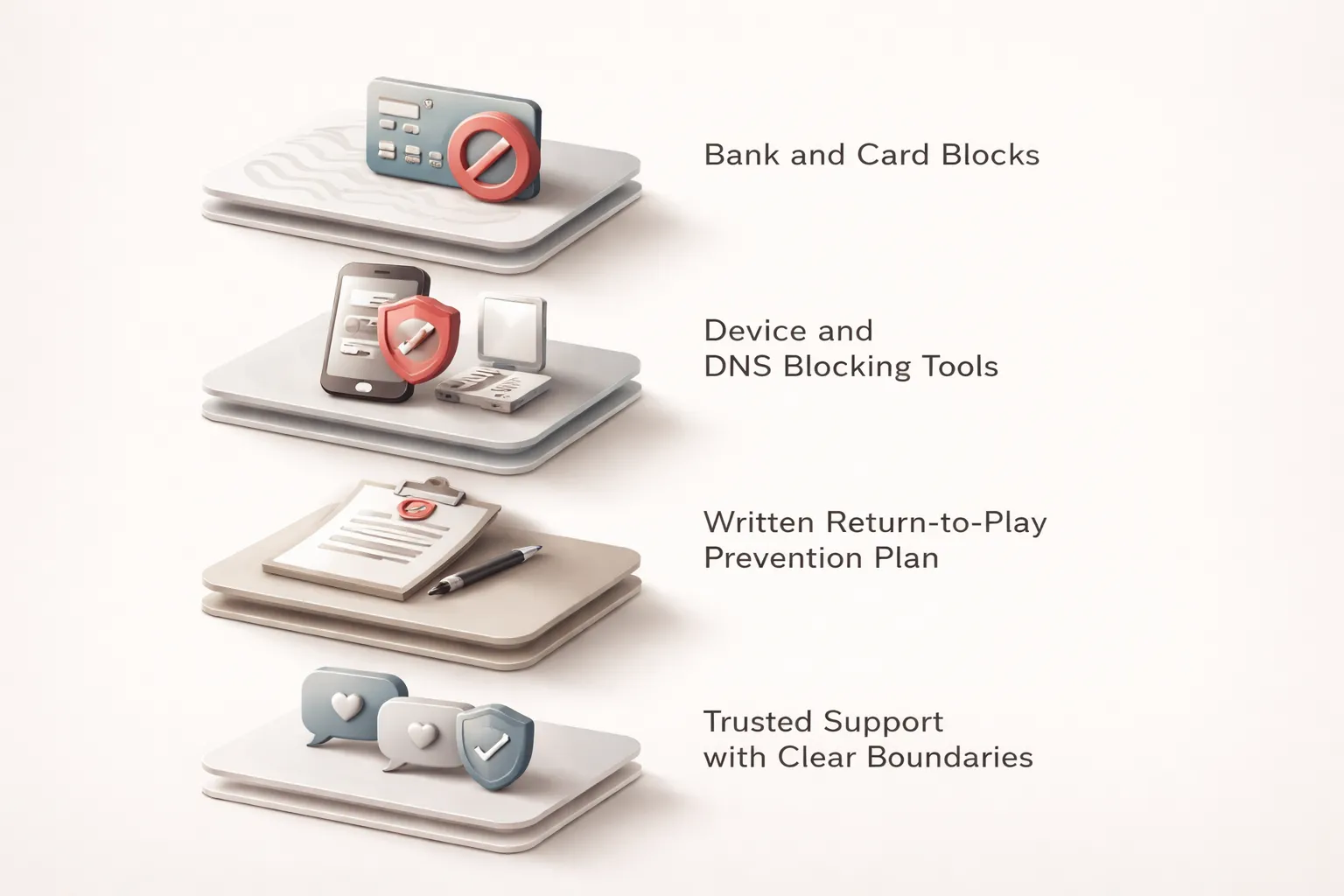
Set up bank and card gambling blocks
Your fastest win comes from your money path. Cut it off at the source.
- Call your bank and card issuers. Ask for a gambling merchant block. Ask if it covers card present, online card payments, and cash-like transactions.
- Block gambling MCCs. Most gambling merchants use Merchant Category Codes tied to betting and casinos. A bank level block stops many deposits before they reach the site.
- Close loopholes. Ask about transfers that can bypass MCC blocks, including wire transfers, faster payments, prepaid cards, e-wallets, and crypto purchases.
- Limit access to extra funds. Reduce credit limits. Remove overdraft. Cancel “one click” payment methods tied to gambling.
- Set alerts. Turn on instant notifications for any attempted gambling payment, declines, and new payees.
- Document the setup. Save confirmation emails, chat transcripts, and case numbers. Keep them in one folder.
Use blocking software and parental controls for gambling content
Self-exclusion closes accounts. Blocking tools reduce access and impulse.
- Cover every device. Install on phone, tablet, and computer. Add browser extensions where supported.
- Block at network level. Use router or DNS filtering so the block applies across your home Wi-Fi. This helps when you install new apps or browsers.
- Lock the settings. Set a password you do not control. Give it to a trusted person, or store it sealed and hard to reach.
- Block search and app installs. Use iOS Screen Time or Android parental controls to restrict new apps, private browsing, and adult content filters.
- Block email and ads where possible. Filter gambling keywords in your inbox. Turn off personalized ads and remove gambling interests in ad settings.
- Test the block. Try to access known casino domains, affiliates, and app stores. Fix gaps the same day.
Create a personal “return-to-play” prevention plan
Plan for relapse risk before it hits. Write it down. Keep it short.
- List your triggers. Time of day, paydays, alcohol, boredom, sports events, stress, or loneliness.
- Set hard rules. No deposits, no “just looking,” no new accounts, no bonus hunting. Treat each as a breach.
- Build a 10 minute delay. When the urge hits, do one fixed action first. Leave the room, take a shower, walk outside, or call someone.
- Make a replacement routine. Pick two activities you can start fast and do anywhere, one physical and one mental.
- Remove setup steps. Delete saved cards, remove payment apps, log out of app stores, and uninstall casino apps.
- Track urges and outcomes. Use a simple note with date, trigger, action, result. Patterns show you where to tighten controls.
- Know your warning flags. If you see them, escalate controls the same day. Use this guide to spot them early: problem gambling warning signs.
Involve trusted support while protecting privacy and autonomy
Support works when roles stay clear. You keep control of your life. Others help you keep boundaries.
- Pick one or two people. Choose calm, consistent support. Avoid anyone who shames, lectures, or escalates conflict.
- Define what you want from them. Examples, hold the blocker password, sit with you on payday, help you call the bank, or be your first call when urges spike.
- Set privacy limits. Share what helps. Do not share full banking access, full email access, or device unlock codes unless you choose to.
- Use structured check-ins. Agree on a schedule and a script. Keep it brief, urges this week, controls still active, any exposure issues.
- Plan escalation steps. If you try to gamble, they help you add friction fast, extend self-exclusion, tighten blocks, and suppress marketing across brands.
- Keep your autonomy. You decide the tools and the duration. Support helps you follow the plan, not replace it.
Special situations: what to do if someone else is at risk
Can you self-exclude a loved one?
In most cases, no. Self-exclusion stays voluntary. The account holder has to request it.
Some programs accept third-party reports. That is different from enrollment. A report can trigger reviews, safer-gambling outreach, or extra checks. It usually cannot force a ban.
If the person at risk is a minor, you can act faster. Tell the operator. Ask for an immediate block. Report any underage access to the license holder.
What most programs allow
- Third-party concern submissions. You report harm; the operator logs it and may contact the player.
- Marketing suppression requests. You ask the operator to stop sending promos to your household emails and phones, when they can verify control.
- Account restrictions on shared devices. You ask support to guide device-level blocking steps and to flag the account for extra friction.
- Source-of-funds and affordability checks. In regulated markets, operators can request evidence and restrict play if risks rise.
- Permanent closure requests. Many operators still require the player to confirm. Some will act if fraud or identity misuse appears.
Documenting harm and requesting operator intervention
Write down facts. Keep it clean and specific. Dates, amounts, and impact.
- Transaction records. Bank statements, card logs, e-wallet history, chargeback attempts.
- Operator evidence. Screenshots of deposits, losses, VIP messages, bonuses, and marketing emails.
- Behavior markers. Missed rent, late bills, payday spikes, secret accounts, borrowing, selling items.
- Safety markers. Threats, self-harm statements, violence, or severe intoxication while gambling.
Contact the operator through support and the responsible gambling email if listed. Ask for these actions in plain terms.
- Flag the account for a safer-gambling review.
- Stop all marketing and bonus offers.
- Apply deposit caps and loss limits if the player agrees during the call.
- Require enhanced checks before further deposits.
- Share the correct self-exclusion route for that license.
If the operator ignores clear risk, escalate to the regulator for that site. Use the licensing details on the operator page and the regulator complaint path. Use your notes and attachments. You can verify the license first in our guide to checking online casino licenses.
Safeguarding finances: shared accounts, limits, and legal options
Move fast on money controls. You reduce damage before the next urge spike.
- Separate finances. Split joint funds into individual accounts when you can. Cancel shared cards. Remove saved payment methods from shared devices.
- Bank blocks. Ask your bank about merchant category blocks for gambling, transaction limits, and card-freeze rules.
- Credit controls. Lower card limits. Remove overdrafts where possible. Place a credit freeze if identity risk exists.
- Bill protection. Put rent, mortgage, utilities, and insurance on accounts the person cannot access.
- Shared devices. Add app locks and parental controls. Remove payment autofill. Lock browsers to safe modes.
- Legal steps. If harm escalates, get advice on power of attorney, guardianship, or financial administration. Rules vary by location. Use this only when capacity and safety require it.
If you see identity misuse, treat it as fraud. Contact the bank and the operator. Keep a paper trail.
When to seek professional help and emergency support
Bring in specialists when you cannot contain risk with limits and blocks.
- Clinical help. Seek a therapist or addiction counselor if gambling drives debt, lies, withdrawal, or loss of control.
- Debt help. Use a nonprofit credit counselor if bills pile up or collectors start.
- Emergency help. If the person threatens self-harm, talks about suicide, or becomes violent, call your local emergency number now. If you are in the US or Canada, call or text 988. Do not leave the person alone if you think danger is immediate.
Learn the early warning flags so you can act before crisis. See our guide to problem gambling signs.
Responsible gambling resources and getting help
Signs of gambling-related harm to watch for
- Money stress: missed rent or mortgage, late utilities, payday loans, cash advances, or selling items to fund play.
- Chasing losses: raising stakes after a loss, longer sessions, or switching games to “win it back.”
- Loss of control: you gamble longer than planned, you cannot stop, or you keep reopening accounts.
- Secrecy: hiding statements, clearing browser history, lying about time or money spent.
- Work and school impact: missed shifts, lower performance, or gambling during work hours.
- Relationship strain: frequent arguments about money, broken promises, or isolation from friends and family.
- Mood changes: irritability, anxiety, sleep problems, or feeling numb when you try to stop.
- Using gambling to cope: you gamble to escape stress, grief, or depression.
- Withdrawal-like patterns: restlessness or agitation when you cannot gamble.
Types of support you can use now
- Counseling: a licensed therapist can help you build a plan for urges, money controls, and relapse prevention. Ask about experience with gambling disorder and debt-related stress.
- Peer groups: mutual support groups give structure and accountability. You get practical tips from people who have been through the same cycle.
- Helplines and chat support: fast, confidential support for crisis moments and next steps. Helplines can guide you to local treatment and self-exclusion options.
- Financial support: a nonprofit credit counselor can help with budgets, payment plans, and creditor calls. Use this if debt drives your gambling.
If you need help from a casino, use online casino customer support to confirm your exclusion status, request account notes, and ask what blocks they apply across brands.
What to prepare before you contact support
- Your spend history: deposits, withdrawals, net losses, and how often you gamble. Pull bank statements and transaction logs.
- Your time pattern: days and times you play, session length, and what devices you use.
- Your triggers: stress, boredom, alcohol, sports events, paydays, loneliness, or conflict.
- Your highest-risk products: slots, live casino, sports betting, bonus hunting, or VIP offers.
- Your current controls: self-exclusion length, deposit limits, loss limits, time limits, and any blocks on payment methods.
- Your goal for the next 30 days: full stop, no online play, no bonuses, or no high-risk games. Keep it simple and measurable.
- Your relapse plan: who you will contact, what you will do in the first 10 minutes of an urge, and what access you will remove.
Privacy, confidentiality, and what gets shared with operators
- Therapy and medical care: your sessions stay confidential under local health privacy rules. Providers do not share details with casinos unless you give written consent or the law requires it.
- Peer support groups: groups usually follow a privacy culture, but they are not a medical service. Treat what you share as personal, keep identifying details limited.
- Helplines: many helplines let you stay anonymous. They may ask for your location to route you to local services. Ask what they record and how long they keep it.
- Casino and regulator self-exclusion: operators and program administrators may share your identifying details to enforce the ban. This often includes name, date of birth, address, email, phone, and account identifiers. Some programs also share a photo.
- What casinos usually do with your data: block logins, stop marketing, and flag your account for compliance. They may keep records to meet licensing and audit rules.
- What casinos usually do not share: detailed play history with other operators, unless you join a multi-operator scheme or a regulator requires it.
- What you should ask before you enroll: who receives your data, whether it covers sister brands, whether it covers affiliates, how marketing suppression works, and how reinstatement works after the term ends.
FAQ
What is online casino self-exclusion?
Self-exclusion is a formal block you place on your account for a set period. The casino must stop you from logging in, betting, or depositing. It also must suppress most marketing to you. It is stronger than a time-out and harder to reverse.
How do I self-exclude from an online casino?
Use responsible gambling tools in your account, or contact support and request self-exclusion. Ask for the exact start time, end time, and brands covered. Save the confirmation email or ticket number. If support delays, escalate to the licensing authority.
How long does self-exclusion last?
Terms depend on the operator and regulator. Common options include 6 months, 1 year, 5 years, or permanent. Some schemes let you choose a custom term. Many rules add a cooling-off period before reinstatement. You cannot shorten the term in most regulated markets.
Can I reverse self-exclusion early?
Usually no. Most regulated systems lock the term. If the operator allows reinstatement, it often requires a written request and a cooling-off period. Treat any offer of instant reversal as a red flag. Check the casino license terms before you enroll.
What happens to my balance and pending withdrawals?
Self-exclusion blocks play, it does not erase your funds. You should still withdraw, subject to KYC and fraud checks. Some casinos freeze deposits or bonuses tied to playthrough. Contact support for a cashout path. Keep records of all requests and timestamps.
Will I still get emails, texts, or ads?
The casino should add you to marketing suppression lists. Expect a delay while systems update. Third-party ads may still appear because ad networks do not know your status. Unsubscribe from affiliate lists. If the casino keeps sending direct promos, file a complaint.
Does self-exclusion cover sister sites and the same casino group?
Sometimes. Some operators apply exclusion across all brands in the same group, others only block one site. Ask for a written list of covered domains and brand names. If you want wider coverage, use a national or regulator-run multi-operator scheme when available.
Will other casinos know I self-excluded?
Only if you join a shared scheme, or a regulator requires operator checks. Many casinos do not share play history with competitors. Do not assume one exclusion blocks every site. If you use multiple casinos, self-exclude at each one or use a central program.
Can someone else self-exclude for me?
Usually no. Most programs require you to request it to prevent misuse and identity disputes. Some regulators allow third-party requests in limited cases, but they still require proof and your identity checks. If you need help, contact support and ask for their escalation process.
What if I manage to gamble while self-excluded?
Stop and document it. Save screenshots, dates, and transaction IDs. Ask the operator to close access and refund stakes placed during the exclusion, if local rules require it. Escalate to the regulator if support refuses. Verify the operator license first via how to check a casino license.
What happens when the term ends?
Some casinos auto-reopen access, others require you to opt back in. Many regulators require a cooling-off window before reactivation. Marketing may restart after reinstatement. Ask in advance how reactivation works, which channels resume, and whether limits reset or stay in place.
Conclusion
Conclusion
Self-exclusion blocks access, blocks promos, and builds friction when you feel impulsive. It also has gaps. Some sites reopen you fast. Some marketing restarts. Some limits reset.
Make the lock stronger while you have clarity. Keep a dated record of your request and the confirmation. Screenshot the term, the scope, and the reactivation rules. Save the support email and ticket number.
Set one next-step guardrail today. Put a budget and time plan in writing, even if you do not plan to play soon. Use a gambling budget you’ll actually stick to and treat it as a rule, not a target.
-
Online Casino Customer Support: What to Look For (Live Chat, Email, Response Times)
8 months ago -
Sign Up for an Online Casino: Create an Account in Minutes
8 months ago -
Online Casino Licensing Explained: Authorities, Licenses & How to Check One
8 months ago -
How to Set a Gambling Budget (That You’ll Actually Stick To)
8 months ago -
Responsible Gambling Tools Explained: Deposit Limits, Self-Exclusion & More
8 months ago
-
- What is online casino self-exclusion?
- How do I self-exclude from an online casino?
- How long does self-exclusion last?
- Can I reverse self-exclusion early?
- What happens to my balance and pending withdrawals?
- Will I still get emails, texts, or ads?
- Does self-exclusion cover sister sites and the same casino group?
- Will other casinos know I self-excluded?
- Can someone else self-exclude for me?
- What if I manage to gamble while self-excluded?
- What happens when the term ends?
-
- What is online casino self-exclusion?
- How do I self-exclude from an online casino?
- How long does self-exclusion last?
- Can I reverse self-exclusion early?
- What happens to my balance and pending withdrawals?
- Will I still get emails, texts, or ads?
- Does self-exclusion cover sister sites and the same casino group?
- Will other casinos know I self-excluded?
- Can someone else self-exclude for me?
- What if I manage to gamble while self-excluded?
- What happens when the term ends?
-
Reload Bonus Explained: What It Is and When It’s Worth Claiming
6 months ago -
Online Casino Licensing Explained: Authorities, Licenses & How to Check One
8 months ago -
Best Live Dealer Casinos: Where to Play Live Blackjack, Roulette & More
8 months ago -
Best Online Casinos for High Rollers: VIP Perks, High Limits & Exclusive Bonuses
8 months ago -
Fast Payout Online Casinos: Best Sites for Quick Withdrawals
8 months ago
-
Online Casino Customer Support: What to Look For (Live Chat, Email, Response Times)
8 months ago -
Sign Up for an Online Casino: Create an Account in Minutes
8 months ago -
Online Casino Payment Safety Tips: How to Deposit and Withdraw Securely
8 months ago -
What to Do If an Online Casino Won’t Pay Out: Step-by-Step Actions
8 months ago -
How to File a Complaint Against an Online Casino (Plus ADR Explained)
8 months ago