Casino Bonus Terms & Conditions: The Tricky Rules to Watch Out For

Casino bonuses come with rules. Those rules decide what you can play, how much you must wager, when you must finish, and how much you can cash out. Miss one line in the terms and conditions and you can lose the bonus, the winnings, or both.
This guide breaks down the bonus terms that cost players money. You will learn how wagering requirements work, how game contribution changes the real rollover, and why max bet limits can void a promo. You will also learn the common traps, including short expiry windows, capped cashouts, restricted games, and withdrawal blocks tied to verification.
If you need a deeper breakdown of rollover math, read our wagering requirements guide.
- In het kort: Treat every bonus as a contract. Read the promo terms before you deposit.
- Check the wagering requirement. Look for bonus plus deposit wagering, and separate rules for free spins wins.
- Account for game contribution. Slots often count 100%. Table games may count 0% to 20%. Your real rollover can jump fast.
- Stay under the max bet. Many promos cap your stake per spin or per hand. One over-limit bet can void your bonus and winnings.
- Watch the expiry timer. Some bonuses expire in 24 to 72 hours. If you miss it, you lose the bonus and any attached winnings.
- Look for a max cashout cap. Some offers cap withdrawals from bonus funds, even after you meet wagering.
- Check restricted games. Casinos often block low edge games, specific providers, or live tables while a bonus is active.
- Know the withdrawal locks. Some sites block cashouts until you finish wagering, or until you pass KYC. Plan for verification.
- Screen for trap clauses. Avoid unclear “irregular play” rules, vague confiscation rights, and promo changes without notice.
- Keep it simple. Pick offers with low wagering, full slot contribution, clear max bet rules, and no tight cashout caps.
If you mainly play free spins, read our free spins bonus rules guide before you claim an offer.
What casino bonus terms & conditions are (and why they feel “tricky”)
How bonus rules differ from general site terms
Casino bonus terms set the rules for one promo, not your whole account.
General site terms cover things like account eligibility, KYC, withdrawals, and restricted countries. Bonus terms add extra limits that apply only while you use bonus funds, free spins, or a bonus-linked deposit.
These bonus rules often override normal cash rules. Your real money balance and your bonus balance can follow different bet limits, game eligibility lists, and withdrawal conditions.
Why casinos add restrictions
- Risk control. A bonus changes the math. Casinos use wagering, caps, and exclusions to limit how much value you can extract.
- Fraud prevention. They target multi-accounting, bonus hunting networks, stolen cards, chargebacks, and collusion. Expect ID checks and play pattern rules.
- Margin protection. They restrict high volatility play, low house edge games, and bet sizes that can turn a promo into a near risk-free cashout.
Why bonus terms feel “tricky”
The rules sit in multiple places. Some live on the promo page, some in a “bonus policy,” and some inside the cashier flow.
The wording often stays broad. Clauses like “irregular play,” “bonus abuse,” or “fair use” give the casino room to deny a cashout if they dislike your play pattern.
The biggest trap is conflict. One page says “slots only,” another lists eligible games, and a third applies a max bet. If you break one line, the casino can void winnings.
Common ways players accidentally violate rules
- Betting over the max bet while bonus money is active, even once.
- Playing excluded games, or games with low contribution that slow wagering.
- Switching between low risk spins and high bets to “lock in” balance, which some casinos flag as irregular play.
- Claiming a promo while you have an active bonus, which can cancel one offer or force forfeiture.
- Letting the bonus expire mid-wagering, which can remove the bonus and linked winnings.
- Trying to withdraw before meeting wagering, which often triggers bonus removal.
- Using payment methods that block withdrawals, then failing verification when cashing out.
For the core math behind clearing playthrough, see our wagering requirements guide.
Quick glossary
- Wagering (playthrough). The total amount you must bet before you can withdraw bonus-linked funds. Example, 40x on a $50 bonus means $2,000 in qualifying bets.
- Sticky vs non-sticky. Sticky means you cannot withdraw the bonus itself, only winnings. Non-sticky means the bonus can convert to cash after you meet conditions.
- Contribution. How much a game counts toward wagering. Slots often count 100%. Table games may count 0% to 20%, sometimes less.
- Forfeiture. The casino removes the bonus, and often winnings from the bonus, when you break a rule or withdraw early.
- Cap (max cashout). A hard limit on what you can withdraw from a promo, even if you win more.
The highest-risk bonus terms and conditions to watch out for
Wagering requirements, what counts and what doesn’t
Wagering is the main risk point. It decides whether your bonus ever becomes cash.
- Bonus vs deposit wagering: Some promos make you wager the bonus only. Others make you wager bonus plus your deposit. Bonus plus deposit costs more.
- Real money first vs bonus first: If the casino uses your cash first, you can clear wagering without risking bonus forfeiture from an early withdrawal. If it uses bonus first, one mistake can wipe the promo and attached winnings.
- Excluded wagering: Many casinos exclude some games, side bets, and special features from wagering. If you play them, you burn time and balance without progress.
- Different rules for free spins: Free spins often have their own wagering and cap rules. See free spins bonuses for the common traps.
Game contribution percentages, slots vs table games vs live dealer
Contribution sets how fast each bet reduces wagering. Low contribution makes clearance unrealistic.
- Slots: Often 100%, sometimes lower on high RTP or jackpot slots.
- Table games: Commonly 0% to 20%. Blackjack and roulette often sit at the low end, sometimes 0%.
- Live dealer: Often excluded or set to 0% because the house edge is lower and bet sizing is flexible.
- Progressive jackpots: Often excluded from wagering. Any wins may also get capped or voided under bonus rules.
Maximum bet limits while bonus funds are active
Max bet rules cause the fastest forfeitures because you can break them with one spin.
- Per spin or hand cap: Common limits include a fixed amount per wager. The limit can differ by currency and game type.
- Stake changes during features: Some games change stake inside bonus rounds. The casino may treat that as your bet size, not your base spin.
- Auto features: Autoplay can repeat an illegal stake for dozens of spins. The casino can void all bonus winnings for one settings mistake.
- Side bets: Side bets can push you over the cap even if your main wager stays under it.
Bonus validity windows and wagering deadlines
Deadlines turn a hard wagering target into a sprint.
- Claim window: You may need to opt in and use the promo within hours or days.
- Wagering deadline: Many bonuses require full wagering completion within a set period. If time runs out, the casino removes the bonus and may remove winnings tied to it.
- Account verification timing: Some casinos freeze withdrawals until KYC finishes. If you wait, you can hit the deadline and lose the bonus balance.
Maximum cashout and maximum win caps
A cap can turn a big win into a small withdrawal.
- Max cashout: The casino limits what you can withdraw from bonus play, even if your balance shows more.
- Max win: Some terms cap total winnings from the promo, not just what you can withdraw.
- Different caps by bonus type: No deposit and free spins promos often come with the tightest caps.
- Multiplier caps: Some casinos cap withdrawals to a multiple of the bonus amount, for example 5x or 10x the bonus.
Sticky (non-cashable) vs non-sticky bonuses and how withdrawals work
This controls what happens when you try to cash out.
- Sticky bonus: You cannot withdraw the bonus itself. You can only withdraw winnings after you meet wagering. If you withdraw early, the casino removes the bonus and may remove winnings made with it.
- Non-sticky bonus: You can often withdraw your deposit while leaving the bonus. Casinos may still remove bonus funds and linked winnings when you reduce your cash balance.
- Withdrawal triggers forfeiture: Many terms treat any withdrawal request as opting out of the promo. You lose the bonus instantly.
- Bonus lock: Some casinos lock your funds until you clear wagering. You cannot partially withdraw even if you only want your deposit back.
Restricted games, features, and strategies
Casinos block tools that reduce risk or spike variance.
- Restricted games: Some slots, all progressives, and many live games can be excluded from wagering, or banned entirely while a bonus is active.
- Bonus buys: Many casinos ban buy-feature mechanics during bonus play. If you use them, they can void winnings.
- Double-up and gamble features: Risk ladders and gamble screens often break bonus rules because they change expected value and bet sizing.
- Autoplay: Some casinos allow it, some restrict it, and some void winnings if autoplay crosses a max bet limit.
- Side bets: Side bets can be excluded from wagering or classed as irregular play, especially in blackjack and baccarat variants.
Betting patterns flagged as “irregular play”
“Irregular play” clauses give the casino broad discretion. They target low-risk clearing tactics.
- Low-risk wagering: Betting in ways that minimize variance, such as flat betting at low volatility games solely to clear wagering.
- Hedging and opposite bets: Placing opposing positions on roulette, baccarat, or similar games, or hedging the same event across games or accounts.
- Arbitrage across tables: Using simultaneous opposite bets to lock a small loss while generating wagering volume.
- Bet ramping after a win: Increasing stakes only after you build a buffer, then dropping back down. Many casinos treat sharp bet swings as abuse.
- Bonus hunting patterns: Repeatedly claiming promos, playing only until you meet a condition, then withdrawing. Some casinos restrict future promos or void winnings under abuse clauses.
Wagering requirements: how to calculate the real cost of a bonus
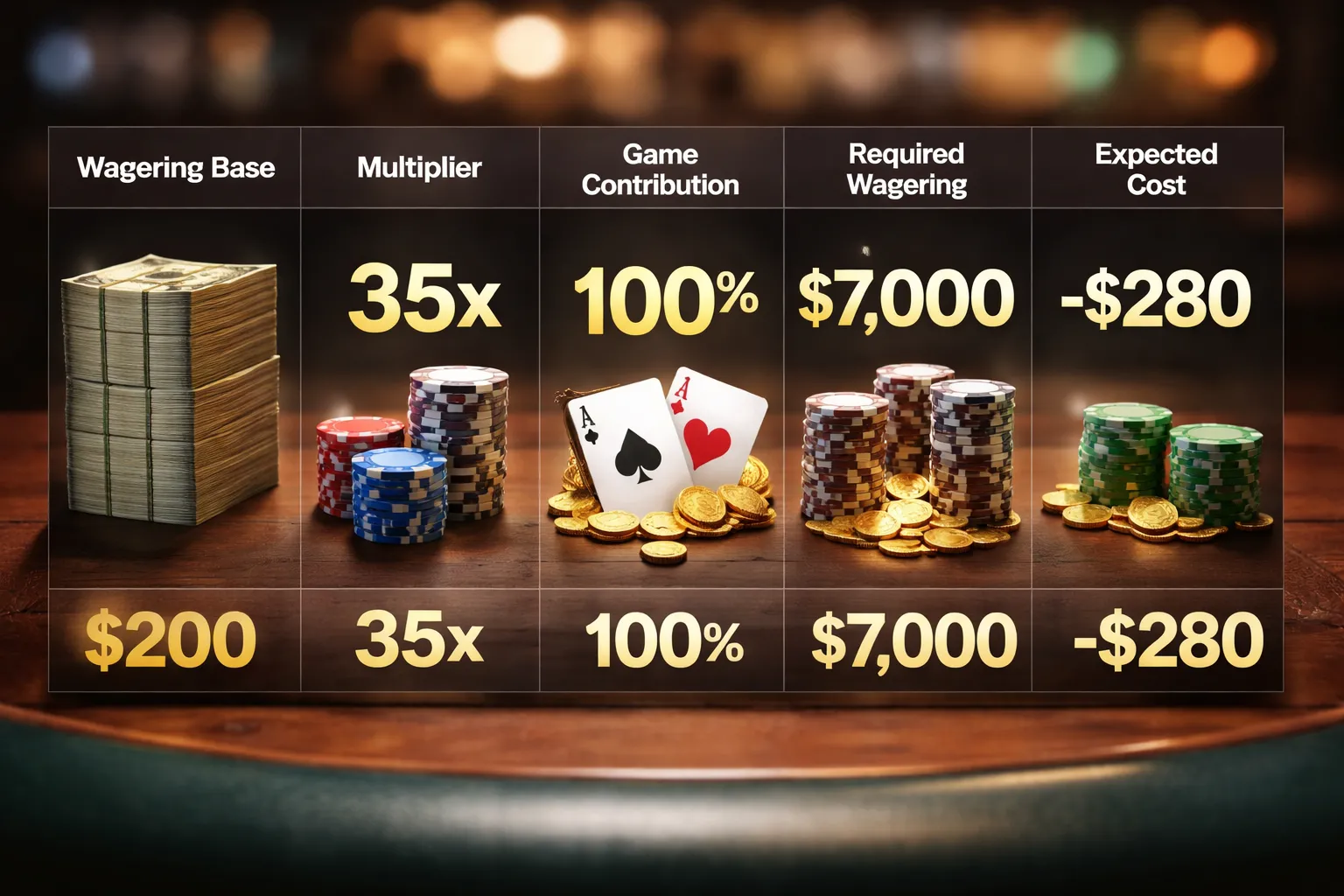
Step-by-step calculation with a simple numeric example
Wagering requirements tell you how much you must bet before you can withdraw bonus-related funds. Treat it as a volume target. Your real cost is the expected loss you take while you chase that target.
- Step 1: Identify the wagering base. It is either bonus only, deposit plus bonus, or winnings.
- Step 2: Apply the multiplier. Wagering base times the playthrough number equals your required wagering.
- Step 3: Adjust for game contribution. If slots count 100% and roulette counts 10%, most table play barely moves the meter.
- Step 4: Estimate expected cost. Required wagering times the game house edge equals your average expected loss.
Example. You deposit $100 and get a $100 bonus with 35x wagering on deposit plus bonus. Slots contribute 100%. You play a slot with a 4% house edge.
- Wagering base: $100 + $100 = $200
- Required wagering: $200 x 35 = $7,000
- Expected cost: $7,000 x 0.04 = $280
This does not mean you will lose $280 every time. It means the bonus needs to be large enough to cover that expected cost, plus variance, plus any limits like max cashout and max bet.
How bonus amount vs deposit amount changes the playthrough
The same multiplier can produce very different targets. The key variable is what the casino uses as the wagering base.
| Offer | Wagering rule | Wagering base | Wagering at 35x |
|---|---|---|---|
| Deposit $100, bonus $100 | Bonus only | $100 | $3,500 |
| Deposit $100, bonus $100 | Deposit + bonus | $200 | $7,000 |
| Deposit $100, bonus $50 | Deposit + bonus | $150 | $5,250 |
| Deposit $50, bonus $100 | Deposit + bonus | $150 | $5,250 |
Higher bonus does not always mean better value. If the casino uses deposit plus bonus, the target grows fast. If you play low contribution games, it grows even faster in practice.
Which wagers are excluded
Casinos often exclude bets they see as low risk or bonus abuse. If a wager does not count, you take risk without moving the wagering meter.
- Void bets. Cancelled sports bets, push outcomes, or markets the book voids. They usually count as zero wagering.
- Free spins wagering. Some casinos count free spin bets at 0% or only count the winnings, not the spin value.
- Zero-risk bets. Opposite bets, hedged bets, matched bets, and “safe” strategies. Many terms treat them as non-qualifying play.
- Low contribution games. Roulette, blackjack, baccarat, and video poker may contribute 0% to 20%. You can wager a lot and still make little progress.
- Bonus buy features. Some casinos exclude feature buys from wagering, or cap their contribution.
Check the excluded bets list before you start. If you plan to use free spins, review the free spins rules under Online Casino Free Spins Explained.
Understanding “wagering on winnings” vs “wagering on bonus only”
These phrases change the math.
- Bonus only. You wager the bonus amount times the multiplier. This is usually the lowest target for the same headline offer.
- Deposit plus bonus. You wager the combined amount times the multiplier. This often doubles the target on a 100% match bonus.
- Winnings. The casino makes you wager what you win from the bonus or free spins. Some terms stack this with other wagering, which creates a moving target.
Example of “wagering on winnings”. You get 50 free spins, you win $60, the terms say 30x wagering on winnings. Your target becomes $60 x 30 = $1,800. If the casino also applies a low contribution rate to your chosen game, your effective target rises again.
Always find the exact wording. Look for “bonus amount”, “deposit and bonus”, “free spins winnings”, and “bonus balance”. Those four terms tell you what you must actually cycle through the cashier.
Game weighting and RTP traps that shrink bonus value
Game weighting cuts your progress
Casinos assign a contribution rate to each game. It tells you how much of each wager counts toward wagering.
Common ranges look like this.
- Slots: often 100% contribution.
- Table games: often 0% to 20%.
- Live casino: often 0%, sometimes excluded entirely.
Low contribution inflates your real target. A 30x wagering requirement on a $60 bonus means $1,800 in wagering at 100% contribution. If your game contributes 20%, you need 5x the wagering. Your real target becomes $9,000. If it contributes 0%, you get no progress at all.
Terms usually hide this under “Game contribution”, “Weighting”, or a table by game type and provider. Find it before you start.
Why table games often count 0% to 20%
Blackjack, baccarat, and roulette carry lower house edges than many slots. Casinos protect bonus value by discounting them.
Watch for these patterns in the rules.
- 0% contribution: you can play, but you do not clear wagering.
- 5% to 20% contribution: you clear wagering slowly, and you hit the deadline faster.
- Different rates by variant: European roulette may count, American roulette may not.
- Different rates by stake: higher stakes may trigger reduced contribution or exclusion.
If you want to use table games during a bonus, calculate your effective wagering first. Low contribution turns a normal playthrough into a grind.
Live casino and blackjack exclusions players miss
Live dealer games often sit in a separate exclusion list. Casinos treat them like low edge, low variance games that players can exploit with bonuses.
Common traps.
- Live blackjack excluded: even if RNG blackjack contributes.
- “All live games excluded”: includes roulette, baccarat, game shows, and live slots.
- Blackjack contributes only on specific software: one provider counts, another does not.
- Side bets excluded: your base bet may count, side bets may count at 0%.
- Dealer game shows excluded: they often look like slots, but rules treat them as live table.
Look for exact wording like “Live Casino”, “Blackjack”, “Card games”, “Baccarat”, “Roulette”, “Game shows”, and “side bets”. If the list exists, assume it overrides the general contribution table.
High-volatility slots vs low-volatility slots under time pressure
Deadlines change the best way to clear wagering. High-volatility slots can deliver big hits, but they can also drain your balance fast. Low-volatility slots keep you alive longer, which helps when you must complete wagering in a short window.
- Short expiry: favor steadier slots, smaller swings, longer play time.
- Tight max bet: high-volatility slots become risky because you cannot size up to absorb variance.
- Low contribution outside slots: you may need to stay on eligible slots the whole time.
Track two numbers while you play. Your remaining wagering, and your remaining time. If either looks tight, avoid games that can wipe your balance in a few spins.
RTP changes between base game and bonus features
Some slots do not keep one fixed RTP across all modes. The base game can run at one RTP, while bonus buys, enhanced spins, or special features run at another. Some casinos also offer the same slot in multiple RTP versions.
What to check in the bonus terms and in the game info panel.
- RTP version: the casino may run a lower RTP configuration than the headline RTP you saw elsewhere.
- Feature buy rules: “Bonus buy” may contribute 0% to wagering, or count at a reduced rate.
- Free spins mode RTP: some games state a different RTP for free spins or feature rounds.
- Jackpots excluded: jackpot side games and must-drop jackpots may not count toward wagering.
You protect your bonus by matching three things. The wagering rules, the game contribution, and the RTP version in the game. If any one of them shifts down, your bonus value shrinks.
For free spins specific terms that change RTP or contributions, use online casino free spins explained.
Limits that affect your ability to withdraw
Minimum withdrawal thresholds and verification holds
Bonuses often add a second gate to withdrawals. You may need to hit a minimum cashout amount, even after you finish wagering.
- Minimum withdrawal: Common thresholds sit around $10 to $50, but some methods have higher minimums. Bank transfers often require more.
- Method lock: Some casinos force you to withdraw back to the deposit method first. If that method has a higher minimum, you wait.
- KYC holds: Casinos can pause withdrawals until you pass identity checks. Expect ID, proof of address, and payment method proof. If you claimed a bonus, they may ask for extra checks.
- Name match rules: Your casino profile name must match your payment method. A mismatch can freeze your withdrawal until you correct it.
Read the cashier page, not just the bonus text. Minimums and KYC rules often sit in banking terms.
Daily, weekly, monthly payout limits and pending withdrawals rules
Many bonuses cap how much you can withdraw in a time window. The casino may also slow payouts by keeping them pending.
- Daily or weekly caps: A common pattern is a daily limit, a weekly limit, or both. High wins can take weeks to fully cash out.
- Monthly caps: Some VIP tiers raise these limits, standard accounts stay low. Your bonus may override VIP limits.
- Max cashout on bonus: No deposit and free spins promos often set a hard ceiling. Example, you can win more, but you can only withdraw up to the cap, the rest gets removed.
- Pending withdrawal blocks new withdrawals: Some sites allow only one open withdrawal at a time. Others block deposits or gameplay while a withdrawal sits pending.
- Reset rules: Limits can reset on a rolling 24 hours, calendar day, or the time of your last cashout. The difference matters.
If you play promos often, learn the rules from no deposit bonus rules. These offers carry the strictest cashout limits.
Withdrawal reversals, when casinos convert winnings back into bonus funds
Some casinos let you cancel a pending withdrawal. If you do, they may reclassify your balance.
- Bonus reattached: The casino can restore the bonus and mark your funds as bonus money again. Your wagering restarts or continues from the new state.
- Winnings removed: If the bonus had a max cashout, the casino can reapply the cap after a reversal. Your balance can drop.
- New limits apply: A reversal can trigger current terms, not the older ones you accepted. If the promo changed, you may lose value.
- Reason codes: Some casinos reverse withdrawals themselves if they flag an issue. Common triggers include KYC not complete, payment method mismatch, or responsible gambling checks.
Do not cancel a withdrawal unless support confirms, in writing, what happens to your cash balance and your bonus status.
Fees, exchange rates, and crypto network costs that reduce net withdrawals
Your cashout amount is not always what hits your wallet. Fees and conversion spread can cut it.
- Withdrawal fees: Some casinos charge a flat fee per cashout, or only after you use your free monthly withdrawals. A $10 fee is a big hit on a $50 withdrawal.
- Payment processor fees: E-wallets and bank wires can add their own charges. The casino may not control these.
- FX conversion spread: If you deposit in one currency and withdraw in another, you pay the exchange rate twice, once in, once out. The spread often costs more than a posted fee.
- Crypto network fees: On-chain withdrawals can require miner fees. Fees swing with network traffic. Some casinos pass the fee to you, others build it into the rate.
- Stablecoin traps: Stablecoins reduce volatility, but you still pay network costs and possible conversion spread at the exchange.
| Cost type | Where it shows up | What you should check |
|---|---|---|
| Casino withdrawal fee | Cashier or banking terms | Free withdrawal count per month, fee per extra cashout |
| FX spread | Deposit and withdrawal conversion | Account currency, payment method currency, rate source |
| Crypto network fee | On-chain transaction | Network used, who pays the fee, minimum withdrawal for that coin |
Expiration dates, time pressure, and how they change optimal play

Typical expiry ranges for match bonuses vs free spins
Expiry rules hit two clocks, the claim window and the wagering window.
- Match bonus (deposit bonus). Common claim windows run 1 to 7 days after deposit. Common wagering windows run 7 to 30 days. Some sites set 72 hours, especially on reload offers.
- Free spins. Common claim windows run 24 to 72 hours. Common usage windows run 24 to 7 days. Winnings from free spins often convert to bonus funds with their own separate expiry, often 7 to 14 days.
- No-deposit bonuses. Common wagering windows run 24 hours to 7 days, with lower max cashout caps and tighter game restrictions.
Always confirm which clock applies. Some casinos start the timer when you opt in, not when you first wager.
Time-limited wagering, why it encourages riskier play
Short deadlines change your best strategy. They push volume over edge control.
- You chase wagering fast. You increase stake size to hit the target before expiry.
- You accept higher variance games to swing the balance up quickly, even if the RTP works against you.
- You skip breaks and session limits. You make more errors. You miss max bet rules.
- You deposit again to keep momentum. Some casinos tie the timer to the last deposit or bonus activation.
If you cannot clear wagering with your normal stakes and your normal pace, the bonus becomes a trap. Treat the deadline as part of the cost.
What happens to remaining bonus funds when time runs out
Casinos handle expiry in a few standard ways. The result matters more than the headline bonus size.
- Bonus removed. The casino deletes remaining bonus funds. Your real money balance stays.
- Bonus and winnings removed. The casino deletes the bonus and any bonus derived winnings. This is common for free spins conversions.
- Forfeit rule triggers. If you requested a withdrawal or breached a bonus term before expiry, the casino may remove the bonus balance and recalculate winnings.
- Max cashout cap still applies. Even if you complete wagering late or near expiry, a cap can limit what you keep.
Look for wording like “all funds associated with the bonus”. That usually means you lose more than the leftover bonus amount.
How to set a compliance checklist before the clock starts
Do this before you opt in or spin once. Save screenshots of the promo page and the full terms.
- Start time. Confirm when the timer begins, opt-in, crediting, or first wager.
- End time. Confirm the exact cutoff, including time zone.
- Wagering target. Write down the multiplier and what counts, deposit, bonus, or both.
- Game eligibility. List allowed games and contribution rates. Avoid low or zero contribution titles.
- Max bet and spin limits. Note the maximum stake, including bonus buy bans and feature rules.
- Cashout limits. Check max cashout and any minimum withdrawal tied to the bonus.
- Split deadlines. Track separate expiries for free spins, converted winnings, and cashback.
- Completion plan. Estimate if you can clear wagering with your normal stakes before expiry. If the math does not fit, skip the offer.
If you need a refresher on the other core terms that interact with expiry, use this guide on how online casino bonuses work.
Eligibility rules that can void bonuses (even after you win)
Country and state restrictions, travel, and VPN pitfalls
Bonuses often apply only in specific countries or states. Casinos enforce this with geolocation checks and KYC address proof. If you claim a bonus while you sit in an excluded region, the casino can remove it and void the related winnings.
- Check your allowed location before you deposit. Do this again before you withdraw, casinos re-check on payout.
- Do not use a VPN or proxy. Many terms treat VPN use as a breach. They can close your account or confiscate bonus winnings.
- Travel can break eligibility. If you travel during a promo, you may trigger a restricted region rule mid-wagering.
- Moving address matters. If your ID shows one country and your IP shows another, expect a hold until you prove residency.
Age, identity, and KYC timing
Most casinos let you deposit and play before full verification. Your withdrawal triggers KYC. If you wait, you risk timing out bonus deadlines while your account sits in review.
- Verify early. Upload ID and proof of address before you start wagering a bonus with a short expiry.
- Match your details. Use the same name, date of birth, and address across your casino profile, ID, and payment method.
- One person, one identity. If you used a different name variation on past accounts, the casino can flag you for duplicate accounts.
- Age rules apply at withdrawal. If you cannot prove age, you can lose the bonus and any winnings tied to it.
Payment method exclusions and payout rules
Some bonuses exclude specific deposit methods. Others allow the deposit but block withdrawals until you use an approved method. Casinos also apply anti-fraud rules to refunds and chargebacks.
- E-wallet and prepaid exclusions. Many promos exclude Skrill, Neteller, Paysafecard, and gift cards. Terms may say the bonus does not apply if you fund with them.
- Crypto restrictions. Some casinos run separate crypto promotions and exclude crypto deposits from standard bonuses.
- Withdrawal to the same method. Casinos often require you to withdraw back to the source first, up to the deposit amount.
- Chargebacks and reversals. A chargeback can void bonuses, freeze funds, and lead to account closure.
If you plan to shop offers by deposit method, use this list of best online casino bonuses to compare terms before you fund your account.
One-per-household and shared device or IP limits
Many terms limit promos to one per person, device, IP, address, or household. This rule can hit you even if you played fair, because casinos treat shared networks as linked accounts.
- One bonus per household. Roommates and partners can trigger a duplicate bonus claim rule.
- Shared Wi-Fi can link you. Dorms, hotels, and workplaces often share IP ranges. The casino may restrict promos or request extra proof.
- One device rule. If two accounts use the same phone or laptop, the casino may void one account’s bonus and related winnings.
- Do not create a second account. Even if you forgot your login, using a new account can break promo eligibility and forfeit winnings.
| Eligibility rule | Common trigger | What you do |
|---|---|---|
| Location restrictions | Travel, IP mismatch, restricted state | Confirm allowed region before deposit and before withdrawal |
| VPN or proxy ban | VPN app on, masked IP | Disable VPN, use normal connection |
| KYC required | Late verification, document mismatch | Verify early, match profile and payment details |
| Payment method excluded | E-wallet, prepaid, crypto, unsupported card | Use an eligible deposit method for that promo |
| One per household | Same address, device, or IP | Keep one account and one promo per home and device |
“Bonus abuse” and fair play clauses: the vaguest rules with the biggest consequences
“Bonus abuse” and fair play clauses: the vaguest rules with the biggest consequences
Many bonus terms include a broad rule like “bonus abuse,” “irregular play,” or “fair use.” It lets the casino remove your bonus, void winnings, or lock your account. The problem is definition. Some casinos list clear triggers. Others keep it discretionary.
Read this part before you play. Treat it like a risk section. If the clause says the casino can act “at its sole discretion” without examples, assume a higher chance of disputes.
Multi-accounting, collusion, and proxy play: what to check
- Multi-accounting. You open more than one account, or you share an account with someone else. Casinos also flag “linked accounts,” same device, same IP, same payment method, or the same identity data. Check if they treat family members as linked even with separate IDs.
- Collusion. You coordinate with other players to gain an edge. This shows up most in poker, live dealer blackjack side bets, or any peer to peer format. Look for wording about “information sharing,” “team play,” or “coordinated betting.”
- Proxy play. Someone plays on your behalf, or you play for someone else. This includes “account lending,” “third-party play,” or using an agent. Some sites also treat remote control tools and shared devices as proxy indicators.
What you want to see in the terms: specific examples, clear evidence standards, and a list of outcomes, bonus removal vs full balance confiscation.
Arbitrage and hedging: opposite bets across products or casinos
Many brands ban “arbitrage,” “matched betting,” or “hedging.” They mean you place opposite bets to reduce variance and convert bonus value into near-cash.
- Sportsbook hedging. You back Team A on one market and cover Team B, draw, or opposing lines on another market, sometimes at another sportsbook.
- Casino and sports cross-hedging. You use the casino bonus while you hedge risk in sports, or you use sports promo funds while you hedge with casino play.
- Different accounts, same strategy. You split action across accounts in the same household to cover both sides of an outcome.
Some casinos treat hedging as normal sports behavior. Others label it “abuse” if it happens while you clear a bonus. The key is whether the terms ban “risk-free betting,” “guaranteed profit play,” or “opposing bets placed with the intention of meeting wagering requirements.”
Low-risk betting patterns and why they get targeted
Casinos target patterns that lower volatility and push wager volume through a bonus with minimal loss.
- Covering outcomes. You spread bets across many outcomes to narrow variance, like betting red and black in roulette using different bet types, or stacking multiple “nearly all numbers” coverage.
- Low-house-edge focus. You play only the lowest edge games or specific side bets if the bonus counts them at 100%.
- Flat wagering at limits. You bet close to the max allowed per spin or per hand for long stretches, especially right after claiming a bonus.
- Minimal entertainment play. You stop play as soon as wagering clears, then you cash out. Many sites treat this as a signal, not a violation, but they combine it with other flags.
These patterns do not always break a written rule. They often fall under “irregular play” when the terms stay vague. If you want lower risk, pick promos with clear max bet rules, clear game contribution tables, and no broad “pattern betting” bans. Compare offer terms before you deposit using the best online casino bonuses list.
How reputable casinos document violations vs vague discretionary enforcement
Good operators write specific rules, then show you what you broke. Weak operators keep it broad, then act without detail.
| Reputable enforcement | Vague enforcement |
| Defines “bonus abuse” with examples, like opposite bets, account sharing, or restricted games. | Uses “irregular play” with no examples, then cites it after you win. |
| Lists clear outcomes, bonus removed, winnings removed, or account closed, tied to the breach. | Reserves the right to void “any winnings” and “confiscate funds” without a breach description. |
| Shows audit data, bet history, timestamps, device or IP linkage, and the specific promo terms. | Gives a one-line reason and points to “discretion” or “security decision.” |
| Offers an escalation path, complaints process, or ADR reference where licensed. | Refuses details and blocks support escalation. |
If the clause allows confiscation of your cash balance for a bonus issue, treat it as a red flag. If the clause limits penalties to bonus funds and bonus winnings, your downside stays smaller.
Free spins, no-deposit, and cashback: terms that work differently than deposit bonuses
Free spins: fixed game, stake value, and winnings caps
Free spins rarely work like cash. The casino controls key variables.
- Fixed game only. Spins often lock to one slot, sometimes one provider. If the RTP sits below the site average, your promo value drops.
- Fixed stake per spin. Typical values run from $0.10 to $0.50 per spin. You cannot raise it. Check the exact coin value and number of lines because some sites show a headline stake that differs from the real bet.
- Winnings convert to bonus funds. Your win usually becomes a bonus with wagering, not withdrawable cash.
- Max winnings cap. Common caps include 10x to 100x the free spin value, or a flat amount like $20 to $100. Anything above the cap gets removed.
- Short expiry. Many free spins expire in 24 to 72 hours. If you miss the window, you lose them and any linked winnings.
- Max cashout cap after wagering. Some terms cap the final withdrawal even if you complete wagering.
No-deposit bonuses: tighter cashout limits, faster expiry, stricter KYC
No-deposit offers carry the hardest restrictions. The casino takes more control because you risk none of your own money.
- Lower withdrawal limits. A common rule caps cashout to a small fixed amount, such as $20 to $100, even if you win more.
- Higher wagering. Wagering can run 30x to 70x. Some casinos apply it to bonus plus winnings, not just winnings.
- Faster expiry. The bonus and any winnings can expire in a few days, sometimes 24 hours.
- Deposit required to withdraw. Many sites require a first deposit before any withdrawal, even from a no-deposit win. This can also trigger new terms, like a different max bet rule.
- Stricter KYC before cashout. Expect identity and payment checks before you withdraw. If the promo bans VPN use, multiple accounts, or shared devices, enforcement often spikes on no-deposit offers.
- Restricted games. The promo may limit you to slots only, or exclude high RTP or low volatility titles.
If you want the full terminology behind wagering, caps, and verification rules, use this guide on how casino bonuses work.
Cashback: loss calculation windows, eligible games, and wagering on cashback
Cashback looks simple. The math and timing rules change the value.
- Loss window. Cashback may apply daily, weekly, or monthly. A daily window can reduce value if you win one day and lose the next, because wins may not offset later losses.
- Net loss definition. Some casinos calculate on net losses only. Others exclude bonus play, free spins, or wins from previous cashback. Read how they treat deposits, withdrawals, and voided bets.
- Game eligibility. Cashback often covers slots at 100% of losses, but table games at 0% to 20%, or excluded entirely. Live casino can sit in a separate tier.
- Cap and rate. A headline rate like 10% may come with a small max, such as $20 to $200 per period.
- Form of cashback. It can credit as cash, bonus, or free spins. Bonus cashback usually adds wagering and a max cashout limit.
- Wagering on cashback. Some sites attach 1x to 10x wagering to the cashback amount. That turns it into a deposit-style bonus with different branding.
- Opt-in timing. Some cashback requires opt-in before you play. If you opt in after your session, you get nothing.
Reload, VIP, and tournament promos: stacking rules and opt-in requirements
These promos fail most often on stacking and registration rules.
- One promo at a time. Many casinos block bonus stacking. If you deposit with an active offer, the system may assign the wrong promo or void the better one.
- Opt-in required. Reloads, VIP boosts, and tournaments often require a button click, a code, or an email link. If you miss it, support may refuse retroactive credit.
- Same deposit cannot trigger multiple offers. A reload deposit might not count toward VIP points, leaderboards, or mission rewards, or it may count at reduced rates.
- Leaderboard rules. Tournaments often score by total wager, net wins, or specific games only. Some exclude bonus money wagers. Some void scores if you exceed a max bet limit.
- VIP conversion rates. Points can earn at different speeds per game. Withdrawals can delay or cancel tier upgrades. In some programs, a tier drop can remove perks immediately.
- Prize forms and strings attached. Tournament prizes can pay as bonus funds with wagering, or as cash with a withdrawal cap.
A practical checklist to evaluate any bonus in under 3 minutes
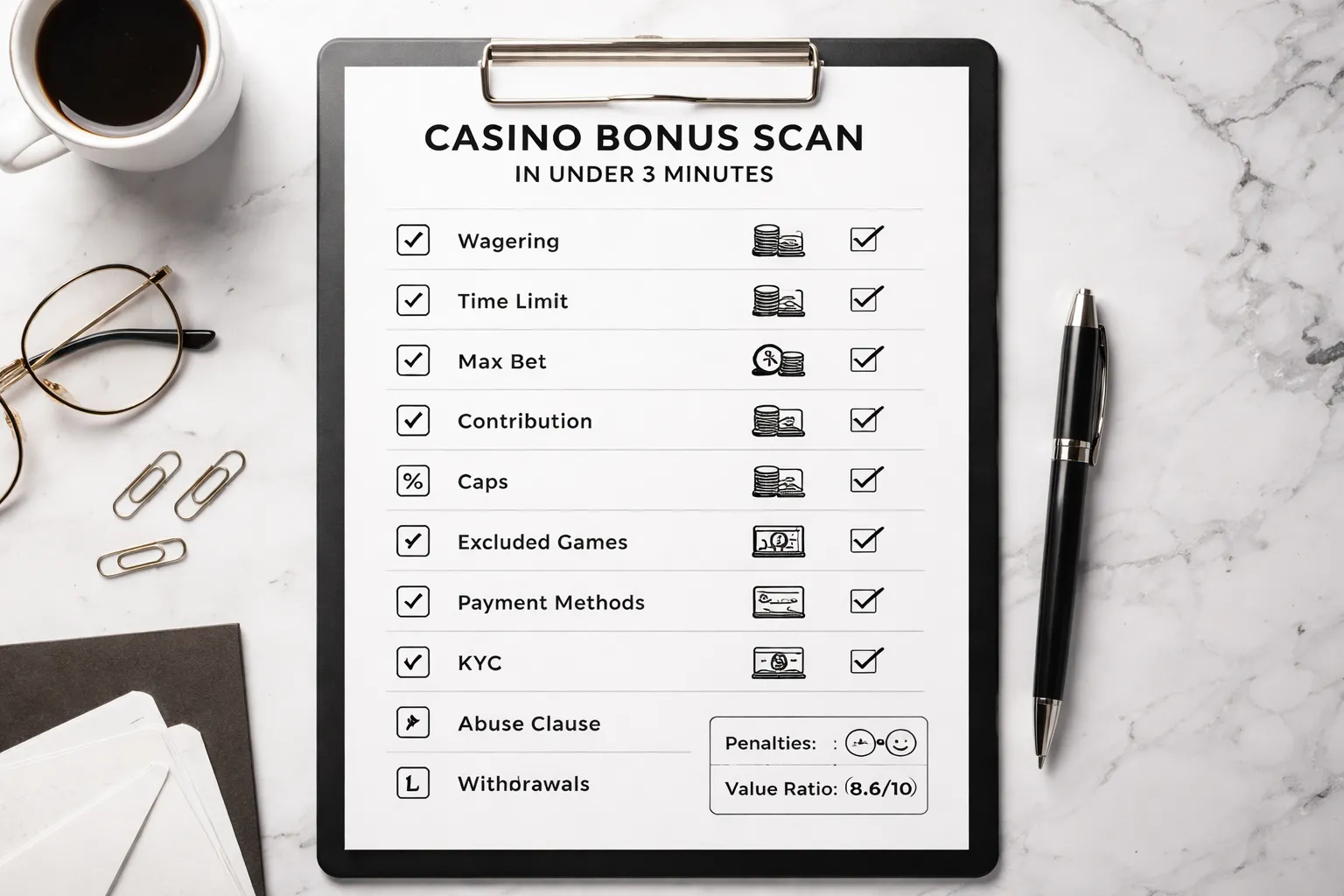
Where to find the promo-specific rules, and what to screenshot
Start on the promo page you click to claim. Then open the link that says Terms, Bonus T&Cs, Promo rules, or Bonus policy. Do not rely on the casino’s main Terms page.
- Screenshot 1: The promo headline and offer details, deposit amount, bonus amount, code, and eligible countries.
- Screenshot 2: Wagering requirement, expiry timer, and max bet limit.
- Screenshot 3: Cashout rules, max withdrawal cap, and withdrawal processing notes.
- Screenshot 4: Game restrictions, contribution table, and excluded games list.
- Screenshot 5: Payment method limits and the KYC line that states when verification must happen.
- Screenshot 6: The bonus abuse clause and “management decision” wording.
Keep the screenshots until you withdraw. If support disputes anything, you need proof of the rules you accepted.
The 10 items to scan in under 3 minutes
- 1) Wagering requirement (WR): Look for “Xx bonus” or “Xx bonus + deposit.” Bonus-only WR usually beats bonus+deposit.
- 2) Time limit: Note the deadline in hours or days. Short windows force higher stakes and higher variance.
- 3) Max bet while bonus is active: Find the exact number per spin, hand, or round. If it says “stake limit applies,” keep looking until you find the figure.
- 4) Game contribution: Slots often count 100%. Table games often count 0% to 20%. Some casinos cap how much table play counts even if the percentage exists.
- 5) Win cap or max cashout: Check if winnings convert to cash with a cap, or if cashout stays capped even after wagering.
- 6) Excluded games: Look for provider lists, specific slot titles, live casino, jackpots, and low edge games. Exclusions can change the whole value.
- 7) Payment method restrictions: Some methods block bonuses, reduce max cashout, or force extra checks. Watch for prepaid cards, e-wallets, crypto, and “instant banking” exceptions.
- 8) KYC trigger: Check when verification must complete. Some require KYC before wagering finishes, others before first withdrawal, some before any play counts.
- 9) Bonus abuse clause: Scan for “irregular play,” “low risk betting,” “hedging,” “opposite betting,” “system play,” “management decision,” and “confiscate winnings.” Broad wording raises risk.
- 10) Withdrawal rules: Check if you must wager any pending deposit, if withdrawals cancel bonuses, if partial withdrawals forfeit winnings, and if fee or minimum withdrawal terms apply.
Red flags vs green flags, what fair terms usually look like
| Term area | Green flags | Red flags |
|---|---|---|
| WR base | WR applies to bonus only, clear math examples | WR applies to bonus + deposit, no examples |
| Time limit | 7 to 30 days, countdown shown | 24 to 72 hours, unclear start time |
| Max bet | Clear number per game type, consistent across site | Hidden number, vague “stake limits apply,” voiding wins for small breaches |
| Contribution | Simple table, most slots 100%, rules match lobby categories | Most games 0% to 20%, extra caps on table play, categories mislabel games |
| Caps | No win cap, or a cap that matches the promo’s intent | Low max cashout, cap applies even after wagering |
| Excluded games | Short list, updated date shown | Large provider bans, jackpots excluded without notice, list changes mid promo |
| Payments | Most methods eligible, restrictions stated on cashier page | Bonuses blocked for common methods, method-specific cashout caps |
| KYC | Clear timeline, clear document list, reasonable deadlines | KYC required “on request” with no deadline, extra documents added after you win |
| Abuse clause | Narrow definitions, specific examples of prohibited behavior | “Any play we deem abusive,” “management decision final,” confiscation language |
| Withdrawals | Clear forfeiture rules, clear processing times | Withdrawal cancels all winnings, partial cashouts forfeit balance, hidden fees |
Compare two bonuses with an apples-to-apples scoring method
Use a fast scorecard. You want a single number you can compare across offers.
Step 1: Compute your wagering target.
- If WR is bonus only: Wager target = bonus amount x WR.
- If WR is bonus + deposit: Wager target = (bonus amount + deposit) x WR.
Step 2: Convert rules into penalties. Subtract points for each constraint.
| Rule | Penalty |
|---|---|
| WR base includes deposit | -2 |
| Time limit under 7 days | -2 |
| Max bet not clearly stated | -3 |
| Max bet at or below 5 currency units per spin | -1 |
| Table games contribute 0% to 10% | -2 |
| Major excluded list, or provider-wide bans | -2 |
| Max cashout cap exists | -3 |
| Payment method restrictions for your preferred method | -2 |
| KYC required before wagering completes | -1 |
| Broad abuse clause with “management decision” | -3 |
| Withdrawal cancels bonus and winnings, or partial withdrawals forfeit | -3 |
Step 3: Create a quick value ratio.
- Value ratio: Bonus amount ÷ wagering target.
- Higher is better. A big bonus with a huge wagering target can rank worse than a smaller bonus with lighter playthrough.
Step 4: Rank by two numbers.
- Primary: Lower total penalties wins.
- Tiebreaker: Higher value ratio wins.
If you want a faster shortlist, start with offers from your bonus terms glossary so you spot problem clauses in seconds.
Responsible gambling and safer bonus use
How bonuses can encourage chasing losses, and how to counter it
Bonuses change how losses feel. You see a larger balance. You bet longer. You lose more time before you stop.
Wagering targets push volume. That pressure can lead to loss chasing. You raise stakes to “finish” the playthrough. You add deposits to keep the bonus alive.
Counter it with hard rules you set before you claim.
- Treat the bonus as locked money. Assume you will lose it. If that feels unacceptable, skip it.
- Pick a fixed stake and keep it. Do not increase bet size to speed up wagering.
- Use a stop-loss and a stop-time. End the session even if you are “close” to clearing.
- Do not redeposit to rescue a bonus. If the offer needs another deposit to “save” it, walk away.
- Track progress in numbers. Write down start balance, current balance, time started, and target stop time.
Set deposit limits, time limits, and loss limits before you claim
Set limits first. If you set them after you start, you will ignore them.
- Deposit limit. Set a daily and weekly cap. Match it to your entertainment budget. Never raise it for a promotion.
- Loss limit. Set a max loss per session and per day. Use cash lost, not “net” after wins.
- Time limit. Set a hard end time. Use a timer outside the casino site.
Use the casino’s built-in tools if available. Use your bank limits too. If your site lets you set a cooling-off period, use it.
When to skip the bonus and play with cash instead
Cash play gives you one rule set. Bonus play adds extra rules that can block withdrawals.
Skip the bonus if any of these apply.
- You want to withdraw fast. Wagering can delay cashouts until you clear the target.
- The max cashout cap is low. A cap can turn a good win into a limited payout.
- The wagering target is high for your budget. If you cannot clear it with low stakes, you will feel forced to bet bigger.
- Game restrictions do not match how you play. If your preferred games contribute poorly, you will grind more.
- The max bet limit is tight. You risk a rule break with one misclick.
- The offer expires soon. Short timers create pressure and longer sessions.
If you do take a bonus, learn the key mechanics first. Use this guide on wagering requirements so you do not clear it the hard way.
Resources and support options if gambling stops being fun
Use support early. Do not wait for a crisis.
- Account tools. Deposit limits, loss limits, session limits, time-outs, and self-exclusion.
- Payment blocks. Ask your bank about gambling merchant blocks. Use card controls where available.
- Device blocks. Use gambling blocking software on your phone and computer.
- Confidential help. Contact local problem gambling helplines and counseling services in your country.
- If you are in immediate danger. Contact your local emergency number.
Tell the casino support team you want safer gambling help. Ask for self-exclusion across all brands under the same operator if they offer it.
FAQ
What are casino bonus terms and conditions?
They are the rules that control how you can use a bonus. They cover wagering requirements, eligible games, bet limits, time limits, withdrawal limits, and verification. Read them before you deposit. Casinos can void winnings if you break them.
What does a wagering requirement mean?
It is how much you must stake before you can withdraw bonus funds. Example, a $100 bonus with 35x wagering means you must wager $3,500. Some casinos count only bets, others count losses and wins the same way.
Do all games count the same toward wagering?
No. Slots often count 100%. Table games may count 0% to 20%. Some live dealer games count 0%. If your main game has low contribution, you can end up needing far more wagering than the headline number suggests.
What is a max bet rule, and why does it matter?
It caps your bet size while you play with an active bonus. A common cap is $5 per spin or per hand. If you exceed it, the casino can remove the bonus or void winnings. Check if the cap changes for free spins.
How do bonus time limits work?
Bonuses can expire in hours or days. Free spins often expire faster than deposit bonuses. If your bonus expires, the casino can remove remaining bonus funds and winnings linked to them. Plan the time needed to finish wagering.
What is a max cashout limit?
It limits how much you can withdraw from a bonus. Example, a $10 bonus may cap withdrawals at $100. Anything above the cap gets removed. This rule shows up often in no deposit bonuses and some free spins offers.
Can a casino cancel your bonus or winnings?
Yes, if you breach terms. Common triggers include exceeding max bet, using restricted games, making low risk hedge bets, or claiming multiple accounts per household. Some casinos also void wins if you fail verification checks on time.
What does “sticky bonus” vs “non-sticky bonus” mean?
Sticky means you cannot withdraw the bonus funds, only winnings after wagering. Non-sticky means bonus funds become withdrawable after you meet wagering. Sticky bonuses can reduce your final cashout even when you complete the requirements.
What should you check before you claim free spins?
Check the game, coin value, number of lines, max win cap, and expiration. Also check if winnings turn into bonus funds with wagering. For more detail, see online casino bonuses explained.
What are the fastest terms to scan to avoid traps?
- Wagering: multiplier, what counts, and game contribution.
- Max bet: per spin, per hand, and per round limits.
- Expiry: bonus and free spins deadlines.
- Cashout cap: maximum withdrawable amount.
- Restricted play: banned games, systems, and bet patterns.
Conclusion
Conclusion
Bonus terms control what you can play, how you must play, and what you can withdraw. If you skip them, you risk voided winnings.
Scan the same five lines every time. Wagering, max bet, expiry, cashout cap, and restricted play. If any one of them looks tight, treat the bonus as low value.
- Match the bonus to your games. If your main games contribute 0% or 10%, the wagering will drag.
- Set your stake to the max bet rule. One over-limit spin can cancel the offer.
- Track the clock. Expiry turns a good deal into forced play.
- Check the cashout cap before you deposit. A hard cap can block most of your upside.
- Avoid restricted patterns. If a rule bans low risk play, stop using that approach on a bonus.
Your final step. Save the terms page, take a screenshot of key limits, and follow one clearing plan. Use this guide on how to clear wagering requirements if you want a safe process you can repeat.
-
Online Casino Bonuses Explained: How They Work + Terms You Must Know
4 weeks ago -
No Deposit Bonus Explained: How It Works, Pros/Cons & Common Rules
4 weeks ago -
Wagering Requirements Explained (and How to Clear Them Faster)
4 weeks ago -
Free Spins Bonus Explained: How Free Spins Work at Online Casinos
4 weeks ago -
Cashback Bonus Explained: How Casino Cashback Really Works
4 weeks ago
-
- Wagering requirements, what counts and what doesn’t
- Game contribution percentages, slots vs table games vs live dealer
- Maximum bet limits while bonus funds are active
- Bonus validity windows and wagering deadlines
- Maximum cashout and maximum win caps
- Sticky (non-cashable) vs non-sticky bonuses and how withdrawals work
- Restricted games, features, and strategies
- Betting patterns flagged as “irregular play”
-
- “Bonus abuse” and fair play clauses: the vaguest rules with the biggest consequences
- Multi-accounting, collusion, and proxy play: what to check
- Arbitrage and hedging: opposite bets across products or casinos
- Low-risk betting patterns and why they get targeted
- How reputable casinos document violations vs vague discretionary enforcement
-
- What are casino bonus terms and conditions?
- What does a wagering requirement mean?
- Do all games count the same toward wagering?
- What is a max bet rule, and why does it matter?
- How do bonus time limits work?
- What is a max cashout limit?
- Can a casino cancel your bonus or winnings?
- What does “sticky bonus” vs “non-sticky bonus” mean?
- What should you check before you claim free spins?
- What are the fastest terms to scan to avoid traps?
-
- Wagering requirements, what counts and what doesn’t
- Game contribution percentages, slots vs table games vs live dealer
- Maximum bet limits while bonus funds are active
- Bonus validity windows and wagering deadlines
- Maximum cashout and maximum win caps
- Sticky (non-cashable) vs non-sticky bonuses and how withdrawals work
- Restricted games, features, and strategies
- Betting patterns flagged as “irregular play”
-
- “Bonus abuse” and fair play clauses: the vaguest rules with the biggest consequences
- Multi-accounting, collusion, and proxy play: what to check
- Arbitrage and hedging: opposite bets across products or casinos
- Low-risk betting patterns and why they get targeted
- How reputable casinos document violations vs vague discretionary enforcement
-
- What are casino bonus terms and conditions?
- What does a wagering requirement mean?
- Do all games count the same toward wagering?
- What is a max bet rule, and why does it matter?
- How do bonus time limits work?
- What is a max cashout limit?
- Can a casino cancel your bonus or winnings?
- What does “sticky bonus” vs “non-sticky bonus” mean?
- What should you check before you claim free spins?
- What are the fastest terms to scan to avoid traps?
-
Online Casino Licensing Explained: Authorities, Licenses & How to Check One
3 weeks ago -
Best Live Dealer Casinos: Where to Play Live Blackjack, Roulette & More
3 weeks ago -
Best Online Casinos for High Rollers: VIP Perks, High Limits & Exclusive Bonuses
3 weeks ago -
Fast Payout Online Casinos: Best Sites for Quick Withdrawals
3 weeks ago -
What Is an Online Casino? How They Work, Games, Bonuses & Safety
4 weeks ago
-
Best Online Casinos for Blackjack: Best Tables, Rules & Bonuses
4 weeks ago -
Online Casino Bonuses Explained: How They Work + Terms You Must Know
4 weeks ago -
Fast Payout Online Casinos: Best Sites for Quick Withdrawals
3 weeks ago -
Online Casino Licensing Explained: Authorities, Licenses & How to Check One
3 weeks ago -
Best Online Casinos for Roulette: Best Wheels, Limits & Live Options
4 weeks ago