Cashback Bonus Explained: How Casino Cashback Really Works

Casino cashback gives you back a percentage of your losses. Casinos use it to keep you playing longer and to soften downswings. The details decide if it helps you or traps you in extra wagering.
This guide breaks down how cashback works in real terms. You will learn the main cashback types, how casinos calculate “net losses”, when cashback triggers, and how caps and percentages change your expected return. You will also learn the common strings attached, including wagering requirements, game contribution rules, minimum loss thresholds, and withdrawal limits. You will see how cashback stacks with other promos, including a no deposit bonus, and when stacking hurts your payout.
Use this to compare offers fast, estimate what you can actually get back, and avoid cashback that costs more than it returns.
Key Takeaways
- In het kort: Cashback pays a percentage of your net losses back as bonus funds, not as cash.
- Check the real rate. A “20% cashback” deal can drop fast after caps, minimum loss rules, and excluded games.
- Read the trigger. Some offers pay daily, some weekly, some only on request.
- Track the window. Cashback usually counts losses in a set period, then expires if you do not use it.
- Look for a cap. A max cashback limit often decides the value more than the headline percentage.
- Know the playthrough. Cashback often comes with wagering requirements and game contribution rules.
- Watch withdrawal limits. Some casinos cap how much you can cash out from cashback winnings.
- Check eligible games. Slots may count 100%, table games may count less, or not at all.
- Stacking can cut value. Another bonus can block cashback, reduce it, or add stricter rules.
- Do the math before you claim. Estimate your expected loss, apply the cap, then apply wagering to see what you can actually withdraw.
- Use terms as your filter. If rules feel vague, skip the offer and compare using clear conditions. For more, see casino bonus terms and conditions.
Cashback Bonus Explained: What It Is (and What It Isn’t)
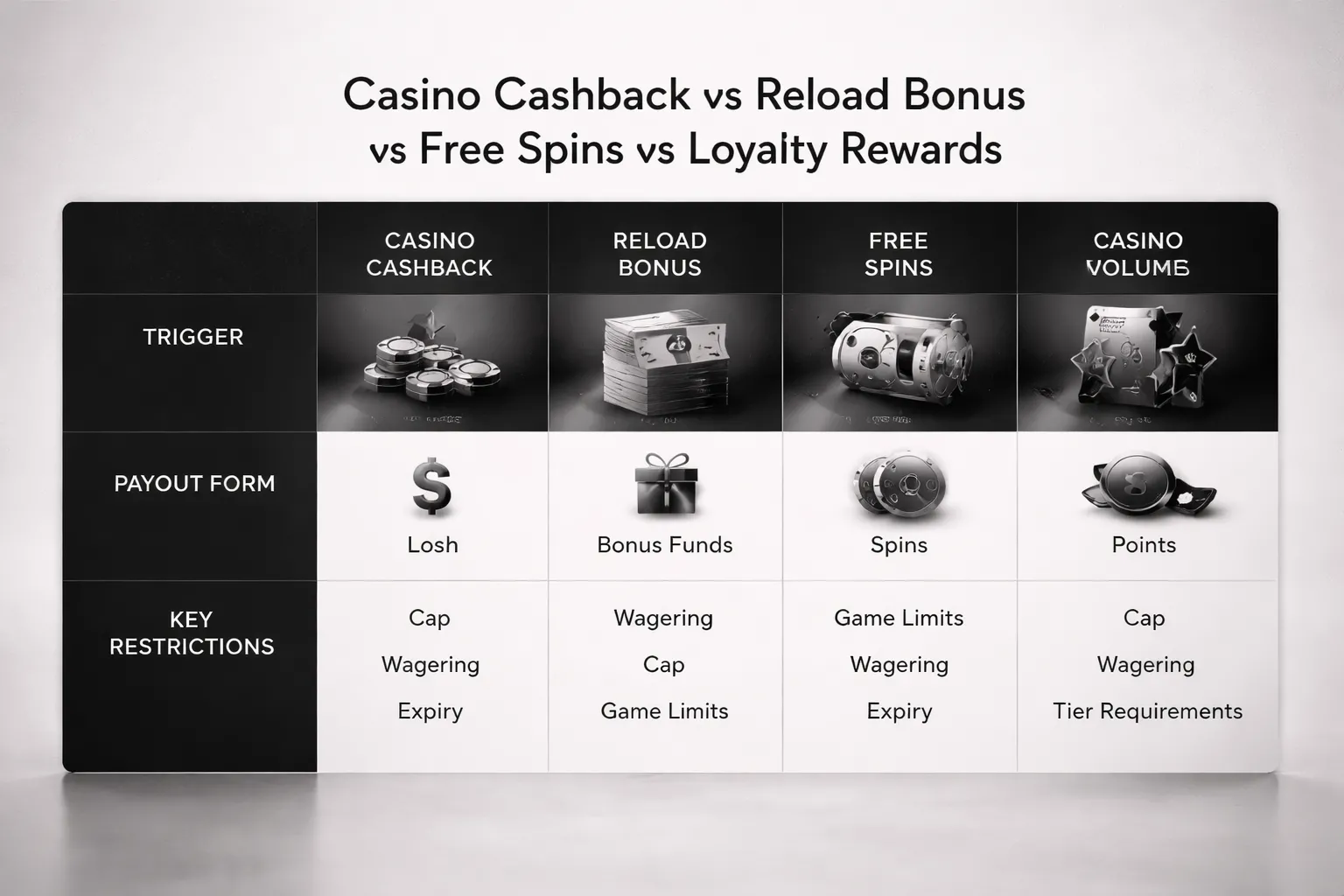
Simple definition: what cashback is
A casino cashback bonus gives you back a percentage of your net losses over a set period. You usually get it as bonus funds, cash, or a mix. The offer sets the rate, the time window, the cap, and the games that count.
Real-world example: You play slots from Monday to Sunday. You deposit $200 and cash out $50. Your net loss is $150. The casino offers 10% cashback, capped at $30. You get $15 back. If the offer pays as bonus funds with 10x wagering, you must wager $150 before you can withdraw any winnings from that $15.
Cashback does not refund every losing bet. It calculates after the period ends, based on your net result.
What cashback is not
- It is not a reload bonus. A reload matches your deposit, for example 50% up to $200. Cashback depends on losses, not deposits. If you win, you may get $0 cashback.
- It is not free spins. Free spins give you set spins on set games. Cashback covers a wider activity window but often comes with caps and exclusions.
- It is not comps or loyalty points. Loyalty rewards track your wagering and can pay out regardless of profit or loss. Cashback ties to net losses in a defined period. For reload mechanics, see reload bonuses.
Cashback vs lossback insurance promos
Some casinos market “lossback” like insurance. It looks like cashback but it works differently.
- Similarities: both return a percentage of losses, both use a time window, both use caps, both can exclude games.
- Key differences: insurance-style promos often apply to a first deposit, a first day, or a specific game category. They may pay only if you finish the period down. They may also require you to opt in before you play.
- Payout form: insurance promos often pay as a matched bonus equal to your lossback amount, with higher wagering than standard cashback.
Why casinos offer cashback
- Retention: a small return after a losing week pushes you to come back and keep playing.
- Volatility smoothing: cashback reduces the pain of downswings, which keeps your bankroll in action longer.
- VIP incentives: higher tiers often get higher rates, higher caps, or more frequent cashback cycles. It is a controllable perk the casino can adjust by segment.
| Offer type | Triggered by | Typical payout | Main catch |
|---|---|---|---|
| Cashback | Net losses in a period | % back, often capped | May pay as bonus funds with wagering |
| Reload bonus | Deposit | % match up to a cap | Wagering usually applies to full bonus |
| Free spins | Claiming promo | Set spins on set slots | Low max cashout, game limits, expiry |
| Comps, loyalty rewards | Wagering volume | Points, perks, occasional cash | Low earn rate, tier rules, exclusions |
How Casino Cashback Really Works: The Core Mechanics
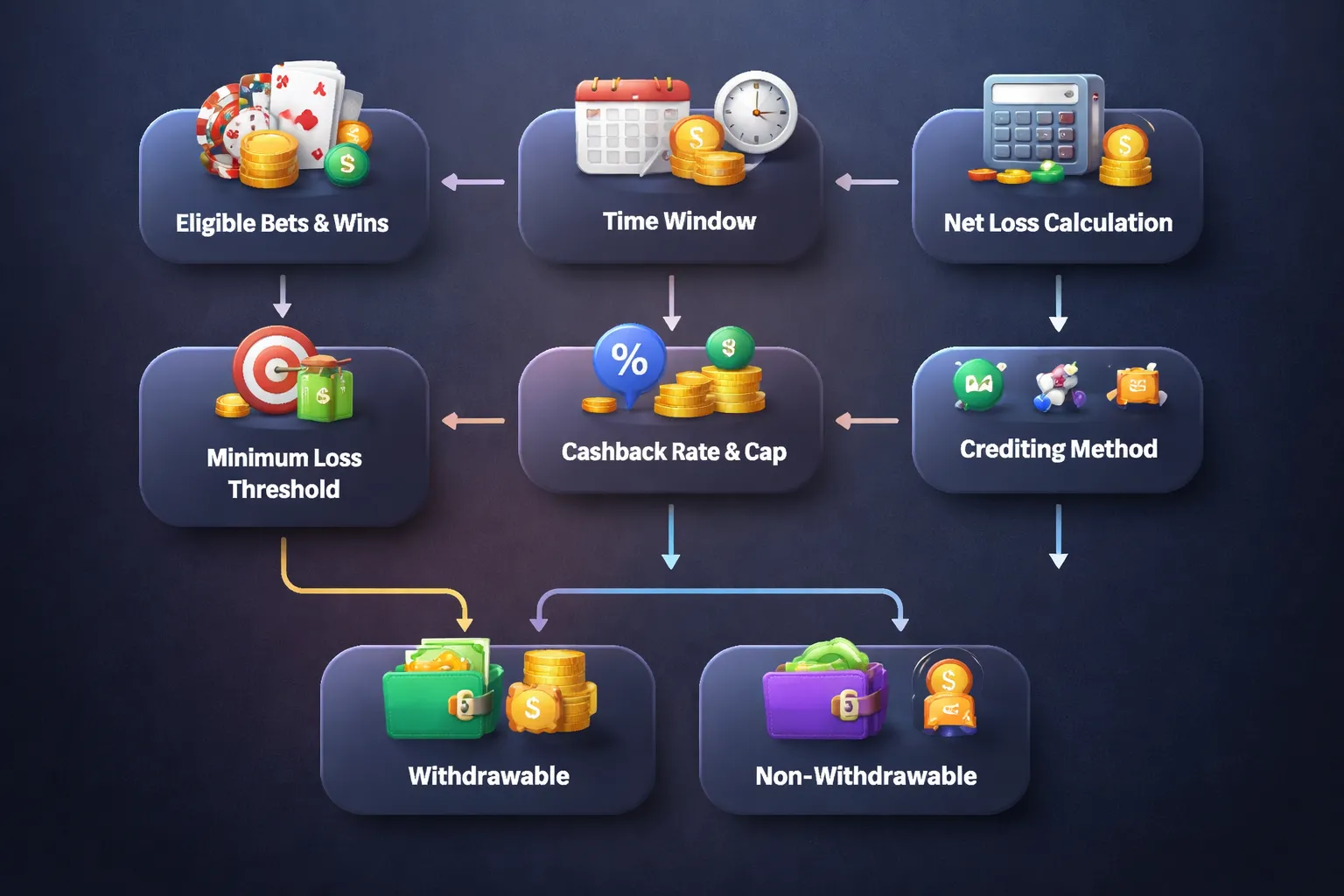
Loss calculation basics
Casino cashback starts with one number, your net loss.
Most casinos calculate it as your total bets minus your total wins for eligible games, over a set window. Some rules also subtract withdrawals made during the same window.
Many casinos exclude bonus play from the calculation. They may count only wagers made with real cash.
- Net loss: Eligible stakes minus eligible returns.
- Game eligibility: Slots often count at 100%. Table games may count at a reduced rate or zero.
- Bonus exclusion: Bets made with bonus funds may not count toward cashback.
Session-based vs period-based tracking
Some cashback tracks a session. Others track a fixed period.
- Session-based: The casino measures your results from a start time to an end time. The session may end after inactivity or at a daily reset time.
- Period-based: The casino measures all eligible play across a day, week, or month, then settles cashback once per period.
Session cashback can feel faster. Period cashback can offset swings, but it can also get diluted if you win later in the same window.
Common time windows
Check the promo terms for the exact window and reset time. These details change the payout.
- Daily: Counts losses during a calendar day or rolling 24 hours. Often credits the next day.
- Weekly: Counts losses during a set week. Often credits once a week on a fixed day.
- Monthly: Counts losses across the month. Often credits at month end or early next month.
- Instant cashback: Credits during play or right after a session. Usually comes with tighter caps and stricter game limits.
Crediting methods
Cashback does not always mean withdrawable cash.
- Real cash: Credits to your cash balance. You can usually withdraw it, subject to standard KYC and withdrawal rules.
- Bonus funds: Credits as a bonus balance. Wagering usually applies before you can withdraw winnings.
- Free spins: Credits as spins on specific slots. Winnings often convert to bonus funds with wagering.
- Manual claim: You must click a button in the cashier or promos page. Miss the claim window and you lose it.
If the offer requires a code, treat it like any other promo. Use the right field and timing. See online casino bonus codes if you need a quick refresher.
Minimum loss thresholds
Many casinos set a minimum net loss before cashback triggers. Common reasons include payment fees, fraud controls, and keeping the offer from paying out tiny amounts.
- Typical rule: No cashback until you lose at least a set amount in the window.
- Impact: A small losing day may pay zero, even if the rate looks strong.
- Stacking: Some programs carry losses forward. Most do not.
Payment and wallet rules
Casinos split your balance into wallet types. Cashback usually lands in one of them.
- Withdrawable balance: Real money you can cash out. It may still require verification and may face withdrawal limits.
- Non-withdrawable balance: Bonus money you must wager. You can usually withdraw only the winnings after you clear the wagering.
- Order of play: Some sites force you to use bonus funds before cash, or the reverse. That choice can change whether your bets qualify for cashback.
- Withdrawal effects: Some offers reduce or cancel pending cashback if you withdraw during the tracking window.
Cashback Calculation Formula (With Step-by-Step Examples)
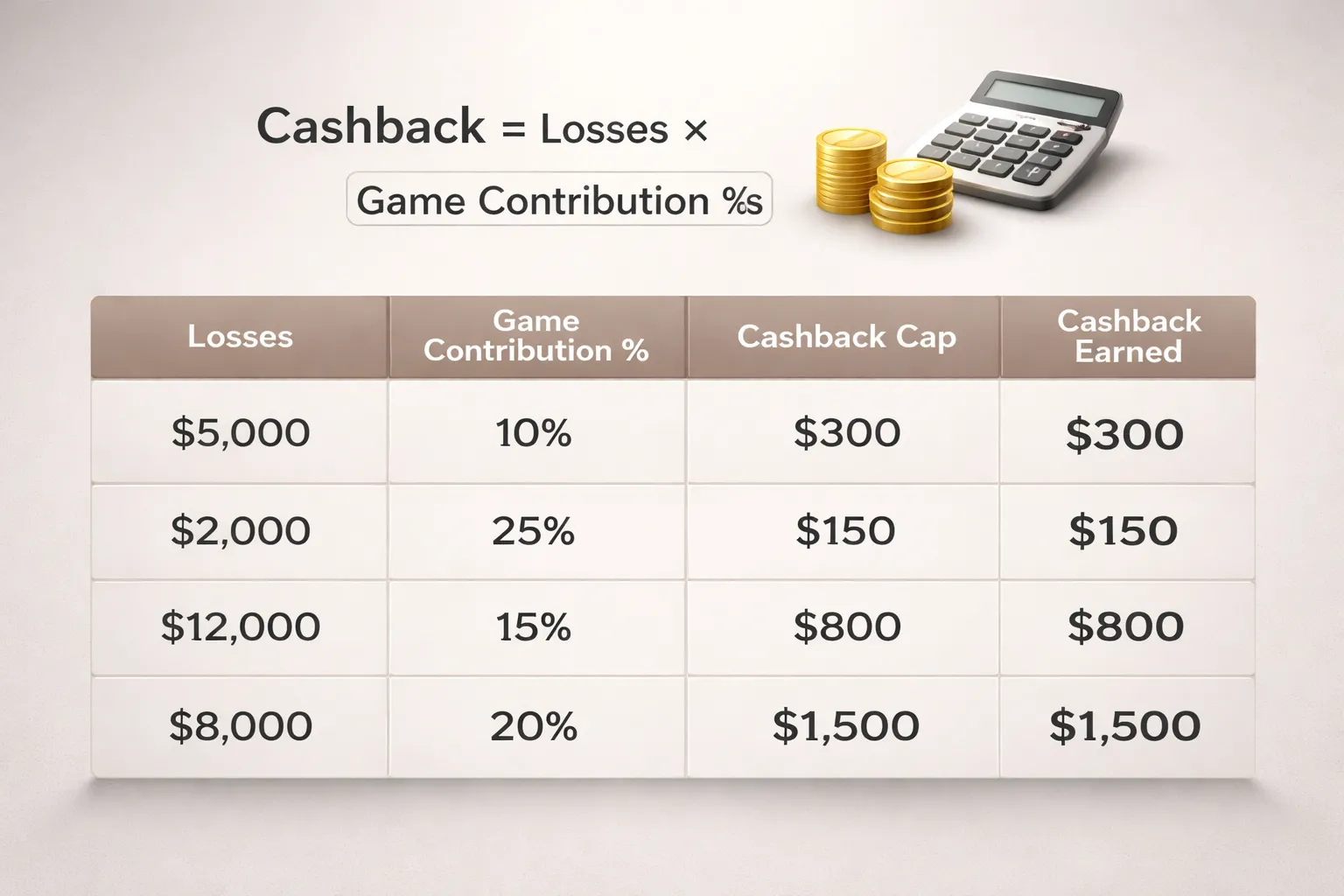
The Standard Cashback Formula
Most casino cashback uses net loss over a set period, such as daily or weekly.
Cashback = cashback % × (eligible stakes − eligible winnings)
- Eligible period, only bets settled inside the tracking window count.
- Eligible games, some games count at 0% or a reduced rate.
- Eligible stakes and winnings, casinos often track real money and bonus money separately.
- Net loss only, if you end in profit, cashback usually equals €0.
Step-by-Step Example 1, 10% Weekly Cashback, €200 Net Loss
Your casino runs cashback from Monday 00:00 to Sunday 23:59.
- Cashback rate: 10%
- Total eligible stakes: €1,200
- Total eligible winnings: €1,000
- Net loss: €1,200 − €1,000 = €200
- Cashback: 10% × €200 = €20
You receive €20, usually as cash or a bonus balance with wagering.
Step-by-Step Example 2, Cashback With a Cap, 15% up to €100
A cap limits the maximum cashback you can receive in one period.
- Cashback rate: 15%
- Cashback cap: €100
- Net loss for the week: €900
- Raw cashback: 15% × €900 = €135
- Capped cashback paid: €100
Your extra €35 does not carry over unless the terms say it does.
Step-by-Step Example 3, Mixed Games With Different Contribution Rates
Some casinos weight losses by game type. Slots might count 100%. Table games might count 10% or 0%.
Weighted net loss = Σ (net loss per game group × contribution rate)
| Game group | Stakes | Winnings | Net loss | Contribution | Weighted loss |
|---|---|---|---|---|---|
| Slots | €800 | €600 | €200 | 100% | €200 |
| Blackjack | €500 | €450 | €50 | 10% | €5 |
| Roulette | €400 | €500 | -€100 | 0% | €0 |
- Total weighted loss: €200 + €5 + €0 = €205
- Cashback rate: 10%
- Cashback: 10% × €205 = €20.50
Even though roulette made a profit, it does not offset other losses if its contribution rate equals 0%.
Step-by-Step Example 4, Profit Week and What Happens
If your eligible winnings exceed your eligible stakes, your net loss becomes negative.
- Cashback rate: 10%
- Total eligible stakes: €1,000
- Total eligible winnings: €1,150
- Net loss: €1,000 − €1,150 = -€150
- Cashback: €0
Most casinos do not pay negative cashback and do not roll the profit into the next period. Check the same rule style used in many bonus offers, including this reload bonus guide.
Key Terms That Change the Value of Cashback
Wagering requirements (playthrough)
Many casinos pay cashback as a bonus, not as cash. That turns a headline rate into a lower real value.
Use this quick estimate:
- Expected value (EV) after wagering = Cashback amount × (1 − House edge × Wagering multiple)
- This ignores variance and any game restrictions. It helps you compare offers fast.
Example:
- Net loss: €200
- Cashback rate: 10%
- Cashback credited: €20
- Wagering: 10x
- Game: slots at 4% house edge
- EV ≈ €20 × (1 − 0.04 × 10) = €20 × 0.60 = €12
If the casino pays cashback as real cash with no playthrough, EV stays close to the headline amount. If it pays as a bonus with high wagering, EV drops fast. Many cashback setups also behave like a reload bonus, so read them the same way.
Game contribution tables
Contribution rules decide which bets count toward wagering and loss tracking. A cashback bonus can look solid, then become weak when you switch games.
| Game type | Typical wagering contribution | Common impact on cashback value |
|---|---|---|
| Slots | 100% | Clears fastest. Highest volatility. |
| Table games | 0% to 20% | Often too slow to clear before expiry. |
| Live dealer | 0% to 10% | Often excluded or capped. |
| Jackpots | 0% or excluded | May not count for wagering, may not count for cashback loss. |
Check two separate lines in the terms:
- Which games count toward wagering.
- Which games count toward cashback calculation in the first place.
Maximum bet limits while clearing cashback-derived bonuses
Casinos often cap your stake per spin or hand while you clear the wagering. Break the cap, and the casino can void the bonus and winnings.
What changes the real value:
- A low max bet forces more spins. That raises the chance you hit the expiry window.
- A low max bet can block your normal volatility control. You cannot size bets to manage balance swings.
- Some casinos set different caps by game type. Slots may allow more than live dealer.
Practical check: find the max bet rule, then estimate clearing time using your normal stake size. If you must cut your bet size by 2x to comply, your clearing time often doubles.
Excluded games and providers
Cashback offers often exclude specific games, whole categories, or certain providers. You can lose cashback value without noticing if you play outside the eligible list.
- Excluded categories often include live dealer, table games, and jackpots.
- Excluded providers can include high RTP slots, branded titles, or new releases.
- Excluded features can include bonus buys, free spins purchases, and some tournaments.
Match your actual play to the eligible list before you chase cashback. If your main games do not qualify, treat the headline rate as €0.
Expiry windows
Cashback has two clocks. Miss either one, and the value drops to zero.
- Claim deadline, you must opt in or click claim within a short window after the period ends.
- Usage deadline, you must complete wagering and cash out before the bonus expires.
Short usage deadlines hit hardest when contribution is low or max bet is tight. If you play table games and they contribute 10%, you may not clear in time even with steady play.
Cashback Types You’ll See at Online Casinos
No-wager cashback (true cash) vs bonus cashback (wagering required)
Casinos use “cashback” to describe two different things. You need to know which one you get before you play.
- No-wager cashback (true cash): The site credits real money. You can withdraw it, subject to standard KYC and withdrawal rules. No wagering requirement applies to the cashback amount.
- Bonus cashback: The site credits a bonus balance. You must wager it before you can withdraw. The wagering requirement can range from low to very high. The bonus may also have max bet limits and low table game contribution.
If terms mention “bonus funds”, “promo balance”, “sticky bonus”, or “wagering”, treat it as bonus cashback. If terms say “cash” or “real money”, confirm it still does not convert into a bonus wallet on credit.
VIP and rakeback-style cashback by loyalty tier
VIP cashback ties your rate to your level. The casino tracks your play, then refunds part of your theoretical loss or net loss based on a tier table.
- Tiered rate: Higher tiers get higher cashback percentages. Your rate can change mid-month if your tier changes.
- Different bases: Some programs use net loss. Others use “comp points” earned from wagering. These systems can produce different results on the same play.
- Game weighting: Slots often earn points faster than tables. Some games earn zero. This affects your effective cashback rate.
- Limits: Many programs cap weekly or monthly cashback, or exclude wins from specific bonuses.
If the offer feels smaller than expected, check the base. “Net loss” usually means deposits minus withdrawals, adjusted by bonuses and sometimes chargebacks.
Deposit-linked cashback and first deposit “lossback” offers
Some cashback promos attach directly to a deposit. The casino refunds a percentage of your loss up to a limit that depends on your deposit amount.
- First deposit lossback: You deposit once, then the site refunds a percent of your losses from a set window, often 24 to 72 hours. The refund usually caps at a fixed amount.
- Reload lossback: The same idea, but it repeats on selected days or after each deposit.
- Deposit caps: The maximum cashback often equals a percent of your deposit, even if your loss is higher.
- Bonus format varies: Some sites pay true cash. Many pay bonus cashback with wagering and expiry rules.
These promos reward short, high-volume sessions. They punish slow play if the eligible window closes before your action posts.
Instant cashback vs end-of-period cashback, speed vs control
Cashback can arrive as you play or after a set period. Each has tradeoffs.
- Instant cashback: Credits right away, or within minutes. You get faster bankroll support and clearer tracking. Sites often lower the percentage and apply tighter caps.
- End-of-period cashback: Calculates daily, weekly, or monthly. You get more control over when you claim, but you face claim deadlines and usage deadlines.
- Accounting delays: Some casinos finalize net loss after withdrawals settle. This can shift the final figure.
End-of-period cashback works best when you can claim on time and you can clear wagering before expiry. If you also play freebies, read the rules on casino bonus terms and conditions since exclusions often hide there.
Crypto casino cashback structures, common variations and caveats
Crypto casinos often present cashback as a permanent feature, not a limited promo. The mechanics still vary.
- Rakeback model: The site returns a percent of your “house edge spend” based on wagering, game type, and VIP level. This can look like cashback even when you end the week in profit.
- Lossback model: The site refunds a percent of net losses over a period. This behaves like traditional cashback.
- Token-based rewards: Cashback may pay in a platform token. The cash value depends on market price and liquidity. Selling may add fees or slippage.
- Chain and fee impact: Withdrawal fees, network congestion, and minimums can reduce the real value of small cashback credits.
- Wallet separation: Some sites credit cashback into a vault, bonus wallet, or locked balance with its own wagering and expiry rules.
With crypto cashback, check the unit of payment, conversion rules, and withdrawal minimums. A high percentage means little if you cannot withdraw it efficiently.
Pros and Cons of Cashback Bonuses (Player Perspective)
Benefits
- Reduced variance. Cashback refunds part of your net losses for the period. Your downswings shrink in cash terms, even if your win rate stays the same.
- Longer playtime. A refund adds bankroll back after a bad run. That gives you more spins, hands, or sessions before you need to deposit again.
- Softer downside during losing streaks. If you chase losses less and plan session limits, cashback can act like a brake. You still lose, but you lose slower.
Downsides
- Wagering traps. Many sites pay cashback as a bonus, not cash. You may need to wager the credit 1x to 40x before you can withdraw. That requirement can turn a refund into extra risk.
- Game exclusions and low contribution. Slots often count 100%. Table games may count 0% to 20%. Some providers or games count zero. If you mainly play excluded games, your headline rate does not matter.
- Caps limit real value. A 20% offer with a $100 cap pays the same as 20% on $500 losses and 2% on $5,000 losses. Always convert the cap into an effective rate for your usual volume.
- Delayed crediting. Cashback often posts weekly or monthly. If you bust today, the refund arrives later, and only if your account stays eligible.
- Balance separation and expiry. Cashback may land in a locked wallet with its own rules, time limits, and max cashout. If it expires fast, you may feel forced to play.
Who cashback suits best
- Slots players. Slots usually qualify at full contribution. You also face higher variance, so a refund has more practical impact.
- High-volume players. If you generate large turnover, caps and posting schedules matter less, and you can clear reasonable wagering faster.
- VIP grinders. Cashback often improves at higher tiers and can stack with loyalty rewards. Learn how VIP cashback and rakeback structures work in casino VIP and loyalty programs.
Who should be cautious
- Low-volume players. Small losses often produce tiny credits. Withdrawal minimums, fees, and expiry can erase the value.
- Table-game specialists. Your games may not qualify, or they may contribute so little that cashback becomes cosmetic.
- Bonus hunters. Cashback terms can block withdrawals, limit max cashout, or conflict with other promos. If you switch offers often, you can trigger ineligibility rules.
How to Evaluate a Cashback Offer Like an Expert
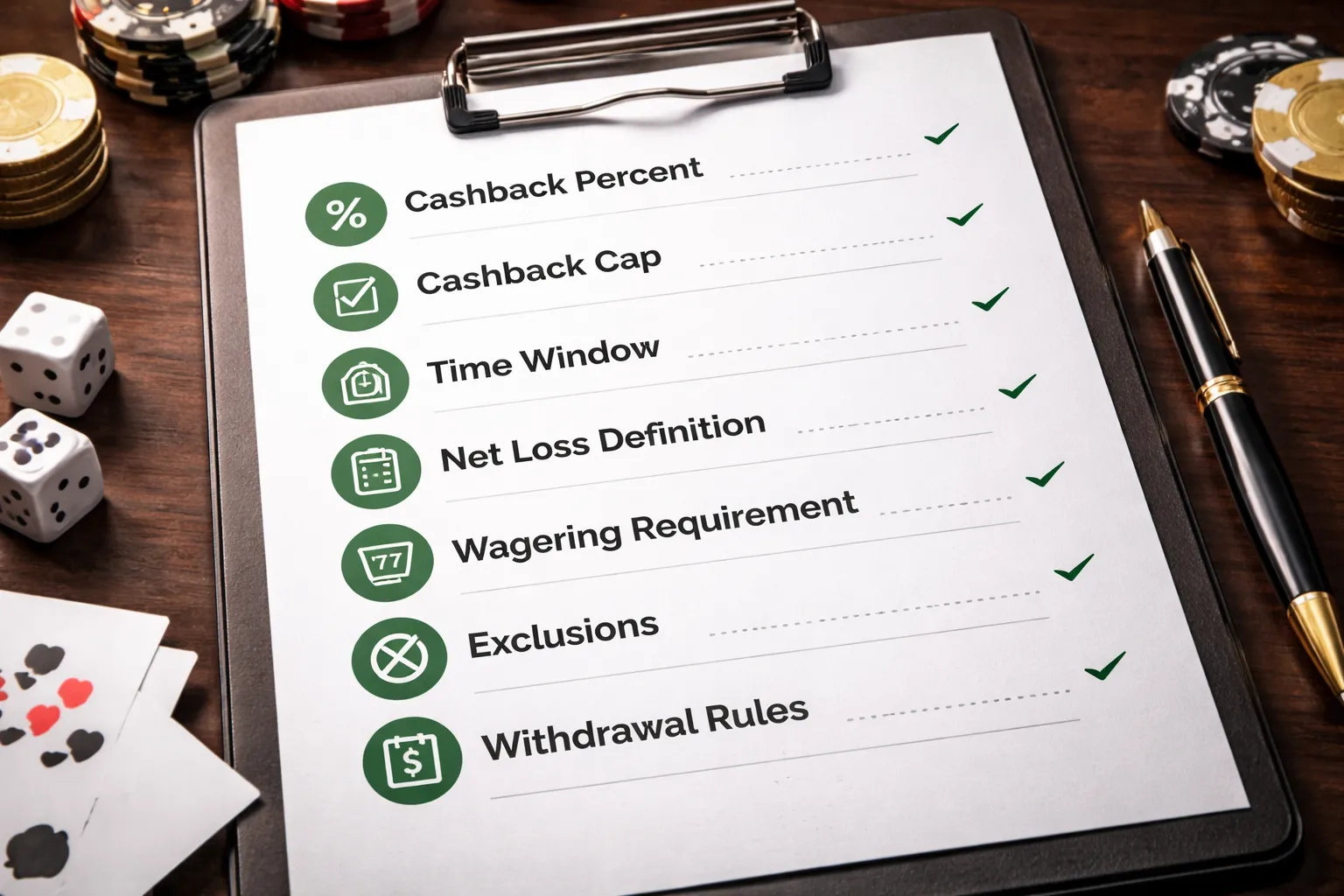
A quick checklist to compare offers
- Cashback percentage. Check the stated rate and whether it applies to all losses or only a specific product.
- Cap. Find the maximum cashback you can receive per day, week, or month.
- Time window. Confirm the period used to calculate losses, 24 hours, a calendar week, or a rolling week.
- Net loss definition. Check if it uses deposits minus withdrawals, bets minus wins, or a mix. Look for whether bonuses count as losses.
- Wagering requirement. Note the playthrough multiple and whether all games contribute equally.
- Game exclusions. Check if table games, live dealer, jackpots, or low house edge games get excluded or reduced contribution.
- Claim rules. Auto credit vs opt-in, manual claim deadlines, and whether you must meet a minimum loss.
- Withdrawal rules. Look for max cashout limits, withdrawal blocks until wagering completes, and forced conversion to bonus funds.
- Expiry. Check how long you have to use the cashback after it posts.
- Stacking. Confirm if cashback conflicts with other promos. This matters if you also use a reload bonus.
How to estimate effective cashback after wagering
Headline cashback overstates value when the credit comes with wagering. You need an effective rate.
Step 1. Calculate your credited cashback.
Cashback credit = Net loss x Cashback %.
Step 2. Convert wagering into expected cost.
Expected wagering cost = Cashback credit x Wagering multiple x House edge.
Step 3. Estimate what you keep.
Expected value kept = Cashback credit minus Expected wagering cost.
Step 4. Convert to an effective rate on your losses.
Effective cashback % = Expected value kept divided by Net loss.
| Input | Example |
|---|---|
| Net loss | $500 |
| Cashback % | 10% |
| Cashback credit | $50 |
| Wagering multiple | 10x |
| House edge you will play | 4% |
| Expected wagering cost | $50 x 10 x 0.04 = $20 |
| Expected value kept | $50 minus $20 = $30 |
| Effective cashback % | $30 divided by $500 = 6% |
Now apply caps and exclusions. If the cap limits the $50 credit to $20, your effective cashback falls again. If your main games contribute 10% to wagering, the real playthrough becomes 10 times higher in practice.
Red flags in terms and conditions
- Vague net loss language. Terms like deposits minus withdrawals can punish you for cashing out, even if you lost in between.
- Undefined exclusions. Phrases like selected games, bonus abuse, irregular play, or low risk betting without clear definitions.
- Manual approval. If staff must approve cashback, you risk delays, denials, or extra verification.
- Discretionary voids. Any clause that lets the casino void cashback at its sole discretion.
- Short claim windows. 24 hour claim windows or strict deadlines that make you miss credits.
- Forced bonus conversion. Cashback that posts as bonus funds with high wagering and no cash option.
- Max cashout limits. Cashback wins capped at a low multiple of the credit.
- Non-withdrawable cashback. Cashback that you can only use to bet and cannot withdraw even after wagering.
- Conflicts with other promos. Rules that cancel cashback if you claimed another bonus during the period.
Questions to ask support before you opt in
- How do you calculate net loss. Ask for the exact formula and an example using deposits, withdrawals, wagers, wins, and bonus funds.
- Is cashback cash or bonus. Confirm if it is withdrawable, and when it becomes withdrawable.
- What wagering applies. Ask for the playthrough multiple and which games contribute at reduced rates.
- Which games qualify. Request a list of excluded games and any low contribution categories, table games, live dealer, jackpots.
- What is the cap. Confirm cap amount, reset schedule, and whether it applies per player, per account, or per IP.
- What is the time window. Confirm start and end times, timezone, and whether it is rolling or calendar based.
- How do I claim. Ask if it auto credits, if you must opt in, and the deadline to claim.
- Any withdrawal restrictions. Ask about max cashout, blocked withdrawals during wagering, and whether winnings from cashback get restricted.
- Can you stack it. Confirm if it works alongside other bonuses, or if claiming anything else cancels eligibility.
Common Cashback Mistakes (and How to Avoid Them)
Assuming cashback applies to total stakes rather than net losses
Many casinos base cashback on net losses, not how much you wagered.
If you stake $1,000 and cash out $950, your net loss is $50. Cashback applies to $50, not $1,000.
Fix it fast.
- Read the definition of “loss” in the cashback terms. Look for “net losses” and the time period used.
- Check if they count void bets, bonus bets, and canceled rounds as stakes or ignore them.
- Track your session results. Use deposits, withdrawals, and end balance, not wager totals.
Ignoring contribution rates and playing excluded games
Cashback often excludes game types or gives them reduced weight.
Slots may count at 100%. Table games may count at 10% to 0%. Some live games count at 0%.
If you play excluded games, your “eligible loss” drops. Your cashback drops with it.
- Find the contribution table for cashback. Do not assume it matches the welcome bonus.
- Check excluded providers and specific games. Many casinos blacklist low house edge titles.
- Keep most play inside the highest contribution group if you aim to qualify.
- If you want long-term rebates, compare cashback to casino VIP and loyalty programs, many use a clearer points model.
Missing opt-in steps, claim windows, or minimum-loss thresholds
Some cashback auto-credits. Others require opt-in each period. Some require a manual claim.
Many offers also set a minimum net loss, like $20 or $50, before cashback triggers.
- Opt in before you play if the promo requires it. Late opt-ins often do not backdate.
- Set a reminder for the claim window. Common windows run 24 to 72 hours after the period ends.
- Check the minimum loss and any minimum deposit tied to eligibility.
- Confirm the timezone used for the period cutoff, then track by that clock.
Breaching max-bet rules while clearing cashback bonuses
Cashback often credits as bonus funds. Bonus funds often come with wagering rules.
Max-bet limits apply during wagering. If you break them, the casino can void the bonus and any winnings.
- Find the max bet amount before you place any high stakes spins or hands.
- Watch for different limits by game type, slots vs tables vs live.
- Keep bet size consistent. Avoid sudden stake jumps while any wagering remains.
- Check if the casino restricts withdrawals until you finish wagering.
Chasing losses because cashback feels like a safety net
Cashback reduces losses. It does not remove them.
A 10% cashback rate means you still carry 90% of losses, plus the house edge.
If the cashback arrives as a bonus with wagering, the real value drops further.
- Set a loss limit before you start. Stop when you hit it, even if cashback will trigger.
- Treat cashback as a rebate, not a bankroll plan.
- Do not increase stakes to “reach” a threshold. Threshold chasing turns small losses into large ones.
- Focus on games you would play anyway, within your budget, within the eligible list.
Responsible Gambling Notes: Cashback Isn’t a Risk-Free Refund
How cashback changes your decisions
Cashback can make losses feel smaller than they are. That mindset can push you to keep playing.
Most cashback does not refund your full loss. It usually pays a small percentage, only on eligible losses, with caps and rules.
Example math. You lose $200. A 10% cashback rate returns $20. Your net loss is still $180.
Cashback can also create threshold chasing. You raise stakes or extend sessions to “qualify.” That turns a controlled session into a longer, riskier one.
If cashback arrives as bonus funds, you face wagering. You may not cash out the full amount. Read the terms, then assume the real value is lower than the headline rate.
Set limits even when cashback is active
- Loss limit: Pick a hard number for the session. Stop when you hit it. Do not factor cashback into your limit.
- Deposit limit: Set a daily, weekly, or monthly cap inside your casino account if available. Keep it below what you can afford to lose.
- Time limit: Set a start and stop time. Use a timer on your phone. Time is a trigger for chasing.
- Game list rule: Play only eligible games you already prefer. Do not switch to higher-variance games to “recover” losses.
- One-bonus rule: Do not stack promos in your head. Treat each offer as a small discount, nothing more. For the fine print, see casino bonus terms and conditions.
| Cashback claim | What you should assume |
|---|---|
| “10% cashback” | 10% of eligible net losses only, after exclusions and caps |
| “Weekly cashback” | Longer tracking window, more time for chasing and overspending |
| “Cashback bonus” | Wagering applies, withdrawable value may be lower |
| “Up to $200” | Maximum cap, most players receive less |
When to stop, take a break, and get help
- Stop if you raise stakes to win back losses.
- Stop if you extend your session to reach a cashback threshold.
- Stop if you feel urgency, anger, or numbness while betting.
- Take a 24 hour break if you break any limit you set.
- Use cooling-off or self-exclusion tools in your account if you cannot stop as planned.
- Get support if gambling starts to affect sleep, work, finances, or relationships.
- Find help resources through your local gambling support services, national helplines, or your regulator’s responsible gambling page.
Frequently Asked Questions
What is a casino cashback bonus?
A casino cashback bonus refunds part of your net losses over a set period. The casino pays it as bonus funds, cash, or both. The rate and rules depend on the promotion. You usually must opt in and meet minimum loss and wagering conditions.
How do casinos calculate cashback?
Most casinos use net loss, your total bets minus total wins, within a day, week, or month. Some exclude bonus bets, void bets, or specific games. Many cap eligible losses. Always check the promo terms for the exact formula and exclusions.
Is cashback based on losses or turnover?
It is usually based on net losses, not turnover. Some offers use turnover, which can look bigger but pay less value. If terms mention “eligible losses,” it is net loss. If they mention “wagered amount,” it is turnover.
What does “net loss” mean for cashback?
Net loss is your deposits and wagers minus your winnings during the cashback window. If you start with a balance, rules may treat it differently. Withdrawals can reduce eligibility at some casinos. Check whether they use “net gaming revenue” or “net loss” wording.
When do you receive cashback?
Cashback credits at a fixed time after the period ends, often weekly. Some casinos issue it daily. Many require you to claim it within a short window, like 24 to 72 hours. If you miss the claim window, you lose it.
Do you need to wager cashback before withdrawing?
Often, yes. Cashback may credit as bonus funds with wagering, like 1x to 10x. Some casinos pay cash cashback with no wagering. Many split it, part cash and part bonus. Read the “cash” versus “bonus” label in your account.
What games count toward cashback wagering?
Slots often count 100%. Table games often count less, like 10% to 20%, or they do not count. Live dealer games often have low contribution. Some high RTP or low house edge games get excluded. Game contribution rules change the real cost.
Can you lose cashback if you withdraw?
Yes. Some casinos cancel cashback eligibility if you withdraw during the cashback period or before claiming. Others reduce your eligible losses by the withdrawal amount. If you plan to cash out, check the withdrawal rule in the cashback terms first.
Are cashback bonuses worth it?
They can reduce variance if you already play and can meet the rules. They are poor value if the wagering is high, the cap is low, or your preferred games contribute little. Compare effective value, cashback rate minus wagering cost and exclusions.
What is the difference between cashback and a reload bonus?
Cashback triggers after losses. A reload bonus triggers on a new deposit. Cashback can feel safer but often has caps and short claim windows. Reload bonuses can offer higher headline value but require fresh funds. See our reload bonus guide.
Does cashback apply if you used another bonus?
Sometimes no. Many casinos exclude bonus play, bonus winnings, or sessions with an active bonus. Others allow cashback but calculate only on real money results. If you stack offers, you risk getting zero cashback. Check the “bonus restrictions” section.
Do VIP levels change cashback rates?
Yes. VIP programs often raise the percentage, increase caps, or offer custom cashback deals. Higher tiers may get daily cashback instead of weekly. Some tiers get cash cashback with lower wagering. Ask support for the exact tier table and current promo rules.
Conclusion
Conclusion
Casino cashback is a loss rebate, not free money. The casino calculates it from your net losses over a set period. It then applies a rate, a cap, and usually wagering.
Use cashback like a risk control tool. It works best when you understand the math and the rules.
- Read the calculation method. Confirm net loss formula, eligible games, and the time window.
- Check the cap. A high percentage with a low cap pays little.
- Confirm wagering and deadlines. Treat it like any other bonus.
- Avoid stacking conflicts. One incompatible offer can void your cashback.
- Track your play. Log deposits, withdrawals, and session results so you can verify the credit.
Final tip. Before you play, ask support for the exact cashback rate, cap, wagering, and excluded games for your account tier. Save the reply.
-
Casino VIP & Loyalty Programs Explained: Points, Tiers, Rewards & Rakeback
6 months ago -
Free Spins Bonus Explained: How Free Spins Work at Online Casinos
6 months ago -
Reload Bonus Explained: What It Is and When It’s Worth Claiming
4 months ago -
No Deposit Bonus Explained: How It Works, Pros/Cons & Common Rules
6 months ago -
Online Casino Bonuses Explained: How They Work + Terms You Must Know
6 months ago
-
- What is a casino cashback bonus?
- How do casinos calculate cashback?
- Is cashback based on losses or turnover?
- What does “net loss” mean for cashback?
- When do you receive cashback?
- Do you need to wager cashback before withdrawing?
- What games count toward cashback wagering?
- Can you lose cashback if you withdraw?
- Are cashback bonuses worth it?
- What is the difference between cashback and a reload bonus?
- Does cashback apply if you used another bonus?
- Do VIP levels change cashback rates?
-
- What is a casino cashback bonus?
- How do casinos calculate cashback?
- Is cashback based on losses or turnover?
- What does “net loss” mean for cashback?
- When do you receive cashback?
- Do you need to wager cashback before withdrawing?
- What games count toward cashback wagering?
- Can you lose cashback if you withdraw?
- Are cashback bonuses worth it?
- What is the difference between cashback and a reload bonus?
- Does cashback apply if you used another bonus?
- Do VIP levels change cashback rates?
-
Reload Bonus Explained: What It Is and When It’s Worth Claiming
4 months ago -
Online Casino Licensing Explained: Authorities, Licenses & How to Check One
6 months ago -
Best Live Dealer Casinos: Where to Play Live Blackjack, Roulette & More
6 months ago -
Best Online Casinos for High Rollers: VIP Perks, High Limits & Exclusive Bonuses
6 months ago -
Fast Payout Online Casinos: Best Sites for Quick Withdrawals
6 months ago
-
Online Casino Licensing Explained: Authorities, Licenses & How to Check One
6 months ago -
Casino VIP & Loyalty Programs Explained: Points, Tiers, Rewards & Rakeback
6 months ago -
Are Online Casinos Legal? Complete Guide by State & Country
6 months ago -
How to Sign Up & Create an Online Casino Account (Step-by-Step)
6 months ago -
Online Casino Fairness Explained: RNG, RTP, House Edge & Provably Fair
6 months ago