Online Casino Reviews: Top-Rated Casinos Reviewed & Compared

Online casino choices keep growing. So do the risks. Weak licensing, slow payouts, and bonus traps cost you money.
This guide reviews and compares top-rated online casinos using a consistent checklist. You will see which sites pay fast, which bonuses hold up after you read the terms, and which game catalogs match your style. We break down licensing, security, payment methods, withdrawal speeds, RTP info when available, game providers, and support performance. We also flag fees, limits, and wagering requirements that change the real value of an offer.
Use these reviews to shortlist casinos that fit your budget, device, and preferred games. If slots are your focus, start with our best online casinos for slots picks.
Key Takeaways
- In het kort: Check the license first, it drives player protection and dispute options.
- In het kort: Treat withdrawals as a core feature, look at speed, fees, and limits.
- In het kort: Verify payment fit, use methods you trust and can cash out with.
- In het kort: Read bonus terms before you claim, wagering rules can erase value.
- In het kort: Match the casino to your games, providers and RTP details matter.
- In het kort: Test support early, slow or vague replies usually stay that way.
Use reviews to narrow your list fast. Start with licensing and security. Then check payments, withdrawal times, fees, and cashout limits. These factors decide how smooth your play will be.
Bonuses need math. Look at wagering requirements, game contribution, max bet rules, and time limits. Compare the offer to the casino’s limits and your budget. Skip deals that restrict withdrawals or cap winnings too hard.
Pick a casino that fits how you play. Confirm game providers, mobile performance, and any RTP info we list. If PayPal is your priority, use our PayPal casino picks to shortlist faster.
Online casino reviews: what they are and how to use them to pick a site
Online casino reviews: what they are and how to use them to pick a site
An online casino review is a breakdown of one casino. It lists the license, ownership, games, bonuses, banking, fees, limits, and support. A comparison review ranks casinos on the same criteria so you can pick faster.
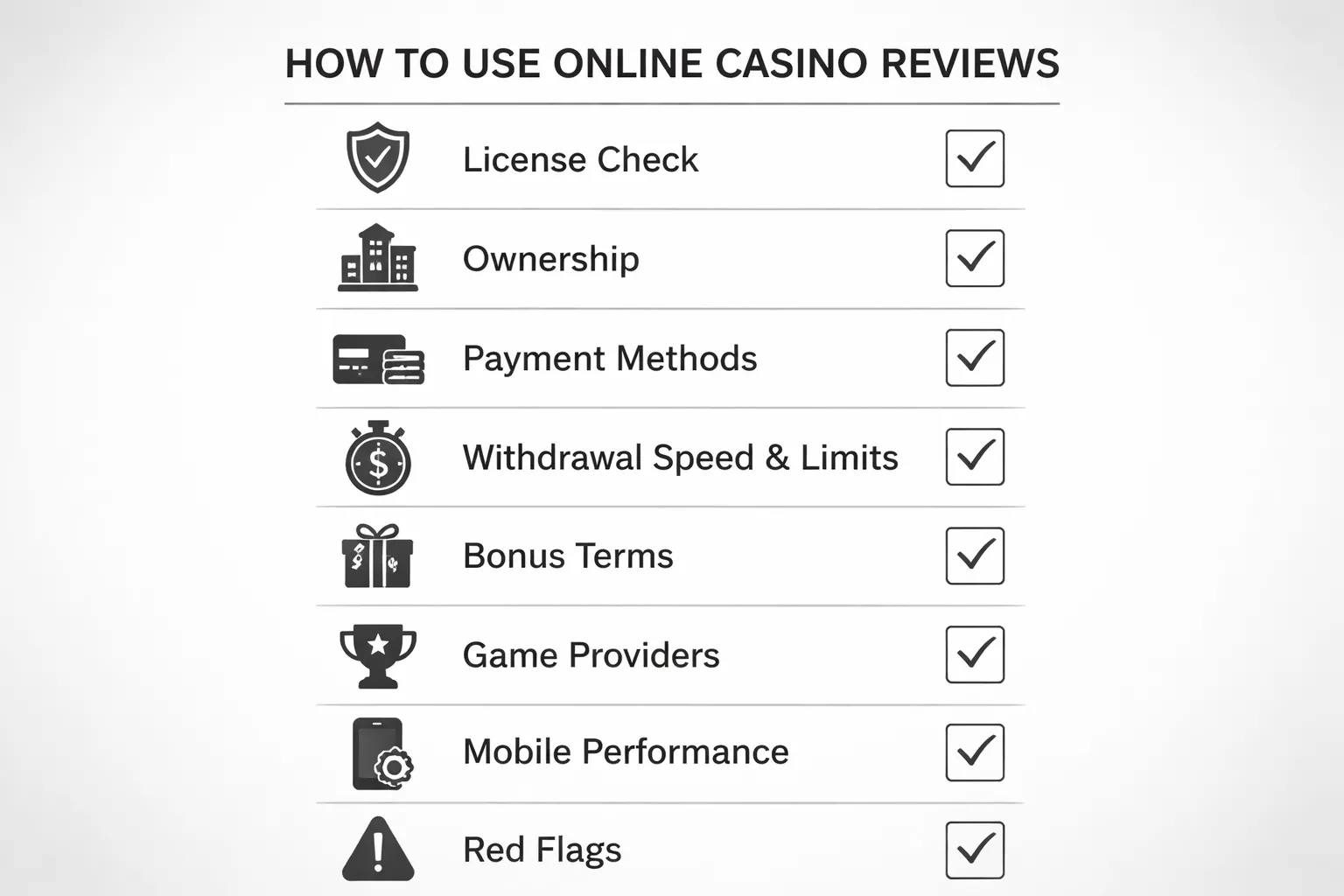
Use reviews to verify claims, not to chase hype. Start with your non-negotiables. Then check the hard limits that control your money, your time, and your withdrawals.
Commercial intent checklist for choosing a casino quickly
- License and regulator: Confirm the regulator, license number, and jurisdiction. Match it to your country and state rules.
- Who runs it: Look for the operator company name and group brands. Avoid casinos that hide ownership.
- Withdrawal speed and limits: Check typical payout times, minimum cashout, maximum per transaction, and any weekly or monthly caps.
- Payment methods you will use: Confirm deposit and withdrawal options, fees, and verification steps. Prioritize methods you already trust.
- Game catalog and providers: Check your games first, slots, live casino, blackjack, roulette, poker. Verify top studios, not just game counts.
- RTP and game rules: Look for RTP disclosure, blackjack rules, roulette wheels, and live dealer limits. For roulette-heavy play, use our roulette casino picks to shortlist.
- Bonus terms that affect cashout: Confirm wagering requirements, game contribution, max bet, expiry, and if a bonus locks your balance.
- Mobile performance: Check iOS and Android support, browser play, load times, and crashes. Verify game filters and cashier usability on mobile.
- Support quality: Confirm live chat hours, email response times, and help center depth. Check if support exists before you deposit.
- Responsible gambling tools: Look for deposit limits, loss limits, time-out, and self-exclusion. It signals a regulated operation.
Key red flags that signal an unsafe or low-quality operator
- No clear license details: No regulator listed, no license number, or a mismatch between brand and license holder.
- Hidden or vague ownership: No company name, no registered address, or only a web form for contact.
- Withdrawal friction: “Pending” payouts with no timeline, unclear verification rules, or strict caps that make large wins hard to cash out.
- Fees and limits buried: Cashout fees, inactive account fees, or high minimum withdrawals placed deep in the terms.
- Bonus terms that trap balance: Low max bet during wagering, short time limits, high wagering requirements, or restricted games that block progress.
- Payment method bait: A deposit method advertised on the homepage, then missing in the cashier for your region.
- Weak game transparency: No provider list, no RTP info, or generic “thousands of games” claims with no proof.
- Poor support access: No live chat, long delays, or scripted replies on withdrawals and bonus rules.
- Terms that give them wide discretion: Broad clauses that let the casino void winnings for vague reasons.
How to separate marketing claims from verifiable facts
Casino pages sell. Reviews should confirm. Use this rule, if you cannot verify it in the cashier, the lobby, or the terms, treat it as marketing.
| Marketing claim | What you should verify |
|---|---|
| “Instant withdrawals” | Real payout range by method, pending periods, limits, and KYC timing. |
| “Best bonus” | Wagering requirement, max bet rule, expiry, game contribution, and withdrawal restrictions. |
| “Thousands of games” | Provider list, search filters, and whether key titles exist in your region. |
| “Top mobile app” | OS support, browser alternative, load speed, crashes, and full cashier access on mobile. |
| “Safe and secure” | License details, operator identity, SSL on cashier, and clear responsible gambling tools. |
| “High RTP slots” | RTP disclosure per game, not a site-wide claim. Confirm in game info screens. |
| “24/7 support” | Live chat hours, average response time, and whether support handles payouts and verification. |
When you read any review, scan the facts first. License, payments, payout limits, bonus rules, and game providers. If those points look solid, then compare extras like VIP perks and promos.
Top-rated online casinos compared (quick shortlist)
Top-rated online casinos compared, quick shortlist
Use this shortlist to compare the basics fast. Then open the full review for the fine print. Focus on license, withdrawals, limits, bonus terms, and fees.
Quick comparison table, what matters
| Casino type | License check | Payout speed | Bonus fit | Fees risk | RTP transparency | Mobile app and site |
|---|---|---|---|---|---|---|
| Regulated US state casinos | State regulator listed on footer and in the cashier. | Often 1 to 3 days for bank, faster for card or e-wallet where offered. | Often lower headline value, clearer rules. | Usually low, but watch bank and check fees. | Varies, check each game info screen. | Usually strong native apps. |
| EU and UK regulated casinos | MGA or UKGC details, plus company name match. | Often same day to 48 hours for e-wallet, longer for bank. | More limits and safer rules, promos can be capped. | Watch currency conversion and provider fees. | Often better disclosures, still per game. | Strong mobile web, apps depend on region. |
| Crypto-first casinos | License varies, verify the regulator and company details. | Often minutes to a few hours after approval. | Big promos are common, terms can be strict. | Watch network fees and exchange spreads. | Check provably fair tools and RTP notes per slot. | Mobile UX ranges from great to rough. |
| Live dealer focused casinos | License plus live studio provider name. | Same as the main cashier options. | Look for live-specific promos with low max bet limits. | Usually low, but watch withdrawal method fees. | Less relevant for live tables, focus on rules and limits. | Needs stable streaming on mobile. |
Best picks by player type
- New players: Pick a site with low wagering, long bonus validity, and a clear max bet rule. Avoid stacked terms like game weighting and short timers.
- VIPs: Pick a site that states VIP benefits upfront. Focus on cashout priority, higher limits, and a named account manager policy.
- Slots players: Pick a site with top providers you like, full RTP access per game, and filters for volatility and features. Watch capped RTP variants.
- Live dealer players: Pick a site with major studios, stable mobile streaming, and table limits that match your bankroll.
- High rollers: Pick a site with high withdrawal limits, fast verification, and clear source of funds rules. Confirm max cashout per month before you deposit.
Best picks by feature
- Fast withdrawals: Look for e-wallet support, instant approval claims with proof, and clear processing windows. Use our fast payout casino shortlist if speed is your top filter.
- Low wagering: Target 10x to 25x or lower, long validity, and low max bet caps that fit your stakes. Avoid high game weighting penalties.
- Crypto: Confirm coin support, minimum withdrawal, required confirmations, and whether the casino charges a handling fee.
- Mobile UX: Prioritize fast login, simple cashier flow, and stable game loading on your device. Test live chat on mobile before you deposit.
How we review and rank online casinos (methodology + scoring)
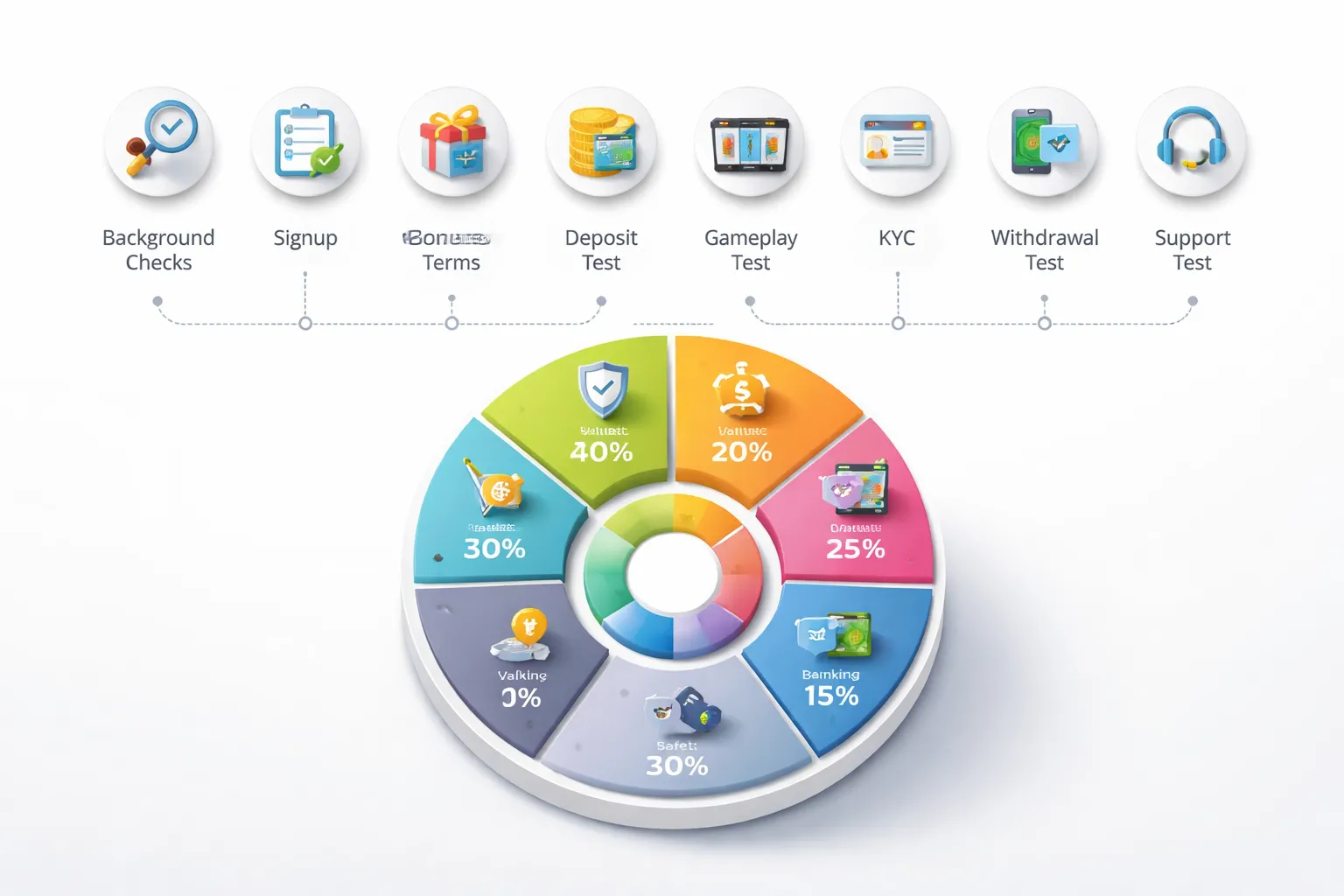
E-E-A-T, who reviews, what we test, how often we re-check
Who reviews. Our reviewers focus on online casinos, payments, and player protection. We use a written checklist. We keep screenshots, timestamps, and transaction records for key steps.
What we test. We test real user flows that affect your money and your time. Licensing and ownership checks. Bonus terms. Game catalog and providers. Banking speed and fees. KYC. Support response quality. Mobile performance.
How often we re-check. We re-check top-ranked casinos on a schedule and after major changes. We also re-test when we see spikes in complaints, bonus term updates, payment issues, or operator ownership changes. If a casino fails a re-check, we lower its score or remove it.
Scoring rubric and weights
We score each category from 0 to 10. We apply weights. We publish a final score out of 100.
| Category | Weight | What we score |
|---|---|---|
| Safety | 30% | License status and regulator, ownership transparency, AML and KYC rules, responsible gambling tools, data security signals, complaint pattern, payout reliability. |
| Value | 20% | Bonus size, wagering, max bet rules, game weighting, expiry, cashout caps, VIP terms, ongoing promos, clarity of terms. |
| Games | 15% | Provider quality, slot and table depth, live dealer coverage, RTP visibility, demo mode access, game stability. |
| Banking | 15% | Deposit and withdrawal methods, minimums, fees, processing time, confirmations for crypto, failed transaction rate, limits that fit normal play. |
| UX and mobile | 10% | Signup speed, login friction, cashier flow, game load time, navigation, session stability, mobile browser and app behavior. |
| Support | 10% | Live chat access, email quality, response time, accuracy, escalation path, tone, ability to solve billing and bonus issues. |
Deal-breakers. We do not recommend a casino if we see clear licensing problems, repeated non-payment reports with evidence, or terms that let the operator void wins without a clear rule and a clear audit trail.
Hands-on testing steps we run on every casino
- Step 1, background checks. We confirm the license, the legal entity, and the site domains covered by the license. We note the regulator and any public enforcement actions.
- Step 2, registration. We time signup, record required fields, and check for friction that blocks legit players. We test password rules and session handling.
- Step 3, bonus and terms review. We read the promo page and full terms. We log wagering, max bet, expiry, restricted games, cashout caps, and withdrawal conditions tied to bonuses.
- Step 4, deposit test. We deposit using common methods when available. We record minimums, fees, approval time, and whether the cashier shows clear status updates.
- Step 5, gameplay test. We play slots and at least one table game and live game if offered. We check game load, crashes, verification popups, and whether RTP and rules link out cleanly.
- Step 6, KYC test. We trigger verification when possible. We document required documents, upload flow, and the time to approval. We log any unclear requests or repeated re-submits.
- Step 7, withdrawal test. We request a withdrawal. We record the timeline from request to approval to receipt. We track fees, limits, partial approval, and any rule citations used to delay payment.
- Step 8, support test. We contact support with the same set of questions on bonuses, KYC, and withdrawals. We score speed, accuracy, and willingness to escalate.
Affiliate transparency and conflicts of interest
Some casinos pay us a referral commission. This never buys a higher score. Reviewers do not negotiate affiliate deals. The scoring rubric stays the same for every casino. If a casino performs poorly in withdrawals, terms, or support, it drops in rank even if it pays more.
When we recommend a casino, we do it based on test results and documented terms. If you want simpler sign-up and stronger guidance, see our beginner-friendly casino picks.
How we handle complaints, disputes, and operator responses
We track player complaints from emails, comment threads, and direct reports. We ask for proof before we treat a claim as verified. We look for receipts, chat logs, email threads, and transaction IDs. We remove personal data.
- Intake. You send the issue, dates, account status, and the exact rule the casino cites.
- Evidence check. We confirm the timeline, payment method, bonus use, and KYC status.
- Pattern check. We compare the report to other cases. One-off mistakes score differently than repeat failures.
- Operator contact. We request a written response and the exact policy used. We give a clear deadline.
- Update. If the operator resolves the case, we note it. If it does not, we adjust the score and add a warning in the review.
We do not act as a legal service. If a dispute involves licensing breaches or non-payment, we point you to the regulator or official ADR path when available.
Safety, licensing, and fairness checks (trust signals that matter)
License checks that you can verify
A license means the casino answers to a regulator. Your job is to confirm the license is real and that it covers your location.
- Find the license details. Scroll to the site footer. Look for the regulator name, license number, and the legal company name.
- Confirm the operator behind the brand. Match the legal entity in the footer to the entity in the terms and conditions, privacy policy, and payment pages.
- Verify on the regulator site. Use the regulator’s license register. Confirm status is active, the domain matches, and the company name matches.
- Check jurisdiction limits. Some licenses cover only certain countries or states. If your region is excluded, you lose protection.
- Look for ADR info. Serious operators list an official dispute route and the regulator contact.
| What to check | What “good” looks like | What to treat as a warning |
|---|---|---|
| License number | Shown in footer and matches the register | Missing, vague, or does not match the register |
| Legal entity | Same company name across policies and payments | Different company names or no company listed |
| Domain coverage | Your exact domain listed on the license entry | License covers another site or a parent brand only |
| Status | Active, not suspended, not expired | Revoked, suspended, or “application pending” |
RNG testing, third-party audits, and provably fair
Most casino games use an RNG, a random number generator. You want proof that an independent lab tested it and that results match the game rules.
- RNG certificate. Look for a testing lab name and a report date. Prefer recent documents and clear scope, like RNG and game math.
- Third-party audit signals. Some sites publish audit summaries, payout reports, or compliance statements. Treat missing scope as a weak signal.
- Provider-level trust. Big studios run their own compliance process, but you still want the casino to show licensed, tested deployment.
Provably fair means you can verify each result using cryptographic checks. You usually see this on some crypto-style games, not on standard slots.
- What you can verify. The game shows a server seed hash before you play, then reveals the server seed after. You can recompute the result and confirm no tampering.
- What it does not guarantee. It does not guarantee you will win. It only proves the draw followed the stated algorithm.
Data protection basics you should expect
Security does not need hype. It needs basics done right.
- SSL. The site should load on https. Your browser should show a valid certificate with no warnings.
- Privacy policy. You should see what data they collect, why they collect it, how long they keep it, and who they share it with.
- Account security. Look for 2FA, device or login alerts, and clear password rules.
- Payment security. Deposits and withdrawals should route through known payment methods. Watch for unclear third-party payees or odd transfer instructions.
- KYC handling. The site should explain document checks and give a realistic timeline. It should not demand excessive documents for small withdrawals.
Game integrity checks, RTP, volatility, and win expectations
Fairness also means transparency. You should know what you are playing and what the numbers imply.
- RTP disclosure. A good casino shows RTP per game, not a site-wide average. Some slots have multiple RTP versions. You want the exact version the casino runs.
- Volatility. High volatility means longer downswings and fewer, bigger hits. Low volatility means smaller swings and more frequent smaller wins.
- House edge reality. RTP is a long-run average across huge volume. Your short session can land far above or below it.
- Table game rules. Rule tweaks change the edge. Blackjack pays 6:5 instead of 3:2, or roulette uses extra zeroes. You should see rules before you bet.
If you focus on high RTP slots, use our guide to high RTP slots and fast payouts to compare operators that publish clear game data.
Common scam patterns we flag
- Fake apps. Download prompts outside official stores, or APK files with broad permissions. Stick to known stores or the casino’s verified web app.
- Clone sites. Copycat domains that mimic a real brand. Small spelling changes, different payment pages, and broken help links often show up first.
- Bonus traps. Wagering terms that block withdrawals, like high multipliers, short time limits, max cashout caps, or excluded games that include most of the lobby.
- Withdrawal stalling. Repeated “security checks” after you win, shifting document demands, or delays that reset when you upload new files.
- Support dodge. No clear escalation path, scripted replies, and no written policy references when you ask for the exact rule used.
We treat these as scoring negatives. When we see patterns across multiple reports, we add warnings and reduce trust scores.
Bonuses and promotions explained (so you don’t get trapped by terms)
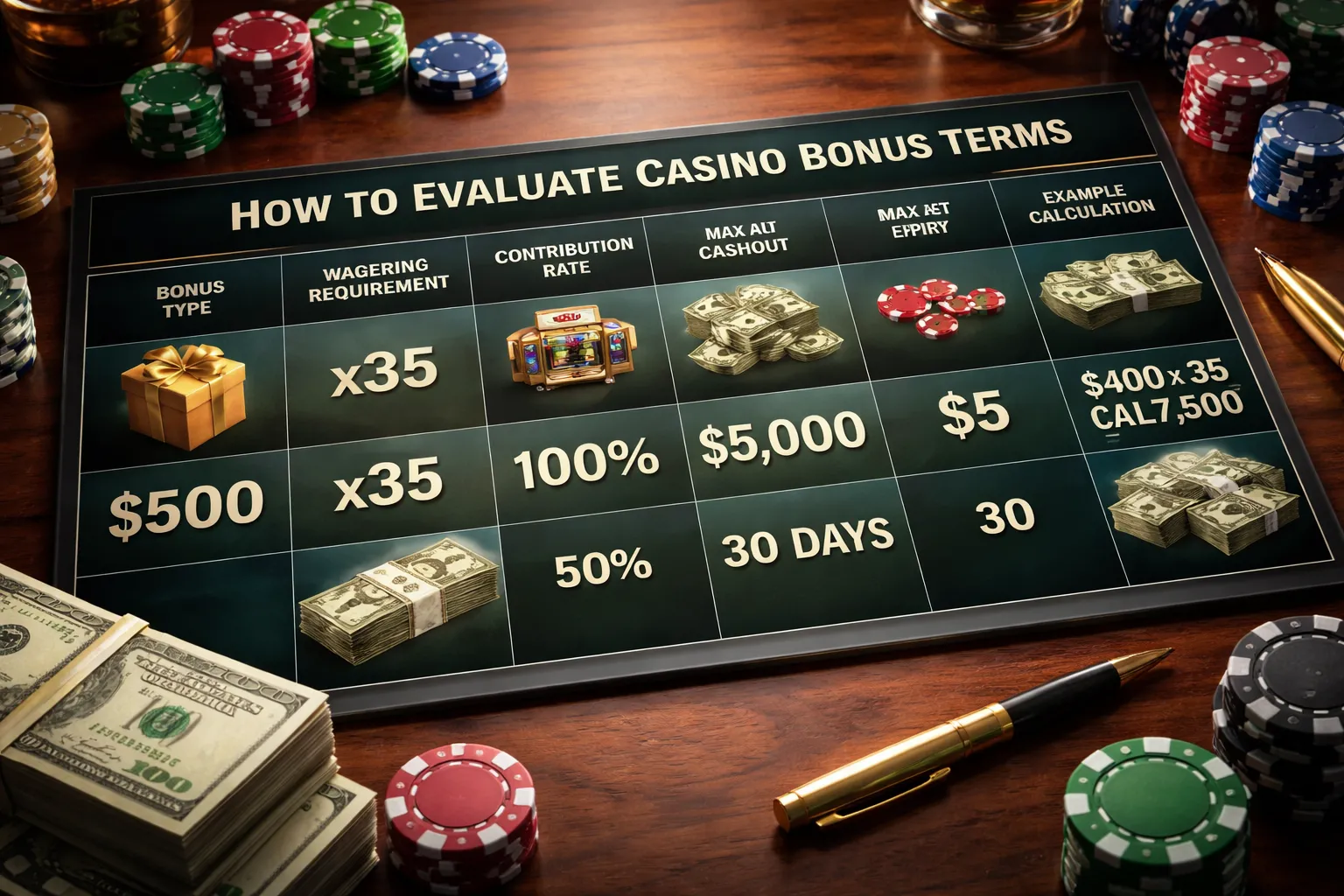
Welcome bonuses vs no-deposit offers vs reloads vs VIP promotions
Bonuses change your risk. Terms decide who wins.
- Welcome bonus. A match on your first deposit, sometimes the first two or three. Good for bankroll size. Often comes with the toughest rules.
- No-deposit bonus. Free spins or a small cash credit for registering. Lowest risk, highest restrictions. Expect low max cashout and short expiry.
- Reload bonus. A match on later deposits, weekly or event-based. Usually smaller than welcome offers. Sometimes better terms.
- VIP promotions. Cashback, tailored reloads, faster withdrawals, higher limits, concierge support. Value depends on your volume. Terms often sit in a separate VIP page.
Wagering requirements, contribution rates, and excluded games
Wagering requirements tell you how much you must bet before you can withdraw bonus funds, and sometimes winnings.
- WR on bonus only. You wager the bonus amount. This is the better structure.
- WR on bonus plus deposit. You wager bonus and your own money. This costs more.
- Contribution rates. Games count at different percentages toward WR. Slots often count 100%. Roulette may count 0% to 20%. Blackjack often counts 0% to 10%. Live dealer games often count 0%.
- Excluded games. Some titles do not count at all. Some casinos block bonus play on specific games.
- Time limits. Many bonuses expire in 7, 14, or 30 days. If you miss the window, you lose the bonus and sometimes the winnings tied to it.
Before you opt in, check the casino bonus page for a “contribution” table and a game exclusion list. If they do not publish one, treat the offer as higher risk.
Bonus caps, max cashout rules, and minimum odds requirements
Caps decide your ceiling, even if you win big.
- Bonus cap. A limit on how much bonus money you can receive. Example, “100% up to $200”.
- Max cashout. A limit on what you can withdraw from a bonus. Common on no-deposit offers. Example, “Max cashout $100”.
- Max bet while wagering. A rule like “Max $5 per spin” or “Max $10 per hand” until WR completes. Breaking it can void winnings.
- Minimum odds requirements. More common on sportsbook-style promos. If casino games fall under a “bonus wallet” tied to sports, you may see minimum odds rules. If you do, confirm the promo applies to casino play, and confirm what counts.
We flag promos that hide caps in secondary pages, or that do not state max bet rules in the main terms.
Free spins, game restrictions, bet size limits, and expiration rules
Free spins look simple. They rarely are.
- Game restriction. Spins often apply to one slot only. If you do not like the slot’s volatility or RTP, you cannot switch.
- Stake per spin. Many offers lock the bet size, for example $0.10 or $0.20 per spin. That limits upside.
- Winnings type. Some free spins pay “bonus funds” that need WR. Others pay “cash” with no WR. The difference is large.
- Expiry. Free spins can expire in 24 to 72 hours. Winnings can expire separately.
- Max cashout. Common on no-deposit free spins. You may win more than you can withdraw.
How to calculate real bonus value with worked examples
Use this checklist. It gives you a fast, comparable number.
- Write down the deposit, match rate, and bonus cap.
- Confirm whether WR applies to bonus only or bonus plus deposit.
- Check WR multiplier and game contribution for what you actually play.
- Check max bet, max cashout, and expiry.
| Item | Example A (cleaner offer) | Example B (costly offer) |
|---|---|---|
| Deposit | $100 | $100 |
| Match | 100% up to $100 | 100% up to $100 |
| Bonus received | $100 | $100 |
| WR basis | Bonus only | Bonus + deposit |
| WR multiplier | 30x | 35x |
| WR total | $100 x 30 = $3,000 | ($100 + $100) x 35 = $7,000 |
| Your game contribution | Slots 100% | Roulette 10% |
| Effective wagering needed | $3,000 in slots play | $7,000 / 0.10 = $70,000 in roulette play |
Example A can be realistic if you accept variance and have time. Example B traps many players because the contribution rate turns a normal WR into a huge target.
Now apply the same math to free spins.
| Item | Example (free spins) |
|---|---|
| Free spins | 50 spins |
| Stake per spin | $0.10 |
| Total stake value | 50 x $0.10 = $5 |
| Winnings type | Bonus funds |
| WR | 40x winnings |
| Max cashout | $50 |
If you win $20 from the spins, you must wager $20 x 40 = $800 before withdrawal, and you still cannot withdraw more than $50 from that promo. That is the real value. It is the cashout cap, the WR, and the contribution rules, not the headline.
If you want promos built for high volume and higher limits, see our high roller casino guide.
Games library and software providers (what to look for beyond ‘thousands of games’)
Games library and software providers, what to look for beyond “thousands of games”
Game count means little. Look at game types, providers, and rules. Those factors decide RTP range, limits, stability, and how fair the games feel in real play.
Slots variety, releases, classics, Megaways, jackpots, demo mode
- New releases: Check if the lobby adds new games weekly or monthly, not once per quarter. A stale library often signals weak provider deals.
- Classics: Look for 3 reel slots, low volatility options, and simple paytables. You want these for bankroll control and quick sessions.
- Megaways and high volatility: Confirm the site carries branded mechanics like Megaways, Infinity Reels, Hold and Win, and bonus buy slots where legal. These drive high variance. Your bankroll needs to match.
- Jackpot slots: Separate jackpot branded games from standard “jackpot” labels in the lobby. Real jackpot slots show the pool type and the current prize.
- Demo mode: Make sure you can play for free in demo. Demo lets you check feature frequency, bonus triggers, and if the game runs well on your device before you deposit.
Live dealer quality, studios, limits, game shows, stream performance
- Studios: Prioritize known studios like Evolution, Playtech, Pragmatic Live, and Ezugi. They tend to deliver better uptime and game integrity, plus more table variants.
- Limits: Check minimum and maximum bets per table. A good live lobby covers micro stakes and high limits, not just one band.
- Game shows: If you play Lightning Roulette, Crazy Time, Monopoly Live, or Mega Wheel, confirm the casino offers multiple tables. More tables means better limits and less crowding.
- Stream performance: Look for stable HD, fast loading, and no audio drift. Poor streams cause misclicks and forced reloading, which matters in fast games.
Table games depth, variants, side bets, rules that change the house edge
- Roulette variants: European and French beat American on odds. One extra zero changes the edge. If roulette matters to you, use our roulette casino guide to compare wheels, limits, and live options.
- Blackjack rules: Track key rules, dealer hits or stands on soft 17, double after split, resplit aces, late surrender, blackjack payout. A 6:5 table costs you.
- Baccarat variants: Standard baccarat stays tight. Side bets often carry a steep edge. Play them only if you accept the cost.
- Side bets: Side bets boost volatility and can mask weak core rules. Check the main game rules first.
- Game speed and UI: Some RNG tables run too fast or hide key info like recent results, bet history, and rule sheets. You want clear rules and clean controls.
Top providers and why they matter, reliability, RTP transparency, features
- Reliability: Big providers usually mean fewer broken games, fewer session drops, and faster bug fixes.
- RTP transparency: Strong casinos show RTP in the game info or help pages, and they do not hide RTP variants. Some slots ship with multiple RTP settings. You want the higher one.
- Features you can verify: Turbo mode, autoplay, buy bonus, realistic spin speed caps, and responsible play tools. These affect how you play and how fast you wager.
- Consistency across devices: The same provider should run smoothly on mobile and desktop. If mobile versions lag or crash, your session quality drops.
Jackpots, network vs local pools, what impacts payout potential
- Network jackpots: One pool shared across many casinos. The prize grows faster and hits more often due to higher total play volume. The casino cannot “pick” when it drops.
- Local jackpots: One pool tied to one casino or one brand group. The pool grows slower. The top prize can still be strong, but you rely on smaller traffic.
- What affects jackpot pace: Player volume, stake size, and the contribution rate built into the game. You cannot control the math, but you can choose games with higher traffic and clear jackpot displays.
- Verify the jackpot: Real jackpots show a live counter in game and a clear game title. Avoid vague “jackpot” categories with no displayed pool.
Banking, withdrawals, and payout speed (the make-or-break category)
Banking and payouts decide if a casino is usable
Games and bonuses do not matter if you cannot cash out fast, in your currency, and at a fair cost. Treat banking as a core rating category. You want clear methods, clear limits, and a trackable payout timeline.
Deposit methods by region
Good casinos match local habits. They also show method availability after you pick your country and currency. If the cashier hides options until after deposit, expect more surprises later.
- United States: PayPal at some regulated brands, online banking via ACH or bank transfer, debit cards, prepaid options in some states. Credit cards often fail for gambling. Some casinos route cards through third-party processors, this can add fees and declines.
- United Kingdom and Ireland: Debit cards, bank transfer, Pay by Bank or open banking, e-wallets. Credit card gambling is banned in the UK. Expect strict name matching on all methods.
- Canada: Interac, debit cards, e-wallets, bank transfer. CAD support matters, forced USD conversion adds cost.
- Europe (EEA): SEPA bank transfer, local instant bank payments, cards, major e-wallets. Some markets see strong prepaid use.
- Latin America: Local bank transfers, cash vouchers, cards, some wallets. Look for local currency support to avoid repeated FX charges.
- Australia and New Zealand: Access depends on local rules and the operator’s licensing. Where offered, expect cards, bank transfer, and wallets. Verify withdrawals before you deposit.
- Crypto-friendly markets: Crypto deposits and withdrawals can be fast, but you take coin volatility and network fees. You also need to confirm the casino allows cashout to the same wallet type.
If you rely on PayPal, use our PayPal casino guide to filter faster.
Withdrawal timelines by method
Payout speed has two parts. Casino processing time, then payment network time. Many sites advertise only the second part. You need both.
| Method | Typical casino processing | Typical delivery after approval | What slows it down |
|---|---|---|---|
| E-wallets (PayPal, Skrill, Neteller) | 0 to 24 hours at strong casinos, 24 to 72 hours at average sites | Minutes to 24 hours | First withdrawal checks, name mismatch, source of funds requests |
| Instant bank (open banking, Pay by Bank where supported) | 0 to 48 hours | Minutes to 24 hours | Bank downtime, manual review, weekend cutoffs |
| Bank transfer (ACH, SEPA, wire) | 24 to 96 hours | 1 to 5 business days | Intermediary banks, compliance checks, incorrect IBAN or routing |
| Debit cards | 24 to 96 hours | 1 to 7 business days | Card issuer rules, card withdrawal limits, refunds processed as reversals |
| Prepaid vouchers | Often deposit-only | N/A | Casino requires you to withdraw via bank or e-wallet instead |
| Crypto (BTC, ETH, stablecoins) | 0 to 48 hours | Minutes to a few hours after broadcast | Blockchain congestion, wrong network selection, extra wallet verification |
How to spot realistic payout claims
- Trust timelines that separate processing from delivery.
- Reject vague promises like instant withdrawals without a defined cap, method list, and verification rules.
- Look for published cutoffs. Many cashiers batch approvals once per day.
- Check if the casino pays only on business days. If yes, weekends can add 2 days.
- Read the withdrawal page for the words up to. “Up to 24 hours” often means “sometimes 24 hours.”
Fees, exchange rates, and hidden costs
Small costs stack. They reduce your bankroll more than you think.
- Deposit fees: Some card and wallet deposits add a percentage fee. A top casino either absorbs it or states it before you confirm.
- Withdrawal fees: Watch for fixed cashout charges, especially for bank transfers and smaller withdrawals.
- Currency conversion: If the casino forces a base currency you do not use, you can pay FX twice, once on deposit, once on withdrawal.
- Bad FX rates: Some sites use wide spreads instead of a clear fee. Compare the cashier rate to a mid-market rate.
- Inactive account fees: These hit players who take breaks. Good casinos warn you clearly and give a long grace period.
- Crypto network fees: You pay them. ETH can spike. Stablecoins on low-fee networks can reduce cost, if the casino supports them.
Limits, pending periods, and checks that delay cashouts
Fast casinos still enforce controls. You need to know where delays come from.
- Minimum withdrawal: Commonly higher for bank transfer than e-wallets. If your balance sits under the minimum, you wait or keep playing.
- Maximum per transaction and per week: Limits create “payout in parts.” High rollers should check monthly caps.
- Pending period: Some casinos hold withdrawals for cancellation windows. They call it pending, cooling-off, or security review.
- Same-method rule: Many sites send withdrawals back to the original deposit method first. This can force card refunds before you can use an e-wallet.
- Bonus rollover checks: If you have an active bonus, the cashier may lock withdrawals until you meet wagering or forfeit the bonus.
- Game contribution rules: Slots often count 100%. Table games may count 0% to 20%. If you ignore this, you extend rollover and delay cashout.
KYC verification, what you need and how to pass fast
KYC causes most first cashout delays. You can avoid it by preparing before you win.
- Proof of identity: Passport, national ID, or driver’s license. Upload color images. Show all corners. Keep text sharp.
- Proof of address: Utility bill, bank statement, or government letter, usually dated within the last 90 days. Match the casino profile address exactly.
- Payment proof: Card photo with middle digits covered, e-wallet screenshot showing your name and email, or bank document with account holder name.
- Source of funds or wealth: Sometimes required for large withdrawals or regulated markets. Expect payslips, bank statements, or tax documents.
- Set your profile first: Use your legal name. Do not use nicknames. Do not mix alphabets.
- Use one method when possible: Multiple deposit methods trigger extra checks.
- Do not crop too tight: Cropped documents fail. Show the full page.
- Match countries and currencies: A UK address with a non-UK payment method can trigger manual review.
- Verify before you request a withdrawal: The best casinos let you submit documents at signup or after your first deposit.
If a casino hides its withdrawal rules, fees, or KYC standards, treat it as a risk signal. Use this checklist with our guide to choosing a safe online casino before you fund an account.
User experience and mobile play (apps, browsers, and performance)
Mobile casino evaluation, load time, stability, and touch-friendly design
Mobile play decides if a casino fits your day-to-day use. You should test it before you deposit.
- Load time: Open the lobby on 4G and on home Wi-Fi. A solid site loads the home screen fast and lets you reach a game in a few taps. If the lobby stalls, your sessions will feel slow.
- Stability: Play 15 to 20 spins, then switch apps and return. You want the game to resume without a reload loop. If you see frequent disconnect banners or frozen reels, expect issues during deposits and withdrawals too.
- Touch design: Check button size, menu spacing, and game controls. You should not need to pinch-zoom to read rules, paylines, or bet settings. Look for clear tap targets for spin, auto-play, and menu.
- Battery and data use: Live dealer and some 3D slots drain power fast. If the casino offers stream quality controls for live tables, you get better performance on weaker connections.
- Payments on mobile: Open cashier, pick a method, and confirm the flow stays inside the browser or app without broken redirects. Failed redirects often cause abandoned deposits.
Native apps vs mobile web, pros, cons, and compatibility notes
Most casinos run well in a mobile browser. Some also offer native apps. Each option has tradeoffs.
- Mobile web pros: No install, quick updates, works on most devices, easy to switch between casinos.
- Mobile web cons: Browser limits can affect background activity, push alerts, and some identity checks. Older phones may struggle with heavy lobbies.
- Native app pros: Smoother navigation, better session persistence, and stronger support for notifications and biometric login on some devices.
- Native app cons: You must update it. Storage use adds up. Some regions require side-loading, which adds risk and friction.
- Compatibility checks: Confirm iOS and Android support, minimum OS version, and whether the same account works across app and browser. Also confirm the game catalog matches, some apps exclude certain providers or live tables.
Localization, languages, currencies, and geo-specific content
Localization impacts payments, support, and the games you can access.
- Languages: Check the full path, signup, cashier, bonus terms, and withdrawal pages. Some casinos translate only the lobby and leave key terms in English.
- Currencies: Pick your base currency at signup if possible. If the casino forces conversions, you may pay extra through exchange rates and issuer fees.
- Geo rules: Game libraries and bonuses often change by country and state. Confirm the casino shows your correct region before you deposit. Mismatched geo detection can block promotions or trigger account review.
- Local payments: A strong localized casino offers methods people in your region use, plus clear limits and processing times on mobile.
Accessibility and account controls (session timers, history, notifications)
Good UX also means control. You should find these tools fast, on mobile, without digging through menus.
- Session controls: Look for session timers, reality checks, deposit limits, loss limits, and time-out options. You should be able to set them in minutes.
- Account history: You need searchable history for deposits, withdrawals, bonuses, and bets. If the casino hides history behind multiple screens, support disputes take longer.
- Notifications: Check how the casino handles bonus alerts, withdrawal updates, and security notices. You want clear opt-outs for marketing messages.
- Security access: Enable 2FA if offered. Confirm you can view active sessions and log out of all devices.
- Help access: Support should stay reachable while you play, via a persistent help icon or in-game menu. Slow access often leads to abandoned chats and unresolved payment issues.
For more safety checks that tie UX to risk signals, use our guide to choosing a safe online casino before you commit to a new site.
Customer support quality (how we test real help, not promises)
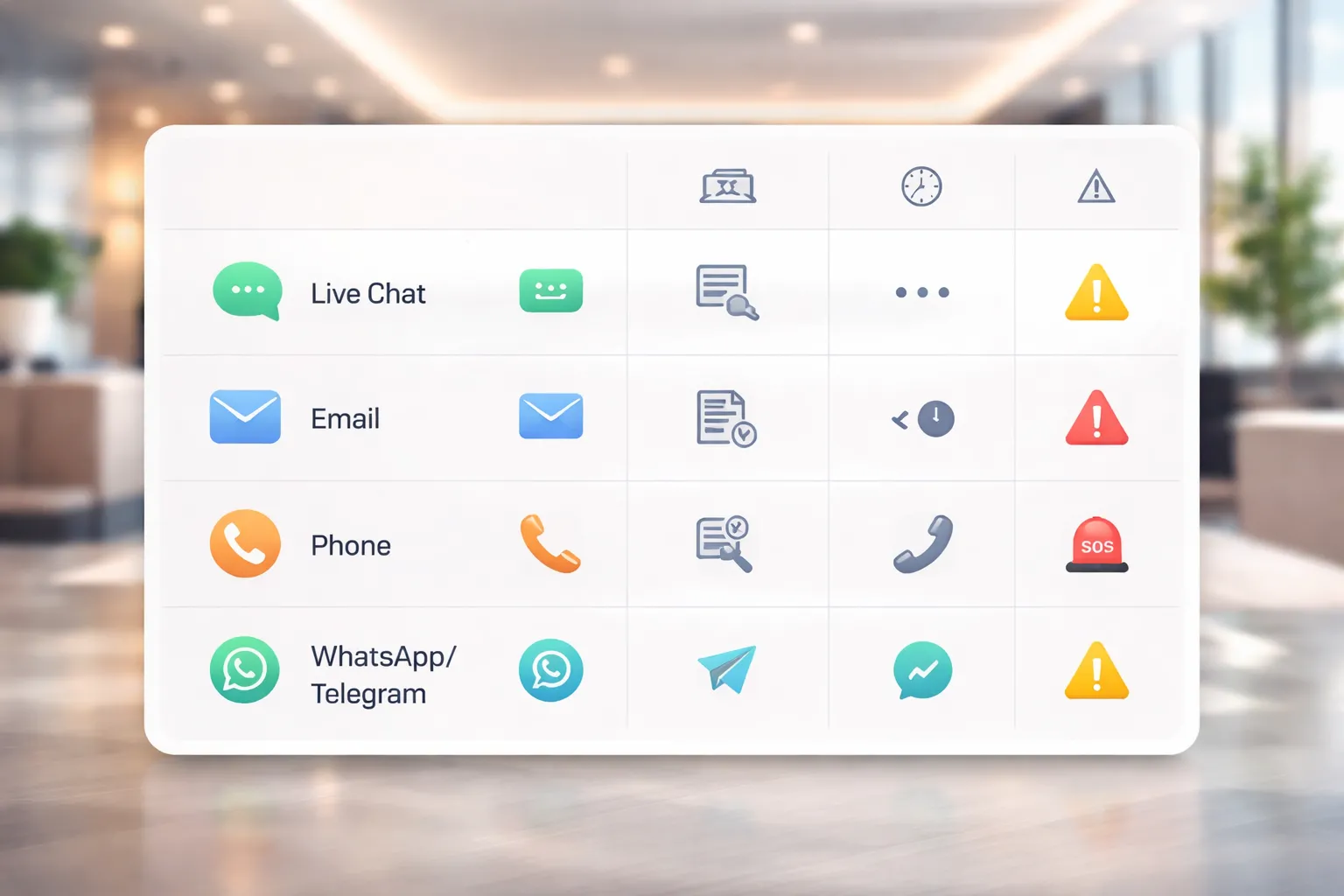
Support channels, what we test and what works
We test support the way you use it, mid-session, on mobile and desktop. We open the same issues across channels and track speed, accuracy, and follow-through. We do not score promises on a footer badge. We score outcomes.
- Live chat. Best for urgent problems, stuck deposits, locked accounts, bonus blocks, and game errors. It must connect fast, identify you, and give clear next steps. We mark down chats that push you to email for basic tasks.
- Email. Best for document checks, chargeback questions, and anything that needs screenshots. We check if you get a ticket number, a clear case owner, and an audit trail of actions taken.
- Phone. Useful for high-value players and account takeovers. We check call availability by country, hold times, and whether the agent can actually act or just repeat policy.
- WhatsApp or Telegram. Useful for quick status checks. High risk for impersonation. We only treat it as a plus if the casino verifies the account inside your logged-in area and never asks for passwords, full card numbers, or codes.
Response-time and resolution benchmarks from real test tickets
We submit real tickets with controlled variables. Same device type, same time windows, same issue set. We log first response time, time to a competent agent, and time to resolution. We retest if the first answer looks copied or avoids the question.
| Test item | Good | Acceptable | Fail |
|---|---|---|---|
| Live chat first response | Under 60 seconds | 1 to 3 minutes | Over 5 minutes, or no agent |
| Live chat resolution | Under 15 minutes | 15 to 45 minutes | Forced to email for simple fixes |
| Email first response | Under 6 hours | 6 to 24 hours | Over 48 hours, or no ticket ID |
| Withdrawal status clarity | Exact step, ETA, and reason codes | General ETA, limited detail | Vague delays, no explanation |
| Policy accuracy | Matches terms and cashier rules | Minor gaps, corrected on follow-up | Contradicts terms, shifts blame |
- We test high-friction cases. Pending withdrawals, bonus restriction checks, failed deposits, verification delays, and self-exclusion questions.
- We look for ownership. Good support assigns a case number, sets a timeline, and updates you without chasing.
- We verify actions. If support claims they escalated, we ask for the team name, reference ID, and expected response window.
- We connect support to payout risk. Slow or evasive answers often track with slow cashouts. Use our fast payout casino list if withdrawals matter most to you.
Self-help resources, depth over volume
Strong help centers reduce mistakes that cause payment holds. We grade clarity, completeness, and whether pages match what you see in the cashier.
- FAQ quality. We expect clear answers on KYC, withdrawal steps, bonus wagering, game restrictions, and account limits. We mark down pages that hide key limits in fine print.
- Payment guides. We check method-by-method limits, fees, typical processing times, and required documents. We test if the guide matches the cashier for your location.
- Troubleshooting. We look for steps you can follow. Cache, app version, browser settings, geolocation errors, and failed deposit causes. We mark down guides that say “try later” with no fix path.
- Status visibility. Good casinos show withdrawal state changes, pending reasons, and next actions inside your account. Bad casinos make you ask support for basics.
Dispute resolution and escalation paths
Support matters most when something goes wrong. We check if you can escalate cleanly, and if the casino gives you a trackable path from chat to a final decision.
- Internal escalation. We look for a clear route to a supervisor or payments team, with a reference number and written recap.
- Complaint handling. We expect defined timelines, a decision in writing, and access to supporting policy text. We mark down casinos that close tickets without answers.
- Regulator or ADR options. Licensed casinos should name the licensing body and provide a formal complaints process. We check if the info sits in the footer and inside the help center.
- Responsible gambling escalation. We test self-exclusion and limit requests. Good support applies changes fast, confirms in writing, and blocks marketing contact where required.
Responsible gambling and player protection tools
Deposit, loss, wager, and session limits
Strong casinos let you set limits inside your account, without support tickets. You should see separate controls for deposits, net losses, wagering, and session time.
- Deposit limits. Daily, weekly, and monthly options. Changes should apply fast. Increases should trigger a cooling period before they take effect.
- Loss limits. Net loss tracking, not vague spending totals. The casino should show how it calculates losses across games and bonuses.
- Wager limits. A cap on total stakes over a period. This matters if you want a hard ceiling even when you win and recycle funds.
- Session limits. A timer that logs you out when time is up. It should block re-entry until the next session window, not just show a reminder.
Good tools show your current usage in real time. You should see remaining headroom, reset dates, and the time zone used for calculations.
We check if limits work across web and mobile, and whether they cover all products. If the casino offers live games, limits should still apply. If you play live tables, use a casino that supports tight limits across providers, see our best live dealer casinos list for options.
Self-exclusion and cooling-off periods
Cooling-off should give you short breaks. Self-exclusion should lock you out for longer periods. Both should be easy to trigger from your account.
- Cooling-off. Common options include 24 hours, 7 days, and 30 days. The casino should log you out, block deposits, and block play until the period ends.
- Self-exclusion. You should see clear terms and lengths, often 6 months, 1 year, or indefinite. A strong casino confirms by email and states the end date if there is one.
- Marketing blocks. After exclusion, the casino should stop promo emails, texts, and push notifications where rules require it.
We test enforcement by trying to log in after activation, trying to deposit, and checking if promos still arrive. We also check if the casino blocks new account creation with the same identity details. Weak casinos allow re-registration or keep marketing active.
Underage gambling prevention and identity safeguards
Player protection starts with age checks and identity controls. You should see clear KYC steps and secure handling of documents.
- Age and identity verification. The casino should verify before you can withdraw, and in higher risk cases before you can deposit or play.
- Duplicate account checks. Strong sites detect repeats using name, date of birth, address, device, and payment signals. This supports self-exclusion enforcement.
- Payment and fraud controls. Expect card and wallet verification, limits on mismatched names, and extra checks on large or rapid deposits.
- Account security. Look for 2FA options, session controls, and alerts for new device logins.
We review the casino’s verification flow, document upload process, and stated data retention rules. We also look for clear timelines and what triggers extra checks.
Where to get help
If gambling stops feeling controlled, act fast. Use the casino tools first, then get outside support.
- Immediate steps. Set a deposit limit. Set a loss limit. Start a cooling-off. If you need a hard stop, self-exclude.
- Ask support for escalation. Request exclusion in writing, ask them to block marketing, and ask for confirmation and effective dates.
- Use specialist support. Licensed casinos should link to recognized problem gambling organizations and helplines for your region. We flag casinos that hide or omit these links.
- Document everything. Save emails, chat transcripts, and screenshots of limit settings. This helps if you need to raise a complaint with a regulator or ADR.
Good casinos place responsible gambling links in the footer, the cashier, and the account menu. You should reach help resources in two clicks or less.
Online casino reviews by location (legal notes + best options)
United States, state-by-state availability and why it matters
US online casinos operate at the state level. Your state decides what is legal, who can offer it, and how disputes work. A casino that is legal in one state can be illegal in the next.
- Regulated states: You play on state-licensed sites. You get stronger consumer protection, audited games, and clear complaint paths.
- Unregulated states: You will see offshore casinos, and sweepstakes-style sites. Your legal and payment risk goes up. Support and dispute options often get weaker.
- Why it matters: Licensing controls game testing, bonus terms, payout rules, tax reporting, and enforcement.
| What to check | What “good” looks like | What to avoid |
|---|---|---|
| State eligibility | Site blocks out-of-state play, clear state list | Vague “available in the US” claims |
| License proof | Named state regulator, license number, public lookup | Only a logo, no license details |
| Geolocation | Known geolocation vendor, clear troubleshooting | Requests for VPN use |
| Payments | State-legal methods, predictable processing times | Crypto-only, wire-only, unclear fees |
Best options in regulated states usually include the major brands tied to land-based partners. You should prioritize sites that publish the regulator name, the license number, and a complaint route.
United Kingdom, UKGC standards, GamStop, and bonus advertising rules
UK sites follow UK Gambling Commission rules. These rules shape how casinos market, verify you, and handle safer gambling.
- UKGC controls: Strict ID checks, anti-fraud systems, protected customer funds policies, and formal complaint and ADR steps.
- GamStop: If you self-exclude, UKGC casinos must block you. A casino that suggests workarounds is a hard no.
- Bonus advertising: Offers must show key terms clearly. Expect clearer wagering rules, time limits, and max cashout terms. If terms hide in footnotes, skip it.
Best options in the UK are UKGC-licensed casinos with clear bonus terms, fast verification, and visible safer gambling tools in your account.
Canada, provincial platforms vs offshore sites, key differences
Canada runs on provincial models. Some provinces offer government-backed platforms. Ontario also licenses private operators under a provincial regulator.
- Provincial platforms: Clear local control, local support, and defined dispute routes. Game selection can be narrower. Bonuses can be smaller.
- Ontario regulated market: Licensed private sites operate under provincial rules. You get defined standards for payouts, complaints, and responsible gambling.
- Offshore sites: Wider bonuses and game libraries, but weaker enforcement and harder disputes. Terms can change fast. Payment limits and withdrawal checks can be stricter.
| Area | Provincial or Ontario-regulated | Offshore |
|---|---|---|
| Disputes | Clear regulator process | Often email-only, limited escalation |
| Game testing | Defined standards, regular oversight | Depends on license and operator |
| Bonuses | More controlled marketing | Bigger offers, tighter traps in terms |
| Withdrawals | More predictable rules | More variance, more extra checks |
If you care most about predictable cashouts, prioritize licensed platforms and sites with a strong withdrawal track record. See our guide to fast payout casinos.
Europe and rest of world, common licensing hubs and local restrictions
Europe mixes local licenses with cross-border licenses. Many countries restrict advertising, bonuses, or game types. Some block unlicensed sites at the ISP or payment level.
- Malta (MGA): Common in Europe. Strong baseline controls. Look for clear terms and a real license entry you can verify.
- Gibraltar: Often used by larger brands. Solid compliance expectations.
- Isle of Man: Smaller hub, but respected. Good for oversight and dispute structure.
- Curaçao: Common global license. Quality varies by operator. You must check operator reputation, complaint handling, and withdrawal history.
- Local licenses: Countries like Spain, Italy, Sweden, Denmark, and the Netherlands require local licensing for legal marketing and operation.
Common restrictions you will run into include deposit and loss limits, bonus limits, mandatory ID checks, and limits on autoplay or certain slot features. These rules differ by country.
How to confirm your eligibility before depositing
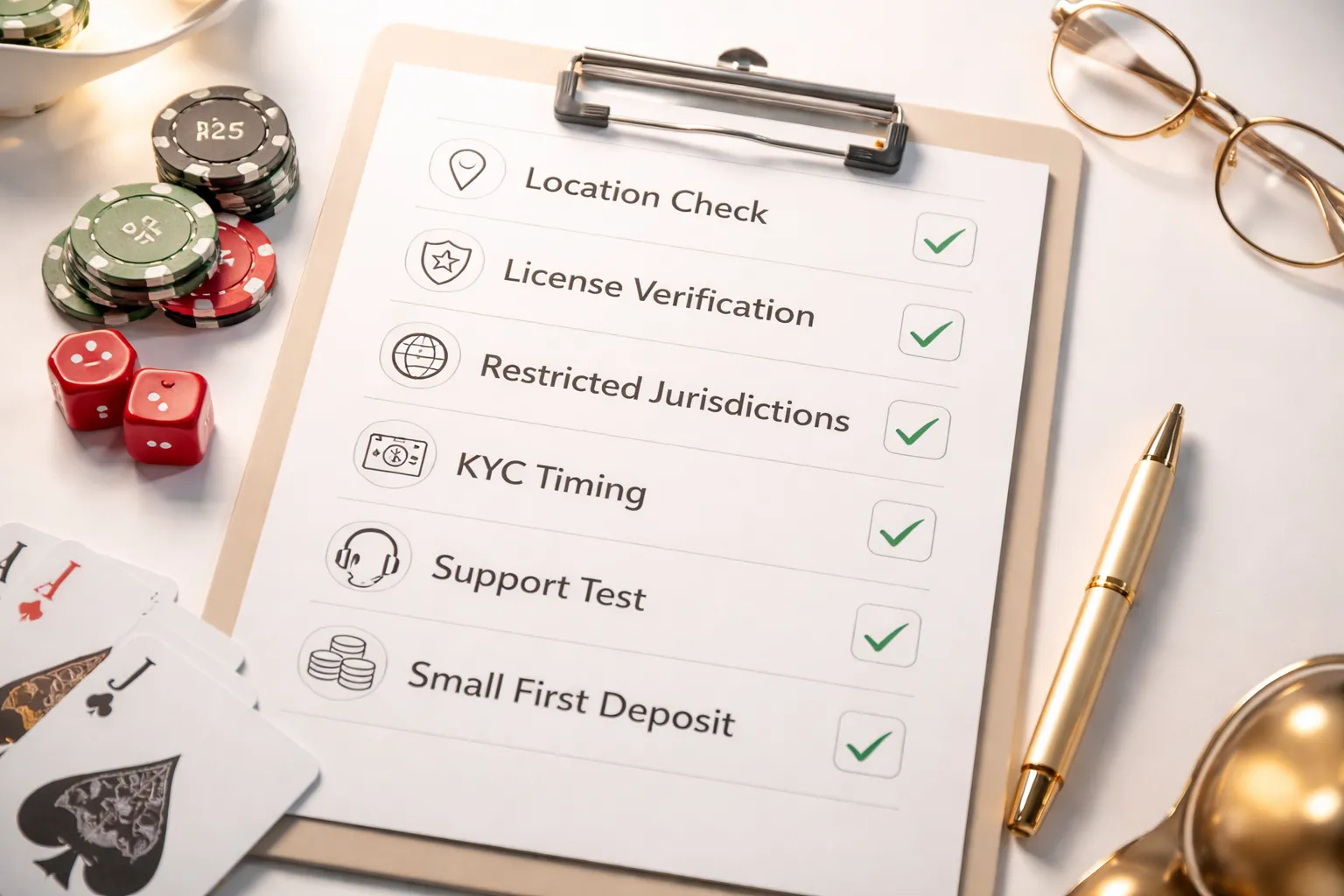
- Step 1, confirm your location rules: Check your country, state, or province rules. Do not rely on a casino homepage banner.
- Step 2, verify the license: Scroll to the footer. Find the regulator name and license number. Use the regulator’s official register to confirm it matches the casino brand and domain.
- Step 3, read restricted countries and payment limits: Open the terms page. Search for “restricted”, “excluded”, “jurisdiction”, and “withdrawal”.
- Step 4, check KYC timing: Look for when the casino verifies you. If it says it can delay checks until withdrawal, expect delays later.
- Step 5, test support before you pay: Ask one clear question about your location eligibility and withdrawal documents. Save the transcript.
- Step 6, deposit small first: Confirm the cashier works, and that you can withdraw using the same method.
If a casino pushes VPN use, blocks terms by region, or refuses to name its license, walk away.
Step-by-step: how to choose the right casino for your play style
Define your priorities before you compare casinos
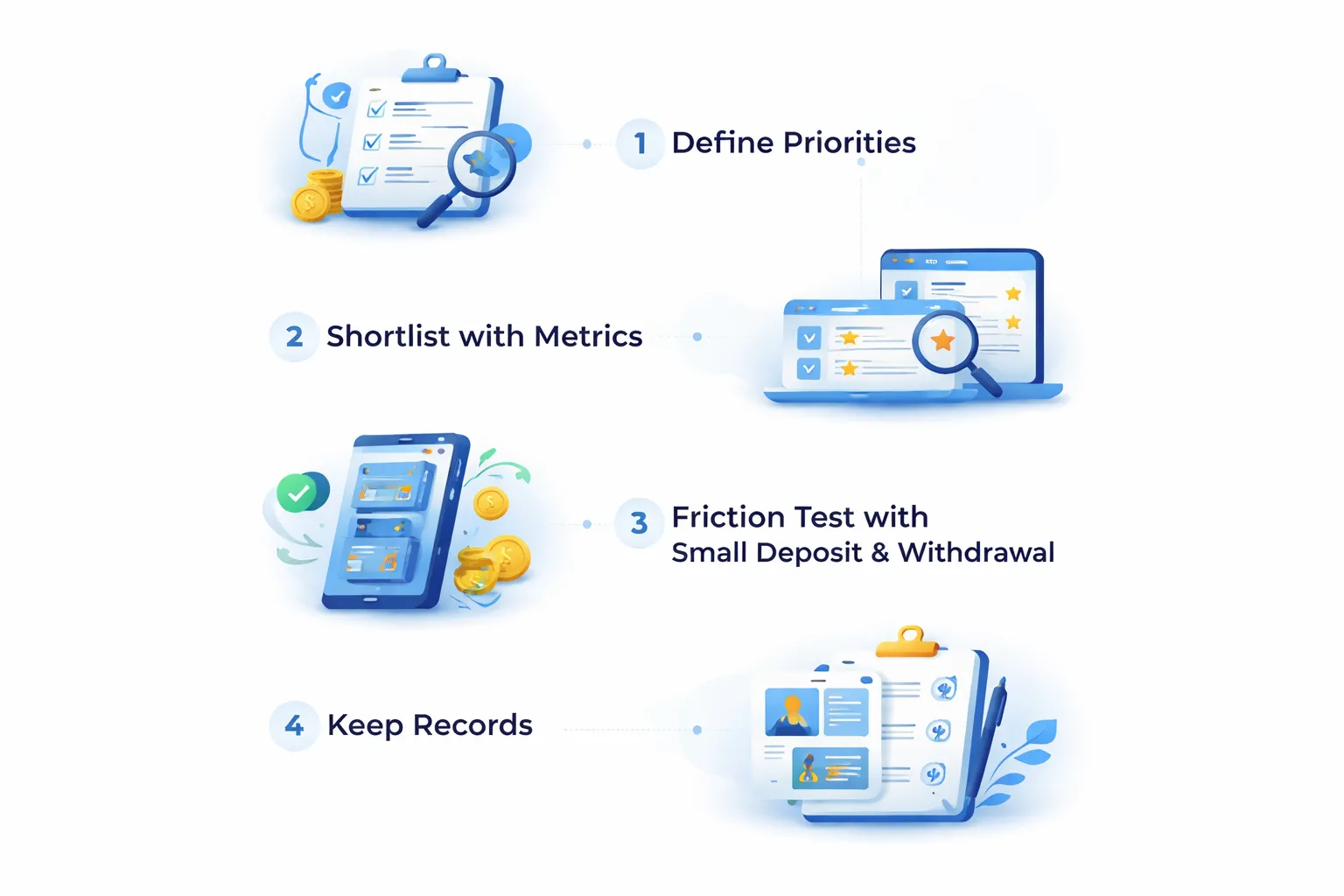
Write down your non-negotiables. Use a short list. Rank each item as must-have or nice-to-have.
- Fast cashouts: Check average payout time by method. Separate e-wallets, cards, bank transfers, and crypto. Look for clear processing windows and cut-off times.
- Low wagering: Focus on wagering multiple, max bet rules, excluded games, and time limits. A big bonus with 50x wagering often costs more than it pays.
- Game types: Pick what you will actually play. Slots, live dealer, blackjack, roulette, poker variants. Then check the provider list and the game count per category.
- Limits: Match your bankroll. Check minimum deposit, minimum withdrawal, and maximum cashout per day, week, and month. Also check max bet while a bonus is active.
- Payment methods: Confirm your preferred method supports both deposit and withdrawal. Avoid casinos that allow deposits by one method but force withdrawals by another.
- Device fit: If you play on phone, prioritize stable mobile UX, fast loading, and biometric login support. Use one source for mobile picks like our best mobile casino apps guide.
Shortlist with objective metrics and independent sources
Build a shortlist of three to five casinos. Use the same checklist for each site. Compare facts, not marketing.
- License and operator: Identify the license number, regulator, and legal entity. Match them to the regulator’s public register.
- Withdrawal terms: Read the banking page and terms for payout speed, verification triggers, and fee policy. Note any clauses that allow “additional checks” without time limits.
- Bonus terms that change value: Capture wagering, excluded games, max bet, contribution rates, and expiration. These decide the real cost of a promo.
- RTP and game rules: For table games and live dealer, check rules that affect house edge. For slots, confirm RTP display and provider authenticity.
- Responsible gambling tools: Look for deposit limits, loss limits, time-outs, and self-exclusion. You want controls you can set yourself.
- Reputation signals: Check multiple independent review sources and complaint logs. Focus on patterns, slow payouts, closed accounts, bonus voids, and KYC disputes.
| Metric | What to record | Why it matters |
|---|---|---|
| Cashout speed | Processing time by method, plus any “up to” wording | Predicts how long your money stays locked |
| Wagering rules | Multiple, max bet, excluded games, expiry | Determines promo value and risk of voided wins |
| Limits | Min deposit, min withdrawal, max cashout caps | Stops you from getting trapped by low caps |
| Verification | Documents list, timing, proof of payment rules | Reduces payout delays and rework |
| Fees | Deposit, withdrawal, currency conversion | Prevents hidden cost on every transaction |
Do a friction test before you commit real money
Do not scale your deposits until the casino proves it can pay you. Run a controlled test.
- Create your account: Use real details. Do not use a VPN. Do not “fix” your location with workarounds.
- Verify early: Submit KYC documents before you deposit or right after. Confirm they accept your document types and your address format.
- Deposit the minimum: Use the method you plan to withdraw with. Take screenshots of the cashier steps and any fees shown.
- Play a small sample: Test one slot and one table or live game. Watch for crashes, delays, or forced logouts.
- Withdraw quickly: Request a small withdrawal after a short session. Track timestamps from request to approval to money received.
- Escalate once: If the withdrawal stalls, contact support with one message. Ask what exact document or step they need and the expected timeline.
Keep records so you can resolve disputes fast
Assume you will need proof. Save it while it is easy to collect.
- Bonus terms: Screenshot the promo page and the full terms at the time you opt in. Include max bet and excluded games.
- Account status: Screenshot your verification status page and any emails confirming approval or rejection.
- Transaction logs: Export or screenshot deposits, withdrawals, and fees. Keep payment provider receipts.
- Game history: Save bet history for sessions tied to bonus play or big wins. Keep round IDs when available.
- Support transcripts: Save chat logs and email threads. Record dates, names, and promised timelines.
These records cut through delays. They also help if you need to file a complaint with the license authority or your payment provider.
Pros and cons of using online casino review sites
Benefits of using online casino review sites
- Time savings. You skip hours of hunting through terms pages and support FAQs. A solid review pulls key rules into one place, like wagering, withdrawal steps, and verification checks.
- Side-by-side comparisons. You can compare welcome offers, max cashout limits, withdrawal speeds, supported payments, and game providers without opening ten tabs.
- Warning signals. Good reviewers flag patterns that cost you money, like bonus clauses that block withdrawals, delayed KYC, frequent payment failures, and repeated complaints about locked accounts.
Limitations and risks
- Affiliate bias. Many review sites earn commissions. Some casinos get better placement because they pay more, not because they treat players better. Treat rankings as marketing until you verify the details.
- Outdated info. Casinos change terms fast. RTP displays, bonus rules, payment options, and withdrawal times can change without notice. A review can look accurate but still miss a new cap or new restriction.
- Regional mismatches. A casino can look great in one country and fail in yours. Games, bonuses, payment rails, and even the license coverage can differ by region. Your local rules can also block signup or limit deposits.
How to cross-check a review before you deposit
- Verify the license. Scroll to the casino footer. Find the license number and regulator name. Check the regulator register and confirm the brand, domain, and status match.
- Check player reports on forums. Look for recent threads about withdrawal delays, verification loops, and closed accounts. Focus on posts that include dates, screenshots, and final outcomes.
- Look for audit and RTP evidence. Confirm the casino uses known game labs and publishes testing or certification references. If a review claims high RTP, confirm it inside the game info panel or the provider listing.
- Confirm payout reality. Compare the review claim to current cashier limits and method-specific timelines. Use a dedicated guide if speed matters, see fast payout casinos.
FAQ
What makes an online casino review trustworthy?
It cites a valid license, terms, and verifiable facts. You can confirm the regulator, company details, and domain ownership. It separates promos from rules. It checks RTP and audit labs. It lists payment methods with real limits and timelines.
How do you check if a casino is licensed?
Scroll to the footer. Find the license number and regulator name. Click through if a registry link exists. Match the casino brand and domain in the regulator database. If details do not match, treat the site as unlicensed.
What should you verify in bonus terms?
Check wagering, max bet, eligible games, time limit, and withdrawal caps. Confirm if winnings become bonus funds after a cashout. Look for restricted payment methods. Read the rule on bonus abuse. Do this before you deposit.
What is RTP, and how should you use it?
RTP shows the long-run return for a game, not your session. Use it to compare versions of the same slot across casinos. Confirm RTP in the game info panel. If the casino hides RTP or uses unclear labels, downgrade trust.
How can you confirm payout speed claims?
Check the cashier page for method-specific processing times. Compare it to the withdrawal limits and verification steps. Look for bank and card delays. Test with a small withdrawal first. If speed is your priority, see our best online casinos list.
Which payment details matter most?
Focus on withdrawal methods, not deposits. Check minimum and maximum cashout, fees, and daily or weekly caps. Confirm if the casino supports instant options like e-wallets. Read the policy on chargebacks and reversed deposits.
How do game providers and test labs affect fairness?
Top providers use certified RNGs and publish audit references. Look for labs like eCOGRA, iTech Labs, GLI, or BMM. Confirm the certification applies to the casino, not just the software brand. Missing lab proof is a risk signal.
What red flags should you treat as a deal breaker?
No license details. Hidden or changing terms. Unclear withdrawal limits. Long, vague payout timelines. Bonus rules that block cashouts. No responsible gambling tools. Support that avoids direct answers. Many identical reviews across unrelated sites.
Conclusion
You do not need a perfect casino. You need a safe one that pays.
- Start with proof. Check the license, the operator name, and the regulator link. Match them to the site footer and the terms.
- Verify fairness. Look for current RNG test reports from known labs. Confirm the certificate covers the casino, not just the game provider.
- Price the bonus. Read wagering rules, max cashout limits, and game weighting. Skip bonuses that block withdrawals.
- Check withdrawals first. Confirm methods, limits, fees, and timelines before you deposit. Track user reports of delays.
- Test support. Ask one direct question about payouts or KYC. Leave if you get vague answers.
Final tip. Use one shortlist and one rule. Only deposit at casinos that show license details, lab testing, clear withdrawal terms, and responsible gambling tools. If one item is missing, move on.
If slots are your main game, use our high RTP slots casino picks to compare payout speed, RTP, and bonus terms in one place.
-
Fast Payout Online Casinos: Best Sites for Quick Withdrawals
8 months ago -
How to Spot a Fake Online Casino (and Avoid Online Casino Scams)
8 months ago -
Best Online Casinos for Blackjack: Best Tables, Rules & Bonuses
8 months ago -
Best Online Casinos (2026): Top-Rated, Safe & Trusted Picks
8 months ago -
Best PayPal Online Casinos: Top Sites That Accept PayPal Deposits & Withdrawals
8 months ago
-
- Welcome bonuses vs no-deposit offers vs reloads vs VIP promotions
- Wagering requirements, contribution rates, and excluded games
- Bonus caps, max cashout rules, and minimum odds requirements
- Free spins, game restrictions, bet size limits, and expiration rules
- How to calculate real bonus value with worked examples
-
- Games library and software providers, what to look for beyond “thousands of games”
- Slots variety, releases, classics, Megaways, jackpots, demo mode
- Live dealer quality, studios, limits, game shows, stream performance
- Table games depth, variants, side bets, rules that change the house edge
- Top providers and why they matter, reliability, RTP transparency, features
- Jackpots, network vs local pools, what impacts payout potential
-
- United States, state-by-state availability and why it matters
- United Kingdom, UKGC standards, GamStop, and bonus advertising rules
- Canada, provincial platforms vs offshore sites, key differences
- Europe and rest of world, common licensing hubs and local restrictions
- How to confirm your eligibility before depositing
-
- What makes an online casino review trustworthy?
- How do you check if a casino is licensed?
- What should you verify in bonus terms?
- What is RTP, and how should you use it?
- How can you confirm payout speed claims?
- Which payment details matter most?
- How do game providers and test labs affect fairness?
- What red flags should you treat as a deal breaker?
-
-
- Welcome bonuses vs no-deposit offers vs reloads vs VIP promotions
- Wagering requirements, contribution rates, and excluded games
- Bonus caps, max cashout rules, and minimum odds requirements
- Free spins, game restrictions, bet size limits, and expiration rules
- How to calculate real bonus value with worked examples
-
- Games library and software providers, what to look for beyond “thousands of games”
- Slots variety, releases, classics, Megaways, jackpots, demo mode
- Live dealer quality, studios, limits, game shows, stream performance
- Table games depth, variants, side bets, rules that change the house edge
- Top providers and why they matter, reliability, RTP transparency, features
- Jackpots, network vs local pools, what impacts payout potential
-
- United States, state-by-state availability and why it matters
- United Kingdom, UKGC standards, GamStop, and bonus advertising rules
- Canada, provincial platforms vs offshore sites, key differences
- Europe and rest of world, common licensing hubs and local restrictions
- How to confirm your eligibility before depositing
-
- What makes an online casino review trustworthy?
- How do you check if a casino is licensed?
- What should you verify in bonus terms?
- What is RTP, and how should you use it?
- How can you confirm payout speed claims?
- Which payment details matter most?
- How do game providers and test labs affect fairness?
- What red flags should you treat as a deal breaker?
-
-
Reload Bonus Explained: What It Is and When It’s Worth Claiming
6 months ago -
Online Casino Licensing Explained: Authorities, Licenses & How to Check One
8 months ago -
Best Live Dealer Casinos: Where to Play Live Blackjack, Roulette & More
8 months ago -
Best Online Casinos for High Rollers: VIP Perks, High Limits & Exclusive Bonuses
8 months ago -
Fast Payout Online Casinos: Best Sites for Quick Withdrawals
8 months ago
-
Online Casino Customer Support: What to Look For (Live Chat, Email, Response Times)
8 months ago -
Sign Up for an Online Casino: Create an Account in Minutes
8 months ago -
Online Casino Payment Safety Tips: How to Deposit and Withdraw Securely
8 months ago -
What to Do If an Online Casino Won’t Pay Out: Step-by-Step Actions
8 months ago -
How to File a Complaint Against an Online Casino (Plus ADR Explained)
8 months ago