How to Choose a Safe Online Casino: Security, Trust Signals & Red Flags

Unsafe casinos cost you money, time, and personal data. You need a simple way to spot them fast.
This guide shows you how to choose a safe online casino using clear trust signals and hard red flags. You will learn how to check a casino licence and regulator, confirm site encryption, review payment safety, and verify game fairness. You will also learn how to scan complaints and reputation, test support before you deposit, and spot terms that trap withdrawals.
If fast withdrawals matter to you, use this alongside our fast payout online casinos guide.
Key Takeaways
In het kort:
- Start with the licence. Check the licence number, regulator, and the legal company name. Match them on the regulator site.
- Confirm encryption. Look for HTTPS and a valid certificate. Avoid login and cashier pages that fail security checks.
- Use safe payments. Stick to known methods. Test a small deposit first. Read fees and processing times before you fund your account.
- Verify game fairness. Check for audited RTP, RNG testing, and clear game provider info. Avoid casinos that hide payout data.
- Check withdrawals before you play. Read KYC rules, limits, and timeframes. Watch for clauses that let the casino delay or void cashouts.
- Scan reputation fast. Search for repeated complaints about blocked withdrawals, account closures, and ignored support tickets.
- Test support early. Contact them with a withdrawal and verification question. Judge speed, clarity, and consistency.
- Trust red flags. No licence, vague terms, pressure bonuses, and poor complaint history mean you leave.
If you also want fast payouts, use this with our best PayPal online casinos guide.
What “safe” means for an online casino (and why it matters)
What “safe” means for an online casino
A safe online casino protects your money, your data, and your ability to play on fair terms.
Safety has three parts. You need all three.
Player safety, game legitimacy, and financial safety
- Player safety means the site protects your identity and your account. It also gives you basic control tools, like deposit limits, timeouts, and self-exclusion.
- Game legitimacy means the games run as advertised. You get fair outcomes, published rules, and independent testing for RNG games.
- Financial safety means you can deposit and withdraw without surprises. The casino follows clear KYC checks, uses secure payments, and pays within stated timeframes.
Common risks you need to avoid
- Rigged or manipulated games. This shows up as missing game providers, no testing disclosures, and unclear rules for RTP, bonus features, or bet settlement.
- Delayed or blocked withdrawals. Common triggers include vague KYC rules, shifting documents requests, “security reviews” with no timeline, and terms that allow reversals for minor issues.
- Identity misuse and data exposure. Risk rises when a site asks for excessive documents, uses insecure upload pages, or has a weak privacy policy.
- Bonus traps. You see this in high wagering requirements, short expiry windows, game contribution limits, max cashout caps, and withdrawal blocks until you meet hidden conditions.
Safety standards vary by jurisdiction
Licensing quality changes by regulator. This affects how much protection you get when something goes wrong.
- Stronger jurisdictions tend to enforce player fund handling rules, clear dispute processes, and stricter KYC and AML controls. They also push faster, documented complaint handling.
- Weaker jurisdictions often allow loose terms, limited oversight, and unclear enforcement. If a casino stalls your withdrawal, you may have no effective escalation path.
- Cross-border reality. A casino can accept players from many countries while holding one licence. Your local consumer protections may not apply, and chargeback outcomes can vary by payment method.
If you deposit with a card, treat payment protections as part of your safety plan. See our guide to Visa and Mastercard-friendly casinos.
| Safety area | What “safe” looks like | What “unsafe” looks like |
|---|---|---|
| Player safety | Clear privacy policy, secure document upload, account controls, responsive support | Excessive data requests, unclear storage, weak support, no control tools |
| Game legitimacy | Known providers, RNG testing info, transparent rules, consistent bet settlement | Unknown software, no testing claims, vague rules, frequent “voided” bets |
| Financial safety | Stated payout times, clear KYC, predictable fees, stable banking options | Withdrawal delays, shifting KYC demands, hidden fees, arbitrary limits |
Step-by-step checklist: how to choose a safe online casino
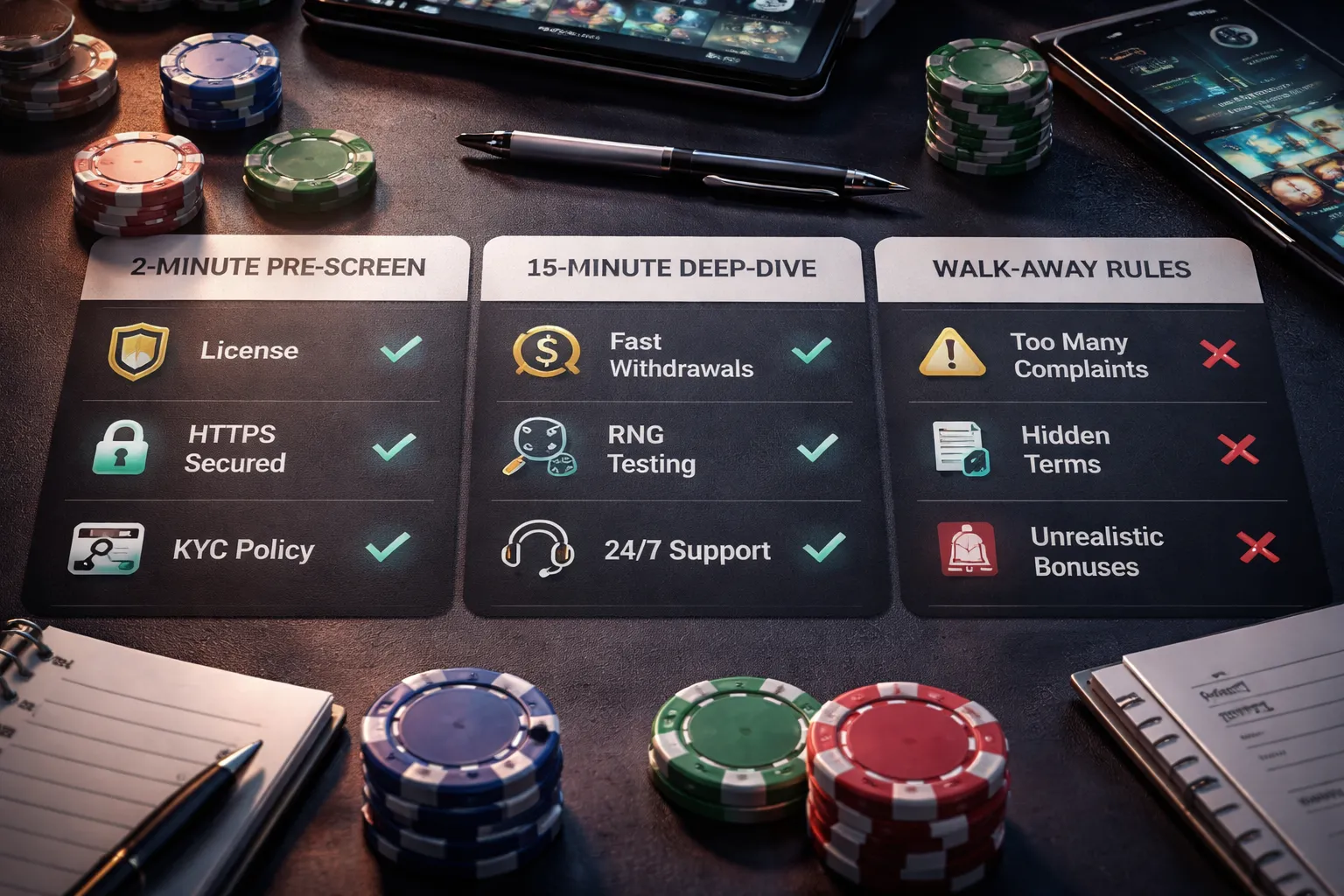
Fast pre-screen in 2 minutes: the minimum checks before depositing
- Check the license. Scroll to the footer. Find the regulator name and license number. Open the regulator site and confirm the license matches the casino name and URL.
- Verify the domain. Use the exact official URL shown on the license record. Avoid copycat domains and mirror links.
- Confirm HTTPS and a valid certificate. Your browser should show a secure connection. Click the lock icon and check the certificate matches the domain.
- Find the owner and address. Look for “About”, “Company”, or “Legal”. You need a company name, registration number, and a real jurisdiction.
- Read payout basics. Open the banking page. Look for stated withdrawal timeframes, fees, and limits. If the site avoids specifics, stop.
- Scan KYC rules. Open the verification page. You should see clear document requirements and review timelines. Watch for vague wording like “we may request more at any time”.
- Check payment methods you will use. Make sure deposits and withdrawals support the same rails. If you plan to use PayPal, stick to casinos that support PayPal withdrawals, not just deposits. See our best PayPal online casinos list for vetted options.
- Test support once. Send one simple question about withdrawals or KYC. If you cannot reach support fast, treat it as a risk.
Deep-dive verification in 15 minutes: what to confirm before serious play
- Match the terms across pages. Compare the bonus terms, banking terms, and general T&Cs. Look for conflicts on withdrawal limits, fees, and eligibility.
- Audit the withdrawal policy. Confirm processing times by method, weekend rules, pending states, and whether the casino batches payouts. Check for “maximum cashout per week” caps.
- Check KYC triggers. Confirm when the casino verifies you, before first withdrawal, after a threshold, or at random. You want a predictable trigger and a clear list of documents.
- Review restricted countries and VPN policy. If your country sits in a grey area, do not play. A later restriction often leads to voided winnings.
- Confirm game providers. Look for known studios and live dealers. Unknown providers can be fine, but you need published testing and clear game rules.
- Look for RNG and testing disclosure. Find an audit seal or testing statement. Verify it links to a real lab report or a recognized testing lab, not a logo image only.
- Read key rules that affect cashouts. Focus on max bet during wagering, excluded games, bonus expiry, and withdrawal conditions for “sticky” bonuses.
- Check responsible gambling controls. You need deposit limits, loss limits, time-outs, self-exclusion, and reality checks. Missing tools signal weak compliance.
- Search for complaint patterns. Look outside the casino site. Focus on repeated issues like delayed withdrawals, sudden KYC changes, closed accounts after wins, and “technical error” voids.
- Inspect privacy and security basics. Confirm a real privacy policy, data retention notes, and contact channels for data requests. A serious operator states how it handles documents and account security.
Decision framework: when to walk away even if one item fails
| Fail | What it usually means | Your move |
|---|---|---|
| No verifiable license | No accountable regulator, weak dispute options | Walk away. |
| License does not match the domain or operator | Brand misuse, mirror site, or shell setup | Walk away. |
| Withdrawal terms are vague or keep changing | Unpredictable cashouts, room for stalling | Walk away. |
| KYC rules feel open-ended | Document fishing, delay tactics at withdrawal | Walk away. |
| Frequent “voided bets” or “technical error” complaints | Weak controls or selective enforcement | Walk away. |
| No clear support access | No fast path to resolve payment and account issues | Walk away. |
| One minor issue only | Possible friction, not always a scam | Proceed only with a small test deposit. Withdraw once before you scale up. |
Rule for your money: If the casino fails any cashout, license, or identity clarity check, you stop. If it passes, you still run a small deposit and a first withdrawal test before you play bigger.
Licensing & regulation: how to verify legitimacy

Licensing and regulation, how to verify legitimacy
A license is your first filter. It sets the rules for payouts, complaints, audits, and player fund handling. Enforcement matters more than logos. A strict regulator investigates, fines, and pulls licenses. A weak one often just sells paperwork.
Regulators that tend to be stricter, and why enforcement matters
- UKGC (United Kingdom). High standards. Strong enforcement. Public actions and fines. Clear rules on fairness and player protection.
- MGA (Malta). Established framework. Ongoing compliance expectations. Better than many offshore permits, but you still must verify the exact operator and site domain.
- Gibraltar. Limited list of operators. Heavier oversight than most offshore hubs.
- State and provincial regulators (US and Canada). Tight controls. Local compliance, approved game suppliers, and banking scrutiny.
- Weaker offshore licenses. Some jurisdictions publish little, enforce less, and make disputes hard. You may get no practical help if a payout goes wrong.
How to validate a license on an official register
Do not trust a footer badge. Use the regulator’s own register and match details line by line.
- Find the license section in the casino footer. Copy the license number and the legal operator name.
- Open the regulator’s official website. Use its license search or public register.
- Check status. You want active and in good standing, not suspended, revoked, expired, or pending.
- Match the operator legal name. A brand name can differ, but the licensed entity must match.
- Match the website URL or domain. If the register lists a different domain, treat it as unlicensed for that site.
- Check the license type. Some cover B2B suppliers, not consumer-facing casinos. You need the operator license for offering games to players.
- Save evidence. Screenshot the register entry and the footer. This helps if you file a complaint later.
Ownership transparency, find the parent company and corporate address
You need to know who takes your deposits. A serious operator shows this without hiding behind vague brand pages.
- Open Terms and Conditions, About, and Responsible Gambling pages. Look for the legal entity name, company number, and registered address.
- Confirm the operator name matches the regulator register. Any mismatch is a stop sign.
- Check who owns the brand. Look for a parent company mention in the site footer or terms.
- Verify the address. A real operator lists a full address, not a mailbox-only line with no corporate identifiers.
- Check support identity. Emails and live chat should name the same operator, not a different company.
Blacklists, warnings, and enforcement actions, where to check
Some regulators publish warnings for unlicensed sites and penalties for licensed ones. Read them. They show patterns.
- Search the regulator site for public warnings, enforcement, sanctions, and license revocations.
- Check your local gambling authority for illegal operator lists and consumer alerts.
- Search the operator legal name plus “fine”, “sanction”, “revoked”, and “warning”. Focus on regulator and court sources first.
- If you see repeat actions tied to payouts, bonus abuse claims, or KYC disputes, treat that as a direct risk to your cashout.
Cross-border access, risks of playing on sites not licensed in your country
A site can accept you and still leave you unprotected. If the casino lacks a license for your location, you take extra risk.
- You may have no regulator that will take your complaint.
- The casino may refuse service later after KYC, then delay or block withdrawal.
- Your bank or card issuer may flag payments and cause failed deposits or reversed withdrawals.
- Local rules on self-exclusion and dispute handling may not apply to you.
If you want options that put payouts first, use verified sources and compare operators in our online casino reviews before you deposit.
Security & privacy: protecting your money and identity
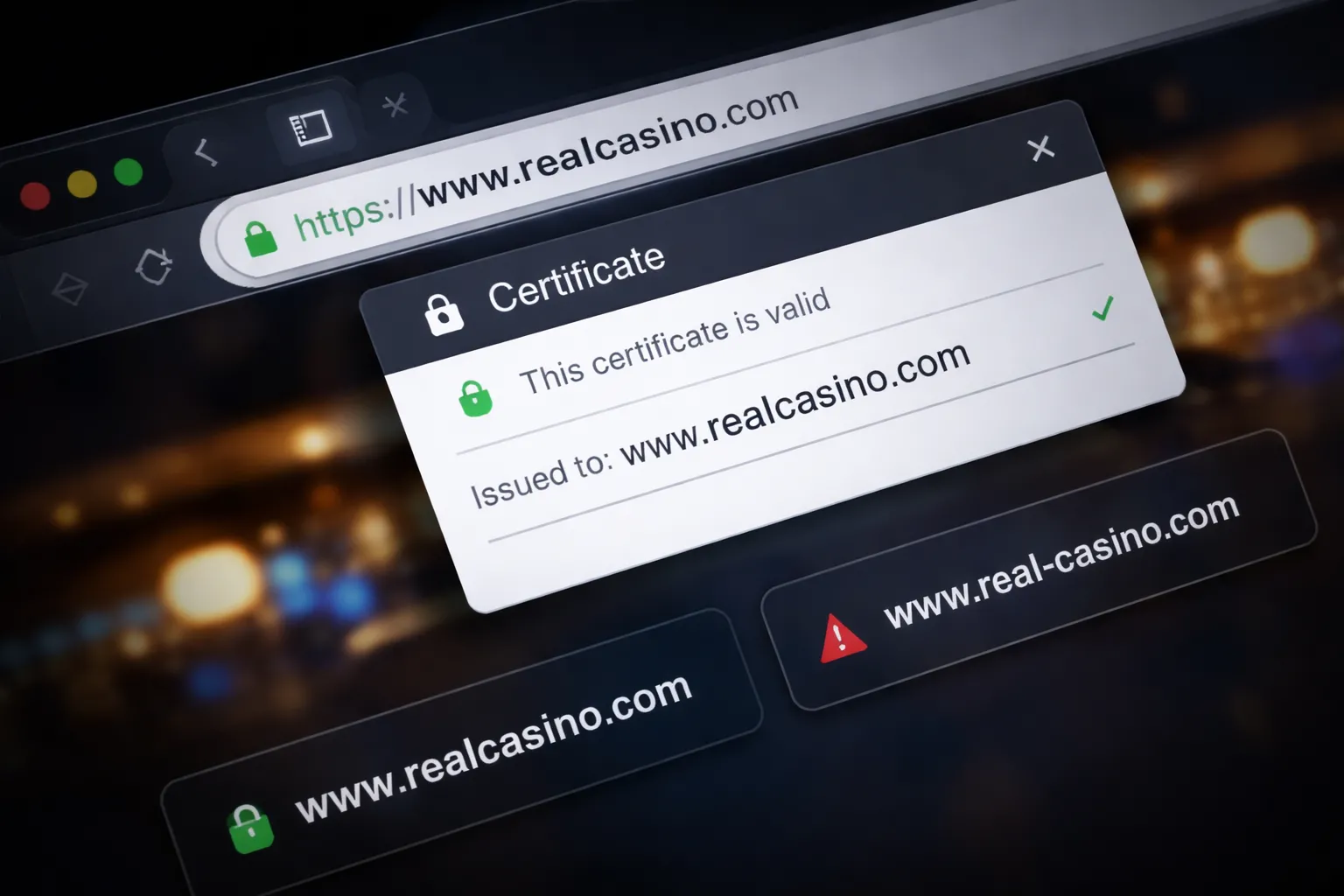
HTTPS and SSL are the baseline
Start with the address bar. You want https:// and a padlock icon. If you see “Not secure”, leave.
- Check the domain. Look for misspellings, extra words, or odd endings. Fake sites often use lookalike names.
- Open the certificate. Click the padlock, then view the certificate details.
- Confirm it matches. The certificate must cover the exact domain you use, not a different brand or random site.
- Watch for redirects. If the site jumps through multiple domains before login or payment, treat it as a risk.
HTTPS protects data in transit. It does not prove the casino will pay. Use it as a minimum filter, not a trust badge.
Account protection features that matter
Security fails fast when your account gets taken over. You want controls that stop unauthorized logins and withdrawals.
- Two-factor authentication (2FA). Prefer an authenticator app. SMS is weaker but still better than nothing.
- Device verification. The casino should challenge new devices and browsers.
- Login alerts. You should get an email or push alert for new logins and password changes.
- Session management. Look for a way to view active sessions and log out of all devices.
- Withdrawal protections. Strong sites require 2FA, email confirmation, or a cool-off period before changing payout details.
Use a unique password and a password manager. Do not reuse your banking password on a casino account.
Data handling and privacy policy red flags
Read the privacy policy like a contract. It tells you what the operator can do with your identity data.
- Long retention with no reason. Watch for “we keep data as long as necessary” with no timeframe or legal basis.
- Broad sharing terms. Red flags include “partners”, “affiliates”, or “service providers” with no list or purpose.
- Marketing by default. You should see clear opt-out options for email, SMS, and third-party marketing.
- Unclear data controller. The policy must name the legal entity that holds your data.
- Jurisdiction mismatch. If the casino targets your country but stores data under a different legal regime, expect harder disputes.
Check where the company sits, where it processes data, and how you can request access or deletion. If those steps are vague, treat it as a warning.
KYC and AML checks: why they ask for ID, and how to do it safely
Legitimate casinos must follow KYC and AML rules. They use them to stop fraud, underage play, chargebacks, and money laundering. You should still protect yourself during verification.
- Verify the domain first. Upload ID only after you confirm you are on the real site and on HTTPS.
- Use the secure upload tool. Avoid sending passports over email or chat unless the casino gives a dedicated encrypted method.
- Send only what they ask for. Typical requests include ID, proof of address, and payment method proof. Extra documents without reason are a red flag.
- Match details. Your account name, payment name, and ID must align. Mismatches create delays.
- Ask about storage. A safe operator explains how long it keeps documents and who can access them.
Expect KYC before large withdrawals, not after you win and request a payout. If they delay KYC until the end, you risk withdrawal disputes.
Phishing and “clone” casinos: confirm you are on the real domain
Scammers copy casino brands to steal logins, deposits, and ID files. You need a repeatable way to confirm the real site.
- Type the URL or use bookmarks. Do not rely on ads, popups, or emailed links.
- Check the full domain. Focus on the last two parts, like example.com. Subdomains can mislead.
- Compare to trusted sources. Use verified listings like our best online casinos page to reach the operator’s correct domain.
- Inspect the login flow. If the login screen loads on a different domain, stop.
- Do not install unknown apps. Only use apps from official stores, and match the publisher name to the operator.
Game fairness: RNG, RTP, and independent testing

RNG in plain English, what it proves and what it does not
Most online slots and virtual table games use an RNG, a random number generator. The RNG picks the result for each spin or hand. It should not follow patterns. It should not react to your bet size, win streak, or time of day.
An RNG certificate can support two claims. The game outcomes come from a tested RNG. The results match the game’s published math model over large samples.
An RNG certificate does not prove you will win in the short term. It does not guarantee fair withdrawals. It does not prove the casino will treat you well if you dispute a result.
How to verify third-party audits and seals without trusting badges
Badges and seals can be copied. Treat them as unverified images until you confirm them.
- Find the auditor name in the casino footer, then confirm it on the auditor’s own site. Look for a public register or a report list.
- Check the report details. You want a report date, the legal operator name, the casino brand, and the tested game list or platform scope.
- Match the operator identity. The auditor report should match the same company name you saw on the licensing page and terms.
- Verify the link target. A real seal link usually goes to the auditor domain, not back to the casino domain.
- Watch for vague language. “Certified fair” with no lab name, no report number, and no date is noise.
RTP transparency, where to find it and why per-game RTP matters
RTP, return to player, shows the long-run payback percentage for a game. It helps you compare games, but it never predicts your next session.
Look for RTP in these places.
- Inside the game info panel. Many slots show RTP under Help, Info, or Game Rules.
- In the casino game page details. Some casinos list RTP next to volatility and max win.
- In the provider’s rule sheet. This can confirm the intended RTP and feature rules.
Per-game RTP matters because casinos can offer thousands of titles. A “high RTP casino” claim means little if your chosen games run lower RTP settings. Some slots ship in multiple RTP versions. You want the exact RTP configured on that site. If the casino hides RTP across most games, treat that as a trust hit.
Live dealer integrity, studio licensing, streams, and clear rules
Live games add a human layer. You need clear oversight and clear game conditions.
- Check the studio and product. The live lobby should show the provider name and table name. Reputable studios publish rule sheets per game.
- Confirm studio licensing. The provider and the casino should both operate under recognized gambling regulators. The casino should not rely on “streaming partner” wording with no regulator listed.
- Read the game rules. Look for rules on reshuffles, blackjack payouts, side bets, roulette wheel type, and bet settlement timing.
- Assess stream stability. Frequent freezes and desync issues increase dispute risk. A solid provider keeps streams consistent and logs decisions cleanly.
- Check limits and bet acceptance. Clear minimums, maximums, and rejection rules reduce surprise voids.
If you want deeper checks on reputable studios and table options, use our best live dealer casinos guide.
Game provider quality signals, reputable studios, versioning, and rule sheets
The game provider matters. Serious casinos list their studios and keep game data consistent.
- Recognized providers. You should see established studios, not only unknown “in-house” titles with no external presence.
- Accessible rule sheets. Each game should offer a full paytable and rules. Missing rules mean you cannot verify key mechanics.
- Version and build info. Many games show a version number in the help menu. Consistent versioning supports traceability in disputes.
- Consistent game names. Cloned games often use near-identical names and artwork but lack the original provider details.
- Stable catalog management. Constant removals, broken demos, and mismatched thumbnails suggest poor operations.
Payments & withdrawals: the real-world safety test
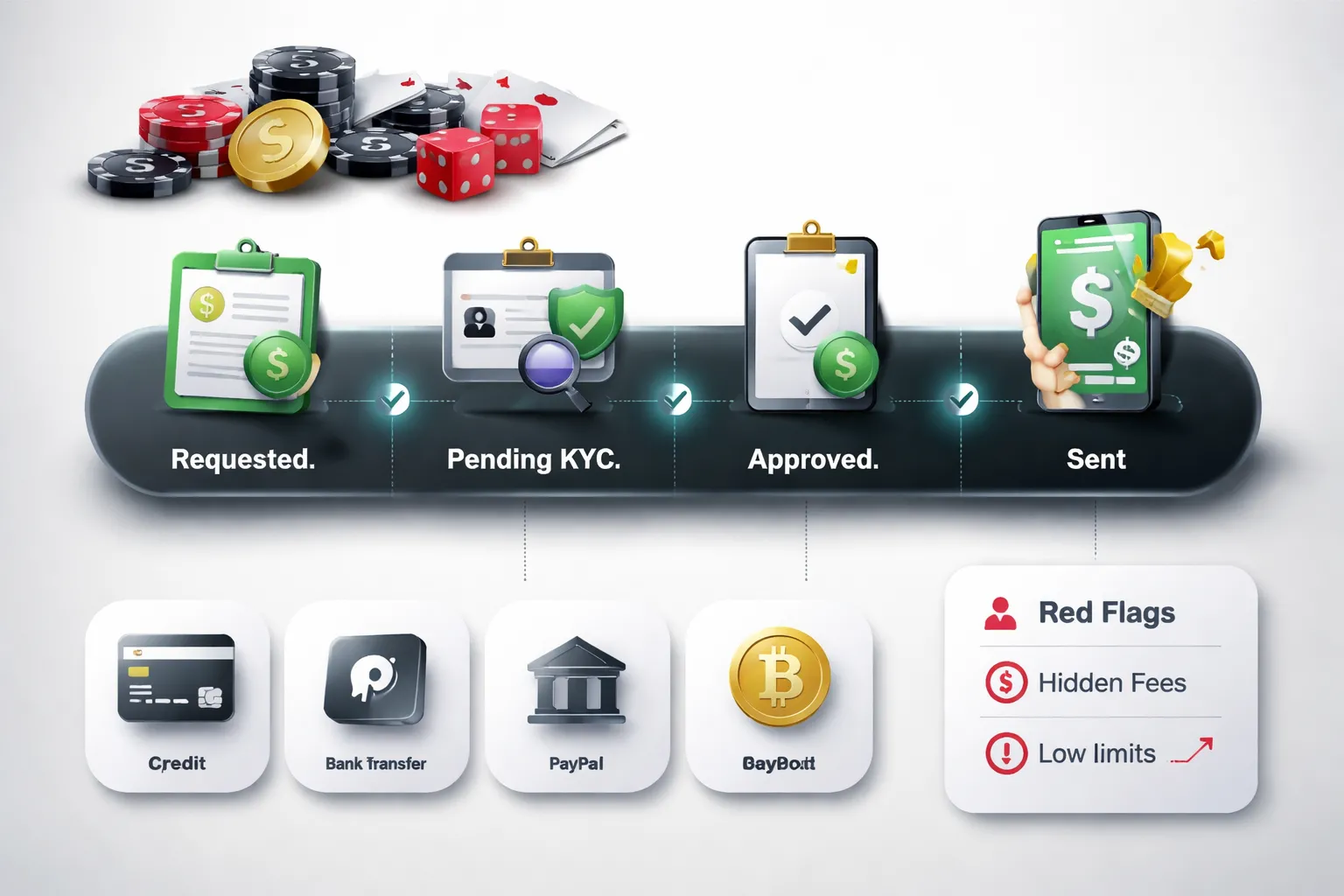
Payments and withdrawals, the real-world safety test
A casino can look legitimate and still fail at payouts. Payments expose how the operation handles compliance, risk, and customer support under stress. Treat banking as a safety audit.
Deposit method safety, cards, e-wallets, bank transfers, and crypto
- Cards. Prefer 3D Secure and clear merchant descriptors on your statement. Avoid sites that route card payments through random third parties or mismatched business names.
- E-wallets. Look for known brands with their own dispute processes. Check if the casino supports the same wallet for both deposits and withdrawals. One-way support often signals friction at cashout.
- Bank transfers. Expect more identity checks and slower settlement. A safe casino provides exact beneficiary details, reference fields, and expected timelines before you send money.
- Crypto. Crypto can be fast, but it is hard to reverse. You need extra proof of legitimacy. Confirm the casino states network, confirmations, and minimums. Avoid vague “instant” claims with no limits table.
Withdrawal reliability checklist, processing times, pending states, and limits
- Published timelines. The cashier page should list typical processing times per method, not a single generic number.
- Clear status stages. You should see steps like requested, pending review, approved, sent. A stuck “pending” with no explanation is a common failure point.
- Verifications before you withdraw. A safe casino tells you KYC requirements upfront. Red flag if it waits until a big win to ask for new documents.
- Withdrawal limits. Check minimum and maximum per transaction, per day, and per month. Watch for low weekly caps that turn payouts into long schedules.
- Method matching rules. Many casinos require withdrawals back to the same method used to deposit. That is normal for anti-fraud. It becomes a problem when they block your method at cashout or push you into a different rail.
- Terms that affect cashouts. Check bonus wagering rules, max cashout clauses, and game contribution rules before you deposit.
Fee transparency and currency conversion pitfalls
- Deposit and withdrawal fees. The cashier should show fees before you confirm. Hidden “processing” fees after approval are a red flag.
- FX markups. If you deposit in one currency and play in another, you can pay conversion twice. Pick an account currency that matches your funding method.
- Dynamic currency conversion. Decline DCC on card payments when offered. It often carries poor exchange rates.
- Crypto spread and network fees. A casino can charge no fee and still hit you with bad rates. Check the quoted exchange rate and the network used. Avoid platforms that do not show the final sent amount.
Chargebacks and disputes, what’s possible and what isn’t by payment type
| Payment type | Dispute options | What to watch |
|---|---|---|
| Card | Chargebacks can work for unauthorized or misrepresented transactions, depends on issuer and evidence. | Keep receipts, emails, and chat logs. Match the merchant name to the casino brand. |
| E-wallet | Wallet providers may review disputes, outcomes vary. Not the same as card chargebacks. | Use wallets with strong buyer protection and clear escalation paths. |
| Bank transfer | Limited reversibility once sent. Recalls depend on bank timing and recipient cooperation. | Verify beneficiary details. Do not send to personal names or unrelated companies. |
| Crypto | Transactions are typically irreversible. | Only use crypto on casinos with strong licensing, clear terms, and consistent payout proof. |
If you want stronger consumer protection, cards usually give you the most leverage. Crypto gives you the least. Choose based on your risk tolerance and the casino’s track record.
Proof points, finding consistent cashout experiences beyond cherry-picked reviews
- Look for pattern reports. Search for repeated details like exact payout times, specific KYC requests, and consistent limits. One-off complaints matter less than recurring ones.
- Filter for withdrawal posts. Prioritize reviews that show method, amount range, time to approval, and time to receive funds.
- Check multiple sources. Compare forums, app store reviews if relevant, and regulator complaint portals where available.
- Watch for affiliate bias. Many “best casino” lists publish only wins and fast payouts. Use independent write-ups and method-specific feedback.
- Verify the cashier UI. Real operators show limits, fees, and statuses inside the cashier. Scam sites stay vague and push you to chat for basic answers.
- Use one solid reference point. Cross-check your shortlist against credible online casino reviews that track payout reliability and term changes over time.
Bonus terms that can make a casino unsafe (even if licensed)
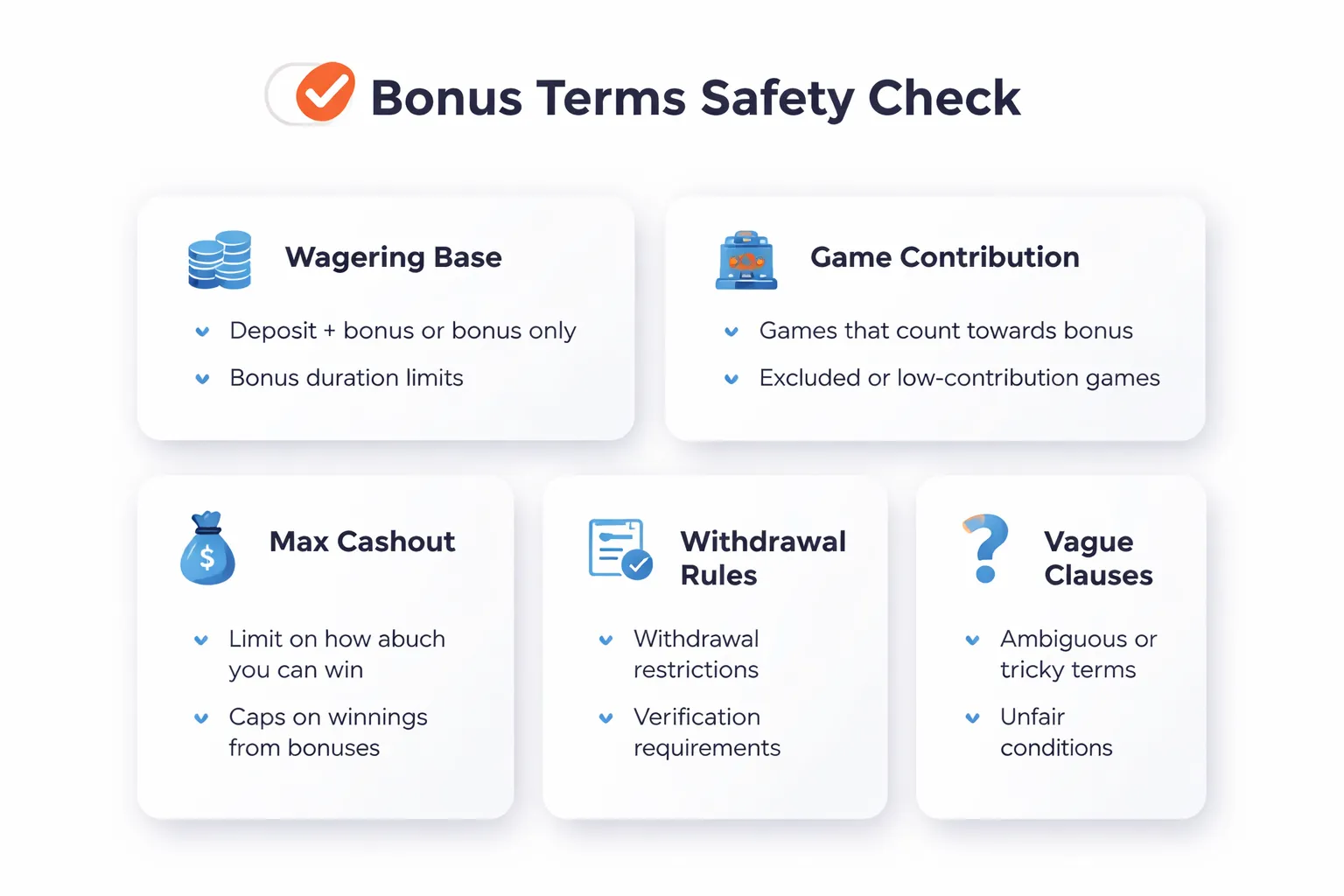
Wagering requirements and game contribution, the hidden math
A license does not make a bonus fair. Bad bonus terms can still lock your money.
Start with the real cost. Convert the wagering requirement into expected spend before you ever deposit.
- Wagering multiple: 30x, 40x, 60x. Higher numbers raise the chance you lose the bonus and your deposit.
- What counts toward wagering: Some casinos count only the bonus. Others count bonus plus deposit. Bonus plus deposit doubles the base.
- Game contribution: Slots might count 100%. Roulette might count 0% to 10%. Live dealer often counts 0% to 20%.
- High RTP games excluded: If they ban “low house edge” slots or specific providers, your best options disappear.
Use a quick estimate. Expected loss roughly equals house edge times total required wagering. If the estimate looks close to the bonus value, the bonus offers little upside.
| Term | Why it matters | Safer range | Red flag |
|---|---|---|---|
| Wagering | Sets how much you must bet before you can cash out | 10x to 35x on bonus only | 40x to 80x, or bonus plus deposit |
| Game contribution | Controls which games help you clear wagering | Slots 100%, tables at least some contribution | Most non slots at 0%, vague categories |
| Excluded games | Limits your choices mid play | Small, specific list | Broad bans, changes without notice |
Maximum cashout clauses and “bonus capped winnings” traps
Some bonuses cap what you can withdraw, even if you win more. The cap can turn a good session into a forced giveaway.
- Max cashout is a fixed number: Example, “Max cashout 5x bonus.” A 100 bonus can cap you at 500.
- Max cashout includes your deposit: This is worse. You can win, then still lose access to your own money above the cap.
- Different caps by game type: Slots might allow more, table games might cap hard.
- Caps tied to “low risk” play: They can claim your play triggered a lower cap after the fact.
A fair cap stays clear, applies to bonus profits only, and sits high enough to matter. A predatory cap sits low and buries key details in the bonus page or full terms.
Withdrawal restrictions tied to bonuses, what’s fair vs. predatory
Bonus terms often control how you withdraw. Some rules protect the casino from abuse. Others block normal cashouts.
- Fair: You must complete wagering before withdrawing bonus funds.
- Fair: Standard KYC before your first withdrawal.
- Predatory: You cannot withdraw your deposit until you clear wagering, even if you forfeit the bonus.
- Predatory: They force one payment method for withdrawal that you cannot access, or they add new method rules after you deposit.
- Predatory: They add high withdrawal fees that appear only in terms, not in the cashier.
- Predatory: They allow “reverse withdrawal” during pending cashouts, then blame you for it.
Check the cashier and the bonus terms side by side. If the cashier hides limits, fees, or processing stages, treat the bonus as high risk. If you want fewer friction points, compare options on fast payout online casinos.
Time limits, minimum odds, and “irregular play” clauses to watch for
Short clocks and vague behavior rules let casinos deny withdrawals without proving fraud.
- Time limit to clear wagering: 7 days or less increases failure risk. It pushes you to overplay.
- Time limit to claim winnings: Some sites cancel wins if you do not request a payout fast.
- Max bet rules during wagering: Example, “Max bet 5 per spin.” If they enforce it retroactively, they can void wins.
- Minimum odds requirements: Common in sports bonuses. They can void bets that do not match their odds rules.
- “Irregular play” and “bonus abuse” catch alls: If the term does not define actions and penalties, the casino holds all power.
Accept strict rules only when they define exact limits, include examples, and state a clear remedy. Avoid terms that let the casino seize funds “at its sole discretion.”
How to compare bonuses safely, a quick evaluation template
Use this template for every offer. You want clarity, predictable costs, and normal withdrawals.
- Step 1, write the base: Bonus amount, minimum deposit, bonus plus deposit or bonus only wagering.
- Step 2, compute total wagering: Wagering multiple times the wagering base. Adjust for game contribution if you plan to play tables or live games.
- Step 3, scan for caps: Max cashout, profit cap, and whether the cap includes deposit.
- Step 4, check withdrawal rules: Can you forfeit the bonus and withdraw your deposit. Are fees and limits visible in the cashier.
- Step 5, check behavior rules: Max bet, time limits, restricted games, and any “irregular play” language.
- Step 6, confirm change control: Look for version dates on terms. Avoid bonuses where terms can change mid play without notice.
Reputation & trust signals you can validate
Independent review hygiene
Start with sources that lose money if they lie, regulators, listed companies, payment processors, and public app stores. Treat most casino review sites as marketing unless they prove otherwise.
- Check the footer. Look for “advertising disclosure”, “sponsored”, “we may receive compensation”. If it exists, assume affiliate intent.
- Scan outbound links. If every “Play now” button uses tracking parameters, the page sells traffic.
- Test for copy patterns. Same bonus text, same pros and cons, same screenshots across many brands signals template content.
- Look for verifiable evidence. Payment proof, dated screenshots of cashier limits, KYC emails, and policy snapshots.
- Prefer negative detail. Unbiased sources list specific failures, dates, amounts, and what the operator did next.
Complaint patterns that matter
Ignore one off rage posts. Track repeating issues across many users and many months.
- Payments. “Pending” withdrawals that reset, unexplained chargebacks, extra fees added after request, forced conversion rates, “manual review” loops.
- Verification. KYC requests after you win, repeated document rejections without clear reason, demands for rare documents, endless source of funds requests for small amounts.
- Account closures. Closures right after a big win, bonus abuse accusations with no rule cited, confiscation of cash balance instead of just bonus funds.
- Game disputes. Void bets without incident logs, “malfunction” claims with no audit trail, refusal to provide round IDs.
- Communication failures. Support stops replying once money is involved, or answers only with scripts.
Brand longevity and track record
Time in market reduces your risk. It does not remove it. A brand that has paid players for years has more to lose by stalling withdrawals.
- Check launch history. Look for older web archives, press releases, and licensing dates that match the brand story.
- Track operator stability. Same company name, same license holder, same payment rails over time signals consistency.
- Watch for rebrands. Frequent name changes, new domains, or “new management” claims often follow complaint cycles.
- Prefer operators with public exposure. Listed groups, long term sports sponsorships, and audited financials add reputational pressure.
Customer support quality checks
Test support before you deposit. You measure speed, clarity, and whether they can escalate.
- Channels. Live chat plus email is the minimum. A phone line is a plus. Messaging only support slows disputes.
- Response time. Ask a simple cashier question and time the first human reply. Repeat at a different hour.
- Accuracy. Ask about withdrawal limits, KYC timing, and fees. If they dodge or contradict the cashier page, expect friction later.
- Escalation. Ask for the complaints process and who handles payment disputes. You want a ticket number and a clear timeline.
- Record keeping. Save chat transcripts and emails. A serious operator offers a transcript or case ID.
Community signals and watchdog checks
Use communities for pattern detection, not final proof. Cross check claims with policy text and regulator records.
- Forums and subforums. Look for long threads with screenshots, timelines, and follow ups. Ignore threads with no amounts, no dates, and no documents.
- Watchdog sites. Focus on unresolved cases, how long they stay open, and whether the casino responds with evidence.
- Regulator portals. Check the license authority site for public warnings, sanctions, and how to file a complaint. If the regulator has no visible complaint path, treat the license as weaker.
- Payment community chatter. Search for reports of blocked cards, rejected bank transfers, and e wallet removals. Payment rail instability often shows up before full withdrawal issues.
| Trust signal you can validate | How you validate it | What it protects you from |
|---|---|---|
| Consistent payout complaints profile | Compare multiple sources, focus on repeating delays and “pending” loops | Stalled withdrawals, hidden limits |
| Clear, reachable escalation path | Ask support for the complaints process, timeline, and ticketing | Endless back and forth with no resolution |
| Stable operator identity | Match license holder name, domain history, and company details | Rebrands used to outrun bad history |
| Independent evidence in reviews | Look for dated screenshots, withdrawal proofs, and policy snapshots | Affiliate fluff and paid rankings |
| Regulator visibility | Check sanctions, warnings, and complaint instructions on the regulator site | Licenses with weak enforcement |
If you plan to play high stakes, shortlist sites that appear in our high withdrawal limit casinos guide, then run the checks above before you fund your account.
Responsible gambling and player protection features
Deposit limits, time-out, self-exclusion: what robust tools look like
Player protection starts before you lose control. Safe casinos give you limits you can set fast, change clearly, and enforce hard.
- Deposit limits, daily, weekly, monthly. You set the amount. The casino blocks deposits once you hit it.
- Loss limits and wager limits. These matter more than deposit limits on high volatility games.
- Cool-off or time-out. You lock yourself out for a short period, usually 24 hours to 6 weeks. Access should not return early via support chat.
- Self-exclusion. You block your account for longer periods, often 6 months, 1 year, or 5 years. A strong casino also offers indefinite exclusion.
- Clear rules for changes. Look for a waiting period when you raise limits. Good operators apply a delay, often 24 hours to 7 days. Red flag if increases apply instantly.
- One place to manage it. Limits should sit in the account menu, not hidden in a PDF or a support ticket flow.
Check if the casino supports wider schemes. In the UK, look for GAMSTOP. In Sweden, look for Spelpaus. In other markets, check if the operator offers network exclusion across sister sites.
Reality checks and session controls: useful UX signals of legitimacy
Reality checks reduce long sessions. They also show the operator builds for compliance, not friction.
- Reality check pop-ups with time played, net result, and a direct exit button to cashier and limits.
- Session timers that stay visible, not buried in settings.
- Optional session caps you can set, for example 60 minutes per day. The casino should log you out when you hit it.
- Spend summaries in your account, with deposits, withdrawals, net spend, and time played by day and month.
- Friction that protects you. A safe site makes it easy to stop. A risky site makes it easy to reload.
If you never see time played, net spend, or limit shortcuts, treat that as a warning. Serious operators surface those controls early.
Underage gambling prevention: age verification practices
Safe casinos stop minors and reduce identity abuse. They verify age, then they verify identity before payouts.
- Age gates at signup plus clear 18+ or 21+ rules, based on your jurisdiction.
- KYC checks that match name, date of birth, and address. Expect document upload or database checks.
- Payment method checks. Some operators block deposits from cards not in your name. That cuts down on third party funding.
- Restricted marketing. Look for a youth protection policy and ad standards, not cartoon themes and teen coded branding.
Red flag if the site pushes you to deposit first and delays verification until you request a withdrawal. That pattern links to payout disputes.
Where safe casinos link for help: recognized support organizations and resources
Trustworthy casinos link to help on key pages, footer, account menu, and responsible gambling section. They also keep the links working.
- UK, GamCare, GambleAware, National Gambling Helpline.
- US, 1-800-GAMBLER and state level problem gambling councils.
- International, Gamblers Anonymous, Gambling Therapy.
- Self-assessment tools and direct referral options to support.
- Contact routes for safer gambling teams, separate from VIP and retention support.
If the casino hides support links, avoids local resources, or offers only vague “play responsibly” text, treat it as a weak signal. If you are new to real money play, start with our online casinos for beginners list, then still verify these controls before you deposit.
Red flags: signs of a rogue or high-risk online casino
License inconsistencies
Start with the license. Rogue sites lie here first. Verify it on the regulator site, not on the casino footer.
- Mismatched company details. The license lists one legal entity, the site terms list another, and the payment descriptor shows a third. Walk away.
- Expired, suspended, or “pending” status. A valid license has a current status, a license number, and a public register entry.
- Fake regulators. Watch for made-up seals, “international gaming authority” logos, and links that do not resolve to a government or known regulator domain.
- Wrong jurisdiction for your location. The site claims it accepts your country, but the license does not cover it, or the regulator blocks the operator.
Withdrawal obstruction
High-risk casinos pay fast on small wins, then block you on larger cashouts. Your goal is simple, test the withdrawal path before you scale your deposits.
- Endless KYC loops. They ask for the same documents again, reject clear photos, or keep adding new requirements after approval.
- Moving goalposts. They add playthrough rules, “source of funds” demands, or new limits only after you request a payout.
- Sudden fee changes. A new “processing fee” appears at withdrawal, or they switch you to a slower method unless you accept a fee.
- Forced withdrawal methods. They refuse to pay back to the method you used to deposit without a clear compliance reason.
- Slow-pay patterns. Support gives scripted replies, no timeline, and no escalation path. If you want casinos built for larger cashouts, use our high withdrawal limit casinos guide, then still verify payout terms on the site.
Manipulative marketing
Bad actors sell urgency and certainty. Legit casinos sell rules and limits.
- Unrealistic win claims. “Guaranteed wins,” “risk-free profits,” or fixed income language. Casinos cannot promise outcomes.
- Pressure tactics. Countdown timers that reset, VIP agents pushing bigger deposits, or “deposit now to unlock withdrawal” claims.
- Spam affiliates. Review pages with no owner info, copied screenshots, and identical bonus text across many domains. Treat that traffic as bought, not earned.
- Bonus traps. Fine print that makes cashing out unlikely, like high wagering, low max cashout, or restricted games that exclude most play.
Technical warning signs
Sloppy sites signal sloppy controls. Security gaps show up in basic site hygiene.
- Broken pages and dead links. Responsible gambling, privacy, and payments pages should work and read clearly.
- Copied text. Terms, game descriptions, and help pages match other casinos word-for-word. That often points to a template network.
- Missing policies. No clear AML, KYC, privacy, bonus terms, or complaints process.
- Sketchy domains. Frequent domain changes, odd subdomains for cashier pages, or brand names that do not match the domain. Check for a consistent operator name across pages.
- Weak transport security signals. Browser warnings, mixed-content errors, or checkout redirects that feel off. Do not enter card data when the flow looks improvised.
Terms that enable confiscation
Read the parts that control your money. Rogue casinos write terms that let them keep it.
- Unilateral confiscation clauses. Terms that allow them to void winnings or seize balances “at our sole discretion” without objective criteria.
- Vague “abuse” definitions. They ban “bonus abuse” or “irregular play” without examples, thresholds, or an appeal path.
- One-sided evidence rules. They claim their logs are final, and you waive the right to dispute, even for payment errors.
- Hidden limits. Max cashout, withdrawal caps, and verification deadlines buried in separate pages or only in promo terms.
| Red flag | What you do |
|---|---|
| License details do not match the operator in terms | Confirm the legal entity on the regulator register. If it differs, do not deposit. |
| Repeated KYC requests after approval | Stop depositing. Request a full withdrawal and save all emails and chat logs. |
| New fees or limits appear at cashout | Screenshot the terms and cashier screens. Escalate via the complaints path listed by the regulator. |
| Guaranteed win language or “risk-free” claims | Exit. Report the ad if it targets your jurisdiction. |
| Terms allow seizure “at discretion” | Choose a different site. You cannot price this risk. |
Practical tools and sources to check before you sign up
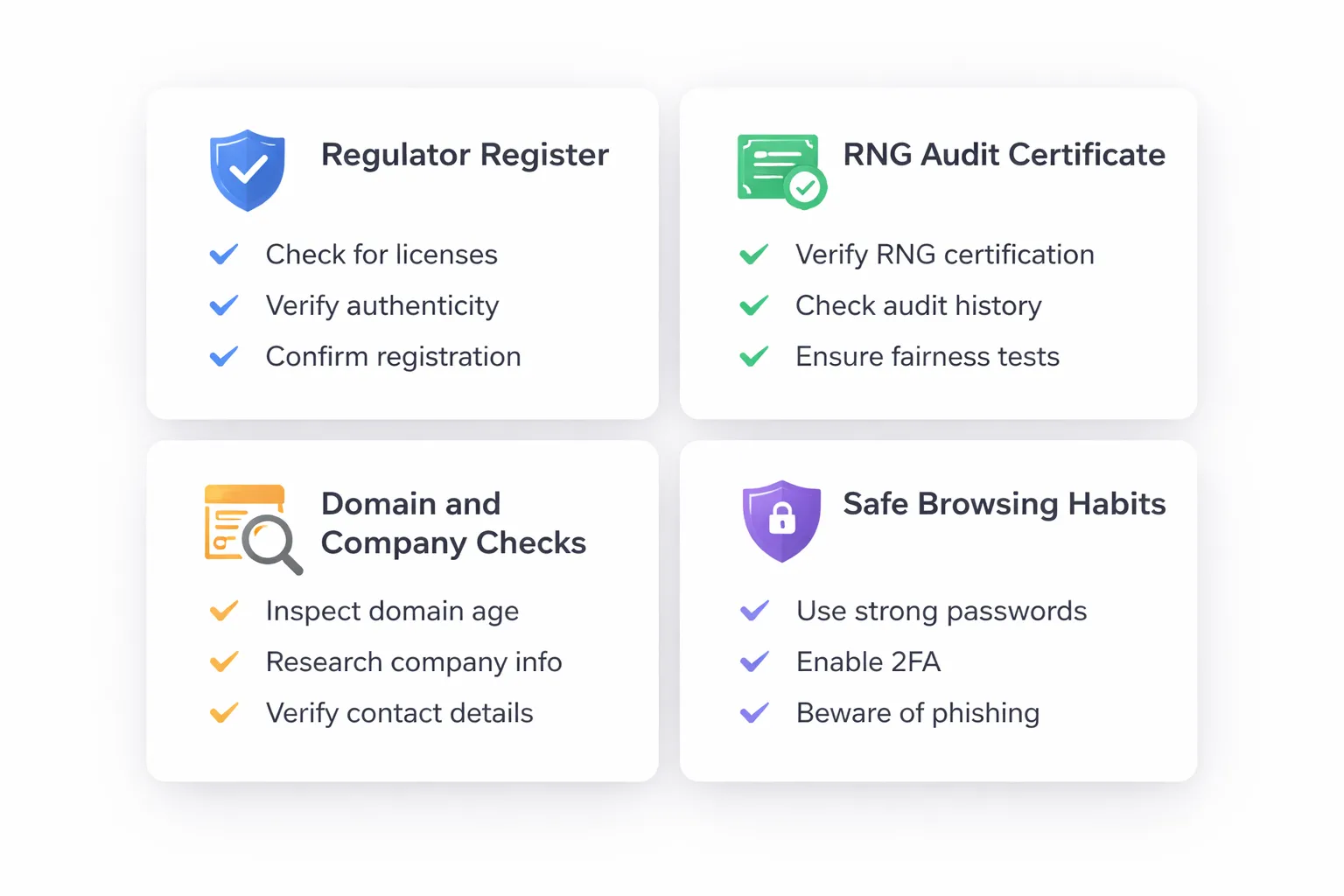
Regulator registers and official verification pages
Start with the regulator. Do not trust a logo in the footer. Verify the licence in the regulator’s public register.
- Find the exact regulator name in the casino footer and in the Terms, usually under “Licence”, “Regulation”, or “Legal”. Write it down.
- Open the regulator site directly and use its “licensee register”, “license verification”, or “public register” search.
- Search by licence number first. If no number shows, search by the legal company name. Avoid searching by brand name only.
- Match these fields between the register and the casino site, legal entity name, licence status, licence type, approved domains, and the licensed address.
- Check the domain list. Many regulators list approved URLs. If your casino domain is missing, treat it as unlicensed for that regulator.
- Check enforcement pages for warnings, suspensions, and revoked licences. If the operator appears there, leave.
RNG and audit documentation
Legit casinos publish independent testing proof. You need a named lab and a traceable certificate.
- Where to look, footer links like “Fairness”, “RNG Certificate”, “Testing”, “Audit”, “Game Integrity”, or “About”. Some post PDFs in the Terms section.
- What to look for, the testing lab name, report date, operator name, and covered products. “Certified” without a report or scope means nothing.
- Common testing labs you can verify, eCOGRA, iTech Labs, GLI, BMM Testlabs. Use the lab’s site to confirm the certificate if they offer a validation page or certificate lookup.
- Red flags, expired reports, a report issued to a different company, a generic badge image, or a certificate that does not mention RNG or game titles.
- Live dealer note, live games do not use RNG for outcomes. Check the studio provider and the regulator coverage for live operations. Use a curated list like best live dealer casinos if you want pre-vetted options.
Domain and company checks
Confirm who owns the site and where the business sits. You want one operator, one domain, one licence trail.
- WHOIS and DNS, use ICANN WHOIS lookup or a reputable WHOIS tool. Privacy protection is common, but you can still check domain age, registrar, and name server changes.
- Domain age, a brand new domain with big “trusted” claims needs extra proof, real licence record, real audits, real payment rails.
- Corporate registry checks, search the legal entity in the company registry for its jurisdiction, for example Malta, Isle of Man, Gibraltar, Curaçao, UK. Match director or address data where possible.
- Brand ownership clues, read the Terms for “operated by” and “owned by” lines. Note the company number, registered address, and any parent company.
- Payments and KYC entity match, the cashier, receipts, and KYC emails should use the same company name as the licence holder. A mismatch signals a proxy setup.
- Press and affiliate footprint, search the legal entity name plus “complaint”, “chargeback”, “withdrawal issue”, and “regulator”. Focus on patterns, not one-off posts.
Safe browsing habits before you click “Sign up”
Most account losses start with bad links and reused passwords. Fix that first.
- Use a password manager and generate a unique password for every casino. Do not reuse email and password pairs.
- Turn on 2FA if the site offers it. Use an authenticator app where possible.
- Type the domain or use a trusted bookmark. Do not register from ads, DMs, or “support” links sent by strangers.
- Avoid mirror links. Rogue operators clone brands with lookalike domains. Check spelling, TLD changes, and extra words in the URL.
- Check the connection, the URL must start with https. Click the padlock and confirm the certificate matches the domain.
- Run basic malware checks, keep your browser updated, block popups, and use built-in safe browsing warnings. If your browser flags the site, leave.
- Separate your gambling email. Use a dedicated email address to limit phishing and spam spillover.
| Check | Tool or source | What “good” looks like |
|---|---|---|
| Licence status | Regulator public register | Active licence, correct legal entity, approved domains listed |
| Complaints path | Regulator site, ADR listings if applicable | Clear escalation steps, named dispute body, working contacts |
| RNG testing | Audit lab certificate, lab verification page | Named lab, current date, correct operator, scope shown |
| Operator identity | Terms “operated by”, corporate registry | Consistent company name, address, company number |
| Domain risk | ICANN WHOIS, DNS history tools | Stable domain history, no rapid ownership shifts tied to complaints |
| Link safety | Manual URL check, browser safe browsing | No redirects to mirror domains, no security warnings |
Quick comparison worksheet: score a casino in 10 minutes
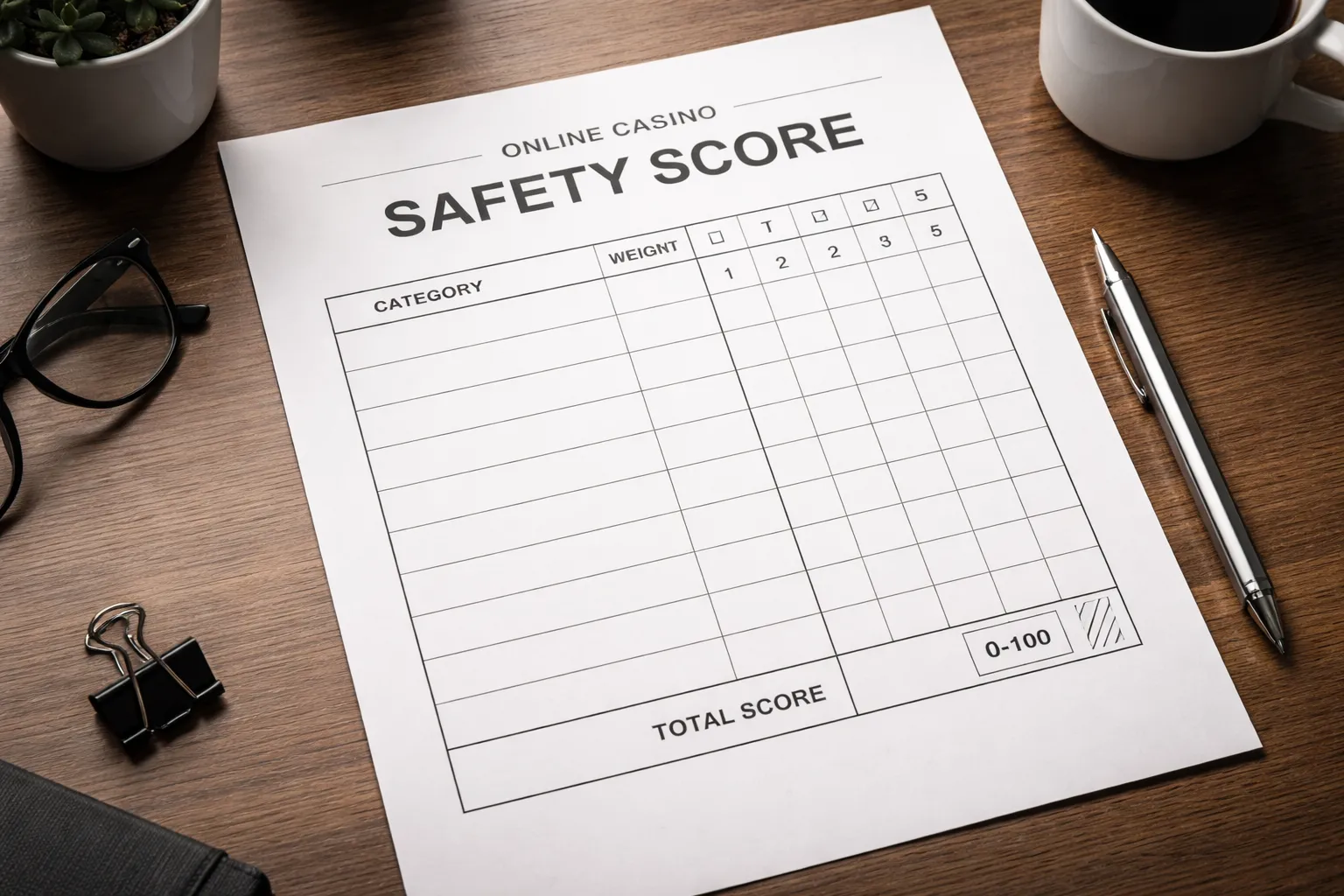
Weighted scoring categories, 10 minute check
Use this worksheet to score a casino fast. You will collect proof as you go. You will end with a number you can compare across sites.
| Category | Weight | What to check in 10 minutes | Evidence to save |
|---|---|---|---|
| Licensing | 25% | License number, regulator name, license status page, matching operator identity. | Screenshot of footer license claim, link to regulator lookup, screenshot of lookup result. |
| Payouts and banking | 20% | Withdrawal timeframes, fees, limits, KYC triggers, method availability in your region. | Link to banking page, screenshot of withdrawal terms, screenshot of fee table. |
| Security and privacy | 15% | HTTPS lock, HSTS present, 2FA support, clear privacy policy, data retention basics. | Screenshot of login security options, link to privacy policy, screenshot of cookie consent choices. |
| Fairness and RNG | 15% | RNG testing lab, audit date, game providers listed, RTP visibility per game. | Link to audit certificate, screenshot of certificate date and scope, screenshot of RTP display on a game. |
| Support and dispute path | 15% | Live chat works, response speed, email ticketing, complaint process, ADR body if listed. | Screenshot of live chat availability, copy of ticket number, link to complaints page. |
| Terms clarity and red flags | 10% | Bonus wagering rules, max cashout, void rules, restricted play, confiscation clauses. | Links to bonus terms and general terms, screenshots of the clauses you rely on. |
Scoring rubric to rank casinos
Score each category from 0 to 5. Multiply by the weight. Add the results for a 0 to 100 score.
| Score | Meaning | Use it when you see |
|---|---|---|
| 5 | Strong proof, low risk signals | Regulator lookup matches, clear terms, recent audit, fast withdrawals stated with no vague carve outs. |
| 4 | Good, minor gaps | Most proof present, some details missing, but no contradictions. |
| 3 | Mixed, needs deeper check | Claims exist without direct verification links, timelines feel broad, support feels slow. |
| 2 | Weak, several warning signs | No easy license verification, vague fees, unclear bonus rules, missing audit info. |
| 1 | High risk | Conflicting operator names, broken policy pages, aggressive terms, many user complaints about withdrawals. |
| 0 | Fail | No license claim, unsafe redirects, browser warnings, or you cannot access key policies. |
Quick interpretation: 80 to 100, shortlist. 60 to 79, proceed only with low stakes. Under 60, skip.
Crypto note: If you use crypto deposits, raise the bar on fairness and withdrawals. See our best crypto casinos guide for what to expect from provably fair and on chain options.
How to document evidence for disputes
- Create a folder per casino. Use a simple name, brand, date, and country.
- Save policy links as text. Paste URLs into a notes file. Policies change. Links prove what you relied on.
- Take screenshots with context. Capture the full browser window, including the URL bar and date if possible.
- Capture the exact clause. Screenshot the bonus rule, withdrawal timeframe, fees, and KYC line items.
- Log support contact. Save chat transcripts, ticket numbers, and timestamps. Email yourself a copy.
- Record transaction details. Keep deposit and withdrawal IDs, amounts, method, and status screens.
- Keep proof of identity submission. Note what you sent and when. Do not store sensitive documents in plain folders.
- Version your notes. Add a new entry each time you check. Do not overwrite older screenshots.
- Export before you escalate. If a dispute starts, export chat logs and save pages to PDF while you still have access.
FAQ
What makes an online casino “safe”?
A safe casino shows a real license, uses HTTPS, and protects payments. It publishes clear terms for bonuses and withdrawals. It verifies game fairness with audited RTP or provably fair tools. It pays on time and resolves complaints with a visible process.
How do I verify a casino license?
Find the license number and regulator name in the footer. Click through to the regulator site and confirm the operator name and domain match. Avoid “licensed” badges without a lookup page. Screenshot the record in case the casino changes it later.
Which regulators are stronger?
UKGC, Malta, and some state level US regulators enforce strict compliance. Curaçao quality varies by issuer. A license helps, but it does not guarantee fast payouts. Pair regulation checks with payout records, term clarity, and complaint history.
What security signals should I check first?
HTTPS lock, modern browser warnings, and a clean domain history. Look for 2FA, strong password rules, and clear privacy terms. Payments should use known processors. Avoid sites that push APK downloads, remote access apps, or unusual “verification tools.”
How can I tell if games are fair?
Check the game providers and verify they are real studios. Look for RTP disclosures and independent audit references. For crypto games, use provably fair with a seed, hash, and verification page. Avoid in house games with no proof or rules.
What are the biggest payout red flags?
Vague withdrawal timelines, changing terms after you win, and repeated “manual review” loops. Watch for high minimum withdrawals, new fees, and forced method changes. If support asks for extra deposits to “unlock” cashouts, stop and document everything.
What KYC requests are normal, and what is not?
Normal: ID, selfie, proof of address, and payment method proof. Not normal: full card PIN, bank login, remote desktop access, or unredacted documents sent by chat. Send files through the casino’s secure upload only. Keep submission proof.
How do I spot bonus traps fast?
Read wagering, max cashout caps, and game contribution rules. Check minimum odds rules for sports, and max bet limits for slots. If terms let the casino void winnings for “irregular play” without examples, treat it as high risk.
Are crypto casinos safer?
Crypto can speed payments and enable provably fair, but it raises risk if the site lacks strong licensing and support. You need clear deposit confirmation rules, network fee policy, and wallet address handling. Use reputable options from best crypto casinos.
What should I do if a casino delays my withdrawal?
Stop depositing. Save screenshots of balances, withdrawal IDs, and status pages. Export chat logs and emails. Ask for the exact reason, the required documents, and a date. If they miss deadlines, escalate to the regulator or an ADR body if available.
How many reviews should I trust?
Do not rely on star ratings. Look for patterns across sources, same complaint type, and documented proof. Give more weight to reports with screenshots, dates, and payment method details. Ignore review clusters that appear on the same day or use repeated phrasing.
Conclusion
You lower your risk by checking the basics before you deposit. License, ownership, and rules. HTTPS and 2FA. Payment methods you can trace. Clear withdrawal limits, timeframes, and verification steps. Independent game testing. A support team that answers in writing.
Do one thing before you play. Run a small deposit and a small withdrawal test. Use a method with buyer protections and a clean paper trail. If you want payout speed, use a shortlist built for it, see our fast payout online casinos.
- Leave fast if terms change after you deposit, KYC expands without reason, or support refuses to confirm policies in writing.
- Keep records of chats, emails, timestamps, amounts, and transaction IDs.
- Escalate to the regulator or ADR when a casino misses stated deadlines.
Trust signals stack. Red flags end the search. Your goal stays simple. Deposit less, verify more, withdraw early.
-
Best Online Casinos for Blackjack: Best Tables, Rules & Bonuses
4 weeks ago -
Fast Payout Online Casinos: Best Sites for Quick Withdrawals
3 weeks ago -
Best Online Casinos for Roulette: Best Wheels, Limits & Live Options
4 weeks ago -
Best PayPal Online Casinos: Top Sites That Accept PayPal Deposits & Withdrawals
4 weeks ago -
Best Online Casinos for High Rollers: VIP Perks, High Limits & Exclusive Bonuses
3 weeks ago
-
-
- Licensing and regulation, how to verify legitimacy
- Regulators that tend to be stricter, and why enforcement matters
- How to validate a license on an official register
- Ownership transparency, find the parent company and corporate address
- Blacklists, warnings, and enforcement actions, where to check
- Cross-border access, risks of playing on sites not licensed in your country
-
- RNG in plain English, what it proves and what it does not
- How to verify third-party audits and seals without trusting badges
- RTP transparency, where to find it and why per-game RTP matters
- Live dealer integrity, studio licensing, streams, and clear rules
- Game provider quality signals, reputable studios, versioning, and rule sheets
-
- Payments and withdrawals, the real-world safety test
- Deposit method safety, cards, e-wallets, bank transfers, and crypto
- Withdrawal reliability checklist, processing times, pending states, and limits
- Fee transparency and currency conversion pitfalls
- Chargebacks and disputes, what’s possible and what isn’t by payment type
- Proof points, finding consistent cashout experiences beyond cherry-picked reviews
-
- Wagering requirements and game contribution, the hidden math
- Maximum cashout clauses and “bonus capped winnings” traps
- Withdrawal restrictions tied to bonuses, what’s fair vs. predatory
- Time limits, minimum odds, and “irregular play” clauses to watch for
- How to compare bonuses safely, a quick evaluation template
-
- What makes an online casino “safe”?
- How do I verify a casino license?
- Which regulators are stronger?
- What security signals should I check first?
- How can I tell if games are fair?
- What are the biggest payout red flags?
- What KYC requests are normal, and what is not?
- How do I spot bonus traps fast?
- Are crypto casinos safer?
- What should I do if a casino delays my withdrawal?
- How many reviews should I trust?
-
-
-
- Licensing and regulation, how to verify legitimacy
- Regulators that tend to be stricter, and why enforcement matters
- How to validate a license on an official register
- Ownership transparency, find the parent company and corporate address
- Blacklists, warnings, and enforcement actions, where to check
- Cross-border access, risks of playing on sites not licensed in your country
-
- RNG in plain English, what it proves and what it does not
- How to verify third-party audits and seals without trusting badges
- RTP transparency, where to find it and why per-game RTP matters
- Live dealer integrity, studio licensing, streams, and clear rules
- Game provider quality signals, reputable studios, versioning, and rule sheets
-
- Payments and withdrawals, the real-world safety test
- Deposit method safety, cards, e-wallets, bank transfers, and crypto
- Withdrawal reliability checklist, processing times, pending states, and limits
- Fee transparency and currency conversion pitfalls
- Chargebacks and disputes, what’s possible and what isn’t by payment type
- Proof points, finding consistent cashout experiences beyond cherry-picked reviews
-
- Wagering requirements and game contribution, the hidden math
- Maximum cashout clauses and “bonus capped winnings” traps
- Withdrawal restrictions tied to bonuses, what’s fair vs. predatory
- Time limits, minimum odds, and “irregular play” clauses to watch for
- How to compare bonuses safely, a quick evaluation template
-
- What makes an online casino “safe”?
- How do I verify a casino license?
- Which regulators are stronger?
- What security signals should I check first?
- How can I tell if games are fair?
- What are the biggest payout red flags?
- What KYC requests are normal, and what is not?
- How do I spot bonus traps fast?
- Are crypto casinos safer?
- What should I do if a casino delays my withdrawal?
- How many reviews should I trust?
-
-
Online Casino Licensing Explained: Authorities, Licenses & How to Check One
3 weeks ago -
Best Live Dealer Casinos: Where to Play Live Blackjack, Roulette & More
3 weeks ago -
Best Online Casinos for High Rollers: VIP Perks, High Limits & Exclusive Bonuses
3 weeks ago -
Fast Payout Online Casinos: Best Sites for Quick Withdrawals
3 weeks ago -
What Is an Online Casino? How They Work, Games, Bonuses & Safety
4 weeks ago
-
Best Online Casinos for Blackjack: Best Tables, Rules & Bonuses
4 weeks ago -
Online Casino Bonuses Explained: How They Work + Terms You Must Know
4 weeks ago -
Fast Payout Online Casinos: Best Sites for Quick Withdrawals
3 weeks ago -
Online Casino Licensing Explained: Authorities, Licenses & How to Check One
3 weeks ago -
Best Online Casinos for Roulette: Best Wheels, Limits & Live Options
4 weeks ago