Best Online Casinos for Beginners: Easy Sign-Up, Simple Games & Great Support

Most online casinos feel built for experienced players. Long sign-up forms, complex bonuses, crowded lobbies. Beginners need the opposite. Fast registration, clear games, and support that answers fast.
This guide lists beginner-friendly casinos that keep setup simple and gameplay easy. You will learn what to look for before you deposit, which games give you the cleanest learning curve, and which site features reduce mistakes.
- Easy sign-up, clear KYC steps, and common payment options
- Simple games, low minimum bets, and demo or free-play modes where available
- Beginner-safe bonuses, with readable terms and realistic wagering rules
- Player support, with live chat hours, email response time, and FAQ quality
- Safety checks, licensing, encryption, and responsible gambling tools
If you want a broader shortlist beyond beginner picks, see our top-rated, safe online casinos.
- In het kort: Pick a casino with a short, clear sign-up and fast ID checks.
- In het kort: Start with simple slots and low-limit table games, use demo mode when available.
- In het kort: Treat bonuses as optional, read wagering, max bet rules, and time limits first.
- In het kort: Use live chat and a strong FAQ, you want fast answers when money is involved.
- In het kort: Verify licensing, SSL encryption, and responsible gambling tools before you deposit.
You will have a better first experience when the basics stay simple. Sign-up should take minutes. Verification should have clear steps. Payments should show fees, limits, and expected processing times before you commit.
Keep your first sessions low risk. Choose games with low minimum bets. Avoid complex bonus paths. If a casino hides key terms or support hours, move on.
Use a safety checklist every time. Confirm the license, encryption, and available limits for deposits, losses, and time. If you want a broader shortlist beyond beginner picks, use our top-rated, safe online casinos list.
What makes an online casino truly beginner-friendly?
Fast registration with minimal steps
Beginner-friendly casinos keep sign-up short. You should finish in a few minutes with basic details, a password, and a clear confirmation step.
- Fewer fields, less chance of errors and lockouts.
- Clear password rules, so you do not fail sign-up loops.
- Upfront country and currency options, so you avoid wrong settings.
- Visible terms links next to the register button, so you can spot key limits early.
Clear identity checks, and how to pass verification smoothly
Good casinos explain KYC before you deposit. They tell you what they need, why they need it, and how long checks usually take.
- Use matching details. Your name and address must match your ID and payment method.
- Prepare 2 documents. One photo ID and one proof of address, recent within 90 days unless stated otherwise.
- Upload clean images. Full document in frame, no glare, readable corners, no edits.
- Confirm your phone and email right away. It prevents login and withdrawal delays.
- Verify before big deposits. It reduces the risk of a withdrawal hold later.
Intuitive lobby design, filters, and search
A beginner-friendly lobby helps you find safe, simple games fast. You should not need to click through endless menus.
- Search that works. It should find a game by name, provider, or keyword like “blackjack”.
- Useful filters. Look for filters for volatility, RTP, features, and minimum bet.
- Clear categories. Slots, table games, live casino, jackpots, and new games.
- Fast loading. Slow lobbies increase misclicks and failed launches on mobile.
Low-stakes tables and penny slots for small budgets
Low minimum bets let you learn without burning your bankroll. Beginner casinos show table limits and slot bet ranges before you open the game.
- Slots with low minimum bets. Many games allow $0.10 to $0.20 spins, some go lower depending on coin value.
- Roulette and blackjack with low limits. Look for tables that start around $1 to $5, higher limits raise your variance fast.
- Live dealer limits shown upfront. Live tables often start higher than RNG versions.
- Easy bankroll controls. You should be able to set deposit, loss, and time limits from your account menu.
Demo and free-play mode
Demo mode lets you learn rules and pacing without risk. It also helps you test whether a game feels too fast or confusing.
- Instant play. No download, no deposit required for demo slots.
- Clear “Play for fun” label. You should not confuse demo credits with real money.
- Easy switch to real money. One toggle, with a clear balance change and confirmation.
Tutorials, rule pages, and in-game guidance
Beginner-friendly casinos teach you inside the product. You should find rules and payouts in one click.
- Short “How to play” guides for blackjack, roulette, baccarat, and popular slot features.
- Visible RTP and paytable access inside slots, plus clear feature explanations.
- Bet slip guidance on table games, especially roulette, so you know what each bet does.
- Live chat that solves basics. Support should handle verification, limits, bonus terms, and game loading issues.
If you want a deeper safety checklist for licenses, encryption, and red flags, use our guide to choosing a safe online casino.
Best online casinos for beginners (our top picks and who each is best for)
Best for the easiest sign-up and onboarding experience
Pick: DraftKings Casino (US), bet365 Casino (where available)
- Best for: First-time players who want a clean sign-up, clear menus, and fast identity checks.
- Why it works for beginners: These brands usually keep the funnel simple. You see what to do next. You get clear prompts for email, phone, and verification.
- Look for: Step-by-step KYC, clear deposit screens, and a visible “responsible gaming” menu with limits you can set in minutes.
- Watch: Promo pop-ups during signup. Skip anything you do not understand, then read the bonus terms later.
Best for simple slots and casual gameplay
Pick: Stake (global), BetMGM Casino (US)
- Best for: Players who want straightforward slots, fast loading, and low-friction play sessions.
- Why it works for beginners: Simple navigation. Strong search and filters. You can find basic 3-reel and low-feature slots fast. You can also open rules and paytables without digging.
- Look for: Demo mode where legal, volatility labels, and clear RTP disclosure per game.
- Watch: Feature-heavy “megaways” and bonus-buy games. They raise variance and can drain a small bankroll fast.
Best for low deposits and low minimum withdrawals
Pick: Unibet Casino (where available), 888casino (where available)
- Best for: Small-budget play and low-stress cashouts.
- Why it works for beginners: These brands often support common banking methods and keep cashier flows simple. You usually see minimums before you confirm.
- What to check before you deposit: Minimum deposit, minimum withdrawal, withdrawal fees, and whether a bonus adds wagering requirements that block quick cashouts.
- Extra tip: If fast cashouts matter most, use our fast payout casinos guide.
Best for mobile-first beginners (apps and browser play)
Pick: FanDuel Casino (US), LeoVegas (where available)
- Best for: Players who mainly use a phone and want a smooth cashier, stable live games, and quick game switching.
- Why it works for beginners: Strong mobile UX. Big buttons. Clear game categories. Fewer misclicks on bets. Better in-play readability on roulette and blackjack.
- Look for: Face ID or biometric login, clear connection warnings on live tables, and fast access to limits and session reminders.
- Watch: Battery drain and data use on live dealer games. Use Wi-Fi when you can.
Best for customer support and new-player help
Pick: BetRivers (US), Caesars Casino (US)
- Best for: Beginners who want quick answers on verification, deposits, withdrawals, and bonus rules.
- Why it works for beginners: Strong help centers and reliable live chat. Support teams usually handle the basics without bouncing you between departments.
- Test it first: Ask support three things before you deposit, KYC timeline, withdrawal processing time, and how to remove a bonus if you change your mind.
- Watch: Vague answers on bonus terms. If support cannot explain it in plain language, treat that as a red flag.
Best for safe, regulated play in legal jurisdictions
Pick: BetMGM (US), DraftKings (US), FanDuel (US), 888casino (UK and regulated markets)
- Best for: Players who want strong oversight, clear rules, and standard withdrawal processes.
- Why it works for beginners: Regulated casinos follow set standards for identity checks, game testing, and responsible gaming tools. You get clearer complaint paths if something goes wrong.
- Do this before you sign up: Confirm you are in a legal state or country for that operator. Verify the license link in the site footer. Read payment method availability for your location.
- Avoid: Sites that hide ownership details, skip licensing info, or push you to deposit before you can read full terms.
| Beginner priority | Best pick type | What you should verify |
|---|---|---|
| Easiest start | Mainstream regulated brand | KYC steps, clear bonus opt-in, simple cashier |
| Simple games | Strong slots catalog with clean filters | Demo mode, RTP info, paytable access |
| Small bankroll | Low min deposit and low min withdrawal | Minimums, fees, wagering rules that block cashouts |
| Phone play | Mobile-first app or optimized web | Login stability, live dealer performance, limits menu |
| Help needed | Fast live chat and strong help center | Support quality on KYC, withdrawals, bonus removal |
| Safety first | Licensed in your jurisdiction | License disclosure, responsible tools, clear T&Cs |
How we rank beginner casinos: criteria you can trust
We rank beginner-friendly casinos with a checklist. We use the same tests for every site. We focus on what affects your first deposits, your first games, and your first cashout.
Licensing, auditing, and reputation checks
- License match. We confirm the casino holds a license that covers your location. We check the regulator site, not just a logo in the footer.
- Operator identity. We verify the company name, address, and related brands. We look for recent ownership changes that can affect payments and support.
- Audit signals. We look for third-party testing claims, then check if they link to real reports or current certificates.
- Complaint patterns. We scan trusted review sources and player forums for repeat issues, stuck withdrawals, KYC delays, and bonus term disputes.
- Rule clarity. We read the key terms that impact cashouts, bonus removal, and account limits.
Bonus value vs. difficulty
- Wagering requirement. We score lower playthrough higher. We flag high multipliers that trap small bankrolls.
- Time limits. We check how long you get to clear wagering. Short windows lower the score.
- Max cashout and win caps. We look for caps that reduce real value, especially on no deposit offers and free spins.
- Contribution and excluded games. We check which games count toward wagering, and which do not. We flag rules that push you into low-value game choices.
- Max bet rules. We check if the casino limits your bet size while you have a bonus. We flag vague rules that can void winnings.
- Sticky vs. non-sticky. We note whether you can cash out your deposit balance after bonus play, and what happens to bonus funds if you withdraw.
Payments, processing times, and real-world cashout reliability
- Deposit options. We list cards, bank transfer, e-wallets, and any local methods. Beginners need familiar rails.
- Withdrawal options. We check if you can cash out to the same method you used to deposit, and what steps you must complete first.
- Fee checks. We look for withdrawal fees, currency conversion fees, and hidden processor charges.
- Processing times. We separate casino approval time from bank or wallet transfer time. We score faster approvals higher.
- Limit transparency. We check minimum and maximum withdrawal limits, plus daily, weekly, and monthly caps.
- KYC friction. We review what documents the casino requests, when it requests them, and how clear the instructions are.
- Reliability signals. We track recurring reports of delayed payouts, repeated document requests, and sudden payment method removals.
Game catalog quality: providers, RTP visibility, and volatility range
- Provider mix. We score higher when a casino uses established studios and offers a wide set of slot and table options.
- Beginner game set. We look for simple classics, low-limit tables, and clear demo mode access where allowed.
- RTP visibility. We check if the casino shows RTP in the game info panel, and if it stays consistent across devices.
- Volatility range. We look for low, medium, and high volatility slots. Beginners need choices that fit small deposits.
- Live dealer quality. We check load stability, table limits, and lobby filters. We flag broken streams and missing limits.
- Game rules access. We check if blackjack and roulette variants show clear rules and side bet terms.
Customer support testing: response times, knowledge, and channels
- Channels. We look for live chat first, then email. Phone support helps but does not replace chat.
- Coverage. We check support hours and weekend availability. Beginners often play outside business hours.
- Response time tests. We time live chat connection and first reply. We repeat tests at different times.
- Knowledge tests. We ask basic beginner questions about KYC, withdrawals, bonus removal, and game limits. We score clear and consistent answers higher.
- Help center quality. We check if the site has step-by-step guides, current screenshots, and clear contact routes.
UX scoring: navigation, loading speed, and responsible design
- Sign-up flow. We score fewer steps higher. We flag forced opt-ins and unclear consent screens.
- Navigation. We check how fast you can find cashier, bonuses, limits, and support from the main menu.
- Mobile performance. We test load speed, login stability, and cashier reliability on phone browsers and apps.
- Search and filters. We check provider filters, RTP and volatility labels where available, and table limit filters.
- Responsible design. We look for clear deposit limit tools, time-out options, and reality checks that you can set in minutes.
Security signals: encryption, 2FA options, and privacy practices
- Encryption. We confirm HTTPS across sign-up, cashier, and account pages. We flag mixed-content and insecure redirects.
- 2FA support. We check if you can enable two-factor authentication, and if it works for withdrawals or login changes.
- Account controls. We look for password rules, session management, and device login alerts.
- Privacy basics. We check how the casino handles data sharing, retention, and marketing consent, and whether you can manage preferences inside your account.
- Fraud prevention. We check for clear guidance on document uploads, secure upload portals, and scam warnings.
If you want a broader safety-first breakdown beyond beginner needs, see our top-rated online casinos list.
Easy sign-up and account verification: a step-by-step beginner walkthrough
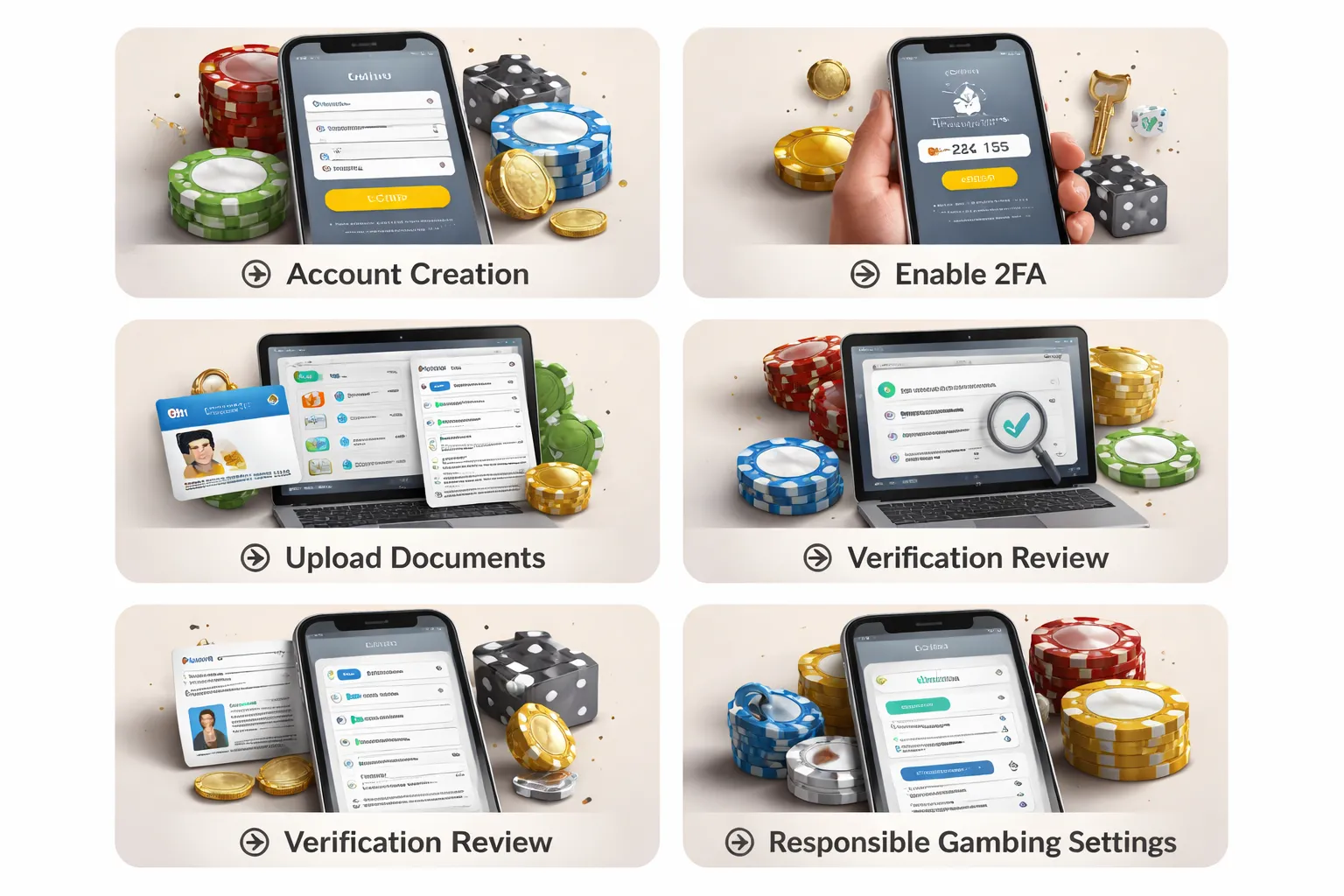
Creating an account safely
Start with basics. They prevent most account problems.
- Use a unique email. Do not reuse an email tied to old gambling accounts, banking logins, or work.
- Create a strong password. Use 12 to 16+ characters. Mix words, numbers, and symbols. Do not reuse it anywhere.
- Turn on two-factor authentication (2FA). Use an authenticator app if the casino offers it. Use SMS only if you have no other option.
- Fill in real details. Your name, date of birth, and address must match your documents and payment method.
- Check the site address. Use the official domain. Avoid sign-up links from random ads or DMs.
- Use secure devices. Avoid public Wi-Fi. Avoid shared computers. Log out after every session.
What verification (KYC) usually requires
Most casinos verify your identity before your first withdrawal. Some verify before you can deposit or claim bonuses.
- Identity document. Passport, national ID, or driver’s license. Upload the full document. All corners visible. No blur.
- Proof of address. Utility bill, bank statement, or government letter. Often must be dated within the last 60 to 90 days.
- Payment proof. A card photo or e-wallet screenshot in some cases. Cover sensitive data where allowed. Keep last 4 digits visible if requested.
- Selfie or live check. A selfie holding your ID, or an in-app scan. Follow the exact frame and lighting rules.
How to submit documents correctly
- Use the secure upload area. Prefer in-account upload over email.
- Match your account details. Your profile name and address must match your documents, including middle names and apartment numbers.
- Upload high-quality files. Use color photos. Avoid glare. Use good lighting. Do not crop text.
- Send complete sets. If the casino asks for front and back, send both in one session.
- Keep copies. Save what you uploaded and the timestamp. It helps if support needs a re-send.
Common verification delays and how to avoid them
- Mismatch errors. Different spelling, old address, or nickname. Fix your profile first, then upload again.
- Expired or unreadable IDs. Check expiry dates. Retake photos until text stays sharp when you zoom in.
- Wrong document type. A mobile bill may not count. Use a bank statement or utility bill if the rules look strict.
- Bonus checks. Large bonuses can trigger extra review. Read the terms before you claim.
- High-risk payment methods. Some prepaid cards and third-party transfers cause extra questions. Use a method in your name.
- Multiple accounts. Do not open more than one account per person or household unless the casino allows it in writing.
If your verification stalls, contact support with your username, the exact missing item, and the upload date. Keep it simple. If you want a quick view of how different sites handle checks, use our online casino reviews.
Set deposit limits and reality checks from day one
Do this before your first deposit. It prevents fast losses.
- Deposit limit. Set a daily or weekly cap you can afford to lose.
- Loss limit. If available, cap how much you can lose in a day or week.
- Wager limit. Limit total stakes. This helps if you play high-speed games.
- Reality check reminders. Turn on time pop-ups, such as every 30 or 60 minutes.
- Session limit. If the casino offers it, set a hard stop time.
Enable safer play settings before your first bet
- Self-exclusion tools. Learn where they are in your account. Use a cool-off period if you feel rushed or tilted.
- Marketing controls. Opt out of promo emails and SMS if they push you to chase bonuses.
- Login and device alerts. Turn on notifications for new logins if offered.
- Payment safeguards. Use one payment method in your name. Avoid lending accounts or shared cards.
- Withdrawal planning. Keep your documents ready before you win. It reduces cashout friction.
Simple casino games beginners should start with (and what to avoid early on)
Slots 101: paylines, bet sizing, volatility, and RTP
Slots look simple. The math sits under the hood. Learn four terms before you spin.
- Paylines and ways to win. Paylines are fixed patterns that pay when symbols land in a line. “Ways” games pay when matching symbols land on adjacent reels. More lines or more ways usually means a higher total bet.
- Bet sizing. Set a small base bet you can repeat for a long session. Avoid max bet early on. Your goal is time and practice, not chasing a jackpot.
- Volatility. Low volatility pays small wins more often. High volatility pays less often, but can pay bigger. Start with low or medium volatility so your balance lasts longer.
- RTP. RTP stands for return to player. A 96% RTP means the game returns about $96 per $100 wagered over a very large sample. It does not predict your short session. Pick higher RTP when you can, and treat anything under 94% as a red flag.
Start with simple video slots with clear paytables. Skip bonus-buy features and huge progressive jackpots at the start. They raise variance and drain a small bankroll fast.
Roulette basics: inside vs. outside bets and safer starting strategies
Roulette has two main bet types.
- Outside bets. Red or black, odd or even, 1 to 18, 19 to 36. These cover many numbers. They pay even money. They reduce swing, but the house edge stays.
- Inside bets. Straight-up numbers, splits, streets, corners. These pay more, but lose more often. They create bigger bankroll swings.
Start with outside bets and small units. Use European roulette when possible. It has one zero, which lowers the house edge versus double-zero tables. Avoid “American roulette” and any “triple zero” wheels early on.
Baccarat for beginners: why it’s simple and how bets work
Baccarat plays fast because you do not make many decisions. You mainly choose where to bet.
- Player bet. You win if Player has the higher total. Payout is 1 to 1.
- Banker bet. You win if Banker has the higher total. Payout is usually 1 to 1 minus a commission, often 5%.
- Tie bet. Pays high, but hits rarely. It carries a much higher house edge.
Begin with Banker or Player. Treat Tie as an avoid. Keep it boring. That is the point.
Blackjack starter tips: essential rules and common mistakes
Blackjack can offer strong odds if you follow basic strategy and pick good rules. It also punishes mistakes.
- Learn hand values and dealer rules. You aim for 21 without going over. The dealer must follow fixed rules, usually hitting until 17.
- Use a basic strategy chart. It tells you when to hit, stand, double, or split. Do not guess. Save a chart on your phone or use an in-game helper if allowed.
- Watch the table rules. Favor games with 3:2 blackjack payouts. Avoid 6:5 tables. Prefer fewer decks, and dealer stands on soft 17 when available.
- Common beginner mistakes. Taking insurance, chasing losses by raising bets, splitting 10s, and ignoring basic strategy because of “gut feel.”
If you want deeper bankroll planning for higher stakes later, read our fast payout online casinos guide before you scale up.
Video poker basics: easiest variants to learn and what paytables mean
Video poker gives you control. That also means you can make costly errors.
- Easiest variants. Start with Jacks or Better. It has simple goals and many guides. Deuces Wild plays differently and can confuse beginners.
- Understand the paytable. The paytable shows what each hand pays. Small changes matter. Two machines can look identical but have different returns.
- Max coins. Many games pay a bigger jackpot on a royal flush when you bet max coins. If you cannot afford max coins consistently, lower denomination instead of lowering coins.
Use a short strategy card for the specific variant and paytable. Do not “hold what feels right.”
Games to approach later: live dealer side bets and complex variants
Some games add traps that look fun and play fast. Leave them for later.
- Live dealer side bets. Perfect Pairs, 21+3, Dragon Bonus, and similar add-ons usually carry a much higher house edge than the main bet. They also increase your total wager without feeling like a bigger bet.
- Complex roulette variants. Bet multipliers, bonus wheels, and special side bets raise volatility and often reduce clarity on cost per spin.
- Blackjack variants with rule changes. Games that pay 6:5, add extra side bets, or change doubling and splitting rules can turn a good game into a bad one.
Start with clean rules and simple bets. Add complexity only after you can track your total wager, your odds, and your session limits.
Beginner casino bonuses explained (without the confusing fine print)
Welcome bonuses, free spins, and no-deposit offers
Bonuses look similar. The rules make them different. Focus on what you can actually withdraw.
- Welcome bonus (match deposit). You deposit, the casino adds bonus funds. Good for longer sessions and table games, if the terms stay simple. Bad when wagering is high, game restrictions are tight, or the bonus locks your deposit until you finish.
- Free spins. You get spins on specific slots. Good for trying slots without learning betting systems. Bad when wins pay as “bonus money” with high wagering, or when the spins only work on high-volatility games.
- No-deposit bonus. You get a small bonus without depositing. Good for testing the casino and support. Bad because wagering is often extreme, withdrawal caps are common, and verification can delay any cashout.
Wagering requirements, explained with one clean example
Wagering means the total amount you must bet before you can withdraw bonus-related funds.
Example:
- You deposit $50.
- You get a 100% match bonus, so you receive $50 bonus.
- The wagering requirement is 35x the bonus.
- Your required playthrough is $50 x 35 = $1,750 in bets.
If the casino counts slots at 100%, every $1 you bet on slots reduces the requirement by $1.
If blackjack counts at 10%, every $10 you bet on blackjack reduces the requirement by $1. That makes the bonus far harder to clear on table games.
Bonus restrictions that surprise beginners
- Max bet limits. Many casinos cap your wager while you hold bonus funds, often around $5 per spin or hand. One oversized bet can void winnings.
- Time limits. Common windows are 7, 14, or 30 days. If you run out of time, the casino can remove the bonus and related winnings.
- Game weighting. Slots may contribute 100%. Roulette and blackjack often contribute 0% to 20%. Some games do not count at all.
- Restricted games. The bonus may only work on certain slots, or it may ban live dealer games.
- Withdrawal caps. No-deposit offers often limit what you can cash out, even if you beat the wagering.
- Sticky vs non-sticky bonuses. Some casinos force you to use bonus funds first and lock your deposit. Others let you withdraw deposit money but remove the bonus if you do. Read this line before you deposit.
- Verification timing. You may need ID checks before withdrawal. Plan for that, especially if you chose a no-deposit offer to “test” payouts.
How to choose a beginner-friendly bonus with realistic terms
Pick terms you can track in one session.
- Look for lower wagering. If you see 20x to 40x on the bonus, you can at least estimate the work. If you see 60x or more, expect a grind.
- Prefer bonus-only wagering over “bonus plus deposit” wagering. Bonus plus deposit increases the target fast.
- Check what games count. If you plan to play blackjack, confirm the contribution rate, then compare with better-value blackjack promos from online casinos for blackjack.
- Confirm the max bet rule before you spin or play a hand. If it is $5, keep your bets under $5. Do not “size up” after a win.
- Pick short, clear promos. One match bonus with one wagering number beats layered deals with wheels, boosts, and mission trackers.
- Check time to clear. If the promo expires in 7 days, do not take it unless you can play enough volume to finish.
When to skip a bonus and play with cash
- You want quick withdrawals. Bonuses can lock funds until you meet wagering.
- You plan to play low-volume sessions. High wagering turns small bankrolls into long commitments.
- You play table games and the casino counts them at 0% to 10%. The math usually fails.
- You dislike rules that change your bet sizing, like strict max bet limits.
- You see withdrawal caps or unclear “bonus funds first” language.
Cash play keeps your money liquid. It also keeps your tracking simple, deposit in, play, withdraw what you win.
Deposits and withdrawals made easy: best payment methods for new players

Fastest beginner options: cards, e-wallets, and instant banking
Your first goal is simple. Deposit fast. Withdraw without friction.
- Debit cards: Fast deposits. Simple setup. Withdrawals often fail or take longer than other methods, even if deposits work.
- Credit cards: Many casinos block them. Banks decline gambling codes. Treat them as unreliable.
- E-wallets (PayPal, Skrill, Neteller): Fast deposits and fast withdrawals at many casinos. You keep your bank details off the casino cashier. You often get the best speed here.
- Instant bank transfer (Trustly style, open banking): Direct from your bank. Low friction. Good approval rates. Withdrawals can be quick, but the casino still controls processing time.
- Prepaid cards: Good for deposit control. Weak for withdrawals. Plan a second method for cashing out.
Minimum deposit and withdrawal pitfalls, and how to plan around them
Limits create beginner traps. You avoid them with one check before you fund.
- Minimum deposit: Common ranges sit around $10 to $20. Some methods sit higher, especially bank wires and some crypto rails.
- Minimum withdrawal: Often higher than the minimum deposit. $50 to $100 is common. If you deposit $20 and win $25, you may not reach cashout.
- Method-specific minimums: The cashier can show one number, then the payment method shows another. Always check both screens.
- Plan around it: Pick a deposit size that clears the minimum withdrawal with room for variance. If the minimum cashout is $100, start with $50 to $100, not $10.
- Keep one backup method: Some casinos force you to withdraw to the same method you used to deposit. If you deposit with prepaid, you can get stuck.
Withdrawal timelines: what’s normal, and what’s a red flag
Two clocks matter. Casino processing time, then payment network time.
- Normal processing: 0 to 48 hours for many reputable casinos after your first verification clears.
- Normal payout delivery: E-wallets often land same day once approved. Cards can take 1 to 5 business days. Bank transfers often take 1 to 5 business days.
- First withdrawal runs slower: KYC checks add time. This is normal if the casino asks for standard documents and finishes in a few days.
- Red flags: No clear timeline posted. Support gives vague answers. The casino delays for “security” with no document request. The casino asks you to redeposit to “unlock” a withdrawal.
- What you do: Verify early. Upload ID before you deposit if the site allows it. Keep screenshots of the cashier limits and the withdrawal request.
If you want more detail on speed benchmarks and which sites pay fastest, use this guide on fast payout casinos.
Fees, currency conversion, and payment limits explained simply
You pay three types of costs. Casino fees, payment method fees, and FX costs.
- Casino fees: Many casinos charge $0 for standard withdrawals, but some charge per cashout or after a monthly cap. Check the banking page, not the promo page.
- Payment method fees: E-wallets may charge for currency conversion and some transfers. Banks can charge wire fees. Crypto exchanges charge withdrawal and network fees.
- Currency conversion: If your casino account runs in USD and your bank runs in another currency, you pay the spread. This can beat a visible fee. Use the same currency end to end when you can.
- Deposit limits: Cards and instant banking often allow higher daily caps than e-wallets, but it depends on your provider and your verification level.
- Withdrawal limits: Watch for per-transaction caps and weekly caps. A casino can advertise “fast payouts” while limiting you to small chunks.
Crypto for beginners: when it helps, and when it complicates things
Crypto can speed up cashouts. It can also add steps and new risks.
- When it helps: You want fewer banking blocks. You want one method that works across deposits and withdrawals. You can handle a wallet and basic transfer checks.
- When it complicates things: You need customer support to walk you through everything. You cannot tolerate price swings. You do not know how to confirm addresses and networks.
- Volatility: BTC and ETH can move fast. Your balance can change in fiat terms between cashout and conversion.
- Stablecoins: USDT or USDC reduce volatility, but you still must pick the right network. Wrong network often means lost funds.
- Beginner rules: Use a reputable exchange or wallet. Send a small test transfer first. Never copy an address from a random app clipboard. Match the network on both ends.
Safety, fairness, and legality: how to avoid scams and risky sites
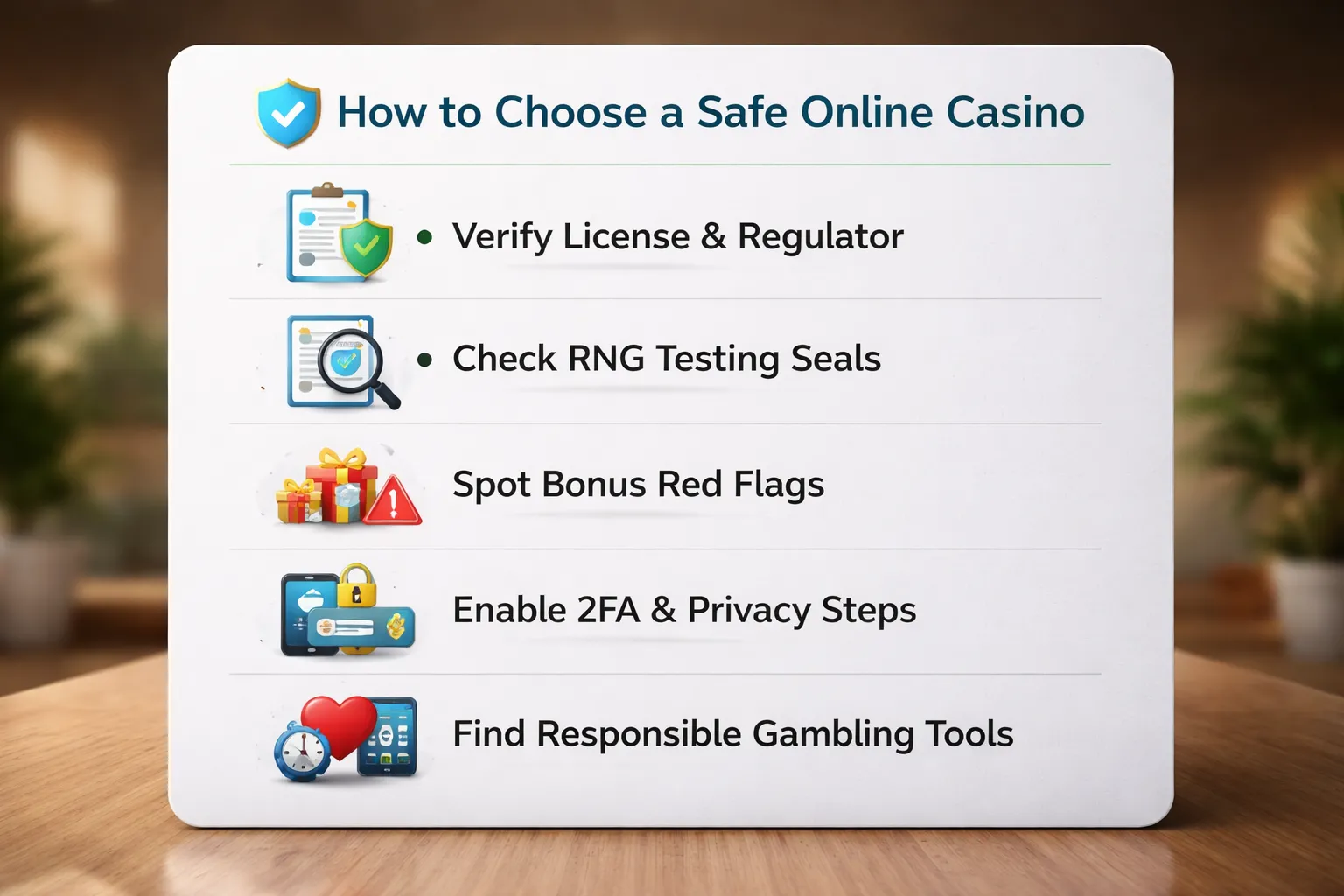
How to check a casino license and regulator in under 2 minutes
- Scroll to the site footer. Find the license line. It should name a regulator and a license number.
- Open the regulator site in a new tab. Use the official domain, not a link from the casino if it looks odd.
- Search the license number or the operator name on the regulator register.
- Match details. Brand name, legal company name, and website domain should match.
- Check status. It should show “active” or “current”. Avoid “suspended”, “surrendered”, or “expired”.
- Read the scope. Some licenses cover sports betting only, or cover B2B software only. You want an operator license for casino play.
Fast rule: If you cannot confirm a license in a public register, treat the site as unlicensed.
RNG fairness and independent testing labs, what seals actually mean
Most online casino games use an RNG, a random number generator. A real testing seal matters only if you can verify it.
- Look for lab names with a test report link, or a certificate ID you can search. A logo alone means little.
- Common labs you will see: eCOGRA, iTech Labs, GLI, BMM Testlabs.
- Check what got tested. Some seals cover the platform, some cover specific game studios, some cover only RNG.
- Check the date. Old certificates can mean the operator changed systems since the last audit.
- Verify RTP info per game. Reputable casinos show RTP, or the game provider shows it in the info screen.
Fast rule: Trust the certificate only if you can click through to a lab page or confirm it on the lab site.
Red flags: predatory bonus terms, unclear ownership, and fake support
- Bonus traps: High wagering like 50x to 80x, short deadlines like 24 to 72 hours, max cashout caps, or “bonus funds are non-withdrawable” rules buried in fine print.
- Game restrictions: Slots-only wagering, excluded providers, or “contribution” rules that make your play count for little.
- Withdrawal blocks: Vague “security review” language with no timeline, or repeated document requests after you already verified.
- Unclear ownership: No legal entity name, no address, no licensing entity, or a support email on a free domain.
- Fake support: Live chat that never answers, scripted replies that ignore your question, or no ticket number and no case history.
- Payment weirdness: Pushy crypto-only deposits with no clear fees, or pressure to use a specific wallet app.
Before you deposit, read the bonus terms and the withdrawal rules. If the site hides them, leave. Use online casino reviews to cross-check complaints, payout speed, and verification issues.
Privacy and data protection basics for gambling accounts
- Use a unique password. Use a password manager.
- Turn on 2FA if the casino offers it.
- Use your real details for KYC. Mismatched names and addresses can block withdrawals.
- Check site basics. The URL should start with https. The site should show a privacy policy and data contact.
- Limit what you share. Do not send documents over social media or chat apps.
- Watch for phishing. Type the casino URL yourself. Do not log in from promo links in random emails.
- Use safer payments. Cards and trusted e-wallets give you clearer records than bank transfers to unknown processors.
Responsible gambling tools that beginner-friendly casinos should offer
- Deposit limits: Daily, weekly, and monthly caps you can set inside your account.
- Loss limits: A stop point that blocks more play after a set loss amount.
- Session limits: Time limits and break reminders.
- Cooling-off: Short breaks like 24 hours to 30 days, set in one click.
- Self-exclusion: Longer blocks, with clear reinstatement rules and no marketing during exclusion.
- Reality checks: Pop-ups that show time played and net spend.
- Account history: Easy access to deposits, withdrawals, bets, and bonuses.
Fast rule: If you cannot set limits before you deposit, you should not play there.
Customer support and beginner help: what great service looks like
Live chat vs. email vs. phone, which is best for first-timers
Live chat works best for most beginner issues. Use it for sign-up errors, bonus activation, and deposit problems. You want real time help and a written transcript.
Email works best for documents and account verification. Use it when you need to attach files or you want a clear paper trail. Expect slower replies.
Phone helps when you cannot log in or you need urgent account access help. It also helps if you struggle with chat. It should not be the only option.
- Best setup for beginners: 24/7 live chat, email with ticket numbers, optional phone support.
- If a casino hides support behind a bot and no human option, treat it as a warning.
Support quality checklist: scripts, escalation, and resolution times
- Gets to your account fast. The agent asks for your username and last transaction reference, not your full card number or password.
- Answers the question you asked. Scripts happen, but the agent should confirm your exact issue in one short line.
- Gives a clear next step. You get a specific action, a time estimate, and what info they need from you.
- Escalates when needed. Payments, KYC, and technical bugs go to a specialist. You get a ticket ID.
- Shares realistic timelines. Good teams say hours or days, not vague promises.
- Closes the loop. They confirm the fix and point you to your account history so you can verify it.
| Issue | What good support does | What you should receive |
|---|---|---|
| Bonus did not credit | Checks eligibility and wager rules, applies bonus or explains the exact blocker | Rule cited, status update, ticket ID if manual review |
| Deposit missing | Checks payment provider logs, confirms pending vs. failed | Transaction reference, expected update window |
| Withdrawal delayed | Explains review steps, lists required documents, confirms queue position | Document list, timeline, confirmation of receipt |
| Account verification | Explains accepted files and how to upload them | Upload link, file rules, review time estimate |
If support refuses to explain a decision, or keeps sending you to terms without pointing to the exact rule, treat it as a red flag. Use this guide on how to spot a fake online casino before you deposit.
Help center essentials: searchable FAQs, tutorials, and payment guides
A beginner friendly casino does not force you to contact support for basic steps. You should find answers in under one minute.
- Searchable FAQ. Works on mobile. Shows clear categories like Payments, Bonuses, Verification, and Responsible Play.
- Step-by-step sign-up and verification. Screenshots or short guides. Lists accepted ID types and file requirements.
- Payment method pages. Shows minimum deposits, withdrawal limits, fees, and typical processing times.
- Withdrawal guide. Explains review steps, common delays, and how to track status in your cashier.
- Bonus guide. Defines wagering requirements, max bet rules, restricted games, and expiry dates in plain language.
- Game tutorials. Explains simple rules for slots, roulette, and blackjack, plus how autoplay and quick spin work.
- Responsible gambling hub. Shows how to set limits and how to self exclude without contacting support.
VIP and loyalty programs: useful perks vs. distractions for beginners
VIP programs can help you later, but they can push you to spend more early. As a beginner, focus on safety and cashout speed, not status.
- Useful perks. Faster withdrawals, lower fees, clear cashback terms, and better limits for verified accounts.
- Distractions. Tier points tied to high wagering, time limited quests, and offers that pressure you to deposit again.
- What to look for. Transparent point earning rates, clear redemption value, and opt-out marketing controls.
If support keeps pushing VIP offers while you ask about withdrawals, pick a different casino.
Beginner mistakes to avoid (and smarter habits to build)
Chasing losses and why it happens
Chasing starts when you treat a loss like a problem you can fix with one more bet. Your brain wants to get back to even. Casinos also speed this up with fast rounds, near misses, and instant re-buys.
- What it looks like: You raise stakes after a loss, you deposit again “just to recover,” you switch games to find a “hot” one.
- Why it hurts: Higher stakes increase volatility. One bad run can wipe your budget fast.
- Smarter habit: Set a stop-loss for the session. When you hit it, you stop. No exceptions.
- Smarter habit: Take cash-out breaks. Withdraw part of any big win before you keep playing.
Misunderstanding RTP and short-term variance
RTP is a long-run average, not a promise for your next 50 spins or 200 hands. Variance decides how wild the swings get. High variance means bigger streaks, both good and bad.
- RTP reality: A 96% RTP game can still crush you in the short term. It can also pay huge. Both fit the math.
- Variance reality: Two slots can show the same RTP and behave very differently. One pays small wins often. One pays rarely but big.
- Smarter habit: Use RTP to compare games, then size your bets for variance. High variance needs smaller bets and more spins.
| Concept | What it means for you |
|---|---|
| RTP | Best for comparing games over time, not predicting short sessions. |
| Variance | Controls bankroll swings. Higher variance needs more buffer. |
Ignoring terms, the fastest way to lose a bonus
Most beginner bonus losses come from terms, not gameplay. You can “win” and still end up with nothing if you break a rule.
- Wagering requirement: If you take a 40x playthrough, you must bet 40 times the bonus amount before you can withdraw bonus funds.
- Game contribution: Slots may count 100%, table games may count 0% to 20%.
- Max bet rule: Many bonuses cap your wager size. One oversized bet can void winnings.
- Time limit: Bonuses often expire in days, sometimes hours.
- Withdrawal limits: Some bonuses cap cashout, even if you win more.
- Smarter habit: Read five lines before you claim. Wagering, max bet, game contribution, expiry, cashout cap.
Overbetting on unfamiliar games and side bets
Beginners lose money when they jump into new rules at full stakes. Side bets also look simple, but they often carry a higher house edge than the main game.
- Common mistake: You play a new table game live, then copy other players without knowing the odds.
- Common mistake: You add side bets every hand because the payouts look big.
- Smarter habit: Start at the minimum bet for 20 to 50 rounds. Learn the pace, the UI, and the betting options.
- Smarter habit: Treat side bets as entertainment spend. Cap them or skip them.
If you want a simple starting point, use a basic strategy table and stick to main bets. See our best online casinos for blackjack guide for beginner-friendly tables and rules.
Bankroll basics, simple session budgeting that works
You need a session plan before you deposit. You also need unit sizing you can keep consistent.
- Pick a session bankroll: Use an amount you can lose without stress. Keep it separate from bills.
- Set a unit size: Use 1% to 2% of your session bankroll per bet for high-variance slots. Use 2% to 5% for lower-variance games.
- Set two hard limits: A stop-loss and a win goal. Stop when you hit either one.
- Limit deposits: Use one deposit per session. Turn off one-click re-deposit if the casino allows it.
- Track results: Log deposit, cashout, and time played. This stops “I barely played” bias.
| Session bankroll | Unit size | 100 bets at unit size |
|---|---|---|
| $100 | $1 to $2 | $100 to $200 total action |
| $250 | $2.50 to $5 | $250 to $500 total action |
| $500 | $5 to $10 | $500 to $1,000 total action |
Quick checklist: choosing the best online casino for beginners in 5 minutes
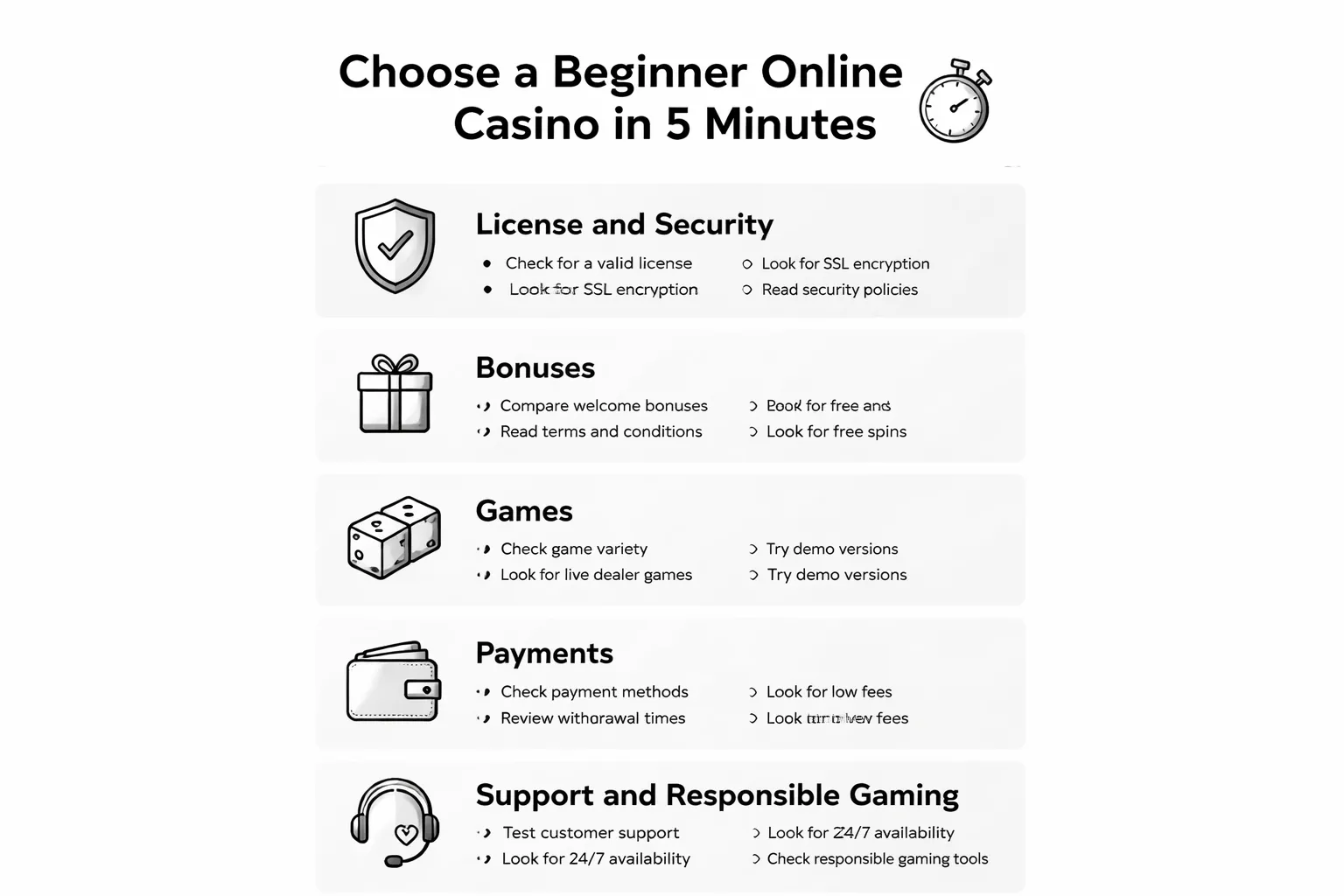
License and security confirmation checklist
- License: Find the license badge in the footer. Open it. Confirm the operator name matches the casino site name.
- Regulator: Look for a real authority, not a “verified” icon. Check the regulator site if the link exists.
- HTTPS: Confirm the URL starts with https and the browser shows a lock icon.
- 2FA: Turn on two-factor authentication in your account settings if available.
- KYC upfront: Check the FAQ for ID and address checks. A clear list means fewer delays at cashout.
- Terms you can find: Locate Terms, Privacy, and Responsible Gaming links in the footer. If they are missing, skip the site.
- Fair play: Look for RNG testing mentions and audit firms. If the site names no tester, treat it as higher risk.
Beginner-friendly bonus checklist
- Bonus type: Prefer simple offers. Deposit match and free spins beat multi-layer promos.
- Minimum deposit: Confirm the minimum deposit fits your budget. Avoid bonuses that force a large first deposit.
- Wagering requirement: Find the playthrough number. Lower is easier. If it is hard to find, skip the bonus.
- Time limit: Check expiry for bonus funds and free spins. Short deadlines push bad decisions.
- Game contribution: Confirm slots, roulette, blackjack, and live games count toward wagering. Many promos exclude low edge games.
- Max bet rule: Check the allowed bet size while bonus funds are active. Breaking this can void winnings.
- Max cashout: Look for a cashout cap on bonus winnings. Avoid tight caps.
- Opt-out option: Make sure you can decline the bonus at deposit. This keeps your cashout simple.
Game selection checklist for simple learning
- Start list: Pick casinos that make it easy to find low complexity games. Slots, blackjack, roulette, and baccarat should be easy to filter.
- Demo mode: Confirm you can play demo versions of slots and table games. Use it to learn controls and pace.
- Rule clarity: Open the game info panel. You should see rules, paytables, RTP, and volatility on slots.
- Low minimum bets: Look for $0.10 to $0.50 slots and $1 to $5 table minimums. Lower mins help you stick to a unit size.
- Few variants: Avoid casinos that push niche rule sets first. Start with classic blackjack rules and single zero roulette if available.
- Provider quality: Choose sites that list major game studios. Missing provider names is a red flag.
- Mobile usability: Test one slot and one table game on your phone. Buttons should not overlap, and the cashier should load fast.
Payment and cashout checklist
- Payment methods: Confirm at least one bank option and one e-wallet option you already use.
- Fees: Check deposit and withdrawal fees. If the site hides fees until checkout, treat it as a warning.
- Cashout speed: Find stated processing times. Separate casino processing from bank transfer times.
- Withdrawal limits: Check minimum and maximum per withdrawal, and any daily, weekly, or monthly caps.
- Verification timing: Submit KYC before your first cashout. This reduces “pending” delays.
- Withdrawal steps: Confirm the cashout flow takes a few clear steps, not multiple redirects.
- Transaction history: Make sure you can export or view deposits and withdrawals in your account for tracking.
Support and responsible gaming checklist
- Live chat: Test it before you deposit. Ask one direct question about withdrawal timing or bonus wagering.
- Support hours: Confirm coverage matches your schedule. 24/7 support matters if you play late.
- Help center quality: Look for clear pages on KYC, withdrawals, limits, and bonus rules.
- Responsible gaming tools: Set deposit limits, session limits, and loss limits if available.
- Cooling-off and self-exclusion: Confirm you can lock your account for days, weeks, or longer.
- Reality checks: Turn on time and spend alerts. Keep them on.
- Gambling support links: The site should link to real help resources. Missing resources suggests weak compliance.
- Extra due diligence: Use one trusted source for comparisons before you choose, like online casino reviews.
FAQ
What makes an online casino beginner-friendly?
Look for fast sign-up, clear menus, and simple games like slots, roulette, and blackjack. Check for a demo or low minimum stakes. Use live chat and a strong help center. Confirm supported banking methods and clear withdrawal rules before you deposit.
How do I know an online casino is safe?
Check for a valid license, HTTPS, and published terms for bonuses and withdrawals. Confirm identity checks and fraud controls. Review responsible gambling tools like deposit limits and self-exclusion. Use one comparison source before you choose, like online casino reviews.
Do I need to verify my identity to withdraw?
Yes, most casinos require KYC before your first withdrawal. You usually upload an ID, proof of address, and sometimes a payment proof. Verify early to avoid delays. Use your real details at sign-up so your documents match your account.
What is a good first deposit amount?
Start small. Use an amount you can lose without stress. Many casinos set low minimum deposits, often $10 to $20. Set a deposit limit before you fund your account. Increase only after you understand the games and the withdrawal process.
Are welcome bonuses worth taking as a beginner?
Sometimes. Check wagering requirements, max bet rules, and eligible games. Avoid offers with high playthrough or short time limits. If terms confuse you, skip the bonus and play with cash. A smaller, clear bonus beats a large, restrictive one.
What are wagering requirements in plain terms?
They tell you how much you must bet before you can withdraw bonus funds. Example, a $50 bonus with 30x wagering means $1,500 in bets. Some games contribute less than 100 percent. Always read the bonus terms before you opt in.
Which games should I start with?
Start with low-volatility slots, European roulette, and blackjack with basic strategy. Avoid complex table variants and side bets at first. Use demo mode if available. Keep stakes small until you understand betting rules, payouts, and session pace.
How fast can I withdraw my winnings?
It depends on the casino, the payment method, and KYC status. E-wallets often pay faster than cards. First withdrawals can take longer due to verification. Check processing times, daily limits, and fees in the banking section before you deposit.
What fees should I watch for?
Watch for withdrawal fees, currency conversion fees, and inactivity fees. Some casinos charge extra for multiple withdrawals per month. Your bank or e-wallet can also charge fees. Read the cashier page and terms. Keep screenshots of limits and processing times.
What support should a beginner expect?
Live chat, email support, and a clear FAQ. Look for support hours that match your time zone. Test chat with a simple question before you deposit. A good casino answers clearly, links to rules, and does not dodge questions about withdrawals.
How do I keep gambling under control?
Use deposit limits, loss limits, and time reminders. Turn on reality checks. Use cooling-off if you feel pressure to chase losses. Use self-exclusion if you need a hard stop. Pick casinos that show these tools in your account settings.
Conclusion
You do not need a big bankroll or expert knowledge to start. You need a licensed casino, simple banking, clear rules, and support that responds fast.
- Start small. Make a low first deposit. Test a withdrawal early, even if it is a small amount.
- Pick simple games. Use demo mode first. Stick to low-volatility slots, blackjack, or roulette with low table limits.
- Use beginner bonuses correctly. Read wagering requirements. Check max bet rules. Avoid promos with unclear terms.
- Track your play. Set deposit and loss limits before you play. Turn on reality checks. Stop when you hit your limit.
- Verify trust signals. Confirm licensing, encryption, and payout policies. Use this guide on how to choose a safe online casino before you fund your account.
Final tip. Treat your first week as a test. If the casino makes identity checks, terms, or withdrawals hard to understand, move on.
-
Best Online Casinos for Blackjack: Best Tables, Rules & Bonuses
4 weeks ago -
Fast Payout Online Casinos: Best Sites for Quick Withdrawals
3 weeks ago -
Best Online Casinos for Roulette: Best Wheels, Limits & Live Options
4 weeks ago -
Best PayPal Online Casinos: Top Sites That Accept PayPal Deposits & Withdrawals
4 weeks ago -
Best Online Casinos for High Rollers: VIP Perks, High Limits & Exclusive Bonuses
3 weeks ago
-
- Licensing, auditing, and reputation checks
- Bonus value vs. difficulty
- Payments, processing times, and real-world cashout reliability
- Game catalog quality: providers, RTP visibility, and volatility range
- Customer support testing: response times, knowledge, and channels
- UX scoring: navigation, loading speed, and responsible design
- Security signals: encryption, 2FA options, and privacy practices
-
- Slots 101: paylines, bet sizing, volatility, and RTP
- Roulette basics: inside vs. outside bets and safer starting strategies
- Baccarat for beginners: why it’s simple and how bets work
- Blackjack starter tips: essential rules and common mistakes
- Video poker basics: easiest variants to learn and what paytables mean
- Games to approach later: live dealer side bets and complex variants
-
- Fastest beginner options: cards, e-wallets, and instant banking
- Minimum deposit and withdrawal pitfalls, and how to plan around them
- Withdrawal timelines: what’s normal, and what’s a red flag
- Fees, currency conversion, and payment limits explained simply
- Crypto for beginners: when it helps, and when it complicates things
-
- How to check a casino license and regulator in under 2 minutes
- RNG fairness and independent testing labs, what seals actually mean
- Red flags: predatory bonus terms, unclear ownership, and fake support
- Privacy and data protection basics for gambling accounts
- Responsible gambling tools that beginner-friendly casinos should offer
-
- What makes an online casino beginner-friendly?
- How do I know an online casino is safe?
- Do I need to verify my identity to withdraw?
- What is a good first deposit amount?
- Are welcome bonuses worth taking as a beginner?
- What are wagering requirements in plain terms?
- Which games should I start with?
- How fast can I withdraw my winnings?
- What fees should I watch for?
- What support should a beginner expect?
- How do I keep gambling under control?
-
-
- Licensing, auditing, and reputation checks
- Bonus value vs. difficulty
- Payments, processing times, and real-world cashout reliability
- Game catalog quality: providers, RTP visibility, and volatility range
- Customer support testing: response times, knowledge, and channels
- UX scoring: navigation, loading speed, and responsible design
- Security signals: encryption, 2FA options, and privacy practices
-
- Slots 101: paylines, bet sizing, volatility, and RTP
- Roulette basics: inside vs. outside bets and safer starting strategies
- Baccarat for beginners: why it’s simple and how bets work
- Blackjack starter tips: essential rules and common mistakes
- Video poker basics: easiest variants to learn and what paytables mean
- Games to approach later: live dealer side bets and complex variants
-
- Fastest beginner options: cards, e-wallets, and instant banking
- Minimum deposit and withdrawal pitfalls, and how to plan around them
- Withdrawal timelines: what’s normal, and what’s a red flag
- Fees, currency conversion, and payment limits explained simply
- Crypto for beginners: when it helps, and when it complicates things
-
- How to check a casino license and regulator in under 2 minutes
- RNG fairness and independent testing labs, what seals actually mean
- Red flags: predatory bonus terms, unclear ownership, and fake support
- Privacy and data protection basics for gambling accounts
- Responsible gambling tools that beginner-friendly casinos should offer
-
- What makes an online casino beginner-friendly?
- How do I know an online casino is safe?
- Do I need to verify my identity to withdraw?
- What is a good first deposit amount?
- Are welcome bonuses worth taking as a beginner?
- What are wagering requirements in plain terms?
- Which games should I start with?
- How fast can I withdraw my winnings?
- What fees should I watch for?
- What support should a beginner expect?
- How do I keep gambling under control?
-
-
Online Casino Licensing Explained: Authorities, Licenses & How to Check One
3 weeks ago -
Best Live Dealer Casinos: Where to Play Live Blackjack, Roulette & More
3 weeks ago -
Best Online Casinos for High Rollers: VIP Perks, High Limits & Exclusive Bonuses
3 weeks ago -
Fast Payout Online Casinos: Best Sites for Quick Withdrawals
3 weeks ago -
What Is an Online Casino? How They Work, Games, Bonuses & Safety
4 weeks ago
-
Best Online Casinos for Blackjack: Best Tables, Rules & Bonuses
4 weeks ago -
Online Casino Bonuses Explained: How They Work + Terms You Must Know
4 weeks ago -
Fast Payout Online Casinos: Best Sites for Quick Withdrawals
3 weeks ago -
Online Casino Licensing Explained: Authorities, Licenses & How to Check One
3 weeks ago -
Best Online Casinos for Roulette: Best Wheels, Limits & Live Options
4 weeks ago