Best Credit Card Online Casinos: Visa/Mastercard-Friendly Casino Sites

Credit cards still power a large share of casino deposits. Visa and Mastercard stay the main options. This guide focuses on credit card online casinos that process deposits cleanly and avoid common banking problems.
You will learn which sites accept Visa and Mastercard, what deposit limits to expect, and which fees can show up at checkout. You will also see the key checks that matter, license details, encryption, fraud controls, and clear terms for bonuses and cashouts. We cover what you can and cannot do with a credit card, including why many casinos block credit card withdrawals and route payouts to other methods.
If you want a deeper safety checklist before you deposit, use this safe online casino guide.
Key Takeaways
- In het kort: Visa and Mastercard deposits work at many casinos, but approval depends on your bank, your country, and the casino’s processor.
- In het kort: Expect declines at checkout. Common causes include MCC blocks, bank fraud rules, 3D Secure checks, and cross border processing.
- In het kort: Credit cards usually fund deposits only. Many casinos do not send withdrawals back to a card, they pay out to bank transfer, e-wallets, or other methods.
- In het kort: Your safest shortlist uses three checks, a real license, strong encryption, and clear bonus and cashout terms.
- In het kort: Watch the full cost. Your issuer can add cash advance fees, interest, and foreign transaction fees, even when the casino lists the deposit as free.
- In het kort: Use limits you control. Set a deposit cap at the casino, then mirror it with card controls or bank limits.
- In het kort: If you care about speed, your withdrawal method matters more than your deposit method. Use a site built for quicker cashouts, see our fast payout casinos list.
Best credit card online casinos (Visa/Mastercard-friendly picks)
Quick comparison: Visa and Mastercard friendly casinos
Credit cards work best for deposits. Most casinos pay withdrawals to a different method. Plan your cashout before you deposit.
| Casino | Min deposit | Card processing time | Card fees | KYC timing | Common withdrawal methods |
|---|---|---|---|---|---|
| Ignition Casino | $20 to $25 | Instant to a few minutes | Usually none from the casino, card issuer may charge cash advance | Before first withdrawal | Crypto, check by courier, bank transfer where available |
| BetOnline Casino | $25 | Instant to a few minutes | Usually none from the casino, issuer fees possible | Before first withdrawal | Crypto, check, bank wire |
| Super Slots | $20 | Instant to a few minutes | Often none from the casino, issuer fees possible | Before first withdrawal | Crypto, check, bank wire |
| Slots.lv | $20 | Instant to a few minutes | Often none from the casino, issuer fees possible | Before first withdrawal | Crypto, check, bank wire |
| Wild Casino | $20 | Instant to a few minutes | Often none from the casino, issuer fees possible | Before first withdrawal | Crypto, check, bank wire |
Top picks by player type
- Slots players: Super Slots, Slots.lv. Solid slot depth and frequent promos. Use a card for deposits, then switch to crypto for faster cashouts.
- Table games players: BetOnline. Strong blackjack and roulette coverage. If roulette is your focus, use our roulette casinos guide to compare wheels and limits.
- Live dealer fans: BetOnline, Ignition. Better live coverage than most card friendly offshore lobbies.
- High rollers: Ignition, BetOnline. Better support and higher limits in practice. Ask support for card limit ceilings before you deposit.
- Beginners: Ignition. Cleaner layout and fewer banking steps. Deposit small, clear KYC early, then test a first withdrawal.
Detailed reviews: what stands out, reliability, best fit
Ignition Casino
- What stands out: Smooth cashier flow for Visa and Mastercard deposits. Beginner friendly lobby. Good mix of casino and poker traffic.
- Payment reliability: Deposits usually clear fast. Withdrawals rarely go back to the card. Expect crypto or check as the normal path. Start KYC before you request a large cashout.
- Best for: Beginners, mixed play, players who want simple deposits and a predictable withdrawal process.
BetOnline Casino
- What stands out: Strong table games lineup and a broader book and casino ecosystem. Good for players who keep everything in one account.
- Payment reliability: Card deposits tend to be quick. Issuer declines can happen, so keep a backup method ready. Withdraw through crypto or bank wire where available.
- Best for: Table games, live dealer, higher stakes players who want higher account limits.
Super Slots
- What stands out: Slot heavy catalog with frequent bonuses. Easy card deposit options in the cashier.
- Payment reliability: Deposits usually post quickly. Withdrawals depend on method and KYC status. Crypto tends to be the fastest option once verified.
- Best for: Slot players who chase promos and want Visa or Mastercard deposits.
Slots.lv
- What stands out: Big slot library and regular reload offers. Strong for players who stick to slots and video poker style games.
- Payment reliability: Card deposits are usually smooth. Plan withdrawals through crypto or check, then follow the site’s ID and proof of address rules.
- Best for: Slots and bonus grinders who can meet wagering terms without rushing.
Wild Casino
- What stands out: Aggressive promos and a straightforward cashier. Works well if you deposit by card but withdraw another way.
- Payment reliability: Deposits often process fast. Withdrawals can slow down if you submit documents late or your bonus terms trigger extra checks.
- Best for: Players who want card deposits and do not mind switching to crypto or check for withdrawals.
Red flags checklist: signs a casino will fight your card deposit or your cashout
- Card deposit works only through “manual” steps: emailed links, chat only payments, or instructions to mislabel the transaction.
- Hidden card surcharges: a fee shows up only at the final cashier step, or the terms mention extra “processing” charges.
- Cash advance language: the casino tells you to treat the deposit like a cash transfer, or the descriptor looks like a money service.
- Withdrawal method trap: the site pushes card deposits but blocks common withdrawals unless you deposit again.
- KYC after you win: no clear document list up front, then new requirements appear in stages after a withdrawal request.
- Bonus terms that delay payouts: unclear wagering, game exclusions, max cashout caps, or rules that let the casino void wins for “irregular play.”
- No clear banking page: missing deposit and withdrawal limits, missing processing times, or no fee disclosure.
- Support avoids specifics: they will not confirm which card types work, typical decline reasons, or which withdrawals are fastest.
How we rank the best online casinos that accept credit cards
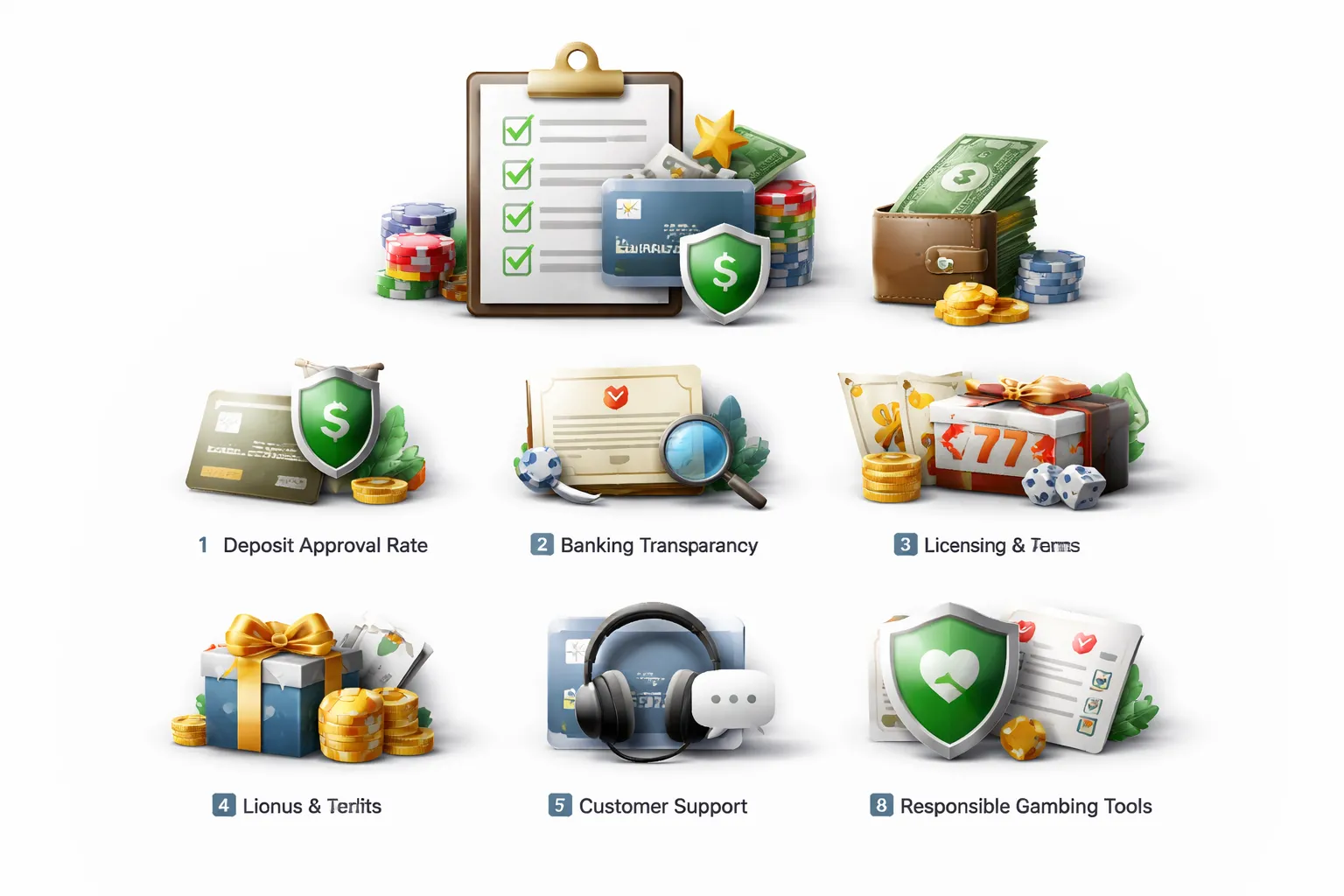
We rank credit card friendly casinos on one thing, can you deposit and cash out without surprises. We test the payment flow, read the banking terms, and check the license record. We also look for patterns in user complaints and support behavior.
Deposit approval rate and checkout stability
- Card acceptance: We test Visa and Mastercard deposits across common amounts. We log approval and decline rates.
- Decline reasons: We check if the casino explains typical failures, bank blocks, 3DS prompts, AVS mismatch, MCC restrictions, and issuer limits.
- Uptime: We track checkout errors, processor outages, and stuck deposit states.
- Verification friction: We note when KYC blocks deposits, forces extra steps mid checkout, or triggers repeated document requests.
Banking transparency
- Fees and FX: We look for clear fee disclosure, currency conversion notes, and who charges what, casino, processor, or bank.
- Limits: We require published minimums, maximums, and daily or weekly caps for deposits and withdrawals.
- MCC disclosure: We check whether the site warns you that card deposits can code as gambling or entertainment and may count as cash advance at some banks.
- Processing partners: We prefer casinos that name or at least describe their payment processors and provide a clear banking contact path.
Withdrawal practicality
- Realistic cashout routes: Many casinos do not send withdrawals back to a credit card. We score higher when you get usable options like bank transfer, e-wallets, crypto, or paper check where offered.
- Times and steps: We compare posted approval windows, payout times, and required verification stages.
- Fees and limits: We check withdrawal fees, minimum cashout, and maximum per transaction.
- Fallback plan: We penalize casinos that push you to deposit by card but hide the cashout method until after you play.
Licensing, audits, and reputation signals
- License quality: We verify the operator and license number on the regulator site, not just a logo in the footer.
- Game testing: We look for recognized testing labs listed in the terms or audit pages, plus provider level certifications.
- Complaint patterns: We scan for repeated reports of blocked withdrawals, sudden KYC demands, bonus voids, and payment stalling.
- Ownership clarity: We check for a real company name, address, and terms that match the operator on the license.
Bonus value vs wagering requirements
- Wagering math: We weigh the wagering multiple, max bet rules, game contribution, and time limits.
- Payment method exclusions: We check if credit card deposits qualify for the bonus, points, or cashback, and if any games get excluded after you opt in.
- Cashout caps: We flag low maximum cashouts tied to bonus play or unclear “irregular play” clauses.
Game portfolio depth
- RNG slots: We look for depth across new releases and proven titles.
- Jackpots: We check for real progressive networks, not house branded counters with unclear rules.
- Table games: We expect multiple variants, fair limits, and stable performance.
- Live dealer: We score higher for known studios, low latency, and a solid table mix.
- Provider list: We prefer casinos that publish providers and do not hide the software stack.
Customer support quality
- Payment troubleshooting: We test whether support can explain card declines, 3DS checks, and what details you must match at checkout.
- Chargeback handling: We check if the terms explain disputes, account locks, and what evidence the casino requests.
- Speed: We time first response on live chat and email and check if answers stay specific.
- Escalation: We look for a clear path for payout disputes and verified banking issues.
Responsible gambling safeguards
- Deposit limits: We require easy to set limits that apply to card deposits, not just net losses.
- Cooling-off: We check for short breaks you can trigger from your account page.
- Self-exclusion: We look for long term exclusion options and clear reinstatement rules.
- Reality checks: We prefer casinos that support session timers and activity summaries.
If you want a deeper checklist for spotting shady operators, use our guide on how to spot a fake online casino.
Which credit cards work at online casinos (and what to expect)
Visa vs Mastercard acceptance differences and typical approval behavior
Visa and Mastercard work at more online casinos than any other credit card brands. They still decline often, because banks treat gambling as higher risk.
- Acceptance: Most casinos support both, but some payment processors support one network better in certain countries.
- Approval: You can see declines even when your card has room, because the issuer blocks gambling transactions by default.
- Merchant coding: Deposits usually run under gambling related merchant category codes. Some casinos use third party processors, so the descriptor may not show the casino name.
- 3D Secure: Many Visa and Mastercard deposits trigger a one time code or bank app approval. If your bank does not support it well, deposits fail.
- Decline patterns: Small test deposits can pass, then larger ones fail. Some banks also block repeat deposits within a short window.
American Express and Discover: why acceptance is limited at many casinos
Amex and Discover show up less often in casino cashiers. Casinos and payment processors avoid them for cost and risk reasons.
- Higher processing costs: Fees often run higher than Visa or Mastercard, so casinos skip them.
- Tighter network controls: These networks and their issuers can apply stricter rules to gambling merchants.
- More frequent declines: Even when a casino lists Amex or Discover, approval rates can be lower than Visa or Mastercard.
- Limited processor coverage: Many gambling focused payment gateways do not support Amex or Discover in all regions.
Prepaid and virtual cards: when they work and when they fail KYC/AVS checks
Prepaid and virtual cards can work for deposits, but they fail more often at verification and fraud checks.
- AVS mismatch: Many prepaid cards do not tie cleanly to your billing address. If the casino runs Address Verification Service, you can get a decline.
- Name mismatch: Some virtual card setups do not match your legal name. That can trigger declines or KYC issues.
- KYC friction: Casinos verify your identity and payment method before withdrawals. If you cannot prove you own the card, you can get delayed.
- Reloadable works better: Reloadable prepaid cards issued by major banks tend to pass checks more often than store bought gift cards.
- Refund limits: If you withdraw to a different method, the casino may first return deposits back to the original card. Prepaid cards sometimes cannot accept credits, so you may need a bank transfer or e-wallet.
Debit vs credit: processing similarities, budgeting differences, and approval odds
Online casinos process debit and credit cards in similar ways. Your bank still decides whether the transaction goes through.
- Processing: Both use the same card rails and the same fraud checks. Debit does not guarantee approval.
- Budget control: Debit draws from your bank balance. Credit can turn a deposit into a high cost cash advance, depending on issuer rules.
- Approval odds: Debit can approve more often at some banks because it reduces credit risk. Other banks block both the same way.
- Holds and reversals: Debit declines and reversals can leave temporary holds on your account. Plan for short term balance impacts.
Issuer policies and cash-advance settings that affect gambling transactions
Your issuer controls the outcome. Casino cashier support cannot override bank rules.
- Gambling blocks: Many issuers let you block gambling transactions in your app or by phone. If it is on, deposits decline.
- Cash advance treatment: Some issuers treat gambling deposits as cash advances. You can pay a fee, start interest immediately, and lose grace periods.
- Cash advance limit: Even with a high credit limit, your cash advance limit may be low. That causes declines on larger deposits.
- International and online security settings: If your bank blocks foreign merchants or online transactions, deposits fail until you change settings.
- Velocity controls: Issuers can block repeated deposits or deposits that look unusual for your account history.
- What to do when you get declined: Call the number on the back of your card, ask if gambling merchant codes are blocked, ask if deposits post as cash advances, then adjust limits or settings before you try again.
Step-by-step: how to deposit with a credit card at an online casino
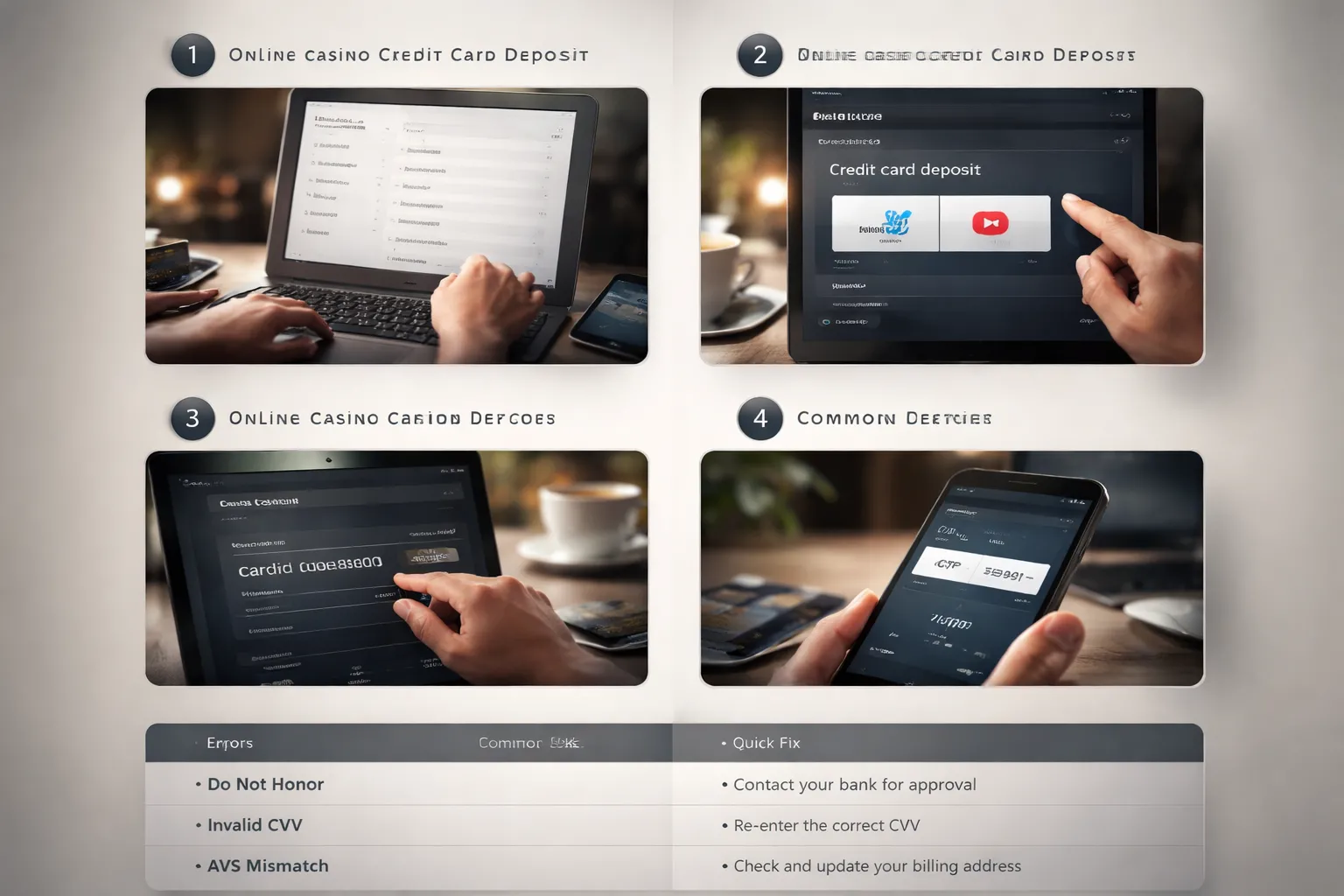
Account setup and identity basics
Start with your account details. Keep them identical to your card and billing profile.
- Name: Use the same first and last name shown on your card statement.
- Address: Enter your full billing address, including apartment number and ZIP or postal code.
- Email and phone: Use a real number you can access. Many casinos send one-time codes to it.
- Date of birth: Match your legal ID. Casinos use it for age checks and fraud screening.
If your profile does not match your bank records, you trigger AVS and fraud filters. Deposits decline more often, and withdrawals get delayed during verification.
Navigating the cashier and entering card details safely
- Log in, then open Cashier or Banking.
- Select Credit Card, then choose Visa or Mastercard if you see separate options.
- Set your deposit amount. Stay within site limits and your card’s daily spend limit.
- Enter your card number, expiry date, and CVV. Double-check digits before you submit.
- Confirm your billing address details exactly as your card issuer has them.
Use a private device and a secure connection. Avoid public Wi-Fi for card deposits. Bookmark the casino site and use that link each time.
3D Secure and OTP verification
Many Visa and Mastercard deposits route through 3D Secure. Your bank may ask for a one-time passcode, app approval, or biometric confirmation.
- Do not refresh the page during verification.
- Do not press back. Complete the flow in the same browser tab.
- If the OTP does not arrive, check spam filters, signal, and whether your bank blocks short codes.
- If you have both SMS and banking app options, use the app when possible. It fails less often than SMS.
If you time out, wait a few minutes before you try again. Rapid repeats can trigger issuer velocity controls.
Common deposit errors and fixes
| Error message | What it usually means | Fix |
|---|---|---|
| Do Not Honor | Issuer blocked the transaction due to risk rules, gambling restrictions, or unusual activity. | Call your issuer. Ask if gambling merchant codes get blocked and if the deposit posts as a cash advance. Ask them to allow the merchant, then try once. |
| Invalid CVV | CVV mismatch, wrong digits, or wrong card type selected. | Re-enter CVV carefully. Use the CVV from the physical card. Confirm you selected Visa or Mastercard correctly. |
| AVS mismatch | Billing address or ZIP does not match issuer records. | Match your statement exactly. Use the correct ZIP, include unit numbers, and avoid abbreviations your issuer does not use. |
| Insufficient funds or limit | Credit limit, daily spend cap, or cash advance limit blocks the deposit. | Lower the deposit amount, raise limits with your bank, or use a different payment method. |
| Transaction not permitted | Your card blocks online, international, or gambling transactions. | Enable online and international usage in your bank app. Ask support which processor country your deposit routes through. |
What casinos store and what you should never share
Reputable casinos and payment processors usually store a token, not your full card number. Tokenization replaces your card details with a reference value for future deposits and fraud checks.
- Typical stored data: A token, card brand, last 4 digits, expiry month and year, and transaction history.
- You should never share: Your full card number by chat or email, your CVV, one-time passcodes, or banking app approval codes.
- Basic rule: If support asks for CVV or OTP, stop. Use official cashier forms only.
If you want a faster, lower-friction play flow after funding, pick a table game with simple rules and stable RTP, see our online blackjack casino guide.
Withdrawals at credit card casinos: what’s actually possible
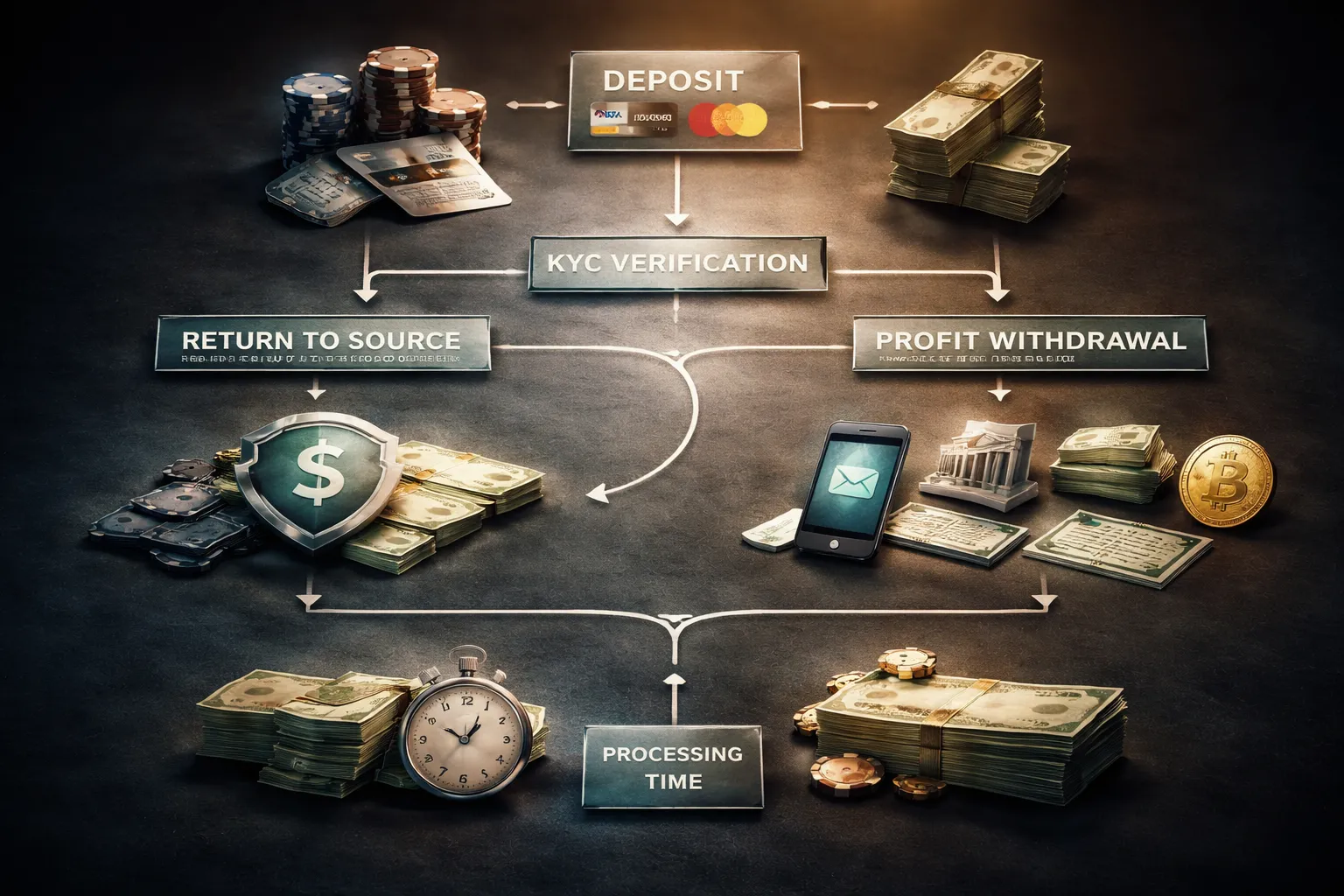
Why many casinos don’t allow direct withdrawals back to credit cards
Credit cards work well for deposits. They often work poorly for withdrawals.
- Card networks treat payouts as refunds. Many casino cashier systems cannot send a true “payout” to a card.
- Issuer rules block credits. Some banks reject incoming card credits tied to gambling activity.
- Time and dispute risk. Card chargebacks create risk for casinos, so they push withdrawals to methods with clearer ownership checks.
- Prepaid and some debit cards usually cannot receive credits, even if they can fund deposits.
Typical withdrawal routes after card deposits
In most cases, you deposit by Visa or Mastercard, then you withdraw by a different method.
- Bank transfer. Common for larger payouts. More paperwork, fewer reversals.
- E-wallets. Fast and flexible. You still need KYC, and the wallet account name must match your casino profile.
- Checks. Slow. Used when other methods fail or in some regions with limited banking rails.
- Crypto. Often the fastest after approval. Some casinos convert to crypto even if you deposited by card, depending on local rules.
Before you deposit, check the cashier for available withdrawal methods in your country or state. If you do not see a method you can use, do not assume support can add it later.
How “return to source” rules work
Many casinos follow a return to source policy. It controls where your first withdrawals go.
- Refunds to your card usually apply up to your total card deposits. Example, you deposit $200 by Visa, the casino can refund up to $200 back to that card if the system allows it.
- Profit goes elsewhere. Anything above the refunded deposit amount pays out to another method, like bank transfer or an e-wallet.
- Mixed deposits create split payouts. If you used a card and an e-wallet, the casino can route refunds back in the same order you funded.
This policy limits fraud and chargebacks. It also means you should set up your preferred withdrawal method early, before you win.
KYC, proof-of-payment, and verification timelines
You will not withdraw until the casino verifies you and your payment method.
- Identity checks. Expect ID and proof of address. Name and address must match your account.
- Proof-of-payment for cards. Many casinos ask for a photo of the card showing your name and last 4 digits. You must cover the middle digits and CVV.
- Ownership checks. Deposits must come from a card in your name. Third-party cards trigger delays or rejections.
- Review timing. Many sites approve documents within 24 to 72 hours, but it can take longer during peak periods or if photos look edited or unclear.
After KYC approval, the casino still runs a withdrawal review. That step often takes another 24 to 48 hours before the payment leaves the casino.
Payout speed expectations and how to avoid delays
Plan for two timelines, casino processing time and payment delivery time.
| Method | Casino processing | Delivery after approval |
|---|---|---|
| Card refund (if allowed) | 24 to 72 hours | 2 to 10 business days |
| E-wallet | 24 to 72 hours | Minutes to 24 hours |
| Bank transfer | 24 to 72 hours | 1 to 5 business days |
| Check | 24 to 72 hours | 5 to 14 business days |
| Crypto | 24 to 72 hours | Minutes to a few hours |
- Finish KYC before you request a payout. Upload clean photos. Use the same details across all accounts.
- Meet wagering requirements. Bonuses often lock withdrawals until you clear rollover. If you want faster cashouts, avoid high-rollover promos.
- Watch withdrawal limits. Many casinos cap daily, weekly, or monthly payouts, especially on large wins.
- Use one verified method for withdrawals. Frequent method changes can trigger extra review.
- Do not charge back. A chargeback can freeze your account and delay every future payout.
If speed matters, focus on casinos known for fast processing and choose e-wallet or crypto where legal. See our guide to fast payout casinos for faster withdrawal options.
Fees, limits, and cash-advance risk (avoid expensive mistakes)
Cash advance vs purchase, why the category matters
Your casino deposit can post as a purchase or a cash advance. You do not control this. The merchant category code and your issuer rules decide.
- Purchase can earn rewards and may get a grace period. It still counts toward your credit limit.
- Cash advance usually triggers a fee right away and starts interest the same day. No grace period. Rewards usually do not apply.
- Quasi-cash can apply to some wallet top-ups, prepaid loads, and similar transactions. Many issuers treat it like a cash advance.
Before you deposit, check your card settings for “cash advance” or “gambling” blocks. If your issuer lets you set a $0 cash advance limit, do it. It can prevent an expensive surprise.
Typical fee types and who charges them
- Payment processing fee charged by the casino or its payment processor. Common on card deposits at some brands.
- Foreign transaction fee charged by your card issuer when the casino processor runs outside your country. Often 1% to 3%.
- Cash advance fee charged by your issuer if the deposit codes as cash advance. Often the greater of $5 to $10 or 3% to 5%.
- Immediate interest charged by your issuer on cash advances. It starts on the transaction date, not the statement date.
- Currency conversion markup set by the card network or processor if you deposit in a different currency than your card.
Keep the deposit currency matched to your card when possible. If you see a “dynamic currency conversion” choice at checkout, skip it and pay in the casino currency. DCC often costs more.
Deposit and withdrawal limits you need to check
Limits show up in three places, the casino cashier, the payment processor, and your issuer.
- Per transaction caps can block large deposits even when your credit limit is higher.
- Daily, weekly, monthly caps can slow bankroll reloads and can affect how fast you can cash out big wins.
- Withdrawal method limits matter because many casinos do not pay winnings back to a credit card beyond the original deposit amount. They often return deposits to the card, then send profits by bank transfer, check, e-wallet, or crypto where allowed.
Plan for split payouts on big wins. Keep one backup withdrawal method verified before you need it.
Chargebacks and disputes, what is legitimate and what backfires
A chargeback is not a routine support tool. Casinos treat it as a high risk event.
- Legitimate disputes include unauthorized card use, duplicate charges, and clear billing errors.
- High risk disputes include “I changed my mind,” losses you regret, or bonus disputes. These often lead to account freezes and long reviews.
- Policy reality is simple, the casino can lock withdrawals during a dispute and may close your account. Your issuer can still deny the claim if you authorized the deposit.
Start with the casino cashier and support first. Keep screenshots of receipts, transaction IDs, and cashier logs. Escalate to your issuer only when you have a true billing problem.
Budgeting guardrails to cut fee exposure
- Use a dedicated card with a low limit. Keep it separate from bills and daily spending.
- Set a $0 cash advance limit if your issuer allows it. It blocks many cash advance coded deposits.
- Turn on alerts for every transaction, balance thresholds, and credit limit usage.
- Cap deposits per session using casino tools where available. If you are new, start with smaller deposits and simple games. See our beginner-friendly casino picks.
- Avoid revolving balances on gambling spend. If you carry a balance, interest compounds fast, especially after cash advances.
| Risk | What happens | What you do |
|---|---|---|
| Deposit posts as cash advance | Fee plus immediate interest, no grace period | Set cash advance limit to $0, use a different method if declines |
| FX and conversion costs | Extra 1% to 3% issuer fee, plus conversion markup | Match deposit currency to card, avoid DCC |
| Limits slow payouts | Split refunds and profits across methods | Verify one withdrawal method early and keep it consistent |
| Chargeback triggers freeze | Account review, payout delays, possible closure | Use support first, dispute only true unauthorized or billing errors |
Safety and legitimacy checks before using a credit card
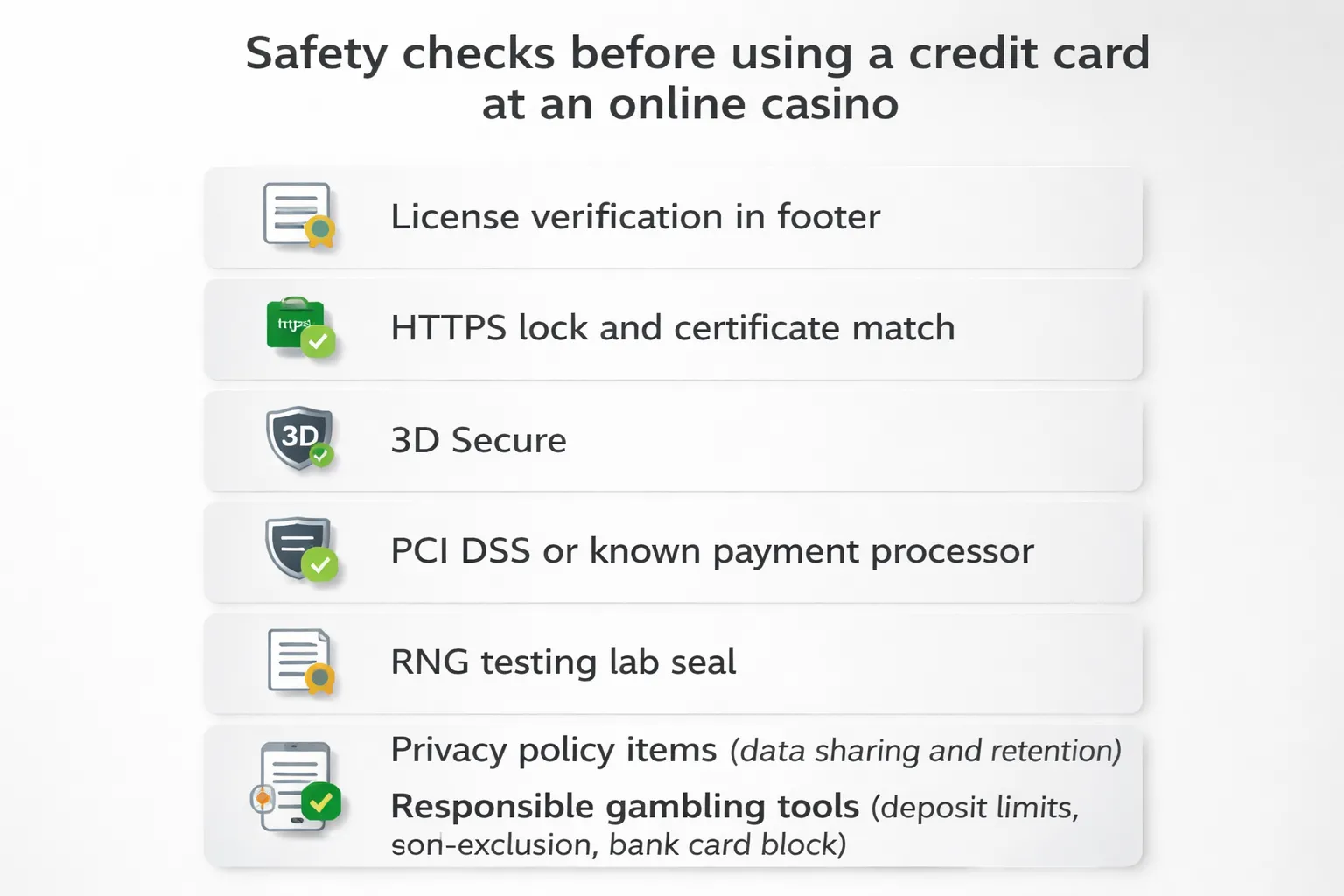
Licensing verification
Start with the license. If a site cannot prove it, do not give it your card details.
- Where to look: Footer of the site, the cashier page, and the Terms and Conditions. Legit casinos show the regulator name, license number, and legal company name.
- Match the operator name: The licensed company name should match the name shown in the Terms, and it should align with the merchant name that will appear on your card statement.
- Validate the license number: Copy the license number and the operator name, then check it on the regulator’s official public register. Confirm status shows active, and confirm the domain you use appears on the license record where applicable.
- Watch for red flags: “Licensed” with no number, scanned certificates, broken regulator links, or a license that belongs to a different brand or company.
Encryption, PCI DSS, and secure checkout indicators
Your goal is simple, reduce the chance of card data exposure and reduce fraud risk.
- HTTPS and lock icon: Your address bar should show https and a lock. Open the certificate details and confirm the certificate matches the casino domain. Avoid checkout pages that jump to unrelated domains with no clear payment branding.
- 3D Secure support: Look for Verified by Visa, Mastercard Identity Check, or a one time passcode flow. This adds bank level verification and lowers unauthorized use risk.
- PCI DSS: PCI DSS means the payment flow meets card network security rules. A casino may not store your full card number. Many route payments through a PCI compliant processor. If a site claims PCI DSS, it should name the processor or provide a compliance statement in its security or payments page.
- Tokenization: Some sites “save” your card using tokens, not raw card data. If the cashier offers saved cards, it should mention secure storage or tokenization.
| Indicator | What it means in plain English | What you do |
|---|---|---|
| https + valid certificate | Traffic encrypts between your device and the site | Do not enter card data on non https pages |
| 3D Secure | Your bank verifies the purchase | Prefer casinos that support it |
| Named payment processor | A specialist handles card data | Check the domain and branding match the processor flow |
| Clear merchant descriptor | You can identify charges on your statement | Save the descriptor and support email |
Fairness signals
Card security matters, but legitimacy also means the games run fairly and the casino pays.
- RNG testing: Slots and digital table games should use an RNG tested by an independent lab. Look for lab names in the footer or “Fair Play” page, and check that the lab seal links to a real verification page, not a static image.
- Game provider credibility: Recognized providers protect their own reputations. If the site uses unknown software with no developer details, treat it as higher risk.
- Audit seals and reports: Some casinos publish payout reports or audit summaries. You want dates, scope, and the legal entity covered. Generic seals with no report details provide little value.
Privacy and data practices
Credit card play creates sensitive data. Read the parts that affect billing, identity checks, and marketing.
- What data they collect: Card billing name, address, device info, and verification documents. The policy should say what they collect and why.
- Who gets your data: Payment processors, KYC providers, fraud tools, and analytics. The policy should list categories of partners and the reasons for sharing.
- Retention period: Look for how long they keep your account data and KYC documents. Open ended retention with no legal basis signals weak governance.
- Marketing and profiling controls: Find opt out steps for email, SMS, and targeted ads. Confirm you can change consent in account settings.
- KYC and source of funds: Check the Terms for when they will request documents and whether they can delay withdrawals until you comply.
- Dispute and refund rules: Confirm how they handle refunds to cards, partial refunds, and chargebacks. If the Terms let them seize balances for routine disputes, treat that as a risk.
Responsible gambling resources, with credit card specifics
Credit cards make it easy to chase losses. Use the tools before you deposit.
- Deposit and loss limits: Set a weekly or monthly cap that matches your budget. Do this before you make your first card deposit.
- Cooling off and self exclusion: Use a time out for short breaks, and self exclusion for longer blocks. Good casinos link these options inside account settings, not only in a help article.
- Reality checks: Enable session timers and pop up reminders. They help reduce long sessions that lead to impulse top ups.
- Support links: Look for direct links to recognized help orgs and local regulators. The responsible gambling page should include contact details, not just logos.
- Card controls: Ask your bank about gambling merchant blocks, transaction alerts, and cash advance settings. Turn on instant notifications so you spot unauthorized charges fast.
- Beginner friendly safeguards: If you want simple limits and clear help options, use a casino built for new players. See our beginner friendly casino picks.
Best alternatives if your credit card deposit is declined
E-wallets, PayPal, Skrill, Neteller
If your card fails, an e-wallet often works because the casino charges the wallet, not your bank card. You fund the wallet by bank transfer, debit card, or other supported rails, then deposit from the wallet.
- Speed: Deposits usually post in minutes. Wallet setup takes longer if you need ID checks.
- Pros: Fewer bank declines, good spending control, you do not share card details with the casino, fast deposits.
- Cons: Not every casino supports PayPal, some wallets block gambling in some regions, fees can apply when funding or withdrawing, withdrawals may go back to the wallet only.
Bank transfer and ACH
Bank rails win on reliability. They also lower the odds of a “gambling merchant” block. Use them when you want consistent approval, higher limits, and clean transaction records.
- Speed: ACH deposits often take 1 to 3 business days. Bank wire transfers often take same day to 2 business days. Some casinos offer instant bank transfer options through third-party providers.
- Pros: High approval rates, higher deposit limits, strong fraud controls, good for larger bankrolls.
- Cons: Slower than cards and wallets, bank details sharing, possible bank fees for wires, withdrawals can take several business days.
Crypto deposits
Crypto can be the fastest option when you need to bypass card networks and you already hold coins. It also helps when your bank blocks gambling transactions.
- Speed: Often 5 to 60 minutes, depending on the coin and network congestion. Some casinos credit after a set number of confirmations.
- Pros: High acceptance, fast settlement, no chargebacks, often higher limits.
- Cons: Price volatility can change your deposit value between sending and playing, network fees vary, mistakes are final if you send to the wrong address, you may need extra steps to buy crypto.
- Volatility control: If you want less price swing, use a stablecoin option when available. Convert only what you plan to play with.
Prepaid vouchers and gift-card style methods
Vouchers work when you want to deposit without linking a bank account or card. You buy a code, then redeem it at checkout.
- Speed: Usually instant once you enter the code.
- Pros: Strong privacy, tight spending control, useful if your bank blocks gambling merchants.
- Cons: Lower limits, limited availability by region, fees can apply, vouchers often support deposits only. You usually need a separate method for withdrawals.
Pick a backup method that still qualifies for bonuses
Some casinos restrict welcome offers by payment type. Before you switch, confirm the cashier terms and the bonus terms on the same page. You want the deposit to track as “eligible” so your bonus and wagering requirements attach correctly.
- Check eligibility: Look for lines like “excluded payment methods” and “bonus not available with” in promo terms.
- Match deposit method to withdrawal rules: Some sites require you to withdraw back to the same rail first. If vouchers cannot withdraw, set up a secondary withdrawal method before you claim.
- Keep proof: Save the deposit confirmation screen and transaction ID. Support resolves bonus and crediting issues faster with a reference.
- Use one trusted source: If you want to avoid surprises, start with casinos that clearly list deposit and withdrawal rules in their cashier and banking FAQs. See our online casino reviews for notes on bonus eligibility by payment method.
Bonuses at credit card online casinos (terms that matter)
Welcome offers and matching bonuses, compare real value
Credit card casinos push big match numbers. The real value sits in the terms.
- Match percent and cap, a 100% match up to $200 equals $200 max bonus. A 200% match up to $50 equals $50 max bonus.
- Min deposit, if the bonus needs $50 and you plan to deposit $20, it is useless.
- Time limit, many welcome bonuses expire in 7 to 30 days. Short windows raise your risk of forfeiting.
- Eligible games, some welcome offers exclude live dealer, jackpots, or certain providers.
- Bonus type, match bonus, free spins, or a mix. Free spins often carry their own wagering rules and max win caps.
| What to compare | What it changes |
|---|---|
| Bonus cap | Sets your maximum upside. |
| Wagering requirement | Controls how hard it is to convert bonus to cash. |
| Game contribution | Decides which games help you clear wagering. |
| Max cashout | Limits profit even after you meet wagering. |
| Expiry | Sets the pace you must play. |
Wagering requirements and game contribution, slots vs tables vs live
Wagering is the turnover you must complete before you withdraw bonus funds or winnings tied to the bonus. Casinos calculate it as a multiple of your deposit, your bonus, or both.
- Bonus-only wagering, you wager the bonus amount only. Example, $100 bonus at 30x equals $3,000 wagering.
- Deposit plus bonus wagering, you wager both. Example, $100 deposit + $100 bonus at 30x equals $6,000 wagering.
- Different rules for free spins, free spin winnings may have their own wagering and max cashout.
Game contribution changes the real difficulty. Slots usually count 100%. Table games often count 0% to 25%. Live dealer can count 0% or get capped by stake limits. If you want to play live games, check the casino rules first, or use our guide to live dealer casinos.
Payment-method restrictions, when card deposits get excluded or capped
Some casinos treat credit card deposits differently for bonuses. You need to confirm eligibility before you opt in.
- Card deposits excluded, the bonus applies only to specific methods like bank transfer or certain wallets.
- Card deposits capped, you can claim the bonus, but only up to a smaller amount when you use Visa or Mastercard.
- Different rollover for cards, the same welcome offer can carry higher wagering when you use a card.
- BIN and region rules, prepaid, corporate, or certain issuing countries can trigger different terms.
Also check for deposit fees. If the casino adds a processing fee, your net deposit drops. That can reduce the bonus you receive and can raise your effective wagering per dollar.
Max cashout, sticky bonuses, and withdrawal locks explained
These terms decide what you can actually withdraw.
- Max cashout, a hard cap on how much you can withdraw from bonus-linked winnings. Example, max cashout $500, even if you win more after meeting wagering.
- Sticky bonus, the bonus itself stays locked until you clear wagering. If you withdraw early, you lose the bonus and often any winnings tied to it.
- Non-sticky or cashable bonus, you can withdraw the bonus after you meet wagering. This usually comes with stricter rules.
- Withdrawal lock, once you accept the bonus, you cannot withdraw until you meet wagering or you forfeit. Some casinos also require a minimum number of deposits before cashout.
- Max bet rule, a per-spin or per-hand limit while a bonus is active. If you exceed it, the casino can void winnings.
VIP and cashback programs, when they beat big welcome bonuses
Welcome bonuses suit short sessions. VIP and cashback can pay better if you deposit often and play steady.
- Cashback, returns a percent of net losses over a set period. Check the rate, the cap, and whether it comes as bonus or cash.
- Comp points, points convert to bonus or cash. Check the earn rate per $ wagered and the conversion value.
- Reload bonuses, smaller matches with better terms can beat a large first-deposit offer over time.
- VIP limits, higher tiers can raise withdrawal limits and speed up payouts. Ask support what changes at each level.
If you plan to play weekly, compare long-run value. Add up cashback, reloads, and point conversions for one month, then weigh that against the cost of wagering and any max cashout rules.
Legal and regional considerations for credit card casino play
Regulated US states vs offshore casinos
State-regulated casinos in the US run under local gaming rules. You get clear dispute paths, audited game standards, and formal responsible gambling tools. You also get tighter payment controls. Many regulated apps limit cards to deposits only.
Offshore casinos run under foreign licenses. Rules vary by operator. You may get more payment flexibility, but you also take on more risk. Support decisions can be final. Chargebacks can trigger account closure and locked balances.
Before you deposit, check three items. The license name, the complaint process, and the withdrawal rules for your card method. If the cashier page does not list card withdrawals, assume you will cash out by bank transfer or crypto.
Geo-restrictions and state-by-state approval issues
Credit card casino transactions fail for predictable reasons. Most failures come from location rules and bank controls, not from the casino cashier.
- State eligibility. A regulated US casino must block play outside approved states. Geolocation tools enforce this. If you travel, deposits can fail even with the same card.
- Issuer blocks. Many banks decline gambling merchant codes by default. Some allow debit but block credit. Some require you to call and opt in.
- Network and processor rules. Visa and Mastercard accept gambling transactions, but the processor still needs the right setup. A mismatch can cause a decline.
- Billing data mismatch. Wrong ZIP code, address, or name format triggers AVS failures. This is common with new accounts and recent moves.
- Velocity limits. Multiple small deposits in a short window look like fraud. Space deposits out.
If a deposit fails, do not spam retries. Confirm your state and location services. Check your billing ZIP. Then call your bank and ask if it blocks gambling transactions. If you need a backup for table play, use a site from our roulette casino guide that supports more than one deposit method.
Tax and recordkeeping basics for winnings
This is general information, not legal or tax advice. Your tax rules depend on your country and state.
Track your results as you play. Keep records that match your cashier history.
- Date and session. Start and end times. Casino name. Game type.
- Amounts. Deposits, withdrawals, net win or loss for the session.
- Proof. Screenshots of the cashier ledger, emails, and bank statements.
- Bonuses. Bonus amount, wagering status, and any forfeits.
- Fees. Card cash-advance fees, foreign transaction fees, and withdrawal fees.
Do not rely on your card statement alone. It shows transfers, not game outcomes. Your casino ledger and your own log fill the gap.
Age and identity requirements
Online casinos verify age and identity. They do it at signup, at first withdrawal, or when your play triggers checks. If your info does not match, payouts can stop.
- Underage accounts. The casino will close the account. You can lose access to winnings and bonuses. You can also lose deposit refunds.
- Name mismatch. Your casino profile must match your ID. Do not use nicknames or different last names.
- Card mismatch. Use a card in your own name. Third-party funding often triggers security holds.
- Address mismatch. Your proof of address must match your profile. Update your profile before you submit documents.
- Document quality. Blurry images or cropped corners cause repeat requests and delays.
Complete verification before you chase a big bonus or move up in stakes. It reduces withdrawal holds. It also lowers the risk of a frozen balance when you switch states or devices.
FAQ: best online casinos that accept credit cards
Which online casinos accept Visa and Mastercard?
Most major brands accept Visa and Mastercard for deposits. Acceptance varies by country, state, and bank rules. Check the cashier for card logos and your local terms before you deposit. If your card fails, use ACH, e-wallets, or crypto.
Can you withdraw to a credit card at online casinos?
Sometimes. Many casinos return deposits to the original card up to the deposited amount, then pay profits by bank transfer, check, ACH, or e-wallet. Your cashier page shows your options after verification and a completed deposit.
Why do credit card deposits get declined?
Common causes are bank gambling blocks, wrong billing address, 3D Secure failure, unsupported region, or daily limits. Call the number on the back of your card and ask for the merchant to be approved. Then retry with exact billing details.
Do online casinos charge fees for credit card deposits?
Some do. Fees often come from the processor or your issuer as a cash advance. Check your casino cashier for a posted fee and your card terms for cash advance APR and charges. Use debit or ACH if fees apply.
Do credit card deposits count as cash advances?
Often, yes. Many issuers code gambling deposits as cash-like transactions. That can trigger instant interest, no grace period, and extra fees. Ask your issuer how the merchant codes, then set a low cash advance limit or block it.
What are typical credit card deposit limits at casinos?
Limits vary by site and player tier. Many casinos set per-transaction, daily, and weekly caps. Your bank can add its own limits. Check the cashier screen before you fund your account, especially if you plan larger deposits.
Is it safe to use a credit card at an online casino?
It can be, if you pick a licensed site with TLS encryption, 3D Secure support, and clear KYC rules. Avoid casinos that hide ownership or banking partners. For vetted options, use our best online casinos list.
What details must match for a smooth card deposit?
Your casino profile must match your card billing name and address. Use your real phone number and date of birth. Fix profile errors before you upload documents. Mismatches trigger declines, extra KYC requests, and withdrawal holds.
How long do withdrawals take at credit card casinos?
Card refunds can take 1 to 10 business days after approval. First-time cashouts often take longer due to KYC and internal review. E-wallets and crypto usually pay faster. Speed also depends on your bank and weekend processing.
Should you use a credit card for casino bonuses?
Read the banking terms first. Some sites exclude card deposits from certain bonuses or limit withdrawal methods. Track wagering requirements and max cashout rules. If you want bonus flexibility, deposit with the method listed as eligible in the promo terms.
What is 3D Secure and why does it matter?
3D Secure adds issuer verification during checkout, often via a one-time code or banking app approval. It cuts fraud and chargebacks. If you fail 3D Secure, the deposit declines. Update your phone number with your bank before you retry.
Conclusion
Credit card deposits work best when you treat them like a controlled tool. Pick a Visa or Mastercard-friendly casino with clear limits, solid licensing, and fast support. Use 3D Secure to your advantage. It blocks fraud and reduces disputes, but it also causes declines if your bank info is outdated.
- Match your deposit method to the bonus terms. If the promo excludes cards, switch to the eligible method before you claim.
- Set hard limits. Use casino deposit caps and your card spending controls, then stop when you hit them.
- Keep your issuer profile current. Update your phone number and banking app, then retry after a 3D Secure failure.
- Plan withdrawals before you deposit. Many casinos do not pay out to cards. Confirm the cashout method and minimums first.
- Track fees and cash-advance coding. If your bank codes gambling as cash advance, use a different card or a different deposit method.
If you want a simple safety check before you commit funds, use this guide on how to choose a safe online casino and verify the basics in two minutes.
-
Best Online Casinos for Blackjack: Best Tables, Rules & Bonuses
4 weeks ago -
Fast Payout Online Casinos: Best Sites for Quick Withdrawals
3 weeks ago -
Best Online Casinos for Roulette: Best Wheels, Limits & Live Options
4 weeks ago -
Best PayPal Online Casinos: Top Sites That Accept PayPal Deposits & Withdrawals
4 weeks ago -
Best Online Casinos for High Rollers: VIP Perks, High Limits & Exclusive Bonuses
3 weeks ago
-
- Visa vs Mastercard acceptance differences and typical approval behavior
- American Express and Discover: why acceptance is limited at many casinos
- Prepaid and virtual cards: when they work and when they fail KYC/AVS checks
- Debit vs credit: processing similarities, budgeting differences, and approval odds
- Issuer policies and cash-advance settings that affect gambling transactions
-
- Welcome offers and matching bonuses, compare real value
- Wagering requirements and game contribution, slots vs tables vs live
- Payment-method restrictions, when card deposits get excluded or capped
- Max cashout, sticky bonuses, and withdrawal locks explained
- VIP and cashback programs, when they beat big welcome bonuses
-
- Which online casinos accept Visa and Mastercard?
- Can you withdraw to a credit card at online casinos?
- Why do credit card deposits get declined?
- Do online casinos charge fees for credit card deposits?
- Do credit card deposits count as cash advances?
- What are typical credit card deposit limits at casinos?
- Is it safe to use a credit card at an online casino?
- What details must match for a smooth card deposit?
- How long do withdrawals take at credit card casinos?
- Should you use a credit card for casino bonuses?
- What is 3D Secure and why does it matter?
-
-
- Visa vs Mastercard acceptance differences and typical approval behavior
- American Express and Discover: why acceptance is limited at many casinos
- Prepaid and virtual cards: when they work and when they fail KYC/AVS checks
- Debit vs credit: processing similarities, budgeting differences, and approval odds
- Issuer policies and cash-advance settings that affect gambling transactions
-
- Welcome offers and matching bonuses, compare real value
- Wagering requirements and game contribution, slots vs tables vs live
- Payment-method restrictions, when card deposits get excluded or capped
- Max cashout, sticky bonuses, and withdrawal locks explained
- VIP and cashback programs, when they beat big welcome bonuses
-
- Which online casinos accept Visa and Mastercard?
- Can you withdraw to a credit card at online casinos?
- Why do credit card deposits get declined?
- Do online casinos charge fees for credit card deposits?
- Do credit card deposits count as cash advances?
- What are typical credit card deposit limits at casinos?
- Is it safe to use a credit card at an online casino?
- What details must match for a smooth card deposit?
- How long do withdrawals take at credit card casinos?
- Should you use a credit card for casino bonuses?
- What is 3D Secure and why does it matter?
-
-
Online Casino Licensing Explained: Authorities, Licenses & How to Check One
3 weeks ago -
Best Live Dealer Casinos: Where to Play Live Blackjack, Roulette & More
3 weeks ago -
Best Online Casinos for High Rollers: VIP Perks, High Limits & Exclusive Bonuses
3 weeks ago -
Fast Payout Online Casinos: Best Sites for Quick Withdrawals
3 weeks ago -
What Is an Online Casino? How They Work, Games, Bonuses & Safety
4 weeks ago
-
Best Online Casinos for Blackjack: Best Tables, Rules & Bonuses
4 weeks ago -
Online Casino Bonuses Explained: How They Work + Terms You Must Know
4 weeks ago -
Fast Payout Online Casinos: Best Sites for Quick Withdrawals
3 weeks ago -
Online Casino Licensing Explained: Authorities, Licenses & How to Check One
3 weeks ago -
Best Online Casinos for Roulette: Best Wheels, Limits & Live Options
4 weeks ago