Best Crypto Casinos: Top Bitcoin Casinos & Provably Fair Picks

Crypto casinos let you deposit and withdraw with Bitcoin and other coins. You get faster payouts, lower fees in many cases, and fewer banking blocks. You also take on new risks, fake licenses, weak security, and unfair games.
This guide lists the best crypto casinos and top Bitcoin casinos, plus provably fair picks. You will learn how we rank sites, what to check before you deposit, and which red flags to avoid.
- Licensing: operator name, regulator, and verifiable status
- Provably fair: seed system, verification tools, and audit notes
- Payouts: expected processing times, limits, and required confirmations
- Fees and exchange rates: network fees, casino fees, and spreads
- Games: slots, live dealer, and crypto originals
Key Takeaways
- In het kort:
- Verify the license first. Match the operator name to the regulator record, and check the status yourself.
- Use provably fair casinos for crypto originals. Confirm the seed system, and run at least one verification check before you scale your bets.
- Plan around payout friction. Track expected processing times, withdrawal limits, and required blockchain confirmations per coin.
- Price the full cost of a deposit and withdrawal. Add network fees, casino fees, and exchange-rate spread.
- Pick a game mix that fits your goal. Slots for volume, live dealer for table play, and originals for provable math.
- Walk away from red flags. No verifiable license, vague ownership, unclear fees, or blocked withdrawals.
- Keep your bankroll portable. Prefer casinos that support multiple coins and stablecoins, and that publish clear minimums and maximums.
- If you mainly play table games, use our guide to the best online blackjack casinos to compare rules, limits, and bonus terms.
Best Online Casinos That Accept Crypto: Our Top Picks (2026)
How we rank and test crypto casinos (criteria + scoring)
We score each casino on 100 points. We test deposits, withdrawals, and support with real user flows. We read the terms you must follow to cash out.
- Safety and licensing (25 points). Verifiable license, clear operator details, audited policies, responsible gambling tools.
- Payout speed and reliability (20 points). Typical crypto cashout time, approval step, weekend processing, rejected withdrawal rate signals.
- Fees and limits (10 points). Minimum deposit, minimum withdrawal, maximum cashout, hidden conversion costs, on-chain fee handling.
- Game quality (15 points). Slot and table depth, RTP info, provider mix, stability on desktop and mobile.
- Provably fair and transparency (10 points). Verifiable fairness for originals, clear seed system, third-party audit notes.
- KYC and account friction (10 points). What you can do before verification, when KYC triggers, document standards, geo blocks.
- Bonuses and terms value (10 points). Wagering, max bet rules, game contribution, time limits, withdrawal caps.
Quick comparison table (2026)
| Casino pick | Coins supported | KYC | Typical crypto payouts | Games | License | Standout perk |
|---|---|---|---|---|---|---|
| Editor’s choice (Best overall) | BTC, ETH, LTC, USDT, USDC | Risk-based | Fast after approval, often same day | Slots, tables, originals, live | Top-tier or well-known offshore | Balanced terms and steady withdrawals |
| Best for fast withdrawals | BTC, ETH, LTC, USDT | Risk-based | Minutes to a few hours for crypto | Slots, tables, originals | Recognized offshore | Automated cashouts on eligible accounts |
| Best for no or low KYC | BTC, ETH, LTC | Low until triggers | Fast for small to mid cashouts | Originals, slots | Varies, check verification | Quick signup, fewer documents early |
| Best for provably fair games | BTC, ETH, LTC, USDT | Risk-based | Same day common | Originals-first, plus slots | Recognized offshore | Public seed verification and fair logs |
| Best for bonuses and free spins | BTC, ETH, USDT | Often required for withdrawals | Fast after bonus clearance | Slots-heavy, some live | Recognized offshore | Best value after wagering, fewer caps |
| Best for live casino | BTC, ETH, USDT, USDC | Risk-based | Same day common | Live blackjack, roulette, baccarat | Top-tier or offshore | Strong studio coverage and table limits |
| Best for sports betting with crypto | BTC, ETH, USDT | Risk-based | Fast for crypto | Sportsbook plus casino | Recognized offshore | Deep markets and sharp odds on majors |
| Best for mobile players | BTC, ETH, LTC, USDT | Risk-based | Fast after approval | Instant play, mobile-first lobby | Recognized offshore | Fast load times and clean cashier flow |
Best overall crypto casino (editor’s choice)
This pick fits you if you want a clean mix of safety, fast crypto payouts, and fair terms. You get multiple coins, stablecoins, and clear limits. You also get a casino that keeps bonus rules readable and enforces them consistently.
- Who it’s for: You want one account for slots, tables, originals, and live.
- What to check before you deposit: Withdrawal minimums by coin, max cashout per day, and whether they pay network fees or pass them to you.
- How to play it smart: Use stablecoins for predictable value if you plan to clear wagering over several days.
Best for fast withdrawals
This pick fits you if cashout speed matters more than bonus size. The best fast-withdrawal crypto casinos automate approvals for low-risk accounts and pay to wallets quickly.
- Typical payout time: Minutes to a few hours after approval for BTC, ETH, and stablecoins.
- What slows you down: First withdrawal, large win spikes, mismatch between deposit method and withdrawal wallet, or flagged play patterns.
- Limits to confirm: Max per transaction, max per day, and whether higher tiers require KYC.
Best for no or low KYC
This pick fits you if you want fewer steps at signup. You trade convenience for more account risk. Most sites still trigger KYC on withdrawals, bonus claims, or higher limits.
- Trade-offs: Lower withdrawal caps, fewer payment options, stricter fraud checks, and more geo blocks.
- Safety checks you should do: Verify the license number, confirm the operator name, read the withdrawal policy, and test a small cashout first.
- Bankroll rule: Keep balances low. Withdraw regularly. Do not treat a low-KYC casino like a wallet.
Best for provably fair games
This pick fits you if you play originals and you want math you can verify. Provably fair only covers games that use a seed system. It does not validate third-party slot RNG.
- What you should see: Client seed control, server seed hash shown before play, nonce counter, and a public verifier tool.
- How you verify: Save the server seed hash, play your rounds, reveal the server seed, then run the verifier to match outcomes.
- Transparency bonus: Some casinos publish fairness docs and audit notes. Prefer those over vague claims.
Best for bonuses and free spins
This pick fits you if you clear wagering efficiently and you avoid traps in the terms. The best value comes from bonuses with realistic playthrough, fair max bet rules, and no harsh withdrawal caps.
- Strongest value after wagering: Lower wagering multipliers, higher slot contribution, and longer time to clear.
- Terms that kill value: High wagering, short expiry, low max cashout, and restricted games that still appear in the lobby.
- Practical move: If you plan to withdraw soon, compare crypto bonuses vs cash deposits. Sometimes a smaller bonus wins because it clears faster.
Best for live casino
This pick fits you if you want real dealers and stable streams. Live quality comes down to studio coverage, table limits, and how the site handles peak traffic.
- Studios to expect: Major studios such as Evolution, Pragmatic Play Live, and Playtech, subject to region.
- Limits to check: Minimum bet for blackjack and roulette, max bet on VIP tables, and side bet caps.
- Stream quality: Look for HD options, low buffering on mobile data, and fast reconnect if you drop.
Best for sports betting with crypto
This pick fits you if you want one wallet for sports and casino. A good crypto sportsbook offers strong pricing on major leagues, deep props, and fast settlement on common markets.
- Markets that matter: Moneylines, spreads, totals, player props, futures, and live betting depth.
- Odds quality: Compare implied margins on major events. Lower hold means better long-term value.
- Cashout rules: Confirm whether they allow partial cashout, and how they treat voids in parlays.
Best for mobile players
This pick fits you if you play from your phone and you want instant load times. Mobile-first casinos keep the cashier simple and avoid heavy popups that break sessions.
- UX must-haves: Fast search, provider filters, one-tap favorites, and clear game rules on small screens.
- Performance checks: Game load speed, crash recovery, and whether the site forces app installs.
- Payments tip: If you want a non-crypto backup on mobile, use our guide to Visa and Mastercard-friendly casino sites.
How Crypto Casinos Work (From Wallet to Withdrawal)
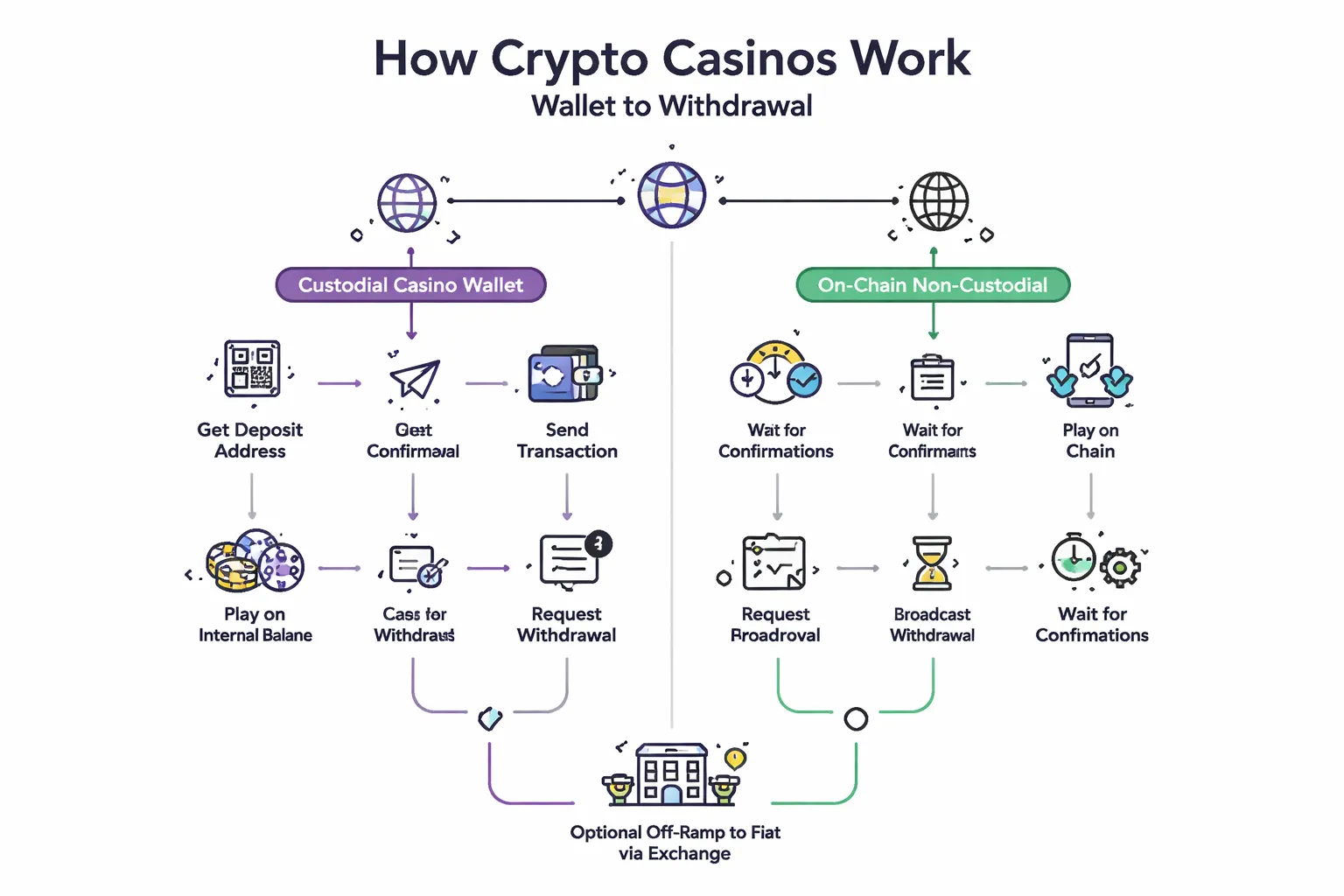
Custodial vs non-custodial flows
Crypto casinos use two wallet models. Your deposit and withdrawal path depends on which one the site runs.
- Custodial casino wallet, you deposit to a unique address the casino controls. Your balance shows as an internal ledger entry. Bets and payouts happen off-chain. Withdrawals require a cashout request.
- Non-custodial or on-chain, you keep custody and interact with a smart contract. Bets and payouts settle on-chain. You usually sign transactions from your wallet, not from a casino cashier balance.
Custodial feels like a normal online casino with crypto rails. Non-custodial feels like a dApp with gambling logic.
Step-by-step: deposit, wagering, and cashout lifecycle
- 1) Set up your wallet, choose a network that matches the casino. Example, USDT exists on several networks. A mismatch can burn funds.
- 2) Generate a deposit address, the casino shows an address and often a QR code. Some sites also support Lightning invoices for BTC.
- 3) Send your deposit, your wallet broadcasts the transaction. You pay a network fee. Higher fees usually confirm faster.
- 4) Wait for confirmations, the casino credits you after its required confirmation count. Once credited, you wager from the casino balance.
- 5) Play and settle bets, with custodial sites, spins and bet results settle instantly inside the platform. With on-chain games, settlement may require on-chain finality.
- 6) Request a withdrawal, you enter your wallet address and amount, then confirm. The casino runs risk checks and queues the payout.
- 7) Receive funds, the casino broadcasts a withdrawal transaction. Your wallet shows it as pending, then confirmed.
Confirmations, mempool delays, and why withdrawals can vary
Blockchains do not settle instantly. Each network has its own block time and congestion pattern.
- Confirmations, each new block adds a confirmation. Casinos set a minimum to reduce double-spend risk. Higher deposit sizes often trigger higher confirmation requirements.
- Mempool and fee markets, your transaction waits in a queue until miners or validators include it. Low fees can stall during traffic spikes.
- Casino processing time, withdrawals add a human or automated approval layer. KYC requests, bonus checks, and fraud screening can slow cashouts.
- Batching, some casinos batch withdrawals to save fees. You may wait for the next batch window.
- Network choice, BTC base layer can slow under load. Lightning can be near-instant but depends on channel liquidity. Stablecoins on fast networks can clear quickly, but only if the casino supports that chain.
If a casino does not publish clear withdrawal rules, treat that as a risk signal. Use our guide on how to choose a safe online casino before you deposit.
On-chain casinos vs traditional operators accepting crypto
- Game logic, on-chain casinos run core mechanics in smart contracts. Traditional operators run games on servers and use crypto as a payment method.
- Custody, on-chain models can keep funds in contracts until settlement. Traditional models usually move funds into a casino-controlled wallet, then into an internal balance.
- Transparency, on-chain activity is auditable on a block explorer. Traditional sites give you account history, not full public settlement data.
- Speed, traditional sites feel instant after deposit credit. On-chain play depends on transaction signing and network finality.
- Support and reversals, on-chain transactions are final. Traditional operators sometimes correct internal ledger issues, but they still cannot reverse on-chain transfers.
Fiat rails and off-ramps after you win
Crypto winnings often end as fiat in your bank. Plan the off-ramp before you cash out.
- Withdraw to your wallet first, avoid sending casino withdrawals straight to an exchange deposit address unless the exchange allows it. Some exchanges reject gambling-linked deposits.
- Swap if needed, convert volatile coins into a stablecoin, or into the asset your off-ramp supports with low fees.
- Cash out to fiat, use an exchange, broker, or payment app that supports your region. Expect identity checks.
- Watch total costs, you pay trading spread, network fees, and sometimes withdrawal fees. Small withdrawals can get eaten by fees on congested chains.
Supported Cryptocurrencies & Payment Methods (What to Choose and Why)
Bitcoin (BTC), security, fees, and typical processing times
BTC works everywhere and has the deepest liquidity. It also has the slowest base layer settlement.
- Security: Strong track record. Good choice when you care most about final settlement.
- Speed: Many casinos credit after 1 to 3 confirmations. That often means about 10 to 30 minutes, longer during congestion.
- Fees: You pay miner fees. They swing with network demand. Small deposits and small withdrawals can get hit hardest.
Use BTC on-chain for larger deposits and withdrawals where an extra 20 minutes does not matter.
Lightning Network (BTC-LN), when it is worth using
Lightning is the best option for quick deposits and quick cashouts, if the casino supports it.
- Speed: Usually near instant credits once the payment routes.
- Fees: Often pennies, sometimes less. Good for frequent play and small transfers.
- Tradeoffs: You need a Lightning wallet and you must manage inbound and outbound liquidity for larger withdrawals.
Use Lightning when you make small deposits, move funds often, or want fast withdrawals without paying on-chain BTC fees.
Ethereum (ETH) and L2s, gas costs and practicality
ETH is common, but gas can be brutal. Many casinos now push you toward L2s for day to day payments.
- ETH mainnet: High gas during busy periods. Avoid for small bankrolls and frequent transfers.
- L2s: Arbitrum, Optimism, Base, and Polygon usually cut fees and improve speed. Casinos increasingly support them for USDT and USDC.
- Stables over ETH: If you just want a dollar bankroll, use USDT or USDC on a supported L2 instead of sending ETH and swapping later.
Use ETH mainnet only when the casino requires it or when you move larger amounts and you can absorb gas. Use L2 rails for routine deposits and withdrawals.
Stablecoins (USDT, USDC), volatility control and bankroll management
Stablecoins solve the biggest problem in crypto gambling, price swings during a session.
- Control: Your balance stays close to a fixed value. That makes limits, stop losses, and cashout planning easier.
- Accounting: Wins and losses feel clear. You avoid guessing whether you profited or just rode a price pump.
- Chain choice matters: USDT and USDC exist on multiple networks. Pick the network your casino supports and your wallet supports.
Use stablecoins when you want predictable bankroll value, faster play cycles, and simpler withdrawals to an exchange.
Altcoins (LTC, DOGE, XRP, BCH), pros, cons, and trends
Altcoins can cut fees and speed up transfers, but support varies by casino and by region.
- LTC: Low fees and quick confirmations. Wide casino support. Solid default if you want simple on-chain payments.
- DOGE: Cheap and fast. Support is common at crypto first casinos, less common at regulated brands.
- XRP: Very fast and very cheap. Some casinos support it, but you must handle destination tags when required by the receiver.
- BCH: Low fees and decent speed. Support is mixed. Liquidity can be weaker than BTC, ETH, and stables.
Pick altcoins when your casino supports them end to end and your off-ramp supports them with tight spreads.
Network selection mistakes to avoid
Most crypto casino payment problems come from wrong network picks, not from the coin itself.
- Wrong chain for the same token: USDT on Ethereum is not the same as USDT on Tron, Polygon, or Arbitrum. If you send on the wrong network, you can lose funds.
- Wrong address format: BTC and Lightning invoices are not interchangeable. ETH style addresses do not mean every EVM network is accepted.
- Memo and tag errors: Some networks and exchanges require a memo or destination tag. Missing it can delay or break your credit.
Match coin and network exactly to the casino deposit screen. Do a small test transfer before you send a large amount.
Minimum deposits, minimum withdrawals, and hidden fee patterns
Minimums and fee rules decide whether a payment method works for your bankroll.
- Minimum deposit: Casinos often set a floor per coin and per network. If you deposit under it, they may not credit you automatically.
- Minimum withdrawal: Many sites set higher withdrawal minimums than deposit minimums. That can trap small balances.
- Fixed withdrawal fees: Some casinos charge a flat fee on top of network fees. This hurts small withdrawals.
- Spread costs: If the casino forces swaps, you pay the spread. This can cost more than the network fee.
- Priority fees: Some sites pass through elevated miner fees during congestion.
Before you deposit, check minimums, fee tables, and network options. If you want broader payment flexibility beyond crypto rails, use a vetted operator list from our best online casinos guide.
Provably Fair Explained (And How to Verify Results Yourself)

What provably fair means vs RNG certification
Provably fair lets you verify each result with math. You can check the inputs and reproduce the outcome after the casino reveals its server seed.
RNG certification checks the casino’s random number generator in audits. Labs test that results look random over large samples. You still cannot verify your single spin or roll.
Provably fair gives you per-bet proof. RNG certification gives you process assurance. The best crypto casinos use both.
Seed systems, server seed, client seed, nonce
Provably fair games use three main inputs.
- Server seed. The casino chooses a long random string. Before you play, it publishes a hash of that string, so it cannot change it later without you noticing.
- Client seed. You choose this, or the site generates it for you. It adds your input to the result, so the casino cannot fully control outcomes.
- Nonce. A counter that increments each bet. It stops repeated bets from producing the same output when seeds stay the same.
Most games then run a fixed formula like HMAC-SHA256 over server seed plus client seed plus nonce. The output becomes a roll number or a sequence that maps to cards, reels, or dice.
How to verify a roll or spin result yourself
Verification usually takes under a minute if the casino provides a bet slip with the inputs.
- Step 1. Open the bet details. Copy the server seed hash shown before the bet. Save it.
- Step 2. After you finish the session or rotate seeds, reveal the server seed. The casino should show it in your fairness tab or bet details.
- Step 3. Hash the revealed server seed using the listed algorithm, often SHA-256. Confirm it matches the saved server seed hash.
- Step 4. Copy your client seed and the bet nonce.
- Step 5. Run the published formula in the casino verifier. Or use an offline script that supports the same HMAC and mapping rules.
- Step 6. Compare your computed result to the game result. They must match exactly.
If the casino does not publish the exact algorithm and mapping method, you cannot reproduce results. That breaks the provably fair claim.
Red flags you should treat as deal breakers
- Unverifiable games. No server seed reveal, no client seed control, no nonce, or no verifier.
- Opaque seed changes. The casino rotates seeds without logging when it happened, or it overwrites old seeds.
- Missing hash logs. You never see the server seed hash before betting, or past hashes disappear.
- Verifier only, no method. A “verify” button without the full formula, hash type, and mapping steps.
- Third-party slots labeled provably fair. Many are standard RNG slots. The casino cannot prove each spin unless the provider supports it end to end.
If you see multiple red flags, use the same caution you would apply when learning how to spot a fake online casino.
Independent audits and certifications to look for
Provably fair helps you check a single bet. Audits help you judge the operator and its broader systems.
- Game testing labs. Look for iTech Labs, eCOGRA, GLI, or BMM Testlabs. Check that the certificate links to a real report page, not a static image.
- RTP disclosure. The casino should list RTP per game, not a single site-wide number.
- Change control. Strong operators log game version changes and publish updated certificates when content updates.
Use audits as a filter. Use provably fair to validate your actual play.
Limits of provably fair
- Live dealer games. Cards, wheels, and shuffles happen in the studio. You rely on licensing, procedures, and studio audits, not seed verification.
- Most third-party slots. They use certified RNG and RTP settings. You usually cannot reproduce a single spin with seeds.
- Side systems. Provably fair does not cover withdrawals, KYC handling, bonus enforcement, or account restrictions.
Safety, Licensing, and Trust Signals (E-E-A-T Checklist)
Licenses and regulators, what they do and what they do not
A license tells you who supervises the operator. It also tells you which rules apply when things go wrong.
- What regulators do: Set operator standards, require identity checks, enforce responsible gambling tools, and define complaint paths.
- What regulators do not do: Guarantee you will win, guarantee fast withdrawals, or prevent every bonus dispute.
- What to verify: The legal entity name, license number, and domain match the license record. Check the regulator site, not the casino footer alone.
- What to avoid: Missing license details, mismatched company names, or “licensed” claims with no registry proof. Use this guide to spot a fake online casino.
KYC and AML, what “no KYC” means in practice
“No KYC” usually means no checks at sign up. It rarely means no checks forever.
- Expect checks at withdrawal: Larger cashouts, unusual play, or risk flags can trigger identity and source of funds requests.
- Expect limits: Some sites cap withdrawals until you verify. Some restrict certain countries and payment methods.
- Know the real risk: If you refuse KYC after a trigger, you may lose access to withdrawals until you comply.
- What to read: Terms for “verification,” “enhanced due diligence,” “source of funds,” “maximum payout,” and “restricted jurisdictions.”
Security basics you should see
Crypto deposits do not protect your account. The site still needs solid security.
- 2FA: App based 2FA, backup codes, and login alerts. Avoid sites that only offer email codes.
- Withdrawal controls: Withdrawal address whitelists, time locks for new addresses, and anti phishing phrases.
- Cold storage: The casino should state how it secures funds. Look for cold storage and separation of hot and cold wallets.
- Encryption: HTTPS on every page, modern TLS, and no mixed content warnings in your browser.
- Operational hygiene: Clear incident history, published security contact, and fast response to account takeover reports.
Transparency, RTP, rules, and disputes
Trust signals show up in the details. You need clear numbers, clear rules, and a clear path to escalate.
- RTP publishing: The casino should list RTP by game, or link to the provider RTP. Watch for vague ranges with no game level data.
- Game rules clarity: Bonus buy rules, max bet limits while wagering, and excluded games should sit in one place.
- Fees and timing: Withdrawal fees, network fee handling, and expected processing times should be stated in plain language.
- Dispute process: Support channels, complaint steps, and the external dispute body for the license. Save ticket numbers and screenshots.
Reputation checks that map to real risk
Marketing claims mean little. Operator behavior over time matters.
- Operator history: Look for past brand closures, rebrands after complaints, and repeated license changes.
- Community feedback: Separate “I lost” posts from operational complaints. Focus on payout delays, KYC loops, and bonus confiscations.
- Complaint patterns: Repeated stories with the same trigger, for example max cashout caps, “game abuse” bans, or stalled withdrawals after big wins.
- Support behavior: Watch for copy paste replies, missing escalation, and refusal to name the license or dispute body.
Responsible gambling tools you can actually use
Strong sites let you control your play fast, without waiting for support.
- Deposit limits: Daily, weekly, monthly. Limits should apply instantly or with a clear cooling off rule for increases.
- Loss limits and wager limits: Caps that stop play when you hit the limit, not just warnings.
- Timeouts: Short breaks that lock your account for a set period.
- Self exclusion: Longer exclusion options and clear reinstatement rules. You should not need a negotiation to stay excluded.
- Reality checks: Session timers, spend summaries, and pop ups you cannot disable permanently.
| Trust signal | What to check | Why it matters |
|---|---|---|
| License record | Entity name, domain, license status on regulator site | Sets oversight and complaint route |
| KYC triggers | Withdrawal thresholds, source of funds language, country limits | Prevents surprise verification blocks |
| Account security | 2FA, whitelist, login alerts, HTTPS | Reduces theft and account takeovers |
| RTP and rules | Per game RTP, bonus terms, max bet, excluded games | Stops hidden edge and bonus traps |
| Disputes | Ticketing, escalation steps, external ADR or regulator contact | Gives you leverage when support stalls |
| Reputation | Repeated complaint themes across communities | Flags chronic payout and KYC issues |
| RG tools | Limits, timeouts, self exclusion, reality checks | Gives you control before losses compound |
Games You’ll Find at Crypto Casinos (And Where Value Actually Is)
Crypto-native originals: crash, dice, mines
These games run fast. They also swing hard. Value comes from understanding volatility and the fixed house edge.
- Dice. You pick a win chance, the payout adjusts. Most sites set a fixed edge, often around 1% to 2%. Lower edge beats flashy multipliers.
- Crash. You cash out before the bust. The edge usually comes from an auto-bust chance or payout curve. Expect high variance, short sessions can look “rigged” even when they are not.
- Mines. You reveal tiles and can cash out anytime. Many mines games price risk so the edge stays steady across choices. It feels like strategy, but the math stays against you.
Where the value is: pick the lowest disclosed edge, confirm provably fair works, and avoid raising risk just to chase a bigger multiplier.
Slots: RTP ranges, volatility, and feature-buy traps
Slots decide your long-term cost through RTP. Volatility decides your short-term pain.
- RTP. Common ranges run from about 94% to 97%, with a few higher. Some casinos run reduced RTP versions. You need to check the game info screen, not the lobby badge.
- Volatility. High volatility means longer dry spells and bigger spikes. If you want bankroll control, medium volatility usually lasts longer per deposit.
- Feature buys. Many buys price in extra edge. They also compress variance into a few spins, which makes you redeposit faster. Use them only if the RTP stays the same and you accept the swing.
Where the value is: prioritize higher RTP versions, avoid unknown studios with no published math, and do not let bonus wagering push you into low-RTP games.
Live dealer: limits, speed, and staking requirements
Live dealer games add pace control and higher table minimums. They can also hide your real cost through speed.
- Limits. Minimums often start higher than RNG tables. VIP tables can jump fast. Use a table that fits your unit size, or you will overbet.
- Game speed. Faster tables increase hands per hour. Your expected loss scales with volume. Slow the pace if you want your bankroll to last.
- Staking. Some casinos require certain bet sizes to unlock promos or cashback tiers. Read the terms, or you will chase status with negative EV play.
Where the value is: lower minimums, clear rules, and a pace you control. If you play big, use a dedicated guide to high-limit and VIP casinos before you commit.
Table games: blackjack rules that change your odds
Small rule changes move the house edge more than most people think. Blackjack gives you the most control if the rules stay player-friendly.
- H17 vs S17. Dealer hits soft 17 (H17) usually worsens your odds versus dealer stands (S17).
- DAS. Double after split (DAS) helps you. No DAS costs you.
- Surrender. Late surrender can cut losses on bad hands. If it is missing, your edge worsens.
- Blackjack payout. 3:2 is standard value. 6:5 is a major downgrade. Avoid 6:5 tables.
Where the value is: 3:2 payout, S17, DAS, and surrender. Then use correct basic strategy. Without it, the rules do not matter.
Sportsbook + casino hybrids: cross-promos and pitfalls
Hybrids push you to bounce between betting and casino. That can help if the promos fit your habits. It can hurt if it forces bad volume.
- Cross-promotions. Some sites reward combined turnover, or require sportsbook bets before you can withdraw casino bonuses.
- Wagering mismatch. Sports bets often settle slower and have max-bet caps on bonus money. Casino wagering can burn faster than you expect.
- Odds and margins. A strong sportsbook has tight lines. A weak one has inflated margins. Do not trade convenience for worse pricing.
Where the value is: clear promo rules, low margin sports pricing, and no forced mixing of products to withdraw.
Game providers that signal quality (and why provider mix matters)
Provider mix tells you more than the game count. Good casinos carry audited studios and keep multiple options per category.
- Why it matters. Providers set RTP options, feature rules, and stability. A casino that only carries obscure studios can control RTP and complaints become harder to verify.
- What to look for. Recognizable slot and live studios, published RTP in the game info, and consistent versioning across markets. For originals, look for transparent edge disclosure and a working provably fair verifier.
- Practical check. Open any slot, confirm the RTP shown in-game, then compare it to the provider’s stated RTP range. If the site hides RTP, assume the worst.
Where the value is: audited providers, visible RTP, and enough provider variety that you can avoid bad rules and low-return versions.
Bonuses, Promotions, and VIP Programs (How to Compare Offers)
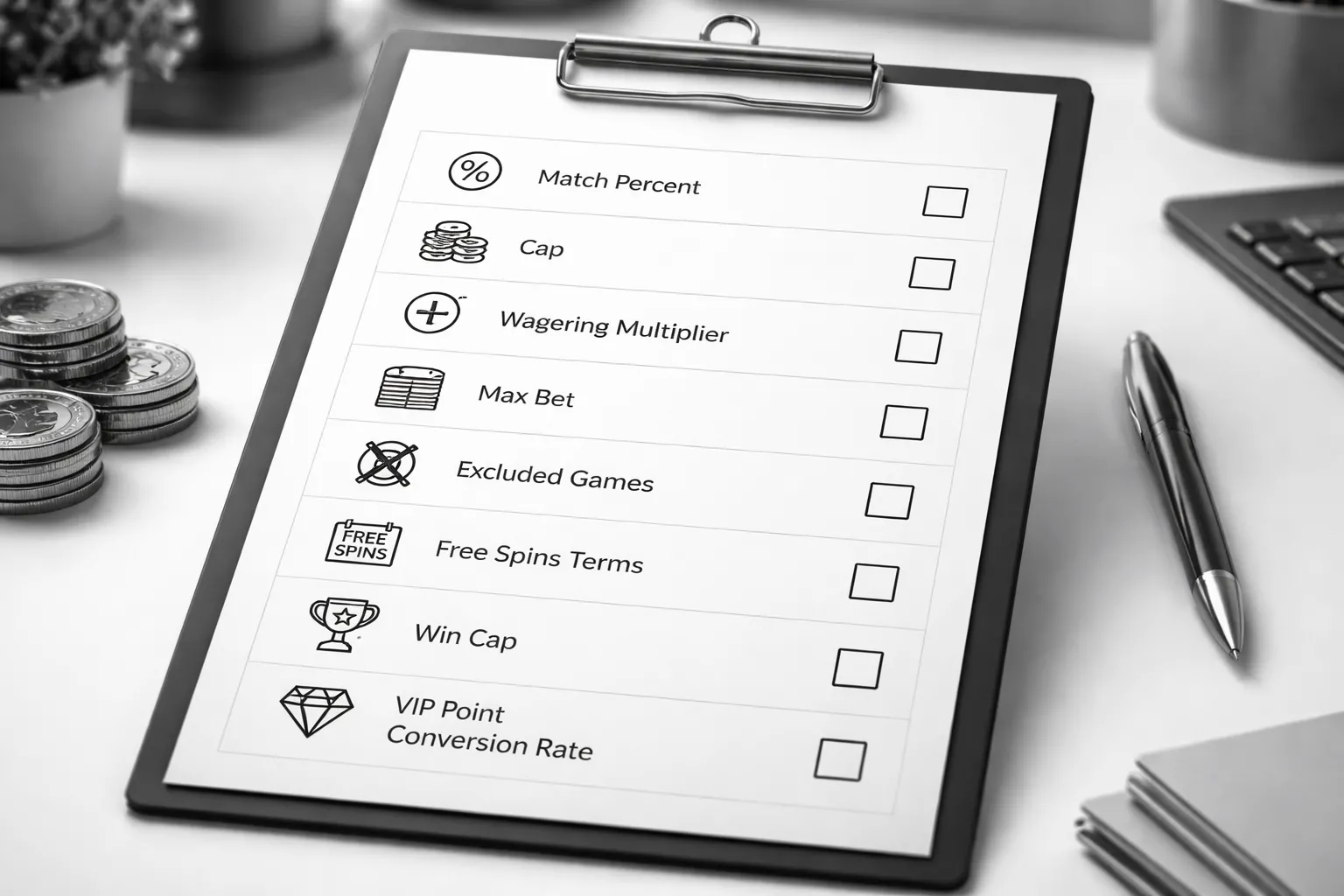
Welcome bonuses, match percent, free spins, and what counts as real value
A big percent means little if the bonus caps low or the rules block withdrawals. Compare offers by expected, usable value.
- Match percent and cap. You care about the cap. A 200% match to 0.05 BTC can beat a 500% match to 0.01 BTC.
- Minimum deposit. High minimums force you to overfund. Favor offers that fit your normal bankroll size.
- Bonus type. Bonus credit often carries wagering. Free spins can be worse if they lock you to one slot with low RTP.
- Free spins terms. Check the slot name, coin size, number of paylines, and any win cap on spins.
- Withdrawal limits on bonus wins. Some offers cap cashout to a small multiple of the bonus. Treat that cap as the true max value.
- Time limits. Short expiry forces high stakes and mistakes. Longer windows reduce risk.
Wagering requirements, explained with a worked example
Wagering decides if a bonus is playable or a trap. You want low multipliers, broad game contribution, and no hidden caps.
Worked example. You deposit 0.01 BTC. The site gives a 100% bonus, so you get 0.01 BTC bonus credit. The wagering is 35x bonus.
- Wagering target. 0.01 BTC x 35 = 0.35 BTC in required bets.
- If slots count 100%. Every 0.001 BTC spin adds 0.001 BTC to progress. You need 350 spins at 0.001 BTC to clear.
- If blackjack counts 10%. Every 0.001 BTC hand adds 0.0001 BTC to progress. You would need 3,500 hands at 0.001 BTC.
- If live casino counts 0%. Your wagering progress stays at zero. You can still lose money while clearing nothing.
Also check if the wagering applies to bonus only or deposit plus bonus. Deposit plus bonus doubles the target in many cases.
Max bet rules, excluded games, and why live casino often gets restricted
Bonus rules often fail on one line. Read these before you claim.
- Max bet while bonus is active. Common limits include a fixed coin amount per spin or per round. If you exceed it, the casino can void winnings. Keep stakes below the max until you finish wagering.
- Excluded games. Table games, video poker, and some high RTP slots often count low or count zero. Some sites exclude whole providers.
- Game contribution rates. Slots may count 100%, roulette may count 10% to 20%, blackjack may count 0% to 10%.
- Why live casino is restricted. Live games run slower and can support lower house edge play. Casinos reduce contribution to limit bonus abuse and reduce variance in clearing.
- Strategy bans. Some terms ban low risk play like roulette red and black, hedge betting, or switching stakes to game the bonus. If they list it, assume they enforce it.
No-deposit bonuses, verification triggers, and realistic expectations
No-deposit offers exist, but they rarely pay cleanly. Treat them as a test drive, not a bankroll.
- Availability. Most come as small free spins, small bonus credit, or airdrop style promos for new signups.
- Verification triggers. Expect KYC before any withdrawal, even if deposits stay crypto. Triggers include first withdrawal request, big win, multiple accounts on one device, or bonus-only play.
- Win caps. Many no-deposit deals cap withdrawal to a small fixed amount. Your extra winnings get removed.
- Tight time limits. Some expire in 24 to 72 hours. If you cannot play in that window, skip it.
- Higher wagering. No-deposit wagering often sits higher than deposit bonuses. If it is 50x to 100x, you need luck to cash out.
Reloads, cashback, rakeback, and tournaments, what fits your play style
After the welcome offer, ongoing promos decide your long-term value.
- Reload bonuses. Best if you deposit on a schedule and play high volume slots. Compare the reload cap, wagering, and how often you can claim.
- Cashback. Best for volatile games and long sessions. Check if cashback applies to net losses, if it excludes bonus play, and if it pays as cash or as bonus credit.
- Rakeback. Common on crypto originals. Best if you grind consistent volume. Verify how they calculate rake, the percentage, and the payout cadence.
- Tournaments and leaderboards. Best if you already play the listed games at the listed stakes. Avoid formats that require stake escalation to compete.
If you mainly play slots, prioritize cashback plus high RTP providers. If you mainly play originals, prioritize rakeback and clear VIP point math. If you want lower complexity, use a casino with simple promos and good UX, see beginner friendly online casinos.
VIP tiers, comp points, withdrawal limits, and host perks to validate
VIP programs vary more than bonuses. Many look good until you check the conversion rate and limits.
- Point earning rate. Find the exact formula, for example points per 1 BTC wagered, and whether different games earn different rates.
- Point value. Convert points to cash. If 10,000 points equals 0.0001 BTC, you can compare across sites.
- Wagering on VIP rewards. Some VIP cashbacks pay as bonus credit with wagering. Cash beats bonus credit.
- Withdrawal limits. Higher tiers sometimes raise daily and monthly caps. This matters more than small reward bumps if you win big.
- Faster cashouts. Some programs prioritize withdrawals. Confirm it in writing, not in marketing.
- Host perks. Validate what you can actually get, custom reloads, lossback deals, fee coverage, and tailored limits. Ask for terms in chat before you chase a tier.
- Tier resets. Some sites reset monthly. If you cannot maintain volume, the benefits vanish.
Fees, Limits, and Payout Speed (The Fine Print That Matters)
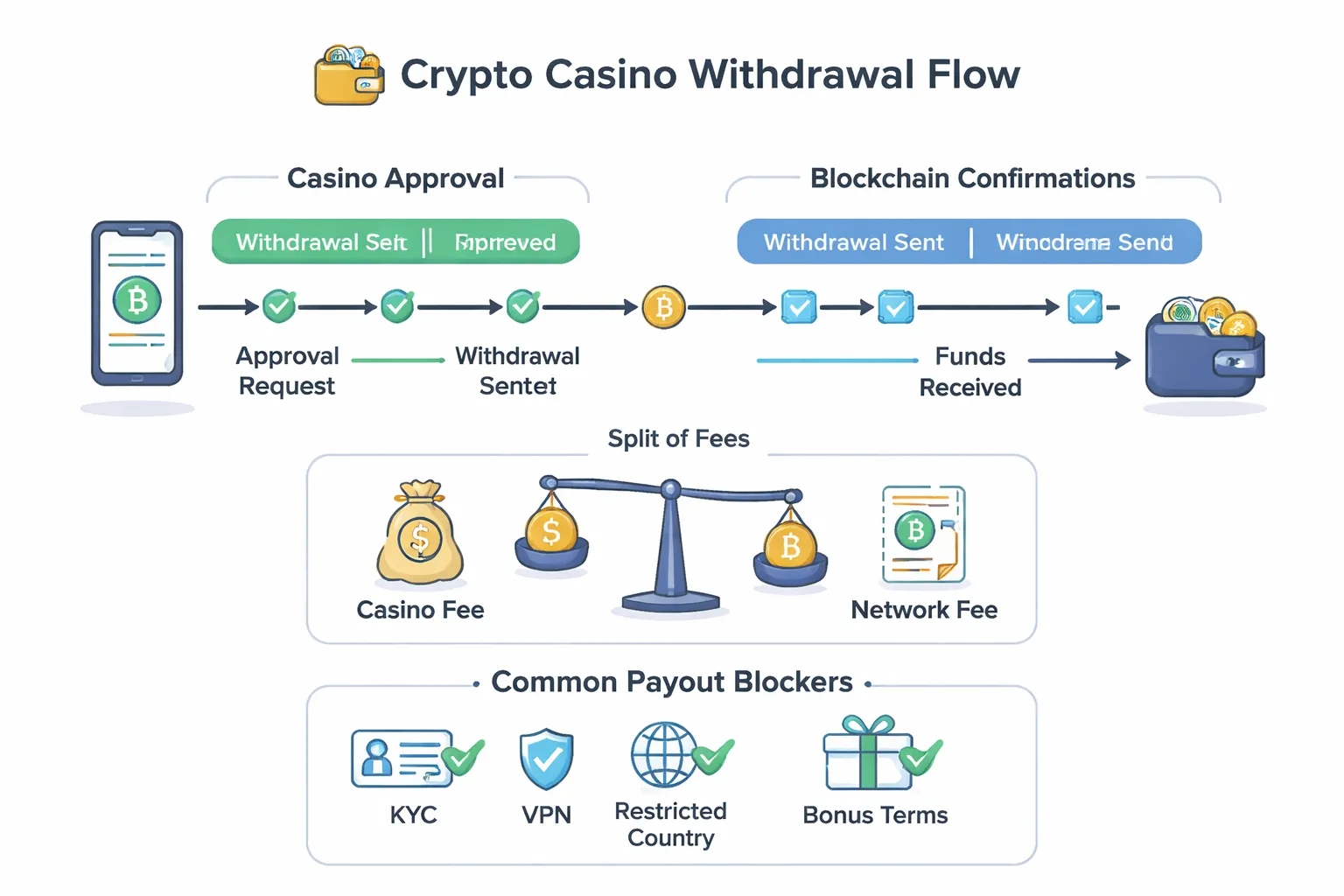
Network fees vs casino fees
Every withdrawal can include two cost layers. The network fee. The casino fee.
- Network fee: You pay miners or validators. It changes with chain congestion. It shows on the blockchain as the difference between what leaves the casino wallet and what hits your wallet.
- Casino fee: The casino deducts a fixed amount or a percentage before it sends anything. You see it on the cashier screen or in the withdrawal receipt.
- How to tell: Take the exact amount you requested, then compare it to the transaction amount on the block explorer. If the casino sends less than you requested, that is a casino fee. If the casino sends your full requested amount but you receive less later, that is usually a wallet or bridge fee, not the casino.
- What to check before you withdraw: fee schedule, minimum fee, fee caps, and which coins the casino treats as “free withdrawals.”
Withdrawal review times
Payout speed depends on two clocks. Casino approval. Network confirmation.
- Automated pipeline: Low friction. The system checks balance, wagering status, and basic risk rules, then broadcasts the transaction. These cashouts tend to run 24/7.
- Manual pipeline: Slower. A staff member reviews your account, bonus terms, and risk flags. Expect delays on first withdrawals, large amounts, or sudden changes in play.
- Where delays come from: unfinished KYC, bonus breach, multiple accounts, mismatched wallet ownership, VPN or location flags, and failed address checks.
- What you can control: finish verification early, withdraw to one wallet you own, keep your play pattern consistent, and avoid mixing deposits and withdrawals across many coins in a short window.
Cashout limits and VIP impact
Limits decide how much you can move, and how often you can move it. Read the caps before you deposit.
- Common limit types: per transaction, per day, per week, per month, and lifetime.
- Game and bonus limits: some sites cap max cashout from a bonus win, even if your balance shows more.
- VIP effects: higher caps, faster approval, and fewer withdrawals needed to move the same amount. Ask support for your tier’s exact daily and monthly limits in writing. For larger bankrolls, use a high-limit focused guide like VIP perks and high limits.
- Operational reality: a “no limits” claim often means no stated cap, not unlimited approvals. Risk teams can still throttle large cashouts.
Geo-restrictions and payment blocks
Most failed cashouts happen because your account trips a location or compliance rule.
- Restricted jurisdictions: the casino blocks play or withdrawals from certain countries and regions. Some allow deposits but stop payouts after review.
- VPN use: it can trigger fraud checks. It can also create a mismatch between your login location and your verification documents.
- Chain and asset blocks: some sites reject privacy coins, mixer-linked funds, or deposits from sanctioned addresses. Some block certain networks for a token, like USDT on specific chains.
- Wallet screening: casinos often use automated tools that flag high-risk sources. A flagged deposit can freeze withdrawals until you prove source of funds.
- What to do: confirm your country is allowed, do not change locations mid-session, and withdraw to a wallet you control with clean transaction history.
Tax implications basics
Crypto casino play can create tax events. You need records, even if the casino does not issue tax forms.
- Track deposits: date, coin, amount, and fiat value at the time. Your deposit sets a cost basis for any later sale or swap.
- Track wins and withdrawals: date, coin, amount, and fiat value when you receive it. Many jurisdictions treat gambling winnings as taxable income.
- Track sales and swaps: if you cash out to fiat or swap BTC to another coin, you may trigger capital gains or losses based on cost basis.
- Keep proof: transaction hashes, wallet addresses, casino statements, and screenshots of withdrawal confirmations.
- Do not guess: rules vary by country and state. Use your records to file correctly or to brief a tax pro.
How to Choose the Best Crypto Casino for You (Decision Framework)
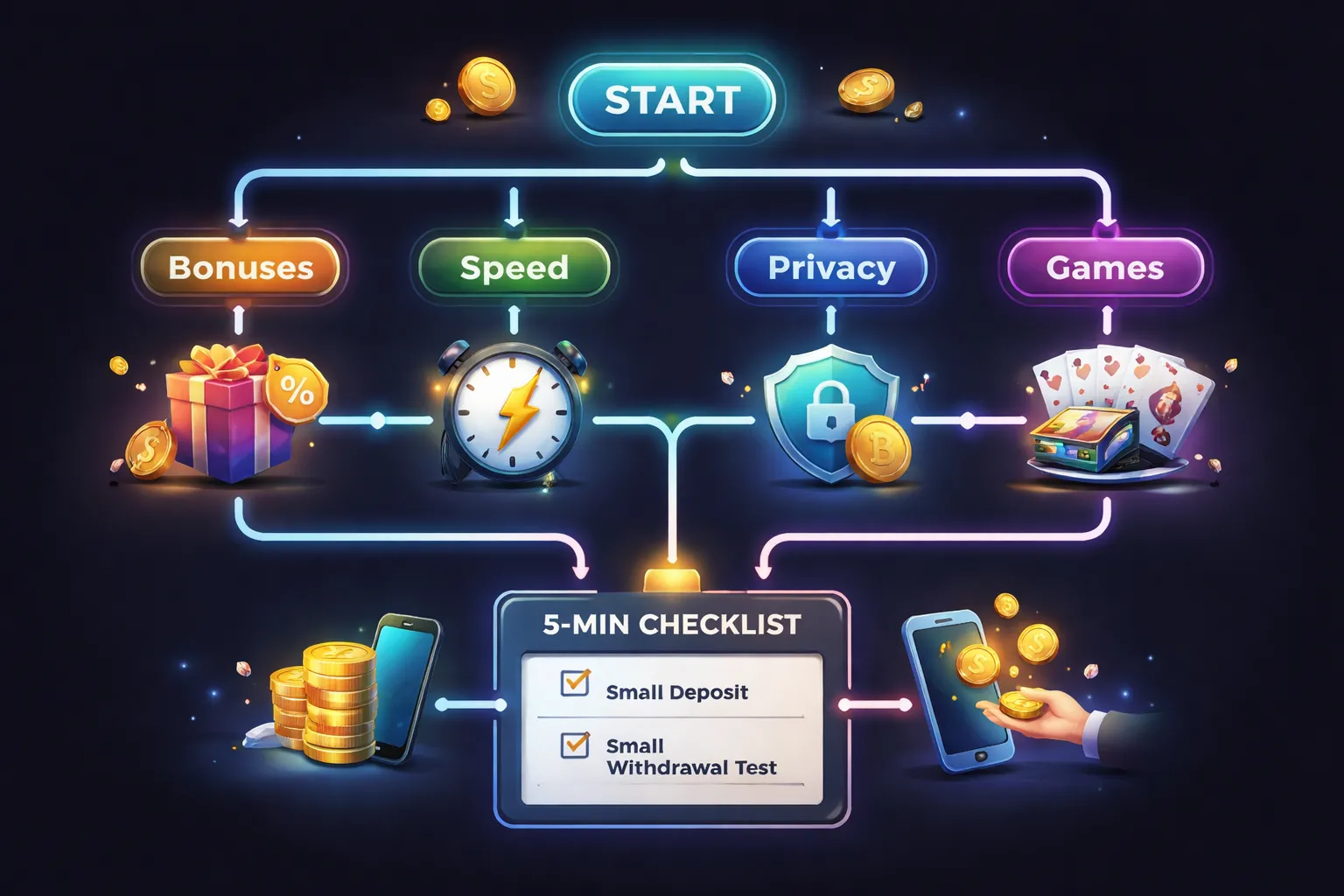
Match the Casino Type to Your Goal
Pick based on what you value most. Most problems come from choosing a site built for a different player.
- Bonuses: Check the wagering rule, game weighting, max bet limits, and time limit. If terms look complex, skip it.
- Speed: Prefer casinos with fast on-chain processing or Lightning support. Check published payout times and recent user reports.
- Privacy: Look for low or tiered KYC. Read the policy for when they ask for documents, and which triggers apply.
- Game selection: Decide if you want slots, live tables, or provably fair originals. If roulette is your main game, use this roulette casino guide to compare wheels, limits, and live tables.
A Pre-Deposit Checklist to Reduce Risk in 5 Minutes
- License and operator identity: Find the license number, legal entity, and jurisdiction. If you cannot verify them fast, move on.
- Provably fair proof: Check that the casino shows server seed, client seed, nonce, and a public hash you can verify.
- Fees and limits: Confirm minimum deposit, minimum withdrawal, and any withdrawal fee. Check max cashout per day or per request.
- Supported networks: Match coin and chain, example USDT on TRC20 vs ERC20. A wrong network can burn your funds.
- KYC and source of funds: Read what documents they can ask for, and when. If you want fewer surprises, choose sites with clear tier rules.
- Bonus terms: Confirm wagering multiple, excluded games, max withdrawal from bonus, and withdrawal rules for mixed deposits.
- Payment proof: Look for recent payouts, public incident notes, or status pages. No history, higher risk.
Testing Strategy: Small Deposit, Small Withdrawal, Then Scale
- Step 1: Deposit the minimum amount on the exact network you plan to use long term.
- Step 2: Play a small volume on low variance games. Avoid big bonus chasing during the test.
- Step 3: Request a small withdrawal fast, even if you are up only a little.
- Step 4: Time it. Note approval time, on-chain broadcast time, and final confirmation time.
- Step 5: Scale deposits only after you complete one clean withdrawal cycle.
This test shows you the real friction points, KYC triggers, and payout speed before your balance grows.
Customer Support Quality Checks
- Live chat response: Test at two times, peak and off-peak. Record first response time and whether a human joins the chat.
- Resolution quality: Ask one specific question about withdrawals, example, “What are the withdrawal limits for BTC per 24 hours, and do you charge a fee.” You want a direct answer with numbers.
- Escalation path: Confirm they can open a ticket and give you an ID. No ticketing, weak accountability.
- Proof requests: If they ask for screenshots or TX hashes, they should explain why and what happens next.
Region and Device Compatibility
- Geo rules: Check restricted countries and states. Do not rely on “it loads in my browser” as approval.
- VPN policy: Read the terms. Many casinos treat VPN use as a breach, especially for bonuses and withdrawals.
- Mobile performance: Test lobby load time, game load time, and cashier flow on your phone. Check if it supports your wallet app and two-factor login without errors.
- Payment availability by region: Some coins, networks, or fiat ramps vary by location. Confirm before you deposit.
Getting Started: Step-by-Step Guide to Playing at a Crypto Casino

Choosing a Wallet
Your wallet controls your deposits and withdrawals. Pick it before you sign up.
- Hot wallet: App or browser wallet. Fast. Higher risk if your device gets compromised.
- Cold wallet: Hardware wallet. Best for storing larger balances. Slower for frequent play.
- Custodial wallet: An exchange or app holds the keys. Easy resets. You rely on their security and withdrawal rules.
- Self-custody wallet: You hold the seed phrase. You control funds. If you lose the seed, you lose the wallet.
Use a separate wallet address for gambling activity when possible. Keep your long-term holdings in cold storage.
Buying Crypto Safely
Buy from a regulated exchange in your region when you can. Use basic risk controls.
- Enable 2FA on the exchange before you deposit fiat.
- Complete KYC early. Many exchanges freeze withdrawals until verification finishes.
- Send a test transfer first. Use a small amount to confirm the address and network.
- Do not buy crypto inside a casino cashier unless you understand the fees and spreads.
Keep records. Exchanges and casinos can ask for proof of funds and source of funds during large withdrawals.
Setting Up Account Security
Secure the casino account before you deposit.
- Turn on 2FA. Use an authenticator app, not SMS, if the casino supports it.
- Set a strong password. Use a password manager. Do not reuse passwords.
- Lock withdrawals if the casino offers it. Look for address whitelisting, withdrawal PINs, or time locks.
- Check device sessions. Log out of old devices. Avoid public Wi-Fi during cashier actions.
Making Your First Deposit and Selecting the Correct Network
Most crypto deposit errors come from using the wrong network. Match coin, chain, and address format.
- Select the coin in the cashier, then copy the deposit address or scan the QR code.
- Confirm the network the casino accepts for that coin. USDT can mean ERC-20, TRC-20, or others, each uses a different chain.
- Check minimum deposit. Deposits under the minimum can fail or credit late.
- Send a small test amount first, then send the full deposit.
- Watch for confirmations. The casino credits after a set number of blocks, which varies by chain.
Claiming a Bonus Safely
Bonuses can lock your balance until you meet the rules. Read these terms first.
- Wagering requirement: The total play you must complete before you can withdraw.
- Game contribution: Slots often count 100%. Table games can count 0% to 20%.
- Max bet rule: A common limit during wagering. Breaking it can void winnings.
- Time limit: Many offers expire in 7 to 30 days.
- Max cashout: Some bonuses cap how much you can withdraw from bonus play.
- Eligible coins: Some bonuses apply only to specific coins or networks.
If you want clean withdrawals, consider skipping the bonus and playing with a cash balance.
Withdrawing Winnings
Plan your withdrawal before you start playing. It reduces delays later.
- Confirm withdrawal limits, fees, and processing windows in the cashier.
- Use the same network your wallet supports. A wrong chain can mean lost funds.
- Expect confirmations on-chain after approval. Chain speed and fee level affect final arrival time.
- Watch for documentation triggers: large withdrawals, sudden deposit pattern changes, bonus abuse flags, or mismatched account details can prompt KYC and source-of-funds checks.
- Withdraw to your wallet first, then move funds to an exchange if you want to cash out to fiat.
If fast cashouts matter most, use a site known for short approval times and clear limits. See our guide to fast payout online casinos.
Pros and Cons of Crypto Casinos (Realistic Trade-Offs)
Advantages: speed, access, and transparency
- Faster withdrawals in many cases. Many crypto casinos pay out as soon as your withdrawal gets approved. The blockchain then settles the transfer. Your bank is not part of the chain.
- Lower friction for deposits. You can fund your balance with a wallet transfer. You avoid card declines, bank blocks, and long processing windows.
- Broader access. Crypto can work in regions where banking rails for gambling payments fail or cost too much. This does not remove the need to follow local laws.
- Transparent transactions. On-chain transfers leave a public trail. You can verify that a payout went to your address and see the timestamp and confirmations.
- Provably fair options. Some games let you verify outcomes with a client seed, server seed, and nonce. You can check the hash and confirm the result after the round.
Downsides: volatility, support quality, and regulation gaps
- Price swings hit your bankroll. Your balance can drop in fiat value even if you do not gamble. This matters most with BTC and smaller caps during volatile days.
- Fees and network congestion. BTC and ETH fees can spike. Congestion can slow confirmations. Some sites support cheaper chains, but you still carry bridge and address risks.
- Customer support varies. Some operators run lean teams. You can wait longer for manual approvals, KYC reviews, or dispute handling.
- Regulatory protection can be weaker. Licensing standards differ by jurisdiction. Some sites offer limited recourse if something goes wrong.
- KYC can still happen. Many casinos trigger checks on large withdrawals, unusual patterns, bonus abuse flags, or mismatched details. Crypto does not guarantee privacy.
- Higher user error risk. A wrong address or wrong network can mean lost funds. Some transfers are not reversible.
When a traditional casino may fit you better
- You want stable balances. Fiat avoids crypto price risk and makes bankroll planning simpler.
- You rely on chargeback rights. Card payments can offer dispute tools. Crypto transfers usually do not.
- You need clear consumer safeguards. Top regulated fiat casinos often provide stronger complaint paths and tighter standards for audits and player protection.
- You prefer familiar banking. Bank transfer and card cashouts can feel simpler if you do not want to manage wallets, networks, and confirmations.
- You want table-game depth. Some fiat-first brands offer stronger live dealer coverage and rules variety. If blackjack is your main game, use a dedicated list of top blackjack casinos.
Risk management tips for volatile bankrolls
- Pick your base currency on purpose. If you track results in USD or EUR, consider holding most of your bankroll in a stablecoin, then converting small session amounts to BTC or ETH.
- Set two limits. Use a loss limit in coins and a loss limit in your fiat reference. Volatility can break a single-limit plan.
- Size bets for drawdowns. Reduce unit size when coin price swings widen. Keep your standard bet small enough to survive variance plus market moves.
- Control exposure time. Convert only what you plan to play. After a win, move surplus back to a stable asset or withdraw to your wallet.
- Track fees as part of EV. Add deposit, swap, and withdrawal fees to your session cost. A low house edge can still lose to high network fees.
- Use clean wallet habits. Copy and paste addresses, verify the first and last characters, confirm the correct network, and test with a small transfer when you use a new chain.
| Factor | Crypto casino | Traditional casino |
|---|---|---|
| Withdrawals | Often fast after approval, depends on operator and network | Often slower, depends on bank, card, and processor |
| Banking access | Works without cards or banks, you need a wallet | Simple if your bank supports gambling payments |
| Value stability | Can swing with market price | Stable in fiat |
| Transparency tools | On-chain transfers, some provably fair games | RNG auditing varies by regulator and lab |
| Dispute leverage | Limited, transfers are usually final | More options with regulated banking rails |
Common Mistakes to Avoid When Using Crypto at Online Casinos
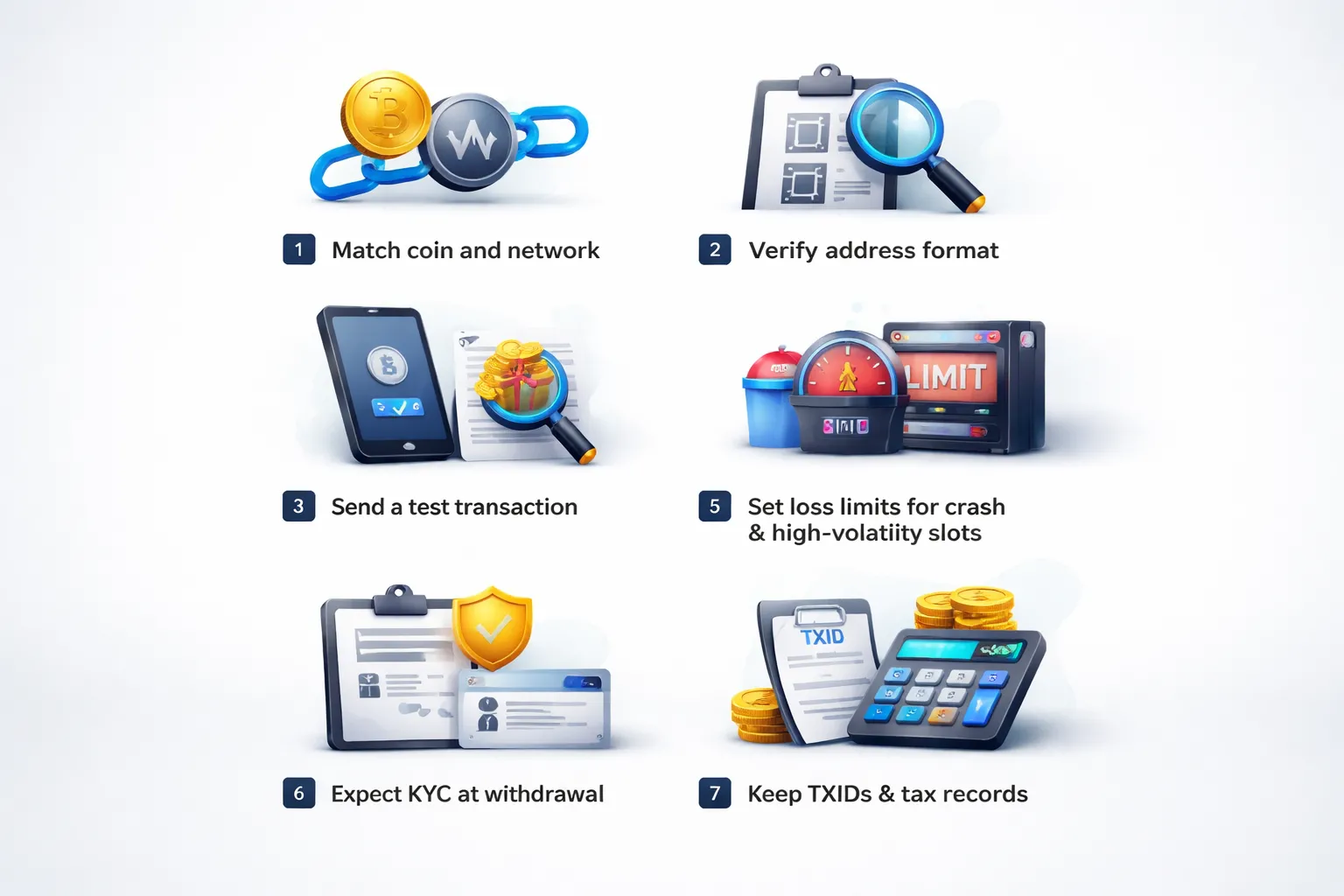
Sending funds on the wrong chain or to the wrong address
Most crypto casino deposit mistakes happen before you play. You send the right coin to the wrong network, or you paste the wrong address. You usually cannot reverse it.
- Match the network. USDT on ERC-20, TRC-20, and Polygon are different rails. Pick the exact one the casino lists on the deposit page.
- Match the asset. BTC goes to a BTC address. Do not send ETH or USDT to a BTC address.
- Check address format. BTC often starts with 1, 3, or bc1. ETH addresses start with 0x. If the format looks wrong, stop.
- Watch for memo or tag fields. Some coins and exchanges require a memo. If the casino shows one, you must include it.
- Send a test transaction. Move a small amount first, then send the full deposit after it lands.
- Confirm before you leave the page. Some casinos generate a unique address per session. Do not reuse old addresses unless the casino says you can.
Ignoring wagering terms and getting capped at cashout
Bonuses can block withdrawals, limit max cashout, or restrict games. If you miss one line, you can win and still get paid less.
- Check max cashout. Some promos cap withdrawals at a fixed amount or a multiple of the bonus.
- Check wagering and time limits. A 40x requirement with a 7-day timer can force rushed play and higher risk.
- Check game contribution. Slots might count 100%. Table games might count 0% to 20%.
- Check max bet rules. Many casinos void bonus winnings if you exceed a bet size during wagering.
- Know the withdrawal rule. Some casinos require one deposit confirmation, minimum play, or a verified account before cashout.
Chasing losses on high-variance games (crash and high-volatility slots)
Crash games and high-volatility slots create long losing stretches. If you raise stakes to get even, you can drain your balance fast.
- Set a hard loss limit. Pick a number before you deposit. Stop when you hit it.
- Cap your session stake. Keep bet size small relative to your bankroll. Large jumps turn variance into a blow-up.
- Avoid martingale-style doubling. A short cold streak can exceed table limits or your balance.
- Use profit targets. If you hit it, withdraw part of it. Do not recycle all winnings into higher stakes.
- Pick lower variance when you need stability. If you plan to clear wagering, steady games can reduce bankroll swings.
Assuming anonymity equals zero checks (why KYC can still happen)
Crypto does not guarantee no identity checks. Casinos can still ask for KYC, especially at withdrawal, high amounts, or flagged activity.
- Expect KYC at cashout. Many sites allow deposits first, then request documents when you withdraw.
- Know what triggers checks. Large withdrawals, multiple accounts, bonus abuse patterns, or unusual betting can trigger review.
- Understand source of funds questions. Some casinos ask where the crypto came from. Exchange statements can help.
- Plan for timing. Verification can take days. Do not assume instant withdrawals when you need money fast.
- Pick sites with clear policies. Read the verification and withdrawal rules before you deposit. Use this guide on how to choose a safe online casino to spot red flags.
Not keeping records for taxes and dispute resolution
Crypto gambling creates a paper trail. You need it for taxes, wallet tracking, and support tickets.
- Save transaction IDs. Keep the TXID for every deposit and withdrawal.
- Record timestamps and amounts in fiat value. Price moves can change your taxable result between deposit and withdrawal.
- Keep screenshots of key pages. Bonus terms, max cashout rules, and withdrawal confirmations matter during disputes.
- Log your addresses. Note which wallet or exchange you used for each transaction.
- Store support chat and email threads. If a payout stalls, you need a timeline and proof.
| Mistake | What it can cost you | Fast fix |
|---|---|---|
| Wrong chain or address | Permanent loss of funds | Match coin and network, send a small test first |
| Missing wagering and max cashout rules | Reduced or voided winnings | Read bonus terms, track max bet, check game contribution |
| Chasing losses on high-variance games | Rapid bankroll depletion | Set loss limits, keep stakes stable, avoid doubling systems |
| Assuming no KYC | Withdrawal delays or account review | Verify early, keep documents and source-of-funds proof ready |
| No records | Tax errors and weak dispute position | Save TXIDs, fiat values, screenshots, and support logs |
Frequently Asked Questions
What makes a crypto casino “best”?
Pick casinos with a real license, strong game providers, clear bonus terms, and fast withdrawals. Check supported coins and network fees. Read the withdrawal rules before you deposit. Use this guide on how to choose a safe online casino to verify trust signals.
Are Bitcoin casinos legal?
Legality depends on your country and state. The casino’s license does not override local law. You must check your local rules before you play. If gambling is restricted, you risk account closure and frozen withdrawals.
Do crypto casinos require KYC?
Many do. Even “no KYC” sites can trigger checks at withdrawal, high volume, or fraud flags. Verify early. Keep ID, address proof, and source-of-funds records ready to avoid delays.
What does “provably fair” mean?
It means you can verify results with cryptographic seeds. You compare server seed hash, your client seed, and nonce to confirm the outcome. It proves the casino did not change the result after you placed the bet.
Are crypto casino deposits instant?
Often. Speed depends on the coin, network congestion, and required confirmations. Lightning can be near instant for BTC. On-chain BTC and ETH can take longer. The casino may also run internal risk checks before crediting funds.
How fast are withdrawals at crypto casinos?
Crypto can settle fast, but withdrawals depend on casino processing time, KYC status, and withdrawal limits. Some pay in minutes, others take 24 to 72 hours. Always check minimums, fees, and payout schedules in the cashier.
What fees will you pay?
You may pay network fees and, sometimes, casino withdrawal fees. Fees vary by chain and wallet settings. ETH can spike during congestion. Stablecoins on low-fee networks can cost less. Check the fee line before you confirm a withdrawal.
Which cryptocurrencies are best for casino play?
BTC works everywhere but can be slower on-chain. LTC and some stablecoin networks often cost less. Choose coins the casino supports with clear deposit networks. Use the exact network shown in the cashier to avoid lost funds.
Can you stay anonymous with a crypto casino?
Crypto is not anonymous by default. Blockchains are traceable. Casinos log device and account data. KYC can also apply. If you want privacy, use a fresh wallet, avoid mixing funds, and keep clean transaction records for disputes and taxes.
How do bonuses work at Bitcoin casinos?
Most bonuses use wagering requirements. You must bet a set multiple before you can withdraw bonus funds. Game weighting, max bet rules, and time limits matter. Read the terms, then decide if the bonus fits your bankroll and game choice.
How do you avoid common bankroll mistakes?
Set a loss limit and stop when you hit it. Keep stakes stable. Avoid chasing losses on high-variance games. Track deposits and withdrawals with TXIDs and fiat values. Good records protect you in disputes and tax reporting.
What should you do if a casino delays your payout?
Check KYC status and withdrawal limits first. Confirm the correct network and address. Save screenshots, TXIDs, and chat logs. Ask support for a timeline and reason. If needed, escalate through the casino’s complaints process and its licensing body.
Do you pay tax on crypto casino winnings?
Often yes. Rules vary by jurisdiction. You may owe tax on winnings, and on crypto gains when you convert to fiat. Save TXIDs, timestamps, and fiat values at deposit and withdrawal. Use consistent records to reduce audit risk.
Conclusion
Conclusion
Pick a crypto casino the same way you would pick an exchange, check the license, test the payouts, and verify the fairness.
- Confirm licensing and ownership. Find the license number, match it to the regulator site, and read the T&Cs on bonuses, withdrawals, and game exclusions.
- Choose provably fair where it matters. Use games with a public verification flow. Save your server seed hash, set your client seed, and keep the bet ID so you can audit results later.
- Control fees and speed. Check supported networks before you deposit. Use Lightning or low-fee chains when available. Avoid sending on the wrong network.
- Test the cashier before you scale. Make a small deposit and a small withdrawal first. Time it. Save TXIDs and screenshots of limits and status logs.
- Track taxes from day one. Record timestamps and fiat values at deposit and withdrawal. Keep a clean trail for wins and conversions.
Final tip, run a “$20 audit” before you chase bonuses. If the site fails on verification, limits, or payout speed, move on.
If you plan to play high limits, use a casino with clear VIP terms and cashout capacity, see our guide to high roller VIP casinos.
-
Best Online Casinos for Blackjack: Best Tables, Rules & Bonuses
4 weeks ago -
Fast Payout Online Casinos: Best Sites for Quick Withdrawals
3 weeks ago -
Best Online Casinos for Roulette: Best Wheels, Limits & Live Options
4 weeks ago -
Best PayPal Online Casinos: Top Sites That Accept PayPal Deposits & Withdrawals
4 weeks ago -
Best Online Casinos for High Rollers: VIP Perks, High Limits & Exclusive Bonuses
3 weeks ago
-
- How we rank and test crypto casinos (criteria + scoring)
- Quick comparison table (2026)
- Best overall crypto casino (editor’s choice)
- Best for fast withdrawals
- Best for no or low KYC
- Best for provably fair games
- Best for bonuses and free spins
- Best for live casino
- Best for sports betting with crypto
- Best for mobile players
-
- Bitcoin (BTC), security, fees, and typical processing times
- Lightning Network (BTC-LN), when it is worth using
- Ethereum (ETH) and L2s, gas costs and practicality
- Stablecoins (USDT, USDC), volatility control and bankroll management
- Altcoins (LTC, DOGE, XRP, BCH), pros, cons, and trends
- Network selection mistakes to avoid
- Minimum deposits, minimum withdrawals, and hidden fee patterns
-
- Crypto-native originals: crash, dice, mines
- Slots: RTP ranges, volatility, and feature-buy traps
- Live dealer: limits, speed, and staking requirements
- Table games: blackjack rules that change your odds
- Sportsbook + casino hybrids: cross-promos and pitfalls
- Game providers that signal quality (and why provider mix matters)
-
- Welcome bonuses, match percent, free spins, and what counts as real value
- Wagering requirements, explained with a worked example
- Max bet rules, excluded games, and why live casino often gets restricted
- No-deposit bonuses, verification triggers, and realistic expectations
- Reloads, cashback, rakeback, and tournaments, what fits your play style
- VIP tiers, comp points, withdrawal limits, and host perks to validate
-
- What makes a crypto casino “best”?
- Are Bitcoin casinos legal?
- Do crypto casinos require KYC?
- What does “provably fair” mean?
- Are crypto casino deposits instant?
- How fast are withdrawals at crypto casinos?
- What fees will you pay?
- Which cryptocurrencies are best for casino play?
- Can you stay anonymous with a crypto casino?
- How do bonuses work at Bitcoin casinos?
- How do you avoid common bankroll mistakes?
- What should you do if a casino delays your payout?
- Do you pay tax on crypto casino winnings?
-
- How we rank and test crypto casinos (criteria + scoring)
- Quick comparison table (2026)
- Best overall crypto casino (editor’s choice)
- Best for fast withdrawals
- Best for no or low KYC
- Best for provably fair games
- Best for bonuses and free spins
- Best for live casino
- Best for sports betting with crypto
- Best for mobile players
-
- Bitcoin (BTC), security, fees, and typical processing times
- Lightning Network (BTC-LN), when it is worth using
- Ethereum (ETH) and L2s, gas costs and practicality
- Stablecoins (USDT, USDC), volatility control and bankroll management
- Altcoins (LTC, DOGE, XRP, BCH), pros, cons, and trends
- Network selection mistakes to avoid
- Minimum deposits, minimum withdrawals, and hidden fee patterns
-
- Crypto-native originals: crash, dice, mines
- Slots: RTP ranges, volatility, and feature-buy traps
- Live dealer: limits, speed, and staking requirements
- Table games: blackjack rules that change your odds
- Sportsbook + casino hybrids: cross-promos and pitfalls
- Game providers that signal quality (and why provider mix matters)
-
- Welcome bonuses, match percent, free spins, and what counts as real value
- Wagering requirements, explained with a worked example
- Max bet rules, excluded games, and why live casino often gets restricted
- No-deposit bonuses, verification triggers, and realistic expectations
- Reloads, cashback, rakeback, and tournaments, what fits your play style
- VIP tiers, comp points, withdrawal limits, and host perks to validate
-
- What makes a crypto casino “best”?
- Are Bitcoin casinos legal?
- Do crypto casinos require KYC?
- What does “provably fair” mean?
- Are crypto casino deposits instant?
- How fast are withdrawals at crypto casinos?
- What fees will you pay?
- Which cryptocurrencies are best for casino play?
- Can you stay anonymous with a crypto casino?
- How do bonuses work at Bitcoin casinos?
- How do you avoid common bankroll mistakes?
- What should you do if a casino delays your payout?
- Do you pay tax on crypto casino winnings?
-
Online Casino Licensing Explained: Authorities, Licenses & How to Check One
3 weeks ago -
Best Live Dealer Casinos: Where to Play Live Blackjack, Roulette & More
3 weeks ago -
Best Online Casinos for High Rollers: VIP Perks, High Limits & Exclusive Bonuses
3 weeks ago -
Fast Payout Online Casinos: Best Sites for Quick Withdrawals
3 weeks ago -
What Is an Online Casino? How They Work, Games, Bonuses & Safety
4 weeks ago
-
Best Online Casinos for Blackjack: Best Tables, Rules & Bonuses
4 weeks ago -
Online Casino Bonuses Explained: How They Work + Terms You Must Know
4 weeks ago -
Fast Payout Online Casinos: Best Sites for Quick Withdrawals
3 weeks ago -
Online Casino Licensing Explained: Authorities, Licenses & How to Check One
3 weeks ago -
Best Online Casinos for Roulette: Best Wheels, Limits & Live Options
4 weeks ago